aads

Earliest sunrises come before the summer solstice


The year’s earliest sunrises don’t happen on the summer solstice. For much of the Northern Hemisphere, they’re happening now. In the Southern Hemisphere, it’s the earliest sunsets that come before the winter solstice in June. The yearly cycle of sunrise and sunset times is easy to miss. But once you start noticing this cycle, it reveals the deeper rhythm of Earth’s journey around the sun … and your place in it.

When to look: The exact dates of the earliest sunrises vary with latitude. For example, for the Northern Hemisphere, the earliest sunrises can come as early as late May. For the southern U.S., the earliest sunrises begin in early June and stretch for weeks. At more northerly latitude, they happen closer to the summer solstice.
Southern Hemisphere? Your earliest sunsets happen before your summer solstice, too, in December. And right now, before your winter solstice, you’re having your earliest sunsets.
When is June solstice? The June solstice – summer solstice for the Northern Hemisphere, winter solstice for the Southern Hemisphere – will fall at 8:25 UTC (3:25 a.m. CDT) on June 21. Read: All you need to know about the June solstice.
For the Northern Hemisphere: Have you noticed how early your sunrises are? The dawn light is beautiful. Check a sunrise/sunset calendar for June. It’s likely your earliest sunrises are happening now, have just happened, or will happen in the coming week or so.
For the Southern Hemisphere: If you relish the daylight, as many do, you’ll be glad to know your sunsets will soon be shifting later! They’ll start shifting before your winter solstice – and shortest day – at the June solstice.
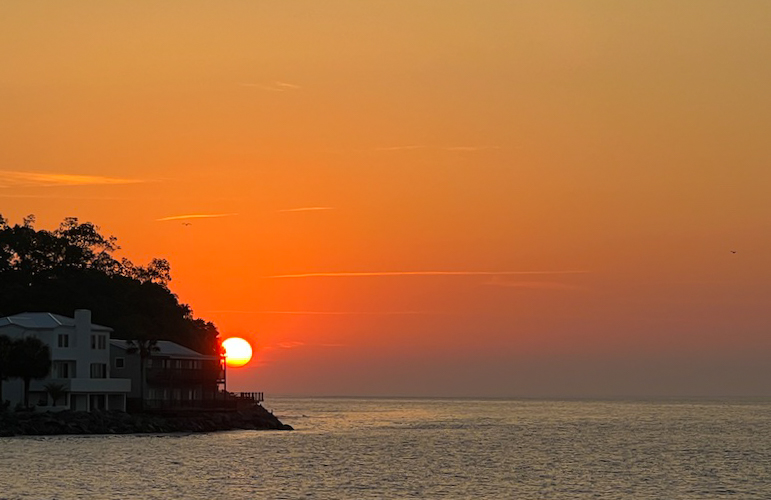
Low white sun in orange sunrise sky over the ocean, with houses on a wooded point to left.
The sun rising over the Atlantic Ocean from St. Simons Island, Georgia. Image via Marcy Curran.

Earliest sunrises vary with latitude

The exact dates of your earliest sunrises (and earliest sunsets) vary with latitude.

  • At the latitude of Mexico City (about 20 degrees N. latitude) the earliest sunrises are in early June.
  • At the latitude of New Orleans, Cairo in Egypt and Chengdu in China (about 30 degrees N.), the earliest sunrises shift later, to around June 10.
  • At the latitude of Philadelphia, Madrid in Spain or northern Japan (about 40 degrees N.) the earliest sunrises of the year happen on and near June 14.
  • And the farther north you go, the closer your earliest sunrises come to the June solstice. By the time you get up to Seattle or Vancouver, they happen only a few days before the solstice.

If you keep going north, you eventually reach a geographic boundary where the concept of “earliest sunrise before the summer solstice” completely breaks down. That is, you reach the Arctic Circle (66.5 degrees N), above which the sun doesn’t rise or set in the weeks or months around the solstice. The concepts of daily “sunrise” and “sunset” disappear entirely, and you get one prolonged period of continuous daylight.

Composite of 11 photos with sun just above a low mountain showing positions of the sun at dawn on 11 dates.
Rupesh Sangoi in Mumbai, India, captured separate images of the sunrise, showing the sun’s movement along the horizon, between the June and December solstices and on the equinoxes. Rupesh wrote: “Did this for over a year, at sunrise.” Glorious composite, Rupesh! Thank you.

Science news, night sky events and beautiful photos, all in one place. Click here to subscribe to our free daily newsletter.

Why aren’t the earliest sunrises on the solstice?

To understand why the earliest sunrises aren’t on the day of the solstice, you have to think about clocks and the spinning Earth.

Earth’s spin gives us the length of the day. One spin of the Earth = one day. And we humans have made clocks to measure that day length.

But clocks click along regularly … and Earth’s spin isn’t as regular. If you were to measure the time it takes for the Earth to rotate once relative to the sun – spanning from one local solar noon (when the sun reaches its highest point in your sky) to the next – you’d find the time from one solar noon to another is rarely exactly 24 hours.

Why isn’t it? Two main reasons: the tilt of Earth’s axis and the shape of Earth’s orbit. It’s the continual overlapping of these two cycles that gives us the earliest sunrises before the summer solstice.

Look at it this way. In June, the day (as measured by successive returns of the midday sun) is nearly 1/4 minute longer than 24 hours. So the midday sun (solar noon) comes later by the clock on the June solstice than it does one week before. And that means the sunrise and sunset times also come later by the clock.

Want a deeper explanation? Look up the Equation of Time.

The table below might help you get a sense of it.
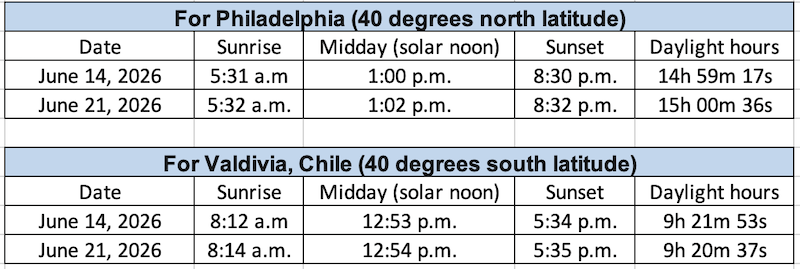
Table showing dates and times for sunsets and sunrises in Philadelphia and Valdivia, Chile on June 14 and 21.
Chart data via Timeanddate.com.

Why before the summer solstice, not after?

The primary reason for the earliest sunrise preceding the summer solstice is the inclination of the Earth’s rotational axis. For example, the earliest sunrise would take place before the solstice even if the Earth went around the sun in a circular orbit.

But the Earth’s elliptical orbit does make the phenomenon more extreme. At the June solstice, Earth in its orbit is rather close to our early July aphelion, our farthest point from the sun. We’re moving slowest in orbit. And this lessens the effect.

On the other hand, at the December solstice, Earth is rather close to our early January perihelion, our closest point to the sun. At that time, we’re moving fastest in orbit, and that accentuates the effect.

So there are little effects related to Earth’s orbit. But the sequence is always the same. Earliest sunrise, summer solstice, latest sunset in summer. Earliest sunset, winter solstice, latest sunrise in winter.

That’s true for you whether you’re in Earth’s Northern or Southern Hemisphere.

And it’s true whether your winter or summer happens when Earth is closest to the sun, or farthest from the sun.
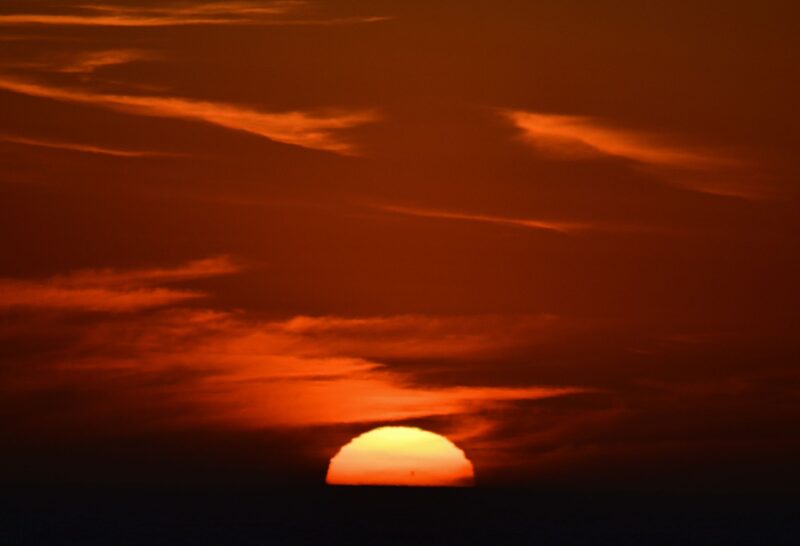
Half sun in an orange sky. The sun looks orangish near the bottom and yellowish at the top.
View at EarthSky Community Photos. | Our friend Cecille Kennedy in Oregon took this photo of the setting sun on June 1, 2026. Thank you, Cecille! The Northern Hemisphere has the earliest sunrises before the June solstice.
Red sky at sunset, with sun peeking through treetops, and people in the foreground watching.
View at EarthSky Community Photos. | Prateek Pandey captured this sunset view in Pachmari, Madhya Pradesh, India, on January 3, 2025. Beautiful!

Bottom line: Are you an early riser? If so – and you live in the Northern Hemisphere – you might know your earliest sunrises of the year are happening now. Southern Hemisphere? Your earliest sunsets are around now.

The post Earliest sunrises come before the summer solstice first appeared on EarthSky.


from EarthSky https://ift.tt/KiReaP4


The year’s earliest sunrises don’t happen on the summer solstice. For much of the Northern Hemisphere, they’re happening now. In the Southern Hemisphere, it’s the earliest sunsets that come before the winter solstice in June. The yearly cycle of sunrise and sunset times is easy to miss. But once you start noticing this cycle, it reveals the deeper rhythm of Earth’s journey around the sun … and your place in it.

When to look: The exact dates of the earliest sunrises vary with latitude. For example, for the Northern Hemisphere, the earliest sunrises can come as early as late May. For the southern U.S., the earliest sunrises begin in early June and stretch for weeks. At more northerly latitude, they happen closer to the summer solstice.
Southern Hemisphere? Your earliest sunsets happen before your summer solstice, too, in December. And right now, before your winter solstice, you’re having your earliest sunsets.
When is June solstice? The June solstice – summer solstice for the Northern Hemisphere, winter solstice for the Southern Hemisphere – will fall at 8:25 UTC (3:25 a.m. CDT) on June 21. Read: All you need to know about the June solstice.
For the Northern Hemisphere: Have you noticed how early your sunrises are? The dawn light is beautiful. Check a sunrise/sunset calendar for June. It’s likely your earliest sunrises are happening now, have just happened, or will happen in the coming week or so.
For the Southern Hemisphere: If you relish the daylight, as many do, you’ll be glad to know your sunsets will soon be shifting later! They’ll start shifting before your winter solstice – and shortest day – at the June solstice.

Low white sun in orange sunrise sky over the ocean, with houses on a wooded point to left.
The sun rising over the Atlantic Ocean from St. Simons Island, Georgia. Image via Marcy Curran.

Earliest sunrises vary with latitude

The exact dates of your earliest sunrises (and earliest sunsets) vary with latitude.

  • At the latitude of Mexico City (about 20 degrees N. latitude) the earliest sunrises are in early June.
  • At the latitude of New Orleans, Cairo in Egypt and Chengdu in China (about 30 degrees N.), the earliest sunrises shift later, to around June 10.
  • At the latitude of Philadelphia, Madrid in Spain or northern Japan (about 40 degrees N.) the earliest sunrises of the year happen on and near June 14.
  • And the farther north you go, the closer your earliest sunrises come to the June solstice. By the time you get up to Seattle or Vancouver, they happen only a few days before the solstice.

If you keep going north, you eventually reach a geographic boundary where the concept of “earliest sunrise before the summer solstice” completely breaks down. That is, you reach the Arctic Circle (66.5 degrees N), above which the sun doesn’t rise or set in the weeks or months around the solstice. The concepts of daily “sunrise” and “sunset” disappear entirely, and you get one prolonged period of continuous daylight.

Composite of 11 photos with sun just above a low mountain showing positions of the sun at dawn on 11 dates.
Rupesh Sangoi in Mumbai, India, captured separate images of the sunrise, showing the sun’s movement along the horizon, between the June and December solstices and on the equinoxes. Rupesh wrote: “Did this for over a year, at sunrise.” Glorious composite, Rupesh! Thank you.

Science news, night sky events and beautiful photos, all in one place. Click here to subscribe to our free daily newsletter.

Why aren’t the earliest sunrises on the solstice?

To understand why the earliest sunrises aren’t on the day of the solstice, you have to think about clocks and the spinning Earth.

Earth’s spin gives us the length of the day. One spin of the Earth = one day. And we humans have made clocks to measure that day length.

But clocks click along regularly … and Earth’s spin isn’t as regular. If you were to measure the time it takes for the Earth to rotate once relative to the sun – spanning from one local solar noon (when the sun reaches its highest point in your sky) to the next – you’d find the time from one solar noon to another is rarely exactly 24 hours.

Why isn’t it? Two main reasons: the tilt of Earth’s axis and the shape of Earth’s orbit. It’s the continual overlapping of these two cycles that gives us the earliest sunrises before the summer solstice.

Look at it this way. In June, the day (as measured by successive returns of the midday sun) is nearly 1/4 minute longer than 24 hours. So the midday sun (solar noon) comes later by the clock on the June solstice than it does one week before. And that means the sunrise and sunset times also come later by the clock.

Want a deeper explanation? Look up the Equation of Time.

The table below might help you get a sense of it.

Table showing dates and times for sunsets and sunrises in Philadelphia and Valdivia, Chile on June 14 and 21.
Chart data via Timeanddate.com.

Why before the summer solstice, not after?

The primary reason for the earliest sunrise preceding the summer solstice is the inclination of the Earth’s rotational axis. For example, the earliest sunrise would take place before the solstice even if the Earth went around the sun in a circular orbit.

But the Earth’s elliptical orbit does make the phenomenon more extreme. At the June solstice, Earth in its orbit is rather close to our early July aphelion, our farthest point from the sun. We’re moving slowest in orbit. And this lessens the effect.

On the other hand, at the December solstice, Earth is rather close to our early January perihelion, our closest point to the sun. At that time, we’re moving fastest in orbit, and that accentuates the effect.

So there are little effects related to Earth’s orbit. But the sequence is always the same. Earliest sunrise, summer solstice, latest sunset in summer. Earliest sunset, winter solstice, latest sunrise in winter.

That’s true for you whether you’re in Earth’s Northern or Southern Hemisphere.

And it’s true whether your winter or summer happens when Earth is closest to the sun, or farthest from the sun.

Half sun in an orange sky. The sun looks orangish near the bottom and yellowish at the top.
View at EarthSky Community Photos. | Our friend Cecille Kennedy in Oregon took this photo of the setting sun on June 1, 2026. Thank you, Cecille! The Northern Hemisphere has the earliest sunrises before the June solstice.
Red sky at sunset, with sun peeking through treetops, and people in the foreground watching.
View at EarthSky Community Photos. | Prateek Pandey captured this sunset view in Pachmari, Madhya Pradesh, India, on January 3, 2025. Beautiful!

Bottom line: Are you an early riser? If so – and you live in the Northern Hemisphere – you might know your earliest sunrises of the year are happening now. Southern Hemisphere? Your earliest sunsets are around now.

The post Earliest sunrises come before the summer solstice first appeared on EarthSky.


from EarthSky https://ift.tt/KiReaP4
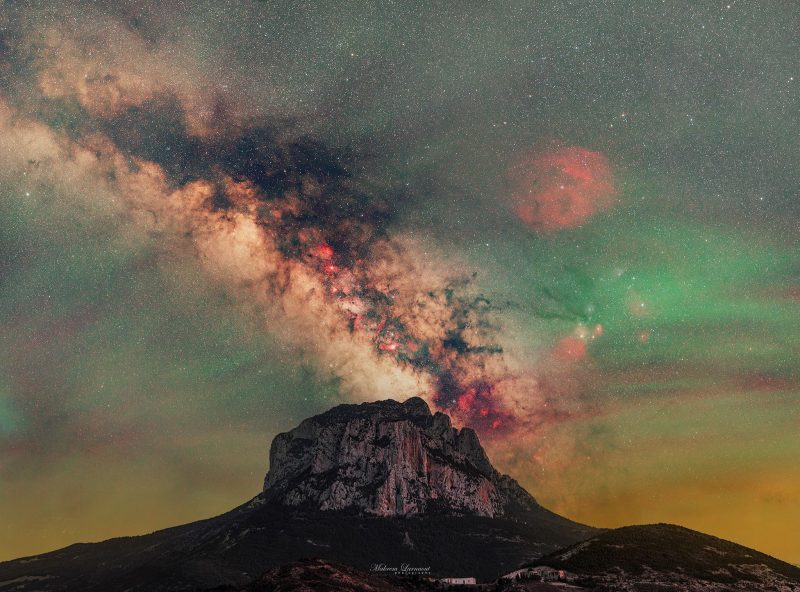
What is airglow? This glowing light is not an aurora

Airglow: A photograph showing a mountain and the Milky Way and green sky.
View at EarthSky Community Photos. | Makrem Larnaout in Morneg, Tunisia, captured this image – with airglow – on June 18, 2023. Thank you, Makrem! And what a fantastic display! Read more about this image.

You deserve a daily dose of good news. For the latest in science and the night sky, click here to subscribe to our free daily newsletter.

What is airglow?

Airglow is the light of excited atoms high in Earth’s atmosphere. And it’s usually too faint for the eye alone to see. But under very dark skies, photographers can capture it. Here’s how NASA’s Earth Observatory describes airglow:

The phenomenon typically occurs when molecules (mostly nitrogen and oxygen) are energized by ultraviolet (UV) radiation from sunlight. To release that energy, atoms in the lower atmosphere bump into each other and lose energy in the collision. But the upper atmosphere is thinner, so atoms are less likely to collide. Instead, they release their energy by emitting photons. And the result is colorful airglow.

Collisions can create airglow, too

But some collisions can also create airglow. In fact, airglow is more common during solar maximum. That’s because the solar activity heats the upper atmosphere, which causes more collisions. Specifically, it causes more collisions that result in greenish light. Spaceweather.com said:

Although airglow does not require solar activity, there is a strong link to the solar cycle. As long ago as 1935, Lord Rayleigh realized that airglow peaks during years around solar maximum. Modern studies (e.g., 2011 and 2015 have confirmed the effect. And airglow is up to 40% brighter when the sun is most active.

Watch a video on airglow

And here’s another view of airglow from the International Space Station.

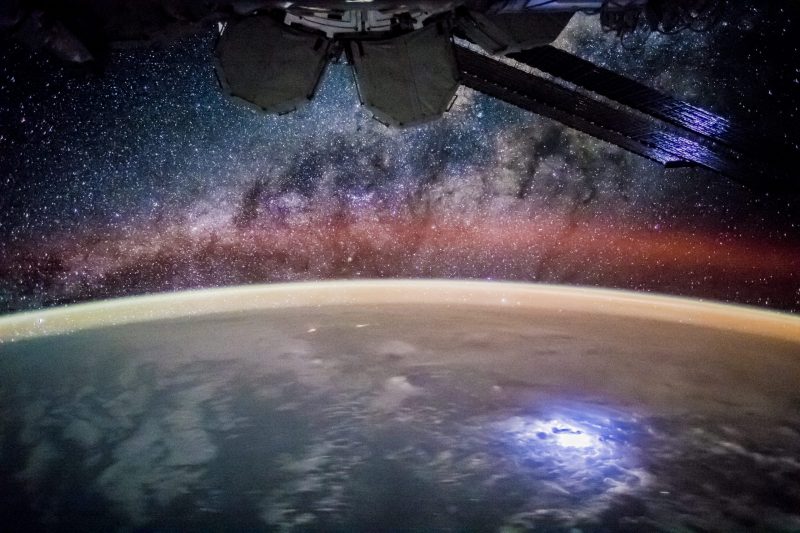
Starry night sky and curve of the horizon of Earth from space with part of the International Space Station visible.
View larger. | Here, lightning, airglow and the Milky Way galaxy lit up the night sky as astronauts passed over Kiribati in the central Pacific. Read more about this image. Image via NASA Earth Observatory.

A photo gallery from our readers

If you have a recent photo of airglow to share, send it to us!

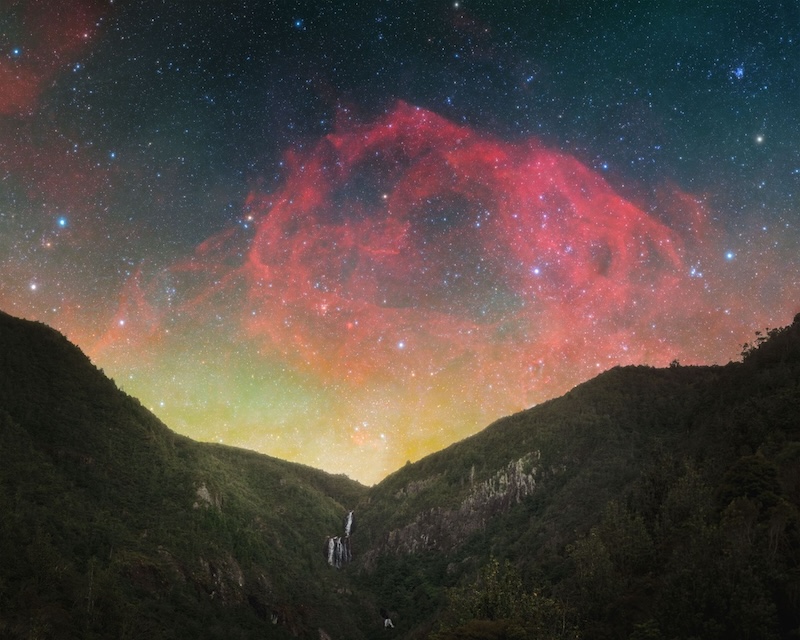
Starry night sky showing large reddish nebula, lots of stars and a greenish airglow above the mountains.
View at EarthSky Community Photos. | Julie Machado captured this image from New Zealand on November 16, 2025. Julie wrote: “This photo shows the faint red emission of the Gum Nebula above the mountains in Coromandel, New Zealand. The nebula is extremely large and very dim, but long-exposure imaging can reveal parts of its structure. The green band near the horizon is natural airglow.
And the sky and foreground were photographed on the same night from the same spot, with the sky taken on a tracked exposure and the landscape untracked. The image reflects the scene as it appeared that night.” Thank you, Julie!
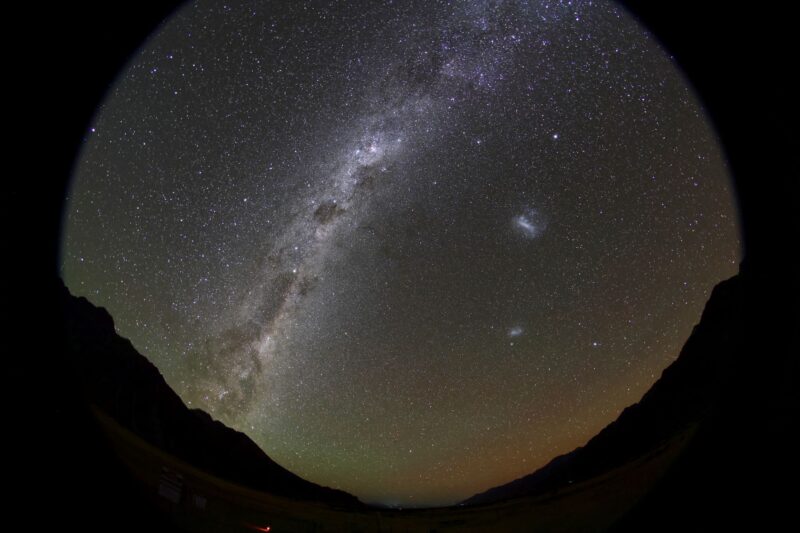
A glowing, cloudy band with dark streaks and patches, and 2 small irregular bright clouds.
View at EarthSky Community Photos. | Meiying Lee in Mount Cook National Park, New Zealand, captured the Milky Way on March 19, 2026. Meiying wrote: “The southern Milky Way rises directly from the horizon, shining with remarkable clarity. On the right side of the sky, 2 faint, cloud-like patches stand out. These are the Large and Small Magellanic Clouds, iconic features of the Southern Hemisphere. And near the horizon, subtle hues of green and red glow softly. This is airglow, quietly revealing just how pure and transparent the sky is here.” Thank you, Meiying!
Foreground rocky hills with starry sky and Milky Way with a hazy patch circled that is the Gegenschein.
View at EarthSky Community Photos. | Paolo Bardelli of Switzerland captured the sun’s counterglow – or gegenschein – on November 2, 2024, and wrote: “The elusive gegenschein phenomenon captured on a clear night from the Simplon Pass in Switzerland. The antisolar point is located in the top right image, barely visible as a very faint and diffuse nebulosity extending over 20 degrees in a sky with green and orange airglow. The image was highly contrasted to accentuate the phenomenon.” Thank you, Paolo.

Bottom line: Airglow is a light that occurs high in Earth’s atmosphere. It’s usually too dim to see with the eye, but photographers can capture glorious photographs of it.

The post What is airglow? This glowing light is not an aurora first appeared on EarthSky.


from EarthSky https://ift.tt/hRtrbni
Airglow: A photograph showing a mountain and the Milky Way and green sky.
View at EarthSky Community Photos. | Makrem Larnaout in Morneg, Tunisia, captured this image – with airglow – on June 18, 2023. Thank you, Makrem! And what a fantastic display! Read more about this image.

You deserve a daily dose of good news. For the latest in science and the night sky, click here to subscribe to our free daily newsletter.

What is airglow?

Airglow is the light of excited atoms high in Earth’s atmosphere. And it’s usually too faint for the eye alone to see. But under very dark skies, photographers can capture it. Here’s how NASA’s Earth Observatory describes airglow:

The phenomenon typically occurs when molecules (mostly nitrogen and oxygen) are energized by ultraviolet (UV) radiation from sunlight. To release that energy, atoms in the lower atmosphere bump into each other and lose energy in the collision. But the upper atmosphere is thinner, so atoms are less likely to collide. Instead, they release their energy by emitting photons. And the result is colorful airglow.

Collisions can create airglow, too

But some collisions can also create airglow. In fact, airglow is more common during solar maximum. That’s because the solar activity heats the upper atmosphere, which causes more collisions. Specifically, it causes more collisions that result in greenish light. Spaceweather.com said:

Although airglow does not require solar activity, there is a strong link to the solar cycle. As long ago as 1935, Lord Rayleigh realized that airglow peaks during years around solar maximum. Modern studies (e.g., 2011 and 2015 have confirmed the effect. And airglow is up to 40% brighter when the sun is most active.

Watch a video on airglow

And here’s another view of airglow from the International Space Station.

Starry night sky and curve of the horizon of Earth from space with part of the International Space Station visible.
View larger. | Here, lightning, airglow and the Milky Way galaxy lit up the night sky as astronauts passed over Kiribati in the central Pacific. Read more about this image. Image via NASA Earth Observatory.

A photo gallery from our readers

If you have a recent photo of airglow to share, send it to us!

Starry night sky showing large reddish nebula, lots of stars and a greenish airglow above the mountains.
View at EarthSky Community Photos. | Julie Machado captured this image from New Zealand on November 16, 2025. Julie wrote: “This photo shows the faint red emission of the Gum Nebula above the mountains in Coromandel, New Zealand. The nebula is extremely large and very dim, but long-exposure imaging can reveal parts of its structure. The green band near the horizon is natural airglow.
And the sky and foreground were photographed on the same night from the same spot, with the sky taken on a tracked exposure and the landscape untracked. The image reflects the scene as it appeared that night.” Thank you, Julie!
A glowing, cloudy band with dark streaks and patches, and 2 small irregular bright clouds.
View at EarthSky Community Photos. | Meiying Lee in Mount Cook National Park, New Zealand, captured the Milky Way on March 19, 2026. Meiying wrote: “The southern Milky Way rises directly from the horizon, shining with remarkable clarity. On the right side of the sky, 2 faint, cloud-like patches stand out. These are the Large and Small Magellanic Clouds, iconic features of the Southern Hemisphere. And near the horizon, subtle hues of green and red glow softly. This is airglow, quietly revealing just how pure and transparent the sky is here.” Thank you, Meiying!
Foreground rocky hills with starry sky and Milky Way with a hazy patch circled that is the Gegenschein.
View at EarthSky Community Photos. | Paolo Bardelli of Switzerland captured the sun’s counterglow – or gegenschein – on November 2, 2024, and wrote: “The elusive gegenschein phenomenon captured on a clear night from the Simplon Pass in Switzerland. The antisolar point is located in the top right image, barely visible as a very faint and diffuse nebulosity extending over 20 degrees in a sky with green and orange airglow. The image was highly contrasted to accentuate the phenomenon.” Thank you, Paolo.

Bottom line: Airglow is a light that occurs high in Earth’s atmosphere. It’s usually too dim to see with the eye, but photographers can capture glorious photographs of it.

The post What is airglow? This glowing light is not an aurora first appeared on EarthSky.


from EarthSky https://ift.tt/hRtrbni

Lyra the Harp contains Vega, a summer gem

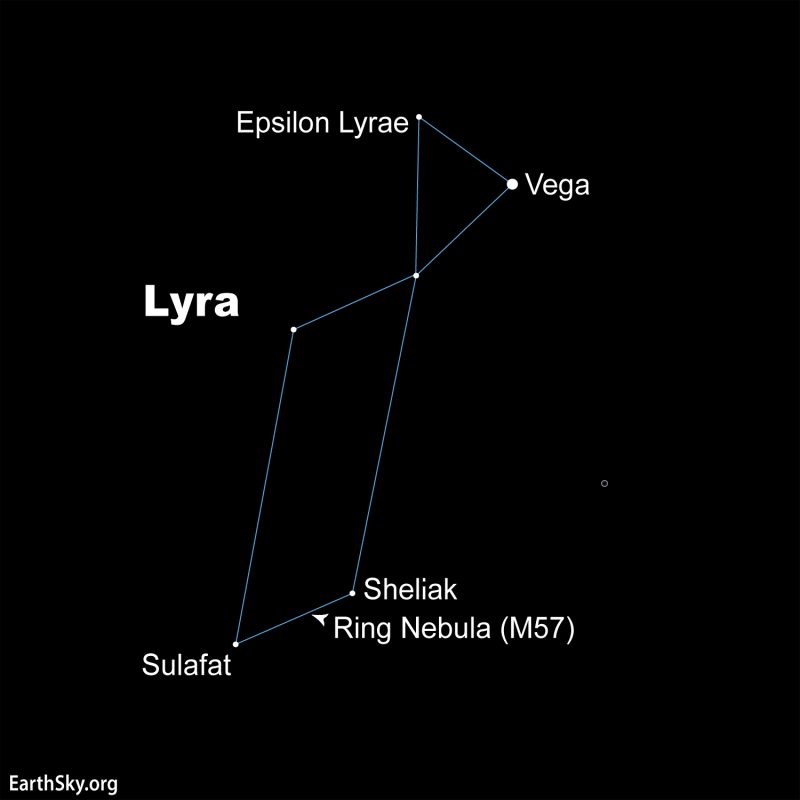
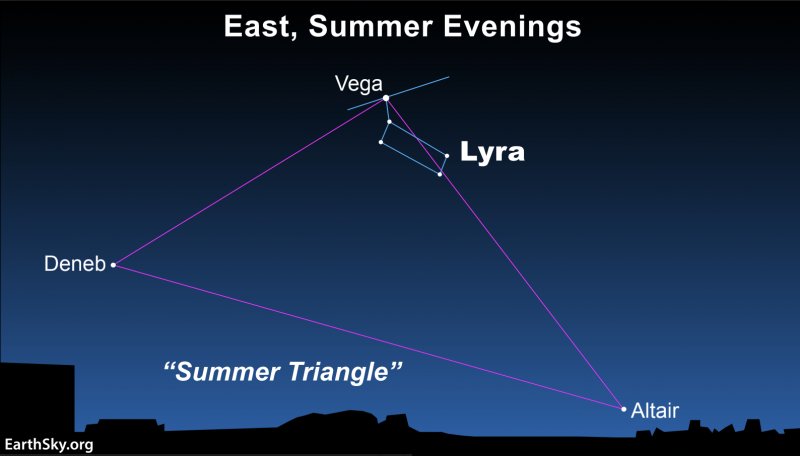
Star chart showing constellation Lyra with 4 stars and a nebula labeled.
This is the constellation Lyra the Harp. It’s made of a triangle and a parallelogram. Its brightest star is Vega. Then, look next to it for Epsilon Lyrae, the famous Double Double star.

Lyra is the 52nd smallest of the 88 constellations, but it has a big presence. That’s because its brightest star Vega is the 5th brightest star in Earth’s sky, or the 2nd brightest star belonging to just the Northern Hemisphere. Vega is best known for being the corner of the famous Summer Triangle star pattern.

Lyra is described as a harp, lyre or stringed instrument. And it’s one of the constellations that Ptolemy named back in the 2nd century.

How to find Lyra in the Northern Hemisphere

The easiest way to find Lyra is to look directly overhead on summer evenings in the Northern Hemisphere. The brightest star closest to your zenith – directly overhead – on a summer night after the sky gets dark will be Vega. It will get closer to the zenith and pass through it as the evening turns to morning.

Sky chart with large purple triangle with star Vega at top and small constellation Lyra below Vega.
Here are the 3 stars of the Summer Triangle, in the east in the evening in June and July. You can see the outline of Vega’s constellation, Lyra. Look for the Summer Triangle in the evening from around May through the end of the year.

How to find Lyra in the Southern Hemisphere

Via Daniel Gaussen, Founder & Guide – Stargaze Mackenzie – New Zealand

Although Lyra is often described as a Northern Hemisphere summer constellation, it is also visible throughout much of the Southern Hemisphere during winter.

The altitude of its brightest star, Vega, depends strongly on latitude. It reaches about 39 degrees above the northern horizon from Darwin, 24 degrees from Brisbane, 17 degrees from Sydney, 13 degrees from Melbourne, and only 8 degrees from Christchurch. For reference, a fist at arm’s length covers about 10 degrees on the sky.

One of the most noticeable differences for Southern Hemisphere observers is Lyra’s orientation. Unlike the view shown in many Northern Hemisphere star charts, Vega is the lowest of Lyra’s bright stars when the constellation reaches its highest in the sky, with the rest of the harp-shaped pattern sitting higher above it. This gives Lyra a distinctly different appearance from our perspective, with the highest star being Sulafat, about 6 degrees higher than Vega.

This also places the famous Ring Nebula or M57 (more on that later) above Vega in our sky. That makes it easier to locate, despite Lyra’s generally low altitude in southern latitudes. At these elevations, the Ring Nebula can sit high enough above the denser, murkier layers of the atmosphere that it remains a viable and rewarding telescopic target.

A hotbed of double stars

Once you find Vega, wait until your eyes are dark-adjusted so that you can make out the parallelogram dangling below it if you’re in the Northern Hemisphere, or above it if you’re in the Southern Hemisphere. Then, when you look back toward Vega, can you trace out a small triangle shape attached to the parallelogram? That star making up the small triangle, and which is not part of the parallelogram, is Epsilon Lyrae. And this star holds a secret.

Epsilon Lyrae is more famously known as the Double Double. Through binoculars, this star appears as two stars. But a telescope reveals that each of these is actually another pair of stars, making a quadruple system. And in the mid-1980s, astronomers detected a 5th star in Epsilon Lyrae! This deceptive star system lies about 160 light-years away.

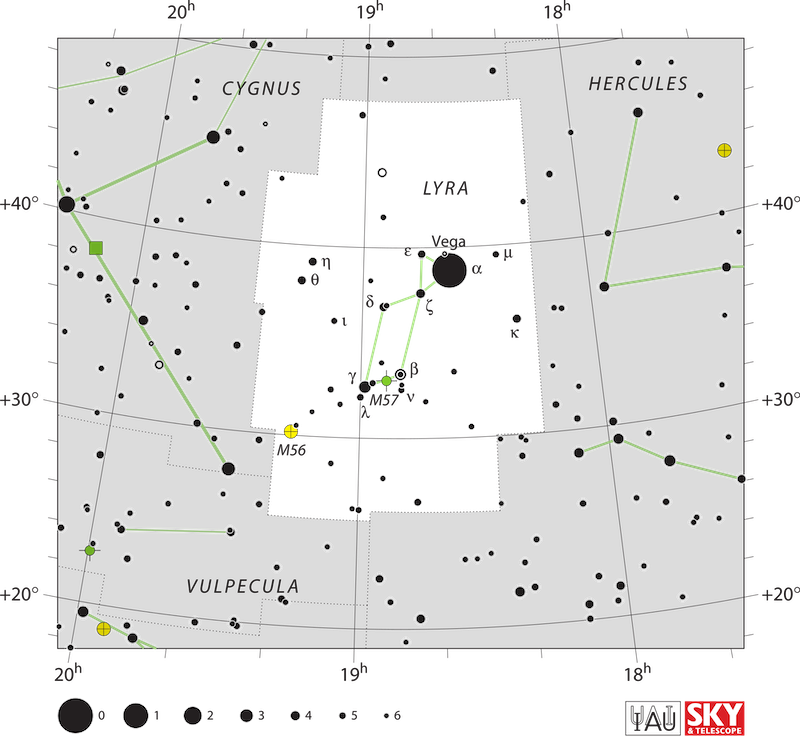
Now that we’ve met Vega (Alpha Lyrae) and Epsilon Lyrae, let’s meet the other stars in the Harp. The two stars in the parallelogram closest to Vega are the dimmer of the four stars. These two stars are both double stars. The double star directly below Vega is Zeta Lyrae. The stars in this pair have magnitudes 4.34 and 5.73. They lie just 44 arcseconds from each other and 150 light-years away from us. A telescope can easily split the pair, but a good pair of binoculars may work as well.

The next double star in the parallelogram consists of Delta 1 and 2 Lyrae. The brighter star has magnitude 4.22, and the dimmer is of magnitude 5.58. They lie 10 arcminutes from each other, so you can easily split them in binoculars. The Delta 1 and 2 stars lie 1,080 and 898 light-years away, respectively.

Two close together white dots on left and two other close together white dots on right, on black background.
This is a telescopic view of Epsilon Lyrae, the Double Double star in the constellation Lyra the Harp. To the unaided eye, this is a single star. See how a zoomed-in view splits it into 2 stars, and each of those into 2 again? Image via Nikolay Nikolov/ Wikimedia Commons.

The rest of the stars of the Harp

Next, continuing on down to the bottom of the parallelogram, we find the stars Beta Lyrae, or Sheliak, and Sulafat, or Gamma Lyrae. Sulafat is the star farthest from Vega. It shines at magnitude 3.25 at a distance of 635 light-years. Sheliak is the last star in the parallelogram and – surprise! – it is also a double star. The main star has a magnitude of 3.52 and its companion is of magnitude 7.14. You can split this eclipsing binary in large telescopes.

A star map with stars in black on white showing the locations of stars in Lyra.
The stars of Lyra. Vega is represented by the large black circle, indicating its brightness relative to other stars. Image via IAU/ Sky & Telescope/ Wikimedia Commons.

Deep-sky objects in Lyra

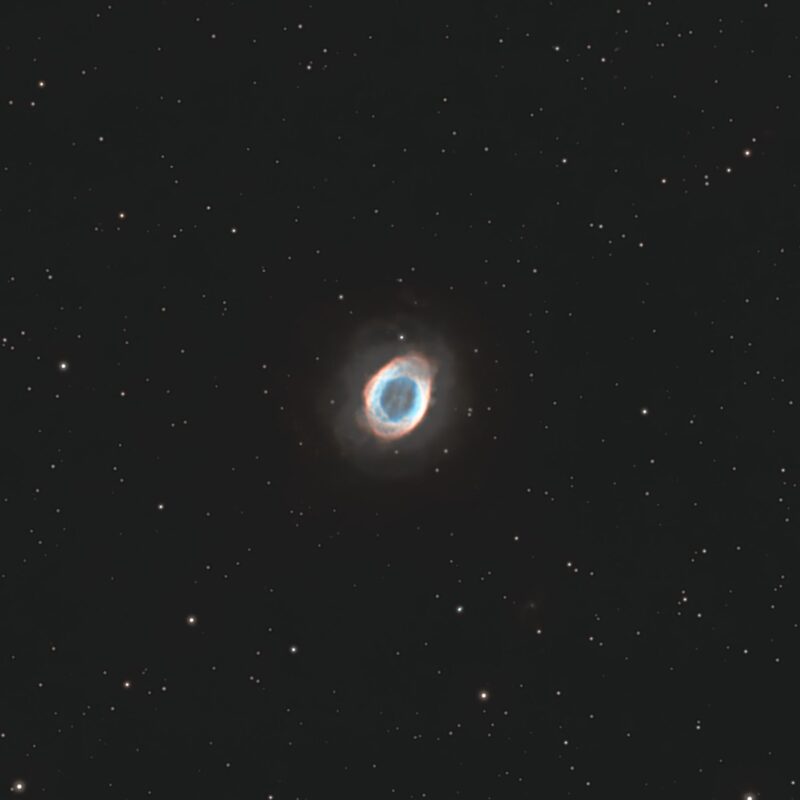
Two Messier objects reside in Lyra. The first is a famous planetary nebula known as the Ring Nebula, or M57. Without a doubt, it’s one of the most observed objects of its type in the sky. It shines at magnitude 9.0 from about 2,300 light-years away. And it’s easy to find by looking between the stars Sheliak and Sulafat, at the end of the parallelogram opposite Vega. Use a telescope to catch its beautiful, eerie oval glow.

Small, ring-shaped cloud of gas in blue and orange, with sparse background stars.
View at EarthSky Community Photos. | Steven Bellavia in Smithfield, Virginia, and Southold, New York, captured this telescopic view of the Ring Nebula on June 23, 2025. Thank you, Steven!

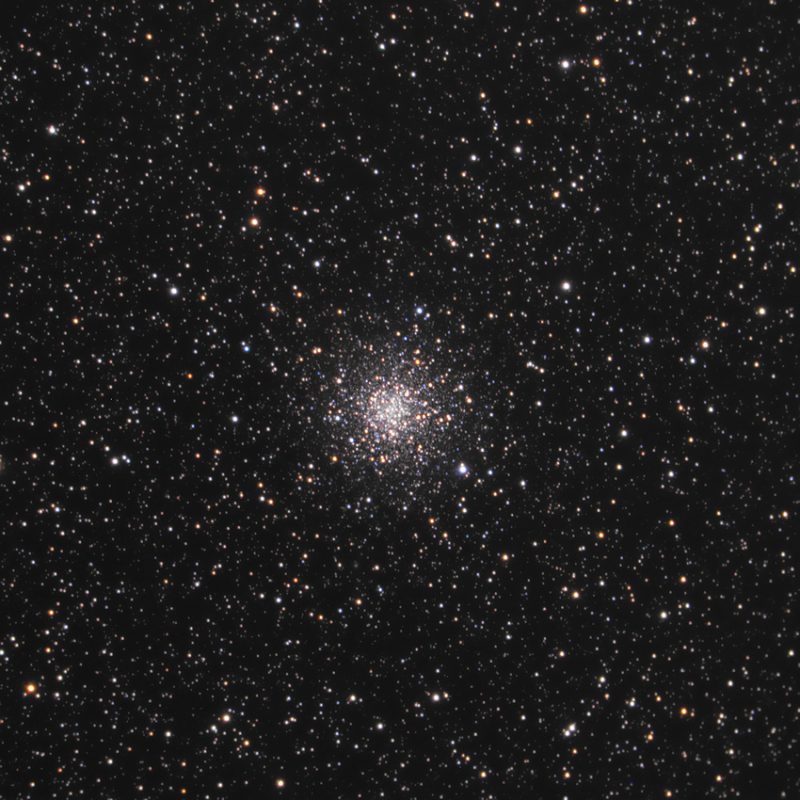
Then a little more than halfway between Sulafat and Albireo, the bright double star at the end of Cygnus, you’ll find M56, a loose globular cluster. M56 is an immense ball of stars orbiting the Milky Way, lying almost 33,000 light-years away.

Star field with a round central concentration of myriad stars.
M56 is a globular cluster in Lyra. Image via Hunter Wilson/ Wikimedia Commons.

Bottom line: The constellation Lyra the Harp hosts the second brightest star in the northern sky, Vega. Look for it on northern summer nights.

Read more: Apex of the sun: Look to Vega in May

The post Lyra the Harp contains Vega, a summer gem first appeared on EarthSky.


from EarthSky https://ift.tt/mjs5i4e
Star chart showing constellation Lyra with 4 stars and a nebula labeled.
This is the constellation Lyra the Harp. It’s made of a triangle and a parallelogram. Its brightest star is Vega. Then, look next to it for Epsilon Lyrae, the famous Double Double star.

Lyra is the 52nd smallest of the 88 constellations, but it has a big presence. That’s because its brightest star Vega is the 5th brightest star in Earth’s sky, or the 2nd brightest star belonging to just the Northern Hemisphere. Vega is best known for being the corner of the famous Summer Triangle star pattern.

Lyra is described as a harp, lyre or stringed instrument. And it’s one of the constellations that Ptolemy named back in the 2nd century.

How to find Lyra in the Northern Hemisphere

The easiest way to find Lyra is to look directly overhead on summer evenings in the Northern Hemisphere. The brightest star closest to your zenith – directly overhead – on a summer night after the sky gets dark will be Vega. It will get closer to the zenith and pass through it as the evening turns to morning.

Sky chart with large purple triangle with star Vega at top and small constellation Lyra below Vega.
Here are the 3 stars of the Summer Triangle, in the east in the evening in June and July. You can see the outline of Vega’s constellation, Lyra. Look for the Summer Triangle in the evening from around May through the end of the year.

How to find Lyra in the Southern Hemisphere

Via Daniel Gaussen, Founder & Guide – Stargaze Mackenzie – New Zealand

Although Lyra is often described as a Northern Hemisphere summer constellation, it is also visible throughout much of the Southern Hemisphere during winter.

The altitude of its brightest star, Vega, depends strongly on latitude. It reaches about 39 degrees above the northern horizon from Darwin, 24 degrees from Brisbane, 17 degrees from Sydney, 13 degrees from Melbourne, and only 8 degrees from Christchurch. For reference, a fist at arm’s length covers about 10 degrees on the sky.

One of the most noticeable differences for Southern Hemisphere observers is Lyra’s orientation. Unlike the view shown in many Northern Hemisphere star charts, Vega is the lowest of Lyra’s bright stars when the constellation reaches its highest in the sky, with the rest of the harp-shaped pattern sitting higher above it. This gives Lyra a distinctly different appearance from our perspective, with the highest star being Sulafat, about 6 degrees higher than Vega.

This also places the famous Ring Nebula or M57 (more on that later) above Vega in our sky. That makes it easier to locate, despite Lyra’s generally low altitude in southern latitudes. At these elevations, the Ring Nebula can sit high enough above the denser, murkier layers of the atmosphere that it remains a viable and rewarding telescopic target.

A hotbed of double stars

Once you find Vega, wait until your eyes are dark-adjusted so that you can make out the parallelogram dangling below it if you’re in the Northern Hemisphere, or above it if you’re in the Southern Hemisphere. Then, when you look back toward Vega, can you trace out a small triangle shape attached to the parallelogram? That star making up the small triangle, and which is not part of the parallelogram, is Epsilon Lyrae. And this star holds a secret.

Epsilon Lyrae is more famously known as the Double Double. Through binoculars, this star appears as two stars. But a telescope reveals that each of these is actually another pair of stars, making a quadruple system. And in the mid-1980s, astronomers detected a 5th star in Epsilon Lyrae! This deceptive star system lies about 160 light-years away.

Now that we’ve met Vega (Alpha Lyrae) and Epsilon Lyrae, let’s meet the other stars in the Harp. The two stars in the parallelogram closest to Vega are the dimmer of the four stars. These two stars are both double stars. The double star directly below Vega is Zeta Lyrae. The stars in this pair have magnitudes 4.34 and 5.73. They lie just 44 arcseconds from each other and 150 light-years away from us. A telescope can easily split the pair, but a good pair of binoculars may work as well.

The next double star in the parallelogram consists of Delta 1 and 2 Lyrae. The brighter star has magnitude 4.22, and the dimmer is of magnitude 5.58. They lie 10 arcminutes from each other, so you can easily split them in binoculars. The Delta 1 and 2 stars lie 1,080 and 898 light-years away, respectively.

Two close together white dots on left and two other close together white dots on right, on black background.
This is a telescopic view of Epsilon Lyrae, the Double Double star in the constellation Lyra the Harp. To the unaided eye, this is a single star. See how a zoomed-in view splits it into 2 stars, and each of those into 2 again? Image via Nikolay Nikolov/ Wikimedia Commons.

The rest of the stars of the Harp

Next, continuing on down to the bottom of the parallelogram, we find the stars Beta Lyrae, or Sheliak, and Sulafat, or Gamma Lyrae. Sulafat is the star farthest from Vega. It shines at magnitude 3.25 at a distance of 635 light-years. Sheliak is the last star in the parallelogram and – surprise! – it is also a double star. The main star has a magnitude of 3.52 and its companion is of magnitude 7.14. You can split this eclipsing binary in large telescopes.

A star map with stars in black on white showing the locations of stars in Lyra.
The stars of Lyra. Vega is represented by the large black circle, indicating its brightness relative to other stars. Image via IAU/ Sky & Telescope/ Wikimedia Commons.

Deep-sky objects in Lyra

Two Messier objects reside in Lyra. The first is a famous planetary nebula known as the Ring Nebula, or M57. Without a doubt, it’s one of the most observed objects of its type in the sky. It shines at magnitude 9.0 from about 2,300 light-years away. And it’s easy to find by looking between the stars Sheliak and Sulafat, at the end of the parallelogram opposite Vega. Use a telescope to catch its beautiful, eerie oval glow.

Small, ring-shaped cloud of gas in blue and orange, with sparse background stars.
View at EarthSky Community Photos. | Steven Bellavia in Smithfield, Virginia, and Southold, New York, captured this telescopic view of the Ring Nebula on June 23, 2025. Thank you, Steven!

Then a little more than halfway between Sulafat and Albireo, the bright double star at the end of Cygnus, you’ll find M56, a loose globular cluster. M56 is an immense ball of stars orbiting the Milky Way, lying almost 33,000 light-years away.

Star field with a round central concentration of myriad stars.
M56 is a globular cluster in Lyra. Image via Hunter Wilson/ Wikimedia Commons.

Bottom line: The constellation Lyra the Harp hosts the second brightest star in the northern sky, Vega. Look for it on northern summer nights.

Read more: Apex of the sun: Look to Vega in May

The post Lyra the Harp contains Vega, a summer gem first appeared on EarthSky.


from EarthSky https://ift.tt/mjs5i4e

Comet 3I/ATLAS has methane, unexpected discovery reveals

Comet 3I/ATLAS has methane: Large, bright white egg-shaped object. It has several diffuse filaments streaming behind it, and background stars.
View larger/ full image. | This image of Comet 3I/ATLAS shows the interstellar comet shining against a background of stars. The European Space Agency’s JUICE spacecraft obtained this image and other data on November 6, 2025. New analysis of data from the James Webb Space Telescope shows that Comet 3I/ATLAS has methane, and a lot of it. Image via ESA/ Juice/ JANUS.
  • Comet 3I/ATLAS is the 3rd known interstellar object to enter our solar system. We are still learning about its composition.
  • New analysis of data from the James Webb Space Telescope reveals that it contains abundant methane.
  • It’s the first time that methane has been found on an interstellar object. The findings suggest that the environment the comet formed in was quite different from that of our solar system.

Science news, night sky events and beautiful photos, all in one place. Click here to subscribe to our free daily newsletter.

Surprise! Comet 3I/ATLAS has methane

NASA’s James Webb Space Telescope has made another significant discovery about the interstellar comet 3I/ATLAS: it contains methane.

Researchers said on June 1, 2026, that this is the 1st time scientists have detected methane on an interstellar object. And the finding suggests 3I/ATLAS was born in a very different environment from that of our solar system.

The team of researchers made the discovery after using the Webb space telescope to observe the comet as it headed back out of the solar system in December 2025. The fact that methane wasn’t detected as the comet sped into the solar system suggests the gas was buried below the top surface of ice. So it was only detectable when the ice and frozen methane sublimated – turned directly to gas – as the comet came close to the sun.

The researchers published their new peer-reviewed findings in The Astrophysical Journal Letters on April 8, 2026.

1st detection of methane on an interstellar object hints at comet’s origin

So this is the 1st time that scientists have found methane on an interstellar object. Mind you, 3I/ATLAS is only the 3rd of these objects we’ve identified. The 1st discovery was the enigmatic comet ‘Oumuamua, and the 2nd was the comet 2I/Borisov.

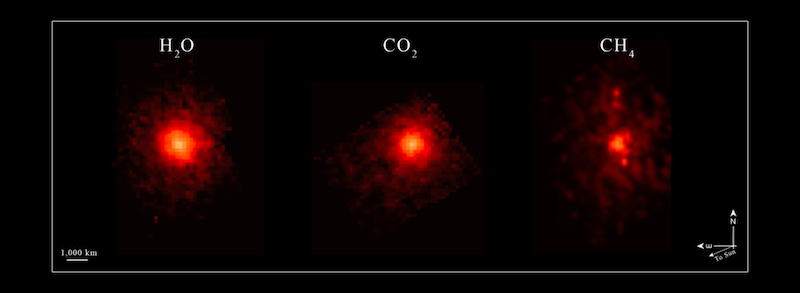
The researchers also found that Comet 3I/ATLAS is oddly rich in carbon dioxide. And this abundance of carbon dioxide and methane provides clues to the comet’s origin.

Comets in our solar system don’t contain large amounts of these gases. This means that 3I/ATLAS must have been born in a very different environment and chemistry than that of our solar system.

2 orange-red blotches, labled H2O and Co2, and a smaller orange-red blotch labeled CH4.
View larger. | Chart depicting the various gases that Webb found on Comet 3I/ATLAS. Methane and carbon dioxide are the most common, concentrated near the comet’s nucleus. Image via NASA/ ESA/ CSA/ STScI/ M. Belyakov (Caltech)/ I. Wong (STScI), Image Processing: A. Pagan (STScI).

Why the delay in detecting the methane?

Scientists first spotted Comet 3I/ATLAS in July, 2025, and it passed closest to the sun in October. But they didn’t detect the methane until the comet was on its way out of the solar system in December. Why is that?

The researchers say it’s likely because the methane was buried under a significant amount of surface ice. It wasn’t until the comet swung closest to the sun during its departure that the comet warmed enough for the methane to sublimate. Sublimation is when a frozen substance turns directly into a gas instead of becoming liquid first.

A comet with 2 long filamentous tails, 1st seen reddish and fading into deep purple.
Comet 3I/ATLAS through red and violet filters. In the red filter, the bright center of the coma is more compact and there are two tails: one straight down, and a fuzzier one going to the lower left. In the violet filter, the coma is bigger but fainter, and only one tail stands out clearly. The differences arise because different gas and dust particles release or reflect light at different wavelengths. Image via ESA.

Other recent 3I/ATLAS news

SETI also recently scanned 3I/ATLAS for possible radio signals. It was a last chance to see if – by any chance – the comet might actually be an artificial object. But alas, nothing was found.

Another study from April found that Comet 3I/ATLAS formed in a cold environment. This is consistent with the newest findings.

And in March, scientists found that 3I/ATLAS is bursting with alcohol, or methanol to be specific.

Bottom line: New analysis of data from the Webb space telescope shows that Comet 3I/ATLAS has methane. This shows its origin is different from comets in our solar system.

Source: The Volatile Inventory of 3I/ATLAS as Seen with JWST/MIRI

Via NASA

Read more: Interstellar comet 3I/ATLAS born in a cold environment

Read more: Interstellar object Comet 3I/ATLAS leaving the solar system

The post Comet 3I/ATLAS has methane, unexpected discovery reveals first appeared on EarthSky.


from EarthSky https://ift.tt/gWQG2JB
Comet 3I/ATLAS has methane: Large, bright white egg-shaped object. It has several diffuse filaments streaming behind it, and background stars.
View larger/ full image. | This image of Comet 3I/ATLAS shows the interstellar comet shining against a background of stars. The European Space Agency’s JUICE spacecraft obtained this image and other data on November 6, 2025. New analysis of data from the James Webb Space Telescope shows that Comet 3I/ATLAS has methane, and a lot of it. Image via ESA/ Juice/ JANUS.
  • Comet 3I/ATLAS is the 3rd known interstellar object to enter our solar system. We are still learning about its composition.
  • New analysis of data from the James Webb Space Telescope reveals that it contains abundant methane.
  • It’s the first time that methane has been found on an interstellar object. The findings suggest that the environment the comet formed in was quite different from that of our solar system.

Science news, night sky events and beautiful photos, all in one place. Click here to subscribe to our free daily newsletter.

Surprise! Comet 3I/ATLAS has methane

NASA’s James Webb Space Telescope has made another significant discovery about the interstellar comet 3I/ATLAS: it contains methane.

Researchers said on June 1, 2026, that this is the 1st time scientists have detected methane on an interstellar object. And the finding suggests 3I/ATLAS was born in a very different environment from that of our solar system.

The team of researchers made the discovery after using the Webb space telescope to observe the comet as it headed back out of the solar system in December 2025. The fact that methane wasn’t detected as the comet sped into the solar system suggests the gas was buried below the top surface of ice. So it was only detectable when the ice and frozen methane sublimated – turned directly to gas – as the comet came close to the sun.

The researchers published their new peer-reviewed findings in The Astrophysical Journal Letters on April 8, 2026.

1st detection of methane on an interstellar object hints at comet’s origin

So this is the 1st time that scientists have found methane on an interstellar object. Mind you, 3I/ATLAS is only the 3rd of these objects we’ve identified. The 1st discovery was the enigmatic comet ‘Oumuamua, and the 2nd was the comet 2I/Borisov.

The researchers also found that Comet 3I/ATLAS is oddly rich in carbon dioxide. And this abundance of carbon dioxide and methane provides clues to the comet’s origin.

Comets in our solar system don’t contain large amounts of these gases. This means that 3I/ATLAS must have been born in a very different environment and chemistry than that of our solar system.

2 orange-red blotches, labled H2O and Co2, and a smaller orange-red blotch labeled CH4.
View larger. | Chart depicting the various gases that Webb found on Comet 3I/ATLAS. Methane and carbon dioxide are the most common, concentrated near the comet’s nucleus. Image via NASA/ ESA/ CSA/ STScI/ M. Belyakov (Caltech)/ I. Wong (STScI), Image Processing: A. Pagan (STScI).

Why the delay in detecting the methane?

Scientists first spotted Comet 3I/ATLAS in July, 2025, and it passed closest to the sun in October. But they didn’t detect the methane until the comet was on its way out of the solar system in December. Why is that?

The researchers say it’s likely because the methane was buried under a significant amount of surface ice. It wasn’t until the comet swung closest to the sun during its departure that the comet warmed enough for the methane to sublimate. Sublimation is when a frozen substance turns directly into a gas instead of becoming liquid first.

A comet with 2 long filamentous tails, 1st seen reddish and fading into deep purple.
Comet 3I/ATLAS through red and violet filters. In the red filter, the bright center of the coma is more compact and there are two tails: one straight down, and a fuzzier one going to the lower left. In the violet filter, the coma is bigger but fainter, and only one tail stands out clearly. The differences arise because different gas and dust particles release or reflect light at different wavelengths. Image via ESA.

Other recent 3I/ATLAS news

SETI also recently scanned 3I/ATLAS for possible radio signals. It was a last chance to see if – by any chance – the comet might actually be an artificial object. But alas, nothing was found.

Another study from April found that Comet 3I/ATLAS formed in a cold environment. This is consistent with the newest findings.

And in March, scientists found that 3I/ATLAS is bursting with alcohol, or methanol to be specific.

Bottom line: New analysis of data from the Webb space telescope shows that Comet 3I/ATLAS has methane. This shows its origin is different from comets in our solar system.

Source: The Volatile Inventory of 3I/ATLAS as Seen with JWST/MIRI

Via NASA

Read more: Interstellar comet 3I/ATLAS born in a cold environment

Read more: Interstellar object Comet 3I/ATLAS leaving the solar system

The post Comet 3I/ATLAS has methane, unexpected discovery reveals first appeared on EarthSky.


from EarthSky https://ift.tt/gWQG2JB

Severe weather in the upper Midwest expected today

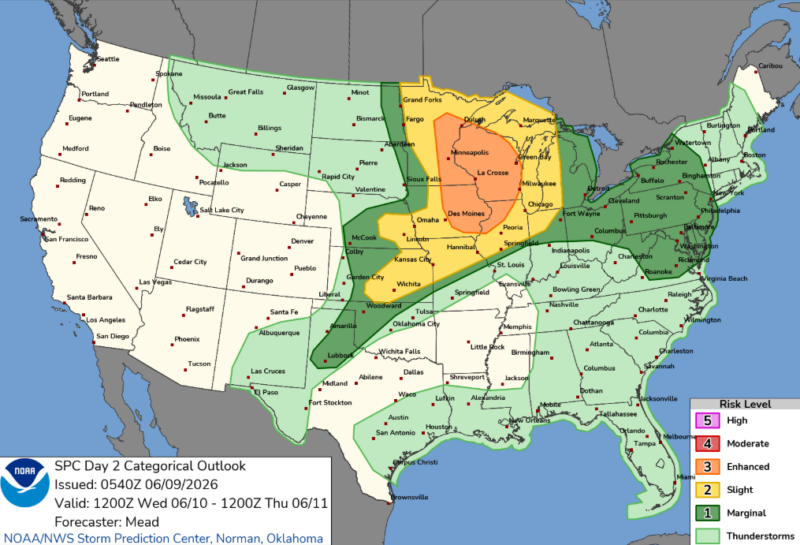
Severe weather including strong tornadoes, damaging wind and large hail are forecast for Wednesday, June 10 in the U.S. upper Midwest. Image via Storm Prediction Center.

Another round of severe weather is likely today, June 10, 2026, for the upper Midwest. Forecasters are warning of large hail of 2″ (5 cm) or larger in diameter, damaging wind of more than 75 miles per hour (120 kilometers per hour), and strong tornadoes. The severe threat then shifts southeast Thursday to the Great Lakes and Missouri and Mississippi Valleys, with the main threats again being strong tornadoes, large hail and destructive thunderstorm winds, according to the Storm Prediction Center.

Severe weather on Wednesday

Unusually warm and humid weather for parts of the upper Midwest will interact with a cold front on Wednesday, creating the chance for severe weather in two waves.

The first wave of possible severe weather is expected in the morning across parts of Minnesota and Wisconsin. These storms will be left over from Tuesday night’s storms, pushing east across these areas.

From there, the cold front will move east across these areas that are warm and humid and initiate more thunderstorms by the afternoon. The afternoon storms will likely start as individual supercells, or strong, rotating thunderstorms. This will bring the greatest chance for large hail of more than 2″ (5 cm) in diameter and strong tornadoes, possibly up to EF-2 in strength.

The storms will eventually transition into more of a storm complex, like a bow echo or derecho. This would favor a damaging wind threat, but tornadoes are still possible.

More than 11-million people are under a level 3 Enhanced Risk for severe weather, including those in the cities of Duluth and Minneapolis, in Minnesota, La Crosse and Madison in Wisconsin, Rockford in Illinois and Cedar Rapids in Iowa. An Enhanced Risk is a level 3 out of 5, typically meaning that several storms are expected to bring severe risks like damaging winds, large hail and tornadoes.

While this is where the worst of the severe weather is likely to occur, the threat for damaging wind gusts, severe hail and tornadoes stretches from Lubbock, Texas through Springfield, Illinois and out toward Philadelphia, Pennsylvania.

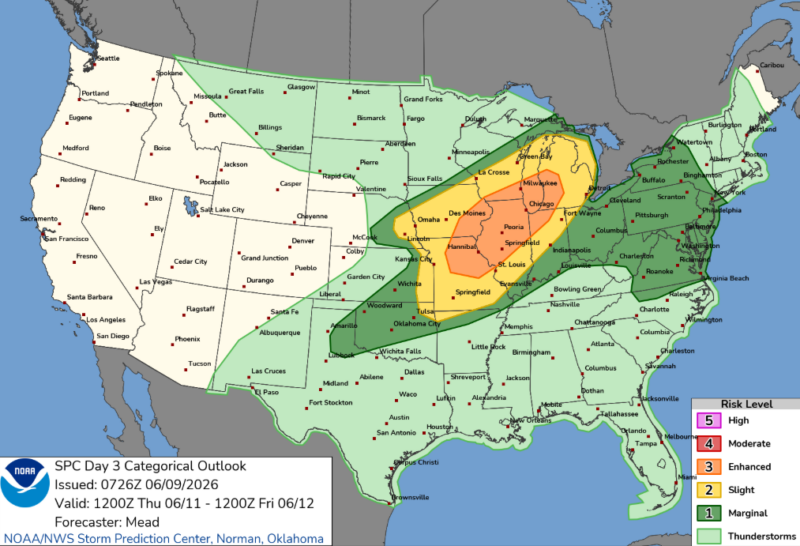
Severe weather including strong tornadoes, damaging wind and large hail is forecast for Thursday, June 11. Image via Storm Prediction Center.

Severe weather on Thursday

The threat for severe weather shifts southeast on Thursday. The Enhanced Risk includes Milwaukee and Madison in Wisconsin, Chicago, Rockford and Springfield in Illinois, Grand Rapids in Michigan and Hannibal in Missouri.

Severe storms are expected to bring destructive wind, strong tornadoes and large hail. Once more, warm and humid conditions will be in place across the upper Midwest and Great Lakes Thursday. So as the cold front continues moving east, storms are expected to develop by late morning before moving east with the front. Like the previous day, the more isolated storms and supercells have the greatest risk for strong tornadoes and large hail, but storms will eventually start to “bow” out, supporting more of a damaging wind threat, but tornadoes are still possible.

While the worst of the weather will again be focused in the upper Midwest and Great Lakes, severe storms are still possible from Oklahoma out toward the Mid-Atlantic. There is also a risk for severe weather Friday from eastern Kentucky and western Virginia up through western New York. Damaging wind gusts and large hail are the most likely threats.

Outdoor Storm Safety

As we get closer to the beginning of summer, many children are out of school, and families may be planning vacations or other outdoor activities. Especially if your plans take you outside, it’s important to have a severe weather plan in place before the weather gets bad!

First is to make sure you’re staying up to date with the forecast. Check in with the trusted, local meteorologists for the area as well as the National Weather Service. This is a great way not only to plan your trip, but also to stay ahead of whatever weather will impact you.

If severe weather is in the forecast, know the best ways to get important warnings. Tornado warnings and flash flood warnings will automatically sound on your phone, as will severe thunderstorm warnings that are particularly dangerous. It’s also vital to have a weather radio programmed for your location (or the location where you will be traveling) as these radios are designed to be loud and wake you up in the of the night or alert you from another room.

Also make sure you know where your safe space is. No place outside is safe during a thunderstorm. During a storm, get inside the closest enclosed building or vehicle with the windows rolled up and wait out the storm. But during a tornado, do not shelter in a car.

You can find more safety tips here for when you’re planning your summer activities.

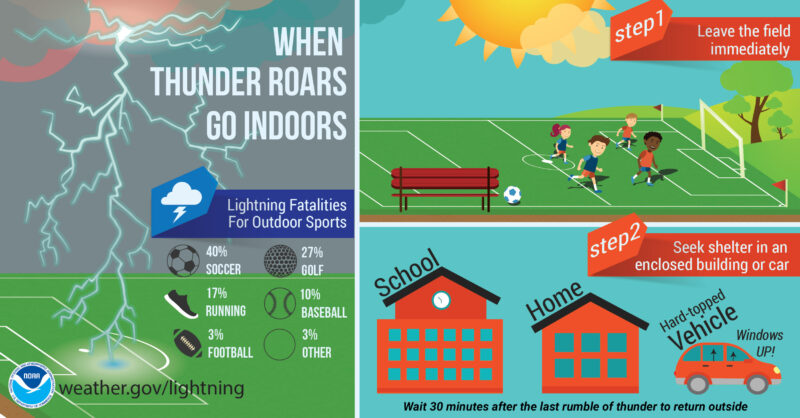
When Thunder Roars Go Indoors! Lightning Fatalities for Outdoor Sports: Soccer-40% Golf-27% Running-17% Baseball-10% Football-3% Other-3%. Step 1: Leave the field immediately. Step 2: Seek shelter in an enclosed building or car (windows up). Wait 30 minutes after hearing thunder to return outside.
Stay safe when getting outside this summer! Image Via: National Weather Service

Bottom line: Severe weather is expected today and tomorrow across the Midwest and Great Lakes. Tornadoes, destructive wind and large hail are possible.

Read more: Be a storm spotter and help during severe weather

The post Severe weather in the upper Midwest expected today first appeared on EarthSky.


from EarthSky https://ift.tt/EacoOYX
Severe weather including strong tornadoes, damaging wind and large hail are forecast for Wednesday, June 10 in the U.S. upper Midwest. Image via Storm Prediction Center.

Another round of severe weather is likely today, June 10, 2026, for the upper Midwest. Forecasters are warning of large hail of 2″ (5 cm) or larger in diameter, damaging wind of more than 75 miles per hour (120 kilometers per hour), and strong tornadoes. The severe threat then shifts southeast Thursday to the Great Lakes and Missouri and Mississippi Valleys, with the main threats again being strong tornadoes, large hail and destructive thunderstorm winds, according to the Storm Prediction Center.

Severe weather on Wednesday

Unusually warm and humid weather for parts of the upper Midwest will interact with a cold front on Wednesday, creating the chance for severe weather in two waves.

The first wave of possible severe weather is expected in the morning across parts of Minnesota and Wisconsin. These storms will be left over from Tuesday night’s storms, pushing east across these areas.

From there, the cold front will move east across these areas that are warm and humid and initiate more thunderstorms by the afternoon. The afternoon storms will likely start as individual supercells, or strong, rotating thunderstorms. This will bring the greatest chance for large hail of more than 2″ (5 cm) in diameter and strong tornadoes, possibly up to EF-2 in strength.

The storms will eventually transition into more of a storm complex, like a bow echo or derecho. This would favor a damaging wind threat, but tornadoes are still possible.

More than 11-million people are under a level 3 Enhanced Risk for severe weather, including those in the cities of Duluth and Minneapolis, in Minnesota, La Crosse and Madison in Wisconsin, Rockford in Illinois and Cedar Rapids in Iowa. An Enhanced Risk is a level 3 out of 5, typically meaning that several storms are expected to bring severe risks like damaging winds, large hail and tornadoes.

While this is where the worst of the severe weather is likely to occur, the threat for damaging wind gusts, severe hail and tornadoes stretches from Lubbock, Texas through Springfield, Illinois and out toward Philadelphia, Pennsylvania.

Severe weather including strong tornadoes, damaging wind and large hail is forecast for Thursday, June 11. Image via Storm Prediction Center.

Severe weather on Thursday

The threat for severe weather shifts southeast on Thursday. The Enhanced Risk includes Milwaukee and Madison in Wisconsin, Chicago, Rockford and Springfield in Illinois, Grand Rapids in Michigan and Hannibal in Missouri.

Severe storms are expected to bring destructive wind, strong tornadoes and large hail. Once more, warm and humid conditions will be in place across the upper Midwest and Great Lakes Thursday. So as the cold front continues moving east, storms are expected to develop by late morning before moving east with the front. Like the previous day, the more isolated storms and supercells have the greatest risk for strong tornadoes and large hail, but storms will eventually start to “bow” out, supporting more of a damaging wind threat, but tornadoes are still possible.

While the worst of the weather will again be focused in the upper Midwest and Great Lakes, severe storms are still possible from Oklahoma out toward the Mid-Atlantic. There is also a risk for severe weather Friday from eastern Kentucky and western Virginia up through western New York. Damaging wind gusts and large hail are the most likely threats.

Outdoor Storm Safety

As we get closer to the beginning of summer, many children are out of school, and families may be planning vacations or other outdoor activities. Especially if your plans take you outside, it’s important to have a severe weather plan in place before the weather gets bad!

First is to make sure you’re staying up to date with the forecast. Check in with the trusted, local meteorologists for the area as well as the National Weather Service. This is a great way not only to plan your trip, but also to stay ahead of whatever weather will impact you.

If severe weather is in the forecast, know the best ways to get important warnings. Tornado warnings and flash flood warnings will automatically sound on your phone, as will severe thunderstorm warnings that are particularly dangerous. It’s also vital to have a weather radio programmed for your location (or the location where you will be traveling) as these radios are designed to be loud and wake you up in the of the night or alert you from another room.

Also make sure you know where your safe space is. No place outside is safe during a thunderstorm. During a storm, get inside the closest enclosed building or vehicle with the windows rolled up and wait out the storm. But during a tornado, do not shelter in a car.

You can find more safety tips here for when you’re planning your summer activities.

When Thunder Roars Go Indoors! Lightning Fatalities for Outdoor Sports: Soccer-40% Golf-27% Running-17% Baseball-10% Football-3% Other-3%. Step 1: Leave the field immediately. Step 2: Seek shelter in an enclosed building or car (windows up). Wait 30 minutes after hearing thunder to return outside.
Stay safe when getting outside this summer! Image Via: National Weather Service

Bottom line: Severe weather is expected today and tomorrow across the Midwest and Great Lakes. Tornadoes, destructive wind and large hail are possible.

Read more: Be a storm spotter and help during severe weather

The post Severe weather in the upper Midwest expected today first appeared on EarthSky.


from EarthSky https://ift.tt/EacoOYX

California faults under record stress, study finds

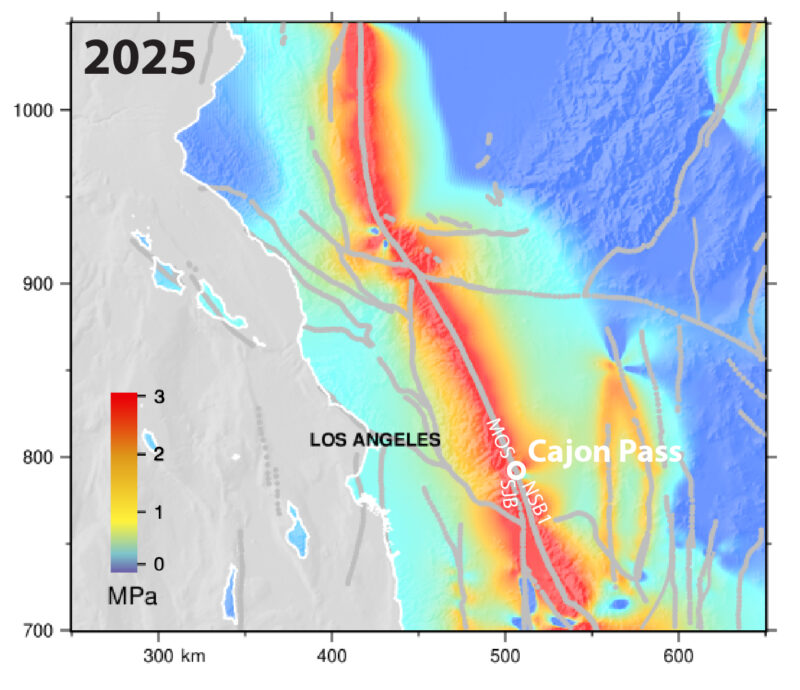
This chart shows stress levels (measured in megapascals) of the San Andreas fault system. The higher the stress levels, the more likely an earthquake is to occur. A new study has found that California faults are showing a level of stress not seen in the past 1,000 years. Image via Liliane Burkhard/ University of Bern.

The University of Bern originally published this article on June 8, 2026. Edits by EarthSky.

California faults under record stress, study finds

Researchers recently modeled 1,000 years of earthquake history along the San Andreas and San Jacinto faults in Southern California. Their finding? Stresses in the crust are higher today than at any time in the last millennium.

Plus, their model indicated that a critical fault junction near Los Angeles could decide how big the next major earthquake will be.

The international research team published its peer-reviewed research on June 3, 2026, in the Journal of Geophysical Research: Solid Earth.

Is California overdue a major earthquake?

Earthquakes usually occur along fracture zones in the Earth’s crust, where large tectonic plates slide past one another and become locked. Stress builds up over long periods of time and is suddenly released in the form of an earthquake. In Southern California, the San Andreas and San Jacinto faults are among the most significant of these zones. They accommodate the majority of the plate motion in the region.

Where the two fault systems approach each other northeast of Los Angeles lies the Cajon Pass. This is a tectonically complex junction where a rupture on one fault could potentially cross onto the other.

The last major earthquake to affect the wider Los Angeles region was the Fort Tejon earthquake of 1857, with a magnitude of 7.9. And since then, tectonic stress along the fault segments has built up continuously. This prolonged quiet period has long concerned researchers, given the potential for a large future rupture.

Modeling 1,000 years of the California faults

For this new study, the researchers modeled 1,000 years of earthquake history along the southern San Andreas and San Jacinto fault systems. They did so by constructing a physics-based earthquake cycle model, and then feeding this with a 1,000-year earthquake record reconstructed from geological evidence such as radiocarbon dating, tree-ring anomalies and historical documentation of ground ruptures. They hoped this model would allow them to estimate the present-day stress loading at Cajon Pass.

Study lead Liliane Burkhard of the University of Bern said:

The model tracks how each earthquake changes stress on neighboring fault segments, how stress accumulates during the quiet intervals between events and how the deeper layers of the crust slowly relax following large ruptures. This simulation allows us to understand how stresses in the fault system build up over centuries.

By running the earthquake history of Southern California as a simulation, we can estimate the extent to which the fault system is already under stress today.

And the results show that tectonic stresses in the region have reached – and in some cases exceeded – the highest levels of the last millennium.

The “earthquake gate” could be the deciding factor

A key finding of the study is that the Cajon Pass can act as a so-called “earthquake gate”. That is, a junction that controls whether large ruptures remain confined to a single fault, or cross both fault systems.

Historical examples of both behaviors exist. The Fort Tejon earthquake of 1857 terminated at Cajon Pass and did not involve the San Jacinto fault, while the Wrightwood earthquake of 1812 ruptured through the junction and across both systems in a single through-going event.

Burkhard explained:

The earthquake gate concept captures something important about how fault junctions work. Cajon Pass doesn’t simply block or channel earthquakes: It responds to stress conditions, and those conditions change over centuries.

Is a joint rupture likely?

The study also shows that the decisive factor is not only how much stress has built up on a single fault, but how aligned the stresses on the two fault systems are. When the stress on both faults rises in concert over time, toward similarly high levels, conditions favor a large joint rupture crossing both systems. When stress levels evolve out of step with each other, ruptures are more likely to terminate at the junction rather than propagate further.

Currently, modeled stress has reached 3.6 MPa on the San Jacinto-Bernardino section, exceeding the highest value seen anywhere in the 1,000-year simulation. On the neighboring Mojave South section of the San Andreas fault, it is 2.8 MPa. Both segments are therefore highly and relatively similarly stressed, placing the system in a configuration that historically has preceded joint ruptures.

Burkhard said:

So not only is it concerning that the stresses are reaching historic highs, but also that the relative stress conditions between the two fault systems are approaching the range we associate with major ruptures crossing both faults simultaneously – and that is a scenario with much larger consequences for the region.

California faults pose increased risk in densely populated regions

A joint rupture of the San Andreas fault and the San Jacinto fault that crosses the Cajon Pass would be a much more severe event than one that is limited to a single fault. The affected region includes some of the most densely populated, infrastructure-critical corridors in the U.S., including the greater Los Angeles area, San Bernardino, Riverside and the Coachella Valley. Major highways, railroads and energy infrastructure run through the Cajon Pass itself.

Burkhard said:

The question of when and how the next major earthquake will occur in this region is one of the most pressing problems in applied geoscience. Our results provide a clearer, physics-based picture of the current stress state of the fault system, and the framework we developed is not just applicable to California, but also for other complex fault junctions worldwide.

However, Burkhard emphasized:

The study is not a prediction of when an earthquake will occur. What we can say is that the system is critically stressed and that physics-based models like ours give a clearer picture of the range of scenarios we should be prepared for. This information is important for hazard assessment, infrastructure planning and emergency preparedness.

Bottom line: A new model of 1,000 years of earthquake history along two California faults has revealed that these faults are under record levels of stress.

You deserve a daily dose of good news. For the latest in science and the night sky, subscribe to EarthSky’s free daily newsletter.

Read more: Big cities are sinking in the US. Is yours one?

The post California faults under record stress, study finds first appeared on EarthSky.


from EarthSky https://ift.tt/bvSVtYe
This chart shows stress levels (measured in megapascals) of the San Andreas fault system. The higher the stress levels, the more likely an earthquake is to occur. A new study has found that California faults are showing a level of stress not seen in the past 1,000 years. Image via Liliane Burkhard/ University of Bern.

The University of Bern originally published this article on June 8, 2026. Edits by EarthSky.

California faults under record stress, study finds

Researchers recently modeled 1,000 years of earthquake history along the San Andreas and San Jacinto faults in Southern California. Their finding? Stresses in the crust are higher today than at any time in the last millennium.

Plus, their model indicated that a critical fault junction near Los Angeles could decide how big the next major earthquake will be.

The international research team published its peer-reviewed research on June 3, 2026, in the Journal of Geophysical Research: Solid Earth.

Is California overdue a major earthquake?

Earthquakes usually occur along fracture zones in the Earth’s crust, where large tectonic plates slide past one another and become locked. Stress builds up over long periods of time and is suddenly released in the form of an earthquake. In Southern California, the San Andreas and San Jacinto faults are among the most significant of these zones. They accommodate the majority of the plate motion in the region.

Where the two fault systems approach each other northeast of Los Angeles lies the Cajon Pass. This is a tectonically complex junction where a rupture on one fault could potentially cross onto the other.

The last major earthquake to affect the wider Los Angeles region was the Fort Tejon earthquake of 1857, with a magnitude of 7.9. And since then, tectonic stress along the fault segments has built up continuously. This prolonged quiet period has long concerned researchers, given the potential for a large future rupture.

Modeling 1,000 years of the California faults

For this new study, the researchers modeled 1,000 years of earthquake history along the southern San Andreas and San Jacinto fault systems. They did so by constructing a physics-based earthquake cycle model, and then feeding this with a 1,000-year earthquake record reconstructed from geological evidence such as radiocarbon dating, tree-ring anomalies and historical documentation of ground ruptures. They hoped this model would allow them to estimate the present-day stress loading at Cajon Pass.

Study lead Liliane Burkhard of the University of Bern said:

The model tracks how each earthquake changes stress on neighboring fault segments, how stress accumulates during the quiet intervals between events and how the deeper layers of the crust slowly relax following large ruptures. This simulation allows us to understand how stresses in the fault system build up over centuries.

By running the earthquake history of Southern California as a simulation, we can estimate the extent to which the fault system is already under stress today.

And the results show that tectonic stresses in the region have reached – and in some cases exceeded – the highest levels of the last millennium.

The “earthquake gate” could be the deciding factor

A key finding of the study is that the Cajon Pass can act as a so-called “earthquake gate”. That is, a junction that controls whether large ruptures remain confined to a single fault, or cross both fault systems.

Historical examples of both behaviors exist. The Fort Tejon earthquake of 1857 terminated at Cajon Pass and did not involve the San Jacinto fault, while the Wrightwood earthquake of 1812 ruptured through the junction and across both systems in a single through-going event.

Burkhard explained:

The earthquake gate concept captures something important about how fault junctions work. Cajon Pass doesn’t simply block or channel earthquakes: It responds to stress conditions, and those conditions change over centuries.

Is a joint rupture likely?

The study also shows that the decisive factor is not only how much stress has built up on a single fault, but how aligned the stresses on the two fault systems are. When the stress on both faults rises in concert over time, toward similarly high levels, conditions favor a large joint rupture crossing both systems. When stress levels evolve out of step with each other, ruptures are more likely to terminate at the junction rather than propagate further.

Currently, modeled stress has reached 3.6 MPa on the San Jacinto-Bernardino section, exceeding the highest value seen anywhere in the 1,000-year simulation. On the neighboring Mojave South section of the San Andreas fault, it is 2.8 MPa. Both segments are therefore highly and relatively similarly stressed, placing the system in a configuration that historically has preceded joint ruptures.

Burkhard said:

So not only is it concerning that the stresses are reaching historic highs, but also that the relative stress conditions between the two fault systems are approaching the range we associate with major ruptures crossing both faults simultaneously – and that is a scenario with much larger consequences for the region.

California faults pose increased risk in densely populated regions

A joint rupture of the San Andreas fault and the San Jacinto fault that crosses the Cajon Pass would be a much more severe event than one that is limited to a single fault. The affected region includes some of the most densely populated, infrastructure-critical corridors in the U.S., including the greater Los Angeles area, San Bernardino, Riverside and the Coachella Valley. Major highways, railroads and energy infrastructure run through the Cajon Pass itself.

Burkhard said:

The question of when and how the next major earthquake will occur in this region is one of the most pressing problems in applied geoscience. Our results provide a clearer, physics-based picture of the current stress state of the fault system, and the framework we developed is not just applicable to California, but also for other complex fault junctions worldwide.

However, Burkhard emphasized:

The study is not a prediction of when an earthquake will occur. What we can say is that the system is critically stressed and that physics-based models like ours give a clearer picture of the range of scenarios we should be prepared for. This information is important for hazard assessment, infrastructure planning and emergency preparedness.

Bottom line: A new model of 1,000 years of earthquake history along two California faults has revealed that these faults are under record levels of stress.

You deserve a daily dose of good news. For the latest in science and the night sky, subscribe to EarthSky’s free daily newsletter.

Read more: Big cities are sinking in the US. Is yours one?

The post California faults under record stress, study finds first appeared on EarthSky.


from EarthSky https://ift.tt/bvSVtYe

Top 10 space objects to see during the day

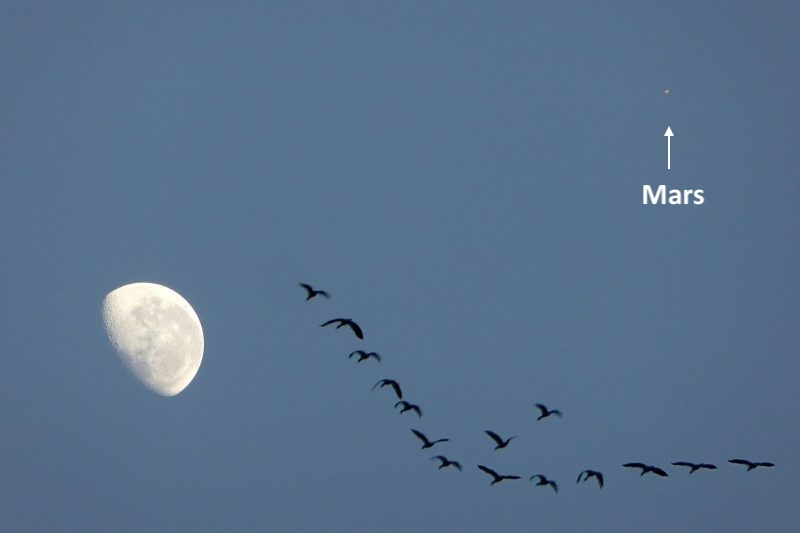
A gibbous moon, the V-shape of a flock of birds, and a very faint red dot of Mars, all in a dark blue daytime sky.
EarthSky community member Peter Lowenstein in Mutare, Zimbabwe, caught the waning moon, Mars and a flock of whistling ducks at dawn on August 9, 2020. Thanks, Peter! The moon is one of the top 10 space objects to see during the day. Amazingly, so is Mars!

You can see some space objects in the daytime. But catching them has its limitations and difficulties. And, as with all skywatching, it also has its rewards. On the list below, the first three are easy. The next few require preparation. And the last few objects are impossible to plan for or predict. That said, here they are, in increasing order of difficulty: your top 10 space objects to see during the day.

1. The sun

The sun is the easiest space object to see during the day. But, paradoxically, you shouldn’t look at it. Gazing at the sun directly can damage your eyes. Don’t do it!

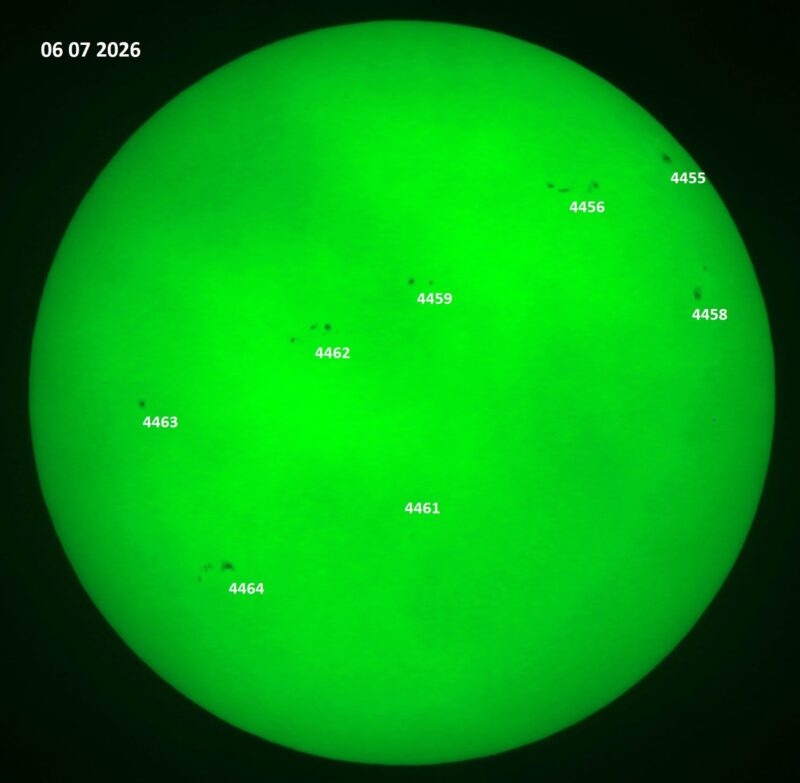
Instead, try solar binoculars from a reliable source. Or rig up a simple indirect viewing method for sun-watching. Once you have that, you can look for sunspots, dark spots on the sun’s visible face. It’s easy and fun to count the number of sunspots you see from day to day. And, if you record what you see, you’ll notice profound changes over time.

The sun has an 11-year cycle, during which the number of spots on the sun’s surface wax and wane. We’re past solar maximum now, so there are fewer visible spots now than a couple of years ago. Still, the sun has been moderately active throughout early 2026, with frequent and impressive sunspots.

Plus the sun gives us a whole range of atmospheric effects. Here are a few:

Read: EarthSky’s daily sun news update

HighPoint Scientific is a reliable source for solar binoculars

The sun, seen as a green sectional sphere with dark spots, each labeled.
View at EarthSky Community Photos. | Victor Rogus in Sedona, Arizona, captured this filtered image on June 7, 2026. Victor wrote: “Through cloudy skies, we see that the sun’s northern hemisphere displays a parade of sunspots, and that sunspot AR4456 has a ‘beta-gamma-delta’ magnetic field that poses a threat for X-class solar flares.” Thank you, Victor!

2. The moon

Some are surprised to see the moon in the daytime sky. But the moon is up in daylight half the time, for half of its monthly orbit around. Sometimes it’s too near our line of sight to the sun to be easily visible. But if you look up frequently, you’ll see the daytime moon often.

Read: 4 keys to understanding moon phases (and daylight moons)

First quarter moon in a blue sky with tree branches in the foreground.
View at EarthSky Community Photos. | Asha Prasad captured this image on May 4, 2025, from Minnesota and wrote: “Moon in its 1st quarter phase. It is photographed against a linden tree that is ready to pop out new leaves as the spring days get warmer.” Thank you, Asha!

3. The planet Venus

Anyone who sees our sky’s brightest planet, Venus, in twilight knows it can be dazzlingly brilliant. But seeing it in daylight is harder. In a blue daytime sky, at best, Venus appears as a tiny white dot that “pops” out at you. You just have to know where to look.

The moon might help you spot Venus in daylight. Check EarthSky’s guide to the bright planets to find dates the moon is near Venus. The moon will be near Venus on the evenings of June 16, 17 and 18, 2026.

Otherwise, it’s easier to spot Venus in daylight when it’s in the morning sky. It’ll remain in our evening sky until September 2026. Then it’ll return to the east before sunrise, probably around November 2026. When Venus is up before the sun, assuming your sky is clear, you can sometimes keep watching it until after dawn breaks.

Read: How to see Venus in daylight.

Read: Why is Venus so bright?

Bright white dot in the sky and inset larger image of the dot, above pine tree branches.
View at EarthSky Community Photos. | Steven Bellavia captured this image on February 7, 2025, in Virginia. Steven wrote: “Venus, in broad daylight, on a beautiful clear day. A little zoom-in, and you can see the crescent shape.” Thank you, Steven!

4. Earth-orbiting satellites during the day

Satellites are a common sight nowadays in dark, nighttime skies. Seasoned observers see them frequently as nighttime falls. They look like slowly and steadily moving stars.

But how about during the day?

You can see the International Space Station (ISS) during the day. The ISS is sometimes the 3rd-brightest object visible in the sky, after the sun and moon. Why only sometimes? The position and brightness of ISS in your sky varies, depending on where the space station is with respect to you. Also, the brightness of Venus – usually the sky’s 3rd-brightest object – varies. Sometimes ISS is brighter than Venus, and sometimes Venus is brighter than ISS.

Still, ISS is a very bright satellite. If conditions are optimum, you might see it in daylight. Spotting a visible pass of ISS in the daytime sky is a fun pastime. Eventually, you’ll be an expert at daylight ISS sightings and you’ll know when they occur over your location.

Read: How to spot the International Space Station

To learn how to see ISS in your sky, try the website Heavens-Above.com

5. The planet Jupiter

Even some seasoned astronomers are surprised to hear mighty Jupiter is visible with the unaided eye in a sunlit sky. A word of caution here: this isn’t an easy observation. Jupiter is significantly dimmer than Venus, and finding it takes a lot more effort. It also helps to have exceptionally good eyesight and excellent atmospheric conditions.

The best time to see Jupiter in daylight is when it’s near a “quadrature.” In other words, when Jupiter is about 90 degrees away from the sun in the sky. Plus, the sky is slightly darker there, due to polarization. This is like the arrangement of first quarter and last quarter moons.

In fact, it is very helpful to have a quarter moon nearby, using it as a sky landmark guiding you to Jupiter.

When is Jupiter at quadrature next? It’ll be at eastern quadrature on May 9, 2027.

Jupiter is also bright enough to catch in twilight, especially when it’s near the moon as shown in the image below. Plus in June 2026, it’ll be near the brilliant planet Venus in the sunset direction. And some of the easiest times to spot Venus in daylight is when it’s near the moon. Check EarthSky’s guide to the bright planets to find dates the moon is near Venus. The moon will be near Jupiter on the evenings of June 16 and 17, 2026.

Dark twilight on the horizon and a thin crescent moon and a small white dot that is Jupiter.
View at EarthSky Community Photos. | Cecille Kennedy captured this image on May 27, 2025, in Oregon. Cecille wrote: “A thin waxing crescent moon at 1.5% Illumination is setting on the ocean. Jupiter on the left is setting as well. And earthshine is slightly visible on the young moon.” Thank you, Cecille!

6. The planet Mars

Only a few observers catch Jupiter in the daytime with the unaided eye. Even fewer score a glimpse of Mars. But it’s possible, sometimes. Mars can reach -2.9 magnitude at very close oppositions. So, the best time to see Mars during the day is around a very close opposition.

Mars’ next opposition is February 2027. Unfortunately, it’s not a super-close one. Mars will only reach magnitude -1.2.

The next very close opposition for Mars is in September 2035. The photo at the top shows Mars as seen in the daytime by Peter Lowenstein in Zimbabwe.

7. Stars during eclipses

During a total solar eclipse, stars and brighter planets pop into view. Such observations are of historical significance. In the early part of the 20th century, they played a critical role in confirming Einstein’s theory of general relativity.

A few observers report seeing some bright stars, such as Sirius, with the unaided eye in the daytime sky. These sightings require truly exceptional eyesight and exceptional sky conditions.

The last total solar eclipse was April 8, 2024. The next total solar eclipse is August 12, 2026.

8. Comets during the day

Over the course of history, many bright comets have been seen in a daytime sky. They’re not always easy to observe. But they’re not all that rare. Comet McNaught was visible in daylight skies in 2007, and a very bright daytime comet preceded Halley’s Comet in 1910.

Daytime comets are more frequently observed because their orbits are predicted ahead of time, enabling people to know where to look.

9. Daytime meteors

Rare and unpredictable, very bright meteors sometimes streak across a daylit sky. Meteors are bits of space debris vaporizing as they encounter Earth’s atmosphere. This space debris comes from comets or the asteroid belt.

A famous example is the 2013 Chelyabinsk meteor over Russia. It was bright enough to cast shadows in daylight. It created an exceedingly bright flash and powerful shock wave, while breaking windows in six Russian cities. Needless to say, the meteor caused a panic, and with good reason. Around 1,500 people required medical treatment, mostly from flying glass.

We hear about daytime meteors pretty often. But, from any one location on Earth, you might see just one in a lifetime.

10. Daytime supernovae

Last on our list of space objects (sometimes) visible in the daytime sky are supernovae, or exploding stars. Estimates vary on the expected frequency of supernova explosions in our Milky Way galaxy. Currently, they are estimated to occur two to three times a century or an average of every 50 years. Many of these supernova are not even visible from Earth due to intervening gas and dust.

In any event, the last supernova bright enough to see in the daytime sky was in 1572!

Bottom line: Love astronomy, but don’t like to stay up late? Here are the top 10 space objects you can see – under the right conditions – during the day.

The post Top 10 space objects to see during the day first appeared on EarthSky.


from EarthSky https://ift.tt/oZLMFsG
A gibbous moon, the V-shape of a flock of birds, and a very faint red dot of Mars, all in a dark blue daytime sky.
EarthSky community member Peter Lowenstein in Mutare, Zimbabwe, caught the waning moon, Mars and a flock of whistling ducks at dawn on August 9, 2020. Thanks, Peter! The moon is one of the top 10 space objects to see during the day. Amazingly, so is Mars!

You can see some space objects in the daytime. But catching them has its limitations and difficulties. And, as with all skywatching, it also has its rewards. On the list below, the first three are easy. The next few require preparation. And the last few objects are impossible to plan for or predict. That said, here they are, in increasing order of difficulty: your top 10 space objects to see during the day.

1. The sun

The sun is the easiest space object to see during the day. But, paradoxically, you shouldn’t look at it. Gazing at the sun directly can damage your eyes. Don’t do it!

Instead, try solar binoculars from a reliable source. Or rig up a simple indirect viewing method for sun-watching. Once you have that, you can look for sunspots, dark spots on the sun’s visible face. It’s easy and fun to count the number of sunspots you see from day to day. And, if you record what you see, you’ll notice profound changes over time.

The sun has an 11-year cycle, during which the number of spots on the sun’s surface wax and wane. We’re past solar maximum now, so there are fewer visible spots now than a couple of years ago. Still, the sun has been moderately active throughout early 2026, with frequent and impressive sunspots.

Plus the sun gives us a whole range of atmospheric effects. Here are a few:

Read: EarthSky’s daily sun news update

HighPoint Scientific is a reliable source for solar binoculars

The sun, seen as a green sectional sphere with dark spots, each labeled.
View at EarthSky Community Photos. | Victor Rogus in Sedona, Arizona, captured this filtered image on June 7, 2026. Victor wrote: “Through cloudy skies, we see that the sun’s northern hemisphere displays a parade of sunspots, and that sunspot AR4456 has a ‘beta-gamma-delta’ magnetic field that poses a threat for X-class solar flares.” Thank you, Victor!

2. The moon

Some are surprised to see the moon in the daytime sky. But the moon is up in daylight half the time, for half of its monthly orbit around. Sometimes it’s too near our line of sight to the sun to be easily visible. But if you look up frequently, you’ll see the daytime moon often.

Read: 4 keys to understanding moon phases (and daylight moons)

First quarter moon in a blue sky with tree branches in the foreground.
View at EarthSky Community Photos. | Asha Prasad captured this image on May 4, 2025, from Minnesota and wrote: “Moon in its 1st quarter phase. It is photographed against a linden tree that is ready to pop out new leaves as the spring days get warmer.” Thank you, Asha!

3. The planet Venus

Anyone who sees our sky’s brightest planet, Venus, in twilight knows it can be dazzlingly brilliant. But seeing it in daylight is harder. In a blue daytime sky, at best, Venus appears as a tiny white dot that “pops” out at you. You just have to know where to look.

The moon might help you spot Venus in daylight. Check EarthSky’s guide to the bright planets to find dates the moon is near Venus. The moon will be near Venus on the evenings of June 16, 17 and 18, 2026.

Otherwise, it’s easier to spot Venus in daylight when it’s in the morning sky. It’ll remain in our evening sky until September 2026. Then it’ll return to the east before sunrise, probably around November 2026. When Venus is up before the sun, assuming your sky is clear, you can sometimes keep watching it until after dawn breaks.

Read: How to see Venus in daylight.

Read: Why is Venus so bright?

Bright white dot in the sky and inset larger image of the dot, above pine tree branches.
View at EarthSky Community Photos. | Steven Bellavia captured this image on February 7, 2025, in Virginia. Steven wrote: “Venus, in broad daylight, on a beautiful clear day. A little zoom-in, and you can see the crescent shape.” Thank you, Steven!

4. Earth-orbiting satellites during the day

Satellites are a common sight nowadays in dark, nighttime skies. Seasoned observers see them frequently as nighttime falls. They look like slowly and steadily moving stars.

But how about during the day?

You can see the International Space Station (ISS) during the day. The ISS is sometimes the 3rd-brightest object visible in the sky, after the sun and moon. Why only sometimes? The position and brightness of ISS in your sky varies, depending on where the space station is with respect to you. Also, the brightness of Venus – usually the sky’s 3rd-brightest object – varies. Sometimes ISS is brighter than Venus, and sometimes Venus is brighter than ISS.

Still, ISS is a very bright satellite. If conditions are optimum, you might see it in daylight. Spotting a visible pass of ISS in the daytime sky is a fun pastime. Eventually, you’ll be an expert at daylight ISS sightings and you’ll know when they occur over your location.

Read: How to spot the International Space Station

To learn how to see ISS in your sky, try the website Heavens-Above.com

5. The planet Jupiter

Even some seasoned astronomers are surprised to hear mighty Jupiter is visible with the unaided eye in a sunlit sky. A word of caution here: this isn’t an easy observation. Jupiter is significantly dimmer than Venus, and finding it takes a lot more effort. It also helps to have exceptionally good eyesight and excellent atmospheric conditions.

The best time to see Jupiter in daylight is when it’s near a “quadrature.” In other words, when Jupiter is about 90 degrees away from the sun in the sky. Plus, the sky is slightly darker there, due to polarization. This is like the arrangement of first quarter and last quarter moons.

In fact, it is very helpful to have a quarter moon nearby, using it as a sky landmark guiding you to Jupiter.

When is Jupiter at quadrature next? It’ll be at eastern quadrature on May 9, 2027.

Jupiter is also bright enough to catch in twilight, especially when it’s near the moon as shown in the image below. Plus in June 2026, it’ll be near the brilliant planet Venus in the sunset direction. And some of the easiest times to spot Venus in daylight is when it’s near the moon. Check EarthSky’s guide to the bright planets to find dates the moon is near Venus. The moon will be near Jupiter on the evenings of June 16 and 17, 2026.

Dark twilight on the horizon and a thin crescent moon and a small white dot that is Jupiter.
View at EarthSky Community Photos. | Cecille Kennedy captured this image on May 27, 2025, in Oregon. Cecille wrote: “A thin waxing crescent moon at 1.5% Illumination is setting on the ocean. Jupiter on the left is setting as well. And earthshine is slightly visible on the young moon.” Thank you, Cecille!

6. The planet Mars

Only a few observers catch Jupiter in the daytime with the unaided eye. Even fewer score a glimpse of Mars. But it’s possible, sometimes. Mars can reach -2.9 magnitude at very close oppositions. So, the best time to see Mars during the day is around a very close opposition.

Mars’ next opposition is February 2027. Unfortunately, it’s not a super-close one. Mars will only reach magnitude -1.2.

The next very close opposition for Mars is in September 2035. The photo at the top shows Mars as seen in the daytime by Peter Lowenstein in Zimbabwe.

7. Stars during eclipses

During a total solar eclipse, stars and brighter planets pop into view. Such observations are of historical significance. In the early part of the 20th century, they played a critical role in confirming Einstein’s theory of general relativity.

A few observers report seeing some bright stars, such as Sirius, with the unaided eye in the daytime sky. These sightings require truly exceptional eyesight and exceptional sky conditions.

The last total solar eclipse was April 8, 2024. The next total solar eclipse is August 12, 2026.

8. Comets during the day

Over the course of history, many bright comets have been seen in a daytime sky. They’re not always easy to observe. But they’re not all that rare. Comet McNaught was visible in daylight skies in 2007, and a very bright daytime comet preceded Halley’s Comet in 1910.

Daytime comets are more frequently observed because their orbits are predicted ahead of time, enabling people to know where to look.

9. Daytime meteors

Rare and unpredictable, very bright meteors sometimes streak across a daylit sky. Meteors are bits of space debris vaporizing as they encounter Earth’s atmosphere. This space debris comes from comets or the asteroid belt.

A famous example is the 2013 Chelyabinsk meteor over Russia. It was bright enough to cast shadows in daylight. It created an exceedingly bright flash and powerful shock wave, while breaking windows in six Russian cities. Needless to say, the meteor caused a panic, and with good reason. Around 1,500 people required medical treatment, mostly from flying glass.

We hear about daytime meteors pretty often. But, from any one location on Earth, you might see just one in a lifetime.

10. Daytime supernovae

Last on our list of space objects (sometimes) visible in the daytime sky are supernovae, or exploding stars. Estimates vary on the expected frequency of supernova explosions in our Milky Way galaxy. Currently, they are estimated to occur two to three times a century or an average of every 50 years. Many of these supernova are not even visible from Earth due to intervening gas and dust.

In any event, the last supernova bright enough to see in the daytime sky was in 1572!

Bottom line: Love astronomy, but don’t like to stay up late? Here are the top 10 space objects you can see – under the right conditions – during the day.

The post Top 10 space objects to see during the day first appeared on EarthSky.


from EarthSky https://ift.tt/oZLMFsG

adds 2