
You can see some space objects in the daytime. But catching them has its limitations and difficulties. And, as with all skywatching, it also has its rewards. On the list below, the first three are easy. The next few require preparation. And the last few objects are impossible to plan for or predict. That said, here they are, in increasing order of difficulty: your top 10 space objects to see during the day.
1. The sun
The sun is the easiest space object to see during the day. But, paradoxically, you shouldn’t look at it. Gazing at the sun directly can damage your eyes. Don’t do it!
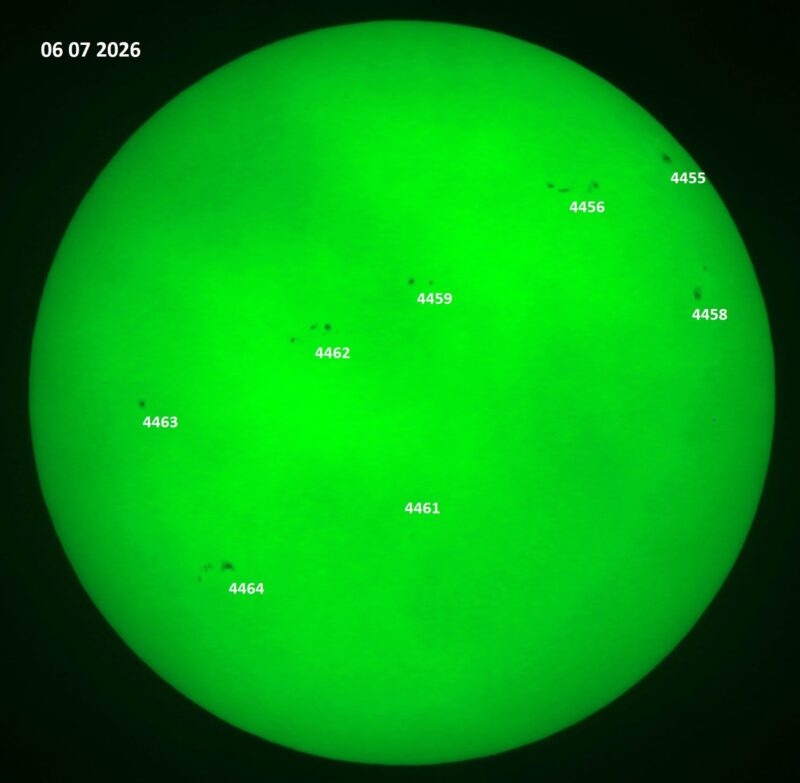
Instead, try solar binoculars from a reliable source. Or rig up a simple indirect viewing method for sun-watching. Once you have that, you can look for sunspots, dark spots on the sun’s visible face. It’s easy and fun to count the number of sunspots you see from day to day. And, if you record what you see, you’ll notice profound changes over time.
The sun has an 11-year cycle, during which the number of spots on the sun’s surface wax and wane. We’re past solar maximum now, so there are fewer visible spots now than a couple of years ago. Still, the sun has been moderately active throughout early 2026, with frequent and impressive sunspots.
Plus the sun gives us a whole range of atmospheric effects. Here are a few:
Read: EarthSky’s daily sun news update
HighPoint Scientific is a reliable source for solar binoculars
2. The moon
Some are surprised to see the moon in the daytime sky. But the moon is up in daylight half the time, for half of its monthly orbit around. Sometimes it’s too near our line of sight to the sun to be easily visible. But if you look up frequently, you’ll see the daytime moon often.
Read: 4 keys to understanding moon phases (and daylight moons)

3. The planet Venus
Anyone who sees our sky’s brightest planet, Venus, in twilight knows it can be dazzlingly brilliant. But seeing it in daylight is harder. In a blue daytime sky, at best, Venus appears as a tiny white dot that “pops” out at you. You just have to know where to look.
The moon might help you spot Venus in daylight. Check EarthSky’s guide to the bright planets to find dates the moon is near Venus. The moon will be near Venus on the evenings of June 16, 17 and 18, 2026.
Otherwise, it’s easier to spot Venus in daylight when it’s in the morning sky. It’ll remain in our evening sky until September 2026. Then it’ll return to the east before sunrise, probably around November 2026. When Venus is up before the sun, assuming your sky is clear, you can sometimes keep watching it until after dawn breaks.
Read: How to see Venus in daylight.

4. Earth-orbiting satellites during the day
Satellites are a common sight nowadays in dark, nighttime skies. Seasoned observers see them frequently as nighttime falls. They look like slowly and steadily moving stars.
But how about during the day?
You can see the International Space Station (ISS) during the day. The ISS is sometimes the 3rd-brightest object visible in the sky, after the sun and moon. Why only sometimes? The position and brightness of ISS in your sky varies, depending on where the space station is with respect to you. Also, the brightness of Venus – usually the sky’s 3rd-brightest object – varies. Sometimes ISS is brighter than Venus, and sometimes Venus is brighter than ISS.
Still, ISS is a very bright satellite. If conditions are optimum, you might see it in daylight. Spotting a visible pass of ISS in the daytime sky is a fun pastime. Eventually, you’ll be an expert at daylight ISS sightings and you’ll know when they occur over your location.
Read: How to spot the International Space Station
To learn how to see ISS in your sky, try the website Heavens-Above.com
Advanced International Space Station spotting in daylight! @VirtualAstro ?? pic.twitter.com/0Hwsm2c8C9
— Sue Watson ? (@Soooisme) May 31, 2020
5. The planet Jupiter
Even some seasoned astronomers are surprised to hear mighty Jupiter is visible with the unaided eye in a sunlit sky. A word of caution here: this isn’t an easy observation. Jupiter is significantly dimmer than Venus, and finding it takes a lot more effort. It also helps to have exceptionally good eyesight and excellent atmospheric conditions.
The best time to see Jupiter in daylight is when it’s near a “quadrature.” In other words, when Jupiter is about 90 degrees away from the sun in the sky. Plus, the sky is slightly darker there, due to polarization. This is like the arrangement of first quarter and last quarter moons.
In fact, it is very helpful to have a quarter moon nearby, using it as a sky landmark guiding you to Jupiter.
When is Jupiter at quadrature next? It’ll be at eastern quadrature on May 9, 2027.
Jupiter is also bright enough to catch in twilight, especially when it’s near the moon as shown in the image below. Plus in June 2026, it’ll be near the brilliant planet Venus in the sunset direction. And some of the easiest times to spot Venus in daylight is when it’s near the moon. Check EarthSky’s guide to the bright planets to find dates the moon is near Venus. The moon will be near Jupiter on the evenings of June 16 and 17, 2026.

6. The planet Mars
Only a few observers catch Jupiter in the daytime with the unaided eye. Even fewer score a glimpse of Mars. But it’s possible, sometimes. Mars can reach -2.9 magnitude at very close oppositions. So, the best time to see Mars during the day is around a very close opposition.
Mars’ next opposition is February 2027. Unfortunately, it’s not a super-close one. Mars will only reach magnitude -1.2.
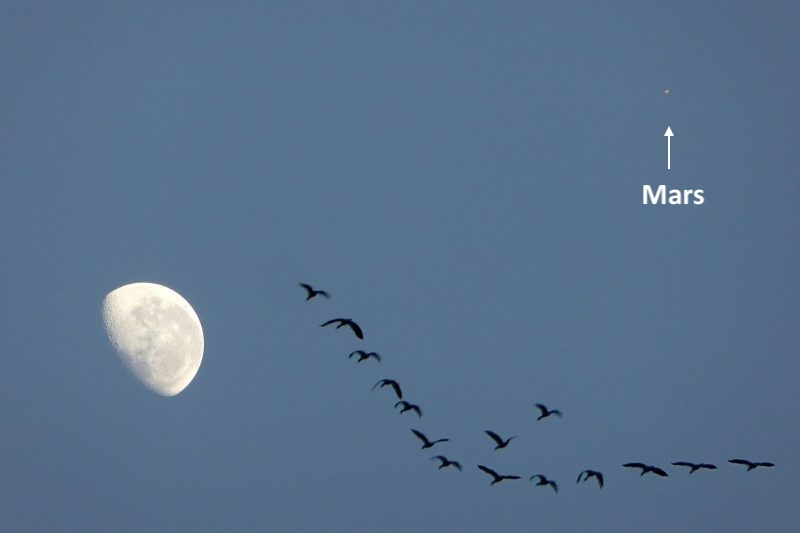
The next very close opposition for Mars is in September 2035. The photo at the top shows Mars as seen in the daytime by Peter Lowenstein in Zimbabwe.
7. Stars during eclipses
During a total solar eclipse, stars and brighter planets pop into view. Such observations are of historical significance. In the early part of the 20th century, they played a critical role in confirming Einstein’s theory of general relativity.
A few observers report seeing some bright stars, such as Sirius, with the unaided eye in the daytime sky. These sightings require truly exceptional eyesight and exceptional sky conditions.
The last total solar eclipse was April 8, 2024. The next total solar eclipse is August 12, 2026.
8. Comets during the day
Over the course of history, many bright comets have been seen in a daytime sky. They’re not always easy to observe. But they’re not all that rare. Comet McNaught was visible in daylight skies in 2007, and a very bright daytime comet preceded Halley’s Comet in 1910.
Daytime comets are more frequently observed because their orbits are predicted ahead of time, enabling people to know where to look.
Flashback to Jan 13 2007. A day light shot of the great Comet McNaught at mag -5.5!. Image courtesy Komet-ISON pic.twitter.com/zVVMBbkELh
— Con Stoitsis (@vivstoitsis) January 13, 2017
9. Daytime meteors
Rare and unpredictable, very bright meteors sometimes streak across a daylit sky. Meteors are bits of space debris vaporizing as they encounter Earth’s atmosphere. This space debris comes from comets or the asteroid belt.
A famous example is the 2013 Chelyabinsk meteor over Russia. It was bright enough to cast shadows in daylight. It created an exceedingly bright flash and powerful shock wave, while breaking windows in six Russian cities. Needless to say, the meteor caused a panic, and with good reason. Around 1,500 people required medical treatment, mostly from flying glass.
We hear about daytime meteors pretty often. But, from any one location on Earth, you might see just one in a lifetime.
Spotting white-hot meteors during the daytime! #meteor ?? pic.twitter.com/uV7yfq5GhL
— AstroHardin ? (@AstroHardin) March 10, 2019
10. Daytime supernovae
Last on our list of space objects (sometimes) visible in the daytime sky are supernovae, or exploding stars. Estimates vary on the expected frequency of supernova explosions in our Milky Way galaxy. Currently, they are estimated to occur two to three times a century or an average of every 50 years. Many of these supernova are not even visible from Earth due to intervening gas and dust.
In any event, the last supernova bright enough to see in the daytime sky was in 1572!
Bottom line: Love astronomy, but don’t like to stay up late? Here are the top 10 space objects you can see – under the right conditions – during the day.
The post Top 10 space objects to see during the day first appeared on EarthSky.
from EarthSky https://ift.tt/oZLMFsG
You can see some space objects in the daytime. But catching them has its limitations and difficulties. And, as with all skywatching, it also has its rewards. On the list below, the first three are easy. The next few require preparation. And the last few objects are impossible to plan for or predict. That said, here they are, in increasing order of difficulty: your top 10 space objects to see during the day.
1. The sun
The sun is the easiest space object to see during the day. But, paradoxically, you shouldn’t look at it. Gazing at the sun directly can damage your eyes. Don’t do it!
Instead, try solar binoculars from a reliable source. Or rig up a simple indirect viewing method for sun-watching. Once you have that, you can look for sunspots, dark spots on the sun’s visible face. It’s easy and fun to count the number of sunspots you see from day to day. And, if you record what you see, you’ll notice profound changes over time.
The sun has an 11-year cycle, during which the number of spots on the sun’s surface wax and wane. We’re past solar maximum now, so there are fewer visible spots now than a couple of years ago. Still, the sun has been moderately active throughout early 2026, with frequent and impressive sunspots.
Plus the sun gives us a whole range of atmospheric effects. Here are a few:
Read: EarthSky’s daily sun news update
HighPoint Scientific is a reliable source for solar binoculars
2. The moon
Some are surprised to see the moon in the daytime sky. But the moon is up in daylight half the time, for half of its monthly orbit around. Sometimes it’s too near our line of sight to the sun to be easily visible. But if you look up frequently, you’ll see the daytime moon often.
Read: 4 keys to understanding moon phases (and daylight moons)
3. The planet Venus
Anyone who sees our sky’s brightest planet, Venus, in twilight knows it can be dazzlingly brilliant. But seeing it in daylight is harder. In a blue daytime sky, at best, Venus appears as a tiny white dot that “pops” out at you. You just have to know where to look.
The moon might help you spot Venus in daylight. Check EarthSky’s guide to the bright planets to find dates the moon is near Venus. The moon will be near Venus on the evenings of June 16, 17 and 18, 2026.
Otherwise, it’s easier to spot Venus in daylight when it’s in the morning sky. It’ll remain in our evening sky until September 2026. Then it’ll return to the east before sunrise, probably around November 2026. When Venus is up before the sun, assuming your sky is clear, you can sometimes keep watching it until after dawn breaks.
Read: How to see Venus in daylight.
4. Earth-orbiting satellites during the day
Satellites are a common sight nowadays in dark, nighttime skies. Seasoned observers see them frequently as nighttime falls. They look like slowly and steadily moving stars.
But how about during the day?
You can see the International Space Station (ISS) during the day. The ISS is sometimes the 3rd-brightest object visible in the sky, after the sun and moon. Why only sometimes? The position and brightness of ISS in your sky varies, depending on where the space station is with respect to you. Also, the brightness of Venus – usually the sky’s 3rd-brightest object – varies. Sometimes ISS is brighter than Venus, and sometimes Venus is brighter than ISS.
Still, ISS is a very bright satellite. If conditions are optimum, you might see it in daylight. Spotting a visible pass of ISS in the daytime sky is a fun pastime. Eventually, you’ll be an expert at daylight ISS sightings and you’ll know when they occur over your location.
Read: How to spot the International Space Station
To learn how to see ISS in your sky, try the website Heavens-Above.com
Advanced International Space Station spotting in daylight! @VirtualAstro ?? pic.twitter.com/0Hwsm2c8C9
— Sue Watson ? (@Soooisme) May 31, 2020
5. The planet Jupiter
Even some seasoned astronomers are surprised to hear mighty Jupiter is visible with the unaided eye in a sunlit sky. A word of caution here: this isn’t an easy observation. Jupiter is significantly dimmer than Venus, and finding it takes a lot more effort. It also helps to have exceptionally good eyesight and excellent atmospheric conditions.
The best time to see Jupiter in daylight is when it’s near a “quadrature.” In other words, when Jupiter is about 90 degrees away from the sun in the sky. Plus, the sky is slightly darker there, due to polarization. This is like the arrangement of first quarter and last quarter moons.
In fact, it is very helpful to have a quarter moon nearby, using it as a sky landmark guiding you to Jupiter.
When is Jupiter at quadrature next? It’ll be at eastern quadrature on May 9, 2027.
Jupiter is also bright enough to catch in twilight, especially when it’s near the moon as shown in the image below. Plus in June 2026, it’ll be near the brilliant planet Venus in the sunset direction. And some of the easiest times to spot Venus in daylight is when it’s near the moon. Check EarthSky’s guide to the bright planets to find dates the moon is near Venus. The moon will be near Jupiter on the evenings of June 16 and 17, 2026.
6. The planet Mars
Only a few observers catch Jupiter in the daytime with the unaided eye. Even fewer score a glimpse of Mars. But it’s possible, sometimes. Mars can reach -2.9 magnitude at very close oppositions. So, the best time to see Mars during the day is around a very close opposition.
Mars’ next opposition is February 2027. Unfortunately, it’s not a super-close one. Mars will only reach magnitude -1.2.
The next very close opposition for Mars is in September 2035. The photo at the top shows Mars as seen in the daytime by Peter Lowenstein in Zimbabwe.
7. Stars during eclipses
During a total solar eclipse, stars and brighter planets pop into view. Such observations are of historical significance. In the early part of the 20th century, they played a critical role in confirming Einstein’s theory of general relativity.
A few observers report seeing some bright stars, such as Sirius, with the unaided eye in the daytime sky. These sightings require truly exceptional eyesight and exceptional sky conditions.
The last total solar eclipse was April 8, 2024. The next total solar eclipse is August 12, 2026.
8. Comets during the day
Over the course of history, many bright comets have been seen in a daytime sky. They’re not always easy to observe. But they’re not all that rare. Comet McNaught was visible in daylight skies in 2007, and a very bright daytime comet preceded Halley’s Comet in 1910.
Daytime comets are more frequently observed because their orbits are predicted ahead of time, enabling people to know where to look.
Flashback to Jan 13 2007. A day light shot of the great Comet McNaught at mag -5.5!. Image courtesy Komet-ISON pic.twitter.com/zVVMBbkELh
— Con Stoitsis (@vivstoitsis) January 13, 2017
9. Daytime meteors
Rare and unpredictable, very bright meteors sometimes streak across a daylit sky. Meteors are bits of space debris vaporizing as they encounter Earth’s atmosphere. This space debris comes from comets or the asteroid belt.
A famous example is the 2013 Chelyabinsk meteor over Russia. It was bright enough to cast shadows in daylight. It created an exceedingly bright flash and powerful shock wave, while breaking windows in six Russian cities. Needless to say, the meteor caused a panic, and with good reason. Around 1,500 people required medical treatment, mostly from flying glass.
We hear about daytime meteors pretty often. But, from any one location on Earth, you might see just one in a lifetime.
Spotting white-hot meteors during the daytime! #meteor ?? pic.twitter.com/uV7yfq5GhL
— AstroHardin ? (@AstroHardin) March 10, 2019
10. Daytime supernovae
Last on our list of space objects (sometimes) visible in the daytime sky are supernovae, or exploding stars. Estimates vary on the expected frequency of supernova explosions in our Milky Way galaxy. Currently, they are estimated to occur two to three times a century or an average of every 50 years. Many of these supernova are not even visible from Earth due to intervening gas and dust.
In any event, the last supernova bright enough to see in the daytime sky was in 1572!
Bottom line: Love astronomy, but don’t like to stay up late? Here are the top 10 space objects you can see – under the right conditions – during the day.
The post Top 10 space objects to see during the day first appeared on EarthSky.
from EarthSky https://ift.tt/oZLMFsG

Aucun commentaire:
Enregistrer un commentaire