
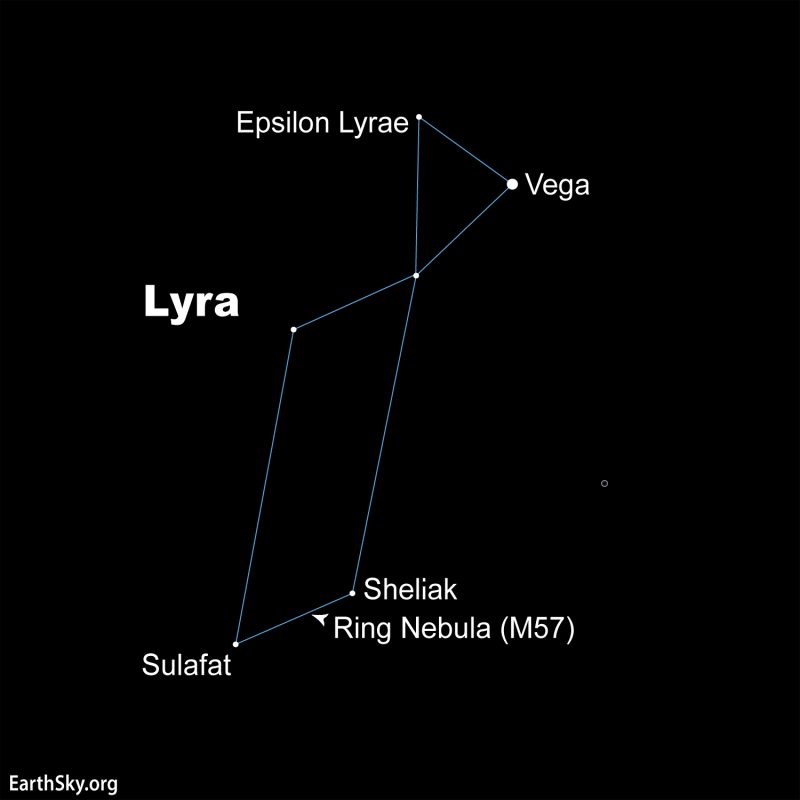
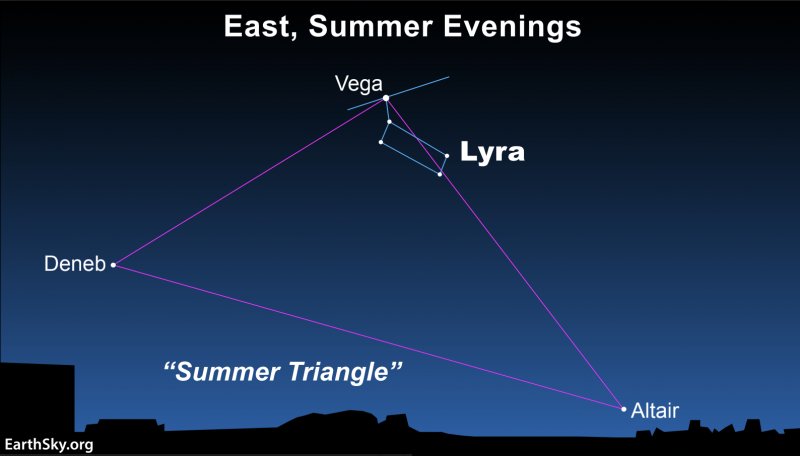
Lyra is the 52nd smallest of the 88 constellations, but it has a big presence. That’s because its brightest star Vega is the 5th brightest star in Earth’s sky, or the 2nd brightest star belonging to just the Northern Hemisphere. Vega is best known for being the corner of the famous Summer Triangle star pattern.
Lyra is described as a harp, lyre or stringed instrument. And it’s one of the constellations that Ptolemy named back in the 2nd century.
How to find Lyra in the Northern Hemisphere
The easiest way to find Lyra is to look directly overhead on summer evenings in the Northern Hemisphere. The brightest star closest to your zenith – directly overhead – on a summer night after the sky gets dark will be Vega. It will get closer to the zenith and pass through it as the evening turns to morning.
How to find Lyra in the Southern Hemisphere
Via Daniel Gaussen, Founder & Guide – Stargaze Mackenzie – New Zealand
Although Lyra is often described as a Northern Hemisphere summer constellation, it is also visible throughout much of the Southern Hemisphere during winter.
The altitude of its brightest star, Vega, depends strongly on latitude. It reaches about 39 degrees above the northern horizon from Darwin, 24 degrees from Brisbane, 17 degrees from Sydney, 13 degrees from Melbourne, and only 8 degrees from Christchurch. For reference, a fist at arm’s length covers about 10 degrees on the sky.
One of the most noticeable differences for Southern Hemisphere observers is Lyra’s orientation. Unlike the view shown in many Northern Hemisphere star charts, Vega is the lowest of Lyra’s bright stars when the constellation reaches its highest in the sky, with the rest of the harp-shaped pattern sitting higher above it. This gives Lyra a distinctly different appearance from our perspective, with the highest star being Sulafat, about 6 degrees higher than Vega.
This also places the famous Ring Nebula or M57 (more on that later) above Vega in our sky. That makes it easier to locate, despite Lyra’s generally low altitude in southern latitudes. At these elevations, the Ring Nebula can sit high enough above the denser, murkier layers of the atmosphere that it remains a viable and rewarding telescopic target.
A hotbed of double stars
Once you find Vega, wait until your eyes are dark-adjusted so that you can make out the parallelogram dangling below it if you’re in the Northern Hemisphere, or above it if you’re in the Southern Hemisphere. Then, when you look back toward Vega, can you trace out a small triangle shape attached to the parallelogram? That star making up the small triangle, and which is not part of the parallelogram, is Epsilon Lyrae. And this star holds a secret.
Epsilon Lyrae is more famously known as the Double Double. Through binoculars, this star appears as two stars. But a telescope reveals that each of these is actually another pair of stars, making a quadruple system. And in the mid-1980s, astronomers detected a 5th star in Epsilon Lyrae! This deceptive star system lies about 160 light-years away.
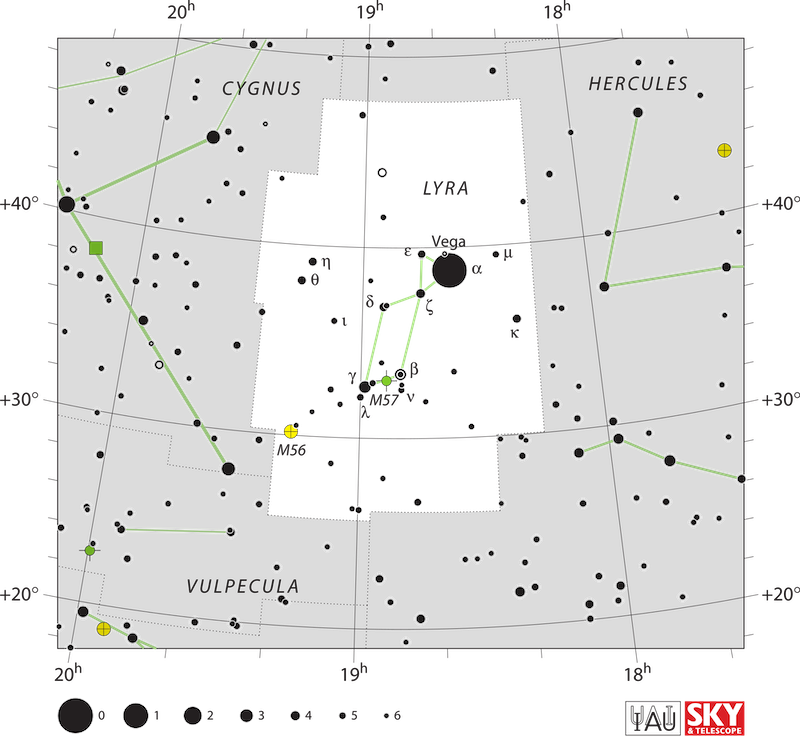
Now that we’ve met Vega (Alpha Lyrae) and Epsilon Lyrae, let’s meet the other stars in the Harp. The two stars in the parallelogram closest to Vega are the dimmer of the four stars. These two stars are both double stars. The double star directly below Vega is Zeta Lyrae. The stars in this pair have magnitudes 4.34 and 5.73. They lie just 44 arcseconds from each other and 150 light-years away from us. A telescope can easily split the pair, but a good pair of binoculars may work as well.
The next double star in the parallelogram consists of Delta 1 and 2 Lyrae. The brighter star has magnitude 4.22, and the dimmer is of magnitude 5.58. They lie 10 arcminutes from each other, so you can easily split them in binoculars. The Delta 1 and 2 stars lie 1,080 and 898 light-years away, respectively.
The rest of the stars of the Harp
Next, continuing on down to the bottom of the parallelogram, we find the stars Beta Lyrae, or Sheliak, and Sulafat, or Gamma Lyrae. Sulafat is the star farthest from Vega. It shines at magnitude 3.25 at a distance of 635 light-years. Sheliak is the last star in the parallelogram and – surprise! – it is also a double star. The main star has a magnitude of 3.52 and its companion is of magnitude 7.14. You can split this eclipsing binary in large telescopes.
Deep-sky objects in Lyra
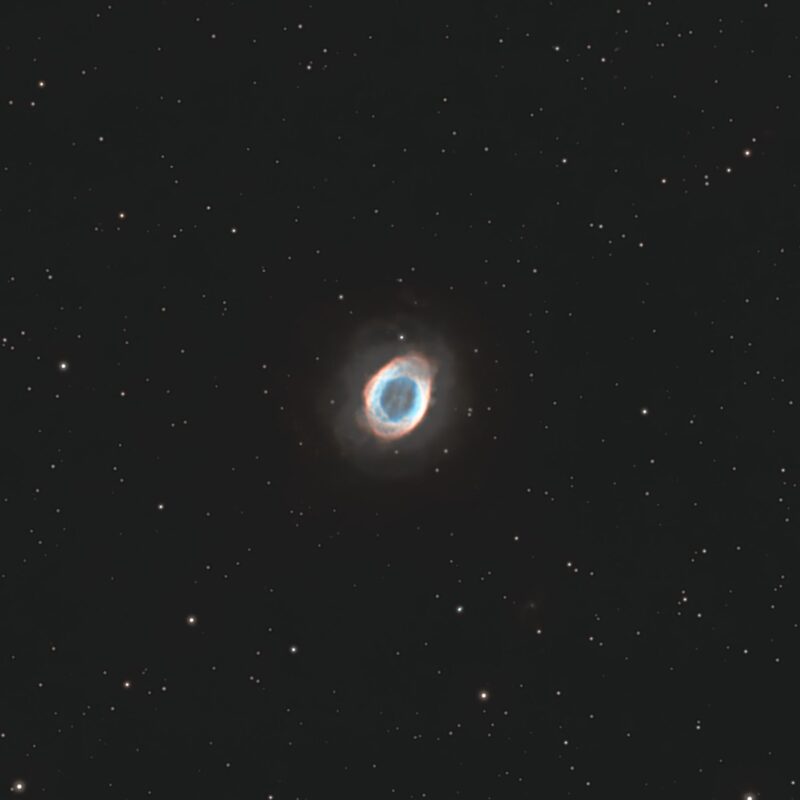
Two Messier objects reside in Lyra. The first is a famous planetary nebula known as the Ring Nebula, or M57. Without a doubt, it’s one of the most observed objects of its type in the sky. It shines at magnitude 9.0 from about 2,300 light-years away. And it’s easy to find by looking between the stars Sheliak and Sulafat, at the end of the parallelogram opposite Vega. Use a telescope to catch its beautiful, eerie oval glow.
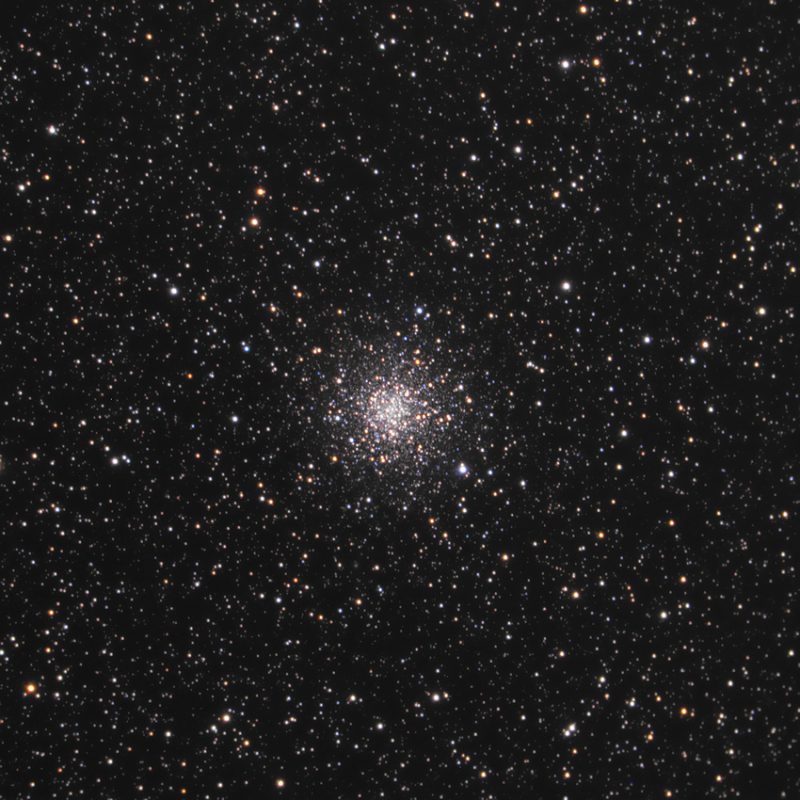
Then a little more than halfway between Sulafat and Albireo, the bright double star at the end of Cygnus, you’ll find M56, a loose globular cluster. M56 is an immense ball of stars orbiting the Milky Way, lying almost 33,000 light-years away.
Bottom line: The constellation Lyra the Harp hosts the second brightest star in the northern sky, Vega. Look for it on northern summer nights.
Read more: Apex of the sun: Look to Vega in May
The post Lyra the Harp contains Vega, a summer gem first appeared on EarthSky.
from EarthSky https://ift.tt/mjs5i4e
Lyra is the 52nd smallest of the 88 constellations, but it has a big presence. That’s because its brightest star Vega is the 5th brightest star in Earth’s sky, or the 2nd brightest star belonging to just the Northern Hemisphere. Vega is best known for being the corner of the famous Summer Triangle star pattern.
Lyra is described as a harp, lyre or stringed instrument. And it’s one of the constellations that Ptolemy named back in the 2nd century.
How to find Lyra in the Northern Hemisphere
The easiest way to find Lyra is to look directly overhead on summer evenings in the Northern Hemisphere. The brightest star closest to your zenith – directly overhead – on a summer night after the sky gets dark will be Vega. It will get closer to the zenith and pass through it as the evening turns to morning.
How to find Lyra in the Southern Hemisphere
Via Daniel Gaussen, Founder & Guide – Stargaze Mackenzie – New Zealand
Although Lyra is often described as a Northern Hemisphere summer constellation, it is also visible throughout much of the Southern Hemisphere during winter.
The altitude of its brightest star, Vega, depends strongly on latitude. It reaches about 39 degrees above the northern horizon from Darwin, 24 degrees from Brisbane, 17 degrees from Sydney, 13 degrees from Melbourne, and only 8 degrees from Christchurch. For reference, a fist at arm’s length covers about 10 degrees on the sky.
One of the most noticeable differences for Southern Hemisphere observers is Lyra’s orientation. Unlike the view shown in many Northern Hemisphere star charts, Vega is the lowest of Lyra’s bright stars when the constellation reaches its highest in the sky, with the rest of the harp-shaped pattern sitting higher above it. This gives Lyra a distinctly different appearance from our perspective, with the highest star being Sulafat, about 6 degrees higher than Vega.
This also places the famous Ring Nebula or M57 (more on that later) above Vega in our sky. That makes it easier to locate, despite Lyra’s generally low altitude in southern latitudes. At these elevations, the Ring Nebula can sit high enough above the denser, murkier layers of the atmosphere that it remains a viable and rewarding telescopic target.
A hotbed of double stars
Once you find Vega, wait until your eyes are dark-adjusted so that you can make out the parallelogram dangling below it if you’re in the Northern Hemisphere, or above it if you’re in the Southern Hemisphere. Then, when you look back toward Vega, can you trace out a small triangle shape attached to the parallelogram? That star making up the small triangle, and which is not part of the parallelogram, is Epsilon Lyrae. And this star holds a secret.
Epsilon Lyrae is more famously known as the Double Double. Through binoculars, this star appears as two stars. But a telescope reveals that each of these is actually another pair of stars, making a quadruple system. And in the mid-1980s, astronomers detected a 5th star in Epsilon Lyrae! This deceptive star system lies about 160 light-years away.
Now that we’ve met Vega (Alpha Lyrae) and Epsilon Lyrae, let’s meet the other stars in the Harp. The two stars in the parallelogram closest to Vega are the dimmer of the four stars. These two stars are both double stars. The double star directly below Vega is Zeta Lyrae. The stars in this pair have magnitudes 4.34 and 5.73. They lie just 44 arcseconds from each other and 150 light-years away from us. A telescope can easily split the pair, but a good pair of binoculars may work as well.
The next double star in the parallelogram consists of Delta 1 and 2 Lyrae. The brighter star has magnitude 4.22, and the dimmer is of magnitude 5.58. They lie 10 arcminutes from each other, so you can easily split them in binoculars. The Delta 1 and 2 stars lie 1,080 and 898 light-years away, respectively.
The rest of the stars of the Harp
Next, continuing on down to the bottom of the parallelogram, we find the stars Beta Lyrae, or Sheliak, and Sulafat, or Gamma Lyrae. Sulafat is the star farthest from Vega. It shines at magnitude 3.25 at a distance of 635 light-years. Sheliak is the last star in the parallelogram and – surprise! – it is also a double star. The main star has a magnitude of 3.52 and its companion is of magnitude 7.14. You can split this eclipsing binary in large telescopes.
Deep-sky objects in Lyra
Two Messier objects reside in Lyra. The first is a famous planetary nebula known as the Ring Nebula, or M57. Without a doubt, it’s one of the most observed objects of its type in the sky. It shines at magnitude 9.0 from about 2,300 light-years away. And it’s easy to find by looking between the stars Sheliak and Sulafat, at the end of the parallelogram opposite Vega. Use a telescope to catch its beautiful, eerie oval glow.
Then a little more than halfway between Sulafat and Albireo, the bright double star at the end of Cygnus, you’ll find M56, a loose globular cluster. M56 is an immense ball of stars orbiting the Milky Way, lying almost 33,000 light-years away.
Bottom line: The constellation Lyra the Harp hosts the second brightest star in the northern sky, Vega. Look for it on northern summer nights.
Read more: Apex of the sun: Look to Vega in May
The post Lyra the Harp contains Vega, a summer gem first appeared on EarthSky.
from EarthSky https://ift.tt/mjs5i4e

Aucun commentaire:
Enregistrer un commentaire