Why do we sleep? A new discovery might have solved the puzzle. Image via Pair Srinrat/ Shutterstock.com.
Why do we sleep? New discovery sheds light
Why do we sleep? Researchers at the University of Oxford in the U.K. claim to have cracked the mystery. On July 18, 2025, researchers said the physical mechanism causing drowsiness in animals appears to be an electrical overload.
That overload is in a component of brain cells – called mitochondria – that energize metabolism.
We set out to understand what sleep is for, and why we feel the need to sleep at all. Despite decades of research, no one had identified a clear physical trigger. Our findings show that the answer may lie in the very process that fuels our bodies: aerobic (oxygen-based) metabolism.
The need for sleep is a byproduct of how cells convert oxygen and nutrients into usable energy for the body, the research indicates. This process is the citric acid cycle. And during this process, electrons build up in mitochondria, which are a type of organelle, or subunit found in cells. Mitochondria also have the nickname of the powerhouse of the cell.
The excess electrons then “leak” into surrounding tissues. The leakage acts as a signal for the brain to initiate sleep and restore the energy imbalance. Miesenböck explained how the feedback works:
In certain sleep-regulating neurons, we discovered that mitochondria – the cell’s energy producers – leak electrons when there is an oversupply. When the leak becomes too large, these cells act like circuit breakers, tripping the system into sleep to prevent overload.
Koalas sleep away more than 18 hours of the day. We may now know why. New research says the need to sleep is caused by an electrical buildup in the body’s energy-creating cellular organelles. Image via David Clode/ Unsplash.
Preventing cells from poisoning themselves with free radicals
You don’t want your mitochondria to leak too many electrons. When they do, they generate reactive molecules that damage cells.
Reactive oxygen species are a form of free radicals, and metabolism with oxygen is a primary source in the body. According to the NIH’s National Cancer Institute, free radicals are specifically linked to cancer.
Free radicals are sometimes beneficial and sometimes damaging to cells. Learning how the body mitigates damage from electrons leaking into brain tissue could also have implications for understanding aging and neurological disorders, according to other research on the topic:
Energy metabolism, oxidative stress, and sleep – three processes implicated independently in lifespan, aging and degenerative disease – are thus mechanistically connected.
The more recent publication by the team including Sarnataro and Miesenböck puts it this way:
Sleep, like aging, may be an inescapable consequence of aerobic metabolism.
The urge to sleep might be triggered by the build-up of electrical charge in brain cells. The chemical byproducts of the overload have been further linked to aging and neurological disease. Image via Joni Stewart. Used with permission.
Studying sleep in the lab
For their research, the investigators used fruit flies as an animal model in the lab. Besides discovering a mismatch in the number of electrons entering and exiting mitochondria as the trigger for sleep, they also learned they could control the amount of sleep the flies required. They could even put them to sleep using light:
First, opening an exit route for surplus electrons … not only relieved the basal pressure to sleep but also remedied the excessive sleep need of flies whose ability to remove breakdown products … was impaired. Second, increasing the demand … for electrons … decreased sleep. And third, powering (energy) synthesis with photons rather than electrons … precipitated sleep.
Finally, the new insights into sleep could explain why larger animals live longer than smaller ones. And these discoveries could have implications for the treatment of sleep disorders and chronic fatigue:
The findings help explain well-known links between metabolism, sleep and lifespan. Smaller animals, which consume more oxygen per gram of body weight, tend to sleep more and live shorter lives. Humans with mitochondrial diseases often experience debilitating fatigue even without exertion, now potentially explained by the same mechanism.
Bottom line: Why do we sleep? Oxford researchers may have cracked the mystery. The cause appears to be an electrical buildup in the energy-creating components in our cells, the mitochondria.
Why do we sleep? A new discovery might have solved the puzzle. Image via Pair Srinrat/ Shutterstock.com.
Why do we sleep? New discovery sheds light
Why do we sleep? Researchers at the University of Oxford in the U.K. claim to have cracked the mystery. On July 18, 2025, researchers said the physical mechanism causing drowsiness in animals appears to be an electrical overload.
That overload is in a component of brain cells – called mitochondria – that energize metabolism.
We set out to understand what sleep is for, and why we feel the need to sleep at all. Despite decades of research, no one had identified a clear physical trigger. Our findings show that the answer may lie in the very process that fuels our bodies: aerobic (oxygen-based) metabolism.
The need for sleep is a byproduct of how cells convert oxygen and nutrients into usable energy for the body, the research indicates. This process is the citric acid cycle. And during this process, electrons build up in mitochondria, which are a type of organelle, or subunit found in cells. Mitochondria also have the nickname of the powerhouse of the cell.
The excess electrons then “leak” into surrounding tissues. The leakage acts as a signal for the brain to initiate sleep and restore the energy imbalance. Miesenböck explained how the feedback works:
In certain sleep-regulating neurons, we discovered that mitochondria – the cell’s energy producers – leak electrons when there is an oversupply. When the leak becomes too large, these cells act like circuit breakers, tripping the system into sleep to prevent overload.
Koalas sleep away more than 18 hours of the day. We may now know why. New research says the need to sleep is caused by an electrical buildup in the body’s energy-creating cellular organelles. Image via David Clode/ Unsplash.
Preventing cells from poisoning themselves with free radicals
You don’t want your mitochondria to leak too many electrons. When they do, they generate reactive molecules that damage cells.
Reactive oxygen species are a form of free radicals, and metabolism with oxygen is a primary source in the body. According to the NIH’s National Cancer Institute, free radicals are specifically linked to cancer.
Free radicals are sometimes beneficial and sometimes damaging to cells. Learning how the body mitigates damage from electrons leaking into brain tissue could also have implications for understanding aging and neurological disorders, according to other research on the topic:
Energy metabolism, oxidative stress, and sleep – three processes implicated independently in lifespan, aging and degenerative disease – are thus mechanistically connected.
The more recent publication by the team including Sarnataro and Miesenböck puts it this way:
Sleep, like aging, may be an inescapable consequence of aerobic metabolism.
The urge to sleep might be triggered by the build-up of electrical charge in brain cells. The chemical byproducts of the overload have been further linked to aging and neurological disease. Image via Joni Stewart. Used with permission.
Studying sleep in the lab
For their research, the investigators used fruit flies as an animal model in the lab. Besides discovering a mismatch in the number of electrons entering and exiting mitochondria as the trigger for sleep, they also learned they could control the amount of sleep the flies required. They could even put them to sleep using light:
First, opening an exit route for surplus electrons … not only relieved the basal pressure to sleep but also remedied the excessive sleep need of flies whose ability to remove breakdown products … was impaired. Second, increasing the demand … for electrons … decreased sleep. And third, powering (energy) synthesis with photons rather than electrons … precipitated sleep.
Finally, the new insights into sleep could explain why larger animals live longer than smaller ones. And these discoveries could have implications for the treatment of sleep disorders and chronic fatigue:
The findings help explain well-known links between metabolism, sleep and lifespan. Smaller animals, which consume more oxygen per gram of body weight, tend to sleep more and live shorter lives. Humans with mitochondrial diseases often experience debilitating fatigue even without exertion, now potentially explained by the same mechanism.
Bottom line: Why do we sleep? Oxford researchers may have cracked the mystery. The cause appears to be an electrical buildup in the energy-creating components in our cells, the mitochondria.
Two pelicans in flight. Image via Calin Stan/ Unsplash.
Majestic and ancient, pelicans glide across skies and coastlines with a grace that belies their size. With their enormous beaks and distinctive throat pouches, they are as iconic as waves on the sea. These birds, which have inhabited Earth for more than 30 million years, impress not only with their fishing prowess, but also with their complex social behaviors, adaptability and curious nesting habits.
Behind their unmistakable silhouette lies a fascinating evolutionary story and a communal life full of surprising strategies. To know pelicans is to glimpse a world where the wild and the sophisticated coexist in balance.
What does a pelican look like?
Pelicans are large aquatic birds, easily recognized by their massive beaks and extendable throat pouches, which they use as nets to catch fish. Depending on the species, these birds range from 3 to 6 feet (about 1 to 2 meters) in length. Their wingspan ranges from 6 to 10 feet (about 2 to 3 meters), and they weigh between 1.88 to 28.6 pounds (4 and 13 kilograms).
There are eight species of pelicans found across every continent except Antarctica. Most pelicans are light-colored (white or gray), with the exception of the brown and Peruvian pelicans.
Their legs are short but strong, with webbed feet that enable them to swim with ease. In flight, their long wings and curved necks make them unmistakable silhouettes in the sky.
Despite their large size, pelicans are excellent fliers. They can soar for long periods by riding thermal updrafts. They also fly at great altitudes (13,000 feet or 4,000 meters) and can reach speeds of up to 34 mph (55 kph).
They often fly in flocks, in V-shaped formations, which helps them conserve energy over long distances, especially during migrations.
Pelicans are equally elegant and fierce birds. Despite their size, they are agile fliers. They also possess a beak that makes it hard to miss prey. Image via Mohan Nannapaneni/ Pexels.
Their beak is an astonishing tool
The pelican’s beak is undoubtedly its most striking feature. Long and straight, it can reach up to 20 inches (50 centimeters) in length, depending on the species. But the most remarkable part is the throat pouch hanging from the lower mandible. This elastic pouch functions as a natural fishing net. When the pelican dips its head to catch fish, it opens its beak and the pouch expands to trap water and prey.
Once the beak is closed, the pelican tilts its head to drain the water and then swallows the fish whole. It can also catch fish with the tip of its beak and toss it into the air so it falls into the pouch, leaving the prey helpless and unable to escape.
Although all pelicans belong to the same family (Pelecanidae) and use their large beaks and throat pouches to catch prey, their hunting strategies vary by species and environment. For example, the brown pelican is the only one that dives from the air into the water.
In all cases, pelicans swallow fish whole, usually headfirst to prevent spines from getting stuck. This simple but effective technique makes them among the most efficient fishers in the animal kingdom. In fact, their skill seems to spark envy, as gulls often perch on pelicans’ heads to steal prey directly from their beaks.
These birds have an infallible tool: their beak. Their throat pouch opens and traps the fish. Then they filter the water and swallow their prey whole, head first. Image via Paul Sunman/ Wikipedia (CC BY-SA 4.0).
Fun facts
Although pelicans have large beaks, their tongues are tiny in comparison. Since the throat pouch does most of the work in catching and holding food, the tongue doesn’t need to be large or strong. It’s usually flat, thin and pointed, just enough to guide food down the throat when the bird tilts its head back to swallow.
Also, like many seabirds, pelicans don’t rely on taste when feeding, so their tongues lack the prominent taste buds found in mammals.
In case you were wondering … When a pelican catches a fish, it usually swallows it immediately. It doesn’t store or carry it around in its pouch. The only exception is when transporting food to regurgitate and feed its chicks. So the idea that pelicans carry food in their pouch is a myth.
Their throat pouch can hold over 3 gallons (13 liters) of water, but they drain the water before swallowing their prey. While it’s true that pelicans can drink salt water, they prefer to drink freshwater when it’s available. They have specialized salt glands in their heads that filter out excess salt from the water they drink, allowing them to survive in marine environments. These glands excrete the excess salt through their nostrils. These glands act like tiny kidneys, filtering the salt from their blood.
As for digestion, the stomach secretes gastric juices, and the small intestine absorbs nutrients. So far, so normal. But did you know that pelicans can regurgitate indigestible parts – like bones or scales – in the form of pellets?
What do pelicans eat?
These beaked birds are omnivorous, though they mainly eat fish that can be up to 12 inches (30 centimeters) long. They can also eat amphibians, crustaceans, turtles and occasionally small birds. Imagine swallowing a turtle whole, shell and all!
Pelicans’ hunting methods depend on factors like habitat, food availability and the presence of other birds or competitors. Some species hunt alone, while others do so in groups.
The brown pelican is more independent, typically hunting solo. It’s also the only one that dives into the water from the air. Other species may hunt alone occasionally but usually cooperate. When working as a team, they swim in semicircles to drive fish into shallow water, then dip their beaks in simultaneously.
It’s also common to see a female pelican teaching her chicks how to fish. Good habits start young.
These birds can hunt on their own, but it is more common for them to collaborate. Image via Marian Strinoiu/ Pexels.
Life among pelicans
Pelicans are highly social birds and live in large colonies. In the wild, they live between 15 and 20 years.
Look at that close-knit family! These birds are very sociable. Image via Mohan Nannapaneni/ Pexels.
During the breeding season, a male and female form a bond and work together to build a nest, incubate the eggs and care for the young. However, they may choose new partners in the next season.
Pelicans choose different nesting sites depending on the species. Some prefer to nest on the ground – in remote islands, beaches or wetlands – while others nest in trees, shrubs, floating vegetation or mangroves. They usually lay two eggs, and both parents help incubate them for about a month.
Afterward, the chicks are fed for up to three months. By two months, they can already walk and swim. They hatch featherless with pink skin, and as they grow, they develop black or gray feathers, until they get their definitive plumage.
Both parents incubate the eggs and take care of their young. So they are monogamous during the breeding season, but they are not monogamous for life. They usually look for a new partner every mating season. Image via Wild Spirit/ Unsplash.
Pelicans know how to flirt!
During mating season, some pelicans show color changes in their beaks and throat pouches, turning brighter shades like pink, yellow or blue, an adaptation for sexual attraction.
Additionally, some male pelicans develop a bump on the top of their beaks during mating season. This temporary crest is made of keratin (like fingernails) and disappears once breeding season ends.
Its main function is to attract females. It acts as a sexual ornament, similar to the brighter colors they display during mating season. It may also signal sexual maturity and good health.
Such temporary physical traits are not unique to pelicans, as many birds develop them during courtship, including brighter feathers or special songs.
Males can develop a crest on their beaks to get females’ attention during mating season. And they can also change the color of their beaks and pouches for the same reason. Image via Anish Lakkapragada/ Unsplash.
Conservation and ecological importance
While some species, like the American white pelican, are considered stable, others face threats due to pollution, wetland destruction and overfishing. Protecting pelicans means protecting the health of our seas and lagoons.
The pelican is more than a silhouette in the sky or a coastal figure. It’s a vital link in the ecological chain and a living symbol of the harmony between air, water and land.
Pelicans are distinctive birds with large pouches that they use to catch fish. Image via Li Yan/ Unsplash.
Bottom line: Pelicans have long, elegant necks, but also a distinctive throat pouch and deadly beak. Not even turtles can survive it … Pelicans swallow their prey in a single gulp.
Two pelicans in flight. Image via Calin Stan/ Unsplash.
Majestic and ancient, pelicans glide across skies and coastlines with a grace that belies their size. With their enormous beaks and distinctive throat pouches, they are as iconic as waves on the sea. These birds, which have inhabited Earth for more than 30 million years, impress not only with their fishing prowess, but also with their complex social behaviors, adaptability and curious nesting habits.
Behind their unmistakable silhouette lies a fascinating evolutionary story and a communal life full of surprising strategies. To know pelicans is to glimpse a world where the wild and the sophisticated coexist in balance.
What does a pelican look like?
Pelicans are large aquatic birds, easily recognized by their massive beaks and extendable throat pouches, which they use as nets to catch fish. Depending on the species, these birds range from 3 to 6 feet (about 1 to 2 meters) in length. Their wingspan ranges from 6 to 10 feet (about 2 to 3 meters), and they weigh between 1.88 to 28.6 pounds (4 and 13 kilograms).
There are eight species of pelicans found across every continent except Antarctica. Most pelicans are light-colored (white or gray), with the exception of the brown and Peruvian pelicans.
Their legs are short but strong, with webbed feet that enable them to swim with ease. In flight, their long wings and curved necks make them unmistakable silhouettes in the sky.
Despite their large size, pelicans are excellent fliers. They can soar for long periods by riding thermal updrafts. They also fly at great altitudes (13,000 feet or 4,000 meters) and can reach speeds of up to 34 mph (55 kph).
They often fly in flocks, in V-shaped formations, which helps them conserve energy over long distances, especially during migrations.
Pelicans are equally elegant and fierce birds. Despite their size, they are agile fliers. They also possess a beak that makes it hard to miss prey. Image via Mohan Nannapaneni/ Pexels.
Their beak is an astonishing tool
The pelican’s beak is undoubtedly its most striking feature. Long and straight, it can reach up to 20 inches (50 centimeters) in length, depending on the species. But the most remarkable part is the throat pouch hanging from the lower mandible. This elastic pouch functions as a natural fishing net. When the pelican dips its head to catch fish, it opens its beak and the pouch expands to trap water and prey.
Once the beak is closed, the pelican tilts its head to drain the water and then swallows the fish whole. It can also catch fish with the tip of its beak and toss it into the air so it falls into the pouch, leaving the prey helpless and unable to escape.
Although all pelicans belong to the same family (Pelecanidae) and use their large beaks and throat pouches to catch prey, their hunting strategies vary by species and environment. For example, the brown pelican is the only one that dives from the air into the water.
In all cases, pelicans swallow fish whole, usually headfirst to prevent spines from getting stuck. This simple but effective technique makes them among the most efficient fishers in the animal kingdom. In fact, their skill seems to spark envy, as gulls often perch on pelicans’ heads to steal prey directly from their beaks.
These birds have an infallible tool: their beak. Their throat pouch opens and traps the fish. Then they filter the water and swallow their prey whole, head first. Image via Paul Sunman/ Wikipedia (CC BY-SA 4.0).
Fun facts
Although pelicans have large beaks, their tongues are tiny in comparison. Since the throat pouch does most of the work in catching and holding food, the tongue doesn’t need to be large or strong. It’s usually flat, thin and pointed, just enough to guide food down the throat when the bird tilts its head back to swallow.
Also, like many seabirds, pelicans don’t rely on taste when feeding, so their tongues lack the prominent taste buds found in mammals.
In case you were wondering … When a pelican catches a fish, it usually swallows it immediately. It doesn’t store or carry it around in its pouch. The only exception is when transporting food to regurgitate and feed its chicks. So the idea that pelicans carry food in their pouch is a myth.
Their throat pouch can hold over 3 gallons (13 liters) of water, but they drain the water before swallowing their prey. While it’s true that pelicans can drink salt water, they prefer to drink freshwater when it’s available. They have specialized salt glands in their heads that filter out excess salt from the water they drink, allowing them to survive in marine environments. These glands excrete the excess salt through their nostrils. These glands act like tiny kidneys, filtering the salt from their blood.
As for digestion, the stomach secretes gastric juices, and the small intestine absorbs nutrients. So far, so normal. But did you know that pelicans can regurgitate indigestible parts – like bones or scales – in the form of pellets?
What do pelicans eat?
These beaked birds are omnivorous, though they mainly eat fish that can be up to 12 inches (30 centimeters) long. They can also eat amphibians, crustaceans, turtles and occasionally small birds. Imagine swallowing a turtle whole, shell and all!
Pelicans’ hunting methods depend on factors like habitat, food availability and the presence of other birds or competitors. Some species hunt alone, while others do so in groups.
The brown pelican is more independent, typically hunting solo. It’s also the only one that dives into the water from the air. Other species may hunt alone occasionally but usually cooperate. When working as a team, they swim in semicircles to drive fish into shallow water, then dip their beaks in simultaneously.
It’s also common to see a female pelican teaching her chicks how to fish. Good habits start young.
These birds can hunt on their own, but it is more common for them to collaborate. Image via Marian Strinoiu/ Pexels.
Life among pelicans
Pelicans are highly social birds and live in large colonies. In the wild, they live between 15 and 20 years.
Look at that close-knit family! These birds are very sociable. Image via Mohan Nannapaneni/ Pexels.
During the breeding season, a male and female form a bond and work together to build a nest, incubate the eggs and care for the young. However, they may choose new partners in the next season.
Pelicans choose different nesting sites depending on the species. Some prefer to nest on the ground – in remote islands, beaches or wetlands – while others nest in trees, shrubs, floating vegetation or mangroves. They usually lay two eggs, and both parents help incubate them for about a month.
Afterward, the chicks are fed for up to three months. By two months, they can already walk and swim. They hatch featherless with pink skin, and as they grow, they develop black or gray feathers, until they get their definitive plumage.
Both parents incubate the eggs and take care of their young. So they are monogamous during the breeding season, but they are not monogamous for life. They usually look for a new partner every mating season. Image via Wild Spirit/ Unsplash.
Pelicans know how to flirt!
During mating season, some pelicans show color changes in their beaks and throat pouches, turning brighter shades like pink, yellow or blue, an adaptation for sexual attraction.
Additionally, some male pelicans develop a bump on the top of their beaks during mating season. This temporary crest is made of keratin (like fingernails) and disappears once breeding season ends.
Its main function is to attract females. It acts as a sexual ornament, similar to the brighter colors they display during mating season. It may also signal sexual maturity and good health.
Such temporary physical traits are not unique to pelicans, as many birds develop them during courtship, including brighter feathers or special songs.
Males can develop a crest on their beaks to get females’ attention during mating season. And they can also change the color of their beaks and pouches for the same reason. Image via Anish Lakkapragada/ Unsplash.
Conservation and ecological importance
While some species, like the American white pelican, are considered stable, others face threats due to pollution, wetland destruction and overfishing. Protecting pelicans means protecting the health of our seas and lagoons.
The pelican is more than a silhouette in the sky or a coastal figure. It’s a vital link in the ecological chain and a living symbol of the harmony between air, water and land.
Pelicans are distinctive birds with large pouches that they use to catch fish. Image via Li Yan/ Unsplash.
Bottom line: Pelicans have long, elegant necks, but also a distinctive throat pouch and deadly beak. Not even turtles can survive it … Pelicans swallow their prey in a single gulp.
You’ve probably heard by now about the new interstellar object – an object from another star system – hurtling toward our sun. Earthly astronomers have named it 3I/ATLAS. It’s only the 3rd-known interstellar object to visit our solar system. The object was originally estimated to have a diameter of 20 km (12 miles). But the size of 3I/ATLAS has now been re-estimated at around 10 km (6 miles). Hear from one of the astronomers who helped refine 3I/ ATLAS’s size estimate – Colin Orion Chandler of the DiRAC Institute of the University of Washington – speaking with EarthSky’s Deborah Byrd. Watch in the player above, or on YouTube.
It’s smaller than we thought
3I/ATLAS is the 3rd-known interstellar object, following 1I/ ‘Oumuamua and 2I/Borisov. That is, its trajectory and speed reveal it as an object not from our solar system, but from another star system.
And now the size of 3I/ATLAS has been re-estimated at around 10 km (6 miles). This is still much larger than the other two interstellar objects. ‘Oumuamua’s size is thought to be about 200 meters across at its widest (if you’ll recall it has an elongated shape). And Borisov is thought to be less than a kilometer across.
Does that change what most astronomers think about this object? No. Most astronomers still think it’s an extremely old comet. To hear directly from one of the astronomers who studied it, and identified it as a comet, watch the video below.
It’s probably an old, old comet
The newly discovered interstellar object 3I/ATLAS – found on July 1 – is likely the oldest comet we’ve ever seen. It could be more than 7 billion years old, predating our solar system by more than 3 billion years! That’s according to University of Oxford astronomer Matthew Hopkins. Hear him explain in the player above, or on YouTube.
Discovery of 3I/ ATLAS
The Asteroid Terrestrial-impact Last Alert System (ATLAS) detected our new visitor on July 1, 2025. And the Minor Planet Center confirmed its interstellar nature on July 2, 2025, naming it 3I/ATLAS (or C/2025 N1). The “3I” means it’s the 3rd interstellar visitor that we’ve found.
The Hubble Space Telescope imaged the object on July 21, 2025. See the post from Bluesky below.
Hubble Space Telescope images of interstellar comet 3I/ATLAS are out! These were taken 5 hours ago. Plenty of cosmic rays peppering the images, but the comet's coma looks very nice and puffy. Best of luck to the researchers trying to write up papers for this… archive.stsci.edu/proposal_sea… ?
The object is traveling on a steep path through the Milky Way galaxy. Astronomers have analyzed its trajectory, which shows it is not swinging around the sun and heading back out into the outskirts of our solar system. Instead it’s just flying by. And their analysis suggests Comet 3I/ATLAS originated within, or at least on the border of, the Milky Way’s thick disk. This is an area of ancient stars orbiting above and below the thin galactic plane where our sun resides.
View larger. | A side-on view of the Milky Way, showing the estimated orbits of both our sun and the 3I/ATLAS comet. In this artist’s concept, 3I/ATLAS is the red dashed line, and the sun’s path is the yellow dotted line. The large extent of 3I’s orbit vertically into the outer thick disk is clear. Meanwhile, the sun stays nearer the plane of the galaxy. Image via Royal Astronomical Society/ M. Hopkins/ Otautahi-Oxford team. Base map: ESA/ Gaia/ DPAC, Stefan Payne-Wardenaar (CC BY 4.0).On the left, the interstellar object Comet 3I/ATLAS streaks across a dense star field as seen by the Gemini North telescope in Hawaii. The colors are courtesy of 3 filters: red, green and blue. On the right, an inset shows the comet’s compact coma, or cloud of gas and dust surrounding its icy nucleus. NOIRLab released this new image on July 15, 2025. Image via International Gemini Observatory/ NOIRLab/ NSF/ AURA/ K. Meech (IfA/U. Hawaii). Image processing: Jen Miller & Mahdi Zamani (NSF NOIRLab).
What we know about Comet 3I/ATLAS
Our new visitor will get its closest to the sun – at about 2 astronomical units (AU), or twice as far as Earth is from the sun – in October. As it reaches perihelion – its closest point to the sun – it will be traveling at almost 15,500 miles (25,000 kilometers) per hour.
The speedy nature of Comet 3I/ATLAS is more proof of its interstellar nature. It has to be moving at a blistering pace in order to escape the sun’s gravitational pull.
Marshall Eubanks, a physicist and VLBI radio astronomer and co-founder of Space Initiatives, said the comet will come within about 0.4 AU of Mars in October. That would make it just barely observable by the Mars Reconnaissance Orbiter.
3I/ATLAS, the white spot in the center, is approximately 42 million miles (67 million km) from the sun and will make its closest approach in late October 2025, passing just inside the orbit of Mars. It might be up to 7 miles (11 km) wide. It poses no danger to Earth, coming no closer than 150 million miles (240 million km), which is more than 1.5 astronomical units (AU, or distance from the Earth to the sun). Image via ESA.
It’s important for science
Having a visitor from another solar system is a rare opportunity for scientists, as NOIRLab said in a press release:
These visitors from faraway regions of the cosmos are valuable objects to study since they offer a tangible connection to other star systems. They carry information about the chemical elements that were present when and where they formed, which gives scientists insight into how planetary systems form at distant stars throughout our galaxy’s history, including stars that have since died out.
View at EarthSky Community Photos. | Filipp Romanov captured the interstellar object on July 2, 2025, when it was still named A11pI3Z. Filipp wrote: “I confirmed new interstellar object candidate A11pl3Z remotely using iTelescope.Net T72 (0.51-m f/6.8 reflector + CCD) in Chile.” Thank you, Filipp!
Observing the new interstellar object
From now through the beginning of September, Comet 3I/ATLAS will be in the evening sky. For the rest of September and October it will be too close to the sun to see. But by November and December the comet will be bright after just passing the sun and also out of the sun’s glare. At this point it will be a morning object, not far from Venus.
Eddie Irizarry shared maps of the location of 3I/ATLAS. Eddie said in an email to EarthSky:
Although Comet 3I/Atlas is currently dim, advanced amateur observers might be able to photograph the new visitor by taking long exposure images through a telescope.
By August, the new comet should reach magnitude 16 and gradually improve, allowing more astrophotographers to capture this rare object.
The dim space rock is currently at about magnitude 16.7.
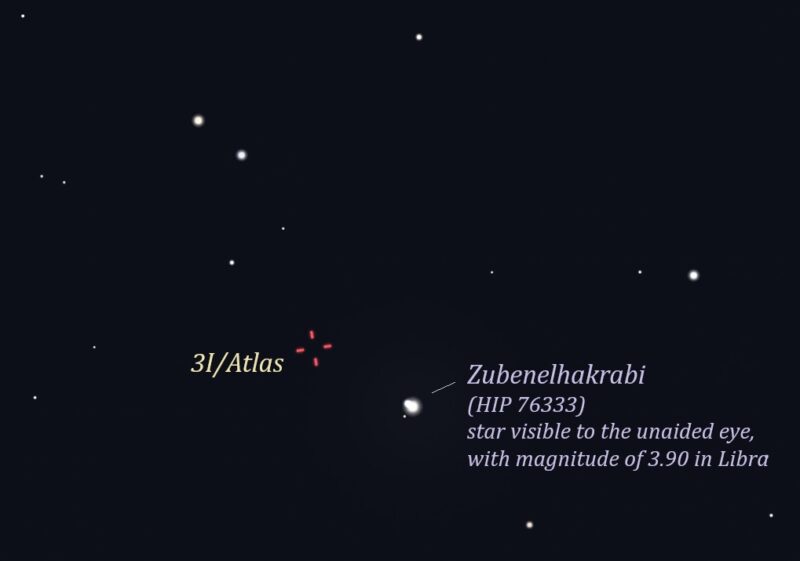
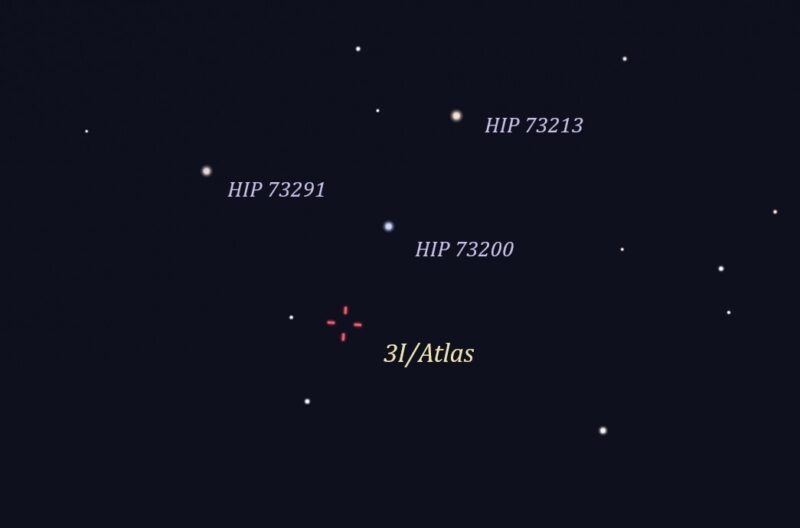
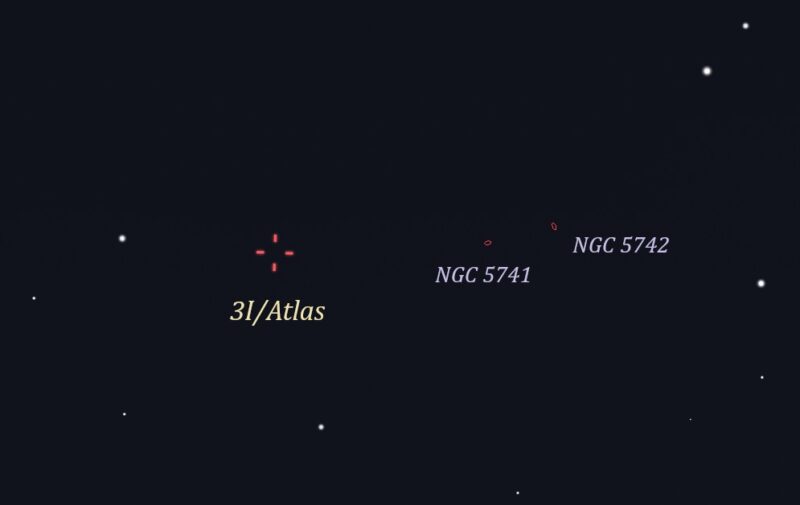
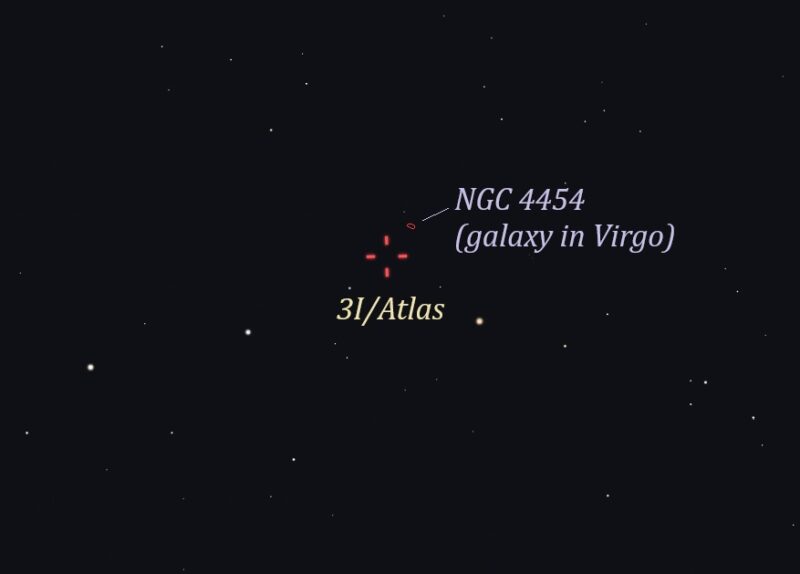
Following are star charts for those who want to search for the comet using a telescope or do astrophotography by capturing the comet close to a star or deep-sky object.
Evening star charts here
The comet will be near the star Zubenelhakrabi in Libra around 9 p.m. CDT on August 28, 2025. Image via Eddie Irizarry/ Stellarium.Comet 3I/ATLAS will be close to a trio of stars in Libra. This chart is for approximately 8:30 p.m. CDT on September 14, 2025. Image via Eddie Irizarry/ Stellarium.This charts shows the interstellar comet will be near 2 galaxies in Libra around 8:30 p.m. CDT on September 19, 2025. Image via Eddie Irizarry/ Stellarium.
Morning star charts here
After Comet 3I/ATLAS makes its close approach to the sun, you can find it in the morning sky.
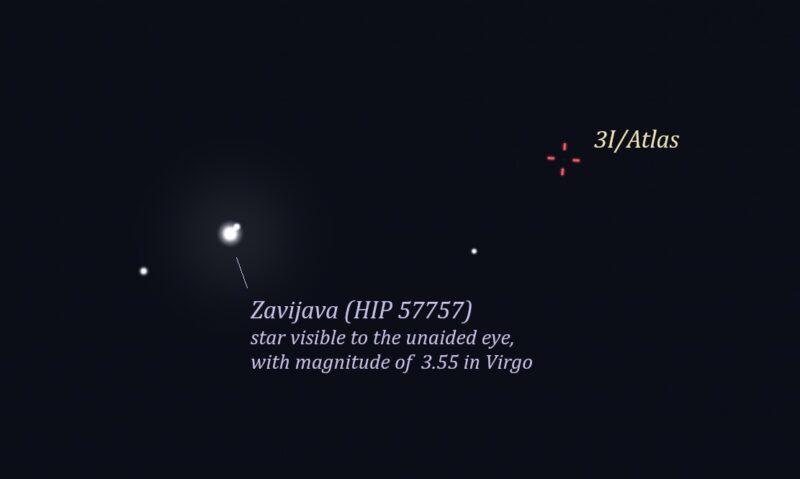
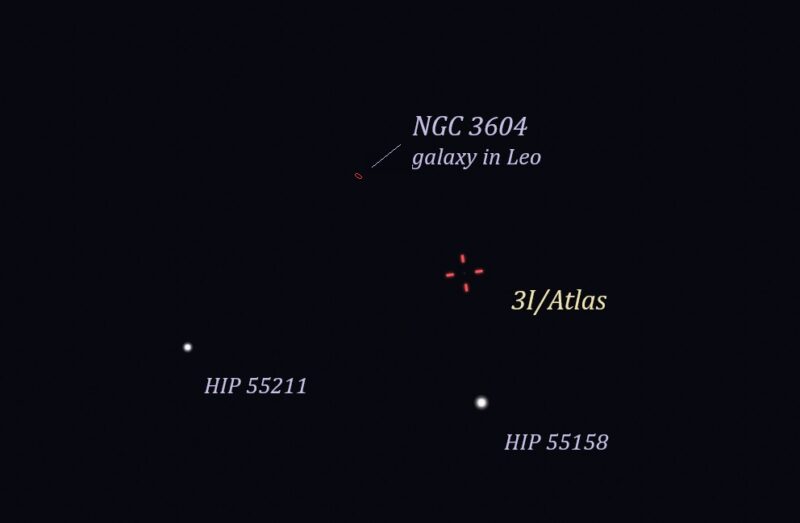
This chart is for 5 a.m. CST on November 22, 2025. On this date, the comet will pass very close to where we see galaxy NGC 4454 in Virgo. Image via Eddie Irizarry/ Stellarium.This star chart is for 5 a.m. CST on December 4, 2025. On this date Comet 3I/ATLAS will be close to the star Zavijava in Virgo. Image via Eddie Irizarry/ Stellarium.This star chart is set for around 5 a.m. CST on December 12, 2025. On that date, the comet will be close to 2 stars and a dim spiral galaxy in Leo. Image via Eddie Irizarry/ Stellarium.
Bottom line: The new interstellar visitor – 3I/ATLAS – was thought to be 20 km across. A new estimate suggests it’s half that size.
You’ve probably heard by now about the new interstellar object – an object from another star system – hurtling toward our sun. Earthly astronomers have named it 3I/ATLAS. It’s only the 3rd-known interstellar object to visit our solar system. The object was originally estimated to have a diameter of 20 km (12 miles). But the size of 3I/ATLAS has now been re-estimated at around 10 km (6 miles). Hear from one of the astronomers who helped refine 3I/ ATLAS’s size estimate – Colin Orion Chandler of the DiRAC Institute of the University of Washington – speaking with EarthSky’s Deborah Byrd. Watch in the player above, or on YouTube.
It’s smaller than we thought
3I/ATLAS is the 3rd-known interstellar object, following 1I/ ‘Oumuamua and 2I/Borisov. That is, its trajectory and speed reveal it as an object not from our solar system, but from another star system.
And now the size of 3I/ATLAS has been re-estimated at around 10 km (6 miles). This is still much larger than the other two interstellar objects. ‘Oumuamua’s size is thought to be about 200 meters across at its widest (if you’ll recall it has an elongated shape). And Borisov is thought to be less than a kilometer across.
Does that change what most astronomers think about this object? No. Most astronomers still think it’s an extremely old comet. To hear directly from one of the astronomers who studied it, and identified it as a comet, watch the video below.
It’s probably an old, old comet
The newly discovered interstellar object 3I/ATLAS – found on July 1 – is likely the oldest comet we’ve ever seen. It could be more than 7 billion years old, predating our solar system by more than 3 billion years! That’s according to University of Oxford astronomer Matthew Hopkins. Hear him explain in the player above, or on YouTube.
Discovery of 3I/ ATLAS
The Asteroid Terrestrial-impact Last Alert System (ATLAS) detected our new visitor on July 1, 2025. And the Minor Planet Center confirmed its interstellar nature on July 2, 2025, naming it 3I/ATLAS (or C/2025 N1). The “3I” means it’s the 3rd interstellar visitor that we’ve found.
The Hubble Space Telescope imaged the object on July 21, 2025. See the post from Bluesky below.
Hubble Space Telescope images of interstellar comet 3I/ATLAS are out! These were taken 5 hours ago. Plenty of cosmic rays peppering the images, but the comet's coma looks very nice and puffy. Best of luck to the researchers trying to write up papers for this… archive.stsci.edu/proposal_sea… ?
The object is traveling on a steep path through the Milky Way galaxy. Astronomers have analyzed its trajectory, which shows it is not swinging around the sun and heading back out into the outskirts of our solar system. Instead it’s just flying by. And their analysis suggests Comet 3I/ATLAS originated within, or at least on the border of, the Milky Way’s thick disk. This is an area of ancient stars orbiting above and below the thin galactic plane where our sun resides.
View larger. | A side-on view of the Milky Way, showing the estimated orbits of both our sun and the 3I/ATLAS comet. In this artist’s concept, 3I/ATLAS is the red dashed line, and the sun’s path is the yellow dotted line. The large extent of 3I’s orbit vertically into the outer thick disk is clear. Meanwhile, the sun stays nearer the plane of the galaxy. Image via Royal Astronomical Society/ M. Hopkins/ Otautahi-Oxford team. Base map: ESA/ Gaia/ DPAC, Stefan Payne-Wardenaar (CC BY 4.0).On the left, the interstellar object Comet 3I/ATLAS streaks across a dense star field as seen by the Gemini North telescope in Hawaii. The colors are courtesy of 3 filters: red, green and blue. On the right, an inset shows the comet’s compact coma, or cloud of gas and dust surrounding its icy nucleus. NOIRLab released this new image on July 15, 2025. Image via International Gemini Observatory/ NOIRLab/ NSF/ AURA/ K. Meech (IfA/U. Hawaii). Image processing: Jen Miller & Mahdi Zamani (NSF NOIRLab).
What we know about Comet 3I/ATLAS
Our new visitor will get its closest to the sun – at about 2 astronomical units (AU), or twice as far as Earth is from the sun – in October. As it reaches perihelion – its closest point to the sun – it will be traveling at almost 15,500 miles (25,000 kilometers) per hour.
The speedy nature of Comet 3I/ATLAS is more proof of its interstellar nature. It has to be moving at a blistering pace in order to escape the sun’s gravitational pull.
Marshall Eubanks, a physicist and VLBI radio astronomer and co-founder of Space Initiatives, said the comet will come within about 0.4 AU of Mars in October. That would make it just barely observable by the Mars Reconnaissance Orbiter.
3I/ATLAS, the white spot in the center, is approximately 42 million miles (67 million km) from the sun and will make its closest approach in late October 2025, passing just inside the orbit of Mars. It might be up to 7 miles (11 km) wide. It poses no danger to Earth, coming no closer than 150 million miles (240 million km), which is more than 1.5 astronomical units (AU, or distance from the Earth to the sun). Image via ESA.
It’s important for science
Having a visitor from another solar system is a rare opportunity for scientists, as NOIRLab said in a press release:
These visitors from faraway regions of the cosmos are valuable objects to study since they offer a tangible connection to other star systems. They carry information about the chemical elements that were present when and where they formed, which gives scientists insight into how planetary systems form at distant stars throughout our galaxy’s history, including stars that have since died out.
View at EarthSky Community Photos. | Filipp Romanov captured the interstellar object on July 2, 2025, when it was still named A11pI3Z. Filipp wrote: “I confirmed new interstellar object candidate A11pl3Z remotely using iTelescope.Net T72 (0.51-m f/6.8 reflector + CCD) in Chile.” Thank you, Filipp!
Observing the new interstellar object
From now through the beginning of September, Comet 3I/ATLAS will be in the evening sky. For the rest of September and October it will be too close to the sun to see. But by November and December the comet will be bright after just passing the sun and also out of the sun’s glare. At this point it will be a morning object, not far from Venus.
Eddie Irizarry shared maps of the location of 3I/ATLAS. Eddie said in an email to EarthSky:
Although Comet 3I/Atlas is currently dim, advanced amateur observers might be able to photograph the new visitor by taking long exposure images through a telescope.
By August, the new comet should reach magnitude 16 and gradually improve, allowing more astrophotographers to capture this rare object.
The dim space rock is currently at about magnitude 16.7.
Following are star charts for those who want to search for the comet using a telescope or do astrophotography by capturing the comet close to a star or deep-sky object.
Evening star charts here
The comet will be near the star Zubenelhakrabi in Libra around 9 p.m. CDT on August 28, 2025. Image via Eddie Irizarry/ Stellarium.Comet 3I/ATLAS will be close to a trio of stars in Libra. This chart is for approximately 8:30 p.m. CDT on September 14, 2025. Image via Eddie Irizarry/ Stellarium.This charts shows the interstellar comet will be near 2 galaxies in Libra around 8:30 p.m. CDT on September 19, 2025. Image via Eddie Irizarry/ Stellarium.
Morning star charts here
After Comet 3I/ATLAS makes its close approach to the sun, you can find it in the morning sky.
This chart is for 5 a.m. CST on November 22, 2025. On this date, the comet will pass very close to where we see galaxy NGC 4454 in Virgo. Image via Eddie Irizarry/ Stellarium.This star chart is for 5 a.m. CST on December 4, 2025. On this date Comet 3I/ATLAS will be close to the star Zavijava in Virgo. Image via Eddie Irizarry/ Stellarium.This star chart is set for around 5 a.m. CST on December 12, 2025. On that date, the comet will be close to 2 stars and a dim spiral galaxy in Leo. Image via Eddie Irizarry/ Stellarium.
Bottom line: The new interstellar visitor – 3I/ATLAS – was thought to be 20 km across. A new estimate suggests it’s half that size.
On July 31, 2025, the World Meteorological Organization certified a new lightning record. It’s for the world’s longest lightning flash, an incredible 829 km (515 miles) in a notorious storm hotspot in the United States. The flash happened in 2017. Watch in the player above or on YouTube.
There’s a new record for the world’s longest-recorded single lightning flash. It stretched 515 miles (829 km).
The GOES-16 satellite monitored the megaflash, which stretched from East Texas to Kansas City.
See other lightning extreme records below. The WMO Weather and Climate Extremes Archive maintains the official records.
Megaflash lightning record set in the United States
On July 31, 2025, the World Meteorological Organization (WMO) confirmed a new world record for the longest lightning flash. It was an incredible 515 miles (829 km) in a notorious storm hotspot in the United States.
The megaflash happened in October 2017, during a major thunderstorm complex. It extended from eastern Texas to near Kansas City. That’s the equivalent to the distance between Paris and Venice in Europe. It would take a car about 8 to 9 hours and a commercial plane at least 90 minutes to cover that distance.
WMO’s Committee on Weather and Climate Extremes, which maintains official records of global, hemispheric and regional extremes, recognized the new record with the help of the latest satellite technologies. The peer-reviewedBulletin of the American Meteorological Societypublished the findings on July 31, 2025.
Lightning is a source of wonder, but also a major hazard that claims many lives around the world every year and is therefore one of the priorities for the international Early Warnings for All initiative.
These new findings highlight important public safety concerns about electrified clouds, which can produce flashes that travel extremely large distances and have a major impact on the aviation sector and can spark wildfires.
A lightning bolt hundreds of miles long
There is a margin of error of plus or minus 5 miles (8 km) in the new record of 515 miles (829 km). It is 40 miles (61 km) greater than the previous record. And that record covered a distance of 477.2 ± 5 miles (768 ± 8 km) across parts of the southern United States on April 29, 2020.
The new record lightning flash occurred in one of the hotspots for Mesoscale Convective System (MCS) thunderstorms. The dynamics of these storms in the Great Plains in North America permit extraordinary megaflashes to occur.
Both the previous and new record used the same maximum great-circle distance methodology to measure flash extent. The 2017 event is notable in that it was one of the first storms where NOAA’s newest Geostationary Operational Environmental Satellite (GOES-16) documented lightning megaflashes. These megaflashes are notable as extremely long duration/distance lightning discharge events.
This particular flash was not identified in the original 2017 analysis of the storm but was discovered through a re-examination of the thunderstorm.
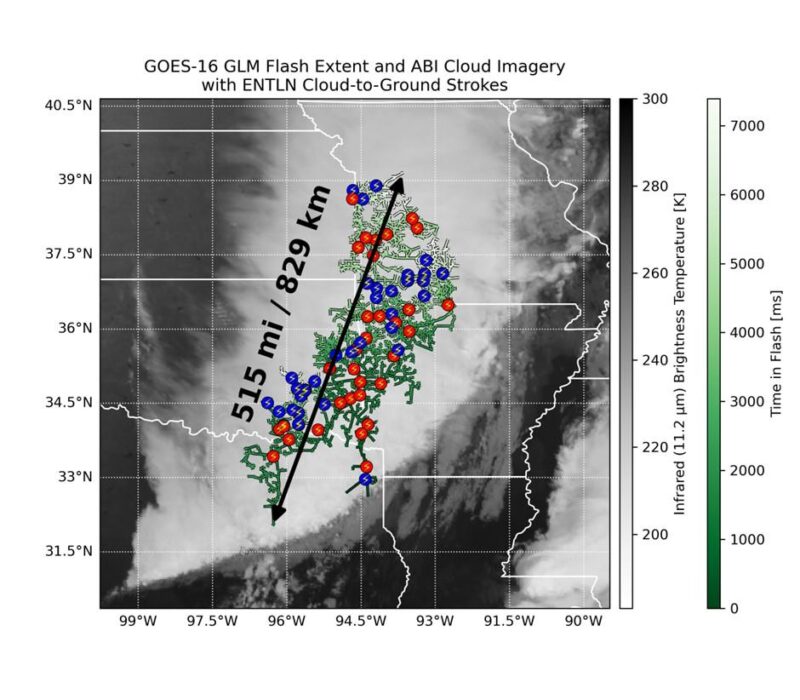
Satellite image of the record-extent lightning flash of 515 ± 5 miles (829 km ± 8 km). It extended from eastern Texas to near Kansas City, Missouri. This megaflash occurred within a thunderstorm complex on October 22, 2017. Image via WMO.
This new record clearly demonstrates the incredible power of the natural environment. Additionally, WMO assessment of environmental extremes such as this lightning distance record testify to the significant scientific progress in observing, documenting and evaluating such events. It is likely that even greater extremes still exist, and that we will be able to observe them as additional high-quality lightning measurements accumulate over time.
The WMO Archive of Weather and Climate Extremes maintains official records of the world, hemispheric and regional extreme records associated with a number of specific types of weather. Presently, the Archive lists extremes for temperature, pressure, rainfall, hail, wind and lightning as well as two specific types of storms, tornadoes and tropical cyclones.
Other previously accepted WMO lightning extremes are:
The greatest duration for a single lightning flash of 17.102 ± 0.002 seconds during a thunderstorm over Uruguay and northern Argentina on June 18, 2020.
Direct strike: 21 people killed by a single flash of lightning as they huddled for safety in a hut in Zimbabwe in 1975.
Indirect strike: 469 people killed in Dronka, Egypt, when lightning struck a set of oil tanks, causing burning oil to flood the town in 1994.
From lightning record to science insight
Lightning specialist and committee member Walt Lyons said:
Investigation of megaflashes is providing new insights into the mesoscale electrical charge variations in Mesoscale Convective System thunderstorms. Furthermore, it illustrates the threat of the newly recognized ‘bolt from the gray,’ analogous to the ‘bolt from the blue’ from isolated cells, but one that can travel many hundreds of kilometers from the main charge generating region.
The only lightning-safe locations are substantial buildings that have wiring and plumbing; not structures such as at a beach or bus stop. The second reliably safe location is inside a fully enclosed metal-topped vehicle; not dune buggies or motorcycles.
If lightning is within 10 km [6 mi] as found with reliable lightning data, go to the lightning safe building or vehicle. As these extreme cases show, lightning can arrive within seconds over a long distance, but they are embedded within larger thunderstorms, so be aware.
This is a visualization of the megaflash that extended 515 miles, or roughly the distance from Dallas, Texas, to Kansas City, Missouri. The flash now holds the record as the longest lightning discharge ever recorded. Researchers created the visualization from data provided by NASA and NOAA. Image via Michael Peterson, GTRI.
Space-based technology
The previous assessments that established the flash duration and extent records used data collected by ground-based Lightning Mapping Array (LMA) networks. Many lightning scientists acknowledged there are upper limits for the scale of lightning that any existing LMA could observe. Identifying megaflashes beyond these extremes would require a lightning mapping technology with a larger observation domain.
Recent advances in space-based lightning mapping offer the ability to measure flash extent and duration continuously over broad geospatial domains.
Lead author and evaluation committee member Michael J. Peterson of the Severe Storms Research Center (SSRC) at the Georgia Institute of Technology said:
The extremes of what lightning is capable of are difficult to study because it pushes the boundaries of what we can practically observe. Adding continuous measurements from geostationary orbit was a major advance. We are now at a point where most of the global megaflash hotspots are covered by a geostationary satellite. And data processing techniques have improved to properly represent flashes in the vast quantity of observational data at all scales.
Over time as the data record continues to expand, we will be able to observe even the rarest types of extreme lightning on Earth and investigate the broad impacts of lightning on society.
Bottom line: On July 31, 2025, the World Meteorological Organization certified a new lightning record. It’s for the longest lightning bolt, at 515 miles (829 km), which occurred in 2017.
On July 31, 2025, the World Meteorological Organization certified a new lightning record. It’s for the world’s longest lightning flash, an incredible 829 km (515 miles) in a notorious storm hotspot in the United States. The flash happened in 2017. Watch in the player above or on YouTube.
There’s a new record for the world’s longest-recorded single lightning flash. It stretched 515 miles (829 km).
The GOES-16 satellite monitored the megaflash, which stretched from East Texas to Kansas City.
See other lightning extreme records below. The WMO Weather and Climate Extremes Archive maintains the official records.
Megaflash lightning record set in the United States
On July 31, 2025, the World Meteorological Organization (WMO) confirmed a new world record for the longest lightning flash. It was an incredible 515 miles (829 km) in a notorious storm hotspot in the United States.
The megaflash happened in October 2017, during a major thunderstorm complex. It extended from eastern Texas to near Kansas City. That’s the equivalent to the distance between Paris and Venice in Europe. It would take a car about 8 to 9 hours and a commercial plane at least 90 minutes to cover that distance.
WMO’s Committee on Weather and Climate Extremes, which maintains official records of global, hemispheric and regional extremes, recognized the new record with the help of the latest satellite technologies. The peer-reviewedBulletin of the American Meteorological Societypublished the findings on July 31, 2025.
Lightning is a source of wonder, but also a major hazard that claims many lives around the world every year and is therefore one of the priorities for the international Early Warnings for All initiative.
These new findings highlight important public safety concerns about electrified clouds, which can produce flashes that travel extremely large distances and have a major impact on the aviation sector and can spark wildfires.
A lightning bolt hundreds of miles long
There is a margin of error of plus or minus 5 miles (8 km) in the new record of 515 miles (829 km). It is 40 miles (61 km) greater than the previous record. And that record covered a distance of 477.2 ± 5 miles (768 ± 8 km) across parts of the southern United States on April 29, 2020.
The new record lightning flash occurred in one of the hotspots for Mesoscale Convective System (MCS) thunderstorms. The dynamics of these storms in the Great Plains in North America permit extraordinary megaflashes to occur.
Both the previous and new record used the same maximum great-circle distance methodology to measure flash extent. The 2017 event is notable in that it was one of the first storms where NOAA’s newest Geostationary Operational Environmental Satellite (GOES-16) documented lightning megaflashes. These megaflashes are notable as extremely long duration/distance lightning discharge events.
This particular flash was not identified in the original 2017 analysis of the storm but was discovered through a re-examination of the thunderstorm.
Satellite image of the record-extent lightning flash of 515 ± 5 miles (829 km ± 8 km). It extended from eastern Texas to near Kansas City, Missouri. This megaflash occurred within a thunderstorm complex on October 22, 2017. Image via WMO.
This new record clearly demonstrates the incredible power of the natural environment. Additionally, WMO assessment of environmental extremes such as this lightning distance record testify to the significant scientific progress in observing, documenting and evaluating such events. It is likely that even greater extremes still exist, and that we will be able to observe them as additional high-quality lightning measurements accumulate over time.
The WMO Archive of Weather and Climate Extremes maintains official records of the world, hemispheric and regional extreme records associated with a number of specific types of weather. Presently, the Archive lists extremes for temperature, pressure, rainfall, hail, wind and lightning as well as two specific types of storms, tornadoes and tropical cyclones.
Other previously accepted WMO lightning extremes are:
The greatest duration for a single lightning flash of 17.102 ± 0.002 seconds during a thunderstorm over Uruguay and northern Argentina on June 18, 2020.
Direct strike: 21 people killed by a single flash of lightning as they huddled for safety in a hut in Zimbabwe in 1975.
Indirect strike: 469 people killed in Dronka, Egypt, when lightning struck a set of oil tanks, causing burning oil to flood the town in 1994.
From lightning record to science insight
Lightning specialist and committee member Walt Lyons said:
Investigation of megaflashes is providing new insights into the mesoscale electrical charge variations in Mesoscale Convective System thunderstorms. Furthermore, it illustrates the threat of the newly recognized ‘bolt from the gray,’ analogous to the ‘bolt from the blue’ from isolated cells, but one that can travel many hundreds of kilometers from the main charge generating region.
The only lightning-safe locations are substantial buildings that have wiring and plumbing; not structures such as at a beach or bus stop. The second reliably safe location is inside a fully enclosed metal-topped vehicle; not dune buggies or motorcycles.
If lightning is within 10 km [6 mi] as found with reliable lightning data, go to the lightning safe building or vehicle. As these extreme cases show, lightning can arrive within seconds over a long distance, but they are embedded within larger thunderstorms, so be aware.
This is a visualization of the megaflash that extended 515 miles, or roughly the distance from Dallas, Texas, to Kansas City, Missouri. The flash now holds the record as the longest lightning discharge ever recorded. Researchers created the visualization from data provided by NASA and NOAA. Image via Michael Peterson, GTRI.
Space-based technology
The previous assessments that established the flash duration and extent records used data collected by ground-based Lightning Mapping Array (LMA) networks. Many lightning scientists acknowledged there are upper limits for the scale of lightning that any existing LMA could observe. Identifying megaflashes beyond these extremes would require a lightning mapping technology with a larger observation domain.
Recent advances in space-based lightning mapping offer the ability to measure flash extent and duration continuously over broad geospatial domains.
Lead author and evaluation committee member Michael J. Peterson of the Severe Storms Research Center (SSRC) at the Georgia Institute of Technology said:
The extremes of what lightning is capable of are difficult to study because it pushes the boundaries of what we can practically observe. Adding continuous measurements from geostationary orbit was a major advance. We are now at a point where most of the global megaflash hotspots are covered by a geostationary satellite. And data processing techniques have improved to properly represent flashes in the vast quantity of observational data at all scales.
Over time as the data record continues to expand, we will be able to observe even the rarest types of extreme lightning on Earth and investigate the broad impacts of lightning on society.
Bottom line: On July 31, 2025, the World Meteorological Organization certified a new lightning record. It’s for the longest lightning bolt, at 515 miles (829 km), which occurred in 2017.
A variety of potatoes and tomatoes from a grocery store. According to a new study, potatoes descended from a wild tomato plant and a type of potato-like plant called etuberosum. Image via Shireen Gonzaga.
Potatoes descended in part from wild tomatoes about 9 million years ago.
Genetic studies show modern potatoes carry DNA from a tomato ancestor.
The development of tubers helped early potatoes survive harsh environments, leading to their widespread adaptation and species diversity.
Potatoes and tomatoes linked in evolution
Potatoes and tomatoes don’t look alike or taste alike. One is a starchy root used to make our favorite comfort foods, like French fries and mashed potatoes. The other grows on a bush and has diverse uses in cooking around the world. But surprise! A new genetic study reveals that the potato plant, which evolved 9 million years ago, arose as a new species created from the hybridization of a tomato plant and a plant called etuberosum.
Our findings show how a hybridization event between species can spark the evolution of new traits, allowing even more species to emerge. We’ve finally solved the mystery of where potatoes came from.
The researchers published their finding in the peer-reviewed journal Cell on July 31, 2025.
A wild tomato plant interbred with a potato-like species
Potatoes (Solanum tuberosum) are among the most important staple crops in the world. They were domesticated about 7,000 to 10,000 years ago in Peru and Bolivia. Then, in the late 16th century, potatoes were introduced to Europe by Spanish conquistadors that invaded Peru. From there, potatoes gradually spread around the world.
But the origin of potato plants had long puzzled scientists.
Modern potato plants appear similar to three potato-like plants called etuberosum, found in Chile. They look like potato plants but don’t have tubers, large roots that hold starch.
According to this new study, etuberosums and wild tomatoes arose from a common ancestor about 14 million years ago. For five million years, they diverged to create different species.
Then, about 9 million years ago, a wild tomato and an etuberosum interbred to create a new species, the first potato plant that had starchy tubers.
The left image shows a potato-like plant that does not have tubers. On the right is an image of a potato plant with tubers. Image via Yuxin Jia and Pei Wang/ Eurekalert.
Tracing the origins potatoes
The scientists studied the genomes – the genetic information in organisms – of 450 cultivated modern potato varieties. They also looked at the genome of 56 wild potato species, some that are ancestors of the cultivated potatoes we eat today.
This figure illustrates the hybridization of wild tomato and etuberosum to create a potato plant, followed by the diversification of potatoes. Image via Z. Zhang, et al./ Cell (CC BY 4.0)
Every potato they sampled had a balanced mix of genetic material from etuberosum and tomato plants. This indicated that potatoes arose from a hybrid of these two plants.
In addition, they found a gene called SP6A. This gene functioned as a master switch that instructed the plant to create tubers. Interestingly, SP6A came from the tomato parent. Another gene called IT1 controlled the formation of tubers, and it came from the etuberosum parent. Both these genes, one from each parent, are responsible for the starchy tubers in potato plants.
Early potatoes adapted well to a changing environment
Not long after potato plants emerged, the Andes mountains experienced a growth spurt, about six to ten million years ago. This upheaval created ecological changes in the region.
Early potatoes, with their ability to store nutrients in tubers, were able to survive in the resulting harsh environments.
Another advantage held by potatoes is that the tubers could reproduce without the need for pollination; potatoes did not need seeds to spread. They could simply sprout new plants from the tubers.
As a result of these traits, early potato plants were able to occupy diverse ecosystems from mild-temperature grasslands to cold alpine meadows of Central America and South America.
Huang commented:
Evolving a tuber gave potatoes a huge advantage in harsh environments, fueling an explosion of new species and contributing to the rich diversity of potatoes we see and rely on today.
Tiina Särkinen, a paper co-author, said in a statement released by the Natural History Museum, London:
These results make us look at our humble potato in a very different light: the potato and all its wild relatives came to exist thanks to a chance encounter of two very different individuals. That’s actually quite romantic. The origin of many of our species isn’t a simple story, and it’s very exciting that we can now discover these tangled, complex origins thanks to the wealth of genomic data.
Bottom line: A new study suggests that potatoes and tomatoes are linked evolutionarily, from a combination of genes 9 million years ago.
A variety of potatoes and tomatoes from a grocery store. According to a new study, potatoes descended from a wild tomato plant and a type of potato-like plant called etuberosum. Image via Shireen Gonzaga.
Potatoes descended in part from wild tomatoes about 9 million years ago.
Genetic studies show modern potatoes carry DNA from a tomato ancestor.
The development of tubers helped early potatoes survive harsh environments, leading to their widespread adaptation and species diversity.
Potatoes and tomatoes linked in evolution
Potatoes and tomatoes don’t look alike or taste alike. One is a starchy root used to make our favorite comfort foods, like French fries and mashed potatoes. The other grows on a bush and has diverse uses in cooking around the world. But surprise! A new genetic study reveals that the potato plant, which evolved 9 million years ago, arose as a new species created from the hybridization of a tomato plant and a plant called etuberosum.
Our findings show how a hybridization event between species can spark the evolution of new traits, allowing even more species to emerge. We’ve finally solved the mystery of where potatoes came from.
The researchers published their finding in the peer-reviewed journal Cell on July 31, 2025.
A wild tomato plant interbred with a potato-like species
Potatoes (Solanum tuberosum) are among the most important staple crops in the world. They were domesticated about 7,000 to 10,000 years ago in Peru and Bolivia. Then, in the late 16th century, potatoes were introduced to Europe by Spanish conquistadors that invaded Peru. From there, potatoes gradually spread around the world.
But the origin of potato plants had long puzzled scientists.
Modern potato plants appear similar to three potato-like plants called etuberosum, found in Chile. They look like potato plants but don’t have tubers, large roots that hold starch.
According to this new study, etuberosums and wild tomatoes arose from a common ancestor about 14 million years ago. For five million years, they diverged to create different species.
Then, about 9 million years ago, a wild tomato and an etuberosum interbred to create a new species, the first potato plant that had starchy tubers.
The left image shows a potato-like plant that does not have tubers. On the right is an image of a potato plant with tubers. Image via Yuxin Jia and Pei Wang/ Eurekalert.
Tracing the origins potatoes
The scientists studied the genomes – the genetic information in organisms – of 450 cultivated modern potato varieties. They also looked at the genome of 56 wild potato species, some that are ancestors of the cultivated potatoes we eat today.
This figure illustrates the hybridization of wild tomato and etuberosum to create a potato plant, followed by the diversification of potatoes. Image via Z. Zhang, et al./ Cell (CC BY 4.0)
Every potato they sampled had a balanced mix of genetic material from etuberosum and tomato plants. This indicated that potatoes arose from a hybrid of these two plants.
In addition, they found a gene called SP6A. This gene functioned as a master switch that instructed the plant to create tubers. Interestingly, SP6A came from the tomato parent. Another gene called IT1 controlled the formation of tubers, and it came from the etuberosum parent. Both these genes, one from each parent, are responsible for the starchy tubers in potato plants.
Early potatoes adapted well to a changing environment
Not long after potato plants emerged, the Andes mountains experienced a growth spurt, about six to ten million years ago. This upheaval created ecological changes in the region.
Early potatoes, with their ability to store nutrients in tubers, were able to survive in the resulting harsh environments.
Another advantage held by potatoes is that the tubers could reproduce without the need for pollination; potatoes did not need seeds to spread. They could simply sprout new plants from the tubers.
As a result of these traits, early potato plants were able to occupy diverse ecosystems from mild-temperature grasslands to cold alpine meadows of Central America and South America.
Huang commented:
Evolving a tuber gave potatoes a huge advantage in harsh environments, fueling an explosion of new species and contributing to the rich diversity of potatoes we see and rely on today.
Tiina Särkinen, a paper co-author, said in a statement released by the Natural History Museum, London:
These results make us look at our humble potato in a very different light: the potato and all its wild relatives came to exist thanks to a chance encounter of two very different individuals. That’s actually quite romantic. The origin of many of our species isn’t a simple story, and it’s very exciting that we can now discover these tangled, complex origins thanks to the wealth of genomic data.
Bottom line: A new study suggests that potatoes and tomatoes are linked evolutionarily, from a combination of genes 9 million years ago.
Watch this video of some of our editors’ picks for the best deep-sky photos of July 2025, and then see more below!
Stunning deep-sky photos from our community
The EarthSky community has many talented astrophotographers who capture stunning images of the deep sky. We gathered some of our favorite deep-sky photos we received in July 2025 for you to enjoy. Do you have some of your own images to share? You can submit them to us here. We love to see them!
Deep-sky photos of diffuse nebulae
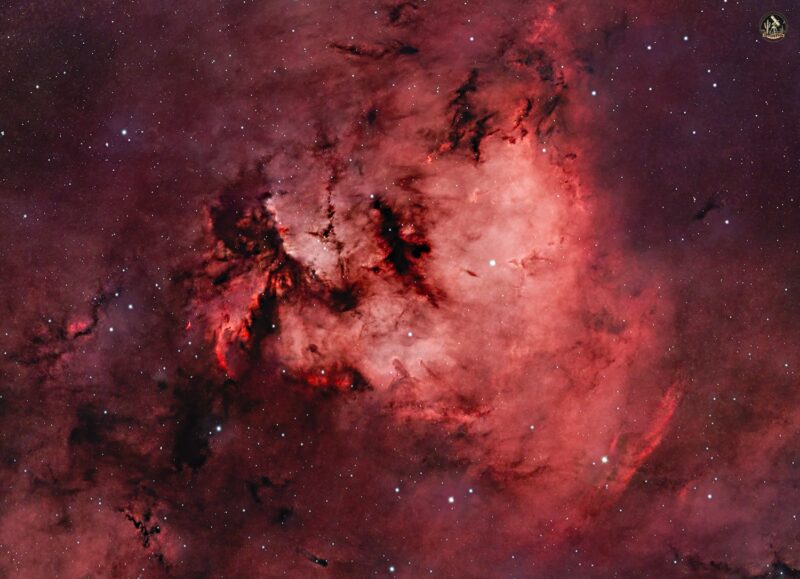
View at EarthSky Community Photos. | Jelieta Walinski at Desert Bloom Observatory in St. David, Arizona, captured the Phantom of the Opera Nebula on June 21, 2025. Jelieta wrote: “Gazing into the cosmos, we find ourselves face-to-face with SH2-171, a captivating emission nebula. It lies approximately 4,800 light-years away in the constellation Cepheus. This nebula’s ghostly visage is formed by ionized gas and dust, illuminated by the intense radiation of nearby stars. Its eerie, mask-like shape has captivated astronomers and stargazers alike, earning it a spot among the most striking nebulae in the night sky.” Thank you, Jelieta!View at EarthSky Community Photos. | Rui Santos in Amor, Leiria, Portugal, captured the Iris Nebula in the constellation Cepheus on July 27, 2025. Rui wrote: “21 hours of exposure. 4 nights under the sky with the telescope. Thousands of frames. The result? The deepest image I’ve ever managed to capture, one of the most beautiful reflection nebulae in the Milky Way.” Thank you, Rui!View at EarthSky Community Photos. | Martin Curran in Cheyenne, Wyoming, captured Barnard 174 on July 27, 2025. Martin wrote: “Barnard 174 is an outstanding dark nebula in Cepheus. It sits among a bright and colorful background, and the stars around it have beautiful halos that really add contrast to the image.” Thank you, Martin!
Deep-sky photos of Cygnus
View at EarthSky Community Photos. | Ernest Jacobs in Eden, New York, captured nebulae around the star Sadr, in the constellation Cygnus, on July 18, 2025. Ernest wrote: “This wide-field look into the Sadr region in Cygnus captures multiple objects in the frame. IC 1318 (Gamma Cygni Nebula), NGC 6888 (the Crescent Nebula), M29 (an open cluster), DWB 111/119 (the Propeller Nebula), plus many more objects. Such a rich and beautiful part of the night sky.” Thank you, Ernest!View at EarthSky Community Photos. | Andy Dungan near Cotopaxi, Colorado, caught diffuse nebulae in the constellations Cygnus and Cepheus on July 28, 2025. Andy wrote: “If you zoom in on the image you can see the Crescent and Cocoon nebulae located directly above the capital C. By the way, the Elephant Trunk nebula is located in Cepheus.” Thank you, Andy!
Veil nebula
View at EarthSky Community Photos. | Tom Cofer in Lakewood Ranch, Florida, captured the Veil Nebula on July 7, 2025. Tom wrote: “This tangled tapestry of cosmic filaments is the colorful wreckage of a star that exploded thousands of years ago. The red and blue wisps are shockwaves plowing through space at over a million miles per hour … space is not as quiet as it looks! If you stare long enough, it almost feels like the universe is showing off just a little.” Thank you, Tom!View at EarthSky Community Photos. | Steven Bellavia in Smithfield, Virginia, caught the Eastern Veil Nebula on July 5, 2025. Steven wrote: “The Eastern Veil is part of a cloud of heated and ionized gas and dust that formed when a star 20 times more massive than the sun exploded. This supernova remnant has expanded to cover an area of the sky roughly 3 degrees in diameter (6 times the full moon). It is 2,400 light-years distant.” Thank you, Steven!View at EarthSky Community Photos. | Tameem Altameemi in the United Arab Emirates (UAE) caught the Veil Nebula Complex on July 25, 2025. Tameem wrote: “Known for its delicate filaments and colorful ionized gas structures, the Veil is a favorite target among astrophotographers.” Thank you, Tameem!
Star clusters
View at EarthSky Community Photos. | Gwen Forrester in DeKalb County, Tennessee, caught the globular star cluster Messier 22 on July 2, 2025. Gwen wrote: “Messier 22, the Great Sagittarius Globular Cluster. 100,000 stars, 80 light-years across, 10,000 light-years away. This was the first deep-space object I came across randomly when I first started browsing around with a telescope. I could only barely see it, as a faint, ghostly patch of light, but I immediately knew it was something special. I always love coming back to it.” Thank you, Gwen!View at EarthSky Community Photos. | Guido Santacana in San Juan, Puerto Rico, captured the Hercules Cluster on July 20, 2025. Guido wrote: “A telescopic view of Messier 13, the Great Cluster in Hercules. This is the brightest globular cluster in the northern celestial hemisphere, containing at least 300,000 stars.” Thank you, Guido!
The Pinwheel Galaxy
View at EarthSky Community Photos. | EarthSky’s own Marcy Curran in Cheyenne, Wyoming, captured the Pinwheel Galaxy on July 1, 2025. Marcy wrote: “The Pinwheel Galaxy (M101) is a face-on, counterclockwise intermediate spiral galaxy. It’s 21 million light-years from Earth in the constellation Ursa Major. It has a diameter of approximately 252,000 light-years and contains around one trillion stars. Pierre Méchain discovered it in 1781. Then Charles Messier verified its position before adding it to his Messier Catalog. It was 101 out of 110 deep-sky objects. The beautiful Pinwheel Galaxy is a near-perfect representation of a spiral galaxy.” Thank you, Marcy!
And a supernova in a distant galaxy
View at EarthSky Community Photos. | Eliot Herman of Tucson, Arizona, used a remote telescope in Chile to capture Supernova 2025rbs (in galaxy NGC 7331) on July 18, 2025. Eliot wrote: “A new type Ia supernova in NGC 7331, a well-studied galaxy. There have been prior supernovas observed in this galaxy.” Thank you, Eliot!
Bottom line: Enjoy this gallery of deep-sky photos for July 2025 from our EarthSky community. If you have a great photo to share, send it in, too. We love to see them!
Watch this video of some of our editors’ picks for the best deep-sky photos of July 2025, and then see more below!
Stunning deep-sky photos from our community
The EarthSky community has many talented astrophotographers who capture stunning images of the deep sky. We gathered some of our favorite deep-sky photos we received in July 2025 for you to enjoy. Do you have some of your own images to share? You can submit them to us here. We love to see them!
Deep-sky photos of diffuse nebulae
View at EarthSky Community Photos. | Jelieta Walinski at Desert Bloom Observatory in St. David, Arizona, captured the Phantom of the Opera Nebula on June 21, 2025. Jelieta wrote: “Gazing into the cosmos, we find ourselves face-to-face with SH2-171, a captivating emission nebula. It lies approximately 4,800 light-years away in the constellation Cepheus. This nebula’s ghostly visage is formed by ionized gas and dust, illuminated by the intense radiation of nearby stars. Its eerie, mask-like shape has captivated astronomers and stargazers alike, earning it a spot among the most striking nebulae in the night sky.” Thank you, Jelieta!View at EarthSky Community Photos. | Rui Santos in Amor, Leiria, Portugal, captured the Iris Nebula in the constellation Cepheus on July 27, 2025. Rui wrote: “21 hours of exposure. 4 nights under the sky with the telescope. Thousands of frames. The result? The deepest image I’ve ever managed to capture, one of the most beautiful reflection nebulae in the Milky Way.” Thank you, Rui!View at EarthSky Community Photos. | Martin Curran in Cheyenne, Wyoming, captured Barnard 174 on July 27, 2025. Martin wrote: “Barnard 174 is an outstanding dark nebula in Cepheus. It sits among a bright and colorful background, and the stars around it have beautiful halos that really add contrast to the image.” Thank you, Martin!
Deep-sky photos of Cygnus
View at EarthSky Community Photos. | Ernest Jacobs in Eden, New York, captured nebulae around the star Sadr, in the constellation Cygnus, on July 18, 2025. Ernest wrote: “This wide-field look into the Sadr region in Cygnus captures multiple objects in the frame. IC 1318 (Gamma Cygni Nebula), NGC 6888 (the Crescent Nebula), M29 (an open cluster), DWB 111/119 (the Propeller Nebula), plus many more objects. Such a rich and beautiful part of the night sky.” Thank you, Ernest!View at EarthSky Community Photos. | Andy Dungan near Cotopaxi, Colorado, caught diffuse nebulae in the constellations Cygnus and Cepheus on July 28, 2025. Andy wrote: “If you zoom in on the image you can see the Crescent and Cocoon nebulae located directly above the capital C. By the way, the Elephant Trunk nebula is located in Cepheus.” Thank you, Andy!
Veil nebula
View at EarthSky Community Photos. | Tom Cofer in Lakewood Ranch, Florida, captured the Veil Nebula on July 7, 2025. Tom wrote: “This tangled tapestry of cosmic filaments is the colorful wreckage of a star that exploded thousands of years ago. The red and blue wisps are shockwaves plowing through space at over a million miles per hour … space is not as quiet as it looks! If you stare long enough, it almost feels like the universe is showing off just a little.” Thank you, Tom!View at EarthSky Community Photos. | Steven Bellavia in Smithfield, Virginia, caught the Eastern Veil Nebula on July 5, 2025. Steven wrote: “The Eastern Veil is part of a cloud of heated and ionized gas and dust that formed when a star 20 times more massive than the sun exploded. This supernova remnant has expanded to cover an area of the sky roughly 3 degrees in diameter (6 times the full moon). It is 2,400 light-years distant.” Thank you, Steven!View at EarthSky Community Photos. | Tameem Altameemi in the United Arab Emirates (UAE) caught the Veil Nebula Complex on July 25, 2025. Tameem wrote: “Known for its delicate filaments and colorful ionized gas structures, the Veil is a favorite target among astrophotographers.” Thank you, Tameem!
Star clusters
View at EarthSky Community Photos. | Gwen Forrester in DeKalb County, Tennessee, caught the globular star cluster Messier 22 on July 2, 2025. Gwen wrote: “Messier 22, the Great Sagittarius Globular Cluster. 100,000 stars, 80 light-years across, 10,000 light-years away. This was the first deep-space object I came across randomly when I first started browsing around with a telescope. I could only barely see it, as a faint, ghostly patch of light, but I immediately knew it was something special. I always love coming back to it.” Thank you, Gwen!View at EarthSky Community Photos. | Guido Santacana in San Juan, Puerto Rico, captured the Hercules Cluster on July 20, 2025. Guido wrote: “A telescopic view of Messier 13, the Great Cluster in Hercules. This is the brightest globular cluster in the northern celestial hemisphere, containing at least 300,000 stars.” Thank you, Guido!
The Pinwheel Galaxy
View at EarthSky Community Photos. | EarthSky’s own Marcy Curran in Cheyenne, Wyoming, captured the Pinwheel Galaxy on July 1, 2025. Marcy wrote: “The Pinwheel Galaxy (M101) is a face-on, counterclockwise intermediate spiral galaxy. It’s 21 million light-years from Earth in the constellation Ursa Major. It has a diameter of approximately 252,000 light-years and contains around one trillion stars. Pierre Méchain discovered it in 1781. Then Charles Messier verified its position before adding it to his Messier Catalog. It was 101 out of 110 deep-sky objects. The beautiful Pinwheel Galaxy is a near-perfect representation of a spiral galaxy.” Thank you, Marcy!
And a supernova in a distant galaxy
View at EarthSky Community Photos. | Eliot Herman of Tucson, Arizona, used a remote telescope in Chile to capture Supernova 2025rbs (in galaxy NGC 7331) on July 18, 2025. Eliot wrote: “A new type Ia supernova in NGC 7331, a well-studied galaxy. There have been prior supernovas observed in this galaxy.” Thank you, Eliot!
Bottom line: Enjoy this gallery of deep-sky photos for July 2025 from our EarthSky community. If you have a great photo to share, send it in, too. We love to see them!
On August 12, brilliant Venus and bright Jupiter make a dynamic duo as they pass close to each other in the morning sky. They’ll create a spectacular scene in the east before sunrise. At their closest, they’ll be less than 1 degree apart. So if you extend your pinky at arm’s length, you’ll be able to hide both the planets behind it. Don’t miss this conjunction! It happens to occur just as the 2025 Perseid meteor shower is reaching its peak. The planetary duo rises a few hours before sunrise. Chart via EarthSky.
The sky’s two brightest planets, Venus and Jupiter, are about to have a spectacular conjunction in the east before sunrise! They’ll be closest on the morning of August 12, the same morning as the peak of the Perseid meteor shower. Wow!
What’s a conjunction?
Occasionally, two or more objects meet up with each other in our sky. Astronomers use the word conjunction to describe these meetings. The word conjunction comes from Latin, meaning to join together. Maybe you remember the old Conjunction Junction cartoons from the 1970s. In language, conjunctions relate to clauses brought together with words like and. In astronomy, conjunctions relate to two or more objects brought together in the sky.
Technically speaking, objects are said to be in conjunction when they have the same right ascension – sort of like celestial longitude – on our sky’s dome. Practically speaking, objects in conjunction will likely be visible near each other for some days. In fact, Venus and Jupiter will be spectacular for days around their conjunction on August 12.
Sometimes one of these objects in a conjunction is the sun, so the conjunction can’t be seen. But other conjunctions – between stars, our moon, and the planets – can be truly spectacular.
View at EarthSky Community Photos. | Soumyadeep Mukherjee of Dhanbad, India, captured these photos of Venus and Jupiter heading toward conjunction on March 1-2, 2023, and wrote: “… Venus and Jupiter have stolen the attention of astrophotographers! They were inching close to one another, slowly but surely. I was lucky enough to capture their relative movement for the last 10 days.” Thank you, Soumyadeep.
Charts for Venus and Jupiter
In the first few weeks of August, there will be 3 visible planets in the morning sky. Here’s the view from the Northern Hemisphere. You can catch Venus and Jupiter before dawn. And keep an eye on Venus and Jupiter. They’ll be an eye-catching pair, lying closest to each other around the mornings of August 12. Also, Saturn is visible most of the night. The planets all lie along the ecliptic, the path the sun travels in the daytime (the green line on our chart). Chart via EarthSky.In early August, before sunrise, brilliant Venus will lie in the east above bright Jupiter. They’ll rise a few hours before sunrise. Plus, they’ll gleam next to each other in the sky around August 12, which, coincidentally, is the peak of the Perseid meteor shower. After their eye-catching close encounter, Jupiter will climb higher each day and move away from brilliant Venus. Both Venus and Jupiter will float among the stars of Gemini the Twins, with Venus moving in front of Cancer the Crab later in the month. Chart via EarthSky.
You can’t see an inferior conjunction
An inferior conjunction is when an object passes between us and the sun. Any object that orbits the sun closer than Earth does might pass through inferior conjunction from time to time. That is assuming its orbit lies more or less close to the ecliptic.
Usually, though, when astronomers speak of an inferior conjunction, they’re talking about Venus or Mercury, which orbit between Earth and the sun. Astronomers sometimes refer to Venus and Mercury as inferior planets. When they’re at or near inferior conjunction, we generally can’t see them. They’re hidden in the sun’s glare. Occasionally, though, Venus or Mercury at inferior conjunction can be seen to transit across the sun’s disk.
We shouldn’t forget the moon here. It passes between Earth and the sun at new moon once each month. Therefore it would be correct, if a little unusual, to say that the moon is at inferior conjunction when it’s at its new phase.
This chart uses the orbit of Venus to show the the points of inferior and superior conjunction. Venus was last at inferior conjunction on March 23, 2025, and will be in that position again on October 24, 2026. It was last at superior conjunction on June 4, 2024, and will be in that position again on January 6, 2026. Chart via EarthSky.
You can’t see a superior conjunction either
A superior conjunction is when an object passes behind the sun from our point of view. Look at Venus’ orbit in the diagram above. Half of its conjunctions with the sun – when they come together on our sky’s dome – are inferior conjunctions, and half are superior conjunctions. It’s fun to imagine the inferior planets on an endless cycle of passing in front of the sun, as seen from Earth, then behind it, and back again, like squirrels running around a tree.
Meanwhile, the superior planets – or planets farther from the sun than Earth – can never be at inferior conjunction. Mars, Jupiter, Saturn, Uranus and Neptune can never pass between us and the sun. So the superior planets only have superior conjunctions.
But other conjunctions can look beautiful
The most common – and most exciting – type of conjunction doesn’t involve the sun. Any time two objects pass each other on the sky’s dome, they’re said to be at conjunction. This sort of conjunction – maybe between two planets, or a planet and a star, or a star and the moon – happens multiple times every month. They are beautiful. The view can stop you in your tracks.
For example, if you were fortunate enough to have looked at the moon on July 21, 1969, the day that Neil Armstrong took the first step on the moon’s Sea of Tranquility, you’d have seen the moon in conjunction with Spica, the brightest star in the constellation Virgo. They were only about 2 degrees apart that night. That’s a bit more than the width of your index finger held out at arm’s length.
There are always a few particularly good conjunctions every year. On March 1-2, 2023, we were treated to a spectacular conjunction between bright planets Venus and Jupiter, as you can see below. Click here to see a full gallery of Venus-Jupiter conjunction photos captured by members of the EarthSky community.
People often think about the night sky as being permanent and unchanging, at least on a human scale. If you watch the skies often, though, you’ve surely noticed that’s not true. The stars don’t move relative to each other, but they do move across the sky over the course of a single night, as Earth spins under the sky. And, from one night to the next, each star rises and sets four minutes earlier each day, as Earth moves around the sun.
Once you’ve found the ecliptic – the sun’s path across the sky – you can see where the real action is. Because they are relatively close to us, the planets and moon do move relative to each other and the stars, and quickly, from our point of view. They change their positions, appear to move closer together and farther apart, and sometimes pass by each other in the sky coming to conjunction. Of all of the pleasures of stargazing, seeing this movement of our nearest neighbors is one of the greatest.
Planetary conjunction of Venus and Jupiter on May 22, 2024, as seen by SOHO’s LASCO C3 imagery equipment aboard the spacecraft. Image via NOAA.
Bottom line: A conjunction is when two objects are close together on our sky’s dome. Practically, they are near each other for some days. Don’t miss the conjunction between Venus and Jupiter around August 12, 2025.
On August 12, brilliant Venus and bright Jupiter make a dynamic duo as they pass close to each other in the morning sky. They’ll create a spectacular scene in the east before sunrise. At their closest, they’ll be less than 1 degree apart. So if you extend your pinky at arm’s length, you’ll be able to hide both the planets behind it. Don’t miss this conjunction! It happens to occur just as the 2025 Perseid meteor shower is reaching its peak. The planetary duo rises a few hours before sunrise. Chart via EarthSky.
The sky’s two brightest planets, Venus and Jupiter, are about to have a spectacular conjunction in the east before sunrise! They’ll be closest on the morning of August 12, the same morning as the peak of the Perseid meteor shower. Wow!
What’s a conjunction?
Occasionally, two or more objects meet up with each other in our sky. Astronomers use the word conjunction to describe these meetings. The word conjunction comes from Latin, meaning to join together. Maybe you remember the old Conjunction Junction cartoons from the 1970s. In language, conjunctions relate to clauses brought together with words like and. In astronomy, conjunctions relate to two or more objects brought together in the sky.
Technically speaking, objects are said to be in conjunction when they have the same right ascension – sort of like celestial longitude – on our sky’s dome. Practically speaking, objects in conjunction will likely be visible near each other for some days. In fact, Venus and Jupiter will be spectacular for days around their conjunction on August 12.
Sometimes one of these objects in a conjunction is the sun, so the conjunction can’t be seen. But other conjunctions – between stars, our moon, and the planets – can be truly spectacular.
View at EarthSky Community Photos. | Soumyadeep Mukherjee of Dhanbad, India, captured these photos of Venus and Jupiter heading toward conjunction on March 1-2, 2023, and wrote: “… Venus and Jupiter have stolen the attention of astrophotographers! They were inching close to one another, slowly but surely. I was lucky enough to capture their relative movement for the last 10 days.” Thank you, Soumyadeep.
Charts for Venus and Jupiter
In the first few weeks of August, there will be 3 visible planets in the morning sky. Here’s the view from the Northern Hemisphere. You can catch Venus and Jupiter before dawn. And keep an eye on Venus and Jupiter. They’ll be an eye-catching pair, lying closest to each other around the mornings of August 12. Also, Saturn is visible most of the night. The planets all lie along the ecliptic, the path the sun travels in the daytime (the green line on our chart). Chart via EarthSky.In early August, before sunrise, brilliant Venus will lie in the east above bright Jupiter. They’ll rise a few hours before sunrise. Plus, they’ll gleam next to each other in the sky around August 12, which, coincidentally, is the peak of the Perseid meteor shower. After their eye-catching close encounter, Jupiter will climb higher each day and move away from brilliant Venus. Both Venus and Jupiter will float among the stars of Gemini the Twins, with Venus moving in front of Cancer the Crab later in the month. Chart via EarthSky.
You can’t see an inferior conjunction
An inferior conjunction is when an object passes between us and the sun. Any object that orbits the sun closer than Earth does might pass through inferior conjunction from time to time. That is assuming its orbit lies more or less close to the ecliptic.
Usually, though, when astronomers speak of an inferior conjunction, they’re talking about Venus or Mercury, which orbit between Earth and the sun. Astronomers sometimes refer to Venus and Mercury as inferior planets. When they’re at or near inferior conjunction, we generally can’t see them. They’re hidden in the sun’s glare. Occasionally, though, Venus or Mercury at inferior conjunction can be seen to transit across the sun’s disk.
We shouldn’t forget the moon here. It passes between Earth and the sun at new moon once each month. Therefore it would be correct, if a little unusual, to say that the moon is at inferior conjunction when it’s at its new phase.
This chart uses the orbit of Venus to show the the points of inferior and superior conjunction. Venus was last at inferior conjunction on March 23, 2025, and will be in that position again on October 24, 2026. It was last at superior conjunction on June 4, 2024, and will be in that position again on January 6, 2026. Chart via EarthSky.
You can’t see a superior conjunction either
A superior conjunction is when an object passes behind the sun from our point of view. Look at Venus’ orbit in the diagram above. Half of its conjunctions with the sun – when they come together on our sky’s dome – are inferior conjunctions, and half are superior conjunctions. It’s fun to imagine the inferior planets on an endless cycle of passing in front of the sun, as seen from Earth, then behind it, and back again, like squirrels running around a tree.
Meanwhile, the superior planets – or planets farther from the sun than Earth – can never be at inferior conjunction. Mars, Jupiter, Saturn, Uranus and Neptune can never pass between us and the sun. So the superior planets only have superior conjunctions.
But other conjunctions can look beautiful
The most common – and most exciting – type of conjunction doesn’t involve the sun. Any time two objects pass each other on the sky’s dome, they’re said to be at conjunction. This sort of conjunction – maybe between two planets, or a planet and a star, or a star and the moon – happens multiple times every month. They are beautiful. The view can stop you in your tracks.
For example, if you were fortunate enough to have looked at the moon on July 21, 1969, the day that Neil Armstrong took the first step on the moon’s Sea of Tranquility, you’d have seen the moon in conjunction with Spica, the brightest star in the constellation Virgo. They were only about 2 degrees apart that night. That’s a bit more than the width of your index finger held out at arm’s length.
There are always a few particularly good conjunctions every year. On March 1-2, 2023, we were treated to a spectacular conjunction between bright planets Venus and Jupiter, as you can see below. Click here to see a full gallery of Venus-Jupiter conjunction photos captured by members of the EarthSky community.
People often think about the night sky as being permanent and unchanging, at least on a human scale. If you watch the skies often, though, you’ve surely noticed that’s not true. The stars don’t move relative to each other, but they do move across the sky over the course of a single night, as Earth spins under the sky. And, from one night to the next, each star rises and sets four minutes earlier each day, as Earth moves around the sun.
Once you’ve found the ecliptic – the sun’s path across the sky – you can see where the real action is. Because they are relatively close to us, the planets and moon do move relative to each other and the stars, and quickly, from our point of view. They change their positions, appear to move closer together and farther apart, and sometimes pass by each other in the sky coming to conjunction. Of all of the pleasures of stargazing, seeing this movement of our nearest neighbors is one of the greatest.
Planetary conjunction of Venus and Jupiter on May 22, 2024, as seen by SOHO’s LASCO C3 imagery equipment aboard the spacecraft. Image via NOAA.
Bottom line: A conjunction is when two objects are close together on our sky’s dome. Practically, they are near each other for some days. Don’t miss the conjunction between Venus and Jupiter around August 12, 2025.