
You’ve probably heard by now about the new interstellar object – an object from another star system – hurtling toward our sun. Earthly astronomers have named it 3I/ATLAS. It’s only the 3rd-known interstellar object to visit our solar system. The object was originally estimated to have a diameter of 20 km (12 miles). But the size of 3I/ATLAS has now been re-estimated at around 10 km (6 miles). Hear from one of the astronomers who helped refine 3I/ ATLAS’s size estimate – Colin Orion Chandler of the DiRAC Institute of the University of Washington – speaking with EarthSky’s Deborah Byrd. Watch in the player above, or on YouTube.
It’s smaller than we thought
3I/ATLAS is the 3rd-known interstellar object, following 1I/ ‘Oumuamua and 2I/Borisov. That is, its trajectory and speed reveal it as an object not from our solar system, but from another star system.
Discovered by the ATLAS asteroid early warning system in early July 2025, the object was originally estimated to have a diameter of 20 km (12 miles). That large size led to a lot of joking online about the mothership, because some astronomers, as expected, just suggested we consider the possibility that 3I/ATLAS is an alien probe.
And now the size of 3I/ATLAS has been re-estimated at around 10 km (6 miles). This is still much larger than the other two interstellar objects. ‘Oumuamua’s size is thought to be about 200 meters across at its widest (if you’ll recall it has an elongated shape). And Borisov is thought to be less than a kilometer across.
Does that change what most astronomers think about this object? No. Most astronomers still think it’s an extremely old comet. To hear directly from one of the astronomers who studied it, and identified it as a comet, watch the video below.
It’s probably an old, old comet
The newly discovered interstellar object 3I/ATLAS – found on July 1 – is likely the oldest comet we’ve ever seen. It could be more than 7 billion years old, predating our solar system by more than 3 billion years! That’s according to University of Oxford astronomer Matthew Hopkins. Hear him explain in the player above, or on YouTube.
Discovery of 3I/ ATLAS
The Asteroid Terrestrial-impact Last Alert System (ATLAS) detected our new visitor on July 1, 2025. And the Minor Planet Center confirmed its interstellar nature on July 2, 2025, naming it 3I/ATLAS (or C/2025 N1). The “3I” means it’s the 3rd interstellar visitor that we’ve found.
The Hubble Space Telescope imaged the object on July 21, 2025. See the post from Bluesky below.
Hubble Space Telescope images of interstellar comet 3I/ATLAS are out! These were taken 5 hours ago. Plenty of cosmic rays peppering the images, but the comet's coma looks very nice and puffy. Best of luck to the researchers trying to write up papers for this… archive.stsci.edu/proposal_sea… ?
— astrafoxen (@astrafoxen.bsky.social) July 21, 2025 at 4:28 PM
From a different part of our galaxy
The object is traveling on a steep path through the Milky Way galaxy. Astronomers have analyzed its trajectory, which shows it is not swinging around the sun and heading back out into the outskirts of our solar system. Instead it’s just flying by. And their analysis suggests Comet 3I/ATLAS originated within, or at least on the border of, the Milky Way’s thick disk. This is an area of ancient stars orbiting above and below the thin galactic plane where our sun resides.

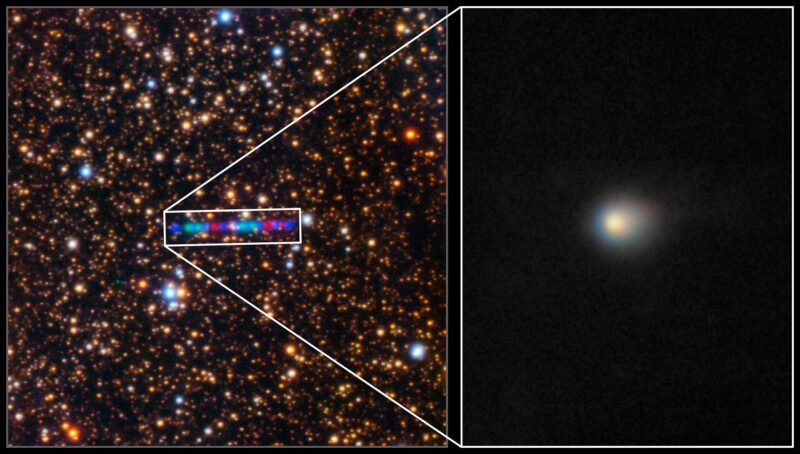
What we know about Comet 3I/ATLAS
Our new visitor will get its closest to the sun – at about 2 astronomical units (AU), or twice as far as Earth is from the sun – in October. As it reaches perihelion – its closest point to the sun – it will be traveling at almost 15,500 miles (25,000 kilometers) per hour.
The speedy nature of Comet 3I/ATLAS is more proof of its interstellar nature. It has to be moving at a blistering pace in order to escape the sun’s gravitational pull.
Marshall Eubanks, a physicist and VLBI radio astronomer and co-founder of Space Initiatives, said the comet will come within about 0.4 AU of Mars in October. That would make it just barely observable by the Mars Reconnaissance Orbiter.

It’s important for science
Having a visitor from another solar system is a rare opportunity for scientists, as NOIRLab said in a press release:
These visitors from faraway regions of the cosmos are valuable objects to study since they offer a tangible connection to other star systems. They carry information about the chemical elements that were present when and where they formed, which gives scientists insight into how planetary systems form at distant stars throughout our galaxy’s history, including stars that have since died out.

Observing the new interstellar object
From now through the beginning of September, Comet 3I/ATLAS will be in the evening sky. For the rest of September and October it will be too close to the sun to see. But by November and December the comet will be bright after just passing the sun and also out of the sun’s glare. At this point it will be a morning object, not far from Venus.
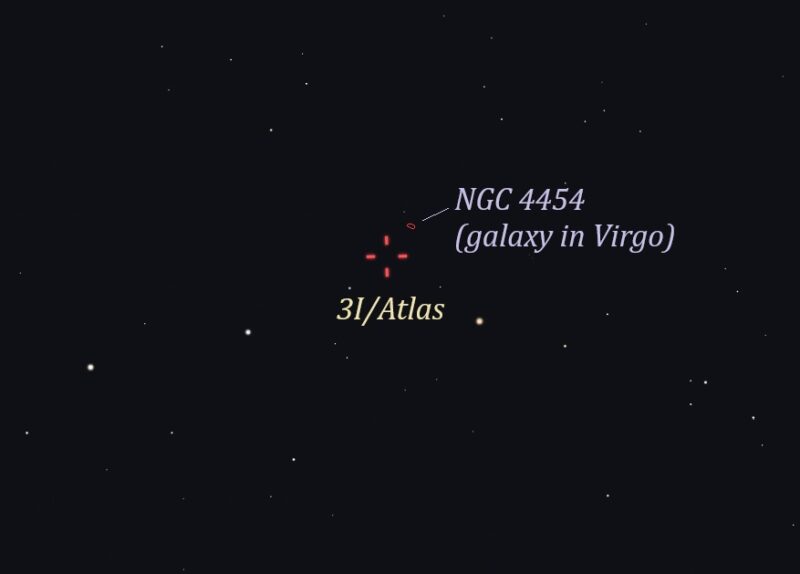
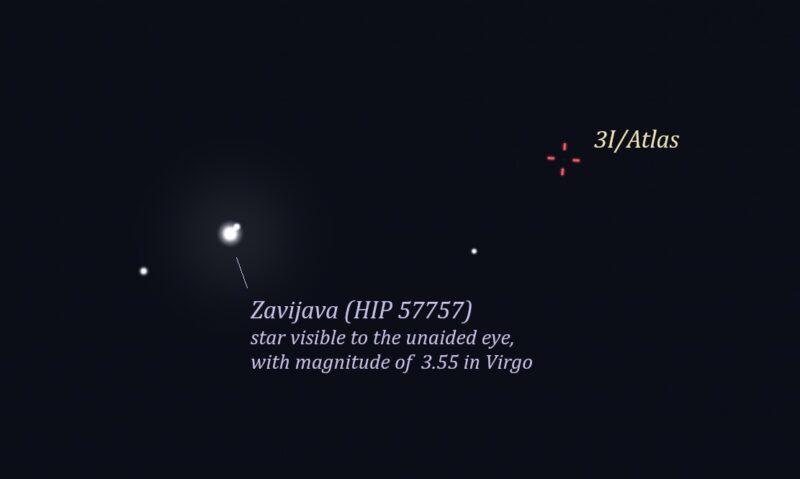
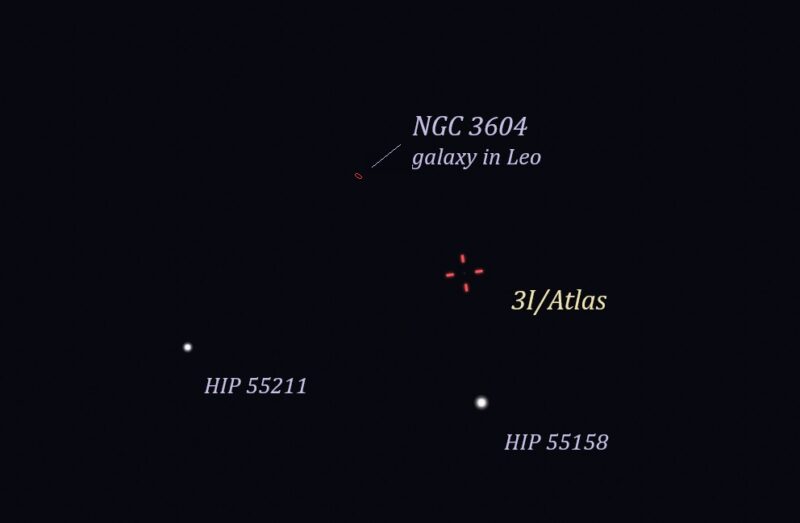
Eddie Irizarry shared maps of the location of 3I/ATLAS. Eddie said in an email to EarthSky:
Although Comet 3I/Atlas is currently dim, advanced amateur observers might be able to photograph the new visitor by taking long exposure images through a telescope.
By August, the new comet should reach magnitude 16 and gradually improve, allowing more astrophotographers to capture this rare object.
The dim space rock is currently at about magnitude 16.7.
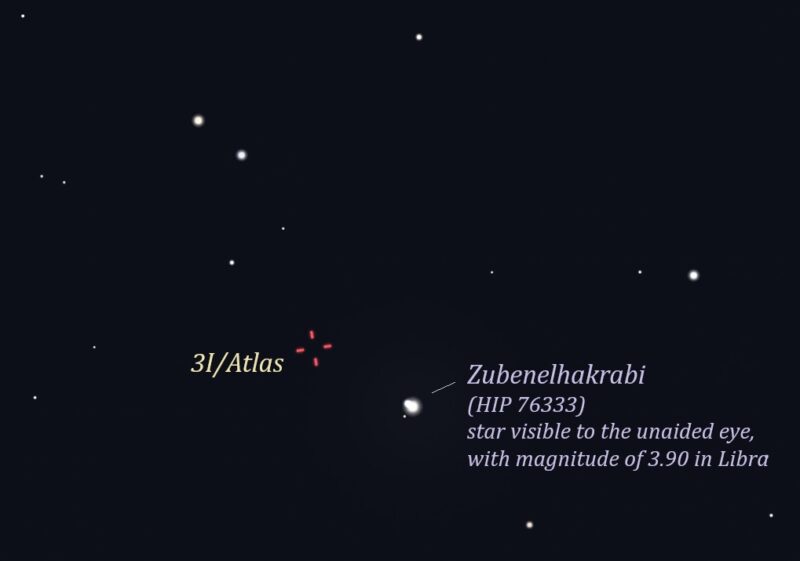
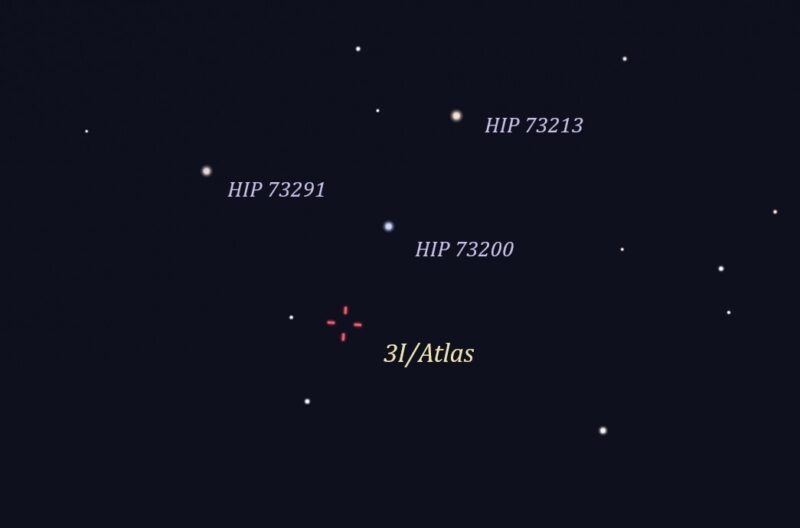
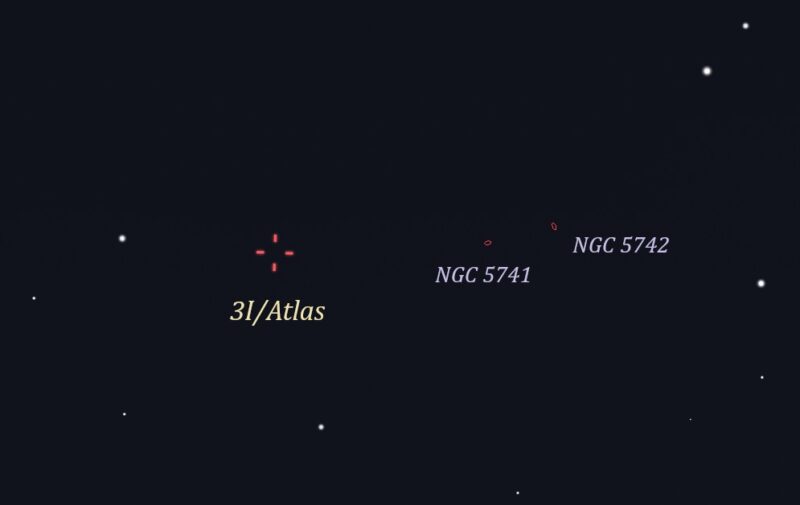
Following are star charts for those who want to search for the comet using a telescope or do astrophotography by capturing the comet close to a star or deep-sky object.
Evening star charts here
Morning star charts here
After Comet 3I/ATLAS makes its close approach to the sun, you can find it in the morning sky.
Bottom line: The new interstellar visitor – 3I/ATLAS – was thought to be 20 km across. A new estimate suggests it’s half that size.
The post Interstellar object Comet 3I/ATLAS: What we know now first appeared on EarthSky.
from EarthSky https://ift.tt/Out9wXa
You’ve probably heard by now about the new interstellar object – an object from another star system – hurtling toward our sun. Earthly astronomers have named it 3I/ATLAS. It’s only the 3rd-known interstellar object to visit our solar system. The object was originally estimated to have a diameter of 20 km (12 miles). But the size of 3I/ATLAS has now been re-estimated at around 10 km (6 miles). Hear from one of the astronomers who helped refine 3I/ ATLAS’s size estimate – Colin Orion Chandler of the DiRAC Institute of the University of Washington – speaking with EarthSky’s Deborah Byrd. Watch in the player above, or on YouTube.
It’s smaller than we thought
3I/ATLAS is the 3rd-known interstellar object, following 1I/ ‘Oumuamua and 2I/Borisov. That is, its trajectory and speed reveal it as an object not from our solar system, but from another star system.
Discovered by the ATLAS asteroid early warning system in early July 2025, the object was originally estimated to have a diameter of 20 km (12 miles). That large size led to a lot of joking online about the mothership, because some astronomers, as expected, just suggested we consider the possibility that 3I/ATLAS is an alien probe.
And now the size of 3I/ATLAS has been re-estimated at around 10 km (6 miles). This is still much larger than the other two interstellar objects. ‘Oumuamua’s size is thought to be about 200 meters across at its widest (if you’ll recall it has an elongated shape). And Borisov is thought to be less than a kilometer across.
Does that change what most astronomers think about this object? No. Most astronomers still think it’s an extremely old comet. To hear directly from one of the astronomers who studied it, and identified it as a comet, watch the video below.
It’s probably an old, old comet
The newly discovered interstellar object 3I/ATLAS – found on July 1 – is likely the oldest comet we’ve ever seen. It could be more than 7 billion years old, predating our solar system by more than 3 billion years! That’s according to University of Oxford astronomer Matthew Hopkins. Hear him explain in the player above, or on YouTube.
Discovery of 3I/ ATLAS
The Asteroid Terrestrial-impact Last Alert System (ATLAS) detected our new visitor on July 1, 2025. And the Minor Planet Center confirmed its interstellar nature on July 2, 2025, naming it 3I/ATLAS (or C/2025 N1). The “3I” means it’s the 3rd interstellar visitor that we’ve found.
The Hubble Space Telescope imaged the object on July 21, 2025. See the post from Bluesky below.
Hubble Space Telescope images of interstellar comet 3I/ATLAS are out! These were taken 5 hours ago. Plenty of cosmic rays peppering the images, but the comet's coma looks very nice and puffy. Best of luck to the researchers trying to write up papers for this… archive.stsci.edu/proposal_sea… ?
— astrafoxen (@astrafoxen.bsky.social) July 21, 2025 at 4:28 PM
From a different part of our galaxy
The object is traveling on a steep path through the Milky Way galaxy. Astronomers have analyzed its trajectory, which shows it is not swinging around the sun and heading back out into the outskirts of our solar system. Instead it’s just flying by. And their analysis suggests Comet 3I/ATLAS originated within, or at least on the border of, the Milky Way’s thick disk. This is an area of ancient stars orbiting above and below the thin galactic plane where our sun resides.
What we know about Comet 3I/ATLAS
Our new visitor will get its closest to the sun – at about 2 astronomical units (AU), or twice as far as Earth is from the sun – in October. As it reaches perihelion – its closest point to the sun – it will be traveling at almost 15,500 miles (25,000 kilometers) per hour.
The speedy nature of Comet 3I/ATLAS is more proof of its interstellar nature. It has to be moving at a blistering pace in order to escape the sun’s gravitational pull.
Marshall Eubanks, a physicist and VLBI radio astronomer and co-founder of Space Initiatives, said the comet will come within about 0.4 AU of Mars in October. That would make it just barely observable by the Mars Reconnaissance Orbiter.
It’s important for science
Having a visitor from another solar system is a rare opportunity for scientists, as NOIRLab said in a press release:
These visitors from faraway regions of the cosmos are valuable objects to study since they offer a tangible connection to other star systems. They carry information about the chemical elements that were present when and where they formed, which gives scientists insight into how planetary systems form at distant stars throughout our galaxy’s history, including stars that have since died out.
Observing the new interstellar object
From now through the beginning of September, Comet 3I/ATLAS will be in the evening sky. For the rest of September and October it will be too close to the sun to see. But by November and December the comet will be bright after just passing the sun and also out of the sun’s glare. At this point it will be a morning object, not far from Venus.
Eddie Irizarry shared maps of the location of 3I/ATLAS. Eddie said in an email to EarthSky:
Although Comet 3I/Atlas is currently dim, advanced amateur observers might be able to photograph the new visitor by taking long exposure images through a telescope.
By August, the new comet should reach magnitude 16 and gradually improve, allowing more astrophotographers to capture this rare object.
The dim space rock is currently at about magnitude 16.7.
Following are star charts for those who want to search for the comet using a telescope or do astrophotography by capturing the comet close to a star or deep-sky object.
Evening star charts here
Morning star charts here
After Comet 3I/ATLAS makes its close approach to the sun, you can find it in the morning sky.
Bottom line: The new interstellar visitor – 3I/ATLAS – was thought to be 20 km across. A new estimate suggests it’s half that size.
The post Interstellar object Comet 3I/ATLAS: What we know now first appeared on EarthSky.
from EarthSky https://ift.tt/Out9wXa

Aucun commentaire:
Enregistrer un commentaire