The University of Massachusetts Amherst said the bare-throated bellbird and the red-legged seriema are both contenders for the world’s loudest birds. The bare-throated bellbird, which lives in the Amazon, has a call of around 131 decibels. The red-legged seriema, which lives in a wide swath of eastern South America, has a call of more than 120 decibels. For comparison, 120-130 decibels is equal to a jet plane taking off or a chainsaw. Video via UMass Amherst.
While the loudest birds might seem like the ones outside your window at sunrise, the University of Massachusetts Amherst shared two contenders for the world’s loudest birds. On September 29, 2026, researchers with UMass Amherst said two South American birds have calls that can rival a chainsaw.
The bare-throated bellbird, which lives in the Amazon, has a call of around 131 decibels. And the red-legged seriema, which lives in a wide swath of eastern South America, has a call of more than 120 decibels. For comparison, a chainsaw roars at about 120-130 decibels.
But the goal behind studying these noisy birds was not to find a world record holder. Instead, the researchers studied them because they were looking to see if physical traits could predict a bird’s loudness.
Plus, they wanted to know if a bird’s loudness is related to its ecological niche and specific social organization.
The researchers published their peer-reviewed study in the journal Evolution on September 29, 2026.
How do you measure the volume of a bird?
To measure the volume of any bird, it’s best to do it in their natural habitat. So the researchers, João C.T. Menezes and Jeff Podos of UMass Amherst, set out to measure the sounds from birds in their own backyard along with birds in Brazil.
For tools, the researchers used golf rangefinders, which operate like a pair of binoculars with a laser that measures distance, plus portable sound meters. That’s because if you hear a loud bird, it also matters how close or far away from you the bird is.
Altogether, the pair measured 123 different bird species for their study. And amazingly, 113 of those species had never had their volume catalogued before. Podos said:
We’ve been able to vastly increase the number of species for which there is amplitude data. This is basic, foundational research that no one else has managed to do on this scale, and it points to all sorts of other questions that would be fun to follow up.
Listen to the call of the bare-throated bellbird. Video via UMass Amherst.
Why are some birds louder than others?
Overall, they found a huge range of volume among the different bird species. For example, one of the softest-voiced birds was the little hummingbird, with a song at a decibel level of 64. That’s about equal to human conversation.
And at the high end of the scale were the bare-throated bellbirds and red-legged seriemas, with songs that register 120+ decibels. So they are the world’s loudest birds.
Unsurprisingly, the smaller bird is quieter while the larger birds are louder. The researchers think big birds with bulky muscles might allow for greater air compression for explosive volume. They also have wider beak openings.
But so far, the data did not support obvious reasons for why loudness would have an ecological or evolutionary purpose. Menezes said:
We now know some of the hows. Bigger bodies and wider beaks, but we’ve yet to discover the whys, and we probably need much more data from many more species to be able to tease out what’s going on on the ecological and evolutionary front.
Now, the researchers are ready to go back out into the field to test some of their hypotheses. Podos said:
You can’t do this kind of work in the lab, or by scraping data from the internet. You have to get out into the world, you have to pay careful attention to what you’re seeing and hearing, and anything you do in the field that forces you to observe more carefully is really fun.
It takes you back to the roots of why we do science in the first place.
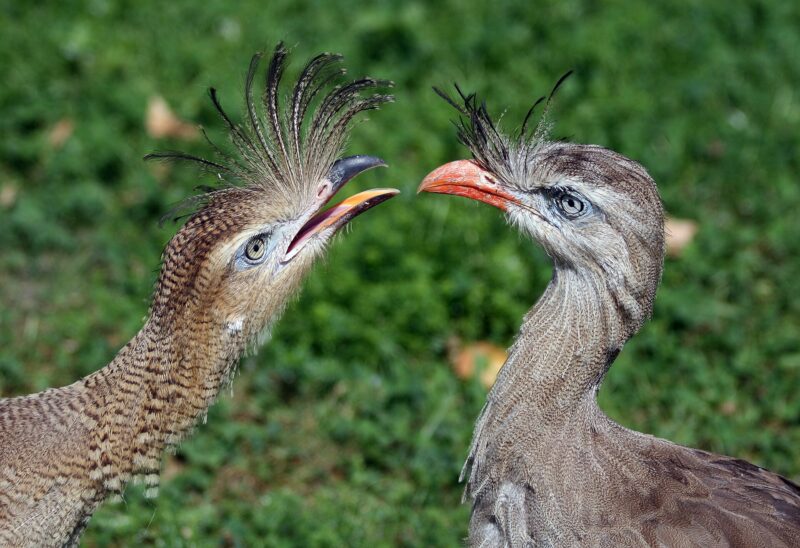
The bare-throated bellbird lives in South America. It is one of the contenders for world’s loudest bird. Image via Ben Tavener/ Wikimedia Commons.The red-legged seriema is also a contender for world’s loudest bird. Image via Manfred Werner/ Tsui/ Wikimedia Commons.
Bottom line: Researchers at the University of Massachusetts Amherst said the bare-throated bellbird and red-legged seriema are two contenders for world’s loudest birds.
The University of Massachusetts Amherst said the bare-throated bellbird and the red-legged seriema are both contenders for the world’s loudest birds. The bare-throated bellbird, which lives in the Amazon, has a call of around 131 decibels. The red-legged seriema, which lives in a wide swath of eastern South America, has a call of more than 120 decibels. For comparison, 120-130 decibels is equal to a jet plane taking off or a chainsaw. Video via UMass Amherst.
While the loudest birds might seem like the ones outside your window at sunrise, the University of Massachusetts Amherst shared two contenders for the world’s loudest birds. On September 29, 2026, researchers with UMass Amherst said two South American birds have calls that can rival a chainsaw.
The bare-throated bellbird, which lives in the Amazon, has a call of around 131 decibels. And the red-legged seriema, which lives in a wide swath of eastern South America, has a call of more than 120 decibels. For comparison, a chainsaw roars at about 120-130 decibels.
But the goal behind studying these noisy birds was not to find a world record holder. Instead, the researchers studied them because they were looking to see if physical traits could predict a bird’s loudness.
Plus, they wanted to know if a bird’s loudness is related to its ecological niche and specific social organization.
The researchers published their peer-reviewed study in the journal Evolution on September 29, 2026.
How do you measure the volume of a bird?
To measure the volume of any bird, it’s best to do it in their natural habitat. So the researchers, João C.T. Menezes and Jeff Podos of UMass Amherst, set out to measure the sounds from birds in their own backyard along with birds in Brazil.
For tools, the researchers used golf rangefinders, which operate like a pair of binoculars with a laser that measures distance, plus portable sound meters. That’s because if you hear a loud bird, it also matters how close or far away from you the bird is.
Altogether, the pair measured 123 different bird species for their study. And amazingly, 113 of those species had never had their volume catalogued before. Podos said:
We’ve been able to vastly increase the number of species for which there is amplitude data. This is basic, foundational research that no one else has managed to do on this scale, and it points to all sorts of other questions that would be fun to follow up.
Listen to the call of the bare-throated bellbird. Video via UMass Amherst.
Why are some birds louder than others?
Overall, they found a huge range of volume among the different bird species. For example, one of the softest-voiced birds was the little hummingbird, with a song at a decibel level of 64. That’s about equal to human conversation.
And at the high end of the scale were the bare-throated bellbirds and red-legged seriemas, with songs that register 120+ decibels. So they are the world’s loudest birds.
Unsurprisingly, the smaller bird is quieter while the larger birds are louder. The researchers think big birds with bulky muscles might allow for greater air compression for explosive volume. They also have wider beak openings.
But so far, the data did not support obvious reasons for why loudness would have an ecological or evolutionary purpose. Menezes said:
We now know some of the hows. Bigger bodies and wider beaks, but we’ve yet to discover the whys, and we probably need much more data from many more species to be able to tease out what’s going on on the ecological and evolutionary front.
Now, the researchers are ready to go back out into the field to test some of their hypotheses. Podos said:
You can’t do this kind of work in the lab, or by scraping data from the internet. You have to get out into the world, you have to pay careful attention to what you’re seeing and hearing, and anything you do in the field that forces you to observe more carefully is really fun.
It takes you back to the roots of why we do science in the first place.
The bare-throated bellbird lives in South America. It is one of the contenders for world’s loudest bird. Image via Ben Tavener/ Wikimedia Commons.The red-legged seriema is also a contender for world’s loudest bird. Image via Manfred Werner/ Tsui/ Wikimedia Commons.
Bottom line: Researchers at the University of Massachusetts Amherst said the bare-throated bellbird and red-legged seriema are two contenders for world’s loudest birds.
Watch a video of the EarthSky’s stargazing tips for beginning astronomers.
Our top 10 stargazing tips for beginners
Stargazing is for everybody. It’s for people who view the night sky with a sense of wonder … and people who just like being outside at night. Maybe that’s you. If so – and if you’re a beginner – here are some tips to help you get started. And remember that, like anything, stargazing takes practice. Soon you’ll be able to point out stars, constellations and planets.
View at EarthSky Community Photos. | Stojan Stojanovski in Bitola, North Macedonia, captured this image on August 30, 2023. Stojan wrote: “My friend shows you the super Blue Moon tonight on the top of the mountain.” Thank you, Stojan! Anyone at any age can enjoy the night sky. Read our top 10 stargazing tips for beginners here.
Tip 1: Watch the moon
Earth’s companion moon is visible from city streets, suburban decks and wide-open rural pastures. The moon connects you to everybody on the planet, because, generally speaking, we all see the moon at the same phase (although, because we live on a round Earth with 24 time zones, not exactly at the same time). The moon’s orbit around Earth is regular and predictable. So the moon waxes and wanes in our sky in a way that’s about as satisfyingly regular and predictable as anything on Earth can be.
Try following it for one lunar cycle. Start looking for a crescent moon in the sunset direction a day or two after new moon and then check it out every night at about the same time. What do you notice? Is it getting fatter or thinner in phase? Does it move from night to night with respect to nearby bright stars or planets?
Then what happens after the full moon? You’ll notice it rises later each day and soon it’ll be visible only after midnight. And eventually it’ll appear above the horizon closer to the sunrise. That’s because during one complete lunar cycle, the moon spends half of its time in the night sky and half of the time in the daytime. So yes, you can sometimes see the moon in daylight. Track it for a month and see how it changes.
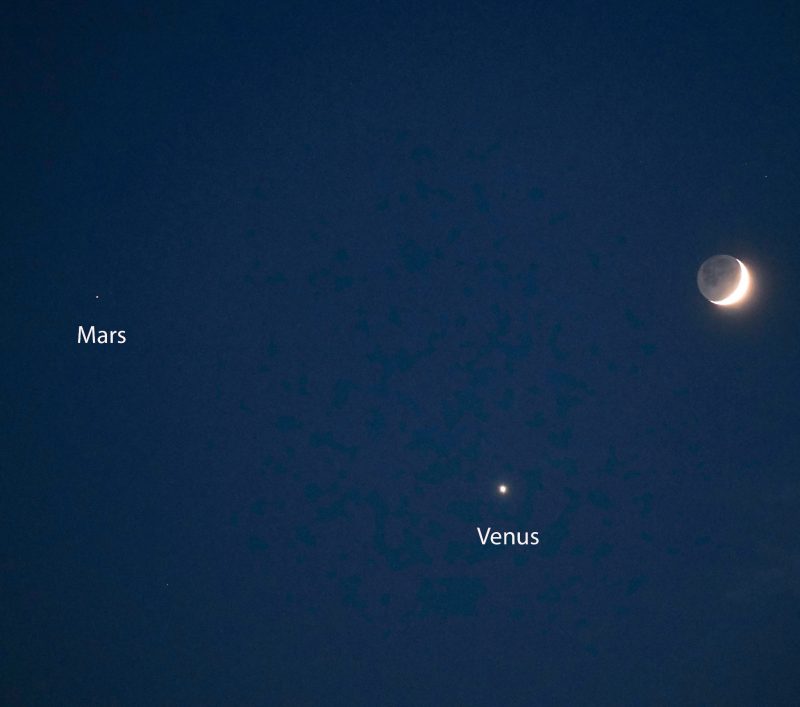
And remember, the moon can help you locate stars and planets. Check our visible planet and night sky guide to see what’s currently visible in the night sky.
Our stargazing tips including watching the sun. Don’t look directly at it, of course. But do notice the point on the horizon where the sun rises or sets as seen from your kitchen window, balcony or yard. Does that rising or setting point change as the seasons pass? Does the path of the sun from east to west during the day change?
The sun rises due east and sets due west at every equinox. If you identify east and west, you’ll have a jump on our next activity. By the way, try this great custom calendar at Sunrise Sunset Calendars. Don’t forget to check the moon phase box, too!
The Internet is great, but a computer is an unwieldy companion on stargazing adventures. What you want is a printed chart. Start with the easy-to-use charts at EarthSky Tonight. These daily charts are geared toward beginners, and each one presents something interesting to spot in that night’s sky. Then take the plunge and purchase a printed chart, maybe one of the planispheres in our store.
In just a few weeks of using our daily EarthSky Tonight charts – plus a planisphere – you will quickly raise your stargazing IQ. Still want an online chart? Try Stellarium.
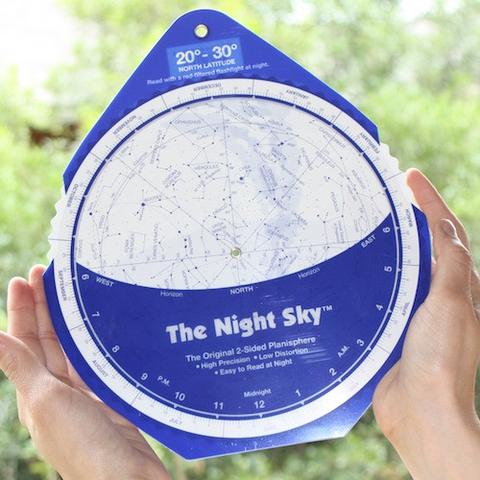
A planisphere will teach you what stars and constellations are overhead for any night of the year. Image via EarthSky.
Tip 4: Don’t buy a telescope yet
Remember that pair of binoculars you stuck way at the top of your closet? Point them at the moon and bright objects in the night sky. Do you see anything you hadn’t noticed before? Point them at noticeable star patterns; for example, the second star from the end of the Big Dipper’s handle is really two stars.
If you’re in a dark location, use your binoculars to sweep along the Milky Way and to check out any hazy patches in the night sky. These patches may be actual named star clusters, or they may be clouds of gas and dust where new stars are forming. You don’t need to know what you’re seeing to enjoy the beauty of it all.
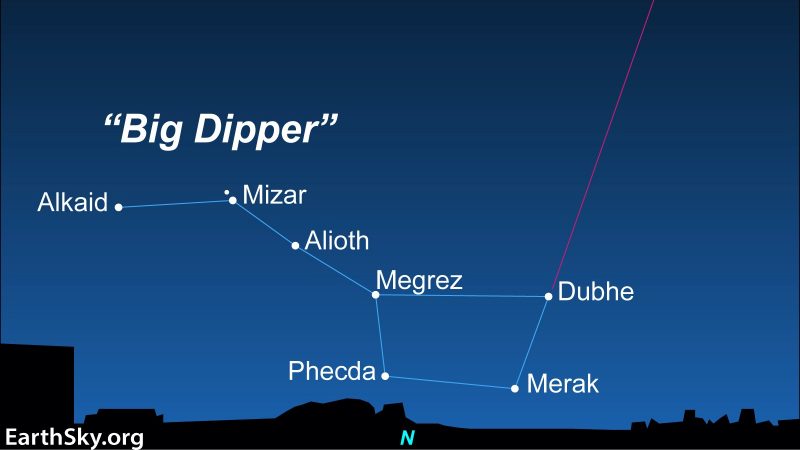
This chart of the Big Dipper includes a label for Mizar, while its companion star, Alcor, appears next to it without a label. Can you see both stars with or without binoculars?
Tip 5: Notice patterns among the stars
Here’s how most stargazers learn constellations. They find a noticeable pattern, and then they notice another pattern nearby. They build outward, going from stars and patterns they know to new ones. Notice triangles, curves and straight lines of stars. Some of these patterns are the same ones our ancestors noticed while sitting around a campfire telling stories. Some of their stories ended up being passed down to us. Make up your own stories!
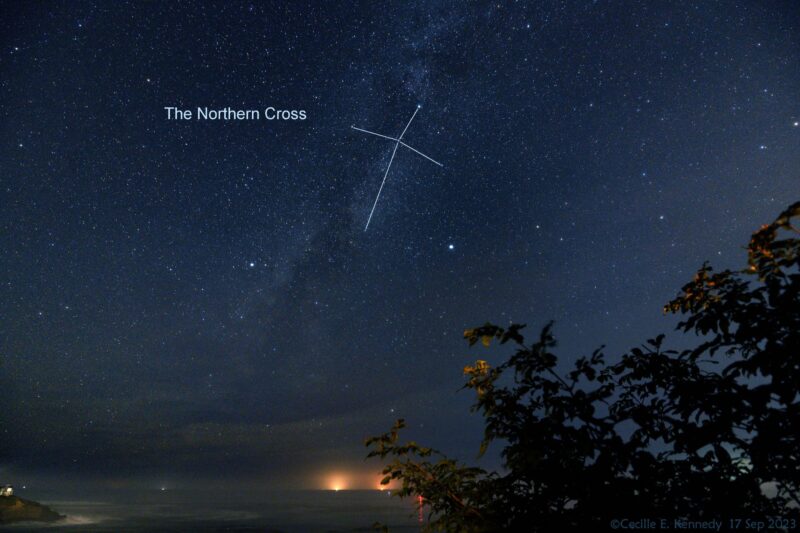
View at EarthSky Community Photos. | Cecille Kennedy captured this shot of the Northern Cross from Oregon. Thank you, Cecille! The Northern Cross is a clipped version of the constellation Cygnus the Swan. It’s an asterism, or pattern of stars. It lies embedded within another much larger asterism: the Summer Triangle, made up of the 3 brightest stars you can see in Cecille’s picture.
Tip 6: Find a dark-sky site
Try a state park or a national park. You won’t be sorry. Visit EarthSky’s Best Places to Stargaze page for dark locations around the world. Check also for an astronomy club in your area. Experienced members are good sources of advice, and some groups loan out telescopes.
Many societies also have libraries stocked with specialized books and atlases often not found in public libraries. Astronomy is also a good hobby to enjoy with a friend or family member. The delight of discovery is infectious.
And leave electronics in your pocket or vehicle. Even night mode is too bright under a dark sky and will ruin your night vision. Use a red flashlight to read your star charts or planisphere.
If you live in a college town, keep an eye out for astronomy community enrichment courses. Local schools, museums and planetariums might also host public programs.
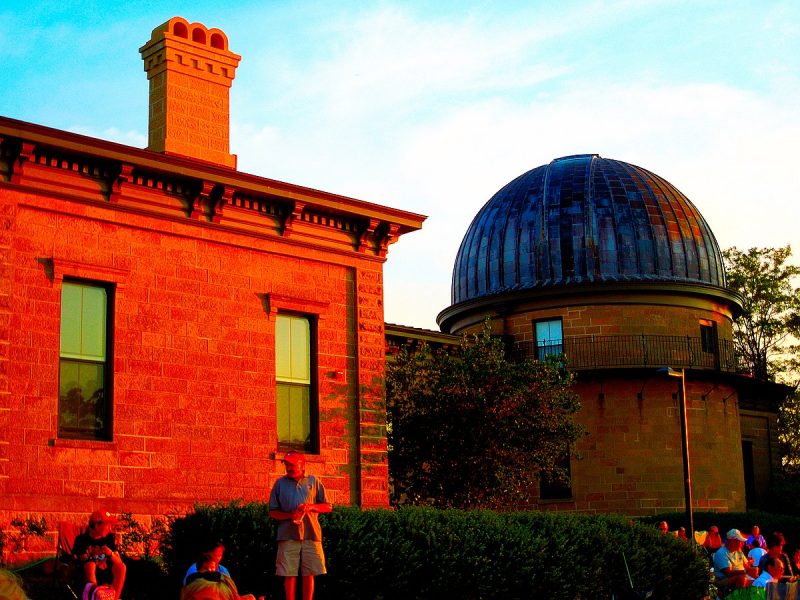
Universities often hold public observing nights at their observatories. Pictured here, Washburn Observatory at the University of Wisconsin-Madison. Image via Wikimedia Commons.
Tip 8: Take the telescope plunge carefully
Have you been watching the night sky for half a year at least? Can you recognize some major constellations? Have you identified a planet or two? The time to buy a telescope is when you’ve given yourself time to acclimate to the sky around you and all its nuances. Before that, if you want more optical power, buy binoculars. Once you’re ready to take the plunge, check these things to know before buying a telescope from High Point Scientific.
View at EarthSky Community Photos. | Dr Ski at Valencia Observatory, Central Philippines, took this image and wrote: “The Omega Centauri globular cluster is the only deep sky object I can capture at high magnification with a pocket camera and no tracking mount! It’s that spectacular. Unlike many astrophotographs, this image is exactly what you can expect to see thru a small telescope at 40x. No embellishments here.” Thank you, Dr Ski!
Tip 9: Just look up
Most of us go through life looking straight ahead. But you’ve got to look up to see stars. Standing outside at a bus stop? Look at the sky. In your car? Look out the window, carefully. Going outside before sunup to take the garbage out? Gaze toward the sunrise horizon. Notice bright objects in the sky. Notice patterns among the stars. Just start looking up and noticing.
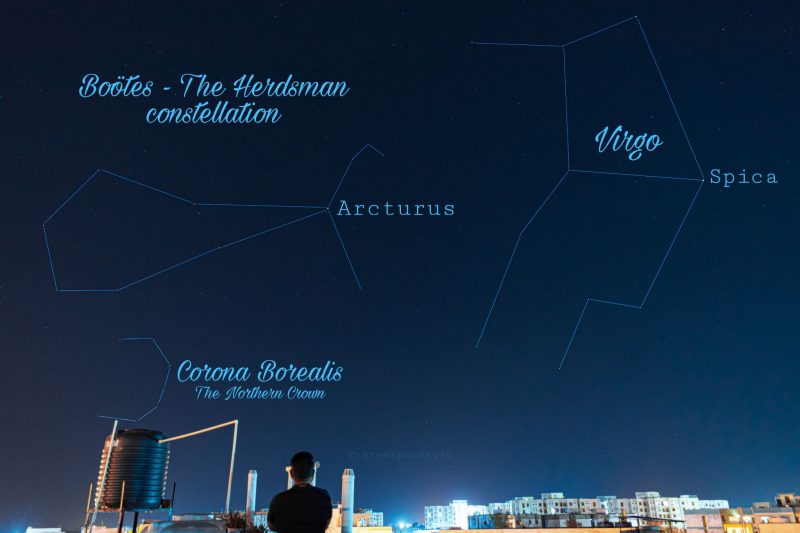
View at EarthSky Community Photos. | Prateek Pandey in Bhopal, Madhya Pradesh, India, captured this photo of Boötes, Virgo and Corona Borealis. He wrote: “Spring constellations twinkling in the eastern horizon.” Thank you, Prateek!
Tip 10: Be faithful to the sky
One of the great things about becoming a stargazer is that you make a lifelong friend: the sky itself. It’s a friend that lives right next door. And like any friend, the sky changes in subtle ways from day to day and year to year. So once you start watching it, be patient. And you can’t learn everything about your friend at once. Be persistent. Watch the sky a lot and watch regularly. You’ll learn by looking! And you’ll make a connection with nature that’ll last your whole life long.
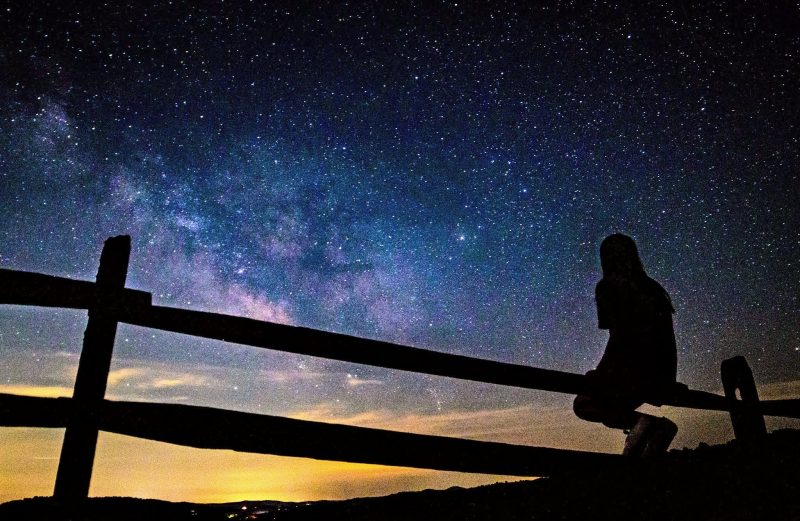
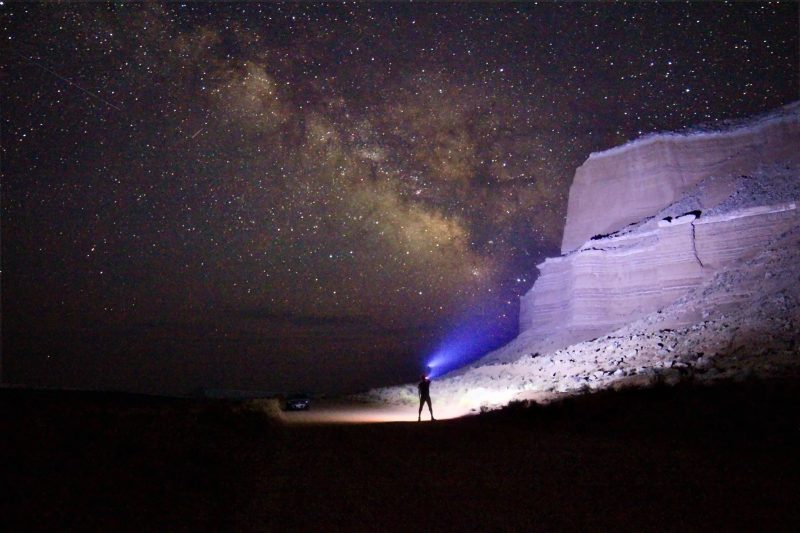
View at EarthSky Community Photos. | Steve Price in the Last Chance Desert, Utah, took this image and wrote: “New moon phase … Approximately 15 miles into The Last Chance Desert near Solomon’s Temple sandstone monolith … a great night to be alone in the desert with the stars and a few mammals scurrying around.” Thank you, Steve!
Bottom line: If you’re new to observing the night sky, check out our top 10 stargazing tips for beginners. We’ll help you explore and expand your love for astronomy.
Watch a video of the EarthSky’s stargazing tips for beginning astronomers.
Our top 10 stargazing tips for beginners
Stargazing is for everybody. It’s for people who view the night sky with a sense of wonder … and people who just like being outside at night. Maybe that’s you. If so – and if you’re a beginner – here are some tips to help you get started. And remember that, like anything, stargazing takes practice. Soon you’ll be able to point out stars, constellations and planets.
View at EarthSky Community Photos. | Stojan Stojanovski in Bitola, North Macedonia, captured this image on August 30, 2023. Stojan wrote: “My friend shows you the super Blue Moon tonight on the top of the mountain.” Thank you, Stojan! Anyone at any age can enjoy the night sky. Read our top 10 stargazing tips for beginners here.
Tip 1: Watch the moon
Earth’s companion moon is visible from city streets, suburban decks and wide-open rural pastures. The moon connects you to everybody on the planet, because, generally speaking, we all see the moon at the same phase (although, because we live on a round Earth with 24 time zones, not exactly at the same time). The moon’s orbit around Earth is regular and predictable. So the moon waxes and wanes in our sky in a way that’s about as satisfyingly regular and predictable as anything on Earth can be.
Try following it for one lunar cycle. Start looking for a crescent moon in the sunset direction a day or two after new moon and then check it out every night at about the same time. What do you notice? Is it getting fatter or thinner in phase? Does it move from night to night with respect to nearby bright stars or planets?
Then what happens after the full moon? You’ll notice it rises later each day and soon it’ll be visible only after midnight. And eventually it’ll appear above the horizon closer to the sunrise. That’s because during one complete lunar cycle, the moon spends half of its time in the night sky and half of the time in the daytime. So yes, you can sometimes see the moon in daylight. Track it for a month and see how it changes.
And remember, the moon can help you locate stars and planets. Check our visible planet and night sky guide to see what’s currently visible in the night sky.
Our stargazing tips including watching the sun. Don’t look directly at it, of course. But do notice the point on the horizon where the sun rises or sets as seen from your kitchen window, balcony or yard. Does that rising or setting point change as the seasons pass? Does the path of the sun from east to west during the day change?
The sun rises due east and sets due west at every equinox. If you identify east and west, you’ll have a jump on our next activity. By the way, try this great custom calendar at Sunrise Sunset Calendars. Don’t forget to check the moon phase box, too!
The Internet is great, but a computer is an unwieldy companion on stargazing adventures. What you want is a printed chart. Start with the easy-to-use charts at EarthSky Tonight. These daily charts are geared toward beginners, and each one presents something interesting to spot in that night’s sky. Then take the plunge and purchase a printed chart, maybe one of the planispheres in our store.
In just a few weeks of using our daily EarthSky Tonight charts – plus a planisphere – you will quickly raise your stargazing IQ. Still want an online chart? Try Stellarium.
A planisphere will teach you what stars and constellations are overhead for any night of the year. Image via EarthSky.
Tip 4: Don’t buy a telescope yet
Remember that pair of binoculars you stuck way at the top of your closet? Point them at the moon and bright objects in the night sky. Do you see anything you hadn’t noticed before? Point them at noticeable star patterns; for example, the second star from the end of the Big Dipper’s handle is really two stars.
If you’re in a dark location, use your binoculars to sweep along the Milky Way and to check out any hazy patches in the night sky. These patches may be actual named star clusters, or they may be clouds of gas and dust where new stars are forming. You don’t need to know what you’re seeing to enjoy the beauty of it all.
This chart of the Big Dipper includes a label for Mizar, while its companion star, Alcor, appears next to it without a label. Can you see both stars with or without binoculars?
Tip 5: Notice patterns among the stars
Here’s how most stargazers learn constellations. They find a noticeable pattern, and then they notice another pattern nearby. They build outward, going from stars and patterns they know to new ones. Notice triangles, curves and straight lines of stars. Some of these patterns are the same ones our ancestors noticed while sitting around a campfire telling stories. Some of their stories ended up being passed down to us. Make up your own stories!
View at EarthSky Community Photos. | Cecille Kennedy captured this shot of the Northern Cross from Oregon. Thank you, Cecille! The Northern Cross is a clipped version of the constellation Cygnus the Swan. It’s an asterism, or pattern of stars. It lies embedded within another much larger asterism: the Summer Triangle, made up of the 3 brightest stars you can see in Cecille’s picture.
Tip 6: Find a dark-sky site
Try a state park or a national park. You won’t be sorry. Visit EarthSky’s Best Places to Stargaze page for dark locations around the world. Check also for an astronomy club in your area. Experienced members are good sources of advice, and some groups loan out telescopes.
Many societies also have libraries stocked with specialized books and atlases often not found in public libraries. Astronomy is also a good hobby to enjoy with a friend or family member. The delight of discovery is infectious.
And leave electronics in your pocket or vehicle. Even night mode is too bright under a dark sky and will ruin your night vision. Use a red flashlight to read your star charts or planisphere.
If you live in a college town, keep an eye out for astronomy community enrichment courses. Local schools, museums and planetariums might also host public programs.
Universities often hold public observing nights at their observatories. Pictured here, Washburn Observatory at the University of Wisconsin-Madison. Image via Wikimedia Commons.
Tip 8: Take the telescope plunge carefully
Have you been watching the night sky for half a year at least? Can you recognize some major constellations? Have you identified a planet or two? The time to buy a telescope is when you’ve given yourself time to acclimate to the sky around you and all its nuances. Before that, if you want more optical power, buy binoculars. Once you’re ready to take the plunge, check these things to know before buying a telescope from High Point Scientific.
View at EarthSky Community Photos. | Dr Ski at Valencia Observatory, Central Philippines, took this image and wrote: “The Omega Centauri globular cluster is the only deep sky object I can capture at high magnification with a pocket camera and no tracking mount! It’s that spectacular. Unlike many astrophotographs, this image is exactly what you can expect to see thru a small telescope at 40x. No embellishments here.” Thank you, Dr Ski!
Tip 9: Just look up
Most of us go through life looking straight ahead. But you’ve got to look up to see stars. Standing outside at a bus stop? Look at the sky. In your car? Look out the window, carefully. Going outside before sunup to take the garbage out? Gaze toward the sunrise horizon. Notice bright objects in the sky. Notice patterns among the stars. Just start looking up and noticing.
View at EarthSky Community Photos. | Prateek Pandey in Bhopal, Madhya Pradesh, India, captured this photo of Boötes, Virgo and Corona Borealis. He wrote: “Spring constellations twinkling in the eastern horizon.” Thank you, Prateek!
Tip 10: Be faithful to the sky
One of the great things about becoming a stargazer is that you make a lifelong friend: the sky itself. It’s a friend that lives right next door. And like any friend, the sky changes in subtle ways from day to day and year to year. So once you start watching it, be patient. And you can’t learn everything about your friend at once. Be persistent. Watch the sky a lot and watch regularly. You’ll learn by looking! And you’ll make a connection with nature that’ll last your whole life long.
View at EarthSky Community Photos. | Steve Price in the Last Chance Desert, Utah, took this image and wrote: “New moon phase … Approximately 15 miles into The Last Chance Desert near Solomon’s Temple sandstone monolith … a great night to be alone in the desert with the stars and a few mammals scurrying around.” Thank you, Steve!
Bottom line: If you’re new to observing the night sky, check out our top 10 stargazing tips for beginners. We’ll help you explore and expand your love for astronomy.
Alpha Cephei, also known as Alderamin, is the brightest star in the constellation Cepheus the King. Astronomers are intrigued by this star because it spins at such a fast rate. Unlike our almost-round sun, Alderamin is distorted by its rapid spin into an oblate form, like a partly deflated beach ball.
This star isn’t the brightest one around, but it’s pretty bright. It shines at about magnitude 2.5.
Its faint constellation, Cepheus, is surprisingly easy to spot in a dark sky because the stars of Cepheus trace out the shape of a child’s stick house.
Science of Alpha Cephei
Alpha Cephei, 49 light-years away, is a white star that is twice the mass of our sun and about 17 times its luminosity. It is considered a Class A star, which is now evolving off the main sequence into a subgiant. It’s thought that this star is now on its way to becoming a red giant as its internal supply of hydrogen fuel runs low.
Alpha Cephei rotates rapidly; observations suggest it could be as fast as 152 miles a second (246 km/s). In comparison, the sun’s rotation speed at the equator is not quite 1.2 miles a second (2 km/s). As a result of its rapid rotation, Alpha Cephei appears slightly flattened. That’s because the star’s surface rotation speed gets progressively faster as you move away from its rotation axis towards its equator.
And, as surface rotation speed increases, the star’s surface is increasingly pushed out. As a result, Alpha Cephei bulges along the equator.
A closer look at Alpha Cephei
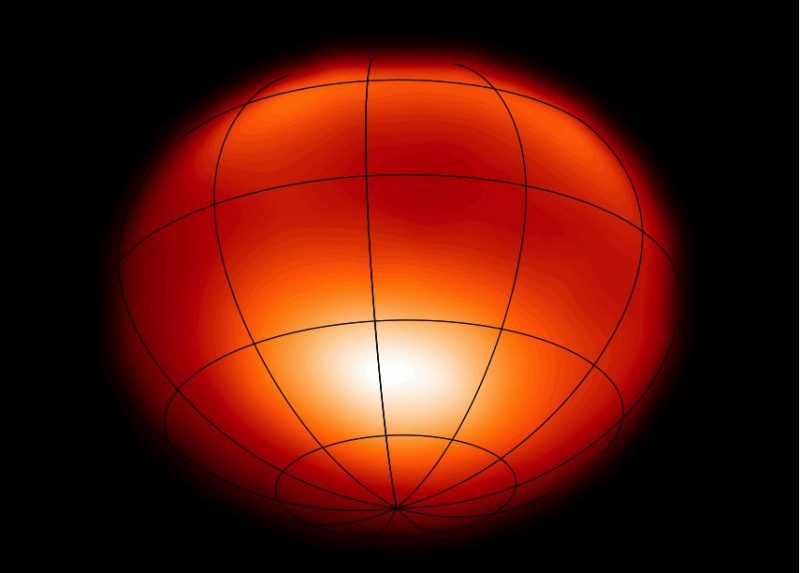
The image at the top of this article is a model of Alpha Cephei based on data from the CHARA telescope array. It shows Alpha Cephei’s oblate shape. It also shows a darker equatorial region, shaded to indicate that these are cooler regions of the star.
Meanwhile, a section near the pole appears brighter. That’s because the surface gravity is higher around the “flattened” poles compared to the bulging equator, and as a result, higher temperatures and pressure are needed to maintain an equilibrium. These differences in brightness across rapidly rotating stars result in a phenomenon scientists call gravity darkening.
Astronomer Jim Kaler wrote about this rapidly spinning star:
The spin may also be related to the star’s activity. [Our] sun is magnetically active in broad part because its outer third is churning up and down in huge convective currents, the movement helping to generate a magnetic field. Such outer zones are supposed to disappear in class A stars like Alderamin. Yet Alderamin emits about the same amount of X-ray radiation as does the sun and has other features that together suggest considerable magnetic activity. No one really knows why. Such anomalies, of course, drive the science. Understanding Alderamin will someday help us understand our own star, on which we depend for life.
How to find Alpha Cephei
On a dark night, Alpha Cephei is easily visible and relatively easy to find. Look northward for this star. It is circumpolar — meaning it never sets — throughout all of Europe, northern Asia, Canada and American cities as far south as San Diego, California. Its constellation, Cepheus, has the shape of the stick house we all drew as children.
Or you might prefer to see the shape of Cepheus as a point on the King’s crown. Cepheus is a rather faint constellation, but Alpha Cephei is by far its brightest star and is easily observable to the unaided eye, even in cities.
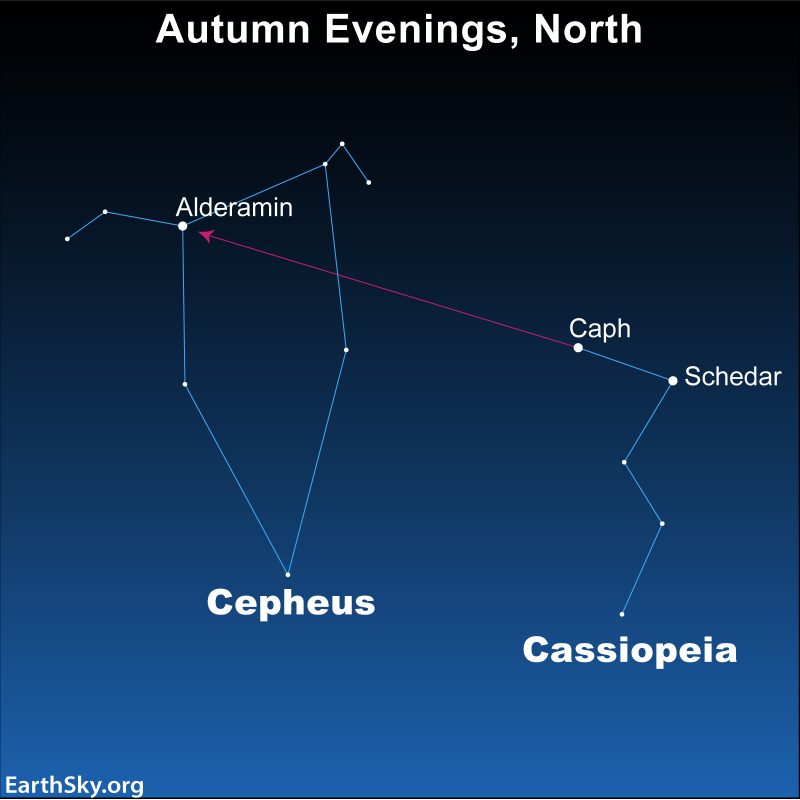
If you know the W or M-shaped constellation Cassiopeia the Queen, you can use the Cassiopeia stars Schedar and Caph to star-hop to Alderamin.
A close-up of Cassiopeia and Cepheus. Notice that a line from Schedar and Caph will lead you to Alderamin, or Alpha Cephei, the brightest star in the King.
A once and future pole star
Alpha Cephei has been a pole star in the past. That is, a bright star close to the sky’s north pole. This is because a slow, constant wobble in Earth’s movement — known as precession — makes the stars shift in relation to our planet’s axis.
The last time Alpha Cephei was the nearest bright star to the north celestial pole was in 18,000 BCE. It will again be a pole star some 5,500 years from now. No matter what is going on at that time on Earth, the heavens will pursue their long and predictable cycles.
And Alpha Cephei will lie some 3 degrees from the sky’s north pole around the year 7500 CE. That means it won’t be as good a pole star as our present-day Polaris, which will be 0.4525 degrees from the north celestial pole on March 24, 2100. But it’ll be pretty good.
This star’s proper name, Alderamin, is from Arabic and means “the right arm,” presumably of Cepheus the King, father of Andromeda in Greek mythology.
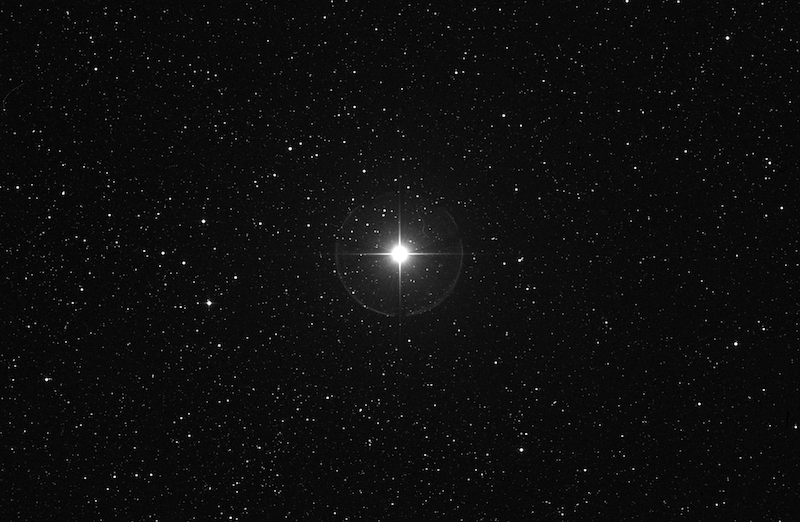
Alpha Cephei is resplendent in this image from the STScI Digital Sky Survey. Image via Mikulski Archive.
Bottom line: Alpha Cephei, or Alderamin, is the brightest star in the faint constellation Cepheus the King. It’s spinning so fast that it appears like a slightly flattened beach ball.
Alpha Cephei, also known as Alderamin, is the brightest star in the constellation Cepheus the King. Astronomers are intrigued by this star because it spins at such a fast rate. Unlike our almost-round sun, Alderamin is distorted by its rapid spin into an oblate form, like a partly deflated beach ball.
This star isn’t the brightest one around, but it’s pretty bright. It shines at about magnitude 2.5.
Its faint constellation, Cepheus, is surprisingly easy to spot in a dark sky because the stars of Cepheus trace out the shape of a child’s stick house.
Science of Alpha Cephei
Alpha Cephei, 49 light-years away, is a white star that is twice the mass of our sun and about 17 times its luminosity. It is considered a Class A star, which is now evolving off the main sequence into a subgiant. It’s thought that this star is now on its way to becoming a red giant as its internal supply of hydrogen fuel runs low.
Alpha Cephei rotates rapidly; observations suggest it could be as fast as 152 miles a second (246 km/s). In comparison, the sun’s rotation speed at the equator is not quite 1.2 miles a second (2 km/s). As a result of its rapid rotation, Alpha Cephei appears slightly flattened. That’s because the star’s surface rotation speed gets progressively faster as you move away from its rotation axis towards its equator.
And, as surface rotation speed increases, the star’s surface is increasingly pushed out. As a result, Alpha Cephei bulges along the equator.
A closer look at Alpha Cephei
The image at the top of this article is a model of Alpha Cephei based on data from the CHARA telescope array. It shows Alpha Cephei’s oblate shape. It also shows a darker equatorial region, shaded to indicate that these are cooler regions of the star.
Meanwhile, a section near the pole appears brighter. That’s because the surface gravity is higher around the “flattened” poles compared to the bulging equator, and as a result, higher temperatures and pressure are needed to maintain an equilibrium. These differences in brightness across rapidly rotating stars result in a phenomenon scientists call gravity darkening.
Astronomer Jim Kaler wrote about this rapidly spinning star:
The spin may also be related to the star’s activity. [Our] sun is magnetically active in broad part because its outer third is churning up and down in huge convective currents, the movement helping to generate a magnetic field. Such outer zones are supposed to disappear in class A stars like Alderamin. Yet Alderamin emits about the same amount of X-ray radiation as does the sun and has other features that together suggest considerable magnetic activity. No one really knows why. Such anomalies, of course, drive the science. Understanding Alderamin will someday help us understand our own star, on which we depend for life.
How to find Alpha Cephei
On a dark night, Alpha Cephei is easily visible and relatively easy to find. Look northward for this star. It is circumpolar — meaning it never sets — throughout all of Europe, northern Asia, Canada and American cities as far south as San Diego, California. Its constellation, Cepheus, has the shape of the stick house we all drew as children.
Or you might prefer to see the shape of Cepheus as a point on the King’s crown. Cepheus is a rather faint constellation, but Alpha Cephei is by far its brightest star and is easily observable to the unaided eye, even in cities.
If you know the W or M-shaped constellation Cassiopeia the Queen, you can use the Cassiopeia stars Schedar and Caph to star-hop to Alderamin.
A close-up of Cassiopeia and Cepheus. Notice that a line from Schedar and Caph will lead you to Alderamin, or Alpha Cephei, the brightest star in the King.
A once and future pole star
Alpha Cephei has been a pole star in the past. That is, a bright star close to the sky’s north pole. This is because a slow, constant wobble in Earth’s movement — known as precession — makes the stars shift in relation to our planet’s axis.
The last time Alpha Cephei was the nearest bright star to the north celestial pole was in 18,000 BCE. It will again be a pole star some 5,500 years from now. No matter what is going on at that time on Earth, the heavens will pursue their long and predictable cycles.
And Alpha Cephei will lie some 3 degrees from the sky’s north pole around the year 7500 CE. That means it won’t be as good a pole star as our present-day Polaris, which will be 0.4525 degrees from the north celestial pole on March 24, 2100. But it’ll be pretty good.
This star’s proper name, Alderamin, is from Arabic and means “the right arm,” presumably of Cepheus the King, father of Andromeda in Greek mythology.
Alpha Cephei is resplendent in this image from the STScI Digital Sky Survey. Image via Mikulski Archive.
Bottom line: Alpha Cephei, or Alderamin, is the brightest star in the faint constellation Cepheus the King. It’s spinning so fast that it appears like a slightly flattened beach ball.
SpaceX’s Starship entered Earth’s orbit for the first time on September 28, 2026. Image via SpaceX.
SpaceX reached a milestone yesterday, September 28, 2026, as its colossal Starship spacecraft reached Earth’s orbit for the first time. It was a much-needed success — though far from flawless — for a vehicle intended to take humans to the lunar surface as soon as 2028.
The rocket, which is the largest and most powerful ever built, launched for its 14th test flight from Starbase, Texas, at 7:48 CDT (12:48 UTC). The boosting phase was a success. But after the booster separated, one of the upper stage’s six engines failed. We heard much deliberation from mission control, and it seemed another disappointing day for SpaceX was on the cards. But SpaceX ultimately pushed ahead, and 25 minutes after its launch — and three years after its first test flight — Starship reached Earth’s orbit.
Starship was meant to circle Earth six times on a 10-hour voyage. But SpaceX pulled the plug after only three hours, bringing the ship down to an explosive splashdown in the Pacific Ocean. SpaceX have since announced that this decision to shorten the flight was taken “out of an abundance of caution given the engine issue experienced during ascent”.
However, despite the mission being cut short, SpaceX had time to successfully deploy 26 Starlink V3 satellites into orbit. Unlike previous missions, which had released dummy satellites, these were real additions to the Starlink system.
So, while not without its issues, this was a test that SpaceX will likely be happy with. It comes following a 13th test in July that saw the booster fail in its landing attempt, and after a shocking explosion on the launchpad in June.
Starship launched for its 14th test flight at 7:48 CDT (12:48 UTC) from Starbase, Texas. Image via SpaceX.
First journey into Earth orbit
This 14th test flight was SpaceX’s first attempt to bring Starship into full Earth orbit. Previous missions had taken suborbital trajectories which ensured that, if SpaceX were to lose control of the rocket (as has happened before), it would come down in the ocean. When in orbit, the risks of a rogue spacecraft are much harder to manage.
And, despite the ultimate success of test flight 14, Starship didn’t entirely behave itself this time round.
The test began with another spectacular launch for the rocket, which stands 394 feet (120 meters) tall on the launch pad. The booster lifted off with all 33 engines running, although one failed during the ascent.
Having boosted Starship’s upper stage out of Earth’s lower atmosphere, the booster separated and performed its trademark flip before boosting back to Earth, with 26 of the intended 28 engines lit. And only 11 of the intended 13 engines lit for its landing burn, which still righted the booster and brought it to a controlled splashdown in the Gulf of Mexico. SpaceX had not planned to catch the booster in its giant mechanical “chopsticks” as it had done in 2024. This is set to be attempted again in flight 15.
After this boost, things took a troubling turn for Starship. With one of the upper stage’s six raptor engines switching off unexpectedly, it seemed the orbital attempt would have to be called off. The presenter on SpaceX’s stream initially suggested as much. But mission control ultimately decided to go ahead. Starship fired a single booster for just 19 seconds to push it up into orbit, some 171 miles (275 km) above the Earth’s surface.
During its 1st flight in Earth’s orbit, Starship deployed 26 Starlink satellites. Image via SpaceX.
Cause for concern?
Cruising at 17,400 miles per hour (28,000 km/h), Starship returned breathtaking shots of our planet. And it opened its bay doors to deposit 26 Starlink satellites into orbit within just 30 minutes.
Another concern with these launches is their environmental impact. While SpaceX’s aim with Starship is to build a fully reusable spacecraft, this testing phase has seen many huge explosions in the Gulf and beyond.
Starship’s upper stage explodes in the Pacific ocean after an initially gentle splashdown. Image via SpaceX.
What’s next for Starship?
While not a perfect test, Starship’s successful entry to Earth orbit will come as a relief not only to SpaceX, but to NASA.
Starship is integral to NASA’s Artemis program, which is aiming to return humans to the lunar surface as early as 2028. Earlier this year, NASA’s Orion capsule carried humans round the moon for the first time in 50 years. But the Orion capsule can’t get humans to the lunar surface. That’s where Starship is meant to come in.
SpaceX has a contract with NASA to provide a Human Landing System variant of Starship, which will ferry astronauts to the lunar surface on the Artemis 4 mission, currently targeted for early 2028. But Starship is currently behind schedule, even despite the other huge delays to the Artemis program.
SpaceX now has a rival for this job: Jeff Bezos’ Blue Origin. Blue Origin now also has a contract for the Artemis program. The current plan is for both Starship and Blue Origin’s Blue Moon lunar lander to be tested in low-Earth orbit during the Artemis 3 mission, currently set for 2027. This should see Starship and Blue Moon dock with Orion, which will have four astronauts on board.
Despite the success of this latest test, Starship surely has a long way to go before NASA will allow it to carry its astronauts.
Bottom line: SpaceX’s Starship spacecraft finally reached Earth orbit in its 14th test flight yesterday, September 28. Though successful, the flight was not without its flaws.
SpaceX’s Starship entered Earth’s orbit for the first time on September 28, 2026. Image via SpaceX.
SpaceX reached a milestone yesterday, September 28, 2026, as its colossal Starship spacecraft reached Earth’s orbit for the first time. It was a much-needed success — though far from flawless — for a vehicle intended to take humans to the lunar surface as soon as 2028.
The rocket, which is the largest and most powerful ever built, launched for its 14th test flight from Starbase, Texas, at 7:48 CDT (12:48 UTC). The boosting phase was a success. But after the booster separated, one of the upper stage’s six engines failed. We heard much deliberation from mission control, and it seemed another disappointing day for SpaceX was on the cards. But SpaceX ultimately pushed ahead, and 25 minutes after its launch — and three years after its first test flight — Starship reached Earth’s orbit.
Starship was meant to circle Earth six times on a 10-hour voyage. But SpaceX pulled the plug after only three hours, bringing the ship down to an explosive splashdown in the Pacific Ocean. SpaceX have since announced that this decision to shorten the flight was taken “out of an abundance of caution given the engine issue experienced during ascent”.
However, despite the mission being cut short, SpaceX had time to successfully deploy 26 Starlink V3 satellites into orbit. Unlike previous missions, which had released dummy satellites, these were real additions to the Starlink system.
So, while not without its issues, this was a test that SpaceX will likely be happy with. It comes following a 13th test in July that saw the booster fail in its landing attempt, and after a shocking explosion on the launchpad in June.
Starship launched for its 14th test flight at 7:48 CDT (12:48 UTC) from Starbase, Texas. Image via SpaceX.
First journey into Earth orbit
This 14th test flight was SpaceX’s first attempt to bring Starship into full Earth orbit. Previous missions had taken suborbital trajectories which ensured that, if SpaceX were to lose control of the rocket (as has happened before), it would come down in the ocean. When in orbit, the risks of a rogue spacecraft are much harder to manage.
And, despite the ultimate success of test flight 14, Starship didn’t entirely behave itself this time round.
The test began with another spectacular launch for the rocket, which stands 394 feet (120 meters) tall on the launch pad. The booster lifted off with all 33 engines running, although one failed during the ascent.
Having boosted Starship’s upper stage out of Earth’s lower atmosphere, the booster separated and performed its trademark flip before boosting back to Earth, with 26 of the intended 28 engines lit. And only 11 of the intended 13 engines lit for its landing burn, which still righted the booster and brought it to a controlled splashdown in the Gulf of Mexico. SpaceX had not planned to catch the booster in its giant mechanical “chopsticks” as it had done in 2024. This is set to be attempted again in flight 15.
After this boost, things took a troubling turn for Starship. With one of the upper stage’s six raptor engines switching off unexpectedly, it seemed the orbital attempt would have to be called off. The presenter on SpaceX’s stream initially suggested as much. But mission control ultimately decided to go ahead. Starship fired a single booster for just 19 seconds to push it up into orbit, some 171 miles (275 km) above the Earth’s surface.
During its 1st flight in Earth’s orbit, Starship deployed 26 Starlink satellites. Image via SpaceX.
Cause for concern?
Cruising at 17,400 miles per hour (28,000 km/h), Starship returned breathtaking shots of our planet. And it opened its bay doors to deposit 26 Starlink satellites into orbit within just 30 minutes.
Another concern with these launches is their environmental impact. While SpaceX’s aim with Starship is to build a fully reusable spacecraft, this testing phase has seen many huge explosions in the Gulf and beyond.
Starship’s upper stage explodes in the Pacific ocean after an initially gentle splashdown. Image via SpaceX.
What’s next for Starship?
While not a perfect test, Starship’s successful entry to Earth orbit will come as a relief not only to SpaceX, but to NASA.
Starship is integral to NASA’s Artemis program, which is aiming to return humans to the lunar surface as early as 2028. Earlier this year, NASA’s Orion capsule carried humans round the moon for the first time in 50 years. But the Orion capsule can’t get humans to the lunar surface. That’s where Starship is meant to come in.
SpaceX has a contract with NASA to provide a Human Landing System variant of Starship, which will ferry astronauts to the lunar surface on the Artemis 4 mission, currently targeted for early 2028. But Starship is currently behind schedule, even despite the other huge delays to the Artemis program.
SpaceX now has a rival for this job: Jeff Bezos’ Blue Origin. Blue Origin now also has a contract for the Artemis program. The current plan is for both Starship and Blue Origin’s Blue Moon lunar lander to be tested in low-Earth orbit during the Artemis 3 mission, currently set for 2027. This should see Starship and Blue Moon dock with Orion, which will have four astronauts on board.
Despite the success of this latest test, Starship surely has a long way to go before NASA will allow it to carry its astronauts.
Bottom line: SpaceX’s Starship spacecraft finally reached Earth orbit in its 14th test flight yesterday, September 28. Though successful, the flight was not without its flaws.
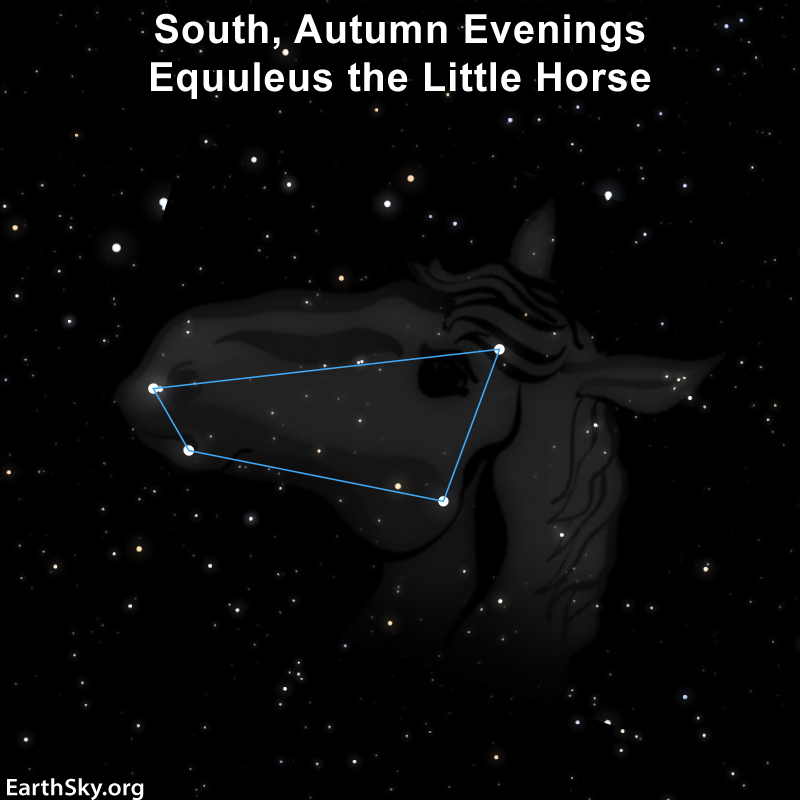
The constellation Equuleus the Little Horse is a small, dim group of stars that lies southeast of the Summer Triangle. Chart via EarthSky.
Equuleus the Little Horse is the second smallest constellation in the sky. It’s a good target for the Northern Hemisphere’s fall sky, but only by knowing just where to look. The good news is, if you have dark skies and can find the Summer Triangle, we can lead you to Equuleus, too.
Mythology of Equuleus the Little Horse
Equuleus (pronounced Eh-KWOO-lee-us) was the mythological child of Pegasus the Winged Horse. Although in other mythological stories, Equuleus is Celeris, the brother of Pegasus. Yet another myth says that Equuleus is a sea horse, who came into being when Neptune and Athena were having a contest showcasing their powers. In this story, Equuleus was born from Neptune’s trident.
Location and stars of Equuleus
Because Equuleus is the child of Pegasus, they are located next to one another in the night sky. Pegasus is easy to find if you remember its asterism, the Great Square of Pegasus. Then look between the Great Square and the Summer Triangle to find Equuleus. Another way to find Equuleus is to look under the shape of the leaping dolphin in the constellation Delphinus.
Equuleus is the smallest of all the constellations in the Northern Hemisphere (only Crux, in the Southern Hemisphere, is smaller than Equuleus). It is less than 13 degrees wide at its widest point. Its brightest star is a magnitude 3.92 star known as Alpha Equulei, or Kitalpha. And it lies 186 light-years away.
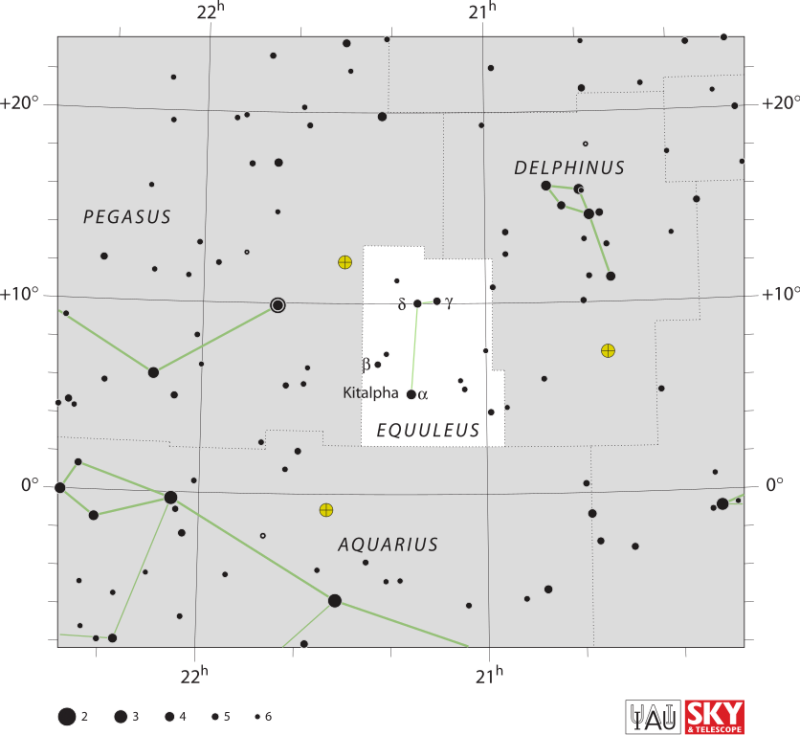
A few other stars in the constellation also have Greek letter designations. Two and a half degrees from Alpha Equulei is Beta Equulei, a magnitude 5.16 star located 360 light-years away. Less than five degrees from Alpha Equulei are two stars in close proximity. The magnitude 4.47 Delta Equulei lies one degree from Gamma Equulei, a magnitude 4.7 star. Delta Equulei is closer at a distance of 60 light-years, while Gamma Equulei lies 115 light-years away. Lastly, the magnitude 5.24 star Epsilon Equulei lies in the western corner of the constellation. Epsilon Equulei is 197 light-years away.
The constellation of Equuleus the Little Horse. Image via IAU/ Sky and Telescope.
Equuleus’ deep-sky objects
Equuleus’ tiny size away from the plane of our Milky Way means it misses out on nebulae, clusters and other good deep-sky observing targets. There are no Messier objects in Equuleus. And you’ll need a hefty telescope to see any of the galaxies here. They’re better targets for a night at the observatory.
Near the center of the constellation is the spiral galaxy NGC 7040 at a magnitude of 15. Less than two degrees away from Gamma Equulei is another spiral galaxy, NGC 7015, with a magnitude of 13. Finally, the barred spiral galaxy NGC 7046 lies in the southern portion of the constellation near some other, even dimmer galaxies. NGC 7046 has a magnitude of 14.
Bottom line: Equuleus the Little Horse is a diminutive constellation that lies south of the Summer Triangle. September nights are a great time to view the Little Horse.
The constellation Equuleus the Little Horse is a small, dim group of stars that lies southeast of the Summer Triangle. Chart via EarthSky.
Equuleus the Little Horse is the second smallest constellation in the sky. It’s a good target for the Northern Hemisphere’s fall sky, but only by knowing just where to look. The good news is, if you have dark skies and can find the Summer Triangle, we can lead you to Equuleus, too.
Mythology of Equuleus the Little Horse
Equuleus (pronounced Eh-KWOO-lee-us) was the mythological child of Pegasus the Winged Horse. Although in other mythological stories, Equuleus is Celeris, the brother of Pegasus. Yet another myth says that Equuleus is a sea horse, who came into being when Neptune and Athena were having a contest showcasing their powers. In this story, Equuleus was born from Neptune’s trident.
Location and stars of Equuleus
Because Equuleus is the child of Pegasus, they are located next to one another in the night sky. Pegasus is easy to find if you remember its asterism, the Great Square of Pegasus. Then look between the Great Square and the Summer Triangle to find Equuleus. Another way to find Equuleus is to look under the shape of the leaping dolphin in the constellation Delphinus.
Equuleus is the smallest of all the constellations in the Northern Hemisphere (only Crux, in the Southern Hemisphere, is smaller than Equuleus). It is less than 13 degrees wide at its widest point. Its brightest star is a magnitude 3.92 star known as Alpha Equulei, or Kitalpha. And it lies 186 light-years away.
A few other stars in the constellation also have Greek letter designations. Two and a half degrees from Alpha Equulei is Beta Equulei, a magnitude 5.16 star located 360 light-years away. Less than five degrees from Alpha Equulei are two stars in close proximity. The magnitude 4.47 Delta Equulei lies one degree from Gamma Equulei, a magnitude 4.7 star. Delta Equulei is closer at a distance of 60 light-years, while Gamma Equulei lies 115 light-years away. Lastly, the magnitude 5.24 star Epsilon Equulei lies in the western corner of the constellation. Epsilon Equulei is 197 light-years away.
The constellation of Equuleus the Little Horse. Image via IAU/ Sky and Telescope.
Equuleus’ deep-sky objects
Equuleus’ tiny size away from the plane of our Milky Way means it misses out on nebulae, clusters and other good deep-sky observing targets. There are no Messier objects in Equuleus. And you’ll need a hefty telescope to see any of the galaxies here. They’re better targets for a night at the observatory.
Near the center of the constellation is the spiral galaxy NGC 7040 at a magnitude of 15. Less than two degrees away from Gamma Equulei is another spiral galaxy, NGC 7015, with a magnitude of 13. Finally, the barred spiral galaxy NGC 7046 lies in the southern portion of the constellation near some other, even dimmer galaxies. NGC 7046 has a magnitude of 14.
Bottom line: Equuleus the Little Horse is a diminutive constellation that lies south of the Summer Triangle. September nights are a great time to view the Little Horse.
Climate Overshoot: Accumulated Effects Persist After Temperatures Fall
You can run your car engine at high RPMs without much lasting issue but the atmosphere is a lot trickier. It may seem that temporary overshoots of warming targets are okay but getting back down below 2 degrees Celcius won't undo the effects that occur in permafrost and oceans, according to a new paper using Earth System Climate Model to compare 42 pairs of climate scenarios and estimate what might occur.
In each model pair, one scenario temporarily exceeded its warming pathway before returning to it, while the other stayed below the threshold.
Overshoot was measured using “degree-years” which combined how much global temperatures exceed a target and how long they remained above it. The scholars found that degree-years were a strong predictor of lasting changes in several climate variables but some variables were found to be much more susceptible to warming than others.
For example, permafrost experienced almost no recovery of its lost carbon when higher temperatures returned to their baseline levels. Also persisting after overshoot were changes to sea-level rise, ocean warming and ocean oxygen levels.
The authors say that the peak level of warming alone does not tell the whole story and policy makers also need to factor in the length of time spent above a target to consider how much lasting change will remain. Therefore, climate goals should not be viewed simply as a temperature level that might get worse before it gets better - like if we eventually adopt green energy that works, such as nuclear - and things will be fine after temperature thresholds are exceeded and settle back. How long we stay at those temperatures matters and factoring in the accumulated effects of overshoot is necessary to better assess climate risks and adaptation measures.
Citation: Dickau, M., Zickfeld, K. & Matthews, H.D. Irreversible climate changes driven by degree-years of temperature overshoot. Commun Earth Environ (2026). DOI: 10.1038/s43247-026-03761-z
from ScienceBlogs - Where the world discusses science https://ift.tt/ISaXxQO
Climate Overshoot: Accumulated Effects Persist After Temperatures Fall
You can run your car engine at high RPMs without much lasting issue but the atmosphere is a lot trickier. It may seem that temporary overshoots of warming targets are okay but getting back down below 2 degrees Celcius won't undo the effects that occur in permafrost and oceans, according to a new paper using Earth System Climate Model to compare 42 pairs of climate scenarios and estimate what might occur.
In each model pair, one scenario temporarily exceeded its warming pathway before returning to it, while the other stayed below the threshold.
Overshoot was measured using “degree-years” which combined how much global temperatures exceed a target and how long they remained above it. The scholars found that degree-years were a strong predictor of lasting changes in several climate variables but some variables were found to be much more susceptible to warming than others.
For example, permafrost experienced almost no recovery of its lost carbon when higher temperatures returned to their baseline levels. Also persisting after overshoot were changes to sea-level rise, ocean warming and ocean oxygen levels.
The authors say that the peak level of warming alone does not tell the whole story and policy makers also need to factor in the length of time spent above a target to consider how much lasting change will remain. Therefore, climate goals should not be viewed simply as a temperature level that might get worse before it gets better - like if we eventually adopt green energy that works, such as nuclear - and things will be fine after temperature thresholds are exceeded and settle back. How long we stay at those temperatures matters and factoring in the accumulated effects of overshoot is necessary to better assess climate risks and adaptation measures.
Citation: Dickau, M., Zickfeld, K. & Matthews, H.D. Irreversible climate changes driven by degree-years of temperature overshoot. Commun Earth Environ (2026). DOI: 10.1038/s43247-026-03761-z
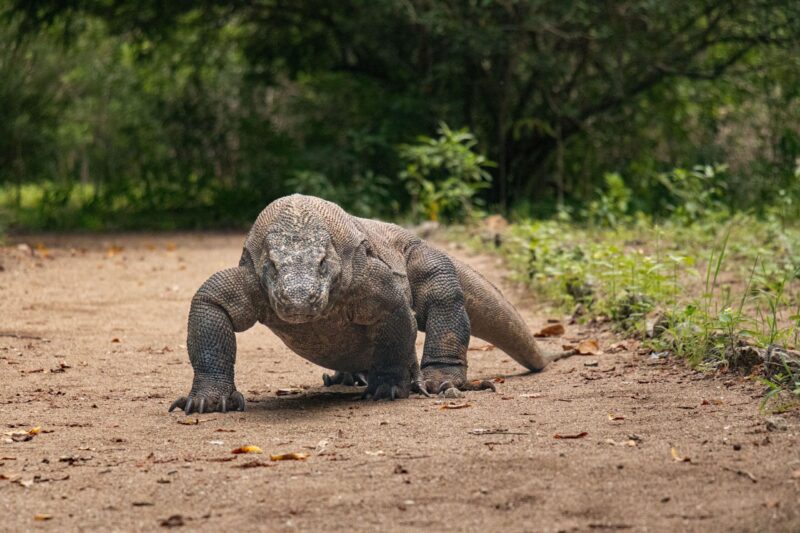
More than 10 feet (3 meters) of muscle, armor, claws and serrated teeth … Now that’s a lizard! Image via Mikhaël Noury/ Pexels.
Let me introduce you to the Komodo dragon, the largest lizard in the world. It can detect food from miles away, hunt large mammals, swim between islands and even produce offspring without a male. Impressive, right? Looking at its size, claws, teeth and prehistoric appearance, the name “dragon” seems pretty fitting.
Growing to more than 10 feet (3 meters) in length, with serrated teeth and venom glands, this reptile is the top land predator on the handful of Indonesian islands where it lives. Are you ready to venture into its territory and discover more about this extraordinary animal?
King of the lizards
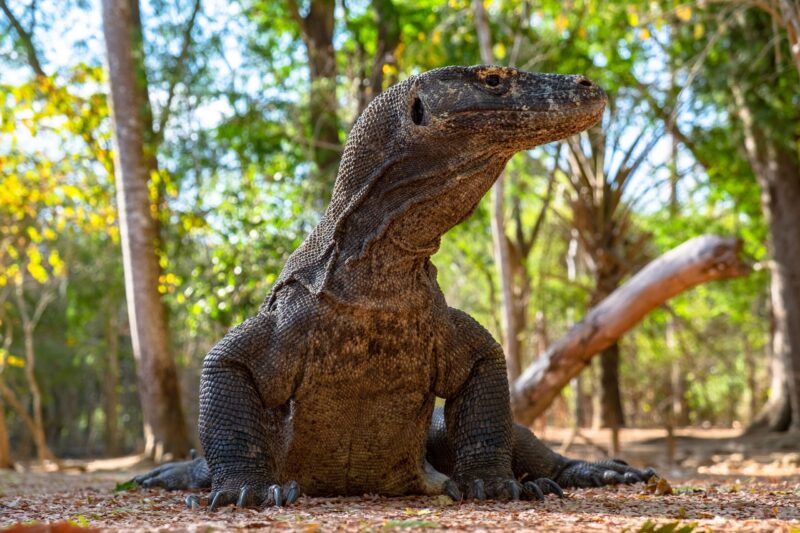
The Komodo dragon (Varanus komodoensis) is the largest living lizard on Earth. The biggest males can exceed 10 feet (3 meters) in length and weigh close to 200 pounds (90 kilograms) in the wild.
Its body is robust and muscular, supported by powerful legs ending in long, curved claws. It uses them to dig burrows, hold onto prey and defend itself. Its tail, which can be almost as long as the rest of its body, helps it keep its balance, defend itself and propel itself through the water.
Its skin is covered in hardened scales that conceal tiny bones called osteoderms. This natural armor provides particular protection to adult dragons.
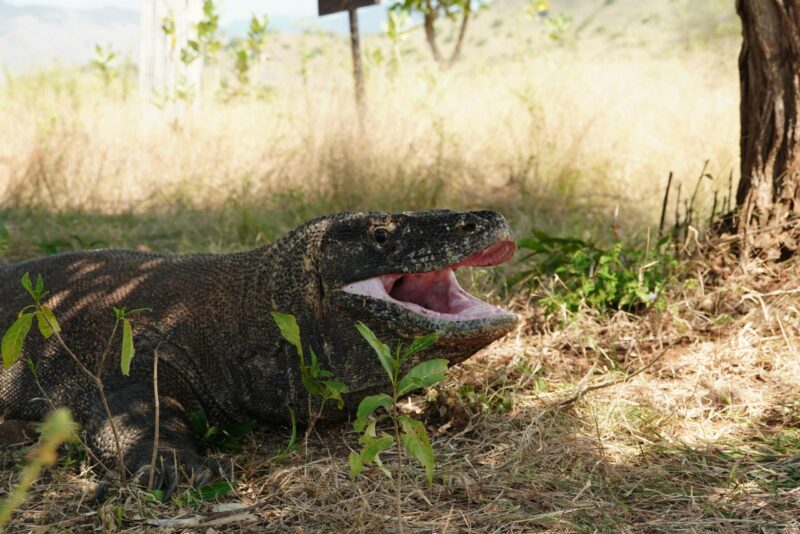
The giant lizard has around 60 teeth with serrated edges that resemble those of sharks. They work like biological knives, capable of cutting and tearing flesh. Its teeth are also continuously replaced throughout its life.
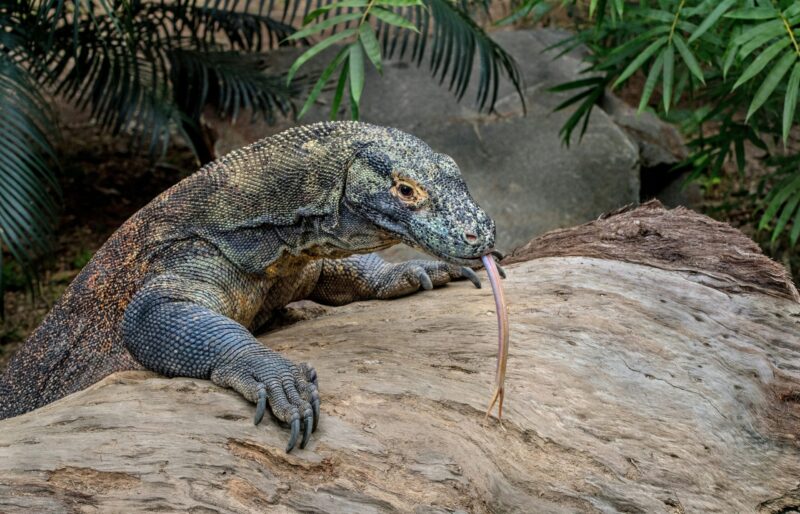
On either side of its head are external ear openings, equivalent to the outer ears of other animals. However, its most important sense is not hearing, but its highly developed chemical sense of smell.
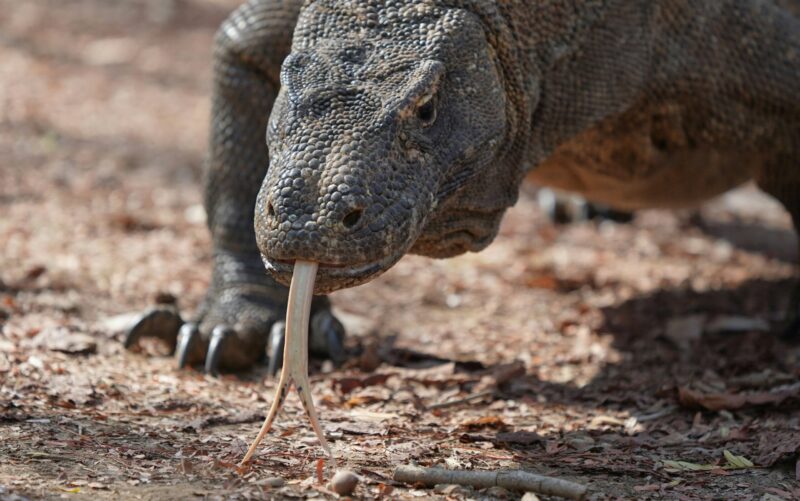
That tongue isn’t just for tasting — it’s a chemical detector, picking up scents and helping the dragon track down food from miles away. Image via Bob Brewer/ Unsplash.
A forked tongue
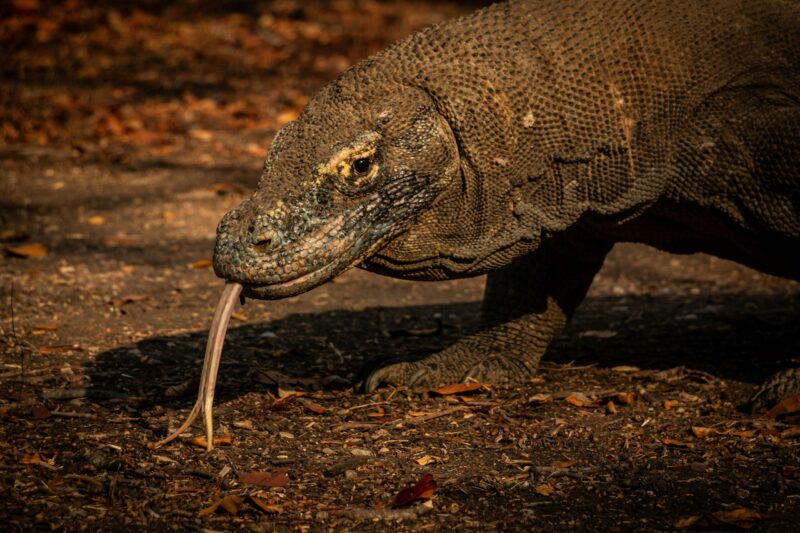
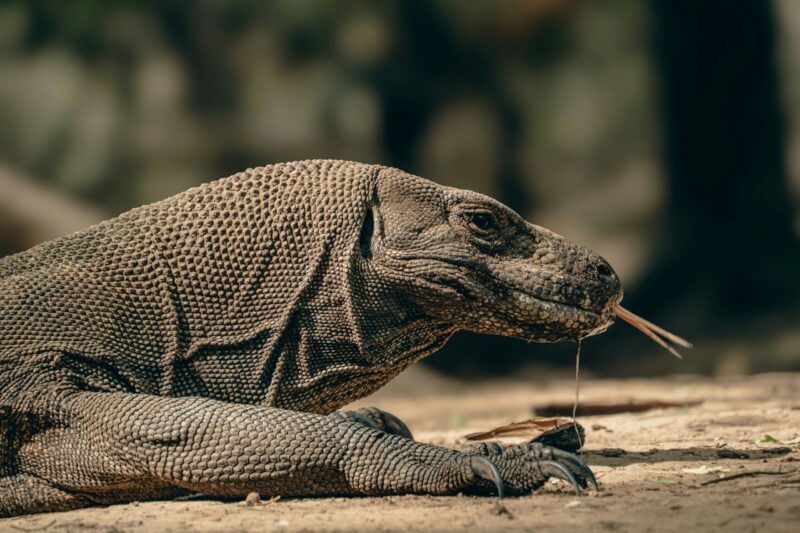
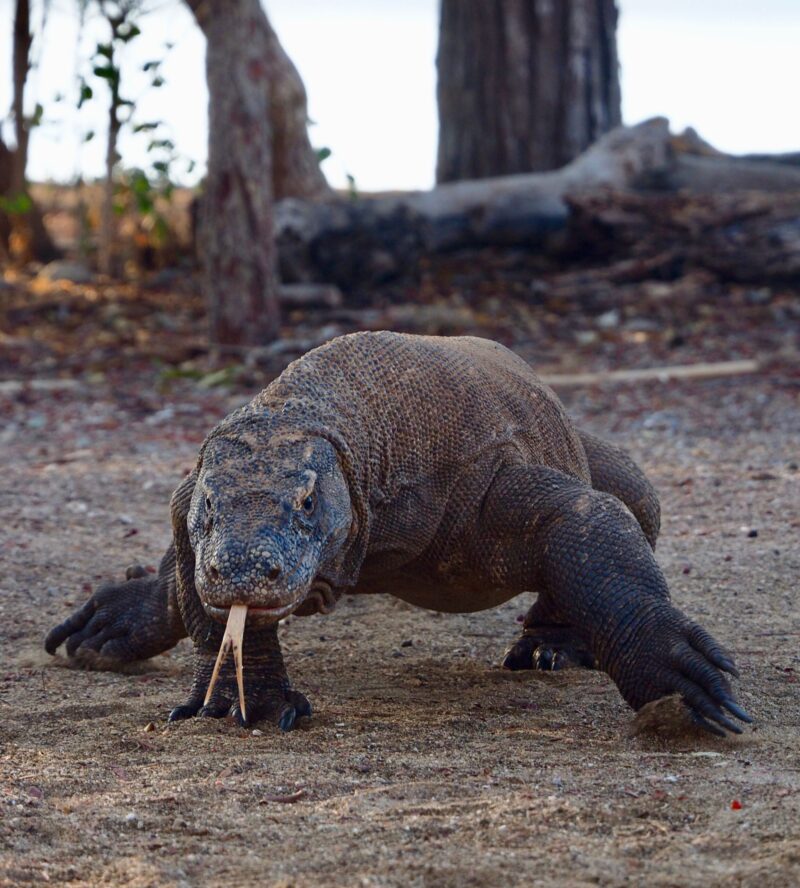
When you see a Komodo dragon constantly flicking its tongue, it isn’t threatening you or showing aggression. It’s “smelling.”
Its forked tongue collects chemical particles from the air and carries them to the Jacobson’s organ, located in the roof of its mouth. The two tips of the tongue can gather information from either side independently, helping the dragon determine where a scent is coming from and follow its trail. Thanks to this system, it can locate food several miles away when conditions are favorable.
In other words, a Komodo dragon doesn’t need to see its prey to find it: it can follow its chemical trail until it reaches it.
Powerful claws, a tongue that can track a scent and venom glands — all packed into one giant lizard. Image via David Clode/ Unsplash.
A bite with a twist
Komodo dragons are predators capable of taking down animals much larger than themselves, including deer, wild boar and water buffalo.
Once it gets a bite on its prey, its serrated teeth sink into the flesh. It then pulls backward with its head and neck, using its body weight to make its teeth slice through the tissue and tear away large chunks of flesh. It doesn’t need an exceptionally powerful bite: it is the combination of its teeth, powerful neck and that pulling motion that makes its bite so effective.
And it has another weapon. Komodo dragons have venom glands in their lower jaws. Their venom promotes bleeding and interferes with blood clotting, allowing the prey to lose blood and weaken rapidly.
Serrated teeth, a powerful neck and an impressive feeding technique allow this giant lizard to tackle surprisingly large prey. Image via Rasmus Gundorff Saederup/ Unsplash.
Nothing goes to waste
Although they are formidable hunters, they never pass up an opportunity for a meal. Carrion can make up a significant part of their diet, and when they find a carcass, they make use of almost everything, including bones that other animals would leave behind.
Their diet is remarkably varied. They can eat large mammals, birds, eggs, other reptiles and even other Komodo dragons! Yes, really …
Nothing is off the menu … even other Komodo dragons. Image via Dennis Schmidt/ Unsplash.
A very different childhood
Being born a Komodo dragon doesn’t guarantee a long life. Although they can live for more than 30 years, the first few years of life are particularly challenging.
Young dragons spend much of their early lives taking refuge in trees. This offers them some protection from adults, which practice cannibalism and will readily eat smaller individuals when the opportunity arises.
This constant threat forces young dragons to live very differently from adults. While adults roam the ground, young dragons remain among the branches, feeding on smaller prey and keeping out of the adults’ reach.
For a young Komodo dragon, the safest place is up in the trees — far from hungry adults. Image via Timon Cornelissen/ Pexels.
Island navigators
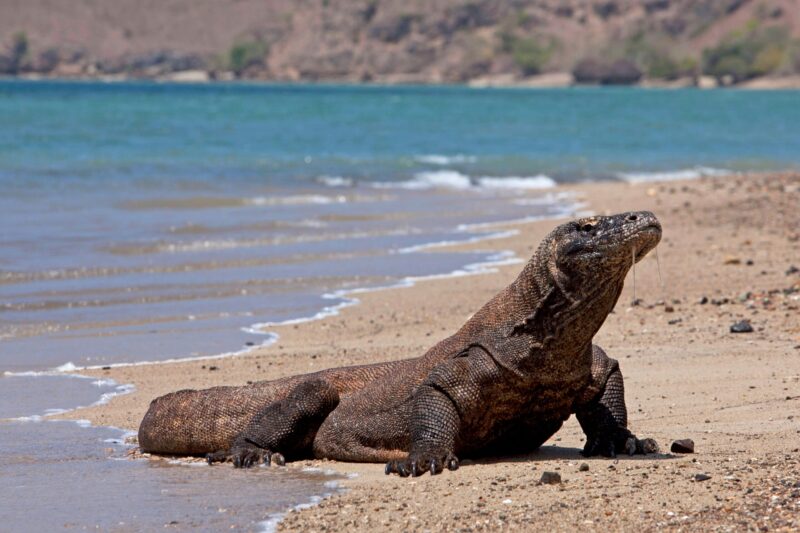
At first glance, an animal this heavy doesn’t exactly look like a great swimmer. Yet Komodo dragons can travel through the sea and cross short stretches of water between islands.
The tail provides much of the propulsion, while the feet, whose toes are partially joined by webbing, help with maneuvering in the water. This ability is particularly important in an archipelago where populations do not always remain completely isolated.
The occasional movement of individuals between islands promotes genetic exchange and reduces some of the risks associated with small, isolated populations.
Watch a Komodo dragon swim.
A reptile full of surprises
Like all reptiles, Komodo dragons are ectothermic: they rely on heat from their surroundings to regulate their body temperature. As a result, they alternate between periods of activity and periods of resting in the sun or shade.
Interestingly, they grow slowly and reach sexual maturity relatively late, usually between eight and ten years of age.
But perhaps the most surprising feature is their ability to reproduce through parthenogenesis. Like most animals, Komodo dragons normally reproduce sexually. However, females can also produce viable eggs without being fertilized by a male.
This ability was discovered in zoos when isolated females produced offspring despite having had no contact with males. For a species spread across several islands, this strategy could be useful if a female reached a new territory on her own and could not find a mate.
But parthenogenesis comes with a trade-off: the offspring produced this way are always male. That means these males would have to mate with their mother to continue the family line, unless they came across other unrelated Komodo dragons.
So while this ability could give a lone female a remarkable advantage in establishing a population in a new territory, it could also limit genetic diversity in that population, which can be harmful.
No male? No problem. A female Komodo dragon can produce offspring on her own. Image via Dimitri Dim/ Pexels.
Busting myths
There are many misconceptions surrounding the Komodo dragon. Let’s bust some myths!
“They kill with the bacteria in their saliva.”
Their saliva does contain bacteria, but the current scientific understanding considers the venom and the wounds caused by the bite to play the main role in their hunting.
“They have the strongest bite of any animal.”
Despite their size and powerful jaws, their hunting success does not depend on exceptional bite force.
“They change color like chameleons.”
There is no solid evidence that Komodo dragons deliberately change color according to the season, their surroundings, or their mood. There is, however, natural variation in coloration between individuals and populations.
“They hunt in packs.”
They are normally solitary animals. When several individuals gather together, it is usually because there is carrion or another abundant food source.
“They became giant because they live on islands.”
The Komodo dragon does live on islands, but its enormous size did not suddenly appear when its ancestors became isolated. Its ancestors already belonged to a group of large lizards. During its evolution, island isolation may have favored the maintenance and even the increase of that size. As it became one of the main terrestrial predators in its ecosystem, a large body allowed it to tackle larger prey and compete more successfully for resources. Today, the Komodo dragon is the largest lizard on Earth.
There’s more to this giant lizard than meets the eye. Its strangest tricks are hidden beneath that prehistoric appearance. Image via M. Rosyadi Aulawi/ Unsplash.
The dragon of Indonesia
The Komodo dragon is naturally found on only a handful of Indonesian islands, including Komodo, Rinca, Flores and Gili Motang.
Habitat loss, declining prey populations and the effects of climate change pose significant challenges to its future survival.
This impressive animal is one of Indonesia’s greatest natural symbols and an emblem of an archipelago that’s home to some of the most extraordinary species on the planet.
For thousands of years, these islands have provided the Komodo dragon with the conditions it needs to survive. The challenge now is to preserve that balance so it can continue to do so for many years to come.
For all its size, the Komodo dragon has an incredibly small home range: just a handful of islands in Indonesia. There is nowhere else on Earth where you can find a giant lizard quite like this one. Image via Jeffry Surianto/ Pexels.
Bottom line: The Komodo dragon is the world’s largest lizard. It’s a venomous predator that can hunt, swim between islands and reproduce without a mate.
More than 10 feet (3 meters) of muscle, armor, claws and serrated teeth … Now that’s a lizard! Image via Mikhaël Noury/ Pexels.
Let me introduce you to the Komodo dragon, the largest lizard in the world. It can detect food from miles away, hunt large mammals, swim between islands and even produce offspring without a male. Impressive, right? Looking at its size, claws, teeth and prehistoric appearance, the name “dragon” seems pretty fitting.
Growing to more than 10 feet (3 meters) in length, with serrated teeth and venom glands, this reptile is the top land predator on the handful of Indonesian islands where it lives. Are you ready to venture into its territory and discover more about this extraordinary animal?
King of the lizards
The Komodo dragon (Varanus komodoensis) is the largest living lizard on Earth. The biggest males can exceed 10 feet (3 meters) in length and weigh close to 200 pounds (90 kilograms) in the wild.
Its body is robust and muscular, supported by powerful legs ending in long, curved claws. It uses them to dig burrows, hold onto prey and defend itself. Its tail, which can be almost as long as the rest of its body, helps it keep its balance, defend itself and propel itself through the water.
Its skin is covered in hardened scales that conceal tiny bones called osteoderms. This natural armor provides particular protection to adult dragons.
The giant lizard has around 60 teeth with serrated edges that resemble those of sharks. They work like biological knives, capable of cutting and tearing flesh. Its teeth are also continuously replaced throughout its life.
On either side of its head are external ear openings, equivalent to the outer ears of other animals. However, its most important sense is not hearing, but its highly developed chemical sense of smell.
That tongue isn’t just for tasting — it’s a chemical detector, picking up scents and helping the dragon track down food from miles away. Image via Bob Brewer/ Unsplash.
A forked tongue
When you see a Komodo dragon constantly flicking its tongue, it isn’t threatening you or showing aggression. It’s “smelling.”
Its forked tongue collects chemical particles from the air and carries them to the Jacobson’s organ, located in the roof of its mouth. The two tips of the tongue can gather information from either side independently, helping the dragon determine where a scent is coming from and follow its trail. Thanks to this system, it can locate food several miles away when conditions are favorable.
In other words, a Komodo dragon doesn’t need to see its prey to find it: it can follow its chemical trail until it reaches it.
Powerful claws, a tongue that can track a scent and venom glands — all packed into one giant lizard. Image via David Clode/ Unsplash.
A bite with a twist
Komodo dragons are predators capable of taking down animals much larger than themselves, including deer, wild boar and water buffalo.
Once it gets a bite on its prey, its serrated teeth sink into the flesh. It then pulls backward with its head and neck, using its body weight to make its teeth slice through the tissue and tear away large chunks of flesh. It doesn’t need an exceptionally powerful bite: it is the combination of its teeth, powerful neck and that pulling motion that makes its bite so effective.
And it has another weapon. Komodo dragons have venom glands in their lower jaws. Their venom promotes bleeding and interferes with blood clotting, allowing the prey to lose blood and weaken rapidly.
Serrated teeth, a powerful neck and an impressive feeding technique allow this giant lizard to tackle surprisingly large prey. Image via Rasmus Gundorff Saederup/ Unsplash.
Nothing goes to waste
Although they are formidable hunters, they never pass up an opportunity for a meal. Carrion can make up a significant part of their diet, and when they find a carcass, they make use of almost everything, including bones that other animals would leave behind.
Their diet is remarkably varied. They can eat large mammals, birds, eggs, other reptiles and even other Komodo dragons! Yes, really …
Nothing is off the menu … even other Komodo dragons. Image via Dennis Schmidt/ Unsplash.
A very different childhood
Being born a Komodo dragon doesn’t guarantee a long life. Although they can live for more than 30 years, the first few years of life are particularly challenging.
Young dragons spend much of their early lives taking refuge in trees. This offers them some protection from adults, which practice cannibalism and will readily eat smaller individuals when the opportunity arises.
This constant threat forces young dragons to live very differently from adults. While adults roam the ground, young dragons remain among the branches, feeding on smaller prey and keeping out of the adults’ reach.
For a young Komodo dragon, the safest place is up in the trees — far from hungry adults. Image via Timon Cornelissen/ Pexels.
Island navigators
At first glance, an animal this heavy doesn’t exactly look like a great swimmer. Yet Komodo dragons can travel through the sea and cross short stretches of water between islands.
The tail provides much of the propulsion, while the feet, whose toes are partially joined by webbing, help with maneuvering in the water. This ability is particularly important in an archipelago where populations do not always remain completely isolated.
The occasional movement of individuals between islands promotes genetic exchange and reduces some of the risks associated with small, isolated populations.
Watch a Komodo dragon swim.
A reptile full of surprises
Like all reptiles, Komodo dragons are ectothermic: they rely on heat from their surroundings to regulate their body temperature. As a result, they alternate between periods of activity and periods of resting in the sun or shade.
Interestingly, they grow slowly and reach sexual maturity relatively late, usually between eight and ten years of age.
But perhaps the most surprising feature is their ability to reproduce through parthenogenesis. Like most animals, Komodo dragons normally reproduce sexually. However, females can also produce viable eggs without being fertilized by a male.
This ability was discovered in zoos when isolated females produced offspring despite having had no contact with males. For a species spread across several islands, this strategy could be useful if a female reached a new territory on her own and could not find a mate.
But parthenogenesis comes with a trade-off: the offspring produced this way are always male. That means these males would have to mate with their mother to continue the family line, unless they came across other unrelated Komodo dragons.
So while this ability could give a lone female a remarkable advantage in establishing a population in a new territory, it could also limit genetic diversity in that population, which can be harmful.
No male? No problem. A female Komodo dragon can produce offspring on her own. Image via Dimitri Dim/ Pexels.
Busting myths
There are many misconceptions surrounding the Komodo dragon. Let’s bust some myths!
“They kill with the bacteria in their saliva.”
Their saliva does contain bacteria, but the current scientific understanding considers the venom and the wounds caused by the bite to play the main role in their hunting.
“They have the strongest bite of any animal.”
Despite their size and powerful jaws, their hunting success does not depend on exceptional bite force.
“They change color like chameleons.”
There is no solid evidence that Komodo dragons deliberately change color according to the season, their surroundings, or their mood. There is, however, natural variation in coloration between individuals and populations.
“They hunt in packs.”
They are normally solitary animals. When several individuals gather together, it is usually because there is carrion or another abundant food source.
“They became giant because they live on islands.”
The Komodo dragon does live on islands, but its enormous size did not suddenly appear when its ancestors became isolated. Its ancestors already belonged to a group of large lizards. During its evolution, island isolation may have favored the maintenance and even the increase of that size. As it became one of the main terrestrial predators in its ecosystem, a large body allowed it to tackle larger prey and compete more successfully for resources. Today, the Komodo dragon is the largest lizard on Earth.
There’s more to this giant lizard than meets the eye. Its strangest tricks are hidden beneath that prehistoric appearance. Image via M. Rosyadi Aulawi/ Unsplash.
The dragon of Indonesia
The Komodo dragon is naturally found on only a handful of Indonesian islands, including Komodo, Rinca, Flores and Gili Motang.
Habitat loss, declining prey populations and the effects of climate change pose significant challenges to its future survival.
This impressive animal is one of Indonesia’s greatest natural symbols and an emblem of an archipelago that’s home to some of the most extraordinary species on the planet.
For thousands of years, these islands have provided the Komodo dragon with the conditions it needs to survive. The challenge now is to preserve that balance so it can continue to do so for many years to come.
For all its size, the Komodo dragon has an incredibly small home range: just a handful of islands in Indonesia. There is nowhere else on Earth where you can find a giant lizard quite like this one. Image via Jeffry Surianto/ Pexels.
Bottom line: The Komodo dragon is the world’s largest lizard. It’s a venomous predator that can hunt, swim between islands and reproduce without a mate.