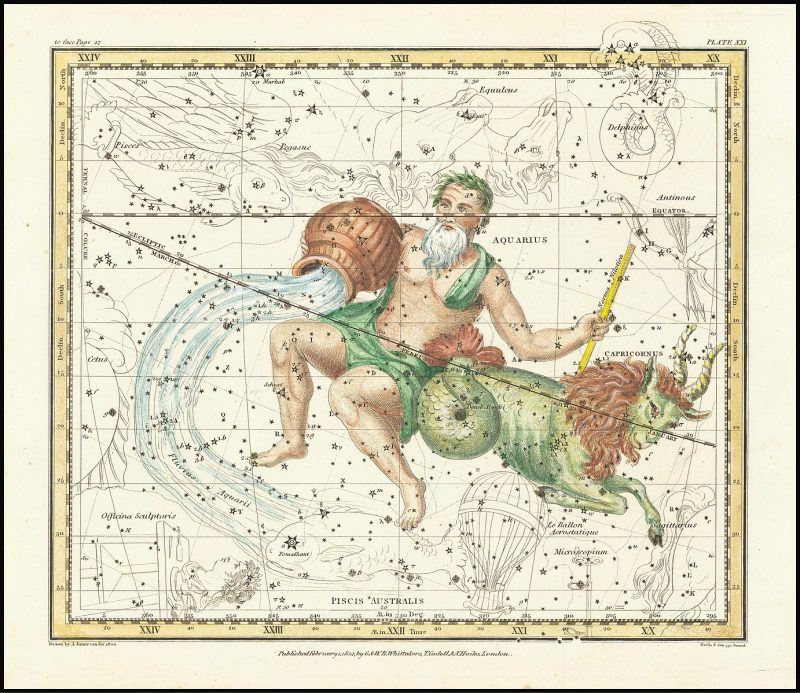
aads

Cassiopeia the Queen ascends in September and October


Do you want to know more about the constellation Cassiopeia the Queen? Watch this video for more details.

Don’t miss the next unmissable night sky event. Sign up to EarthSky’s free newsletter for daily night sky updates.

Cassiopeia the Queen in autumn

Any late summer evening and throughout northern autumn, Cassiopeia the Queen will be ascending in the northeast after nightfall. The shape of this constellation makes Cassiopeia’s stars very noticeable. Cassiopeia looks like the letter W (or M).

Look for the Queen at nightfall in September, and notice how she gets higher in the northeast with each day as northern autumn unfolds.

For those at the latitudes of the northern U.S. and Canada, Cassiopeia is circumpolar. That means the constellation stays above the horizon all night, every night.

How to see Cassiopeia

Cassiopeia represents an ancient queen of Ethiopia. You still sometimes hear the old name for this constellation: Cassiopeia’s Chair. And some old star maps depict the queen sitting on the chair, marked by five stars.

These stars – the brightest ones in Cassiopeia – are Schedar, Caph, Gamma Cassiopeiae, Ruchbah and Segin.

Around the middle of the night during the autumn months, Cassiopeia swings above Polaris, the North Star.

Before dawn, look in the northwest.
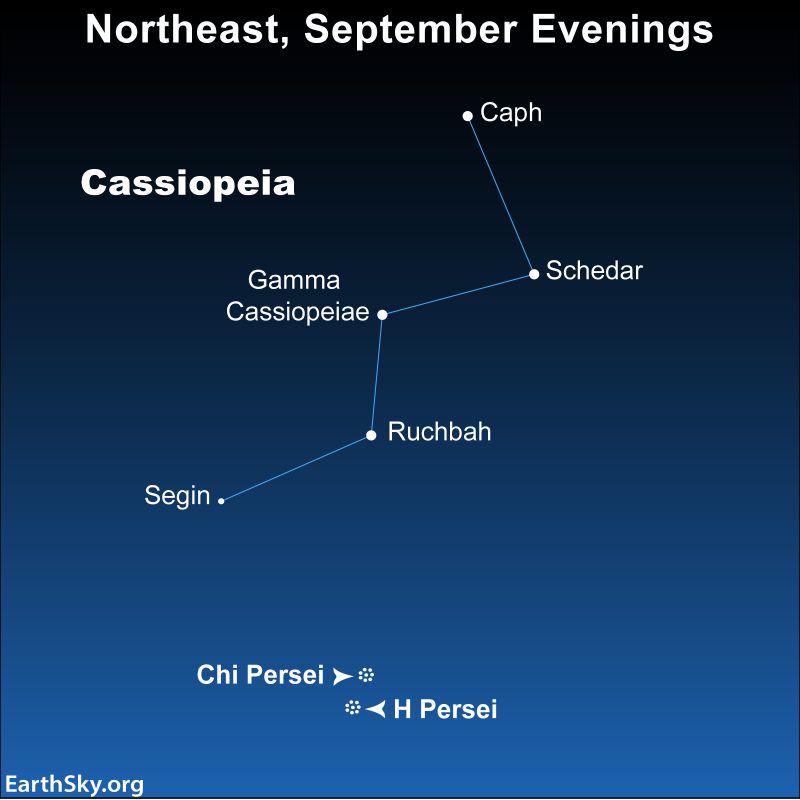
Star chart of constellation Cassiopeia with stars labeled and two tiny, labeled rings of dots.
You can find Cassiopeia the Queen in the northeast around the month of September. If you have a dark sky, look below Cassiopeia for a famous binocular object. This object is called the Double Cluster in Perseus. Chart via EarthSky.

Opposite the Big Dipper

Cassiopeia is opposite the Big Dipper in the northern sky.

That is, the two constellations lie on opposite sides of the pole star, Polaris.

So when Cassiopeia is high in the sky, as it is on evenings from about September through February, the Big Dipper is low in the sky. Every March, when the Dipper is ascending in the northeast, getting ready to appear prominent again in the evening sky, Cassiopeia is descending in the northwest.

Animated diagram of Cassiopeia stars and Big Dipper circling around Polaris in the center.
The Big Dipper and the W-shaped constellation Cassiopeia circle around Polaris, the North Star, in a period of 23 hours and 56 minutes. The Dipper is circumpolar at 41 degrees north latitude, and all latitudes farther north. Image via Mjchael/ Wikipedia.

A guide to deep-sky beauties

If you have a dark sky, look below Cassiopeia in the northeast on these autumn evenings for the Double Cluster in Perseus.

These are two open star clusters. Each consists of young stars still moving together from the primordial cloud of gas and dust that gave birth to them.

These two clusters are familiarly known to stargazers as H and Chi Persei.

Interestingly, their names are from two different alphabets, the Greek and the Roman. Stars have Greek letter names, but most star clusters don’t. Johann Bayer (1572-1625) gave Chi Persei its Greek letter name. Then, it’s said, he ran out of Greek letters. That’s when he used a Roman letter – the letter H – to name the other cluster.

Charts for Cassiopeia

Sky chart of constellation Cassiopeia with stars in black on white and other objects as small colored symbols.
In the 1930s, the International Astronomical Union (IAU) – an organization of professional astronomers – decided to define boundaries and officially name 88 constellations. This is the realm of night sky they identified as Cassiopeia. Read more about the constellations. Image via IAU.
Old-fashioned drawing of Queen Cassiopeia in Greek garb on her throne, with scattered stars.
Cassiopeia as Johannes Hevelius depicted it in the 1600s. Image via Wikimedia Commons.

Lore of Cassiopeia

In skylore and in Greek mythology, Cassiopeia is a beautiful and vain queen of Ethiopia. It’s said that she committed the sin of pride by boasting that both she and her daughter Andromeda were more beautiful than Nereids, or sea nymphs. Pridefulness, in mythology, is never wise.

Since her boast angered Poseidon, God of the Sea, he sent a sea monster (Cetus the Whale) to ravage the kingdom. So to pacify the monster, Cassiopeia’s daughter, Princess Andromeda, was left tied to a rock by the sea. Cetus was about to devour her when Perseus the Hero happened by on Pegasus, the Flying Horse.

Perseus rescued the princess, and all lived happily … and the gods were pleased, so all of these characters were elevated to the heavens as stars.

But – because of her vanity – Cassiopeia suffered an indignity. At some times of the night or year, this constellation has more the shape of the letter M, and you might imagine the Queen reclining on her starry throne.

At other times of year or night – as in the wee hours between midnight and dawn in February and March – Cassiopeia’s Chair dips below the celestial pole. And then this constellation appears to us on Earth more like the letter W. That’s when the Lady of the Chair, as astronomers sometimes call her, is said to hang on for dear life. If Cassiopeia the Queen lets go, she will drop from the sky into the ocean below, where the Nereids must still be waiting.

Cassiopeia by our EarthSky Community

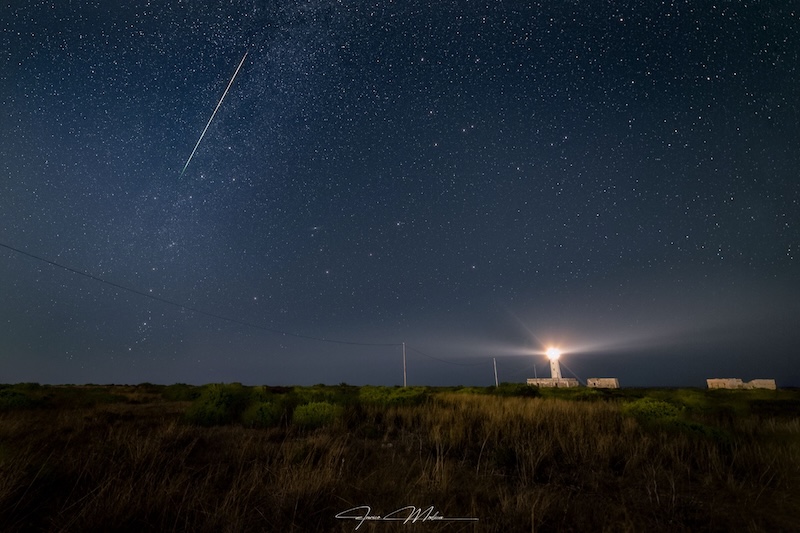
Starry sky with a bright Perseid by Cassiopeia. There's a lighthouse to the right.
View at EarthSky Community Photos. | Enrico Modica captured this photo on August 13, 2026, in Italy. Enrico wrote: “This image shows the Plemmirio Lighthouse near Syracuse, Sicily, beneath the summer night sky, with the constellations of Andromeda, Cassiopeia, and Perseus, as well as the Andromeda Galaxy (M31), approximately 2.5 million light-years away. A Perseid meteor is also visible on the left side of the frame right by Cassiopeia.” Thank you, Enrico!
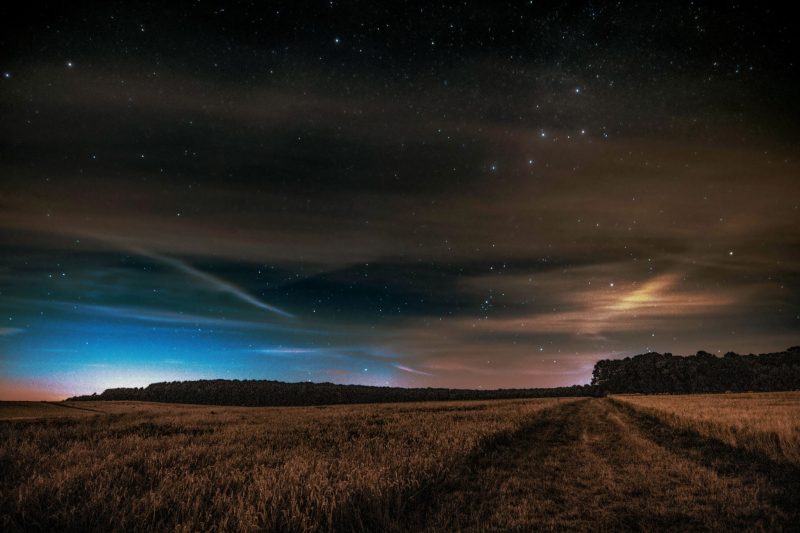
Broad agricultural fields, with Cassiopeia shining through wispy clouds.
View at EarthSky Community Photos. | V. Liard Photography in Champagne, France, took this wonderful image on July 22, 2023. It features the W-shaped constellation Cassiopeia the Queen. Thank you, V. Liard! Cassiopeia is a great constellation to come to know, especially if you have a dark sky. That’s because it points to our neighbor, the Andromeda galaxy.

Bottom line: Cassiopeia the Queen is an easy-to-find constellation. It has the shape of a W or M. Look for it in the north-northeast sky on September and October evenings.

Help support EarthSky! Visit the EarthSky store to see the great selection of educational tools and team gear we have to offer.

Enjoying EarthSky so far? Sign up for our free daily newsletter today!

The post Cassiopeia the Queen ascends in September and October first appeared on EarthSky.


from EarthSky https://ift.tt/dryDqvU


Do you want to know more about the constellation Cassiopeia the Queen? Watch this video for more details.

Don’t miss the next unmissable night sky event. Sign up to EarthSky’s free newsletter for daily night sky updates.

Cassiopeia the Queen in autumn

Any late summer evening and throughout northern autumn, Cassiopeia the Queen will be ascending in the northeast after nightfall. The shape of this constellation makes Cassiopeia’s stars very noticeable. Cassiopeia looks like the letter W (or M).

Look for the Queen at nightfall in September, and notice how she gets higher in the northeast with each day as northern autumn unfolds.

For those at the latitudes of the northern U.S. and Canada, Cassiopeia is circumpolar. That means the constellation stays above the horizon all night, every night.

How to see Cassiopeia

Cassiopeia represents an ancient queen of Ethiopia. You still sometimes hear the old name for this constellation: Cassiopeia’s Chair. And some old star maps depict the queen sitting on the chair, marked by five stars.

These stars – the brightest ones in Cassiopeia – are Schedar, Caph, Gamma Cassiopeiae, Ruchbah and Segin.

Around the middle of the night during the autumn months, Cassiopeia swings above Polaris, the North Star.

Before dawn, look in the northwest.

Star chart of constellation Cassiopeia with stars labeled and two tiny, labeled rings of dots.
You can find Cassiopeia the Queen in the northeast around the month of September. If you have a dark sky, look below Cassiopeia for a famous binocular object. This object is called the Double Cluster in Perseus. Chart via EarthSky.

Opposite the Big Dipper

Cassiopeia is opposite the Big Dipper in the northern sky.

That is, the two constellations lie on opposite sides of the pole star, Polaris.

So when Cassiopeia is high in the sky, as it is on evenings from about September through February, the Big Dipper is low in the sky. Every March, when the Dipper is ascending in the northeast, getting ready to appear prominent again in the evening sky, Cassiopeia is descending in the northwest.

Animated diagram of Cassiopeia stars and Big Dipper circling around Polaris in the center.
The Big Dipper and the W-shaped constellation Cassiopeia circle around Polaris, the North Star, in a period of 23 hours and 56 minutes. The Dipper is circumpolar at 41 degrees north latitude, and all latitudes farther north. Image via Mjchael/ Wikipedia.

A guide to deep-sky beauties

If you have a dark sky, look below Cassiopeia in the northeast on these autumn evenings for the Double Cluster in Perseus.

These are two open star clusters. Each consists of young stars still moving together from the primordial cloud of gas and dust that gave birth to them.

These two clusters are familiarly known to stargazers as H and Chi Persei.

Interestingly, their names are from two different alphabets, the Greek and the Roman. Stars have Greek letter names, but most star clusters don’t. Johann Bayer (1572-1625) gave Chi Persei its Greek letter name. Then, it’s said, he ran out of Greek letters. That’s when he used a Roman letter – the letter H – to name the other cluster.

Charts for Cassiopeia
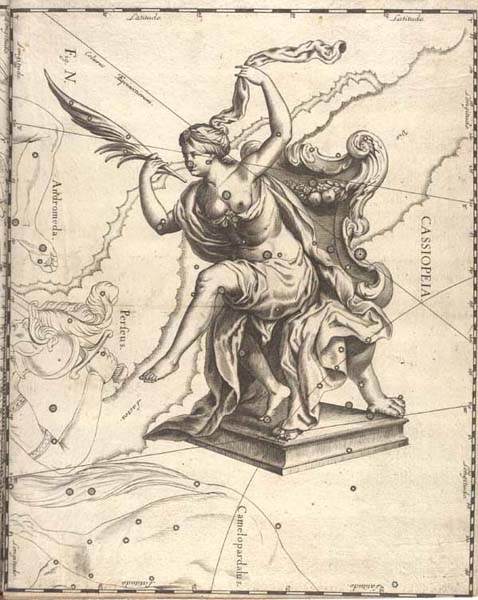
Sky chart of constellation Cassiopeia with stars in black on white and other objects as small colored symbols.
In the 1930s, the International Astronomical Union (IAU) – an organization of professional astronomers – decided to define boundaries and officially name 88 constellations. This is the realm of night sky they identified as Cassiopeia. Read more about the constellations. Image via IAU.
Old-fashioned drawing of Queen Cassiopeia in Greek garb on her throne, with scattered stars.
Cassiopeia as Johannes Hevelius depicted it in the 1600s. Image via Wikimedia Commons.

Lore of Cassiopeia

In skylore and in Greek mythology, Cassiopeia is a beautiful and vain queen of Ethiopia. It’s said that she committed the sin of pride by boasting that both she and her daughter Andromeda were more beautiful than Nereids, or sea nymphs. Pridefulness, in mythology, is never wise.

Since her boast angered Poseidon, God of the Sea, he sent a sea monster (Cetus the Whale) to ravage the kingdom. So to pacify the monster, Cassiopeia’s daughter, Princess Andromeda, was left tied to a rock by the sea. Cetus was about to devour her when Perseus the Hero happened by on Pegasus, the Flying Horse.

Perseus rescued the princess, and all lived happily … and the gods were pleased, so all of these characters were elevated to the heavens as stars.

But – because of her vanity – Cassiopeia suffered an indignity. At some times of the night or year, this constellation has more the shape of the letter M, and you might imagine the Queen reclining on her starry throne.

At other times of year or night – as in the wee hours between midnight and dawn in February and March – Cassiopeia’s Chair dips below the celestial pole. And then this constellation appears to us on Earth more like the letter W. That’s when the Lady of the Chair, as astronomers sometimes call her, is said to hang on for dear life. If Cassiopeia the Queen lets go, she will drop from the sky into the ocean below, where the Nereids must still be waiting.

Cassiopeia by our EarthSky Community
Starry sky with a bright Perseid by Cassiopeia. There's a lighthouse to the right.
View at EarthSky Community Photos. | Enrico Modica captured this photo on August 13, 2026, in Italy. Enrico wrote: “This image shows the Plemmirio Lighthouse near Syracuse, Sicily, beneath the summer night sky, with the constellations of Andromeda, Cassiopeia, and Perseus, as well as the Andromeda Galaxy (M31), approximately 2.5 million light-years away. A Perseid meteor is also visible on the left side of the frame right by Cassiopeia.” Thank you, Enrico!
Broad agricultural fields, with Cassiopeia shining through wispy clouds.
View at EarthSky Community Photos. | V. Liard Photography in Champagne, France, took this wonderful image on July 22, 2023. It features the W-shaped constellation Cassiopeia the Queen. Thank you, V. Liard! Cassiopeia is a great constellation to come to know, especially if you have a dark sky. That’s because it points to our neighbor, the Andromeda galaxy.

Bottom line: Cassiopeia the Queen is an easy-to-find constellation. It has the shape of a W or M. Look for it in the north-northeast sky on September and October evenings.

Help support EarthSky! Visit the EarthSky store to see the great selection of educational tools and team gear we have to offer.

Enjoying EarthSky so far? Sign up for our free daily newsletter today!

The post Cassiopeia the Queen ascends in September and October first appeared on EarthSky.


from EarthSky https://ift.tt/dryDqvU

BepiColombo mission 1 step closer to Mercury today

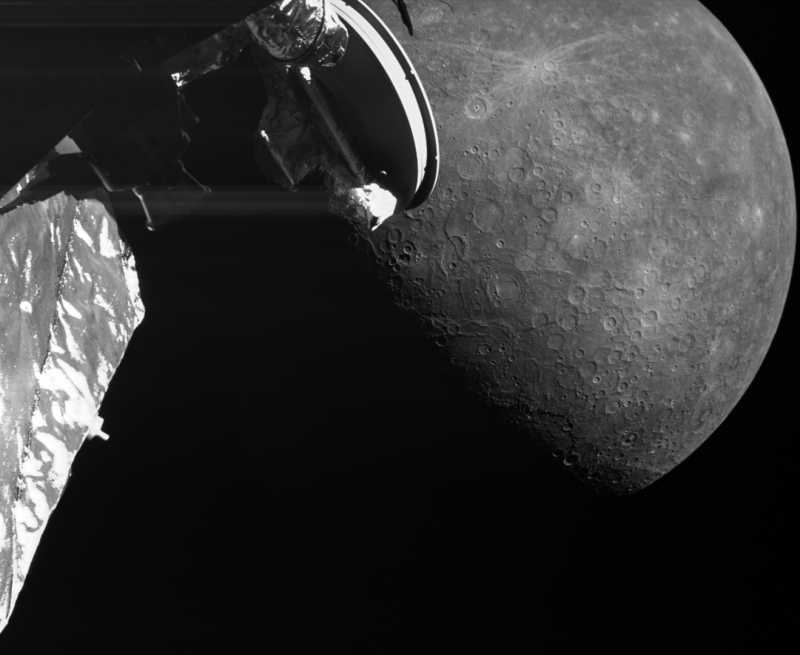
BepiColombo: Black and white image of a spacecraft arm with a cratered world behind it.
View larger. | This view of Mercury from the BepiColombo spacecraft came from its 3rd flyby of the planet on June 19, 2023. BepiColombo’s propulsion system will separate from its 2 orbiters on September 3, 2026. Then the 2 spacecraft will enter orbit around Mercury on November 21, 2026. Image via ESA/ BepiColombo/ MTM.

Science news, night sky events and beautiful photos, all in one place. Click here to subscribe to our free daily newsletter.

BepiColombo mission to arrive at Mercury in November

Today, on September 3, 2026, ESA’s BepiColombo spacecraft is moving one crucial step closer to entering Mercury’s orbit.

Bepicolombo launched to space way back October 20, 2018, from Kourou, French Guiana. The spacecraft has spent eight years maneuvering into position so that it can orbit Mercury, the closest planet to the sun. Orbiting Mercury is a true engineering challenge, because the spacecraft picks up speed as it nears the massive sun. But it must slow down to enter Mercury’s orbit and not fly straight past.

So, during its journey, BepiColombo has made flybys of Earth, Venus and Mercury to help put on the brakes. And on September 3, 2026, Bepicolombo’s Mercury Transfer Module (the spacecraft’s propulsion unit) will separate from the science orbiters, Mercury Planetary Orbiter (MPO) and Mercury Magnetospheric Orbiter (MMO). These two spacecraft will then enter orbit around Mercury on November 21, 2026.

On December 9-10, the two orbiters will separate from each other. Finally, science operations will begin in April 2027.

BepiColombo’s flybys

BepiColombo has made one Earth flyby, two Venus flybys, and six Mercury flybys since its launch in 2018. Click the links below to learn more about the flybys.

April 10, 2020: 1st Earth flyby
October 15, 2020: 1st Venus flyby
August 10, 2021: 2nd Venus flyby
October 1, 2021: 1st Mercury flyby
June 23, 2022: 2nd Mercury flyby
June 20, 2023: 3rd Mercury flyby
September 4, 2024: 4th Mercury flyby
December 1, 2024: 5th Mercury flyby
January 8, 2025: 6th Mercury flyby

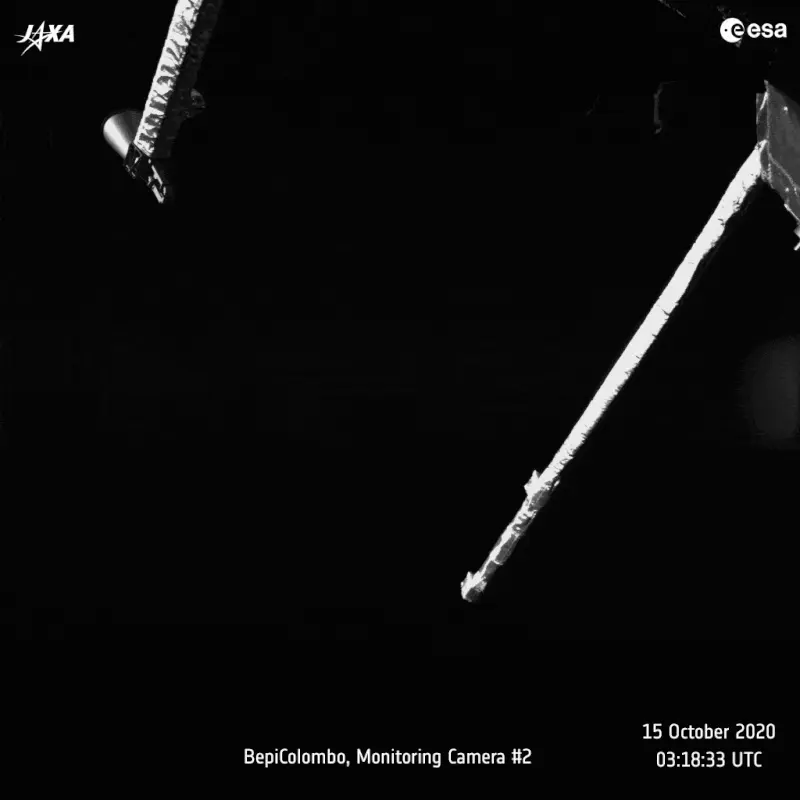
View larger. | The European Space Agency’s BepiColombo spacecraft, heading toward Mercury, caught this fleeting image of Venus on October 15, 2020. You can see the terminator line, or dividing line between light and dark on Venus, pass from right to left, causing Venus to change phase as the spacecraft swept past. Image via ESA/ BepiColombo/ MTM.

What scientists hope to learn at Mercury

Mercury is currently the least-understood planet in the inner solar system. In fact, before BepiColombo, the only spacecraft to have visited Mercury were NASA’s Mariner 10 and MESSENGER missions.

Now, scientists hope to solve five mysteries with BepiColombo:

  1. Where did Mercury come from?
  2. Is there really water on Mercury?
  3. Is Mercury dead or alive?
  4. Why is Mercury so dark?
  5. Why does Mercury have a magnetic field?

To answer these questions, BepiColombo will spend at least one year orbiting Mercury. The mission will use its high-resolution instruments to learn about the mineralogical and elemental composition of Mercury’s surface. Plus, it will scan polar regions for ice. BepiColombo will look for anything that looks like it has changed on Mercury since MESSENGER visited 10 years earlier. And the two orbiters will travel through different areas of the planet’s magnetosphere to measure how it changes and interacts with the sun.

Bottom line: The BepiColombo mission has been maneuvering its way into orbit around Mercury for eight years. On September 3, it will release two orbiters in Mercury orbit.

Via ESA

Read more: Mercury images from final flyby of BepiColombo!

Read more: Mercury lives on? Strange streaks hint at active world

The post BepiColombo mission 1 step closer to Mercury today first appeared on EarthSky.


from EarthSky https://ift.tt/7yKlBtZ
BepiColombo: Black and white image of a spacecraft arm with a cratered world behind it.
View larger. | This view of Mercury from the BepiColombo spacecraft came from its 3rd flyby of the planet on June 19, 2023. BepiColombo’s propulsion system will separate from its 2 orbiters on September 3, 2026. Then the 2 spacecraft will enter orbit around Mercury on November 21, 2026. Image via ESA/ BepiColombo/ MTM.

Science news, night sky events and beautiful photos, all in one place. Click here to subscribe to our free daily newsletter.

BepiColombo mission to arrive at Mercury in November

Today, on September 3, 2026, ESA’s BepiColombo spacecraft is moving one crucial step closer to entering Mercury’s orbit.

Bepicolombo launched to space way back October 20, 2018, from Kourou, French Guiana. The spacecraft has spent eight years maneuvering into position so that it can orbit Mercury, the closest planet to the sun. Orbiting Mercury is a true engineering challenge, because the spacecraft picks up speed as it nears the massive sun. But it must slow down to enter Mercury’s orbit and not fly straight past.

So, during its journey, BepiColombo has made flybys of Earth, Venus and Mercury to help put on the brakes. And on September 3, 2026, Bepicolombo’s Mercury Transfer Module (the spacecraft’s propulsion unit) will separate from the science orbiters, Mercury Planetary Orbiter (MPO) and Mercury Magnetospheric Orbiter (MMO). These two spacecraft will then enter orbit around Mercury on November 21, 2026.

On December 9-10, the two orbiters will separate from each other. Finally, science operations will begin in April 2027.

BepiColombo’s flybys

BepiColombo has made one Earth flyby, two Venus flybys, and six Mercury flybys since its launch in 2018. Click the links below to learn more about the flybys.

April 10, 2020: 1st Earth flyby
October 15, 2020: 1st Venus flyby
August 10, 2021: 2nd Venus flyby
October 1, 2021: 1st Mercury flyby
June 23, 2022: 2nd Mercury flyby
June 20, 2023: 3rd Mercury flyby
September 4, 2024: 4th Mercury flyby
December 1, 2024: 5th Mercury flyby
January 8, 2025: 6th Mercury flyby

View larger. | The European Space Agency’s BepiColombo spacecraft, heading toward Mercury, caught this fleeting image of Venus on October 15, 2020. You can see the terminator line, or dividing line between light and dark on Venus, pass from right to left, causing Venus to change phase as the spacecraft swept past. Image via ESA/ BepiColombo/ MTM.

What scientists hope to learn at Mercury

Mercury is currently the least-understood planet in the inner solar system. In fact, before BepiColombo, the only spacecraft to have visited Mercury were NASA’s Mariner 10 and MESSENGER missions.

Now, scientists hope to solve five mysteries with BepiColombo:

  1. Where did Mercury come from?
  2. Is there really water on Mercury?
  3. Is Mercury dead or alive?
  4. Why is Mercury so dark?
  5. Why does Mercury have a magnetic field?

To answer these questions, BepiColombo will spend at least one year orbiting Mercury. The mission will use its high-resolution instruments to learn about the mineralogical and elemental composition of Mercury’s surface. Plus, it will scan polar regions for ice. BepiColombo will look for anything that looks like it has changed on Mercury since MESSENGER visited 10 years earlier. And the two orbiters will travel through different areas of the planet’s magnetosphere to measure how it changes and interacts with the sun.

Bottom line: The BepiColombo mission has been maneuvering its way into orbit around Mercury for eight years. On September 3, it will release two orbiters in Mercury orbit.

Via ESA

Read more: Mercury images from final flyby of BepiColombo!

Read more: Mercury lives on? Strange streaks hint at active world

The post BepiColombo mission 1 step closer to Mercury today first appeared on EarthSky.


from EarthSky https://ift.tt/7yKlBtZ

Corona Australis is the sparkling Southern Crown

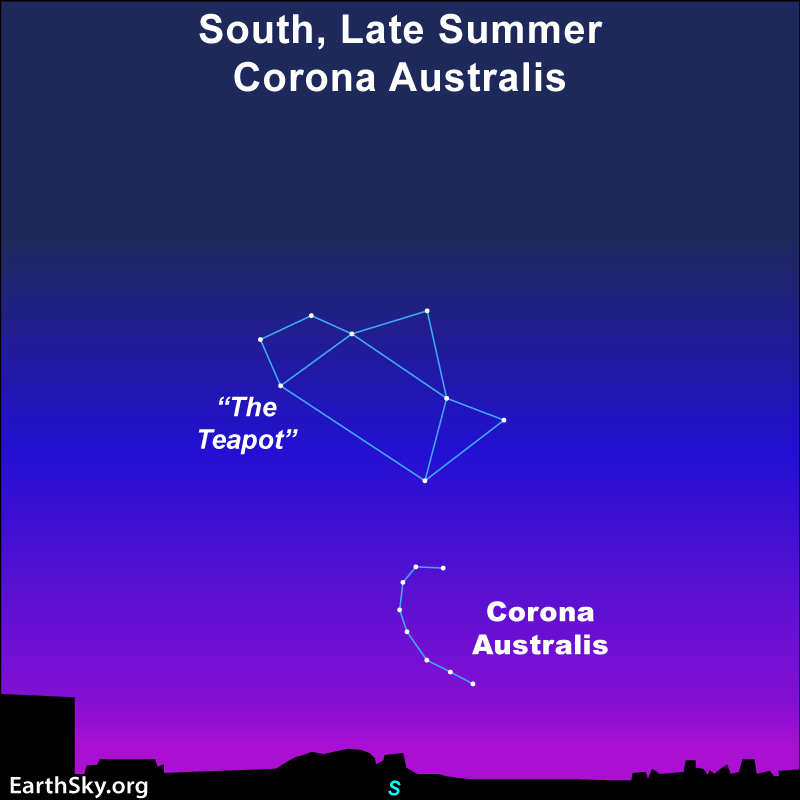
Star chart showing a Teapot-shaped group of stars and a curve of stars below labeled Corona Australis.
Corona Australis the Southern Crown can be challenging for northerners to spot. But it’s below the Teapot asterism in Sagittarius so look for it on late summer evenings. Chart via EarthSky.

Corona Australis the Southern Crown appears as an arc of sparkling stars. In fact, it’s one of the few constellations that somewhat resembles the object it’s named after. Ptolemy named Corona Australis in the 2nd century. Ancient Greeks saw this constellation as a wreath, while other civilizations saw a turtle or ostrich nest. Since it’s quite dim, you’ll want to be under dark skies to find it. But it’s relatively easy to pick out due to its location just south of major constellations. That’s because Corona Australis lies south of the Teapot asterism within Sagittarius.

The stars of Corona Australis

Just like its northern cousin, Corona Borealis, Corona Australis forms an arc. But the stars of the Southern Crown are so dim that its brightest stars are a mere magnitude 4.11. Beta Coronae Australis shines at the eastern edge of the constellation near the middle of the arc shape. The star lies 474 light-years distant.

The next star to the north in the arc is Alpha Coronae Australis, magnitude 4.10 and 125 light-years distant. Continuing in the same direction along the arc is a magnitude 4.23 star, 58 light-years away: Gamma Coronae Australis. Then 1.5 degrees west of this star is Epsilon Coronae Australis, magnitude 4.83 and 98 light-years away. Finally, the last notable star on this side of the arc is just over 3 degrees away, magnitude 5.11, Lambda Coronae Australis, at 202 light-years distant.

Heading the other direction from Beta is Delta Coronae Australis, a magnitude 4.57 star at a distance of 175 light-years. Next out is Zeta Coronae Australis, magnitude 4.74 and 184 light-years away. At the end of the crown is a double star system, Eta 1 and 2 Coronae Australis, at magnitude 5.46 and 347 light-years away, and magnitude 5.60 and 607 light-years distant, respectively.

Check out this lovely deep-sky image of nebulae in Corona Australis by Hector Rafael Vazquez Rispoli in Buenos Aires, Argentina.

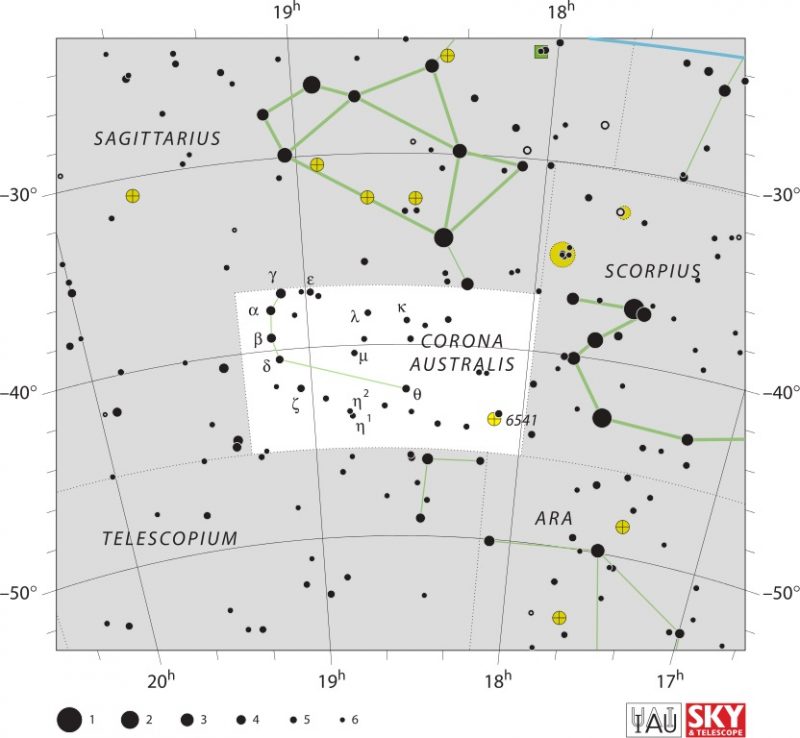
White chart with stars in black, several forming the arc of Corona Australis.
The stars of Corona Australis. Image via IAU/ Sky and Telescope/ Wikimedia Commons.

Bottom line: Corona Australis is a dim constellation lying below the Teapot asterism of Sagittarius. Its sparkling, curving shape befits its name.

The post Corona Australis is the sparkling Southern Crown first appeared on EarthSky.


from EarthSky https://ift.tt/L49JMql
Star chart showing a Teapot-shaped group of stars and a curve of stars below labeled Corona Australis.
Corona Australis the Southern Crown can be challenging for northerners to spot. But it’s below the Teapot asterism in Sagittarius so look for it on late summer evenings. Chart via EarthSky.

Corona Australis the Southern Crown appears as an arc of sparkling stars. In fact, it’s one of the few constellations that somewhat resembles the object it’s named after. Ptolemy named Corona Australis in the 2nd century. Ancient Greeks saw this constellation as a wreath, while other civilizations saw a turtle or ostrich nest. Since it’s quite dim, you’ll want to be under dark skies to find it. But it’s relatively easy to pick out due to its location just south of major constellations. That’s because Corona Australis lies south of the Teapot asterism within Sagittarius.

The stars of Corona Australis

Just like its northern cousin, Corona Borealis, Corona Australis forms an arc. But the stars of the Southern Crown are so dim that its brightest stars are a mere magnitude 4.11. Beta Coronae Australis shines at the eastern edge of the constellation near the middle of the arc shape. The star lies 474 light-years distant.

The next star to the north in the arc is Alpha Coronae Australis, magnitude 4.10 and 125 light-years distant. Continuing in the same direction along the arc is a magnitude 4.23 star, 58 light-years away: Gamma Coronae Australis. Then 1.5 degrees west of this star is Epsilon Coronae Australis, magnitude 4.83 and 98 light-years away. Finally, the last notable star on this side of the arc is just over 3 degrees away, magnitude 5.11, Lambda Coronae Australis, at 202 light-years distant.

Heading the other direction from Beta is Delta Coronae Australis, a magnitude 4.57 star at a distance of 175 light-years. Next out is Zeta Coronae Australis, magnitude 4.74 and 184 light-years away. At the end of the crown is a double star system, Eta 1 and 2 Coronae Australis, at magnitude 5.46 and 347 light-years away, and magnitude 5.60 and 607 light-years distant, respectively.

Check out this lovely deep-sky image of nebulae in Corona Australis by Hector Rafael Vazquez Rispoli in Buenos Aires, Argentina.

White chart with stars in black, several forming the arc of Corona Australis.
The stars of Corona Australis. Image via IAU/ Sky and Telescope/ Wikimedia Commons.

Bottom line: Corona Australis is a dim constellation lying below the Teapot asterism of Sagittarius. Its sparkling, curving shape befits its name.

The post Corona Australis is the sparkling Southern Crown first appeared on EarthSky.


from EarthSky https://ift.tt/L49JMql

Giant mega-Earth is 23 times more massive than Earth

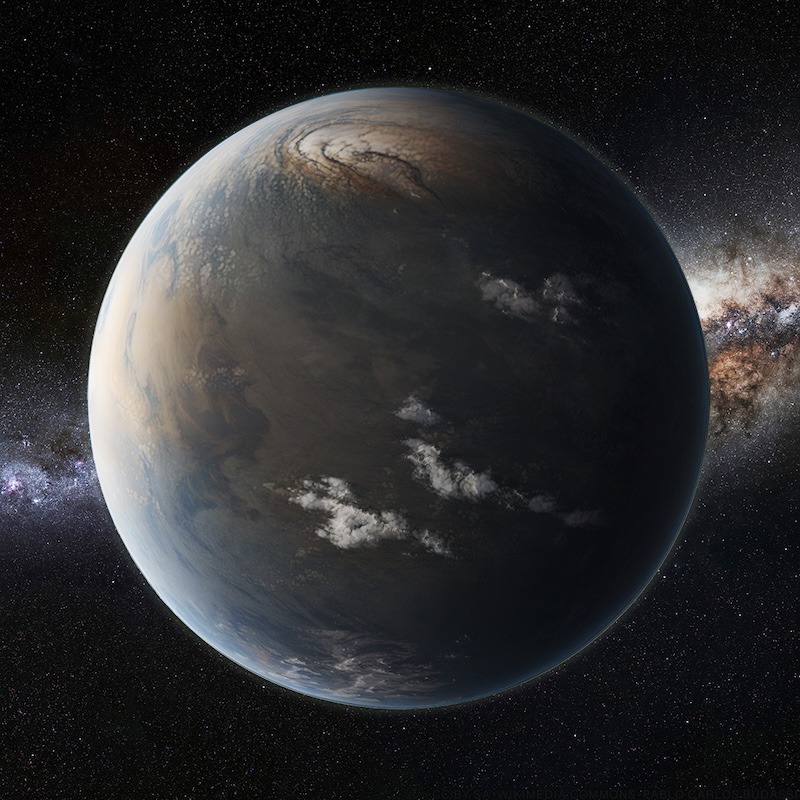
Giant mega-Earth: Large, rocky planet similar to Earth with the Milky Way in the background.
View larger. | Artist’s concept of a giant mega-Earth. The newly discovered mega-Earth GJ 523b is 23.5 times the mass of Earth and 2.5 times its size. Image via Pablo Carlos Budassi/ Wikimedia Commons.
  • Astronomers have confirmed an unusual planet called GJ 523b. It belongs to a rare group of worlds known as mega-Earths.
  • The planet is only about 2.5 times as wide as Earth but has more than 23 times its mass. That makes it unusually dense.
  • Scientists don’t understand how it formed this way. A planet this massive would normally be expected to have a thick atmosphere of hydrogen and helium.

Science news, night sky events and beautiful photos, all in one place. Click here to subscribe to our free daily newsletter.

Giant mega-Earth is 23 times Earth’s mass

On July 23, 2026, astronomers at the University of Wisconsin–Madison announced the confirmation of GJ 523b, an unusually dense mega-Earth first detected in data from NASA’s TESS telescope.

Rocky exoplanets called super-Earths are quite common in our galaxy. These worlds are larger and more massive than Earth, but smaller than Neptune. But now astronomers have found an even more massive planets called  mega-Earths. Fewer mega-Earths have been discovered so far than super-Earths, but they do exist. This newest one – GJ 523b – might be the best example known so far. It is a whopping 23 times as massive as Earth.

GJ 523b is 2.5 times the diameter of Earth. Some super-Earths can be that large, but the extreme mass is unusual. And the planet is estimated to be only 170 million years old. That’s in contrast to Earth’s age of 4.54 billion years. So the GJ 523 system is much younger than our own solar system. The planet orbits a orange dwarf star.

Thomas Beatty at University of Wisconsin-Madison said:

People have been using the phrase ‘Mega-Earth’ for more than a decade, but we’ve never had a planet that let us say concretely what one is. GJ 523b finally does. What is also striking is that nailing down the definition of a Mega-Earth isn’t something us astronomers can really do by ourselves: We need geologists who understand how iron and rock behave at pressures no laboratory on Earth can reach, and atmospheric scientists who can tell us how much of what we measured is rock at all.

The new paper is still undergoing peer-review but was first published on the preprint server arXiv on March 25, 2026.

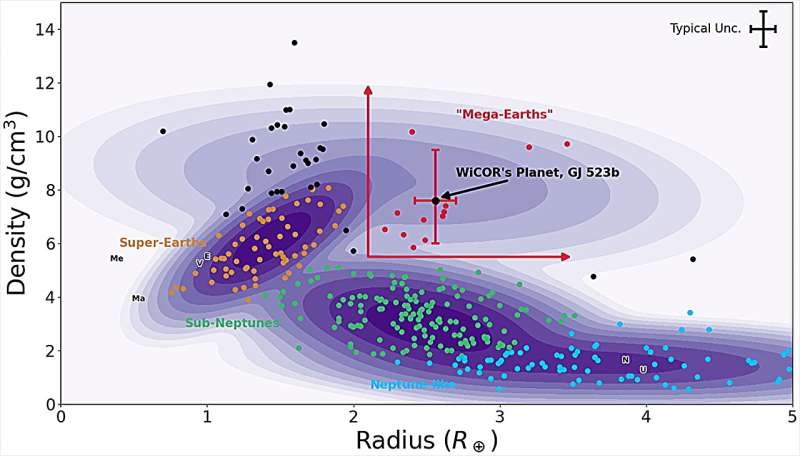
Diagram comparing the radii and densities of confirmed exoplanets. Mega-Earths appear in red, while the arrows mark the authors’ proposed definition of the class. GJ 523b is among the unusually dense planets in this region. Image via Kroft et al./ arXiv.

TESS makes a surprising discovery

Astronomers first used NASA’s TESS space telescope first detected GJ 523b as it passed in front of its star, causing a tiny dip in the star’s brightness. These transits allowed astronomers to estimate the planet’s size.

Lead author Max Kroft at University of Wisconsin-Madison said:

There’s this periodic dipping of the star’s light. We think that’s a planet passing in front of the star and transiting. It’s blocking some of the light from the star, and the star gets dimmer.

We picked out this planet based on what we thought its size and temperature were. A bigger planet makes a bigger dip, so we get an idea of the size, and based on how often that dip happens, we get the distance of its orbit and we can use that to estimate the temperature of the exoplanet.

The researchers then used the NEID spectrograph and data on the WIYN 3.5-meter telescope to determine it’s mass. High-resolution imaging from Gemini North and Palomarto were used to further study GJ 523b. They found some surprises. It was more massive than most rocky planets of its size; 23.5 times more massive than Earth and 2.5 times the diameter of Earth, or 60% the size of Neptune. As Kroft noted, this was an unexpected finding:

This isn’t what we expected at all. Dense planets like this aren’t uncommon, but they’re usually small rocky planets similar to Earth or Mercury. This planet is 2.5 times bigger than the Earth.

Man with wide smile, eyeglasses and very curly hair.
Max Kroft at University of Wisconsin-Madison led the new study about GJ 523b. Image via University of Wisconsin-Madison.

How did GJ 523b form this way?

So how did GJ 523b end up being so extremely dense and massive? Why didn’t the planet develop a massive hydrogen atmosphere?

In the words of Kroft, the discovery was:

a real curveball.

During planet formation, worlds with cores around 10 to 20 times Earth’s mass are generally expected to pull in thick atmospheres of hydrogen and helium. GJ 523b is massive enough for this to happen, yet it appears to contain very little gas.

The study found that ordinary heating from the star probably could not remove enough gas. Giant impacts, an extremely close passage by the star or forming without much gas are possible explanations.

Kroft also notes that the planet would still have been hot from its formation. Too hot to hold onto its atmosphere. Krofft explained:

It kind of blows away. A planet can’t hold on to its atmosphere if it’s really hot, and so you could be left with this big glob of rock made by these two planets with very little atmosphere.

The planet’s orbit offers another clue.

The researchers estimate that it is tilted by at least 71 degrees relative to the rotation of its star. This unusual alignment suggests that GJ 523b might have migrated from elsewhere in the system or experienced a turbulent event early in its history.

More planets like GJ 523b

The researchers are hopeful that astronomers will find more planets like GJ 523b. There are over 6,000 confirmed exoplanets already found, and thousands more candidates. Kroft said:

It’s hard to infer things about planet formation in general from a sample size of one. We’re not going to get to 10,000 of these over-dense planets, but if we can get to 20 or 30, maybe some trends might pop out, where maybe the heaviest ones have shorter orbital periods, or they tend not to have companion planets.

Bottom line: Astronomers discover mega-Earth, GJ 523b, has 23.5 times Earth’s mass but only 2.5 times its radius. Its extreme density, apparent lack of a thick gas atmosphere and highly tilted orbit challenge standard ideas about how massive planets form.

Source: GJ 523b is a Massive, 170 Myr-old Mega-Earth, Likely on a Polar Orbit

Via University of Wisconsin-Madison

Via Phys.org

Read more: Kepler-10 star system has a mega-Earth!

Read more: Exoplanet art lets you visualize alien worlds

The post Giant mega-Earth is 23 times more massive than Earth first appeared on EarthSky.


from EarthSky https://ift.tt/MWrkqcR
Giant mega-Earth: Large, rocky planet similar to Earth with the Milky Way in the background.
View larger. | Artist’s concept of a giant mega-Earth. The newly discovered mega-Earth GJ 523b is 23.5 times the mass of Earth and 2.5 times its size. Image via Pablo Carlos Budassi/ Wikimedia Commons.
  • Astronomers have confirmed an unusual planet called GJ 523b. It belongs to a rare group of worlds known as mega-Earths.
  • The planet is only about 2.5 times as wide as Earth but has more than 23 times its mass. That makes it unusually dense.
  • Scientists don’t understand how it formed this way. A planet this massive would normally be expected to have a thick atmosphere of hydrogen and helium.

Science news, night sky events and beautiful photos, all in one place. Click here to subscribe to our free daily newsletter.

Giant mega-Earth is 23 times Earth’s mass

On July 23, 2026, astronomers at the University of Wisconsin–Madison announced the confirmation of GJ 523b, an unusually dense mega-Earth first detected in data from NASA’s TESS telescope.

Rocky exoplanets called super-Earths are quite common in our galaxy. These worlds are larger and more massive than Earth, but smaller than Neptune. But now astronomers have found an even more massive planets called  mega-Earths. Fewer mega-Earths have been discovered so far than super-Earths, but they do exist. This newest one – GJ 523b – might be the best example known so far. It is a whopping 23 times as massive as Earth.

GJ 523b is 2.5 times the diameter of Earth. Some super-Earths can be that large, but the extreme mass is unusual. And the planet is estimated to be only 170 million years old. That’s in contrast to Earth’s age of 4.54 billion years. So the GJ 523 system is much younger than our own solar system. The planet orbits a orange dwarf star.

Thomas Beatty at University of Wisconsin-Madison said:

People have been using the phrase ‘Mega-Earth’ for more than a decade, but we’ve never had a planet that let us say concretely what one is. GJ 523b finally does. What is also striking is that nailing down the definition of a Mega-Earth isn’t something us astronomers can really do by ourselves: We need geologists who understand how iron and rock behave at pressures no laboratory on Earth can reach, and atmospheric scientists who can tell us how much of what we measured is rock at all.

The new paper is still undergoing peer-review but was first published on the preprint server arXiv on March 25, 2026.

Diagram comparing the radii and densities of confirmed exoplanets. Mega-Earths appear in red, while the arrows mark the authors’ proposed definition of the class. GJ 523b is among the unusually dense planets in this region. Image via Kroft et al./ arXiv.

TESS makes a surprising discovery

Astronomers first used NASA’s TESS space telescope first detected GJ 523b as it passed in front of its star, causing a tiny dip in the star’s brightness. These transits allowed astronomers to estimate the planet’s size.

Lead author Max Kroft at University of Wisconsin-Madison said:

There’s this periodic dipping of the star’s light. We think that’s a planet passing in front of the star and transiting. It’s blocking some of the light from the star, and the star gets dimmer.

We picked out this planet based on what we thought its size and temperature were. A bigger planet makes a bigger dip, so we get an idea of the size, and based on how often that dip happens, we get the distance of its orbit and we can use that to estimate the temperature of the exoplanet.

The researchers then used the NEID spectrograph and data on the WIYN 3.5-meter telescope to determine it’s mass. High-resolution imaging from Gemini North and Palomarto were used to further study GJ 523b. They found some surprises. It was more massive than most rocky planets of its size; 23.5 times more massive than Earth and 2.5 times the diameter of Earth, or 60% the size of Neptune. As Kroft noted, this was an unexpected finding:

This isn’t what we expected at all. Dense planets like this aren’t uncommon, but they’re usually small rocky planets similar to Earth or Mercury. This planet is 2.5 times bigger than the Earth.

Man with wide smile, eyeglasses and very curly hair.
Max Kroft at University of Wisconsin-Madison led the new study about GJ 523b. Image via University of Wisconsin-Madison.

How did GJ 523b form this way?

So how did GJ 523b end up being so extremely dense and massive? Why didn’t the planet develop a massive hydrogen atmosphere?

In the words of Kroft, the discovery was:

a real curveball.

During planet formation, worlds with cores around 10 to 20 times Earth’s mass are generally expected to pull in thick atmospheres of hydrogen and helium. GJ 523b is massive enough for this to happen, yet it appears to contain very little gas.

The study found that ordinary heating from the star probably could not remove enough gas. Giant impacts, an extremely close passage by the star or forming without much gas are possible explanations.

Kroft also notes that the planet would still have been hot from its formation. Too hot to hold onto its atmosphere. Krofft explained:

It kind of blows away. A planet can’t hold on to its atmosphere if it’s really hot, and so you could be left with this big glob of rock made by these two planets with very little atmosphere.

The planet’s orbit offers another clue.

The researchers estimate that it is tilted by at least 71 degrees relative to the rotation of its star. This unusual alignment suggests that GJ 523b might have migrated from elsewhere in the system or experienced a turbulent event early in its history.

More planets like GJ 523b

The researchers are hopeful that astronomers will find more planets like GJ 523b. There are over 6,000 confirmed exoplanets already found, and thousands more candidates. Kroft said:

It’s hard to infer things about planet formation in general from a sample size of one. We’re not going to get to 10,000 of these over-dense planets, but if we can get to 20 or 30, maybe some trends might pop out, where maybe the heaviest ones have shorter orbital periods, or they tend not to have companion planets.

Bottom line: Astronomers discover mega-Earth, GJ 523b, has 23.5 times Earth’s mass but only 2.5 times its radius. Its extreme density, apparent lack of a thick gas atmosphere and highly tilted orbit challenge standard ideas about how massive planets form.

Source: GJ 523b is a Massive, 170 Myr-old Mega-Earth, Likely on a Polar Orbit

Via University of Wisconsin-Madison

Via Phys.org

Read more: Kepler-10 star system has a mega-Earth!

Read more: Exoplanet art lets you visualize alien worlds

The post Giant mega-Earth is 23 times more massive than Earth first appeared on EarthSky.


from EarthSky https://ift.tt/MWrkqcR

Will fall migration bring a billion bird night?

Fall migration: Map of US with orange in much of the east and only dark purple near southern Oregon into Nevada.
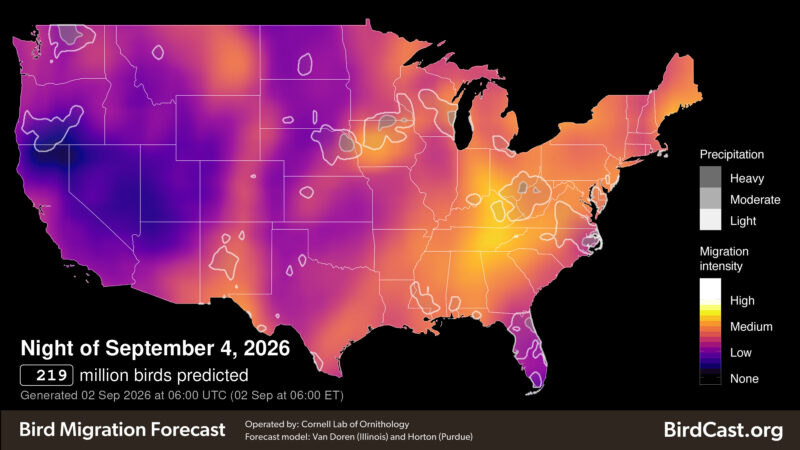
This is the BirdCast fall migration forecast for the evening of September 4, 2026. BirdCast predicts around 219 million birds crossing the United States, with the highest concentrations in the locations with the lightest colors. Millions of birds regularly cross the U.S. in fall as they head south. And sometimes up to a billion birds a night can take flight. Map generated at 6 UTC September 6. Image via Van Doren (Illinois) and Horton (Purdue) Cornell Lab of Ornithology. See most recent map here.

Will we see a billion birds during fall migration?

It’s peak fall migration season for birds! While the numbers of birds crossing the U.S. is usually in the millions during September and October, we can sometimes see a billion bird night. That happened last year, on September 25, 2025, when BirdCast tracked more than 1.2 billion birds heading south after sunset. That was the most BirdCast had ever tracked in one night since it began its project in 2018. How do they track the birds? They use:

the same weather radar technology behind daily forecasts to track migrating birds.

On that night, about 10% of North America’s birds were in flight at the same time. And there’s something you can do in the fall to help them make their journey southward.

Lights out for birds during fall migration!

Every day you can check the BirdCast.info website to get an idea of what regions will see the highest number of birds passing each night. So when your area is especially active, turn off your exterior lights and encourage your neighbors to do the same. Artificial lights disorient birds, changing their behavior and sometimes leading to their deaths.

BirdCast.info says:

Light pollution attracts and disorients migrating birds, confusing and exhausting them as well as making them vulnerable to collisions with buildings.

So here’s what you can do:

  • Turn off non-essential lights from 11 p.m. until 6 a.m. during critical migration periods
  • Turn off or dim lobby and atrium lights
  • Be sure outside lights are aimed down and well shielded
  • Turn off or dim interior home lighting, or draw blinds to prevent light escaping
  • Turn off decorative landscape lighting
  • Install motion sensors on outside lights to minimize use
  • Turn off lights before leaving the home or office
  • Prevent daylight collisions with bird-friendly products for windows

Read more: Want to save millions of migratory birds? Turn off your outdoor lights in spring and fall

Migration maps

The maps from BirdCast.info depict migratory patterns over the years. As the website explains:

Bird migration forecasts show predicted nocturnal migration 3 hours after local sunset and are updated every 6 hours. These forecasts come from models trained on the last 23 years of bird movements in the atmosphere as detected by the US NEXRAD weather surveillance radar network.

You can get the next three nights’ worth of maps at the site. And besides the prediction maps, you can also find live bird migration maps. They’ll give you an idea of where birds are active right now. Birds are most active after dark. And if you don’t want to keep checking back at the website to see when birds are active in your area, you can sign up for alerts.

Science news, night sky events and beautiful photos, all in one place. Click here to subscribe to our free daily newsletter.

Sites to help you see and protect birds

Tracking and research tools:

  • BirdCast
    Migration forecasts, live radar-based migration maps and alerts you can use to know when migration is happening in your area.
  • Motus Wildlife Tracking System
    A global collaboration using small tracking tags (for birds, bats, insects) and receiving stations to map how animals move across landscapes.
  • Audubon’s Bird Migration Explorer
    Interactive maps and data showing annual migration routes for hundreds of species across North America.
  • National Zoo: Migratory Birds Tracking Map
    Shows real tracking data (from tagged birds) on real maps.
  • Journey North
    Citizen science and seasonal tracking of migrating species (birds, butterflies, etc.).
  • Canadian Migration Monitoring Network (CMMN)
    Long-term monitoring of migration trends in Canada, via many observatories.
  • PixCams Live Bird Migration Station
    A hybrid setup (optical + thermal + acoustic) giving real-time monitoring of nocturnal migrations.
  • MigrantWatch (India)
    A citizen science effort to log migratory bird sightings in India.
  • eBird India
  • A nationwide citizen-science platform where birdwatchers record their sightings to build an open database tracking bird distribution, abundance and migration patterns across India year-round.

Some initiatives for protecting migrating birds:

Bottom line: Will we see a billion bird night during fall migration this year? And get tips on how you can help birds by turning off exterior lights.

Read more: Fall hummingbird migration in progress across North America

The post Will fall migration bring a billion bird night? first appeared on EarthSky.


from EarthSky https://ift.tt/8pMIB4E
Fall migration: Map of US with orange in much of the east and only dark purple near southern Oregon into Nevada.
This is the BirdCast fall migration forecast for the evening of September 4, 2026. BirdCast predicts around 219 million birds crossing the United States, with the highest concentrations in the locations with the lightest colors. Millions of birds regularly cross the U.S. in fall as they head south. And sometimes up to a billion birds a night can take flight. Map generated at 6 UTC September 6. Image via Van Doren (Illinois) and Horton (Purdue) Cornell Lab of Ornithology. See most recent map here.

Will we see a billion birds during fall migration?

It’s peak fall migration season for birds! While the numbers of birds crossing the U.S. is usually in the millions during September and October, we can sometimes see a billion bird night. That happened last year, on September 25, 2025, when BirdCast tracked more than 1.2 billion birds heading south after sunset. That was the most BirdCast had ever tracked in one night since it began its project in 2018. How do they track the birds? They use:

the same weather radar technology behind daily forecasts to track migrating birds.

On that night, about 10% of North America’s birds were in flight at the same time. And there’s something you can do in the fall to help them make their journey southward.

Lights out for birds during fall migration!

Every day you can check the BirdCast.info website to get an idea of what regions will see the highest number of birds passing each night. So when your area is especially active, turn off your exterior lights and encourage your neighbors to do the same. Artificial lights disorient birds, changing their behavior and sometimes leading to their deaths.

BirdCast.info says:

Light pollution attracts and disorients migrating birds, confusing and exhausting them as well as making them vulnerable to collisions with buildings.

So here’s what you can do:

  • Turn off non-essential lights from 11 p.m. until 6 a.m. during critical migration periods
  • Turn off or dim lobby and atrium lights
  • Be sure outside lights are aimed down and well shielded
  • Turn off or dim interior home lighting, or draw blinds to prevent light escaping
  • Turn off decorative landscape lighting
  • Install motion sensors on outside lights to minimize use
  • Turn off lights before leaving the home or office
  • Prevent daylight collisions with bird-friendly products for windows

Read more: Want to save millions of migratory birds? Turn off your outdoor lights in spring and fall

Migration maps

The maps from BirdCast.info depict migratory patterns over the years. As the website explains:

Bird migration forecasts show predicted nocturnal migration 3 hours after local sunset and are updated every 6 hours. These forecasts come from models trained on the last 23 years of bird movements in the atmosphere as detected by the US NEXRAD weather surveillance radar network.

You can get the next three nights’ worth of maps at the site. And besides the prediction maps, you can also find live bird migration maps. They’ll give you an idea of where birds are active right now. Birds are most active after dark. And if you don’t want to keep checking back at the website to see when birds are active in your area, you can sign up for alerts.

Science news, night sky events and beautiful photos, all in one place. Click here to subscribe to our free daily newsletter.

Sites to help you see and protect birds

Tracking and research tools:

  • BirdCast
    Migration forecasts, live radar-based migration maps and alerts you can use to know when migration is happening in your area.
  • Motus Wildlife Tracking System
    A global collaboration using small tracking tags (for birds, bats, insects) and receiving stations to map how animals move across landscapes.
  • Audubon’s Bird Migration Explorer
    Interactive maps and data showing annual migration routes for hundreds of species across North America.
  • National Zoo: Migratory Birds Tracking Map
    Shows real tracking data (from tagged birds) on real maps.
  • Journey North
    Citizen science and seasonal tracking of migrating species (birds, butterflies, etc.).
  • Canadian Migration Monitoring Network (CMMN)
    Long-term monitoring of migration trends in Canada, via many observatories.
  • PixCams Live Bird Migration Station
    A hybrid setup (optical + thermal + acoustic) giving real-time monitoring of nocturnal migrations.
  • MigrantWatch (India)
    A citizen science effort to log migratory bird sightings in India.
  • eBird India
  • A nationwide citizen-science platform where birdwatchers record their sightings to build an open database tracking bird distribution, abundance and migration patterns across India year-round.

Some initiatives for protecting migrating birds:

Bottom line: Will we see a billion bird night during fall migration this year? And get tips on how you can help birds by turning off exterior lights.

Read more: Fall hummingbird migration in progress across North America

The post Will fall migration bring a billion bird night? first appeared on EarthSky.


from EarthSky https://ift.tt/8pMIB4E

Fomalhaut is the Loneliest Star once again

Two telescopes pointed at the sky with a starry background with Saturn, Fomalhaut and the Great Square labeled.
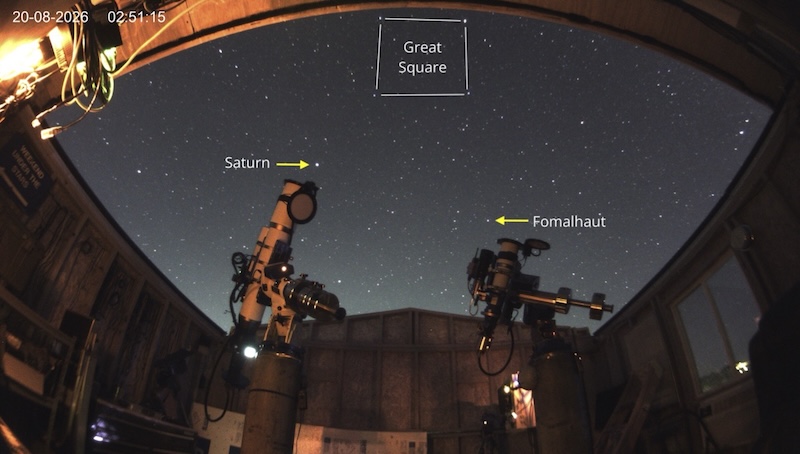
Saturn and Fomalhaut are the brightest two objects showing from this all-sky camera taken from inside an observatory in Wyoming. They are also below the Great Square of Pegasus. Image via WyoAstro allsky camera. Used with permission.

Fomalhaut, bright and lonely

Fomalhaut, aka Alpha Piscis Austrinus, carries the nickname the Loneliest Star. That’s because Fomalhaut is the only bright star in a wide stretch of sky. From the Northern Hemisphere in autumn, Fomalhaut arcs across the southern sky in solitary splendor … usually. Over the past few years, it was befriended in the sky by golden Saturn. But in autumn 2026, Saturn is starting to leave Fomalhaut alone once again.

Saturn takes a leisurely 30 years to complete one orbit of the sun. That means it moves very slowly against the background stars. And so, it spent several years making its way past Fomalhaut. Now, in 2026, Saturn and Fomalhaut are no longer particularly close. They’re separated by some 43 degrees (about 4 fists at arm’s length) on the sky’s dome.

But they’re still the 2 brightest objects in that sparse patch of sky. To make sure you don’t get these objects confused, know that Saturn is the brighter of the two. Plus it will shine with a steady light, while Fomalhaut might be twinkling. And Saturn will be located more to the east on the sky’s dome.

That’s also true from the Southern Hemisphere. But in the Southern Hemisphere, you’ll need to face north and look higher up in the sky to see Fomalhaut and Saturn in your season of spring.

Fomalhaut is a young star with dusty debris disks around it. Does it have planets? The answer to that is one of astronomy’s most fascinating stories! Read more below.

How to see it

Fomalhaut is the 18th brightest star in the night sky. It’s part of the faint constellation Piscis Austrinus the Southern Fish. In a dark sky, you’ll see a half-circle of faint stars of which bright Fomalhaut is a part. This star pattern marks the open mouth of the Southern Fish.

In early September, Fomalhaut is opposite the sun. So, it shines in the sky all night. It reaches its culmination – its highest point in the sky – around local midnight in mid-September.

Fomalhaut culminates at different times on different dates. Here are just a few approximate times and dates of culmination:

July 15: 4:30 a.m. daylight saving time (DST)
August 15: 2:30 a.m. DST
September 15: 12:30 a.m. DST
October 15: 10:30 p.m. DST
November 15: 8:30 p.m. DST
December 15: 5:30 p.m. standard time

Star chart outlining a blob-like shape with 1 star, Fomalhaut, labeled.
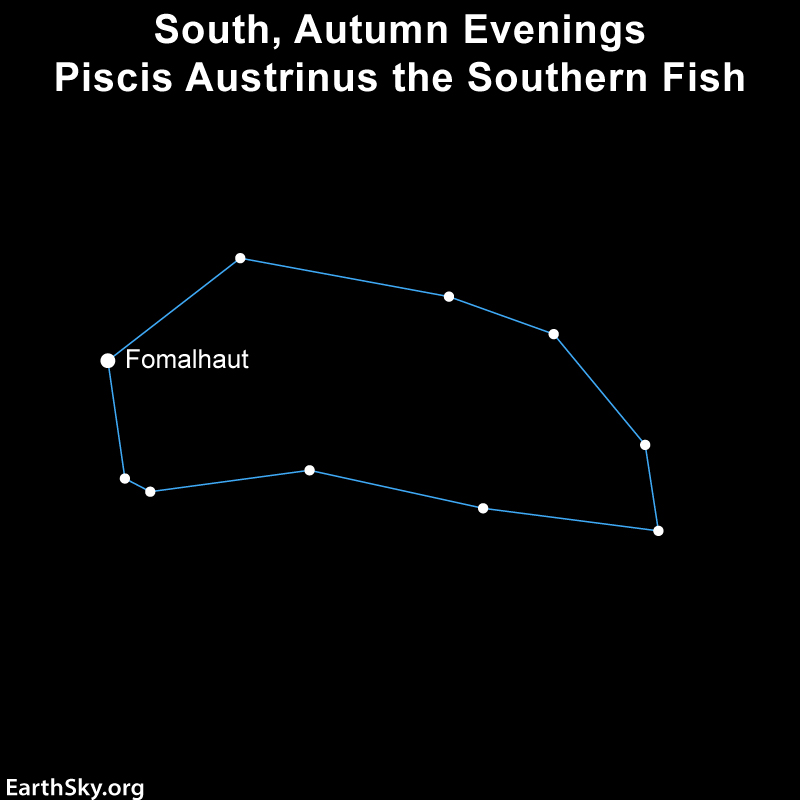
Piscis Austrinus the Southern Fish is notable for its one bright star, Fomalhaut. When you look toward Fomalhaut, you are looking out our Milky Way galaxy’s south window and into intergalactic space. By the way, the rest of the stars making up Piscis Austrinus are faint and difficult to see unless you have a dark sky. Chart via EarthSky.

The view from different hemispheres

From the Northern Hemisphere, you can see Fomalhaut from as far north as 60 degrees latitude (southern Alaska, central Canada, northern Europe), where it just skims the southern horizon. From the Southern Hemisphere, Fomalhaut appears much higher in the sky. You can use one of several stargazing smartphone apps, some that are free, to help you find it. Or visit Stellarium-Web.org, the free online planetarium, and enter your location and time.

Very bright bluish star with many more stars in background.
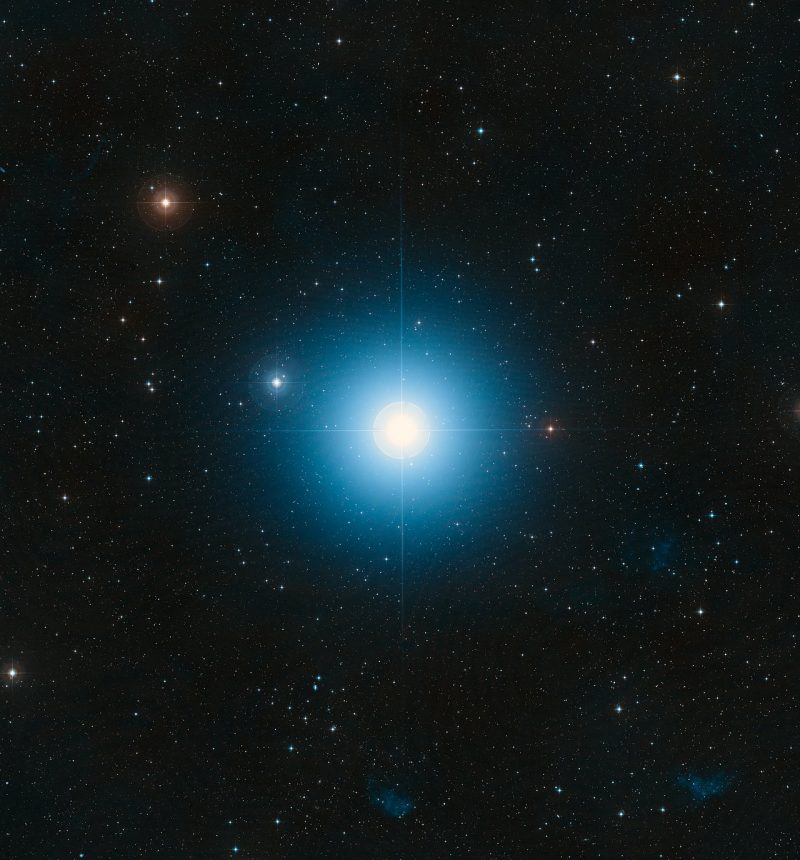
The star Fomalhaut as seen by an Earth-based telescope on November 13, 2008. Image via NASA/ ESA/ Digitized Sky Survey 2/ Davide De Martin (ESA/Hubble)/ ESA.

Rings of dust and gas

Fomalhaut is a hot white star about 25 light-years away. It’s almost twice the mass and size of our sun but radiates over 16 times the sun’s energy. Fomalhaut has a companion star less than a light-year away from it. The companion is an orange dwarf star, about 70% the mass of our sun. A third member of the Fomalhaut star system was announced in 2013, a small reddish star about 2.5 light-years from Fomalhaut. From Earth, we see the third star located in the constellation Aquarius instead of Piscis Austrinus.

Fomalhaut itself is a young star, just 440 million years old. That’s in contrast to 4 1/2 billion years for our sun. Fomalhaut is surrounded by a striking system of debris disks, revealed in detail by Hubble, ALMA, and the Webb space telescope. It has a broad, cold outer belt – similar to our Kuiper Belt – but also inner, nested belts and gaps whose sharp edges and offsets suggest they are being shaped by unseen planets.

A planet for Fomalhaut?

A study published in 2008 generated a lot of excitement when Hubble Space Telescope images – taken in 2004, 2006 and 2008 – showed a faint moving dot near Fomalhaut. This object was called Fomalhaut b. It was thought to be located just a few astronomical units (AU) from the star (so at a distance not unlike Earth’s). It was immediately hailed as the first exoplanet seen in visible light!

But later observations complicated the story. The object faded and eventually vanished from view, leading many astronomers to suggest it wasn’t a planet after all, but instead a dust cloud from a collision of icy bodies.

The dust ring around Fomalhaut, however, is sharply edged and offset from the star, features that usually hint at the presence of planets shaping the debris.

Fomalhaut b probably not a planet

So the current picture (as of 2026):

  • Fomalhaut b is probably not a planet.
  • But indirect evidence strongly suggests that planets must be there, sculpting the debris disk, even though none have yet been directly confirmed.

New Webb observations (especially with its MIRI instrument) show that Fomalhaut has multiple nested belts of dust and gaps, some interior to the main outer debris belt. There’s at least one intermediate belt (between the star and the outer belt) that could be “shepherded” by a planet. The belts are misaligned relative to each other.

Left: Fuzzy orange oval line around a star. Right: a series of dots, fading from bright to dim, annotated with years.
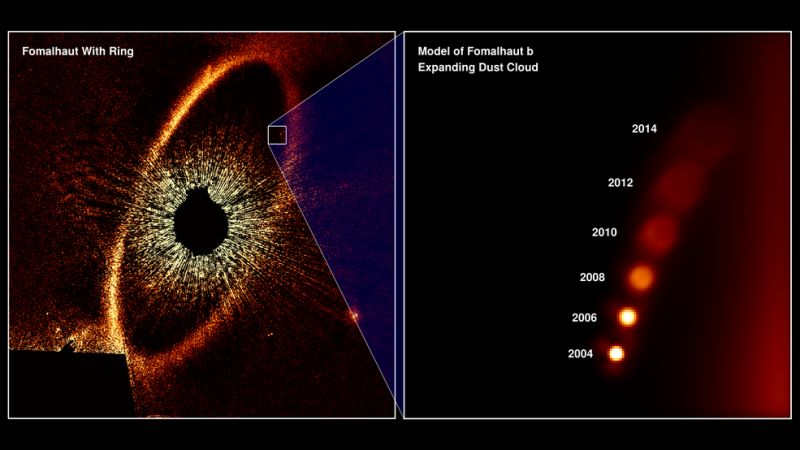
On the left, a Hubble Space Telescope image showing Fomalhaut’s debris disk. The star itself has been blocked so its brightness doesn’t drown out the view of the faint ring. The small box shows the object once thought to be a planet (but no more). On the right is a simulation, based on observations, of how the object appeared from 2004 to 2014. The object is now thought to be the result of a collision in the disk. Image via NASA.

Fomalhaut in history and mythology

The name Fomalhaut derives from the Arabic Fum al Hut, meaning Mouth of the Fish.

In the sky visible from the Northern Hemisphere, the constellation Aquarius the Water Bearer resides above Fomalhaut’s constellation Piscis Austrinus. You can see a zigzag line of stars from Aquarius to Piscis Austrinus. In sky lore, this line of stars represents water from the Jar of the Water Bearer, trickling into the open Mouth of the Fish.

1 of the 4 guardians

According to Richard Hinckley Allen, Fomalhaut was one of the four guardians of the heavens to the ancient Persians, in 3,000 BCE, called by them Hastorang. (The other guardians were Aldebaran in Taurus, Antares in Scorpius, and Regulus in Leo.) Around 2,500 BCE, Fomalhaut helped mark the location of the winter solstice, meaning that it helped to define the location in the sky where the sun crossed the meridian at noon on the first day of winter. Also Allen also says that in 500 BCE, people worshipped Fomalhaut at the temple of Demeter in Eleusis, in ancient Greece.

Antique etching of an old man carrying a water jug. Below him is a fish. Stars are scattered over the chart.
View larger. | Here’s an 1822 illustration of Aquarius the Water Carrier, the constellation above Fomalhaut’s constellation, Piscis Austrinus the Southern Fish. This illustration is from Alexander Jamieson’s Celestial Atlas. In the illustration, water from the Water Jar of Aquarius is going into the Mouth of the Southern Fish. if it’s dark where you are, you can easily see a zigzag line of stars extending from Aquarius to the star Fomalhaut … the same starry zigzag that inspired the idea of water in the minds of the early constellation-namers. Image via Wikimedia.

Bottom line: Fomalhaut is known as the Loneliest Star because it shines brightly in an otherwise dim patch of sky. In recent years, it has been joined by Saturn. But in 2026, Saturn is starting to pull away. Fomalhaut is of special interest to astronomers because of debris rings around it that are possibly the beginnings of a planetary system.

Read more: Fomalhaut has 3 nested belts around the star

The post Fomalhaut is the Loneliest Star once again first appeared on EarthSky.


from EarthSky https://ift.tt/lGQb7I3
Two telescopes pointed at the sky with a starry background with Saturn, Fomalhaut and the Great Square labeled.
Saturn and Fomalhaut are the brightest two objects showing from this all-sky camera taken from inside an observatory in Wyoming. They are also below the Great Square of Pegasus. Image via WyoAstro allsky camera. Used with permission.

Fomalhaut, bright and lonely

Fomalhaut, aka Alpha Piscis Austrinus, carries the nickname the Loneliest Star. That’s because Fomalhaut is the only bright star in a wide stretch of sky. From the Northern Hemisphere in autumn, Fomalhaut arcs across the southern sky in solitary splendor … usually. Over the past few years, it was befriended in the sky by golden Saturn. But in autumn 2026, Saturn is starting to leave Fomalhaut alone once again.

Saturn takes a leisurely 30 years to complete one orbit of the sun. That means it moves very slowly against the background stars. And so, it spent several years making its way past Fomalhaut. Now, in 2026, Saturn and Fomalhaut are no longer particularly close. They’re separated by some 43 degrees (about 4 fists at arm’s length) on the sky’s dome.

But they’re still the 2 brightest objects in that sparse patch of sky. To make sure you don’t get these objects confused, know that Saturn is the brighter of the two. Plus it will shine with a steady light, while Fomalhaut might be twinkling. And Saturn will be located more to the east on the sky’s dome.

That’s also true from the Southern Hemisphere. But in the Southern Hemisphere, you’ll need to face north and look higher up in the sky to see Fomalhaut and Saturn in your season of spring.

Fomalhaut is a young star with dusty debris disks around it. Does it have planets? The answer to that is one of astronomy’s most fascinating stories! Read more below.

How to see it

Fomalhaut is the 18th brightest star in the night sky. It’s part of the faint constellation Piscis Austrinus the Southern Fish. In a dark sky, you’ll see a half-circle of faint stars of which bright Fomalhaut is a part. This star pattern marks the open mouth of the Southern Fish.

In early September, Fomalhaut is opposite the sun. So, it shines in the sky all night. It reaches its culmination – its highest point in the sky – around local midnight in mid-September.

Fomalhaut culminates at different times on different dates. Here are just a few approximate times and dates of culmination:

July 15: 4:30 a.m. daylight saving time (DST)
August 15: 2:30 a.m. DST
September 15: 12:30 a.m. DST
October 15: 10:30 p.m. DST
November 15: 8:30 p.m. DST
December 15: 5:30 p.m. standard time

Star chart outlining a blob-like shape with 1 star, Fomalhaut, labeled.
Piscis Austrinus the Southern Fish is notable for its one bright star, Fomalhaut. When you look toward Fomalhaut, you are looking out our Milky Way galaxy’s south window and into intergalactic space. By the way, the rest of the stars making up Piscis Austrinus are faint and difficult to see unless you have a dark sky. Chart via EarthSky.

The view from different hemispheres

From the Northern Hemisphere, you can see Fomalhaut from as far north as 60 degrees latitude (southern Alaska, central Canada, northern Europe), where it just skims the southern horizon. From the Southern Hemisphere, Fomalhaut appears much higher in the sky. You can use one of several stargazing smartphone apps, some that are free, to help you find it. Or visit Stellarium-Web.org, the free online planetarium, and enter your location and time.

Very bright bluish star with many more stars in background.
The star Fomalhaut as seen by an Earth-based telescope on November 13, 2008. Image via NASA/ ESA/ Digitized Sky Survey 2/ Davide De Martin (ESA/Hubble)/ ESA.

Rings of dust and gas

Fomalhaut is a hot white star about 25 light-years away. It’s almost twice the mass and size of our sun but radiates over 16 times the sun’s energy. Fomalhaut has a companion star less than a light-year away from it. The companion is an orange dwarf star, about 70% the mass of our sun. A third member of the Fomalhaut star system was announced in 2013, a small reddish star about 2.5 light-years from Fomalhaut. From Earth, we see the third star located in the constellation Aquarius instead of Piscis Austrinus.

Fomalhaut itself is a young star, just 440 million years old. That’s in contrast to 4 1/2 billion years for our sun. Fomalhaut is surrounded by a striking system of debris disks, revealed in detail by Hubble, ALMA, and the Webb space telescope. It has a broad, cold outer belt – similar to our Kuiper Belt – but also inner, nested belts and gaps whose sharp edges and offsets suggest they are being shaped by unseen planets.

A planet for Fomalhaut?

A study published in 2008 generated a lot of excitement when Hubble Space Telescope images – taken in 2004, 2006 and 2008 – showed a faint moving dot near Fomalhaut. This object was called Fomalhaut b. It was thought to be located just a few astronomical units (AU) from the star (so at a distance not unlike Earth’s). It was immediately hailed as the first exoplanet seen in visible light!

But later observations complicated the story. The object faded and eventually vanished from view, leading many astronomers to suggest it wasn’t a planet after all, but instead a dust cloud from a collision of icy bodies.

The dust ring around Fomalhaut, however, is sharply edged and offset from the star, features that usually hint at the presence of planets shaping the debris.

Fomalhaut b probably not a planet

So the current picture (as of 2026):

  • Fomalhaut b is probably not a planet.
  • But indirect evidence strongly suggests that planets must be there, sculpting the debris disk, even though none have yet been directly confirmed.

New Webb observations (especially with its MIRI instrument) show that Fomalhaut has multiple nested belts of dust and gaps, some interior to the main outer debris belt. There’s at least one intermediate belt (between the star and the outer belt) that could be “shepherded” by a planet. The belts are misaligned relative to each other.

Left: Fuzzy orange oval line around a star. Right: a series of dots, fading from bright to dim, annotated with years.
On the left, a Hubble Space Telescope image showing Fomalhaut’s debris disk. The star itself has been blocked so its brightness doesn’t drown out the view of the faint ring. The small box shows the object once thought to be a planet (but no more). On the right is a simulation, based on observations, of how the object appeared from 2004 to 2014. The object is now thought to be the result of a collision in the disk. Image via NASA.

Fomalhaut in history and mythology

The name Fomalhaut derives from the Arabic Fum al Hut, meaning Mouth of the Fish.

In the sky visible from the Northern Hemisphere, the constellation Aquarius the Water Bearer resides above Fomalhaut’s constellation Piscis Austrinus. You can see a zigzag line of stars from Aquarius to Piscis Austrinus. In sky lore, this line of stars represents water from the Jar of the Water Bearer, trickling into the open Mouth of the Fish.

1 of the 4 guardians

According to Richard Hinckley Allen, Fomalhaut was one of the four guardians of the heavens to the ancient Persians, in 3,000 BCE, called by them Hastorang. (The other guardians were Aldebaran in Taurus, Antares in Scorpius, and Regulus in Leo.) Around 2,500 BCE, Fomalhaut helped mark the location of the winter solstice, meaning that it helped to define the location in the sky where the sun crossed the meridian at noon on the first day of winter. Also Allen also says that in 500 BCE, people worshipped Fomalhaut at the temple of Demeter in Eleusis, in ancient Greece.

Antique etching of an old man carrying a water jug. Below him is a fish. Stars are scattered over the chart.
View larger. | Here’s an 1822 illustration of Aquarius the Water Carrier, the constellation above Fomalhaut’s constellation, Piscis Austrinus the Southern Fish. This illustration is from Alexander Jamieson’s Celestial Atlas. In the illustration, water from the Water Jar of Aquarius is going into the Mouth of the Southern Fish. if it’s dark where you are, you can easily see a zigzag line of stars extending from Aquarius to the star Fomalhaut … the same starry zigzag that inspired the idea of water in the minds of the early constellation-namers. Image via Wikimedia.

Bottom line: Fomalhaut is known as the Loneliest Star because it shines brightly in an otherwise dim patch of sky. In recent years, it has been joined by Saturn. But in 2026, Saturn is starting to pull away. Fomalhaut is of special interest to astronomers because of debris rings around it that are possibly the beginnings of a planetary system.

Read more: Fomalhaut has 3 nested belts around the star

The post Fomalhaut is the Loneliest Star once again first appeared on EarthSky.


from EarthSky https://ift.tt/lGQb7I3

Sapphire: September birthstone comes in many colors

A round blue sapphire ring in yellow gold with diamond accents.
The September birthstone is the sapphire. Although it comes in many colors, the traditional blue sapphire is always a popular choice and sometimes used in engagement rings. Image via Marcy Curran.

September birthstone

September’s birthstone, the sapphire, is a relative of July’s birthstone, the ruby. That’s because both are forms of the mineral corundum, a crystalline form of aluminum oxide. But the red corundum is ruby. And all other gem-quality forms of corundum are sapphires.

All corundum, including sapphire, has a hardness of 9 on the Mohs scale. In fact, sapphires are second in hardness only to diamonds.

The September birthstone: Large, oval pink gemstone with halo of diamonds around it in yellow gold ring.
The September birthstone is sapphire. Although it’s traditionally thought of as blue, it comes in many colors such as this pink sapphire ring. Image via Charles Sharp/ Wikipedia.

Source of sapphires

Typically, sapphires appear as blue stones. They range from very pale blue to deep indigo. In fact, the exact shade depends on how much titanium and iron lies within the crystal structure. The most valued shade of blue is the medium-deep cornflower blue. However, sapphires also occur in other natural colors and tints – colorless, gray, yellow, pale pink, orange, green, violet and brown – called fancy sapphires. Different kinds of impurities within the crystal cause the various gemstone colors. For example, yellow sapphires get their color from ferric iron, and colorless gems have no contaminants.

Primarily, the biggest source of sapphires world-wide is Australia, especially New South Wales and Queensland. They are found in alluvial deposits of weathered basalt. Australian sapphires typically are blue stones with a dark and inky appearance. On the other hand, Kashmir, in India, used to be a well-known source of the cornflower-blue stones. And in the United States, a major source is the Yogo Gulch Mine in Montana. It mostly yields small stones for industrial use.

Sapphire lore about the September birthstone

The word sapphire has its roots in ancient languages: from the Latin sapphirus (meaning blue) and from the Greek word sappheiros for the island of Sappherine in the Arabian Sea, the name being derived from the Arabic word safir. Sappherine was the source for sapphire in ancient Grecian times. Ancient Persians called sapphire the “Celestial Stone.” It was the gem of Apollo, Greek God of prophecy. Worshipers visiting his shrine in Delphi to seek his help wore sapphires. Ancient Etruscans used sapphires as far back as the 7th century BCE.

Besides being the September birthstone, the sapphire represented the purity of the soul. Before and during the Middle Ages, priests wore it as protection from impure thoughts and temptations of the flesh. Medieval kings of Europe valued these stones for rings and brooches, believing that it protected them from harm and envy. Warriors presented their young wives with sapphire necklaces so they would remain faithful. A common belief was that the stone’s color would darken if worn by an adulterer or adulteress, or by an unworthy person.

Some believed sapphires protected people from snakes. People believed that by placing poisonous reptiles and spiders in a jar containing the stone, the creatures would immediately die. The French of the 13th century believed that sapphire transformed stupidity to wisdom, and irritability to good temper.

Medium-deep blue, faceted oval gemstone.
Of course, probably the best-known color of sapphire is blue. Image via gemrockauctions.com. Used with permission.

Some famous sapphires

One of the most famous sapphires rests on the Imperial State Crown worn by Queen Victoria in 1838. It resides with the British Crown Jewels in the Tower of London. In fact, this gem once belonged to Edward the Confessor. He wore the stone on a ring during his coronation in 1042, and it became known as St. Edward’s Sapphire.

Rectangular, dark blue, faceted gem with 20 small diamonds set around its edge.
The Logan Sapphire Brooch, the second largest sapphire known (at 422.99 carats), is on display at the National Museum of Natural History in Washington, D.C. Image via Andrew Bossi/ Wikipedia.

Bottom line: The September birthstone is the sapphire. It is generally known as a blue gemstone, but it comes in many colors.

Find out about the birthstones for the other months of the year:

January birthstone
February birthstone
March birthstone
April birthstone
May birthstone
June birthstone
July birthstone
August birthstone
September birthstone
October birthstone
November birthstone
December birthstone

The post Sapphire: September birthstone comes in many colors first appeared on EarthSky.


from EarthSky https://ift.tt/6SE2m45
A round blue sapphire ring in yellow gold with diamond accents.
The September birthstone is the sapphire. Although it comes in many colors, the traditional blue sapphire is always a popular choice and sometimes used in engagement rings. Image via Marcy Curran.

September birthstone

September’s birthstone, the sapphire, is a relative of July’s birthstone, the ruby. That’s because both are forms of the mineral corundum, a crystalline form of aluminum oxide. But the red corundum is ruby. And all other gem-quality forms of corundum are sapphires.

All corundum, including sapphire, has a hardness of 9 on the Mohs scale. In fact, sapphires are second in hardness only to diamonds.

The September birthstone: Large, oval pink gemstone with halo of diamonds around it in yellow gold ring.
The September birthstone is sapphire. Although it’s traditionally thought of as blue, it comes in many colors such as this pink sapphire ring. Image via Charles Sharp/ Wikipedia.

Source of sapphires

Typically, sapphires appear as blue stones. They range from very pale blue to deep indigo. In fact, the exact shade depends on how much titanium and iron lies within the crystal structure. The most valued shade of blue is the medium-deep cornflower blue. However, sapphires also occur in other natural colors and tints – colorless, gray, yellow, pale pink, orange, green, violet and brown – called fancy sapphires. Different kinds of impurities within the crystal cause the various gemstone colors. For example, yellow sapphires get their color from ferric iron, and colorless gems have no contaminants.

Primarily, the biggest source of sapphires world-wide is Australia, especially New South Wales and Queensland. They are found in alluvial deposits of weathered basalt. Australian sapphires typically are blue stones with a dark and inky appearance. On the other hand, Kashmir, in India, used to be a well-known source of the cornflower-blue stones. And in the United States, a major source is the Yogo Gulch Mine in Montana. It mostly yields small stones for industrial use.

Sapphire lore about the September birthstone

The word sapphire has its roots in ancient languages: from the Latin sapphirus (meaning blue) and from the Greek word sappheiros for the island of Sappherine in the Arabian Sea, the name being derived from the Arabic word safir. Sappherine was the source for sapphire in ancient Grecian times. Ancient Persians called sapphire the “Celestial Stone.” It was the gem of Apollo, Greek God of prophecy. Worshipers visiting his shrine in Delphi to seek his help wore sapphires. Ancient Etruscans used sapphires as far back as the 7th century BCE.

Besides being the September birthstone, the sapphire represented the purity of the soul. Before and during the Middle Ages, priests wore it as protection from impure thoughts and temptations of the flesh. Medieval kings of Europe valued these stones for rings and brooches, believing that it protected them from harm and envy. Warriors presented their young wives with sapphire necklaces so they would remain faithful. A common belief was that the stone’s color would darken if worn by an adulterer or adulteress, or by an unworthy person.

Some believed sapphires protected people from snakes. People believed that by placing poisonous reptiles and spiders in a jar containing the stone, the creatures would immediately die. The French of the 13th century believed that sapphire transformed stupidity to wisdom, and irritability to good temper.

Medium-deep blue, faceted oval gemstone.
Of course, probably the best-known color of sapphire is blue. Image via gemrockauctions.com. Used with permission.

Some famous sapphires

One of the most famous sapphires rests on the Imperial State Crown worn by Queen Victoria in 1838. It resides with the British Crown Jewels in the Tower of London. In fact, this gem once belonged to Edward the Confessor. He wore the stone on a ring during his coronation in 1042, and it became known as St. Edward’s Sapphire.

Rectangular, dark blue, faceted gem with 20 small diamonds set around its edge.
The Logan Sapphire Brooch, the second largest sapphire known (at 422.99 carats), is on display at the National Museum of Natural History in Washington, D.C. Image via Andrew Bossi/ Wikipedia.

Bottom line: The September birthstone is the sapphire. It is generally known as a blue gemstone, but it comes in many colors.

Find out about the birthstones for the other months of the year:

January birthstone
February birthstone
March birthstone
April birthstone
May birthstone
June birthstone
July birthstone
August birthstone
September birthstone
October birthstone
November birthstone
December birthstone

The post Sapphire: September birthstone comes in many colors first appeared on EarthSky.


from EarthSky https://ift.tt/6SE2m45

adds 2