
Fomalhaut, bright and lonely
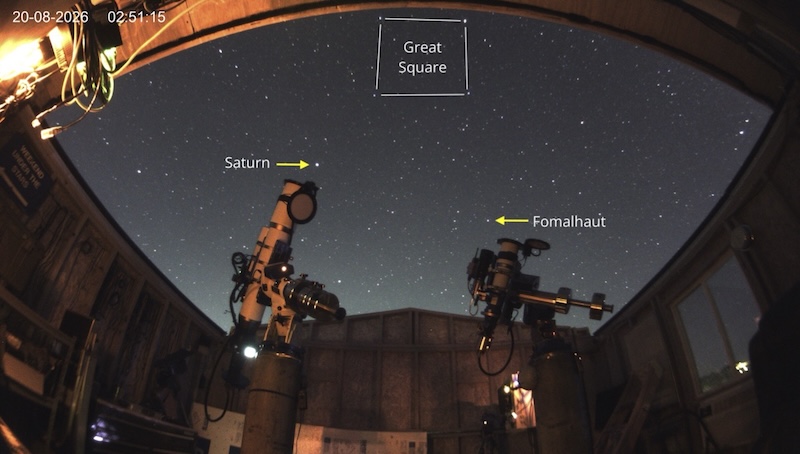
Fomalhaut, aka Alpha Piscis Austrinus, carries the nickname the Loneliest Star. That’s because Fomalhaut is the only bright star in a wide stretch of sky. From the Northern Hemisphere in autumn, Fomalhaut arcs across the southern sky in solitary splendor … usually. Over the past few years, it was befriended in the sky by golden Saturn. But in autumn 2026, Saturn is starting to leave Fomalhaut alone once again.
Saturn takes a leisurely 30 years to complete one orbit of the sun. That means it moves very slowly against the background stars. And so, it spent several years making its way past Fomalhaut. Now, in 2026, Saturn and Fomalhaut are no longer particularly close. They’re separated by some 43 degrees (about 4 fists at arm’s length) on the sky’s dome.
But they’re still the 2 brightest objects in that sparse patch of sky. To make sure you don’t get these objects confused, know that Saturn is the brighter of the two. Plus it will shine with a steady light, while Fomalhaut might be twinkling. And Saturn will be located more to the east on the sky’s dome.
That’s also true from the Southern Hemisphere. But in the Southern Hemisphere, you’ll need to face north and look higher up in the sky to see Fomalhaut and Saturn in your season of spring.
Fomalhaut is a young star with dusty debris disks around it. Does it have planets? The answer to that is one of astronomy’s most fascinating stories! Read more below.
How to see it
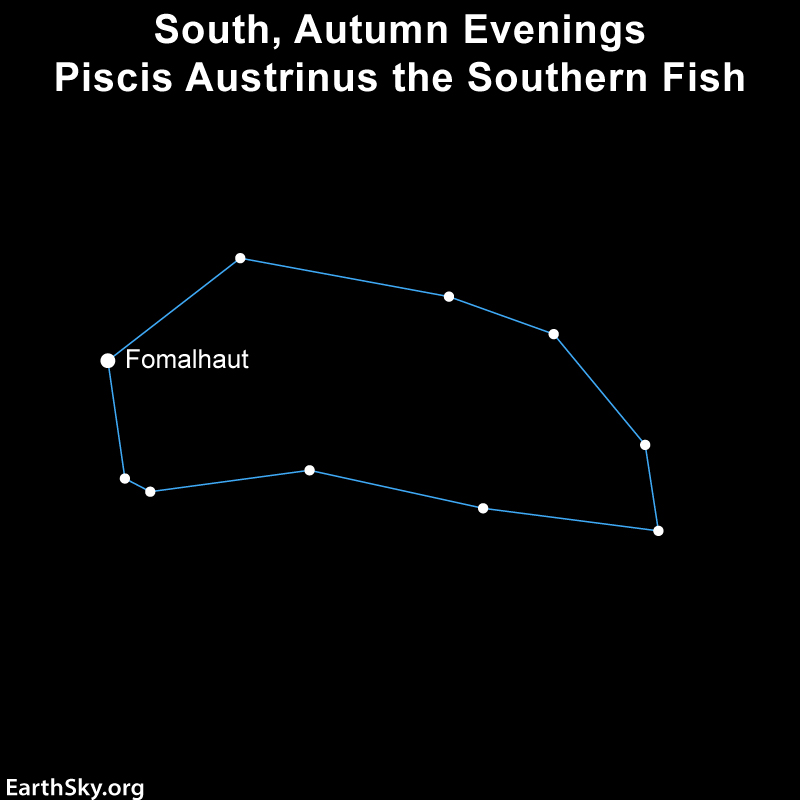
Fomalhaut is the 18th brightest star in the night sky. It’s part of the faint constellation Piscis Austrinus the Southern Fish. In a dark sky, you’ll see a half-circle of faint stars of which bright Fomalhaut is a part. This star pattern marks the open mouth of the Southern Fish.
In early September, Fomalhaut is opposite the sun. So, it shines in the sky all night. It reaches its culmination – its highest point in the sky – around local midnight in mid-September.
Fomalhaut culminates at different times on different dates. Here are just a few approximate times and dates of culmination:
July 15: 4:30 a.m. daylight saving time (DST)
August 15: 2:30 a.m. DST
September 15: 12:30 a.m. DST
October 15: 10:30 p.m. DST
November 15: 8:30 p.m. DST
December 15: 5:30 p.m. standard time
The view from different hemispheres
From the Northern Hemisphere, you can see Fomalhaut from as far north as 60 degrees latitude (southern Alaska, central Canada, northern Europe), where it just skims the southern horizon. From the Southern Hemisphere, Fomalhaut appears much higher in the sky. You can use one of several stargazing smartphone apps, some that are free, to help you find it. Or visit Stellarium-Web.org, the free online planetarium, and enter your location and time.
Rings of dust and gas
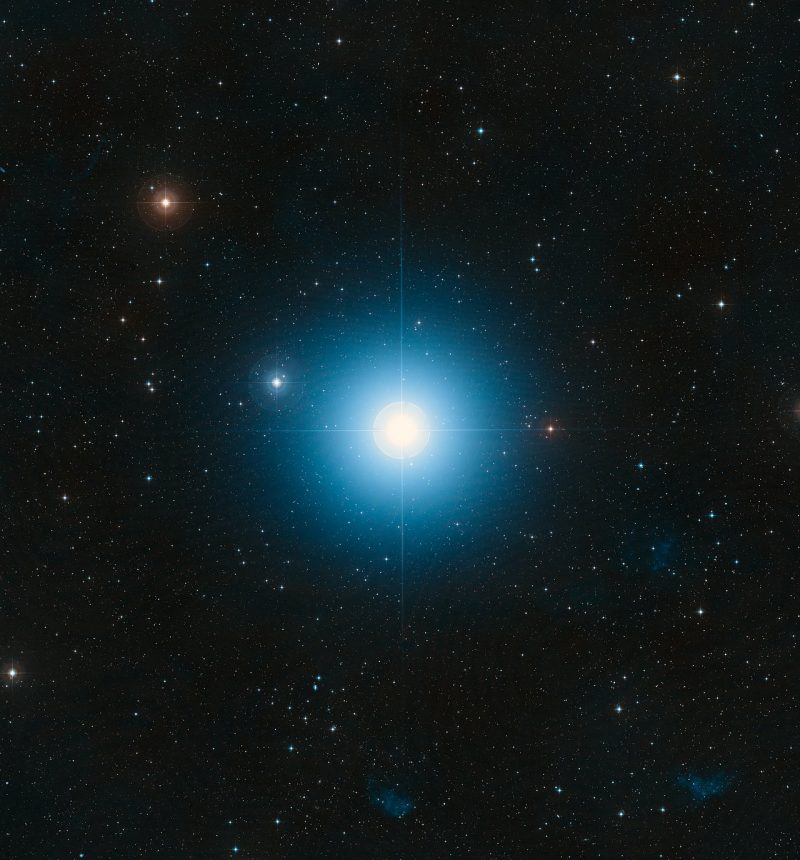
Fomalhaut is a hot white star about 25 light-years away. It’s almost twice the mass and size of our sun but radiates over 16 times the sun’s energy. Fomalhaut has a companion star less than a light-year away from it. The companion is an orange dwarf star, about 70% the mass of our sun. A third member of the Fomalhaut star system was announced in 2013, a small reddish star about 2.5 light-years from Fomalhaut. From Earth, we see the third star located in the constellation Aquarius instead of Piscis Austrinus.
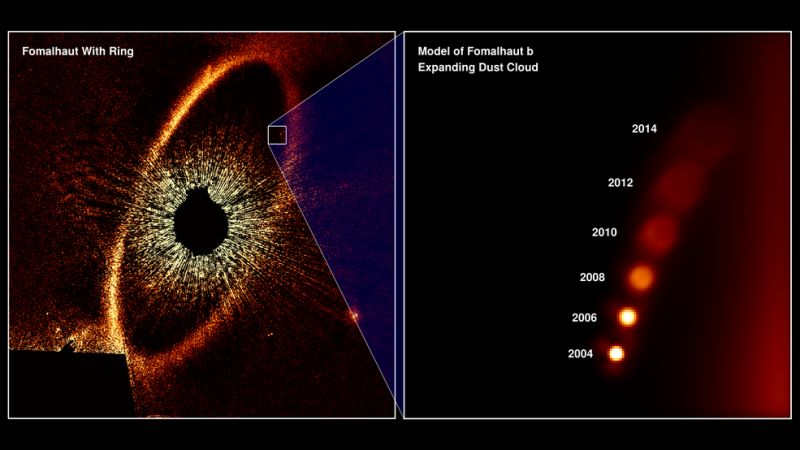
Fomalhaut itself is a young star, just 440 million years old. That’s in contrast to 4 1/2 billion years for our sun. Fomalhaut is surrounded by a striking system of debris disks, revealed in detail by Hubble, ALMA, and the Webb space telescope. It has a broad, cold outer belt – similar to our Kuiper Belt – but also inner, nested belts and gaps whose sharp edges and offsets suggest they are being shaped by unseen planets.
A planet for Fomalhaut?
A study published in 2008 generated a lot of excitement when Hubble Space Telescope images – taken in 2004, 2006 and 2008 – showed a faint moving dot near Fomalhaut. This object was called Fomalhaut b. It was thought to be located just a few astronomical units (AU) from the star (so at a distance not unlike Earth’s). It was immediately hailed as the first exoplanet seen in visible light!
But later observations complicated the story. The object faded and eventually vanished from view, leading many astronomers to suggest it wasn’t a planet after all, but instead a dust cloud from a collision of icy bodies.
The dust ring around Fomalhaut, however, is sharply edged and offset from the star, features that usually hint at the presence of planets shaping the debris.
Fomalhaut b probably not a planet
So the current picture (as of 2026):
- Fomalhaut b is probably not a planet.
- But indirect evidence strongly suggests that planets must be there, sculpting the debris disk, even though none have yet been directly confirmed.
New Webb observations (especially with its MIRI instrument) show that Fomalhaut has multiple nested belts of dust and gaps, some interior to the main outer debris belt. There’s at least one intermediate belt (between the star and the outer belt) that could be “shepherded” by a planet. The belts are misaligned relative to each other.
Fomalhaut in history and mythology
The name Fomalhaut derives from the Arabic Fum al Hut, meaning Mouth of the Fish.
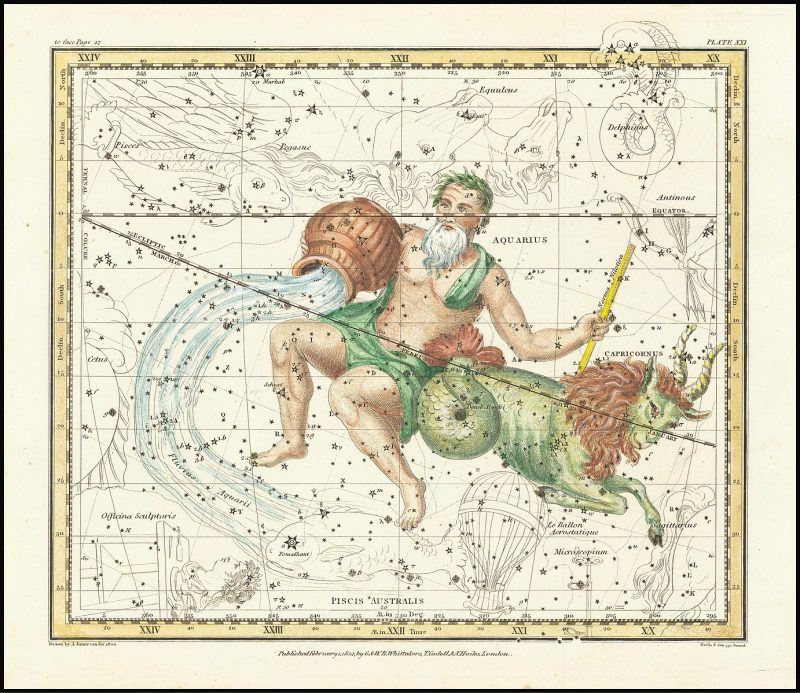
In the sky visible from the Northern Hemisphere, the constellation Aquarius the Water Bearer resides above Fomalhaut’s constellation Piscis Austrinus. You can see a zigzag line of stars from Aquarius to Piscis Austrinus. In sky lore, this line of stars represents water from the Jar of the Water Bearer, trickling into the open Mouth of the Fish.
1 of the 4 guardians
According to Richard Hinckley Allen, Fomalhaut was one of the four guardians of the heavens to the ancient Persians, in 3,000 BCE, called by them Hastorang. (The other guardians were Aldebaran in Taurus, Antares in Scorpius, and Regulus in Leo.) Around 2,500 BCE, Fomalhaut helped mark the location of the winter solstice, meaning that it helped to define the location in the sky where the sun crossed the meridian at noon on the first day of winter. Also Allen also says that in 500 BCE, people worshipped Fomalhaut at the temple of Demeter in Eleusis, in ancient Greece.
Bottom line: Fomalhaut is known as the Loneliest Star because it shines brightly in an otherwise dim patch of sky. In recent years, it has been joined by Saturn. But in 2026, Saturn is starting to pull away. Fomalhaut is of special interest to astronomers because of debris rings around it that are possibly the beginnings of a planetary system.
Read more: Fomalhaut has 3 nested belts around the star
The post Fomalhaut is the Loneliest Star once again first appeared on EarthSky.
from EarthSky https://ift.tt/lGQb7I3
Fomalhaut, bright and lonely
Fomalhaut, aka Alpha Piscis Austrinus, carries the nickname the Loneliest Star. That’s because Fomalhaut is the only bright star in a wide stretch of sky. From the Northern Hemisphere in autumn, Fomalhaut arcs across the southern sky in solitary splendor … usually. Over the past few years, it was befriended in the sky by golden Saturn. But in autumn 2026, Saturn is starting to leave Fomalhaut alone once again.
Saturn takes a leisurely 30 years to complete one orbit of the sun. That means it moves very slowly against the background stars. And so, it spent several years making its way past Fomalhaut. Now, in 2026, Saturn and Fomalhaut are no longer particularly close. They’re separated by some 43 degrees (about 4 fists at arm’s length) on the sky’s dome.
But they’re still the 2 brightest objects in that sparse patch of sky. To make sure you don’t get these objects confused, know that Saturn is the brighter of the two. Plus it will shine with a steady light, while Fomalhaut might be twinkling. And Saturn will be located more to the east on the sky’s dome.
That’s also true from the Southern Hemisphere. But in the Southern Hemisphere, you’ll need to face north and look higher up in the sky to see Fomalhaut and Saturn in your season of spring.
Fomalhaut is a young star with dusty debris disks around it. Does it have planets? The answer to that is one of astronomy’s most fascinating stories! Read more below.
How to see it
Fomalhaut is the 18th brightest star in the night sky. It’s part of the faint constellation Piscis Austrinus the Southern Fish. In a dark sky, you’ll see a half-circle of faint stars of which bright Fomalhaut is a part. This star pattern marks the open mouth of the Southern Fish.
In early September, Fomalhaut is opposite the sun. So, it shines in the sky all night. It reaches its culmination – its highest point in the sky – around local midnight in mid-September.
Fomalhaut culminates at different times on different dates. Here are just a few approximate times and dates of culmination:
July 15: 4:30 a.m. daylight saving time (DST)
August 15: 2:30 a.m. DST
September 15: 12:30 a.m. DST
October 15: 10:30 p.m. DST
November 15: 8:30 p.m. DST
December 15: 5:30 p.m. standard time
The view from different hemispheres
From the Northern Hemisphere, you can see Fomalhaut from as far north as 60 degrees latitude (southern Alaska, central Canada, northern Europe), where it just skims the southern horizon. From the Southern Hemisphere, Fomalhaut appears much higher in the sky. You can use one of several stargazing smartphone apps, some that are free, to help you find it. Or visit Stellarium-Web.org, the free online planetarium, and enter your location and time.
Rings of dust and gas
Fomalhaut is a hot white star about 25 light-years away. It’s almost twice the mass and size of our sun but radiates over 16 times the sun’s energy. Fomalhaut has a companion star less than a light-year away from it. The companion is an orange dwarf star, about 70% the mass of our sun. A third member of the Fomalhaut star system was announced in 2013, a small reddish star about 2.5 light-years from Fomalhaut. From Earth, we see the third star located in the constellation Aquarius instead of Piscis Austrinus.
Fomalhaut itself is a young star, just 440 million years old. That’s in contrast to 4 1/2 billion years for our sun. Fomalhaut is surrounded by a striking system of debris disks, revealed in detail by Hubble, ALMA, and the Webb space telescope. It has a broad, cold outer belt – similar to our Kuiper Belt – but also inner, nested belts and gaps whose sharp edges and offsets suggest they are being shaped by unseen planets.
A planet for Fomalhaut?
A study published in 2008 generated a lot of excitement when Hubble Space Telescope images – taken in 2004, 2006 and 2008 – showed a faint moving dot near Fomalhaut. This object was called Fomalhaut b. It was thought to be located just a few astronomical units (AU) from the star (so at a distance not unlike Earth’s). It was immediately hailed as the first exoplanet seen in visible light!
But later observations complicated the story. The object faded and eventually vanished from view, leading many astronomers to suggest it wasn’t a planet after all, but instead a dust cloud from a collision of icy bodies.
The dust ring around Fomalhaut, however, is sharply edged and offset from the star, features that usually hint at the presence of planets shaping the debris.
Fomalhaut b probably not a planet
So the current picture (as of 2026):
- Fomalhaut b is probably not a planet.
- But indirect evidence strongly suggests that planets must be there, sculpting the debris disk, even though none have yet been directly confirmed.
New Webb observations (especially with its MIRI instrument) show that Fomalhaut has multiple nested belts of dust and gaps, some interior to the main outer debris belt. There’s at least one intermediate belt (between the star and the outer belt) that could be “shepherded” by a planet. The belts are misaligned relative to each other.
Fomalhaut in history and mythology
The name Fomalhaut derives from the Arabic Fum al Hut, meaning Mouth of the Fish.
In the sky visible from the Northern Hemisphere, the constellation Aquarius the Water Bearer resides above Fomalhaut’s constellation Piscis Austrinus. You can see a zigzag line of stars from Aquarius to Piscis Austrinus. In sky lore, this line of stars represents water from the Jar of the Water Bearer, trickling into the open Mouth of the Fish.
1 of the 4 guardians
According to Richard Hinckley Allen, Fomalhaut was one of the four guardians of the heavens to the ancient Persians, in 3,000 BCE, called by them Hastorang. (The other guardians were Aldebaran in Taurus, Antares in Scorpius, and Regulus in Leo.) Around 2,500 BCE, Fomalhaut helped mark the location of the winter solstice, meaning that it helped to define the location in the sky where the sun crossed the meridian at noon on the first day of winter. Also Allen also says that in 500 BCE, people worshipped Fomalhaut at the temple of Demeter in Eleusis, in ancient Greece.
Bottom line: Fomalhaut is known as the Loneliest Star because it shines brightly in an otherwise dim patch of sky. In recent years, it has been joined by Saturn. But in 2026, Saturn is starting to pull away. Fomalhaut is of special interest to astronomers because of debris rings around it that are possibly the beginnings of a planetary system.
Read more: Fomalhaut has 3 nested belts around the star
The post Fomalhaut is the Loneliest Star once again first appeared on EarthSky.
from EarthSky https://ift.tt/lGQb7I3

Aucun commentaire:
Enregistrer un commentaire