
Will we see a billion birds during fall migration?
It’s peak fall migration season for birds! While the numbers of birds crossing the U.S. is usually in the millions during September and October, we can sometimes see a billion bird night. That happened last year, on September 25, 2025, when BirdCast tracked more than 1.2 billion birds heading south after sunset. That was the most BirdCast had ever tracked in one night since it began its project in 2018. How do they track the birds? They use:
the same weather radar technology behind daily forecasts to track migrating birds.
On that night, about 10% of North America’s birds were in flight at the same time. And there’s something you can do in the fall to help them make their journey southward.
Lights out for birds during fall migration!
Every day you can check the BirdCast.info website to get an idea of what regions will see the highest number of birds passing each night. So when your area is especially active, turn off your exterior lights and encourage your neighbors to do the same. Artificial lights disorient birds, changing their behavior and sometimes leading to their deaths.
BirdCast.info says:
Light pollution attracts and disorients migrating birds, confusing and exhausting them as well as making them vulnerable to collisions with buildings.
So here’s what you can do:
- Turn off non-essential lights from 11 p.m. until 6 a.m. during critical migration periods
- Turn off or dim lobby and atrium lights
- Be sure outside lights are aimed down and well shielded
- Turn off or dim interior home lighting, or draw blinds to prevent light escaping
- Turn off decorative landscape lighting
- Install motion sensors on outside lights to minimize use
- Turn off lights before leaving the home or office
- Prevent daylight collisions with bird-friendly products for windows
Read more: Want to save millions of migratory birds? Turn off your outdoor lights in spring and fall
Migration maps
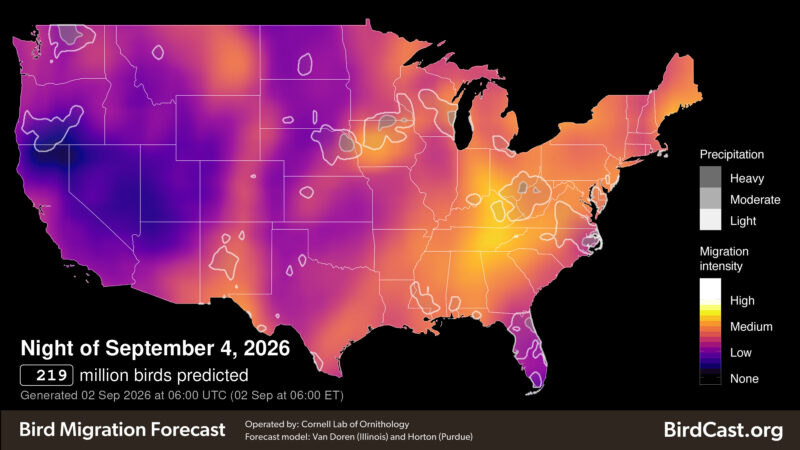
The maps from BirdCast.info depict migratory patterns over the years. As the website explains:
Bird migration forecasts show predicted nocturnal migration 3 hours after local sunset and are updated every 6 hours. These forecasts come from models trained on the last 23 years of bird movements in the atmosphere as detected by the US NEXRAD weather surveillance radar network.
You can get the next three nights’ worth of maps at the site. And besides the prediction maps, you can also find live bird migration maps. They’ll give you an idea of where birds are active right now. Birds are most active after dark. And if you don’t want to keep checking back at the website to see when birds are active in your area, you can sign up for alerts.
Sites to help you see and protect birds
Tracking and research tools:
- BirdCast
Migration forecasts, live radar-based migration maps and alerts you can use to know when migration is happening in your area. - Motus Wildlife Tracking System
A global collaboration using small tracking tags (for birds, bats, insects) and receiving stations to map how animals move across landscapes. - Audubon’s Bird Migration Explorer
Interactive maps and data showing annual migration routes for hundreds of species across North America. - National Zoo: Migratory Birds Tracking Map
Shows real tracking data (from tagged birds) on real maps. - Journey North
Citizen science and seasonal tracking of migrating species (birds, butterflies, etc.). - Canadian Migration Monitoring Network (CMMN)
Long-term monitoring of migration trends in Canada, via many observatories. - PixCams Live Bird Migration Station
A hybrid setup (optical + thermal + acoustic) giving real-time monitoring of nocturnal migrations. - MigrantWatch (India)
A citizen science effort to log migratory bird sightings in India. - eBird India
A nationwide citizen-science platform where birdwatchers record their sightings to build an open database tracking bird distribution, abundance and migration patterns across India year-round.
Some initiatives for protecting migrating birds:
- Audubon Lights Out Program
Encourages turning off/excluding unnecessary lighting during migration seasons to reduce bird collisions. - Lights Out Heartland
A regional campaign in the U.S. Midwest focused on reducing light pollution during key migration windows. - FLAP Canada (Fatal Light Awareness Program)
Works on reducing collisions, raising awareness, and tracking collisions especially in Canada. - City & Local Lights Out Programs
Many cities have local versions that you can join or replicate in your area.
Bottom line: Will we see a billion bird night during fall migration this year? And get tips on how you can help birds by turning off exterior lights.
Read more: Fall hummingbird migration in progress across North America
The post Will fall migration bring a billion bird night? first appeared on EarthSky.
from EarthSky https://ift.tt/8pMIB4E
Will we see a billion birds during fall migration?
It’s peak fall migration season for birds! While the numbers of birds crossing the U.S. is usually in the millions during September and October, we can sometimes see a billion bird night. That happened last year, on September 25, 2025, when BirdCast tracked more than 1.2 billion birds heading south after sunset. That was the most BirdCast had ever tracked in one night since it began its project in 2018. How do they track the birds? They use:
the same weather radar technology behind daily forecasts to track migrating birds.
On that night, about 10% of North America’s birds were in flight at the same time. And there’s something you can do in the fall to help them make their journey southward.
Lights out for birds during fall migration!
Every day you can check the BirdCast.info website to get an idea of what regions will see the highest number of birds passing each night. So when your area is especially active, turn off your exterior lights and encourage your neighbors to do the same. Artificial lights disorient birds, changing their behavior and sometimes leading to their deaths.
BirdCast.info says:
Light pollution attracts and disorients migrating birds, confusing and exhausting them as well as making them vulnerable to collisions with buildings.
So here’s what you can do:
- Turn off non-essential lights from 11 p.m. until 6 a.m. during critical migration periods
- Turn off or dim lobby and atrium lights
- Be sure outside lights are aimed down and well shielded
- Turn off or dim interior home lighting, or draw blinds to prevent light escaping
- Turn off decorative landscape lighting
- Install motion sensors on outside lights to minimize use
- Turn off lights before leaving the home or office
- Prevent daylight collisions with bird-friendly products for windows
Read more: Want to save millions of migratory birds? Turn off your outdoor lights in spring and fall
Migration maps
The maps from BirdCast.info depict migratory patterns over the years. As the website explains:
Bird migration forecasts show predicted nocturnal migration 3 hours after local sunset and are updated every 6 hours. These forecasts come from models trained on the last 23 years of bird movements in the atmosphere as detected by the US NEXRAD weather surveillance radar network.
You can get the next three nights’ worth of maps at the site. And besides the prediction maps, you can also find live bird migration maps. They’ll give you an idea of where birds are active right now. Birds are most active after dark. And if you don’t want to keep checking back at the website to see when birds are active in your area, you can sign up for alerts.
Sites to help you see and protect birds
Tracking and research tools:
- BirdCast
Migration forecasts, live radar-based migration maps and alerts you can use to know when migration is happening in your area. - Motus Wildlife Tracking System
A global collaboration using small tracking tags (for birds, bats, insects) and receiving stations to map how animals move across landscapes. - Audubon’s Bird Migration Explorer
Interactive maps and data showing annual migration routes for hundreds of species across North America. - National Zoo: Migratory Birds Tracking Map
Shows real tracking data (from tagged birds) on real maps. - Journey North
Citizen science and seasonal tracking of migrating species (birds, butterflies, etc.). - Canadian Migration Monitoring Network (CMMN)
Long-term monitoring of migration trends in Canada, via many observatories. - PixCams Live Bird Migration Station
A hybrid setup (optical + thermal + acoustic) giving real-time monitoring of nocturnal migrations. - MigrantWatch (India)
A citizen science effort to log migratory bird sightings in India. - eBird India
A nationwide citizen-science platform where birdwatchers record their sightings to build an open database tracking bird distribution, abundance and migration patterns across India year-round.
Some initiatives for protecting migrating birds:
- Audubon Lights Out Program
Encourages turning off/excluding unnecessary lighting during migration seasons to reduce bird collisions. - Lights Out Heartland
A regional campaign in the U.S. Midwest focused on reducing light pollution during key migration windows. - FLAP Canada (Fatal Light Awareness Program)
Works on reducing collisions, raising awareness, and tracking collisions especially in Canada. - City & Local Lights Out Programs
Many cities have local versions that you can join or replicate in your area.
Bottom line: Will we see a billion bird night during fall migration this year? And get tips on how you can help birds by turning off exterior lights.
Read more: Fall hummingbird migration in progress across North America
The post Will fall migration bring a billion bird night? first appeared on EarthSky.
from EarthSky https://ift.tt/8pMIB4E

Aucun commentaire:
Enregistrer un commentaire