aads

Solar eclipse: Top 5 tips for photographing an eclipse

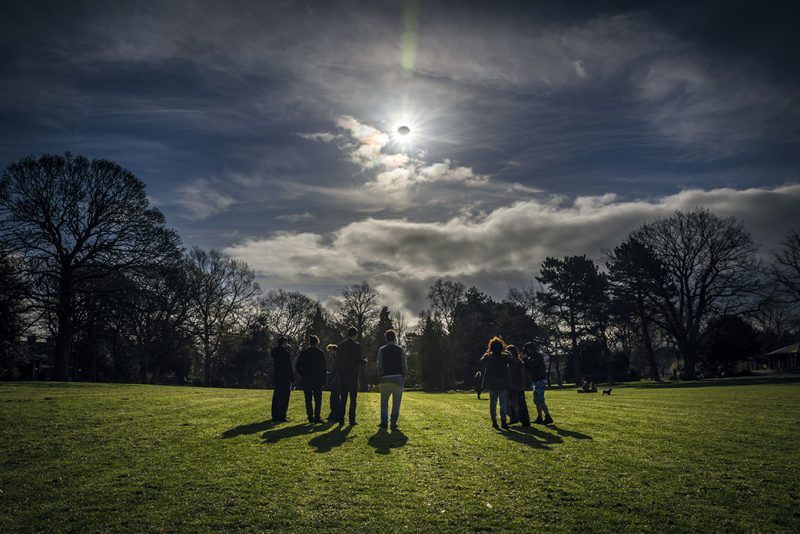
Solar eclipse: Group of people standing in a grassy field, with trees in the distance and a the blocked-out sun above them.
People watch a partial solar eclipse in Belfast, Northern Ireland, on March 20, 2015. Image via NASA/ Robin Cordiner.

Via Mara Johnson-Groh, NASA’s Goddard Space Flight Center

There’s a total solar eclipse on August 12, 2026, visible from parts of the Arctic, Greenland, Iceland and Spain. And it’ll be visible as a partial eclipse from much of western Europe and North America.

Here’s a unique photo tip: During this total solar eclipse, you might catch a Perseid meteor! That’s because the Perseid shower is reaching its peak on August 12-13.

Solar eclipses offer a unique opportunity for scientists studying the shadow of the moon. And it’s also a perfect opportunity to capture unforgettable images. Try out these tips for photographing the eclipse.

1. Safety first

To take images as the sun is being eclipsed, you’ll need to use a special solar filter to protect your camera’s sensor. That’s just like you’ll need a pair of eclipse glasses to protect your own eyes. However, at totality, when the moon completely blocks the sun, make sure to remove the filter so you can see the sun’s outer atmosphere, the corona.

How to watch a solar eclipse safely

Having a few other pieces of equipment can also come in handy during the eclipse. Using a tripod can help you stabilize the camera and avoid taking blurry images thanks to the low lighting. Additionally, using a delayed shutter release timer will allow you to snap shots without jiggling the camera.
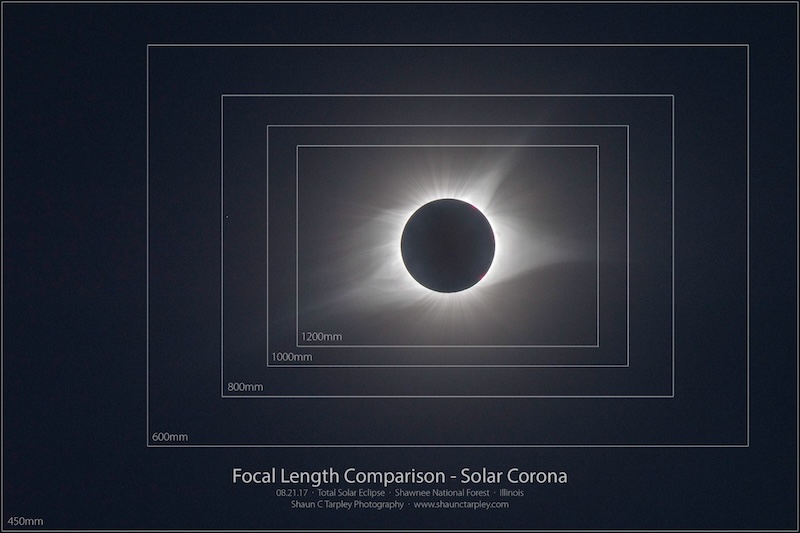
Solid black circle with with white streamers all around, in four concentric boxes around it.
View at EarthSky Community Photos. | Shaun Tarpley in Shawnee National Forest, Illinois, wrote: “I created this using a 9-image bracket series I took during the 2017 total solar eclipse and overlaid frames indicating the relative field-of-view of common focal lengths to help photographers planning to photograph the 2024 eclipse to visualize what focal length is optimum for their imaging goals. It is a quick way to visualize the differences.” Thank you, Shaun!

2. Any camera is a good camera

Taking a stunning photo has more to do with the photographer than the camera. Whether you have a high-end DLSR or a camera phone, you can take great photos during the eclipse. After all, the best piece of equipment you can have is a good eye and a vision for the image you want to create.

If you don’t have a telephoto zoom lens, focus on taking landscape shots, which capture the changing environment.

During totality, the moon completely covers the sun. If you do have a telephoto lens with a solar filter, you’ll be able to see and photograph the structures in the sun’s corona.
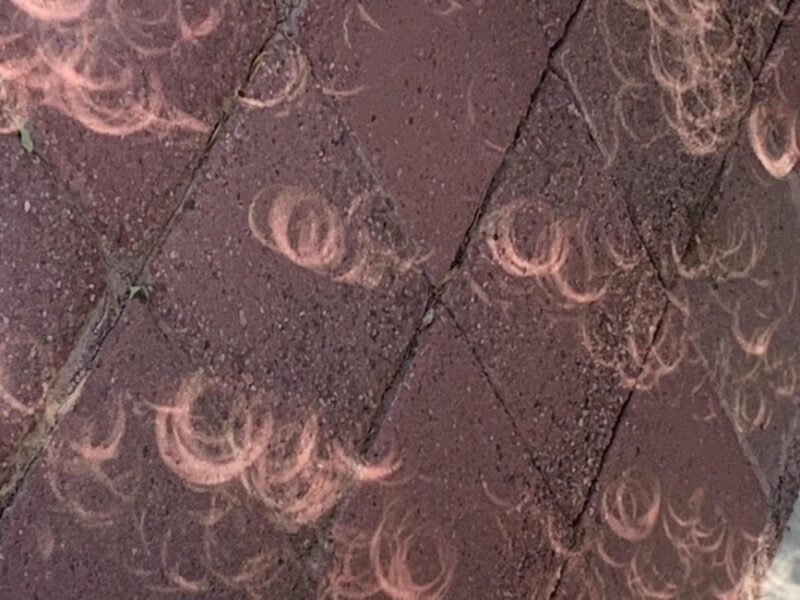
Very many scattered rings of light on a deep-red brick pavement.
Robert Asher in Artesia, New Mexico, captured these images of the sun in a ring around the moon – at mid-eclipse – on October 14, 2023. When you see crescents dancing under the trees during an eclipse of the sun, it’s because tree leaves are creating natural pinhole cameras that project the image of the sun and moon. Thank you, Robert! Used with permission.

3. Look up, down, all around

While the sun is the most commanding element of an eclipse, remember to look around you. As the moon slips in front of the sun, the landscape will be bathed in long shadows, creating eerie lighting across the landscape. Light filtering through the overlapping leaves of trees will create natural pinholes, producing mini eclipse replicas on the ground. Everywhere you can point your camera can yield exceptional imagery, so be sure to compose some wide-angle photos that can capture your eclipse experience.

NASA photographer Bill Ingalls recommends focusing on the human experience of watching the eclipse. He said:

The real pictures are going to be of the people around you pointing, gawking and watching it. Those are going to be some great moments to capture to show the emotion of the whole thing.

4. Practice and plan

Be sure you know the capabilities of your camera before eclipse day. Most cameras, and even many camera phones, have adjustable exposures. These can help you darken or lighten your image during the tricky eclipse lighting. Make sure you know how to manually focus the camera for crisp shots.

For DSLR cameras, the best way to determine the correct exposure is to test settings on the uneclipsed sun beforehand using a solar filter. Using a fixed aperture of f/8 to f/16, try shutter speeds between 1/1000 to 1/4 second to find the optimal setting. You can then use that to take images during the partial stages of the eclipse. During totality, the corona has a wide range of brightness. So it’s best to use a fixed aperture and a range of exposures from approximately 1/1000 to 1 second without the solar filter. Then, put your solar filter back once totality has ended.

5. Share!

Share your eclipse experience with friends and family afterwards. Use the hashtag #Eclipse2026 on your favorite social media sites.

And share your pics with us at EarthSky here.

While you’re out perfecting your perfect eclipse shot, don’t forget to stop and look at the eclipse with your own eyes. Just remember to wear your eclipse glasses for all stages of the eclipse before and after totality!

Bottom line: Here are five tips for photographing the August 12, 2026, total solar eclipse.

Science news, night sky events and beautiful photos, all in one place. Click here to subscribe to our free daily newsletter.

Read more: April 8, 2024, total solar eclipse pics and video from the EarthSky community

Read more: Eclipse photos here! Annular solar eclipse October 14, 2023

The post Solar eclipse: Top 5 tips for photographing an eclipse first appeared on EarthSky.


from EarthSky https://ift.tt/HcRAxmG
Solar eclipse: Group of people standing in a grassy field, with trees in the distance and a the blocked-out sun above them.
People watch a partial solar eclipse in Belfast, Northern Ireland, on March 20, 2015. Image via NASA/ Robin Cordiner.

Via Mara Johnson-Groh, NASA’s Goddard Space Flight Center

There’s a total solar eclipse on August 12, 2026, visible from parts of the Arctic, Greenland, Iceland and Spain. And it’ll be visible as a partial eclipse from much of western Europe and North America.

Here’s a unique photo tip: During this total solar eclipse, you might catch a Perseid meteor! That’s because the Perseid shower is reaching its peak on August 12-13.

Solar eclipses offer a unique opportunity for scientists studying the shadow of the moon. And it’s also a perfect opportunity to capture unforgettable images. Try out these tips for photographing the eclipse.

1. Safety first

To take images as the sun is being eclipsed, you’ll need to use a special solar filter to protect your camera’s sensor. That’s just like you’ll need a pair of eclipse glasses to protect your own eyes. However, at totality, when the moon completely blocks the sun, make sure to remove the filter so you can see the sun’s outer atmosphere, the corona.

How to watch a solar eclipse safely

Having a few other pieces of equipment can also come in handy during the eclipse. Using a tripod can help you stabilize the camera and avoid taking blurry images thanks to the low lighting. Additionally, using a delayed shutter release timer will allow you to snap shots without jiggling the camera.

Solid black circle with with white streamers all around, in four concentric boxes around it.
View at EarthSky Community Photos. | Shaun Tarpley in Shawnee National Forest, Illinois, wrote: “I created this using a 9-image bracket series I took during the 2017 total solar eclipse and overlaid frames indicating the relative field-of-view of common focal lengths to help photographers planning to photograph the 2024 eclipse to visualize what focal length is optimum for their imaging goals. It is a quick way to visualize the differences.” Thank you, Shaun!

2. Any camera is a good camera

Taking a stunning photo has more to do with the photographer than the camera. Whether you have a high-end DLSR or a camera phone, you can take great photos during the eclipse. After all, the best piece of equipment you can have is a good eye and a vision for the image you want to create.

If you don’t have a telephoto zoom lens, focus on taking landscape shots, which capture the changing environment.

During totality, the moon completely covers the sun. If you do have a telephoto lens with a solar filter, you’ll be able to see and photograph the structures in the sun’s corona.

Very many scattered rings of light on a deep-red brick pavement.
Robert Asher in Artesia, New Mexico, captured these images of the sun in a ring around the moon – at mid-eclipse – on October 14, 2023. When you see crescents dancing under the trees during an eclipse of the sun, it’s because tree leaves are creating natural pinhole cameras that project the image of the sun and moon. Thank you, Robert! Used with permission.

3. Look up, down, all around

While the sun is the most commanding element of an eclipse, remember to look around you. As the moon slips in front of the sun, the landscape will be bathed in long shadows, creating eerie lighting across the landscape. Light filtering through the overlapping leaves of trees will create natural pinholes, producing mini eclipse replicas on the ground. Everywhere you can point your camera can yield exceptional imagery, so be sure to compose some wide-angle photos that can capture your eclipse experience.

NASA photographer Bill Ingalls recommends focusing on the human experience of watching the eclipse. He said:

The real pictures are going to be of the people around you pointing, gawking and watching it. Those are going to be some great moments to capture to show the emotion of the whole thing.

4. Practice and plan

Be sure you know the capabilities of your camera before eclipse day. Most cameras, and even many camera phones, have adjustable exposures. These can help you darken or lighten your image during the tricky eclipse lighting. Make sure you know how to manually focus the camera for crisp shots.

For DSLR cameras, the best way to determine the correct exposure is to test settings on the uneclipsed sun beforehand using a solar filter. Using a fixed aperture of f/8 to f/16, try shutter speeds between 1/1000 to 1/4 second to find the optimal setting. You can then use that to take images during the partial stages of the eclipse. During totality, the corona has a wide range of brightness. So it’s best to use a fixed aperture and a range of exposures from approximately 1/1000 to 1 second without the solar filter. Then, put your solar filter back once totality has ended.

5. Share!

Share your eclipse experience with friends and family afterwards. Use the hashtag #Eclipse2026 on your favorite social media sites.

And share your pics with us at EarthSky here.

While you’re out perfecting your perfect eclipse shot, don’t forget to stop and look at the eclipse with your own eyes. Just remember to wear your eclipse glasses for all stages of the eclipse before and after totality!

Bottom line: Here are five tips for photographing the August 12, 2026, total solar eclipse.

Science news, night sky events and beautiful photos, all in one place. Click here to subscribe to our free daily newsletter.

Read more: April 8, 2024, total solar eclipse pics and video from the EarthSky community

Read more: Eclipse photos here! Annular solar eclipse October 14, 2023

The post Solar eclipse: Top 5 tips for photographing an eclipse first appeared on EarthSky.


from EarthSky https://ift.tt/HcRAxmG
Aquila the Eagle soars along the Milky Way

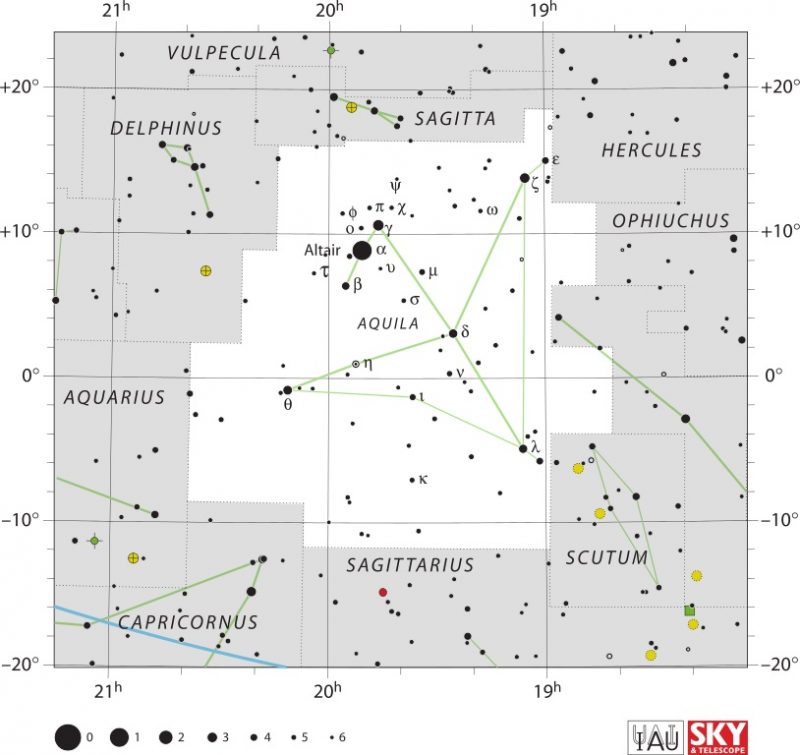
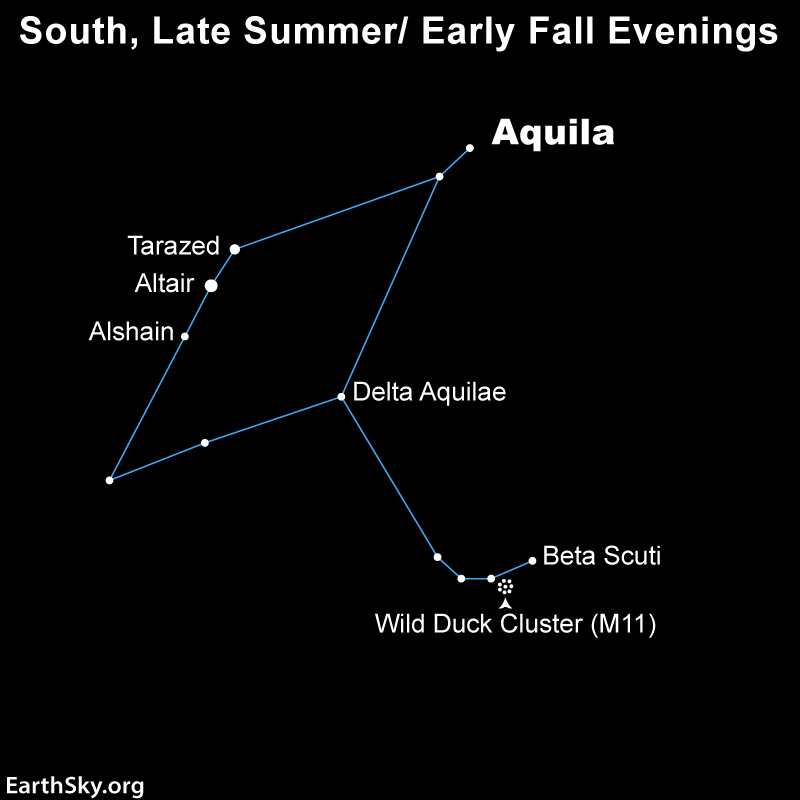
Aquila the Eagle: Star chart of a stretched diamond shape with a tail from the wide edge, with labels.
Aquila the Eagle is home to the star Altair, which is one of the corners of the Summer Triangle. In addition, you can also use Aquila to starhop your way to the Wild Duck cluster in Scutum the Shield. Image via EarthSky.

The best time to see the constellation Aquila the Eagle in the evening sky is from July to November as it soars along the Milky Way. And, because our galaxy provides a starry backdrop, many clusters and nebulae lie within its borders. Aquila’s brightest star, Altair, is the southernmost corner star in the Summer Triangle. In mythology, Aquila carried Zeus’ thunderbolts for him.

The stars of Aquila the Eagle

The brightest star in Aquila is Alpha Aquilae, or Altair. At magnitude 0.76, it is one of the three bright stars that mark the corners of the Summer Triangle. Deneb and Vega are the other two and they lie higher in the sky, closer to the zenith on summer evenings. Altair lies just 17 light-years away from Earth.

Additionally, two moderately bright stars lie on either side of Altair. To the southeast is Beta Aquilae, or Alshain. This magnitude 3.71 star lies 45 light-years away. To the other side of Altair is Gamma Aquilae, or Tarazed. At magnitude 2.72, it’s brighter than Alshain but lies much farther away at 461 light-years. This trio of stars is found near the head of Aquila the Eagle.

Then, the star marking Aquila’s back is Delta Aquilae, at magnitude 3.36 and 50 light-years away. Likewise, Theta Aquilae marks the left wing. It shines at magnitude 3.26 from across 286 light-years. The right wing, that points to Vega, holds Zeta Aquilae at magnitude 2.99 and 83 light-years distant. Lastly, the star at the end of the tail of the Eagle is Lambda Aquilae at magnitude 3.43, lying 125 light-years away.

Star chart with stars in black on white and constellation lines in green.
The stars of Aquila the Eagle. The larger the dot, the brighter the star. Image via IAU/ Sky and Telescope/ Wikimedia Commons (CC BY 3.0).

Globular clusters

While there are no Messier objects in Aquila, there is still a lot to see, especially if you have a big enough telescope. For example, two globular clusters lie in Aquila: NGC 6749 and NGC 6760.

The two globular clusters are in the vicinity of Delta Aquilae. NGC 6760 shines at magnitude 9.1. Then, about 2 degrees farther away is NGC 6749 at magnitude 12.

In addition, several open clusters lie in Aquila, but most of them are faint. With this in mind, the best one to observe is NGC 6755, a 7.5-magnitude grouping found near the star marking the back of the Eagle. Another good open cluster to try for is NGC 6709, which, at magnitude 6.7, appears in binoculars. NGC 6709 is fairly near Zeta Aquilae, the upper wing of the Eagle. Between these two clusters is yet another cluster, NGC 6738. This sparse cluster is 8th magnitude.

Also, a lot of observers who come to Aquila use it to starhop to a cluster just over the border of the constellation Scutum the Shield. The Wild Duck Cluster, M11, shines at magnitude 6.3, making it brighter than any of the clusters in Aquila. Here’s how to find it.

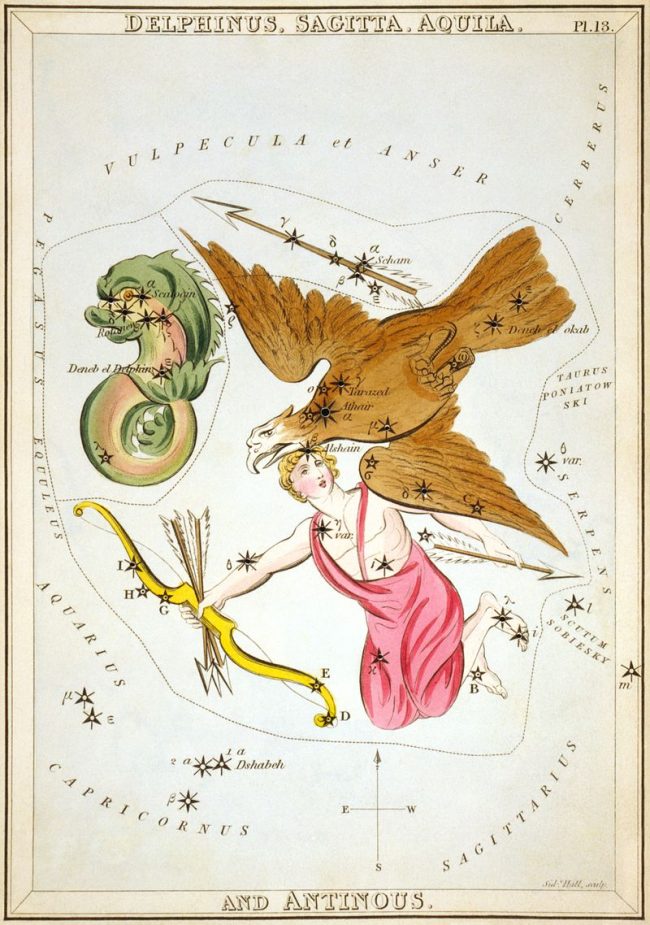
Antique colored etching of a flying eagle near a fish and an archer, all scattered with stars.
Altair in Aquila the Eagle, with 2 smaller constellations nearby. Image via Wikipedia.

Nebulae of Aquila

A number of nebulae lie along the line that marks the body of the Eagle, but only one is bright enough to reach even 10th magnitude. NGC 6790 lies a little less than 2 degrees from the star that marks the back of the Eagle in the direction of its tail.

Good luck tracking down these tough-to-spot, faint objects in Aquila the Eagle. Or, you can always just scan the area in binoculars and see what materializes.

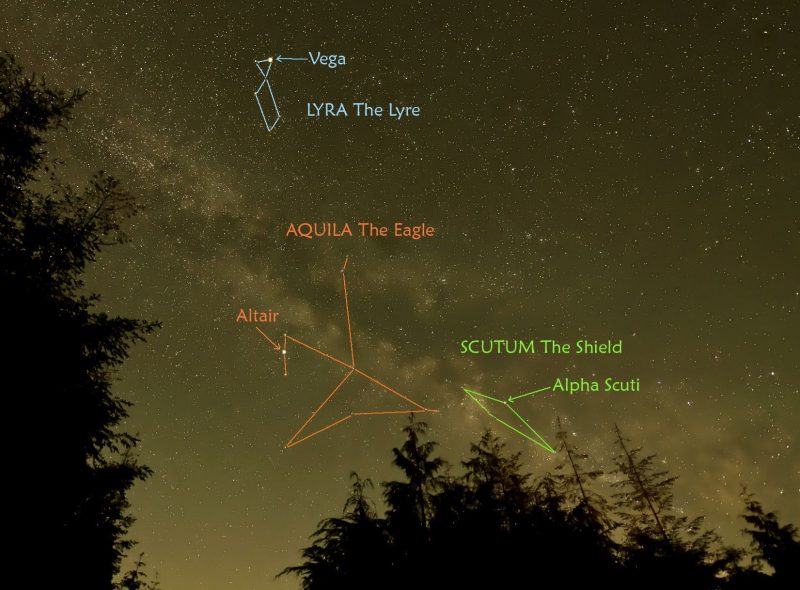
Photo of the starlit band of the Milky Way, with outlines for Scutum, Aquila the Eagle and Lyra.
View at EarthSky Community Photos. | Cecille Kennedy caught this image from the central Oregon coast. Notice how Aquila the Eagle soars along the Milky Way. Thank you, Cecille!

Bottom line: Aquila the Eagle is home to the bright star Altair, which forms one corner of the Summer Triangle. And you can see this constellation at its best in northern late summer or early fall evenings.

The post Aquila the Eagle soars along the Milky Way first appeared on EarthSky.


from EarthSky https://ift.tt/Ab1yljK
Aquila the Eagle: Star chart of a stretched diamond shape with a tail from the wide edge, with labels.
Aquila the Eagle is home to the star Altair, which is one of the corners of the Summer Triangle. In addition, you can also use Aquila to starhop your way to the Wild Duck cluster in Scutum the Shield. Image via EarthSky.

The best time to see the constellation Aquila the Eagle in the evening sky is from July to November as it soars along the Milky Way. And, because our galaxy provides a starry backdrop, many clusters and nebulae lie within its borders. Aquila’s brightest star, Altair, is the southernmost corner star in the Summer Triangle. In mythology, Aquila carried Zeus’ thunderbolts for him.

The stars of Aquila the Eagle

The brightest star in Aquila is Alpha Aquilae, or Altair. At magnitude 0.76, it is one of the three bright stars that mark the corners of the Summer Triangle. Deneb and Vega are the other two and they lie higher in the sky, closer to the zenith on summer evenings. Altair lies just 17 light-years away from Earth.

Additionally, two moderately bright stars lie on either side of Altair. To the southeast is Beta Aquilae, or Alshain. This magnitude 3.71 star lies 45 light-years away. To the other side of Altair is Gamma Aquilae, or Tarazed. At magnitude 2.72, it’s brighter than Alshain but lies much farther away at 461 light-years. This trio of stars is found near the head of Aquila the Eagle.

Then, the star marking Aquila’s back is Delta Aquilae, at magnitude 3.36 and 50 light-years away. Likewise, Theta Aquilae marks the left wing. It shines at magnitude 3.26 from across 286 light-years. The right wing, that points to Vega, holds Zeta Aquilae at magnitude 2.99 and 83 light-years distant. Lastly, the star at the end of the tail of the Eagle is Lambda Aquilae at magnitude 3.43, lying 125 light-years away.

Star chart with stars in black on white and constellation lines in green.
The stars of Aquila the Eagle. The larger the dot, the brighter the star. Image via IAU/ Sky and Telescope/ Wikimedia Commons (CC BY 3.0).

Globular clusters

While there are no Messier objects in Aquila, there is still a lot to see, especially if you have a big enough telescope. For example, two globular clusters lie in Aquila: NGC 6749 and NGC 6760.

The two globular clusters are in the vicinity of Delta Aquilae. NGC 6760 shines at magnitude 9.1. Then, about 2 degrees farther away is NGC 6749 at magnitude 12.

In addition, several open clusters lie in Aquila, but most of them are faint. With this in mind, the best one to observe is NGC 6755, a 7.5-magnitude grouping found near the star marking the back of the Eagle. Another good open cluster to try for is NGC 6709, which, at magnitude 6.7, appears in binoculars. NGC 6709 is fairly near Zeta Aquilae, the upper wing of the Eagle. Between these two clusters is yet another cluster, NGC 6738. This sparse cluster is 8th magnitude.

Also, a lot of observers who come to Aquila use it to starhop to a cluster just over the border of the constellation Scutum the Shield. The Wild Duck Cluster, M11, shines at magnitude 6.3, making it brighter than any of the clusters in Aquila. Here’s how to find it.

Antique colored etching of a flying eagle near a fish and an archer, all scattered with stars.
Altair in Aquila the Eagle, with 2 smaller constellations nearby. Image via Wikipedia.

Nebulae of Aquila

A number of nebulae lie along the line that marks the body of the Eagle, but only one is bright enough to reach even 10th magnitude. NGC 6790 lies a little less than 2 degrees from the star that marks the back of the Eagle in the direction of its tail.

Good luck tracking down these tough-to-spot, faint objects in Aquila the Eagle. Or, you can always just scan the area in binoculars and see what materializes.

Photo of the starlit band of the Milky Way, with outlines for Scutum, Aquila the Eagle and Lyra.
View at EarthSky Community Photos. | Cecille Kennedy caught this image from the central Oregon coast. Notice how Aquila the Eagle soars along the Milky Way. Thank you, Cecille!

Bottom line: Aquila the Eagle is home to the bright star Altair, which forms one corner of the Summer Triangle. And you can see this constellation at its best in northern late summer or early fall evenings.

The post Aquila the Eagle soars along the Milky Way first appeared on EarthSky.


from EarthSky https://ift.tt/Ab1yljK

How to watch a solar eclipse safely: tips here

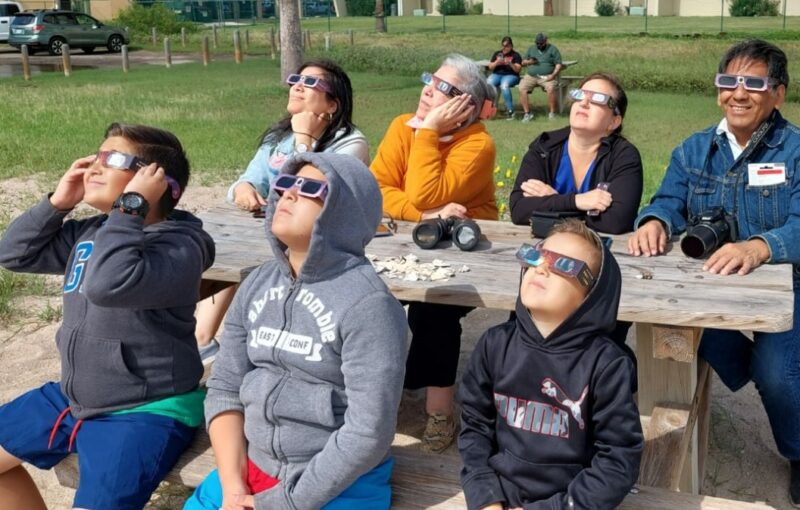
Group of 7 people, adults and children, sit at a picnic table, wearing eclipse glasses and looking up.
Raúl Cortés – a co-author of EarthSky’s daily sun post – is the one on the top right in this photo. He lives in Mexico. But he and his family traveled to Corpus Christi, Texas, to place themselves in the path of the annular eclipse on October 14, 2023. Thank you, Raúl! Read tips below on how to safely watch a solar eclipse.

You learned long ago never to look directly at the sun. Gazing sunward without eye protection can permanently damage your eyes. But there are a variety of ways you can safely view the August 12, 2026, total solar eclipse.

You deserve a daily dose of good news. For the latest in science and the night sky, click here to subscribe to our free daily newsletter.

Here’s what NOT to do

First, let’s cover what you shouldn’t do to look at the sun. Whatever you do, never look at the sun directly without a safe filter in place to protect your eyes.

Besides your unprotected eyeballs, here are some other things you should not use: Do NOT use sunglasses, polaroid filters, smoked glass, exposed color film, X-ray film or photographic neutral density filters.

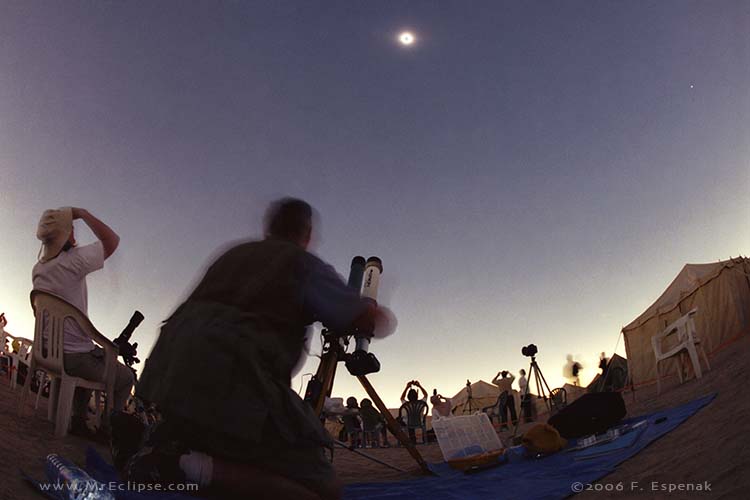
A group watching the eclipsed sun, a man in the foreground aiming a filtered telescope toward it.
Fred Espenak created this self-portrait during a 2006 total solar eclipse. He’s using a small telescope equipped with a solar filter for observing the sun safely. Thank you, Fred! Used with permission. Read the ways to watch a solar eclipse – and the sun – safely, below.

DO use these techniques for observing the sun safely

Safe commercial solar filters for a telescope. If you have a telescope, you’ll need a safe solar filter on the sky end of it in order to search for sunspots or watch a solar eclipse safely. Do not use a filter on the eyepiece end of your telescope. There’s too much to say about solar filters to include in this article, so we refer you to Fred Espenak’s article on safe solar filters. If you don’t have a ‘scope, you still have plenty of options, such as …

Creating a pinhole camera. If you make a DIY easy pinhole projector, you can shine the sun’s image onto a flat surface and give your friends and family a cool experience too.

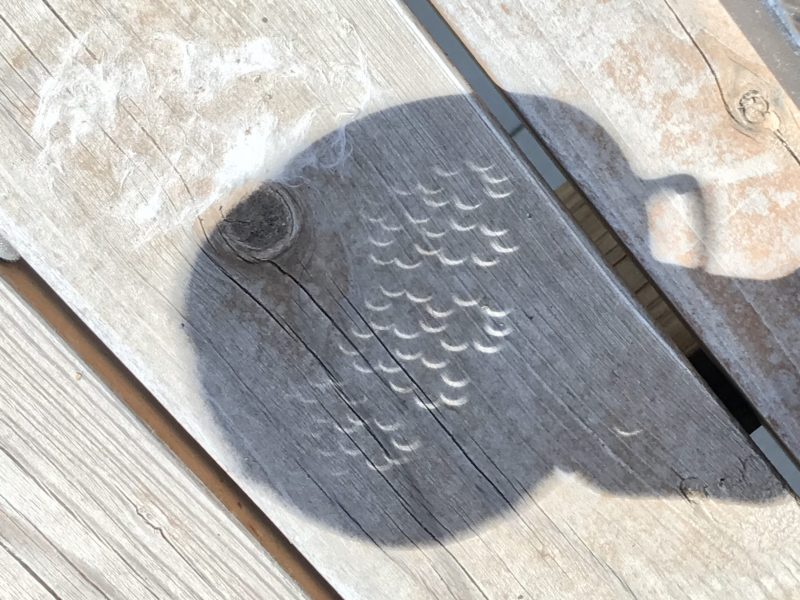
Use handy things around the house. You can use a colander, a slotted spoon or even criss-cross your fingers and let the sun shine through them to see dozens of little eclipsed suns on the ground.

Shadow on a wooden deck of a hand holding a colander and many small bright crescents projected onto deck.
Use a colander as an easy pinhole projector to safely view a solar eclipse. Image via Marcy Curran.

Check out the ground below trees

The little pinholes in leaves on trees are a wonderful pinhole projector.

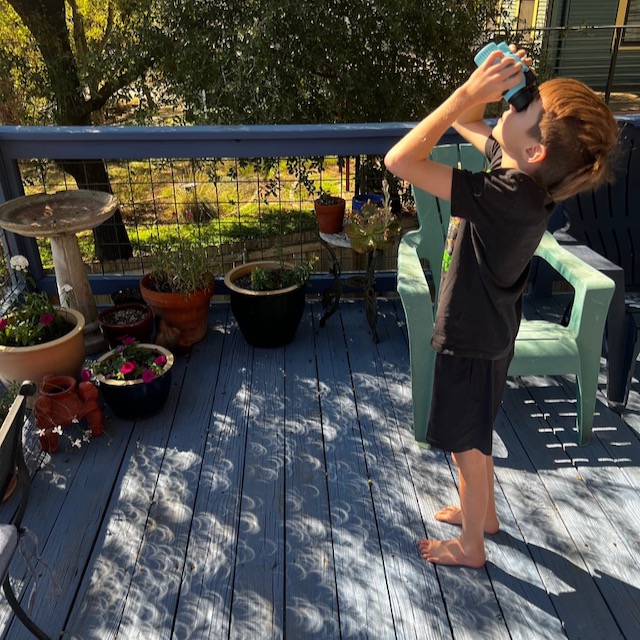
Small boy in dark T-shirt and shorts standing on a deck, looking up through solar binoculars.
This young astronomer in Austin, Texas, is using solar binoculars, especially designed for watching eclipses and tracking sunspots. See the crescent suns at his feet? Those are projected images of the eclipsed sun. Image via EarthSky.

But wait, there’s more …

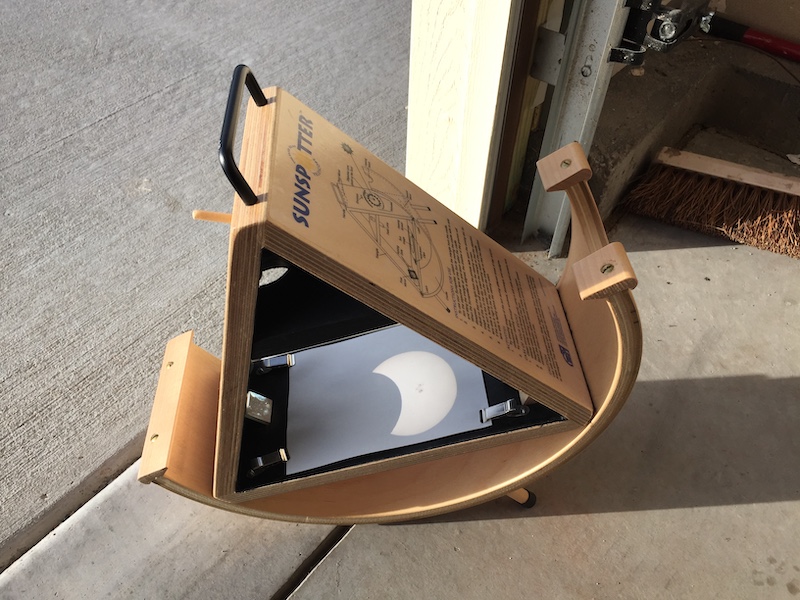
A commercial pinhole projector. There are several versions of this handy and unique device to safely project an image of the sun. The Sunspotter projects an enlarged image of the sun onto a piece of paper, and even shows all but the smallest sunspots. It’s easy to use, plus multiple people can safely watch the eclipse (or see sunspots) at the same time. Of course, for solar eclipses the advancing – and eventual retreating – of the moon’s shadow is easy to see and even photograph.

Wooden device with a semicircle base, a triangular insert projecting a picture of an eclipsed sun on white paper.
Commercial sun projection devices are available as well, such as this Sunspotter. They use lenses to project the sun on a piece of paper to safely watch solar eclipses and to view sunspots. Image via Marcy Curran.

Commercial solar eclipse glasses. You might find these online or at a local nature center or museum. Solar eclipse glasses – or eclipse viewers – are super easy to use, and they’re sort of cool-looking.

Watch a solar eclipse: Closeup of smiling young woman's sunlit face. She has on cardboard glasses with black lenses.
Certified eclipse glasses are a safe alternative for viewing.

Watch a solar eclipse with others

Local viewing at an astronomy club, park or nature center. We highly recommend this route for any kind of eclipse, any daytime solar viewing or any nighttime astronomical event. If you watch among other amateur astronomers and casual sky gazers, you’ll have fun, learn about astronomy and get a great view of the objects and events going on in the sky.

The NASA Night Sky Network has a list of local astronomy clubs in the U.S. Here’s a search page from Go-astronomy.com which includes worldwide clubs. And here are astronomy clubs and societies affiliated with the Astronomical League, one of the most established confederations of amateur astronomers in the U.S.

Bottom line: Some tips for observing the sun safely during a solar eclipse here.

Read about the August 12, 2026, total solar eclipse

The post How to watch a solar eclipse safely: tips here first appeared on EarthSky.


from EarthSky https://ift.tt/kiuES1m
Group of 7 people, adults and children, sit at a picnic table, wearing eclipse glasses and looking up.
Raúl Cortés – a co-author of EarthSky’s daily sun post – is the one on the top right in this photo. He lives in Mexico. But he and his family traveled to Corpus Christi, Texas, to place themselves in the path of the annular eclipse on October 14, 2023. Thank you, Raúl! Read tips below on how to safely watch a solar eclipse.

You learned long ago never to look directly at the sun. Gazing sunward without eye protection can permanently damage your eyes. But there are a variety of ways you can safely view the August 12, 2026, total solar eclipse.

You deserve a daily dose of good news. For the latest in science and the night sky, click here to subscribe to our free daily newsletter.

Here’s what NOT to do

First, let’s cover what you shouldn’t do to look at the sun. Whatever you do, never look at the sun directly without a safe filter in place to protect your eyes.

Besides your unprotected eyeballs, here are some other things you should not use: Do NOT use sunglasses, polaroid filters, smoked glass, exposed color film, X-ray film or photographic neutral density filters.

A group watching the eclipsed sun, a man in the foreground aiming a filtered telescope toward it.
Fred Espenak created this self-portrait during a 2006 total solar eclipse. He’s using a small telescope equipped with a solar filter for observing the sun safely. Thank you, Fred! Used with permission. Read the ways to watch a solar eclipse – and the sun – safely, below.

DO use these techniques for observing the sun safely

Safe commercial solar filters for a telescope. If you have a telescope, you’ll need a safe solar filter on the sky end of it in order to search for sunspots or watch a solar eclipse safely. Do not use a filter on the eyepiece end of your telescope. There’s too much to say about solar filters to include in this article, so we refer you to Fred Espenak’s article on safe solar filters. If you don’t have a ‘scope, you still have plenty of options, such as …

Creating a pinhole camera. If you make a DIY easy pinhole projector, you can shine the sun’s image onto a flat surface and give your friends and family a cool experience too.

Use handy things around the house. You can use a colander, a slotted spoon or even criss-cross your fingers and let the sun shine through them to see dozens of little eclipsed suns on the ground.

Shadow on a wooden deck of a hand holding a colander and many small bright crescents projected onto deck.
Use a colander as an easy pinhole projector to safely view a solar eclipse. Image via Marcy Curran.

Check out the ground below trees

The little pinholes in leaves on trees are a wonderful pinhole projector.

Small boy in dark T-shirt and shorts standing on a deck, looking up through solar binoculars.
This young astronomer in Austin, Texas, is using solar binoculars, especially designed for watching eclipses and tracking sunspots. See the crescent suns at his feet? Those are projected images of the eclipsed sun. Image via EarthSky.

But wait, there’s more …

A commercial pinhole projector. There are several versions of this handy and unique device to safely project an image of the sun. The Sunspotter projects an enlarged image of the sun onto a piece of paper, and even shows all but the smallest sunspots. It’s easy to use, plus multiple people can safely watch the eclipse (or see sunspots) at the same time. Of course, for solar eclipses the advancing – and eventual retreating – of the moon’s shadow is easy to see and even photograph.

Wooden device with a semicircle base, a triangular insert projecting a picture of an eclipsed sun on white paper.
Commercial sun projection devices are available as well, such as this Sunspotter. They use lenses to project the sun on a piece of paper to safely watch solar eclipses and to view sunspots. Image via Marcy Curran.

Commercial solar eclipse glasses. You might find these online or at a local nature center or museum. Solar eclipse glasses – or eclipse viewers – are super easy to use, and they’re sort of cool-looking.

Watch a solar eclipse: Closeup of smiling young woman's sunlit face. She has on cardboard glasses with black lenses.
Certified eclipse glasses are a safe alternative for viewing.

Watch a solar eclipse with others

Local viewing at an astronomy club, park or nature center. We highly recommend this route for any kind of eclipse, any daytime solar viewing or any nighttime astronomical event. If you watch among other amateur astronomers and casual sky gazers, you’ll have fun, learn about astronomy and get a great view of the objects and events going on in the sky.

The NASA Night Sky Network has a list of local astronomy clubs in the U.S. Here’s a search page from Go-astronomy.com which includes worldwide clubs. And here are astronomy clubs and societies affiliated with the Astronomical League, one of the most established confederations of amateur astronomers in the U.S.

Bottom line: Some tips for observing the sun safely during a solar eclipse here.

Read about the August 12, 2026, total solar eclipse

The post How to watch a solar eclipse safely: tips here first appeared on EarthSky.


from EarthSky https://ift.tt/kiuES1m

Luddites Is A Popular Technophobe Insult - Here's Who They Were

Luddites Is A Popular Technophobe Insult - Here's Who They Were

American filmmaker George Lucas is one of the latest to indicate he’s open to AI in the movie industry.

In a recent interview, the director said resistance to the technology was “very much like sitting here saying: ‘Well, I believe the horse and the buggy is really where it’s at. These cars, they break down, they need gas, there’s all kinds of problems with them and pretty soon they’ll be making them into tanks, and then they’ll be killing people. It’s terrible.’”

The Guardian story was headlined: “George Lucas likens AI sceptics to luddites clinging to horses and carts.”

“Luddites” have sometimes stood in for enemies of progress: those destined to be swept aside in the forward march of history.

Drawing of a man with his hand on another man's shoulder, while a third bystander holds his hat between his hands and looks down.
Image from ‘Through the Fray: a tale of the Luddite Riots, etc.,’ by George Alfred Henty, published in 1897. (British Library/Flickr)

The label of “neo-Luddism” or “digital Luddite” is also being reclaimed by people concerned about labour conditions, society and democracy in an era of AI expansion twinned with personal profit.

But who exactly were the Luddites? They were a collective reaction to the traumas of the Industrial Revolution, in early industrial England.

Their legacy has been profound, as suggested by both negative and positive polemics related to them in intellectual and cultural commentary, art and literature and popular histories produced as digital technology continues to grow.

When trade unions were illegal

As the new political economy, fueled by transatlantic slavery and colonial extraction, began to transform work practices in England and introduce new forms of mechanization, skilled artisans and weavers resisted. They sought to protect their livelihoods, their ways of life and their communities.

Trade unions were illegal and the workers did not have political representation. Co-operative societies did not yet exist and state welfare was a distant dream. The only alternative to acquiescence was what historian Eric Hobsbawm memorably called “collective bargaining by riot.”

Food riots, destroying machinery or setting fire to factories were in-your-face ways to get employers and local authorities to pay attention to their legitimate grievances.

When the English cartoonist Charles Williams depicted a veterinarian and a blacksmith violently attacking dandies on bicycles for undermining traditional horse-drawn transportation in 1819, the blacksmith’s smashing with a mallet was a clear reference to the spasm of machine-wrecking earlier in the decade.

Williams’s caricature came within a few years of the mass outbreak in Britain when the terms Luddism and Luddite became commonplace.


Cartoon by Charles Williams showing a veterinary surgeon and a blacksmith attacking dandies on bicycles representing the anti-bicycle movement. (Wikimedia), CC BY

Famous episodes of Luddism

Historians agree that the most famous episode of Luddism began in 1811 in Nottinghamshire in the English Midlands.

A group of stocking weavers formed a secret organization, purportedly led by a certain Ned Ludd, a fictitious figure also styled as Captain, General or King Ludd.


‘Leader of the Luddites’ hand-coloured etching from 1812. (British Museum)

In the context of widespread economic misery caused by the war against Napoleon, the weavers blamed new, wide-frame knitting machines for stealing their jobs, reducing their earnings and making a bad situation worse. In targeted attacks, they smashed more than 1,000 of the stocking frames, and the property destruction then spread to the textile weaving and spinning districts of Lancashire and Yorkshire.

Fearing the revolutionary potential of this wave of violence — and that English plebeians might follow the French example and overthrow the old regime — the government cracked down hard. It sent in 12,000 troops to quell the riots, and members of Parliament voted overwhelmingly to make frame-breaking a hanging offence.

The ruling classes managed to restore order, despite sporadic outbreaks until 1816, punctuating their clampdown with exemplary hangings and sentences of transportation to Australia. Their determination to prevent revolution, protect property and enable unfettered economic expansion was patently clear.


Destruction of property spread to the textile weaving and spinning districts of Lancashire and Yorkshire. (Wellcome Collection)

So do the Luddites deserve such a bad rap? As a historian who has examined industrial-era English history, along with many others, I say: absolutely not.

The Luddites were not blindly lashing out but sending a message; to some extent at least, that message was heard. Along with the political radicals and the labour campaigners over the course of the 19th century, they took part in a prolonged struggle waged for rights, dignity and justice. That struggle partially succeeded, forcing the ruling classes to compromise rather than continuing to rely on brute force.

As historian E.P. Thompson famously put it in his book The Making of the English Working Class, the Luddites need to be rescued “from the enormous condescension of posterity.”

Luddites in verse, literature


Byron lamented how ‘absolute want’ had ‘unparalleled distress’ had provoked riots. (Wellcome Collection), CC BY

One of the few aristocrats to express sympathy for the Luddites was the poet Lord Byron. In his maiden speech in the House of Lords, Byron lamented that “absolute want” and “unparalleled distress” had provoked the riots and, rather than compassion or an attempt to remedy wrongs, all the government could propose was “dragoons and executioners.”

A few months later, he penned a bitingly satirical poem in a London newspaper with a similar message:

“Some folks for certain have thought it was shocking,

When Famine appeals, and when Poverty groans,

That life should be valued at less than a stocking,

And breaking of frames lead to breaking of bones.”

Fellow poet Percy Bysshe Shelley reacted with similar rage. His 1813 poem Queen Mab, a paean to a utopian future, combined an attack on the state, organized religion and the soul-destroying capitalism of the new machine age.

Mary Wollstonecraft Shelley, wife of Percy and daughter of feminist philosopher Mary Wollstonecraft, was also inspired by Luddism in her writing of the 1818 novel Frankenstein. Victor Frankenstein’s creation, the Monster, like Ned Ludd, only became violent and destructive when horrendously mistreated.

The message was clear: technological progress was not necessarily in itself evil, but if the outcome was a vicious zero-sum game of winners and losers, then industrial capitalism was deeply inhumane and resistance was inevitable.

These were just the earliest writers who reacted to the Luddites. Notable later novelists tilling the same furrow included Charlotte Brontë and Samuel Butler.

Brontë’s 1849 novel Shirley, set in the Yorkshire textile district in 1811-12, combined sympathy for the plight of the workers with a criticism of violence and a call for paternalism from the mill owners.

Butler’s 1872 novel Erewhon, the ultimate Luddite fantasy, featured a society that outlawed machines and destroyed inventions to prevent them from taking over and enslaving humanity.

Not blindly lashing out

The Luddites may have partly lost the battle in Regency England; the state and the propertied classes may have prevailed.

But it’s a mistake to see them as no more than victims crushed by industrialization.

Caricatures of the Luddites as history’s losers are simply false. We have not stopped talking about them ever since.

By Brian Lewis, Professor of History, McGill University. This article is republished from The Conversation under a Creative Commons license. Read the original article.

The Conversation

sb admin
Categories


from ScienceBlogs - Where the world discusses science https://ift.tt/J0uBg8c
Luddites Is A Popular Technophobe Insult - Here's Who They Were

American filmmaker George Lucas is one of the latest to indicate he’s open to AI in the movie industry.

In a recent interview, the director said resistance to the technology was “very much like sitting here saying: ‘Well, I believe the horse and the buggy is really where it’s at. These cars, they break down, they need gas, there’s all kinds of problems with them and pretty soon they’ll be making them into tanks, and then they’ll be killing people. It’s terrible.’”

The Guardian story was headlined: “George Lucas likens AI sceptics to luddites clinging to horses and carts.”

“Luddites” have sometimes stood in for enemies of progress: those destined to be swept aside in the forward march of history.

Drawing of a man with his hand on another man's shoulder, while a third bystander holds his hat between his hands and looks down.
Image from ‘Through the Fray: a tale of the Luddite Riots, etc.,’ by George Alfred Henty, published in 1897. (British Library/Flickr)

The label of “neo-Luddism” or “digital Luddite” is also being reclaimed by people concerned about labour conditions, society and democracy in an era of AI expansion twinned with personal profit.

But who exactly were the Luddites? They were a collective reaction to the traumas of the Industrial Revolution, in early industrial England.

Their legacy has been profound, as suggested by both negative and positive polemics related to them in intellectual and cultural commentary, art and literature and popular histories produced as digital technology continues to grow.

When trade unions were illegal

As the new political economy, fueled by transatlantic slavery and colonial extraction, began to transform work practices in England and introduce new forms of mechanization, skilled artisans and weavers resisted. They sought to protect their livelihoods, their ways of life and their communities.

Trade unions were illegal and the workers did not have political representation. Co-operative societies did not yet exist and state welfare was a distant dream. The only alternative to acquiescence was what historian Eric Hobsbawm memorably called “collective bargaining by riot.”

Food riots, destroying machinery or setting fire to factories were in-your-face ways to get employers and local authorities to pay attention to their legitimate grievances.

When the English cartoonist Charles Williams depicted a veterinarian and a blacksmith violently attacking dandies on bicycles for undermining traditional horse-drawn transportation in 1819, the blacksmith’s smashing with a mallet was a clear reference to the spasm of machine-wrecking earlier in the decade.

Williams’s caricature came within a few years of the mass outbreak in Britain when the terms Luddism and Luddite became commonplace.


Cartoon by Charles Williams showing a veterinary surgeon and a blacksmith attacking dandies on bicycles representing the anti-bicycle movement. (Wikimedia), CC BY

Famous episodes of Luddism

Historians agree that the most famous episode of Luddism began in 1811 in Nottinghamshire in the English Midlands.

A group of stocking weavers formed a secret organization, purportedly led by a certain Ned Ludd, a fictitious figure also styled as Captain, General or King Ludd.


‘Leader of the Luddites’ hand-coloured etching from 1812. (British Museum)

In the context of widespread economic misery caused by the war against Napoleon, the weavers blamed new, wide-frame knitting machines for stealing their jobs, reducing their earnings and making a bad situation worse. In targeted attacks, they smashed more than 1,000 of the stocking frames, and the property destruction then spread to the textile weaving and spinning districts of Lancashire and Yorkshire.

Fearing the revolutionary potential of this wave of violence — and that English plebeians might follow the French example and overthrow the old regime — the government cracked down hard. It sent in 12,000 troops to quell the riots, and members of Parliament voted overwhelmingly to make frame-breaking a hanging offence.

The ruling classes managed to restore order, despite sporadic outbreaks until 1816, punctuating their clampdown with exemplary hangings and sentences of transportation to Australia. Their determination to prevent revolution, protect property and enable unfettered economic expansion was patently clear.


Destruction of property spread to the textile weaving and spinning districts of Lancashire and Yorkshire. (Wellcome Collection)

So do the Luddites deserve such a bad rap? As a historian who has examined industrial-era English history, along with many others, I say: absolutely not.

The Luddites were not blindly lashing out but sending a message; to some extent at least, that message was heard. Along with the political radicals and the labour campaigners over the course of the 19th century, they took part in a prolonged struggle waged for rights, dignity and justice. That struggle partially succeeded, forcing the ruling classes to compromise rather than continuing to rely on brute force.

As historian E.P. Thompson famously put it in his book The Making of the English Working Class, the Luddites need to be rescued “from the enormous condescension of posterity.”

Luddites in verse, literature


Byron lamented how ‘absolute want’ had ‘unparalleled distress’ had provoked riots. (Wellcome Collection), CC BY

One of the few aristocrats to express sympathy for the Luddites was the poet Lord Byron. In his maiden speech in the House of Lords, Byron lamented that “absolute want” and “unparalleled distress” had provoked the riots and, rather than compassion or an attempt to remedy wrongs, all the government could propose was “dragoons and executioners.”

A few months later, he penned a bitingly satirical poem in a London newspaper with a similar message:

“Some folks for certain have thought it was shocking,

When Famine appeals, and when Poverty groans,

That life should be valued at less than a stocking,

And breaking of frames lead to breaking of bones.”

Fellow poet Percy Bysshe Shelley reacted with similar rage. His 1813 poem Queen Mab, a paean to a utopian future, combined an attack on the state, organized religion and the soul-destroying capitalism of the new machine age.

Mary Wollstonecraft Shelley, wife of Percy and daughter of feminist philosopher Mary Wollstonecraft, was also inspired by Luddism in her writing of the 1818 novel Frankenstein. Victor Frankenstein’s creation, the Monster, like Ned Ludd, only became violent and destructive when horrendously mistreated.

The message was clear: technological progress was not necessarily in itself evil, but if the outcome was a vicious zero-sum game of winners and losers, then industrial capitalism was deeply inhumane and resistance was inevitable.

These were just the earliest writers who reacted to the Luddites. Notable later novelists tilling the same furrow included Charlotte Brontë and Samuel Butler.

Brontë’s 1849 novel Shirley, set in the Yorkshire textile district in 1811-12, combined sympathy for the plight of the workers with a criticism of violence and a call for paternalism from the mill owners.

Butler’s 1872 novel Erewhon, the ultimate Luddite fantasy, featured a society that outlawed machines and destroyed inventions to prevent them from taking over and enslaving humanity.

Not blindly lashing out

The Luddites may have partly lost the battle in Regency England; the state and the propertied classes may have prevailed.

But it’s a mistake to see them as no more than victims crushed by industrialization.

Caricatures of the Luddites as history’s losers are simply false. We have not stopped talking about them ever since.

By Brian Lewis, Professor of History, McGill University. This article is republished from The Conversation under a Creative Commons license. Read the original article.

The Conversation

sb admin
Categories


from ScienceBlogs - Where the world discusses science https://ift.tt/J0uBg8c

Were Neptune’s inner moons born from an ancient cataclysm?

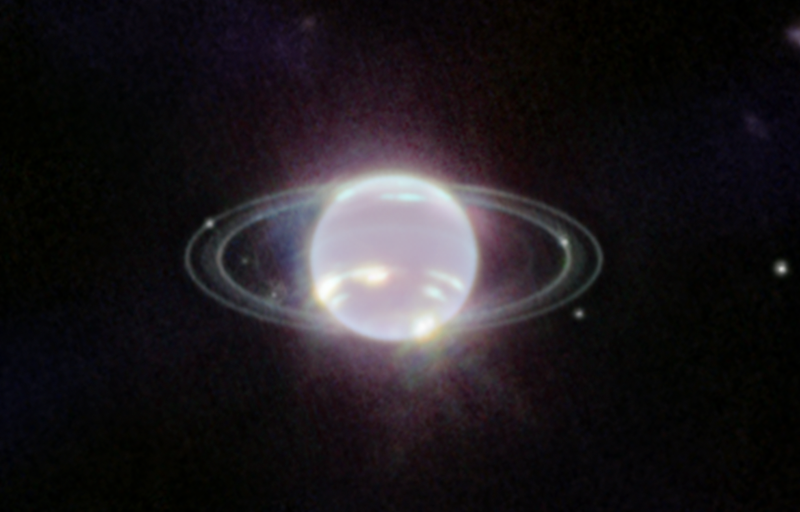
Neptune's inner moons: Hazy-looking planet with rings and several small moons near it.
View larger. | This infrared image from the James Webb Space Telescope, taken on July 12, 2022, shows Neptune, its rings and some of its inner moons. A new study shows that Neptune’s inner moons might have formed through the destruction of a previous family of moons. Image via NASA/ ESA/ CSA/ STScI; Image Processing: Joseph DePasquale (STScI)/ Naomi Rowe-Gurney (NASA-GSFC).
  • How did Neptune’s inner moons form? Scientists have considered various possibilities.
  • A new hypothesis suggests that they formed from the remnants of a previous family of moons. Those moons would have been mostly obliterated when Neptune’s gravity captured Triton, the planet’s largest moon.
  • Two of the studied moons, surprisingly, have rich clay deposits. But the third moon has none. Why?

You deserve a daily dose of good news. For the latest in science and the night sky, subscribe to EarthSky’s free daily newsletter.

Neptune’s inner moons

Neptune has 16 known moons. NASA’s James Webb Space Telescope recently took a closer look at three of the innermost small moons – Larissa, Galatea and Proteus – and found something interesting; they have a unique composition among all the bodies in the solar system.

Having looked into this surprising finding, a team of researchers said on July 29, 2026, that these moons likely formed from the remnants of a former system of moons around Neptune. They believe these moons were destroyed when the planet’s current largest moon, Triton, was captured by Neptune billions of years ago.

Ryleigh Davis, a former Caltech graduate student, now at UC San Diego, is the lead author of a new paper about these moons. She said:

If Neptune once had a system of moons that looked something like what we see at Uranus today [a stable family of multiple moons of different sizes orbiting the planet], we expect it would’ve been completely destroyed by the process of Triton getting captured. This is exciting new evidence that something catastrophic happened at Neptune that completely destroyed its original satellites, and we’re getting to see the fingerprints left behind by that process.

Those former icy moons are all gone now, except maybe for Nereid. Scientists think it might be the sole survivor of that catastrophe.

Davis and her colleagues published their peer-reviewed findings in Science Advances on July 29, 2026.

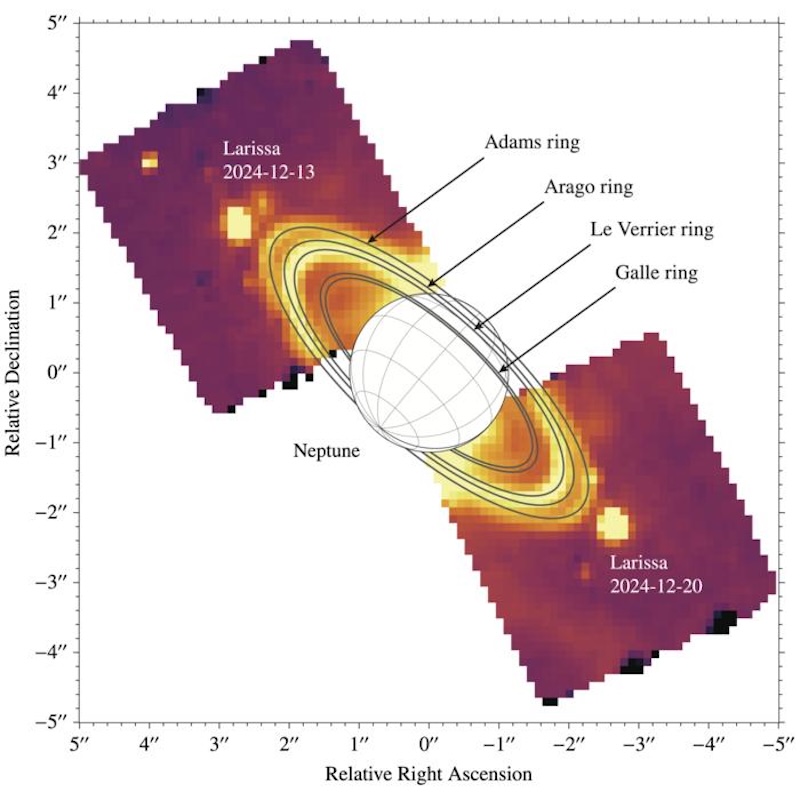
Diagram showing a planet with rings in black and white, with 2 colored squares, 1 on either side, with text labels.
View larger. | Infrared view from the James Webb Space Telescope of the moon Larissa, and Neptune and its rings. Image via Davis et al. 2026; NASA/ ESA/ CSA JWST data/ Caltech.

Clays on Larissa, Galatea and in the rings

The researchers wanted to study Neptune’s inner moons more, to learn more about the planet’s history. There is still much that scientists don’t know about these small, distant worlds.

Astronomers had only recently obtained spectroscopy data for the moons, which tells scientists what kinds of molecules are present.

Surprisingly, they found phyllosilicates, or clays, on the moons, and in Neptune’s rings. It was an unexpected discovery, as Davis noted:

Phyllosilicates had never been detected anywhere in the outer solar system beyond Jupiter, so that was not on our list of things to look for. We were shocked to find the observed clays, which had to come from objects that were much, much bigger than Neptune’s small inner ring moons.

Webb found the signatures of magnesium-rich phyllosilicates (clays). Why was this surprising?

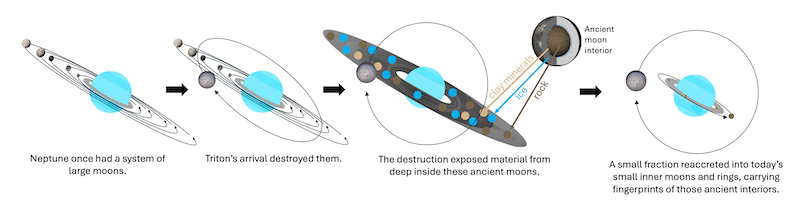
Diagram in 4 parts showing a blue planet with rings and moons, as the moons formed and changed.
View larger. | This diagram depicts how the current inner moons of Neptune formed. The capture of Triton by Neptune destroyed the previous family of moons. The current small moon then formed from their debris. Image via R. Davis/ Caltech (License: original content).

Where did the clays come from?

Clays require water to form. But no water ice was found on any of the moons or in the rings. And it’s way too cold for liquid water. So the moons and rings must have originated from some body or bodies that did have ice. Davis explained:

That’s really surprising because everything out in this part of the solar system is really icy. So, we’re fairly confident that they had to come from deep inside something that was big enough to generate enough heat that it melted its water ice. We think the most likely place would be an original system of icy moons, although it’s a bit of a mystery where the ice may have gone.

Scientist Mike Brown at Caltech added:

It took diligent detective work from Ryleigh before we understood what we were seeing. Sometimes in science you are trying to find evidence to evaluate a specific hypothesis, and, sometimes, something that you had not been thinking about just hits you in the face.

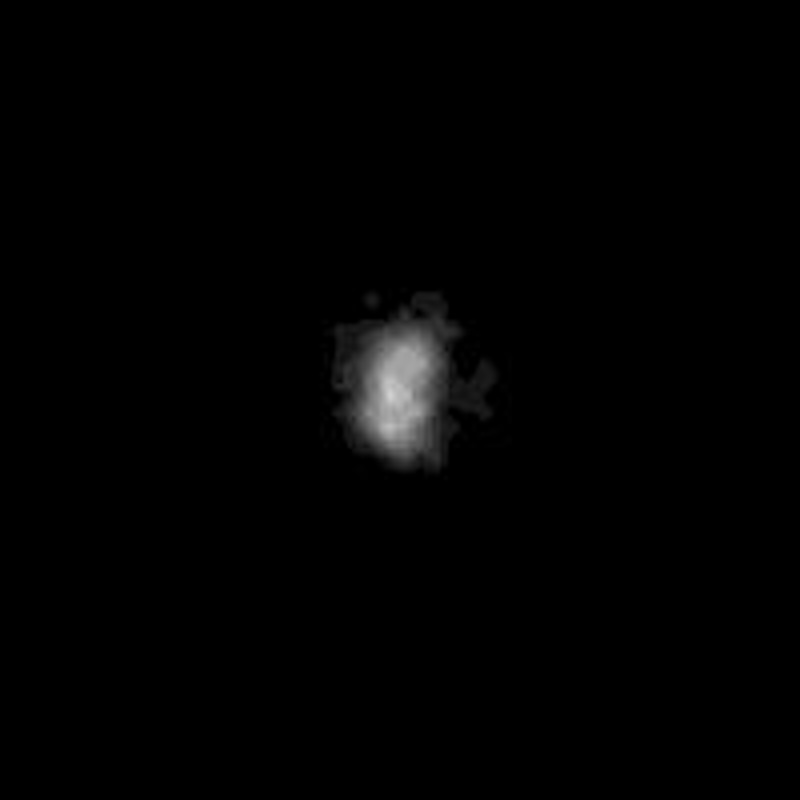
Fuzzy, oblong gray object on black background.
Nereid is the 3rd-largest moon of Neptune. It might be the only original inner moon left that survived the cataclysm caused by Triton. This is still the best image of the moon, captured by Voyager 2 on August 24, 1989. Image via NASA/ Wikimedia Commons.

No clays for Proteus and an unknown mineral

There’s another twist, though. Proteus is the largest of the three small moons. And it doesn’t have the clays on it. Why? It might simply have originated from a part of the former debris where clays were absent. Or, perhaps there were clays originally, but heat destroyed them.

Plus, Webb identified a hydrated mineral that is on all three moons. But scientists don’t know what it is yet. It hasn’t even been seen elsewhere in the solar system. Davis said:

We see something that doesn’t really look like anything else we’ve identified in the solar system; it doesn’t match anything we have in our spectral libraries. We assume it’s some form of hydrated rock from the moons as well, but there’s still a lot of mystery.

This is reminiscent of another recent discovery. Scientists found a mineral that is present on the surfaces of both Pluto and Saturn’s moon Titan. But again, it’s never been seen before anywhere else, until now.

Smiling woman wearing a dark blue blazer and white shirt.
Ryleigh Davis at UC San Diego is the lead author of the new paper about Neptune’s inner moons. Image via GitHub.

A destroyed Kuiper Belt object?

The researchers consider the system of ancient moons to be the most likely scenario to explain the current inner moons of Neptune. But there is another possibility. A larger single object from the Kuiper Belt beyond Neptune, about the size of Pluto, might have passed too close to Neptune. Neptune’s immense gravity would then have shredded the object. Davis said:

Either way, what we’re seeing on these moons had to come from deep inside something much larger. That material is normally permanently buried—we can only infer what’s there. Here, a catastrophic event essentially turned these ancient moons inside out, and we get to see what was hidden inside.

But if Triton did play a role, then it would have had a big effect on how the current moons formed and their behavior. Davis noted:

If you bring Triton in, and you smash up your large moons, we think only 1 percent or so of that material stayed around in the system. But the actual behavior of that material might be really different if Triton is still there shaking things up for a long time. So, looking forward, understanding how that process actually proceeds would be interesting. From there, the question is: ‘Can we learn anything about how big the initial moons had to be to have formed and provided this material?’

Bottom line: A new study suggests that Neptune’s inner moons formed when Neptune captured its largest moon Triton, and a family of original small icy moons was destroyed.

Source: Neptune’s inner moons and rings are exposed icy body interiors

Via Caltech

Read more: Are Uranus and Neptune rock giants and not ice giants?

Read more: New moons! Uranus now has 28 and Neptune 16

The post Were Neptune’s inner moons born from an ancient cataclysm? first appeared on EarthSky.


from EarthSky https://ift.tt/0qQCXIe
Neptune's inner moons: Hazy-looking planet with rings and several small moons near it.
View larger. | This infrared image from the James Webb Space Telescope, taken on July 12, 2022, shows Neptune, its rings and some of its inner moons. A new study shows that Neptune’s inner moons might have formed through the destruction of a previous family of moons. Image via NASA/ ESA/ CSA/ STScI; Image Processing: Joseph DePasquale (STScI)/ Naomi Rowe-Gurney (NASA-GSFC).
  • How did Neptune’s inner moons form? Scientists have considered various possibilities.
  • A new hypothesis suggests that they formed from the remnants of a previous family of moons. Those moons would have been mostly obliterated when Neptune’s gravity captured Triton, the planet’s largest moon.
  • Two of the studied moons, surprisingly, have rich clay deposits. But the third moon has none. Why?

You deserve a daily dose of good news. For the latest in science and the night sky, subscribe to EarthSky’s free daily newsletter.

Neptune’s inner moons

Neptune has 16 known moons. NASA’s James Webb Space Telescope recently took a closer look at three of the innermost small moons – Larissa, Galatea and Proteus – and found something interesting; they have a unique composition among all the bodies in the solar system.

Having looked into this surprising finding, a team of researchers said on July 29, 2026, that these moons likely formed from the remnants of a former system of moons around Neptune. They believe these moons were destroyed when the planet’s current largest moon, Triton, was captured by Neptune billions of years ago.

Ryleigh Davis, a former Caltech graduate student, now at UC San Diego, is the lead author of a new paper about these moons. She said:

If Neptune once had a system of moons that looked something like what we see at Uranus today [a stable family of multiple moons of different sizes orbiting the planet], we expect it would’ve been completely destroyed by the process of Triton getting captured. This is exciting new evidence that something catastrophic happened at Neptune that completely destroyed its original satellites, and we’re getting to see the fingerprints left behind by that process.

Those former icy moons are all gone now, except maybe for Nereid. Scientists think it might be the sole survivor of that catastrophe.

Davis and her colleagues published their peer-reviewed findings in Science Advances on July 29, 2026.

Diagram showing a planet with rings in black and white, with 2 colored squares, 1 on either side, with text labels.
View larger. | Infrared view from the James Webb Space Telescope of the moon Larissa, and Neptune and its rings. Image via Davis et al. 2026; NASA/ ESA/ CSA JWST data/ Caltech.

Clays on Larissa, Galatea and in the rings

The researchers wanted to study Neptune’s inner moons more, to learn more about the planet’s history. There is still much that scientists don’t know about these small, distant worlds.

Astronomers had only recently obtained spectroscopy data for the moons, which tells scientists what kinds of molecules are present.

Surprisingly, they found phyllosilicates, or clays, on the moons, and in Neptune’s rings. It was an unexpected discovery, as Davis noted:

Phyllosilicates had never been detected anywhere in the outer solar system beyond Jupiter, so that was not on our list of things to look for. We were shocked to find the observed clays, which had to come from objects that were much, much bigger than Neptune’s small inner ring moons.

Webb found the signatures of magnesium-rich phyllosilicates (clays). Why was this surprising?

Diagram in 4 parts showing a blue planet with rings and moons, as the moons formed and changed.
View larger. | This diagram depicts how the current inner moons of Neptune formed. The capture of Triton by Neptune destroyed the previous family of moons. The current small moon then formed from their debris. Image via R. Davis/ Caltech (License: original content).

Where did the clays come from?

Clays require water to form. But no water ice was found on any of the moons or in the rings. And it’s way too cold for liquid water. So the moons and rings must have originated from some body or bodies that did have ice. Davis explained:

That’s really surprising because everything out in this part of the solar system is really icy. So, we’re fairly confident that they had to come from deep inside something that was big enough to generate enough heat that it melted its water ice. We think the most likely place would be an original system of icy moons, although it’s a bit of a mystery where the ice may have gone.

Scientist Mike Brown at Caltech added:

It took diligent detective work from Ryleigh before we understood what we were seeing. Sometimes in science you are trying to find evidence to evaluate a specific hypothesis, and, sometimes, something that you had not been thinking about just hits you in the face.

Fuzzy, oblong gray object on black background.
Nereid is the 3rd-largest moon of Neptune. It might be the only original inner moon left that survived the cataclysm caused by Triton. This is still the best image of the moon, captured by Voyager 2 on August 24, 1989. Image via NASA/ Wikimedia Commons.

No clays for Proteus and an unknown mineral

There’s another twist, though. Proteus is the largest of the three small moons. And it doesn’t have the clays on it. Why? It might simply have originated from a part of the former debris where clays were absent. Or, perhaps there were clays originally, but heat destroyed them.

Plus, Webb identified a hydrated mineral that is on all three moons. But scientists don’t know what it is yet. It hasn’t even been seen elsewhere in the solar system. Davis said:

We see something that doesn’t really look like anything else we’ve identified in the solar system; it doesn’t match anything we have in our spectral libraries. We assume it’s some form of hydrated rock from the moons as well, but there’s still a lot of mystery.

This is reminiscent of another recent discovery. Scientists found a mineral that is present on the surfaces of both Pluto and Saturn’s moon Titan. But again, it’s never been seen before anywhere else, until now.

Smiling woman wearing a dark blue blazer and white shirt.
Ryleigh Davis at UC San Diego is the lead author of the new paper about Neptune’s inner moons. Image via GitHub.

A destroyed Kuiper Belt object?

The researchers consider the system of ancient moons to be the most likely scenario to explain the current inner moons of Neptune. But there is another possibility. A larger single object from the Kuiper Belt beyond Neptune, about the size of Pluto, might have passed too close to Neptune. Neptune’s immense gravity would then have shredded the object. Davis said:

Either way, what we’re seeing on these moons had to come from deep inside something much larger. That material is normally permanently buried—we can only infer what’s there. Here, a catastrophic event essentially turned these ancient moons inside out, and we get to see what was hidden inside.

But if Triton did play a role, then it would have had a big effect on how the current moons formed and their behavior. Davis noted:

If you bring Triton in, and you smash up your large moons, we think only 1 percent or so of that material stayed around in the system. But the actual behavior of that material might be really different if Triton is still there shaking things up for a long time. So, looking forward, understanding how that process actually proceeds would be interesting. From there, the question is: ‘Can we learn anything about how big the initial moons had to be to have formed and provided this material?’

Bottom line: A new study suggests that Neptune’s inner moons formed when Neptune captured its largest moon Triton, and a family of original small icy moons was destroyed.

Source: Neptune’s inner moons and rings are exposed icy body interiors

Via Caltech

Read more: Are Uranus and Neptune rock giants and not ice giants?

Read more: New moons! Uranus now has 28 and Neptune 16

The post Were Neptune’s inner moons born from an ancient cataclysm? first appeared on EarthSky.


from EarthSky https://ift.tt/0qQCXIe

Mars Curiosity rover’s 7 minutes of terror 14 years ago

Science news, night sky events and beautiful photos, all in one place. Click here to subscribe to EarthSky’s free daily newsletter.

14 years ago on August 5: A nail-biter of a Mars landing

On August 5, 2012, NASA achieved one of the most challenging feats in planetary exploration: landing the Curiosity rover safely on Mars. The rover was not just another spacecraft reaching the red planet — it was a 1-ton (900 kg) mobile laboratory that needed a completely new landing system to reach the surface.

After entering Mars’ atmosphere at around 13,000 miles per hour (about 21,000 kph), Curiosity had only seven minutes to slow down, navigate through the thin Mars atmosphere, deploy a parachute and be lowered gently to the ground by a rocket-powered “sky crane.” Engineers couldn’t control the landing in real time; they could only wait for the signals to arrive from Mars.

Those seven minutes became known as the “seven minutes of terror” — a dramatic name for a sequence in which years of engineering had to work perfectly on another planet.

Getting there is easy, but landing there is not

Years before the landing of Curiosity, in 2003, veteran NASA official Firouz Naderi summed up Mars’ historical significance for space exploration:

Mars is a favorite target.

We – the United States and former USSR – have been going to Mars for 40 years. The first time we flew by a planet, it was Mars. The first time we orbited a planet, it was Mars. And the first time we landed on a planet it was Mars. The first time we roved around the surface of a planet, it was Mars. We go there often.

At that time – around the turn of this century – the world was averaging about two failures for every three spacecraft launched toward Mars, according to NASA. In fact, there were a total of 39 Mars missions launched and 25 failures, or partial failures, by the year 2000, according to Wikipedia.

But then we got better at it. And as the video above shows, Curiosity’s landing used a combination of complicated new technologies, including a new guided entry system and a rocket-powered sky crane that used cables to lower the 1-ton (900 kg) robot rover to the Martian surface.

Mars Curiosity rover is still going strong

Since 2012, Curiosity has been crawling across Mars’ surface and exploring Gale crater. The rover has traveled more than 20 miles (32 km) across Mars. It has learned, among many other things, that Gale crater might once have held a great salty lake.

Read more: Mars rover Curiosity heads for intriguing ‘spiderwebs’

Read more: Martian rock crushed by Curiosity hides a surprise!

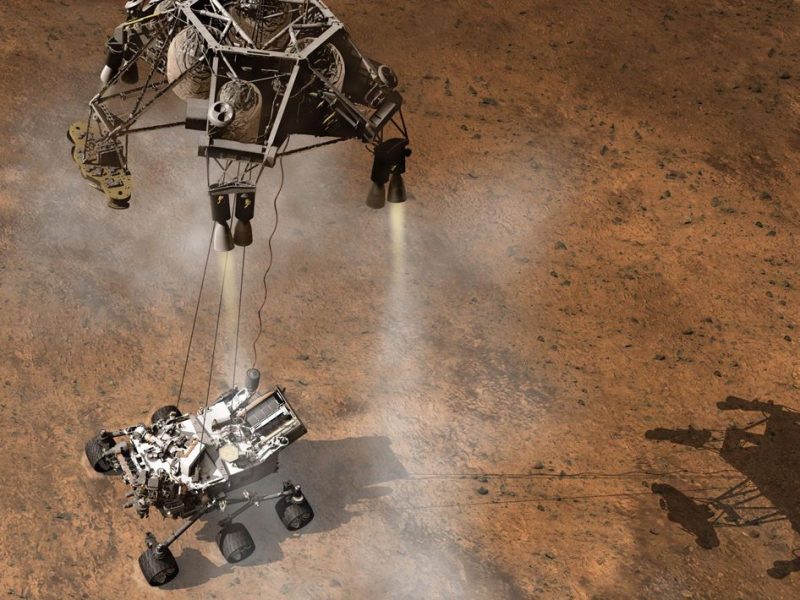
Mars Curiosity: Spacecraft hovering above the surface, firing retrorockets, with cables from the craft lowering the rover.
Artist’s concept of Curiosity rover’s landing on Mars via a “sky crane” and cables. The new rover that arrived at Mars in March 2021 – Perseverance – also landed on Mars via sky crane. Image via NASA.
Dusty 6-wheeled rover looking our way with a camera on a pole, in reddish Martian desert.
Curiosity took this self-portrait on May 11, 2016, at the “Okoruso” drilling site in the foothills of Mount Sharp, the central peak of Gale crater. If Gale crater once held a lake, Mount Sharp might have been an island in the middle of that lake. This self-portrait combines multiple images taken with the rover’s Mars Hand Lens Imager (MAHLI), during the 1,338th Martian day, or sol, of the rover’s work on Mars. Image via NASA.

Perseverance was the next to land

Curiosity was followed to Mars by another robot rover, Perseverance, which launched from Earth on July 30, 2020. Finally, Perseverance touched down on Mars landing in Jezero crater on February 18, 2021. Perseverance is largely the same design as Curiosity. When the $2.4 billion spacecraft carrying it reached Mars, it also hit the atmosphere at high speed (more than 12,000 miles per hour or 19,000 kph) and then came to a complete stop on Mars’ surface seven minutes later. Like Curiosity, it landed via “sky crane,” but with one big difference: the sky crane technology was now tried-and-true.

Still, as with Curiosity, space engineers surely experienced a nail-biting seven minutes, waiting to hear that the Perseverance rover had set down successfully, as gently as it could, on Mars’ surface.

There, it joined the other rovers in the search for life on Mars and an exploration of the planet’s surface, atmosphere and history. Perseverance brought with it a special helicopter named Ingenuity, that explored the Martian surface as well until its mission ended in January 2024.

Why focus so many spacecraft on Mars?

Read more from the NY Times: Too much Mars? This is an interesting discussion between two veteran space journalists about why Mars seems to absorb so much of the oxygen – and budgetary resources – in the rooms where explorations of our solar system are decided.

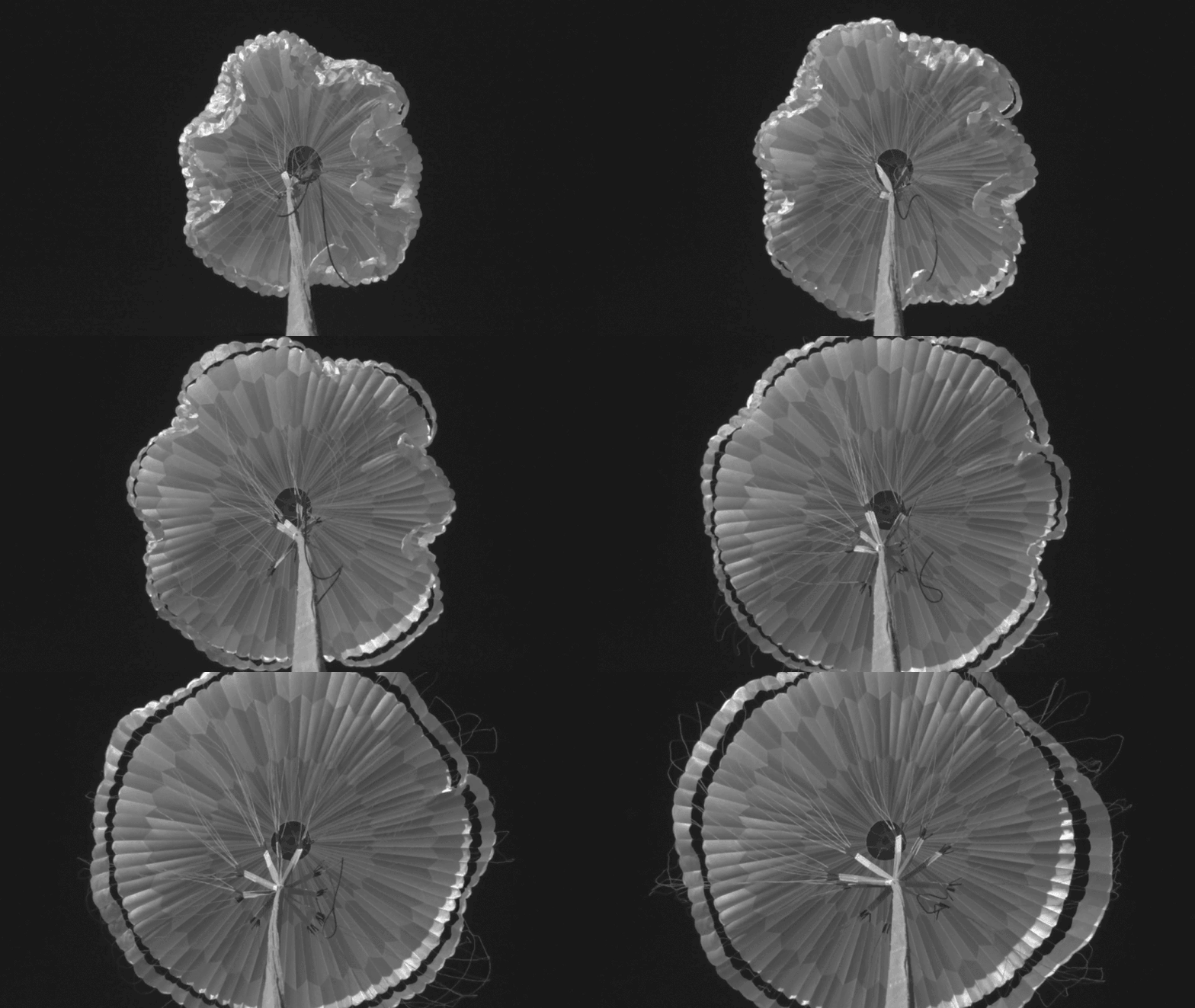
Animated view of a parachute opening, seen from below.
Parachute test for Mars Perseverance rover. The images for this animation were taken on September 7, 2018, during the 3rd and final flight of the Advanced Supersonic Parachute Inflation Research Experiment (ASPIRE) project. Read more about this GIF via NASA/ JPL-Caltech.

Why is landing on Mars so hard? This 2017 video from MinutePhysics does a great job of explaining it:

Bottom line: Watch a NASA video describing the final seven minutes of the Curiosity rover’s chilling descent to the surface of Mars 14 years ago on August 5, 2012.

Read more: Curiosity rover on Mars snags highest-resolution panorama yet

Read more: Mars rover measures key life ingredient

The post Mars Curiosity rover’s 7 minutes of terror 14 years ago first appeared on EarthSky.


from EarthSky https://ift.tt/dWpJ6vY

Science news, night sky events and beautiful photos, all in one place. Click here to subscribe to EarthSky’s free daily newsletter.

14 years ago on August 5: A nail-biter of a Mars landing

On August 5, 2012, NASA achieved one of the most challenging feats in planetary exploration: landing the Curiosity rover safely on Mars. The rover was not just another spacecraft reaching the red planet — it was a 1-ton (900 kg) mobile laboratory that needed a completely new landing system to reach the surface.

After entering Mars’ atmosphere at around 13,000 miles per hour (about 21,000 kph), Curiosity had only seven minutes to slow down, navigate through the thin Mars atmosphere, deploy a parachute and be lowered gently to the ground by a rocket-powered “sky crane.” Engineers couldn’t control the landing in real time; they could only wait for the signals to arrive from Mars.

Those seven minutes became known as the “seven minutes of terror” — a dramatic name for a sequence in which years of engineering had to work perfectly on another planet.

Getting there is easy, but landing there is not

Years before the landing of Curiosity, in 2003, veteran NASA official Firouz Naderi summed up Mars’ historical significance for space exploration:

Mars is a favorite target.

We – the United States and former USSR – have been going to Mars for 40 years. The first time we flew by a planet, it was Mars. The first time we orbited a planet, it was Mars. And the first time we landed on a planet it was Mars. The first time we roved around the surface of a planet, it was Mars. We go there often.

At that time – around the turn of this century – the world was averaging about two failures for every three spacecraft launched toward Mars, according to NASA. In fact, there were a total of 39 Mars missions launched and 25 failures, or partial failures, by the year 2000, according to Wikipedia.

But then we got better at it. And as the video above shows, Curiosity’s landing used a combination of complicated new technologies, including a new guided entry system and a rocket-powered sky crane that used cables to lower the 1-ton (900 kg) robot rover to the Martian surface.

Mars Curiosity rover is still going strong

Since 2012, Curiosity has been crawling across Mars’ surface and exploring Gale crater. The rover has traveled more than 20 miles (32 km) across Mars. It has learned, among many other things, that Gale crater might once have held a great salty lake.

Read more: Mars rover Curiosity heads for intriguing ‘spiderwebs’

Read more: Martian rock crushed by Curiosity hides a surprise!

Mars Curiosity: Spacecraft hovering above the surface, firing retrorockets, with cables from the craft lowering the rover.
Artist’s concept of Curiosity rover’s landing on Mars via a “sky crane” and cables. The new rover that arrived at Mars in March 2021 – Perseverance – also landed on Mars via sky crane. Image via NASA.
Dusty 6-wheeled rover looking our way with a camera on a pole, in reddish Martian desert.
Curiosity took this self-portrait on May 11, 2016, at the “Okoruso” drilling site in the foothills of Mount Sharp, the central peak of Gale crater. If Gale crater once held a lake, Mount Sharp might have been an island in the middle of that lake. This self-portrait combines multiple images taken with the rover’s Mars Hand Lens Imager (MAHLI), during the 1,338th Martian day, or sol, of the rover’s work on Mars. Image via NASA.

Perseverance was the next to land

Curiosity was followed to Mars by another robot rover, Perseverance, which launched from Earth on July 30, 2020. Finally, Perseverance touched down on Mars landing in Jezero crater on February 18, 2021. Perseverance is largely the same design as Curiosity. When the $2.4 billion spacecraft carrying it reached Mars, it also hit the atmosphere at high speed (more than 12,000 miles per hour or 19,000 kph) and then came to a complete stop on Mars’ surface seven minutes later. Like Curiosity, it landed via “sky crane,” but with one big difference: the sky crane technology was now tried-and-true.

Still, as with Curiosity, space engineers surely experienced a nail-biting seven minutes, waiting to hear that the Perseverance rover had set down successfully, as gently as it could, on Mars’ surface.

There, it joined the other rovers in the search for life on Mars and an exploration of the planet’s surface, atmosphere and history. Perseverance brought with it a special helicopter named Ingenuity, that explored the Martian surface as well until its mission ended in January 2024.

Why focus so many spacecraft on Mars?

Read more from the NY Times: Too much Mars? This is an interesting discussion between two veteran space journalists about why Mars seems to absorb so much of the oxygen – and budgetary resources – in the rooms where explorations of our solar system are decided.

Animated view of a parachute opening, seen from below.
Parachute test for Mars Perseverance rover. The images for this animation were taken on September 7, 2018, during the 3rd and final flight of the Advanced Supersonic Parachute Inflation Research Experiment (ASPIRE) project. Read more about this GIF via NASA/ JPL-Caltech.

Why is landing on Mars so hard? This 2017 video from MinutePhysics does a great job of explaining it:

Bottom line: Watch a NASA video describing the final seven minutes of the Curiosity rover’s chilling descent to the surface of Mars 14 years ago on August 5, 2012.

Read more: Curiosity rover on Mars snags highest-resolution panorama yet

Read more: Mars rover measures key life ingredient

The post Mars Curiosity rover’s 7 minutes of terror 14 years ago first appeared on EarthSky.


from EarthSky https://ift.tt/dWpJ6vY

Double star 61 Cygni: Why is it known as the Flying Star?

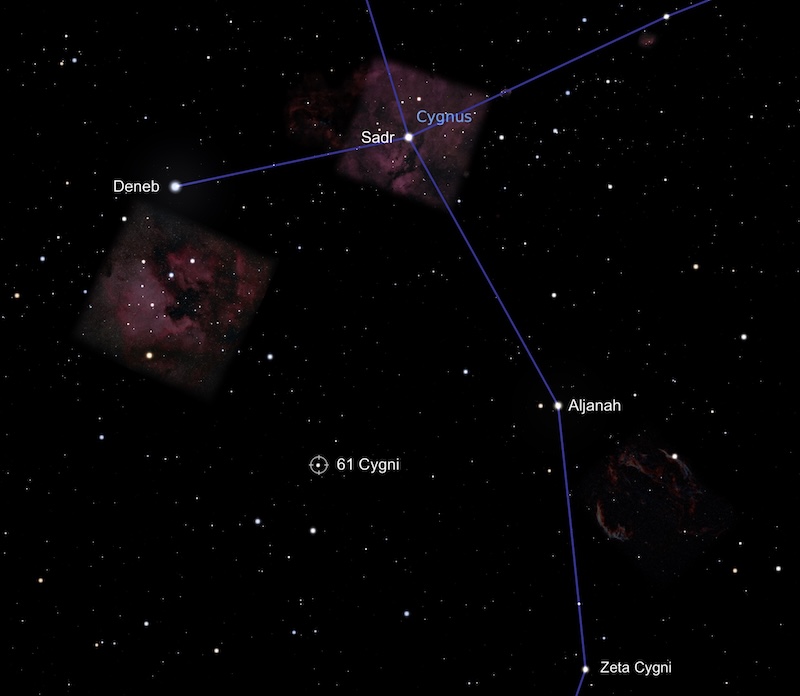
Star chart: Many white stars, several labeled including 61 Cygni, and 2 reddish nebulae.
In this finder chart, 61 Cygni is marked in the crosshairs. If you could imagine Deneb, Sadr and Aljanah as part of a rough rectangle, 61 Cygni would be in the 4th corner. Alternately, you can find Zeta Cygni and draw an imaginary line to Deneb. Then, you would find 61 Cygni about halfway between the 2 stars. But what’s so special about this star? Image via Stellarium. Used with permission.

You deserve a daily dose of good news. For the latest in science and the night sky, subscribe to EarthSky’s free daily newsletter.

They call it the Flying Star

61 Cygni is a double star in the constellation Cygnus the Swan. It’s not a standout star in brightness … so what’s so special about it?


61 Cygni is particularly cool because it has one of the highest proper motions of any visible star. That’s its movement across the dome of our sky.

So if you took photos of 61 Cygni over the course of several years, you’d see it shift position in the sky with respect to the more distant stars around it.

This unusual motion across our sky has earned 61 Cygni the nickname the Flying Star.

61 Cygni has a high proper motion

So why does this star have such a high proper motion? Imagine two people running across your field of view, one closer to you and the other farther away. In relation to the more distant landscape, the person closer to you would appear to cover more ground – more objects would pass behind them – than the person farther away.

In a similar way, very distant stars appear “fixed” in relationship to each other. However, they’re actually moving through space in their various journeys around the center of our Milky Way galaxy. But most are so far away that we can’t easily detect their proper motions. On the other hand, 61 Cygni is different. It moves relatively rapidly in front of the fixed stars because it is relatively near Earth.

While not the closest star to the sun (that honor goes to the Alpha Centauri system), 61 Cygni is just 11.4 light-years distant. That makes it the 4th-closest star that’s visible to the unaided eye, after Alpha Centauri, Sirius and Epsilon Eridani.

Animation showing two close stars very visibly moving against background stars.
In this sequence of images taken from 2012 to 2020, 61 Cygni’s motion can be seen against the backdrop of more distant stars. Image via IndividusObservantis/ Wikimedia Commons.
Complex diagram: Sun, with lines forming an angle toward an object with arrows showing its motion.
The motion of a star in space, from our Earth-bound perspective, can be broken into 2 components. The transverse velocity is its motion across the dome of the sky. That annual motion, measured as an angle, is called proper motion. Radial velocity is the star’s movement either toward or away from us. It’s measured spectroscopically. Image via Brews ohare/ Wikimedia Commons.

Science of 61 Cygni

61 Cygni isn’t just one star. It’s a binary system, with two stars that take about 659 years to orbit one another. To the unaided eye and through most binoculars, it appears as one star. However, if you look at it through a modestly-sized telescope, you’ll see it resolved as two stars. They have apparent magnitudes of 5.21 and 6.03.

The 61 Cygni binary system is the 15th-nearest known star system to us. Both are K-type dwarf stars in the main sequence, thought to have formed 6 billion years ago (the sun, in comparison, is 4.6 billion years old).

The more massive star of the pair has 70% of our sun’s mass and puts out 15% of our sun’s total electromagnetic energy. Its companion has 63% of our sun’s mass and shines at just 8.5% of our sun’s luminosity. Both are a bit over half the size of our sun. They’re also variable stars, exhibiting small changes in brightness over time.

Three spheres: one larger yellow one, two smaller orange ones close together.
Size comparison of our sun (left), 61 Cygni A (lower) and 61 Cygni B (upper right). Image via RJHall/ Wikimedia Commons.

The history of 61 Cygni

61 Cygni has no role in classical mythology. Of course, since it’s barely visible to the eye, it’s not surprising that the ancients apparently left no written reference to it at all. But its role in the history of astronomy is assured.

The motion of 61 Cygni across our sky, while large compared to other stars, can’t be easily detected with the eye alone over the span of a human lifetime. It was with the arrival of telescopes and through meticulous observations that astronomers discovered high proper motions of stars.

Astronomer Giuseppe Piazzi, in 1792, first noticed that 61 Cygni had a high proper motion when he compared his observations to those taken by another astronomer 40 years earlier. By 1804, he had gathered enough information to be the first to publish about this extraordinary star that he nicknamed the Flying Star.

Piazzi correctly noted that this high proper motion indicated that 61 Cygni was a nearby star, and that parallax measurements could be used to figure out its distance. German astronomer F.W. Bessel was the first to get reliable measurements of the 61 Cygni stars’ parallaxes that gave a distance of 10.4 light-years, which is pretty close to the distance we know today, 11.4 light-years. It’s also the first time a star’s distance was reliably measured.

How to see it

61 Cygni is roughly halfway between two other stars that you can probably identify. First is Deneb, the brightest star in the constellation Cygnus the Swan. And the other star is Zeta Cygni, at one end of the Swan’s wing. You’ll find 61 Cygni between these two. Several other similarly dim stars are located nearby, so you’ll need a detailed finder star chart to properly identify 61 Cygni. Take a look at our chart at the top of this post.

61 Cygni’s position is RA: 21h 06m 55s, Dec: +38° 44′ 57″
Proper motion: 4″ in Right Ascension, 3″ in Declination
Parallax: 0.286″

A sparse faint star field with two beautiful yellowish-orange stars, almost equally bright, in the center.
The 61 Cygni binary stars, photographed using a camera attached to a 12-inch telescope. Image via Tom and Jane Wildoner/ Dark Side Observatory. Used with permission.

Bottom line: 61 Cygni, while faint to the unaided eye, is one of the closest stars to Earth. It exhibits a high proper motion – or motion across the sky – compared to other stars.

Read more: Double stars: How to find, observe and enjoy them

The post Double star 61 Cygni: Why is it known as the Flying Star? first appeared on EarthSky.


from EarthSky https://ift.tt/1ht9ZoX
Star chart: Many white stars, several labeled including 61 Cygni, and 2 reddish nebulae.
In this finder chart, 61 Cygni is marked in the crosshairs. If you could imagine Deneb, Sadr and Aljanah as part of a rough rectangle, 61 Cygni would be in the 4th corner. Alternately, you can find Zeta Cygni and draw an imaginary line to Deneb. Then, you would find 61 Cygni about halfway between the 2 stars. But what’s so special about this star? Image via Stellarium. Used with permission.

You deserve a daily dose of good news. For the latest in science and the night sky, subscribe to EarthSky’s free daily newsletter.

They call it the Flying Star

61 Cygni is a double star in the constellation Cygnus the Swan. It’s not a standout star in brightness … so what’s so special about it?

61 Cygni is particularly cool because it has one of the highest proper motions of any visible star. That’s its movement across the dome of our sky.

So if you took photos of 61 Cygni over the course of several years, you’d see it shift position in the sky with respect to the more distant stars around it.

This unusual motion across our sky has earned 61 Cygni the nickname the Flying Star.

61 Cygni has a high proper motion

So why does this star have such a high proper motion? Imagine two people running across your field of view, one closer to you and the other farther away. In relation to the more distant landscape, the person closer to you would appear to cover more ground – more objects would pass behind them – than the person farther away.

In a similar way, very distant stars appear “fixed” in relationship to each other. However, they’re actually moving through space in their various journeys around the center of our Milky Way galaxy. But most are so far away that we can’t easily detect their proper motions. On the other hand, 61 Cygni is different. It moves relatively rapidly in front of the fixed stars because it is relatively near Earth.

While not the closest star to the sun (that honor goes to the Alpha Centauri system), 61 Cygni is just 11.4 light-years distant. That makes it the 4th-closest star that’s visible to the unaided eye, after Alpha Centauri, Sirius and Epsilon Eridani.

Animation showing two close stars very visibly moving against background stars.
In this sequence of images taken from 2012 to 2020, 61 Cygni’s motion can be seen against the backdrop of more distant stars. Image via IndividusObservantis/ Wikimedia Commons.
Complex diagram: Sun, with lines forming an angle toward an object with arrows showing its motion.
The motion of a star in space, from our Earth-bound perspective, can be broken into 2 components. The transverse velocity is its motion across the dome of the sky. That annual motion, measured as an angle, is called proper motion. Radial velocity is the star’s movement either toward or away from us. It’s measured spectroscopically. Image via Brews ohare/ Wikimedia Commons.

Science of 61 Cygni

61 Cygni isn’t just one star. It’s a binary system, with two stars that take about 659 years to orbit one another. To the unaided eye and through most binoculars, it appears as one star. However, if you look at it through a modestly-sized telescope, you’ll see it resolved as two stars. They have apparent magnitudes of 5.21 and 6.03.

The 61 Cygni binary system is the 15th-nearest known star system to us. Both are K-type dwarf stars in the main sequence, thought to have formed 6 billion years ago (the sun, in comparison, is 4.6 billion years old).

The more massive star of the pair has 70% of our sun’s mass and puts out 15% of our sun’s total electromagnetic energy. Its companion has 63% of our sun’s mass and shines at just 8.5% of our sun’s luminosity. Both are a bit over half the size of our sun. They’re also variable stars, exhibiting small changes in brightness over time.

Three spheres: one larger yellow one, two smaller orange ones close together.
Size comparison of our sun (left), 61 Cygni A (lower) and 61 Cygni B (upper right). Image via RJHall/ Wikimedia Commons.

The history of 61 Cygni

61 Cygni has no role in classical mythology. Of course, since it’s barely visible to the eye, it’s not surprising that the ancients apparently left no written reference to it at all. But its role in the history of astronomy is assured.

The motion of 61 Cygni across our sky, while large compared to other stars, can’t be easily detected with the eye alone over the span of a human lifetime. It was with the arrival of telescopes and through meticulous observations that astronomers discovered high proper motions of stars.

Astronomer Giuseppe Piazzi, in 1792, first noticed that 61 Cygni had a high proper motion when he compared his observations to those taken by another astronomer 40 years earlier. By 1804, he had gathered enough information to be the first to publish about this extraordinary star that he nicknamed the Flying Star.

Piazzi correctly noted that this high proper motion indicated that 61 Cygni was a nearby star, and that parallax measurements could be used to figure out its distance. German astronomer F.W. Bessel was the first to get reliable measurements of the 61 Cygni stars’ parallaxes that gave a distance of 10.4 light-years, which is pretty close to the distance we know today, 11.4 light-years. It’s also the first time a star’s distance was reliably measured.

How to see it

61 Cygni is roughly halfway between two other stars that you can probably identify. First is Deneb, the brightest star in the constellation Cygnus the Swan. And the other star is Zeta Cygni, at one end of the Swan’s wing. You’ll find 61 Cygni between these two. Several other similarly dim stars are located nearby, so you’ll need a detailed finder star chart to properly identify 61 Cygni. Take a look at our chart at the top of this post.

61 Cygni’s position is RA: 21h 06m 55s, Dec: +38° 44′ 57″
Proper motion: 4″ in Right Ascension, 3″ in Declination
Parallax: 0.286″

A sparse faint star field with two beautiful yellowish-orange stars, almost equally bright, in the center.
The 61 Cygni binary stars, photographed using a camera attached to a 12-inch telescope. Image via Tom and Jane Wildoner/ Dark Side Observatory. Used with permission.

Bottom line: 61 Cygni, while faint to the unaided eye, is one of the closest stars to Earth. It exhibits a high proper motion – or motion across the sky – compared to other stars.

Read more: Double stars: How to find, observe and enjoy them

The post Double star 61 Cygni: Why is it known as the Flying Star? first appeared on EarthSky.


from EarthSky https://ift.tt/1ht9ZoX

adds 2