14 years ago on August 5: A nail-biter of a Mars landing
On August 5, 2012, NASA achieved one of the most challenging feats in planetary exploration: landing the Curiosity rover safely on Mars. The rover was not just another spacecraft reaching the red planet — it was a 1-ton (900 kg) mobile laboratory that needed a completely new landing system to reach the surface.
After entering Mars’ atmosphere at around 13,000 miles per hour (about 21,000 kph), Curiosity had only seven minutes to slow down, navigate through the thin Mars atmosphere, deploy a parachute and be lowered gently to the ground by a rocket-powered “sky crane.” Engineers couldn’t control the landing in real time; they could only wait for the signals to arrive from Mars.
Those seven minutes became known as the “seven minutes of terror” — a dramatic name for a sequence in which years of engineering had to work perfectly on another planet.
Getting there is easy, but landing there is not
Years before the landing of Curiosity, in 2003, veteran NASA official Firouz Naderi summed up Mars’ historical significance for space exploration:
Mars is a favorite target.
We – the United States and former USSR – have been going to Mars for 40 years. The first time we flew by a planet, it was Mars. The first time we orbited a planet, it was Mars. And the first time we landed on a planet it was Mars. The first time we roved around the surface of a planet, it was Mars. We go there often.
At that time – around the turn of this century – the world was averaging about two failures for every three spacecraft launched toward Mars, according to NASA. In fact, there were a total of 39 Mars missions launched and 25 failures, or partial failures, by the year 2000, according to Wikipedia.
But then we got better at it. And as the video above shows, Curiosity’s landing used a combination of complicated new technologies, including a new guided entry system and a rocket-powered sky crane that used cables to lower the 1-ton (900 kg) robot rover to the Martian surface.
Mars Curiosity rover is still going strong
Since 2012, Curiosity has been crawling across Mars’ surface and exploring Gale crater. The rover has traveled more than 20 miles (32 km) across Mars. It has learned, among many other things, that Gale crater might once have held a great salty lake.
Artist’s concept of Curiosity rover’s landing on Mars via a “sky crane” and cables. The new rover that arrived at Mars in March 2021 – Perseverance – also landed on Mars via sky crane. Image via NASA.Curiosity took this self-portrait on May 11, 2016, at the “Okoruso” drilling site in the foothills of Mount Sharp, the central peak of Gale crater. If Gale crater once held a lake, Mount Sharp might have been an island in the middle of that lake. This self-portrait combines multiple images taken with the rover’s Mars Hand Lens Imager (MAHLI), during the 1,338th Martian day, or sol, of the rover’s work on Mars. Image via NASA.
Perseverance was the next to land
Curiosity was followed to Mars by another robot rover, Perseverance, which launched from Earth on July 30, 2020. Finally, Perseverance touched down on Mars landing in Jezero crater on February 18, 2021. Perseverance is largely the same design as Curiosity. When the $2.4 billion spacecraft carrying it reached Mars, it also hit the atmosphere at high speed (more than 12,000 miles per hour or 19,000 kph) and then came to a complete stop on Mars’ surface seven minutes later. Like Curiosity, it landed via “sky crane,” but with one big difference: the sky crane technology was now tried-and-true.
Still, as with Curiosity, space engineers surely experienced a nail-biting seven minutes, waiting to hear that the Perseverance rover had set down successfully, as gently as it could, on Mars’ surface.
There, it joined the other rovers in the search for life on Mars and an exploration of the planet’s surface, atmosphere and history. Perseverance brought with it a special helicopter named Ingenuity, that explored the Martian surface as well until its mission ended in January 2024.
Why focus so many spacecraft on Mars?
Read more from the NY Times: Too much Mars? This is an interesting discussion between two veteran space journalists about why Mars seems to absorb so much of the oxygen – and budgetary resources – in the rooms where explorations of our solar system are decided.
Parachute test for Mars Perseverance rover. The images for this animation were taken on September 7, 2018, during the 3rd and final flight of the Advanced Supersonic Parachute Inflation Research Experiment (ASPIRE) project. Read more about this GIF via NASA/ JPL-Caltech.
Why is landing on Mars so hard? This 2017 video from MinutePhysics does a great job of explaining it:
Bottom line: Watch a NASA video describing the final seven minutes of the Curiosity rover’s chilling descent to the surface of Mars 14 years ago on August 5, 2012.
14 years ago on August 5: A nail-biter of a Mars landing
On August 5, 2012, NASA achieved one of the most challenging feats in planetary exploration: landing the Curiosity rover safely on Mars. The rover was not just another spacecraft reaching the red planet — it was a 1-ton (900 kg) mobile laboratory that needed a completely new landing system to reach the surface.
After entering Mars’ atmosphere at around 13,000 miles per hour (about 21,000 kph), Curiosity had only seven minutes to slow down, navigate through the thin Mars atmosphere, deploy a parachute and be lowered gently to the ground by a rocket-powered “sky crane.” Engineers couldn’t control the landing in real time; they could only wait for the signals to arrive from Mars.
Those seven minutes became known as the “seven minutes of terror” — a dramatic name for a sequence in which years of engineering had to work perfectly on another planet.
Getting there is easy, but landing there is not
Years before the landing of Curiosity, in 2003, veteran NASA official Firouz Naderi summed up Mars’ historical significance for space exploration:
Mars is a favorite target.
We – the United States and former USSR – have been going to Mars for 40 years. The first time we flew by a planet, it was Mars. The first time we orbited a planet, it was Mars. And the first time we landed on a planet it was Mars. The first time we roved around the surface of a planet, it was Mars. We go there often.
At that time – around the turn of this century – the world was averaging about two failures for every three spacecraft launched toward Mars, according to NASA. In fact, there were a total of 39 Mars missions launched and 25 failures, or partial failures, by the year 2000, according to Wikipedia.
But then we got better at it. And as the video above shows, Curiosity’s landing used a combination of complicated new technologies, including a new guided entry system and a rocket-powered sky crane that used cables to lower the 1-ton (900 kg) robot rover to the Martian surface.
Mars Curiosity rover is still going strong
Since 2012, Curiosity has been crawling across Mars’ surface and exploring Gale crater. The rover has traveled more than 20 miles (32 km) across Mars. It has learned, among many other things, that Gale crater might once have held a great salty lake.
Artist’s concept of Curiosity rover’s landing on Mars via a “sky crane” and cables. The new rover that arrived at Mars in March 2021 – Perseverance – also landed on Mars via sky crane. Image via NASA.Curiosity took this self-portrait on May 11, 2016, at the “Okoruso” drilling site in the foothills of Mount Sharp, the central peak of Gale crater. If Gale crater once held a lake, Mount Sharp might have been an island in the middle of that lake. This self-portrait combines multiple images taken with the rover’s Mars Hand Lens Imager (MAHLI), during the 1,338th Martian day, or sol, of the rover’s work on Mars. Image via NASA.
Perseverance was the next to land
Curiosity was followed to Mars by another robot rover, Perseverance, which launched from Earth on July 30, 2020. Finally, Perseverance touched down on Mars landing in Jezero crater on February 18, 2021. Perseverance is largely the same design as Curiosity. When the $2.4 billion spacecraft carrying it reached Mars, it also hit the atmosphere at high speed (more than 12,000 miles per hour or 19,000 kph) and then came to a complete stop on Mars’ surface seven minutes later. Like Curiosity, it landed via “sky crane,” but with one big difference: the sky crane technology was now tried-and-true.
Still, as with Curiosity, space engineers surely experienced a nail-biting seven minutes, waiting to hear that the Perseverance rover had set down successfully, as gently as it could, on Mars’ surface.
There, it joined the other rovers in the search for life on Mars and an exploration of the planet’s surface, atmosphere and history. Perseverance brought with it a special helicopter named Ingenuity, that explored the Martian surface as well until its mission ended in January 2024.
Why focus so many spacecraft on Mars?
Read more from the NY Times: Too much Mars? This is an interesting discussion between two veteran space journalists about why Mars seems to absorb so much of the oxygen – and budgetary resources – in the rooms where explorations of our solar system are decided.
Parachute test for Mars Perseverance rover. The images for this animation were taken on September 7, 2018, during the 3rd and final flight of the Advanced Supersonic Parachute Inflation Research Experiment (ASPIRE) project. Read more about this GIF via NASA/ JPL-Caltech.
Why is landing on Mars so hard? This 2017 video from MinutePhysics does a great job of explaining it:
Bottom line: Watch a NASA video describing the final seven minutes of the Curiosity rover’s chilling descent to the surface of Mars 14 years ago on August 5, 2012.
In this finder chart, 61 Cygni is marked in the crosshairs. If you could imagine Deneb, Sadr and Aljanah as part of a rough rectangle, 61 Cygni would be in the 4th corner. Alternately, you can find Zeta Cygni and draw an imaginary line to Deneb. Then, you would find 61 Cygni about halfway between the 2 stars. But what’s so special about this star? Image via Stellarium. Used with permission.
61 Cygni is a double star in the constellation Cygnus the Swan. It’s not a standout star in brightness … so what’s so special about it?
61 Cygni is particularly cool because it has one of the highest proper motions of any visible star. That’s its movement across the dome of our sky.
So if you took photos of 61 Cygni over the course of several years, you’d see it shift position in the sky with respect to the more distant stars around it.
This unusual motion across our sky has earned 61 Cygni the nickname the Flying Star.
Two images showing the apparent motion of the double star 61 Cygni over nearly ten years. pic.twitter.com/h1K46FOWVF
— Dave Eagle ? Keep Looking Up. (@Dave_StarGeezer) April 19, 2025
61 Cygni has a high proper motion
So why does this star have such a high proper motion? Imagine two people running across your field of view, one closer to you and the other farther away. In relation to the more distant landscape, the person closer to you would appear to cover more ground – more objects would pass behind them – than the person farther away.
In a similar way, very distant stars appear “fixed” in relationship to each other. However, they’re actually moving through space in their various journeys around the center of our Milky Way galaxy. But most are so far away that we can’t easily detect their proper motions. On the other hand, 61 Cygni is different. It moves relatively rapidly in front of the fixed stars because it is relatively near Earth.
While not the closest star to the sun (that honor goes to the Alpha Centauri system), 61 Cygni is just 11.4 light-years distant. That makes it the 4th-closest star that’s visible to the unaided eye, after Alpha Centauri, Sirius and Epsilon Eridani.
In this sequence of images taken from 2012 to 2020, 61 Cygni’s motion can be seen against the backdrop of more distant stars. Image via IndividusObservantis/ Wikimedia Commons.The motion of a star in space, from our Earth-bound perspective, can be broken into 2 components. The transverse velocity is its motion across the dome of the sky. That annual motion, measured as an angle, is called proper motion. Radial velocity is the star’s movement either toward or away from us. It’s measured spectroscopically. Image via Brews ohare/ Wikimedia Commons.
Science of 61 Cygni
61 Cygni isn’t just one star. It’s a binary system, with two stars that take about 659 years to orbit one another. To the unaided eye and through most binoculars, it appears as one star. However, if you look at it through a modestly-sized telescope, you’ll see it resolved as two stars. They have apparent magnitudes of 5.21 and 6.03.
The 61 Cygni binary system is the 15th-nearest known star system to us. Both are K-type dwarf stars in the main sequence, thought to have formed 6 billion years ago (the sun, in comparison, is 4.6 billion years old).
The more massive star of the pair has 70% of our sun’s mass and puts out 15% of our sun’s total electromagnetic energy. Its companion has 63% of our sun’s mass and shines at just 8.5% of our sun’s luminosity. Both are a bit over half the size of our sun. They’re also variable stars, exhibiting small changes in brightness over time.
Size comparison of our sun (left), 61 Cygni A (lower) and 61 Cygni B (upper right). Image via RJHall/ Wikimedia Commons.
The history of 61 Cygni
61 Cygni has no role in classical mythology. Of course, since it’s barely visible to the eye, it’s not surprising that the ancients apparently left no written reference to it at all. But its role in the history of astronomy is assured.
The motion of 61 Cygni across our sky, while large compared to other stars, can’t be easily detected with the eye alone over the span of a human lifetime. It was with the arrival of telescopes and through meticulous observations that astronomers discovered high proper motions of stars.
Astronomer Giuseppe Piazzi, in 1792, first noticed that 61 Cygni had a high proper motion when he compared his observations to those taken by another astronomer 40 years earlier. By 1804, he had gathered enough information to be the first to publish about this extraordinary star that he nicknamed the Flying Star.
Piazzi correctly noted that this high proper motion indicated that 61 Cygni was a nearby star, and that parallax measurements could be used to figure out its distance. German astronomer F.W. Bessel was the first to get reliable measurements of the 61 Cygni stars’ parallaxes that gave a distance of 10.4 light-years, which is pretty close to the distance we know today, 11.4 light-years. It’s also the first time a star’s distance was reliably measured.
How to see it
61 Cygni is roughly halfway between two other stars that you can probably identify. First is Deneb, the brightest star in the constellation Cygnus the Swan. And the other star is Zeta Cygni, at one end of the Swan’s wing. You’ll find 61 Cygni between these two. Several other similarly dim stars are located nearby, so you’ll need a detailed finder star chart to properly identify 61 Cygni. Take a look at our chart at the top of this post.
61 Cygni’s position is RA: 21h 06m 55s, Dec: +38° 44′ 57″
Proper motion: 4″ in Right Ascension, 3″ in Declination
Parallax: 0.286″
Bottom line: 61 Cygni, while faint to the unaided eye, is one of the closest stars to Earth. It exhibits a high proper motion – or motion across the sky – compared to other stars.
In this finder chart, 61 Cygni is marked in the crosshairs. If you could imagine Deneb, Sadr and Aljanah as part of a rough rectangle, 61 Cygni would be in the 4th corner. Alternately, you can find Zeta Cygni and draw an imaginary line to Deneb. Then, you would find 61 Cygni about halfway between the 2 stars. But what’s so special about this star? Image via Stellarium. Used with permission.
61 Cygni is a double star in the constellation Cygnus the Swan. It’s not a standout star in brightness … so what’s so special about it?
61 Cygni is particularly cool because it has one of the highest proper motions of any visible star. That’s its movement across the dome of our sky.
So if you took photos of 61 Cygni over the course of several years, you’d see it shift position in the sky with respect to the more distant stars around it.
This unusual motion across our sky has earned 61 Cygni the nickname the Flying Star.
Two images showing the apparent motion of the double star 61 Cygni over nearly ten years. pic.twitter.com/h1K46FOWVF
— Dave Eagle ? Keep Looking Up. (@Dave_StarGeezer) April 19, 2025
61 Cygni has a high proper motion
So why does this star have such a high proper motion? Imagine two people running across your field of view, one closer to you and the other farther away. In relation to the more distant landscape, the person closer to you would appear to cover more ground – more objects would pass behind them – than the person farther away.
In a similar way, very distant stars appear “fixed” in relationship to each other. However, they’re actually moving through space in their various journeys around the center of our Milky Way galaxy. But most are so far away that we can’t easily detect their proper motions. On the other hand, 61 Cygni is different. It moves relatively rapidly in front of the fixed stars because it is relatively near Earth.
While not the closest star to the sun (that honor goes to the Alpha Centauri system), 61 Cygni is just 11.4 light-years distant. That makes it the 4th-closest star that’s visible to the unaided eye, after Alpha Centauri, Sirius and Epsilon Eridani.
In this sequence of images taken from 2012 to 2020, 61 Cygni’s motion can be seen against the backdrop of more distant stars. Image via IndividusObservantis/ Wikimedia Commons.The motion of a star in space, from our Earth-bound perspective, can be broken into 2 components. The transverse velocity is its motion across the dome of the sky. That annual motion, measured as an angle, is called proper motion. Radial velocity is the star’s movement either toward or away from us. It’s measured spectroscopically. Image via Brews ohare/ Wikimedia Commons.
Science of 61 Cygni
61 Cygni isn’t just one star. It’s a binary system, with two stars that take about 659 years to orbit one another. To the unaided eye and through most binoculars, it appears as one star. However, if you look at it through a modestly-sized telescope, you’ll see it resolved as two stars. They have apparent magnitudes of 5.21 and 6.03.
The 61 Cygni binary system is the 15th-nearest known star system to us. Both are K-type dwarf stars in the main sequence, thought to have formed 6 billion years ago (the sun, in comparison, is 4.6 billion years old).
The more massive star of the pair has 70% of our sun’s mass and puts out 15% of our sun’s total electromagnetic energy. Its companion has 63% of our sun’s mass and shines at just 8.5% of our sun’s luminosity. Both are a bit over half the size of our sun. They’re also variable stars, exhibiting small changes in brightness over time.
Size comparison of our sun (left), 61 Cygni A (lower) and 61 Cygni B (upper right). Image via RJHall/ Wikimedia Commons.
The history of 61 Cygni
61 Cygni has no role in classical mythology. Of course, since it’s barely visible to the eye, it’s not surprising that the ancients apparently left no written reference to it at all. But its role in the history of astronomy is assured.
The motion of 61 Cygni across our sky, while large compared to other stars, can’t be easily detected with the eye alone over the span of a human lifetime. It was with the arrival of telescopes and through meticulous observations that astronomers discovered high proper motions of stars.
Astronomer Giuseppe Piazzi, in 1792, first noticed that 61 Cygni had a high proper motion when he compared his observations to those taken by another astronomer 40 years earlier. By 1804, he had gathered enough information to be the first to publish about this extraordinary star that he nicknamed the Flying Star.
Piazzi correctly noted that this high proper motion indicated that 61 Cygni was a nearby star, and that parallax measurements could be used to figure out its distance. German astronomer F.W. Bessel was the first to get reliable measurements of the 61 Cygni stars’ parallaxes that gave a distance of 10.4 light-years, which is pretty close to the distance we know today, 11.4 light-years. It’s also the first time a star’s distance was reliably measured.
How to see it
61 Cygni is roughly halfway between two other stars that you can probably identify. First is Deneb, the brightest star in the constellation Cygnus the Swan. And the other star is Zeta Cygni, at one end of the Swan’s wing. You’ll find 61 Cygni between these two. Several other similarly dim stars are located nearby, so you’ll need a detailed finder star chart to properly identify 61 Cygni. Take a look at our chart at the top of this post.
61 Cygni’s position is RA: 21h 06m 55s, Dec: +38° 44′ 57″
Proper motion: 4″ in Right Ascension, 3″ in Declination
Parallax: 0.286″
Bottom line: 61 Cygni, while faint to the unaided eye, is one of the closest stars to Earth. It exhibits a high proper motion – or motion across the sky – compared to other stars.
Venus rings! On the right, an unpolarized view of the cloud tops of Venus on the left (a) shows a smooth, regular brightness. On the left, a view in polarized light (b) reveals a set of planet-circling concentric rings – really, atmospheric ripples – in the dense, high atmosphere. Image via Gourav Mahapatra/The Planetary Science Journal
A group of Dutch astrophysicists has stumbled across a set of giant “rings” on Venus. They’re not solid planetary rings (like Saturn’s), but planet-circling concentric banding, hidden high in the atmosphere of Venus. And they’re not visible to the eye, but can be seen in polarized light, which blocks some scattered light and enhances subtle patterns. They are waves/ ripples in Venus’ atmosphere, but very ring-like! The group discovered them while taking a 2nd look at images of Venus captured in 2010 by the William Herschel Telescope.
The rings appear to be the result of differences in gas density above the cloud tops. A simulation of Venus’ atmosphere created for the study shows gravity waves could be driving the phenomenon. The same kind of gravity waves create the broad, expanding rings that spread across a pond after you toss in a stone. And gravity waves help shape weather and climate patterns on Earth.
The announcement of rings in Venus’ atmosphere is recent, but the data was collected in 2010. The authors said they captured the images while waiting for the sky to darken enough to continue their hunt for exoplanets:
The Venus images we present here are truly serendipitous. They were captured [using] the 4.2-meter William Herschel Telescope … during a period of about 36 minutes in which we were waiting for the end of the astronomical evening twilight on May 24, 2010. [We were waiting] to start observations of circumstellar disks [around exoplanets].
The Extreme Polarimeter (ExPo) was an instrument designed to detect circumstellar disks of gas and debris around distant stars. Signs of exoplanets are often hidden within these disks. ExPo has since been decommissioned and disassembled.
The giant rings on Venus are centered on a region downwind of the planet’s subsolar point, the continuously moving spot on Venus’ surface from which the sun appears directly overhead (at the zenith). The subsolar point on Venus moves slowly, as the planet takes 117 Earth days to complete one rotation.
Images captured through 6 different polarization filters by the William Herschel Telescope on the Canary Islands revealed a previously unknown set of rings in the planet’s atmosphere. Image via Gourav Mahapatra/The Planetary Science Journal
Images of Venus rings are one-of-a-kind
At first, because they’re almost centered on the brightest point on the planet’s disk, the researchers thought the giant rings on Venus might be an artifact of the ExPo detector. But the tool for measuring the polarization of light waves was designed to avoid such errors. Six different kinds of filters were used to create six sets of images, and the rings only showed up in three of them.
The science team had no other explanation: the rings are really there. And these are the only pictures of them ever taken.
The images from ExPo were captured under the extremely dark skies above the Canary Islands off the coast of Africa during a night of exceptionally clear skies. Unfortunately, the paper explains why that’s not the only reason other images of the rings can’t be taken with ExPo on the Magellan Telescope:
We have no other images of Venus with rings, as we did not have other opportunities to observe Venus under such advantageous seeing conditions and, due to the experimental nature of ExPo, the instrument has been taken apart and its optical components reused for other experiments. To the best of our knowledge, there are no other polarimeters available that combine imaging with ExPo’s high polarimetric sensitivity.
Upcoming mission to Venus to help explain ring mystery
The researchers, of course, want more observations to deepen our understanding of how and why these Venus rings form. They want both ground-based imagery, as well as measurements taken by space-based telescopes.
They might get an extremely close look from ESA’s EnVision mission. It includes plans to carry a high-resolution polarimeter into orbit around Venus. Launch is scheduled for 2032.
But who knows? The rings might not be there when the orbiter arrives. No one knows how often this atmospheric ring feature forms or how long it lasts.
And, despite not finding an error in the way ExPo collected the data, it’s still possible the rings are a false signal. While it looks like a newly discovered weather pattern, there isn’t enough information to be sure. The researchers said:
Moreover, ExPo was an experimental instrument that was not later reinstalled in an identical configuration and has since been dismantled. For these reasons, the present observations cannot by themselves establish a definitive detection of a new Venusian atmospheric phenomenon and should instead be viewed as a candidate signal that requires independent confirmation.
Still, what we see in the first ring images is enough to let the team speculate about how the rings came to be:
If the observed pattern is astrophysical rather than instrumental, one plausible explanation is spatial variation in the gas density above the hazes and clouds. Such planet-wide density variations could result from atmospheric waves emanating from the region close to the subsolar point. …
Bottom line: New analysis of images taken in 2010 reveal giant Venus rings. The rings are high in the Venus atmosphere. They are ripples in the atmosphere, not solid particles.
Venus rings! On the right, an unpolarized view of the cloud tops of Venus on the left (a) shows a smooth, regular brightness. On the left, a view in polarized light (b) reveals a set of planet-circling concentric rings – really, atmospheric ripples – in the dense, high atmosphere. Image via Gourav Mahapatra/The Planetary Science Journal
A group of Dutch astrophysicists has stumbled across a set of giant “rings” on Venus. They’re not solid planetary rings (like Saturn’s), but planet-circling concentric banding, hidden high in the atmosphere of Venus. And they’re not visible to the eye, but can be seen in polarized light, which blocks some scattered light and enhances subtle patterns. They are waves/ ripples in Venus’ atmosphere, but very ring-like! The group discovered them while taking a 2nd look at images of Venus captured in 2010 by the William Herschel Telescope.
The rings appear to be the result of differences in gas density above the cloud tops. A simulation of Venus’ atmosphere created for the study shows gravity waves could be driving the phenomenon. The same kind of gravity waves create the broad, expanding rings that spread across a pond after you toss in a stone. And gravity waves help shape weather and climate patterns on Earth.
The announcement of rings in Venus’ atmosphere is recent, but the data was collected in 2010. The authors said they captured the images while waiting for the sky to darken enough to continue their hunt for exoplanets:
The Venus images we present here are truly serendipitous. They were captured [using] the 4.2-meter William Herschel Telescope … during a period of about 36 minutes in which we were waiting for the end of the astronomical evening twilight on May 24, 2010. [We were waiting] to start observations of circumstellar disks [around exoplanets].
The Extreme Polarimeter (ExPo) was an instrument designed to detect circumstellar disks of gas and debris around distant stars. Signs of exoplanets are often hidden within these disks. ExPo has since been decommissioned and disassembled.
The giant rings on Venus are centered on a region downwind of the planet’s subsolar point, the continuously moving spot on Venus’ surface from which the sun appears directly overhead (at the zenith). The subsolar point on Venus moves slowly, as the planet takes 117 Earth days to complete one rotation.
Images captured through 6 different polarization filters by the William Herschel Telescope on the Canary Islands revealed a previously unknown set of rings in the planet’s atmosphere. Image via Gourav Mahapatra/The Planetary Science Journal
Images of Venus rings are one-of-a-kind
At first, because they’re almost centered on the brightest point on the planet’s disk, the researchers thought the giant rings on Venus might be an artifact of the ExPo detector. But the tool for measuring the polarization of light waves was designed to avoid such errors. Six different kinds of filters were used to create six sets of images, and the rings only showed up in three of them.
The science team had no other explanation: the rings are really there. And these are the only pictures of them ever taken.
The images from ExPo were captured under the extremely dark skies above the Canary Islands off the coast of Africa during a night of exceptionally clear skies. Unfortunately, the paper explains why that’s not the only reason other images of the rings can’t be taken with ExPo on the Magellan Telescope:
We have no other images of Venus with rings, as we did not have other opportunities to observe Venus under such advantageous seeing conditions and, due to the experimental nature of ExPo, the instrument has been taken apart and its optical components reused for other experiments. To the best of our knowledge, there are no other polarimeters available that combine imaging with ExPo’s high polarimetric sensitivity.
Upcoming mission to Venus to help explain ring mystery
The researchers, of course, want more observations to deepen our understanding of how and why these Venus rings form. They want both ground-based imagery, as well as measurements taken by space-based telescopes.
They might get an extremely close look from ESA’s EnVision mission. It includes plans to carry a high-resolution polarimeter into orbit around Venus. Launch is scheduled for 2032.
But who knows? The rings might not be there when the orbiter arrives. No one knows how often this atmospheric ring feature forms or how long it lasts.
And, despite not finding an error in the way ExPo collected the data, it’s still possible the rings are a false signal. While it looks like a newly discovered weather pattern, there isn’t enough information to be sure. The researchers said:
Moreover, ExPo was an experimental instrument that was not later reinstalled in an identical configuration and has since been dismantled. For these reasons, the present observations cannot by themselves establish a definitive detection of a new Venusian atmospheric phenomenon and should instead be viewed as a candidate signal that requires independent confirmation.
Still, what we see in the first ring images is enough to let the team speculate about how the rings came to be:
If the observed pattern is astrophysical rather than instrumental, one plausible explanation is spatial variation in the gas density above the hazes and clouds. Such planet-wide density variations could result from atmospheric waves emanating from the region close to the subsolar point. …
Bottom line: New analysis of images taken in 2010 reveal giant Venus rings. The rings are high in the Venus atmosphere. They are ripples in the atmosphere, not solid particles.
Almost everything about outer space is amazing, from what we might find on Earth’s moon to the visible boundary of our universe … it can all leave you scratching your head. Here are nine truly mind-blowing facts about our Earth, sun, solar system and universe. Enjoy … and share (you’ll be a hit at your next dinner party).
1. There might be dinosaur fossils on the moon
Some 65 million years ago, an asteroid hurtled toward Earth. When it hit, it triggered a mass extinction, ending the rein of the dinosaurs. At that time, dinosaurs had already been around for some 200 million years. So, many generations had already died and their bones had become fossilized in earthly rocks.
And, when the dinosaur-killing asteroid hit Earth, it impacted so violently that some of the rocks jettisoned from the impact flew into space. And it’s possible some of those rocks with fossilized dinosaurs might have ultimately ended up on the moon, colliding with it in much the same way a SpaceX rocket is colliding with the moon tonight, August 5, 2026.
So there could be rocks with dinosaur fossils on the moon!
Artist’s concept of an asteroid striking Earth during the age of the dinosaurs. The impact might have jettisoned dinosaur fossils to the moon. Image via NASA/ Don Davis/ Wikipedia.
2. All the planets could fit between Earth and the moon
The distance between objects in space is vast. As an example of this, if you took all the other planets in the solar system, you could pack them tightly between Earth and the moon.
There are a couple of caveats here. First, we are stacking the planets pole to pole so we don’t have to worry about Saturn’s rings.
Second, we’re performing this feat during apogee, or when the moon is farthest away from Earth in its elliptical orbit.
NASA’s OSIRIS-REx mission caught this view of Earth (left) and the moon (right). Now picture Mercury, Venus, Mars, Jupiter, Saturn, Uranus and Neptune wedged between them. Image via NASA/ Goddard/ University of Arizona.
3. If we could hear the sun, its noise would be deafening
Sound waves can’t travel through the vacuum of space. They need a medium (like air or water) to travel because they are vibrations of particles. Space is a vacuum with almost no particles, so sound cannot travel through it.
And while it might seem charming to not only see – but also hear the universe around us – mostly what we’d hear is the sound of the sun screaming.
If sound waves could travel through space, we’d hear the sun roaring. That roar would pound our ears at about 100 decibels. It’d be like standing next to Niagara Falls all day long. It’d only be as night fell, and we turned away from the sun, that we’d get some peace and quiet.
A view of the sun producing an X (strong) flare on June 30, 2026. Read our daily sun news here. Image via NOAA.
4. That roar would linger
But what if you could hear the sun, and it suddenly disappeared? In that case, the light from it would be gone in eight minutes. But the sound from the sun would continue for 13 years.
Light traveling from the sun to Earth takes 8 minutes to reach us. But light is more than 850,000 times faster than sound. So if sound could similarly travel through space, what we hear at this moment is really closer to 13 years old.
So it’d take eight minutes to see the sun wink out. But its roar would continue for 13 years.
5. The dinosaurs didn’t see the same constellations we do
Stars are born, evolve and die, just like humans. Some of the stars we see now didn’t exist during the Age of Dinosaurs, from about 252 million to 66 million years ago.
So when the dinosaurs looked up at the night sky, they saw different stars and constellations than we see now.
Consider the constellation Orion the Hunter. Its famous bright blue star Rigel is just 8 million years old. And its famous red star Betelgeuse – marking Orion’s shoulder – is only 10 million years old.
If they ever looked up, the dinosaurs couldn’t have seen the figure of Orion. Likewise, they never saw the Big Dipper, or the Teapot of Sagittarius.
And, also, remember, our solar system is orbiting the center of our Milky Way galaxy. So during the height of the dinosaurs’ rein, Earth was on the opposite side of the galaxy from now.
6. Galaxies collide, but stars don’t (usually)
You might have already guessed it from mind-blowing fact number two, but there is a lot of space in space.
In fact, there’s so much space between things in our universe that even though the Milky Way and Andromeda galaxies might collide and merge one day, it’s unlikely that any of stars (or planets) will collide.
Instead, when Andromeda and the Milky Way collide, they’ll pass through one another like ghosts.
The galaxies themselves won’t be unaffected, though. The collision will distort their shapes. Plus, collisions between clouds of gas and dust in the two galaxies are expected to ignite bursts of new star formation!
This image represents Earth’s night sky in 3.75 billion years. The Andromeda galaxy (left) will fill our field of view as it heads toward a collision with our Milky Way galaxy. Image via NASA/ ESA/ Z. Levay and R. van der Marel, STScI/ T. Hallas/ A. Mellinger.
7. There are countless galaxies packed into every patch of sky
If you’ve ever taken time to gaze at some of the deep-field images from our best telescopes, you already know the universe is absolutely packed with galaxies. From the Hubble Ultra Deep Field to the James Webb Space Telescope’s view of distant galaxies to the new Vera C. Rubin Observatory’s look at our distant universe, galaxies are everywhere we look. Brian Greene is a theoretical physicist at Columbia University and author of Until the End of Time. He said:
Hold your thumb at arm’s length against the night sky, and it will cover more than 10 million galaxies in the observable universe.
Here’s a small section of NSF-DOE Vera C. Rubin Observatory’s total view of the Virgo cluster of galaxies. Visible are 2 prominent spiral galaxies (lower right), 3 merging galaxies (upper right), several groups of distant galaxies, many stars in the Milky Way galaxy and more. Image via NSF-DOE Vera C. Rubin Observatory.
8. The observable universe is wider than light has had time to travel
So what is the observable universe? It’s all the light we can see in the universe.
And although light is speedy, it still has its limits. We can only see light that has had time to reach Earth since it was emitted.
So while the universe might be infinite, our view of it is not. Our view of the universe stretches in every direction around us for about 46.5 billion light-years. That means the total width of the observable universe from one side of us to the other is 93 billion light-years wide. But we measure the observable universe at nearly 14 billion years old, starting with the Big Bang.
So how can the observable universe be wider than the universe is old? It’s because the universe has been expanding throughout the time the light has been traveling.
Light from the most distant objects has been on its way for about 13.8 billion years. But, during that time, the space between those objects and us has stretched. As a result, those objects are now about 46.5 billion light-years away, even though their light has been traveling for only 13.8 billion years.
9. Most of the universe will move beyond our sight
If we look far, far into the future, our view from the Milky Way galaxy will become increasingly limited by the expanding universe. Astronomers call the ultimate boundary of what we can ever observe the cosmic event horizon. Because light travels at a finite speed and the expansion of the universe is accelerating, there are regions of space whose light will never reach us.
Over time, galaxies that are not gravitationally bound to our own will recede ever farther away. Eventually, the light from those galaxies will become so stretched and faint that we will no longer be able to see them. In fact, the universe’s expansion has been accelerating for about the last 5 billion years. As Katie Mack explains in her book The End of Everything:
As the expansion of the universe accelerates, galaxies that are currently inside our Hubble radius will be outside it. Eventually, no galaxies outside our Local Group will be visible.
Someday, every galaxy beyond our Local Group will disappear from view, leaving future astronomers with no direct evidence that the vast universe we see today ever existed.
Bottom line: Read nine mind-blowing space facts that will surprise and delight you. You’ll be a hit at your next dinner party!
Almost everything about outer space is amazing, from what we might find on Earth’s moon to the visible boundary of our universe … it can all leave you scratching your head. Here are nine truly mind-blowing facts about our Earth, sun, solar system and universe. Enjoy … and share (you’ll be a hit at your next dinner party).
1. There might be dinosaur fossils on the moon
Some 65 million years ago, an asteroid hurtled toward Earth. When it hit, it triggered a mass extinction, ending the rein of the dinosaurs. At that time, dinosaurs had already been around for some 200 million years. So, many generations had already died and their bones had become fossilized in earthly rocks.
And, when the dinosaur-killing asteroid hit Earth, it impacted so violently that some of the rocks jettisoned from the impact flew into space. And it’s possible some of those rocks with fossilized dinosaurs might have ultimately ended up on the moon, colliding with it in much the same way a SpaceX rocket is colliding with the moon tonight, August 5, 2026.
So there could be rocks with dinosaur fossils on the moon!
Artist’s concept of an asteroid striking Earth during the age of the dinosaurs. The impact might have jettisoned dinosaur fossils to the moon. Image via NASA/ Don Davis/ Wikipedia.
2. All the planets could fit between Earth and the moon
The distance between objects in space is vast. As an example of this, if you took all the other planets in the solar system, you could pack them tightly between Earth and the moon.
There are a couple of caveats here. First, we are stacking the planets pole to pole so we don’t have to worry about Saturn’s rings.
Second, we’re performing this feat during apogee, or when the moon is farthest away from Earth in its elliptical orbit.
NASA’s OSIRIS-REx mission caught this view of Earth (left) and the moon (right). Now picture Mercury, Venus, Mars, Jupiter, Saturn, Uranus and Neptune wedged between them. Image via NASA/ Goddard/ University of Arizona.
3. If we could hear the sun, its noise would be deafening
Sound waves can’t travel through the vacuum of space. They need a medium (like air or water) to travel because they are vibrations of particles. Space is a vacuum with almost no particles, so sound cannot travel through it.
And while it might seem charming to not only see – but also hear the universe around us – mostly what we’d hear is the sound of the sun screaming.
If sound waves could travel through space, we’d hear the sun roaring. That roar would pound our ears at about 100 decibels. It’d be like standing next to Niagara Falls all day long. It’d only be as night fell, and we turned away from the sun, that we’d get some peace and quiet.
A view of the sun producing an X (strong) flare on June 30, 2026. Read our daily sun news here. Image via NOAA.
4. That roar would linger
But what if you could hear the sun, and it suddenly disappeared? In that case, the light from it would be gone in eight minutes. But the sound from the sun would continue for 13 years.
Light traveling from the sun to Earth takes 8 minutes to reach us. But light is more than 850,000 times faster than sound. So if sound could similarly travel through space, what we hear at this moment is really closer to 13 years old.
So it’d take eight minutes to see the sun wink out. But its roar would continue for 13 years.
5. The dinosaurs didn’t see the same constellations we do
Stars are born, evolve and die, just like humans. Some of the stars we see now didn’t exist during the Age of Dinosaurs, from about 252 million to 66 million years ago.
So when the dinosaurs looked up at the night sky, they saw different stars and constellations than we see now.
Consider the constellation Orion the Hunter. Its famous bright blue star Rigel is just 8 million years old. And its famous red star Betelgeuse – marking Orion’s shoulder – is only 10 million years old.
If they ever looked up, the dinosaurs couldn’t have seen the figure of Orion. Likewise, they never saw the Big Dipper, or the Teapot of Sagittarius.
And, also, remember, our solar system is orbiting the center of our Milky Way galaxy. So during the height of the dinosaurs’ rein, Earth was on the opposite side of the galaxy from now.
6. Galaxies collide, but stars don’t (usually)
You might have already guessed it from mind-blowing fact number two, but there is a lot of space in space.
In fact, there’s so much space between things in our universe that even though the Milky Way and Andromeda galaxies might collide and merge one day, it’s unlikely that any of stars (or planets) will collide.
Instead, when Andromeda and the Milky Way collide, they’ll pass through one another like ghosts.
The galaxies themselves won’t be unaffected, though. The collision will distort their shapes. Plus, collisions between clouds of gas and dust in the two galaxies are expected to ignite bursts of new star formation!
This image represents Earth’s night sky in 3.75 billion years. The Andromeda galaxy (left) will fill our field of view as it heads toward a collision with our Milky Way galaxy. Image via NASA/ ESA/ Z. Levay and R. van der Marel, STScI/ T. Hallas/ A. Mellinger.
7. There are countless galaxies packed into every patch of sky
If you’ve ever taken time to gaze at some of the deep-field images from our best telescopes, you already know the universe is absolutely packed with galaxies. From the Hubble Ultra Deep Field to the James Webb Space Telescope’s view of distant galaxies to the new Vera C. Rubin Observatory’s look at our distant universe, galaxies are everywhere we look. Brian Greene is a theoretical physicist at Columbia University and author of Until the End of Time. He said:
Hold your thumb at arm’s length against the night sky, and it will cover more than 10 million galaxies in the observable universe.
Here’s a small section of NSF-DOE Vera C. Rubin Observatory’s total view of the Virgo cluster of galaxies. Visible are 2 prominent spiral galaxies (lower right), 3 merging galaxies (upper right), several groups of distant galaxies, many stars in the Milky Way galaxy and more. Image via NSF-DOE Vera C. Rubin Observatory.
8. The observable universe is wider than light has had time to travel
So what is the observable universe? It’s all the light we can see in the universe.
And although light is speedy, it still has its limits. We can only see light that has had time to reach Earth since it was emitted.
So while the universe might be infinite, our view of it is not. Our view of the universe stretches in every direction around us for about 46.5 billion light-years. That means the total width of the observable universe from one side of us to the other is 93 billion light-years wide. But we measure the observable universe at nearly 14 billion years old, starting with the Big Bang.
So how can the observable universe be wider than the universe is old? It’s because the universe has been expanding throughout the time the light has been traveling.
Light from the most distant objects has been on its way for about 13.8 billion years. But, during that time, the space between those objects and us has stretched. As a result, those objects are now about 46.5 billion light-years away, even though their light has been traveling for only 13.8 billion years.
9. Most of the universe will move beyond our sight
If we look far, far into the future, our view from the Milky Way galaxy will become increasingly limited by the expanding universe. Astronomers call the ultimate boundary of what we can ever observe the cosmic event horizon. Because light travels at a finite speed and the expansion of the universe is accelerating, there are regions of space whose light will never reach us.
Over time, galaxies that are not gravitationally bound to our own will recede ever farther away. Eventually, the light from those galaxies will become so stretched and faint that we will no longer be able to see them. In fact, the universe’s expansion has been accelerating for about the last 5 billion years. As Katie Mack explains in her book The End of Everything:
As the expansion of the universe accelerates, galaxies that are currently inside our Hubble radius will be outside it. Eventually, no galaxies outside our Local Group will be visible.
Someday, every galaxy beyond our Local Group will disappear from view, leaving future astronomers with no direct evidence that the vast universe we see today ever existed.
Bottom line: Read nine mind-blowing space facts that will surprise and delight you. You’ll be a hit at your next dinner party!
The annual Perseid meteors radiate from a point in the constellation Perseus the Hero. In August, the radiant of the Perseid meteor shower rises in late evening and is highest at dawn.
Perseids peak mornings August 12 and 13
Predicted peak: The peak is predicted** for 14:53 UTC on August 13, 2026. So the mornings of August 12 and 13 are probably your best bets. August 14 might be good as well, but be aware that the Perseids tend to fall off rapidly after their peak. When to watch: The moon will be a new moon during 2026’s peak of the Perseid meteor shower. So you’ll have dark skies for meteor viewing. This shower rises to a peak gradually, then falls off rapidly. And Perseid meteors tend to strengthen in number as late night deepens into the wee hours before dawn. The shower is often best just before dawn. Radiant: The radiant rises late in the evening and is highest at dawn. See the chart above. Nearest moon phase:The new moon falls at 17:37 UTC on August 12. In fact, those lucky enough to be observing the August 12 total solar eclipse, might see some Perseids during totality. Duration of shower: July 14 to September 1. This time period is when we’re passing through the meteor stream in space! Expected meteors at peak, under ideal conditions: Under a dark sky with no moon, skywatchers frequently report 90 meteors per hour, or more. In 2026, you’ll have a moonless sky to watch for Perseids. The August Perseid meteor shower is rich and steady, from early August through the peak. The meteors are colorful and many of them are bright. And they frequently leave persistent trains. All of these factors make the Perseid shower perhaps the most beloved meteor shower for the Northern Hemisphere.
The view looking toward the east-northeast horizon during the Perseid meteor shower. In 2026, the best time to watch is the after midnight through dawn on the mornings of August 12 and 13. You’ll have dark skies for meteor viewing. Image via Guy Ottewell’s Astronomical Calendar 2026. Used with permission.
Perseid meteor shower radiant point
Around the peak mornings, if you trace all the Perseid meteors backward, they seem to come from the constellation Perseus near the famous Double Cluster. Hence, the meteor shower is named in honor of the constellation Perseus the Hero.
Diagram of the 2026 Perseid meteor shower as seen from above the Earth’s surface, looking down. Chart via Guy Ottewell’s 2026 Astronomical Calendar. Used with permission.
Of course, there’s no real connection between the meteor shower radiant and the constellation Perseus. The stars in Perseus are many light-years distant, while these meteors burn up about 60 miles (100 km) above the Earth’s surface.
The parent comet responsible for the Perseid meteor shower is a rather large comet called 109P/Swift-Tuttle. The comet orbits the sun approximately every 133 years. Lewis Swift of Marathon, New York, visually discovered it on July 16, 1862, using an 11-centimeter (4.3-inch) refractor lens telescope. He did not report it immediately, believing that he was observing Comet Schmidt, which was found two weeks prior. Then, three days later, Horace Tuttle picked it up from Harvard Observatory. Scientists calculated that the comet would return in 120 years. That is, that we would see it again in 1982.
So, 1982 came and went. And the comet didn’t show up. Oops! It was back to the drawing board, and this time, the appearance of a comet observed in 1737 was considered a possible early appearance of the comet. Now, the orbital period was more like 130 years. Brian Marsden published new orbital elements and an ephemeris as to where to find it for its 1992 return.
In the 1980s, many of us visual comet hunters would, from time to time, cover the part of the sky where the incoming comet was supposed to appear. The 1991 outburst of Perseid meteors indicated that the comet was probably on its way back. Another meteor outburst in 1992 seemed to confirm that.
On September 26, 1992, Tsuruhiko Kiuchi, an amateur astronomer and comet hunter, picked up the comet in the evening sky just north of the bowl of the Big Dipper. Knowing where to look, I observed this comet 16 hours later and made a brightness estimate 5 times brighter than the original report. Others then confirmed this. Later, Gary Kronk suggested that the comets observed in 69 BCE and 188 CE were also appearances of this comet, a theory later confirmed.
Do Perseid meteors ever hit the ground?
Meteors that hit the ground intact are called meteorites. But few – if any – meteors in annual showers become meteorites. That’s primarily because of the flimsy nature of cometary debris. Comets are made of ices. Most meteorites, on the other hand, are the remains of rocky or metallic asteroids.
In ancient Greek star lore, Perseus is the son of the god Zeus and the mortal Danaë. It was said that the Perseid shower commemorates the time when Zeus visited Danaë, the mother of Perseus, in a shower of gold.
So think of the ephemeral nature of meteors in meteor showers, as you stand outside watching for Perseids in 2025. Most meteors strike Earth’s atmosphere unseen. You can consider any Perseid meteor you do see in 2025 as there for your viewing pleasure!
A few Perseid meteor shower photos from EarthSky’s community
View at EarthSky Community Photos. | Joel Coombs in Pahranagat National Wildlife Refuge, Nevada, captured this photo of a fireball on August 12, 2021. He wrote: “2 Perseids in 1 shot and 1 is a fireball. Went up to Upper Pahranagat Lake in hopes of getting a couple shots of the Perseids. With thunderstorms building all day, I wasn’t very hopeful. Clouds were rolling through all night, but there were clearings here and there. Just as the clouds were coming back I got to see this.” Thank you, Joel!View at EarthSky Community Photos. | Peter Ryan in Point Judith, Rhode Island, captured this photo of a Perseid with the Milky Way on August 13, 2021, and wrote: “A single Perseid meteor alongside the Milky Way.” Thank you, Peter!
More Perseid meteor shower photos from EarthSky’s community
View at EarthSky Community Photos. | Riste Spiroski shared this shot from Ohrid, Macedonia, and wrote: “We spent about 2 hours planning this shot and were lucky to catch it while enjoying the Perseid meteor shower, seeing over 10 bright meteors in less than an hour.” Awesome! Thank you.View at EarthSky Community Photos. | Joel Weatherly in Edmonton, Alberta, Canada, captured this photo of a meteor on August 12, 2021. He wrote: “Here’s a photo of a bright Perseid meteor I caught streaking across the sky last night. This meteor sported a brilliant green hue and even left a faint persistent train.” Thank you, Joel!View at EarthSky Community Photos. | Garth Battista of Halcottsville, New York, took this photo of a Perseid meteor over the Catskill Mountains on August 13, 2020. Thank you, Garth!
Bottom line: The Perseid meteor shower will peak around the mornings of August 13 in 2026. And you’ll have dark skies to watch this year’s Perseid meteors.
**Predicted peak times and dates for meteor showers are from the American Meteor Society. Note that meteor shower peak times can vary.
The annual Perseid meteors radiate from a point in the constellation Perseus the Hero. In August, the radiant of the Perseid meteor shower rises in late evening and is highest at dawn.
Perseids peak mornings August 12 and 13
Predicted peak: The peak is predicted** for 14:53 UTC on August 13, 2026. So the mornings of August 12 and 13 are probably your best bets. August 14 might be good as well, but be aware that the Perseids tend to fall off rapidly after their peak. When to watch: The moon will be a new moon during 2026’s peak of the Perseid meteor shower. So you’ll have dark skies for meteor viewing. This shower rises to a peak gradually, then falls off rapidly. And Perseid meteors tend to strengthen in number as late night deepens into the wee hours before dawn. The shower is often best just before dawn. Radiant: The radiant rises late in the evening and is highest at dawn. See the chart above. Nearest moon phase:The new moon falls at 17:37 UTC on August 12. In fact, those lucky enough to be observing the August 12 total solar eclipse, might see some Perseids during totality. Duration of shower: July 14 to September 1. This time period is when we’re passing through the meteor stream in space! Expected meteors at peak, under ideal conditions: Under a dark sky with no moon, skywatchers frequently report 90 meteors per hour, or more. In 2026, you’ll have a moonless sky to watch for Perseids. The August Perseid meteor shower is rich and steady, from early August through the peak. The meteors are colorful and many of them are bright. And they frequently leave persistent trains. All of these factors make the Perseid shower perhaps the most beloved meteor shower for the Northern Hemisphere.
The view looking toward the east-northeast horizon during the Perseid meteor shower. In 2026, the best time to watch is the after midnight through dawn on the mornings of August 12 and 13. You’ll have dark skies for meteor viewing. Image via Guy Ottewell’s Astronomical Calendar 2026. Used with permission.
Perseid meteor shower radiant point
Around the peak mornings, if you trace all the Perseid meteors backward, they seem to come from the constellation Perseus near the famous Double Cluster. Hence, the meteor shower is named in honor of the constellation Perseus the Hero.
Diagram of the 2026 Perseid meteor shower as seen from above the Earth’s surface, looking down. Chart via Guy Ottewell’s 2026 Astronomical Calendar. Used with permission.
Of course, there’s no real connection between the meteor shower radiant and the constellation Perseus. The stars in Perseus are many light-years distant, while these meteors burn up about 60 miles (100 km) above the Earth’s surface.
The parent comet responsible for the Perseid meteor shower is a rather large comet called 109P/Swift-Tuttle. The comet orbits the sun approximately every 133 years. Lewis Swift of Marathon, New York, visually discovered it on July 16, 1862, using an 11-centimeter (4.3-inch) refractor lens telescope. He did not report it immediately, believing that he was observing Comet Schmidt, which was found two weeks prior. Then, three days later, Horace Tuttle picked it up from Harvard Observatory. Scientists calculated that the comet would return in 120 years. That is, that we would see it again in 1982.
So, 1982 came and went. And the comet didn’t show up. Oops! It was back to the drawing board, and this time, the appearance of a comet observed in 1737 was considered a possible early appearance of the comet. Now, the orbital period was more like 130 years. Brian Marsden published new orbital elements and an ephemeris as to where to find it for its 1992 return.
In the 1980s, many of us visual comet hunters would, from time to time, cover the part of the sky where the incoming comet was supposed to appear. The 1991 outburst of Perseid meteors indicated that the comet was probably on its way back. Another meteor outburst in 1992 seemed to confirm that.
On September 26, 1992, Tsuruhiko Kiuchi, an amateur astronomer and comet hunter, picked up the comet in the evening sky just north of the bowl of the Big Dipper. Knowing where to look, I observed this comet 16 hours later and made a brightness estimate 5 times brighter than the original report. Others then confirmed this. Later, Gary Kronk suggested that the comets observed in 69 BCE and 188 CE were also appearances of this comet, a theory later confirmed.
Do Perseid meteors ever hit the ground?
Meteors that hit the ground intact are called meteorites. But few – if any – meteors in annual showers become meteorites. That’s primarily because of the flimsy nature of cometary debris. Comets are made of ices. Most meteorites, on the other hand, are the remains of rocky or metallic asteroids.
In ancient Greek star lore, Perseus is the son of the god Zeus and the mortal Danaë. It was said that the Perseid shower commemorates the time when Zeus visited Danaë, the mother of Perseus, in a shower of gold.
So think of the ephemeral nature of meteors in meteor showers, as you stand outside watching for Perseids in 2025. Most meteors strike Earth’s atmosphere unseen. You can consider any Perseid meteor you do see in 2025 as there for your viewing pleasure!
A few Perseid meteor shower photos from EarthSky’s community
View at EarthSky Community Photos. | Joel Coombs in Pahranagat National Wildlife Refuge, Nevada, captured this photo of a fireball on August 12, 2021. He wrote: “2 Perseids in 1 shot and 1 is a fireball. Went up to Upper Pahranagat Lake in hopes of getting a couple shots of the Perseids. With thunderstorms building all day, I wasn’t very hopeful. Clouds were rolling through all night, but there were clearings here and there. Just as the clouds were coming back I got to see this.” Thank you, Joel!View at EarthSky Community Photos. | Peter Ryan in Point Judith, Rhode Island, captured this photo of a Perseid with the Milky Way on August 13, 2021, and wrote: “A single Perseid meteor alongside the Milky Way.” Thank you, Peter!
More Perseid meteor shower photos from EarthSky’s community
View at EarthSky Community Photos. | Riste Spiroski shared this shot from Ohrid, Macedonia, and wrote: “We spent about 2 hours planning this shot and were lucky to catch it while enjoying the Perseid meteor shower, seeing over 10 bright meteors in less than an hour.” Awesome! Thank you.View at EarthSky Community Photos. | Joel Weatherly in Edmonton, Alberta, Canada, captured this photo of a meteor on August 12, 2021. He wrote: “Here’s a photo of a bright Perseid meteor I caught streaking across the sky last night. This meteor sported a brilliant green hue and even left a faint persistent train.” Thank you, Joel!View at EarthSky Community Photos. | Garth Battista of Halcottsville, New York, took this photo of a Perseid meteor over the Catskill Mountains on August 13, 2020. Thank you, Garth!
Bottom line: The Perseid meteor shower will peak around the mornings of August 13 in 2026. And you’ll have dark skies to watch this year’s Perseid meteors.
**Predicted peak times and dates for meteor showers are from the American Meteor Society. Note that meteor shower peak times can vary.
Federal officials said the two states had failed to provide sufficient evidence that a number of disputed medical claims were legitimate. These include bills for in-home care and other services covered by the two states’ Medicaid programs for low-income residents.
Medicaid administrators say the funds can be recovered if the states supply the requested documentation. But the action is highly unusual: Typically, Medicaid officials partner with states to conduct an audit when they suspect fraud, a careful process that often takes years.
It’s the second time in 2026 that the Trump administration has withheld or deferred federal Medicaid funds for several states, including California and Minnesota, because of alleged fraud and abuse. The Democratic governors of those states havecalled the decision a politically motivated attack on their constituents.
I’m a historian of social policy who led the first comprehensive historical overview of Medi-Cal, California’s statewide Medicaid system. I’ve found that U.S. leaders have long used the language of fraud and abuse to blur the line between correcting very real failures within Medicaid and – as I believe the Trump administration is currently doing – discrediting and defunding the program itself.
Who pays when Medicaid is cut? It affects children’s health care, nursing home care, disability services and health insurance.
Slashing the safety net
The Medicaid restrictions are part of the Trump administration’s overall efforts to slash federal funding for the safety net.
Researchers estimate that almost 12 million people, on top of the estimated 28 million without health insurance in 2025, could become uninsured by 2034 due to these changes. By mid-2026, more than 3 million people had already lost their insurance coverage due to Republican changes to the Affordable Care Act.
‘Padlocking’ the ‘cookie jar’
In February 2026, Vice President JD Vance, Health Secretary Robert F. Kennedy Jr. and Dr. Mehmet Oz, the administrator of the Centers for Medicare & Medicaid Services, or CMS, announced a new anti-fraud initiative called Comprehensive Regulations to Uncover Suspicious Healthcare.
Also known by its rather unsubtle acronym, CRUSH, this initiative is taking unprecedented steps to withhold and defer funds in response to suspected fraud. “CMS is done trying to catch fraudsters with their hands in the cookie jar,” Oz said in announcing CRUSH’s formation. “Instead, we’re padlocking the jar and letting them starve.”
To be sure, Medicaid fraud, waste and abuse – such as providers billing Medicaid for services that are unnecessary or never rendered – are very real problems that cost taxpayers billions of dollars annually. They do divert funds from the low-income and disabled Americans enrolled in the program.
But the Trump administration’s latest moves are part of a much broader history of weaponizing Medicaid fraud and abuse – both real and imagined. I see them as a politicized attempt to prove that Medicaid itself is wasteful, that state governments cannot be trusted to administer federal money, and that public benefits inevitably invite dishonesty.
Medicaid was established, along with Medicare for older adults, in 1965 as part of President Lyndon B. Johnson’s “Great Society” reforms. Despite providing millions of Americans with health insurance coverage for the first time, these programs had few centralized mechanisms for the kind of federal oversight that could prevent and catch fraud and abuse.
And the sheer scale and complexity of the Medicaid system – joint federal-state funding, varying eligibility requirements, millions of enrollees and thousands of providers – created opportunities for questionable billing practices among providers.
The 1970s saw a number of highly publicized Medicaid scandals involving nursing homes, laboratories, pharmacies and so-called “Medicaid mills” – healthcare providers that sought to bill the government for large numbers of Medicaid patients for shoddy and often fraudulent care.
The state-run Medicaid Fraud Control Units received generous federal matching funds to investigate and prosecute fraud.
The most serious Medicaid fraud was generally committed by healthcare providers and contractors, not patients. Medicaid Fraud Control Units were principally responsible for investigating providers, while also prosecuting the abuse and neglect of patients whose care was billed to Medicaid.
At the same time, however, Medicaid was becoming entangled in a broader political debate over social spending, whether many Americans were becoming too dependent on government benefits, and the alleged use of benefits by people who should not have received them. In the 1980s and 1990s, widely circulated stories about Medicaid exposed fraud and malfeasance by providers.
But disproportionately, they also highlighted the comparatively few instances of fraud by people enrolled in the program, such as cases where they submitted false receipts for covered medically related travel or sold drugs they obtained through Medicaid for free or at low cost.
Using Medicare fraud to justify spending cuts
The distinction between Medicaid and cash assistance programs, such as the Aid to Families with Dependent Children “welfare” program, frequently disappeared in political rhetoric. False or exaggerated stories that portrayed African American single mothers living extravagantly while fraudulently claiming welfare benefits became potent symbols of supposed government failure.
While campaigning as a presidential candidate, Ronald Reagan seized on this trope of the welfare queen” in his attacks on social spending.
People line up at the Baltimore City Welfare Office in 1975, years before concerns about social spending led to big cuts to safety net programs.O'Halloran/Library of Congress via Getty Images via The Conversation
By the mid-1990s, opposition to welfare programs had become increasingly bipartisan. Politicians in both parties often used tales of Medicaid fraud on the part of providers and recipients to justify tighter eligibility rules and spending cuts.
Concerns about Medicaid’s “integrity” became highly politicized in the debates surrounding the ACA. Critics of Medicaid expansion argued that increasing the number of people who could get health insurance through the program would increase fraud and improper enrollment. Supporters of expanding Medicaid to help more Americans gain health insurance maintained that anti-fraud rhetoric often disguised ideological opposition to the program’s expansion.
Blurring distinctions then and now
For the six decades that this program has helped millions of low-income Americans get healthcare, politicians have blurred the distinction between protecting Medicaid from abuse and using abuse to discredit Medicaid itself.
In my view, the Trump administration’s campaigns against California and Minnesota continue that pattern. It is using real weaknesses within Medicaid to advance much broader political arguments: that Democratic states cannot be trusted, that public benefits naturally invite abuse, and that withholding funds is itself a form of reform.
The result will no doubt be that fewer low-income Americans will be able to get the healthcare they need.
By Ben Zdencanovic, Assistant Professor of U.S. History, University of Cambridge. This article is republished from The Conversation under a Creative Commons license. Read the original article.
Federal officials said the two states had failed to provide sufficient evidence that a number of disputed medical claims were legitimate. These include bills for in-home care and other services covered by the two states’ Medicaid programs for low-income residents.
Medicaid administrators say the funds can be recovered if the states supply the requested documentation. But the action is highly unusual: Typically, Medicaid officials partner with states to conduct an audit when they suspect fraud, a careful process that often takes years.
It’s the second time in 2026 that the Trump administration has withheld or deferred federal Medicaid funds for several states, including California and Minnesota, because of alleged fraud and abuse. The Democratic governors of those states havecalled the decision a politically motivated attack on their constituents.
I’m a historian of social policy who led the first comprehensive historical overview of Medi-Cal, California’s statewide Medicaid system. I’ve found that U.S. leaders have long used the language of fraud and abuse to blur the line between correcting very real failures within Medicaid and – as I believe the Trump administration is currently doing – discrediting and defunding the program itself.
Who pays when Medicaid is cut? It affects children’s health care, nursing home care, disability services and health insurance.
Slashing the safety net
The Medicaid restrictions are part of the Trump administration’s overall efforts to slash federal funding for the safety net.
Researchers estimate that almost 12 million people, on top of the estimated 28 million without health insurance in 2025, could become uninsured by 2034 due to these changes. By mid-2026, more than 3 million people had already lost their insurance coverage due to Republican changes to the Affordable Care Act.
‘Padlocking’ the ‘cookie jar’
In February 2026, Vice President JD Vance, Health Secretary Robert F. Kennedy Jr. and Dr. Mehmet Oz, the administrator of the Centers for Medicare & Medicaid Services, or CMS, announced a new anti-fraud initiative called Comprehensive Regulations to Uncover Suspicious Healthcare.
Also known by its rather unsubtle acronym, CRUSH, this initiative is taking unprecedented steps to withhold and defer funds in response to suspected fraud. “CMS is done trying to catch fraudsters with their hands in the cookie jar,” Oz said in announcing CRUSH’s formation. “Instead, we’re padlocking the jar and letting them starve.”
To be sure, Medicaid fraud, waste and abuse – such as providers billing Medicaid for services that are unnecessary or never rendered – are very real problems that cost taxpayers billions of dollars annually. They do divert funds from the low-income and disabled Americans enrolled in the program.
But the Trump administration’s latest moves are part of a much broader history of weaponizing Medicaid fraud and abuse – both real and imagined. I see them as a politicized attempt to prove that Medicaid itself is wasteful, that state governments cannot be trusted to administer federal money, and that public benefits inevitably invite dishonesty.
Medicaid was established, along with Medicare for older adults, in 1965 as part of President Lyndon B. Johnson’s “Great Society” reforms. Despite providing millions of Americans with health insurance coverage for the first time, these programs had few centralized mechanisms for the kind of federal oversight that could prevent and catch fraud and abuse.
And the sheer scale and complexity of the Medicaid system – joint federal-state funding, varying eligibility requirements, millions of enrollees and thousands of providers – created opportunities for questionable billing practices among providers.
The 1970s saw a number of highly publicized Medicaid scandals involving nursing homes, laboratories, pharmacies and so-called “Medicaid mills” – healthcare providers that sought to bill the government for large numbers of Medicaid patients for shoddy and often fraudulent care.
The state-run Medicaid Fraud Control Units received generous federal matching funds to investigate and prosecute fraud.
The most serious Medicaid fraud was generally committed by healthcare providers and contractors, not patients. Medicaid Fraud Control Units were principally responsible for investigating providers, while also prosecuting the abuse and neglect of patients whose care was billed to Medicaid.
At the same time, however, Medicaid was becoming entangled in a broader political debate over social spending, whether many Americans were becoming too dependent on government benefits, and the alleged use of benefits by people who should not have received them. In the 1980s and 1990s, widely circulated stories about Medicaid exposed fraud and malfeasance by providers.
But disproportionately, they also highlighted the comparatively few instances of fraud by people enrolled in the program, such as cases where they submitted false receipts for covered medically related travel or sold drugs they obtained through Medicaid for free or at low cost.
Using Medicare fraud to justify spending cuts
The distinction between Medicaid and cash assistance programs, such as the Aid to Families with Dependent Children “welfare” program, frequently disappeared in political rhetoric. False or exaggerated stories that portrayed African American single mothers living extravagantly while fraudulently claiming welfare benefits became potent symbols of supposed government failure.
While campaigning as a presidential candidate, Ronald Reagan seized on this trope of the welfare queen” in his attacks on social spending.
People line up at the Baltimore City Welfare Office in 1975, years before concerns about social spending led to big cuts to safety net programs.O'Halloran/Library of Congress via Getty Images via The Conversation
By the mid-1990s, opposition to welfare programs had become increasingly bipartisan. Politicians in both parties often used tales of Medicaid fraud on the part of providers and recipients to justify tighter eligibility rules and spending cuts.
Concerns about Medicaid’s “integrity” became highly politicized in the debates surrounding the ACA. Critics of Medicaid expansion argued that increasing the number of people who could get health insurance through the program would increase fraud and improper enrollment. Supporters of expanding Medicaid to help more Americans gain health insurance maintained that anti-fraud rhetoric often disguised ideological opposition to the program’s expansion.
Blurring distinctions then and now
For the six decades that this program has helped millions of low-income Americans get healthcare, politicians have blurred the distinction between protecting Medicaid from abuse and using abuse to discredit Medicaid itself.
In my view, the Trump administration’s campaigns against California and Minnesota continue that pattern. It is using real weaknesses within Medicaid to advance much broader political arguments: that Democratic states cannot be trusted, that public benefits naturally invite abuse, and that withholding funds is itself a form of reform.
The result will no doubt be that fewer low-income Americans will be able to get the healthcare they need.
By Ben Zdencanovic, Assistant Professor of U.S. History, University of Cambridge. This article is republished from The Conversation under a Creative Commons license. Read the original article.
We’ve seen many asteroids that are made from 2 bodies stuck together, but asteroid Nysa might be the first known trinary asteroid. Plus, in the upper left of this image, you can see a small moon orbiting Nysa. Image via SHARK-VIS instrument of the Large Binocular Telescope/ Lowell Observatory.
The German-French astronomer Hermann Goldschmidt discovered asteroid Nysa (pronounced NYE-suh) back on May 27, 1857. It became the 44th known minor planet. Now, nearly 170 years later, we are still discovering the true nature of this rocky world in the asteroid belt.
On July 29, 2026, Lowell Observatory said astronomers using the Large Binocular Telescope in Arizona and the Very Large Telescope in Chile have discovered that this world is likely made of three bodies that have stuck together.
What’s more, their observations also revealed a tiny moon circling the asteroid.
Nysa is unusual
Astronomers have previously found a number of asteroids that look like two rocky bodies collided and stuck together. These binary asteroids include Donaldjohanson and Torifune.
But Nysa – named after the mythical mountainous land of Nysa from Greek mythology – would be the first known trinary asteroid.
Lead author Kate Minker of Lowell Observatory in Flagstaff, Arizona, said:
The images reveal a remarkably unusual object. The most likely explanation is that Nysa is either a contact trinary, consisting of three connected components, or an extremely irregular coherent body unlike anything we’ve previously observed.
The researchers published their peer-reviewed paper on arXiv on July 28, 2026. It’s been accepted for publication by the journal Astronomy & Astrophysics. Al Conrad of the Large Binocular Telescope Observatory said:
In this paper, we’re finally unmasking the asteroid’s true nature, long after it was discovered.
Asteroid 44 Nysa
The new images of Nysa appear to show two depressions that wrap around the asteroid. These would be the connection points between the three previously separate objects. The astronomers call these colli, or neck-like connections between separate lobes.
Nysa’s composition suggests it formed close to the sun. Nysa is an E-type asteroid because it’s rich in a mineral called enstatite. That’s a mineral that reflect a lot of light, making Nysa one of the brightest asteroids. It shines at around magnitude 6.75. That’s within reach of a pair of 7×50 binoculars.
So how did it get its unique shape? Astronomers think it might have formed during a collision, even before it reached the asteroid belt. Three of the scattered pieces then slowly gravitated back together and stuck. Another possibility is the asteroid could have formed after a hit-and-run from another asteroid. These collisions can offer astronomers a peek at the conditions of the early solar system.
Here’s another view of asteroid Nysa spinning. It has a weird, 3-lobed appearance. Image via SHARK-VIS instrument of the Large Binocular Telescope/ Lowell Observatory.
A mini moon for Nysa
The new imagery also shows a pretty clear moon orbiting the asteroid. It even has its own designation: S/2026 (44) 1. The researchers estimate the moon to be around a half mile (a little more than 1 km) in diameter. It has a separation from Nysa of about 100 miles (160 km). Nysa itself has a diameter of about 46 miles (75 km).
Bottom line: The asteroid Nysa might be the first-known three-lobed body. And the new observations also reveal a tiny moon orbiting the asteroid.
We’ve seen many asteroids that are made from 2 bodies stuck together, but asteroid Nysa might be the first known trinary asteroid. Plus, in the upper left of this image, you can see a small moon orbiting Nysa. Image via SHARK-VIS instrument of the Large Binocular Telescope/ Lowell Observatory.
The German-French astronomer Hermann Goldschmidt discovered asteroid Nysa (pronounced NYE-suh) back on May 27, 1857. It became the 44th known minor planet. Now, nearly 170 years later, we are still discovering the true nature of this rocky world in the asteroid belt.
On July 29, 2026, Lowell Observatory said astronomers using the Large Binocular Telescope in Arizona and the Very Large Telescope in Chile have discovered that this world is likely made of three bodies that have stuck together.
What’s more, their observations also revealed a tiny moon circling the asteroid.
Nysa is unusual
Astronomers have previously found a number of asteroids that look like two rocky bodies collided and stuck together. These binary asteroids include Donaldjohanson and Torifune.
But Nysa – named after the mythical mountainous land of Nysa from Greek mythology – would be the first known trinary asteroid.
Lead author Kate Minker of Lowell Observatory in Flagstaff, Arizona, said:
The images reveal a remarkably unusual object. The most likely explanation is that Nysa is either a contact trinary, consisting of three connected components, or an extremely irregular coherent body unlike anything we’ve previously observed.
The researchers published their peer-reviewed paper on arXiv on July 28, 2026. It’s been accepted for publication by the journal Astronomy & Astrophysics. Al Conrad of the Large Binocular Telescope Observatory said:
In this paper, we’re finally unmasking the asteroid’s true nature, long after it was discovered.
Asteroid 44 Nysa
The new images of Nysa appear to show two depressions that wrap around the asteroid. These would be the connection points between the three previously separate objects. The astronomers call these colli, or neck-like connections between separate lobes.
Nysa’s composition suggests it formed close to the sun. Nysa is an E-type asteroid because it’s rich in a mineral called enstatite. That’s a mineral that reflect a lot of light, making Nysa one of the brightest asteroids. It shines at around magnitude 6.75. That’s within reach of a pair of 7×50 binoculars.
So how did it get its unique shape? Astronomers think it might have formed during a collision, even before it reached the asteroid belt. Three of the scattered pieces then slowly gravitated back together and stuck. Another possibility is the asteroid could have formed after a hit-and-run from another asteroid. These collisions can offer astronomers a peek at the conditions of the early solar system.
Here’s another view of asteroid Nysa spinning. It has a weird, 3-lobed appearance. Image via SHARK-VIS instrument of the Large Binocular Telescope/ Lowell Observatory.
A mini moon for Nysa
The new imagery also shows a pretty clear moon orbiting the asteroid. It even has its own designation: S/2026 (44) 1. The researchers estimate the moon to be around a half mile (a little more than 1 km) in diameter. It has a separation from Nysa of about 100 miles (160 km). Nysa itself has a diameter of about 46 miles (75 km).
Bottom line: The asteroid Nysa might be the first-known three-lobed body. And the new observations also reveal a tiny moon orbiting the asteroid.

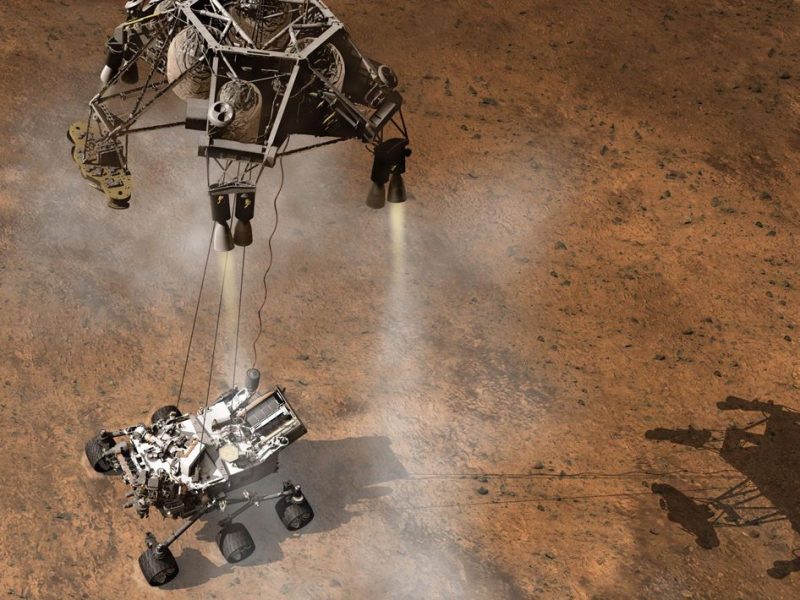
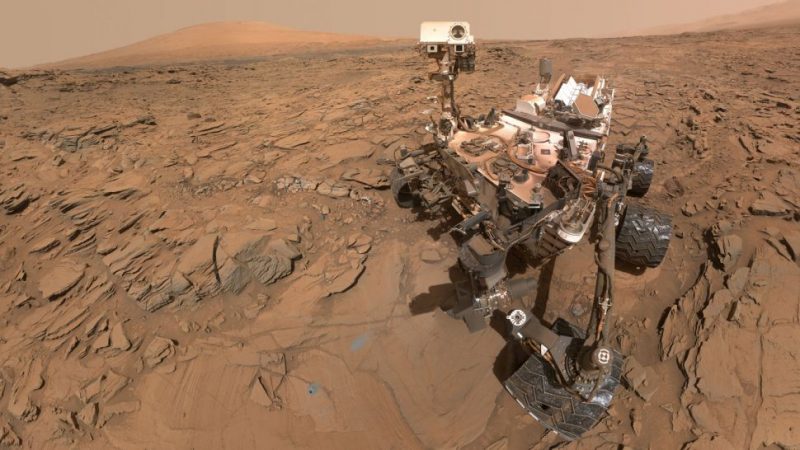
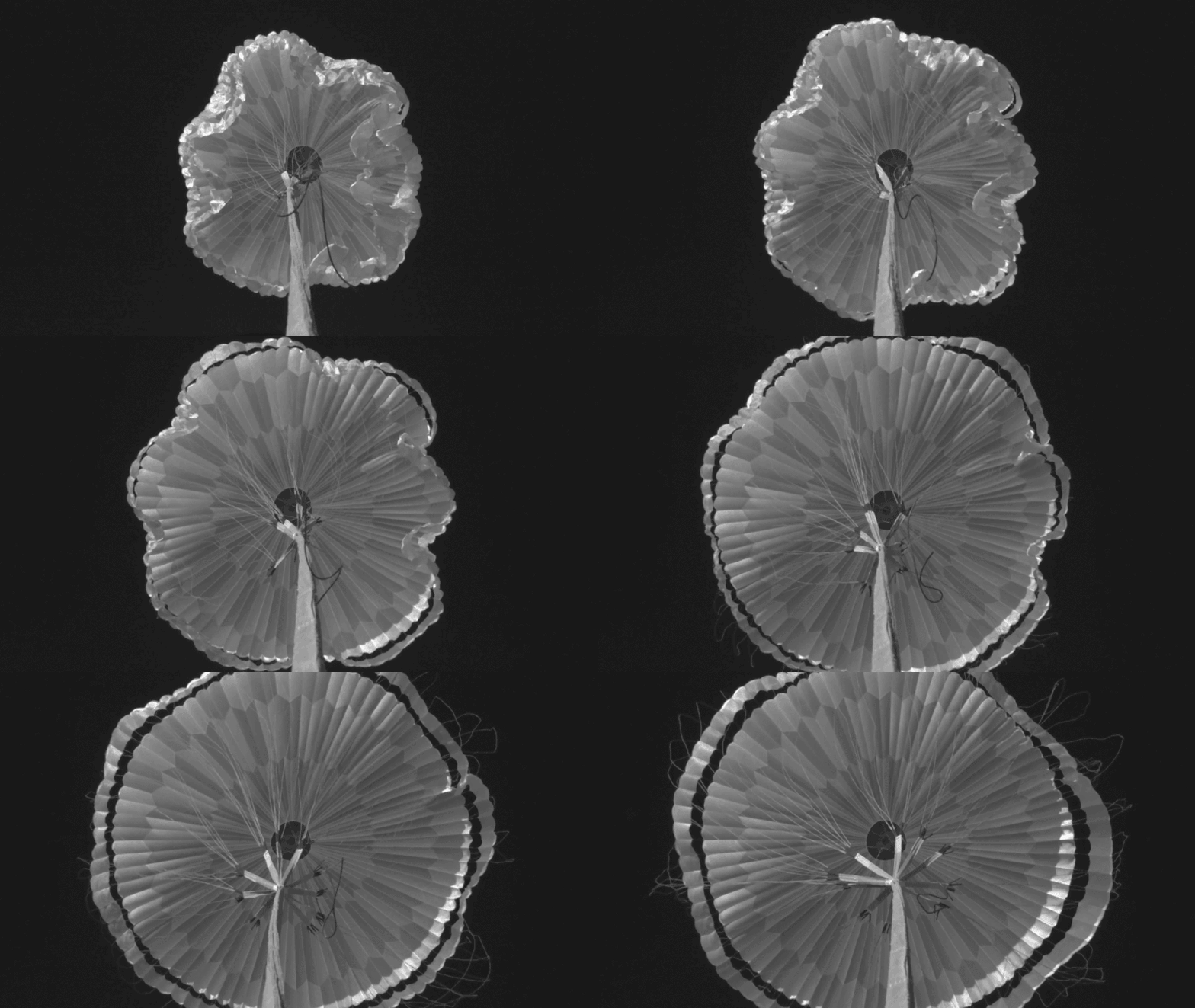

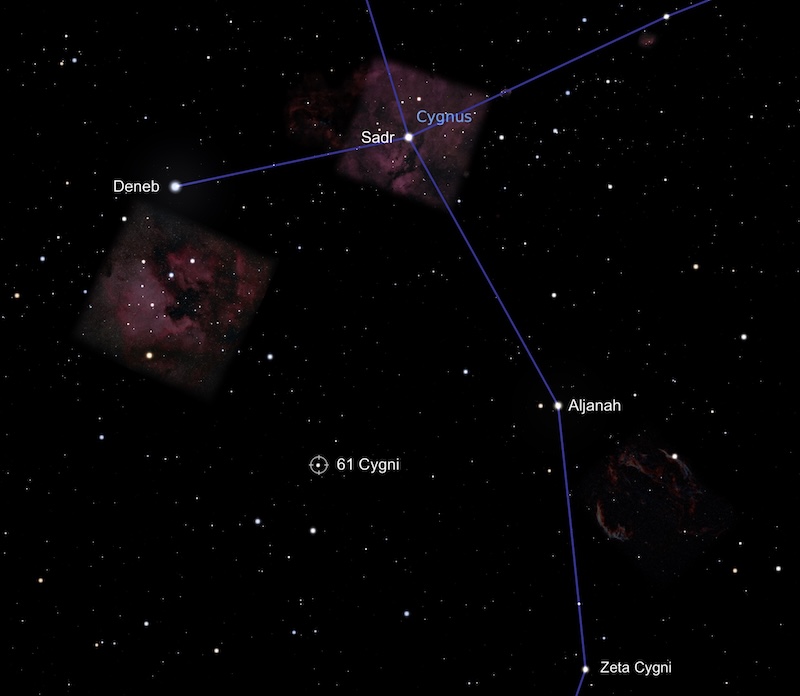

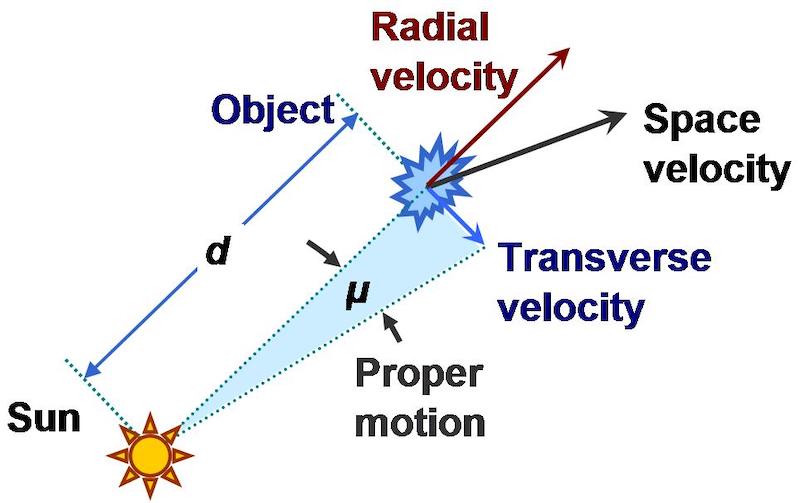
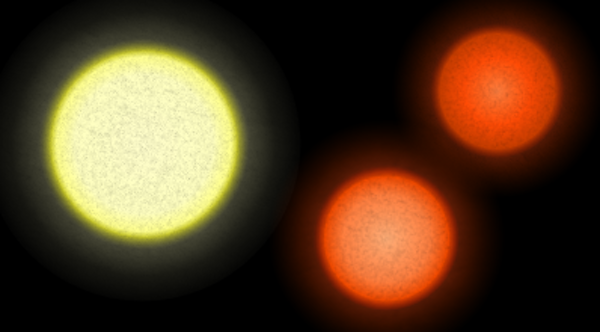
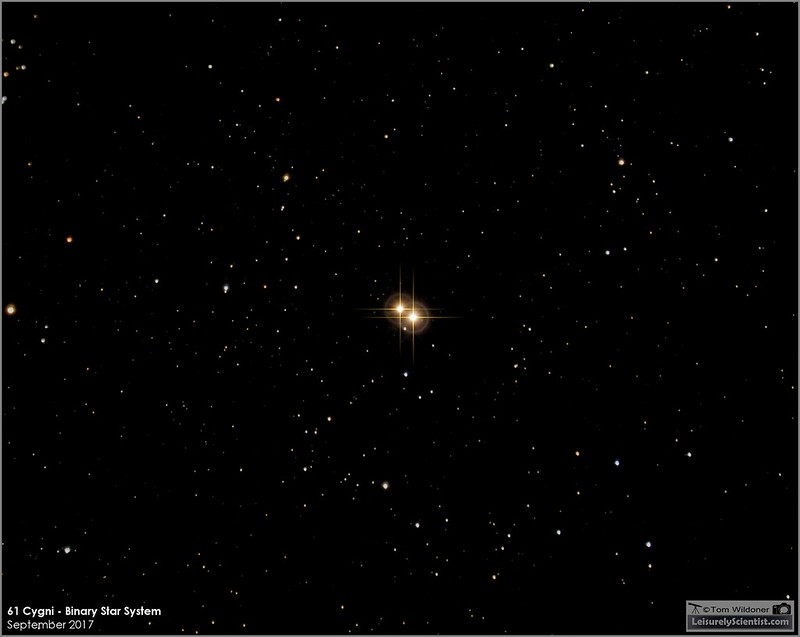
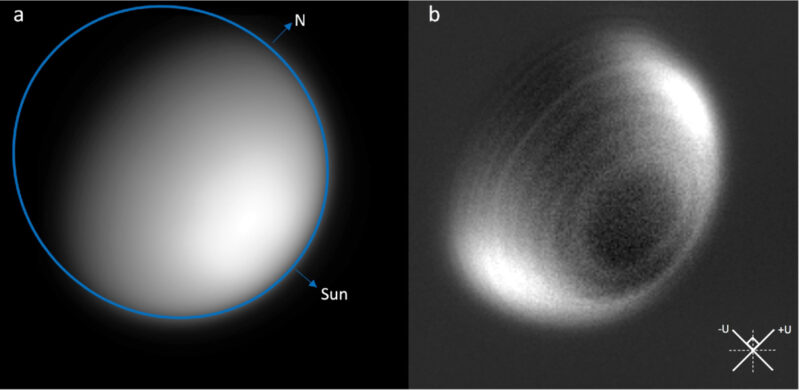
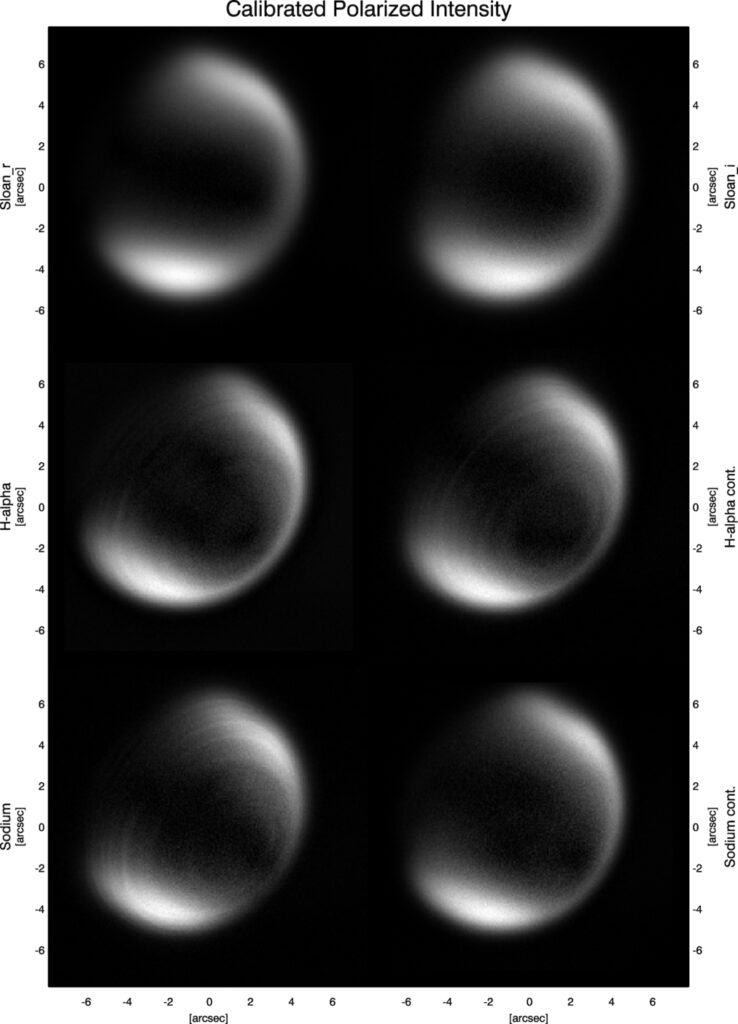

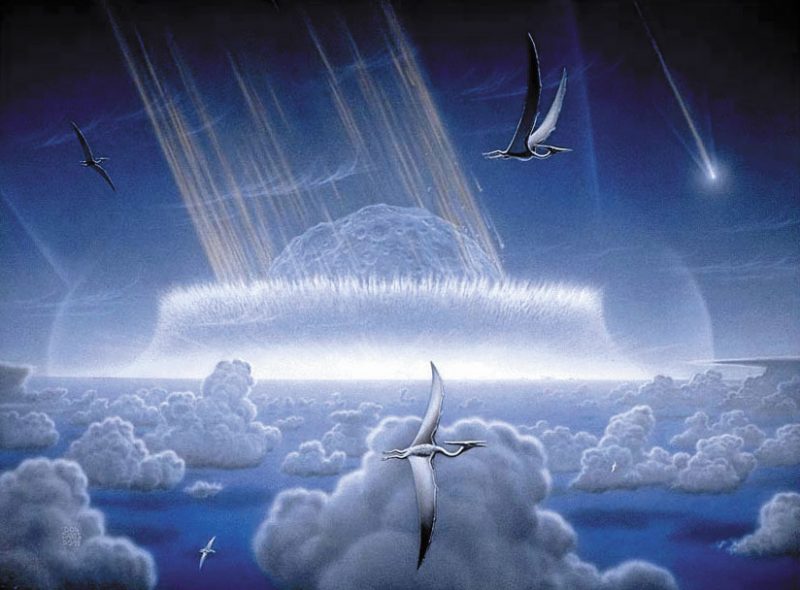


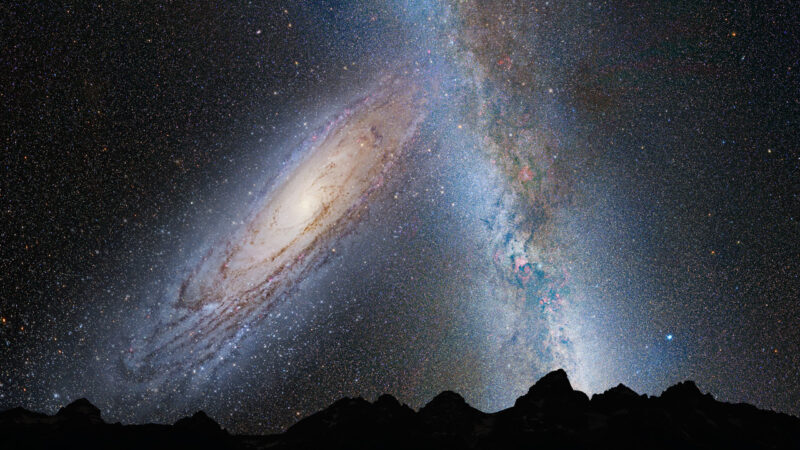
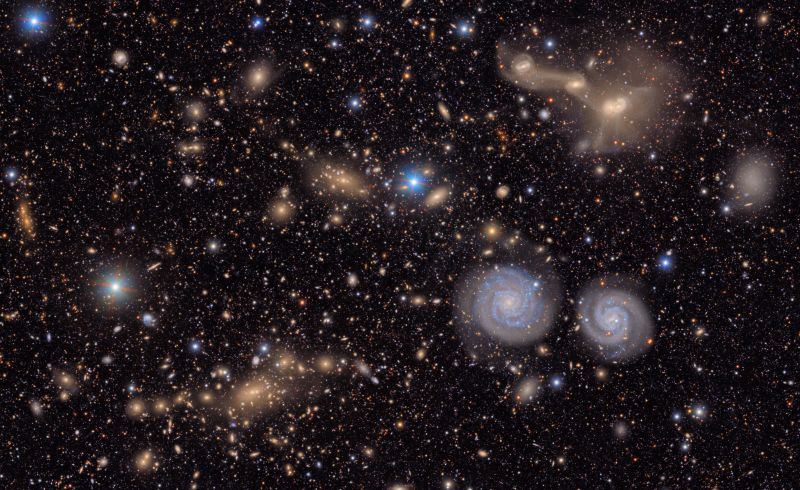
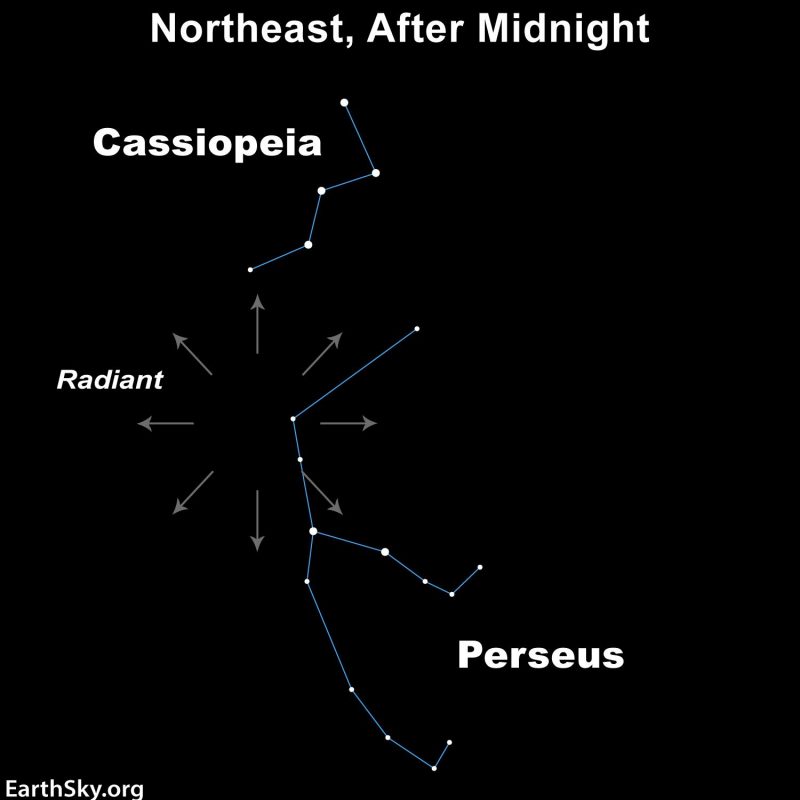


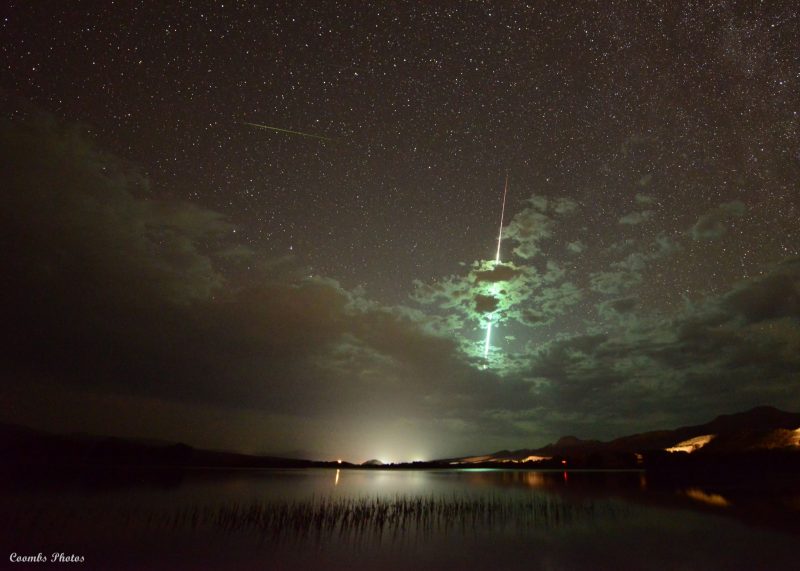
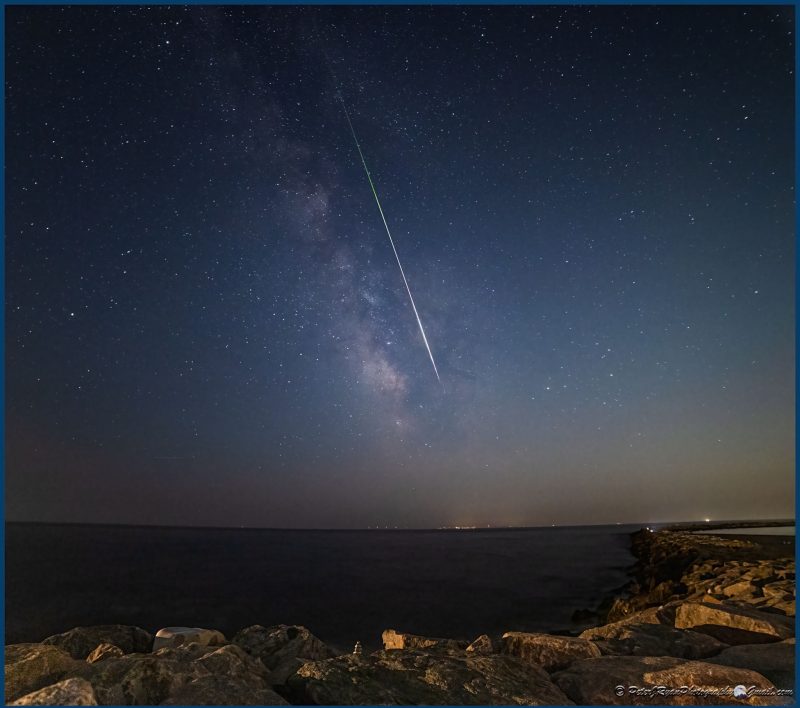
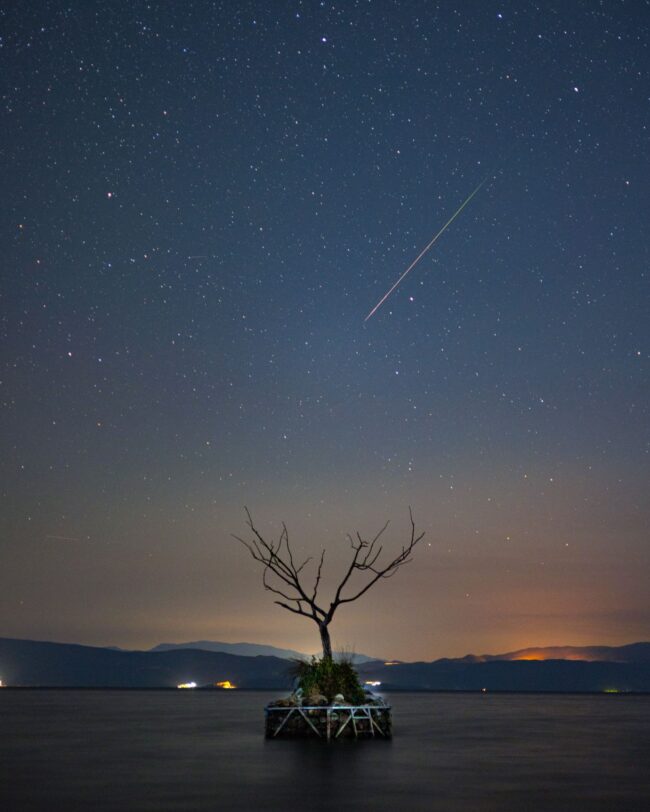
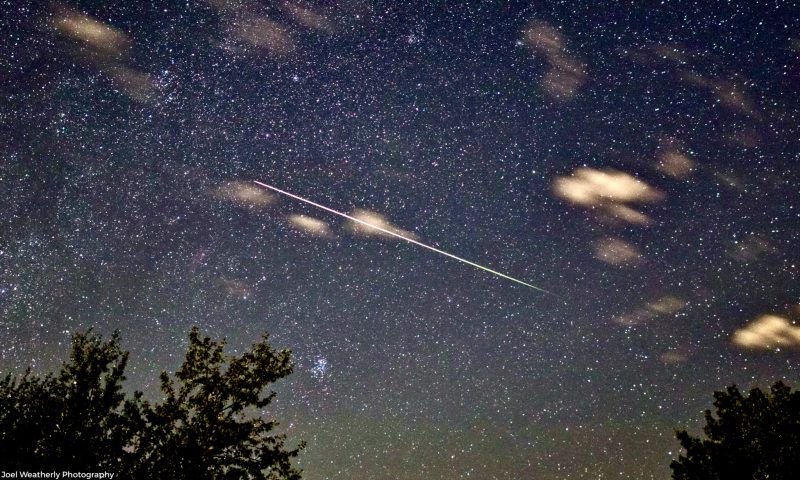
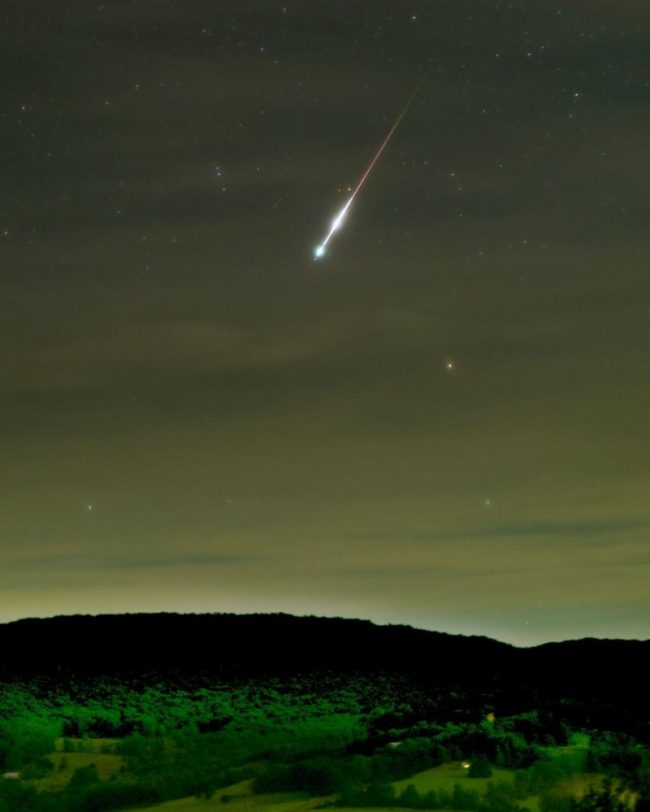
 ="" p="" height="400">