The dog days of summer refer to the hottest days of the year that we experience in July and August. They’re named after the Dog Star, Sirius, the brightest star in the sky. It’s in the constellation of Canis Major, the Greater Dog. The Belt of Orion can point you to dazzling Sirius in the morning sky.
What are the dog days of summer?
You might have heard the hottest days of summer referred to as the dog days of summer … but where did this term come from? According to the National Weather Service:
The “dog days of summer” is a phrase used to describe the hot and humid days of summer. It can be traced back thousands of years to the days of the Roman Empire. It refers to the dates from July 3 through August 11, which is 20 days prior and 20 days after the star Sirius rises and falls in conjunction [sharing the same spot in our sky] with the sun. Sirius was known as the “Dog Star,” because it is the brightest star in the constellation Canis Major (Large Dog).
So, you can see the term dog days isn’t new. And its origin is based on objects in the sky.
What does Sirius have to do with the hottest days of summer?
The name Sirius comes from an ancient Greek word for “scorching” or “glowing.” It’s the brightest star visible from Earth, and skywatchers in both hemispheres can see it.
Sirius is a beacon in Northern Hemisphere winter skies. During northern summer, it lies behind the sun from Earth’s perspective. And in late summer it appears in the east before sunrise, near the sun in our sky.
Ancient Egyptians noted that Sirius rose just before the sun each year immediately prior to the annual flooding of the Nile River. Although the floods could bring destruction, they also brought new soil and new life.
Ancient Romans noticed the reappearance of Sirius in the morning sky as well. And they blamed it for the heat in July and August. That’s because Sirius rose each day before sunrise. And then, it traveled across the sky with the sun all day. Thus, early stargazers might have imagined a double-whammy from Sirius and the sun caused the hot weather.
Sirius in conjunction with the sun
Since Sirius is in conjunction with the sun on July 23, the dog days of summer center around then. The dog days of summer fall between July 3 to August 11, and that’s when we have many of our warmest days in the Northern Hemisphere.
So even though we know why this is the hottest time of the year in the Northern Hemisphere, the legend of the dog days has survived.
Bottom line: The dog days of summer are named for the Dog Star, Sirius – the brightest star in the sky – in the constellation Canis Major the Greater Dog.
The dog days of summer refer to the hottest days of the year that we experience in July and August. They’re named after the Dog Star, Sirius, the brightest star in the sky. It’s in the constellation of Canis Major, the Greater Dog. The Belt of Orion can point you to dazzling Sirius in the morning sky.
What are the dog days of summer?
You might have heard the hottest days of summer referred to as the dog days of summer … but where did this term come from? According to the National Weather Service:
The “dog days of summer” is a phrase used to describe the hot and humid days of summer. It can be traced back thousands of years to the days of the Roman Empire. It refers to the dates from July 3 through August 11, which is 20 days prior and 20 days after the star Sirius rises and falls in conjunction [sharing the same spot in our sky] with the sun. Sirius was known as the “Dog Star,” because it is the brightest star in the constellation Canis Major (Large Dog).
So, you can see the term dog days isn’t new. And its origin is based on objects in the sky.
What does Sirius have to do with the hottest days of summer?
The name Sirius comes from an ancient Greek word for “scorching” or “glowing.” It’s the brightest star visible from Earth, and skywatchers in both hemispheres can see it.
Sirius is a beacon in Northern Hemisphere winter skies. During northern summer, it lies behind the sun from Earth’s perspective. And in late summer it appears in the east before sunrise, near the sun in our sky.
Ancient Egyptians noted that Sirius rose just before the sun each year immediately prior to the annual flooding of the Nile River. Although the floods could bring destruction, they also brought new soil and new life.
Ancient Romans noticed the reappearance of Sirius in the morning sky as well. And they blamed it for the heat in July and August. That’s because Sirius rose each day before sunrise. And then, it traveled across the sky with the sun all day. Thus, early stargazers might have imagined a double-whammy from Sirius and the sun caused the hot weather.
Sirius in conjunction with the sun
Since Sirius is in conjunction with the sun on July 23, the dog days of summer center around then. The dog days of summer fall between July 3 to August 11, and that’s when we have many of our warmest days in the Northern Hemisphere.
So even though we know why this is the hottest time of the year in the Northern Hemisphere, the legend of the dog days has survived.
Bottom line: The dog days of summer are named for the Dog Star, Sirius – the brightest star in the sky – in the constellation Canis Major the Greater Dog.
View larger. | This Mars Express spacecraft view shows Olympus Mons on Mars, the largest volcano in the solar system. A new study has revealed that Mars’ volcanoes – now dormant – were once not as disconnected as 1st thought. Instead, they were intertwined by vast magma systems below the surface. These magma systems on Mars spanned throughout the northern hemisphere’s crust. Image via ESA/ DLR/ FU Berlin/ J. Cowart.
Mars has many volcanoes, just like Earth. Scientists have long thought that these volcanoes, back when they were still active, were relatively simple and disconnected from each other.
But a new study of data from the InSight lander mission shows that there were vast, interconnected magma systems below the Martian surface.
That would mean Mars’ volcanic systems were more earthlike than previously thought, despite the planet not having plate tectonics.
Like Earth, Mars has numerous volcanoes dotting its surface. As far as we know, those volcanoes are now extinct. And scientists have long thought the planet’s volcanic system overall was simpler than Earth’s, since Mars lacks plate tectonics. But now there’s evidence that isn’t quite true.
Scientists at the University of Oxford in the U.K. said on June 26, 2026, they’ve found evidence that Mars once had enormous, Earth-like magma systems – interconnected zones of molten rock – deep beneath its surface.
Scientists have long categorized Mars as a stagnant lid planet. That means it has one large solid surface, or “lid,” instead of the surface being broken into smaller tectonic plates like on Earth. On Earth, plate tectonics drives volcanism, recycling and continent–building.
But this new study points to huge, interconnected magma systems. They show that Mars’ volcanoes weren’t just simple isolated formations as previously assumed. And they force us to ask … How did this occur without plate tectonics?
We’ve traditionally assumed that volcanism on Mars was relatively simple compared to that on Earth. But this discovery suggests the planet could sustain massive, long-lived magmatic systems capable of evolving and reprocessing molten rock throughout the crust. Because these systems are known to generate large metal deposits, Mars may hold significantly more near-surface mineral wealth than previously recognised, boosting its potential for future mining, crewed missions and eventually, permanent settlements.
The researchers published their peer-reviewed findings in Nature Astronomy on June 26, 2026.
NEW: Mars may have been far more Earth-like beneath its surface than scientists once thought ??Oxford researchers have uncovered evidence of vast hidden magma systems that could reshape our understanding of how rocky planets evolve ??https://bit.ly/4wwd4jx
The researchers made the discovery when analyzing data from NASA’s InSight lander. InSight ended its mission in 2022, but there is still a ton of data to study. The lander recorded seismic waves from marsquakes and meteorite impacts.
The researchers used the data to investigate an unusual boundary about 15 miles (24 km) below the surface. Scientists knew about the boundary before, but didn’t know what it was. One possibility is that it marked a transition between two different types of rock. To test this, the researchers compared hundreds of different rock compositions with the seismic data.
The results showed that there was indeed a boundary between two types of rock. Below the boundary, the rocks were ultramafic, meaning rich in iron and magnesium. But interestingly, the rocks above the boundary were quite different. They were mafic rocks, rich in silica.
Why is the rock layer below the boundary so different from the layer above? The researchers say that molten rock likely pooled there. Then, it gradually separated into different materials over time. This left behind a residue of dense crystals at the base of the crust. Meanwhile, lighter molten rock moved upwards. This is similar to what happens on Earth beneath volcanic arcs. This is also linked to the formation of continents, although Mars never got to that stage.
View larger. | Illustration depicting NASA’s InSight lander on Mars, with a cutaway view of the subsurface. Image via PGP/ Nicolas Sarter/ Jet Propulsion Laboratory/ NASA.
Vast magma layer across the northern hemisphere
The researchers say this magma layer was vast, spanning hundreds of miles sideways beneath the surface. That means that instead of Mars’ volcanoes being isolated, they were actually interconnected by these sprawling magma systems. On Earth, this is known as transcrustal magmatism. Until now, scientists only knew of it occurring on one planet: Earth.
But if it happened on Mars too, that raises questions about how rocky planets form and if they can be habitable. Co-author Jon Wade at the University of Oxford said:
One of the big questions in planetary science is whether Earth is unique. If Mars could develop this kind of complex crust without plate tectonics, then maybe the conditions needed for habitability can emerge on more planets than we realised, including those previously dismissed based on size or their apparent lack of tectonic activity.
In 2024, scientists reported evidence for magma possibly still existing beneath Olympus Mons, the largest volcano on Mars. If so, it would mean that there is still some residual tectonic and volcanic activity below the surface today. Mars might still be alive, at least geologically!
Bottom line: Scientists have found evidence of enormous ancient magma systems on Mars. They show that Mars’ volcanic systems were once more complex than first thought.
View larger. | This Mars Express spacecraft view shows Olympus Mons on Mars, the largest volcano in the solar system. A new study has revealed that Mars’ volcanoes – now dormant – were once not as disconnected as 1st thought. Instead, they were intertwined by vast magma systems below the surface. These magma systems on Mars spanned throughout the northern hemisphere’s crust. Image via ESA/ DLR/ FU Berlin/ J. Cowart.
Mars has many volcanoes, just like Earth. Scientists have long thought that these volcanoes, back when they were still active, were relatively simple and disconnected from each other.
But a new study of data from the InSight lander mission shows that there were vast, interconnected magma systems below the Martian surface.
That would mean Mars’ volcanic systems were more earthlike than previously thought, despite the planet not having plate tectonics.
Like Earth, Mars has numerous volcanoes dotting its surface. As far as we know, those volcanoes are now extinct. And scientists have long thought the planet’s volcanic system overall was simpler than Earth’s, since Mars lacks plate tectonics. But now there’s evidence that isn’t quite true.
Scientists at the University of Oxford in the U.K. said on June 26, 2026, they’ve found evidence that Mars once had enormous, Earth-like magma systems – interconnected zones of molten rock – deep beneath its surface.
Scientists have long categorized Mars as a stagnant lid planet. That means it has one large solid surface, or “lid,” instead of the surface being broken into smaller tectonic plates like on Earth. On Earth, plate tectonics drives volcanism, recycling and continent–building.
But this new study points to huge, interconnected magma systems. They show that Mars’ volcanoes weren’t just simple isolated formations as previously assumed. And they force us to ask … How did this occur without plate tectonics?
We’ve traditionally assumed that volcanism on Mars was relatively simple compared to that on Earth. But this discovery suggests the planet could sustain massive, long-lived magmatic systems capable of evolving and reprocessing molten rock throughout the crust. Because these systems are known to generate large metal deposits, Mars may hold significantly more near-surface mineral wealth than previously recognised, boosting its potential for future mining, crewed missions and eventually, permanent settlements.
The researchers published their peer-reviewed findings in Nature Astronomy on June 26, 2026.
NEW: Mars may have been far more Earth-like beneath its surface than scientists once thought ??Oxford researchers have uncovered evidence of vast hidden magma systems that could reshape our understanding of how rocky planets evolve ??https://bit.ly/4wwd4jx
The researchers made the discovery when analyzing data from NASA’s InSight lander. InSight ended its mission in 2022, but there is still a ton of data to study. The lander recorded seismic waves from marsquakes and meteorite impacts.
The researchers used the data to investigate an unusual boundary about 15 miles (24 km) below the surface. Scientists knew about the boundary before, but didn’t know what it was. One possibility is that it marked a transition between two different types of rock. To test this, the researchers compared hundreds of different rock compositions with the seismic data.
The results showed that there was indeed a boundary between two types of rock. Below the boundary, the rocks were ultramafic, meaning rich in iron and magnesium. But interestingly, the rocks above the boundary were quite different. They were mafic rocks, rich in silica.
Why is the rock layer below the boundary so different from the layer above? The researchers say that molten rock likely pooled there. Then, it gradually separated into different materials over time. This left behind a residue of dense crystals at the base of the crust. Meanwhile, lighter molten rock moved upwards. This is similar to what happens on Earth beneath volcanic arcs. This is also linked to the formation of continents, although Mars never got to that stage.
View larger. | Illustration depicting NASA’s InSight lander on Mars, with a cutaway view of the subsurface. Image via PGP/ Nicolas Sarter/ Jet Propulsion Laboratory/ NASA.
Vast magma layer across the northern hemisphere
The researchers say this magma layer was vast, spanning hundreds of miles sideways beneath the surface. That means that instead of Mars’ volcanoes being isolated, they were actually interconnected by these sprawling magma systems. On Earth, this is known as transcrustal magmatism. Until now, scientists only knew of it occurring on one planet: Earth.
But if it happened on Mars too, that raises questions about how rocky planets form and if they can be habitable. Co-author Jon Wade at the University of Oxford said:
One of the big questions in planetary science is whether Earth is unique. If Mars could develop this kind of complex crust without plate tectonics, then maybe the conditions needed for habitability can emerge on more planets than we realised, including those previously dismissed based on size or their apparent lack of tectonic activity.
In 2024, scientists reported evidence for magma possibly still existing beneath Olympus Mons, the largest volcano on Mars. If so, it would mean that there is still some residual tectonic and volcanic activity below the surface today. Mars might still be alive, at least geologically!
Bottom line: Scientists have found evidence of enormous ancient magma systems on Mars. They show that Mars’ volcanic systems were once more complex than first thought.
Albireo, also known as Beta Cygni, is the 2nd-brightest star in the constellation Cygnus the Swan. At first glance, it doesn’t particularly stand out. But viewing this star through a small telescope can take your breath away. Indeed, it resolves into a striking pair of stars, one a lovely gold and the other a dimmer blue.
The two stars appear close in the sky from our perspective, but scientists aren’t sure that they’re gravitationally bound to each other. Regardless, the striking color contrast between the close pair makes Albireo one of the most beautiful double stars in our sky.
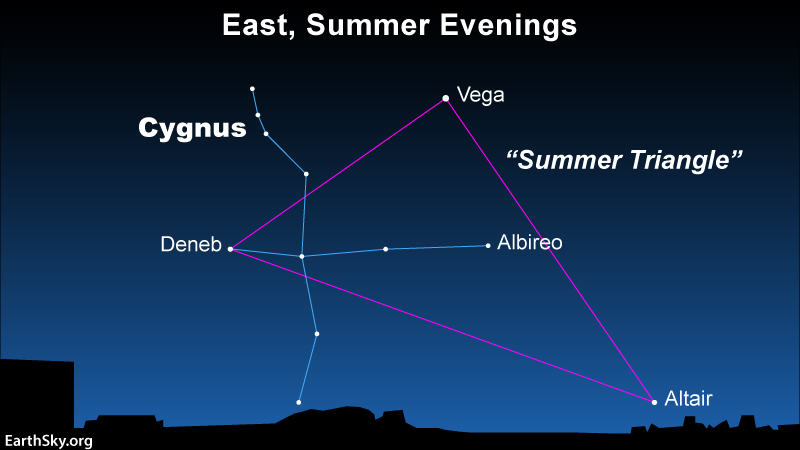
The bright star Deneb is part of the famous Summer Triangle asterism. Its constellation, Cygnus the Swan, flies across the July evening sky.
How to find Albireo
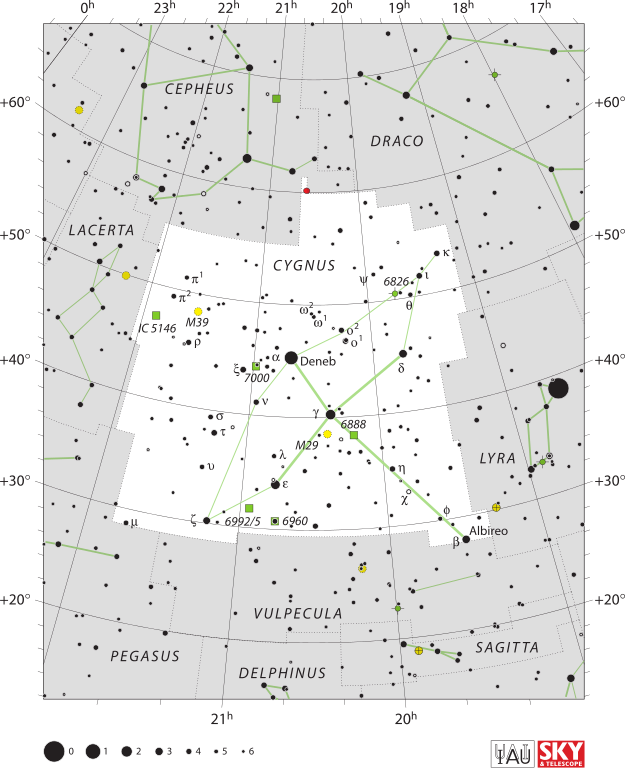
How can you spot Albireo in the night sky? It’s easy to find if you can locate Cygnus the Swan. Cygnus is known for containing an easily recognizable cross shape, known as the Northern Cross. The brightest star in Cygnus, Deneb, marks the top of the Cross, or the Tail of the Swan. Albireo, meanwhile, marks the base of the Cross or the Head of Cygnus the Swan.
And how can you see Albireo as two stars? Unless you have exceedingly powerful binoculars mounted on a tripod, binoculars unfortunately won’t show you Albireo as two stars. But any small telescope will. It’s best to view them at 30X (“30 power” or a magnification of 30). And when you see Albireo as two stars, be sure to notice the striking color contrast between the two.
The brighter, golden star – Albireo A – is about 400 light-years away. Albireo B, the dimmer blue star, is around 400 light-years distant. And although this is not confirmed, Albireo A and B are thought to only be a pair from our perspective, rather than being a gravitationally bound binary system.
But on the other hand, Albireo A itself is a binary star, formed of two stars so close together that you can’t see them separately. These stars take 121.6 years to orbit one another. The brighter star of the two is responsible for the gold color you see through a telescope. It’s a red supergiant star, about 5 times the mass of the sun. It shines at magnitude 3.21. And it outshines its fainter companion, a hot main sequence star that’s 2.7 times the sun’s mass.
Furthermore, in a recent analysis of the Albireo A binary system, astronomers were surprised to find that there might be more stars in the system, possibly making Albireo A a triple or quadruple star system.
Albireo B, the fainter blue star of the pair when viewed through a small telescope, appears just 34 arc seconds away from gold-colored Albireo A. It’s a hot blue star with about 3.7 times the sun’s mass. It shines at magnitude 5.11. If it is a physical companion star to Albireo A, their orbital period would take about 100,000 years.
Bottom line: Albireo, in the constellation Cygnus, is a favorite for stargazers. Through a small telescope, it appears as a beautiful golden star with a dimmer blue companion.
Albireo, also known as Beta Cygni, is the 2nd-brightest star in the constellation Cygnus the Swan. At first glance, it doesn’t particularly stand out. But viewing this star through a small telescope can take your breath away. Indeed, it resolves into a striking pair of stars, one a lovely gold and the other a dimmer blue.
The two stars appear close in the sky from our perspective, but scientists aren’t sure that they’re gravitationally bound to each other. Regardless, the striking color contrast between the close pair makes Albireo one of the most beautiful double stars in our sky.
The bright star Deneb is part of the famous Summer Triangle asterism. Its constellation, Cygnus the Swan, flies across the July evening sky.
How to find Albireo
How can you spot Albireo in the night sky? It’s easy to find if you can locate Cygnus the Swan. Cygnus is known for containing an easily recognizable cross shape, known as the Northern Cross. The brightest star in Cygnus, Deneb, marks the top of the Cross, or the Tail of the Swan. Albireo, meanwhile, marks the base of the Cross or the Head of Cygnus the Swan.
And how can you see Albireo as two stars? Unless you have exceedingly powerful binoculars mounted on a tripod, binoculars unfortunately won’t show you Albireo as two stars. But any small telescope will. It’s best to view them at 30X (“30 power” or a magnification of 30). And when you see Albireo as two stars, be sure to notice the striking color contrast between the two.
The brighter, golden star – Albireo A – is about 400 light-years away. Albireo B, the dimmer blue star, is around 400 light-years distant. And although this is not confirmed, Albireo A and B are thought to only be a pair from our perspective, rather than being a gravitationally bound binary system.
But on the other hand, Albireo A itself is a binary star, formed of two stars so close together that you can’t see them separately. These stars take 121.6 years to orbit one another. The brighter star of the two is responsible for the gold color you see through a telescope. It’s a red supergiant star, about 5 times the mass of the sun. It shines at magnitude 3.21. And it outshines its fainter companion, a hot main sequence star that’s 2.7 times the sun’s mass.
Furthermore, in a recent analysis of the Albireo A binary system, astronomers were surprised to find that there might be more stars in the system, possibly making Albireo A a triple or quadruple star system.
Albireo B, the fainter blue star of the pair when viewed through a small telescope, appears just 34 arc seconds away from gold-colored Albireo A. It’s a hot blue star with about 3.7 times the sun’s mass. It shines at magnitude 5.11. If it is a physical companion star to Albireo A, their orbital period would take about 100,000 years.
Bottom line: Albireo, in the constellation Cygnus, is a favorite for stargazers. Through a small telescope, it appears as a beautiful golden star with a dimmer blue companion.
Along with its close relative, the sapphire, the ruby is a form of the mineral corundum. This mineral is normally drab and gray in color. So a red corundum gemstone is a ruby, and all other colored corundum gemstones – orange, yellow, brown, green, blue, purple, violet, black, and colorless – are sapphires.
And that makes the July birthstone – the ruby – rare and precious. It’s among the most highly prized of gemstones. Large rubies are more difficult to find than large diamonds. And at 9 on the Mohs scale, they’re harder than emerald, topaz, zircon and garnet.
As a result, rubies’ value increases with size more than any other gemstone.
The word ruby comes from the Latin “ruber,” meaning red. This name formerly meant any red stone, including red spinel, red tourmaline, and red garnet.
An oval faceted ruby gemstone. Image via Humanfeather/ Wikipedia.
Sources of the ruby
The Mogok valley of Upper Burma is famous as the source for the finest and rarest rubies of all, known as “pigeon’s blood” for the stones’ intense red color.
Another major source of rubies is Thailand, well-known for dark, brownish-red rubies. Both Thailand and Burma regard the ruby as their national stone.
Giant 11,000-Carat #Ruby Found in #Myanmar Could Be Worth a FortuneMore info and pics: https://ift.tt/geXiL5P…
In much of Asia, people once believed that rubies contained the spark of life – “a deep drop of the heart’s blood of Mother Earth,” according to ancient Eastern legends.
Plus, ancient Asian stories say the ruby is self-luminous. They called it “glowing stone” or “lamp stone.” One story is that an emperor of China used a large ruby to light his chamber, where it glowed as bright as day. Brahmins – Hindu priests of the highest caste – believed that the homes of the gods were lit by enormous emeralds and rubies.
Later, in Greek legends, the ruby symbolized the goddess Aphrodite’s ill-fated love affair with the mortal Adonis.
Raw Tanzanian rubies embedded in a rock matrix. Image via Jarno/ Wikipedia.
Ancient Hindus, Burmese, and Ceylonese regarded sapphires as unripe rubies. Thus, they believed if they buried the sapphire in the ground, it would mature to a rich red ruby.
In the Middle Ages, rubies were thought to bring good health, as well as guard against wicked thoughts, amorous desires, and disputes. Rubies, along with other types of red stones, were said to cure bleeding. And it was believed that the ruby held the power to warn its owner of coming misfortunes, illness, or death, by turning darker in color. It is said that Catherine of Aragon, first wife of King Henry VIII, predicted her downfall when seeing the darkening of her ruby.
Famous rubies?
Because of their rarity, there are very few famous large rubies. In his 13th-century books of his travels, Marco Polo relates the tale of a magnificent gemstone – believed to be a ruby nine inches long and as thick as a man’s arm – belonging to the king of Ceylon. Kublai Khan, the emperor of China, offered an entire city in exchange for the enormous stone, to which the king of Ceylon replied that he would never part with his prize for all the treasures of the world.
Many famous rubies in history turned out not to be rubies after all. For example, the famed Timur ruby – given to Queen Victoria in 1851 – was later found to be ruby spinel.
A round faceted ruby. Image via Decym92/ Wikimedia.
Along with its close relative, the sapphire, the ruby is a form of the mineral corundum. This mineral is normally drab and gray in color. So a red corundum gemstone is a ruby, and all other colored corundum gemstones – orange, yellow, brown, green, blue, purple, violet, black, and colorless – are sapphires.
And that makes the July birthstone – the ruby – rare and precious. It’s among the most highly prized of gemstones. Large rubies are more difficult to find than large diamonds. And at 9 on the Mohs scale, they’re harder than emerald, topaz, zircon and garnet.
As a result, rubies’ value increases with size more than any other gemstone.
The word ruby comes from the Latin “ruber,” meaning red. This name formerly meant any red stone, including red spinel, red tourmaline, and red garnet.
An oval faceted ruby gemstone. Image via Humanfeather/ Wikipedia.
Sources of the ruby
The Mogok valley of Upper Burma is famous as the source for the finest and rarest rubies of all, known as “pigeon’s blood” for the stones’ intense red color.
Another major source of rubies is Thailand, well-known for dark, brownish-red rubies. Both Thailand and Burma regard the ruby as their national stone.
Giant 11,000-Carat #Ruby Found in #Myanmar Could Be Worth a FortuneMore info and pics: https://ift.tt/geXiL5P…
In much of Asia, people once believed that rubies contained the spark of life – “a deep drop of the heart’s blood of Mother Earth,” according to ancient Eastern legends.
Plus, ancient Asian stories say the ruby is self-luminous. They called it “glowing stone” or “lamp stone.” One story is that an emperor of China used a large ruby to light his chamber, where it glowed as bright as day. Brahmins – Hindu priests of the highest caste – believed that the homes of the gods were lit by enormous emeralds and rubies.
Later, in Greek legends, the ruby symbolized the goddess Aphrodite’s ill-fated love affair with the mortal Adonis.
Raw Tanzanian rubies embedded in a rock matrix. Image via Jarno/ Wikipedia.
Ancient Hindus, Burmese, and Ceylonese regarded sapphires as unripe rubies. Thus, they believed if they buried the sapphire in the ground, it would mature to a rich red ruby.
In the Middle Ages, rubies were thought to bring good health, as well as guard against wicked thoughts, amorous desires, and disputes. Rubies, along with other types of red stones, were said to cure bleeding. And it was believed that the ruby held the power to warn its owner of coming misfortunes, illness, or death, by turning darker in color. It is said that Catherine of Aragon, first wife of King Henry VIII, predicted her downfall when seeing the darkening of her ruby.
Famous rubies?
Because of their rarity, there are very few famous large rubies. In his 13th-century books of his travels, Marco Polo relates the tale of a magnificent gemstone – believed to be a ruby nine inches long and as thick as a man’s arm – belonging to the king of Ceylon. Kublai Khan, the emperor of China, offered an entire city in exchange for the enormous stone, to which the king of Ceylon replied that he would never part with his prize for all the treasures of the world.
Many famous rubies in history turned out not to be rubies after all. For example, the famed Timur ruby – given to Queen Victoria in 1851 – was later found to be ruby spinel.
A round faceted ruby. Image via Decym92/ Wikimedia.
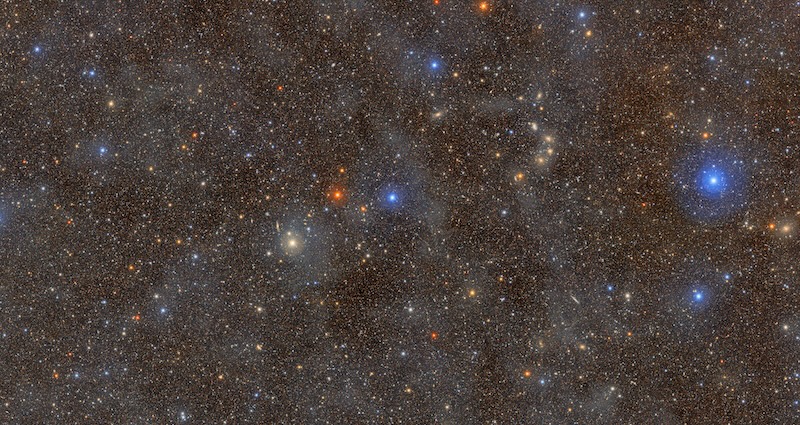
The Vera C. Rubin Observatory took this 1.7-gigapixel image of a field of stars in the constellation Lupus the Wolf and Centaurus the Centaur. Rubin is unique in its ability to capture both a wide field of view and extremely faint objects. NOIRLab said on June 30, 2026, that the Rubin Observatory has officially begun its 10-year timelapse of the universe: the Legacy Survey of Space and Time (LSST). Image via NSF–DOE Vera C. Rubin Observatory/ NOIRLab/ SLAC/ AURA.
Rubin Observatory begins 10-year timelapse of the universe
Last June, we got our first look at what the Vera C. Rubin Observatory could do. We were wowed by images of galaxies floating in deep space and a video of thousands of never-before-seen asteroids. And now, on June 30, 2026, the Rubin Observatory has officially begun its 10-year-long survey of the night sky: the Legacy Survey of Space and Time (LSST).
Every night for the next decade, Rubin will rapidly scan the sky using the world’s largest digital camera to create an ultra-wide, ultra-high-definition timelapse of our universe. The goal of the survey is:
to create the most comprehensive, cinematic record of the universe in history.
Brian Stone, the National Science Foundation director, said:
Today, we begin filming the greatest cosmic movie ever made.
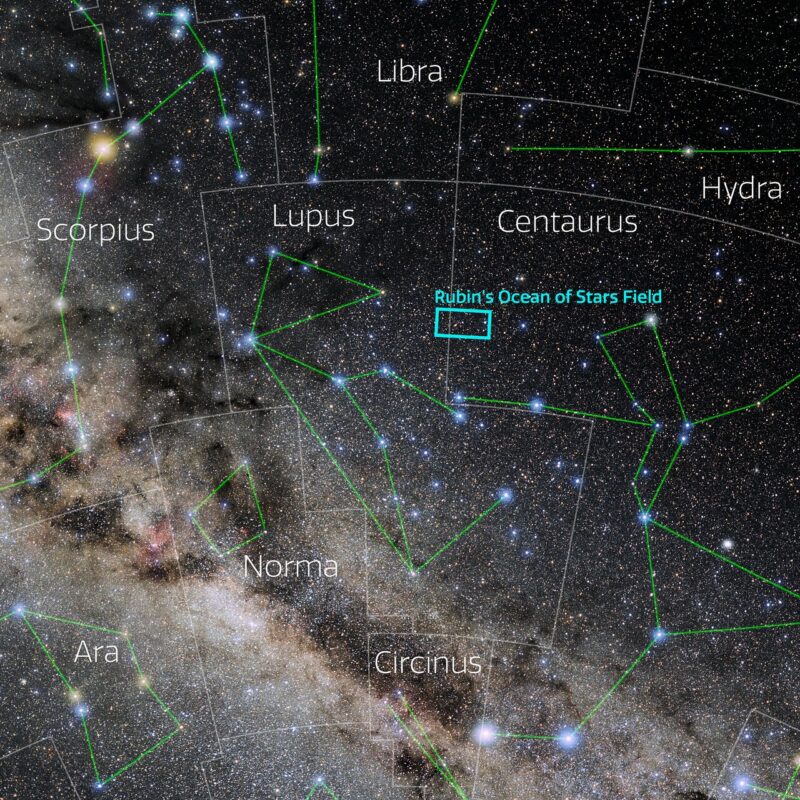
The image at top (Rubin’s Oceans of Stars Field) comes from this area of the sky in the Southern Hemisphere constellations of Lupus the Wolf and Centaurus the Centaur. Image via E. Slawik/NOIRLab/NSF/AURA/M. Zamani.
A flood of data
The Rubin Observatory acquires about 10 terabytes of data per night. And every time it sees something change in the night sky – whether that be a supernova erupting or an asteroid sailing in front of the background stars – it sends an alert. How many alerts might it produce in one night? As many as 7 million, says NOIRLab.
After 10 years of the survey, astronomers expect a final dataset of billions of objects with trillions of measurements. It will open the gates to a flood of knowledge about the universe. And that information will be available to both scientists and the public.
Rubin Observatory will capture the dynamic nature of our cosmos and reveal unimagined insights into our universe’s biggest mysteries, from our own solar system to the very structure of the universe. By seeking to understand the enigmatic phenomena of dark energy and dark matter, we are not just observing the stars; we are striving to grasp the fundamental laws that govern our existence.
Watch: A week in the life of Rubin Observatory
The Rubin Observatory will build a multicolor map of the universe. This video shows how much of the sky Rubin can scan in a week with its various color filters.
Rubin Observatory by the numbers
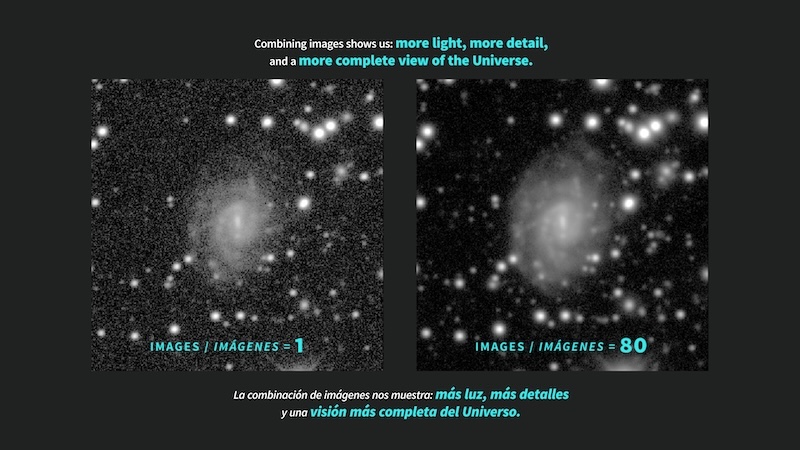
Rubin Observatory’s Legacy Survey of Space and Time by the numbers. Image via NSF–DOE Vera C. Rubin Observatory/ NOIRLab/ SLAC/ AURA.Rubin’s repeated recordings of the universe will bring out a wealth of detail in the objects it sees. Combining many images allows astronomers to see more light and get a sharper, more detailed view of the universe. Image via NSF–DOE Vera C. Rubin Observatory/ NOIRLab/ SLAC/ AURA.
Bottom line: The Rubin Observatory has now begun its Legacy Survey of Space and Time. This 10-year survey will create a timelapse record of the universe, from asteroids cruising through our solar system to whirling deep-space galaxies.
The Vera C. Rubin Observatory took this 1.7-gigapixel image of a field of stars in the constellation Lupus the Wolf and Centaurus the Centaur. Rubin is unique in its ability to capture both a wide field of view and extremely faint objects. NOIRLab said on June 30, 2026, that the Rubin Observatory has officially begun its 10-year timelapse of the universe: the Legacy Survey of Space and Time (LSST). Image via NSF–DOE Vera C. Rubin Observatory/ NOIRLab/ SLAC/ AURA.
Rubin Observatory begins 10-year timelapse of the universe
Last June, we got our first look at what the Vera C. Rubin Observatory could do. We were wowed by images of galaxies floating in deep space and a video of thousands of never-before-seen asteroids. And now, on June 30, 2026, the Rubin Observatory has officially begun its 10-year-long survey of the night sky: the Legacy Survey of Space and Time (LSST).
Every night for the next decade, Rubin will rapidly scan the sky using the world’s largest digital camera to create an ultra-wide, ultra-high-definition timelapse of our universe. The goal of the survey is:
to create the most comprehensive, cinematic record of the universe in history.
Brian Stone, the National Science Foundation director, said:
Today, we begin filming the greatest cosmic movie ever made.
The image at top (Rubin’s Oceans of Stars Field) comes from this area of the sky in the Southern Hemisphere constellations of Lupus the Wolf and Centaurus the Centaur. Image via E. Slawik/NOIRLab/NSF/AURA/M. Zamani.
A flood of data
The Rubin Observatory acquires about 10 terabytes of data per night. And every time it sees something change in the night sky – whether that be a supernova erupting or an asteroid sailing in front of the background stars – it sends an alert. How many alerts might it produce in one night? As many as 7 million, says NOIRLab.
After 10 years of the survey, astronomers expect a final dataset of billions of objects with trillions of measurements. It will open the gates to a flood of knowledge about the universe. And that information will be available to both scientists and the public.
Rubin Observatory will capture the dynamic nature of our cosmos and reveal unimagined insights into our universe’s biggest mysteries, from our own solar system to the very structure of the universe. By seeking to understand the enigmatic phenomena of dark energy and dark matter, we are not just observing the stars; we are striving to grasp the fundamental laws that govern our existence.
Watch: A week in the life of Rubin Observatory
The Rubin Observatory will build a multicolor map of the universe. This video shows how much of the sky Rubin can scan in a week with its various color filters.
Rubin Observatory by the numbers
Rubin Observatory’s Legacy Survey of Space and Time by the numbers. Image via NSF–DOE Vera C. Rubin Observatory/ NOIRLab/ SLAC/ AURA.Rubin’s repeated recordings of the universe will bring out a wealth of detail in the objects it sees. Combining many images allows astronomers to see more light and get a sharper, more detailed view of the universe. Image via NSF–DOE Vera C. Rubin Observatory/ NOIRLab/ SLAC/ AURA.
Bottom line: The Rubin Observatory has now begun its Legacy Survey of Space and Time. This 10-year survey will create a timelapse record of the universe, from asteroids cruising through our solar system to whirling deep-space galaxies.
On June 30, 1908, the largest asteroid impact in recorded history occurred on a warm summer morning in a remote part of Siberia, Russia. Now, we observe Asteroid Day each year on June 30, on the anniversary of what’s now known as the Tunguska explosion.
The explosion happened over sparsely populated forestland north of the Podkamennaya Tunguska River, in what is present-day Krasnoyarsk Krai.
The blast released enough energy to kill reindeer and flatten an estimated 80 million trees over an area of 830 square miles (2,150 square km). Witnesses reported seeing a bluish light nearly as bright as the sun moving across the sky. They said a flash and a sound similar to artillery fire followed the fireball. And, according to the American Physical Society, a powerful shockwave broke windows hundreds of miles away, knocking people off their feet.
Yet, ultimately, decades passed before anyone could explain the event.
The approximate location of the Tunguska event of 1908 in Siberia, Russia. Image via Bobby D. Bryant/ Wikimedia Commons (CC BY-SA 3.0).
Tunguska explosion: One of the largest in recorded history
A mysterious aspect of the Tunguska event was that, surprisingly, no one ever found a crater. But even without a crater, scientists still categorized it as an impact event. They now believe the incoming object never struck Earth. Instead, it exploded in the atmosphere, causing what’s known as an air burst. This type of atmospheric explosion was still enough to cause massive damage to the forest in the region.
Scientists determined the object was most likely a stony asteroid approximately 165-260 feet (50-80 m) in diameter, traveling at a speed of about 33,500 miles per hour (54,000 kph) and exploded 3 to 6 miles (5 to 10 km) above Earth’s surface.
The Tunguska explosion was equal to about 4 megatons of TNT. That would make it 250 times more powerful than the atom bomb dropped on Hiroshima.
Fallen trees from the 1908 Tunguska explosion at Tunguska in Siberia. It wasn’t until 1927 that Russian scientists – led by Leonid Kulik – were finally able to get to the scene. Image via Leonid Kulik/ Wikipedia.
Understanding the Tunguska explosion
Why did it take so long for scientists to understand what caused the Tunguska event? It took almost two decades for the first scientific expedition to reach this remote site in central Siberia. The region was extremely isolated, with no roads, railways or nearby settlements, making access possible only through long and difficult expeditions across the taiga.
This delay was further extended by major historical disruptions, including World War I, the Russian Revolution and the Russian Civil War, which made large-scale scientific travel and funding nearly impossible for many years.
It was not until 1927 that the first major scientific expedition, led by Leonid Kulik, finally reached the site. By then, much of the immediate physical evidence had already degraded or disappeared due to the passage of time and natural regeneration of the forest.
As a result of the delayed investigation and the lack of typical impact evidence such as a crater or large meteorite fragments, early interpretations remained uncertain, allowing speculative explanations to emerge before the true nature of the event was eventually understood. Some concocted wild theories to explain the Tunguska event. People claimed a stricken alien spacecraft caused the destruction. Later, they pointed to a mini-black-hole or a particle of antimatter.
The truth is just as interesting, and perhaps more terrifying … because it can happen again.
Photo of an air burst, in this case from a U.S. Navy submarine-launched Tomahawk cruise missile. A similar kind of air burst from an incoming asteroid flattened the trees in Siberia in 1908. Image via Wikimedia Commons.
The Chelyabinsk meteor impact
Interestingly, the Tunguska event basically did happen again with the Chelyabinsk meteor, 105 years later. On February 15, 2013, a similar – although smaller – airburst occurred over the city of Chelyabinsk, Russia, 1,500 miles (2,400 km) to the west of Tunguska.
Deborah Byrd :
Vapor trail left by the Chelyabinsk meteor, as captured by Flickr user Alex Alishevskikh.
The Chelyabinsk event provided vital clues as to what happened during the Tunguska event. As NASA explained, new evidence arrived to help solve the mystery of Tunguska:
This highly documented fireball created an opportunity for researchers to apply modern computer modeling techniques to explain what was seen, heard and felt.
The models were used with video observations of the fireball and maps of the damage on the ground to reconstruct the original size, motion and speed of the Chelyabinsk object. The resulting interpretation is that Chelyabinsk was most likely a stony asteroid the size of a five-story building [50–70 feet or 15–21 meters] that broke apart 15 miles (24 kilometers) above the ground. This generated a shock wave equivalent to a 550-kiloton explosion. The explosion’s shockwave blew out roughly a million windows and injured more than a thousand people. Fortunately, the force of the explosion was not enough to knock down trees or structures.
Per current understanding of the asteroid population, an object like the Chelyabinsk meteor can impact Earth every 10 to 100 years on average.
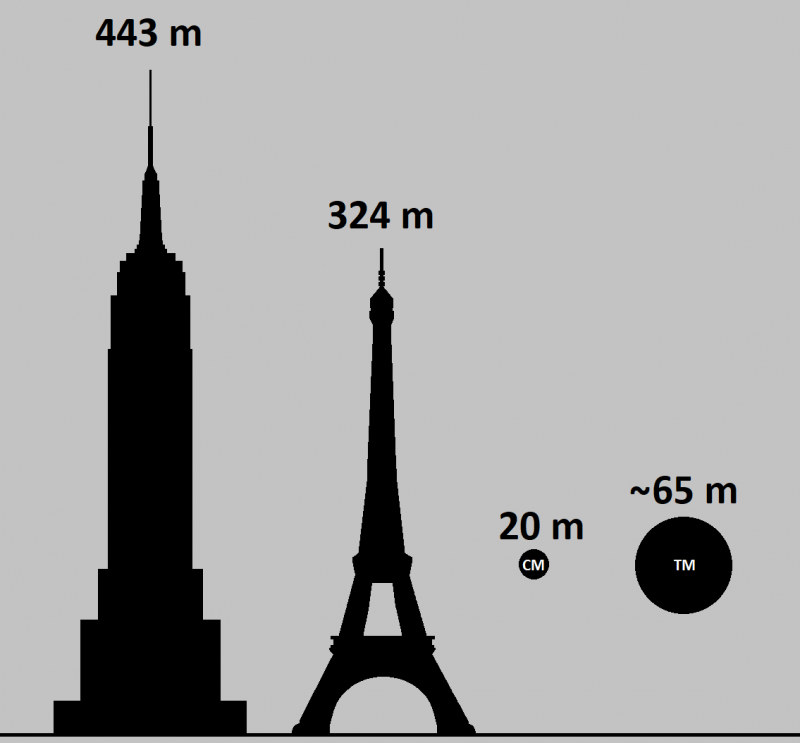
Chelyabinsk and Tunguska, in relation to the Empire State Building and the Eiffel Tower. Image via Phoenix CZE/ Wikimedia Commons (CC BY-SA 4.0).
Studying the Tunguska explosion to prepare for future events
In 2019, scientists published new research about the Tunguska event in a series of papers in a special issue of the journal Icarus. A workshop held at NASA’s Ames Research Center in Silicon Valley and sponsored by the NASA Planetary Defense Coordination Office inspired the research.
The theme of the workshop was Reexamining the astronomical cold case of the 1908 Tunguska impact event.
In recent decades – due to the Tunguska event and other smaller impacts – astronomers have come to take the possibility of catastrophic comet and asteroid impacts seriously. They now have observing programs to watch for near-Earth objects (NEOs). At regular meetings they discuss what might happen if we do find a large object on a collision course with Earth.
DART’s successful asteroid mission
DART – the Double Asteroid Redirection Test – was a huge hit, quite literally. The spacecraft smashed into an asteroid moon – called Didymos B, or Dimorphos – on September 26, 2022. The goal was to prove that we can send a spacecraft to push an asteroid slightly in its orbit. It was practice for a possible future scenario in which we find a hazardous asteroid barreling toward Earth. NASA said on October 11, 2022, that analysis of data obtained from the DART mission shows the spacecraft did, indeed, successfully alter the orbit of Dimorphos.
ESA’s Hera mission launched on October 7, 2024. The Hera mission will journey to Didymos to study DART’s impact. It’s expected to reach Didymos in late December 2026.
Because there are so few observed cases, a lot of uncertainty remains about how large asteroids break up in the atmosphere and how much damage they could cause on the ground. However, recent advancements in computational models, along with analyses of the Chelyabinsk and other meteor events, are helping to improve our understanding of these factors so that we can better evaluate potential asteroid threats in the future.
Tunguska is the largest cosmic impact witnessed by modern humans. It also is characteristic of the sort of impact we are likely to have to protect against in the future.
Bottom line: The Tunguska explosion on June 30, 1908, was the largest asteroid impact in recorded history. It flattened 830 square miles (2,150 square km) of Siberian forest. Researchers are preparing for future Tunguska-sized events.
On June 30, 1908, the largest asteroid impact in recorded history occurred on a warm summer morning in a remote part of Siberia, Russia. Now, we observe Asteroid Day each year on June 30, on the anniversary of what’s now known as the Tunguska explosion.
The explosion happened over sparsely populated forestland north of the Podkamennaya Tunguska River, in what is present-day Krasnoyarsk Krai.
The blast released enough energy to kill reindeer and flatten an estimated 80 million trees over an area of 830 square miles (2,150 square km). Witnesses reported seeing a bluish light nearly as bright as the sun moving across the sky. They said a flash and a sound similar to artillery fire followed the fireball. And, according to the American Physical Society, a powerful shockwave broke windows hundreds of miles away, knocking people off their feet.
Yet, ultimately, decades passed before anyone could explain the event.
The approximate location of the Tunguska event of 1908 in Siberia, Russia. Image via Bobby D. Bryant/ Wikimedia Commons (CC BY-SA 3.0).
Tunguska explosion: One of the largest in recorded history
A mysterious aspect of the Tunguska event was that, surprisingly, no one ever found a crater. But even without a crater, scientists still categorized it as an impact event. They now believe the incoming object never struck Earth. Instead, it exploded in the atmosphere, causing what’s known as an air burst. This type of atmospheric explosion was still enough to cause massive damage to the forest in the region.
Scientists determined the object was most likely a stony asteroid approximately 165-260 feet (50-80 m) in diameter, traveling at a speed of about 33,500 miles per hour (54,000 kph) and exploded 3 to 6 miles (5 to 10 km) above Earth’s surface.
The Tunguska explosion was equal to about 4 megatons of TNT. That would make it 250 times more powerful than the atom bomb dropped on Hiroshima.
Fallen trees from the 1908 Tunguska explosion at Tunguska in Siberia. It wasn’t until 1927 that Russian scientists – led by Leonid Kulik – were finally able to get to the scene. Image via Leonid Kulik/ Wikipedia.
Understanding the Tunguska explosion
Why did it take so long for scientists to understand what caused the Tunguska event? It took almost two decades for the first scientific expedition to reach this remote site in central Siberia. The region was extremely isolated, with no roads, railways or nearby settlements, making access possible only through long and difficult expeditions across the taiga.
This delay was further extended by major historical disruptions, including World War I, the Russian Revolution and the Russian Civil War, which made large-scale scientific travel and funding nearly impossible for many years.
It was not until 1927 that the first major scientific expedition, led by Leonid Kulik, finally reached the site. By then, much of the immediate physical evidence had already degraded or disappeared due to the passage of time and natural regeneration of the forest.
As a result of the delayed investigation and the lack of typical impact evidence such as a crater or large meteorite fragments, early interpretations remained uncertain, allowing speculative explanations to emerge before the true nature of the event was eventually understood. Some concocted wild theories to explain the Tunguska event. People claimed a stricken alien spacecraft caused the destruction. Later, they pointed to a mini-black-hole or a particle of antimatter.
The truth is just as interesting, and perhaps more terrifying … because it can happen again.
Photo of an air burst, in this case from a U.S. Navy submarine-launched Tomahawk cruise missile. A similar kind of air burst from an incoming asteroid flattened the trees in Siberia in 1908. Image via Wikimedia Commons.
The Chelyabinsk meteor impact
Interestingly, the Tunguska event basically did happen again with the Chelyabinsk meteor, 105 years later. On February 15, 2013, a similar – although smaller – airburst occurred over the city of Chelyabinsk, Russia, 1,500 miles (2,400 km) to the west of Tunguska.
Deborah Byrd :
Vapor trail left by the Chelyabinsk meteor, as captured by Flickr user Alex Alishevskikh.
The Chelyabinsk event provided vital clues as to what happened during the Tunguska event. As NASA explained, new evidence arrived to help solve the mystery of Tunguska:
This highly documented fireball created an opportunity for researchers to apply modern computer modeling techniques to explain what was seen, heard and felt.
The models were used with video observations of the fireball and maps of the damage on the ground to reconstruct the original size, motion and speed of the Chelyabinsk object. The resulting interpretation is that Chelyabinsk was most likely a stony asteroid the size of a five-story building [50–70 feet or 15–21 meters] that broke apart 15 miles (24 kilometers) above the ground. This generated a shock wave equivalent to a 550-kiloton explosion. The explosion’s shockwave blew out roughly a million windows and injured more than a thousand people. Fortunately, the force of the explosion was not enough to knock down trees or structures.
Per current understanding of the asteroid population, an object like the Chelyabinsk meteor can impact Earth every 10 to 100 years on average.
Chelyabinsk and Tunguska, in relation to the Empire State Building and the Eiffel Tower. Image via Phoenix CZE/ Wikimedia Commons (CC BY-SA 4.0).
Studying the Tunguska explosion to prepare for future events
In 2019, scientists published new research about the Tunguska event in a series of papers in a special issue of the journal Icarus. A workshop held at NASA’s Ames Research Center in Silicon Valley and sponsored by the NASA Planetary Defense Coordination Office inspired the research.
The theme of the workshop was Reexamining the astronomical cold case of the 1908 Tunguska impact event.
In recent decades – due to the Tunguska event and other smaller impacts – astronomers have come to take the possibility of catastrophic comet and asteroid impacts seriously. They now have observing programs to watch for near-Earth objects (NEOs). At regular meetings they discuss what might happen if we do find a large object on a collision course with Earth.
DART’s successful asteroid mission
DART – the Double Asteroid Redirection Test – was a huge hit, quite literally. The spacecraft smashed into an asteroid moon – called Didymos B, or Dimorphos – on September 26, 2022. The goal was to prove that we can send a spacecraft to push an asteroid slightly in its orbit. It was practice for a possible future scenario in which we find a hazardous asteroid barreling toward Earth. NASA said on October 11, 2022, that analysis of data obtained from the DART mission shows the spacecraft did, indeed, successfully alter the orbit of Dimorphos.
ESA’s Hera mission launched on October 7, 2024. The Hera mission will journey to Didymos to study DART’s impact. It’s expected to reach Didymos in late December 2026.
Because there are so few observed cases, a lot of uncertainty remains about how large asteroids break up in the atmosphere and how much damage they could cause on the ground. However, recent advancements in computational models, along with analyses of the Chelyabinsk and other meteor events, are helping to improve our understanding of these factors so that we can better evaluate potential asteroid threats in the future.
Tunguska is the largest cosmic impact witnessed by modern humans. It also is characteristic of the sort of impact we are likely to have to protect against in the future.
Bottom line: The Tunguska explosion on June 30, 1908, was the largest asteroid impact in recorded history. It flattened 830 square miles (2,150 square km) of Siberian forest. Researchers are preparing for future Tunguska-sized events.
The boat-billed heron is a startling creature! And behind its looks lie some powerful adaptations. Image via StockMediaSeller/ Shutterstock.
The boat-billed heron is one of those creatures that makes you look twice. The first time, to make sure you’re not seeing things. The second, to figure out what exactly you’re looking at.
This bird’s enormous bill seems far too large for its head. Its eyes are strikingly oversized. And its crest gives it the appearance of a rock star who has spent a little too much time in the mangroves. Yet none of this is accidental. Every one of these features serves a specific purpose and forms part of one of the most remarkable adaptations among water birds.
Heron, what a big mouth you have!
The boat-billed heron’s most distinctive feature is the enormous bill that gives the species its name. It is so broad and deep that it resembles a small boat turned upside down over its face. This wide-mouthed creature could easily have replaced the wolf in Little Red Riding Hood!
Compared with other herons, the size difference is so striking that it’s hard to believe they belong to the same group of birds.
And this bill is far more than a decorative feature. It’s actually an extraordinarily effective hunting tool. Its large surface area helps the bird to catch fish, crustaceans, frogs and other aquatic animals.
What is even more fascinating is that much of its anatomy appears to have evolved around this structure. The skull, neck and muscles all work together to support and control one of the most specialized hunting tools found in the wetlands of the Americas.
Seen head-on, the bill occupies such a large portion of the head that it’s hard to imagine how the rest of the bird managed to fit around it.
These birds have oversized bills, which are highly specialized hunting tools. They are perfectly adapted for catching aquatic prey. Image via Daniel Lloyd Blunk-Fernández/ Unsplash.
A head built to support an impressive tool
Having one of the most oversized bills in the heron world comes with certain anatomical challenges. Evolution has invested a lot of this bird’s resources into this feature.
The boat-billed heron’s skull is sturdier than you might expect for a bird of its size, and its neck muscles are especially well developed to support the weight of the head. In a sense, much of its anatomy is organized around a single mission: handling that extraordinary bill efficiently.
A bill this large needs a strong neck and a sturdy skull to support it. Image via Katharina Kammermann/ Pixabay.
The eyes of a nocturnal hunter
While many herons are mainly active during the day, the boat-billed heron prefers to emerge after dark.
To do so, it relies on exceptionally large eyes capable of making the most of the limited available light. Thanks to this adaptation, it can detect movement on the water’s surface when most other birds are already at rest.
These huge eyes give it such an unusual expression that many people compare it to an owl, despite the fact that the two are not closely related.
Unlike most herons, the boat-billed heron hunts at night. Its huge eyes help it spot prey in the dark. Image via Goszton/ Pexels.
A hairstyle worthy of a rock star
And if the bill and eyes are not enough to attract attention, the boat-billed heron also sports an elegant crest made up of long, dark feathers that grow from the back of the head. More than a few people would envy such impressive “hair”!
These feathers can lie smoothly backward or become more prominent when the bird is alert. The result is a slightly tousled appearance that adds to its eccentric look. Both males and females possess this striking crest, and during courtship it may play an important role in their visual displays.
Few birds manage to look dignified, comical and powerful all at once, but this species pulls it off effortlessly.
Its long, dark crest adds even more personality, making this already unusual bird look both elegant and rebellious. Image via Christian Musat/ Shutterstock.
The art of disappearing into the mangroves
Despite its eye-catching appearance, the boat-billed heron is surprisingly difficult to spot.
It inhabits tropical wetlands, particularly mangroves, estuaries, coastal lagoons and the banks of slow-moving rivers. Its range extends across much of tropical America, from southern Mexico through Central America and into large areas of South America.
These habitats are not only its home but also one of its greatest advantages. Submerged roots, deep shadows and tangled vegetation create the perfect setting for both hunting and hiding.
Its plumage – a blend of grays, blacks and browns – blends seamlessly into this environment. During the day, it remains motionless among branches and roots, letting its camouflage do the work as it observes from a hidden vantage point.
It’s likely that many have passed within just a few feet of a boat-billed heron without ever noticing it.
Despite its unusual appearance, the boat-billed heron is remarkably hard to spot. Its camouflage allows it to disappear among mangroves and riverside vegetation. Image via Goszton/ Pexels.
A patient and methodical hunter
The hunting strategy of this species relies more on patience than speed.
Rather than constantly patrolling the shoreline in search of food, it often stands still for long periods, waiting for the right opportunity. When prey comes close enough, it strikes with remarkable speed and precision.
Most of its activity takes place at dusk and during the night. While other water birds become less active, the boat-billed heron uses its enormous eyes to detect even the slightest movement in shallow water.
It will often remain motionless for minutes at a time, carefully watching the surface. Once it detects potential prey, it reacts with impressive speed. It uses its huge bill like a trap, snapping it shut around fish, amphibians or crustaceans before they have a chance to react.
Its diet includes small fish, frogs, aquatic insects, crabs, shrimp and other wetland creatures. It is an opportunistic hunter, capable of taking advantage of almost any food source it encounters in shallow waters.
Patience is its greatest hunting skill. It stands perfectly still until prey comes close, then strikes with lightning-fast precision. Image via Goszton/ Pexels.
A flight silhouette like no other
In flight, it adopts the typical heron posture, with its neck tucked back into a characteristic curve.
There is, however, one detail that sets it apart immediately: its enormous head. Even from a distance, its silhouette looks unusual because the front part of the body appears disproportionately large compared with the rest.
Chicks are born looking outlandish
Boat-billed heron chicks look like unfinished miniature versions of the adults.
From a very young age, they already possess a surprisingly large bill for their size, giving them a disproportionate and somewhat comical appearance. As they grow, this feature becomes increasingly pronounced until it reaches the mighty dimensions of adult birds.
Both parents build the nest, incubate the eggs and later feed the chicks through regurgitation, a common practice among many water birds.
The bird that puzzled scientists
For a long time, ornithologists struggled to determine exactly where this species belonged on the avian evolutionary tree.
Its appearance was so different from that of other herons that some specialists even suggested it deserved its own classification. Although modern studies have clarified its evolutionary relationships, it remains one of the most distinctive species in the entire group.
And perhaps that is the best way to describe it: a heron that looks startlingly unlike a heron.
Scientists once questioned whether this was really a heron. We can see why! Image via Goszton/ Pexels.
Bottom line: The boat-billed heron is a striking example of evolution going big. This creature has an oversized bill, large eyes, and an anatomy shaped around a specialized hunting tool.
The boat-billed heron is a startling creature! And behind its looks lie some powerful adaptations. Image via StockMediaSeller/ Shutterstock.
The boat-billed heron is one of those creatures that makes you look twice. The first time, to make sure you’re not seeing things. The second, to figure out what exactly you’re looking at.
This bird’s enormous bill seems far too large for its head. Its eyes are strikingly oversized. And its crest gives it the appearance of a rock star who has spent a little too much time in the mangroves. Yet none of this is accidental. Every one of these features serves a specific purpose and forms part of one of the most remarkable adaptations among water birds.
Heron, what a big mouth you have!
The boat-billed heron’s most distinctive feature is the enormous bill that gives the species its name. It is so broad and deep that it resembles a small boat turned upside down over its face. This wide-mouthed creature could easily have replaced the wolf in Little Red Riding Hood!
Compared with other herons, the size difference is so striking that it’s hard to believe they belong to the same group of birds.
And this bill is far more than a decorative feature. It’s actually an extraordinarily effective hunting tool. Its large surface area helps the bird to catch fish, crustaceans, frogs and other aquatic animals.
What is even more fascinating is that much of its anatomy appears to have evolved around this structure. The skull, neck and muscles all work together to support and control one of the most specialized hunting tools found in the wetlands of the Americas.
Seen head-on, the bill occupies such a large portion of the head that it’s hard to imagine how the rest of the bird managed to fit around it.
These birds have oversized bills, which are highly specialized hunting tools. They are perfectly adapted for catching aquatic prey. Image via Daniel Lloyd Blunk-Fernández/ Unsplash.
A head built to support an impressive tool
Having one of the most oversized bills in the heron world comes with certain anatomical challenges. Evolution has invested a lot of this bird’s resources into this feature.
The boat-billed heron’s skull is sturdier than you might expect for a bird of its size, and its neck muscles are especially well developed to support the weight of the head. In a sense, much of its anatomy is organized around a single mission: handling that extraordinary bill efficiently.
A bill this large needs a strong neck and a sturdy skull to support it. Image via Katharina Kammermann/ Pixabay.
The eyes of a nocturnal hunter
While many herons are mainly active during the day, the boat-billed heron prefers to emerge after dark.
To do so, it relies on exceptionally large eyes capable of making the most of the limited available light. Thanks to this adaptation, it can detect movement on the water’s surface when most other birds are already at rest.
These huge eyes give it such an unusual expression that many people compare it to an owl, despite the fact that the two are not closely related.
Unlike most herons, the boat-billed heron hunts at night. Its huge eyes help it spot prey in the dark. Image via Goszton/ Pexels.
A hairstyle worthy of a rock star
And if the bill and eyes are not enough to attract attention, the boat-billed heron also sports an elegant crest made up of long, dark feathers that grow from the back of the head. More than a few people would envy such impressive “hair”!
These feathers can lie smoothly backward or become more prominent when the bird is alert. The result is a slightly tousled appearance that adds to its eccentric look. Both males and females possess this striking crest, and during courtship it may play an important role in their visual displays.
Few birds manage to look dignified, comical and powerful all at once, but this species pulls it off effortlessly.
Its long, dark crest adds even more personality, making this already unusual bird look both elegant and rebellious. Image via Christian Musat/ Shutterstock.
The art of disappearing into the mangroves
Despite its eye-catching appearance, the boat-billed heron is surprisingly difficult to spot.
It inhabits tropical wetlands, particularly mangroves, estuaries, coastal lagoons and the banks of slow-moving rivers. Its range extends across much of tropical America, from southern Mexico through Central America and into large areas of South America.
These habitats are not only its home but also one of its greatest advantages. Submerged roots, deep shadows and tangled vegetation create the perfect setting for both hunting and hiding.
Its plumage – a blend of grays, blacks and browns – blends seamlessly into this environment. During the day, it remains motionless among branches and roots, letting its camouflage do the work as it observes from a hidden vantage point.
It’s likely that many have passed within just a few feet of a boat-billed heron without ever noticing it.
Despite its unusual appearance, the boat-billed heron is remarkably hard to spot. Its camouflage allows it to disappear among mangroves and riverside vegetation. Image via Goszton/ Pexels.
A patient and methodical hunter
The hunting strategy of this species relies more on patience than speed.
Rather than constantly patrolling the shoreline in search of food, it often stands still for long periods, waiting for the right opportunity. When prey comes close enough, it strikes with remarkable speed and precision.
Most of its activity takes place at dusk and during the night. While other water birds become less active, the boat-billed heron uses its enormous eyes to detect even the slightest movement in shallow water.
It will often remain motionless for minutes at a time, carefully watching the surface. Once it detects potential prey, it reacts with impressive speed. It uses its huge bill like a trap, snapping it shut around fish, amphibians or crustaceans before they have a chance to react.
Its diet includes small fish, frogs, aquatic insects, crabs, shrimp and other wetland creatures. It is an opportunistic hunter, capable of taking advantage of almost any food source it encounters in shallow waters.
Patience is its greatest hunting skill. It stands perfectly still until prey comes close, then strikes with lightning-fast precision. Image via Goszton/ Pexels.
A flight silhouette like no other
In flight, it adopts the typical heron posture, with its neck tucked back into a characteristic curve.
There is, however, one detail that sets it apart immediately: its enormous head. Even from a distance, its silhouette looks unusual because the front part of the body appears disproportionately large compared with the rest.
Chicks are born looking outlandish
Boat-billed heron chicks look like unfinished miniature versions of the adults.
From a very young age, they already possess a surprisingly large bill for their size, giving them a disproportionate and somewhat comical appearance. As they grow, this feature becomes increasingly pronounced until it reaches the mighty dimensions of adult birds.
Both parents build the nest, incubate the eggs and later feed the chicks through regurgitation, a common practice among many water birds.
The bird that puzzled scientists
For a long time, ornithologists struggled to determine exactly where this species belonged on the avian evolutionary tree.
Its appearance was so different from that of other herons that some specialists even suggested it deserved its own classification. Although modern studies have clarified its evolutionary relationships, it remains one of the most distinctive species in the entire group.
And perhaps that is the best way to describe it: a heron that looks startlingly unlike a heron.
Scientists once questioned whether this was really a heron. We can see why! Image via Goszton/ Pexels.
Bottom line: The boat-billed heron is a striking example of evolution going big. This creature has an oversized bill, large eyes, and an anatomy shaped around a specialized hunting tool.