
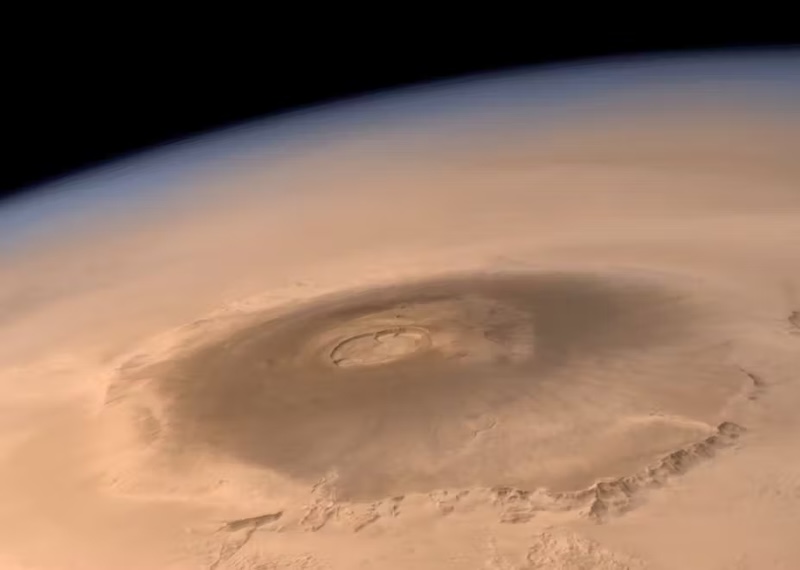
- Mars has many volcanoes, just like Earth. Scientists have long thought that these volcanoes, back when they were still active, were relatively simple and disconnected from each other.
- But a new study of data from the InSight lander mission shows that there were vast, interconnected magma systems below the Martian surface.
- That would mean Mars’ volcanic systems were more earthlike than previously thought, despite the planet not having plate tectonics.
Huge ancient magma systems on Mars
Like Earth, Mars has numerous volcanoes dotting its surface. As far as we know, those volcanoes are now extinct. And scientists have long thought the planet’s volcanic system overall was simpler than Earth’s, since Mars lacks plate tectonics. But now there’s evidence that isn’t quite true.
Scientists at the University of Oxford in the U.K. said on June 26, 2026, they’ve found evidence that Mars once had enormous, Earth-like magma systems – interconnected zones of molten rock – deep beneath its surface.
Scientists have long categorized Mars as a stagnant lid planet. That means it has one large solid surface, or “lid,” instead of the surface being broken into smaller tectonic plates like on Earth. On Earth, plate tectonics drives volcanism, recycling and continent–building.
But this new study points to huge, interconnected magma systems. They show that Mars’ volcanoes weren’t just simple isolated formations as previously assumed. And they force us to ask … How did this occur without plate tectonics?
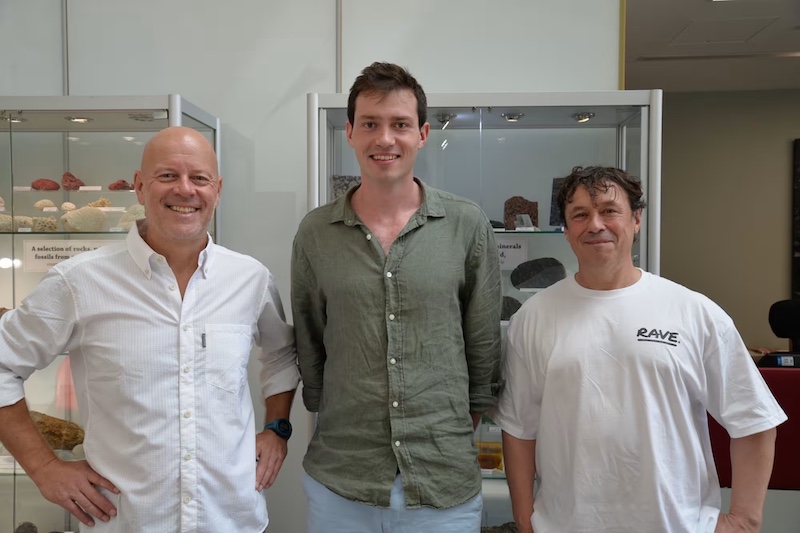
Lead author Tobermory Mackay-Champion at the University of Oxford said:
We’ve traditionally assumed that volcanism on Mars was relatively simple compared to that on Earth. But this discovery suggests the planet could sustain massive, long-lived magmatic systems capable of evolving and reprocessing molten rock throughout the crust. Because these systems are known to generate large metal deposits, Mars may hold significantly more near-surface mineral wealth than previously recognised, boosting its potential for future mining, crewed missions and eventually, permanent settlements.
The researchers published their peer-reviewed findings in Nature Astronomy on June 26, 2026.
NEW: Mars may have been far more Earth-like beneath its surface than scientists once thought ??Oxford researchers have uncovered evidence of vast hidden magma systems that could reshape our understanding of how rocky planets evolve ??https://bit.ly/4wwd4jx
— University of Oxford (@ox.ac.uk) 2026-06-26T13:26:02.740122411Z
InSight spacecraft data provides clues
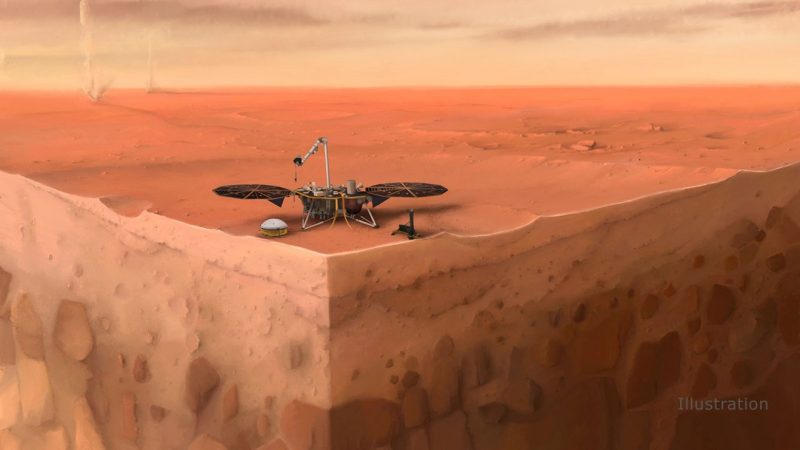
The researchers made the discovery when analyzing data from NASA’s InSight lander. InSight ended its mission in 2022, but there is still a ton of data to study. The lander recorded seismic waves from marsquakes and meteorite impacts.
The researchers used the data to investigate an unusual boundary about 15 miles (24 km) below the surface. Scientists knew about the boundary before, but didn’t know what it was. One possibility is that it marked a transition between two different types of rock. To test this, the researchers compared hundreds of different rock compositions with the seismic data.
Very different rocks below the boundary
The results showed that there was indeed a boundary between two types of rock. Below the boundary, the rocks were ultramafic, meaning rich in iron and magnesium. But interestingly, the rocks above the boundary were quite different. They were mafic rocks, rich in silica.
Why is the rock layer below the boundary so different from the layer above? The researchers say that molten rock likely pooled there. Then, it gradually separated into different materials over time. This left behind a residue of dense crystals at the base of the crust. Meanwhile, lighter molten rock moved upwards. This is similar to what happens on Earth beneath volcanic arcs. This is also linked to the formation of continents, although Mars never got to that stage.
Vast magma layer across the northern hemisphere
The researchers say this magma layer was vast, spanning hundreds of miles sideways beneath the surface. That means that instead of Mars’ volcanoes being isolated, they were actually interconnected by these sprawling magma systems. On Earth, this is known as transcrustal magmatism. Until now, scientists only knew of it occurring on one planet: Earth.
But if it happened on Mars too, that raises questions about how rocky planets form and if they can be habitable. Co-author Jon Wade at the University of Oxford said:
One of the big questions in planetary science is whether Earth is unique. If Mars could develop this kind of complex crust without plate tectonics, then maybe the conditions needed for habitability can emerge on more planets than we realised, including those previously dismissed based on size or their apparent lack of tectonic activity.
In 2024, scientists reported evidence for magma possibly still existing beneath Olympus Mons, the largest volcano on Mars. If so, it would mean that there is still some residual tectonic and volcanic activity below the surface today. Mars might still be alive, at least geologically!
Bottom line: Scientists have found evidence of enormous ancient magma systems on Mars. They show that Mars’ volcanic systems were once more complex than first thought.
Source: Seismic evidence for a melt-depleted lower crust and transcrustal magmatism on Mars
Read more:
Ancient volcanoes on Mars were diverse
The most recent volcanoes on Mars were surprisingly active
34 dust devils on Mars in 1 shot! Can you spot them all?
The post Huge magma systems on Mars existed below the surface first appeared on EarthSky.
from EarthSky https://ift.tt/mdAGlMO
- Mars has many volcanoes, just like Earth. Scientists have long thought that these volcanoes, back when they were still active, were relatively simple and disconnected from each other.
- But a new study of data from the InSight lander mission shows that there were vast, interconnected magma systems below the Martian surface.
- That would mean Mars’ volcanic systems were more earthlike than previously thought, despite the planet not having plate tectonics.
Huge ancient magma systems on Mars
Like Earth, Mars has numerous volcanoes dotting its surface. As far as we know, those volcanoes are now extinct. And scientists have long thought the planet’s volcanic system overall was simpler than Earth’s, since Mars lacks plate tectonics. But now there’s evidence that isn’t quite true.
Scientists at the University of Oxford in the U.K. said on June 26, 2026, they’ve found evidence that Mars once had enormous, Earth-like magma systems – interconnected zones of molten rock – deep beneath its surface.
Scientists have long categorized Mars as a stagnant lid planet. That means it has one large solid surface, or “lid,” instead of the surface being broken into smaller tectonic plates like on Earth. On Earth, plate tectonics drives volcanism, recycling and continent–building.
But this new study points to huge, interconnected magma systems. They show that Mars’ volcanoes weren’t just simple isolated formations as previously assumed. And they force us to ask … How did this occur without plate tectonics?
Lead author Tobermory Mackay-Champion at the University of Oxford said:
We’ve traditionally assumed that volcanism on Mars was relatively simple compared to that on Earth. But this discovery suggests the planet could sustain massive, long-lived magmatic systems capable of evolving and reprocessing molten rock throughout the crust. Because these systems are known to generate large metal deposits, Mars may hold significantly more near-surface mineral wealth than previously recognised, boosting its potential for future mining, crewed missions and eventually, permanent settlements.
The researchers published their peer-reviewed findings in Nature Astronomy on June 26, 2026.
NEW: Mars may have been far more Earth-like beneath its surface than scientists once thought ??Oxford researchers have uncovered evidence of vast hidden magma systems that could reshape our understanding of how rocky planets evolve ??https://bit.ly/4wwd4jx
— University of Oxford (@ox.ac.uk) 2026-06-26T13:26:02.740122411Z
InSight spacecraft data provides clues
The researchers made the discovery when analyzing data from NASA’s InSight lander. InSight ended its mission in 2022, but there is still a ton of data to study. The lander recorded seismic waves from marsquakes and meteorite impacts.
The researchers used the data to investigate an unusual boundary about 15 miles (24 km) below the surface. Scientists knew about the boundary before, but didn’t know what it was. One possibility is that it marked a transition between two different types of rock. To test this, the researchers compared hundreds of different rock compositions with the seismic data.
Very different rocks below the boundary
The results showed that there was indeed a boundary between two types of rock. Below the boundary, the rocks were ultramafic, meaning rich in iron and magnesium. But interestingly, the rocks above the boundary were quite different. They were mafic rocks, rich in silica.
Why is the rock layer below the boundary so different from the layer above? The researchers say that molten rock likely pooled there. Then, it gradually separated into different materials over time. This left behind a residue of dense crystals at the base of the crust. Meanwhile, lighter molten rock moved upwards. This is similar to what happens on Earth beneath volcanic arcs. This is also linked to the formation of continents, although Mars never got to that stage.
Vast magma layer across the northern hemisphere
The researchers say this magma layer was vast, spanning hundreds of miles sideways beneath the surface. That means that instead of Mars’ volcanoes being isolated, they were actually interconnected by these sprawling magma systems. On Earth, this is known as transcrustal magmatism. Until now, scientists only knew of it occurring on one planet: Earth.
But if it happened on Mars too, that raises questions about how rocky planets form and if they can be habitable. Co-author Jon Wade at the University of Oxford said:
One of the big questions in planetary science is whether Earth is unique. If Mars could develop this kind of complex crust without plate tectonics, then maybe the conditions needed for habitability can emerge on more planets than we realised, including those previously dismissed based on size or their apparent lack of tectonic activity.
In 2024, scientists reported evidence for magma possibly still existing beneath Olympus Mons, the largest volcano on Mars. If so, it would mean that there is still some residual tectonic and volcanic activity below the surface today. Mars might still be alive, at least geologically!
Bottom line: Scientists have found evidence of enormous ancient magma systems on Mars. They show that Mars’ volcanic systems were once more complex than first thought.
Source: Seismic evidence for a melt-depleted lower crust and transcrustal magmatism on Mars
Read more:
Ancient volcanoes on Mars were diverse
The most recent volcanoes on Mars were surprisingly active
34 dust devils on Mars in 1 shot! Can you spot them all?
The post Huge magma systems on Mars existed below the surface first appeared on EarthSky.
from EarthSky https://ift.tt/mdAGlMO

Aucun commentaire:
Enregistrer un commentaire