aads

Summer Triangle: Star pattern of the season

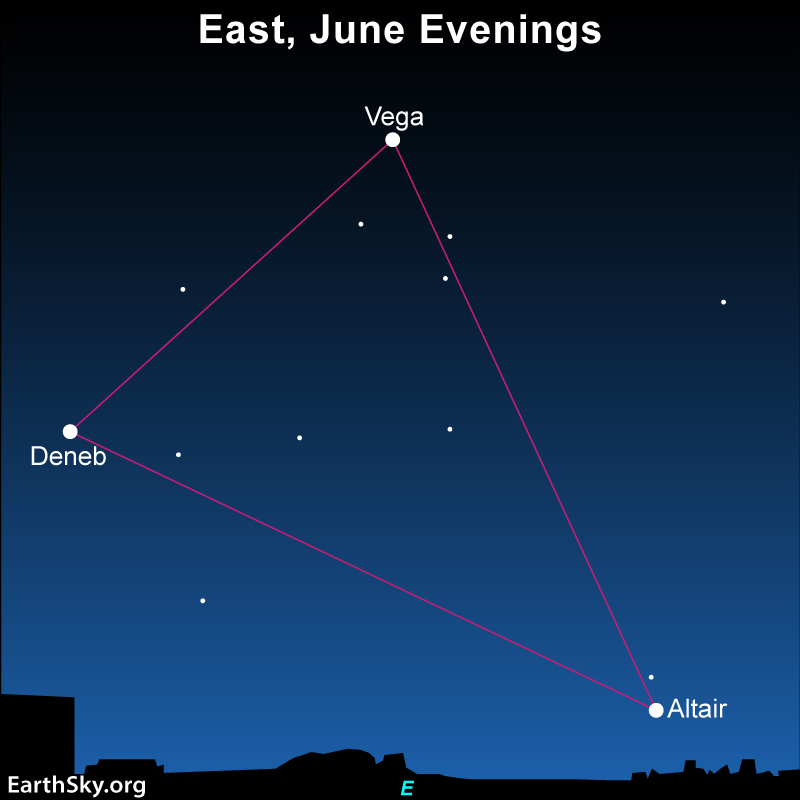
Star chart: Pink lines forming a large triangle in the sky with a labeled star at each corner.
The Summer Triangle, ascending for Northern Hemisphere observers in the east on June evenings. Are you in the Southern Hemisphere? See below. Chart via EarthSky.

Northern summer is Summer Triangle time

During the summertime in the Northern Hemisphere, the days are long. The sun is high in the midday sky. And our summer sky is with us, too. Watch for the famous Summer Triangle, now ascending in the eastern sky on these late June and July evenings.

The Summer Triangle isn’t a constellation. It’s an asterism, or noticeable pattern of stars. This pattern consists of three bright stars in three separate constellations: Deneb in the constellation Cygnus the Swan, Vega in the constellation Lyra the Harp, and Altair in the constellation Aquila the Eagle.

Learn to recognize the Summer Triangle asterism now, and you can watch it all summer as it shifts higher in the east, then finally appears high overhead in the late northern summer and early northern autumn sky.

From the Southern Hemisphere, the Summer Triangle appears upside down – as it’s viewed from the Northern Hemisphere – and low above the northern horizon during the southern winter months.

Seeing the Summer Triangle from the Northern Hemisphere

As night falls in June or July, look east for a sparkling blue-white star. That will be Vega, in Lyra the Harp. Reigning at the apex of the celebrated Summer Triangle, Vega is also the brightest of the Summer Triangle’s three stars, which are all bright enough to be seen from many light-polluted cities.

Look to the lower right of Vega to locate the Summer Triangle’s second brightest star. That’s Altair, the brightest star in the constellation Aquila the Eagle. A ruler (12 inches/ 30 cm) held at arm’s length fills the gap between these two stars.

Look to the lower left of Vega for another bright star: Deneb, the brightest in the constellation Cygnus the Swan and the third brightest in the Summer Triangle. An outstretched hand at arm’s length approximates the distance from Vega to Deneb.

It’s difficult to convey the huge size of the Summer Triangle. But you’ll see it. These three bright stars — Vega, Deneb and Altair — will become your summertime favorites.
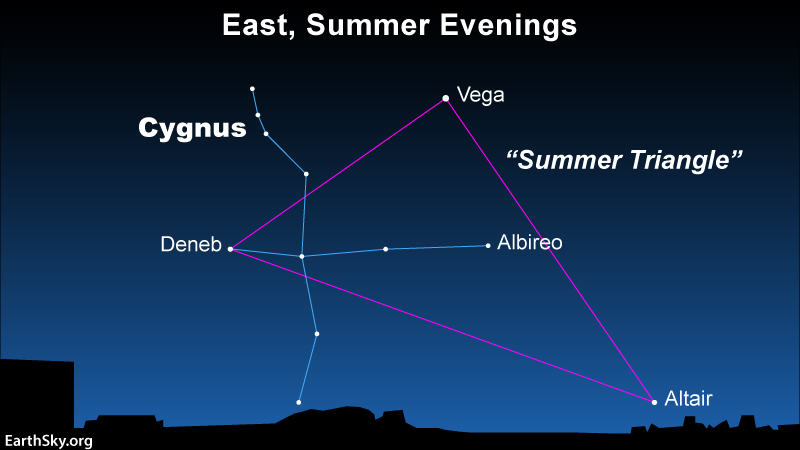
Star chart with the Summer Triangle in purple, with Cygnus constellation in blue overlying the triangle.
Once Cygnus the Swan clears the horizon, you can easily see all of the Summer Triangle asterism. It’s a summertime favorite and easy to see.

Summer Triangle in Winter? A View from the South

Via Daniel Gaussen, Founder & Guide – Stargaze Mackenzie – New Zealand

From the Southern Hemisphere, the Summer Triangle appears flipped upside down and rises low into the northern sky. But, for many at populated latitudes across the Southern Hemisphere, Deneb is close to or below the northern horizon rendering the triangle incomplete for many observers. If you are closer to the South Pole than about 45 degrees S. latitude, you won’t see Deneb.

So we don’t tend to recognize the triangle as it is seen in the north, and even if we do, it’s only visible, briefly, during our winter season. So the name Summer Triangle is somewhat lost on us. Instead, the sight of Vega and Altair rising to the northeast are a clear sign of winter in the southern hemisphere.

Altair reaches a modest altitude of about 35–40 degrees from latitudes like those in New Zealand and Australia.

But Vega sits very low, between about 5–15 degrees from many places down under. For example:

  • Sydney, Australia (approx. 34° S): Vega reaches a maximum altitude of about 17° above the northern horizon.
  • Auckland, New Zealand (approx. 37° S): Vega reaches a maximum altitude of about 14° above the northern horizon.
  • Christchurch, New Zealand (approx. 43.5° S): Vega reaches a maximum altitude of about 7.5° above the northern horizon.

Still, Vega is the 5th-brightest star as seen from Earth as a whole. So it blazes brightly to those with a clear view of the northern horizon. And both Vega and Altair stars act as luminous markers of the Southern Hemisphere’s winter northern sky.

Arching through the sky between these two stars is the glow of the Milky Way, with Vega to the west and Altair to the east. They frame the galaxy as if it were a river flowing between them.

In Japanese tradition, this is celebrated in July during the summer star festival and the story of Tanabata, where Vega and Altair represent two separated lovers, divided by the Milky Way and allowed to meet only once a year.

From the Southern Hemisphere, this cultural imagery remains fitting, as the two stars appear as distant beacons low in the northern sky, divided by the glowing stream of the galaxy.
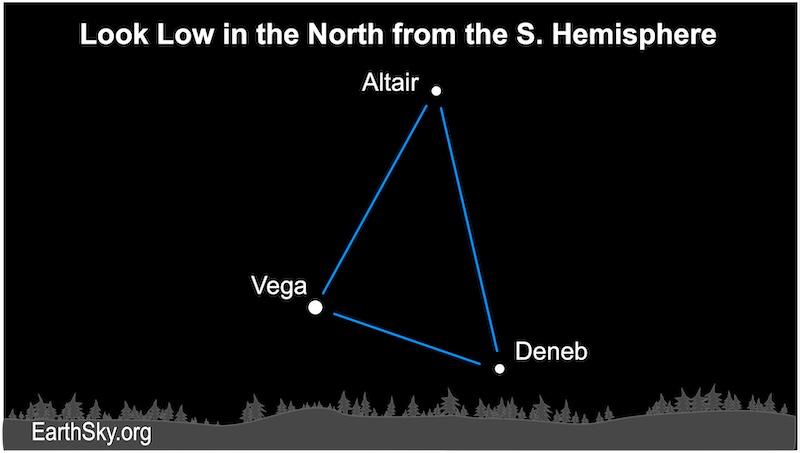
Star chart showing 3 bright stars, Vega, Deneb and Altair, from about 35 degrees S.
Looking north from the Southern Hemisphere. Assuming you’re at about 40 degrees S. – to the equator – you can see all of the so-called Summer Triangle during your southern winter months by looking north. If you’re closer to the South Pole than about 40 degrees S. latitude, you likely won’t see Deneb! Technically you can see it from slightly further south. But, in reality, the murk on your northern horizon will likely block it from your view. Chart via EarthSky.

The Summer Triangle is a northern road map to the Milky Way, too

Likewise, from the Northern Hemisphere, if you’re lucky enough to be under a dark sky on a moonless night, you’ll see the great swath of stars passing between the Summer Triangle’s Vega and Altair. For our latitudes, the star Deneb bobs in the middle of this river of stars, which arcs across dark summer skies. This sky river is, of course, the edgewise view into our own Milky Way galaxy. Every star you see with the unaided eye is a member of the Milky Way. And at this time of year, we can see clearly into the galaxy’s flat disk, where most of the stars congregate. By August and September, we’ll have a good view toward the galaxy’s center.

Once northern observers master the Summer Triangle, they can always locate the Milky Way on a clear, dark night. How about making the most of a dark summer night to explore this band of stars, this starlit boulevard with its celestial delights? Use binoculars to reveal the gossamer beauty of the haunting nebulae and bejeweled star clusters along this starlit trail.
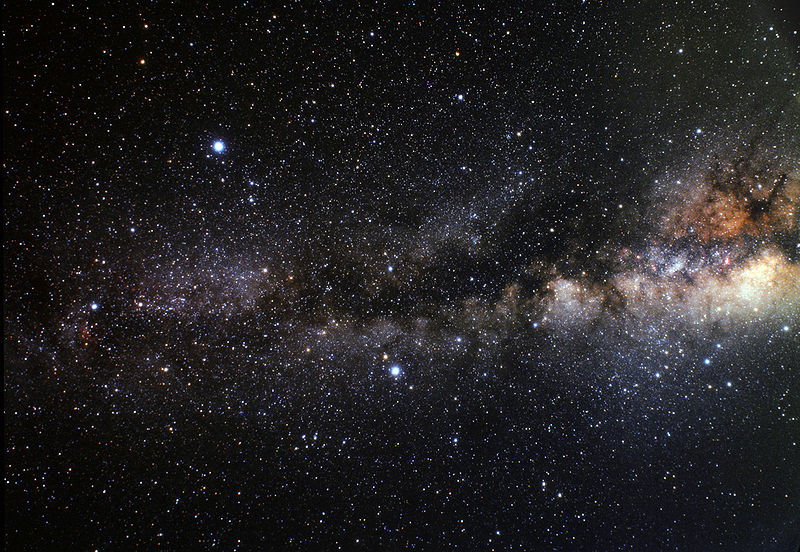
Densely starry sky with detailed cloudy band of the Milky Way and 3 extra-bright stars well separated.
The 3 brightest stars in this image make up the asterism of the Summer Triangle, a giant triangle in the sky composed of the bright stars Vega (top left), Altair (lower middle) and Deneb (far left). Also in this image, under a dark sky and on a moonless night, is the Great Rift that passes right through the Milky Way and the Summer Triangle. Image via NASA/ A. Fujii/ ESA.

A word about asterisms

As we mentioned above, asterisms aren’t constellations; they’re just patterns on the sky’s dome. Constellations generally come to us from ancient times. In the 1930s, the International Astronomical Union officially drew the boundaries of the 88 constellations we recognize today.

Meanwhile, you can make up and name your own asterisms, in much the same way you can recognize shapes in puffy clouds on a summer day.

Of course, some asterisms are so obvious that they’re acknowledged around the world. And – especially if you can see it from the Northern Hemisphere – the Summer Triangle is one of these.

Bottom line: For us in the Northern Hemisphere, the Summer Triangle says “summer” in the sky.

What’s a constellation? What’s an asterism?

What is the Milky Way? It’s our home galaxy

The post Summer Triangle: Star pattern of the season first appeared on EarthSky.


from EarthSky https://ift.tt/Evz42Hl
Star chart: Pink lines forming a large triangle in the sky with a labeled star at each corner.
The Summer Triangle, ascending for Northern Hemisphere observers in the east on June evenings. Are you in the Southern Hemisphere? See below. Chart via EarthSky.

Northern summer is Summer Triangle time

During the summertime in the Northern Hemisphere, the days are long. The sun is high in the midday sky. And our summer sky is with us, too. Watch for the famous Summer Triangle, now ascending in the eastern sky on these late June and July evenings.

The Summer Triangle isn’t a constellation. It’s an asterism, or noticeable pattern of stars. This pattern consists of three bright stars in three separate constellations: Deneb in the constellation Cygnus the Swan, Vega in the constellation Lyra the Harp, and Altair in the constellation Aquila the Eagle.

Learn to recognize the Summer Triangle asterism now, and you can watch it all summer as it shifts higher in the east, then finally appears high overhead in the late northern summer and early northern autumn sky.

From the Southern Hemisphere, the Summer Triangle appears upside down – as it’s viewed from the Northern Hemisphere – and low above the northern horizon during the southern winter months.

Seeing the Summer Triangle from the Northern Hemisphere

As night falls in June or July, look east for a sparkling blue-white star. That will be Vega, in Lyra the Harp. Reigning at the apex of the celebrated Summer Triangle, Vega is also the brightest of the Summer Triangle’s three stars, which are all bright enough to be seen from many light-polluted cities.

Look to the lower right of Vega to locate the Summer Triangle’s second brightest star. That’s Altair, the brightest star in the constellation Aquila the Eagle. A ruler (12 inches/ 30 cm) held at arm’s length fills the gap between these two stars.

Look to the lower left of Vega for another bright star: Deneb, the brightest in the constellation Cygnus the Swan and the third brightest in the Summer Triangle. An outstretched hand at arm’s length approximates the distance from Vega to Deneb.

It’s difficult to convey the huge size of the Summer Triangle. But you’ll see it. These three bright stars — Vega, Deneb and Altair — will become your summertime favorites.

Star chart with the Summer Triangle in purple, with Cygnus constellation in blue overlying the triangle.
Once Cygnus the Swan clears the horizon, you can easily see all of the Summer Triangle asterism. It’s a summertime favorite and easy to see.

Summer Triangle in Winter? A View from the South

Via Daniel Gaussen, Founder & Guide – Stargaze Mackenzie – New Zealand

From the Southern Hemisphere, the Summer Triangle appears flipped upside down and rises low into the northern sky. But, for many at populated latitudes across the Southern Hemisphere, Deneb is close to or below the northern horizon rendering the triangle incomplete for many observers. If you are closer to the South Pole than about 45 degrees S. latitude, you won’t see Deneb.

So we don’t tend to recognize the triangle as it is seen in the north, and even if we do, it’s only visible, briefly, during our winter season. So the name Summer Triangle is somewhat lost on us. Instead, the sight of Vega and Altair rising to the northeast are a clear sign of winter in the southern hemisphere.

Altair reaches a modest altitude of about 35–40 degrees from latitudes like those in New Zealand and Australia.

But Vega sits very low, between about 5–15 degrees from many places down under. For example:

  • Sydney, Australia (approx. 34° S): Vega reaches a maximum altitude of about 17° above the northern horizon.
  • Auckland, New Zealand (approx. 37° S): Vega reaches a maximum altitude of about 14° above the northern horizon.
  • Christchurch, New Zealand (approx. 43.5° S): Vega reaches a maximum altitude of about 7.5° above the northern horizon.

Still, Vega is the 5th-brightest star as seen from Earth as a whole. So it blazes brightly to those with a clear view of the northern horizon. And both Vega and Altair stars act as luminous markers of the Southern Hemisphere’s winter northern sky.

Arching through the sky between these two stars is the glow of the Milky Way, with Vega to the west and Altair to the east. They frame the galaxy as if it were a river flowing between them.

In Japanese tradition, this is celebrated in July during the summer star festival and the story of Tanabata, where Vega and Altair represent two separated lovers, divided by the Milky Way and allowed to meet only once a year.

From the Southern Hemisphere, this cultural imagery remains fitting, as the two stars appear as distant beacons low in the northern sky, divided by the glowing stream of the galaxy.

Star chart showing 3 bright stars, Vega, Deneb and Altair, from about 35 degrees S.
Looking north from the Southern Hemisphere. Assuming you’re at about 40 degrees S. – to the equator – you can see all of the so-called Summer Triangle during your southern winter months by looking north. If you’re closer to the South Pole than about 40 degrees S. latitude, you likely won’t see Deneb! Technically you can see it from slightly further south. But, in reality, the murk on your northern horizon will likely block it from your view. Chart via EarthSky.

The Summer Triangle is a northern road map to the Milky Way, too

Likewise, from the Northern Hemisphere, if you’re lucky enough to be under a dark sky on a moonless night, you’ll see the great swath of stars passing between the Summer Triangle’s Vega and Altair. For our latitudes, the star Deneb bobs in the middle of this river of stars, which arcs across dark summer skies. This sky river is, of course, the edgewise view into our own Milky Way galaxy. Every star you see with the unaided eye is a member of the Milky Way. And at this time of year, we can see clearly into the galaxy’s flat disk, where most of the stars congregate. By August and September, we’ll have a good view toward the galaxy’s center.

Once northern observers master the Summer Triangle, they can always locate the Milky Way on a clear, dark night. How about making the most of a dark summer night to explore this band of stars, this starlit boulevard with its celestial delights? Use binoculars to reveal the gossamer beauty of the haunting nebulae and bejeweled star clusters along this starlit trail.

Densely starry sky with detailed cloudy band of the Milky Way and 3 extra-bright stars well separated.
The 3 brightest stars in this image make up the asterism of the Summer Triangle, a giant triangle in the sky composed of the bright stars Vega (top left), Altair (lower middle) and Deneb (far left). Also in this image, under a dark sky and on a moonless night, is the Great Rift that passes right through the Milky Way and the Summer Triangle. Image via NASA/ A. Fujii/ ESA.

A word about asterisms

As we mentioned above, asterisms aren’t constellations; they’re just patterns on the sky’s dome. Constellations generally come to us from ancient times. In the 1930s, the International Astronomical Union officially drew the boundaries of the 88 constellations we recognize today.

Meanwhile, you can make up and name your own asterisms, in much the same way you can recognize shapes in puffy clouds on a summer day.

Of course, some asterisms are so obvious that they’re acknowledged around the world. And – especially if you can see it from the Northern Hemisphere – the Summer Triangle is one of these.

Bottom line: For us in the Northern Hemisphere, the Summer Triangle says “summer” in the sky.

What’s a constellation? What’s an asterism?

What is the Milky Way? It’s our home galaxy

The post Summer Triangle: Star pattern of the season first appeared on EarthSky.


from EarthSky https://ift.tt/Evz42Hl
Arietids – most active daytime meteor shower – around June 10

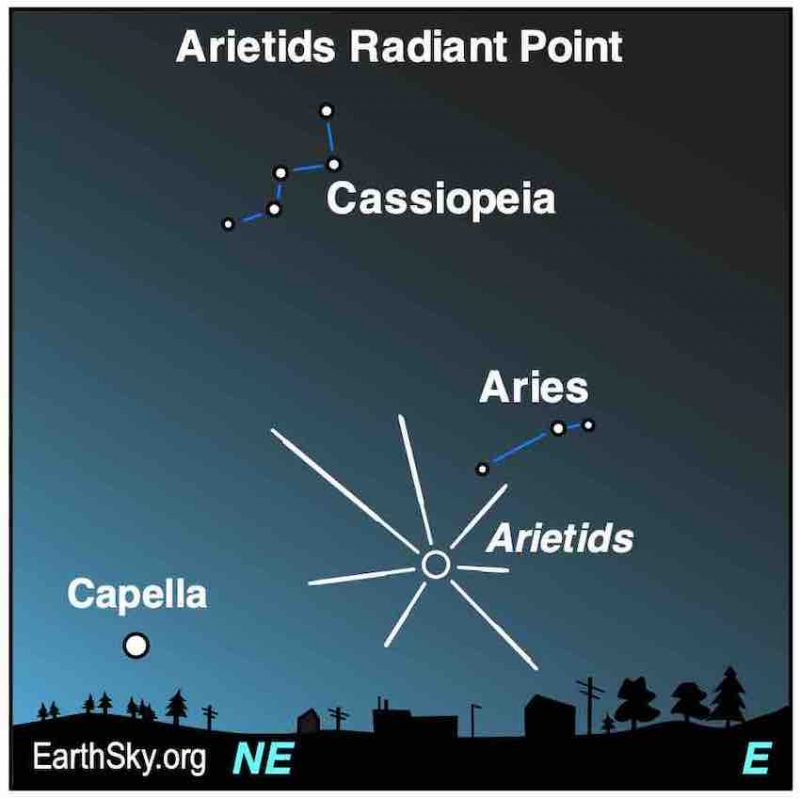
Star chart: Cassiopiea, Aries, and Capella with radial lines from a point in the sky.
The Arietids are an active shower, but they’re visible mostly in daytime. Watch for them in the sunrise direction in the dark hour before dawn from May 22 to July 3. They’ll be best around June 10. You’ll be looking for meteors that shoot up from the horizon. The radiant is below the constellation Aries the Ram. Chart by EarthSky.

June 2026 daytime meteor shower … the Arietids

Most meteor showers are easy to observe. Just find a dark sky, and look up! But what about meteor showers that happen in the daytime, when the sun is up? The Arietids are sometimes said to be the most active daytime meteor shower. In 2026, their predicted** peak will be around the mornings of June 10. You might catch some Arietids around that morning in the dark hour before dawn.

When to watch: Watch from May 22 to July 3. There’s a predicted** peak for the mornings around June 10, 2026. Watch for them in the sunrise direction in the dark hour before dawn breaks.
Nearest moon phase: In 2026, a 3rd quarter moon occurs at 10:00 UTC on June 8. So on the mornings around June 10, a thick waxing crescent moon will interfere with watching for meteors. Watch from a place that’s in the moon shadow or find a distant object to block out the light of the moon.
Radiant: The shower’s radiant point – the point in the sky from which the meteors appear to radiate – is in the constellation Aries. You’ll find this constellation in the east before sunrise.
Duration of shower: May 22 to July 3.
Expected meteors at peak: This is tricky for daytime meteor showers because once the sun comes up, you won’t be able to see them. But the Arietids have a strong zenithal hourly rate (ZHR)! Meteor counts with radar and radio echoes have indicated a rate of 60 meteors per hour, and perhaps as high as 200 meteors per hour.
Note: The Arietids are sometimes said to be the most active daytime meteor shower.

Read more: Arietids, most active daytime meteor shower

Report a fireball (very bright meteor) to the American Meteor Society: it’s fun and easy!

More about a shower’s radiant point

The Arietids shower’s radiant point – the point in the sky from which the meteors appear to radiate – is only 30 degrees from the sun. This 30-degree angle – the angle between the sun and the meteor radiant as seen from Earth – is the shower’s elongation.

How to observe the Arietids

So – although most Arietid meteors fly in daylight – you might catch an Arietid in the last dark hour before dawn, any time during the first and second weeks of June.

The trick is to catch them in the narrow window after the radiant rises (or when it is about to rise), but before the visible breaking of dawn. The radiant rises just before the beginning of astronomical twilight – the darkest twilight stage – which is defined as the period of time when the center of the sun is 12 degrees below the horizon to 18 degrees below the horizon. You probably won’t even notice any illumination in the sky during astronomical twilight.

Face east and watch for meteors moving away from the radiant. The meteors will be moving out in all directions from the radiant. Therefore, many will never breach your horizon. But some meteors will move upward in your eastern predawn sky.

How many meteors will you see?

A shower’s zenithal hourly rate is the number of meteors you’ll see in one hour when the radiant is directly overhead and you can see stars as faint as magnitude 6.5.

For daytime meteor showers, we have a couple of problems here. When a daytime meteor shower’s radiant is overhead, it’s daytime. And so you can’t see stars down to magnitude 6.5. But when it’s nighttime and seeing faint stars becomes possible, a daytime meteor shower’s radiant is below your horizon.

So we never have ideal conditions for seeing the Arietids. But they have an awesome hourly rate! Meteor counts with radar and radio echoes have indicated a rate of 60 meteors per hour, and perhaps as high as 200 meteors per hour.

How many will you see on the morning of June 10, or the several mornings around then? Meteor shower peaks often vary between experts. But who knows? And it’d be fun to see any meteors from this (mostly) daytime shower.

You can keep track of the activity of daytime meteor showers, as well as those beyond the limits of visual observing, by visiting the NASA Meteor Shower Portal. You can move the sky globe to see different areas of the sky. Colored dots indicate shower meteors while white dots indicate sporadic (random) activity. The large orange disk indicates the position of the sun, so little activity will be seen in that area of the sky.

Arietids history and parent comet

The Arietids have a fascinating history. Astronomers at the Jodrell Bank Radio Telescope in England first noticed them in 1947. Here’s a paper that discusses this daytime meteor shower, plus three other showers. Scientists made the discovery with radar echoes and confirmed them, in some cases, with photographs.

For many years, no one knew the parent comet for the Arietids. Then, in May 1986, Don Machholz, discovered a comet that became known as 96P/Machholz. This comet might be directly involved with this meteor shower, or the shower’s source might be a part of the Machholz Complex. The Machholz Complex is a combination of two comet groups, eight meteor showers and at least one asteroid all associated with Comet 96P/Machholz.

If you capture an Arietid meteor, share your image with us!

Bottom line: The Arietids – the most active daytime meteor shower – peak on the mornings around June 10. Watch for them before dawn, but find a way to block out the light of a waxing crescent moon.

**Predicted peak times and dates for meteor showers are from the American Meteor Society. Note that meteor shower peak times can vary.

EarthSky’s meteor shower guide

The post Arietids – most active daytime meteor shower – around June 10 first appeared on EarthSky.


from EarthSky https://ift.tt/Pyqzmfx
Star chart: Cassiopiea, Aries, and Capella with radial lines from a point in the sky.
The Arietids are an active shower, but they’re visible mostly in daytime. Watch for them in the sunrise direction in the dark hour before dawn from May 22 to July 3. They’ll be best around June 10. You’ll be looking for meteors that shoot up from the horizon. The radiant is below the constellation Aries the Ram. Chart by EarthSky.

June 2026 daytime meteor shower … the Arietids

Most meteor showers are easy to observe. Just find a dark sky, and look up! But what about meteor showers that happen in the daytime, when the sun is up? The Arietids are sometimes said to be the most active daytime meteor shower. In 2026, their predicted** peak will be around the mornings of June 10. You might catch some Arietids around that morning in the dark hour before dawn.

When to watch: Watch from May 22 to July 3. There’s a predicted** peak for the mornings around June 10, 2026. Watch for them in the sunrise direction in the dark hour before dawn breaks.
Nearest moon phase: In 2026, a 3rd quarter moon occurs at 10:00 UTC on June 8. So on the mornings around June 10, a thick waxing crescent moon will interfere with watching for meteors. Watch from a place that’s in the moon shadow or find a distant object to block out the light of the moon.
Radiant: The shower’s radiant point – the point in the sky from which the meteors appear to radiate – is in the constellation Aries. You’ll find this constellation in the east before sunrise.
Duration of shower: May 22 to July 3.
Expected meteors at peak: This is tricky for daytime meteor showers because once the sun comes up, you won’t be able to see them. But the Arietids have a strong zenithal hourly rate (ZHR)! Meteor counts with radar and radio echoes have indicated a rate of 60 meteors per hour, and perhaps as high as 200 meteors per hour.
Note: The Arietids are sometimes said to be the most active daytime meteor shower.

Read more: Arietids, most active daytime meteor shower

Report a fireball (very bright meteor) to the American Meteor Society: it’s fun and easy!

More about a shower’s radiant point

The Arietids shower’s radiant point – the point in the sky from which the meteors appear to radiate – is only 30 degrees from the sun. This 30-degree angle – the angle between the sun and the meteor radiant as seen from Earth – is the shower’s elongation.

How to observe the Arietids

So – although most Arietid meteors fly in daylight – you might catch an Arietid in the last dark hour before dawn, any time during the first and second weeks of June.

The trick is to catch them in the narrow window after the radiant rises (or when it is about to rise), but before the visible breaking of dawn. The radiant rises just before the beginning of astronomical twilight – the darkest twilight stage – which is defined as the period of time when the center of the sun is 12 degrees below the horizon to 18 degrees below the horizon. You probably won’t even notice any illumination in the sky during astronomical twilight.

Face east and watch for meteors moving away from the radiant. The meteors will be moving out in all directions from the radiant. Therefore, many will never breach your horizon. But some meteors will move upward in your eastern predawn sky.

How many meteors will you see?

A shower’s zenithal hourly rate is the number of meteors you’ll see in one hour when the radiant is directly overhead and you can see stars as faint as magnitude 6.5.

For daytime meteor showers, we have a couple of problems here. When a daytime meteor shower’s radiant is overhead, it’s daytime. And so you can’t see stars down to magnitude 6.5. But when it’s nighttime and seeing faint stars becomes possible, a daytime meteor shower’s radiant is below your horizon.

So we never have ideal conditions for seeing the Arietids. But they have an awesome hourly rate! Meteor counts with radar and radio echoes have indicated a rate of 60 meteors per hour, and perhaps as high as 200 meteors per hour.

How many will you see on the morning of June 10, or the several mornings around then? Meteor shower peaks often vary between experts. But who knows? And it’d be fun to see any meteors from this (mostly) daytime shower.

You can keep track of the activity of daytime meteor showers, as well as those beyond the limits of visual observing, by visiting the NASA Meteor Shower Portal. You can move the sky globe to see different areas of the sky. Colored dots indicate shower meteors while white dots indicate sporadic (random) activity. The large orange disk indicates the position of the sun, so little activity will be seen in that area of the sky.

Arietids history and parent comet

The Arietids have a fascinating history. Astronomers at the Jodrell Bank Radio Telescope in England first noticed them in 1947. Here’s a paper that discusses this daytime meteor shower, plus three other showers. Scientists made the discovery with radar echoes and confirmed them, in some cases, with photographs.

For many years, no one knew the parent comet for the Arietids. Then, in May 1986, Don Machholz, discovered a comet that became known as 96P/Machholz. This comet might be directly involved with this meteor shower, or the shower’s source might be a part of the Machholz Complex. The Machholz Complex is a combination of two comet groups, eight meteor showers and at least one asteroid all associated with Comet 96P/Machholz.

If you capture an Arietid meteor, share your image with us!

Bottom line: The Arietids – the most active daytime meteor shower – peak on the mornings around June 10. Watch for them before dawn, but find a way to block out the light of a waxing crescent moon.

**Predicted peak times and dates for meteor showers are from the American Meteor Society. Note that meteor shower peak times can vary.

EarthSky’s meteor shower guide

The post Arietids – most active daytime meteor shower – around June 10 first appeared on EarthSky.


from EarthSky https://ift.tt/Pyqzmfx

The constellation Norma is home to the Great Attractor

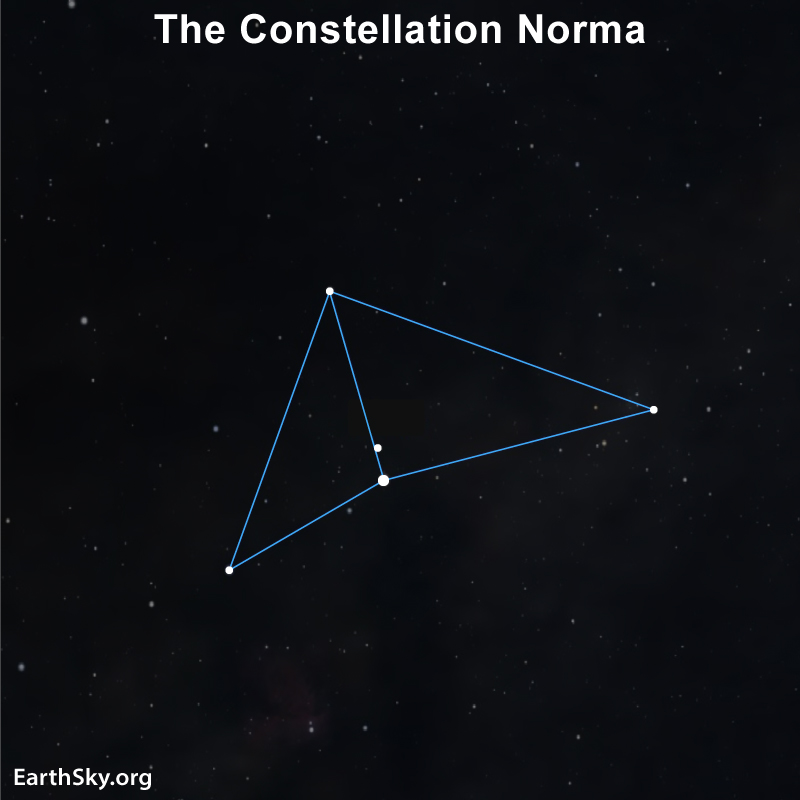
Constellation Norma: Two triangles together making a right triangle with starry background.
The constellation Norma in the Southern Hemisphere is meant to represent a right angle. Chart via EarthSky.

What is the Great Attractor?

The Great Attractor is a massive gravitational anomaly: an invisible, unimaginably colossal amount of mass in space that astronomers did not expect to find. They know it’s there because it’s pulling on everything around it. It’s like a cosmic tug-of-war champion, pulling millions of galaxies – including our own Local Group of galaxies – toward it. In fact, our local region of space is rushing toward this central point at a blistering speed of about 1.4 million miles per hour (600 km/s). The Virgo Supercluster and the Hydra-Centaurus Supercluster are also defying the smooth expansion of our universe and rushing toward the Great Attractor.

And, at the heart of the Great Attractor, is a giant galaxy cluster called the Norma Cluster. It’s called that because this pull is coming from the direction to our constellation Norma.

Science news, night sky events and beautiful photos, all in one place. Click here to subscribe to our free daily newsletter.

The Norma Cluster

The Great Attractor covers such a large expanse of space that it spans Norma plus the neighboring constellation Triangulum Australe, the Southern Triangle.

The galaxy cluster at the heart of the Great Attractor is the Norma Cluster, also known as Abell 3627. And it’s one of the most massive galaxy clusters known.

Stars of Norma

Norma’s stars are dim. Indeed, stargazers in large cities will surely see nothing but sky here. All of the stars are 4th magnitude and dimmer. The brightest star in Norma is magnitude 4.02 Gamma Normae, a double star that is hardly distinguishable from its neighbors. Gamma Normae lies 127 light-years away.

The Norma Cluster isn’t easy to observe, either. It lies behind the plane of the Milky Way galaxy, which obscures our view.

About the name Norma

Norma is an unusual name for a constellation. The 18th-century astronomer Nicolas-Louis de Lacaille named it, along with 13 other constellations in the Southern Hemisphere. Plus, most northern constellations are more older. They’re named for ancient gods and animals. But, generally, Lacaille named constellations for scientific instruments.

Also, Norma is Latin for normal, and it’s supposed to represent a carpenter’s square or level.

Seeing Norma from the Southern Hemisphere

Via Daniel Gaussen, Founder & Guide – Stargaze Mackenzie – New Zealand

For Southern Hemisphere observers, Norma climbs high in the winter sky, often reaching altitudes of around 80 degrees from locations such as New Zealand. It’s highest at midnight around June. And its high elevation and position within the Milky Way produce exceptionally sharp, bright views of dense star fields spanning thousands of light years.

But from latitudes south of about 45°S, Norma becomes circumpolar, meaning it circles the celestial pole and never sets below the horizon.

From Southern Hemisphere locations, where the constellation climbs high into the sky, Norma becomes an exciting region for stargazers and astrophotographers alike, revealing rich nebulae and dense Milky Way star fields that are difficult or impossible to observe from most northern latitudes.

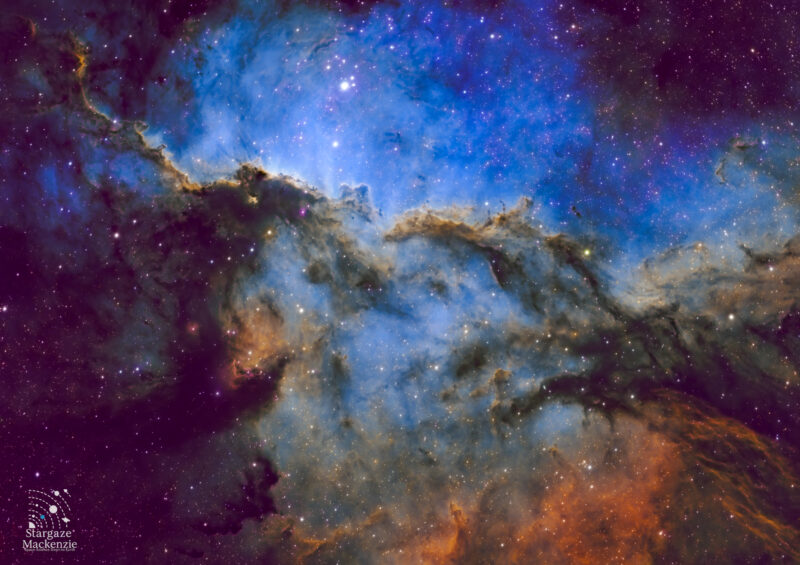
For example, near the border between the constellation Norma and its neighboring constellation, Ara, you can find one of the southern sky’s most spectacular deep-sky treasures. It’s called the Fighting Dragons of Ara Nebula (NGC 6188).

This vast emission nebula spans more than two degrees of sky and is filled with glowing hydrogen gas illuminated by young, hot stars. Dark lanes of interstellar dust weave through the nebula, creating dramatic dragon-like shapes that give the object its popular nickname.

Fighting Dragons Of Ara: Towering colorful clouds against a blue background of stars NGC 6188 (Fighting Dragons of Ara Nebula) captured in narrowband HSO over 9 hours with a 400mm telescope. Photo via Daniel Gaussen – Stargaze Mackenzie Photography,Twizel NZ.
Seeing Norma from the Northern Hemisphere

Norma is south of the celestial equator, a great circle around our sky above the earthly equator. With this in mind, it’s best viewed from the Southern Hemisphere. But you can glimpse it from latitudes of 30 degrees N or southward. For example, you can see it from the U.S. state of Florida.

Norma culminates at midnight – or appears highest in the sky at midnight – in June. So the months around June are the best time to glimpse it from the Northern Hemisphere. The constellation sits beside Lupus and south of Scorpius.

Its stars are dim, so your best bet is to first trace out the form of the Scorpion and then look for the dark patch of sky to the south.

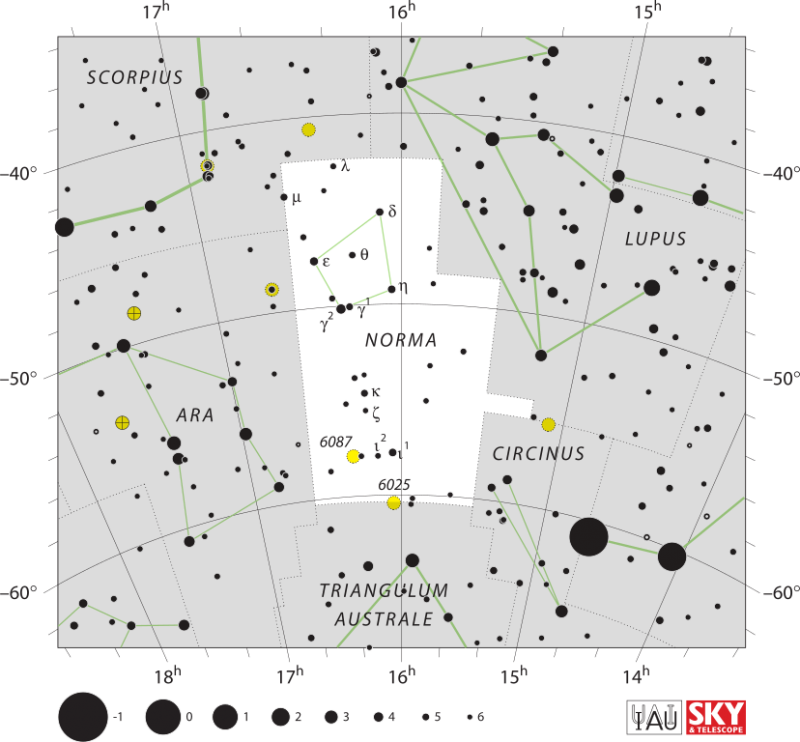
White chart with black circles, lines and text.
The stars of Norma. Image via IAU/ Sky and Telescope/ Wikimedia Commons.

Stars and deep-sky objects in Norma

Norma’s location in the Milky Way means that it holds a number of deep-sky observing targets. The star cluster NGC 6067 is magnitude 5.6 and lies 1/2 degree north of Kappa Normae, a magnitude 4.94 star. NGC 6087 is a magnitude 5.4 open cluster almost 4 degrees below NGC 6067. And if you scan the region of Norma in binoculars, you can see at least eight open clusters.

Star field with cluster of white dots near the center.
NGC 6067 is a star cluster at magnitude 5.6. Image via Wikimedia Commons.

Bottom line: The constellation Norma lies in southern skies and is home to the the Great Attractor.

The post The constellation Norma is home to the Great Attractor first appeared on EarthSky.


from EarthSky https://ift.tt/dn0EVoy
Constellation Norma: Two triangles together making a right triangle with starry background.
The constellation Norma in the Southern Hemisphere is meant to represent a right angle. Chart via EarthSky.

What is the Great Attractor?

The Great Attractor is a massive gravitational anomaly: an invisible, unimaginably colossal amount of mass in space that astronomers did not expect to find. They know it’s there because it’s pulling on everything around it. It’s like a cosmic tug-of-war champion, pulling millions of galaxies – including our own Local Group of galaxies – toward it. In fact, our local region of space is rushing toward this central point at a blistering speed of about 1.4 million miles per hour (600 km/s). The Virgo Supercluster and the Hydra-Centaurus Supercluster are also defying the smooth expansion of our universe and rushing toward the Great Attractor.

And, at the heart of the Great Attractor, is a giant galaxy cluster called the Norma Cluster. It’s called that because this pull is coming from the direction to our constellation Norma.

Science news, night sky events and beautiful photos, all in one place. Click here to subscribe to our free daily newsletter.

The Norma Cluster

The Great Attractor covers such a large expanse of space that it spans Norma plus the neighboring constellation Triangulum Australe, the Southern Triangle.

The galaxy cluster at the heart of the Great Attractor is the Norma Cluster, also known as Abell 3627. And it’s one of the most massive galaxy clusters known.

Stars of Norma

Norma’s stars are dim. Indeed, stargazers in large cities will surely see nothing but sky here. All of the stars are 4th magnitude and dimmer. The brightest star in Norma is magnitude 4.02 Gamma Normae, a double star that is hardly distinguishable from its neighbors. Gamma Normae lies 127 light-years away.

The Norma Cluster isn’t easy to observe, either. It lies behind the plane of the Milky Way galaxy, which obscures our view.

About the name Norma

Norma is an unusual name for a constellation. The 18th-century astronomer Nicolas-Louis de Lacaille named it, along with 13 other constellations in the Southern Hemisphere. Plus, most northern constellations are more older. They’re named for ancient gods and animals. But, generally, Lacaille named constellations for scientific instruments.

Also, Norma is Latin for normal, and it’s supposed to represent a carpenter’s square or level.

Seeing Norma from the Southern Hemisphere

Via Daniel Gaussen, Founder & Guide – Stargaze Mackenzie – New Zealand

For Southern Hemisphere observers, Norma climbs high in the winter sky, often reaching altitudes of around 80 degrees from locations such as New Zealand. It’s highest at midnight around June. And its high elevation and position within the Milky Way produce exceptionally sharp, bright views of dense star fields spanning thousands of light years.

But from latitudes south of about 45°S, Norma becomes circumpolar, meaning it circles the celestial pole and never sets below the horizon.

From Southern Hemisphere locations, where the constellation climbs high into the sky, Norma becomes an exciting region for stargazers and astrophotographers alike, revealing rich nebulae and dense Milky Way star fields that are difficult or impossible to observe from most northern latitudes.

For example, near the border between the constellation Norma and its neighboring constellation, Ara, you can find one of the southern sky’s most spectacular deep-sky treasures. It’s called the Fighting Dragons of Ara Nebula (NGC 6188).

This vast emission nebula spans more than two degrees of sky and is filled with glowing hydrogen gas illuminated by young, hot stars. Dark lanes of interstellar dust weave through the nebula, creating dramatic dragon-like shapes that give the object its popular nickname.

Fighting Dragons Of Ara: Towering colorful clouds against a blue background of stars NGC 6188 (Fighting Dragons of Ara Nebula) captured in narrowband HSO over 9 hours with a 400mm telescope. Photo via Daniel Gaussen – Stargaze Mackenzie Photography,Twizel NZ.
Seeing Norma from the Northern Hemisphere

Norma is south of the celestial equator, a great circle around our sky above the earthly equator. With this in mind, it’s best viewed from the Southern Hemisphere. But you can glimpse it from latitudes of 30 degrees N or southward. For example, you can see it from the U.S. state of Florida.

Norma culminates at midnight – or appears highest in the sky at midnight – in June. So the months around June are the best time to glimpse it from the Northern Hemisphere. The constellation sits beside Lupus and south of Scorpius.

Its stars are dim, so your best bet is to first trace out the form of the Scorpion and then look for the dark patch of sky to the south.

White chart with black circles, lines and text.
The stars of Norma. Image via IAU/ Sky and Telescope/ Wikimedia Commons.

Stars and deep-sky objects in Norma

Norma’s location in the Milky Way means that it holds a number of deep-sky observing targets. The star cluster NGC 6067 is magnitude 5.6 and lies 1/2 degree north of Kappa Normae, a magnitude 4.94 star. NGC 6087 is a magnitude 5.4 open cluster almost 4 degrees below NGC 6067. And if you scan the region of Norma in binoculars, you can see at least eight open clusters.

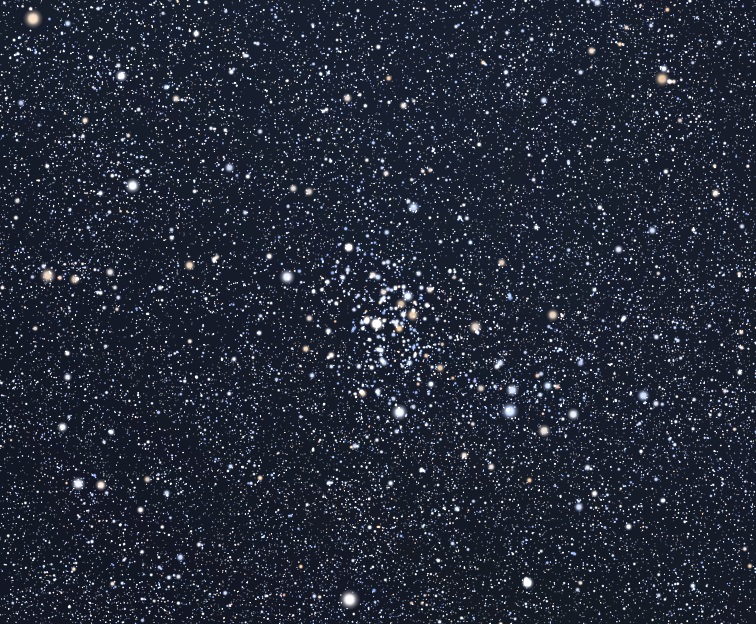
Star field with cluster of white dots near the center.
NGC 6067 is a star cluster at magnitude 5.6. Image via Wikimedia Commons.

Bottom line: The constellation Norma lies in southern skies and is home to the the Great Attractor.

The post The constellation Norma is home to the Great Attractor first appeared on EarthSky.


from EarthSky https://ift.tt/dn0EVoy

Rare meteorite hints at giant early planet

Rare meteorite: Multicolored flecks on a black background.
This is a view of the rare meteorite NWA 12774 under cross-polarized light. Scientists from the University of Colorado Boulder said the source of the meteorite might be a giant, early planet that shattered in a collision billions of years ago. Image via CU Boulder/ John Kashuba.

Rare meteorite hints at giant early planet

Fragmented rocks and debris in our solar system sometimes strike Earth, burning up in our atmosphere as meteors. Occasionally, those pieces of debris are large enough to survive the trip through Earth’s atmosphere and make it to the ground. Scientists have analyzed these meteorites and discovered most are from three sources: asteroids, the moon and Mars. But a few rare meteorites are from other sources. And on June 1, 2026, researchers from the University of Colorado Boulder said the meteorite NWA 12774 is likely from a previously unknown massive, early planet that shattered billions of years ago.

The journal Earth and Planetary Science Letters will publish the researchers’ peer-reviewed study on July 1, 2026.

Our early solar system was chaotic

Our solar system formed out of a large cloud of gas and dust about 4.5 billion years ago. It was a chaotic environment, with objects colliding and sticking together or shattering apart. And the meteorite that scientists have labeled NWA 12774 reveals a world that might have been trying to form along with Earth and the other planets.

The scientists said the world might have been as large as the moon or Mars when a collision shattered it, producing the fragment that eventually made its way to the Sahara Desert in Northwest Africa.

Aaron Bell of CU Boulder was the lead author of the new paper. Bell said:

It’s incredible to think there was once a world this large. We only know it existed because a few fragments of it happened to land on Earth. These meteorites preserved evidence of a completely different pathway through which early planets developed.

The rare meteorite is an angrite

This meteorite is from a rare class of meteorites that scientists call angrites. People have discovered more than 80,000 meteorites on Earth. But only 68 of those have been angrites. They have a different makeup than meteorites that are from asteroids, the moon and Mars.

Silicon dioxide – aka silica – is a common material that’s in quartz, sand and nearly every known terrestrial planet in the solar system. But it’s scarce in angrites. So most scientists thought these meteorites came from an asteroid.

Portion of a black rock with a white crystalized spot.
This is a 40mm long slice of the meteorite NWA 12774. Image via CU Boulder/ John Kashuba.

High pressure must have formed the meteorite

But when the CU Boulder researchers studied NWA 12774, they found a rock-forming mineral called clinopyroxene. And the clinopyroxene had an unusual abundance of aluminium. These ingredients told the researchers that the meteorite originally formed under enormous pressure deep underground. In fact, they found the pressure that would have been needed to form NWA 12774 was greater than the pressure at the bottom of the ocean.

To be specific, forming the aluminum-rich clinopyroxene in NWA 12774 would require at least 17.5 kilobars of pressure. And the pressure at the Mariana Trench in the Pacific (the deepest trench on Earth) is 1 kilobar.

So the researchers concluded that only a large parent body could have produced this meteorite. The parent body would have had to be at least 1,242 miles across (2,000 km).

Or was the planet even bigger?

But wait. The crystals in the meteorite still have sharp edges. This would not be the case if the rock sample formed deep underground. And it also had delicate chemical patterns that could not have formed deep underground either. So that means it likely formed underground but at shallow depths of an even larger parent body.

The researchers estimate the parent body could have been the size of the moon or Mars, or some 2,240 miles (3,600 km) to 4,100 miles (6,600 km) across.

Could there be more meteorites pointing to other lost worlds? Bell said:

There are many meteorites sitting in drawers that haven’t been thoroughly studied, so there were likely more of these protoplanets we don’t know about.

A rock with many sharp-edged crystals in orange and the background in deep purple.
This is an X-ray view of meteorite NWA 12774. Image via Aaron Bell/ CU Boulder.

Bottom line: Scientists have found a rare meteorite that contains evidence of a lost early protoplanet. It offers a glimpse into the chaotic collisions that shaped our solar system.

Source: High-pressure clinopyroxene in Northwest Africa 12774 and new geobarometric evidence for a planetary embryo-sized angrite parent body

Via CU Boulder

Read more: Meteorite hunting? Here’s tips on how to find one

The post Rare meteorite hints at giant early planet first appeared on EarthSky.


from EarthSky https://ift.tt/EMztLIB
Rare meteorite: Multicolored flecks on a black background.
This is a view of the rare meteorite NWA 12774 under cross-polarized light. Scientists from the University of Colorado Boulder said the source of the meteorite might be a giant, early planet that shattered in a collision billions of years ago. Image via CU Boulder/ John Kashuba.

Rare meteorite hints at giant early planet

Fragmented rocks and debris in our solar system sometimes strike Earth, burning up in our atmosphere as meteors. Occasionally, those pieces of debris are large enough to survive the trip through Earth’s atmosphere and make it to the ground. Scientists have analyzed these meteorites and discovered most are from three sources: asteroids, the moon and Mars. But a few rare meteorites are from other sources. And on June 1, 2026, researchers from the University of Colorado Boulder said the meteorite NWA 12774 is likely from a previously unknown massive, early planet that shattered billions of years ago.

The journal Earth and Planetary Science Letters will publish the researchers’ peer-reviewed study on July 1, 2026.

Our early solar system was chaotic

Our solar system formed out of a large cloud of gas and dust about 4.5 billion years ago. It was a chaotic environment, with objects colliding and sticking together or shattering apart. And the meteorite that scientists have labeled NWA 12774 reveals a world that might have been trying to form along with Earth and the other planets.

The scientists said the world might have been as large as the moon or Mars when a collision shattered it, producing the fragment that eventually made its way to the Sahara Desert in Northwest Africa.

Aaron Bell of CU Boulder was the lead author of the new paper. Bell said:

It’s incredible to think there was once a world this large. We only know it existed because a few fragments of it happened to land on Earth. These meteorites preserved evidence of a completely different pathway through which early planets developed.

The rare meteorite is an angrite

This meteorite is from a rare class of meteorites that scientists call angrites. People have discovered more than 80,000 meteorites on Earth. But only 68 of those have been angrites. They have a different makeup than meteorites that are from asteroids, the moon and Mars.

Silicon dioxide – aka silica – is a common material that’s in quartz, sand and nearly every known terrestrial planet in the solar system. But it’s scarce in angrites. So most scientists thought these meteorites came from an asteroid.

Portion of a black rock with a white crystalized spot.
This is a 40mm long slice of the meteorite NWA 12774. Image via CU Boulder/ John Kashuba.

High pressure must have formed the meteorite

But when the CU Boulder researchers studied NWA 12774, they found a rock-forming mineral called clinopyroxene. And the clinopyroxene had an unusual abundance of aluminium. These ingredients told the researchers that the meteorite originally formed under enormous pressure deep underground. In fact, they found the pressure that would have been needed to form NWA 12774 was greater than the pressure at the bottom of the ocean.

To be specific, forming the aluminum-rich clinopyroxene in NWA 12774 would require at least 17.5 kilobars of pressure. And the pressure at the Mariana Trench in the Pacific (the deepest trench on Earth) is 1 kilobar.

So the researchers concluded that only a large parent body could have produced this meteorite. The parent body would have had to be at least 1,242 miles across (2,000 km).

Or was the planet even bigger?

But wait. The crystals in the meteorite still have sharp edges. This would not be the case if the rock sample formed deep underground. And it also had delicate chemical patterns that could not have formed deep underground either. So that means it likely formed underground but at shallow depths of an even larger parent body.

The researchers estimate the parent body could have been the size of the moon or Mars, or some 2,240 miles (3,600 km) to 4,100 miles (6,600 km) across.

Could there be more meteorites pointing to other lost worlds? Bell said:

There are many meteorites sitting in drawers that haven’t been thoroughly studied, so there were likely more of these protoplanets we don’t know about.

A rock with many sharp-edged crystals in orange and the background in deep purple.
This is an X-ray view of meteorite NWA 12774. Image via Aaron Bell/ CU Boulder.

Bottom line: Scientists have found a rare meteorite that contains evidence of a lost early protoplanet. It offers a glimpse into the chaotic collisions that shaped our solar system.

Source: High-pressure clinopyroxene in Northwest Africa 12774 and new geobarometric evidence for a planetary embryo-sized angrite parent body

Via CU Boulder

Read more: Meteorite hunting? Here’s tips on how to find one

The post Rare meteorite hints at giant early planet first appeared on EarthSky.


from EarthSky https://ift.tt/EMztLIB

Crystal Ball Nebula hides a fading star and its companion

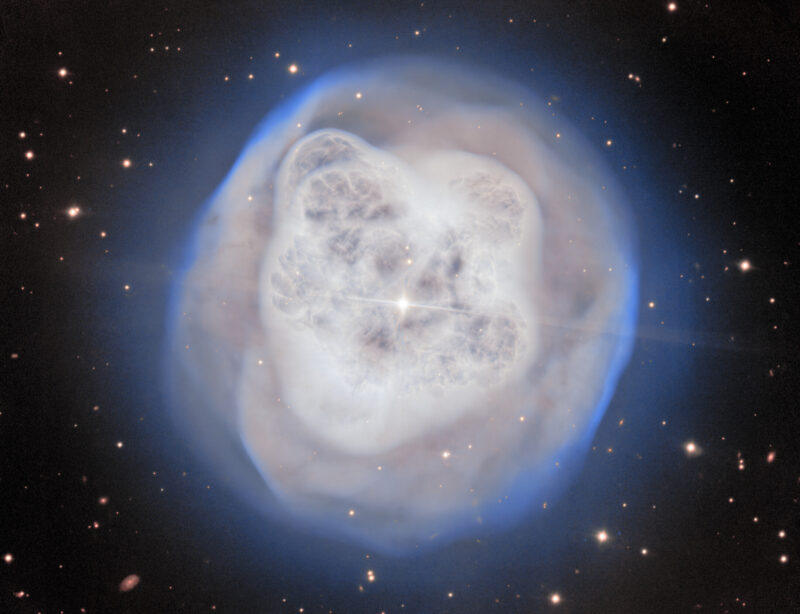
Crystal Ball Nebula: A translucent sphere of white cloud with tendrils inside and a bright core on a starry background.
The Crystal Ball Nebula, also known as NGC 1514, is an exquisite ball of gas encircling a pair of stars. The Gemini North telescope captured this image from atop Mauna Kea in Hawaii. Image via International Gemini Observatory/ NOIRLab/ NSF/ AURA.

Science news, night sky events and beautiful photos, all in one place. Click here to subscribe to EarthSky’s free daily newsletter.

Meet the Crystal Ball Nebula

NOIRLab released this sensational new image of the Crystal Ball Nebula on May 21, 2026. The Gemini North telescope captured this image from atop Mauna Kea in Hawaii. The Crystal Ball Nebula, also known as NGC 1514, lies in the constellation Taurus the Bull, at a distance of 1,500 light-years from us.

Astronomer William Herschel first spotted the Crystal Ball Nebula in 1790. Through his telescope he saw it as a star surrounded with a faintly luminous atmosphere.

A hidden pair shaping the nebula

But modern observations show there are actually two stars at the center of the nebula. One of the two stars in this binary pair, an O-type star, has shed its outer layers as it nears the end of its life. That’s what has created the ball of gas and dust around the stars, which astronomers call a planetary nebula. The name is a bit misleading, because its creation does not involve planets. It was in fact Herschel who coined the term planetary nebula, because their round shape reminded him of the planets.

The two stars complete an orbit around each other approximately once every nine years. That makes this pair’s orbit the longest known for any planetary nebula.

The Crystal Ball Nebula is a bit unusual for a planetary nebula. Most have smoother shapes. But the strong winds blowing from these stars create the sculpted tendrils of gas we can see in this image.

Bottom line: The Crystal Ball Nebula is a giant sphere of gas and dust encircling a pair of stars in the direction of the constellation Taurus the Bull.

Read more: Iconic Ring Nebula holds a mysterious iron bar, study finds

Read more: Meet the Crab Nebula, remnant of an exploding star

The post Crystal Ball Nebula hides a fading star and its companion first appeared on EarthSky.


from EarthSky https://ift.tt/E2qa43x
Crystal Ball Nebula: A translucent sphere of white cloud with tendrils inside and a bright core on a starry background.
The Crystal Ball Nebula, also known as NGC 1514, is an exquisite ball of gas encircling a pair of stars. The Gemini North telescope captured this image from atop Mauna Kea in Hawaii. Image via International Gemini Observatory/ NOIRLab/ NSF/ AURA.

Science news, night sky events and beautiful photos, all in one place. Click here to subscribe to EarthSky’s free daily newsletter.

Meet the Crystal Ball Nebula

NOIRLab released this sensational new image of the Crystal Ball Nebula on May 21, 2026. The Gemini North telescope captured this image from atop Mauna Kea in Hawaii. The Crystal Ball Nebula, also known as NGC 1514, lies in the constellation Taurus the Bull, at a distance of 1,500 light-years from us.

Astronomer William Herschel first spotted the Crystal Ball Nebula in 1790. Through his telescope he saw it as a star surrounded with a faintly luminous atmosphere.

A hidden pair shaping the nebula

But modern observations show there are actually two stars at the center of the nebula. One of the two stars in this binary pair, an O-type star, has shed its outer layers as it nears the end of its life. That’s what has created the ball of gas and dust around the stars, which astronomers call a planetary nebula. The name is a bit misleading, because its creation does not involve planets. It was in fact Herschel who coined the term planetary nebula, because their round shape reminded him of the planets.

The two stars complete an orbit around each other approximately once every nine years. That makes this pair’s orbit the longest known for any planetary nebula.

The Crystal Ball Nebula is a bit unusual for a planetary nebula. Most have smoother shapes. But the strong winds blowing from these stars create the sculpted tendrils of gas we can see in this image.

Bottom line: The Crystal Ball Nebula is a giant sphere of gas and dust encircling a pair of stars in the direction of the constellation Taurus the Bull.

Read more: Iconic Ring Nebula holds a mysterious iron bar, study finds

Read more: Meet the Crab Nebula, remnant of an exploding star

The post Crystal Ball Nebula hides a fading star and its companion first appeared on EarthSky.


from EarthSky https://ift.tt/E2qa43x

Big and Little Dippers in the northern sky on June evenings

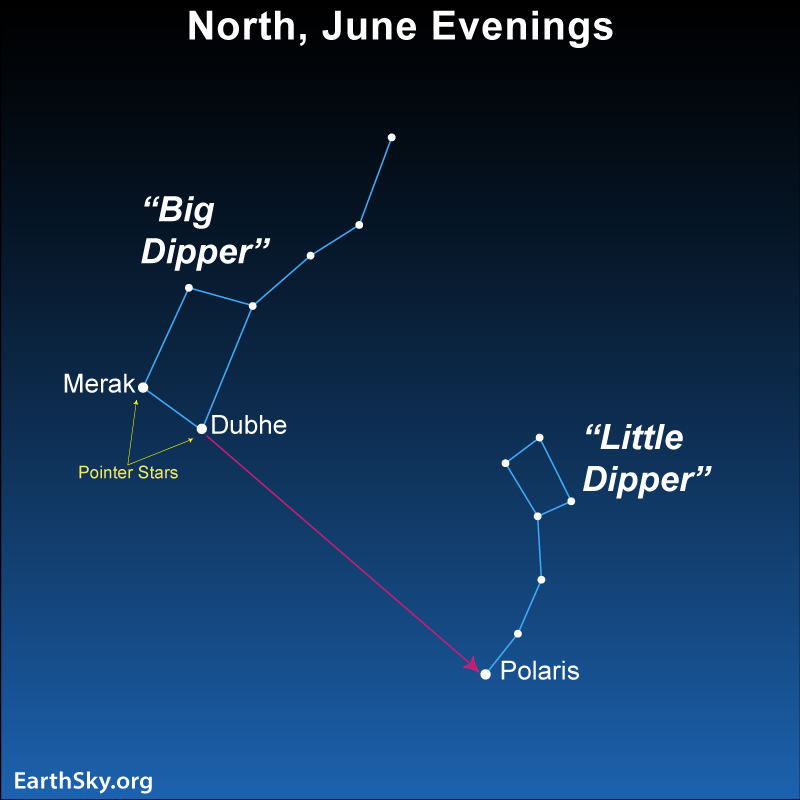
Star chart: Big and Little Dippers with red arrow from bowl stars to Polaris.
Here are 2 asterisms – noticeable star patterns – known to Northern Hemisphere stargazers as the Big and Little Dippers. To find the Little Dipper, use the 2 outer stars in the bowl of the Big Dipper – aka the Pointers – to point to Polaris, the North Star. Note that Polaris marks the end of the handle of the Little Dipper. After you find Polaris, if your sky is dark enough, you should be able to trace out the other stars in the Little Dipper. Chart via EarthSky.

Tonight, assuming you’re in the Northern Hemisphere, you can easily find the legendary Big Dipper, called the Plough by our friends in the United Kingdom or the Wagon throughout much of Europe.

This familiar star pattern is high in the north at nightfall in June, for Northern Hemisphere stargazers. Find it and let it be your guide to the Little Dipper.

The Big Dipper is easy to find because its shape really resembles a dipper. And it is made up of moderately bright stars. But the Little Dipper isn’t as easy. You need a dark sky to see it. So be sure to avoid city lights.

Science news, night sky events and beautiful photos, all in one place. Click here to subscribe to EarthSky’s free daily newsletter.

How to find the Dippers from the Northern Hemisphere

Simply face northward on a June evening and look for a large, dipper-like pattern. Which way is north? Rotate around until your left side faces the sunset point. You are now looking toward the north. That easy-to-see pattern high in the sky is the Big Dipper.

Also, notice that the Big Dipper has two parts: a bowl and a handle. The bowl has four stars and the handle has three. See the two outer stars in the bowl? They’re known as the Pointers because they point to the North Star, which is also known as Polaris.

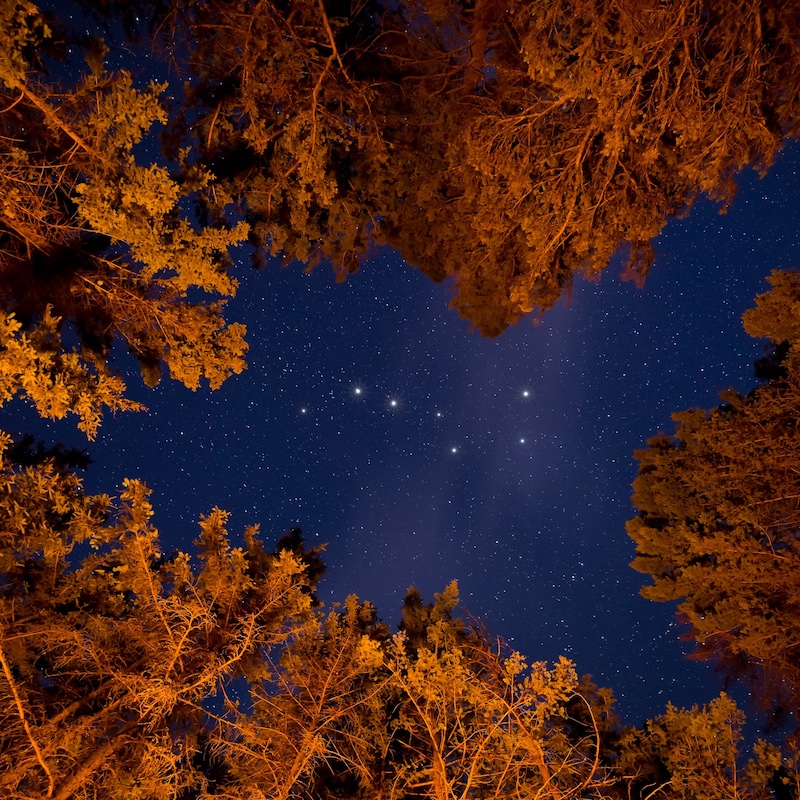
View straight up through a clearing in tall, golden trees into the starry sky with the Big Dipper in the middle.
The Big Dipper stands out in the night sky. Image via James Wheeler/ Unsplash.

Polaris is the brightest star of the Little Dipper

Once you’ve found Polaris, you can find the Little Dipper. Polaris marks the end of the handle of the Little Dipper. You need a dark sky to see the all of the Little Dipper, because it’s fainter than its larger and brighter counterpart. If your skies are not very dark, you might see only the three brightest stars in the Little Dipper. Those three stars are Polaris and the two end stars in the bowl of the Little Dipper.

By the way, can you see the Big Dipper from Earth’s Southern Hemisphere? Yes, if you’re in the southern tropics. However, much farther south, it gets harder because you are farther south on Earth’s globe. So, the Big Dipper sinks closer and closer to the northern horizon.

Meanwhile, Polaris, the North Star, disappears beneath the horizon once you get south of the Earth’s equator.

Can you see the Dippers from the Southern Hemisphere?

Via Daniel Gaussen, Founder & Guide – Stargaze Mackenzie – New Zealand

For observers in the Southern Hemisphere, the Big Dipper is a much less familiar sight. It can be seen from some tropical and subtropical latitudes, but only very low in the northern sky, skimming close to the horizon.

The best months to look for it in the evening are around April and May, when it’s culminating (reaching its highest point in the north) in late evening. Because all the stars rise 4 minutes earlier each day, the Dipper culminates earlier in the evening in June.

Meanwhile, for the most part, the Little Dipper can’t be seen at all. The Little Dipper’s anchor star, Polaris – the North Star, or star that marks the north celestial pole (point in the sky around which the entire northern sky turns) – doesn’t rise above the horizon for those south of the equator.

Instead, Southern Hemisphere stargazers turn to the Southern Cross (Crux) as their most recognizable navigational star pattern. The bright stars Alpha and Beta Centauri are commonly known as the Pointer Stars because they point toward the Southern Cross, helping observers locate the south celestial pole (point around which the entire southern sky turns).

So Alpha and Beta Centauri mirror the role of the Big Dipper’s two outer bowl stars, Dubhe and Merak, also known as the Pointers in the north, guiding the eye toward Polaris and the north celestial pole.

Big and Little Dipper in skylore

In his classic book Star Names: Their Lore and Meaning, Richard Hinckley Allen claims the Greek constellation Ursa Minor the Lesser Bear – our Little Dipper – was never mentioned in the literary works of Homer (9th century BCE) or Hesiod (8th century BCE).

That’s probably because Ursa Minor hadn’t been invented yet.

According to the Greek geographer and historian Strabo (63 BCE to about 21 CE), the seven stars we see today as part of Ursa Minor (the Little Dipper) didn’t carry that name until 600 BCE or so. Before that time, people saw this group of stars outlining the wings of the constellation Draco the Dragon.

When the seafaring Phoenicians visited the Greek philosopher Thales around 600 BCE, they showed him how to navigate by the stars. Purportedly, Thales clipped the Dragon’s wings to create a new constellation, possibly because this new way of looking at the stars enabled Greek sailors to more easily locate the north celestial pole.

But it’s not just our names for things in the sky that change. The sky itself changes, too. In our day, Polaris closely marks the north celestial pole in the sky. In 600 BCE – thanks to the motion of precession – the Little Dipper’s stars Kochab and Pherkad more closely marked the position of the north celestial pole.

Read more: Kochab and Pherkad: The Guardians of the Pole

Bottom line: If you live in the Northern Hemisphere, look for the Big and Little Dippers in the north at nightfall on June evenings.

EarthSky astronomy kits are perfect for beginners. Order today from the EarthSky store

The post Big and Little Dippers in the northern sky on June evenings first appeared on EarthSky.


from EarthSky https://ift.tt/ngAj4ID
Star chart: Big and Little Dippers with red arrow from bowl stars to Polaris.
Here are 2 asterisms – noticeable star patterns – known to Northern Hemisphere stargazers as the Big and Little Dippers. To find the Little Dipper, use the 2 outer stars in the bowl of the Big Dipper – aka the Pointers – to point to Polaris, the North Star. Note that Polaris marks the end of the handle of the Little Dipper. After you find Polaris, if your sky is dark enough, you should be able to trace out the other stars in the Little Dipper. Chart via EarthSky.

Tonight, assuming you’re in the Northern Hemisphere, you can easily find the legendary Big Dipper, called the Plough by our friends in the United Kingdom or the Wagon throughout much of Europe.

This familiar star pattern is high in the north at nightfall in June, for Northern Hemisphere stargazers. Find it and let it be your guide to the Little Dipper.

The Big Dipper is easy to find because its shape really resembles a dipper. And it is made up of moderately bright stars. But the Little Dipper isn’t as easy. You need a dark sky to see it. So be sure to avoid city lights.

Science news, night sky events and beautiful photos, all in one place. Click here to subscribe to EarthSky’s free daily newsletter.

How to find the Dippers from the Northern Hemisphere

Simply face northward on a June evening and look for a large, dipper-like pattern. Which way is north? Rotate around until your left side faces the sunset point. You are now looking toward the north. That easy-to-see pattern high in the sky is the Big Dipper.

Also, notice that the Big Dipper has two parts: a bowl and a handle. The bowl has four stars and the handle has three. See the two outer stars in the bowl? They’re known as the Pointers because they point to the North Star, which is also known as Polaris.

View straight up through a clearing in tall, golden trees into the starry sky with the Big Dipper in the middle.
The Big Dipper stands out in the night sky. Image via James Wheeler/ Unsplash.

Polaris is the brightest star of the Little Dipper

Once you’ve found Polaris, you can find the Little Dipper. Polaris marks the end of the handle of the Little Dipper. You need a dark sky to see the all of the Little Dipper, because it’s fainter than its larger and brighter counterpart. If your skies are not very dark, you might see only the three brightest stars in the Little Dipper. Those three stars are Polaris and the two end stars in the bowl of the Little Dipper.

By the way, can you see the Big Dipper from Earth’s Southern Hemisphere? Yes, if you’re in the southern tropics. However, much farther south, it gets harder because you are farther south on Earth’s globe. So, the Big Dipper sinks closer and closer to the northern horizon.

Meanwhile, Polaris, the North Star, disappears beneath the horizon once you get south of the Earth’s equator.

Can you see the Dippers from the Southern Hemisphere?

Via Daniel Gaussen, Founder & Guide – Stargaze Mackenzie – New Zealand

For observers in the Southern Hemisphere, the Big Dipper is a much less familiar sight. It can be seen from some tropical and subtropical latitudes, but only very low in the northern sky, skimming close to the horizon.

The best months to look for it in the evening are around April and May, when it’s culminating (reaching its highest point in the north) in late evening. Because all the stars rise 4 minutes earlier each day, the Dipper culminates earlier in the evening in June.

Meanwhile, for the most part, the Little Dipper can’t be seen at all. The Little Dipper’s anchor star, Polaris – the North Star, or star that marks the north celestial pole (point in the sky around which the entire northern sky turns) – doesn’t rise above the horizon for those south of the equator.

Instead, Southern Hemisphere stargazers turn to the Southern Cross (Crux) as their most recognizable navigational star pattern. The bright stars Alpha and Beta Centauri are commonly known as the Pointer Stars because they point toward the Southern Cross, helping observers locate the south celestial pole (point around which the entire southern sky turns).

So Alpha and Beta Centauri mirror the role of the Big Dipper’s two outer bowl stars, Dubhe and Merak, also known as the Pointers in the north, guiding the eye toward Polaris and the north celestial pole.

Big and Little Dipper in skylore

In his classic book Star Names: Their Lore and Meaning, Richard Hinckley Allen claims the Greek constellation Ursa Minor the Lesser Bear – our Little Dipper – was never mentioned in the literary works of Homer (9th century BCE) or Hesiod (8th century BCE).

That’s probably because Ursa Minor hadn’t been invented yet.

According to the Greek geographer and historian Strabo (63 BCE to about 21 CE), the seven stars we see today as part of Ursa Minor (the Little Dipper) didn’t carry that name until 600 BCE or so. Before that time, people saw this group of stars outlining the wings of the constellation Draco the Dragon.

When the seafaring Phoenicians visited the Greek philosopher Thales around 600 BCE, they showed him how to navigate by the stars. Purportedly, Thales clipped the Dragon’s wings to create a new constellation, possibly because this new way of looking at the stars enabled Greek sailors to more easily locate the north celestial pole.

But it’s not just our names for things in the sky that change. The sky itself changes, too. In our day, Polaris closely marks the north celestial pole in the sky. In 600 BCE – thanks to the motion of precession – the Little Dipper’s stars Kochab and Pherkad more closely marked the position of the north celestial pole.

Read more: Kochab and Pherkad: The Guardians of the Pole

Bottom line: If you live in the Northern Hemisphere, look for the Big and Little Dippers in the north at nightfall on June evenings.

EarthSky astronomy kits are perfect for beginners. Order today from the EarthSky store

The post Big and Little Dippers in the northern sky on June evenings first appeared on EarthSky.


from EarthSky https://ift.tt/ngAj4ID

Prepare for El Niño conditions, urge officials

Super El Niño: People surfing and playing volleyball on a beach beneath a blazing afternoon sun.
It appears likely El Niño conditions will emerge soon. On Tuesday, June 2, 2026, officials from the World Meteorological Organization urged people to prepare for above average temperatures and more extreme weather patterns. In addition, we could be facing a super El Niño, if the sea surface temperatures in the Eastern Pacific climb to about 2.0° C (3.6 F) above normal. Image via Peggy Marco/ Pixabay.

Science news, night sky events and beautiful photos, all in one place. Click here to subscribe to EarthSky’s free daily newsletter.

World Meteorological Organization urges people to prepare for El Niño

On Tuesday, June 2, 2026, the World Meteorological Organization (WMO), based in Geneva, Switzerland, urged people to prepare for coming El Niño conditions. The WMO, a specialized agency of the United Nations that focuses on weather, climate and water resources, said:

Fueled by unusually warm ocean waters in the tropical Pacific, El Niño conditions are developing and are set to influence global temperature and rainfall patterns, increasing the risk of extreme weather over the coming months.

The newest update on El Niño conditions now shows an 80% likelihood of El Nino developing in the next three months. Plus, the likelihood that El Niño conditions will continue until at least November are around 90%. And there is still a possibility that it will become a super El Niño event.

UN Secretary-General António Guterres did not hold back in a statement:

The science is clear: El Niño is arriving on our doorstep in the coming months with 90% certainty. The world must treat it as the urgent climate warning it is. El Niño conditions will pour fuel on the fire of a warming world. Impacts will hit even harder, travel even farther, and cross borders with devastating speed. The only effective response is climate action equal to the crisis – ending the addiction to fossil fuels, accelerating the shift to renewables, protecting the most vulnerable, and delivering early warning systems for all.

What could El Niño bring?

WMO Secretary-General Celeste Saulo said:

We need to prepare for a potentially strong El Niño event – which will exacerbate drought and heavy rainfall and increase the risk of heatwaves both on land and in the ocean. The most recent El Niño, in 2023-24, was one of the five strongest on record and it played a role in the record global temperatures we saw in 2024.

Just like any weather event, preparation is key. The WMO said that nearly everywhere can expect above average temperatures for June to August. Do you know how to beat the heat? Meteorologist Rachel Duensing provides tips below.

Celeste Saulo also said:

Advance seasonal forecasts and early warnings are vital to save lives and cushion the impact on our economies and our communities.

The Eastern Pacific is more likely to see more hurricanes, while the Atlantic is likely to see fewer during an El Niño year. Read more: The Atlantic hurricane season forecast for 2026 is out!

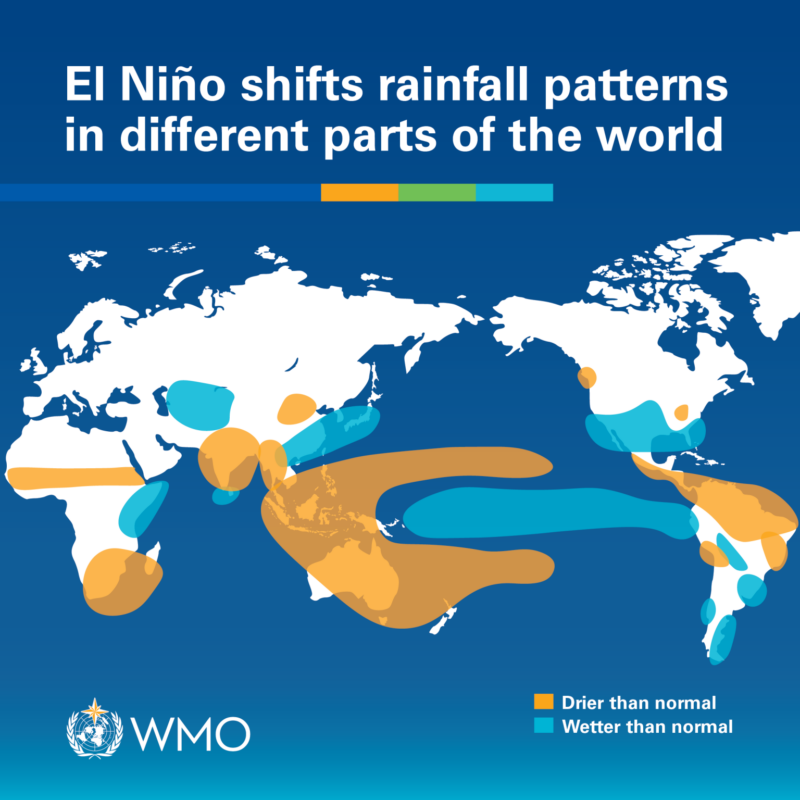
Map of globe with orange and blue showing drier and wetter areas during El Nino.
Some parts of the world see wetter conditions during an El Niño (blue) while others are more likely to experience drought (orange). Image via WMO.

What is a super El Niño?

So what is an El Niño and a super El Niño? Let’s start with what a typical El Niño is. There are three types of conditions that can guide global weather: El Niño, La Niña and neutral. These three conditions make up ENSO, or the El Niño–Southern Oscillation. ENSO is a natural climate pattern in the tropical Pacific Ocean that shifts between warm and cool phases. El Niño is the warm phase and La Niña is the cool phase. And these phases influence weather around the world, including rainfall, droughts and storms.

So an average El Niño occurs when warm water pools up in the eastern Pacific Ocean, around the equator. Once the temperatures reach 0.5 degrees Celsius (0.9 F) warmer than normal in the sea surface, an El Niño has formed. El Niño conditions can last for up to a year.

A super El Niño is a stronger event. Meteorologists often call it a super El Niño when the sea surface temperature anomalies peak at about 2.0° C (3.6 F) above normal. And currently, some models are calling for the coming El Niño to exceed 2.5° C (4.5 F) above the seasonal average by October.

You can follow along with NOAA’s El Niño watch here. The next update will be on June 11. As of May 16, 2026, NOAA said:

El Niño is likely to emerge soon (82% chance in May-July 2026) and continue through Northern Hemisphere winter 2026-27 (96% chance in December 2026-February 2027).

Higher temperatures with El Niño

An El Niño usually brings higher global temperatures. The excess heat in the Pacific Ocean eventually enters the atmosphere. This causes warmer global temperatures. However, the rise in temperatures often has a lag time of a few months.

Some forecasters have already said that if a strong El Niño emerges, 2027 could become one of the hottest years on record. Northern Illinois University meteorology professor Victor Gensini told PBS:

A strong El Niño could plausibly push global temperatures to new record levels in late 2026 and into 2027.

This comes on the heels of the hottest March on record for the contiguous United States. NOAA said:

The contiguous U.S. average temperature in March was 50.85° F (10.4 C), 9.35° F (5.19 C) above the 20th-century average, marking the first time any month’s average has exceeded 9° F (5 C) above that baseline.

Other impacts from El Niño

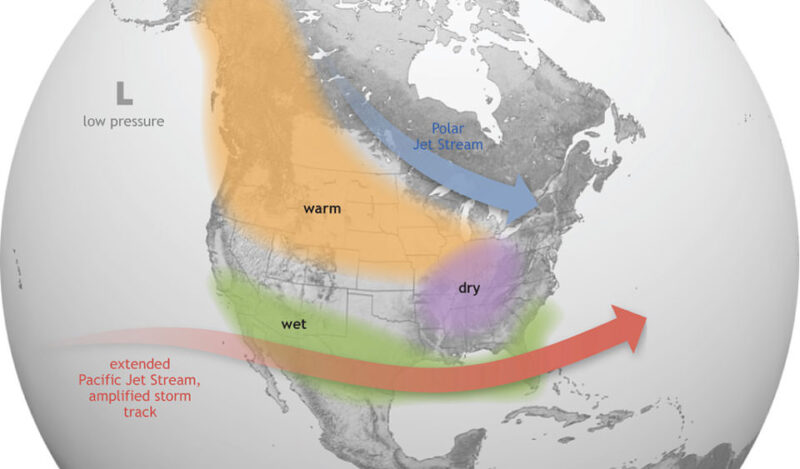
In the summer, El Niño can dampen hurricane formation in the Atlantic. But it’s in winter that we feel El Niño the strongest. Often the jet stream will drop south, steering storms into California and Arizona and bringing much-needed rain. If the jet stream drops, then the southern and eastern U.S. can expect wetter and cooler weather. Meanwhile, drier weather could prevail in the northern U.S. and Great Lakes region.

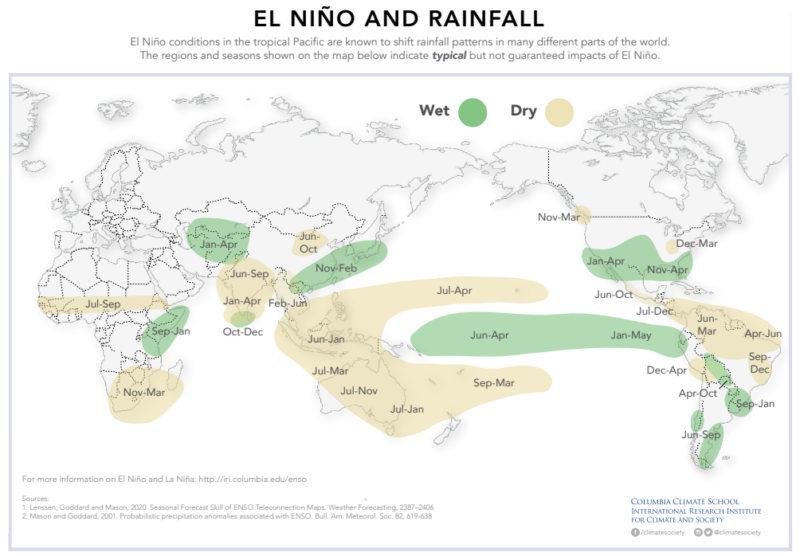
Across the globe, El Niño brings drought conditions to places such as Australia, India and central Africa. And it can bring heavy rains to southern South America and eastern Africa.

Map of North America with big arrows for polar and Pacific jet streams and areas of wet and dry weather.
An El Niño increases the likelihood of wetter weather in the southern and eastern U.S., with dry conditions near the Great Lakes and warm conditions along the upper tier of the U.S. Image via NOAA.
Map of world showing tan for drier areas and green for wetter areas mostly in more southerly locations.
El Niño conditions in the tropical Pacific are known to shift rainfall patterns in many different parts of the world. The regions and seasons shown on the map indicate typical but not guaranteed impacts of El Niño. Image via Columbia Climate School. CC BY.

Staying safe in extreme heat

From EarthSky’s weather author, meteorologist Rachel Duensing:

Staying safe in extreme heat can vary a bit depending on your situation. But the main idea is to avoid the heat as much as possible. If you are able to stay inside, ideally in air-conditioning (A/C), this is your best option. But as mentioned, if you cannot avoid the hot weather, there are things you can do. Take frequent breaks in the shade. Make sure you’re staying hydrated. Wear light color, loose-fitting clothing. And pay close attention to how you’re feeling as the day goes on.

If you, or someone you are with, is sweating heavily, feeling weak, tired, dizzy or nauseated, these could be signs of heat exhaustion. Immediately move yourself or the other person into A/C. Loosen their clothing, give them sips of cool water and put cold compresses on their body.

If someone is acting confused and slurring their speech, has red and hot skin or passes out, this is likely a heat stroke. They need medical attention immediately! Call 911. While you wait for help to arrive, move the person to A/C, add cool compresses to lower their body temperature, but do not give them anything to drink.

The heat can also be more dangerous to the very young, the very old, people with chronic medical conditions and pregnant women. In addition, the unhoused and lower income communities, who may not be able to afford to run their air-conditioning, are also at risk. Check on your friends, family and neighbors before, during and after extreme heat.

Bottom line: The World Meteorological Organization said on Tuesday, June 2, 2026, that people should start preparing now for above average temperatures and extreme weather due to coming El Niño conditions.

Via:

NOAA

Yale Climate Connections

WMO

The post Prepare for El Niño conditions, urge officials first appeared on EarthSky.


from EarthSky https://ift.tt/GIDxr81
Super El Niño: People surfing and playing volleyball on a beach beneath a blazing afternoon sun.
It appears likely El Niño conditions will emerge soon. On Tuesday, June 2, 2026, officials from the World Meteorological Organization urged people to prepare for above average temperatures and more extreme weather patterns. In addition, we could be facing a super El Niño, if the sea surface temperatures in the Eastern Pacific climb to about 2.0° C (3.6 F) above normal. Image via Peggy Marco/ Pixabay.

Science news, night sky events and beautiful photos, all in one place. Click here to subscribe to EarthSky’s free daily newsletter.

World Meteorological Organization urges people to prepare for El Niño

On Tuesday, June 2, 2026, the World Meteorological Organization (WMO), based in Geneva, Switzerland, urged people to prepare for coming El Niño conditions. The WMO, a specialized agency of the United Nations that focuses on weather, climate and water resources, said:

Fueled by unusually warm ocean waters in the tropical Pacific, El Niño conditions are developing and are set to influence global temperature and rainfall patterns, increasing the risk of extreme weather over the coming months.

The newest update on El Niño conditions now shows an 80% likelihood of El Nino developing in the next three months. Plus, the likelihood that El Niño conditions will continue until at least November are around 90%. And there is still a possibility that it will become a super El Niño event.

UN Secretary-General António Guterres did not hold back in a statement:

The science is clear: El Niño is arriving on our doorstep in the coming months with 90% certainty. The world must treat it as the urgent climate warning it is. El Niño conditions will pour fuel on the fire of a warming world. Impacts will hit even harder, travel even farther, and cross borders with devastating speed. The only effective response is climate action equal to the crisis – ending the addiction to fossil fuels, accelerating the shift to renewables, protecting the most vulnerable, and delivering early warning systems for all.

What could El Niño bring?

WMO Secretary-General Celeste Saulo said:

We need to prepare for a potentially strong El Niño event – which will exacerbate drought and heavy rainfall and increase the risk of heatwaves both on land and in the ocean. The most recent El Niño, in 2023-24, was one of the five strongest on record and it played a role in the record global temperatures we saw in 2024.

Just like any weather event, preparation is key. The WMO said that nearly everywhere can expect above average temperatures for June to August. Do you know how to beat the heat? Meteorologist Rachel Duensing provides tips below.

Celeste Saulo also said:

Advance seasonal forecasts and early warnings are vital to save lives and cushion the impact on our economies and our communities.

The Eastern Pacific is more likely to see more hurricanes, while the Atlantic is likely to see fewer during an El Niño year. Read more: The Atlantic hurricane season forecast for 2026 is out!

Map of globe with orange and blue showing drier and wetter areas during El Nino.
Some parts of the world see wetter conditions during an El Niño (blue) while others are more likely to experience drought (orange). Image via WMO.

What is a super El Niño?

So what is an El Niño and a super El Niño? Let’s start with what a typical El Niño is. There are three types of conditions that can guide global weather: El Niño, La Niña and neutral. These three conditions make up ENSO, or the El Niño–Southern Oscillation. ENSO is a natural climate pattern in the tropical Pacific Ocean that shifts between warm and cool phases. El Niño is the warm phase and La Niña is the cool phase. And these phases influence weather around the world, including rainfall, droughts and storms.

So an average El Niño occurs when warm water pools up in the eastern Pacific Ocean, around the equator. Once the temperatures reach 0.5 degrees Celsius (0.9 F) warmer than normal in the sea surface, an El Niño has formed. El Niño conditions can last for up to a year.

A super El Niño is a stronger event. Meteorologists often call it a super El Niño when the sea surface temperature anomalies peak at about 2.0° C (3.6 F) above normal. And currently, some models are calling for the coming El Niño to exceed 2.5° C (4.5 F) above the seasonal average by October.

You can follow along with NOAA’s El Niño watch here. The next update will be on June 11. As of May 16, 2026, NOAA said:

El Niño is likely to emerge soon (82% chance in May-July 2026) and continue through Northern Hemisphere winter 2026-27 (96% chance in December 2026-February 2027).

Higher temperatures with El Niño

An El Niño usually brings higher global temperatures. The excess heat in the Pacific Ocean eventually enters the atmosphere. This causes warmer global temperatures. However, the rise in temperatures often has a lag time of a few months.

Some forecasters have already said that if a strong El Niño emerges, 2027 could become one of the hottest years on record. Northern Illinois University meteorology professor Victor Gensini told PBS:

A strong El Niño could plausibly push global temperatures to new record levels in late 2026 and into 2027.

This comes on the heels of the hottest March on record for the contiguous United States. NOAA said:

The contiguous U.S. average temperature in March was 50.85° F (10.4 C), 9.35° F (5.19 C) above the 20th-century average, marking the first time any month’s average has exceeded 9° F (5 C) above that baseline.

Other impacts from El Niño

In the summer, El Niño can dampen hurricane formation in the Atlantic. But it’s in winter that we feel El Niño the strongest. Often the jet stream will drop south, steering storms into California and Arizona and bringing much-needed rain. If the jet stream drops, then the southern and eastern U.S. can expect wetter and cooler weather. Meanwhile, drier weather could prevail in the northern U.S. and Great Lakes region.

Across the globe, El Niño brings drought conditions to places such as Australia, India and central Africa. And it can bring heavy rains to southern South America and eastern Africa.

Map of North America with big arrows for polar and Pacific jet streams and areas of wet and dry weather.
An El Niño increases the likelihood of wetter weather in the southern and eastern U.S., with dry conditions near the Great Lakes and warm conditions along the upper tier of the U.S. Image via NOAA.
Map of world showing tan for drier areas and green for wetter areas mostly in more southerly locations.
El Niño conditions in the tropical Pacific are known to shift rainfall patterns in many different parts of the world. The regions and seasons shown on the map indicate typical but not guaranteed impacts of El Niño. Image via Columbia Climate School. CC BY.

Staying safe in extreme heat

From EarthSky’s weather author, meteorologist Rachel Duensing:

Staying safe in extreme heat can vary a bit depending on your situation. But the main idea is to avoid the heat as much as possible. If you are able to stay inside, ideally in air-conditioning (A/C), this is your best option. But as mentioned, if you cannot avoid the hot weather, there are things you can do. Take frequent breaks in the shade. Make sure you’re staying hydrated. Wear light color, loose-fitting clothing. And pay close attention to how you’re feeling as the day goes on.

If you, or someone you are with, is sweating heavily, feeling weak, tired, dizzy or nauseated, these could be signs of heat exhaustion. Immediately move yourself or the other person into A/C. Loosen their clothing, give them sips of cool water and put cold compresses on their body.

If someone is acting confused and slurring their speech, has red and hot skin or passes out, this is likely a heat stroke. They need medical attention immediately! Call 911. While you wait for help to arrive, move the person to A/C, add cool compresses to lower their body temperature, but do not give them anything to drink.

The heat can also be more dangerous to the very young, the very old, people with chronic medical conditions and pregnant women. In addition, the unhoused and lower income communities, who may not be able to afford to run their air-conditioning, are also at risk. Check on your friends, family and neighbors before, during and after extreme heat.

Bottom line: The World Meteorological Organization said on Tuesday, June 2, 2026, that people should start preparing now for above average temperatures and extreme weather due to coming El Niño conditions.

Via:

NOAA

Yale Climate Connections

WMO

The post Prepare for El Niño conditions, urge officials first appeared on EarthSky.


from EarthSky https://ift.tt/GIDxr81

adds 2