
Rare meteorite hints at giant early planet
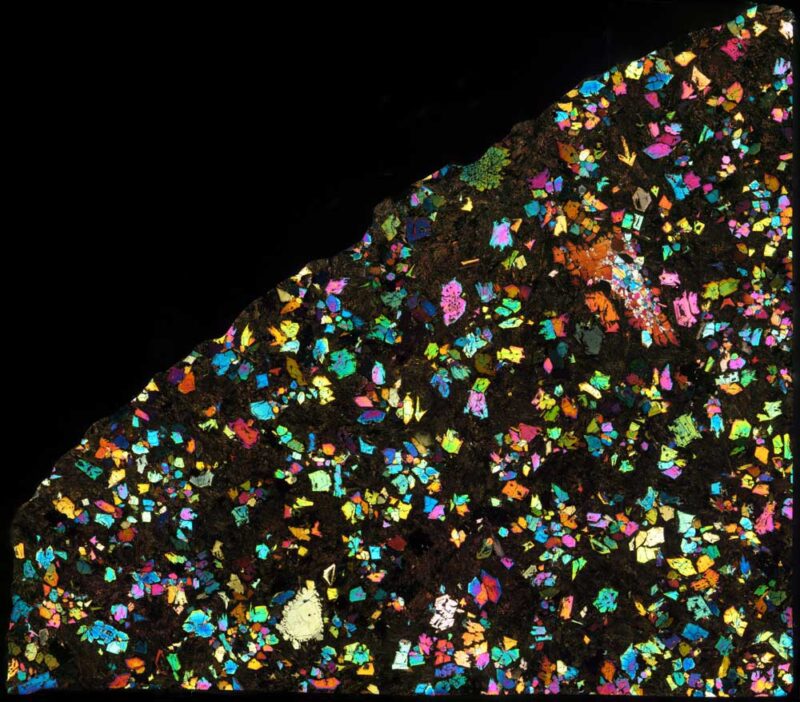
Fragmented rocks and debris in our solar system sometimes strike Earth, burning up in our atmosphere as meteors. Occasionally, those pieces of debris are large enough to survive the trip through Earth’s atmosphere and make it to the ground. Scientists have analyzed these meteorites and discovered most are from three sources: asteroids, the moon and Mars. But a few rare meteorites are from other sources. And on June 1, 2026, researchers from the University of Colorado Boulder said the meteorite NWA 12774 is likely from a previously unknown massive, early planet that shattered billions of years ago.
The journal Earth and Planetary Science Letters will publish the researchers’ peer-reviewed study on July 1, 2026.
Our early solar system was chaotic
Our solar system formed out of a large cloud of gas and dust about 4.5 billion years ago. It was a chaotic environment, with objects colliding and sticking together or shattering apart. And the meteorite that scientists have labeled NWA 12774 reveals a world that might have been trying to form along with Earth and the other planets.
The scientists said the world might have been as large as the moon or Mars when a collision shattered it, producing the fragment that eventually made its way to the Sahara Desert in Northwest Africa.
Aaron Bell of CU Boulder was the lead author of the new paper. Bell said:
It’s incredible to think there was once a world this large. We only know it existed because a few fragments of it happened to land on Earth. These meteorites preserved evidence of a completely different pathway through which early planets developed.
The rare meteorite is an angrite
This meteorite is from a rare class of meteorites that scientists call angrites. People have discovered more than 80,000 meteorites on Earth. But only 68 of those have been angrites. They have a different makeup than meteorites that are from asteroids, the moon and Mars.
Silicon dioxide – aka silica – is a common material that’s in quartz, sand and nearly every known terrestrial planet in the solar system. But it’s scarce in angrites. So most scientists thought these meteorites came from an asteroid.
High pressure must have formed the meteorite
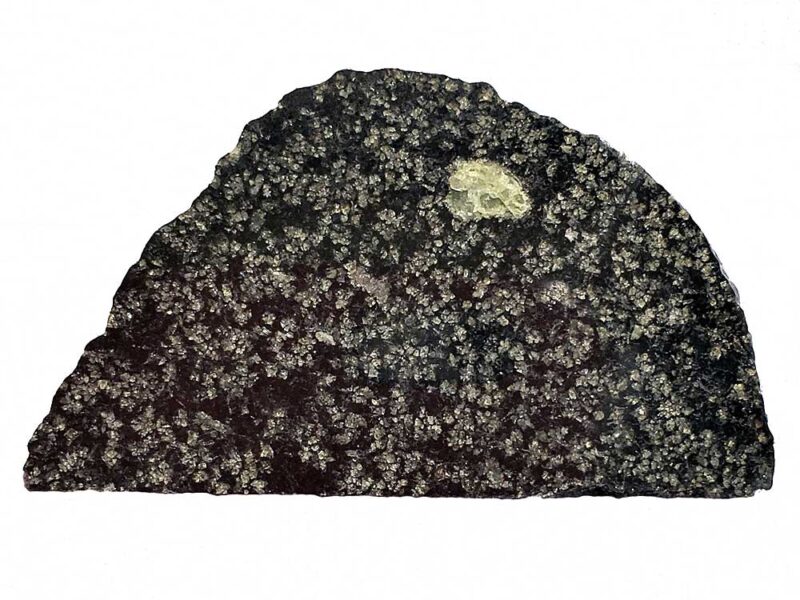
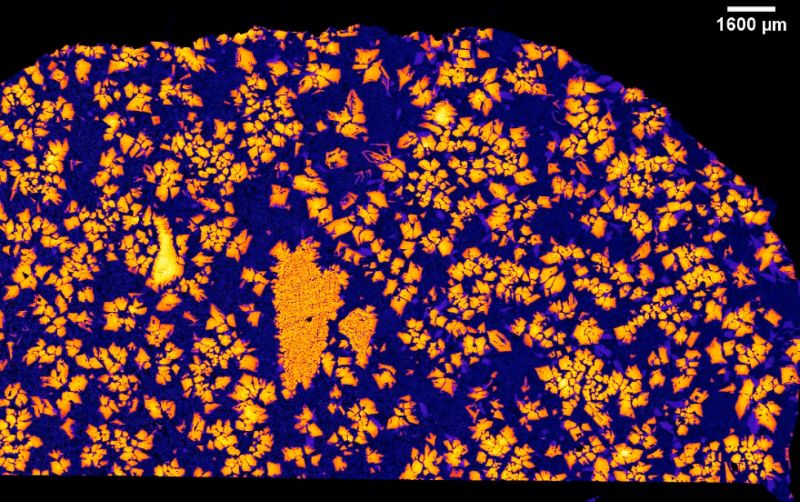
But when the CU Boulder researchers studied NWA 12774, they found a rock-forming mineral called clinopyroxene. And the clinopyroxene had an unusual abundance of aluminium. These ingredients told the researchers that the meteorite originally formed under enormous pressure deep underground. In fact, they found the pressure that would have been needed to form NWA 12774 was greater than the pressure at the bottom of the ocean.
To be specific, forming the aluminum-rich clinopyroxene in NWA 12774 would require at least 17.5 kilobars of pressure. And the pressure at the Mariana Trench in the Pacific (the deepest trench on Earth) is 1 kilobar.
So the researchers concluded that only a large parent body could have produced this meteorite. The parent body would have had to be at least 1,242 miles across (2,000 km).
Or was the planet even bigger?
But wait. The crystals in the meteorite still have sharp edges. This would not be the case if the rock sample formed deep underground. And it also had delicate chemical patterns that could not have formed deep underground either. So that means it likely formed underground but at shallow depths of an even larger parent body.
The researchers estimate the parent body could have been the size of the moon or Mars, or some 2,240 miles (3,600 km) to 4,100 miles (6,600 km) across.
Could there be more meteorites pointing to other lost worlds? Bell said:
There are many meteorites sitting in drawers that haven’t been thoroughly studied, so there were likely more of these protoplanets we don’t know about.
Bottom line: Scientists have found a rare meteorite that contains evidence of a lost early protoplanet. It offers a glimpse into the chaotic collisions that shaped our solar system.
Read more: Meteorite hunting? Here’s tips on how to find one
The post Rare meteorite hints at giant early planet first appeared on EarthSky.
from EarthSky https://ift.tt/EMztLIB
Rare meteorite hints at giant early planet
Fragmented rocks and debris in our solar system sometimes strike Earth, burning up in our atmosphere as meteors. Occasionally, those pieces of debris are large enough to survive the trip through Earth’s atmosphere and make it to the ground. Scientists have analyzed these meteorites and discovered most are from three sources: asteroids, the moon and Mars. But a few rare meteorites are from other sources. And on June 1, 2026, researchers from the University of Colorado Boulder said the meteorite NWA 12774 is likely from a previously unknown massive, early planet that shattered billions of years ago.
The journal Earth and Planetary Science Letters will publish the researchers’ peer-reviewed study on July 1, 2026.
Our early solar system was chaotic
Our solar system formed out of a large cloud of gas and dust about 4.5 billion years ago. It was a chaotic environment, with objects colliding and sticking together or shattering apart. And the meteorite that scientists have labeled NWA 12774 reveals a world that might have been trying to form along with Earth and the other planets.
The scientists said the world might have been as large as the moon or Mars when a collision shattered it, producing the fragment that eventually made its way to the Sahara Desert in Northwest Africa.
Aaron Bell of CU Boulder was the lead author of the new paper. Bell said:
It’s incredible to think there was once a world this large. We only know it existed because a few fragments of it happened to land on Earth. These meteorites preserved evidence of a completely different pathway through which early planets developed.
The rare meteorite is an angrite
This meteorite is from a rare class of meteorites that scientists call angrites. People have discovered more than 80,000 meteorites on Earth. But only 68 of those have been angrites. They have a different makeup than meteorites that are from asteroids, the moon and Mars.
Silicon dioxide – aka silica – is a common material that’s in quartz, sand and nearly every known terrestrial planet in the solar system. But it’s scarce in angrites. So most scientists thought these meteorites came from an asteroid.
High pressure must have formed the meteorite
But when the CU Boulder researchers studied NWA 12774, they found a rock-forming mineral called clinopyroxene. And the clinopyroxene had an unusual abundance of aluminium. These ingredients told the researchers that the meteorite originally formed under enormous pressure deep underground. In fact, they found the pressure that would have been needed to form NWA 12774 was greater than the pressure at the bottom of the ocean.
To be specific, forming the aluminum-rich clinopyroxene in NWA 12774 would require at least 17.5 kilobars of pressure. And the pressure at the Mariana Trench in the Pacific (the deepest trench on Earth) is 1 kilobar.
So the researchers concluded that only a large parent body could have produced this meteorite. The parent body would have had to be at least 1,242 miles across (2,000 km).
Or was the planet even bigger?
But wait. The crystals in the meteorite still have sharp edges. This would not be the case if the rock sample formed deep underground. And it also had delicate chemical patterns that could not have formed deep underground either. So that means it likely formed underground but at shallow depths of an even larger parent body.
The researchers estimate the parent body could have been the size of the moon or Mars, or some 2,240 miles (3,600 km) to 4,100 miles (6,600 km) across.
Could there be more meteorites pointing to other lost worlds? Bell said:
There are many meteorites sitting in drawers that haven’t been thoroughly studied, so there were likely more of these protoplanets we don’t know about.
Bottom line: Scientists have found a rare meteorite that contains evidence of a lost early protoplanet. It offers a glimpse into the chaotic collisions that shaped our solar system.
Read more: Meteorite hunting? Here’s tips on how to find one
The post Rare meteorite hints at giant early planet first appeared on EarthSky.
from EarthSky https://ift.tt/EMztLIB

Aucun commentaire:
Enregistrer un commentaire