
Tonight, assuming you’re in the Northern Hemisphere, you can easily find the legendary Big Dipper, called the Plough by our friends in the United Kingdom or the Wagon throughout much of Europe.
This familiar star pattern is high in the north at nightfall in June, for Northern Hemisphere stargazers. Find it and let it be your guide to the Little Dipper.
The Big Dipper is easy to find because its shape really resembles a dipper. And it is made up of moderately bright stars. But the Little Dipper isn’t as easy. You need a dark sky to see it. So be sure to avoid city lights.
How to find the Dippers from the Northern Hemisphere
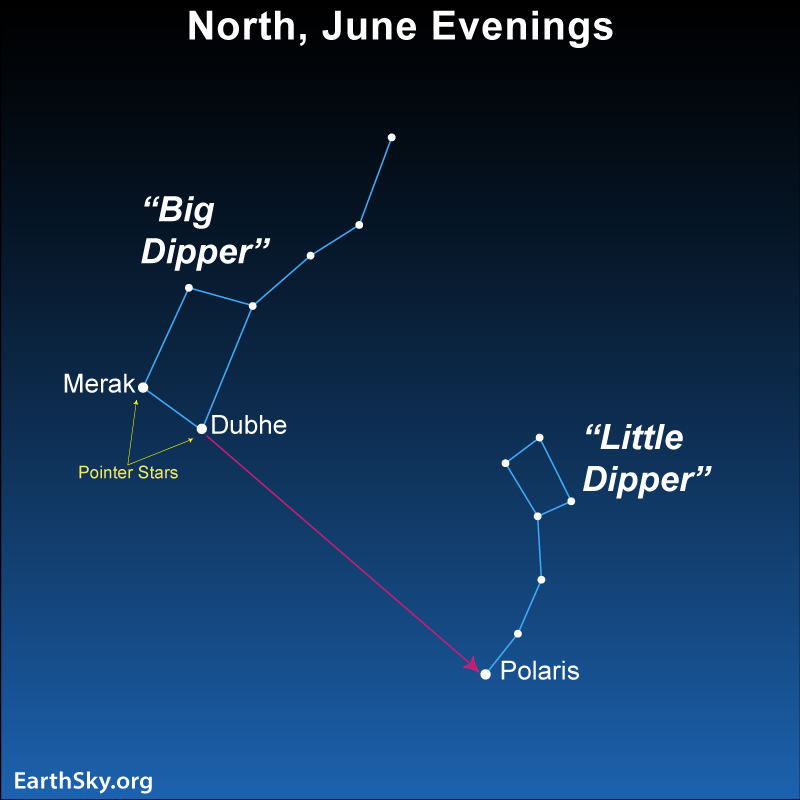
Simply face northward on a June evening and look for a large, dipper-like pattern. Which way is north? Rotate around until your left side faces the sunset point. You are now looking toward the north. That easy-to-see pattern high in the sky is the Big Dipper.
Also, notice that the Big Dipper has two parts: a bowl and a handle. The bowl has four stars and the handle has three. See the two outer stars in the bowl? They’re known as the Pointers because they point to the North Star, which is also known as Polaris.

Polaris is the brightest star of the Little Dipper
Once you’ve found Polaris, you can find the Little Dipper. Polaris marks the end of the handle of the Little Dipper. You need a dark sky to see the all of the Little Dipper, because it’s fainter than its larger and brighter counterpart. If your skies are not very dark, you might see only the three brightest stars in the Little Dipper. Those three stars are Polaris and the two end stars in the bowl of the Little Dipper.
By the way, can you see the Big Dipper from Earth’s Southern Hemisphere? Yes, if you’re in the southern tropics. However, much farther south, it gets harder because you are farther south on Earth’s globe. So, the Big Dipper sinks closer and closer to the northern horizon.
Meanwhile, Polaris, the North Star, disappears beneath the horizon once you get south of the Earth’s equator.
Can you see the Dippers from the Southern Hemisphere?
Via Daniel Gaussen, Founder & Guide – Stargaze Mackenzie – New Zealand
For observers in the Southern Hemisphere, the Big Dipper is a much less familiar sight. It can be seen from some tropical and subtropical latitudes, but only very low in the northern sky, skimming close to the horizon.
The best months to look for it in the evening are around April and May, when it’s culminating (reaching its highest point in the north) in late evening. Because all the stars rise 4 minutes earlier each day, the Dipper culminates earlier in the evening in June.
Meanwhile, for the most part, the Little Dipper can’t be seen at all. The Little Dipper’s anchor star, Polaris – the North Star, or star that marks the north celestial pole (point in the sky around which the entire northern sky turns) – doesn’t rise above the horizon for those south of the equator.
Instead, Southern Hemisphere stargazers turn to the Southern Cross (Crux) as their most recognizable navigational star pattern. The bright stars Alpha and Beta Centauri are commonly known as the Pointer Stars because they point toward the Southern Cross, helping observers locate the south celestial pole (point around which the entire southern sky turns).
So Alpha and Beta Centauri mirror the role of the Big Dipper’s two outer bowl stars, Dubhe and Merak, also known as the Pointers in the north, guiding the eye toward Polaris and the north celestial pole.
Big and Little Dipper in skylore
In his classic book Star Names: Their Lore and Meaning, Richard Hinckley Allen claims the Greek constellation Ursa Minor the Lesser Bear – our Little Dipper – was never mentioned in the literary works of Homer (9th century BCE) or Hesiod (8th century BCE).
That’s probably because Ursa Minor hadn’t been invented yet.
According to the Greek geographer and historian Strabo (63 BCE to about 21 CE), the seven stars we see today as part of Ursa Minor (the Little Dipper) didn’t carry that name until 600 BCE or so. Before that time, people saw this group of stars outlining the wings of the constellation Draco the Dragon.
When the seafaring Phoenicians visited the Greek philosopher Thales around 600 BCE, they showed him how to navigate by the stars. Purportedly, Thales clipped the Dragon’s wings to create a new constellation, possibly because this new way of looking at the stars enabled Greek sailors to more easily locate the north celestial pole.
But it’s not just our names for things in the sky that change. The sky itself changes, too. In our day, Polaris closely marks the north celestial pole in the sky. In 600 BCE – thanks to the motion of precession – the Little Dipper’s stars Kochab and Pherkad more closely marked the position of the north celestial pole.
Read more: Kochab and Pherkad: The Guardians of the Pole
Bottom line: If you live in the Northern Hemisphere, look for the Big and Little Dippers in the north at nightfall on June evenings.
EarthSky astronomy kits are perfect for beginners. Order today from the EarthSky store
The post Big and Little Dippers in the northern sky on June evenings first appeared on EarthSky.
from EarthSky https://ift.tt/ngAj4ID
Tonight, assuming you’re in the Northern Hemisphere, you can easily find the legendary Big Dipper, called the Plough by our friends in the United Kingdom or the Wagon throughout much of Europe.
This familiar star pattern is high in the north at nightfall in June, for Northern Hemisphere stargazers. Find it and let it be your guide to the Little Dipper.
The Big Dipper is easy to find because its shape really resembles a dipper. And it is made up of moderately bright stars. But the Little Dipper isn’t as easy. You need a dark sky to see it. So be sure to avoid city lights.
How to find the Dippers from the Northern Hemisphere
Simply face northward on a June evening and look for a large, dipper-like pattern. Which way is north? Rotate around until your left side faces the sunset point. You are now looking toward the north. That easy-to-see pattern high in the sky is the Big Dipper.
Also, notice that the Big Dipper has two parts: a bowl and a handle. The bowl has four stars and the handle has three. See the two outer stars in the bowl? They’re known as the Pointers because they point to the North Star, which is also known as Polaris.
Polaris is the brightest star of the Little Dipper
Once you’ve found Polaris, you can find the Little Dipper. Polaris marks the end of the handle of the Little Dipper. You need a dark sky to see the all of the Little Dipper, because it’s fainter than its larger and brighter counterpart. If your skies are not very dark, you might see only the three brightest stars in the Little Dipper. Those three stars are Polaris and the two end stars in the bowl of the Little Dipper.
By the way, can you see the Big Dipper from Earth’s Southern Hemisphere? Yes, if you’re in the southern tropics. However, much farther south, it gets harder because you are farther south on Earth’s globe. So, the Big Dipper sinks closer and closer to the northern horizon.
Meanwhile, Polaris, the North Star, disappears beneath the horizon once you get south of the Earth’s equator.
Can you see the Dippers from the Southern Hemisphere?
Via Daniel Gaussen, Founder & Guide – Stargaze Mackenzie – New Zealand
For observers in the Southern Hemisphere, the Big Dipper is a much less familiar sight. It can be seen from some tropical and subtropical latitudes, but only very low in the northern sky, skimming close to the horizon.
The best months to look for it in the evening are around April and May, when it’s culminating (reaching its highest point in the north) in late evening. Because all the stars rise 4 minutes earlier each day, the Dipper culminates earlier in the evening in June.
Meanwhile, for the most part, the Little Dipper can’t be seen at all. The Little Dipper’s anchor star, Polaris – the North Star, or star that marks the north celestial pole (point in the sky around which the entire northern sky turns) – doesn’t rise above the horizon for those south of the equator.
Instead, Southern Hemisphere stargazers turn to the Southern Cross (Crux) as their most recognizable navigational star pattern. The bright stars Alpha and Beta Centauri are commonly known as the Pointer Stars because they point toward the Southern Cross, helping observers locate the south celestial pole (point around which the entire southern sky turns).
So Alpha and Beta Centauri mirror the role of the Big Dipper’s two outer bowl stars, Dubhe and Merak, also known as the Pointers in the north, guiding the eye toward Polaris and the north celestial pole.
Big and Little Dipper in skylore
In his classic book Star Names: Their Lore and Meaning, Richard Hinckley Allen claims the Greek constellation Ursa Minor the Lesser Bear – our Little Dipper – was never mentioned in the literary works of Homer (9th century BCE) or Hesiod (8th century BCE).
That’s probably because Ursa Minor hadn’t been invented yet.
According to the Greek geographer and historian Strabo (63 BCE to about 21 CE), the seven stars we see today as part of Ursa Minor (the Little Dipper) didn’t carry that name until 600 BCE or so. Before that time, people saw this group of stars outlining the wings of the constellation Draco the Dragon.
When the seafaring Phoenicians visited the Greek philosopher Thales around 600 BCE, they showed him how to navigate by the stars. Purportedly, Thales clipped the Dragon’s wings to create a new constellation, possibly because this new way of looking at the stars enabled Greek sailors to more easily locate the north celestial pole.
But it’s not just our names for things in the sky that change. The sky itself changes, too. In our day, Polaris closely marks the north celestial pole in the sky. In 600 BCE – thanks to the motion of precession – the Little Dipper’s stars Kochab and Pherkad more closely marked the position of the north celestial pole.
Read more: Kochab and Pherkad: The Guardians of the Pole
Bottom line: If you live in the Northern Hemisphere, look for the Big and Little Dippers in the north at nightfall on June evenings.
EarthSky astronomy kits are perfect for beginners. Order today from the EarthSky store
The post Big and Little Dippers in the northern sky on June evenings first appeared on EarthSky.
from EarthSky https://ift.tt/ngAj4ID

Aucun commentaire:
Enregistrer un commentaire