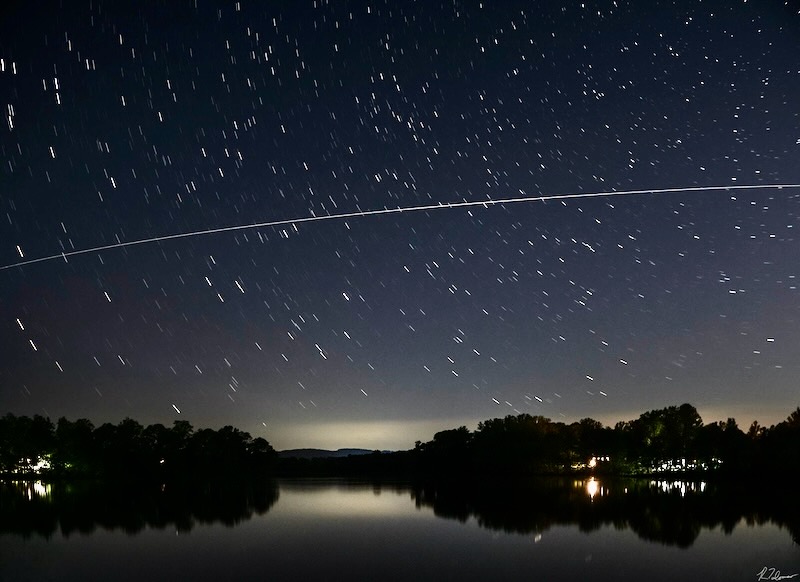
View at EarthSky Community Photos. | Ray Tolomeo wrote: “Looking to the northwest, the International Space Station flies over Lake Brittle near Warrenton, Virginia, on the evening of May 8, 2026. This is a composite of 7 30-second exposures.” Thank you, Ray!
See the International Space Station before it’s gone!
The International Space Station (ISS) has been orbiting our planet since 1998. And it’s scheduled to be de-orbited – and safely brought down over the Pacific Ocean – as early as 2031. So now is the time to see it in your sky! From about 95% of the inhabited locations on Earth, ISS makes periodic passes across the sky. It looks like a bright star, moving quickly from horizon to horizon.
But how do you know when to see the ISS pass overhead from your location?
NASA has a great tool to help. Sign up to the Spot the Station program and you’ll receive alerts to let you know when the ISS will be visible from your location, wherever you are in the world. Plus, there’s a map-based feature to track when to look for the station as it flies over you.
Typically, alerts are sent out a few times each month when the station’s orbit is near your location. You’ll get notices only when the ISS will be clearly visible from your location for at least a couple of minutes.
One note: ISS is not visible north or south of about the 51st parallel. Specifically, it’s not visible 51.6 degrees north or south.
If you’re close to that latitude, say, just below it, you might want to visit the Spot the Station website directly to see upcoming sighting opportunities. This is because notifications in this region will be rare.
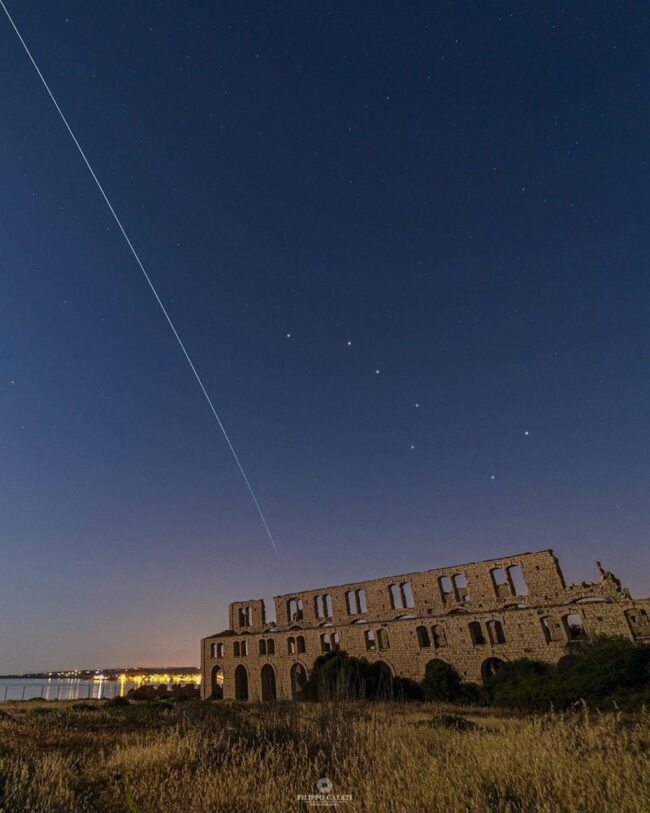
View at EarthSky Community Photos. | Filippo Galati in Sampieri, Sicily, Italy, shared this image. Filippo wrote: “On May 16, 2022 … I photographed a particularly favorable passage of the International Space Station over the skies of Sicily. It is framed by the ancient furnace Penna and highlighted in the sky by the constellation Ursa Major.” Thank you, Filippo!
How to spot the International Space Station
Spot the Station will tell you which direction to look for the ISS in your night sky. If you’re not sure about your directions, just note where the sun rises or sets from your observing spot. You know it rises generally east and sets generally west. Knowing east and west can anchor you, and help you find the direction where the station will appear (for example, in the southeast or northwest).
Via NASA’s service, the height at which the station will appear in your sky is given in degrees. And remember, 90 degrees is directly over your head. So any number less than 90 degrees means the station will appear somewhere between the horizon and the overhead mark.
Want a way to measure degrees on the sky’s dome? Make a fist, and stretch out your arm: your fist at arm’s length is equal to about 10 degrees. Then, just use the appropriate number of fist-lengths to find the location marker. For example, four fist-lengths from the horizon would be about 40 degrees.
And don’t worry, the station is bright! It’s hard to miss if you’re looking in the correct direction.
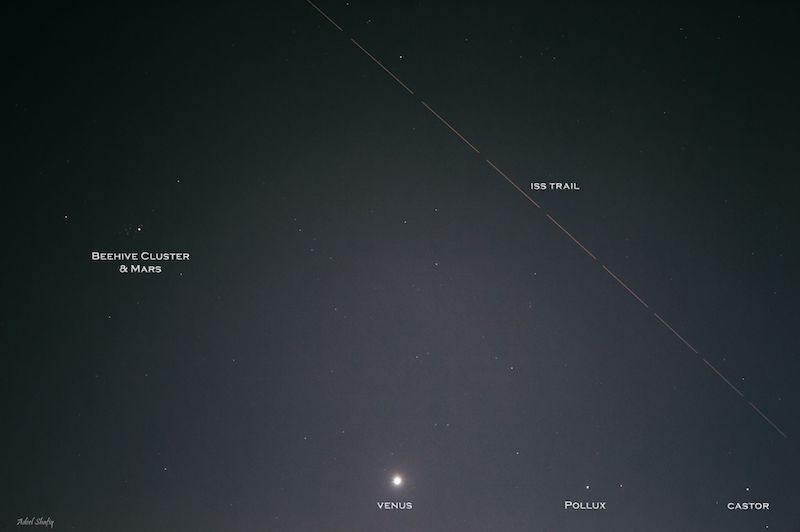
View at EarthSky Community Photos. | Mohammad Adeel in Lahore, Punjab, Pakistan, captured this image on June 2, 2023. Mohammad wrote: “It had been a while since ISS showed up in the sky, and tonight I had the chance to capture it with some interesting conjunctions. Planet Venus being at greatest western elongation and shining brightly was lining up with the twins (Pollux and Castor) in a straight line, while planet Mars was almost over the Beehive Cluster. And having ISS in the frame was too much of a busy sky not to be captured.” Thank you, Mohammad!
Over two decades of human occupation
The first module of the ISS was launched into space in 1998. The initial construction of the station took about two years to complete. Human occupation of the station began on November 2, 2000. And since that time, ISS has been continuously occupied.
ISS orbits at approximately 220 miles (350 km) above the Earth. It travels at an average speed of 17,227 miles per hour (27,724 km/h). It makes approximately 16 orbits around Earth every day.
And it serves as both an orbiting laboratory and a port for international spacecraft.
The primary partnering countries involved in operating the ISS include the United States, Canada, Japan, several European countries and Russia. China has its own space station, Tiangong, with the first module launched in 2021 and the last of its three initial modules launched in November 2022.
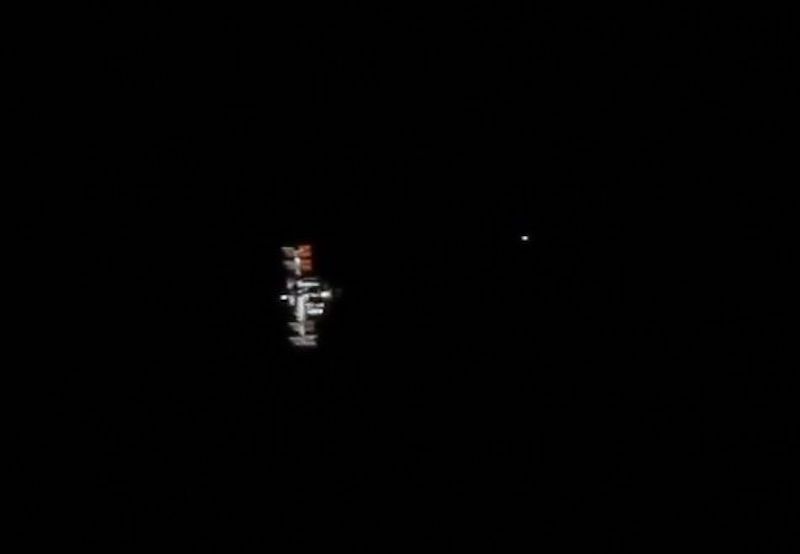
View at EarthSky Community Photos. | Patricio Leon in Santiago, Chile, captured this shot of SpaceX’s Dragon capsule approaching the International Space Station on April 9, 2022. He wrote: “Imaged at dawn today, the chasing Dragon capsule appeared as a bright star close to the ISS at the telescope finder, a very nice surprise indeed. Actual docking took place 2 hours after. The station’s solar panels lie along our line of view so are poorly represented, and the bright sphere on the left of the main body is another docked Dragon capsule.” Thank you, Patricio!
Bottom line: Learn how to spot the International Space Station from your location.
View at EarthSky Community Photos. | Ray Tolomeo wrote: “Looking to the northwest, the International Space Station flies over Lake Brittle near Warrenton, Virginia, on the evening of May 8, 2026. This is a composite of 7 30-second exposures.” Thank you, Ray!
See the International Space Station before it’s gone!
The International Space Station (ISS) has been orbiting our planet since 1998. And it’s scheduled to be de-orbited – and safely brought down over the Pacific Ocean – as early as 2031. So now is the time to see it in your sky! From about 95% of the inhabited locations on Earth, ISS makes periodic passes across the sky. It looks like a bright star, moving quickly from horizon to horizon.
But how do you know when to see the ISS pass overhead from your location?
NASA has a great tool to help. Sign up to the Spot the Station program and you’ll receive alerts to let you know when the ISS will be visible from your location, wherever you are in the world. Plus, there’s a map-based feature to track when to look for the station as it flies over you.
Typically, alerts are sent out a few times each month when the station’s orbit is near your location. You’ll get notices only when the ISS will be clearly visible from your location for at least a couple of minutes.
One note: ISS is not visible north or south of about the 51st parallel. Specifically, it’s not visible 51.6 degrees north or south.
If you’re close to that latitude, say, just below it, you might want to visit the Spot the Station website directly to see upcoming sighting opportunities. This is because notifications in this region will be rare.
View at EarthSky Community Photos. | Filippo Galati in Sampieri, Sicily, Italy, shared this image. Filippo wrote: “On May 16, 2022 … I photographed a particularly favorable passage of the International Space Station over the skies of Sicily. It is framed by the ancient furnace Penna and highlighted in the sky by the constellation Ursa Major.” Thank you, Filippo!
How to spot the International Space Station
Spot the Station will tell you which direction to look for the ISS in your night sky. If you’re not sure about your directions, just note where the sun rises or sets from your observing spot. You know it rises generally east and sets generally west. Knowing east and west can anchor you, and help you find the direction where the station will appear (for example, in the southeast or northwest).
Via NASA’s service, the height at which the station will appear in your sky is given in degrees. And remember, 90 degrees is directly over your head. So any number less than 90 degrees means the station will appear somewhere between the horizon and the overhead mark.
Want a way to measure degrees on the sky’s dome? Make a fist, and stretch out your arm: your fist at arm’s length is equal to about 10 degrees. Then, just use the appropriate number of fist-lengths to find the location marker. For example, four fist-lengths from the horizon would be about 40 degrees.
And don’t worry, the station is bright! It’s hard to miss if you’re looking in the correct direction.
View at EarthSky Community Photos. | Mohammad Adeel in Lahore, Punjab, Pakistan, captured this image on June 2, 2023. Mohammad wrote: “It had been a while since ISS showed up in the sky, and tonight I had the chance to capture it with some interesting conjunctions. Planet Venus being at greatest western elongation and shining brightly was lining up with the twins (Pollux and Castor) in a straight line, while planet Mars was almost over the Beehive Cluster. And having ISS in the frame was too much of a busy sky not to be captured.” Thank you, Mohammad!
Over two decades of human occupation
The first module of the ISS was launched into space in 1998. The initial construction of the station took about two years to complete. Human occupation of the station began on November 2, 2000. And since that time, ISS has been continuously occupied.
ISS orbits at approximately 220 miles (350 km) above the Earth. It travels at an average speed of 17,227 miles per hour (27,724 km/h). It makes approximately 16 orbits around Earth every day.
And it serves as both an orbiting laboratory and a port for international spacecraft.
The primary partnering countries involved in operating the ISS include the United States, Canada, Japan, several European countries and Russia. China has its own space station, Tiangong, with the first module launched in 2021 and the last of its three initial modules launched in November 2022.
View at EarthSky Community Photos. | Patricio Leon in Santiago, Chile, captured this shot of SpaceX’s Dragon capsule approaching the International Space Station on April 9, 2022. He wrote: “Imaged at dawn today, the chasing Dragon capsule appeared as a bright star close to the ISS at the telescope finder, a very nice surprise indeed. Actual docking took place 2 hours after. The station’s solar panels lie along our line of view so are poorly represented, and the bright sphere on the left of the main body is another docked Dragon capsule.” Thank you, Patricio!
Bottom line: Learn how to spot the International Space Station from your location.
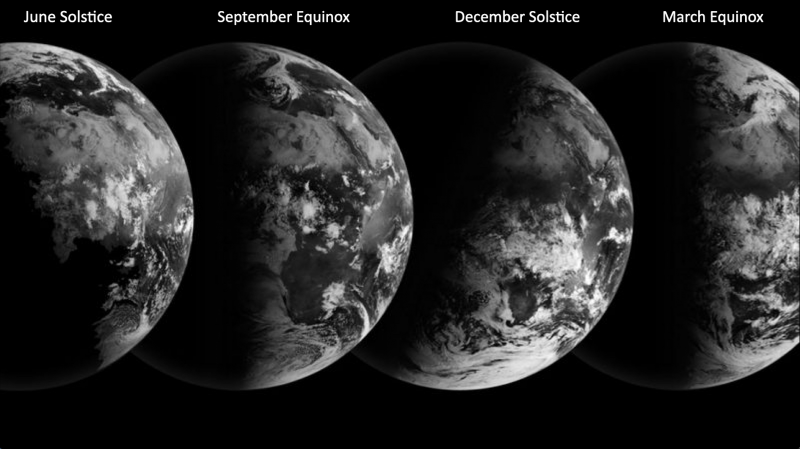
Satellite views of Earth on the solstices and equinoxes. From left to right, a June solstice, a September equinox, a December solstice and a March equinox. To understand these images, look at the poles. Notice that at the June solstice, the North Pole is in sunlight. At the December solstice, the South Pole is in sunlight. Read more about these images, which are via Robert Simmon (Sigma Space Corporation)/ NASA.
June solstice in 2026
When is it? In 2026, the solstice moment will fall at 8:25 UTC (3:25 a.m. CDT) on June 21. What is it? At the June solstice, the sun reaches its northernmost point. This point is on the celestial Tropic of Cancer, a parallel around the sky, 23.5 degrees north of the celestial equator. At this solstice, the Northern Hemisphere is most tilted toward the sun, by the maximum angle of 23 1/2 degrees. Conversely, the south is most tilted away, by the same amount. What are its main effects? At the June solstice, no matter where you are on Earth, the sun rises and sets farthest north on your horizon. The sun is directly overhead at local noon as viewed from the Tropic of Cancer. Throughout the Northern Hemisphere, the sun is high in the sky and closest to being overhead at local noon. What about day length? For us in the Northern Hemisphere, the June solstice marks the shortest nights and longest days of the year. For the Southern Hemisphere, however, it marks the longest nights and shortest days. After this solstice, the sun will begin moving southward in our sky again.
What is a solstice?
Ancient cultures knew that the sun’s path across the sky, the length of daylight and the location of the sunrise and sunset all shifted in a regular way throughout the year.
With this in mind, they built monuments such as the ones at Stonehenge in England and at Machu Picchu in Peru to follow the sun’s yearly progress.
Today, we know that the solstice is caused by Earth’s tilt on its axis and by its orbital motion around the sun.
The Earth doesn’t orbit upright with respect to the plane of our orbit around the sun. Instead, our world is tilted on its axis by 23 1/2 degrees. Through the year, this tilt causes Earth’s Northern and Southern Hemispheres to trade places in receiving the sun’s light and warmth most directly.
So it’s Earth’s tilt – not our distance from the sun – that causes winter and summer. In fact, our planet is closest to the sun in January, and farthest from the sun in July, during the Northern Hemisphere summer.
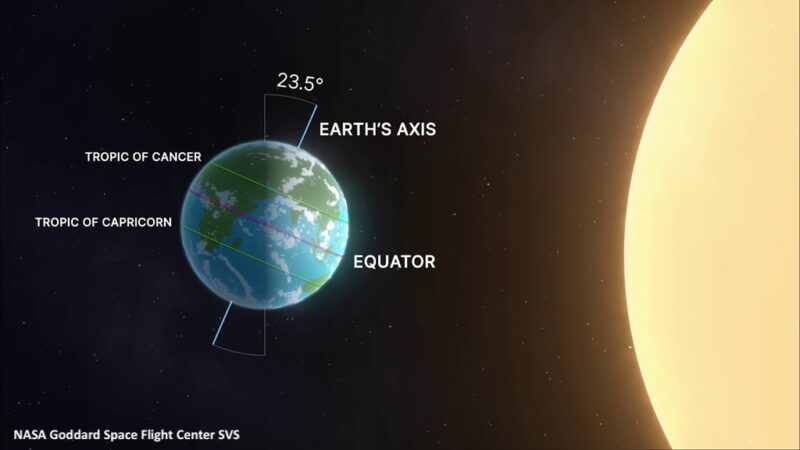
The northern summer solstice happens when Earth’s tilt toward the sun is at a maximum and the sun is directly over the Tropic of Cancer, which is located at 23.5 degrees north latitude. During the summer solstice, the sun reaches its highest noonday point in the sky. The summer solstice marks the longest day of the year. Image via NASA Goddard Scientific Visualization Studio.
Signs of the June solstice in nature
Where should you look? Everywhere.
For all of Earth’s creatures, nothing is so fundamental as the length of the day. After all, the sun is the ultimate source of almost all light and warmth on Earth’s surface.
If you live in the Northern Hemisphere, you might notice the early dawns and late sunsets, and the high arc of the sun across the sky each day. You might see how high the sun appears in the sky at local noon. And, also be sure to look at your noontime shadow. Around the time of the solstice, it’s your shortest noontime shadow of the year.
If you’re a person who’s tuned in to the out-of-doors, you know the peaceful, comforting feeling that accompanies these signs and signals of the year’s longest day.
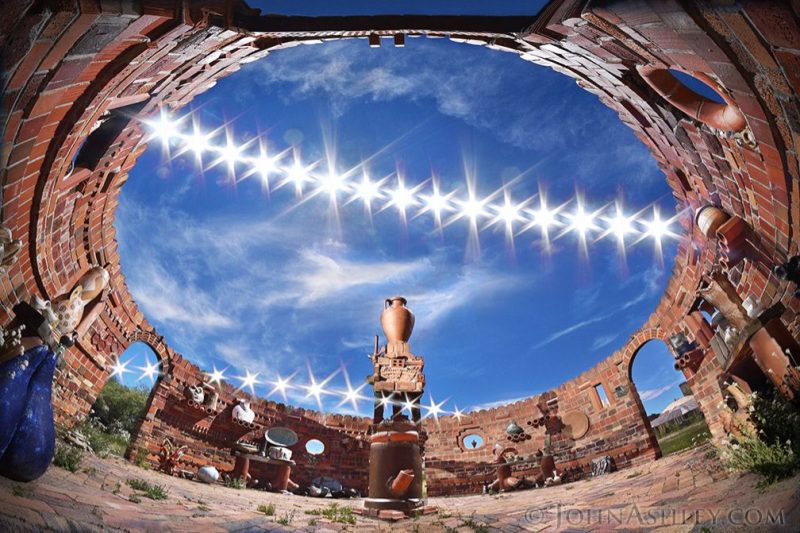
John Ashley was in Helena, Montana, when he created this composite image of 2 days of solstice suns in 2018. The uppermost line of suns is from that year’s summer solstice. The lower line of suns is from that year’s December solstice. John wrote, “The sun’s path during summer solstice arches high across the sky (upper), but at winter solstice its path barely clears the brick walls of the Potter’s Shrine, a sculptural landmark on the grounds of the Archie Bray Foundation in Helena, Montana. The interval composite photo was created over 2 days – months apart – by placing a fisheye lens on the ground and aiming it at the southern sky.” Thank you, John!
Is the June solstice the first day of summer?
No world body has designated an official day to start each new season, and different schools of thought or traditions define the seasons in different ways.
In meteorology, for example, summer begins on June 1. And every schoolchild knows that summer starts when the last school bell of the year rings.
Yet June 21 is perhaps the most widely recognized day upon which summer begins in the Northern Hemisphere and upon which winter begins on the southern half of Earth’s globe. However, the June solstice can fall on June 20 or 22. Indeed, there’s nothing official about it, but it’s such a long-held tradition that we all recognize those dates as the June solstice.
It has been universal among humans to treasure this time of warmth and light.
Stonehenge
For us in the modern world, the solstice is a time to recall the reverence and understanding that early people had for the sky. Some 5,000 years ago, people placed huge stones in a circle on a broad plain in what’s now England and aligned them with the June solstice sunrise.
We may never comprehend the full significance of Stonehenge. But we do know that knowledge of this sort wasn’t limited to just one part of the world. In fact, around the same time Stonehenge was being constructed in England, two great pyramids and then the Sphinx were built on Egyptian sands. If you stood at the Sphinx on the summer solstice and gazed toward the two pyramids, you’d see the sun set exactly between them.
EarthSky’s Will Triggs captured this dawn view of Stonehenge on June 20, 2025. Every year, thousands of people gather at Stonehenge to celebrate the solstices and equinoxes. Thank you, Will!
Why doesn’t the longest day have the hottest weather?
People often ask:
If the June solstice brings the longest day, why do we experience the hottest weather in late July and August?
This effect is called the lag of the seasons. It’s the same reason it’s hotter in midafternoon than at noontime. Essentially, Earth just takes a while to warm up after a long winter. Even in June, ice and snow still blanket the ground in some places. The sun has to melt the ice – and warm the oceans – and then we feel the most sweltering summer heat.
Ice and snow have been melting since spring began. Meltwater and rainwater have been percolating down through snow on tops of glaciers.
However, the runoff from glaciers isn’t as great now as it’ll be in another month, even though sunlight is striking the Northern Hemisphere most directly around now.
So wait another month for the hottest weather. It’ll come when the days are already beginning to shorten again, as Earth continues to move in orbit around the sun, bringing us closer to another winter.
And so the cycle continues.

Check this out … the Breathing Earth. It’s a year of seasonal transformations on our planet, including the June solstice. John Nelson created this animation, using images from the NASA Visible Earth team.Hello, summer solstice! Image via Abigail Hart.
Bottom line: The 2026 June solstice will happen at 8:25 UTC on June 21 (3:25 a.m. CDT). This solstice – the beginning of summer in the Northern Hemisphere – marks the sun’s most northerly point in Earth’s sky.
Satellite views of Earth on the solstices and equinoxes. From left to right, a June solstice, a September equinox, a December solstice and a March equinox. To understand these images, look at the poles. Notice that at the June solstice, the North Pole is in sunlight. At the December solstice, the South Pole is in sunlight. Read more about these images, which are via Robert Simmon (Sigma Space Corporation)/ NASA.
June solstice in 2026
When is it? In 2026, the solstice moment will fall at 8:25 UTC (3:25 a.m. CDT) on June 21. What is it? At the June solstice, the sun reaches its northernmost point. This point is on the celestial Tropic of Cancer, a parallel around the sky, 23.5 degrees north of the celestial equator. At this solstice, the Northern Hemisphere is most tilted toward the sun, by the maximum angle of 23 1/2 degrees. Conversely, the south is most tilted away, by the same amount. What are its main effects? At the June solstice, no matter where you are on Earth, the sun rises and sets farthest north on your horizon. The sun is directly overhead at local noon as viewed from the Tropic of Cancer. Throughout the Northern Hemisphere, the sun is high in the sky and closest to being overhead at local noon. What about day length? For us in the Northern Hemisphere, the June solstice marks the shortest nights and longest days of the year. For the Southern Hemisphere, however, it marks the longest nights and shortest days. After this solstice, the sun will begin moving southward in our sky again.
What is a solstice?
Ancient cultures knew that the sun’s path across the sky, the length of daylight and the location of the sunrise and sunset all shifted in a regular way throughout the year.
With this in mind, they built monuments such as the ones at Stonehenge in England and at Machu Picchu in Peru to follow the sun’s yearly progress.
Today, we know that the solstice is caused by Earth’s tilt on its axis and by its orbital motion around the sun.
The Earth doesn’t orbit upright with respect to the plane of our orbit around the sun. Instead, our world is tilted on its axis by 23 1/2 degrees. Through the year, this tilt causes Earth’s Northern and Southern Hemispheres to trade places in receiving the sun’s light and warmth most directly.
So it’s Earth’s tilt – not our distance from the sun – that causes winter and summer. In fact, our planet is closest to the sun in January, and farthest from the sun in July, during the Northern Hemisphere summer.
The northern summer solstice happens when Earth’s tilt toward the sun is at a maximum and the sun is directly over the Tropic of Cancer, which is located at 23.5 degrees north latitude. During the summer solstice, the sun reaches its highest noonday point in the sky. The summer solstice marks the longest day of the year. Image via NASA Goddard Scientific Visualization Studio.
Signs of the June solstice in nature
Where should you look? Everywhere.
For all of Earth’s creatures, nothing is so fundamental as the length of the day. After all, the sun is the ultimate source of almost all light and warmth on Earth’s surface.
If you live in the Northern Hemisphere, you might notice the early dawns and late sunsets, and the high arc of the sun across the sky each day. You might see how high the sun appears in the sky at local noon. And, also be sure to look at your noontime shadow. Around the time of the solstice, it’s your shortest noontime shadow of the year.
If you’re a person who’s tuned in to the out-of-doors, you know the peaceful, comforting feeling that accompanies these signs and signals of the year’s longest day.
John Ashley was in Helena, Montana, when he created this composite image of 2 days of solstice suns in 2018. The uppermost line of suns is from that year’s summer solstice. The lower line of suns is from that year’s December solstice. John wrote, “The sun’s path during summer solstice arches high across the sky (upper), but at winter solstice its path barely clears the brick walls of the Potter’s Shrine, a sculptural landmark on the grounds of the Archie Bray Foundation in Helena, Montana. The interval composite photo was created over 2 days – months apart – by placing a fisheye lens on the ground and aiming it at the southern sky.” Thank you, John!
Is the June solstice the first day of summer?
No world body has designated an official day to start each new season, and different schools of thought or traditions define the seasons in different ways.
In meteorology, for example, summer begins on June 1. And every schoolchild knows that summer starts when the last school bell of the year rings.
Yet June 21 is perhaps the most widely recognized day upon which summer begins in the Northern Hemisphere and upon which winter begins on the southern half of Earth’s globe. However, the June solstice can fall on June 20 or 22. Indeed, there’s nothing official about it, but it’s such a long-held tradition that we all recognize those dates as the June solstice.
It has been universal among humans to treasure this time of warmth and light.
Stonehenge
For us in the modern world, the solstice is a time to recall the reverence and understanding that early people had for the sky. Some 5,000 years ago, people placed huge stones in a circle on a broad plain in what’s now England and aligned them with the June solstice sunrise.
We may never comprehend the full significance of Stonehenge. But we do know that knowledge of this sort wasn’t limited to just one part of the world. In fact, around the same time Stonehenge was being constructed in England, two great pyramids and then the Sphinx were built on Egyptian sands. If you stood at the Sphinx on the summer solstice and gazed toward the two pyramids, you’d see the sun set exactly between them.
EarthSky’s Will Triggs captured this dawn view of Stonehenge on June 20, 2025. Every year, thousands of people gather at Stonehenge to celebrate the solstices and equinoxes. Thank you, Will!
Why doesn’t the longest day have the hottest weather?
People often ask:
If the June solstice brings the longest day, why do we experience the hottest weather in late July and August?
This effect is called the lag of the seasons. It’s the same reason it’s hotter in midafternoon than at noontime. Essentially, Earth just takes a while to warm up after a long winter. Even in June, ice and snow still blanket the ground in some places. The sun has to melt the ice – and warm the oceans – and then we feel the most sweltering summer heat.
Ice and snow have been melting since spring began. Meltwater and rainwater have been percolating down through snow on tops of glaciers.
However, the runoff from glaciers isn’t as great now as it’ll be in another month, even though sunlight is striking the Northern Hemisphere most directly around now.
So wait another month for the hottest weather. It’ll come when the days are already beginning to shorten again, as Earth continues to move in orbit around the sun, bringing us closer to another winter.
And so the cycle continues.
Check this out … the Breathing Earth. It’s a year of seasonal transformations on our planet, including the June solstice. John Nelson created this animation, using images from the NASA Visible Earth team.Hello, summer solstice! Image via Abigail Hart.
Bottom line: The 2026 June solstice will happen at 8:25 UTC on June 21 (3:25 a.m. CDT). This solstice – the beginning of summer in the Northern Hemisphere – marks the sun’s most northerly point in Earth’s sky.
Powerful “winds” that blasted gas into space might have been a common killer of massive galaxies in the early universe. But where did these winds come from? Read more about a galaxy-killing wind in the early universe below. Image via Joshua Worth/ The Conversation.
When astronomers look far back in space and time, they see more big, dead galaxies than expected. But why?
Powerful winds can sweep away a galaxy’s gas and dust, which are needed to create new stars.
A new study suggests intense star formation drove the winds that then paradoxically swept away the material for future star formation.
At the start of cosmic history, galaxies were big clouds of gas. And they grew by turning that gas into stars. If a galaxy runs out of gas, it will stop forming stars and die.
Present-day galaxies have had more than 10 billion years to grow old and die. But this is not true in the early universe. We expect to see very few dead galaxies in the first billion years of cosmic time.
In 2022, the James Webb Space Telescope gave us our first clear glimpse of galaxies in the early universe. What we saw completely defied our expectations. There were too many big, dead galaxies, far earlier than expected.
Astronomers came up with many possible explanations. Some suggested that dark energy – the mysterious phenomenon believed to be driving the universe’s expansion – may have been stronger in the early universe than current theories predict. This would allow galaxies to grow (and die) faster. However, the real solution may be much simpler.
Our new study, published June 10, 2026, in the peer-reviewed journal Monthly Notices of the Royal Astronomical Society, reveals an early massive galaxy in the throes of death. Its gas is being rapidly blasted into space by a powerful “galaxy wind,” and it may very soon run out of gas. This galaxy offers a new solution to the mystery of what killed big galaxies in the early universe.
There are two ways to eject gas from galaxies: exploding stars (called supernovae) that push gas away, and supermassive black holes that accelerate gas to such high speeds that it escapes the gravitational pull of the galaxy. Both produce fast-moving gas streams that astronomers call galaxy winds.
Black holes produce faster winds than exploding stars, making them the favored means for ejecting gas from the largest, most massive galaxies. Many theories suggest that only the powerful winds driven by supermassive black holes can kill the largest galaxies.
However, testing these predictions is hard. As the gas in the wind leaves a galaxy, it becomes very faint very quickly, making galaxy winds difficult to see even in nearby galaxies.
In distant galaxies, they were almost invisible until recently.
Revelations from the James Webb Space Telescope
Designed to look deeper in space than any telescope before it, the James Webb Space Telescope has transformed our view of the early universe. It allows us to see things that were previously undetectable. And that includes hot, fast-moving gas ejected from early massive galaxies.
For our new study, we paired observations from the James Webb Space Telescope with data from the Atacama Large Millimeter Array, the world’s most powerful radio telescope, which measures cold star-forming gas swept out of galaxies by winds.
Together, these telescopes give us the most complete picture yet of galaxy winds in the early universe.
One galaxy, called CRISTAL-02, stood out to us immediately. We noticed it was forming stars twice as fast as other similar-sized galaxies. Our extremely sensitive observations revealed a huge plume of cold gas extending far away from CRISTAL-02. This plume was almost as long as the galaxy itself. And that was a telltale sign the gas was being driven out of the galaxy.
The wind from CRISTAL-02 was ejecting twice as much gas as the galaxy converts into stars, and this gas was likely traveling fast enough to escape the galaxy. If the wind kept ejecting gas at the same rate, the galaxy would run out of fuel in less than 100 million years – a blink of an eye in cosmic terms – forming a massive dead galaxy less than 1.5 billion years after the Big Bang.
Paradoxically, the wind appeared to be driven by the same intense star formation that was making the galaxy grow so quickly.
The cold gas plume (white contours) extends away from CRISTAL-02, revealing a galaxy wind. Image via Rebecca Davies/ The Conversation.
Do cosmic collisions hold the answer?
To complete the picture, we need to understand why CRISTAL-02 was growing so fast in the first place.
The answer may lie in the fact that CRISTAL-02 is not a single galaxy, but multiple galaxies in the final stages of a cosmic collision. During such collisions, gas funnels towards the galaxy centers, triggering strong bursts of star formation.
In the present-day universe, galaxy collisions are relatively rare: they are seen in only a few percent of galaxies. But 1 billion years after the Big Bang, the universe was far more compact, meaning galaxies were packed much closer together.
Recent studies suggest that around 40% of big galaxies in the early universe are in the process of merging. Some of these galaxies will likely face a similar fate to CRISTAL-02: undergoing frenzied bursts of star-formation, followed by powerful winds that lead to their deaths.
Our findings show that powerful winds capable of killing galaxies do not originate exclusively from supermassive black holes. They can also be triggered by the intense star-formation that causes galaxies to grow rapidly.
If many early galaxies collide and experience rapid growth, then it may not be surprising at all that we see so many dead galaxies in the early universe. CRISTAL-02 offers a natural solution to the mystery of why these massive galaxies live fast and die young.
Bottom line: Astronomers discovered winds from intense star formation in the early universe could then have swept away the materials for future star formation. This resulted in a galaxy-killing wind that led to the early deaths of galaxies as no more stars formed.
Powerful “winds” that blasted gas into space might have been a common killer of massive galaxies in the early universe. But where did these winds come from? Read more about a galaxy-killing wind in the early universe below. Image via Joshua Worth/ The Conversation.
When astronomers look far back in space and time, they see more big, dead galaxies than expected. But why?
Powerful winds can sweep away a galaxy’s gas and dust, which are needed to create new stars.
A new study suggests intense star formation drove the winds that then paradoxically swept away the material for future star formation.
At the start of cosmic history, galaxies were big clouds of gas. And they grew by turning that gas into stars. If a galaxy runs out of gas, it will stop forming stars and die.
Present-day galaxies have had more than 10 billion years to grow old and die. But this is not true in the early universe. We expect to see very few dead galaxies in the first billion years of cosmic time.
In 2022, the James Webb Space Telescope gave us our first clear glimpse of galaxies in the early universe. What we saw completely defied our expectations. There were too many big, dead galaxies, far earlier than expected.
Astronomers came up with many possible explanations. Some suggested that dark energy – the mysterious phenomenon believed to be driving the universe’s expansion – may have been stronger in the early universe than current theories predict. This would allow galaxies to grow (and die) faster. However, the real solution may be much simpler.
Our new study, published June 10, 2026, in the peer-reviewed journal Monthly Notices of the Royal Astronomical Society, reveals an early massive galaxy in the throes of death. Its gas is being rapidly blasted into space by a powerful “galaxy wind,” and it may very soon run out of gas. This galaxy offers a new solution to the mystery of what killed big galaxies in the early universe.
There are two ways to eject gas from galaxies: exploding stars (called supernovae) that push gas away, and supermassive black holes that accelerate gas to such high speeds that it escapes the gravitational pull of the galaxy. Both produce fast-moving gas streams that astronomers call galaxy winds.
Black holes produce faster winds than exploding stars, making them the favored means for ejecting gas from the largest, most massive galaxies. Many theories suggest that only the powerful winds driven by supermassive black holes can kill the largest galaxies.
However, testing these predictions is hard. As the gas in the wind leaves a galaxy, it becomes very faint very quickly, making galaxy winds difficult to see even in nearby galaxies.
In distant galaxies, they were almost invisible until recently.
Revelations from the James Webb Space Telescope
Designed to look deeper in space than any telescope before it, the James Webb Space Telescope has transformed our view of the early universe. It allows us to see things that were previously undetectable. And that includes hot, fast-moving gas ejected from early massive galaxies.
For our new study, we paired observations from the James Webb Space Telescope with data from the Atacama Large Millimeter Array, the world’s most powerful radio telescope, which measures cold star-forming gas swept out of galaxies by winds.
Together, these telescopes give us the most complete picture yet of galaxy winds in the early universe.
One galaxy, called CRISTAL-02, stood out to us immediately. We noticed it was forming stars twice as fast as other similar-sized galaxies. Our extremely sensitive observations revealed a huge plume of cold gas extending far away from CRISTAL-02. This plume was almost as long as the galaxy itself. And that was a telltale sign the gas was being driven out of the galaxy.
The wind from CRISTAL-02 was ejecting twice as much gas as the galaxy converts into stars, and this gas was likely traveling fast enough to escape the galaxy. If the wind kept ejecting gas at the same rate, the galaxy would run out of fuel in less than 100 million years – a blink of an eye in cosmic terms – forming a massive dead galaxy less than 1.5 billion years after the Big Bang.
Paradoxically, the wind appeared to be driven by the same intense star formation that was making the galaxy grow so quickly.
The cold gas plume (white contours) extends away from CRISTAL-02, revealing a galaxy wind. Image via Rebecca Davies/ The Conversation.
Do cosmic collisions hold the answer?
To complete the picture, we need to understand why CRISTAL-02 was growing so fast in the first place.
The answer may lie in the fact that CRISTAL-02 is not a single galaxy, but multiple galaxies in the final stages of a cosmic collision. During such collisions, gas funnels towards the galaxy centers, triggering strong bursts of star formation.
In the present-day universe, galaxy collisions are relatively rare: they are seen in only a few percent of galaxies. But 1 billion years after the Big Bang, the universe was far more compact, meaning galaxies were packed much closer together.
Recent studies suggest that around 40% of big galaxies in the early universe are in the process of merging. Some of these galaxies will likely face a similar fate to CRISTAL-02: undergoing frenzied bursts of star-formation, followed by powerful winds that lead to their deaths.
Our findings show that powerful winds capable of killing galaxies do not originate exclusively from supermassive black holes. They can also be triggered by the intense star-formation that causes galaxies to grow rapidly.
If many early galaxies collide and experience rapid growth, then it may not be surprising at all that we see so many dead galaxies in the early universe. CRISTAL-02 offers a natural solution to the mystery of why these massive galaxies live fast and die young.
Bottom line: Astronomers discovered winds from intense star formation in the early universe could then have swept away the materials for future star formation. This resulted in a galaxy-killing wind that led to the early deaths of galaxies as no more stars formed.
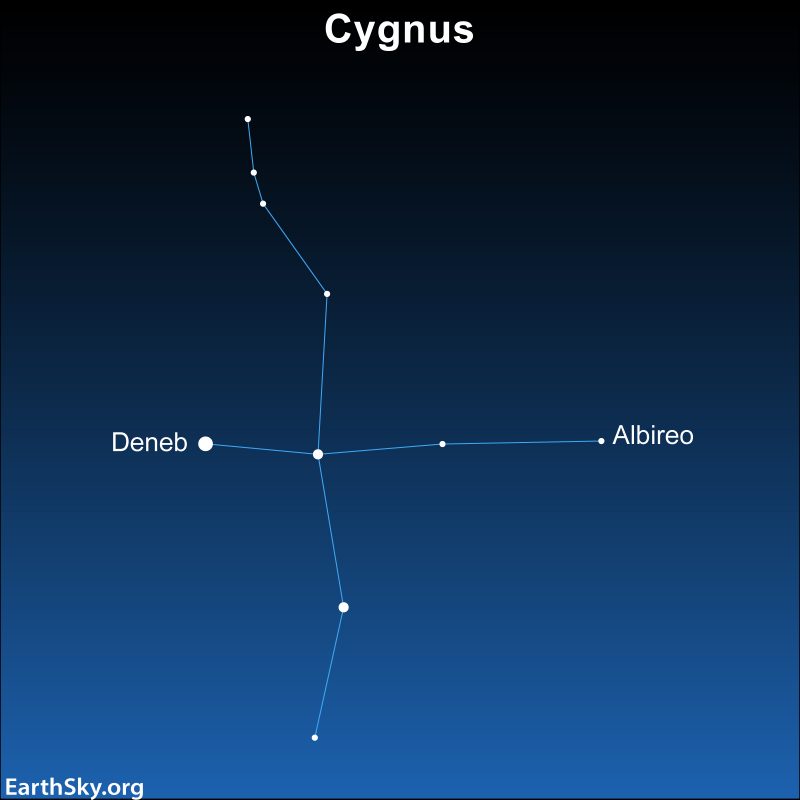
Cygnus the Swan’s brightest star, Deneb, marks one of the corners of the Summer Triangle. And its bright double star, Albireo, is one of the finest in the heavens.
If you have a dark sky, you can observe the edgewise view into our own galaxy – our Milky Way – spanning across the heavens. As you gaze toward it, you’ll also be looking toward the constellation Cygnus the Swan. Its brightest star is called Deneb, the Swan’s Tail.
Additionally, the constellation Cygnus contains one of the most beloved double stars in the sky, Albireo, whose two component stars appear blue and gold.
The constellation Cygnus – with its noticeable stars Deneb and Albireo – are sometimes called the Northern Cross.
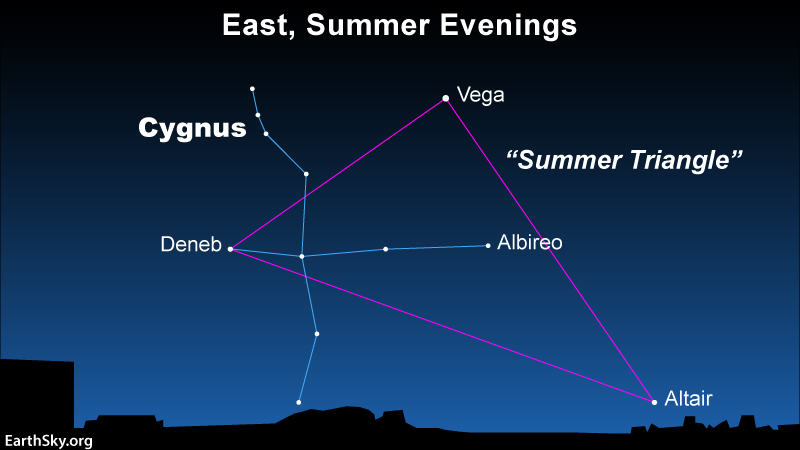
Plus, the star Deneb marks one of the corners of the famous Summer Triangle, an asterism composed of three bright stars in three different constellations.
So there’s a lot going on in this part of the sky! And no wonder, because the Swan lets you peer into the depths of the Milky Way.
How to find Cygnus from the Northern Hemisphere
You can find Cygnus high above the eastern horizon after sunset in the evening in June. As the sky grows dark, the first of its stars that you’ll see is Deneb, because it’s so bright. It’s the brightest in its constellation at magnitude 1.25.
Later, as June nights wear on, you’ll be able to trace out the body of the Swan and its bent wings. Then, you can find the double star, Albireo, which marks its head.
If you can find the large Summer Triangle shape, Deneb in Cygnus is the star that lies toward the northeast.
Then – assuming you have a dark sky – you can look along the length of Cygnus to see the hazy “cloud” behind it. It isn’t a true cloud, but a vast collection of billions our stars: our home galaxy, the Milky Way. You’ll notice the Milky Way runs along the same axis as the long line of the body of the Swan.
The bright star Deneb is part of the famous Summer Triangle asterism. Its constellation, Cygnus the Swan, flies across the northern summer evening sky.
The Swan in skylore
The mythology of Cygnus tells the story of Zeus, who changed into the form of a swan to entice Queen Leda. From their union came the twins Castor and Pollux.
It’s said that, today, we see Castor and Pollux as the bright stars of the constellation Gemini the Twins.
Stars of the Swan
Deneb, or Alpha Cygni, is the 19th brightest star in the sky. At magnitude 1.25, it’s a blue-white supergiant star lying about 1,500 light-years away, which is a long distance for a star that shines so brightly in our skies.
Albireo, the head of the Swan, is one of the most beautiful double stars in the heavens. And, with a small telescope, you can easily divide Albireo into a larger yellow star and smaller blue star. The brighter star of Albireo (or Beta Cygni) is magnitude 3.1, and the dimmer is magnitude 5.8. The stars are approximately 380 light-years distant.
Omicron Cygni, or 30 and 31 Cygni, is a double star with orange and blue components that you can see with binoculars. These stars lie between Deneb and Delta Cygni, which is the western wing of the Swan. At magnitudes 4.8 and 3.8, 30 and 31 Cygni lie 610 and 1.350 light-years away, respectively.
Gliese 777 is a yellow subgiant star shining at 5.71 magnitude and located about 51 light-years distant. Three extrasolar planets have been confirmed in its system.
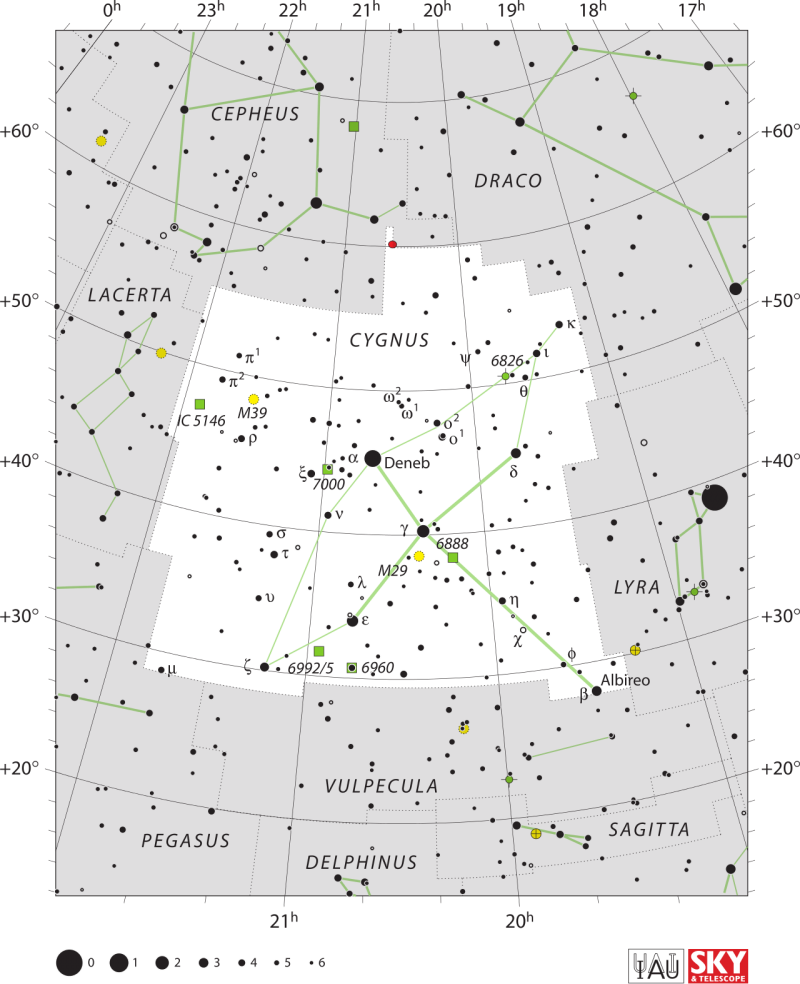
The constellation Cygnus with its stars, that form an asterism known as the Northern Cross. Image via IAU/ Sky & Telescope/ Wikimedia Commons (CC BY 4.0).
Deep-sky objects in Cygnus
In addition, you can find an open cluster in Cygnus lying less than 2 degrees from Sadr, or Gamma Cygni, the 3rd brightest star of the constellation, at magnitude 2.23, at the center of the cross or Swan. This open cluster is M29, at magnitude 7.1. With this in mind, try using binoculars to track it down.
Also, another Messier object in Cygnus is M39, an open cluster lying about 9 degrees northeast of Deneb. M39 is magnitude 5.5. In this case, you can try to spot with just your eyes alone.
Sadr and star clusters
Now, head back to Sadr. A 7.4-magnitude open cluster, NGC 6910, lies just 1/2 degree north of the star. Then scanning along the western boundary of Cygnus with binoculars or a telescope reveals other clusters, including the magnitude 7.3 Foxhead Cluster (NGC 6819) and the 6.8-magnitude Hole-in-a-Cluster (NGC 6811).
Also, on the western side of the constellation, 5 1/2 degrees north of Sadr, or Gamma Cygni, is the 8.8 magnitude Blinking Planetary, NGC 6826. To be sure, as you move your eyes across it, does it appear to blink?
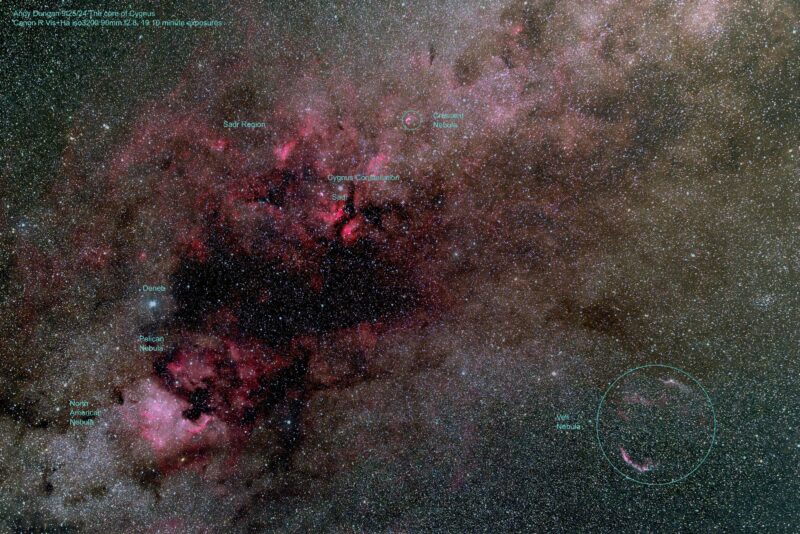
View at EarthSky Community Photos. | Andy Dungan near Cotopaxi, Colorado, captured this wide-field view of diffuse nebulae in Cygnus on September 24, 2024. Andy wrote: “As the moon continues to come up later, I have been experimenting with wide-angle photos. Cygnus is such a treat because there are so many spectacular objects quite close together and this pic shows them.” It sure does show a lot of objects. Thank you, Andy!
North America and Veil nebulae
The North America Nebula, or NGC 7000, lies a little over 3 degrees east of Deneb. When you look at it in photos, can you trace out the shape of the continent for which it’s named? You can glimpse this large nebula under dark skies with binoculars. In fact, it extends up to four moon-widths. Depending on your vision and sky conditions, you might detect this large 4.4 magnitude nebula with your eyes alone.
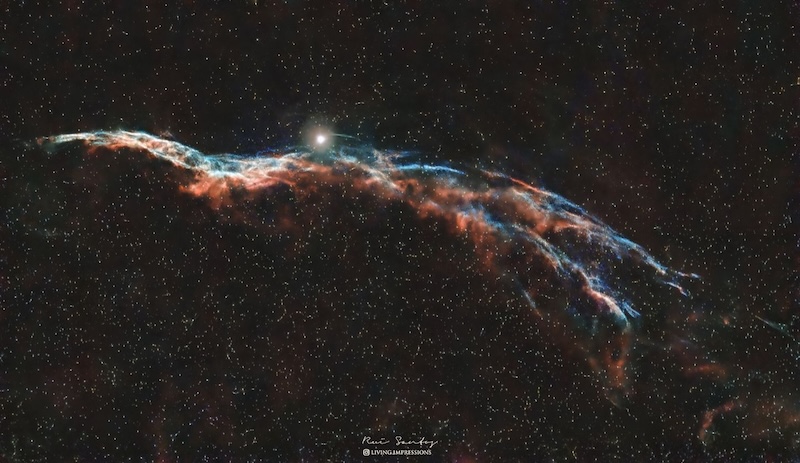
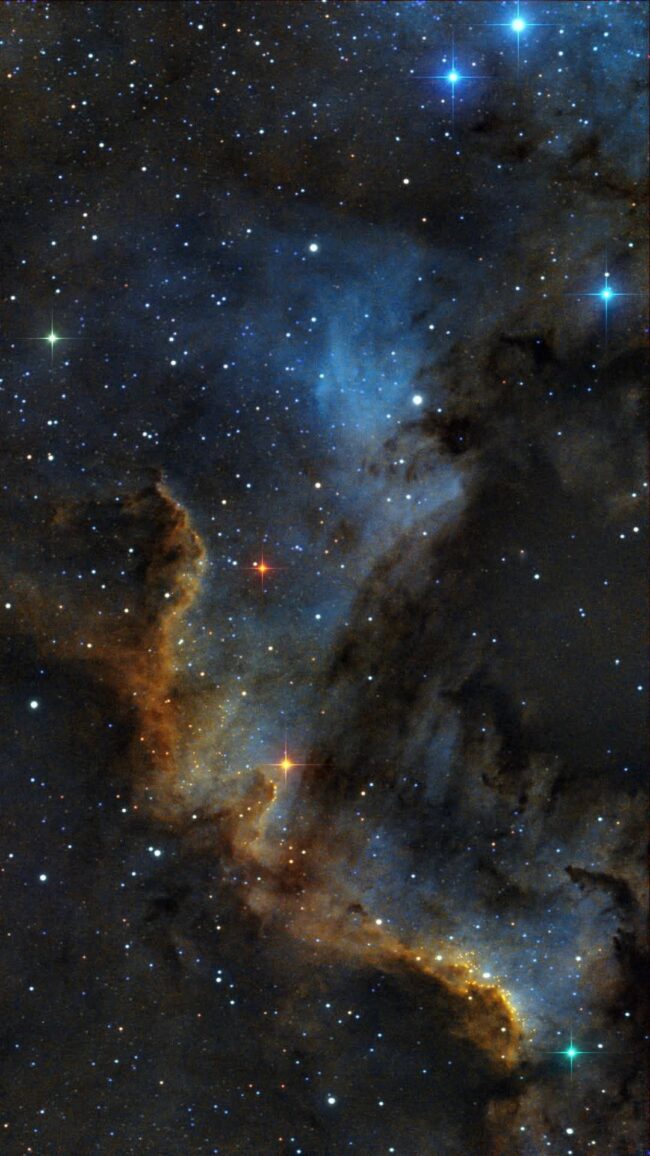
View at EarthSky Community Photos. | Rui Santos captured this image on July 9, 2025, from Portugal and wrote: “The Western Veil nebula, located in the constellation Cygnus, is part of a supernova remnant, so it’s the remains of a massive star that exploded around 8,000 years ago. It’s about 2,400 light-years from Earth, and had nearly 20 times the mass of our sun! The explosion was so powerful that it hurled the star’s outer layers into space at incredibly high speeds. That formed these filament-like structures that glow as they collide with interstellar gas. It’s amazing to think that such a catastrophic event could leave behind something so incredibly beautiful.” It’s also known as the Witch’s Broom. Thank you, Rui!View at EarthSky Community Photos. | Robert R. Gaudet in Pennfield, New Brunswick, Canada, captured this telescopic view of the North America Nebula, in the constellation Cygnus, on June 26, 2025. Robert wrote: “Just a beautiful night in Pennfield, New Brunswick Canada, that I couldn’t pass up imaging the Cygnus Wall portion of NGC 7000 or the North America Nebula.” Thank you, Robert!
Cygnus is great to explore with binoculars
In addition to the objects mentioned above, you can explore Cygnus in binoculars. That’s because the Milky Way makes a rich background in this part of the sky. So you can find many more nebulae and clusters if you’re patient and sweep the area with binoculars. You might catch even more with a telescope.
For observers in the Southern Hemisphere, Cygnus is a winter constellation that appears effectively upside down from our perspective. From far southern locations such as New Zealand’s South Island (around 45°S latitude), the constellation never fully rises above the horizon.
The star Albireo—the Swan’s head—becomes the highest point of the constellation, giving the impression of the swan flying up from beyond the northern horizon. Albireo reaches an altitude of approximately 17° above the horizon, while the constellation’s brightest star, Deneb, resides on or below the horizon from much of New Zealand’s South Island and cannot be seen.
Further north, Cygnus becomes progressively more visible as the swan flies higher into the sky. From Christchurch (43.5°S), Deneb just skims above the horizon at culmination, while from Wellington (41.3°S) it reaches around 4° altitude. In Auckland (36.8°S), Deneb climbs to approximately 9° above the northern horizon, and from Brisbane, Australia (27.5°S), it reaches about 18°.
Even from these locations, however, Deneb remains a low-altitude object, often affected by atmospheric haze and extinction.
Despite this, several of Cygnus’s most famous deep-sky objects become accessible from southern latitudes. The Veil Nebula with its rich filamentary structures climbs high enough above the horizon to become a viable target for astrophotographers.
Bottom line: Cygnus the Swan is a constellation that lies in front of the starlit band of the Milky Way. Its brightest star, Deneb, is part of the Summer Triangle.
Cygnus the Swan’s brightest star, Deneb, marks one of the corners of the Summer Triangle. And its bright double star, Albireo, is one of the finest in the heavens.
If you have a dark sky, you can observe the edgewise view into our own galaxy – our Milky Way – spanning across the heavens. As you gaze toward it, you’ll also be looking toward the constellation Cygnus the Swan. Its brightest star is called Deneb, the Swan’s Tail.
Additionally, the constellation Cygnus contains one of the most beloved double stars in the sky, Albireo, whose two component stars appear blue and gold.
The constellation Cygnus – with its noticeable stars Deneb and Albireo – are sometimes called the Northern Cross.
Plus, the star Deneb marks one of the corners of the famous Summer Triangle, an asterism composed of three bright stars in three different constellations.
So there’s a lot going on in this part of the sky! And no wonder, because the Swan lets you peer into the depths of the Milky Way.
How to find Cygnus from the Northern Hemisphere
You can find Cygnus high above the eastern horizon after sunset in the evening in June. As the sky grows dark, the first of its stars that you’ll see is Deneb, because it’s so bright. It’s the brightest in its constellation at magnitude 1.25.
Later, as June nights wear on, you’ll be able to trace out the body of the Swan and its bent wings. Then, you can find the double star, Albireo, which marks its head.
If you can find the large Summer Triangle shape, Deneb in Cygnus is the star that lies toward the northeast.
Then – assuming you have a dark sky – you can look along the length of Cygnus to see the hazy “cloud” behind it. It isn’t a true cloud, but a vast collection of billions our stars: our home galaxy, the Milky Way. You’ll notice the Milky Way runs along the same axis as the long line of the body of the Swan.
The bright star Deneb is part of the famous Summer Triangle asterism. Its constellation, Cygnus the Swan, flies across the northern summer evening sky.
The Swan in skylore
The mythology of Cygnus tells the story of Zeus, who changed into the form of a swan to entice Queen Leda. From their union came the twins Castor and Pollux.
It’s said that, today, we see Castor and Pollux as the bright stars of the constellation Gemini the Twins.
Stars of the Swan
Deneb, or Alpha Cygni, is the 19th brightest star in the sky. At magnitude 1.25, it’s a blue-white supergiant star lying about 1,500 light-years away, which is a long distance for a star that shines so brightly in our skies.
Albireo, the head of the Swan, is one of the most beautiful double stars in the heavens. And, with a small telescope, you can easily divide Albireo into a larger yellow star and smaller blue star. The brighter star of Albireo (or Beta Cygni) is magnitude 3.1, and the dimmer is magnitude 5.8. The stars are approximately 380 light-years distant.
Omicron Cygni, or 30 and 31 Cygni, is a double star with orange and blue components that you can see with binoculars. These stars lie between Deneb and Delta Cygni, which is the western wing of the Swan. At magnitudes 4.8 and 3.8, 30 and 31 Cygni lie 610 and 1.350 light-years away, respectively.
Gliese 777 is a yellow subgiant star shining at 5.71 magnitude and located about 51 light-years distant. Three extrasolar planets have been confirmed in its system.
The constellation Cygnus with its stars, that form an asterism known as the Northern Cross. Image via IAU/ Sky & Telescope/ Wikimedia Commons (CC BY 4.0).
Deep-sky objects in Cygnus
In addition, you can find an open cluster in Cygnus lying less than 2 degrees from Sadr, or Gamma Cygni, the 3rd brightest star of the constellation, at magnitude 2.23, at the center of the cross or Swan. This open cluster is M29, at magnitude 7.1. With this in mind, try using binoculars to track it down.
Also, another Messier object in Cygnus is M39, an open cluster lying about 9 degrees northeast of Deneb. M39 is magnitude 5.5. In this case, you can try to spot with just your eyes alone.
Sadr and star clusters
Now, head back to Sadr. A 7.4-magnitude open cluster, NGC 6910, lies just 1/2 degree north of the star. Then scanning along the western boundary of Cygnus with binoculars or a telescope reveals other clusters, including the magnitude 7.3 Foxhead Cluster (NGC 6819) and the 6.8-magnitude Hole-in-a-Cluster (NGC 6811).
Also, on the western side of the constellation, 5 1/2 degrees north of Sadr, or Gamma Cygni, is the 8.8 magnitude Blinking Planetary, NGC 6826. To be sure, as you move your eyes across it, does it appear to blink?
View at EarthSky Community Photos. | Andy Dungan near Cotopaxi, Colorado, captured this wide-field view of diffuse nebulae in Cygnus on September 24, 2024. Andy wrote: “As the moon continues to come up later, I have been experimenting with wide-angle photos. Cygnus is such a treat because there are so many spectacular objects quite close together and this pic shows them.” It sure does show a lot of objects. Thank you, Andy!
North America and Veil nebulae
The North America Nebula, or NGC 7000, lies a little over 3 degrees east of Deneb. When you look at it in photos, can you trace out the shape of the continent for which it’s named? You can glimpse this large nebula under dark skies with binoculars. In fact, it extends up to four moon-widths. Depending on your vision and sky conditions, you might detect this large 4.4 magnitude nebula with your eyes alone.
View at EarthSky Community Photos. | Rui Santos captured this image on July 9, 2025, from Portugal and wrote: “The Western Veil nebula, located in the constellation Cygnus, is part of a supernova remnant, so it’s the remains of a massive star that exploded around 8,000 years ago. It’s about 2,400 light-years from Earth, and had nearly 20 times the mass of our sun! The explosion was so powerful that it hurled the star’s outer layers into space at incredibly high speeds. That formed these filament-like structures that glow as they collide with interstellar gas. It’s amazing to think that such a catastrophic event could leave behind something so incredibly beautiful.” It’s also known as the Witch’s Broom. Thank you, Rui!View at EarthSky Community Photos. | Robert R. Gaudet in Pennfield, New Brunswick, Canada, captured this telescopic view of the North America Nebula, in the constellation Cygnus, on June 26, 2025. Robert wrote: “Just a beautiful night in Pennfield, New Brunswick Canada, that I couldn’t pass up imaging the Cygnus Wall portion of NGC 7000 or the North America Nebula.” Thank you, Robert!
Cygnus is great to explore with binoculars
In addition to the objects mentioned above, you can explore Cygnus in binoculars. That’s because the Milky Way makes a rich background in this part of the sky. So you can find many more nebulae and clusters if you’re patient and sweep the area with binoculars. You might catch even more with a telescope.
For observers in the Southern Hemisphere, Cygnus is a winter constellation that appears effectively upside down from our perspective. From far southern locations such as New Zealand’s South Island (around 45°S latitude), the constellation never fully rises above the horizon.
The star Albireo—the Swan’s head—becomes the highest point of the constellation, giving the impression of the swan flying up from beyond the northern horizon. Albireo reaches an altitude of approximately 17° above the horizon, while the constellation’s brightest star, Deneb, resides on or below the horizon from much of New Zealand’s South Island and cannot be seen.
Further north, Cygnus becomes progressively more visible as the swan flies higher into the sky. From Christchurch (43.5°S), Deneb just skims above the horizon at culmination, while from Wellington (41.3°S) it reaches around 4° altitude. In Auckland (36.8°S), Deneb climbs to approximately 9° above the northern horizon, and from Brisbane, Australia (27.5°S), it reaches about 18°.
Even from these locations, however, Deneb remains a low-altitude object, often affected by atmospheric haze and extinction.
Despite this, several of Cygnus’s most famous deep-sky objects become accessible from southern latitudes. The Veil Nebula with its rich filamentary structures climbs high enough above the horizon to become a viable target for astrophotographers.
Bottom line: Cygnus the Swan is a constellation that lies in front of the starlit band of the Milky Way. Its brightest star, Deneb, is part of the Summer Triangle.
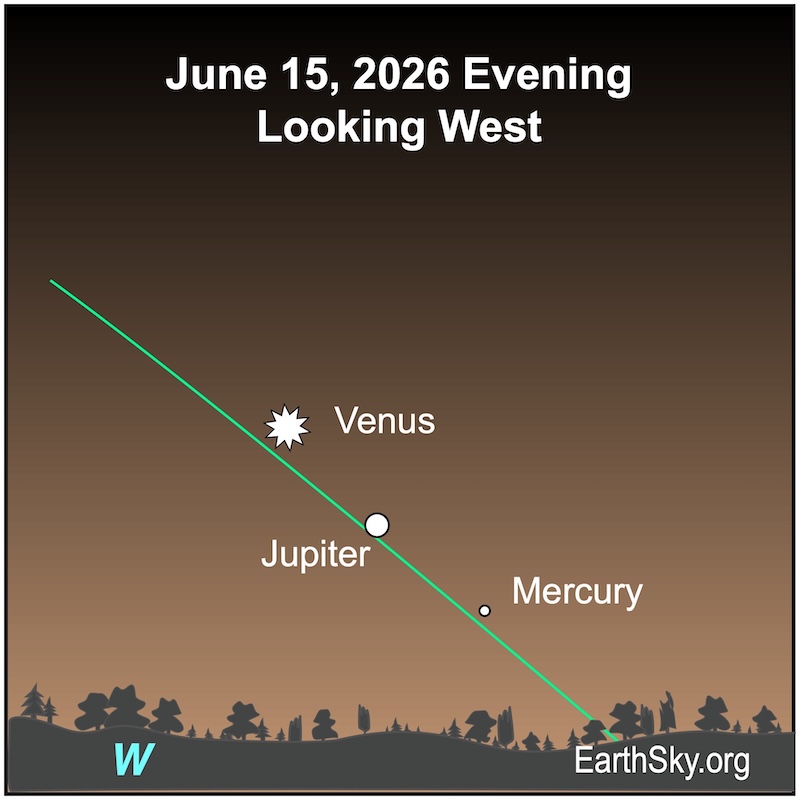
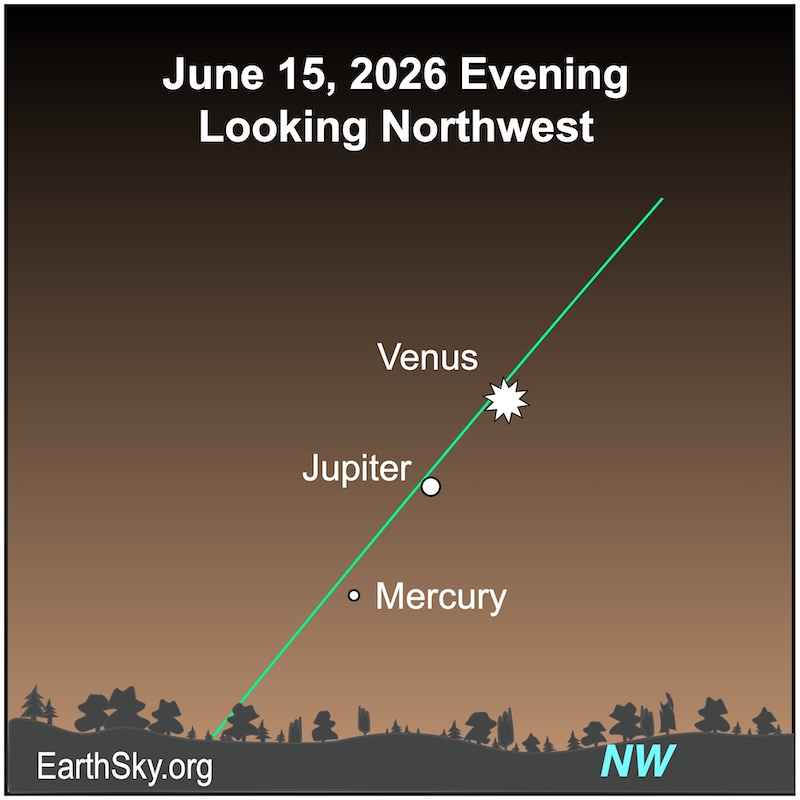
For all of us on Earth now, the sun’s innermost planet, Mercury, is in the west after sunset, below blazing Venus and Jupiter. A line between Venus and Jupiter more or less points to Mercury. This is the view from the Northern Hemisphere. Notice how the planets make a line extending above and to the left of the sunset point. Mercury is farthest from the sunset – at greatest elongation on June 15. But look soon! Mercury – sometimes calle the most elusive planet – will slip away again before the end of this month. Chart via EarthSky.
Mercury after sunset in June 2026
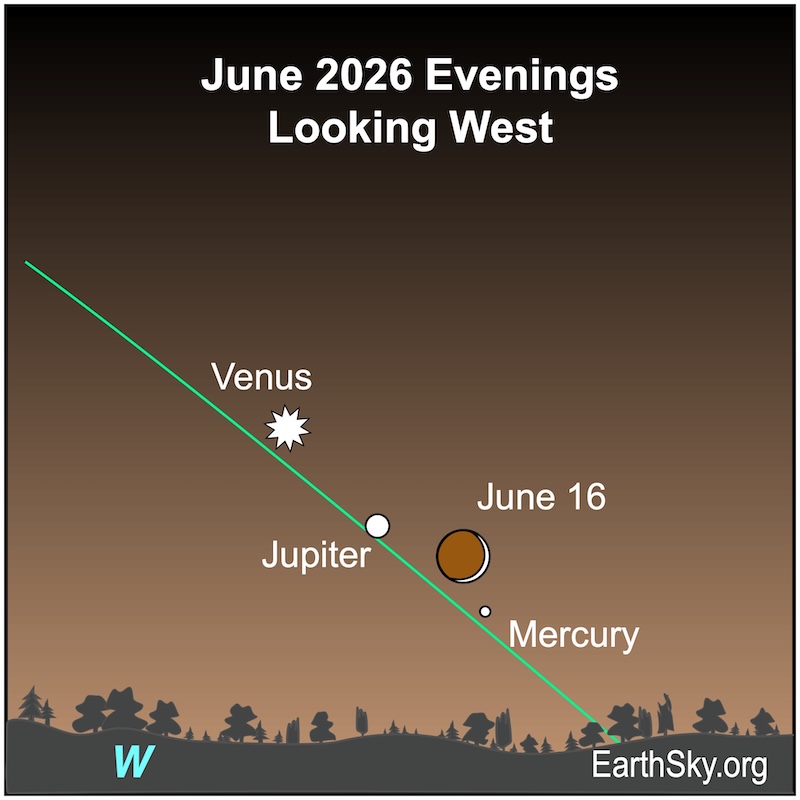
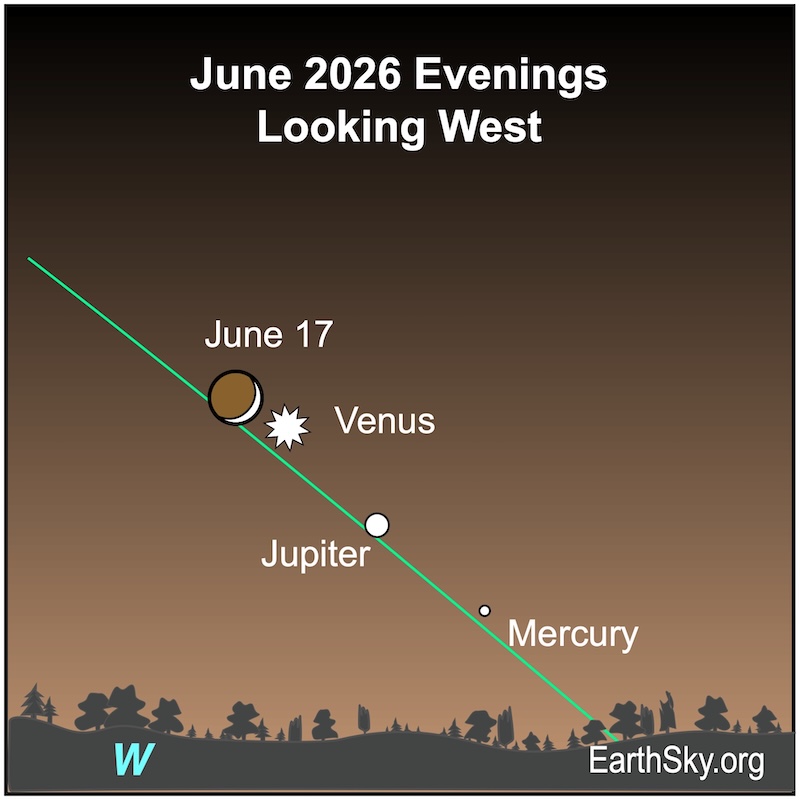
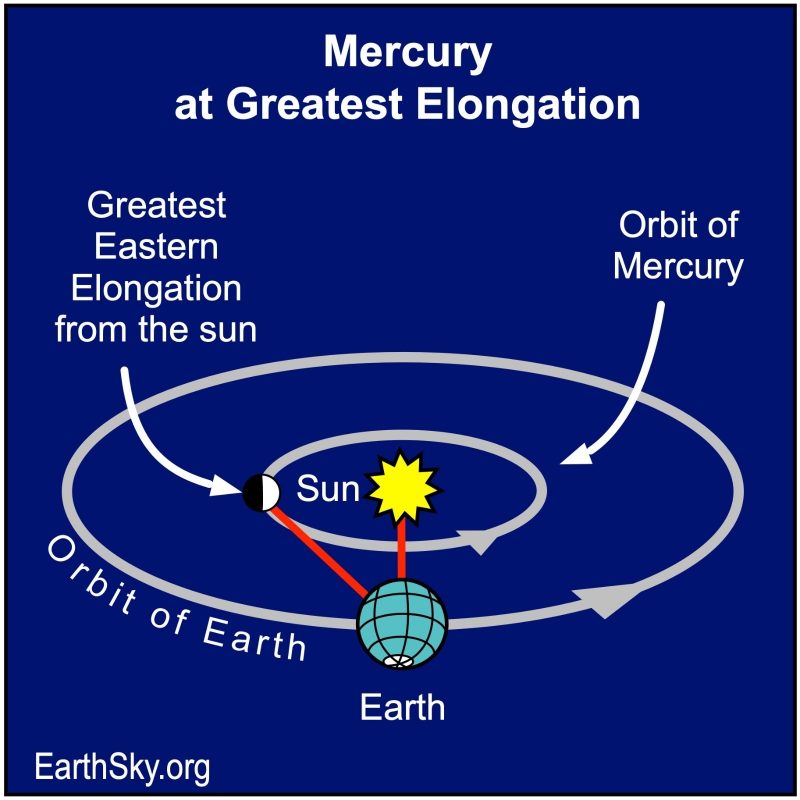
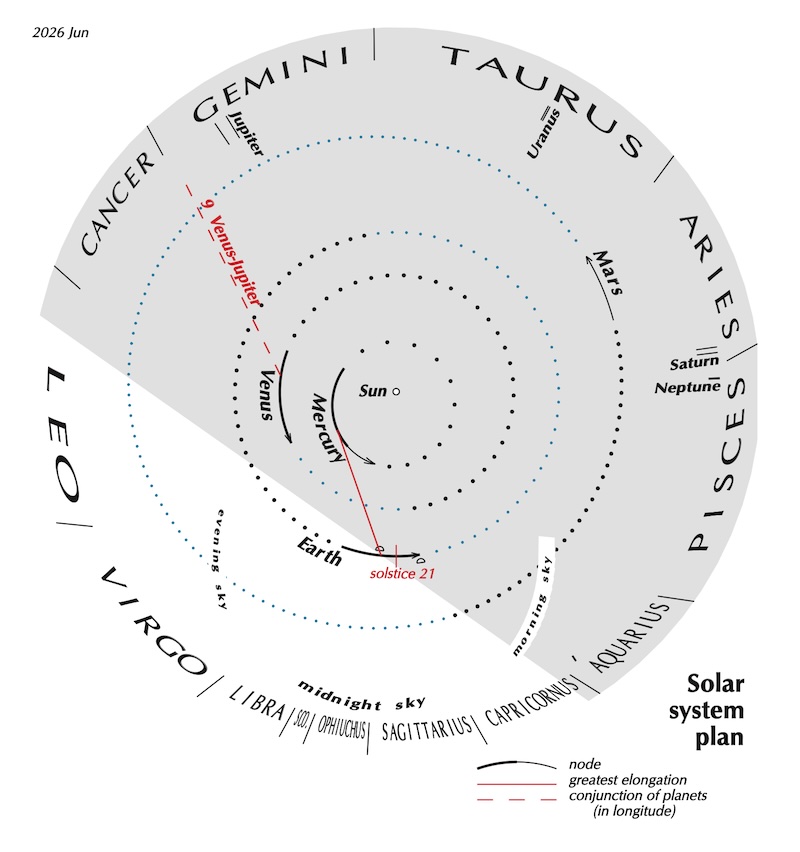
Where to look: Look west, in the sunset direction – shortly after sunset – for Mercury. The sky’s two brightest planets – Venus and Jupiter – will point to it. Mercury emerged in the evening twilight sometime in late May. Watch for the moon near Mercury on the evening of June 16. Greatest elongation: Mercury is farthest from the sun on our sky’s dome at 20 UTC (3 p.m. CST) on June 15, 2026. At that time, Mercury will be 25 degrees from the sun in our sky. See a comparison of elongations, below. Brightness: Mercury emerged in the evening sky late in May. Since then, it’s been shining at around 0.1 magnitude. At greatest elongation it’ll be farther from the sunset glare, shining around 0 magnitude and therefore brighter than most stars! In the evenings after greatest elongation, the innermost planet will drop rapidly closer to the horizon the rest of the month. And Jupiter will draw close enough that you can see both of them in a pair of binoculars. Mercury will be moving between Earth and the sun, with its illuminated side becoming less and less visible. It’ll disappear in early July and will reach inferior conjunction – when it passes between Earth and the sun – at 1 UTC on July 13. Through a telescope: Mercury will appear about 38% illuminated at greatest elongation. It’ll measure 8.19 arcseconds across. Constellation: Mercury will lie in front of the constellation Gemini the Twins at this elongation. Doubtless, the stars in this constellation will be lost in the twilight. Note: As the innermost planet, Mercury is tied to the sun in our sky. As a result, it never ventures very far above the horizon after sunset. So as soon as the sun disappears below your horizon, your clock starts ticking. Will you see the glowing point of light that is Mercury before it drops below the horizon, following the setting sun?
Here are the planets from Earth’s Southern Hemisphere, in the west shortly after sunset. Same line of planets, but the perspective is different. See how a line between them points from the sunset point up and to the right? Chart via EarthSky.
Watch for the planets and young moon on June 16 and 17
The very young moon will appear near Mercury, Venus and Jupiter on the evening of June 16. Chart via EarthSky.You’ll find the young moon near Mercury, Jupiter and Venus on the evening of June 17, too. Look west, shortly after the sun goes down. Also look for the glow of earthshine on the unlit portion of the moon. That’s sunlight bounced off Earth onto the moon’s surface. Chart via EarthSky.
What is greatest elongation?
The 3D view: At greatest elongation, we’re seeing Mercury to one side of the sun. The sky view: Greatest elongation means the distance between Mercury and the sunset is at its greatest. This chart is not to scale! When thinking about these worlds in space, you have to realize they are miniscule dots in contrast to the vast space around them. Chart via EarthSky.
For precise sun and Mercury setting times at your location:
Jan 21, 2026: Superior conjunction (passes behind sun from Earth) Feb 19, 2026: Greatest elongation (evening) Mar 7, 2026: Inferior conjunction (races between Earth and sun) Apr 3, 2026: Greatest elongation (morning) May 14, 2026: Superior conjunction (passes behind sun from Earth) Jun 15, 2026: Greatest elongation (evening) Jul 13, 2026: Inferior conjunction (races between Earth and sun) Aug 2, 2026: Greatest elongation (morning) Aug 27, 2026: Superior conjunction (passes behind sun from Earth) Oct 12, 2026: Greatest elongation (evening) Nov 4, 2026: Inferior conjunction (races between Earth and sun) Nov 21, 2026: Greatest elongation (morning)
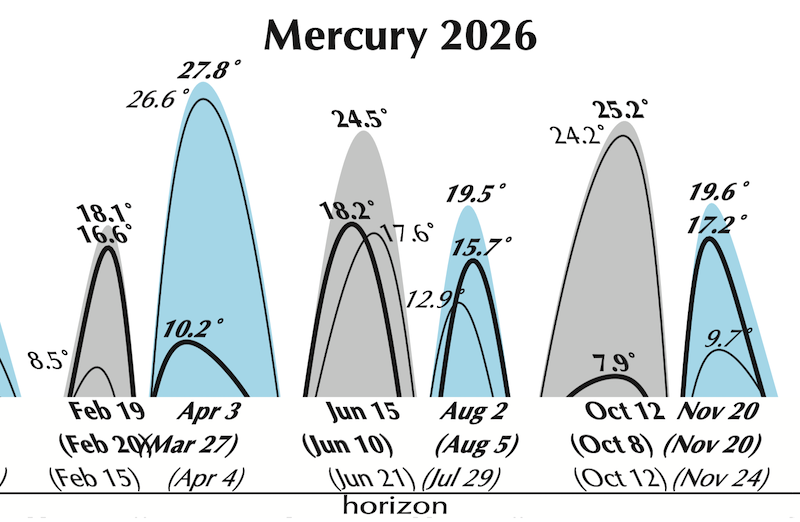
In June 2026, Mercury stretches out 25 degrees from the sun in our sky. In fact, the farthest from the sun that Mercury can ever appear on the sky’s dome is about 28 degrees. And the least distance is around 18 degrees.
Mercury (and Venus) elongations are better or worse depending on the time of the year they occur. So in 2026, the Northern Hemisphere will had the best evening apparition in February. And the Southern Hemisphere will have its best evening elongation of Mercury in October.
In the autumn for either hemisphere, the ecliptic – or path of the sun, moon and planets – makes a narrow angle to the horizon in the evening. But it makes a steep slant, nearly perpendicular, in the morning. So, in autumn from either hemisphere, morning elongations of Mercury are best. That’s when Mercury appears higher above the horizon and farther from the glow of the sun. However, evening elongations in autumn are harder to see.
In the spring for either hemisphere, the situation reverses. The ecliptic and horizon meet at a sharper angle on spring evenings and a narrower angle on spring mornings. So, in springtime for either hemisphere, evening elongations of Mercury are best. Meanwhile, morning elongations in springtime are harder to see.
Mercury elongations compared. Here, gray areas represent evening apparitions (eastward elongation). Blue areas represent morning apparitions (westward elongation). The top figures are the maximum elongations, reached at the top dates shown beneath. Curves show the altitude of the planet above the horizon at sunrise or sunset, for latitude 40 degrees north (thick line) and 35 degrees south (thin line). Likewise, maxima are reached at the parenthesized dates below (40 degrees north in bold). Chart via Guy Ottewell’s 2026 Astronomical Calendar. Used with permission.
More Mercury evening elongation comparisons for 2026
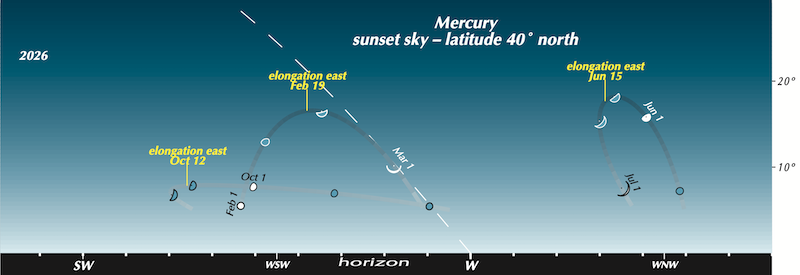
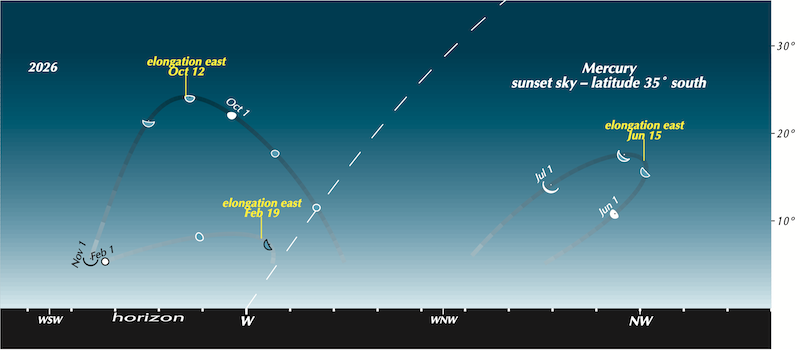
Mercury’s greatest evening elongations in 2026 from the Northern Hemisphere as viewed through a powerful telescope. The planet images are at the 1st, 11th, and 21st of each month. Dots show the actual positions of the planet for every day. Chart via Guy Ottewell’s 2026 Astronomical Calendar. Used with permission.Mercury’s greatest evening elongations in 2026 from the Southern Hemisphere as viewed through a powerful telescope. The planet images are at the 1st, 11th, and 21st of each month. Dots show the actual positions of the planet for every day. Chart via Guy Ottewell’s 2026 Astronomical Calendar. Used with permission.
Bottom line: The sun’s innermost planet, Mercury, will be 25 degrees from the sunset when it reaches its greatest elongation at 20 UTC on June 15. Also, this is a decent evening apparition of Mercury in 2026 for both the Northern and Southern Hemispheres.
For all of us on Earth now, the sun’s innermost planet, Mercury, is in the west after sunset, below blazing Venus and Jupiter. A line between Venus and Jupiter more or less points to Mercury. This is the view from the Northern Hemisphere. Notice how the planets make a line extending above and to the left of the sunset point. Mercury is farthest from the sunset – at greatest elongation on June 15. But look soon! Mercury – sometimes calle the most elusive planet – will slip away again before the end of this month. Chart via EarthSky.
Mercury after sunset in June 2026
Where to look: Look west, in the sunset direction – shortly after sunset – for Mercury. The sky’s two brightest planets – Venus and Jupiter – will point to it. Mercury emerged in the evening twilight sometime in late May. Watch for the moon near Mercury on the evening of June 16. Greatest elongation: Mercury is farthest from the sun on our sky’s dome at 20 UTC (3 p.m. CST) on June 15, 2026. At that time, Mercury will be 25 degrees from the sun in our sky. See a comparison of elongations, below. Brightness: Mercury emerged in the evening sky late in May. Since then, it’s been shining at around 0.1 magnitude. At greatest elongation it’ll be farther from the sunset glare, shining around 0 magnitude and therefore brighter than most stars! In the evenings after greatest elongation, the innermost planet will drop rapidly closer to the horizon the rest of the month. And Jupiter will draw close enough that you can see both of them in a pair of binoculars. Mercury will be moving between Earth and the sun, with its illuminated side becoming less and less visible. It’ll disappear in early July and will reach inferior conjunction – when it passes between Earth and the sun – at 1 UTC on July 13. Through a telescope: Mercury will appear about 38% illuminated at greatest elongation. It’ll measure 8.19 arcseconds across. Constellation: Mercury will lie in front of the constellation Gemini the Twins at this elongation. Doubtless, the stars in this constellation will be lost in the twilight. Note: As the innermost planet, Mercury is tied to the sun in our sky. As a result, it never ventures very far above the horizon after sunset. So as soon as the sun disappears below your horizon, your clock starts ticking. Will you see the glowing point of light that is Mercury before it drops below the horizon, following the setting sun?
Here are the planets from Earth’s Southern Hemisphere, in the west shortly after sunset. Same line of planets, but the perspective is different. See how a line between them points from the sunset point up and to the right? Chart via EarthSky.
Watch for the planets and young moon on June 16 and 17
The very young moon will appear near Mercury, Venus and Jupiter on the evening of June 16. Chart via EarthSky.You’ll find the young moon near Mercury, Jupiter and Venus on the evening of June 17, too. Look west, shortly after the sun goes down. Also look for the glow of earthshine on the unlit portion of the moon. That’s sunlight bounced off Earth onto the moon’s surface. Chart via EarthSky.
What is greatest elongation?
The 3D view: At greatest elongation, we’re seeing Mercury to one side of the sun. The sky view: Greatest elongation means the distance between Mercury and the sunset is at its greatest. This chart is not to scale! When thinking about these worlds in space, you have to realize they are miniscule dots in contrast to the vast space around them. Chart via EarthSky.
For precise sun and Mercury setting times at your location:
Jan 21, 2026: Superior conjunction (passes behind sun from Earth) Feb 19, 2026: Greatest elongation (evening) Mar 7, 2026: Inferior conjunction (races between Earth and sun) Apr 3, 2026: Greatest elongation (morning) May 14, 2026: Superior conjunction (passes behind sun from Earth) Jun 15, 2026: Greatest elongation (evening) Jul 13, 2026: Inferior conjunction (races between Earth and sun) Aug 2, 2026: Greatest elongation (morning) Aug 27, 2026: Superior conjunction (passes behind sun from Earth) Oct 12, 2026: Greatest elongation (evening) Nov 4, 2026: Inferior conjunction (races between Earth and sun) Nov 21, 2026: Greatest elongation (morning)
In June 2026, Mercury stretches out 25 degrees from the sun in our sky. In fact, the farthest from the sun that Mercury can ever appear on the sky’s dome is about 28 degrees. And the least distance is around 18 degrees.
Mercury (and Venus) elongations are better or worse depending on the time of the year they occur. So in 2026, the Northern Hemisphere will had the best evening apparition in February. And the Southern Hemisphere will have its best evening elongation of Mercury in October.
In the autumn for either hemisphere, the ecliptic – or path of the sun, moon and planets – makes a narrow angle to the horizon in the evening. But it makes a steep slant, nearly perpendicular, in the morning. So, in autumn from either hemisphere, morning elongations of Mercury are best. That’s when Mercury appears higher above the horizon and farther from the glow of the sun. However, evening elongations in autumn are harder to see.
In the spring for either hemisphere, the situation reverses. The ecliptic and horizon meet at a sharper angle on spring evenings and a narrower angle on spring mornings. So, in springtime for either hemisphere, evening elongations of Mercury are best. Meanwhile, morning elongations in springtime are harder to see.
Mercury elongations compared. Here, gray areas represent evening apparitions (eastward elongation). Blue areas represent morning apparitions (westward elongation). The top figures are the maximum elongations, reached at the top dates shown beneath. Curves show the altitude of the planet above the horizon at sunrise or sunset, for latitude 40 degrees north (thick line) and 35 degrees south (thin line). Likewise, maxima are reached at the parenthesized dates below (40 degrees north in bold). Chart via Guy Ottewell’s 2026 Astronomical Calendar. Used with permission.
More Mercury evening elongation comparisons for 2026
Mercury’s greatest evening elongations in 2026 from the Northern Hemisphere as viewed through a powerful telescope. The planet images are at the 1st, 11th, and 21st of each month. Dots show the actual positions of the planet for every day. Chart via Guy Ottewell’s 2026 Astronomical Calendar. Used with permission.Mercury’s greatest evening elongations in 2026 from the Southern Hemisphere as viewed through a powerful telescope. The planet images are at the 1st, 11th, and 21st of each month. Dots show the actual positions of the planet for every day. Chart via Guy Ottewell’s 2026 Astronomical Calendar. Used with permission.
Bottom line: The sun’s innermost planet, Mercury, will be 25 degrees from the sunset when it reaches its greatest elongation at 20 UTC on June 15. Also, this is a decent evening apparition of Mercury in 2026 for both the Northern and Southern Hemispheres.
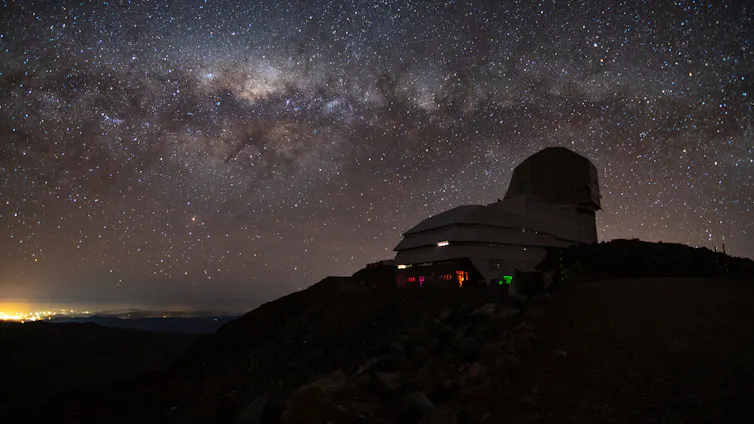
Dark matter makes up a large proportion of galaxies like the Milky Way, but scientists are still figuring out what it is. New telescopes like the Rubin Observatory could help astronomers find dark matter. Image Rubin Observatory/ NOIRLab/ SLAC/ NSF/ DOE/ AURA/ B. Quint.
Dark matter makes up about 85% of the universe’s matter, but cannot be seen directly.
Researchers have found possible dark matter hints, but the evidence is not yet conclusive.
New telescopes could help confirm whether these signals come from dark matter.
NASA’s plans to return astronauts to the moon through the Artemis program and ultimately send humans to Mars highlight just how far space exploration has come. Yet while the moon and Mars remain compelling destinations filled with scientific mysteries, looking beyond our solar system raises even deeper questions about the universe itself.
Among the biggest of those mysteries is matter: the substance that makes up everything around us. Surprisingly, most of the matter in the universe is invisible, and astronomers still do not know what it is.
Physicists estimate that about 85% of all matter is made of something we cannot see, touch or directly detect. This elusive substance is known as dark matter. It doesn’t emit light like stars or galaxies. The only reason scientists know it exists is because of its gravity.
Galaxies rotate too fast to be held together by just the matter that can be seen. Light bends more strongly than expected as it travels through space. Galaxies within clusters fly past one another much faster than they should based on their visible mass alone.
Based on data from across the cosmos, scientists keep coming to the same conclusion: There is something out there that cannot be seen, but whose presence is unmistakable. It’s a question that has intrigued astronomerslike us for more than 50 years.
So what is dark matter, and why does it matter?
Entirely new kinds of particles?
Everything in our everyday world is made of atoms, which are combinations of protons, neutrons and electrons. These particles form stars, planets, people and everything you see.
Dark matter, scientists believe, is fundamentally different. It is likely made of entirely new kinds of particles yet to be discovered. Understanding what those particles are would fill a major gap in the scientific understanding of physics. But the importance of dark matter goes far beyond particle physics.
Dark matter played a crucial role in shaping the universe. Shortly after the Big Bang that kicked off the birth of the universe, it acted as a kind of gravitational scaffolding, helping ordinary matter clump together to form the first galaxies and stars. Even today, it acts as the invisible glue that holds galaxies together.
In other words, without dark matter, the universe as you know it might not exist.
How to search for the invisible
Because dark matter does not emit light, scientists must search for it indirectly. One promising approach is to look for the signals it might produce when its particles collide and destroy each other through a process known as annihilation.
This idea may sound exotic, but it has a familiar analogy. In medical imaging, devices such as positron emission tomography scanners, or PET scanners for short, detect radiation produced when particles of antimatter – positrons – annihilate with electrons, which are normal matter.
Antimatter is just a form of matter made of particles that have the same mass as ordinary matter, but opposite charges and quantum properties. The annihilation signals in PET scanners allow doctors to map cancerous tissues inside the human body.
Scientists hope something similar could happen with dark matter. If dark matter particles annihilate with each other, they may produce high-energy radiation called gamma rays. These gamma rays could act as fingerprints, revealing where dark matter is concentrated and its properties.
As astrophysicists who study gamma rays, we and our collaborators use space-based telescopes to search for these signals.
Visualization from the Aquarius Project, a high-resolution cosmological dark matter simulation. The image shows the dark matter structure on both large cosmological scales, left panel, and on the scale of the Milky Way. Image by Volker Springel/ Virgo Consortium/ The Aquarius Project.
A mysterious signal at the heart of our galaxy
One of the most powerful tools for this search is NASA’s Fermi Large Area Telescope, known as Fermi-LAT, which has been observing the gamma-ray sky since 2008. Gamma rays are the most energetic form of light, and they are produced by some of the universe’s most extreme phenomena.
For years, Fermi has detected an unexplained glow of gamma rays coming from the center of the Milky Way. Based on gravitational observations such as galaxy rotation curves, stellar motions and the bending of light, combined with cosmological simulations, astrophysicists expect this region to be extremely rich in dark matter, making it an intriguing place to look for annihilation signals.
Could this glow be evidence of dark matter?
Possibly. But there’s a complication: The center of our galaxy is also crowded with more conventional astrophysical gamma ray sources, such as rapidly spinning neutron stars, which are produced from the collapse of massive stars. These objects can produce gamma rays that mimic the expected signal from dark matter.
At the moment, scientists cannot say for certain what is causing the emission. The signal could be a breakthrough, or it could be something more ordinary.
Clues from smaller galaxies
To help resolve this mystery, researchers also study much smaller systems, known as dwarf galaxies, which orbit the Milky Way. These galaxies contain dark matter but relatively few other sources of gamma rays, making them cleaner environments to search for dark matter-related signals.
So far, no definitive detection has been made.
However, an analysis published in March 2024 led by our team at Clemson University found hints of a signal emerging from these dwarf galaxies, and updated results collected since have supported these findings.
Using the latest Fermi-LAT data, combined with an updated census of dwarf galaxies and improved estimates of their dark matter content, we searched for faint gamma-ray signals across the population of dwarf galaxies. This led us to uncover an excess of gamma rays that earlier studies had also hinted at. The more data we’ve collected, the more significant the excess appears to become.
The evidence is not yet strong enough to claim a detection of dark matter, but it is intriguing. The properties of this signal are also consistent with what scientists see in the center of the Milky Way. If both signals share the same origin, the case for dark matter would grow stronger.
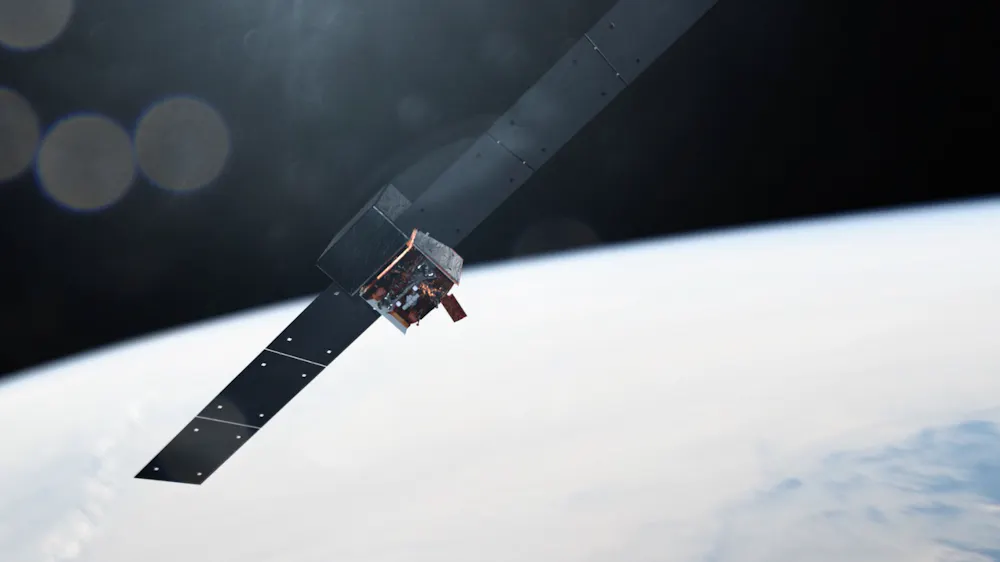
The Fermi spacecraft surveys the sky searching indirectly for dark matter. Image via NASA/ Goddard Space Flight Center/ Chris Smith (USRA/ GESTAR).
The next decade could be decisive
Confirming a dark matter signal will require more data and better instruments working together.
Future observations from Fermi-LAT will continue to improve the sensitivity of these searches. Additionally, new facilities such as the Vera C. Rubin Observatory in Chile, are expected to discover more dwarf galaxies for researchers to study.
Another key mission is NASA’s Compton Spectrometer and Imager, or COSI, scheduled for launch in 2027. COSI will offer a new view of the gamma-ray sky and could help clear up several longstanding mysteries. Among these mysteries is yet another unexplained bright glow from the center of the galaxy, produced when electrons and positrons annihilate, just as in PET scans.
Despite discovering the annihilation signal more than 50 years ago, scientists still don’t know where these positrons are coming from. By mapping this emission in unprecedented detail, COSI could help reveal what’s producing the glow, and whether it might be connected to dark matter and other unexplained signals in the Milky Way.
These efforts, along with many other ongoing searches, may help determine whether scientists are truly seeing the fingerprints of dark matter or something else entirely.
As humans push further into space, from the moon to Mars and beyond, new worlds wait to be discovered. In parallel with the new age of space exploration, with each new observation, scientists may be getting closer to answering one of the most fundamental questions in physics.
Bottom line: New telescopes might bring scientists closer to detecting dark matter. They could soon reveal signals that finally let us understand this mysterious substance.
Dark matter makes up a large proportion of galaxies like the Milky Way, but scientists are still figuring out what it is. New telescopes like the Rubin Observatory could help astronomers find dark matter. Image Rubin Observatory/ NOIRLab/ SLAC/ NSF/ DOE/ AURA/ B. Quint.
Dark matter makes up about 85% of the universe’s matter, but cannot be seen directly.
Researchers have found possible dark matter hints, but the evidence is not yet conclusive.
New telescopes could help confirm whether these signals come from dark matter.
NASA’s plans to return astronauts to the moon through the Artemis program and ultimately send humans to Mars highlight just how far space exploration has come. Yet while the moon and Mars remain compelling destinations filled with scientific mysteries, looking beyond our solar system raises even deeper questions about the universe itself.
Among the biggest of those mysteries is matter: the substance that makes up everything around us. Surprisingly, most of the matter in the universe is invisible, and astronomers still do not know what it is.
Physicists estimate that about 85% of all matter is made of something we cannot see, touch or directly detect. This elusive substance is known as dark matter. It doesn’t emit light like stars or galaxies. The only reason scientists know it exists is because of its gravity.
Galaxies rotate too fast to be held together by just the matter that can be seen. Light bends more strongly than expected as it travels through space. Galaxies within clusters fly past one another much faster than they should based on their visible mass alone.
Based on data from across the cosmos, scientists keep coming to the same conclusion: There is something out there that cannot be seen, but whose presence is unmistakable. It’s a question that has intrigued astronomerslike us for more than 50 years.
So what is dark matter, and why does it matter?
Entirely new kinds of particles?
Everything in our everyday world is made of atoms, which are combinations of protons, neutrons and electrons. These particles form stars, planets, people and everything you see.
Dark matter, scientists believe, is fundamentally different. It is likely made of entirely new kinds of particles yet to be discovered. Understanding what those particles are would fill a major gap in the scientific understanding of physics. But the importance of dark matter goes far beyond particle physics.
Dark matter played a crucial role in shaping the universe. Shortly after the Big Bang that kicked off the birth of the universe, it acted as a kind of gravitational scaffolding, helping ordinary matter clump together to form the first galaxies and stars. Even today, it acts as the invisible glue that holds galaxies together.
In other words, without dark matter, the universe as you know it might not exist.
How to search for the invisible
Because dark matter does not emit light, scientists must search for it indirectly. One promising approach is to look for the signals it might produce when its particles collide and destroy each other through a process known as annihilation.
This idea may sound exotic, but it has a familiar analogy. In medical imaging, devices such as positron emission tomography scanners, or PET scanners for short, detect radiation produced when particles of antimatter – positrons – annihilate with electrons, which are normal matter.
Antimatter is just a form of matter made of particles that have the same mass as ordinary matter, but opposite charges and quantum properties. The annihilation signals in PET scanners allow doctors to map cancerous tissues inside the human body.
Scientists hope something similar could happen with dark matter. If dark matter particles annihilate with each other, they may produce high-energy radiation called gamma rays. These gamma rays could act as fingerprints, revealing where dark matter is concentrated and its properties.
As astrophysicists who study gamma rays, we and our collaborators use space-based telescopes to search for these signals.
Visualization from the Aquarius Project, a high-resolution cosmological dark matter simulation. The image shows the dark matter structure on both large cosmological scales, left panel, and on the scale of the Milky Way. Image by Volker Springel/ Virgo Consortium/ The Aquarius Project.
A mysterious signal at the heart of our galaxy
One of the most powerful tools for this search is NASA’s Fermi Large Area Telescope, known as Fermi-LAT, which has been observing the gamma-ray sky since 2008. Gamma rays are the most energetic form of light, and they are produced by some of the universe’s most extreme phenomena.
For years, Fermi has detected an unexplained glow of gamma rays coming from the center of the Milky Way. Based on gravitational observations such as galaxy rotation curves, stellar motions and the bending of light, combined with cosmological simulations, astrophysicists expect this region to be extremely rich in dark matter, making it an intriguing place to look for annihilation signals.
Could this glow be evidence of dark matter?
Possibly. But there’s a complication: The center of our galaxy is also crowded with more conventional astrophysical gamma ray sources, such as rapidly spinning neutron stars, which are produced from the collapse of massive stars. These objects can produce gamma rays that mimic the expected signal from dark matter.
At the moment, scientists cannot say for certain what is causing the emission. The signal could be a breakthrough, or it could be something more ordinary.
Clues from smaller galaxies
To help resolve this mystery, researchers also study much smaller systems, known as dwarf galaxies, which orbit the Milky Way. These galaxies contain dark matter but relatively few other sources of gamma rays, making them cleaner environments to search for dark matter-related signals.
So far, no definitive detection has been made.
However, an analysis published in March 2024 led by our team at Clemson University found hints of a signal emerging from these dwarf galaxies, and updated results collected since have supported these findings.
Using the latest Fermi-LAT data, combined with an updated census of dwarf galaxies and improved estimates of their dark matter content, we searched for faint gamma-ray signals across the population of dwarf galaxies. This led us to uncover an excess of gamma rays that earlier studies had also hinted at. The more data we’ve collected, the more significant the excess appears to become.
The evidence is not yet strong enough to claim a detection of dark matter, but it is intriguing. The properties of this signal are also consistent with what scientists see in the center of the Milky Way. If both signals share the same origin, the case for dark matter would grow stronger.
The Fermi spacecraft surveys the sky searching indirectly for dark matter. Image via NASA/ Goddard Space Flight Center/ Chris Smith (USRA/ GESTAR).
The next decade could be decisive
Confirming a dark matter signal will require more data and better instruments working together.
Future observations from Fermi-LAT will continue to improve the sensitivity of these searches. Additionally, new facilities such as the Vera C. Rubin Observatory in Chile, are expected to discover more dwarf galaxies for researchers to study.
Another key mission is NASA’s Compton Spectrometer and Imager, or COSI, scheduled for launch in 2027. COSI will offer a new view of the gamma-ray sky and could help clear up several longstanding mysteries. Among these mysteries is yet another unexplained bright glow from the center of the galaxy, produced when electrons and positrons annihilate, just as in PET scans.
Despite discovering the annihilation signal more than 50 years ago, scientists still don’t know where these positrons are coming from. By mapping this emission in unprecedented detail, COSI could help reveal what’s producing the glow, and whether it might be connected to dark matter and other unexplained signals in the Milky Way.
These efforts, along with many other ongoing searches, may help determine whether scientists are truly seeing the fingerprints of dark matter or something else entirely.
As humans push further into space, from the moon to Mars and beyond, new worlds wait to be discovered. In parallel with the new age of space exploration, with each new observation, scientists may be getting closer to answering one of the most fundamental questions in physics.
Bottom line: New telescopes might bring scientists closer to detecting dark matter. They could soon reveal signals that finally let us understand this mysterious substance.
The year’s earliest sunrises don’t happen on the summer solstice. For much of the Northern Hemisphere, they’re happening now. In the Southern Hemisphere, it’s the earliest sunsets that come before the winter solstice in June. The yearly cycle of sunrise and sunset times is easy to miss. But once you start noticing this cycle, it reveals the deeper rhythm of Earth’s journey around the sun … and your place in it.
When to look: The exact dates of the earliest sunrises vary with latitude. For example, for the Northern Hemisphere, the earliest sunrises can come as early as late May. For the southern U.S., the earliest sunrises begin in early June and stretch for weeks. At more northerly latitude, they happen closer to the summer solstice. Southern Hemisphere? Your earliest sunsets happen before your summer solstice, too, in December. And right now, before your winter solstice, you’re having your earliest sunsets. When is June solstice? The June solstice – summer solstice for the Northern Hemisphere, winter solstice for the Southern Hemisphere – will fall at 8:25 UTC (3:25 a.m. CDT) on June 21. Read: All you need to know about the June solstice. For the Northern Hemisphere: Have you noticed how early your sunrises are? The dawn light is beautiful. Check a sunrise/sunset calendar for June. It’s likely your earliest sunrises are happening now, have just happened, or will happen in the coming week or so. For the Southern Hemisphere: If you relish the daylight, as many do, you’ll be glad to know your sunsets will soon be shifting later! They’ll start shifting before your winter solstice – and shortest day – at the June solstice.
The sun rising over the Atlantic Ocean from St. Simons Island, Georgia. Image via Marcy Curran.
Earliest sunrises vary with latitude
The exact dates of your earliest sunrises (and earliest sunsets) vary with latitude.
At the latitude of Mexico City (about 20 degrees N. latitude) the earliest sunrises are in early June.
At the latitude of New Orleans, Cairo in Egypt and Chengdu in China (about 30 degrees N.), the earliest sunrises shift later, to around June 10.
At the latitude of Philadelphia, Madrid in Spain or northern Japan (about 40 degrees N.) the earliest sunrises of the year happen on and near June 14.
And the farther north you go, the closer your earliest sunrises come to the June solstice. By the time you get up to Seattle or Vancouver, they happen only a few days before the solstice.
If you keep going north, you eventually reach a geographic boundary where the concept of “earliest sunrise before the summer solstice” completely breaks down. That is, you reach the Arctic Circle (66.5 degrees N), above which the sun doesn’t rise or set in the weeks or months around the solstice. The concepts of daily “sunrise” and “sunset” disappear entirely, and you get one prolonged period of continuous daylight.
Rupesh Sangoi in Mumbai, India, captured separate images of the sunrise, showing the sun’s movement along the horizon, between the June and December solstices and on the equinoxes. Rupesh wrote: “Did this for over a year, at sunrise.” Glorious composite, Rupesh! Thank you.
To understand why the earliest sunrises aren’t on the day of the solstice, you have to think about clocks and the spinning Earth.
Earth’s spin gives us the length of the day. One spin of the Earth = one day. And we humans have made clocks to measure that day length.
But clocks click along regularly … and Earth’s spin isn’t as regular. If you were to measure the time it takes for the Earth to rotate once relative to the sun – spanning from one local solar noon (when the sun reaches its highest point in your sky) to the next – you’d find the time from one solar noon to another is rarely exactly 24 hours.
Why isn’t it? Two main reasons: the tilt of Earth’s axis and the shape of Earth’s orbit. It’s the continual overlapping of these two cycles that gives us the earliest sunrises before the summer solstice.
Look at it this way. In June, the day (as measured by successive returns of the midday sun) is nearly 1/4 minute longer than 24 hours. So the midday sun (solar noon) comes later by the clock on the June solstice than it does one week before. And that means the sunrise and sunset times also come later by the clock.
The primary reason for the earliest sunrise preceding the summer solstice is the inclination of the Earth’s rotational axis. For example, the earliest sunrise would take place before the solstice even if the Earth went around the sun in a circular orbit.
But the Earth’s elliptical orbit does make the phenomenon more extreme. At the June solstice, Earth in its orbit is rather close to our early July aphelion, our farthest point from the sun. We’re moving slowest in orbit. And this lessens the effect.
On the other hand, at the December solstice, Earth is rather close to our early January perihelion, our closest point to the sun. At that time, we’re moving fastest in orbit, and that accentuates the effect.
So there are little effects related to Earth’s orbit. But the sequence is always the same. Earliest sunrise, summer solstice, latest sunset in summer. Earliest sunset, winter solstice, latest sunrise in winter.
That’s true for you whether you’re in Earth’s Northern or Southern Hemisphere.
And it’s true whether your winter or summer happens when Earth is closest to the sun, or farthest from the sun.
Bottom line: Are you an early riser? If so – and you live in the Northern Hemisphere – you might know your earliest sunrises of the year are happening now. Southern Hemisphere? Your earliest sunsets are around now.
The year’s earliest sunrises don’t happen on the summer solstice. For much of the Northern Hemisphere, they’re happening now. In the Southern Hemisphere, it’s the earliest sunsets that come before the winter solstice in June. The yearly cycle of sunrise and sunset times is easy to miss. But once you start noticing this cycle, it reveals the deeper rhythm of Earth’s journey around the sun … and your place in it.
When to look: The exact dates of the earliest sunrises vary with latitude. For example, for the Northern Hemisphere, the earliest sunrises can come as early as late May. For the southern U.S., the earliest sunrises begin in early June and stretch for weeks. At more northerly latitude, they happen closer to the summer solstice. Southern Hemisphere? Your earliest sunsets happen before your summer solstice, too, in December. And right now, before your winter solstice, you’re having your earliest sunsets. When is June solstice? The June solstice – summer solstice for the Northern Hemisphere, winter solstice for the Southern Hemisphere – will fall at 8:25 UTC (3:25 a.m. CDT) on June 21. Read: All you need to know about the June solstice. For the Northern Hemisphere: Have you noticed how early your sunrises are? The dawn light is beautiful. Check a sunrise/sunset calendar for June. It’s likely your earliest sunrises are happening now, have just happened, or will happen in the coming week or so. For the Southern Hemisphere: If you relish the daylight, as many do, you’ll be glad to know your sunsets will soon be shifting later! They’ll start shifting before your winter solstice – and shortest day – at the June solstice.
The sun rising over the Atlantic Ocean from St. Simons Island, Georgia. Image via Marcy Curran.
Earliest sunrises vary with latitude
The exact dates of your earliest sunrises (and earliest sunsets) vary with latitude.
At the latitude of Mexico City (about 20 degrees N. latitude) the earliest sunrises are in early June.
At the latitude of New Orleans, Cairo in Egypt and Chengdu in China (about 30 degrees N.), the earliest sunrises shift later, to around June 10.
At the latitude of Philadelphia, Madrid in Spain or northern Japan (about 40 degrees N.) the earliest sunrises of the year happen on and near June 14.
And the farther north you go, the closer your earliest sunrises come to the June solstice. By the time you get up to Seattle or Vancouver, they happen only a few days before the solstice.
If you keep going north, you eventually reach a geographic boundary where the concept of “earliest sunrise before the summer solstice” completely breaks down. That is, you reach the Arctic Circle (66.5 degrees N), above which the sun doesn’t rise or set in the weeks or months around the solstice. The concepts of daily “sunrise” and “sunset” disappear entirely, and you get one prolonged period of continuous daylight.
Rupesh Sangoi in Mumbai, India, captured separate images of the sunrise, showing the sun’s movement along the horizon, between the June and December solstices and on the equinoxes. Rupesh wrote: “Did this for over a year, at sunrise.” Glorious composite, Rupesh! Thank you.
To understand why the earliest sunrises aren’t on the day of the solstice, you have to think about clocks and the spinning Earth.
Earth’s spin gives us the length of the day. One spin of the Earth = one day. And we humans have made clocks to measure that day length.
But clocks click along regularly … and Earth’s spin isn’t as regular. If you were to measure the time it takes for the Earth to rotate once relative to the sun – spanning from one local solar noon (when the sun reaches its highest point in your sky) to the next – you’d find the time from one solar noon to another is rarely exactly 24 hours.
Why isn’t it? Two main reasons: the tilt of Earth’s axis and the shape of Earth’s orbit. It’s the continual overlapping of these two cycles that gives us the earliest sunrises before the summer solstice.
Look at it this way. In June, the day (as measured by successive returns of the midday sun) is nearly 1/4 minute longer than 24 hours. So the midday sun (solar noon) comes later by the clock on the June solstice than it does one week before. And that means the sunrise and sunset times also come later by the clock.
The primary reason for the earliest sunrise preceding the summer solstice is the inclination of the Earth’s rotational axis. For example, the earliest sunrise would take place before the solstice even if the Earth went around the sun in a circular orbit.
But the Earth’s elliptical orbit does make the phenomenon more extreme. At the June solstice, Earth in its orbit is rather close to our early July aphelion, our farthest point from the sun. We’re moving slowest in orbit. And this lessens the effect.
On the other hand, at the December solstice, Earth is rather close to our early January perihelion, our closest point to the sun. At that time, we’re moving fastest in orbit, and that accentuates the effect.
So there are little effects related to Earth’s orbit. But the sequence is always the same. Earliest sunrise, summer solstice, latest sunset in summer. Earliest sunset, winter solstice, latest sunrise in winter.
That’s true for you whether you’re in Earth’s Northern or Southern Hemisphere.
And it’s true whether your winter or summer happens when Earth is closest to the sun, or farthest from the sun.
Bottom line: Are you an early riser? If so – and you live in the Northern Hemisphere – you might know your earliest sunrises of the year are happening now. Southern Hemisphere? Your earliest sunsets are around now.