
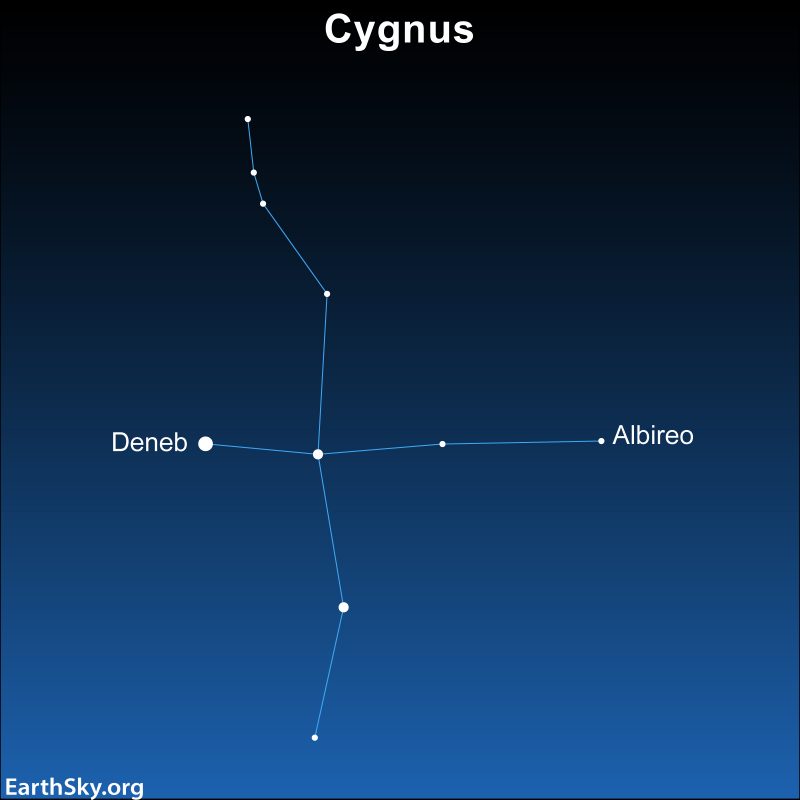
If you have a dark sky, you can observe the edgewise view into our own galaxy – our Milky Way – spanning across the heavens. As you gaze toward it, you’ll also be looking toward the constellation Cygnus the Swan. Its brightest star is called Deneb, the Swan’s Tail.
Additionally, the constellation Cygnus contains one of the most beloved double stars in the sky, Albireo, whose two component stars appear blue and gold.
The constellation Cygnus – with its noticeable stars Deneb and Albireo – are sometimes called the Northern Cross.
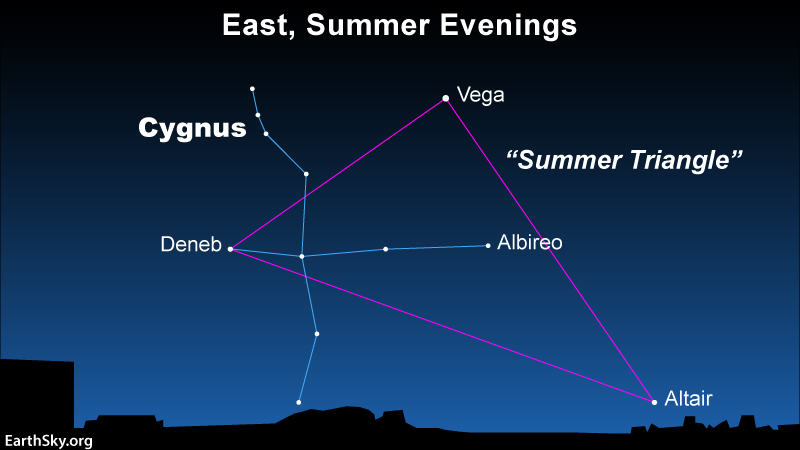
Plus, the star Deneb marks one of the corners of the famous Summer Triangle, an asterism composed of three bright stars in three different constellations.
So there’s a lot going on in this part of the sky! And no wonder, because the Swan lets you peer into the depths of the Milky Way.
How to find Cygnus from the Northern Hemisphere
You can find Cygnus high above the eastern horizon after sunset in the evening in June. As the sky grows dark, the first of its stars that you’ll see is Deneb, because it’s so bright. It’s the brightest in its constellation at magnitude 1.25.
Later, as June nights wear on, you’ll be able to trace out the body of the Swan and its bent wings. Then, you can find the double star, Albireo, which marks its head.
If you can find the large Summer Triangle shape, Deneb in Cygnus is the star that lies toward the northeast.
Then – assuming you have a dark sky – you can look along the length of Cygnus to see the hazy “cloud” behind it. It isn’t a true cloud, but a vast collection of billions our stars: our home galaxy, the Milky Way. You’ll notice the Milky Way runs along the same axis as the long line of the body of the Swan.
The Swan in skylore
The mythology of Cygnus tells the story of Zeus, who changed into the form of a swan to entice Queen Leda. From their union came the twins Castor and Pollux.
It’s said that, today, we see Castor and Pollux as the bright stars of the constellation Gemini the Twins.
Stars of the Swan
Deneb, or Alpha Cygni, is the 19th brightest star in the sky. At magnitude 1.25, it’s a blue-white supergiant star lying about 1,500 light-years away, which is a long distance for a star that shines so brightly in our skies.
Albireo, the head of the Swan, is one of the most beautiful double stars in the heavens. And, with a small telescope, you can easily divide Albireo into a larger yellow star and smaller blue star. The brighter star of Albireo (or Beta Cygni) is magnitude 3.1, and the dimmer is magnitude 5.8. The stars are approximately 380 light-years distant.
Omicron Cygni, or 30 and 31 Cygni, is a double star with orange and blue components that you can see with binoculars. These stars lie between Deneb and Delta Cygni, which is the western wing of the Swan. At magnitudes 4.8 and 3.8, 30 and 31 Cygni lie 610 and 1.350 light-years away, respectively.
Gliese 777 is a yellow subgiant star shining at 5.71 magnitude and located about 51 light-years distant. Three extrasolar planets have been confirmed in its system.
Deep-sky objects in Cygnus
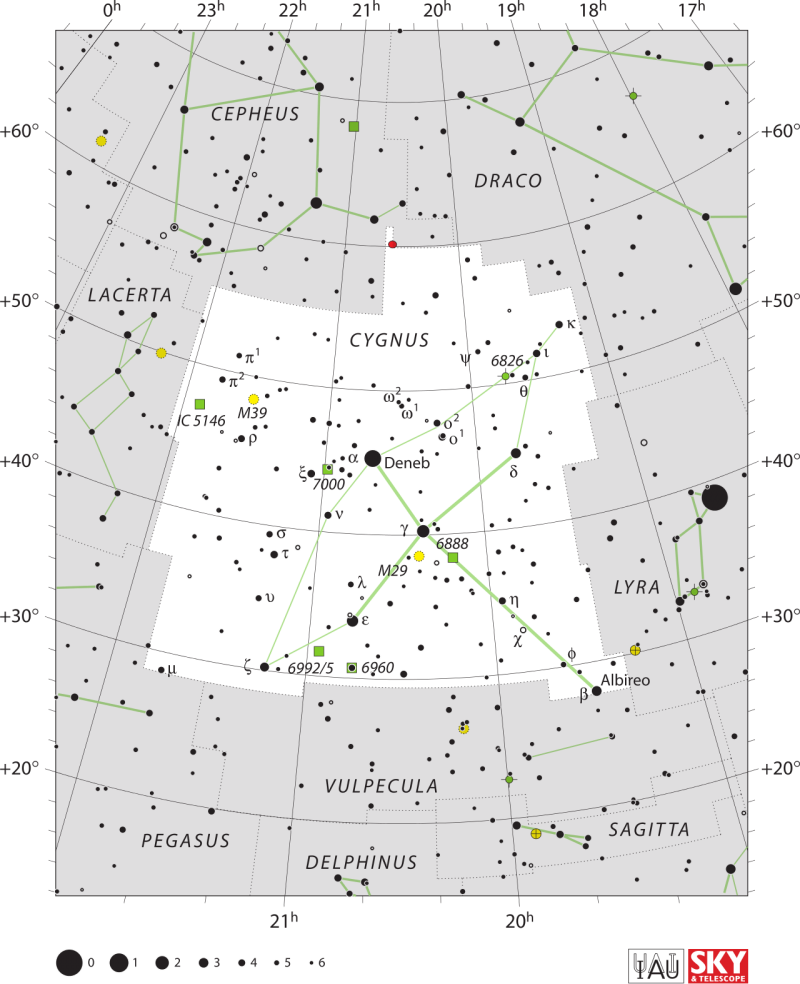
In addition, you can find an open cluster in Cygnus lying less than 2 degrees from Sadr, or Gamma Cygni, the 3rd brightest star of the constellation, at magnitude 2.23, at the center of the cross or Swan. This open cluster is M29, at magnitude 7.1. With this in mind, try using binoculars to track it down.
Also, another Messier object in Cygnus is M39, an open cluster lying about 9 degrees northeast of Deneb. M39 is magnitude 5.5. In this case, you can try to spot with just your eyes alone.
Sadr and star clusters
Now, head back to Sadr. A 7.4-magnitude open cluster, NGC 6910, lies just 1/2 degree north of the star. Then scanning along the western boundary of Cygnus with binoculars or a telescope reveals other clusters, including the magnitude 7.3 Foxhead Cluster (NGC 6819) and the 6.8-magnitude Hole-in-a-Cluster (NGC 6811).
Also, on the western side of the constellation, 5 1/2 degrees north of Sadr, or Gamma Cygni, is the 8.8 magnitude Blinking Planetary, NGC 6826. To be sure, as you move your eyes across it, does it appear to blink?
North America and Veil nebulae
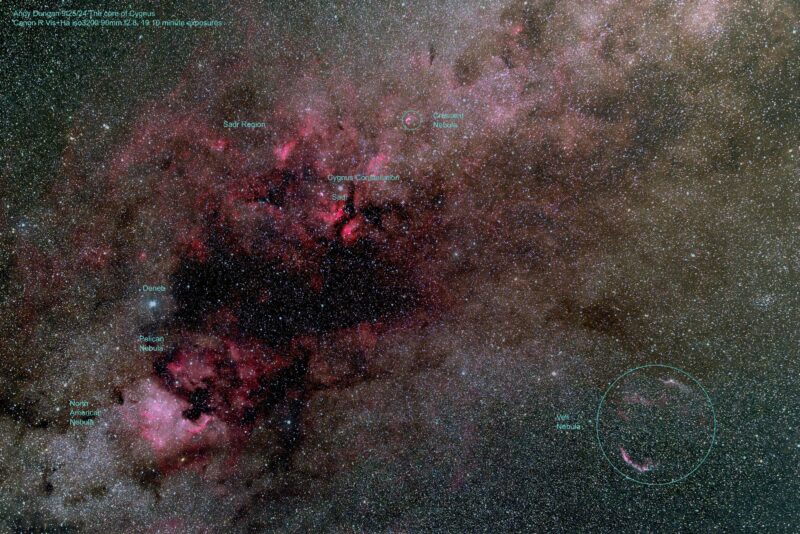
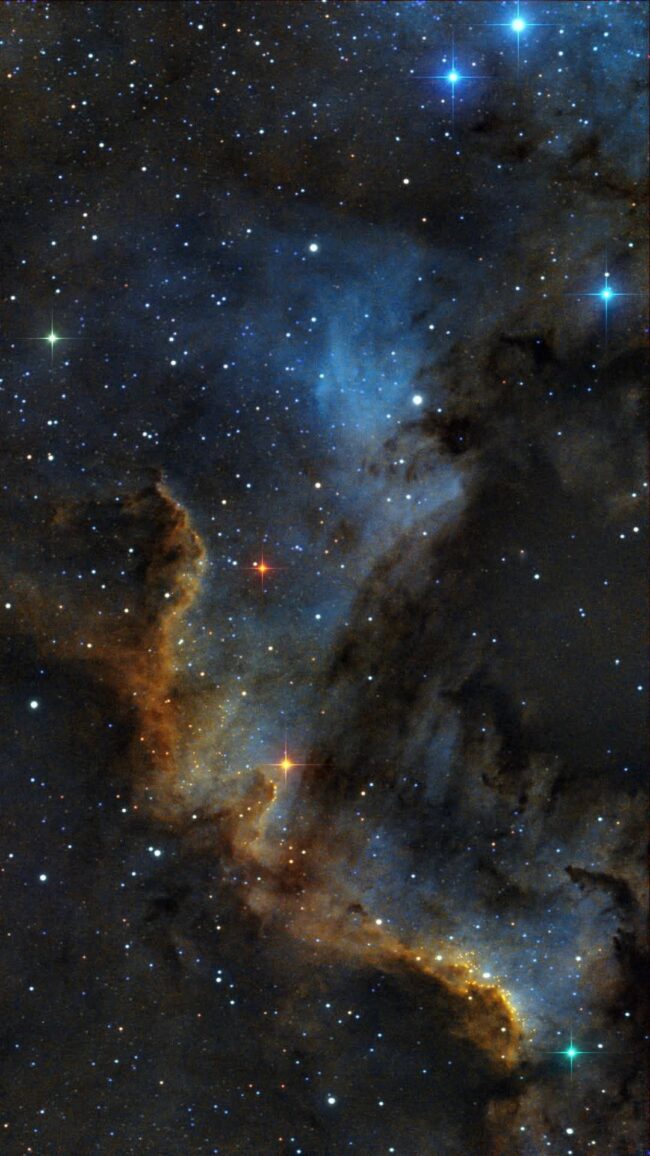
The North America Nebula, or NGC 7000, lies a little over 3 degrees east of Deneb. When you look at it in photos, can you trace out the shape of the continent for which it’s named? You can glimpse this large nebula under dark skies with binoculars. In fact, it extends up to four moon-widths. Depending on your vision and sky conditions, you might detect this large 4.4 magnitude nebula with your eyes alone.
Cygnus is great to explore with binoculars
In addition to the objects mentioned above, you can explore Cygnus in binoculars. That’s because the Milky Way makes a rich background in this part of the sky. So you can find many more nebulae and clusters if you’re patient and sweep the area with binoculars. You might catch even more with a telescope.
Cygnus From The South
Via Daniel Gaussen, Founder & Guide – Stargaze Mackenzie – New Zealand
For observers in the Southern Hemisphere, Cygnus is a winter constellation that appears effectively upside down from our perspective. From far southern locations such as New Zealand’s South Island (around 45°S latitude), the constellation never fully rises above the horizon.
The star Albireo—the Swan’s head—becomes the highest point of the constellation, giving the impression of the swan flying up from beyond the northern horizon. Albireo reaches an altitude of approximately 17° above the horizon, while the constellation’s brightest star, Deneb, resides on or below the horizon from much of New Zealand’s South Island and cannot be seen.
Further north, Cygnus becomes progressively more visible as the swan flies higher into the sky. From Christchurch (43.5°S), Deneb just skims above the horizon at culmination, while from Wellington (41.3°S) it reaches around 4° altitude. In Auckland (36.8°S), Deneb climbs to approximately 9° above the northern horizon, and from Brisbane, Australia (27.5°S), it reaches about 18°.
Even from these locations, however, Deneb remains a low-altitude object, often affected by atmospheric haze and extinction.
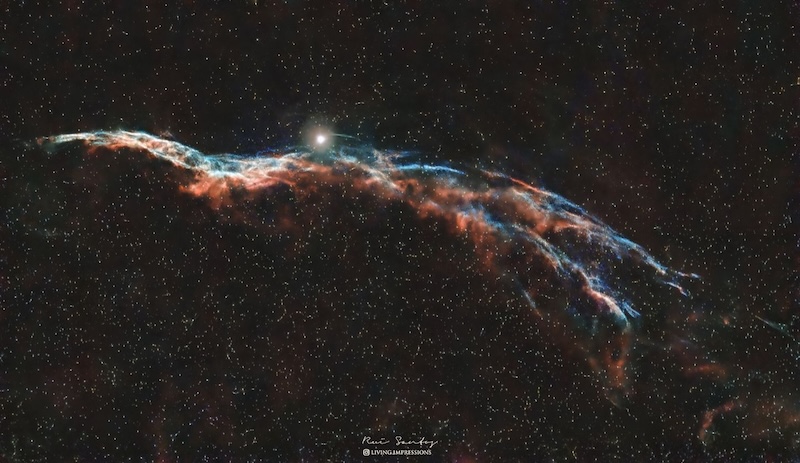
Despite this, several of Cygnus’s most famous deep-sky objects become accessible from southern latitudes. The Veil Nebula with its rich filamentary structures climbs high enough above the horizon to become a viable target for astrophotographers.
Bottom line: Cygnus the Swan is a constellation that lies in front of the starlit band of the Milky Way. Its brightest star, Deneb, is part of the Summer Triangle.
Read more: Why 61 Cygni is nicknamed Flying Star
The post Cygnus the Swan flies along the Milky Way first appeared on EarthSky.
from EarthSky https://ift.tt/jPmYOLI
If you have a dark sky, you can observe the edgewise view into our own galaxy – our Milky Way – spanning across the heavens. As you gaze toward it, you’ll also be looking toward the constellation Cygnus the Swan. Its brightest star is called Deneb, the Swan’s Tail.
Additionally, the constellation Cygnus contains one of the most beloved double stars in the sky, Albireo, whose two component stars appear blue and gold.
The constellation Cygnus – with its noticeable stars Deneb and Albireo – are sometimes called the Northern Cross.
Plus, the star Deneb marks one of the corners of the famous Summer Triangle, an asterism composed of three bright stars in three different constellations.
So there’s a lot going on in this part of the sky! And no wonder, because the Swan lets you peer into the depths of the Milky Way.
How to find Cygnus from the Northern Hemisphere
You can find Cygnus high above the eastern horizon after sunset in the evening in June. As the sky grows dark, the first of its stars that you’ll see is Deneb, because it’s so bright. It’s the brightest in its constellation at magnitude 1.25.
Later, as June nights wear on, you’ll be able to trace out the body of the Swan and its bent wings. Then, you can find the double star, Albireo, which marks its head.
If you can find the large Summer Triangle shape, Deneb in Cygnus is the star that lies toward the northeast.
Then – assuming you have a dark sky – you can look along the length of Cygnus to see the hazy “cloud” behind it. It isn’t a true cloud, but a vast collection of billions our stars: our home galaxy, the Milky Way. You’ll notice the Milky Way runs along the same axis as the long line of the body of the Swan.
The Swan in skylore
The mythology of Cygnus tells the story of Zeus, who changed into the form of a swan to entice Queen Leda. From their union came the twins Castor and Pollux.
It’s said that, today, we see Castor and Pollux as the bright stars of the constellation Gemini the Twins.
Stars of the Swan
Deneb, or Alpha Cygni, is the 19th brightest star in the sky. At magnitude 1.25, it’s a blue-white supergiant star lying about 1,500 light-years away, which is a long distance for a star that shines so brightly in our skies.
Albireo, the head of the Swan, is one of the most beautiful double stars in the heavens. And, with a small telescope, you can easily divide Albireo into a larger yellow star and smaller blue star. The brighter star of Albireo (or Beta Cygni) is magnitude 3.1, and the dimmer is magnitude 5.8. The stars are approximately 380 light-years distant.
Omicron Cygni, or 30 and 31 Cygni, is a double star with orange and blue components that you can see with binoculars. These stars lie between Deneb and Delta Cygni, which is the western wing of the Swan. At magnitudes 4.8 and 3.8, 30 and 31 Cygni lie 610 and 1.350 light-years away, respectively.
Gliese 777 is a yellow subgiant star shining at 5.71 magnitude and located about 51 light-years distant. Three extrasolar planets have been confirmed in its system.
Deep-sky objects in Cygnus
In addition, you can find an open cluster in Cygnus lying less than 2 degrees from Sadr, or Gamma Cygni, the 3rd brightest star of the constellation, at magnitude 2.23, at the center of the cross or Swan. This open cluster is M29, at magnitude 7.1. With this in mind, try using binoculars to track it down.
Also, another Messier object in Cygnus is M39, an open cluster lying about 9 degrees northeast of Deneb. M39 is magnitude 5.5. In this case, you can try to spot with just your eyes alone.
Sadr and star clusters
Now, head back to Sadr. A 7.4-magnitude open cluster, NGC 6910, lies just 1/2 degree north of the star. Then scanning along the western boundary of Cygnus with binoculars or a telescope reveals other clusters, including the magnitude 7.3 Foxhead Cluster (NGC 6819) and the 6.8-magnitude Hole-in-a-Cluster (NGC 6811).
Also, on the western side of the constellation, 5 1/2 degrees north of Sadr, or Gamma Cygni, is the 8.8 magnitude Blinking Planetary, NGC 6826. To be sure, as you move your eyes across it, does it appear to blink?
North America and Veil nebulae
The North America Nebula, or NGC 7000, lies a little over 3 degrees east of Deneb. When you look at it in photos, can you trace out the shape of the continent for which it’s named? You can glimpse this large nebula under dark skies with binoculars. In fact, it extends up to four moon-widths. Depending on your vision and sky conditions, you might detect this large 4.4 magnitude nebula with your eyes alone.
Cygnus is great to explore with binoculars
In addition to the objects mentioned above, you can explore Cygnus in binoculars. That’s because the Milky Way makes a rich background in this part of the sky. So you can find many more nebulae and clusters if you’re patient and sweep the area with binoculars. You might catch even more with a telescope.
Cygnus From The South
Via Daniel Gaussen, Founder & Guide – Stargaze Mackenzie – New Zealand
For observers in the Southern Hemisphere, Cygnus is a winter constellation that appears effectively upside down from our perspective. From far southern locations such as New Zealand’s South Island (around 45°S latitude), the constellation never fully rises above the horizon.
The star Albireo—the Swan’s head—becomes the highest point of the constellation, giving the impression of the swan flying up from beyond the northern horizon. Albireo reaches an altitude of approximately 17° above the horizon, while the constellation’s brightest star, Deneb, resides on or below the horizon from much of New Zealand’s South Island and cannot be seen.
Further north, Cygnus becomes progressively more visible as the swan flies higher into the sky. From Christchurch (43.5°S), Deneb just skims above the horizon at culmination, while from Wellington (41.3°S) it reaches around 4° altitude. In Auckland (36.8°S), Deneb climbs to approximately 9° above the northern horizon, and from Brisbane, Australia (27.5°S), it reaches about 18°.
Even from these locations, however, Deneb remains a low-altitude object, often affected by atmospheric haze and extinction.
Despite this, several of Cygnus’s most famous deep-sky objects become accessible from southern latitudes. The Veil Nebula with its rich filamentary structures climbs high enough above the horizon to become a viable target for astrophotographers.
Bottom line: Cygnus the Swan is a constellation that lies in front of the starlit band of the Milky Way. Its brightest star, Deneb, is part of the Summer Triangle.
Read more: Why 61 Cygni is nicknamed Flying Star
The post Cygnus the Swan flies along the Milky Way first appeared on EarthSky.
from EarthSky https://ift.tt/jPmYOLI

Aucun commentaire:
Enregistrer un commentaire