
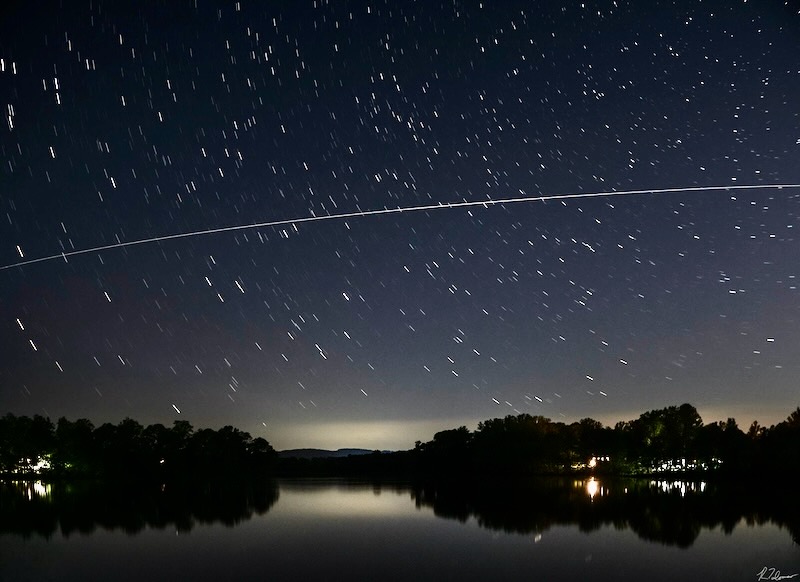
See the International Space Station before it’s gone!
The International Space Station (ISS) has been orbiting our planet since 1998. And it’s scheduled to be de-orbited – and safely brought down over the Pacific Ocean – as early as 2031. So now is the time to see it in your sky! From about 95% of the inhabited locations on Earth, ISS makes periodic passes across the sky. It looks like a bright star, moving quickly from horizon to horizon.
But how do you know when to see the ISS pass overhead from your location?
NASA has a great tool to help. Sign up to the Spot the Station program and you’ll receive alerts to let you know when the ISS will be visible from your location, wherever you are in the world. Plus, there’s a map-based feature to track when to look for the station as it flies over you.
Typically, alerts are sent out a few times each month when the station’s orbit is near your location. You’ll get notices only when the ISS will be clearly visible from your location for at least a couple of minutes.
One note: ISS is not visible north or south of about the 51st parallel. Specifically, it’s not visible 51.6 degrees north or south.
If you’re close to that latitude, say, just below it, you might want to visit the Spot the Station website directly to see upcoming sighting opportunities. This is because notifications in this region will be rare.
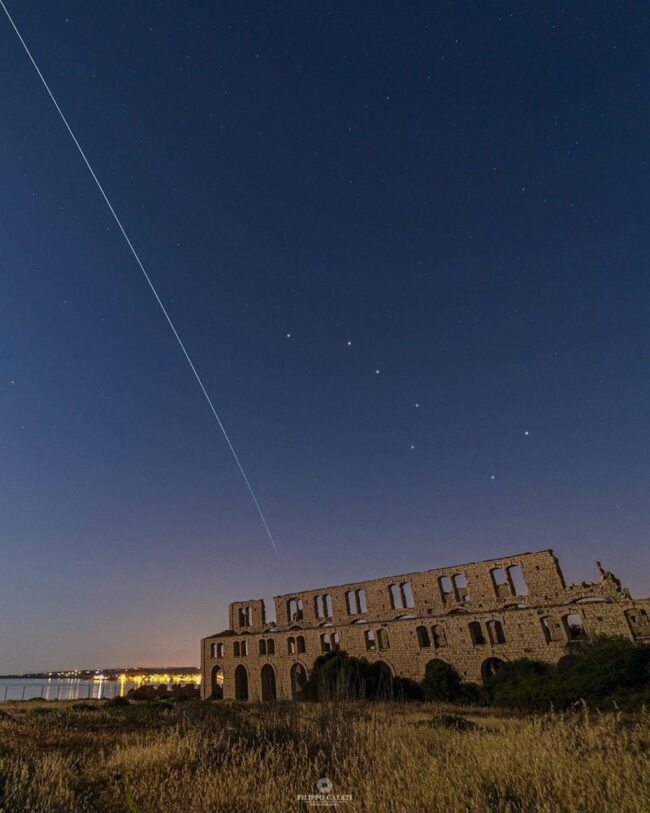
How to spot the International Space Station
Spot the Station will tell you which direction to look for the ISS in your night sky. If you’re not sure about your directions, just note where the sun rises or sets from your observing spot. You know it rises generally east and sets generally west. Knowing east and west can anchor you, and help you find the direction where the station will appear (for example, in the southeast or northwest).
Via NASA’s service, the height at which the station will appear in your sky is given in degrees. And remember, 90 degrees is directly over your head. So any number less than 90 degrees means the station will appear somewhere between the horizon and the overhead mark.
Want a way to measure degrees on the sky’s dome? Make a fist, and stretch out your arm: your fist at arm’s length is equal to about 10 degrees. Then, just use the appropriate number of fist-lengths to find the location marker. For example, four fist-lengths from the horizon would be about 40 degrees.
And don’t worry, the station is bright! It’s hard to miss if you’re looking in the correct direction.
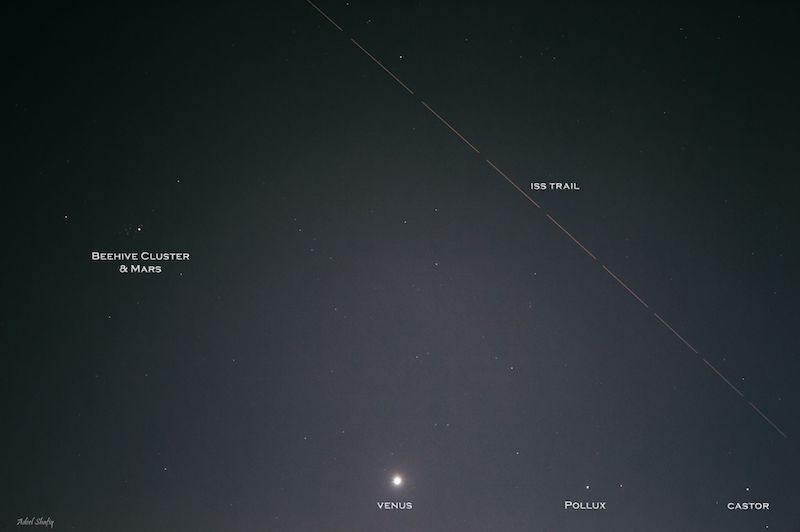
Over two decades of human occupation
The first module of the ISS was launched into space in 1998. The initial construction of the station took about two years to complete. Human occupation of the station began on November 2, 2000. And since that time, ISS has been continuously occupied.
ISS orbits at approximately 220 miles (350 km) above the Earth. It travels at an average speed of 17,227 miles per hour (27,724 km/h). It makes approximately 16 orbits around Earth every day.
And it serves as both an orbiting laboratory and a port for international spacecraft.
The primary partnering countries involved in operating the ISS include the United States, Canada, Japan, several European countries and Russia. China has its own space station, Tiangong, with the first module launched in 2021 and the last of its three initial modules launched in November 2022.
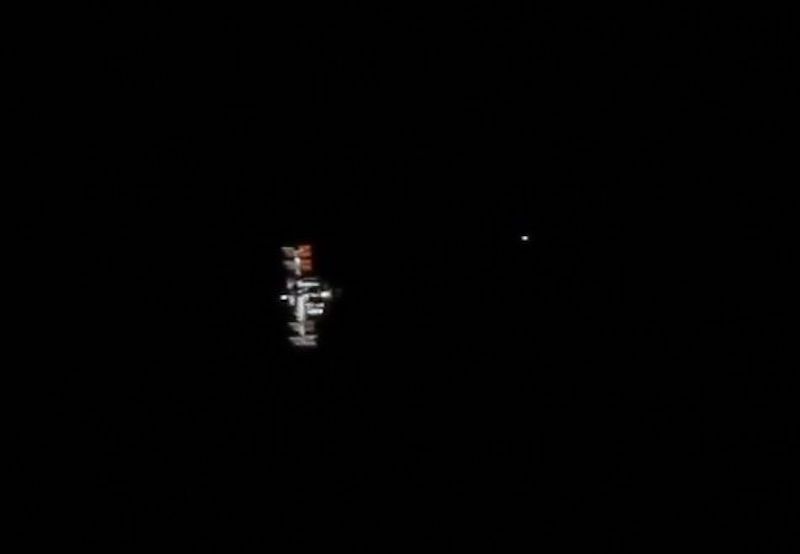
Bottom line: Learn how to spot the International Space Station from your location.
Additional resource for bright satellite passes
The post See the International Space Station before it’s gone first appeared on EarthSky.
from EarthSky https://ift.tt/kVOWlop
See the International Space Station before it’s gone!
The International Space Station (ISS) has been orbiting our planet since 1998. And it’s scheduled to be de-orbited – and safely brought down over the Pacific Ocean – as early as 2031. So now is the time to see it in your sky! From about 95% of the inhabited locations on Earth, ISS makes periodic passes across the sky. It looks like a bright star, moving quickly from horizon to horizon.
But how do you know when to see the ISS pass overhead from your location?
NASA has a great tool to help. Sign up to the Spot the Station program and you’ll receive alerts to let you know when the ISS will be visible from your location, wherever you are in the world. Plus, there’s a map-based feature to track when to look for the station as it flies over you.
Typically, alerts are sent out a few times each month when the station’s orbit is near your location. You’ll get notices only when the ISS will be clearly visible from your location for at least a couple of minutes.
One note: ISS is not visible north or south of about the 51st parallel. Specifically, it’s not visible 51.6 degrees north or south.
If you’re close to that latitude, say, just below it, you might want to visit the Spot the Station website directly to see upcoming sighting opportunities. This is because notifications in this region will be rare.
How to spot the International Space Station
Spot the Station will tell you which direction to look for the ISS in your night sky. If you’re not sure about your directions, just note where the sun rises or sets from your observing spot. You know it rises generally east and sets generally west. Knowing east and west can anchor you, and help you find the direction where the station will appear (for example, in the southeast or northwest).
Via NASA’s service, the height at which the station will appear in your sky is given in degrees. And remember, 90 degrees is directly over your head. So any number less than 90 degrees means the station will appear somewhere between the horizon and the overhead mark.
Want a way to measure degrees on the sky’s dome? Make a fist, and stretch out your arm: your fist at arm’s length is equal to about 10 degrees. Then, just use the appropriate number of fist-lengths to find the location marker. For example, four fist-lengths from the horizon would be about 40 degrees.
And don’t worry, the station is bright! It’s hard to miss if you’re looking in the correct direction.
Over two decades of human occupation
The first module of the ISS was launched into space in 1998. The initial construction of the station took about two years to complete. Human occupation of the station began on November 2, 2000. And since that time, ISS has been continuously occupied.
ISS orbits at approximately 220 miles (350 km) above the Earth. It travels at an average speed of 17,227 miles per hour (27,724 km/h). It makes approximately 16 orbits around Earth every day.
And it serves as both an orbiting laboratory and a port for international spacecraft.
The primary partnering countries involved in operating the ISS include the United States, Canada, Japan, several European countries and Russia. China has its own space station, Tiangong, with the first module launched in 2021 and the last of its three initial modules launched in November 2022.
Bottom line: Learn how to spot the International Space Station from your location.
Additional resource for bright satellite passes
The post See the International Space Station before it’s gone first appeared on EarthSky.
from EarthSky https://ift.tt/kVOWlop

Aucun commentaire:
Enregistrer un commentaire