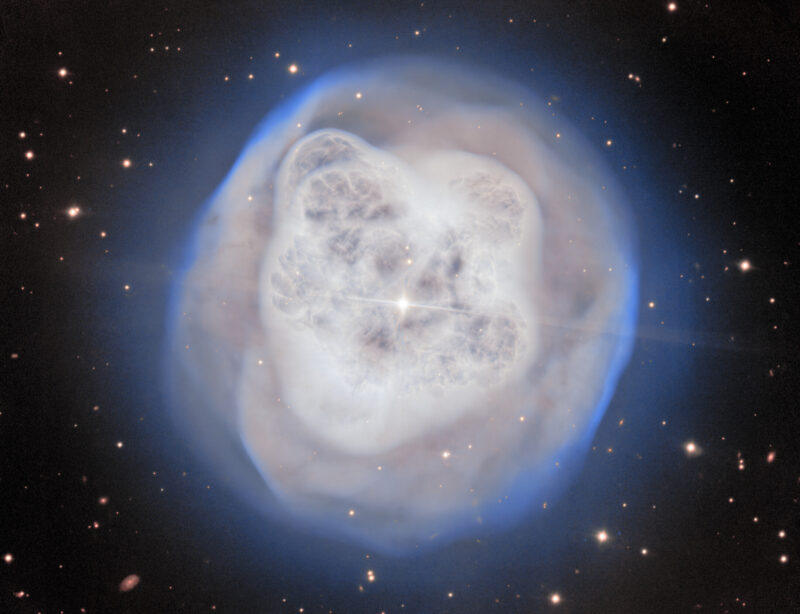
The Crystal Ball Nebula, also known as NGC 1514, is an exquisite ball of gas encircling a pair of stars. The Gemini North telescope captured this image from atop Mauna Kea in Hawaii. Image via International Gemini Observatory/ NOIRLab/ NSF/ AURA.
NOIRLab released this sensational new image of the Crystal Ball Nebula on May 21, 2026. The Gemini North telescope captured this image from atop Mauna Kea in Hawaii. The Crystal Ball Nebula, also known as NGC 1514, lies in the constellation Taurus the Bull, at a distance of 1,500 light-years from us.
Astronomer William Herschel first spotted the Crystal Ball Nebula in 1790. Through his telescope he saw it as a star surrounded with a faintly luminous atmosphere.
A hidden pair shaping the nebula
But modern observations show there are actually two stars at the center of the nebula. One of the two stars in this binary pair, an O-type star, has shed its outer layers as it nears the end of its life. That’s what has created the ball of gas and dust around the stars, which astronomers call a planetary nebula. The name is a bit misleading, because its creation does not involve planets. It was in fact Herschel who coined the term planetary nebula, because their round shape reminded him of the planets.
The two stars complete an orbit around each other approximately once every nine years. That makes this pair’s orbit the longest known for any planetary nebula.
The Crystal Ball Nebula is a bit unusual for a planetary nebula. Most have smoother shapes. But the strong winds blowing from these stars create the sculpted tendrils of gas we can see in this image.
Bottom line: The Crystal Ball Nebula is a giant sphere of gas and dust encircling a pair of stars in the direction of the constellation Taurus the Bull.
The Crystal Ball Nebula, also known as NGC 1514, is an exquisite ball of gas encircling a pair of stars. The Gemini North telescope captured this image from atop Mauna Kea in Hawaii. Image via International Gemini Observatory/ NOIRLab/ NSF/ AURA.
NOIRLab released this sensational new image of the Crystal Ball Nebula on May 21, 2026. The Gemini North telescope captured this image from atop Mauna Kea in Hawaii. The Crystal Ball Nebula, also known as NGC 1514, lies in the constellation Taurus the Bull, at a distance of 1,500 light-years from us.
Astronomer William Herschel first spotted the Crystal Ball Nebula in 1790. Through his telescope he saw it as a star surrounded with a faintly luminous atmosphere.
A hidden pair shaping the nebula
But modern observations show there are actually two stars at the center of the nebula. One of the two stars in this binary pair, an O-type star, has shed its outer layers as it nears the end of its life. That’s what has created the ball of gas and dust around the stars, which astronomers call a planetary nebula. The name is a bit misleading, because its creation does not involve planets. It was in fact Herschel who coined the term planetary nebula, because their round shape reminded him of the planets.
The two stars complete an orbit around each other approximately once every nine years. That makes this pair’s orbit the longest known for any planetary nebula.
The Crystal Ball Nebula is a bit unusual for a planetary nebula. Most have smoother shapes. But the strong winds blowing from these stars create the sculpted tendrils of gas we can see in this image.
Bottom line: The Crystal Ball Nebula is a giant sphere of gas and dust encircling a pair of stars in the direction of the constellation Taurus the Bull.
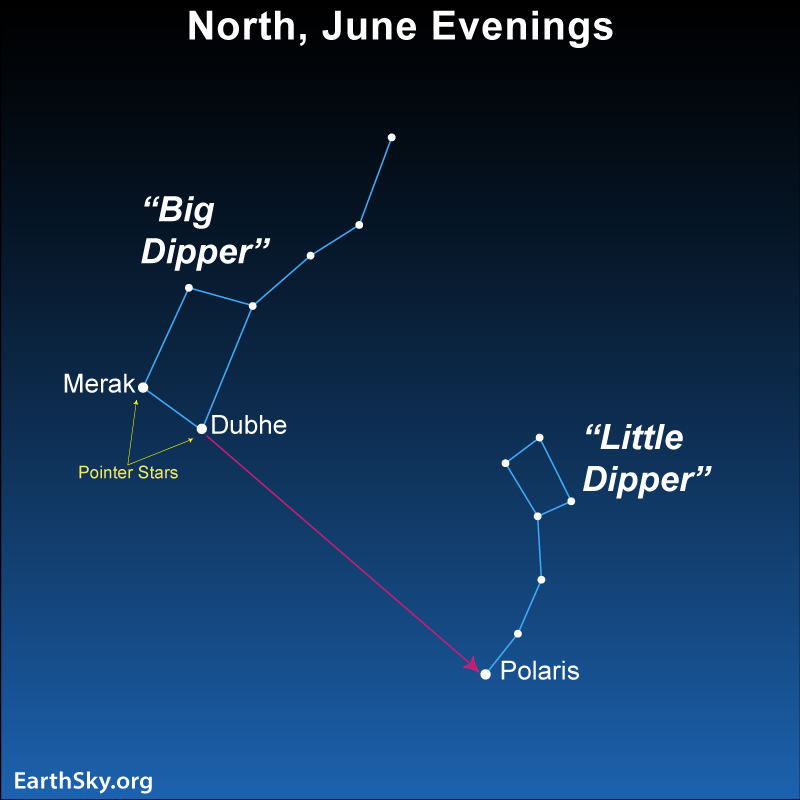
Here are 2 asterisms – noticeable star patterns – known to Northern Hemisphere stargazers as the Big and Little Dippers. To find the Little Dipper, use the 2 outer stars in the bowl of the Big Dipper – aka the Pointers – to point to Polaris, the North Star. Note that Polaris marks the end of the handle of the Little Dipper. After you find Polaris, if your sky is dark enough, you should be able to trace out the other stars in the Little Dipper. Chart via EarthSky.
Tonight, assuming you’re in the Northern Hemisphere, you can easily find the legendary Big Dipper, called the Plough by our friends in the United Kingdom or the Wagon throughout much of Europe.
This familiar star pattern is high in the north at nightfall in June, for Northern Hemisphere stargazers. Find it and let it be your guide to the Little Dipper.
The Big Dipper is easy to find because its shape really resembles a dipper. And it is made up of moderately bright stars. But the Little Dipper isn’t as easy. You need a dark sky to see it. So be sure to avoid city lights.
How to find the Dippers from the Northern Hemisphere
Simply face northward on a June evening and look for a large, dipper-like pattern. Which way is north? Rotate around until your left side faces the sunset point. You are now looking toward the north. That easy-to-see pattern high in the sky is the Big Dipper.
Also, notice that the Big Dipper has two parts: a bowl and a handle. The bowl has four stars and the handle has three. See the two outer stars in the bowl? They’re known as the Pointers because they point to the North Star, which is also known as Polaris.
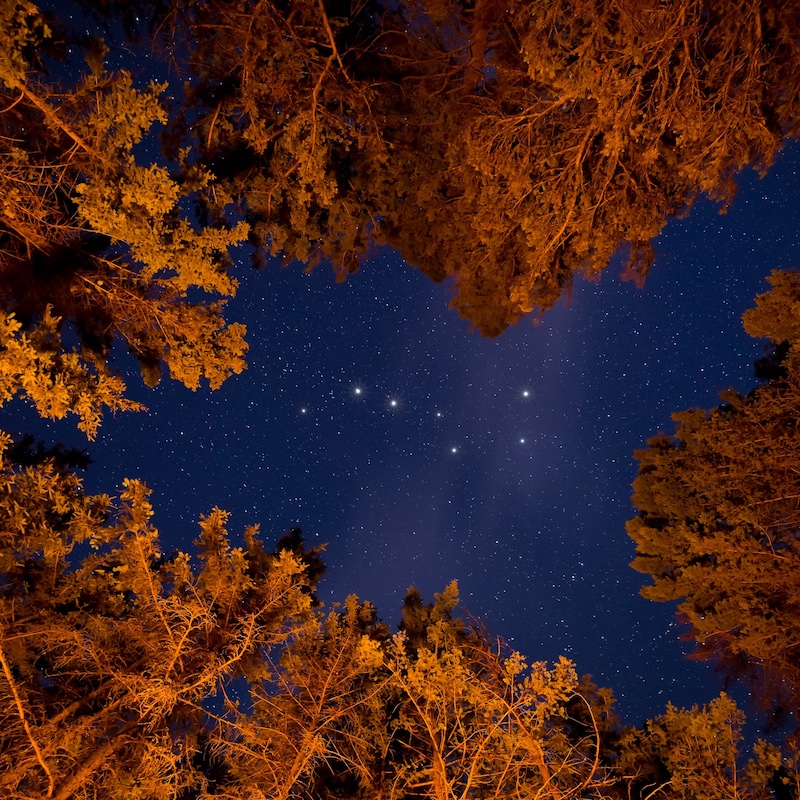
The Big Dipper stands out in the night sky. Image via James Wheeler/ Unsplash.
Polaris is the brightest star of the Little Dipper
Once you’ve found Polaris, you can find the Little Dipper. Polaris marks the end of the handle of the Little Dipper. You need a dark sky to see the all of the Little Dipper, because it’s fainter than its larger and brighter counterpart. If your skies are not very dark, you might see only the three brightest stars in the Little Dipper. Those three stars are Polaris and the two end stars in the bowl of the Little Dipper.
By the way, can you see the Big Dipper from Earth’s Southern Hemisphere? Yes, if you’re in the southern tropics. However, much farther south, it gets harder because you are farther south on Earth’s globe. So, the Big Dipper sinks closer and closer to the northern horizon.
Meanwhile, Polaris, the North Star, disappears beneath the horizon once you get south of the Earth’s equator.
Can you see the Dippers from the Southern Hemisphere?
For observers in the Southern Hemisphere, the Big Dipper is a much less familiar sight. It can be seen from some tropical and subtropical latitudes, but only very low in the northern sky, skimming close to the horizon.
The best months to look for it in the evening are around April and May, when it’s culminating (reaching its highest point in the north) in late evening. Because all the stars rise 4 minutes earlier each day, the Dipper culminates earlier in the evening in June.
Meanwhile, for the most part, the Little Dipper can’t be seen at all. The Little Dipper’s anchor star, Polaris – the North Star, or star that marks the north celestial pole (point in the sky around which the entire northern sky turns) – doesn’t rise above the horizon for those south of the equator.
Instead, Southern Hemisphere stargazers turn to the Southern Cross (Crux) as their most recognizable navigational star pattern. The bright stars Alpha and Beta Centauri are commonly known as the Pointer Stars because they point toward the Southern Cross, helping observers locate the south celestial pole (point around which the entire southern sky turns).
So Alpha and Beta Centauri mirror the role of the Big Dipper’s two outer bowl stars, Dubhe and Merak, also known as the Pointers in the north, guiding the eye toward Polaris and the north celestial pole.
Big and Little Dipper in skylore
In his classic book Star Names: Their Lore and Meaning, Richard Hinckley Allen claims the Greek constellation Ursa Minor the Lesser Bear – our Little Dipper – was never mentioned in the literary works of Homer (9th century BCE) or Hesiod (8th century BCE).
That’s probably because Ursa Minor hadn’t been invented yet.
According to the Greek geographer and historian Strabo (63 BCE to about 21 CE), the seven stars we see today as part of Ursa Minor (the Little Dipper) didn’t carry that name until 600 BCE or so. Before that time, people saw this group of stars outlining the wings of the constellation Draco the Dragon.
When the seafaring Phoenicians visited the Greek philosopher Thales around 600 BCE, they showed him how to navigate by the stars. Purportedly, Thales clipped the Dragon’s wings to create a new constellation, possibly because this new way of looking at the stars enabled Greek sailors to more easily locate the north celestial pole.
But it’s not just our names for things in the sky that change. The sky itself changes, too. In our day, Polaris closely marks the north celestial pole in the sky. In 600 BCE – thanks to the motion of precession – the Little Dipper’s stars Kochab and Pherkad more closely marked the position of the north celestial pole.
Here are 2 asterisms – noticeable star patterns – known to Northern Hemisphere stargazers as the Big and Little Dippers. To find the Little Dipper, use the 2 outer stars in the bowl of the Big Dipper – aka the Pointers – to point to Polaris, the North Star. Note that Polaris marks the end of the handle of the Little Dipper. After you find Polaris, if your sky is dark enough, you should be able to trace out the other stars in the Little Dipper. Chart via EarthSky.
Tonight, assuming you’re in the Northern Hemisphere, you can easily find the legendary Big Dipper, called the Plough by our friends in the United Kingdom or the Wagon throughout much of Europe.
This familiar star pattern is high in the north at nightfall in June, for Northern Hemisphere stargazers. Find it and let it be your guide to the Little Dipper.
The Big Dipper is easy to find because its shape really resembles a dipper. And it is made up of moderately bright stars. But the Little Dipper isn’t as easy. You need a dark sky to see it. So be sure to avoid city lights.
How to find the Dippers from the Northern Hemisphere
Simply face northward on a June evening and look for a large, dipper-like pattern. Which way is north? Rotate around until your left side faces the sunset point. You are now looking toward the north. That easy-to-see pattern high in the sky is the Big Dipper.
Also, notice that the Big Dipper has two parts: a bowl and a handle. The bowl has four stars and the handle has three. See the two outer stars in the bowl? They’re known as the Pointers because they point to the North Star, which is also known as Polaris.
The Big Dipper stands out in the night sky. Image via James Wheeler/ Unsplash.
Polaris is the brightest star of the Little Dipper
Once you’ve found Polaris, you can find the Little Dipper. Polaris marks the end of the handle of the Little Dipper. You need a dark sky to see the all of the Little Dipper, because it’s fainter than its larger and brighter counterpart. If your skies are not very dark, you might see only the three brightest stars in the Little Dipper. Those three stars are Polaris and the two end stars in the bowl of the Little Dipper.
By the way, can you see the Big Dipper from Earth’s Southern Hemisphere? Yes, if you’re in the southern tropics. However, much farther south, it gets harder because you are farther south on Earth’s globe. So, the Big Dipper sinks closer and closer to the northern horizon.
Meanwhile, Polaris, the North Star, disappears beneath the horizon once you get south of the Earth’s equator.
Can you see the Dippers from the Southern Hemisphere?
For observers in the Southern Hemisphere, the Big Dipper is a much less familiar sight. It can be seen from some tropical and subtropical latitudes, but only very low in the northern sky, skimming close to the horizon.
The best months to look for it in the evening are around April and May, when it’s culminating (reaching its highest point in the north) in late evening. Because all the stars rise 4 minutes earlier each day, the Dipper culminates earlier in the evening in June.
Meanwhile, for the most part, the Little Dipper can’t be seen at all. The Little Dipper’s anchor star, Polaris – the North Star, or star that marks the north celestial pole (point in the sky around which the entire northern sky turns) – doesn’t rise above the horizon for those south of the equator.
Instead, Southern Hemisphere stargazers turn to the Southern Cross (Crux) as their most recognizable navigational star pattern. The bright stars Alpha and Beta Centauri are commonly known as the Pointer Stars because they point toward the Southern Cross, helping observers locate the south celestial pole (point around which the entire southern sky turns).
So Alpha and Beta Centauri mirror the role of the Big Dipper’s two outer bowl stars, Dubhe and Merak, also known as the Pointers in the north, guiding the eye toward Polaris and the north celestial pole.
Big and Little Dipper in skylore
In his classic book Star Names: Their Lore and Meaning, Richard Hinckley Allen claims the Greek constellation Ursa Minor the Lesser Bear – our Little Dipper – was never mentioned in the literary works of Homer (9th century BCE) or Hesiod (8th century BCE).
That’s probably because Ursa Minor hadn’t been invented yet.
According to the Greek geographer and historian Strabo (63 BCE to about 21 CE), the seven stars we see today as part of Ursa Minor (the Little Dipper) didn’t carry that name until 600 BCE or so. Before that time, people saw this group of stars outlining the wings of the constellation Draco the Dragon.
When the seafaring Phoenicians visited the Greek philosopher Thales around 600 BCE, they showed him how to navigate by the stars. Purportedly, Thales clipped the Dragon’s wings to create a new constellation, possibly because this new way of looking at the stars enabled Greek sailors to more easily locate the north celestial pole.
But it’s not just our names for things in the sky that change. The sky itself changes, too. In our day, Polaris closely marks the north celestial pole in the sky. In 600 BCE – thanks to the motion of precession – the Little Dipper’s stars Kochab and Pherkad more closely marked the position of the north celestial pole.
It appears likely El Niño conditions will emerge soon. On Tuesday, June 2, 2026, officials from the World Meteorological Organization urged people to prepare for above average temperatures and more extreme weather patterns. In addition, we could be facing a super El Niño, if the sea surface temperatures in the Eastern Pacific climb to about 2.0° C (3.6 F) above normal. Image via Peggy Marco/ Pixabay.
World Meteorological Organization urges people to prepare for El Niño
On Tuesday, June 2, 2026, the World Meteorological Organization (WMO), based in Geneva, Switzerland, urged people to prepare for coming El Niño conditions. The WMO, a specialized agency of the United Nations that focuses on weather, climate and water resources, said:
Fueled by unusually warm ocean waters in the tropical Pacific, El Niño conditions are developing and are set to influence global temperature and rainfall patterns, increasing the risk of extreme weather over the coming months.
The newest update on El Niño conditions now shows an 80% likelihood of El Nino developing in the next three months. Plus, the likelihood that El Niño conditions will continue until at least November are around 90%. And there is still a possibility that it will become a super El Niño event.
The science is clear: El Niño is arriving on our doorstep in the coming months with 90% certainty. The world must treat it as the urgent climate warning it is. El Niño conditions will pour fuel on the fire of a warming world. Impacts will hit even harder, travel even farther, and cross borders with devastating speed. The only effective response is climate action equal to the crisis – ending the addiction to fossil fuels, accelerating the shift to renewables, protecting the most vulnerable, and delivering early warning systems for all.
We need to prepare for a potentially strong El Niño event – which will exacerbate drought and heavy rainfall and increase the risk of heatwaves both on land and in the ocean. The most recent El Niño, in 2023-24, was one of the five strongest on record and it played a role in the record global temperatures we saw in 2024.
Just like any weather event, preparation is key. The WMO said that nearly everywhere can expect above average temperatures for June to August. Do you know how to beat the heat? Meteorologist Rachel Duensing provides tips below.
Celeste Saulo also said:
Advance seasonal forecasts and early warnings are vital to save lives and cushion the impact on our economies and our communities.
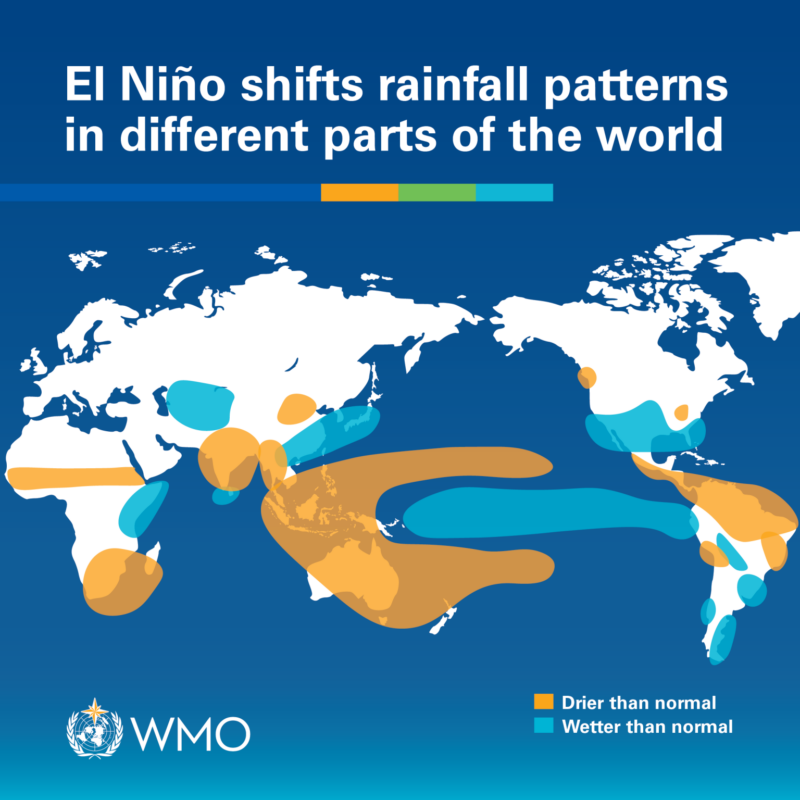
Some parts of the world see wetter conditions during an El Niño (blue) while others are more likely to experience drought (orange). Image via WMO.
What is a super El Niño?
So what is an El Niño and a super El Niño? Let’s start with what a typical El Niño is. There are three types of conditions that can guide global weather: El Niño, La Niña and neutral. These three conditions make up ENSO, or the El Niño–Southern Oscillation. ENSO is a natural climate pattern in the tropical Pacific Ocean that shifts between warm and cool phases. El Niño is the warm phase and La Niña is the cool phase. And these phases influence weather around the world, including rainfall, droughts and storms.
So an average El Niño occurs when warm water pools up in the eastern Pacific Ocean, around the equator. Once the temperatures reach 0.5 degrees Celsius (0.9 F) warmer than normal in the sea surface, an El Niño has formed. El Niño conditions can last for up to a year.
A super El Niño is a stronger event. Meteorologists often call it a super El Niño when the sea surface temperature anomalies peak at about 2.0° C (3.6 F) above normal. And currently, some models are calling for the coming El Niño to exceed 2.5° C (4.5 F) above the seasonal average by October.
You can follow along with NOAA’s El Niño watch here. The next update will be on June 11. As of May 16, 2026, NOAA said:
El Niño is likely to emerge soon (82% chance in May-July 2026) and continue through Northern Hemisphere winter 2026-27 (96% chance in December 2026-February 2027).
Higher temperatures with El Niño
An El Niño usually brings higher global temperatures. The excess heat in the Pacific Ocean eventually enters the atmosphere. This causes warmer global temperatures. However, the rise in temperatures often has a lag time of a few months.
Some forecasters have already said that if a strong El Niño emerges, 2027 could become one of the hottest years on record. Northern Illinois University meteorology professor Victor Gensini told PBS:
A strong El Niño could plausibly push global temperatures to new record levels in late 2026 and into 2027.
This comes on the heels of the hottest March on record for the contiguous United States. NOAA said:
The contiguous U.S. average temperature in March was 50.85° F (10.4 C), 9.35° F (5.19 C) above the 20th-century average, marking the first time any month’s average has exceeded 9° F (5 C) above that baseline.
Other impacts from El Niño
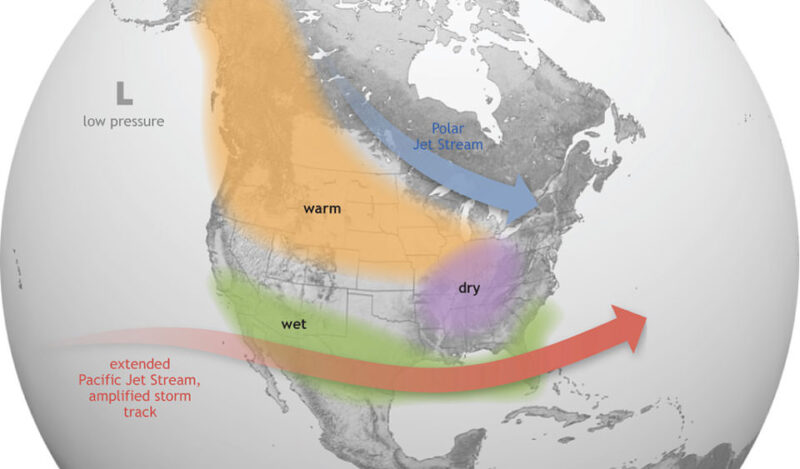
In the summer, El Niño can dampen hurricane formation in the Atlantic. But it’s in winter that we feel El Niño the strongest. Often the jet stream will drop south, steering storms into California and Arizona and bringing much-needed rain. If the jet stream drops, then the southern and eastern U.S. can expect wetter and cooler weather. Meanwhile, drier weather could prevail in the northern U.S. and Great Lakes region.
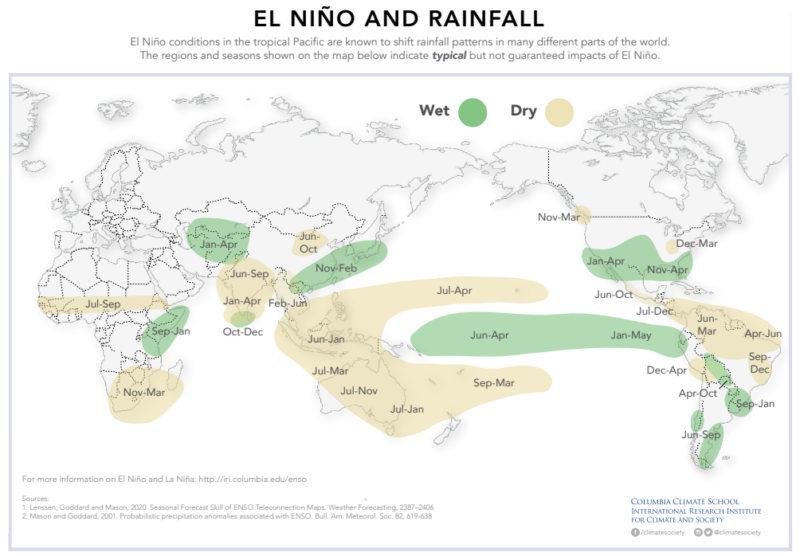
Across the globe, El Niño brings drought conditions to places such as Australia, India and central Africa. And it can bring heavy rains to southern South America and eastern Africa.
An El Niño increases the likelihood of wetter weather in the southern and eastern U.S., with dry conditions near the Great Lakes and warm conditions along the upper tier of the U.S. Image via NOAA.El Niño conditions in the tropical Pacific are known to shift rainfall patterns in many different parts of the world. The regions and seasons shown on the map indicate typical but not guaranteed impacts of El Niño. Image via Columbia Climate School. CC BY.
Staying safe in extreme heat
From EarthSky’s weather author, meteorologist Rachel Duensing:
Staying safe in extreme heat can vary a bit depending on your situation. But the main idea is to avoid the heat as much as possible. If you are able to stay inside, ideally in air-conditioning (A/C), this is your best option. But as mentioned, if you cannot avoid the hot weather, there are things you can do. Take frequent breaks in the shade. Make sure you’re staying hydrated. Wear light color, loose-fitting clothing. And pay close attention to how you’re feeling as the day goes on.
If you, or someone you are with, is sweating heavily, feeling weak, tired, dizzy or nauseated, these could be signs of heat exhaustion. Immediately move yourself or the other person into A/C. Loosen their clothing, give them sips of cool water and put cold compresses on their body.
If someone is acting confused and slurring their speech, has red and hot skin or passes out, this is likely a heat stroke. They need medical attention immediately! Call 911. While you wait for help to arrive, move the person to A/C, add cool compresses to lower their body temperature, but do not give them anything to drink.
The heat can also be more dangerous to the very young, the very old, people with chronic medical conditions and pregnant women. In addition, the unhoused and lower income communities, who may not be able to afford to run their air-conditioning, are also at risk. Check on your friends, family and neighbors before, during and after extreme heat.
Bottom line: The World Meteorological Organization said on Tuesday, June 2, 2026, that people should start preparing now for above average temperatures and extreme weather due to coming El Niño conditions.
It appears likely El Niño conditions will emerge soon. On Tuesday, June 2, 2026, officials from the World Meteorological Organization urged people to prepare for above average temperatures and more extreme weather patterns. In addition, we could be facing a super El Niño, if the sea surface temperatures in the Eastern Pacific climb to about 2.0° C (3.6 F) above normal. Image via Peggy Marco/ Pixabay.
World Meteorological Organization urges people to prepare for El Niño
On Tuesday, June 2, 2026, the World Meteorological Organization (WMO), based in Geneva, Switzerland, urged people to prepare for coming El Niño conditions. The WMO, a specialized agency of the United Nations that focuses on weather, climate and water resources, said:
Fueled by unusually warm ocean waters in the tropical Pacific, El Niño conditions are developing and are set to influence global temperature and rainfall patterns, increasing the risk of extreme weather over the coming months.
The newest update on El Niño conditions now shows an 80% likelihood of El Nino developing in the next three months. Plus, the likelihood that El Niño conditions will continue until at least November are around 90%. And there is still a possibility that it will become a super El Niño event.
The science is clear: El Niño is arriving on our doorstep in the coming months with 90% certainty. The world must treat it as the urgent climate warning it is. El Niño conditions will pour fuel on the fire of a warming world. Impacts will hit even harder, travel even farther, and cross borders with devastating speed. The only effective response is climate action equal to the crisis – ending the addiction to fossil fuels, accelerating the shift to renewables, protecting the most vulnerable, and delivering early warning systems for all.
We need to prepare for a potentially strong El Niño event – which will exacerbate drought and heavy rainfall and increase the risk of heatwaves both on land and in the ocean. The most recent El Niño, in 2023-24, was one of the five strongest on record and it played a role in the record global temperatures we saw in 2024.
Just like any weather event, preparation is key. The WMO said that nearly everywhere can expect above average temperatures for June to August. Do you know how to beat the heat? Meteorologist Rachel Duensing provides tips below.
Celeste Saulo also said:
Advance seasonal forecasts and early warnings are vital to save lives and cushion the impact on our economies and our communities.
Some parts of the world see wetter conditions during an El Niño (blue) while others are more likely to experience drought (orange). Image via WMO.
What is a super El Niño?
So what is an El Niño and a super El Niño? Let’s start with what a typical El Niño is. There are three types of conditions that can guide global weather: El Niño, La Niña and neutral. These three conditions make up ENSO, or the El Niño–Southern Oscillation. ENSO is a natural climate pattern in the tropical Pacific Ocean that shifts between warm and cool phases. El Niño is the warm phase and La Niña is the cool phase. And these phases influence weather around the world, including rainfall, droughts and storms.
So an average El Niño occurs when warm water pools up in the eastern Pacific Ocean, around the equator. Once the temperatures reach 0.5 degrees Celsius (0.9 F) warmer than normal in the sea surface, an El Niño has formed. El Niño conditions can last for up to a year.
A super El Niño is a stronger event. Meteorologists often call it a super El Niño when the sea surface temperature anomalies peak at about 2.0° C (3.6 F) above normal. And currently, some models are calling for the coming El Niño to exceed 2.5° C (4.5 F) above the seasonal average by October.
You can follow along with NOAA’s El Niño watch here. The next update will be on June 11. As of May 16, 2026, NOAA said:
El Niño is likely to emerge soon (82% chance in May-July 2026) and continue through Northern Hemisphere winter 2026-27 (96% chance in December 2026-February 2027).
Higher temperatures with El Niño
An El Niño usually brings higher global temperatures. The excess heat in the Pacific Ocean eventually enters the atmosphere. This causes warmer global temperatures. However, the rise in temperatures often has a lag time of a few months.
Some forecasters have already said that if a strong El Niño emerges, 2027 could become one of the hottest years on record. Northern Illinois University meteorology professor Victor Gensini told PBS:
A strong El Niño could plausibly push global temperatures to new record levels in late 2026 and into 2027.
This comes on the heels of the hottest March on record for the contiguous United States. NOAA said:
The contiguous U.S. average temperature in March was 50.85° F (10.4 C), 9.35° F (5.19 C) above the 20th-century average, marking the first time any month’s average has exceeded 9° F (5 C) above that baseline.
Other impacts from El Niño
In the summer, El Niño can dampen hurricane formation in the Atlantic. But it’s in winter that we feel El Niño the strongest. Often the jet stream will drop south, steering storms into California and Arizona and bringing much-needed rain. If the jet stream drops, then the southern and eastern U.S. can expect wetter and cooler weather. Meanwhile, drier weather could prevail in the northern U.S. and Great Lakes region.
Across the globe, El Niño brings drought conditions to places such as Australia, India and central Africa. And it can bring heavy rains to southern South America and eastern Africa.
An El Niño increases the likelihood of wetter weather in the southern and eastern U.S., with dry conditions near the Great Lakes and warm conditions along the upper tier of the U.S. Image via NOAA.El Niño conditions in the tropical Pacific are known to shift rainfall patterns in many different parts of the world. The regions and seasons shown on the map indicate typical but not guaranteed impacts of El Niño. Image via Columbia Climate School. CC BY.
Staying safe in extreme heat
From EarthSky’s weather author, meteorologist Rachel Duensing:
Staying safe in extreme heat can vary a bit depending on your situation. But the main idea is to avoid the heat as much as possible. If you are able to stay inside, ideally in air-conditioning (A/C), this is your best option. But as mentioned, if you cannot avoid the hot weather, there are things you can do. Take frequent breaks in the shade. Make sure you’re staying hydrated. Wear light color, loose-fitting clothing. And pay close attention to how you’re feeling as the day goes on.
If you, or someone you are with, is sweating heavily, feeling weak, tired, dizzy or nauseated, these could be signs of heat exhaustion. Immediately move yourself or the other person into A/C. Loosen their clothing, give them sips of cool water and put cold compresses on their body.
If someone is acting confused and slurring their speech, has red and hot skin or passes out, this is likely a heat stroke. They need medical attention immediately! Call 911. While you wait for help to arrive, move the person to A/C, add cool compresses to lower their body temperature, but do not give them anything to drink.
The heat can also be more dangerous to the very young, the very old, people with chronic medical conditions and pregnant women. In addition, the unhoused and lower income communities, who may not be able to afford to run their air-conditioning, are also at risk. Check on your friends, family and neighbors before, during and after extreme heat.
Bottom line: The World Meteorological Organization said on Tuesday, June 2, 2026, that people should start preparing now for above average temperatures and extreme weather due to coming El Niño conditions.
This is a gravitationally lensed image of QSO1, an ancient Little Red Dot galaxy. It contains a supermassive black hole in its center. Which came 1st: the black hole or galaxy? A new study says the black hole did. Image via NASA/ ESA/ CSA/ Lukas Furtak (Ben-Gurion University); Image Processing: Alyssa Pagan (STScI).
QSO1 is a tiny galaxy from the early universe. It contains a supermassive black hole in its center. Which came first, the galaxy or the black hole?
A new study says that the black hole came first, contrary to expectations.
Galaxies like these are probably quite common, the researchers say.
When we look out into the universe, we see countless distant galaxies with supermassive black holes at their centers. Astronomers believe most galaxies have supermassive black holes. There’s one in our own Milky Way! But which came first: the black hole or the galaxy? A new study has found that, at least in one case, it was the black hole.
Astronomers long assumed that galaxies formed first. In that scenario, a huge cloud of gas would give rise to the galaxy’s stars. When the largest of these stars run out of fuel, they would collapse and form black holes. These black holes would grow by feeding on stars, gas and merging with other black holes, until they eventually form a supermassive black hole.
But researchers led by the University of Cambridge in the U.K., said on May 27, 2026, that the giant black hole in the center of the tiny galaxy Abell2744-QSO1 predates its galaxy. This galactic black hole was huge right from the beginning.
The evidence for a black hole preceding its galaxy is a gamechanger. Co-author Roberto Maiolino at the University of Cambridge said:
This is a remarkable finding. It’s a paradigm shift, a total revisiting of the classical scenarios of how black holes form and grow.
The immense gravity of the galaxy cluster Abell 2744 has magnified and distorted the light from the galaxy Abell2744-QSO1, producing multiple lensed images (A, B, and C) of the same object. Image via NASA/ ESA/ CSA/ Lukas Furtak (Ben-Gurion University); Image Processing: Alyssa Pagan (STScI).
QSO1 is an ancient, young galaxy
The galaxy Abell2744-QSO1 is what astronomers call a Little Red Dot. Little Red Dots are tiny, reddish objects, as seen by telescopes. They appear to be early forms of galaxies in the young universe. Scientists estimate that QSO1 formed only 700 million years after the Big Bang.
QSO1 is small for a galaxy, at only 1,300 light-years across. And like other Little Red Dots, it is incredibly far away and difficult to observe. But thankfully, QSO1 is gravitationally lensed by the galaxy cluster Abell 2744 (Pandora’s Cluster). The gravity of the cluster bends the light of QSO1, which magnifies it. This also causes the galaxy to be “mirrored,” so it appears in three different places in the sky.
And QSO1 probably isn’t a galaxy in the way we usually think. Instead of a nice spiral with arms and a glowing center, it’s likely little more than a hydrogen and helium gas cloud around a black hole. Scientists estimate the supermassive black hole in its center is 50 million times the mass of our sun.
The observations of QSO1 are more detailed than for previous Little Red Dots. Co-author Francesco D’Eugenio at the University of Cambridge said:
Before now, all of the mass measurements of black holes in the early universe have been indirect, based on assumptions from what we know about them in the local universe. We didn’t know if those assumptions really apply to the distant universe.
A paper in Nature reports a direct measurement of a black hole mass in a distant object known as a little red dot, found in a galaxy dating back to when the Universe was just 700 million years old. go.nature.com/4nWSjKD ??
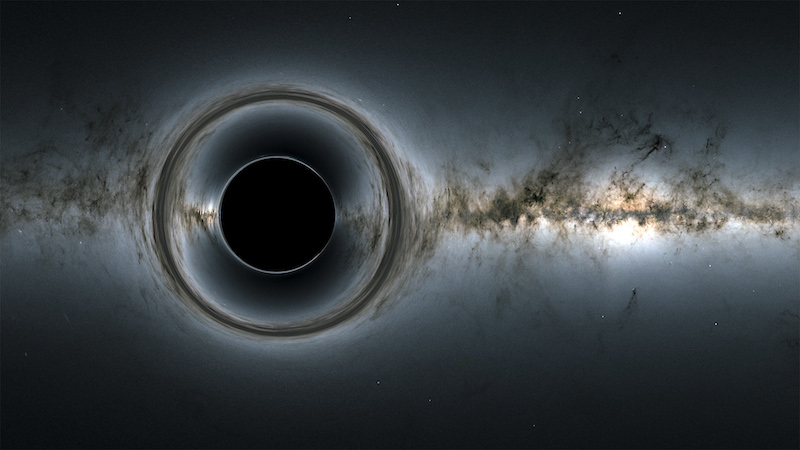
This image is a simulation of a supermassive black hole showing how it distorts the starry background and captures light, producing a black hole silhouette. Scientists think that most, if not all, larger galaxies have supermassive black holes in their centers. Image via NASA’s Goddard Space Flight Center/ ESA/ Gaia/ DPAC.
Most of QSO1’s mass comes from its black hole
So how massive is the black hole in QSO1? To find out, the researchers used Webb’s NIRSpec (Near Infrared Spectrograph). It can trace the effects of the black hole’s gravity and also map the distribution of gas in QSO1.
The team found that the gas has Keplerian motion. That is, it orbits a single central point, similar to how our solar system’s planets orbit the sun. This also shows that most of the mass of QSO1 is taken up by the black hole. Ignas Juodžbalis, lead author of the Nature paper at the University of Cambridge, said:
This is important because it tells us that most of the mass of QSO1 is concentrated in the black hole at the center. If the mass were more distributed, as it would be if there were a lot of stars, the gas would not have this perfect Keplerian rotation.
By measuring the velocity of the gases in QSO1, the researchers could also determine the mass of the black hole. As it turned out, it is immense: 50 million times the mass of our sun. That means the black hole accounts for 2/3 of QSO1’s overall mass. That’s thousands of times more than we see in developed galaxies.
QSO1 is a pristine galaxy
The gases in the tiny galaxy are almost completely hydrogen and helium. Its metallicity – the proportion of elements that are heavier than hydrogen and helium – is over 200 times less than that of our sun. This makes it one of cleanest and “pristine” galactic environments that scientists have ever seen.
This matters because the birth and death of stars produces heavier elements, such as oxygen and carbon. The lack of these heavier elements suggests that this is not a galaxy rich in stars and stellar debris.
So if the black hole came first, how did it form? Since it is so massive, the researchers don’t think it formed from smaller black holes merging together. This would have taken far longer and required a large stellar population. Instead, it might be a primordial black hole. These are hypothetical black holes that might have formed fractions of a second after the Big Bang. As Juodžbalis noted:
It seems that we have found a black hole that does not have a substantial host galaxy and that has predated stellar processes. This is very exciting because it is evidence for primordial black holes or direct collapse black holes, which have been theorized but not confirmed.
This means it was born large. It could have formed from a “heavy seed” within one second of the Big Bang or later when a giant cloud of gas collapsed.
Bottom line: QSO1 is an ancient Little Red Dot galaxy from the early universe. It contains a supermassive black hole. Which came 1st, the black hole or galaxy?
This is a gravitationally lensed image of QSO1, an ancient Little Red Dot galaxy. It contains a supermassive black hole in its center. Which came 1st: the black hole or galaxy? A new study says the black hole did. Image via NASA/ ESA/ CSA/ Lukas Furtak (Ben-Gurion University); Image Processing: Alyssa Pagan (STScI).
QSO1 is a tiny galaxy from the early universe. It contains a supermassive black hole in its center. Which came first, the galaxy or the black hole?
A new study says that the black hole came first, contrary to expectations.
Galaxies like these are probably quite common, the researchers say.
When we look out into the universe, we see countless distant galaxies with supermassive black holes at their centers. Astronomers believe most galaxies have supermassive black holes. There’s one in our own Milky Way! But which came first: the black hole or the galaxy? A new study has found that, at least in one case, it was the black hole.
Astronomers long assumed that galaxies formed first. In that scenario, a huge cloud of gas would give rise to the galaxy’s stars. When the largest of these stars run out of fuel, they would collapse and form black holes. These black holes would grow by feeding on stars, gas and merging with other black holes, until they eventually form a supermassive black hole.
But researchers led by the University of Cambridge in the U.K., said on May 27, 2026, that the giant black hole in the center of the tiny galaxy Abell2744-QSO1 predates its galaxy. This galactic black hole was huge right from the beginning.
The evidence for a black hole preceding its galaxy is a gamechanger. Co-author Roberto Maiolino at the University of Cambridge said:
This is a remarkable finding. It’s a paradigm shift, a total revisiting of the classical scenarios of how black holes form and grow.
The immense gravity of the galaxy cluster Abell 2744 has magnified and distorted the light from the galaxy Abell2744-QSO1, producing multiple lensed images (A, B, and C) of the same object. Image via NASA/ ESA/ CSA/ Lukas Furtak (Ben-Gurion University); Image Processing: Alyssa Pagan (STScI).
QSO1 is an ancient, young galaxy
The galaxy Abell2744-QSO1 is what astronomers call a Little Red Dot. Little Red Dots are tiny, reddish objects, as seen by telescopes. They appear to be early forms of galaxies in the young universe. Scientists estimate that QSO1 formed only 700 million years after the Big Bang.
QSO1 is small for a galaxy, at only 1,300 light-years across. And like other Little Red Dots, it is incredibly far away and difficult to observe. But thankfully, QSO1 is gravitationally lensed by the galaxy cluster Abell 2744 (Pandora’s Cluster). The gravity of the cluster bends the light of QSO1, which magnifies it. This also causes the galaxy to be “mirrored,” so it appears in three different places in the sky.
And QSO1 probably isn’t a galaxy in the way we usually think. Instead of a nice spiral with arms and a glowing center, it’s likely little more than a hydrogen and helium gas cloud around a black hole. Scientists estimate the supermassive black hole in its center is 50 million times the mass of our sun.
The observations of QSO1 are more detailed than for previous Little Red Dots. Co-author Francesco D’Eugenio at the University of Cambridge said:
Before now, all of the mass measurements of black holes in the early universe have been indirect, based on assumptions from what we know about them in the local universe. We didn’t know if those assumptions really apply to the distant universe.
A paper in Nature reports a direct measurement of a black hole mass in a distant object known as a little red dot, found in a galaxy dating back to when the Universe was just 700 million years old. go.nature.com/4nWSjKD ??
This image is a simulation of a supermassive black hole showing how it distorts the starry background and captures light, producing a black hole silhouette. Scientists think that most, if not all, larger galaxies have supermassive black holes in their centers. Image via NASA’s Goddard Space Flight Center/ ESA/ Gaia/ DPAC.
Most of QSO1’s mass comes from its black hole
So how massive is the black hole in QSO1? To find out, the researchers used Webb’s NIRSpec (Near Infrared Spectrograph). It can trace the effects of the black hole’s gravity and also map the distribution of gas in QSO1.
The team found that the gas has Keplerian motion. That is, it orbits a single central point, similar to how our solar system’s planets orbit the sun. This also shows that most of the mass of QSO1 is taken up by the black hole. Ignas Juodžbalis, lead author of the Nature paper at the University of Cambridge, said:
This is important because it tells us that most of the mass of QSO1 is concentrated in the black hole at the center. If the mass were more distributed, as it would be if there were a lot of stars, the gas would not have this perfect Keplerian rotation.
By measuring the velocity of the gases in QSO1, the researchers could also determine the mass of the black hole. As it turned out, it is immense: 50 million times the mass of our sun. That means the black hole accounts for 2/3 of QSO1’s overall mass. That’s thousands of times more than we see in developed galaxies.
QSO1 is a pristine galaxy
The gases in the tiny galaxy are almost completely hydrogen and helium. Its metallicity – the proportion of elements that are heavier than hydrogen and helium – is over 200 times less than that of our sun. This makes it one of cleanest and “pristine” galactic environments that scientists have ever seen.
This matters because the birth and death of stars produces heavier elements, such as oxygen and carbon. The lack of these heavier elements suggests that this is not a galaxy rich in stars and stellar debris.
So if the black hole came first, how did it form? Since it is so massive, the researchers don’t think it formed from smaller black holes merging together. This would have taken far longer and required a large stellar population. Instead, it might be a primordial black hole. These are hypothetical black holes that might have formed fractions of a second after the Big Bang. As Juodžbalis noted:
It seems that we have found a black hole that does not have a substantial host galaxy and that has predated stellar processes. This is very exciting because it is evidence for primordial black holes or direct collapse black holes, which have been theorized but not confirmed.
This means it was born large. It could have formed from a “heavy seed” within one second of the Big Bang or later when a giant cloud of gas collapsed.
Bottom line: QSO1 is an ancient Little Red Dot galaxy from the early universe. It contains a supermassive black hole. Which came 1st, the black hole or galaxy?
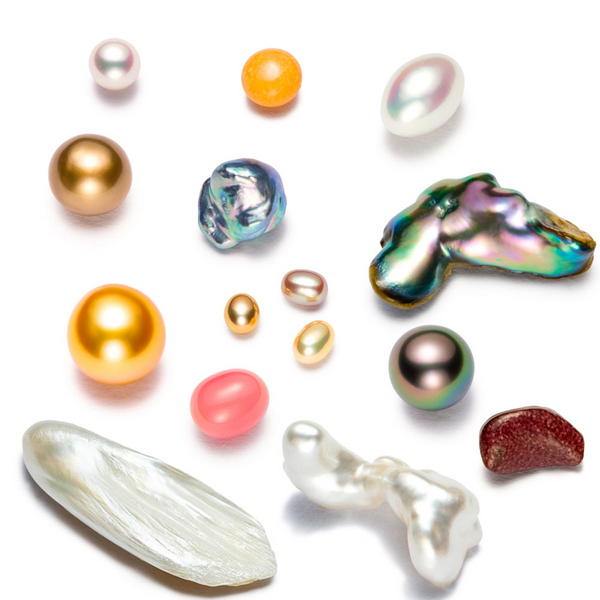
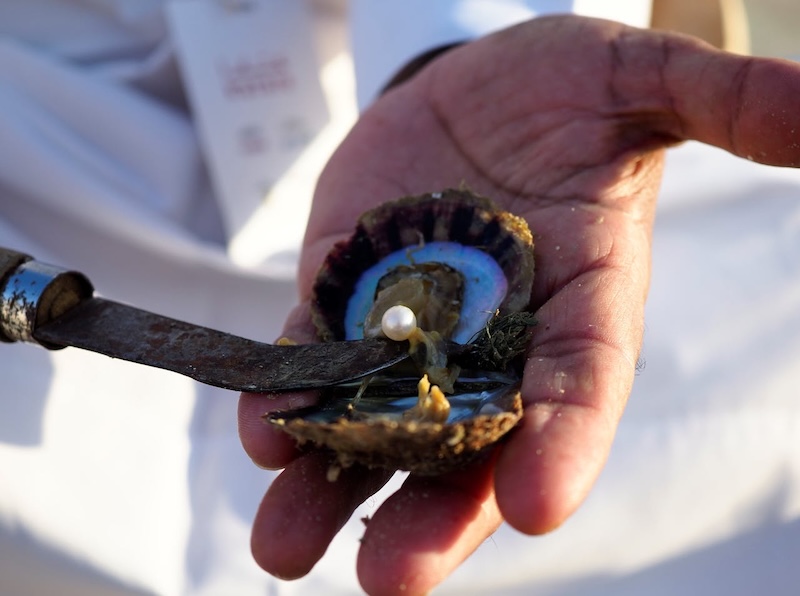
Pearls – 1 of 3 choices for the June birthstone – come in many sizes, shapes, and colors. Image via Masayuki Kato/ Wikipedia (CC BY-SA 3.0).
Pearl as a June birthstone
Most gemstones are found within the Earth. But pearls grow inside the shells of oysters and clams. Some pearls form naturally in these mollusks, which is a word that describes many creatures possessing soft, unsegmented bodies plus a mantle or shell, found both in salty seas and in fresh water.
But many pearls today aren’t found in the wild. Instead, they’re cultured, meaning they’re raised at oyster farms.
Pearls are made mostly of aragonite, a relatively soft carbonate mineral (CaCO3). This same mineral can be found in the shells of oysters and clams.
A pearl forms when a small fragment of rock, a sand grain, or a parasite finds its way into the shell of one of these creatures. It irritates the animal, which responds by coating the foreign material with layer upon layer of shell material.
Pearls forming up next to the inside of the shell are usually irregular in shape and have little commercial value. But those that form within the tissue of the creature are spherical or pear-shaped.
And these are highly sought out for jewelry.
Pearls are organic. They grow inside the shells of certain species of oysters and clams. Image via nata/Pexels.
Pearls come in several colors
Pearls possess a delicate translucence and luster that make them one of the most highly valued gemstones. The color of the pearl depends on the species of mollusk that produced it, and on its environment.
Generally, white is the best-known and most common color of pearl. But pearls also come in delicate shades of black, cream, gray, blue, yellow, lavender, green, and mauve.
Black pearls are found in the Gulf of Mexico and waters off some islands in the Pacific Ocean. The Persian Gulf and Sri Lanka are well-known for exquisite cream-colored pearls called Orientals.
Pearls come in many colors. Image via Gem Rock Auctions. Used with permission.
Cultured pearls are popular, too
Japan is famous for its cultured pearls. And everyone familiar with jewelry has heard of Mikimoto pearls, named after the creator of the industry, Kokichi Mikimoto.
Cultured pearls grow in large oyster beds in Japanese waters. An “irritant,” such as a tiny fragment of mother-of-pearl, is introduced into the fleshy part of two-to-three-year-old oysters.
The oysters then grow in mesh bags submerged beneath the water. They’re nourished for seven to nine years before being harvested.
In addition to Japan, Australia and the equatorial islands of the Pacific have cultured pearl industries.
Famous pearls
The largest pearl in the world is believed about 3 inches long and 2 inches across (7.6 by 5 cm), weighing 1/3 of a pound (.15 kg). Called the Pearl of Asia, it was a gift from Shah Jahan of India to his favorite wife, Mumtaz, in whose memory he built the Taj Mahal.
Many experts consider La Peregrina (the Wanderer) to be the most beautiful pearl. Legend says a slave found it in Panama in the 1500s, who gave it up in return for his freedom. In 1570, the conquistador ruler of the area sent the pearl to King Philip II of Spain. This pear-shaped white pearl, 1 1/2 inches (almost 4 cm) in length, hangs from a platinum mount studded with diamonds.
Then the pearl went to Mary I of England, then to Prince Louis Napoleon of France. And he sold it to the British Marquis of Abercorn, whose family kept the pearl until 1969, when they offered it for sale at Sotheby’s.
Finally, actor Richard Burton bought it for his wife, Elizabeth Taylor.
Pearl lore
Pearls, according to South Asian mythology, were dewdrops from heaven that fell into the sea. It’s said that shellfish caught them under the first rays of the rising sun, during a period of full moon.
In India, warriors encrusted their swords with pearls to symbolize the tears and sorrow that a sword brings.
Pearls were also widely used as medicine in Europe until the 17th century. Arabs and Persians believed they were a cure for various kinds of diseases, including insanity.
In China, pearls were used as medicine as early as 2000 BCE. They were believed to represent wealth, power and longevity.
Even today, in Asia, ground-up low-grade pearls are used as medicine.
A cabochon moonstone, showing its unusual light-reflecting qualities. Image via Didier Descouens/ Wikipedia (CC BY-SA 4.0).
Another June birthstone: the moonstone
June’s second birthstone is the moonstone. Moonstones are believed to be named for the bluish white spots within them. When held up to light they exhibit a silvery play of color very much like moonlight. And when the stone moves back and forth, brilliant silvery rays move about within them, like moonbeams playing over water.
Moonstone belongs to the family of minerals called feldspars, an important group of silicate minerals commonly formed in rocks. About half the Earth’s crust is composed of feldspars. This mineral occurs in many igneous and metamorphic rocks. It also constitutes a large percentage of soils and marine clays.
Rare geologic conditions produce gem varieties of feldspar such as moonstone, labradorite, amazonite, and sunstone. They appear as large, clean mineral grains, found in pegmatites (coarse-grained igneous rock) and ancient deep crustal rocks. Feldspars of gem quality are aluminosilicates (minerals containing aluminum, silicon and oxygen), mixed with sodium and potassium.
The best moonstones are from Sri Lanka. Plus, they are found in the Alps, Madagascar, Myanmar (Burma), and India.
The ancient Roman natural historian, Pliny, said that the moonstone changed in appearance with the phases of the moon. That belief persisted until the 16th century. The ancient Romans also believed the image of Diana, goddess of the moon, was enclosed within the stone. Moonstones were believed to have the power to bring victory, health, and wisdom to those who wore them.
In India, the moonstone is considered a sacred stone and often displayed on a yellow cloth, with yellow considered a sacred color. The stone is believed to bring good fortune, brought on by a spirit that lives within the stone.
A moonstone ring. Image via Gem Rock Auctions. Used with permission.
Or select alexandrite as your June birthstone
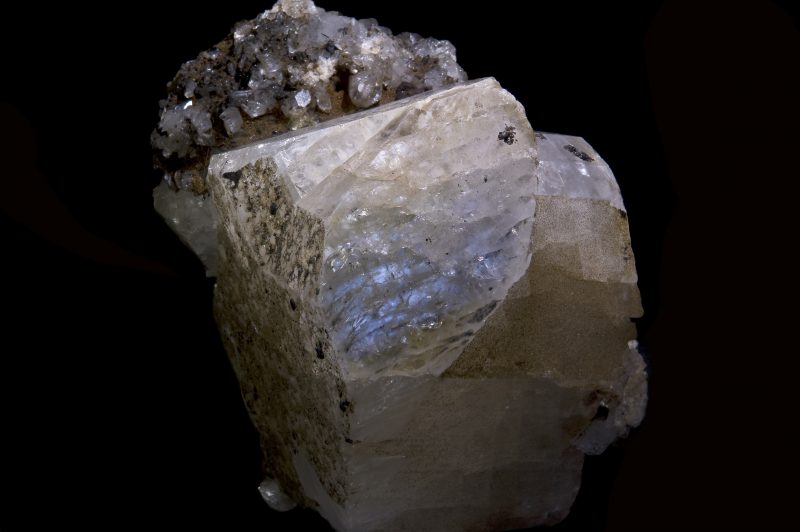
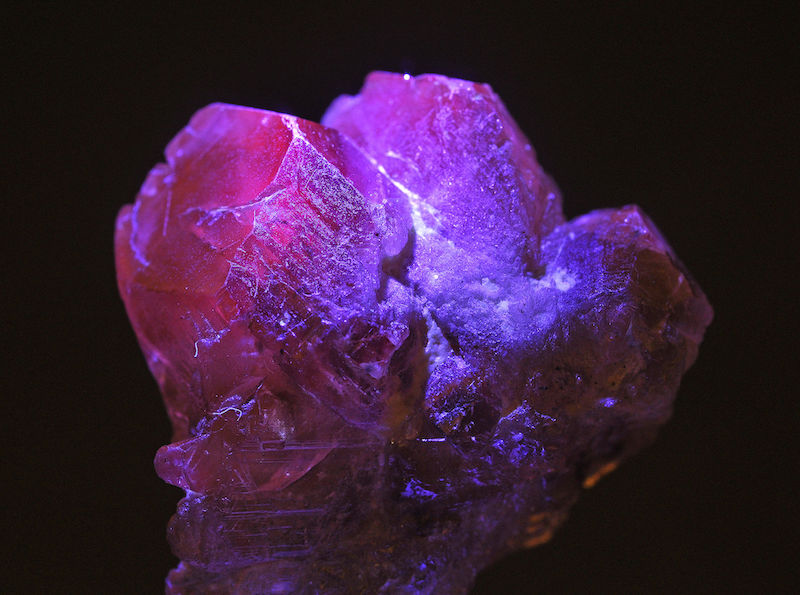
Lastly, June’s 3rd birthstone is the alexandrite. Alexandrite possesses an enchanting chameleon-like personality. In daylight, it appears as a beautiful green, sometimes with a bluish cast or a brownish tint. But, under artificial lighting, the stone turns reddish-violet or violet.
Alexandrite belongs to the chrysoberyl family. That’s a mineral called beryllium aluminum oxide in chemistry jargon. It contains the elements beryllium, aluminum and oxygen (BeAl2O4). Alexandrite is a hard mineral, surpassed in hardness only by diamonds and corundum (sapphires and rubies).
Meanwhile, the unusual colors in alexandrite come from the presence of chromium in the mineral.
This is rough alexandrite. Image via Gem Rock Auctions. Used with permission.
Alexandrite is rare and expensive
Alexandrite is an uncommon stone. So it’s expensive. Sri Lanka is the main source of alexandrite today, and the stones have also been found in Brazil, Madagascar, Zimbabwe, Tanzania, and Myanmar (Burma).
Meanwhile, synthetic alexandrite – resembling a reddish-hued amethyst with a tinge of green – has been manufactured. But you don’t see the color change in the synthetic stones. Perhaps for that reason, the synthetic stones have met with only marginal market success in the United States.
Alexandrite appears with different colors depending on the light. Left: sunlight. Right: incandescent light. Image via David Weinberg/ Wikipedia (CC BY-SA 3.0).
History of June birthstone alexandrite
Alexandrite is named after Prince Alexander of Russia, who became Czar Alexander II in 1855. Discovered in 1839 on the prince’s birthday, alexandrite was found in an emerald mine in the Ural Mountains of Russia.
The stone was also popular in part because it reflected the Russian national colors, green and red.
Because of its relatively recent discovery, there’s been little time for myth and superstition to build around this unusual stone.
Pearls – 1 of 3 choices for the June birthstone – come in many sizes, shapes, and colors. Image via Masayuki Kato/ Wikipedia (CC BY-SA 3.0).
Pearl as a June birthstone
Most gemstones are found within the Earth. But pearls grow inside the shells of oysters and clams. Some pearls form naturally in these mollusks, which is a word that describes many creatures possessing soft, unsegmented bodies plus a mantle or shell, found both in salty seas and in fresh water.
But many pearls today aren’t found in the wild. Instead, they’re cultured, meaning they’re raised at oyster farms.
Pearls are made mostly of aragonite, a relatively soft carbonate mineral (CaCO3). This same mineral can be found in the shells of oysters and clams.
A pearl forms when a small fragment of rock, a sand grain, or a parasite finds its way into the shell of one of these creatures. It irritates the animal, which responds by coating the foreign material with layer upon layer of shell material.
Pearls forming up next to the inside of the shell are usually irregular in shape and have little commercial value. But those that form within the tissue of the creature are spherical or pear-shaped.
And these are highly sought out for jewelry.
Pearls are organic. They grow inside the shells of certain species of oysters and clams. Image via nata/Pexels.
Pearls come in several colors
Pearls possess a delicate translucence and luster that make them one of the most highly valued gemstones. The color of the pearl depends on the species of mollusk that produced it, and on its environment.
Generally, white is the best-known and most common color of pearl. But pearls also come in delicate shades of black, cream, gray, blue, yellow, lavender, green, and mauve.
Black pearls are found in the Gulf of Mexico and waters off some islands in the Pacific Ocean. The Persian Gulf and Sri Lanka are well-known for exquisite cream-colored pearls called Orientals.
Pearls come in many colors. Image via Gem Rock Auctions. Used with permission.
Cultured pearls are popular, too
Japan is famous for its cultured pearls. And everyone familiar with jewelry has heard of Mikimoto pearls, named after the creator of the industry, Kokichi Mikimoto.
Cultured pearls grow in large oyster beds in Japanese waters. An “irritant,” such as a tiny fragment of mother-of-pearl, is introduced into the fleshy part of two-to-three-year-old oysters.
The oysters then grow in mesh bags submerged beneath the water. They’re nourished for seven to nine years before being harvested.
In addition to Japan, Australia and the equatorial islands of the Pacific have cultured pearl industries.
Famous pearls
The largest pearl in the world is believed about 3 inches long and 2 inches across (7.6 by 5 cm), weighing 1/3 of a pound (.15 kg). Called the Pearl of Asia, it was a gift from Shah Jahan of India to his favorite wife, Mumtaz, in whose memory he built the Taj Mahal.
Many experts consider La Peregrina (the Wanderer) to be the most beautiful pearl. Legend says a slave found it in Panama in the 1500s, who gave it up in return for his freedom. In 1570, the conquistador ruler of the area sent the pearl to King Philip II of Spain. This pear-shaped white pearl, 1 1/2 inches (almost 4 cm) in length, hangs from a platinum mount studded with diamonds.
Then the pearl went to Mary I of England, then to Prince Louis Napoleon of France. And he sold it to the British Marquis of Abercorn, whose family kept the pearl until 1969, when they offered it for sale at Sotheby’s.
Finally, actor Richard Burton bought it for his wife, Elizabeth Taylor.
Pearl lore
Pearls, according to South Asian mythology, were dewdrops from heaven that fell into the sea. It’s said that shellfish caught them under the first rays of the rising sun, during a period of full moon.
In India, warriors encrusted their swords with pearls to symbolize the tears and sorrow that a sword brings.
Pearls were also widely used as medicine in Europe until the 17th century. Arabs and Persians believed they were a cure for various kinds of diseases, including insanity.
In China, pearls were used as medicine as early as 2000 BCE. They were believed to represent wealth, power and longevity.
Even today, in Asia, ground-up low-grade pearls are used as medicine.
A cabochon moonstone, showing its unusual light-reflecting qualities. Image via Didier Descouens/ Wikipedia (CC BY-SA 4.0).
Another June birthstone: the moonstone
June’s second birthstone is the moonstone. Moonstones are believed to be named for the bluish white spots within them. When held up to light they exhibit a silvery play of color very much like moonlight. And when the stone moves back and forth, brilliant silvery rays move about within them, like moonbeams playing over water.
Moonstone belongs to the family of minerals called feldspars, an important group of silicate minerals commonly formed in rocks. About half the Earth’s crust is composed of feldspars. This mineral occurs in many igneous and metamorphic rocks. It also constitutes a large percentage of soils and marine clays.
Rare geologic conditions produce gem varieties of feldspar such as moonstone, labradorite, amazonite, and sunstone. They appear as large, clean mineral grains, found in pegmatites (coarse-grained igneous rock) and ancient deep crustal rocks. Feldspars of gem quality are aluminosilicates (minerals containing aluminum, silicon and oxygen), mixed with sodium and potassium.
The best moonstones are from Sri Lanka. Plus, they are found in the Alps, Madagascar, Myanmar (Burma), and India.
The ancient Roman natural historian, Pliny, said that the moonstone changed in appearance with the phases of the moon. That belief persisted until the 16th century. The ancient Romans also believed the image of Diana, goddess of the moon, was enclosed within the stone. Moonstones were believed to have the power to bring victory, health, and wisdom to those who wore them.
In India, the moonstone is considered a sacred stone and often displayed on a yellow cloth, with yellow considered a sacred color. The stone is believed to bring good fortune, brought on by a spirit that lives within the stone.
A moonstone ring. Image via Gem Rock Auctions. Used with permission.
Or select alexandrite as your June birthstone
Lastly, June’s 3rd birthstone is the alexandrite. Alexandrite possesses an enchanting chameleon-like personality. In daylight, it appears as a beautiful green, sometimes with a bluish cast or a brownish tint. But, under artificial lighting, the stone turns reddish-violet or violet.
Alexandrite belongs to the chrysoberyl family. That’s a mineral called beryllium aluminum oxide in chemistry jargon. It contains the elements beryllium, aluminum and oxygen (BeAl2O4). Alexandrite is a hard mineral, surpassed in hardness only by diamonds and corundum (sapphires and rubies).
Meanwhile, the unusual colors in alexandrite come from the presence of chromium in the mineral.
This is rough alexandrite. Image via Gem Rock Auctions. Used with permission.
Alexandrite is rare and expensive
Alexandrite is an uncommon stone. So it’s expensive. Sri Lanka is the main source of alexandrite today, and the stones have also been found in Brazil, Madagascar, Zimbabwe, Tanzania, and Myanmar (Burma).
Meanwhile, synthetic alexandrite – resembling a reddish-hued amethyst with a tinge of green – has been manufactured. But you don’t see the color change in the synthetic stones. Perhaps for that reason, the synthetic stones have met with only marginal market success in the United States.
Alexandrite appears with different colors depending on the light. Left: sunlight. Right: incandescent light. Image via David Weinberg/ Wikipedia (CC BY-SA 3.0).
History of June birthstone alexandrite
Alexandrite is named after Prince Alexander of Russia, who became Czar Alexander II in 1855. Discovered in 1839 on the prince’s birthday, alexandrite was found in an emerald mine in the Ural Mountains of Russia.
The stone was also popular in part because it reflected the Russian national colors, green and red.
Because of its relatively recent discovery, there’s been little time for myth and superstition to build around this unusual stone.
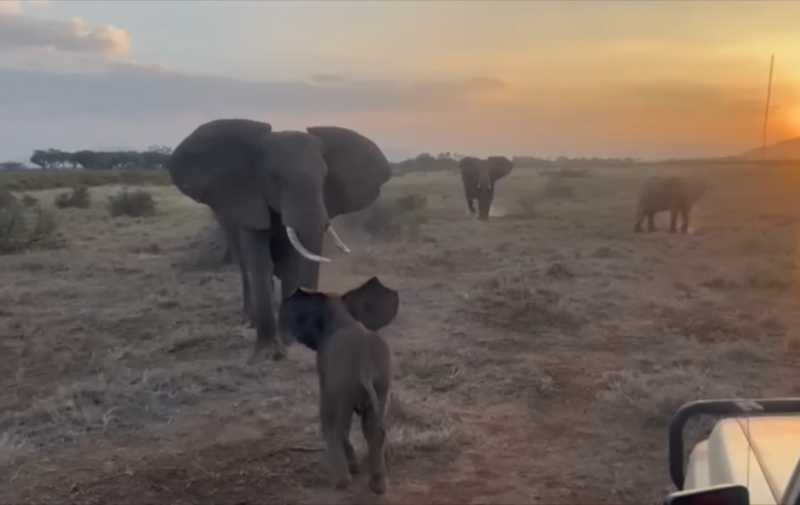
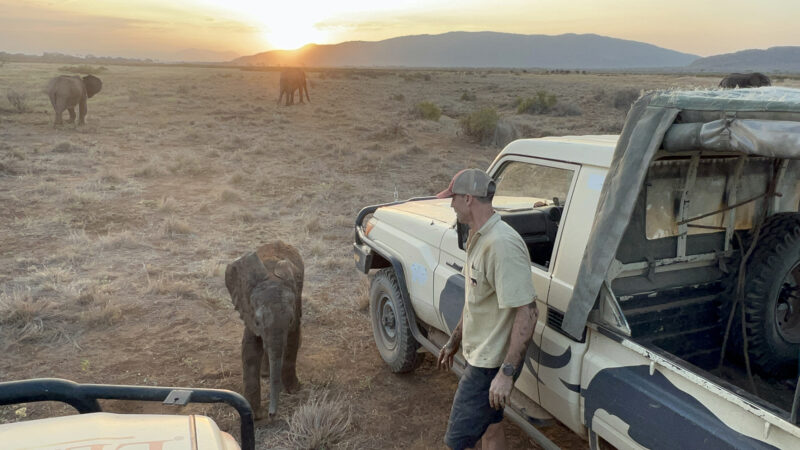
Elephant calf reunion in Kenya reveals the powerful family bonds of elephants after a lost baby answers her aunt’s call and rushes back to her herd. Image via George Wittemyer and Save the Elephants. Used with permission.
On February 11, 2026, a baby elephant wandered alone into a tourist camp in northern Kenya. She had become separated from her family. What happened next revealed just how powerful elephant bonds can be. After researchers spent hours searching for the calf’s relatives, they reunited her with the family they believed she belonged to, and the response was immediate.
One elephant approached and called out. The calf answered. Within moments, the entire family gathered around the youngster, rumbling and trumpeting in what researchers described as an emotional reunion. The moment offered a glimpse into the deep social lives of elephants and the remarkable way families care for one another.
A Colorado State University (CSU) report published on May 19, 2026, describes how field researchers working in northern Kenya reconnected the calf with her family.
The search to reunite a calf with her family
The rescue began when staff at a tourist camp in Samburu found a four-month-old elephant calf alone and disoriented. They contacted a research team led by Colorado State University professor George Wittemyer, who has studied elephants in northern Kenya for nearly three decades.
Researchers searched the Samburu National Reserve to determine which elephant family was missing a calf. The exact circumstances of how the young elephant became separated from her group are not known. After identifying the most likely family, the team carefully brought the calf back to them. How would they react?
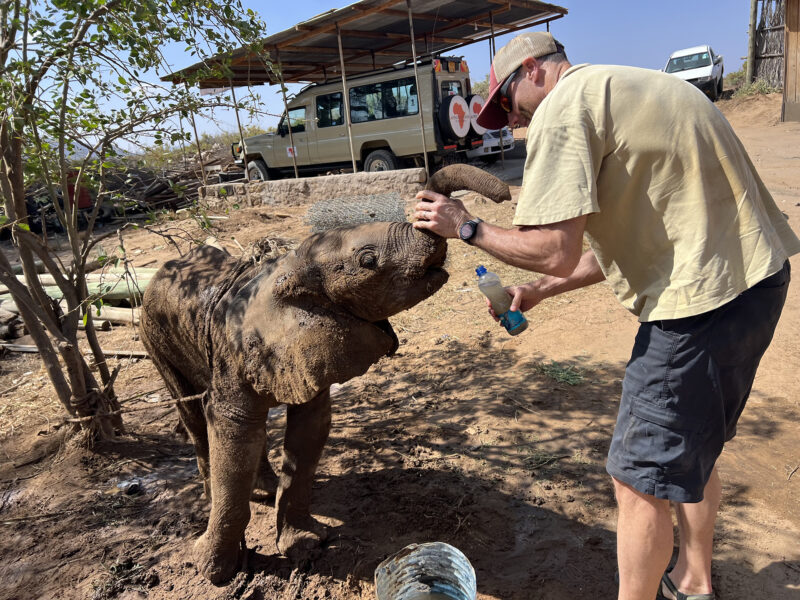
George Wittemyer helps the elephant calf drink water from a bottle after she wandered into a tourist camp alone and was tied to a tree by well-meaning campsite staff. Researchers gave the calf water and a mud bath to cool her off before searching for her family among the roughly 40 elephant families in Samburu National Reserve. Image via George Wittemyer and Save the Elephants. Used with permission.
The elephant calf reunion happened through sound
One of the calf’s aunts, known to researchers as Adelaide, approached and called out. The calf responded immediately.
That exchange triggered a rapid response from the herd. Relatives moved in, surrounding the calf with rumbles and trumpeting sounds in what scientists recognize as a reunion ceremony after separation. Wittemyer explained:
Elephants are highly social, forming powerful bonds between each other that last a lifetime. Similar to our societies, these bonds make up the social fabric of elephant society and underpin the rich behaviors elephants exhibit.
Elephants rely on extended family care
Elephant families are built around cooperation and long-term social bonds. Calves are raised within tight family groups where mothers are supported by close female relatives who help protect and care for the young.
These relationships can last decades and are central to survival in the wild.
In this case, the calf’s mother had died from natural causes some time earlier. The family quickly took over caregiving roles after the reunion, staying close to the young calf and supporting her within the group. One of her aunts, Markle, who had lost her own calf earlier in the year, even nursed the hungry calf upon her return.
The importance of long-term research
Beautiful moments like this are possible thanks to long-term field research in Samburu National Reserve. Wittemyer and colleagues at Save the Elephants track elephant births, deaths, movements and social relationships, allowing them to recognize individuals and understand family structures. Wittemyer said:
Landscape integrity and protection is critical for the species’ survival given projections about human population growth in Africa over the next 80 years.
Wittemyer also teaches wildlife and conservation biology at Colorado State University, where he works with students to help them understand and appreciate the complexity of elephant societies and the conservation challenges they face. Wittemyer commented:
My work focuses on understanding the rich and complex social lives of elephants, so we can better understand their needs and engender fascination and interest in their lives among the people living with them and the global public.
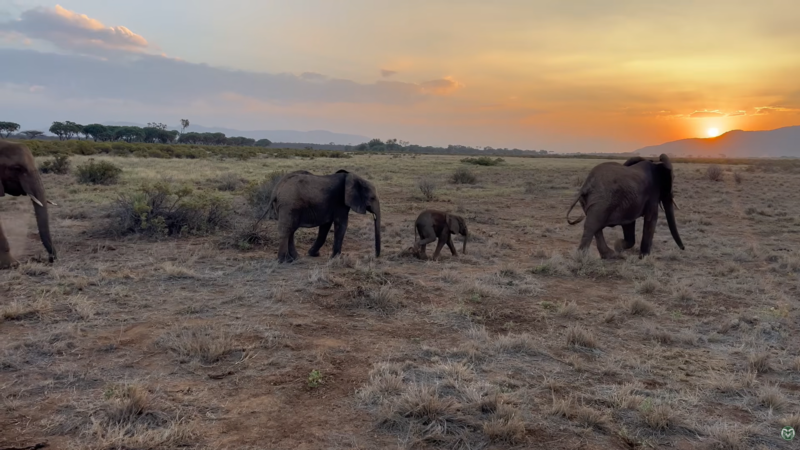
Field researchers in Kenya have spent years tracking elephant families, learning how they live, move, and care for each other, so they can better understand them and protect their future. Image via George Wittemyer and Save the Elephants. Used with permission.
Technology supports elephant conservation
Researchers combine field observation with technology such as GPS collars, drones and acoustic recorders to study movement patterns and communication. These tools allow scientists to follow elephant groups over long periods and across wide, often inaccessible landscapes.
GPS collars help map migration routes and show how different family units move. Drones provide a broader view of herd structure and movement patterns.
Acoustic recorders add another layer of information by capturing the complex vocalizations elephants use. Some research suggests that certain calls may function in a name-like way, allowing individuals to recognize and respond to specific members of their family.
Together, these technologies help conservationists identify key migration corridors and critical habitats before human expansion fragments them, improving strategies to reduce conflict between people and elephants. Wittemyer said:
Elephants are one of the most sentient and, therefore, relatable animals we share this planet with. But they are big and need space and resources as a result. Only with determination and foresight can we ensure the protection and survival of elephants – something I have faith we will accomplish.
The goal is simple and heartfelt: to protect elephant families and the bonds that hold them together, so they can stay whole and free in the landscapes they call home. Image via George Wittemyer and Save the Elephants. Used with permission.
When reunion was not enough
Although the reunion with her family was remarkable, the calf continued to face challenges in the days that followed. Markle allowed her to nurse, but there were concerns that she was not producing enough milk to fully support the orphaned calf.
Family members also remained attentive after the reunion, and when she became separated at one point in a dry riverbed, they called out to her until she rejoined the group.
Researchers do not know why she repeatedly wandered away. Elephants form lifelong relationships and can recognize and remember individual family members for decades. Given her very young age and dependence on milk, she may have struggled to keep up with the group, or may have been searching for her mother.
When she was later seen alone in an area known for lions, conservationists stepped in to prevent a potentially dangerous situation. On February 14, she was taken into the care of Reteti Elephant Sanctuary, where she could receive protection and specialized support.
Her story reflects the powerful social bonds of elephant families and the real risks young calves can face in the wild, and how timely human intervention can sometimes make the difference between survival and loss.
Bottom line: An elephant calf reunion in Kenya melted hearts recently. The lost baby answered her aunt’s call and her family rushed in to welcome her home.
Elephant calf reunion in Kenya reveals the powerful family bonds of elephants after a lost baby answers her aunt’s call and rushes back to her herd. Image via George Wittemyer and Save the Elephants. Used with permission.
On February 11, 2026, a baby elephant wandered alone into a tourist camp in northern Kenya. She had become separated from her family. What happened next revealed just how powerful elephant bonds can be. After researchers spent hours searching for the calf’s relatives, they reunited her with the family they believed she belonged to, and the response was immediate.
One elephant approached and called out. The calf answered. Within moments, the entire family gathered around the youngster, rumbling and trumpeting in what researchers described as an emotional reunion. The moment offered a glimpse into the deep social lives of elephants and the remarkable way families care for one another.
A Colorado State University (CSU) report published on May 19, 2026, describes how field researchers working in northern Kenya reconnected the calf with her family.
The search to reunite a calf with her family
The rescue began when staff at a tourist camp in Samburu found a four-month-old elephant calf alone and disoriented. They contacted a research team led by Colorado State University professor George Wittemyer, who has studied elephants in northern Kenya for nearly three decades.
Researchers searched the Samburu National Reserve to determine which elephant family was missing a calf. The exact circumstances of how the young elephant became separated from her group are not known. After identifying the most likely family, the team carefully brought the calf back to them. How would they react?
George Wittemyer helps the elephant calf drink water from a bottle after she wandered into a tourist camp alone and was tied to a tree by well-meaning campsite staff. Researchers gave the calf water and a mud bath to cool her off before searching for her family among the roughly 40 elephant families in Samburu National Reserve. Image via George Wittemyer and Save the Elephants. Used with permission.
The elephant calf reunion happened through sound
One of the calf’s aunts, known to researchers as Adelaide, approached and called out. The calf responded immediately.
That exchange triggered a rapid response from the herd. Relatives moved in, surrounding the calf with rumbles and trumpeting sounds in what scientists recognize as a reunion ceremony after separation. Wittemyer explained:
Elephants are highly social, forming powerful bonds between each other that last a lifetime. Similar to our societies, these bonds make up the social fabric of elephant society and underpin the rich behaviors elephants exhibit.
Elephants rely on extended family care
Elephant families are built around cooperation and long-term social bonds. Calves are raised within tight family groups where mothers are supported by close female relatives who help protect and care for the young.
These relationships can last decades and are central to survival in the wild.
In this case, the calf’s mother had died from natural causes some time earlier. The family quickly took over caregiving roles after the reunion, staying close to the young calf and supporting her within the group. One of her aunts, Markle, who had lost her own calf earlier in the year, even nursed the hungry calf upon her return.
The importance of long-term research
Beautiful moments like this are possible thanks to long-term field research in Samburu National Reserve. Wittemyer and colleagues at Save the Elephants track elephant births, deaths, movements and social relationships, allowing them to recognize individuals and understand family structures. Wittemyer said:
Landscape integrity and protection is critical for the species’ survival given projections about human population growth in Africa over the next 80 years.
Wittemyer also teaches wildlife and conservation biology at Colorado State University, where he works with students to help them understand and appreciate the complexity of elephant societies and the conservation challenges they face. Wittemyer commented:
My work focuses on understanding the rich and complex social lives of elephants, so we can better understand their needs and engender fascination and interest in their lives among the people living with them and the global public.
Field researchers in Kenya have spent years tracking elephant families, learning how they live, move, and care for each other, so they can better understand them and protect their future. Image via George Wittemyer and Save the Elephants. Used with permission.
Technology supports elephant conservation
Researchers combine field observation with technology such as GPS collars, drones and acoustic recorders to study movement patterns and communication. These tools allow scientists to follow elephant groups over long periods and across wide, often inaccessible landscapes.
GPS collars help map migration routes and show how different family units move. Drones provide a broader view of herd structure and movement patterns.
Acoustic recorders add another layer of information by capturing the complex vocalizations elephants use. Some research suggests that certain calls may function in a name-like way, allowing individuals to recognize and respond to specific members of their family.
Together, these technologies help conservationists identify key migration corridors and critical habitats before human expansion fragments them, improving strategies to reduce conflict between people and elephants. Wittemyer said:
Elephants are one of the most sentient and, therefore, relatable animals we share this planet with. But they are big and need space and resources as a result. Only with determination and foresight can we ensure the protection and survival of elephants – something I have faith we will accomplish.
The goal is simple and heartfelt: to protect elephant families and the bonds that hold them together, so they can stay whole and free in the landscapes they call home. Image via George Wittemyer and Save the Elephants. Used with permission.
When reunion was not enough
Although the reunion with her family was remarkable, the calf continued to face challenges in the days that followed. Markle allowed her to nurse, but there were concerns that she was not producing enough milk to fully support the orphaned calf.
Family members also remained attentive after the reunion, and when she became separated at one point in a dry riverbed, they called out to her until she rejoined the group.
Researchers do not know why she repeatedly wandered away. Elephants form lifelong relationships and can recognize and remember individual family members for decades. Given her very young age and dependence on milk, she may have struggled to keep up with the group, or may have been searching for her mother.
When she was later seen alone in an area known for lions, conservationists stepped in to prevent a potentially dangerous situation. On February 14, she was taken into the care of Reteti Elephant Sanctuary, where she could receive protection and specialized support.
Her story reflects the powerful social bonds of elephant families and the real risks young calves can face in the wild, and how timely human intervention can sometimes make the difference between survival and loss.
Bottom line: An elephant calf reunion in Kenya melted hearts recently. The lost baby answered her aunt’s call and her family rushed in to welcome her home.
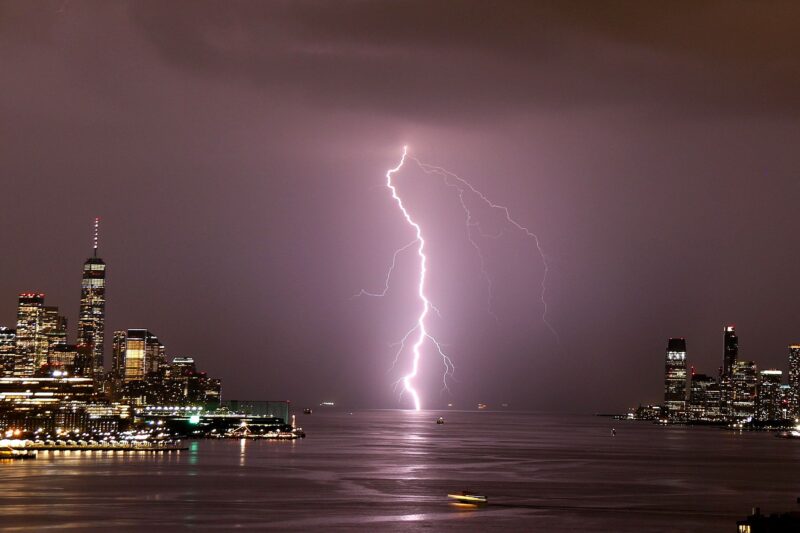
View at EarthSky Community Photos. | Alexander Krivenyshev of WorldTimeZone.com captured this stormy shot on July 14, 2023. Alexander wrote: “Lightning bolt strikes the Hudson River between lower Manhattan and Jersey City.” Thank you, Alexander! A new study shows how cities can change the weather and provides particular insight into when urban flooding can happen.
It’s a hot, steamy day, and you see a pop-up thunderstorm darken the sky to your west as a low grumble of thunder shudders the ground. Whether you’re watching from the countryside or a cement-and-steel city can determine what will happen next. Researchers from Texas A&M University said on May 20, 2026, that certain types of storms can intensify over cities. They looked at more than 40,000 storms over 22 years in Texas to discover that certain storms, such as isolated thunderstorm cells, can grow stronger and drop more rain over urban areas.
The researchers pored over data of storms that hit Houston, Dallas-Fort Worth, Austin and San Antonio between 1995 and 2017. While other studies have looked at regional rainfall, this team of researchers zeroed in on the rainfall resulting from different types of storms that hit cities. Co-author John Nielsen-Gammon of Texas A&M University said:
Different storms are driven by different physical processes. Once you separate storms by type, the patterns became much clearer.
The researchers published their study in the peer-reviewed journal Nature on May 20, 2026.
Storms that boost rainfall
Urban flooding is a significant problem in cities. Cities largely consist of buildings and concrete without many places for rainwater to naturally soak into the ground. And storms that hit quickly with heavy rainfall can overwhelm a city’s stormwater system. As a result, streets can flood, endangering drivers and pedestrians. Plus, homes and businesses can incur expensive flood damage. So discovering which storms increase rainfall was particularly important to the researchers.
Two of the categories of storms the researchers looked at – single-cell thunderstorms and larger isolated storms – showed intensification and heavier rainfall when encountering a city. Looking at the radar data, the researchers found single-cell thunderstorms in particular grew taller and more intense over cities. The urban heat island effect – where cities trap heat and are warmer than the surrounding landscape – can cause updrafts that feed storms. In the four Texas cities studied, these small storms occurred 7 to 31% more often than over nearby rural land.
This was especially true at night, when rural areas cooled but the cities retained their heat. Nielsen-Gammon said:
Urban areas hold heat after sunset. That retained warmth can continue to fuel storms overnight, when similar storms over rural areas are more likely to weaken.
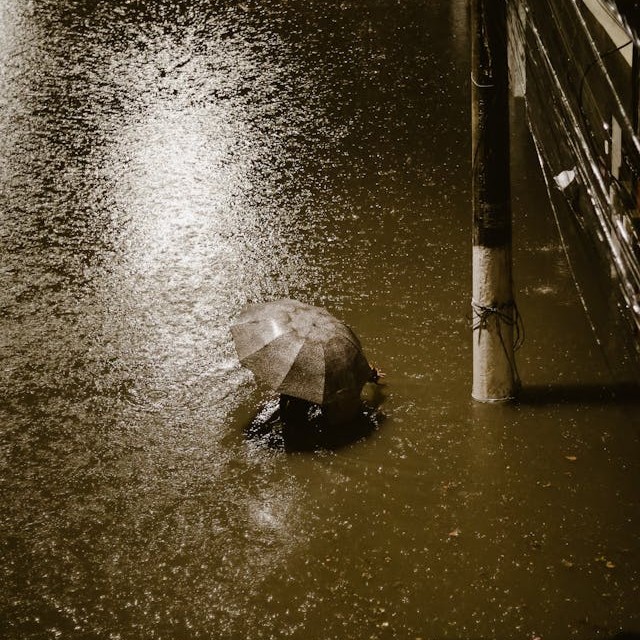
A person navigates a flooded city street at night. Image via Rafael Titoneli/ Pexels.
Storms that weaken over cities
But not all storms intensify when they reach a city. For example, storms along a cold front can weaken as they drift over urban heat islands. These types of storms form because of the temperature difference between the advancing cold air and the warm air already present. The study found that storms associated with cold fronts declined about 16 to 28% in their rainfall intensity compared with nearby rural areas. Although, as the storm first hits the city, it can sometimes briefly intensify as the temperature difference becomes sharper. But then it would diminish as the warmth of the city and buildings disrupt the air flow.
Nielsen-Gammon explained:
Cold front rainfall is driven by sharp temperature and wind differences. As they move into the warmer and more turbulent urban environment, those contrasts can weaken, reducing rainfall intensity.
Cities had less of an effect on the other two categories of storms the researchers studied: warm front storms and tropical storms. The main difference the researchers found was that for tropical storms, such as hurricanes, the heavy rain formed lower in the atmosphere over cities. So that could have an impact on flooding. But Nielsen-Gammon said:
These larger systems are driven mainly by ocean heat and larger-scale wind patterns. Urban effects don’t disappear, but they’re secondary compared to those factors.
In 2017, Hurricane Harvey caused flooding in Texas and Louisiana and resulted in the deaths of more than 100 people. Image via NOAA/ Wikimedia Commons.
Knowing how cities can change the weather can help us prepare
The researchers said that urban planners need to factor in storms of short duration and high intensity. Previous plans for drainage systems and flood controls relied on averaged rainfall statistics. Nielsen-Gammon said:
If you design only for region-wide averages, you can underestimate the kinds of rainfall that actually cause the most damage. Understanding which storms cities amplify helps planners target the real risks. Asking whether cities get more or less rain is the wrong question. The right question is which storms are affected, because that’s what determines the risk people actually face on the ground.
Bottom line: Researchers have looked at 22 years of data to discover how cities can change the weather. Certain types of storms intensify over cities, leading to more urban flooding.
View at EarthSky Community Photos. | Alexander Krivenyshev of WorldTimeZone.com captured this stormy shot on July 14, 2023. Alexander wrote: “Lightning bolt strikes the Hudson River between lower Manhattan and Jersey City.” Thank you, Alexander! A new study shows how cities can change the weather and provides particular insight into when urban flooding can happen.
It’s a hot, steamy day, and you see a pop-up thunderstorm darken the sky to your west as a low grumble of thunder shudders the ground. Whether you’re watching from the countryside or a cement-and-steel city can determine what will happen next. Researchers from Texas A&M University said on May 20, 2026, that certain types of storms can intensify over cities. They looked at more than 40,000 storms over 22 years in Texas to discover that certain storms, such as isolated thunderstorm cells, can grow stronger and drop more rain over urban areas.
The researchers pored over data of storms that hit Houston, Dallas-Fort Worth, Austin and San Antonio between 1995 and 2017. While other studies have looked at regional rainfall, this team of researchers zeroed in on the rainfall resulting from different types of storms that hit cities. Co-author John Nielsen-Gammon of Texas A&M University said:
Different storms are driven by different physical processes. Once you separate storms by type, the patterns became much clearer.
The researchers published their study in the peer-reviewed journal Nature on May 20, 2026.
Storms that boost rainfall
Urban flooding is a significant problem in cities. Cities largely consist of buildings and concrete without many places for rainwater to naturally soak into the ground. And storms that hit quickly with heavy rainfall can overwhelm a city’s stormwater system. As a result, streets can flood, endangering drivers and pedestrians. Plus, homes and businesses can incur expensive flood damage. So discovering which storms increase rainfall was particularly important to the researchers.
Two of the categories of storms the researchers looked at – single-cell thunderstorms and larger isolated storms – showed intensification and heavier rainfall when encountering a city. Looking at the radar data, the researchers found single-cell thunderstorms in particular grew taller and more intense over cities. The urban heat island effect – where cities trap heat and are warmer than the surrounding landscape – can cause updrafts that feed storms. In the four Texas cities studied, these small storms occurred 7 to 31% more often than over nearby rural land.
This was especially true at night, when rural areas cooled but the cities retained their heat. Nielsen-Gammon said:
Urban areas hold heat after sunset. That retained warmth can continue to fuel storms overnight, when similar storms over rural areas are more likely to weaken.
A person navigates a flooded city street at night. Image via Rafael Titoneli/ Pexels.
Storms that weaken over cities
But not all storms intensify when they reach a city. For example, storms along a cold front can weaken as they drift over urban heat islands. These types of storms form because of the temperature difference between the advancing cold air and the warm air already present. The study found that storms associated with cold fronts declined about 16 to 28% in their rainfall intensity compared with nearby rural areas. Although, as the storm first hits the city, it can sometimes briefly intensify as the temperature difference becomes sharper. But then it would diminish as the warmth of the city and buildings disrupt the air flow.
Nielsen-Gammon explained:
Cold front rainfall is driven by sharp temperature and wind differences. As they move into the warmer and more turbulent urban environment, those contrasts can weaken, reducing rainfall intensity.
Cities had less of an effect on the other two categories of storms the researchers studied: warm front storms and tropical storms. The main difference the researchers found was that for tropical storms, such as hurricanes, the heavy rain formed lower in the atmosphere over cities. So that could have an impact on flooding. But Nielsen-Gammon said:
These larger systems are driven mainly by ocean heat and larger-scale wind patterns. Urban effects don’t disappear, but they’re secondary compared to those factors.
In 2017, Hurricane Harvey caused flooding in Texas and Louisiana and resulted in the deaths of more than 100 people. Image via NOAA/ Wikimedia Commons.
Knowing how cities can change the weather can help us prepare
The researchers said that urban planners need to factor in storms of short duration and high intensity. Previous plans for drainage systems and flood controls relied on averaged rainfall statistics. Nielsen-Gammon said:
If you design only for region-wide averages, you can underestimate the kinds of rainfall that actually cause the most damage. Understanding which storms cities amplify helps planners target the real risks. Asking whether cities get more or less rain is the wrong question. The right question is which storms are affected, because that’s what determines the risk people actually face on the ground.
Bottom line: Researchers have looked at 22 years of data to discover how cities can change the weather. Certain types of storms intensify over cities, leading to more urban flooding.