
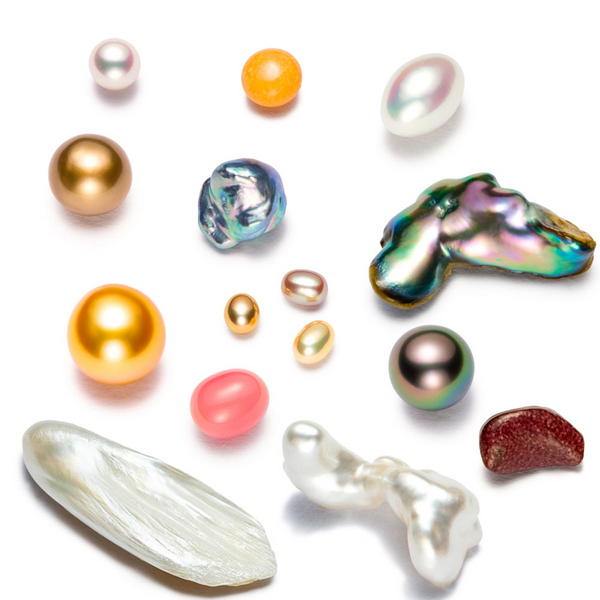
Pearl as a June birthstone
Most gemstones are found within the Earth. But pearls grow inside the shells of oysters and clams. Some pearls form naturally in these mollusks, which is a word that describes many creatures possessing soft, unsegmented bodies plus a mantle or shell, found both in salty seas and in fresh water.
But many pearls today aren’t found in the wild. Instead, they’re cultured, meaning they’re raised at oyster farms.
Pearls are made mostly of aragonite, a relatively soft carbonate mineral (CaCO3). This same mineral can be found in the shells of oysters and clams.
A pearl forms when a small fragment of rock, a sand grain, or a parasite finds its way into the shell of one of these creatures. It irritates the animal, which responds by coating the foreign material with layer upon layer of shell material.
Pearls forming up next to the inside of the shell are usually irregular in shape and have little commercial value. But those that form within the tissue of the creature are spherical or pear-shaped.
And these are highly sought out for jewelry.
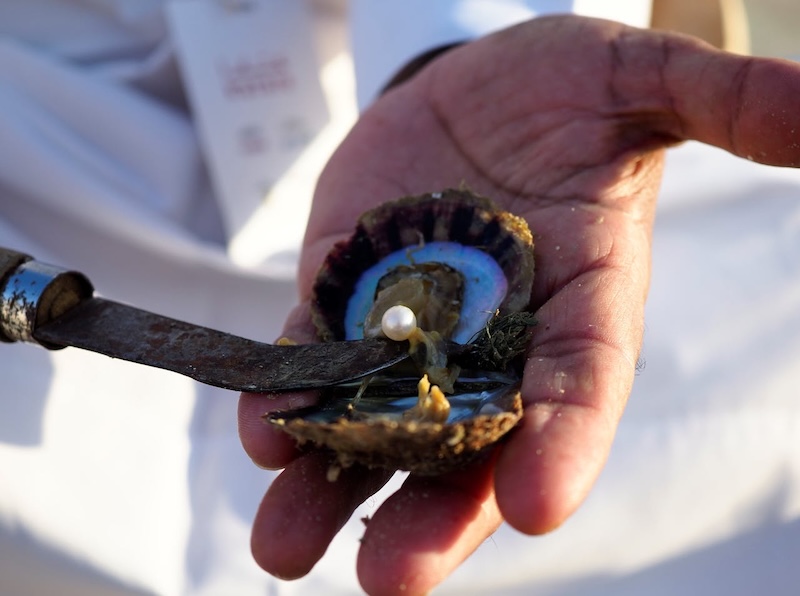
Pearls come in several colors
Pearls possess a delicate translucence and luster that make them one of the most highly valued gemstones. The color of the pearl depends on the species of mollusk that produced it, and on its environment.
Generally, white is the best-known and most common color of pearl. But pearls also come in delicate shades of black, cream, gray, blue, yellow, lavender, green, and mauve.
Black pearls are found in the Gulf of Mexico and waters off some islands in the Pacific Ocean. The Persian Gulf and Sri Lanka are well-known for exquisite cream-colored pearls called Orientals.
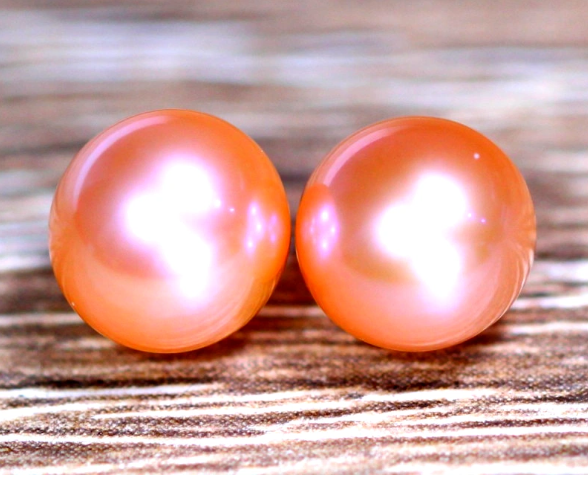
Cultured pearls are popular, too
Japan is famous for its cultured pearls. And everyone familiar with jewelry has heard of Mikimoto pearls, named after the creator of the industry, Kokichi Mikimoto.
Cultured pearls grow in large oyster beds in Japanese waters. An “irritant,” such as a tiny fragment of mother-of-pearl, is introduced into the fleshy part of two-to-three-year-old oysters.
The oysters then grow in mesh bags submerged beneath the water. They’re nourished for seven to nine years before being harvested.
In addition to Japan, Australia and the equatorial islands of the Pacific have cultured pearl industries.
Famous pearls
The largest pearl in the world is believed about 3 inches long and 2 inches across (7.6 by 5 cm), weighing 1/3 of a pound (.15 kg). Called the Pearl of Asia, it was a gift from Shah Jahan of India to his favorite wife, Mumtaz, in whose memory he built the Taj Mahal.
Many experts consider La Peregrina (the Wanderer) to be the most beautiful pearl. Legend says a slave found it in Panama in the 1500s, who gave it up in return for his freedom. In 1570, the conquistador ruler of the area sent the pearl to King Philip II of Spain. This pear-shaped white pearl, 1 1/2 inches (almost 4 cm) in length, hangs from a platinum mount studded with diamonds.
Then the pearl went to Mary I of England, then to Prince Louis Napoleon of France. And he sold it to the British Marquis of Abercorn, whose family kept the pearl until 1969, when they offered it for sale at Sotheby’s.
Finally, actor Richard Burton bought it for his wife, Elizabeth Taylor.
Pearl lore
Pearls, according to South Asian mythology, were dewdrops from heaven that fell into the sea. It’s said that shellfish caught them under the first rays of the rising sun, during a period of full moon.
In India, warriors encrusted their swords with pearls to symbolize the tears and sorrow that a sword brings.
Pearls were also widely used as medicine in Europe until the 17th century. Arabs and Persians believed they were a cure for various kinds of diseases, including insanity.
In China, pearls were used as medicine as early as 2000 BCE. They were believed to represent wealth, power and longevity.
Even today, in Asia, ground-up low-grade pearls are used as medicine.
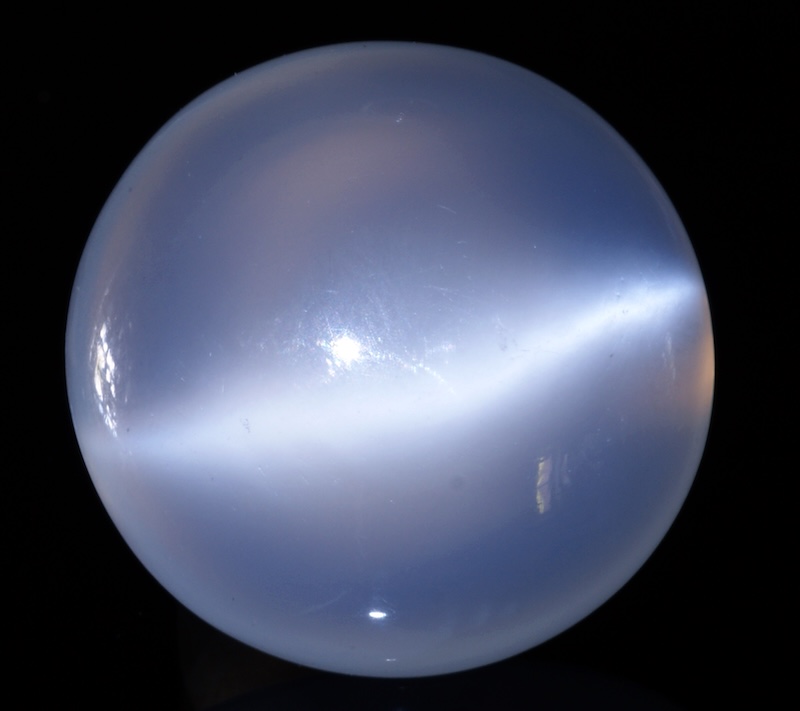
Another June birthstone: the moonstone
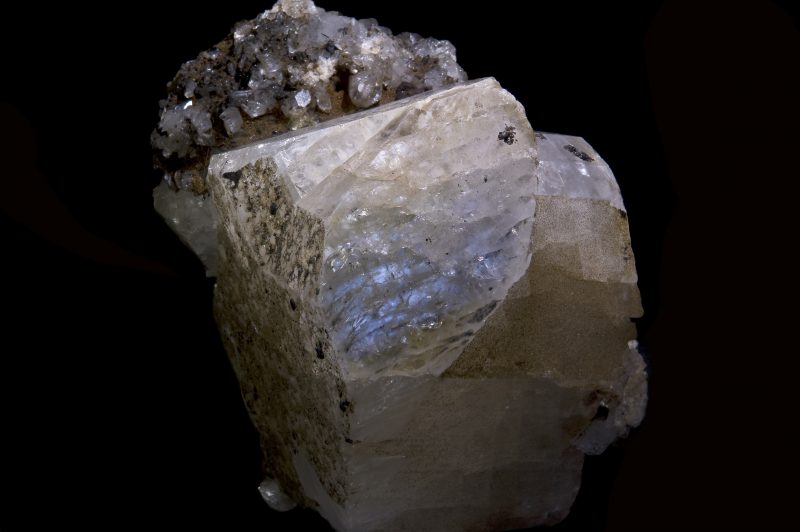
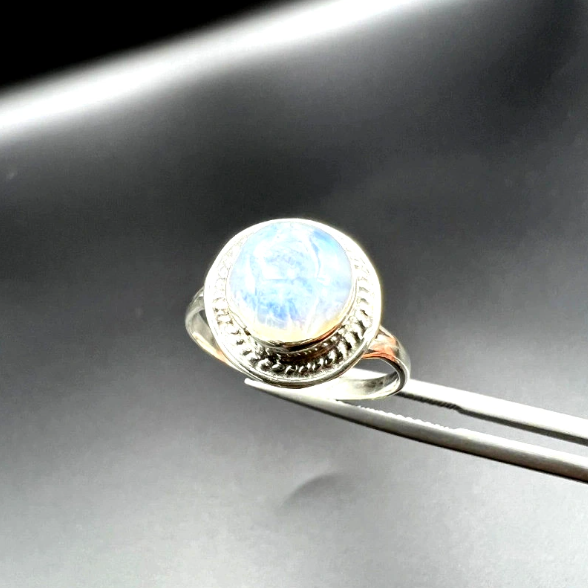
June’s second birthstone is the moonstone. Moonstones are believed to be named for the bluish white spots within them. When held up to light they exhibit a silvery play of color very much like moonlight. And when the stone moves back and forth, brilliant silvery rays move about within them, like moonbeams playing over water.
Moonstone belongs to the family of minerals called feldspars, an important group of silicate minerals commonly formed in rocks. About half the Earth’s crust is composed of feldspars. This mineral occurs in many igneous and metamorphic rocks. It also constitutes a large percentage of soils and marine clays.
Rare geologic conditions produce gem varieties of feldspar such as moonstone, labradorite, amazonite, and sunstone. They appear as large, clean mineral grains, found in pegmatites (coarse-grained igneous rock) and ancient deep crustal rocks. Feldspars of gem quality are aluminosilicates (minerals containing aluminum, silicon and oxygen), mixed with sodium and potassium.
The best moonstones are from Sri Lanka. Plus, they are found in the Alps, Madagascar, Myanmar (Burma), and India.
Moonstone lore
The ancient Roman natural historian, Pliny, said that the moonstone changed in appearance with the phases of the moon. That belief persisted until the 16th century. The ancient Romans also believed the image of Diana, goddess of the moon, was enclosed within the stone. Moonstones were believed to have the power to bring victory, health, and wisdom to those who wore them.
In India, the moonstone is considered a sacred stone and often displayed on a yellow cloth, with yellow considered a sacred color. The stone is believed to bring good fortune, brought on by a spirit that lives within the stone.
Or select alexandrite as your June birthstone
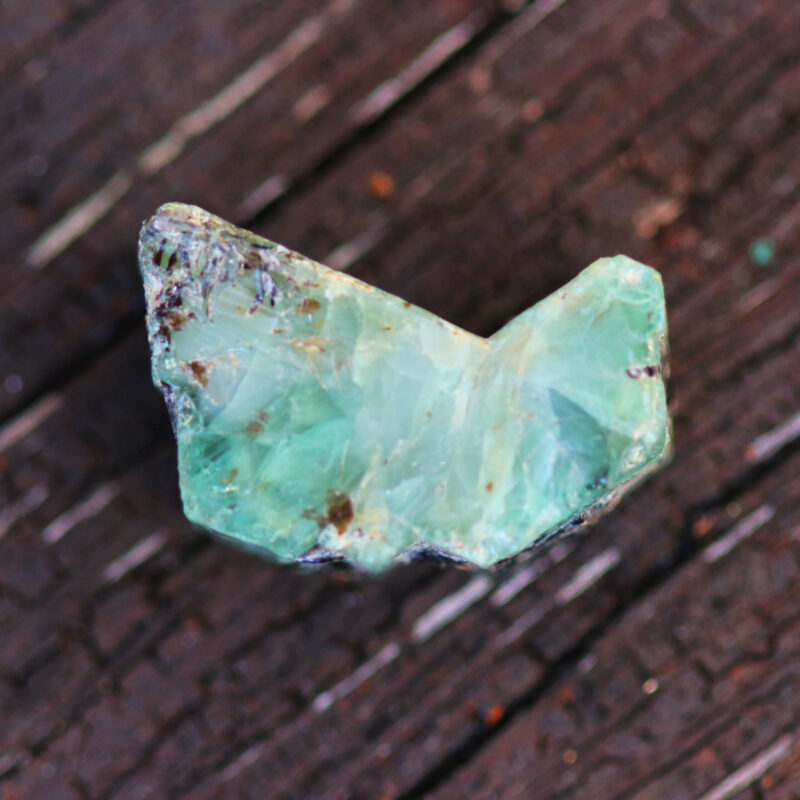
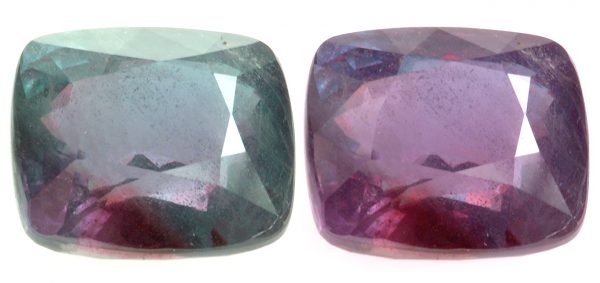
Lastly, June’s 3rd birthstone is the alexandrite. Alexandrite possesses an enchanting chameleon-like personality. In daylight, it appears as a beautiful green, sometimes with a bluish cast or a brownish tint. But, under artificial lighting, the stone turns reddish-violet or violet.
Alexandrite belongs to the chrysoberyl family. That’s a mineral called beryllium aluminum oxide in chemistry jargon. It contains the elements beryllium, aluminum and oxygen (BeAl2O4). Alexandrite is a hard mineral, surpassed in hardness only by diamonds and corundum (sapphires and rubies).
Meanwhile, the unusual colors in alexandrite come from the presence of chromium in the mineral.
Alexandrite is rare and expensive
Alexandrite is an uncommon stone. So it’s expensive. Sri Lanka is the main source of alexandrite today, and the stones have also been found in Brazil, Madagascar, Zimbabwe, Tanzania, and Myanmar (Burma).
Meanwhile, synthetic alexandrite – resembling a reddish-hued amethyst with a tinge of green – has been manufactured. But you don’t see the color change in the synthetic stones. Perhaps for that reason, the synthetic stones have met with only marginal market success in the United States.
History of June birthstone alexandrite
Alexandrite is named after Prince Alexander of Russia, who became Czar Alexander II in 1855. Discovered in 1839 on the prince’s birthday, alexandrite was found in an emerald mine in the Ural Mountains of Russia.
The stone was also popular in part because it reflected the Russian national colors, green and red.
Because of its relatively recent discovery, there’s been little time for myth and superstition to build around this unusual stone.
But it has been associated with good luck!
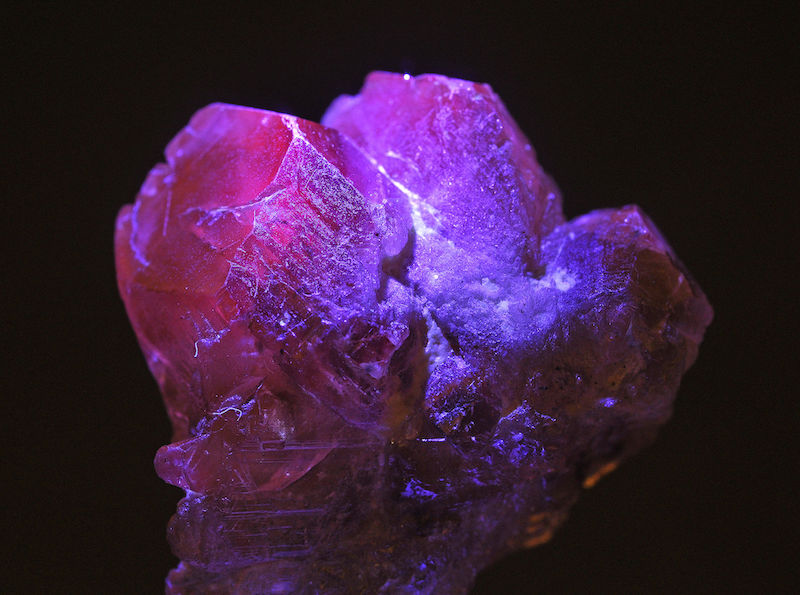
Bottom line: For June babies, for your June birthstone: choose pearl, moonstone or a alexandrite. All are lovely choices.
Enjoying EarthSky so far? Sign up for our free daily newsletter today!
Find out about the birthstones for the other months of the year.
January birthstone
February birthstone
March birthstone
April birthstone
May birthstone
July birthstone
August birthstone
September birthstone
October birthstone
November birthstone
December birthstone
The post June birthstone: Pearl, moonstone or alexandrite first appeared on EarthSky.
from EarthSky https://ift.tt/L0Vpg6e
Pearl as a June birthstone
Most gemstones are found within the Earth. But pearls grow inside the shells of oysters and clams. Some pearls form naturally in these mollusks, which is a word that describes many creatures possessing soft, unsegmented bodies plus a mantle or shell, found both in salty seas and in fresh water.
But many pearls today aren’t found in the wild. Instead, they’re cultured, meaning they’re raised at oyster farms.
Pearls are made mostly of aragonite, a relatively soft carbonate mineral (CaCO3). This same mineral can be found in the shells of oysters and clams.
A pearl forms when a small fragment of rock, a sand grain, or a parasite finds its way into the shell of one of these creatures. It irritates the animal, which responds by coating the foreign material with layer upon layer of shell material.
Pearls forming up next to the inside of the shell are usually irregular in shape and have little commercial value. But those that form within the tissue of the creature are spherical or pear-shaped.
And these are highly sought out for jewelry.
Pearls come in several colors
Pearls possess a delicate translucence and luster that make them one of the most highly valued gemstones. The color of the pearl depends on the species of mollusk that produced it, and on its environment.
Generally, white is the best-known and most common color of pearl. But pearls also come in delicate shades of black, cream, gray, blue, yellow, lavender, green, and mauve.
Black pearls are found in the Gulf of Mexico and waters off some islands in the Pacific Ocean. The Persian Gulf and Sri Lanka are well-known for exquisite cream-colored pearls called Orientals.
Cultured pearls are popular, too
Japan is famous for its cultured pearls. And everyone familiar with jewelry has heard of Mikimoto pearls, named after the creator of the industry, Kokichi Mikimoto.
Cultured pearls grow in large oyster beds in Japanese waters. An “irritant,” such as a tiny fragment of mother-of-pearl, is introduced into the fleshy part of two-to-three-year-old oysters.
The oysters then grow in mesh bags submerged beneath the water. They’re nourished for seven to nine years before being harvested.
In addition to Japan, Australia and the equatorial islands of the Pacific have cultured pearl industries.
Famous pearls
The largest pearl in the world is believed about 3 inches long and 2 inches across (7.6 by 5 cm), weighing 1/3 of a pound (.15 kg). Called the Pearl of Asia, it was a gift from Shah Jahan of India to his favorite wife, Mumtaz, in whose memory he built the Taj Mahal.
Many experts consider La Peregrina (the Wanderer) to be the most beautiful pearl. Legend says a slave found it in Panama in the 1500s, who gave it up in return for his freedom. In 1570, the conquistador ruler of the area sent the pearl to King Philip II of Spain. This pear-shaped white pearl, 1 1/2 inches (almost 4 cm) in length, hangs from a platinum mount studded with diamonds.
Then the pearl went to Mary I of England, then to Prince Louis Napoleon of France. And he sold it to the British Marquis of Abercorn, whose family kept the pearl until 1969, when they offered it for sale at Sotheby’s.
Finally, actor Richard Burton bought it for his wife, Elizabeth Taylor.
Pearl lore
Pearls, according to South Asian mythology, were dewdrops from heaven that fell into the sea. It’s said that shellfish caught them under the first rays of the rising sun, during a period of full moon.
In India, warriors encrusted their swords with pearls to symbolize the tears and sorrow that a sword brings.
Pearls were also widely used as medicine in Europe until the 17th century. Arabs and Persians believed they were a cure for various kinds of diseases, including insanity.
In China, pearls were used as medicine as early as 2000 BCE. They were believed to represent wealth, power and longevity.
Even today, in Asia, ground-up low-grade pearls are used as medicine.
Another June birthstone: the moonstone
June’s second birthstone is the moonstone. Moonstones are believed to be named for the bluish white spots within them. When held up to light they exhibit a silvery play of color very much like moonlight. And when the stone moves back and forth, brilliant silvery rays move about within them, like moonbeams playing over water.
Moonstone belongs to the family of minerals called feldspars, an important group of silicate minerals commonly formed in rocks. About half the Earth’s crust is composed of feldspars. This mineral occurs in many igneous and metamorphic rocks. It also constitutes a large percentage of soils and marine clays.
Rare geologic conditions produce gem varieties of feldspar such as moonstone, labradorite, amazonite, and sunstone. They appear as large, clean mineral grains, found in pegmatites (coarse-grained igneous rock) and ancient deep crustal rocks. Feldspars of gem quality are aluminosilicates (minerals containing aluminum, silicon and oxygen), mixed with sodium and potassium.
The best moonstones are from Sri Lanka. Plus, they are found in the Alps, Madagascar, Myanmar (Burma), and India.
Moonstone lore
The ancient Roman natural historian, Pliny, said that the moonstone changed in appearance with the phases of the moon. That belief persisted until the 16th century. The ancient Romans also believed the image of Diana, goddess of the moon, was enclosed within the stone. Moonstones were believed to have the power to bring victory, health, and wisdom to those who wore them.
In India, the moonstone is considered a sacred stone and often displayed on a yellow cloth, with yellow considered a sacred color. The stone is believed to bring good fortune, brought on by a spirit that lives within the stone.
Or select alexandrite as your June birthstone
Lastly, June’s 3rd birthstone is the alexandrite. Alexandrite possesses an enchanting chameleon-like personality. In daylight, it appears as a beautiful green, sometimes with a bluish cast or a brownish tint. But, under artificial lighting, the stone turns reddish-violet or violet.
Alexandrite belongs to the chrysoberyl family. That’s a mineral called beryllium aluminum oxide in chemistry jargon. It contains the elements beryllium, aluminum and oxygen (BeAl2O4). Alexandrite is a hard mineral, surpassed in hardness only by diamonds and corundum (sapphires and rubies).
Meanwhile, the unusual colors in alexandrite come from the presence of chromium in the mineral.
Alexandrite is rare and expensive
Alexandrite is an uncommon stone. So it’s expensive. Sri Lanka is the main source of alexandrite today, and the stones have also been found in Brazil, Madagascar, Zimbabwe, Tanzania, and Myanmar (Burma).
Meanwhile, synthetic alexandrite – resembling a reddish-hued amethyst with a tinge of green – has been manufactured. But you don’t see the color change in the synthetic stones. Perhaps for that reason, the synthetic stones have met with only marginal market success in the United States.
History of June birthstone alexandrite
Alexandrite is named after Prince Alexander of Russia, who became Czar Alexander II in 1855. Discovered in 1839 on the prince’s birthday, alexandrite was found in an emerald mine in the Ural Mountains of Russia.
The stone was also popular in part because it reflected the Russian national colors, green and red.
Because of its relatively recent discovery, there’s been little time for myth and superstition to build around this unusual stone.
But it has been associated with good luck!
Bottom line: For June babies, for your June birthstone: choose pearl, moonstone or a alexandrite. All are lovely choices.
Enjoying EarthSky so far? Sign up for our free daily newsletter today!
Find out about the birthstones for the other months of the year.
January birthstone
February birthstone
March birthstone
April birthstone
May birthstone
July birthstone
August birthstone
September birthstone
October birthstone
November birthstone
December birthstone
The post June birthstone: Pearl, moonstone or alexandrite first appeared on EarthSky.
from EarthSky https://ift.tt/L0Vpg6e

Aucun commentaire:
Enregistrer un commentaire