aads

Why are scorpion stings so painful? Metal stingers!

A brown scorpion with small pincers, sturdy tail, and large stinger.
This is a granulated thick-tailed scorpion (Parabuthus granulatus), photographed in Debeden, South Africa. So why are scorpion stings so painful? A new study explored how metal makes scorpion stingers and pincers more formidable. Image via Ryan van Huyssteen/ iNaturalist (CC BY 4.0).
  • Scorpion stings and pinches are particularly painful because the stingers and pincers are reinforced with metal.
  • Now, a new study of 18 scorpion species has revealed in new detail how these metals are distributed.
  • The results reveal how natural selection favors certain types of metals for different purposes in scorpions.

You deserve a daily dose of good news. For the latest in science and the night sky, click here to subscribe to our free daily newsletter.

Scorpion stingers and pincers contain metal!

Scorpions are infamous for their imposing pincers and venomous stingers. They use these formidable appendages to defend themselves and attack prey. But why are scorpion stings and pinches so powerful? Metal.

Scientists have long known that scorpion stingers and pincers are often fortified with metals. But is this the case with all scorpions? And with different predation and defense techniques across different scorpion species, do their metal deposits vary too?

In April 2026, researchers published a study that explored these questions.

In it, they analyzed 18 species from a wide range of scorpion families (a term for a group of related animals). They uncovered interesting new details as to how these metals were distributed in pincers and stingers. And their findings offered fresh insight into how natural selection favors certain types of metal deposits for different purposes.

Sam Campbell of the University of Queensland led this research. He said, in a statement:

Scorpions are incredible hunters, and while we knew that metals strengthen the weapons in some species’ arsenals, we don’t know if all scorpions’ weapons contain metal, and if so, whether this metal enrichment relates to how they hunt.

We decided to use microanalytical techniques to unravel where and how these metals are distributed in the scorpions’ weapons to offer a clue as to how and why metal enrichment has been carried through the scorpion family tree.

The research team published their study in the peer-reviewed Journal of the Royal Society Interface on April 29, 2026.

Scorpion stings and pinches vary

Overall, there are about 3,000 species of scorpion, found in all continents except Antarctica. And with such a wide diversity of species comes a wide range of predatory and defense behaviors.

Some scorpions routinely subdue their prey using their stingers to inject venom. But others rarely use them except to quell difficult prey. Scorpions with large powerful pincers use them to crush prey, but have small stingers. Conversely, others have large stingers and small pincers.

The Smithsonian National Museum of Natural History has a collection of preserved scorpions from around the world. In addition to x-ray analysis, the research team performed high-resolution electron microscopy on 18 of these specimens. They specifically examined the pincers and stingers.

A black scorpion with heavy, large pincers and smallish stinger.
The common emperor scorpion (Pandinus imperator) was one of the species in this study. It had zinc and manganese in its stinger, with zinc and a little iron in its pincers. Image via Jan Ebr and Ivana Ebrová/ iNaturalist (CC BY 4.0).

Scorpion stings and pinches are zinc-powered

In the scorpion stingers, the researchers found zinc at the tip of the needle-like structure. But many of the scorpions had a sharp transition to manganese below this point.

Meanwhile, in the outer part of the pincers, called the tarsus, the researchers found zinc. In addition, some scorpion pincers also contained iron. Interestingly, the metal only reinforced the cutting edge of the pincer. That’s the side of the tarsus that endures the most stress from struggling prey.

Edward Vicenzi, at the National Museum of Natural History, commented:

The National Museum of Natural History’s large scorpion collection allowed us to analyze metal enrichment in a wide range of scorpion species, more than have ever been studied before using these techniques. The microscopic-scale methods we used allowed us to identify individual transition metals in extremely high detail, showing us how nature skillfully engineered these metals in the scorpion’s weapons.
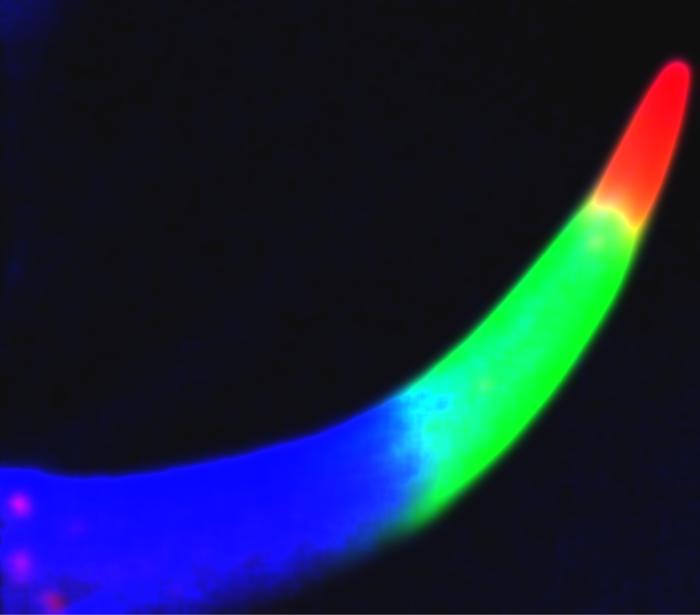
A long, curved horn-shaped structure with red at the tip, green in the middle, and blue at its base.
Micro X-ray fluorescence microscopy is a high resolution X-ray imaging system that can identify elements. In this stinger from an emperor scorpion (Pandinus imperator), the imaging detected zinc (in red) at the tip, with manganese (in green) below it. Image via E. P. Vicenzi/ Smithsonian Museum Conservation Institute/ NIST/ Eurekalert!.

Unexpected findings

The scientists thought they’d find higher levels of zinc in chunky, powerful pincers, to be used for crushing prey. But instead, they discovered that scorpions with long, slender pincers had higher levels of zinc.

Campbell said:

This points to a role for zinc beyond hardness, perhaps playing a bigger role in durability. After all, long claws need to grasp prey and prevent it from escaping before being injected by venom. This is an interesting finding because it suggests an evolutionary relationship between how a weapon is used and the specific properties of the metal that reinforces it.

Bottom line: Scientists found that the stingers and pincers in 18 scorpion species contain deposits of zinc, manganese and iron, varying depending on how each species uses its appendages.

Source: Heavy metal predators: diverse elemental enrichment across the weapons of scorpions

Via Smithsonian National Museum of Natural History

Read more about scorpions and watch a video

Read more: Komodo dragons have iron-coated teeth

The post Why are scorpion stings so painful? Metal stingers! first appeared on EarthSky.


from EarthSky https://ift.tt/t5dD6eK
A brown scorpion with small pincers, sturdy tail, and large stinger.
This is a granulated thick-tailed scorpion (Parabuthus granulatus), photographed in Debeden, South Africa. So why are scorpion stings so painful? A new study explored how metal makes scorpion stingers and pincers more formidable. Image via Ryan van Huyssteen/ iNaturalist (CC BY 4.0).
  • Scorpion stings and pinches are particularly painful because the stingers and pincers are reinforced with metal.
  • Now, a new study of 18 scorpion species has revealed in new detail how these metals are distributed.
  • The results reveal how natural selection favors certain types of metals for different purposes in scorpions.

You deserve a daily dose of good news. For the latest in science and the night sky, click here to subscribe to our free daily newsletter.

Scorpion stingers and pincers contain metal!

Scorpions are infamous for their imposing pincers and venomous stingers. They use these formidable appendages to defend themselves and attack prey. But why are scorpion stings and pinches so powerful? Metal.

Scientists have long known that scorpion stingers and pincers are often fortified with metals. But is this the case with all scorpions? And with different predation and defense techniques across different scorpion species, do their metal deposits vary too?

In April 2026, researchers published a study that explored these questions.

In it, they analyzed 18 species from a wide range of scorpion families (a term for a group of related animals). They uncovered interesting new details as to how these metals were distributed in pincers and stingers. And their findings offered fresh insight into how natural selection favors certain types of metal deposits for different purposes.

Sam Campbell of the University of Queensland led this research. He said, in a statement:

Scorpions are incredible hunters, and while we knew that metals strengthen the weapons in some species’ arsenals, we don’t know if all scorpions’ weapons contain metal, and if so, whether this metal enrichment relates to how they hunt.

We decided to use microanalytical techniques to unravel where and how these metals are distributed in the scorpions’ weapons to offer a clue as to how and why metal enrichment has been carried through the scorpion family tree.

The research team published their study in the peer-reviewed Journal of the Royal Society Interface on April 29, 2026.

Scorpion stings and pinches vary

Overall, there are about 3,000 species of scorpion, found in all continents except Antarctica. And with such a wide diversity of species comes a wide range of predatory and defense behaviors.

Some scorpions routinely subdue their prey using their stingers to inject venom. But others rarely use them except to quell difficult prey. Scorpions with large powerful pincers use them to crush prey, but have small stingers. Conversely, others have large stingers and small pincers.

The Smithsonian National Museum of Natural History has a collection of preserved scorpions from around the world. In addition to x-ray analysis, the research team performed high-resolution electron microscopy on 18 of these specimens. They specifically examined the pincers and stingers.

A black scorpion with heavy, large pincers and smallish stinger.
The common emperor scorpion (Pandinus imperator) was one of the species in this study. It had zinc and manganese in its stinger, with zinc and a little iron in its pincers. Image via Jan Ebr and Ivana Ebrová/ iNaturalist (CC BY 4.0).

Scorpion stings and pinches are zinc-powered

In the scorpion stingers, the researchers found zinc at the tip of the needle-like structure. But many of the scorpions had a sharp transition to manganese below this point.

Meanwhile, in the outer part of the pincers, called the tarsus, the researchers found zinc. In addition, some scorpion pincers also contained iron. Interestingly, the metal only reinforced the cutting edge of the pincer. That’s the side of the tarsus that endures the most stress from struggling prey.

Edward Vicenzi, at the National Museum of Natural History, commented:

The National Museum of Natural History’s large scorpion collection allowed us to analyze metal enrichment in a wide range of scorpion species, more than have ever been studied before using these techniques. The microscopic-scale methods we used allowed us to identify individual transition metals in extremely high detail, showing us how nature skillfully engineered these metals in the scorpion’s weapons.

A long, curved horn-shaped structure with red at the tip, green in the middle, and blue at its base.
Micro X-ray fluorescence microscopy is a high resolution X-ray imaging system that can identify elements. In this stinger from an emperor scorpion (Pandinus imperator), the imaging detected zinc (in red) at the tip, with manganese (in green) below it. Image via E. P. Vicenzi/ Smithsonian Museum Conservation Institute/ NIST/ Eurekalert!.

Unexpected findings

The scientists thought they’d find higher levels of zinc in chunky, powerful pincers, to be used for crushing prey. But instead, they discovered that scorpions with long, slender pincers had higher levels of zinc.

Campbell said:

This points to a role for zinc beyond hardness, perhaps playing a bigger role in durability. After all, long claws need to grasp prey and prevent it from escaping before being injected by venom. This is an interesting finding because it suggests an evolutionary relationship between how a weapon is used and the specific properties of the metal that reinforces it.

Bottom line: Scientists found that the stingers and pincers in 18 scorpion species contain deposits of zinc, manganese and iron, varying depending on how each species uses its appendages.

Source: Heavy metal predators: diverse elemental enrichment across the weapons of scorpions

Via Smithsonian National Museum of Natural History

Read more about scorpions and watch a video

Read more: Komodo dragons have iron-coated teeth

The post Why are scorpion stings so painful? Metal stingers! first appeared on EarthSky.


from EarthSky https://ift.tt/t5dD6eK
What is a derecho? And when is derecho season?

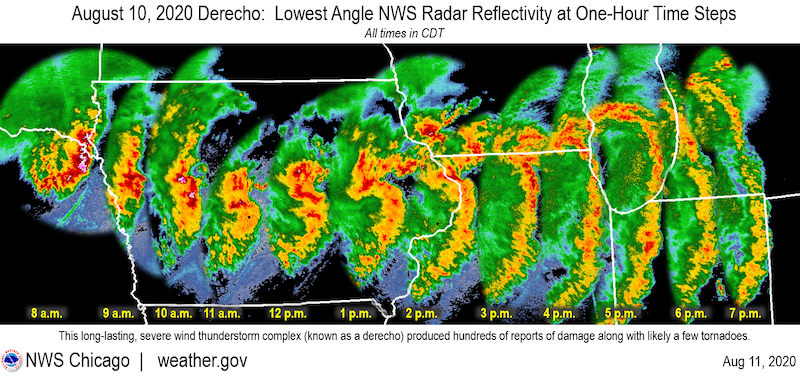
A map of several states with 12 successively longer parallel arcs in red, surrounded by other colors, across it.
This composite radar image shows the progression of a derecho on August 10, 2020. This derecho caused 3 deaths and an estimated $11 billion in storm damage. It knocked out power for millions of people. Image via NOAA/ National Weather Service/ Wikipedia.

Science news, night sky events and beautiful photos, all in one place. Click here to subscribe to our free daily newsletter.

What is a derecho?

Derecho is a term weather-watchers like to throw around a lot in the summer. But what is it? It’s a take on the Spanish word derecho which can mean straight ahead. A derecho in meteorology is a widespread, long-lived windstorm. It’s associated with a line of fast-moving thunderstorms that causes damage for more than 240 miles (385 km). And it contains winds of 58 mph (93 kph) or greater along most the length of the storm’s path.

Derechos are the result of downburst clusters, or groups of downbursts. These downbursts are strong damaging wind gusts in a thunderstorm moving downward. An individual downburst can be up to 6 miles (10 km) in size. On the other hand, a downburst cluster can be up to 60 miles (100 km) long. The damage that derechos produce is due to straight-line winds, as opposed to the swirling winds of a tornado.

Sometimes people mistakenly call derechos “inland hurricanes” or even large tornadoes. But neither of these are true. Hurricanes form over warm ocean water. Meanwhile, derechos can produce hurricane-force winds and form over land, usually as a complex of thunderstorms, before strengthening further. And the widest tornado on record in the United States was 2.6 miles wide. That’s far smaller than the hundreds of miles wide some derechos can be. We’ve talked a bit of what they are, as well as what they aren’t … so how does a complex of thunderstorms become a derecho?

Street scene with rubble, roof parts, mashed car, and general destruction.
Damage caused by a 2022 derecho in Barga, Italy. Image via Wikipedia (CC BY-SA 4.0).

How do derechos form?

A thunderstorm has a series of updrafts and downdrafts. As the downdraft, which is rain-cooled, reaches the ground, it spreads out. This burst of cooler air is the gust front, sometimes called an outflow boundary. While it can signify a storm is starting to collapse, it can also help fuel more storm development.

The gust front can act as a mini-cold front, forcing warm, humid air up into the sky. And this creates rising motion and prompts the development of another thunderstorm. As that storm gets stronger, it also produces rain-cooled air, strengthening the gust front. This creates an inflow that tilts the updraft of the thunderstorms. Then, the storms expand, producing more rain, which cools more air, which makes the gust front stronger, which causes the thunderstorms to bow out. When thunderstorms bow out, they are called bow echoes, because as those strong winds reach the ground they spread out.

We explain how bow echoes are formed because derechos typically start out as bow echoes. This process can continue across hundreds of miles for hours at a time, impacting thousands – and sometimes even millions – of people.

Diagram of a tall cloud with a wind direction arrows and a colorful, arc-shaped radar image on the ground below it.
The dashed orange arrow is an inflow into the storm. The inflow tilts the thunderstorm’s updraft (the red arrow) allowing the storm to expand and produce more rain. It also strengthens the gust front (arc-shaped blue line with blue triangles) and bowing out the storm. Image via NOAA.

When is derecho season?

Like most thunderstorm-related severe weather, derechos are most common in the warmer months, typically May through August. In fact, nearly 70% of all derechos in the United States occur during this period. To break it down further, 22% happen in May, 20% in June and 21% in July. Like any severe weather, though, derechos can happen at any time, even during the cooler months.

Serial derechos are more likely to occur in the cooler months. A serial derecho comes from multiple bow echoes in a large line that can be hundreds of miles long. It often covers a very wide and long area. In the cooler months, these serial derechos will most likely develop from eastern Texas toward the southeast.

Progressive derechos are most common in the warm season. While they can travel hundreds of miles, a progressive derecho is usually narrower, as small as 40 miles (65 km) wide. They can also start narrow and grow to be hundreds of miles wide. Most progressive derechos will occur in the northern Plains and Upper Midwest of the United States.

Map of US with concentric colored areas in the east, darker in the center, concentrating on northern Arkansas.
The most common locations for derechos in the United States. Image via NOAA.

How to prepare for derechos

According to NOAA, derechos kill more people than EF0 and EF1 tornadoes combined, and EF0 and EF1 tornadoes make up 80% of all recorded tornadoes! While tornadoes can cause significant destruction, derechos can cause a wide path of destruction and move into communities at 60 to 70 miles per hour (about 96 to 112 kph).

Roughly half of all recorded derecho deaths were people in vehicles or boats. The boat deaths were typically because the boat overturned due to high winds, causing drowning. The vehicle deaths are due to higher profile vehicles blowing over and smaller cars driven into trees, or, often, trees falling on vehicles.

This is why you need to be prepared. If a derecho is occurring, it will fall under a “Severe Thunderstorm Warning” issued by your local National Weather Service office. Derechos can catch people off guard because they move fast. So no matter what your plans are, but especially if you plan to be outside: Always check the weather!

Get weather alerts

If you plan to be outside, have emergency alerts on your mobile device turned on, or bring a mobile weather radio with you. If you plan on being inside: also have emergency alerts turned on your mobile device, and have a weather radio turned on. While derechos and tornadoes are not the same, if a severe thunderstorm warning is issued for a derecho, take cover inside a sturdy shelter, in a lower floor like you would during a tornado, away from all windows and outside walls. This will best protect you should strong winds blow out windows or a tree falls on your property.

Bottom line: Derechos are fast-moving, widespread wind storms that can produce wind gusts of hurricane-force. They are more common during the warm months of the year in the United States.

Read more: Be a storm spotter and help during severe weather

Read more: Notable derechos in recent history

The post What is a derecho? And when is derecho season? first appeared on EarthSky.


from EarthSky https://ift.tt/4M5dock
A map of several states with 12 successively longer parallel arcs in red, surrounded by other colors, across it.
This composite radar image shows the progression of a derecho on August 10, 2020. This derecho caused 3 deaths and an estimated $11 billion in storm damage. It knocked out power for millions of people. Image via NOAA/ National Weather Service/ Wikipedia.

Science news, night sky events and beautiful photos, all in one place. Click here to subscribe to our free daily newsletter.

What is a derecho?

Derecho is a term weather-watchers like to throw around a lot in the summer. But what is it? It’s a take on the Spanish word derecho which can mean straight ahead. A derecho in meteorology is a widespread, long-lived windstorm. It’s associated with a line of fast-moving thunderstorms that causes damage for more than 240 miles (385 km). And it contains winds of 58 mph (93 kph) or greater along most the length of the storm’s path.

Derechos are the result of downburst clusters, or groups of downbursts. These downbursts are strong damaging wind gusts in a thunderstorm moving downward. An individual downburst can be up to 6 miles (10 km) in size. On the other hand, a downburst cluster can be up to 60 miles (100 km) long. The damage that derechos produce is due to straight-line winds, as opposed to the swirling winds of a tornado.

Sometimes people mistakenly call derechos “inland hurricanes” or even large tornadoes. But neither of these are true. Hurricanes form over warm ocean water. Meanwhile, derechos can produce hurricane-force winds and form over land, usually as a complex of thunderstorms, before strengthening further. And the widest tornado on record in the United States was 2.6 miles wide. That’s far smaller than the hundreds of miles wide some derechos can be. We’ve talked a bit of what they are, as well as what they aren’t … so how does a complex of thunderstorms become a derecho?

Street scene with rubble, roof parts, mashed car, and general destruction.
Damage caused by a 2022 derecho in Barga, Italy. Image via Wikipedia (CC BY-SA 4.0).

How do derechos form?

A thunderstorm has a series of updrafts and downdrafts. As the downdraft, which is rain-cooled, reaches the ground, it spreads out. This burst of cooler air is the gust front, sometimes called an outflow boundary. While it can signify a storm is starting to collapse, it can also help fuel more storm development.

The gust front can act as a mini-cold front, forcing warm, humid air up into the sky. And this creates rising motion and prompts the development of another thunderstorm. As that storm gets stronger, it also produces rain-cooled air, strengthening the gust front. This creates an inflow that tilts the updraft of the thunderstorms. Then, the storms expand, producing more rain, which cools more air, which makes the gust front stronger, which causes the thunderstorms to bow out. When thunderstorms bow out, they are called bow echoes, because as those strong winds reach the ground they spread out.

We explain how bow echoes are formed because derechos typically start out as bow echoes. This process can continue across hundreds of miles for hours at a time, impacting thousands – and sometimes even millions – of people.

Diagram of a tall cloud with a wind direction arrows and a colorful, arc-shaped radar image on the ground below it.
The dashed orange arrow is an inflow into the storm. The inflow tilts the thunderstorm’s updraft (the red arrow) allowing the storm to expand and produce more rain. It also strengthens the gust front (arc-shaped blue line with blue triangles) and bowing out the storm. Image via NOAA.

When is derecho season?

Like most thunderstorm-related severe weather, derechos are most common in the warmer months, typically May through August. In fact, nearly 70% of all derechos in the United States occur during this period. To break it down further, 22% happen in May, 20% in June and 21% in July. Like any severe weather, though, derechos can happen at any time, even during the cooler months.

Serial derechos are more likely to occur in the cooler months. A serial derecho comes from multiple bow echoes in a large line that can be hundreds of miles long. It often covers a very wide and long area. In the cooler months, these serial derechos will most likely develop from eastern Texas toward the southeast.

Progressive derechos are most common in the warm season. While they can travel hundreds of miles, a progressive derecho is usually narrower, as small as 40 miles (65 km) wide. They can also start narrow and grow to be hundreds of miles wide. Most progressive derechos will occur in the northern Plains and Upper Midwest of the United States.

Map of US with concentric colored areas in the east, darker in the center, concentrating on northern Arkansas.
The most common locations for derechos in the United States. Image via NOAA.

How to prepare for derechos

According to NOAA, derechos kill more people than EF0 and EF1 tornadoes combined, and EF0 and EF1 tornadoes make up 80% of all recorded tornadoes! While tornadoes can cause significant destruction, derechos can cause a wide path of destruction and move into communities at 60 to 70 miles per hour (about 96 to 112 kph).

Roughly half of all recorded derecho deaths were people in vehicles or boats. The boat deaths were typically because the boat overturned due to high winds, causing drowning. The vehicle deaths are due to higher profile vehicles blowing over and smaller cars driven into trees, or, often, trees falling on vehicles.

This is why you need to be prepared. If a derecho is occurring, it will fall under a “Severe Thunderstorm Warning” issued by your local National Weather Service office. Derechos can catch people off guard because they move fast. So no matter what your plans are, but especially if you plan to be outside: Always check the weather!

Get weather alerts

If you plan to be outside, have emergency alerts on your mobile device turned on, or bring a mobile weather radio with you. If you plan on being inside: also have emergency alerts turned on your mobile device, and have a weather radio turned on. While derechos and tornadoes are not the same, if a severe thunderstorm warning is issued for a derecho, take cover inside a sturdy shelter, in a lower floor like you would during a tornado, away from all windows and outside walls. This will best protect you should strong winds blow out windows or a tree falls on your property.

Bottom line: Derechos are fast-moving, widespread wind storms that can produce wind gusts of hurricane-force. They are more common during the warm months of the year in the United States.

Read more: Be a storm spotter and help during severe weather

Read more: Notable derechos in recent history

The post What is a derecho? And when is derecho season? first appeared on EarthSky.


from EarthSky https://ift.tt/4M5dock

NASA releases 12,000 Artemis pics! See our faves here

Moon with some crater visible at top right and a glow all around it.
This is one of the thousands of images from the Artemis 2 mission that NASA recently released. In this image, you can see the moon, with some craters visible at top left, and the glow of the eclipsed sun shining behind. Over the weekend, NASA released 12,000 Artemis pics to the public. See our favorites below. Image via NASA.

NASA releases 12,000 Artemis pics!

NASA has released more than 12,000 images from the Artemis 2 mission on its website. They are a collection of views of Earth and the moon that the astronauts captured while aboard their spacecraft, Integrity. The website is here. Note that a high interest in the images has caused the website to go offline numerous times since NASA released the pictures.

To find images from the Artemis 2 mission, you’ll want to click on Search Photos. Then scroll down to the box that says “Search using NASA Photo IDs” and enter ART002-E (for the Artemis 2 mission). Then hit Run Query. Voilà!

At this point, the image data is mostly blank. A few of the downloads shared information on which astronaut – Reid Wiseman, Victor Glover, Christina Koch, and Jeremy Hansen – took the image. But most did not. Eventually, the details on who took each photo with what equipment and what you’re seeing in the photo will come.

It’s not the smoothest process! But thankfully, beloved science communicator Hank Green has built a solution. He’s created a website that allows you to view the best Artemis 2 mission photos in chronological order. Take a look. And he’s currently running a public vote to find the best of the new 12,000 photos so he can add them to the site. You can take part here.

And now, relive the thrill of the mission with some of EarthSky’s favorite images below.

You deserve a daily dose of good news. For the latest in science and the night sky, click here to subscribe to our free daily newsletter.

Some of our faves

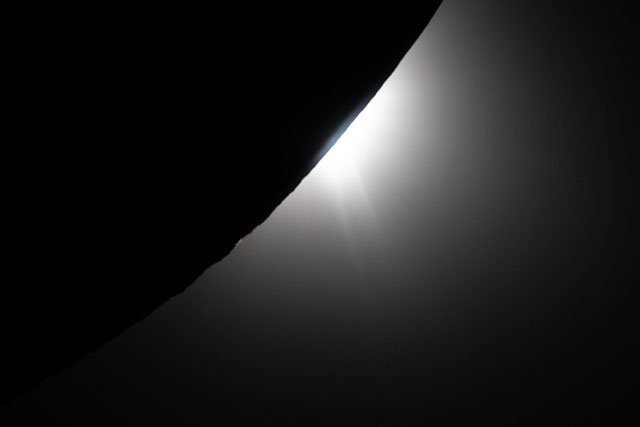
Limb of the moon with some unevenness on the surface and the glow of the sun behind.
Reid Wiseman took this image showing sunlight peeking out from behind the moon. You can even see some unevenness in the moon’s terrain on the limb (edge). Image via NASA.
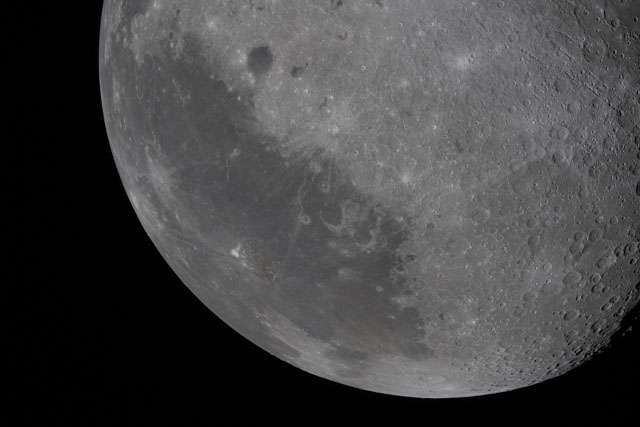
12,000 Artemis pics: A portion of the moon with some craters that almost resemble a bear's face.
Here’s a shot of the moon that Reid Wiseman took during their lunar flyby. Instead of a man in the moon, can you see craters that almost create an image of a bear’s face near the center of the image? Image via NASA.
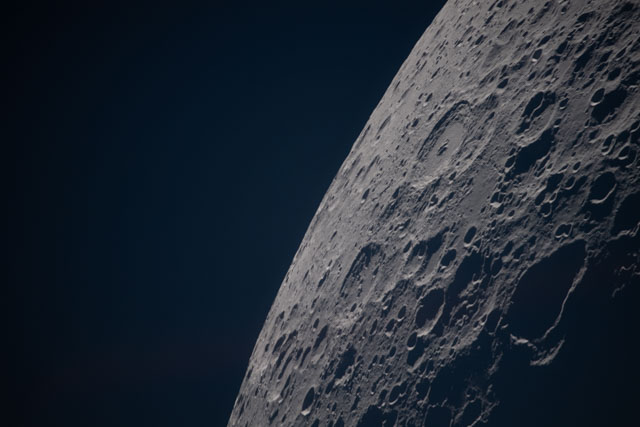
Closeup of the cratered moon's limb.
This closeup of the moon’s cratered limb is from Victor Glover. Image via NASA.
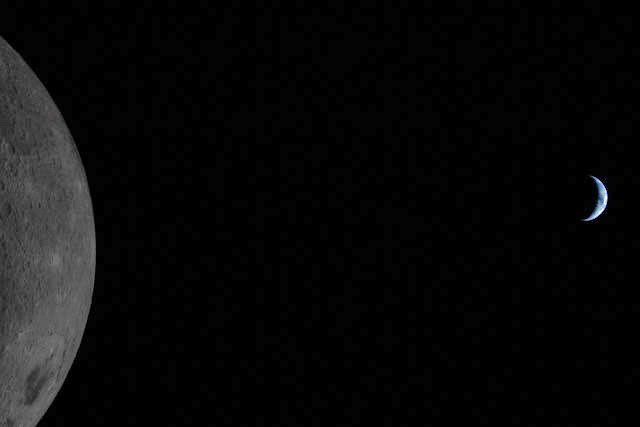
Moon on left closeup, crescent Earth on right.
Christina Koch captured this image of the moon (left) and distant Earth (right). Image via NASA.

Looking toward home

Crescent Earth lit on the right side.
Here’s a view of the crescent Earth from the window of the Integrity spacecraft. Image via NASA.
A dark-ish Earth with a sliver of light on the right side.
This is the “dark side” of Earth, with the sun lighting up the limb (edge) on the right. Image via NASA.
Thin light blue curve showing Earth's atmosphere and dark space.
Victor Glover took this image of Earth’s thin atmosphere lit from behind. Image via NASA.
Part of Earth showing blue water and white clouds plus a little land below.
Victor Glover captured this image of home. Image via NASA.

Seeing stars

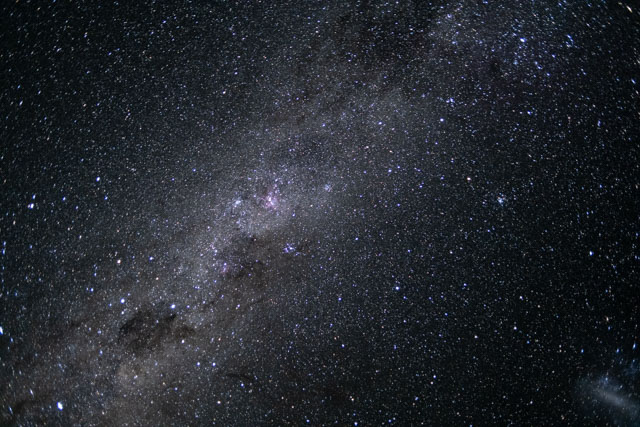
The starry Milky Way with some cloudy patches of gas and dust.
The Artemis 2 astronauts also had a good view of the Milky Way galaxy. Image via NASA.
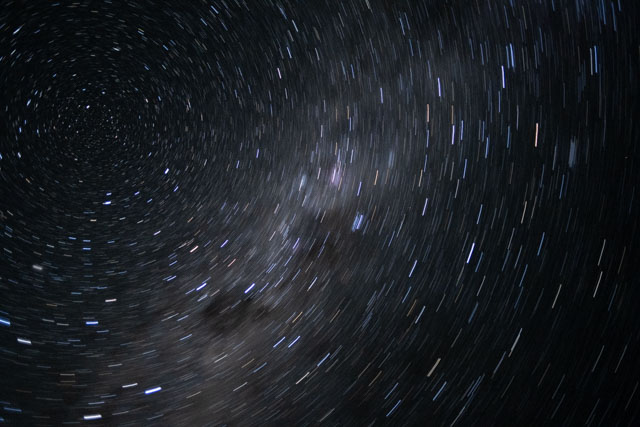
Milky Way plus star trails.
Here’s a view of the Milky Way with a time lapse that reveals star trails. Image via NASA.

Bottom line: NASA has released more than 12,000 Artemis pics to the public. See some of our favorites here and find out how to access them yourself!

Read more: Artemis 2 splashdown! Astronauts return safely from historic mission

The post NASA releases 12,000 Artemis pics! See our faves here first appeared on EarthSky.


from EarthSky https://ift.tt/BVwKQTc
Moon with some crater visible at top right and a glow all around it.
This is one of the thousands of images from the Artemis 2 mission that NASA recently released. In this image, you can see the moon, with some craters visible at top left, and the glow of the eclipsed sun shining behind. Over the weekend, NASA released 12,000 Artemis pics to the public. See our favorites below. Image via NASA.

NASA releases 12,000 Artemis pics!

NASA has released more than 12,000 images from the Artemis 2 mission on its website. They are a collection of views of Earth and the moon that the astronauts captured while aboard their spacecraft, Integrity. The website is here. Note that a high interest in the images has caused the website to go offline numerous times since NASA released the pictures.

To find images from the Artemis 2 mission, you’ll want to click on Search Photos. Then scroll down to the box that says “Search using NASA Photo IDs” and enter ART002-E (for the Artemis 2 mission). Then hit Run Query. Voilà!

At this point, the image data is mostly blank. A few of the downloads shared information on which astronaut – Reid Wiseman, Victor Glover, Christina Koch, and Jeremy Hansen – took the image. But most did not. Eventually, the details on who took each photo with what equipment and what you’re seeing in the photo will come.

It’s not the smoothest process! But thankfully, beloved science communicator Hank Green has built a solution. He’s created a website that allows you to view the best Artemis 2 mission photos in chronological order. Take a look. And he’s currently running a public vote to find the best of the new 12,000 photos so he can add them to the site. You can take part here.

And now, relive the thrill of the mission with some of EarthSky’s favorite images below.

You deserve a daily dose of good news. For the latest in science and the night sky, click here to subscribe to our free daily newsletter.

Some of our faves

Limb of the moon with some unevenness on the surface and the glow of the sun behind.
Reid Wiseman took this image showing sunlight peeking out from behind the moon. You can even see some unevenness in the moon’s terrain on the limb (edge). Image via NASA.
12,000 Artemis pics: A portion of the moon with some craters that almost resemble a bear's face.
Here’s a shot of the moon that Reid Wiseman took during their lunar flyby. Instead of a man in the moon, can you see craters that almost create an image of a bear’s face near the center of the image? Image via NASA.
Closeup of the cratered moon's limb.
This closeup of the moon’s cratered limb is from Victor Glover. Image via NASA.
Moon on left closeup, crescent Earth on right.
Christina Koch captured this image of the moon (left) and distant Earth (right). Image via NASA.

Looking toward home

Crescent Earth lit on the right side.
Here’s a view of the crescent Earth from the window of the Integrity spacecraft. Image via NASA.
A dark-ish Earth with a sliver of light on the right side.
This is the “dark side” of Earth, with the sun lighting up the limb (edge) on the right. Image via NASA.
Thin light blue curve showing Earth's atmosphere and dark space.
Victor Glover took this image of Earth’s thin atmosphere lit from behind. Image via NASA.
Part of Earth showing blue water and white clouds plus a little land below.
Victor Glover captured this image of home. Image via NASA.

Seeing stars

The starry Milky Way with some cloudy patches of gas and dust.
The Artemis 2 astronauts also had a good view of the Milky Way galaxy. Image via NASA.
Milky Way plus star trails.
Here’s a view of the Milky Way with a time lapse that reveals star trails. Image via NASA.

Bottom line: NASA has released more than 12,000 Artemis pics to the public. See some of our favorites here and find out how to access them yourself!

Read more: Artemis 2 splashdown! Astronauts return safely from historic mission

The post NASA releases 12,000 Artemis pics! See our faves here first appeared on EarthSky.


from EarthSky https://ift.tt/BVwKQTc

Today in science: Neil Armstrong’s close call


This amazing footage from 1968 shows Neil Armstrong’s close call while training for his moon landing.

Science news, night sky events and beautiful photos, all in one place. Click here to subscribe to EarthSky’s free daily newsletter.

On this day in May 6, 1968: Neil Armstrong’s close call

In 1969, Neil Armstrong became the first human to set foot on the moon. But things could have been very different. More than a year earlier, he narrowly escaped from a dramatic accident during training.

He was flying in the Lunar Landing Research Vehicle (LLRV) at Ellington Air Force Base near Houston. The LLRV had been designed to simulate a descent to the moon’s surface, and all the lunar astronauts trained in it. That day, while Armstrong was piloting, a leaking propellant caused a total failure of his flight controls.

He attempted to right the vehicle, but to no avail. The craft plummeted to the ground … and he ejected just before impact. See the dramatic footage of Neil Armstrong’s close call above.

Neil Armstrong: Boyish looking man in space suit with helmet off grinning at the camera.
Neil Armstrong in the lunar module Eagle shortly after his historic 1st moonwalk, when he became the 1st human to set foot on a world besides Earth. Image via NASA/ Wikipedia.

Armstrong made it through unscathed

Armstrong was fine. He bit his tongue hard during his landing by parachute, but otherwise was uninjured. Smithsonian magazine described this encounter between Armstrong and another astronaut later that day:

… astronaut Alan Bean saw Armstrong that afternoon at his desk in the astronaut office. Bean then heard colleagues in the hall talking about the accident, and asked them: ‘When did this happen?’, ‘About an hour ago,’ they replied.

Bean returned to Armstrong and said: ‘I just heard the funniest story!’ Armstrong said: ‘What?’

‘I heard that you bailed out of the LLRV an hour ago.’

‘Yeah, I did,’ replied Armstrong. ‘I lost control and had to bail out of the darn thing.’

Bean later recalled: ‘I can’t think of another person, let alone another astronaut, who would have just gone back to his office after ejecting a fraction of a second before getting killed.’

So no doubt … Armstrong was made of the right stuff for space travel!

Bottom line: On May 6, 1968 – more than a year before his famous first moonwalk – Neil Armstrong narrowly escaped disaster during a training accident.

Read more: Artemis 2: Return to the moon

Read more: 4 astronauts win Congressional Gold Medals

The post Today in science: Neil Armstrong’s close call first appeared on EarthSky.


from EarthSky https://ift.tt/8DXPRku


This amazing footage from 1968 shows Neil Armstrong’s close call while training for his moon landing.

Science news, night sky events and beautiful photos, all in one place. Click here to subscribe to EarthSky’s free daily newsletter.

On this day in May 6, 1968: Neil Armstrong’s close call

In 1969, Neil Armstrong became the first human to set foot on the moon. But things could have been very different. More than a year earlier, he narrowly escaped from a dramatic accident during training.

He was flying in the Lunar Landing Research Vehicle (LLRV) at Ellington Air Force Base near Houston. The LLRV had been designed to simulate a descent to the moon’s surface, and all the lunar astronauts trained in it. That day, while Armstrong was piloting, a leaking propellant caused a total failure of his flight controls.

He attempted to right the vehicle, but to no avail. The craft plummeted to the ground … and he ejected just before impact. See the dramatic footage of Neil Armstrong’s close call above.

Neil Armstrong: Boyish looking man in space suit with helmet off grinning at the camera.
Neil Armstrong in the lunar module Eagle shortly after his historic 1st moonwalk, when he became the 1st human to set foot on a world besides Earth. Image via NASA/ Wikipedia.

Armstrong made it through unscathed

Armstrong was fine. He bit his tongue hard during his landing by parachute, but otherwise was uninjured. Smithsonian magazine described this encounter between Armstrong and another astronaut later that day:

… astronaut Alan Bean saw Armstrong that afternoon at his desk in the astronaut office. Bean then heard colleagues in the hall talking about the accident, and asked them: ‘When did this happen?’, ‘About an hour ago,’ they replied.

Bean returned to Armstrong and said: ‘I just heard the funniest story!’ Armstrong said: ‘What?’

‘I heard that you bailed out of the LLRV an hour ago.’

‘Yeah, I did,’ replied Armstrong. ‘I lost control and had to bail out of the darn thing.’

Bean later recalled: ‘I can’t think of another person, let alone another astronaut, who would have just gone back to his office after ejecting a fraction of a second before getting killed.’

So no doubt … Armstrong was made of the right stuff for space travel!

Bottom line: On May 6, 1968 – more than a year before his famous first moonwalk – Neil Armstrong narrowly escaped disaster during a training accident.

Read more: Artemis 2: Return to the moon

Read more: 4 astronauts win Congressional Gold Medals

The post Today in science: Neil Armstrong’s close call first appeared on EarthSky.


from EarthSky https://ift.tt/8DXPRku

Meet Omega Centauri, a giant globular star cluster

A large, round, symmetrical ball of thousands of stars, so dense in the middle it appears solid white.
The globular cluster Omega Centauri – with as many as 10 million stars – shows all its splendor in this image captured with ESO’s La Silla Observatory. Image via ESO/ Wikimedia Commons.

You deserve a daily dose of good news. For the latest in science and the night sky, subscribe to EarthSky’s free daily newsletter.

Omega Centauri is a monster globular star cluster

Omega Centauri is the largest known globular star cluster of the Milky Way. This behemoth, also known as NGC 5139, contains about 10 million stars, and has a diameter of about 150 light-years. That makes it 10 times more massive than a typical globular cluster.

It’s not only Omega Centauri’s great size that sets it apart from other globular star clusters. While most globular clusters are made of stars of a similar age and composition, Omega Centauri is different. It holds stellar populations that formed at various periods of time. It may be that Omega Centauri is something other than a globular cluster. Instead, it might be a remnant of a small galaxy absorbed by our Milky Way galaxy in the distant past!

Despite all its stars, scientists have said Omega Centauri is probably not home to life. Why? Stars are packed so tightly inside Omega Centauri that the average distance between stars in the cluster’s core is 0.1 light-years. That’s much closer than the sun’s nearest neighbor, Proxima Centauri, at 4.25 light-years. So scientists suspect that stars in Omega Centauri would gravitationally interact with each other too frequently to harbor stable habitable planets.

What’s a globular star cluster?

The symmetrical, round appearance of Omega Centauri distinguishes it from star clusters such as the Pleiades and Hyades. These are examples of what astronomers call open star clusters.

An open star cluster is a loose gathering of dozens to hundreds of young stars that formed together within the disk of the Milky Way galaxy. Open clusters are weakly held together by gravity, and tend to disperse after several hundreds of millions of years.

Globular clusters, on the other hand, orbit the Milky Way outside the galactic disk. They harbor tens of thousands to millions of stars. Tightly bound by gravity, globular clusters remain intact for billions of years.

Sphere of thousands of densely packed multicolored stars, less dense toward edges.
Omega Centauri in infrared light captured by the Spitzer Space Telescope. Image via NASA/ Wikimedia Commons.

How to see Omega Centauri

Omega Centauri is the most luminous of all globular star clusters, making it a great object for stargazers. It sits far to the south on the sky’s dome. It’s visible from the southern half of the United States, or south of 40 degrees north latitude (the latitude of Denver, Colorado and Beijing, China).

However, it’s been said that Canadians can spot Omega Centauri from as far north as Point Pelee (42 degrees north latitude). When seeing conditions are just right, they say they can catch Omega Centauri skimming along the surface of Lake Erie.

On the other hand, from the Southern Hemisphere, Omega Centauri appears much higher in the sky and is a glorious sight.

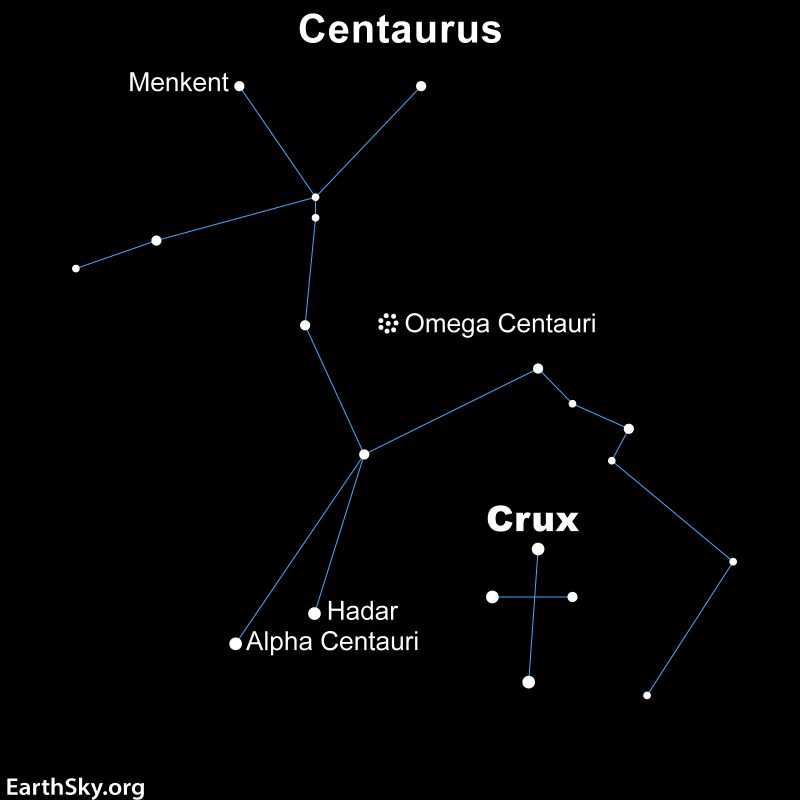
Chart of large centaur-shaped constellation, with Crux, Omega Centauri and several stars labeled.
From the Southern Hemisphere, use the bright constellation Crux as a guide to find Centaurus and Omega Centauri.

It’s visible to the unaided eye

At about 16,000 light-years away, Omega Centauri is one of the few of our galaxy’s 150 or so globular clusters that is visible to the unaided eye.

It shines at +3.9 magnitude. It looks like a faint, fuzzy star. Like any globular cluster, Omega Centauri is best viewed with a telescope. Even a small scope will reveal a delicate, glittering ball of stars that becomes almost impossibly dense toward the center.

Finding Omega Centauri from the Northern Hemisphere

From some northerly latitudes, Omega Centauri is never visible. But it can be seen in more southerly parts of the Nothern Hemisphere. To see if it’s visible where you are, try inputting your location in Stellarium.

If you’re in part of the Northern Hemisphere that can see this cluster, know that it can only be seen at certain times of the year. It’s best seen in the evening sky from the Northern Hemisphere late on April, May and June evenings.

So around mid-May, this wondrous star cluster is highest up and due south around 11 p.m. your local daylight-saving time.

Then, by mid-June, Omega Centauri is highest up and due south around 10 p.m. your local daylight-saving time.

Some Northern Hemisphere residents can see Omega Centauri from January through April as well, but they must be willing to stay up past midnight or get up before dawn.

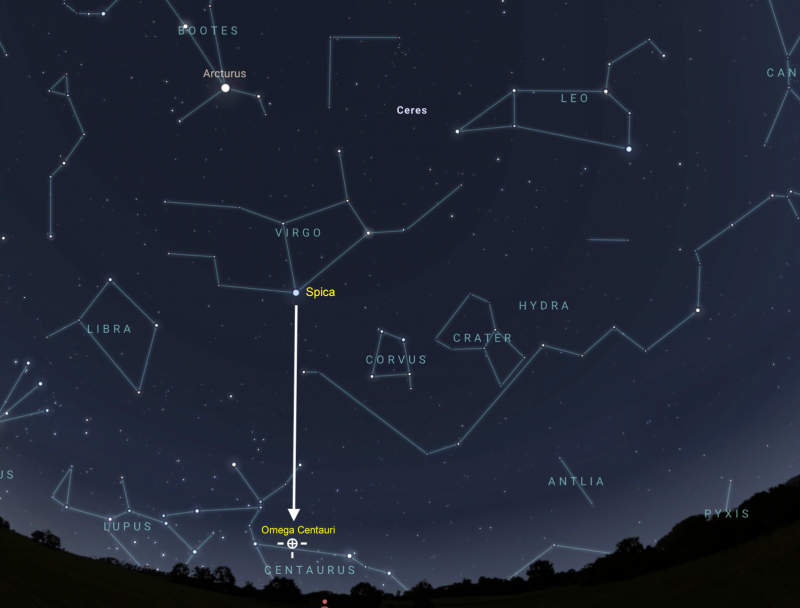
Star map with constellations. An arrow points straight down from Spica to Omega Centauri near the horizon.
Use the bright blue-white star Spica to locate the large Omega Centauri star cluster on Northern Hemisphere spring evenings. This chart shows the view from 35 degrees north latitude. Image via Stellarium.

Use the Big Dipper to find Spica

For those in the Northern Hemisphere, Spica, the brightest star in the constellation Virgo the Maiden, serves as your guide star to Omega Centauri.

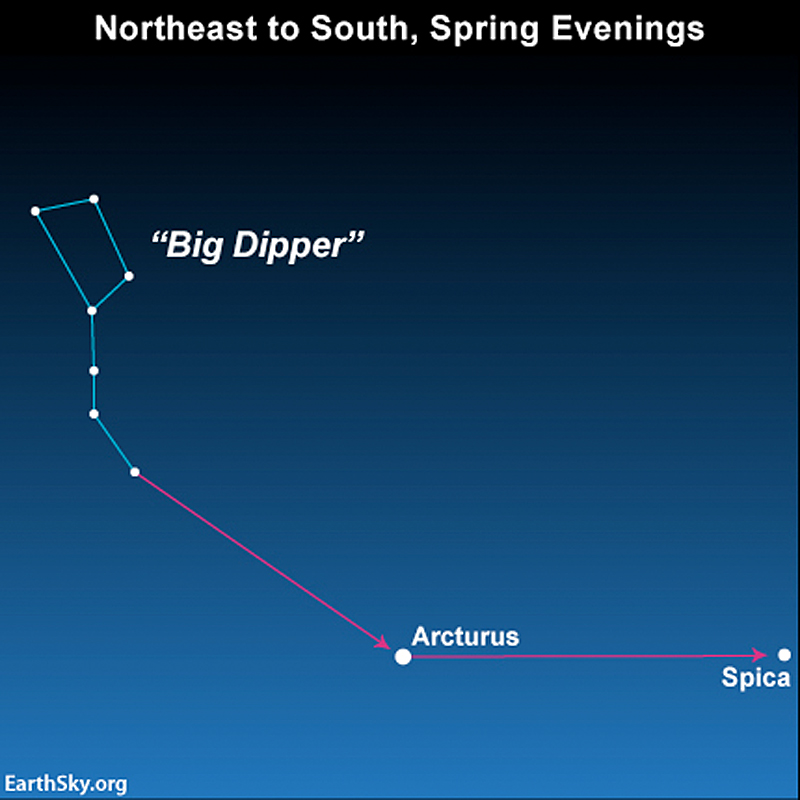
When Spica and Omega Centauri transit – appear due south and reach the highest point in the sky – they do so in unison. However, Omega Centauri transits about 35 degrees south of (or below) sparkling blue-white Spica. For reference, your fist at arm’s length is roughly 10 degrees on the sky. Find Spica by following the arc in the handle of the Big Dipper.

Star chart of Big Dipper with long magenta arrows from its handle to labeled stars Arcturus and Spica.
Use the Big Dipper to locate the stars Arcturus and Spica.

Photos from our EarthSky community

A large, spherical cluster containing thousands of bright white stars.
View at EarthSky Community Photos. | Giuseppe Pappa from Sicily, Italy, used a remote telescope in Namibia to capture this view of globular cluster Omega Centauri on May 22, 2025. Giuseppe wrote: “Omega Centauri taken remotely from Namibia. For me it is one of the most beautiful and exotic objects in the sky. Where I live in Sicily, in this period, is visible very low above the horizon. This time I photographed it from Namibia with a remotely-controlled telescope.” Thank you, Giuseppe!
A large, round, symmetrical ball of thousands of stars, so dense in the middle it appears solid white.
View at EarthSky Community Photos. | Scott Smith of Palmetto, Florida, captured this image on March 3 2025. Scott wrote: “Omega Centauri (NGC 5139 or Caldwell 80) is a globular cluster in the constellation of Centaurus. Located at a distance of 17,090 light-years, it is the largest known globular cluster in the Milky Way at a diameter of roughly 150 light-years. It is estimated to contain approximately 10 million stars, making it the most massive known globular cluster in the Milky Way.” Thank you, Scott!

Bottom line: The Milky Way’s largest globular star cluster, Omega Centauri, contains about 10 million stars. It’s visible from the Southern Hemisphere as well as parts of the Northern Hemisphere.

Enjoying EarthSky? Sign up for our free daily newsletter today!

The post Meet Omega Centauri, a giant globular star cluster first appeared on EarthSky.


from EarthSky https://ift.tt/Iou4GnY
A large, round, symmetrical ball of thousands of stars, so dense in the middle it appears solid white.
The globular cluster Omega Centauri – with as many as 10 million stars – shows all its splendor in this image captured with ESO’s La Silla Observatory. Image via ESO/ Wikimedia Commons.

You deserve a daily dose of good news. For the latest in science and the night sky, subscribe to EarthSky’s free daily newsletter.

Omega Centauri is a monster globular star cluster

Omega Centauri is the largest known globular star cluster of the Milky Way. This behemoth, also known as NGC 5139, contains about 10 million stars, and has a diameter of about 150 light-years. That makes it 10 times more massive than a typical globular cluster.

It’s not only Omega Centauri’s great size that sets it apart from other globular star clusters. While most globular clusters are made of stars of a similar age and composition, Omega Centauri is different. It holds stellar populations that formed at various periods of time. It may be that Omega Centauri is something other than a globular cluster. Instead, it might be a remnant of a small galaxy absorbed by our Milky Way galaxy in the distant past!

Despite all its stars, scientists have said Omega Centauri is probably not home to life. Why? Stars are packed so tightly inside Omega Centauri that the average distance between stars in the cluster’s core is 0.1 light-years. That’s much closer than the sun’s nearest neighbor, Proxima Centauri, at 4.25 light-years. So scientists suspect that stars in Omega Centauri would gravitationally interact with each other too frequently to harbor stable habitable planets.

What’s a globular star cluster?

The symmetrical, round appearance of Omega Centauri distinguishes it from star clusters such as the Pleiades and Hyades. These are examples of what astronomers call open star clusters.

An open star cluster is a loose gathering of dozens to hundreds of young stars that formed together within the disk of the Milky Way galaxy. Open clusters are weakly held together by gravity, and tend to disperse after several hundreds of millions of years.

Globular clusters, on the other hand, orbit the Milky Way outside the galactic disk. They harbor tens of thousands to millions of stars. Tightly bound by gravity, globular clusters remain intact for billions of years.

Sphere of thousands of densely packed multicolored stars, less dense toward edges.
Omega Centauri in infrared light captured by the Spitzer Space Telescope. Image via NASA/ Wikimedia Commons.

How to see Omega Centauri

Omega Centauri is the most luminous of all globular star clusters, making it a great object for stargazers. It sits far to the south on the sky’s dome. It’s visible from the southern half of the United States, or south of 40 degrees north latitude (the latitude of Denver, Colorado and Beijing, China).

However, it’s been said that Canadians can spot Omega Centauri from as far north as Point Pelee (42 degrees north latitude). When seeing conditions are just right, they say they can catch Omega Centauri skimming along the surface of Lake Erie.

On the other hand, from the Southern Hemisphere, Omega Centauri appears much higher in the sky and is a glorious sight.

Chart of large centaur-shaped constellation, with Crux, Omega Centauri and several stars labeled.
From the Southern Hemisphere, use the bright constellation Crux as a guide to find Centaurus and Omega Centauri.

It’s visible to the unaided eye

At about 16,000 light-years away, Omega Centauri is one of the few of our galaxy’s 150 or so globular clusters that is visible to the unaided eye.

It shines at +3.9 magnitude. It looks like a faint, fuzzy star. Like any globular cluster, Omega Centauri is best viewed with a telescope. Even a small scope will reveal a delicate, glittering ball of stars that becomes almost impossibly dense toward the center.

Finding Omega Centauri from the Northern Hemisphere

From some northerly latitudes, Omega Centauri is never visible. But it can be seen in more southerly parts of the Nothern Hemisphere. To see if it’s visible where you are, try inputting your location in Stellarium.

If you’re in part of the Northern Hemisphere that can see this cluster, know that it can only be seen at certain times of the year. It’s best seen in the evening sky from the Northern Hemisphere late on April, May and June evenings.

So around mid-May, this wondrous star cluster is highest up and due south around 11 p.m. your local daylight-saving time.

Then, by mid-June, Omega Centauri is highest up and due south around 10 p.m. your local daylight-saving time.

Some Northern Hemisphere residents can see Omega Centauri from January through April as well, but they must be willing to stay up past midnight or get up before dawn.

Star map with constellations. An arrow points straight down from Spica to Omega Centauri near the horizon.
Use the bright blue-white star Spica to locate the large Omega Centauri star cluster on Northern Hemisphere spring evenings. This chart shows the view from 35 degrees north latitude. Image via Stellarium.

Use the Big Dipper to find Spica

For those in the Northern Hemisphere, Spica, the brightest star in the constellation Virgo the Maiden, serves as your guide star to Omega Centauri.

When Spica and Omega Centauri transit – appear due south and reach the highest point in the sky – they do so in unison. However, Omega Centauri transits about 35 degrees south of (or below) sparkling blue-white Spica. For reference, your fist at arm’s length is roughly 10 degrees on the sky. Find Spica by following the arc in the handle of the Big Dipper.

Star chart of Big Dipper with long magenta arrows from its handle to labeled stars Arcturus and Spica.
Use the Big Dipper to locate the stars Arcturus and Spica.

Photos from our EarthSky community

A large, spherical cluster containing thousands of bright white stars.
View at EarthSky Community Photos. | Giuseppe Pappa from Sicily, Italy, used a remote telescope in Namibia to capture this view of globular cluster Omega Centauri on May 22, 2025. Giuseppe wrote: “Omega Centauri taken remotely from Namibia. For me it is one of the most beautiful and exotic objects in the sky. Where I live in Sicily, in this period, is visible very low above the horizon. This time I photographed it from Namibia with a remotely-controlled telescope.” Thank you, Giuseppe!
A large, round, symmetrical ball of thousands of stars, so dense in the middle it appears solid white.
View at EarthSky Community Photos. | Scott Smith of Palmetto, Florida, captured this image on March 3 2025. Scott wrote: “Omega Centauri (NGC 5139 or Caldwell 80) is a globular cluster in the constellation of Centaurus. Located at a distance of 17,090 light-years, it is the largest known globular cluster in the Milky Way at a diameter of roughly 150 light-years. It is estimated to contain approximately 10 million stars, making it the most massive known globular cluster in the Milky Way.” Thank you, Scott!

Bottom line: The Milky Way’s largest globular star cluster, Omega Centauri, contains about 10 million stars. It’s visible from the Southern Hemisphere as well as parts of the Northern Hemisphere.

Enjoying EarthSky? Sign up for our free daily newsletter today!

The post Meet Omega Centauri, a giant globular star cluster first appeared on EarthSky.


from EarthSky https://ift.tt/Iou4GnY

1st American in space, 65 years ago today

American in space: Young man's face seen through clear helmet visor, plastic pipes running from helmet to space suit.
Astronaut Alan B. Shepard Jr. was the 1st American in space. Here he is in his silver pressure suit with the helmet visor closed, preparing for his historic flight into space. Date of photo: April 20, 1961. Image via NASA.

Science news, night sky events and beautiful photos, all in one place. Click here to subscribe to EarthSky’s free daily newsletter.

Alan Shepard becomes 1st American in space

May 5, 1961. Just 23 days after Yuri Gagarin of the Soviet Union became the first person in space, NASA launched astronaut Alan Shepard aboard the Freedom 7 capsule powered by a Redstone booster to become the first American in space. His historic flight began from Cape Canaveral in Florida and, notably, lasted 15 minutes and 28 seconds before a splashdown in the Atlantic Ocean.

During the rocket’s acceleration, Shepard experienced 6.3 g (g-forces), or 6.3 times his normal weight, just before shutdown of the Redstone engine two minutes and 22 seconds after liftoff. Soon after, America’s first space traveler got sight of the Earth from above and became the first astronaut to say:

What a beautiful view.

Splashdown: Mission success!

His spacecraft splashed down in the Atlantic Ocean, 302 miles (486 kilometers) from Cape Canaveral. Subsequently, a helicopter recovered him and Freedom 7 and transported them to the waiting aircraft carrier USS Lake Champlain. After his flight, the astronaut joked:

It’s a very sobering feeling to be up in space and realize that one’s safety factor was determined by the lowest bidder on a government contract.

View from above in helicopter down on man being towed out of water.
A serviceman hoists Alan Shepard out of the ocean and onto an awaiting helicopter in 1961. Image via NASA.

Project Mercury put the 1st American in space

Alan Shepard was one of 110 test flight pilots who volunteered for NASA’s manned space flight program – Project Mercury – in 1959. Later, NASA selected him and six other pilots to be part of the project. All of the pilots went through a rigorous training regimen before NASA made a final selection. Of these magnificent seven, America’s first astronauts, NASA chose Shepard to become the first American to travel into space.

Meanwhile, the first American to orbit Earth was John Glenn, aboard Friendship 7 on February 20, 1962.

Click here for an early NASA film showing the type of training undergone by the first astronauts

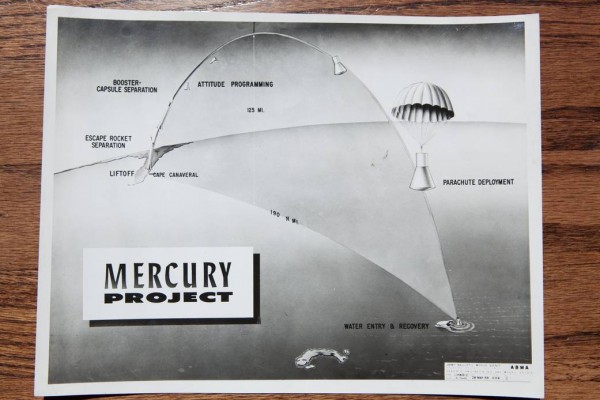
Map diagram of length and height of space capsule flight from Florida to the ocean.
Trajectory of Alan Shepard’s flight aboard Freedom 7 on May 5, 1961. Image via NASA.

Competing against the Soviet Union during the Cold War

NASA launched Alan Shepard into space against a backdrop of the Cold War. The Soviet Union had launched Yuri Gagarin on April 12, 1961, aboard a spacecraft named Vostok (Russian for East). Gagarin completed a single orbit of the Earth, landing after a flight of one hour and 29 minutes. Consequently, he became a hero in the Soviet Union and around the world.

Then three weeks later, NASA astronaut Alan Shepard flew aboard a Mercury spacecraft, which he had named Freedom 7. Kurt Debus, who was NASA’s Launch Operations director at the time and who would go on to serve as the first director of the Kennedy Space Center, said years later:

We knew we were in a competitive situation. But, we never permitted the pressure to make us take risks that might endanger Shepard’s life or the success of the mission.

The Space Race heats up

Just weeks after Shepard’s flight, the Space Race began to heat up. Significantly, on May 25, 1961, President John F. Kennedy gave a stirring speech before a joint session of Congress, in which he declared his intention to focus U.S. efforts on landing humans on the moon within a decade. Among other things, he said:

I believe that this nation should commit itself to achieving the goal, before this decade is out, of landing a man on the moon and returning him safely to the Earth.

In due time, the first human footsteps on the moon took place on July 20, 1969. On that date, Apollo 11’s lunar module – named the Eagle – successfully landed on the moon.

Read more: Return to the moon: Artemis 2

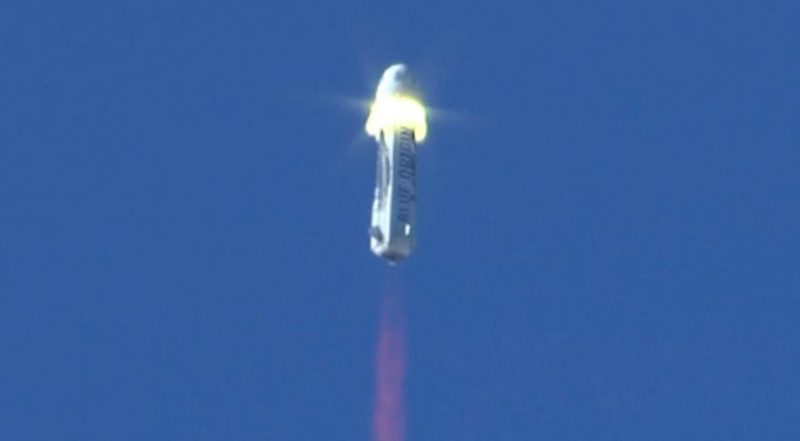
Rocket blasting off into blue sky.
The New Shepard crew capsule – named for Alan Shepard – separates from its propulsion module during an October 5, 2016, in-flight test. New Shepard is a reusable launch system – a vertical-takeoff, vertical-landing suborbital manned rocket – being developed by Blue Origin as a commercial system for suborbital space tourism. Image via Blue Origin/ SpaceNews.com.

Bottom line: Alan Shepard became the first American in space on May 5, 1961. His suborbital flight took place just three weeks after the Soviet Union’s Yuri Gagarin orbited Earth.

Read more: 7 weird things space does to the human body

The post 1st American in space, 65 years ago today first appeared on EarthSky.


from EarthSky https://ift.tt/b2rJLG8
American in space: Young man's face seen through clear helmet visor, plastic pipes running from helmet to space suit.
Astronaut Alan B. Shepard Jr. was the 1st American in space. Here he is in his silver pressure suit with the helmet visor closed, preparing for his historic flight into space. Date of photo: April 20, 1961. Image via NASA.

Science news, night sky events and beautiful photos, all in one place. Click here to subscribe to EarthSky’s free daily newsletter.

Alan Shepard becomes 1st American in space

May 5, 1961. Just 23 days after Yuri Gagarin of the Soviet Union became the first person in space, NASA launched astronaut Alan Shepard aboard the Freedom 7 capsule powered by a Redstone booster to become the first American in space. His historic flight began from Cape Canaveral in Florida and, notably, lasted 15 minutes and 28 seconds before a splashdown in the Atlantic Ocean.

During the rocket’s acceleration, Shepard experienced 6.3 g (g-forces), or 6.3 times his normal weight, just before shutdown of the Redstone engine two minutes and 22 seconds after liftoff. Soon after, America’s first space traveler got sight of the Earth from above and became the first astronaut to say:

What a beautiful view.

Splashdown: Mission success!

His spacecraft splashed down in the Atlantic Ocean, 302 miles (486 kilometers) from Cape Canaveral. Subsequently, a helicopter recovered him and Freedom 7 and transported them to the waiting aircraft carrier USS Lake Champlain. After his flight, the astronaut joked:

It’s a very sobering feeling to be up in space and realize that one’s safety factor was determined by the lowest bidder on a government contract.

View from above in helicopter down on man being towed out of water.
A serviceman hoists Alan Shepard out of the ocean and onto an awaiting helicopter in 1961. Image via NASA.

Project Mercury put the 1st American in space

Alan Shepard was one of 110 test flight pilots who volunteered for NASA’s manned space flight program – Project Mercury – in 1959. Later, NASA selected him and six other pilots to be part of the project. All of the pilots went through a rigorous training regimen before NASA made a final selection. Of these magnificent seven, America’s first astronauts, NASA chose Shepard to become the first American to travel into space.

Meanwhile, the first American to orbit Earth was John Glenn, aboard Friendship 7 on February 20, 1962.

Click here for an early NASA film showing the type of training undergone by the first astronauts

Map diagram of length and height of space capsule flight from Florida to the ocean.
Trajectory of Alan Shepard’s flight aboard Freedom 7 on May 5, 1961. Image via NASA.

Competing against the Soviet Union during the Cold War

NASA launched Alan Shepard into space against a backdrop of the Cold War. The Soviet Union had launched Yuri Gagarin on April 12, 1961, aboard a spacecraft named Vostok (Russian for East). Gagarin completed a single orbit of the Earth, landing after a flight of one hour and 29 minutes. Consequently, he became a hero in the Soviet Union and around the world.

Then three weeks later, NASA astronaut Alan Shepard flew aboard a Mercury spacecraft, which he had named Freedom 7. Kurt Debus, who was NASA’s Launch Operations director at the time and who would go on to serve as the first director of the Kennedy Space Center, said years later:

We knew we were in a competitive situation. But, we never permitted the pressure to make us take risks that might endanger Shepard’s life or the success of the mission.

The Space Race heats up

Just weeks after Shepard’s flight, the Space Race began to heat up. Significantly, on May 25, 1961, President John F. Kennedy gave a stirring speech before a joint session of Congress, in which he declared his intention to focus U.S. efforts on landing humans on the moon within a decade. Among other things, he said:

I believe that this nation should commit itself to achieving the goal, before this decade is out, of landing a man on the moon and returning him safely to the Earth.

In due time, the first human footsteps on the moon took place on July 20, 1969. On that date, Apollo 11’s lunar module – named the Eagle – successfully landed on the moon.

Read more: Return to the moon: Artemis 2

Rocket blasting off into blue sky.
The New Shepard crew capsule – named for Alan Shepard – separates from its propulsion module during an October 5, 2016, in-flight test. New Shepard is a reusable launch system – a vertical-takeoff, vertical-landing suborbital manned rocket – being developed by Blue Origin as a commercial system for suborbital space tourism. Image via Blue Origin/ SpaceNews.com.

Bottom line: Alan Shepard became the first American in space on May 5, 1961. His suborbital flight took place just three weeks after the Soviet Union’s Yuri Gagarin orbited Earth.

Read more: 7 weird things space does to the human body

The post 1st American in space, 65 years ago today first appeared on EarthSky.


from EarthSky https://ift.tt/b2rJLG8

Archaeologists recreate Pompeii victim using AI technology

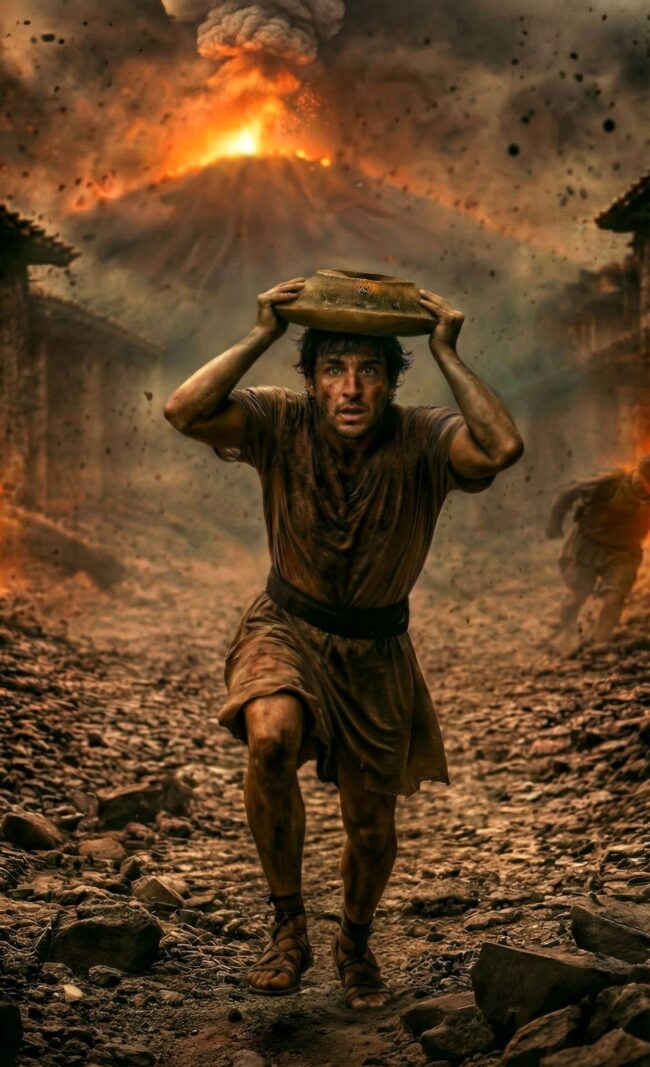
Pompeii: A man in a brown tunic, running through rubble holding a large bowl over his head, with erupting volcano behind him.
Archaeologists used AI to create this image of a man fleeing in ancient Pompeii, which was destroyed during the eruption of Mount Vesuvius in 79 CE. So the image is fake … but the man was real. His skeleton was found holding a bowl over his head as he fled. Image via Pompeii Archaeological Park/ University of Padua – Digital Cultural Heritage Laboratory/ Ministry of Culture.

Archaeologists recreate Pompeii victim using AI technology

In 79 CE, Mount Vesuvius erupted above Pompeii, Italy, filling the air with flying rocks. A man ran through the streets of the Porta Stabia neighborhood, holding a terracotta bowl over his head for protection from the heavy shower of volcanic ash. But it wasn’t enough. He didn’t escape the devastation.

In 2024, archaeologists unearthed the skeleton of this man just outside one of Pompeii’s busiest gates. They found him curled up with the fractured terracotta bowl near his head. He also carried a ceramic lamp in an attempt to see through the ash-darkened streets. And he wore a small iron ring on his left little finger and carried 10 bronze coins.

On April 27, 2026, the Pompeii Archaeological Park in Italy said that, for the first time, it has reconstructed the moments just before the man’s ultimate fate, using AI digital technology.

Researchers used artificial intelligence software and photo editing techniques to create the image above. They wanted to present a scientifically sound image that was still accessible to the general public.

Science news, night sky events and beautiful photos, all in one place. Click here to subscribe to our free daily newsletter.

Archaeology and AI

The Pompeii Archaeological Park, in collaboration with the University of Padua – Digital Cultural Heritage Laboratory and the Ministry of Culture, created the AI reconstruction based on the skeleton and nearby materials. Minister of Culture Alessandro Giuli talked about the intersection of excavations and AI. Giuli said:

The investigations conducted with these excavations demonstrate that innovative methodologies, used rigorously, can offer us new historical perspectives.

Pompeii’s director Gabriel Zuchtriegel added:

The vastness of archaeological data at Pompeii and beyond is now such that only with the help of artificial intelligence will we be able to adequately protect and enhance it. If used well, AI can contribute to a renewal of classical studies, narrating the classical world in a more immersive way.

And Jacopo Bonetto of the University of Padua said:

The project opens a broader debate on the use of AI in archaeology: a technology that can contribute to the production of interpretative models and the improvement of communication tools, but which requires controlled and methodologically sound use, always in integration with the work of specialists.

Reconstructing the last moments

Luciano Floridi is the founding director of the Digital Ethics Center at Yale. Floridi said:

The man of Pompeii fled with a mortar on his head, a lamp in his hand, and ten coins: he carried whatever he thought was useful for orienting himself in the darkness. Two thousand years later, AI is helping us reconstruct his last moments.

AI does not replace the archaeologist. Under its control, it expands and deepens his potential and makes accessible to many what was previously accessible only to a few. Without AI, much of the heritage risks remaining unexplored for those who practice archaeology, and silent for those who love it …

AI produces hypotheses, not truths. Hypotheses must be reviewed, discussed, corrected, integrated, approved. Scientific responsibility cannot be delegated. But the risk is not that AI makes mistakes: it’s that we stop thinking by using it. The humanities teach us precisely this, to distinguish reconstruction from fantasy. Pompeii, once again, is the great laboratory that teaches us.

Pliny the Younger

The story of this man who ran for his life while trying to protect his head echoes the stories told by an eyewitness. Pliny the Younger wrote two accounts of the eruption at Pompeii. In them, he described people trying to protect their heads with objects, including tying pillows to their heads.

Photos from the excavation

Skeleton curled up with a large terracotta bowl with a fracture missing near its head.
The skeleton of the man was near a large terracotta bowl that had a fracture. Image via Pompeii Archaeological Park/ University of Padua – Digital Cultural Heritage Laboratory/ Ministry of Culture.
Small, brown clay lamp on gravel surface with a black and white scale ruler.
Archaeologists also found a ceramic lamp near the skeleton of the man who was trying to protect his head. Image via Pompeii Archaeological Park/ University of Padua – Digital Cultural Heritage Laboratory/ Ministry of Culture.
A skeleton that is lying on its side in a running position with feet apart.
There was a second victim uncovered close to the man with the bowl protecting his head. This victim was a bit younger and likely died some hours after the first man. Archaeologists think he was overcome as he tried to run from the pyroclastic flow. A pyroclastic flow is fast-moving gas and ash that sweeps down from an eruption. These flows kill via incineration and asphyxiation. Image via Pompeii Archaeological Park/ University of Padua – Digital Cultural Heritage Laboratory/ Ministry of Culture.

Bottom line: Archaeologists have used AI technology to recreate a Pompeii victim. The man fled the volcano while trying to protect his head with a terracotta bowl.

Via Pompeii Archaeological Park

The post Archaeologists recreate Pompeii victim using AI technology first appeared on EarthSky.


from EarthSky https://ift.tt/RQWlPpd
Pompeii: A man in a brown tunic, running through rubble holding a large bowl over his head, with erupting volcano behind him.
Archaeologists used AI to create this image of a man fleeing in ancient Pompeii, which was destroyed during the eruption of Mount Vesuvius in 79 CE. So the image is fake … but the man was real. His skeleton was found holding a bowl over his head as he fled. Image via Pompeii Archaeological Park/ University of Padua – Digital Cultural Heritage Laboratory/ Ministry of Culture.

Archaeologists recreate Pompeii victim using AI technology

In 79 CE, Mount Vesuvius erupted above Pompeii, Italy, filling the air with flying rocks. A man ran through the streets of the Porta Stabia neighborhood, holding a terracotta bowl over his head for protection from the heavy shower of volcanic ash. But it wasn’t enough. He didn’t escape the devastation.

In 2024, archaeologists unearthed the skeleton of this man just outside one of Pompeii’s busiest gates. They found him curled up with the fractured terracotta bowl near his head. He also carried a ceramic lamp in an attempt to see through the ash-darkened streets. And he wore a small iron ring on his left little finger and carried 10 bronze coins.

On April 27, 2026, the Pompeii Archaeological Park in Italy said that, for the first time, it has reconstructed the moments just before the man’s ultimate fate, using AI digital technology.

Researchers used artificial intelligence software and photo editing techniques to create the image above. They wanted to present a scientifically sound image that was still accessible to the general public.

Science news, night sky events and beautiful photos, all in one place. Click here to subscribe to our free daily newsletter.

Archaeology and AI

The Pompeii Archaeological Park, in collaboration with the University of Padua – Digital Cultural Heritage Laboratory and the Ministry of Culture, created the AI reconstruction based on the skeleton and nearby materials. Minister of Culture Alessandro Giuli talked about the intersection of excavations and AI. Giuli said:

The investigations conducted with these excavations demonstrate that innovative methodologies, used rigorously, can offer us new historical perspectives.

Pompeii’s director Gabriel Zuchtriegel added:

The vastness of archaeological data at Pompeii and beyond is now such that only with the help of artificial intelligence will we be able to adequately protect and enhance it. If used well, AI can contribute to a renewal of classical studies, narrating the classical world in a more immersive way.

And Jacopo Bonetto of the University of Padua said:

The project opens a broader debate on the use of AI in archaeology: a technology that can contribute to the production of interpretative models and the improvement of communication tools, but which requires controlled and methodologically sound use, always in integration with the work of specialists.

Reconstructing the last moments

Luciano Floridi is the founding director of the Digital Ethics Center at Yale. Floridi said:

The man of Pompeii fled with a mortar on his head, a lamp in his hand, and ten coins: he carried whatever he thought was useful for orienting himself in the darkness. Two thousand years later, AI is helping us reconstruct his last moments.

AI does not replace the archaeologist. Under its control, it expands and deepens his potential and makes accessible to many what was previously accessible only to a few. Without AI, much of the heritage risks remaining unexplored for those who practice archaeology, and silent for those who love it …

AI produces hypotheses, not truths. Hypotheses must be reviewed, discussed, corrected, integrated, approved. Scientific responsibility cannot be delegated. But the risk is not that AI makes mistakes: it’s that we stop thinking by using it. The humanities teach us precisely this, to distinguish reconstruction from fantasy. Pompeii, once again, is the great laboratory that teaches us.

Pliny the Younger

The story of this man who ran for his life while trying to protect his head echoes the stories told by an eyewitness. Pliny the Younger wrote two accounts of the eruption at Pompeii. In them, he described people trying to protect their heads with objects, including tying pillows to their heads.

Photos from the excavation

Skeleton curled up with a large terracotta bowl with a fracture missing near its head.
The skeleton of the man was near a large terracotta bowl that had a fracture. Image via Pompeii Archaeological Park/ University of Padua – Digital Cultural Heritage Laboratory/ Ministry of Culture.
Small, brown clay lamp on gravel surface with a black and white scale ruler.
Archaeologists also found a ceramic lamp near the skeleton of the man who was trying to protect his head. Image via Pompeii Archaeological Park/ University of Padua – Digital Cultural Heritage Laboratory/ Ministry of Culture.
A skeleton that is lying on its side in a running position with feet apart.
There was a second victim uncovered close to the man with the bowl protecting his head. This victim was a bit younger and likely died some hours after the first man. Archaeologists think he was overcome as he tried to run from the pyroclastic flow. A pyroclastic flow is fast-moving gas and ash that sweeps down from an eruption. These flows kill via incineration and asphyxiation. Image via Pompeii Archaeological Park/ University of Padua – Digital Cultural Heritage Laboratory/ Ministry of Culture.

Bottom line: Archaeologists have used AI technology to recreate a Pompeii victim. The man fled the volcano while trying to protect his head with a terracotta bowl.

Via Pompeii Archaeological Park

The post Archaeologists recreate Pompeii victim using AI technology first appeared on EarthSky.


from EarthSky https://ift.tt/RQWlPpd

adds 2