
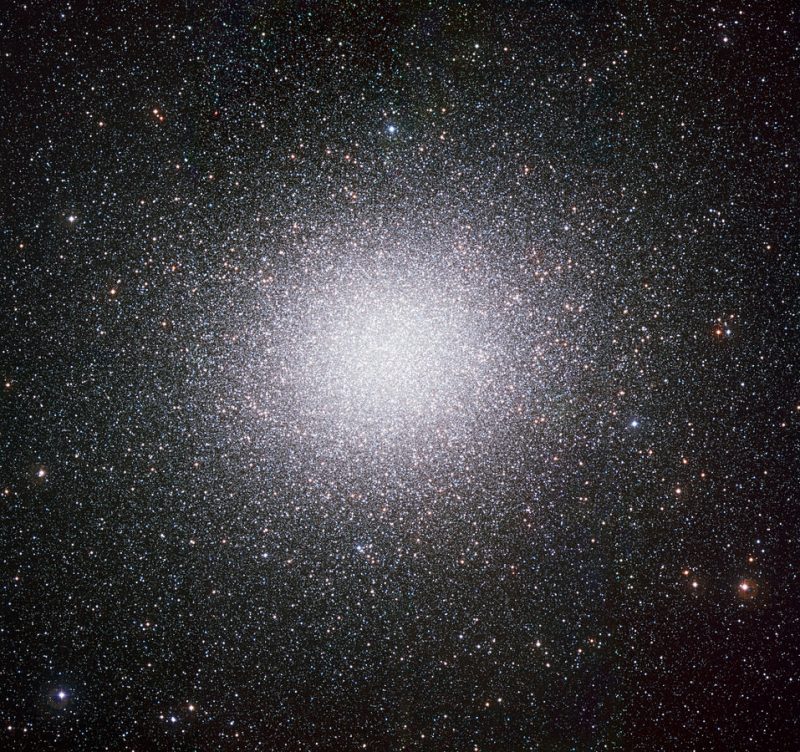
Omega Centauri is a monster globular star cluster
Omega Centauri is the largest known globular star cluster of the Milky Way. This behemoth, also known as NGC 5139, contains about 10 million stars, and has a diameter of about 150 light-years. That makes it 10 times more massive than a typical globular cluster.
It’s not only Omega Centauri’s great size that sets it apart from other globular star clusters. While most globular clusters are made of stars of a similar age and composition, Omega Centauri is different. It holds stellar populations that formed at various periods of time. It may be that Omega Centauri is something other than a globular cluster. Instead, it might be a remnant of a small galaxy absorbed by our Milky Way galaxy in the distant past!
Despite all its stars, scientists have said Omega Centauri is probably not home to life. Why? Stars are packed so tightly inside Omega Centauri that the average distance between stars in the cluster’s core is 0.1 light-years. That’s much closer than the sun’s nearest neighbor, Proxima Centauri, at 4.25 light-years. So scientists suspect that stars in Omega Centauri would gravitationally interact with each other too frequently to harbor stable habitable planets.
What’s a globular star cluster?
The symmetrical, round appearance of Omega Centauri distinguishes it from star clusters such as the Pleiades and Hyades. These are examples of what astronomers call open star clusters.
An open star cluster is a loose gathering of dozens to hundreds of young stars that formed together within the disk of the Milky Way galaxy. Open clusters are weakly held together by gravity, and tend to disperse after several hundreds of millions of years.
Globular clusters, on the other hand, orbit the Milky Way outside the galactic disk. They harbor tens of thousands to millions of stars. Tightly bound by gravity, globular clusters remain intact for billions of years.
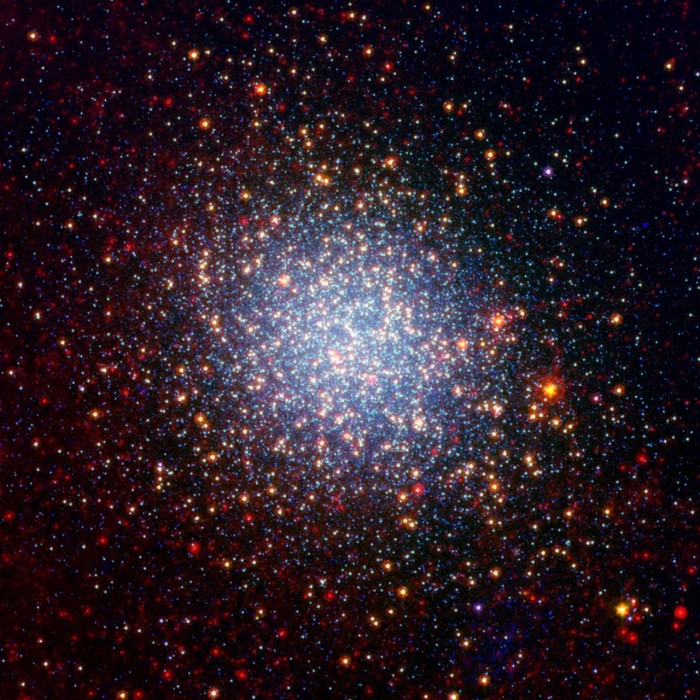
How to see Omega Centauri
Omega Centauri is the most luminous of all globular star clusters, making it a great object for stargazers. It sits far to the south on the sky’s dome. It’s visible from the southern half of the United States, or south of 40 degrees north latitude (the latitude of Denver, Colorado and Beijing, China).
However, it’s been said that Canadians can spot Omega Centauri from as far north as Point Pelee (42 degrees north latitude). When seeing conditions are just right, they say they can catch Omega Centauri skimming along the surface of Lake Erie.
On the other hand, from the Southern Hemisphere, Omega Centauri appears much higher in the sky and is a glorious sight.
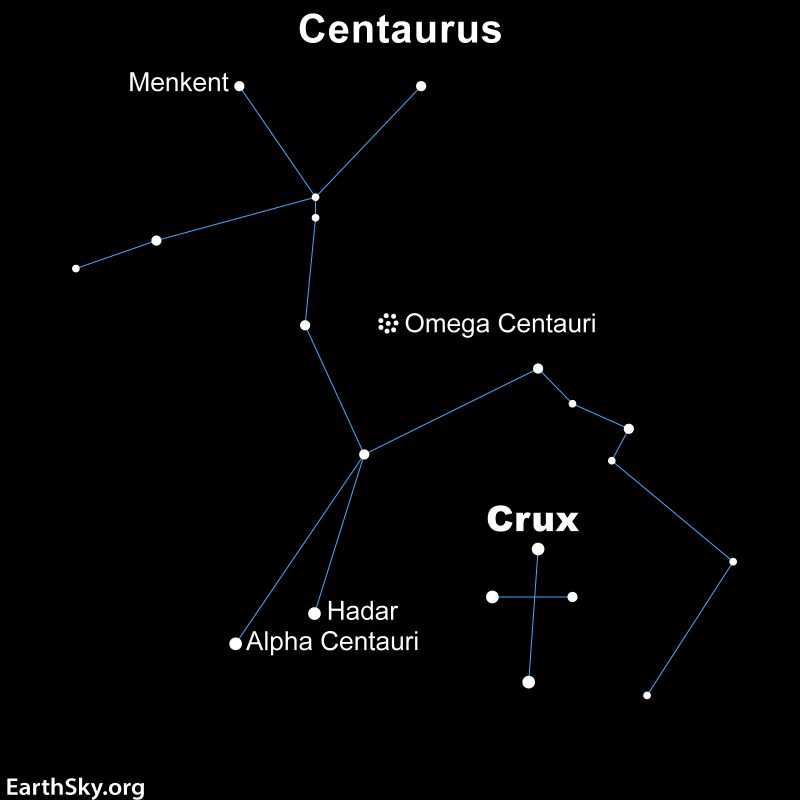
It’s visible to the unaided eye
At about 16,000 light-years away, Omega Centauri is one of the few of our galaxy’s 150 or so globular clusters that is visible to the unaided eye.
It shines at +3.9 magnitude. It looks like a faint, fuzzy star. Like any globular cluster, Omega Centauri is best viewed with a telescope. Even a small scope will reveal a delicate, glittering ball of stars that becomes almost impossibly dense toward the center.
Finding Omega Centauri from the Northern Hemisphere
From some northerly latitudes, Omega Centauri is never visible. But it can be seen in more southerly parts of the Nothern Hemisphere. To see if it’s visible where you are, try inputting your location in Stellarium.
If you’re in part of the Northern Hemisphere that can see this cluster, know that it can only be seen at certain times of the year. It’s best seen in the evening sky from the Northern Hemisphere late on April, May and June evenings.
So around mid-May, this wondrous star cluster is highest up and due south around 11 p.m. your local daylight-saving time.
Then, by mid-June, Omega Centauri is highest up and due south around 10 p.m. your local daylight-saving time.
Some Northern Hemisphere residents can see Omega Centauri from January through April as well, but they must be willing to stay up past midnight or get up before dawn.
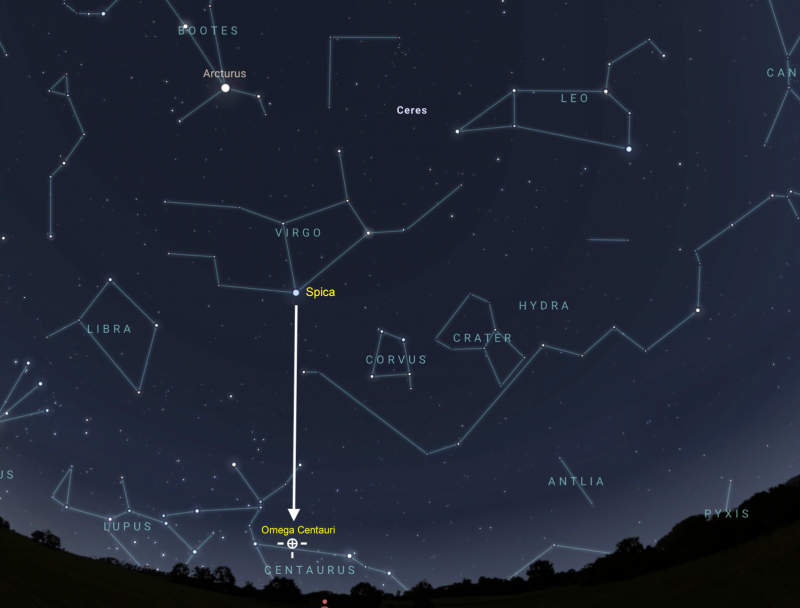
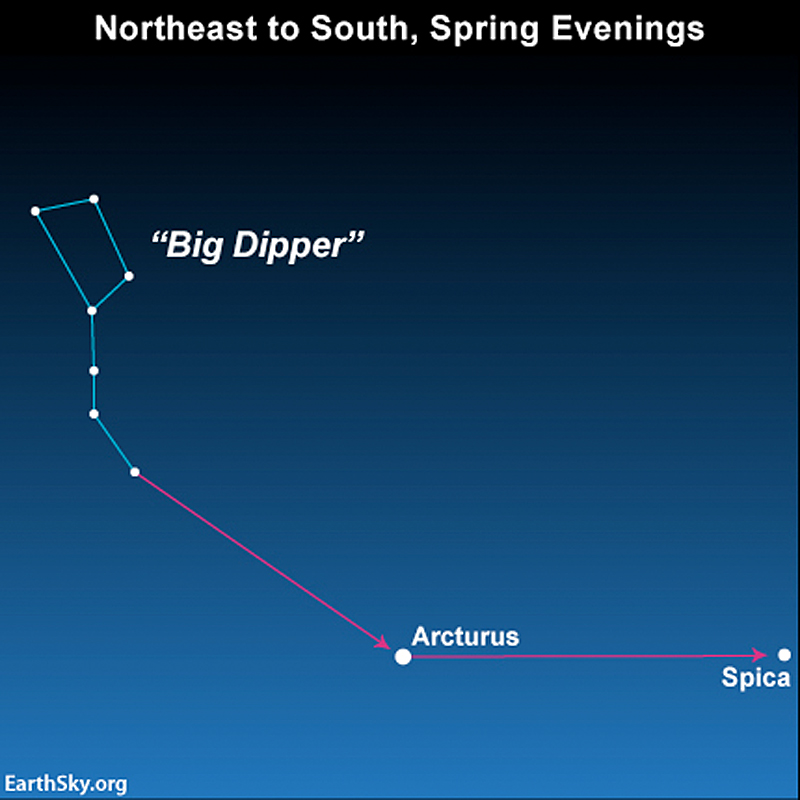
Use the Big Dipper to find Spica
For those in the Northern Hemisphere, Spica, the brightest star in the constellation Virgo the Maiden, serves as your guide star to Omega Centauri.
When Spica and Omega Centauri transit – appear due south and reach the highest point in the sky – they do so in unison. However, Omega Centauri transits about 35 degrees south of (or below) sparkling blue-white Spica. For reference, your fist at arm’s length is roughly 10 degrees on the sky. Find Spica by following the arc in the handle of the Big Dipper.
Photos from our EarthSky community


Bottom line: The Milky Way’s largest globular star cluster, Omega Centauri, contains about 10 million stars. It’s visible from the Southern Hemisphere as well as parts of the Northern Hemisphere.
Enjoying EarthSky? Sign up for our free daily newsletter today!
The post Meet Omega Centauri, a giant globular star cluster first appeared on EarthSky.
from EarthSky https://ift.tt/Iou4GnY
Omega Centauri is a monster globular star cluster
Omega Centauri is the largest known globular star cluster of the Milky Way. This behemoth, also known as NGC 5139, contains about 10 million stars, and has a diameter of about 150 light-years. That makes it 10 times more massive than a typical globular cluster.
It’s not only Omega Centauri’s great size that sets it apart from other globular star clusters. While most globular clusters are made of stars of a similar age and composition, Omega Centauri is different. It holds stellar populations that formed at various periods of time. It may be that Omega Centauri is something other than a globular cluster. Instead, it might be a remnant of a small galaxy absorbed by our Milky Way galaxy in the distant past!
Despite all its stars, scientists have said Omega Centauri is probably not home to life. Why? Stars are packed so tightly inside Omega Centauri that the average distance between stars in the cluster’s core is 0.1 light-years. That’s much closer than the sun’s nearest neighbor, Proxima Centauri, at 4.25 light-years. So scientists suspect that stars in Omega Centauri would gravitationally interact with each other too frequently to harbor stable habitable planets.
What’s a globular star cluster?
The symmetrical, round appearance of Omega Centauri distinguishes it from star clusters such as the Pleiades and Hyades. These are examples of what astronomers call open star clusters.
An open star cluster is a loose gathering of dozens to hundreds of young stars that formed together within the disk of the Milky Way galaxy. Open clusters are weakly held together by gravity, and tend to disperse after several hundreds of millions of years.
Globular clusters, on the other hand, orbit the Milky Way outside the galactic disk. They harbor tens of thousands to millions of stars. Tightly bound by gravity, globular clusters remain intact for billions of years.
How to see Omega Centauri
Omega Centauri is the most luminous of all globular star clusters, making it a great object for stargazers. It sits far to the south on the sky’s dome. It’s visible from the southern half of the United States, or south of 40 degrees north latitude (the latitude of Denver, Colorado and Beijing, China).
However, it’s been said that Canadians can spot Omega Centauri from as far north as Point Pelee (42 degrees north latitude). When seeing conditions are just right, they say they can catch Omega Centauri skimming along the surface of Lake Erie.
On the other hand, from the Southern Hemisphere, Omega Centauri appears much higher in the sky and is a glorious sight.
It’s visible to the unaided eye
At about 16,000 light-years away, Omega Centauri is one of the few of our galaxy’s 150 or so globular clusters that is visible to the unaided eye.
It shines at +3.9 magnitude. It looks like a faint, fuzzy star. Like any globular cluster, Omega Centauri is best viewed with a telescope. Even a small scope will reveal a delicate, glittering ball of stars that becomes almost impossibly dense toward the center.
Finding Omega Centauri from the Northern Hemisphere
From some northerly latitudes, Omega Centauri is never visible. But it can be seen in more southerly parts of the Nothern Hemisphere. To see if it’s visible where you are, try inputting your location in Stellarium.
If you’re in part of the Northern Hemisphere that can see this cluster, know that it can only be seen at certain times of the year. It’s best seen in the evening sky from the Northern Hemisphere late on April, May and June evenings.
So around mid-May, this wondrous star cluster is highest up and due south around 11 p.m. your local daylight-saving time.
Then, by mid-June, Omega Centauri is highest up and due south around 10 p.m. your local daylight-saving time.
Some Northern Hemisphere residents can see Omega Centauri from January through April as well, but they must be willing to stay up past midnight or get up before dawn.
Use the Big Dipper to find Spica
For those in the Northern Hemisphere, Spica, the brightest star in the constellation Virgo the Maiden, serves as your guide star to Omega Centauri.
When Spica and Omega Centauri transit – appear due south and reach the highest point in the sky – they do so in unison. However, Omega Centauri transits about 35 degrees south of (or below) sparkling blue-white Spica. For reference, your fist at arm’s length is roughly 10 degrees on the sky. Find Spica by following the arc in the handle of the Big Dipper.
Photos from our EarthSky community
Bottom line: The Milky Way’s largest globular star cluster, Omega Centauri, contains about 10 million stars. It’s visible from the Southern Hemisphere as well as parts of the Northern Hemisphere.
Enjoying EarthSky? Sign up for our free daily newsletter today!
The post Meet Omega Centauri, a giant globular star cluster first appeared on EarthSky.
from EarthSky https://ift.tt/Iou4GnY

Aucun commentaire:
Enregistrer un commentaire