aads

May birthstone: The magnificent green emerald

May birthstone. Five green faceted gems, rectangular with the corners cut off (emerald cut).
The May birthstone is the emerald. Image via Mauro Cateb/ Wikipedia (CC BY-SA 3.0).

Science news, night sky events and beautiful photos, all in one place. Click here to subscribe to EarthSky’s free daily newsletter.

The emerald, May’s birthstone

The emerald belongs to the beryl family of minerals. This family also includes aquamarine (one of March’s birthstones). And it includes heliodor, aka golden or yellow beryl. It also includes morganite, which has an orange-pink color.

Beryl is a six-sided symmetrical crystal. Chemically, it contains beryllium, aluminum, silicon, and oxygen.

Emeralds vary in color from light to deep green. And it’s commonly thought that an emerald’s color derives from the presence of chromium and/or vanadium replacing some of the aluminum in the mineral’s structure.

Emeralds are known to lose their color when heated strongly.

They’re most frequently found inside a form of shale, a fine-grained sedimentary rock. Emerald-bearing shale has undergone recrystallization pressure and/or temperature changes.

Columnar natural crystal, greener with inclusions at the bottom fading to near clear at the top.
A 5-carat emerald crystal. Image via Rob Lavinsky/ Wikipedia (CC BY-SA 3.0).

History of emeralds

Knowledge of emeralds date back to antiquity. The name emerald derives from the Greek word smaragdos, a term applied to several kinds of green stones.

Royalty wore them in ancient Babylon and Egypt. For example, Queen Cleopatra is known to have worn emeralds, during her reign in Egypt from 51–30 BCE. It’s said her emeralds probably originated from mines in southern Egypt, near the Red Sea.

And the emerald mines of ancient Egypt had tools dating back much farther, to the reign of Ramesses II. He ruled for 66 years, between 1279 and 1213 BCE. (one of the longest reigns in ancient history).

Emeralds in South America

Emeralds weren’t just a part of the “old world.” When the conquistadors first arrived in South America from Spain in the late 1400s, they saw indigenous rulers wearing emeralds.

And today, among the famous historical artifacts containing emeralds is the Crown of the Andes, made from emeralds worn by Atahualpa, the last Inca (king) of Peru. The crown is set with about 450 emeralds, collectively weighing 10 ounces (1523 carats).

The Spanish conquerors later stole large quantities of emeralds from the Peruvians. But it took them decades to discover the source of the emeralds.

It wasn’t until 1537 that the Spaniards found Chivor in Colombia, now the location of an important emerald mine. They also took over the Muzo mine in Colombia, following the defeat of the Muzo Indians. Mining operations at Muzo have continued almost uninterrupted since the Spanish invasion. It’s perhaps the most famous emerald mine in Colombia and is said to produce the world’s best emeralds.

Emeralds in Russia and elsewhere

In 1830, a Russian peasant charcoal-burner named Maxim Kozhevnikov found several green crystals in the exposed roots of a fallen tree along the banks of the Tokovaya River in the Ural Mountains of Russia. He brought the stones to the Royal Lapidary Factory in Yekaterinburg, where the director, Yakov Kokovin, identified them as high-quality emeralds. This find sparked an immediate gem rush and the establishment of official state-run mining operations in early 1831.

Today, North Carolina – in the United States – is a source for emeralds.

Around the world, they also occur in Zambia, Brazil, Pakistan, Norway, Austria, India, Madagascar, and Australia.

German chemists began making synthetic emeralds shortly before World War II. Then, growing synthetic stones of fine quality began in the United States in 1946. Also, there are excellent imitation emeralds on the market made of colored cut glass.

White, sparkling rock with fragments of green in a line.
Rough emerald. Image via Gem Rock Auctions. Used with permission.

Find out about the birthstones for the other months of the year

January birthstone
February birthstone
March birthstone
April birthstone
May birthstone
June birthstone
July birthstone
August birthstone
September birthstone
October birthstone
November birthstone
December birthstone

Bottom line: Happy birthday, May babies! The May birthstone is the emerald, a stone once worn by royalty in ancient Babylon and Egypt. Perfect emeralds are among the rarest of all gemstones.

The post May birthstone: The magnificent green emerald first appeared on EarthSky.


from EarthSky https://ift.tt/Tnk2R6H
May birthstone. Five green faceted gems, rectangular with the corners cut off (emerald cut).
The May birthstone is the emerald. Image via Mauro Cateb/ Wikipedia (CC BY-SA 3.0).

Science news, night sky events and beautiful photos, all in one place. Click here to subscribe to EarthSky’s free daily newsletter.

The emerald, May’s birthstone

The emerald belongs to the beryl family of minerals. This family also includes aquamarine (one of March’s birthstones). And it includes heliodor, aka golden or yellow beryl. It also includes morganite, which has an orange-pink color.

Beryl is a six-sided symmetrical crystal. Chemically, it contains beryllium, aluminum, silicon, and oxygen.

Emeralds vary in color from light to deep green. And it’s commonly thought that an emerald’s color derives from the presence of chromium and/or vanadium replacing some of the aluminum in the mineral’s structure.

Emeralds are known to lose their color when heated strongly.

They’re most frequently found inside a form of shale, a fine-grained sedimentary rock. Emerald-bearing shale has undergone recrystallization pressure and/or temperature changes.

Columnar natural crystal, greener with inclusions at the bottom fading to near clear at the top.
A 5-carat emerald crystal. Image via Rob Lavinsky/ Wikipedia (CC BY-SA 3.0).

History of emeralds

Knowledge of emeralds date back to antiquity. The name emerald derives from the Greek word smaragdos, a term applied to several kinds of green stones.

Royalty wore them in ancient Babylon and Egypt. For example, Queen Cleopatra is known to have worn emeralds, during her reign in Egypt from 51–30 BCE. It’s said her emeralds probably originated from mines in southern Egypt, near the Red Sea.

And the emerald mines of ancient Egypt had tools dating back much farther, to the reign of Ramesses II. He ruled for 66 years, between 1279 and 1213 BCE. (one of the longest reigns in ancient history).

Emeralds in South America

Emeralds weren’t just a part of the “old world.” When the conquistadors first arrived in South America from Spain in the late 1400s, they saw indigenous rulers wearing emeralds.

And today, among the famous historical artifacts containing emeralds is the Crown of the Andes, made from emeralds worn by Atahualpa, the last Inca (king) of Peru. The crown is set with about 450 emeralds, collectively weighing 10 ounces (1523 carats).

The Spanish conquerors later stole large quantities of emeralds from the Peruvians. But it took them decades to discover the source of the emeralds.

It wasn’t until 1537 that the Spaniards found Chivor in Colombia, now the location of an important emerald mine. They also took over the Muzo mine in Colombia, following the defeat of the Muzo Indians. Mining operations at Muzo have continued almost uninterrupted since the Spanish invasion. It’s perhaps the most famous emerald mine in Colombia and is said to produce the world’s best emeralds.

Emeralds in Russia and elsewhere

In 1830, a Russian peasant charcoal-burner named Maxim Kozhevnikov found several green crystals in the exposed roots of a fallen tree along the banks of the Tokovaya River in the Ural Mountains of Russia. He brought the stones to the Royal Lapidary Factory in Yekaterinburg, where the director, Yakov Kokovin, identified them as high-quality emeralds. This find sparked an immediate gem rush and the establishment of official state-run mining operations in early 1831.

Today, North Carolina – in the United States – is a source for emeralds.

Around the world, they also occur in Zambia, Brazil, Pakistan, Norway, Austria, India, Madagascar, and Australia.

German chemists began making synthetic emeralds shortly before World War II. Then, growing synthetic stones of fine quality began in the United States in 1946. Also, there are excellent imitation emeralds on the market made of colored cut glass.

White, sparkling rock with fragments of green in a line.
Rough emerald. Image via Gem Rock Auctions. Used with permission.

Find out about the birthstones for the other months of the year

January birthstone
February birthstone
March birthstone
April birthstone
May birthstone
June birthstone
July birthstone
August birthstone
September birthstone
October birthstone
November birthstone
December birthstone

Bottom line: Happy birthday, May babies! The May birthstone is the emerald, a stone once worn by royalty in ancient Babylon and Egypt. Perfect emeralds are among the rarest of all gemstones.

The post May birthstone: The magnificent green emerald first appeared on EarthSky.


from EarthSky https://ift.tt/Tnk2R6H
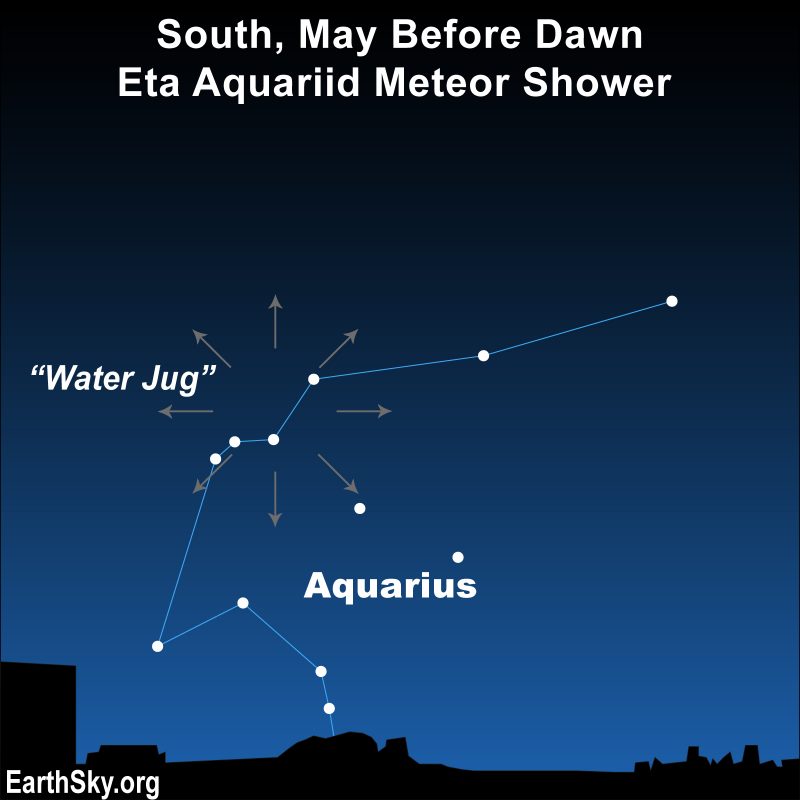
2026 Eta Aquariid meteor shower best before dawn on May 5

Meteor shower chart: Lines marking constellation with radial arrows near middle of it.
The radiant point of the Eta Aquariid meteor shower is near the star Eta Aquarii in the constellation Aquarius the Water Bearer. The radiant rises in the wee hours after midnight and is still climbing toward its highest point at dawn. That highest point is in the south as viewed from the Northern Hemisphere, closer to overhead for the Southern Hemisphere. That’s why the Southern Hemisphere sees more meteors (the radiant is higher up), and it’s why – for all of us around the globe – the hours before dawn are best for this shower.

May 2026 meteors … the Eta Aquariids

When to watch: The best morning to watch is May 5, 2026, in the hours before dawn. The American Meteor Society is listing 3:51 UTC on May 5 as the shower’s predicted** peak time. The fact is that the peak of this shower stretches out over several days. So you can expect elevated numbers of meteors a few days before and after the peak time. The mornings of both May 4 and May 6 are also good times to watch!
Nearest moon phase: The last quarter moon will fall at 21:10 UTC on May 9. So, there will be a waning gibbous moon in the post-midnight sky, that sets after sunrise. So the sky before dawn on the mornings around the predicted peak for the 2025 Eta Aquariids will compete with a bright gibbous moon. Find a way to block out the moon for a better view of the sky.
The radiant: will rise in the wee hours, climbing toward its highest point at dawn. That’s why the hours before dawn will be the best time to watch this shower.
Duration of shower: April 15 to May 27. This time period is when we’re passing through the Eta Aquariid meteor stream in space!
Expected meteors at peak, under ideal conditions: The zenithal hourly rate (ZHR) of this shower (the rate at the shower’s peak, under a dark sky, with no moon, when the radiant is high in the sky) is 60. In 2026, a waning gibbous moon will severely affect this shower, reducing hourly rates. And be aware that the shower is best for latitudes like those in the southern half of the U.S. or even farther south, in the Southern Hemisphere. These are swift meteors that produce a high percentage of persistent trains.
Note: The Eta Aquariids’ radiant will be on the ecliptic, which will ride low in the sky on spring mornings as seen from far northerly latitudes. This shower favors more southerly latitudes (like those in the southern U.S. or the Southern Hemisphere), where the radiant appears higher in the morning sky. It’s often the Southern Hemisphere’s best meteor shower of the year.

Read more: Meteors in moonlight: 6 tips for watching

More about this shower’s radiant

If you trace the paths of the Eta Aquariid meteors backward, they all seem to radiate from a point in the constellation Aquarius the Water Bearer. This point on the sky’s dome is called the radiant of the meteor shower. It nearly aligns with the faint star Eta Aquarii, and the meteor shower takes its name from this star.

Eta Aquarii is one of the four stars making up the Y-shaped Water Jar asterism in the northern part of Aquarius. If you can find the Water Jar in the constellation Aquarius, you’ve located the radiant point for the Eta Aquariid meteors. The alignment of the radiant and the star is, of course, coincidental. Eta Aquarii is some 170 light-years away – trillions upon trillions of miles away – while the Eta Aquariid meteors burn up nearby – only 60 miles (100 km) above Earth’s surface.

Meteor shower radiants are sometimes misunderstood by casual meteor-watchers. You don’t need to know where they are to watch a meteor shower. That’s because the meteors fly every way across the sky, in front of numerous constellations. However, the higher a shower’s radiant appears in your sky, the more meteors you’re likely to see. For the Eta Aquariids, the radiant soars highest in the nighttime sky just before dawn. That’s one of the reasons why you can expect to see the most meteors in the wee morning hours.

How to view a meteor shower

As with all meteors in annual showers, no special equipment is required to watch the Eta Aquariids. But a little luck always helps.

Find a dark, open sky away from artificial lights, and sprawl out on a reclining lawn chair.

Make yourself comfortable with a hot flask of your favorite beverage. Keep warm but not so snug that you fall asleep!

Meteor watching is a lot like fishing. Sometimes you catch a good number of them, and sometimes you don’t.

Meteor showers: Tips for watching the show

The Eta Aquariids’ parent comet

This section is by the late, great Don Machholz (1952-2022), who discovered 12 comets …

The object responsible for the Eta Aquariid meteor shower – that is, its parent comet – is the famous Halley’s comet. This comet is in a retrograde orbit around the sun. That means it runs around the sun in the opposite direction from Earth and all the other planets. As a result, we pass near its path twice, one time along the outbound portion of the comet’s orbit. That happens every early May, causing the Eta Aquariid meteor shower. The other time is along the inbound portion of the comet’s orbit, and that passage causes the Orionid meteor shower in late October of each year.

Halley’s comet orbits the sun on an average of every 76 years (the range is from 74 through 79 years due to perturbations of the planets). So, in most years, the comet is nowhere near when we sweep through its orbit, and when debris left behind by the comet enters our atmosphere to create Halley’s two meteor showers.

Perhaps you saw Halley’s comet when it returned last, in 1985/86. It has been observed since the year 240 BCE. Presently, the comet is traveling heading back toward the sun at about 0.6 miles a second (0.9 km/sec).

In December of 2023, the comet reached its farthest point from the sun, which binds it in orbit. Then – pulled inexorably by the sun’s gravity – it curved around and is heading back toward the inner solar system again. Halley’s comet will be back in 2061.

While waiting for Halley’s comet to return, watch for the next best thing: the Eta Aquariid meteor shower in early May.

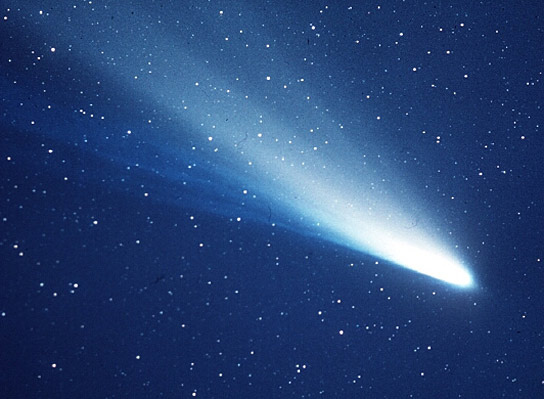
Bright white comet with wide glowing tail streaming out from it in starry deep blue sky.
Halley’s comet, the parent of the May Eta Aquariid and October Orionid meteor showers. Dust from this comet will light the night as Eta Aquariid meteors on the morning of May 5. Image via NASA.

Eta Aquariid meteor shower photos from EarthSky’s community

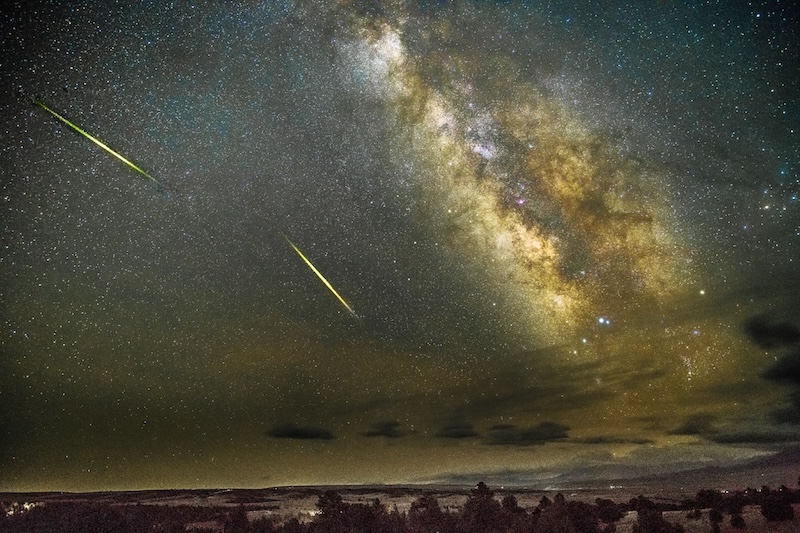
Starry sky with rich Milky Way and two meteor streaks.
View at EarthSky Community Photos. | Christoph Stopka captured some Eta Aquariid meteors on May 5, 2024, near Westcliffe, Colorado, and said: “I kept my camera pointed towards the Milky Way, hoping for a meteor streaking by. And finally, it was showtime: I saw a greenish flash to the left of the Milky Way and knew instantly I had a winner! Sure enough, when I checked my last 15 seconds exposure on the screen of the camera, I could clearly identify a good size meteor in the image. But to my big surprise, I saw that there was actually a SECOND, smaller meteor below the one I had noticed!” Thank you, Christoph!
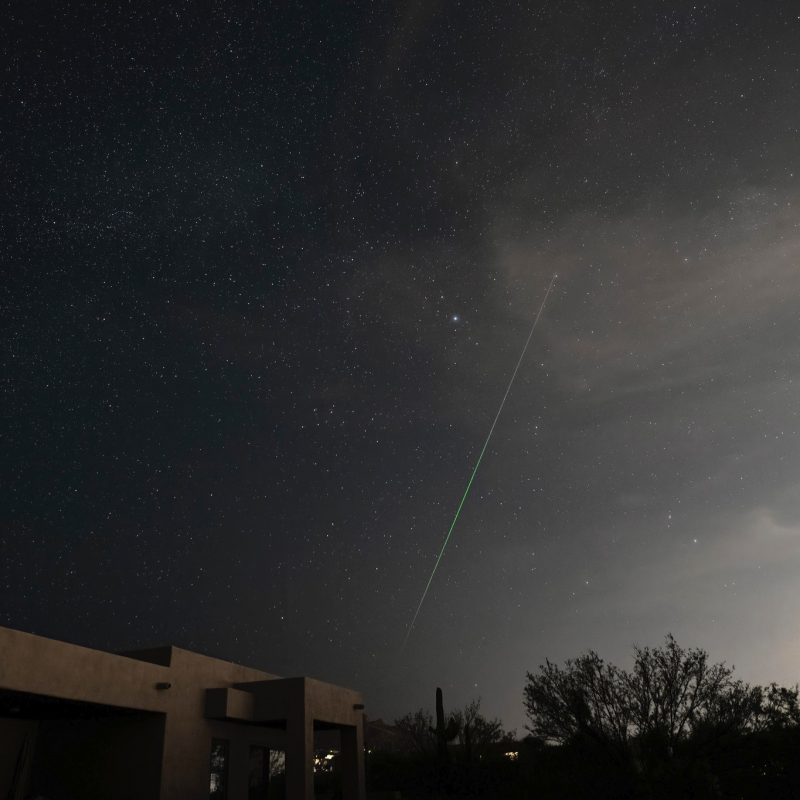
Greenish streak of light in dark sky.
View at EarthSky Community Photos. | Eliot Herman in Tucson, Arizona, captured this photo of an Eta Aquariid meteor on May 5, 2021. He wrote: “1:48 am on peak night. The radiant is still below the horizon, resulting in this long-trail meteor with the beautiful green, typical of Halley’s comet-derived meteors. My backyard view.” Thank you, Eliot!
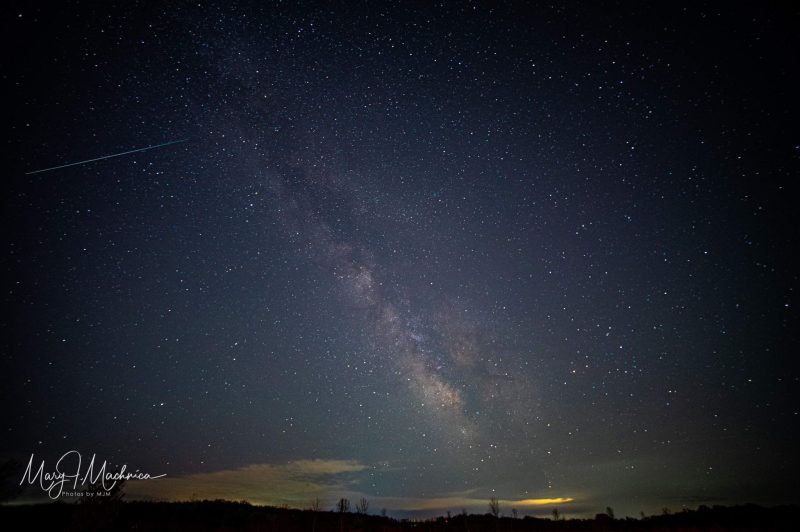
Cloudy stretch of stars with streak in left corner.
View at EarthSky Community Photos. | Mary Jo Machnica in Hamburg, New York, captured this photo of an Eta Aquariid on May 6, 2021. She wrote: “I knew that the Eta Aquariids meteor shower was going to peak this morning. I knew there was going to be a ton of light pollution. But, it didn’t matter. I just needed to be under the stars. Needing to feel small. Getting there right before 3 a.m. I set up my camera. Super damp out! Glad I have my lens warmer. With everything set up. I just keep taking photo after photo hoping to capture a glimpse of a meteor. I see a couple meteors with my eyes, but they don’t show up in the photo … That’s ok. I keep snapping away.” Thank you!

Bottom line: May’s Eta Aquariid meteor shower is best in 2026 on the morning of May 5. Be sure to watch in the hours before dawn. Find a way to block out the waning gibbous moon.

Read more: Why the Eta Aquariids are best from the Southern Hemisphere.

Visit EarthSky’s meteor shower guide

Report a fireball (very bright meteor) to the American Meteor Society: it’s fun and easy!

Learn how to shoot photos of meteors

**Predicted peak times and dates for meteor showers are from the American Meteor Society. Note that meteor shower peak times can vary. Back to top.

The post 2026 Eta Aquariid meteor shower best before dawn on May 5 first appeared on EarthSky.


from EarthSky https://ift.tt/q1tLhSX
Meteor shower chart: Lines marking constellation with radial arrows near middle of it.
The radiant point of the Eta Aquariid meteor shower is near the star Eta Aquarii in the constellation Aquarius the Water Bearer. The radiant rises in the wee hours after midnight and is still climbing toward its highest point at dawn. That highest point is in the south as viewed from the Northern Hemisphere, closer to overhead for the Southern Hemisphere. That’s why the Southern Hemisphere sees more meteors (the radiant is higher up), and it’s why – for all of us around the globe – the hours before dawn are best for this shower.

May 2026 meteors … the Eta Aquariids

When to watch: The best morning to watch is May 5, 2026, in the hours before dawn. The American Meteor Society is listing 3:51 UTC on May 5 as the shower’s predicted** peak time. The fact is that the peak of this shower stretches out over several days. So you can expect elevated numbers of meteors a few days before and after the peak time. The mornings of both May 4 and May 6 are also good times to watch!
Nearest moon phase: The last quarter moon will fall at 21:10 UTC on May 9. So, there will be a waning gibbous moon in the post-midnight sky, that sets after sunrise. So the sky before dawn on the mornings around the predicted peak for the 2025 Eta Aquariids will compete with a bright gibbous moon. Find a way to block out the moon for a better view of the sky.
The radiant: will rise in the wee hours, climbing toward its highest point at dawn. That’s why the hours before dawn will be the best time to watch this shower.
Duration of shower: April 15 to May 27. This time period is when we’re passing through the Eta Aquariid meteor stream in space!
Expected meteors at peak, under ideal conditions: The zenithal hourly rate (ZHR) of this shower (the rate at the shower’s peak, under a dark sky, with no moon, when the radiant is high in the sky) is 60. In 2026, a waning gibbous moon will severely affect this shower, reducing hourly rates. And be aware that the shower is best for latitudes like those in the southern half of the U.S. or even farther south, in the Southern Hemisphere. These are swift meteors that produce a high percentage of persistent trains.
Note: The Eta Aquariids’ radiant will be on the ecliptic, which will ride low in the sky on spring mornings as seen from far northerly latitudes. This shower favors more southerly latitudes (like those in the southern U.S. or the Southern Hemisphere), where the radiant appears higher in the morning sky. It’s often the Southern Hemisphere’s best meteor shower of the year.

Read more: Meteors in moonlight: 6 tips for watching

More about this shower’s radiant

If you trace the paths of the Eta Aquariid meteors backward, they all seem to radiate from a point in the constellation Aquarius the Water Bearer. This point on the sky’s dome is called the radiant of the meteor shower. It nearly aligns with the faint star Eta Aquarii, and the meteor shower takes its name from this star.

Eta Aquarii is one of the four stars making up the Y-shaped Water Jar asterism in the northern part of Aquarius. If you can find the Water Jar in the constellation Aquarius, you’ve located the radiant point for the Eta Aquariid meteors. The alignment of the radiant and the star is, of course, coincidental. Eta Aquarii is some 170 light-years away – trillions upon trillions of miles away – while the Eta Aquariid meteors burn up nearby – only 60 miles (100 km) above Earth’s surface.

Meteor shower radiants are sometimes misunderstood by casual meteor-watchers. You don’t need to know where they are to watch a meteor shower. That’s because the meteors fly every way across the sky, in front of numerous constellations. However, the higher a shower’s radiant appears in your sky, the more meteors you’re likely to see. For the Eta Aquariids, the radiant soars highest in the nighttime sky just before dawn. That’s one of the reasons why you can expect to see the most meteors in the wee morning hours.

How to view a meteor shower

As with all meteors in annual showers, no special equipment is required to watch the Eta Aquariids. But a little luck always helps.

Find a dark, open sky away from artificial lights, and sprawl out on a reclining lawn chair.

Make yourself comfortable with a hot flask of your favorite beverage. Keep warm but not so snug that you fall asleep!

Meteor watching is a lot like fishing. Sometimes you catch a good number of them, and sometimes you don’t.

Meteor showers: Tips for watching the show

The Eta Aquariids’ parent comet

This section is by the late, great Don Machholz (1952-2022), who discovered 12 comets …

The object responsible for the Eta Aquariid meteor shower – that is, its parent comet – is the famous Halley’s comet. This comet is in a retrograde orbit around the sun. That means it runs around the sun in the opposite direction from Earth and all the other planets. As a result, we pass near its path twice, one time along the outbound portion of the comet’s orbit. That happens every early May, causing the Eta Aquariid meteor shower. The other time is along the inbound portion of the comet’s orbit, and that passage causes the Orionid meteor shower in late October of each year.

Halley’s comet orbits the sun on an average of every 76 years (the range is from 74 through 79 years due to perturbations of the planets). So, in most years, the comet is nowhere near when we sweep through its orbit, and when debris left behind by the comet enters our atmosphere to create Halley’s two meteor showers.

Perhaps you saw Halley’s comet when it returned last, in 1985/86. It has been observed since the year 240 BCE. Presently, the comet is traveling heading back toward the sun at about 0.6 miles a second (0.9 km/sec).

In December of 2023, the comet reached its farthest point from the sun, which binds it in orbit. Then – pulled inexorably by the sun’s gravity – it curved around and is heading back toward the inner solar system again. Halley’s comet will be back in 2061.

While waiting for Halley’s comet to return, watch for the next best thing: the Eta Aquariid meteor shower in early May.

Bright white comet with wide glowing tail streaming out from it in starry deep blue sky.
Halley’s comet, the parent of the May Eta Aquariid and October Orionid meteor showers. Dust from this comet will light the night as Eta Aquariid meteors on the morning of May 5. Image via NASA.

Eta Aquariid meteor shower photos from EarthSky’s community

Starry sky with rich Milky Way and two meteor streaks.
View at EarthSky Community Photos. | Christoph Stopka captured some Eta Aquariid meteors on May 5, 2024, near Westcliffe, Colorado, and said: “I kept my camera pointed towards the Milky Way, hoping for a meteor streaking by. And finally, it was showtime: I saw a greenish flash to the left of the Milky Way and knew instantly I had a winner! Sure enough, when I checked my last 15 seconds exposure on the screen of the camera, I could clearly identify a good size meteor in the image. But to my big surprise, I saw that there was actually a SECOND, smaller meteor below the one I had noticed!” Thank you, Christoph!
Greenish streak of light in dark sky.
View at EarthSky Community Photos. | Eliot Herman in Tucson, Arizona, captured this photo of an Eta Aquariid meteor on May 5, 2021. He wrote: “1:48 am on peak night. The radiant is still below the horizon, resulting in this long-trail meteor with the beautiful green, typical of Halley’s comet-derived meteors. My backyard view.” Thank you, Eliot!
Cloudy stretch of stars with streak in left corner.
View at EarthSky Community Photos. | Mary Jo Machnica in Hamburg, New York, captured this photo of an Eta Aquariid on May 6, 2021. She wrote: “I knew that the Eta Aquariids meteor shower was going to peak this morning. I knew there was going to be a ton of light pollution. But, it didn’t matter. I just needed to be under the stars. Needing to feel small. Getting there right before 3 a.m. I set up my camera. Super damp out! Glad I have my lens warmer. With everything set up. I just keep taking photo after photo hoping to capture a glimpse of a meteor. I see a couple meteors with my eyes, but they don’t show up in the photo … That’s ok. I keep snapping away.” Thank you!

Bottom line: May’s Eta Aquariid meteor shower is best in 2026 on the morning of May 5. Be sure to watch in the hours before dawn. Find a way to block out the waning gibbous moon.

Read more: Why the Eta Aquariids are best from the Southern Hemisphere.

Visit EarthSky’s meteor shower guide

Report a fireball (very bright meteor) to the American Meteor Society: it’s fun and easy!

Learn how to shoot photos of meteors

**Predicted peak times and dates for meteor showers are from the American Meteor Society. Note that meteor shower peak times can vary. Back to top.

The post 2026 Eta Aquariid meteor shower best before dawn on May 5 first appeared on EarthSky.


from EarthSky https://ift.tt/q1tLhSX

Western US wildfires less frequent but more massive

Western US wildfires: Houses on the Pacific Coast with a glow of orange fire in the sky behind.
In this view from January 8, 2025, the Palisades Fire threatens houses along the Pacific Coast in California. A new study says western US wildfires have become less frequent over the past 30 years. However, the wildfires are getting larger. Image via CAL FIRE.
  • Wildfires in the western U.S. are becoming less frequent, a new study says.
  • But the wildfires that do occur are getting worse. They’re burning larger areas and causing more damage.
  • Humans appear to be driving these changes. Human-driven climate change is making wildfires more destructive, while human behavioural change seems to be making them less frequent.

Western US wildfires less frequent but more massive

First, the good news: The number of wildfires in the western U.S. has gone down. Wildfires in this region are down about 28% over the past 30 years. And a large part of that is due to a 40% decline in fires accidentally started by humans.

Now, the bad news: The wildfires that do occur in the West are having a larger impact. They are burning larger areas, and so fire damages are increasing. The cause? Human-driven climate change making these regions hotter and drier.

These are the findings of a new study published on April 30, 2026, examining fire frequency and human influence in the western United States.

The researchers also identified a pattern relating to human habitation. In areas with lots of people, there are fewer fires. Meanwhile, in areas with fewer people, the frequency of fires goes up as the population density of that region rises. Unfortunately, there are also exceptions to these population trends. Los Angeles, Phoenix and Denver are seeing more frequent fires despite their high population densities.

The researchers say studying human demographics and wildfire frequency could help predict future patterns. But it’s still early to draw too many conclusions. Gavin Madakumbura, an atmospheric and oceanic scientist at UCLA and leader of the study, said:

It would be premature to talk about informing fire management [based on] these results, but the main implication is that we can incorporate these results into projections of future fire activity.

The peer-reviewed journal Earth’s Future published the new study on April 30, 2026.

Less frequent fires but a greater impact

Even though the total number of wildfires in the western U.S. has gone down, it might not seem like it. That’s because the impacts of the wildfires are going up. The fires may be fewer in number, but they are burning more land. Between 1992 and 2020, 4% more land burned each year. Case in point: In 2020, wildfires across California, Oregon and Washington burned more than 9 million acres. That’s larger than the state of Maryland.

But in the new study, the researchers did find that the number of fires per year in the West is going down. In 1992, they counted 25,000 fires. And by 2020, it was down to 18,000 fires. So that’s 305 fewer fires each year. Their study looked at 11 western states, from Montana, Wyoming, Colorado, New Mexico and westward.

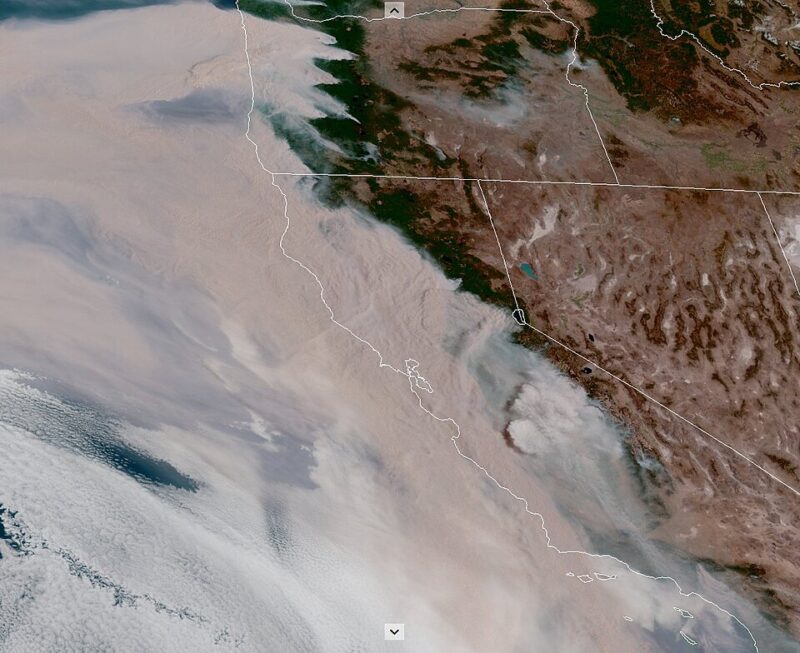
Satellite image of California and Oregon with thick tan smoke flowing westward.
This was the view from the GOES-17 satellite on September 9, 2020. That year, wildfires burned more than 9 million acres in the western U.S. Image via NWS.

What is the role of humans in these fires?

The decline of human-started fires was not consistent across all states. While California and Arizona saw fewer fires started by people, Wyoming saw more. Part of this could be due to public resources.

The researchers looked at a number of factors, including changes in population density and fire protection and management expenditures for each state. The higher the population density, the more the state spent on fire protection. For example, California spends 7 billion dollars more a year on fire protection compared to Wyoming.

Scientists call the link between population density and fires pyric transition. As the press release explained:

In sparsely populated regions, the idea goes, adding more people leads to more fires accidentally sparked by human activity. But past a certain threshold of population density, more people also means more coordinated fire prevention and public awareness efforts to tackle the rising risk. This, coupled with the fragmented, patchwork nature of more populated landscapes, can end up making fires less frequent.

So the scientists are seeing a correlation between population density and fires. But is there a causation as well? Madakumbura said:

We know that with increasing human activity, we get more accidental human ignitions. But at the same time, a lot of regions are spending so much money on fire prevention and fire awareness, so we should see this in the data. The data definitely seem to indicate that this is a possible causative relationship.

What about the big-city outliers?

Los Angeles, Phoenix and Denver have some of the larger population centers in the western U.S., but they still have frequent fires. But it could be a difference in fire reporting practices, said Madakumbura. These areas might have more reports of small fires, whereas a lower-population area might not have these reports. Sparsely populated areas might focus more on wildland fires.

The role of climate change

So why is a larger area burning even though there are fewer fires? Madakumbura said human-driven climate warming is to blame. As these regions got hotter and drier, the conditions encourage the development of larger fires.

But climate change may both be triggering a rise in fires and suppression as well. As the West grapples with the threat of fire due to the heat and low humidity, places with adequate resources increase their prevention efforts.

So while human-caused climate change is a factor in fires, the human demographics of an area also appears to be a factor. The researchers are hoping to help predict future fire patterns more accurately by looking at all possible factors. Madakumbura concluded:

Even though we have been able to reduce the number of fires through fire preparedness, fire awareness, and spending a lot of money on protective measures, there is a disconnect. We haven’t been able to reduce the damages.

Bottom line: Researchers looked at western U.S. wildfires over the past 30 years and found that while they are becoming less frequent, the fires that pop up are larger and more damaging.

Source: Evolving Fire Frequency in the Western United States and Its Links to Human Influence

Via AGU

Read more: This Is Wildfire: Tips on preparing yourself and your home

The post Western US wildfires less frequent but more massive first appeared on EarthSky.


from EarthSky https://ift.tt/xspTb8C
Western US wildfires: Houses on the Pacific Coast with a glow of orange fire in the sky behind.
In this view from January 8, 2025, the Palisades Fire threatens houses along the Pacific Coast in California. A new study says western US wildfires have become less frequent over the past 30 years. However, the wildfires are getting larger. Image via CAL FIRE.
  • Wildfires in the western U.S. are becoming less frequent, a new study says.
  • But the wildfires that do occur are getting worse. They’re burning larger areas and causing more damage.
  • Humans appear to be driving these changes. Human-driven climate change is making wildfires more destructive, while human behavioural change seems to be making them less frequent.

Western US wildfires less frequent but more massive

First, the good news: The number of wildfires in the western U.S. has gone down. Wildfires in this region are down about 28% over the past 30 years. And a large part of that is due to a 40% decline in fires accidentally started by humans.

Now, the bad news: The wildfires that do occur in the West are having a larger impact. They are burning larger areas, and so fire damages are increasing. The cause? Human-driven climate change making these regions hotter and drier.

These are the findings of a new study published on April 30, 2026, examining fire frequency and human influence in the western United States.

The researchers also identified a pattern relating to human habitation. In areas with lots of people, there are fewer fires. Meanwhile, in areas with fewer people, the frequency of fires goes up as the population density of that region rises. Unfortunately, there are also exceptions to these population trends. Los Angeles, Phoenix and Denver are seeing more frequent fires despite their high population densities.

The researchers say studying human demographics and wildfire frequency could help predict future patterns. But it’s still early to draw too many conclusions. Gavin Madakumbura, an atmospheric and oceanic scientist at UCLA and leader of the study, said:

It would be premature to talk about informing fire management [based on] these results, but the main implication is that we can incorporate these results into projections of future fire activity.

The peer-reviewed journal Earth’s Future published the new study on April 30, 2026.

Less frequent fires but a greater impact

Even though the total number of wildfires in the western U.S. has gone down, it might not seem like it. That’s because the impacts of the wildfires are going up. The fires may be fewer in number, but they are burning more land. Between 1992 and 2020, 4% more land burned each year. Case in point: In 2020, wildfires across California, Oregon and Washington burned more than 9 million acres. That’s larger than the state of Maryland.

But in the new study, the researchers did find that the number of fires per year in the West is going down. In 1992, they counted 25,000 fires. And by 2020, it was down to 18,000 fires. So that’s 305 fewer fires each year. Their study looked at 11 western states, from Montana, Wyoming, Colorado, New Mexico and westward.

Satellite image of California and Oregon with thick tan smoke flowing westward.
This was the view from the GOES-17 satellite on September 9, 2020. That year, wildfires burned more than 9 million acres in the western U.S. Image via NWS.

What is the role of humans in these fires?

The decline of human-started fires was not consistent across all states. While California and Arizona saw fewer fires started by people, Wyoming saw more. Part of this could be due to public resources.

The researchers looked at a number of factors, including changes in population density and fire protection and management expenditures for each state. The higher the population density, the more the state spent on fire protection. For example, California spends 7 billion dollars more a year on fire protection compared to Wyoming.

Scientists call the link between population density and fires pyric transition. As the press release explained:

In sparsely populated regions, the idea goes, adding more people leads to more fires accidentally sparked by human activity. But past a certain threshold of population density, more people also means more coordinated fire prevention and public awareness efforts to tackle the rising risk. This, coupled with the fragmented, patchwork nature of more populated landscapes, can end up making fires less frequent.

So the scientists are seeing a correlation between population density and fires. But is there a causation as well? Madakumbura said:

We know that with increasing human activity, we get more accidental human ignitions. But at the same time, a lot of regions are spending so much money on fire prevention and fire awareness, so we should see this in the data. The data definitely seem to indicate that this is a possible causative relationship.

What about the big-city outliers?

Los Angeles, Phoenix and Denver have some of the larger population centers in the western U.S., but they still have frequent fires. But it could be a difference in fire reporting practices, said Madakumbura. These areas might have more reports of small fires, whereas a lower-population area might not have these reports. Sparsely populated areas might focus more on wildland fires.

The role of climate change

So why is a larger area burning even though there are fewer fires? Madakumbura said human-driven climate warming is to blame. As these regions got hotter and drier, the conditions encourage the development of larger fires.

But climate change may both be triggering a rise in fires and suppression as well. As the West grapples with the threat of fire due to the heat and low humidity, places with adequate resources increase their prevention efforts.

So while human-caused climate change is a factor in fires, the human demographics of an area also appears to be a factor. The researchers are hoping to help predict future fire patterns more accurately by looking at all possible factors. Madakumbura concluded:

Even though we have been able to reduce the number of fires through fire preparedness, fire awareness, and spending a lot of money on protective measures, there is a disconnect. We haven’t been able to reduce the damages.

Bottom line: Researchers looked at western U.S. wildfires over the past 30 years and found that while they are becoming less frequent, the fires that pop up are larger and more damaging.

Source: Evolving Fire Frequency in the Western United States and Its Links to Human Influence

Via AGU

Read more: This Is Wildfire: Tips on preparing yourself and your home

The post Western US wildfires less frequent but more massive first appeared on EarthSky.


from EarthSky https://ift.tt/xspTb8C

Falcon rocket will hit the moon on August 5

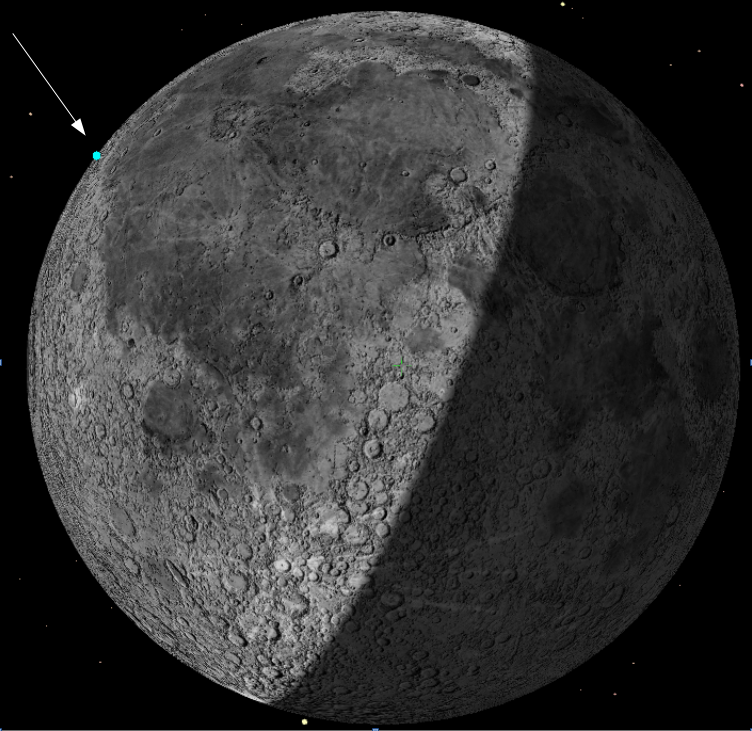
Rocket will hit the moon: The half-lit moon with an arrow pointing to a blue spot right on the horizon of the lit portion.
This is the spot where a Falcon 9 upper stage rocket body will collide with the moon on August 5, 2026. The spent rocket will hit the moon at 5,400 mph (8,700 kph). Image via Bill Gray. Used with permission.

You deserve a daily dose of good news. For the latest in science and the night sky, click here to subscribe to our free daily newsletter.

Falcon rocket will hit the moon on August 5

Back on January 15, 2025, a Falcon 9 rocket launched two missions toward the moon: Blue Ghost and Hakuto-R. After the upper stage of the Falcon 9 rocket completed its boosting mission, it became just another piece of space junk. But now, says Bill Gray, a prolific tracker of near-Earth objects, the Falcon 9 is on a collision course with the moon.

Gray estimates the upper stage will hit the moon at 1:44 a.m. CDT (6:44 UTC) on August 5, 2026. As Gray said:

It doesn’t present any danger to anyone, though it does highlight a certain carelessness about how leftover space hardware (space junk) is disposed of.

Will we be able to see the impact?

The moon will be close to last quarter phase on August 5, 2026. By 1:44 a.m. CDT, those in the Central Time Zone will be able to see the moon, as it will have already risen in the east. Saturn will be nearby. Check Stellarium to see if the moon will be above the horizon at the time of impact if you’re further west. The timing will favor people in the eastern half of the U.S. and Canada, plus much of South America.

So where will the rocket hit? Right now, Gray said he estimates the impact will occur near the edge, or limb, of the moon, close to the Einstein crater.

However, the chances are we won’t be able to see the impact from Earth. Darn. Although the Einstein crater should (barely) be visible, the impact will likely be too small to see from so great a distance. However, after the impact, NASA’s Lunar Reconnaissance Orbiter might be able to get an image of the resulting crater. It’s happened before.

Previous lunar impact

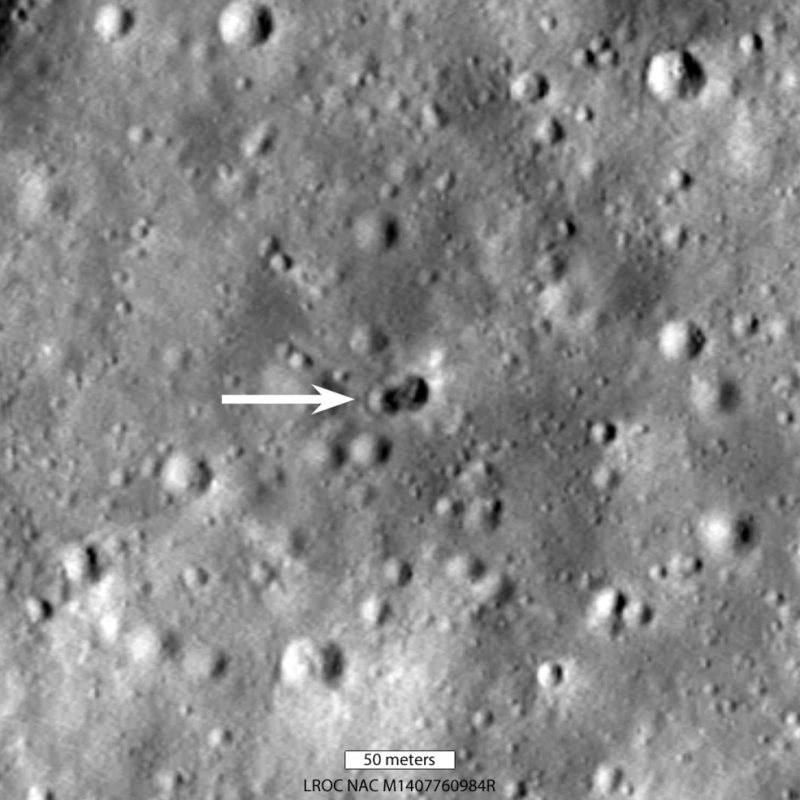
Back in 2022, Bill Gray also predicted a rocket impact with the moon. There was a little confusion about where the rocket came from, but the space junk did indeed hit the moon on March 4, 2022. And it left a mark, too. NASA’s Lunar Reconnaissance Orbiter took an image of the aftermath.

Gray cratered surface, with an arrow pointing to 2 small overlapping craters.
A rocket body struck the moon on March 4, 2022, near Hertzsprung crater. It created a double crater roughly 100 feet (30 meters) wide at its longest. Image via NASA/ Goddard/ Arizona State University.

A speeding object

Gray estimates the space junk will hit the moon at about 2.43 kilometers (1.51 miles) a second. That equates to 5,400 miles (8,700 kilometers) an hour. Because the moon has no real atmosphere, there will be nothing to slow it down.

Tracking the Falcon 9 upper stage

There have been hundreds of Falcon 9 launches. Usually, the spent rocket bodies orbit closely to Earth and eventually reenter our atmosphere. But some have gone on to orbit the sun.

This upper stage rocket has spent most of its time farther out than average, around the distance of the moon. Asteroid surveys pick up objects like this as they scan for dangerous space rocks. As Gray said:

The asteroid surveys would actually prefer not to observe space junk. Time spent observing junk is time not spent finding rocks. But both the rocks and the high-altitude space junk are slowly moving points of light in their images; they aren’t easy to distinguish. So the asteroid surveys find this sort of junk whether they want to or not.

Gray provides software tools for astronomers that help them distinguish between space rocks and space junk. He also computes orbits for high-orbiting objects the military doesn’t track. And he’s been tracking this piece of space junk for months. He’s known since September 2025 that the upper stage was likely on a collision course with the moon. And as he told EarthSky, he wasn’t surprised:

I’ve been checking for such possible impacts for about 20 years, ever since we started having many large bits of junk in orbits that could hit the moon. In a way, the only real surprise is that only two objects have hit the moon.

Rocket will hit the moon despite tiny pushes from sunlight

Over the past months he’s continued to track the object. The reason it can change course a tiny bit is due to the gentle push of sunlight on objects. And that little bit of push is tricky to track. As Gray said:

As an object tumbles, it may catch more or less sunlight, and may reflect some of it sideways.

But, as Gray told EarthSky:

I was reasonably sure a month or two later, but was in no rush to say anything about it. I figured I’d wait until the impact location was well established. So it was something of a gradual process, with no ‘Aha! It’s gonna hit!’ moment.

Not a lot of tracking farther from Earth

Gray told EarthSky:

I am an astronomer working under contract with both asteroid and artificial object observers. I started out doing this for natural objects (asteroids, comets, moons of other planets) about 30 years ago. A few years later, the asteroid surveys started to notice the occasional artificial object and asked me if I could find orbits for them as well.

And as Gray explains on his website, various countries carefully track objects in low-Earth orbit because there are so many pieces of debris with risks of collision with military and science satellites. Farther from Earth, there is less tracking. Or, as Gray said:

Generally speaking, high-altitude junk goes ignored. (Except, it appears, by me.)

Gray works with asteroid hunters. As he said:

My ‘day work’ is for the asteroid-hunting community … Most artificial objects are close to the Earth and move fast enough that there is no risk of mistaking them for an asteroid. But there are about a dozen ‘high-flying’ objects that can move slowly enough to look like a rock, at least briefly. For about 15 or 20 years now, I’ve taken these observations and computed orbits. Then, when the surveys find such objects, they can fairly quickly say ‘Never mind; it’s not a rock; it’s just another nuisance artificial object,’ and go back to looking for actual rocks.

Bottom line: A Falcon 9 rocket will hit the moon on August 5, 2026. How fast will it be going? Will we be able to see it? Answers here.

The post Falcon rocket will hit the moon on August 5 first appeared on EarthSky.


from EarthSky https://ift.tt/2KHN9s0
Rocket will hit the moon: The half-lit moon with an arrow pointing to a blue spot right on the horizon of the lit portion.
This is the spot where a Falcon 9 upper stage rocket body will collide with the moon on August 5, 2026. The spent rocket will hit the moon at 5,400 mph (8,700 kph). Image via Bill Gray. Used with permission.

You deserve a daily dose of good news. For the latest in science and the night sky, click here to subscribe to our free daily newsletter.

Falcon rocket will hit the moon on August 5

Back on January 15, 2025, a Falcon 9 rocket launched two missions toward the moon: Blue Ghost and Hakuto-R. After the upper stage of the Falcon 9 rocket completed its boosting mission, it became just another piece of space junk. But now, says Bill Gray, a prolific tracker of near-Earth objects, the Falcon 9 is on a collision course with the moon.

Gray estimates the upper stage will hit the moon at 1:44 a.m. CDT (6:44 UTC) on August 5, 2026. As Gray said:

It doesn’t present any danger to anyone, though it does highlight a certain carelessness about how leftover space hardware (space junk) is disposed of.

Will we be able to see the impact?

The moon will be close to last quarter phase on August 5, 2026. By 1:44 a.m. CDT, those in the Central Time Zone will be able to see the moon, as it will have already risen in the east. Saturn will be nearby. Check Stellarium to see if the moon will be above the horizon at the time of impact if you’re further west. The timing will favor people in the eastern half of the U.S. and Canada, plus much of South America.

So where will the rocket hit? Right now, Gray said he estimates the impact will occur near the edge, or limb, of the moon, close to the Einstein crater.

However, the chances are we won’t be able to see the impact from Earth. Darn. Although the Einstein crater should (barely) be visible, the impact will likely be too small to see from so great a distance. However, after the impact, NASA’s Lunar Reconnaissance Orbiter might be able to get an image of the resulting crater. It’s happened before.

Previous lunar impact

Back in 2022, Bill Gray also predicted a rocket impact with the moon. There was a little confusion about where the rocket came from, but the space junk did indeed hit the moon on March 4, 2022. And it left a mark, too. NASA’s Lunar Reconnaissance Orbiter took an image of the aftermath.

Gray cratered surface, with an arrow pointing to 2 small overlapping craters.
A rocket body struck the moon on March 4, 2022, near Hertzsprung crater. It created a double crater roughly 100 feet (30 meters) wide at its longest. Image via NASA/ Goddard/ Arizona State University.

A speeding object

Gray estimates the space junk will hit the moon at about 2.43 kilometers (1.51 miles) a second. That equates to 5,400 miles (8,700 kilometers) an hour. Because the moon has no real atmosphere, there will be nothing to slow it down.

Tracking the Falcon 9 upper stage

There have been hundreds of Falcon 9 launches. Usually, the spent rocket bodies orbit closely to Earth and eventually reenter our atmosphere. But some have gone on to orbit the sun.

This upper stage rocket has spent most of its time farther out than average, around the distance of the moon. Asteroid surveys pick up objects like this as they scan for dangerous space rocks. As Gray said:

The asteroid surveys would actually prefer not to observe space junk. Time spent observing junk is time not spent finding rocks. But both the rocks and the high-altitude space junk are slowly moving points of light in their images; they aren’t easy to distinguish. So the asteroid surveys find this sort of junk whether they want to or not.

Gray provides software tools for astronomers that help them distinguish between space rocks and space junk. He also computes orbits for high-orbiting objects the military doesn’t track. And he’s been tracking this piece of space junk for months. He’s known since September 2025 that the upper stage was likely on a collision course with the moon. And as he told EarthSky, he wasn’t surprised:

I’ve been checking for such possible impacts for about 20 years, ever since we started having many large bits of junk in orbits that could hit the moon. In a way, the only real surprise is that only two objects have hit the moon.

Rocket will hit the moon despite tiny pushes from sunlight

Over the past months he’s continued to track the object. The reason it can change course a tiny bit is due to the gentle push of sunlight on objects. And that little bit of push is tricky to track. As Gray said:

As an object tumbles, it may catch more or less sunlight, and may reflect some of it sideways.

But, as Gray told EarthSky:

I was reasonably sure a month or two later, but was in no rush to say anything about it. I figured I’d wait until the impact location was well established. So it was something of a gradual process, with no ‘Aha! It’s gonna hit!’ moment.

Not a lot of tracking farther from Earth

Gray told EarthSky:

I am an astronomer working under contract with both asteroid and artificial object observers. I started out doing this for natural objects (asteroids, comets, moons of other planets) about 30 years ago. A few years later, the asteroid surveys started to notice the occasional artificial object and asked me if I could find orbits for them as well.

And as Gray explains on his website, various countries carefully track objects in low-Earth orbit because there are so many pieces of debris with risks of collision with military and science satellites. Farther from Earth, there is less tracking. Or, as Gray said:

Generally speaking, high-altitude junk goes ignored. (Except, it appears, by me.)

Gray works with asteroid hunters. As he said:

My ‘day work’ is for the asteroid-hunting community … Most artificial objects are close to the Earth and move fast enough that there is no risk of mistaking them for an asteroid. But there are about a dozen ‘high-flying’ objects that can move slowly enough to look like a rock, at least briefly. For about 15 or 20 years now, I’ve taken these observations and computed orbits. Then, when the surveys find such objects, they can fairly quickly say ‘Never mind; it’s not a rock; it’s just another nuisance artificial object,’ and go back to looking for actual rocks.

Bottom line: A Falcon 9 rocket will hit the moon on August 5, 2026. How fast will it be going? Will we be able to see it? Answers here.

The post Falcon rocket will hit the moon on August 5 first appeared on EarthSky.


from EarthSky https://ift.tt/2KHN9s0

5 amazing places to see migrating birds in spring

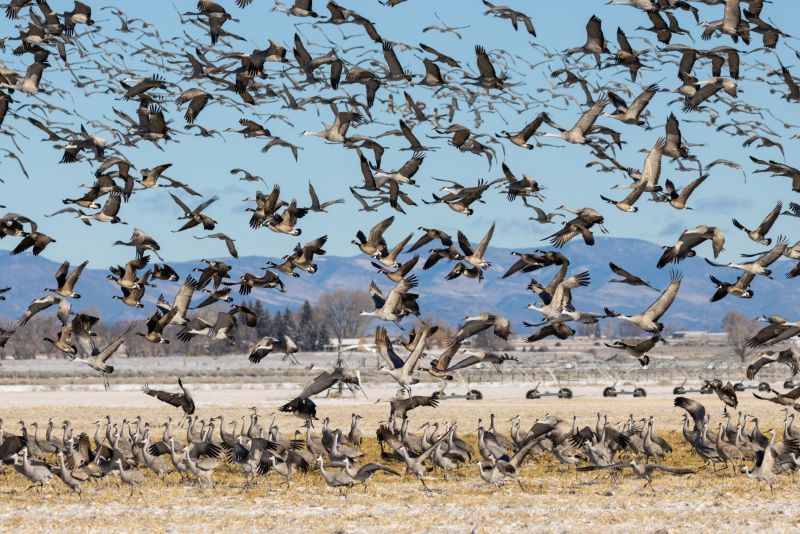
See migrating birds: Huge crowd of big birds flying near the ground, with multitudes already landed.
Migrating sandhill cranes (Antigone canadensis) stop for a rest at Monte Vista National Wildlife Refuge in Colorado. Read on for 5 amazing places to see migrating birds like these this spring. Image via Rachel Portwood/ U.S. Fish and Wildlife Service.
  • Each spring, millions of birds migrate north to summer breeding grounds in the U.S. and Canada.
  • So that makes this time of year fantastic for birding.
  • From nature sanctuaries to your local park, here are some great places to see migrating birds this spring.

5 amazing places to see migrating birds in spring

As spring unfolds above the equator, millions of birds depart their overwintering habitats and fly north to summer breeding grounds in the U.S. and Canada. The spectacle of spring migration involves both the arrival of warm weather favorites, like red-winged blackbirds, and the brief passage of rarely seen species, like many wood warblers. And there are certain places within North America where watching bird migration can be particularly rewarding. So here are five to consider for your next birding adventure.

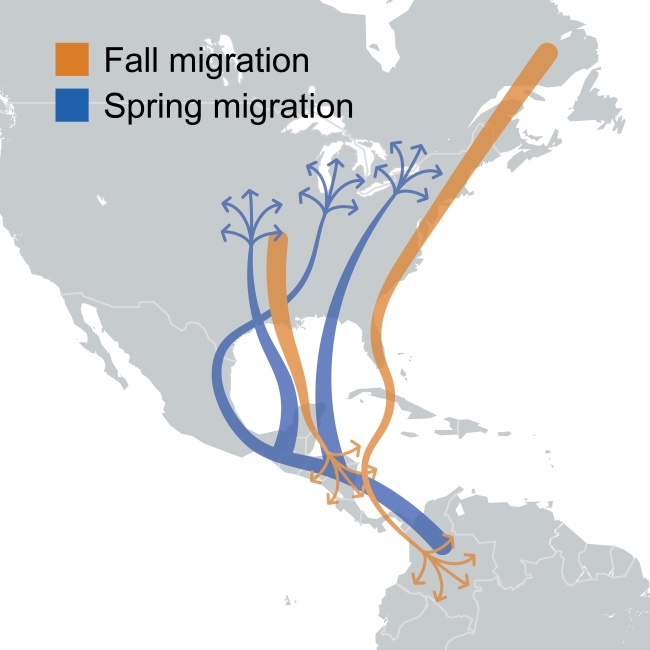
Map of most of North America and top of South America and arrows between areas of both.
Common migratory flyways for songbirds in North America. Image via U.S. Fish and Wildlife Service.

High Island, Texas

High Island sits on top of a salt dome along the Gulf Coast of Texas near the Louisiana border. This elevated dome attracts weary birds that have traveled long distances over open waters from the Yucatán Peninsula.

There are four bird sanctuaries here: Boy Scout Woods, Smith Oaks, Eubanks Woods and Gast Red Bay. Each provides important habitat (food, water, shelter) for the migrants. Warblers, tanagers, orioles and grosbeaks abound. Roseate Spoonbills, egrets and herons nest in a rookery at Smith Oaks sanctuary.

Migration season at High Island runs mid-March to mid-May, but the best times to visit are around the end of April through early May, according to Houston Audubon. And when storms force the birds to “fallout” onto the land, the birding here can get intense, with birds on every tree.

A hungry painted bunting (Passerina ciris) eating a mulberry after arriving at High Island, Texas. Image via Lev Frid. Used with permission.

Science news, night sky events and beautiful photos, all in one place. Click here to subscribe to our free daily newsletter.

Magee Marsh, Ohio

Magee Marsh along the shores of Lake Erie spans just over 2,200 acres (8.9 square kilometers). The Ohio Department of Natural Resources owns the site. The nutrient-rich wetlands attract diverse birds during the migration season.

Spring migration here begins in March with the spring thaw and lasts through May. Waterfowl commonly seen in the wetlands in spring include blue-winged teals, gadwalls, northern shovelers, ring-necked ducks, northern pintails and American wigeons. The wood warblers in particular are a big draw. In fact, at least 36 species of warblers have been recorded at Magee Marsh over the years, including blue-winged warblers, orange-crowned warblers and prothonotary warblers.

A fun time to visit is during the Biggest Week in American Birding. This event is held every year in early May. Black Swamp Bird Observatory hosts the 10-day festival and offers guided tours of Magee Marsh and other nearby hotspots. And while there, visitors can attend bird identification workshops and presentations by luminaries in the birding world.

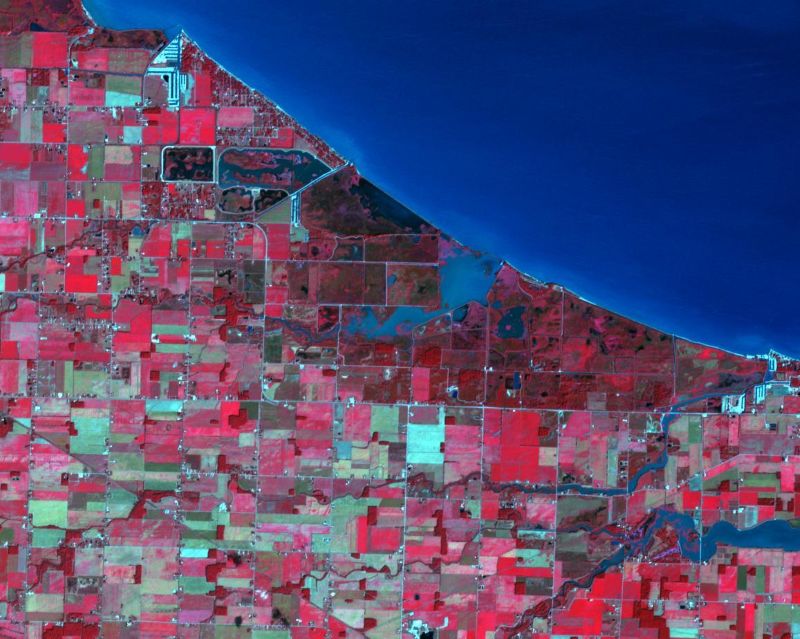
Orbital view of landscape divided into many small rectangles in various shades of red, next to a body of water.
Satellite image of Magee Marsh, Ohio, on September 18, 2024. What’s with the colors? This image comes from NASA’s ASTER instrument on its Terra satellite, which images in visible light and infrared wavelengths. The red colors here mostly show vegetation, which reflects a lot of infrared light. Image NASA/JPL/ METI/ AIST/ Japan Space Systems/ U.S.-Japan ASTER Science Team.

Point Pelee, Ontario

Point Pelee National Park in Ontario, Canada, sits on a long, sandy spit that juts out into Lake Erie. The park contains the southernmost spot in mainland Canada. It is an important stopover site for migrants crossing the lake. In 1987, Point Pelee was designated as a wetland of international importance under the Ramsar Convention. In 2006, the Royal Astronomical Society of Canada designated the park as a dark sky preserve.

Spring bird migration at Point Pelee runs from March, with the arrival of waterfowl, to early June, for late migrants such as shorebirds and flycatchers. The warblers, vireos, and tanagers are best viewed during early to mid-May. Plus, this timeframe coincides with the Festival of Birds. Visitors can choose from a number of guided hikes and birding lectures during the festival.

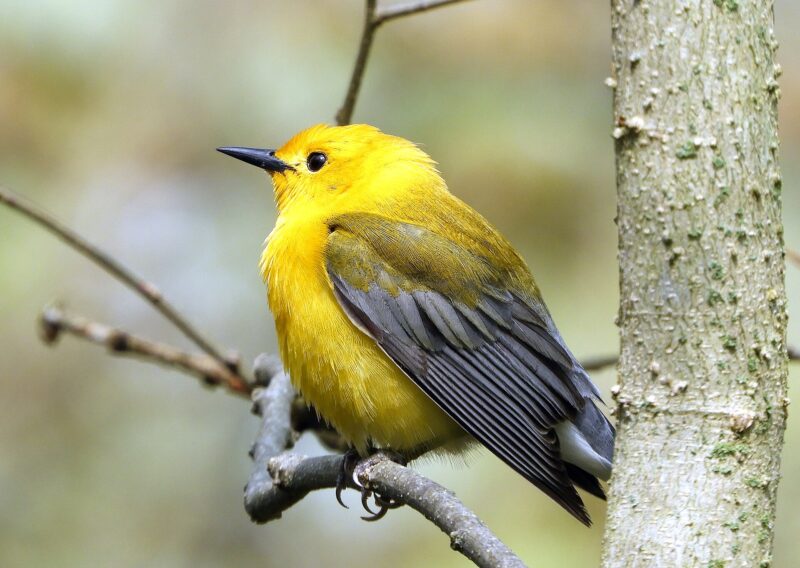
A small, roundish bird with bright yellow head and belly and black, pointed beak, perched on a twig.
Prothonotary warbler (Protonotaria citrea) photographed at Point Pelee National Park, Ontario, Canada. Image via Deenaerrampalli/ Wikimedia Commons (CC BY-SA 4.0).

Hawk Mountain, Pennsylvania

Hawk Mountain Sanctuary is an observation, research and education facility dedicated to the conservation of birds of prey. Founded in the 1930s by Rosalie Edge, the sanctuary is located on Kittatinny Ridge in eastern Pennsylvania. The high elevations allow for expansive views of the surrounding forests and sky.

Spring migration counts at Hawk Mountain Sanctuary run from April 1 to May 15. During the count, trained birders keep a tally of the number and types of raptors seen each day. On big days with northerly winds, over 300 birds might be spotted. Common migrants include bald eagles, broad-winged hawks and American kestrels. Visitors are welcome to help spot raptors as they pass overhead.

Your hometown

Indeed, you might be surprised at how many different bird species visit local parks during spring migration. The website eBird has a great Explore Regions feature, where you can type in the county, click Hotspots, and see the tops sites for species. Visit any one of the places in the top 10 during spring migration and see what you can find. And on a big day, there likely will be many giddy birders out and about.

Bottom line: Birding during spring migration season can be particularly rewarding. Here are five amazing places to see migrating birds this spring.

Read more: Lights out for birds during spring migration!

Read more: Media We Love: The Merlin Bird ID app

The post 5 amazing places to see migrating birds in spring first appeared on EarthSky.


from EarthSky https://ift.tt/NHBnKfF
See migrating birds: Huge crowd of big birds flying near the ground, with multitudes already landed.
Migrating sandhill cranes (Antigone canadensis) stop for a rest at Monte Vista National Wildlife Refuge in Colorado. Read on for 5 amazing places to see migrating birds like these this spring. Image via Rachel Portwood/ U.S. Fish and Wildlife Service.
  • Each spring, millions of birds migrate north to summer breeding grounds in the U.S. and Canada.
  • So that makes this time of year fantastic for birding.
  • From nature sanctuaries to your local park, here are some great places to see migrating birds this spring.

5 amazing places to see migrating birds in spring

As spring unfolds above the equator, millions of birds depart their overwintering habitats and fly north to summer breeding grounds in the U.S. and Canada. The spectacle of spring migration involves both the arrival of warm weather favorites, like red-winged blackbirds, and the brief passage of rarely seen species, like many wood warblers. And there are certain places within North America where watching bird migration can be particularly rewarding. So here are five to consider for your next birding adventure.

Map of most of North America and top of South America and arrows between areas of both.
Common migratory flyways for songbirds in North America. Image via U.S. Fish and Wildlife Service.

High Island, Texas

High Island sits on top of a salt dome along the Gulf Coast of Texas near the Louisiana border. This elevated dome attracts weary birds that have traveled long distances over open waters from the Yucatán Peninsula.

There are four bird sanctuaries here: Boy Scout Woods, Smith Oaks, Eubanks Woods and Gast Red Bay. Each provides important habitat (food, water, shelter) for the migrants. Warblers, tanagers, orioles and grosbeaks abound. Roseate Spoonbills, egrets and herons nest in a rookery at Smith Oaks sanctuary.

Migration season at High Island runs mid-March to mid-May, but the best times to visit are around the end of April through early May, according to Houston Audubon. And when storms force the birds to “fallout” onto the land, the birding here can get intense, with birds on every tree.

A hungry painted bunting (Passerina ciris) eating a mulberry after arriving at High Island, Texas. Image via Lev Frid. Used with permission.

Science news, night sky events and beautiful photos, all in one place. Click here to subscribe to our free daily newsletter.

Magee Marsh, Ohio

Magee Marsh along the shores of Lake Erie spans just over 2,200 acres (8.9 square kilometers). The Ohio Department of Natural Resources owns the site. The nutrient-rich wetlands attract diverse birds during the migration season.

Spring migration here begins in March with the spring thaw and lasts through May. Waterfowl commonly seen in the wetlands in spring include blue-winged teals, gadwalls, northern shovelers, ring-necked ducks, northern pintails and American wigeons. The wood warblers in particular are a big draw. In fact, at least 36 species of warblers have been recorded at Magee Marsh over the years, including blue-winged warblers, orange-crowned warblers and prothonotary warblers.

A fun time to visit is during the Biggest Week in American Birding. This event is held every year in early May. Black Swamp Bird Observatory hosts the 10-day festival and offers guided tours of Magee Marsh and other nearby hotspots. And while there, visitors can attend bird identification workshops and presentations by luminaries in the birding world.

Orbital view of landscape divided into many small rectangles in various shades of red, next to a body of water.
Satellite image of Magee Marsh, Ohio, on September 18, 2024. What’s with the colors? This image comes from NASA’s ASTER instrument on its Terra satellite, which images in visible light and infrared wavelengths. The red colors here mostly show vegetation, which reflects a lot of infrared light. Image NASA/JPL/ METI/ AIST/ Japan Space Systems/ U.S.-Japan ASTER Science Team.

Point Pelee, Ontario

Point Pelee National Park in Ontario, Canada, sits on a long, sandy spit that juts out into Lake Erie. The park contains the southernmost spot in mainland Canada. It is an important stopover site for migrants crossing the lake. In 1987, Point Pelee was designated as a wetland of international importance under the Ramsar Convention. In 2006, the Royal Astronomical Society of Canada designated the park as a dark sky preserve.

Spring bird migration at Point Pelee runs from March, with the arrival of waterfowl, to early June, for late migrants such as shorebirds and flycatchers. The warblers, vireos, and tanagers are best viewed during early to mid-May. Plus, this timeframe coincides with the Festival of Birds. Visitors can choose from a number of guided hikes and birding lectures during the festival.

A small, roundish bird with bright yellow head and belly and black, pointed beak, perched on a twig.
Prothonotary warbler (Protonotaria citrea) photographed at Point Pelee National Park, Ontario, Canada. Image via Deenaerrampalli/ Wikimedia Commons (CC BY-SA 4.0).

Hawk Mountain, Pennsylvania

Hawk Mountain Sanctuary is an observation, research and education facility dedicated to the conservation of birds of prey. Founded in the 1930s by Rosalie Edge, the sanctuary is located on Kittatinny Ridge in eastern Pennsylvania. The high elevations allow for expansive views of the surrounding forests and sky.

Spring migration counts at Hawk Mountain Sanctuary run from April 1 to May 15. During the count, trained birders keep a tally of the number and types of raptors seen each day. On big days with northerly winds, over 300 birds might be spotted. Common migrants include bald eagles, broad-winged hawks and American kestrels. Visitors are welcome to help spot raptors as they pass overhead.

Your hometown

Indeed, you might be surprised at how many different bird species visit local parks during spring migration. The website eBird has a great Explore Regions feature, where you can type in the county, click Hotspots, and see the tops sites for species. Visit any one of the places in the top 10 during spring migration and see what you can find. And on a big day, there likely will be many giddy birders out and about.

Bottom line: Birding during spring migration season can be particularly rewarding. Here are five amazing places to see migrating birds this spring.

Read more: Lights out for birds during spring migration!

Read more: Media We Love: The Merlin Bird ID app

The post 5 amazing places to see migrating birds in spring first appeared on EarthSky.


from EarthSky https://ift.tt/NHBnKfF

Hercules is between 2 bright stars: Vega and Arcturus

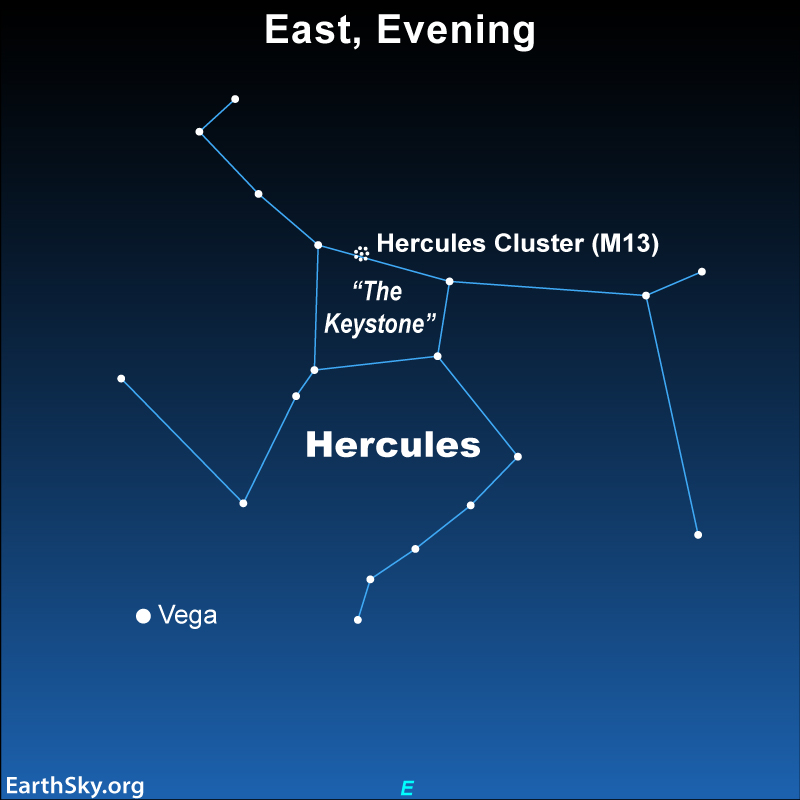
Man-shaped constellation with bent arms and legs, and labeled stars.
Hercules the Strongman is, overall, a faint constellation. But its midsection contains the easy-to-see Keystone asterism. In order to find it, look between the bright stars Vega in Lyra the Harp and Arcturus in Boötes the Herdsman. Chart via EarthSky.

Don’t miss the next unmissable night sky event. Sign up for our free newsletter for daily night sky updates, as well as the latest science news.

Finding Hercules

Tonight, try locating the constellation Hercules the Strongman. This star pattern is ascending in the east-northeast on these Northern Hemisphere spring evenings. You can find it between two brilliantly bright stars, Arcturus and Vega.

The chart at the top of this post shows the evening sky in late April, when the constellation Hercules, and the two stars so essential for finding it, are well up in the northeastern to eastern sky.

The brighter of the two guide stars is Arcturus, in the constellation Boötes the Herdsman. The other, Vega, is in the constellation Lyra the Harp. At nightfall, Vega might still be below your horizon. If so, wait a while … it’ll rise soon.

Then if you draw a line between Arcturus and Vega, it’ll pass through what is known as the Keystone – a squarish asterism, or noticeable star pattern – in the center of Hercules.

Constellation with arms and legs around a squarish center, and a labeled cluster.
As darkness falls, look for the Keystone to the upper right of the brilliant star Vega. Once you find the Keystone, you can look for M13, a wonderful globular star cluster within its boundaries. Chart via EarthSky.

The Keystone guides you to M13

The Keystone is helpful for several reasons. First, it’s a noticeable star pattern, so it can lead your eye to Hercules.

Second, the Keystone can help you find the most fascinating telescopic object within the boundaries of this constellation. This object is a globular star cluster known to stargazers as M13 or the Great Cluster. Although M13 is barely visible to the eye alone in dark skies, binoculars reveal a nebulous starlike patch of light. And telescopes show stars both on the periphery of the cluster and toward its center.

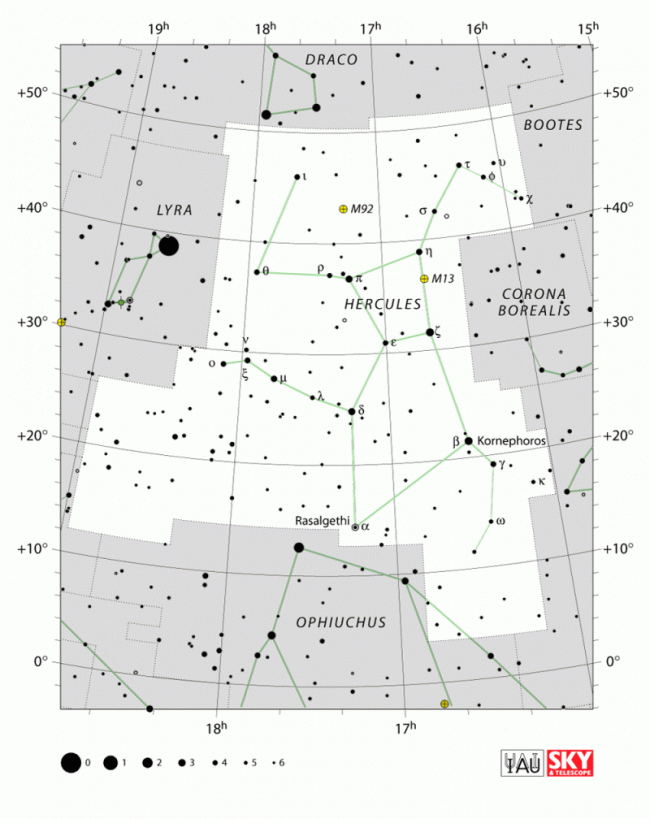
Chart with stars in black on white, constellation Hercules outlined and small dots for star cluster.
Chart showing M13 (the Great Cluster) in the Keystone. And M92, another globular cluster, lies above the Keystone. Image via IAU/ Sky & Telescope/ Wikipedia (CC BY 3.0).

Undoubtedly, this beautiful object is one of the galaxy’s oldest inhabitants. It’s a tightly packed spherical collection of about one million stars.

Read more: M13 or the Great Cluster in Hercules

EarthSky astronomy kits are perfect for beginners. Order today from the EarthSky store

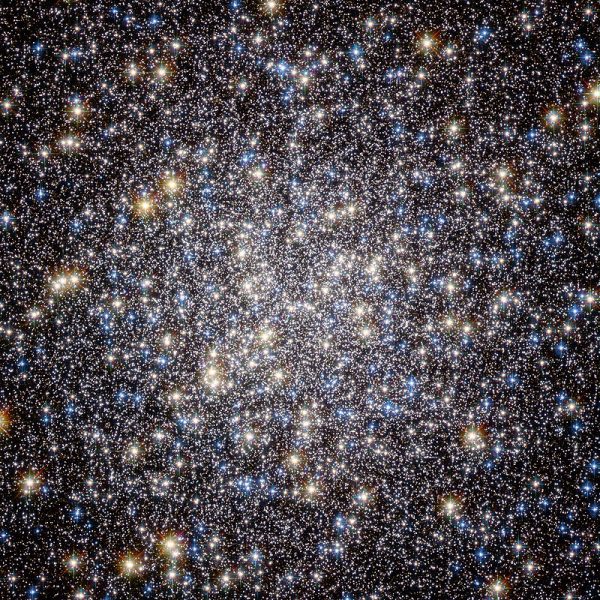
Round region of many densely packed stars, density fading off at edges.
M13, aka the Great Cluster. This object is a globular star cluster, one of our galaxy’s oldest inhabitants. Photo via ESA/ Hubble/ NASA.

But wait, there’s more

Although it’s not as spectacular as M13, Hercules has another great globular cluster, M92. It makes a triangle with the two northernmost stars in the Keystone. So imagine it is where Hercules’ head would be. Even though you can marginally see it without optical aid, it shows up easily in binoculars and a telescope.

Bottom line: Tonight, if you look between the brilliant stars Arcturus and Vega, you can find the constellation Hercules the Strongman. And look for its two fabulous globular clusters, easily found in binoculars.

The post Hercules is between 2 bright stars: Vega and Arcturus first appeared on EarthSky.


from EarthSky https://ift.tt/zSEDeHF
Man-shaped constellation with bent arms and legs, and labeled stars.
Hercules the Strongman is, overall, a faint constellation. But its midsection contains the easy-to-see Keystone asterism. In order to find it, look between the bright stars Vega in Lyra the Harp and Arcturus in Boötes the Herdsman. Chart via EarthSky.

Don’t miss the next unmissable night sky event. Sign up for our free newsletter for daily night sky updates, as well as the latest science news.

Finding Hercules

Tonight, try locating the constellation Hercules the Strongman. This star pattern is ascending in the east-northeast on these Northern Hemisphere spring evenings. You can find it between two brilliantly bright stars, Arcturus and Vega.

The chart at the top of this post shows the evening sky in late April, when the constellation Hercules, and the two stars so essential for finding it, are well up in the northeastern to eastern sky.

The brighter of the two guide stars is Arcturus, in the constellation Boötes the Herdsman. The other, Vega, is in the constellation Lyra the Harp. At nightfall, Vega might still be below your horizon. If so, wait a while … it’ll rise soon.

Then if you draw a line between Arcturus and Vega, it’ll pass through what is known as the Keystone – a squarish asterism, or noticeable star pattern – in the center of Hercules.

Constellation with arms and legs around a squarish center, and a labeled cluster.
As darkness falls, look for the Keystone to the upper right of the brilliant star Vega. Once you find the Keystone, you can look for M13, a wonderful globular star cluster within its boundaries. Chart via EarthSky.

The Keystone guides you to M13

The Keystone is helpful for several reasons. First, it’s a noticeable star pattern, so it can lead your eye to Hercules.

Second, the Keystone can help you find the most fascinating telescopic object within the boundaries of this constellation. This object is a globular star cluster known to stargazers as M13 or the Great Cluster. Although M13 is barely visible to the eye alone in dark skies, binoculars reveal a nebulous starlike patch of light. And telescopes show stars both on the periphery of the cluster and toward its center.

Chart with stars in black on white, constellation Hercules outlined and small dots for star cluster.
Chart showing M13 (the Great Cluster) in the Keystone. And M92, another globular cluster, lies above the Keystone. Image via IAU/ Sky & Telescope/ Wikipedia (CC BY 3.0).

Undoubtedly, this beautiful object is one of the galaxy’s oldest inhabitants. It’s a tightly packed spherical collection of about one million stars.

Read more: M13 or the Great Cluster in Hercules

EarthSky astronomy kits are perfect for beginners. Order today from the EarthSky store

Round region of many densely packed stars, density fading off at edges.
M13, aka the Great Cluster. This object is a globular star cluster, one of our galaxy’s oldest inhabitants. Photo via ESA/ Hubble/ NASA.

But wait, there’s more

Although it’s not as spectacular as M13, Hercules has another great globular cluster, M92. It makes a triangle with the two northernmost stars in the Keystone. So imagine it is where Hercules’ head would be. Even though you can marginally see it without optical aid, it shows up easily in binoculars and a telescope.

Bottom line: Tonight, if you look between the brilliant stars Arcturus and Vega, you can find the constellation Hercules the Strongman. And look for its two fabulous globular clusters, easily found in binoculars.

The post Hercules is between 2 bright stars: Vega and Arcturus first appeared on EarthSky.


from EarthSky https://ift.tt/zSEDeHF

Euclid Space Warps: Help spot galaxies bending spacetime!

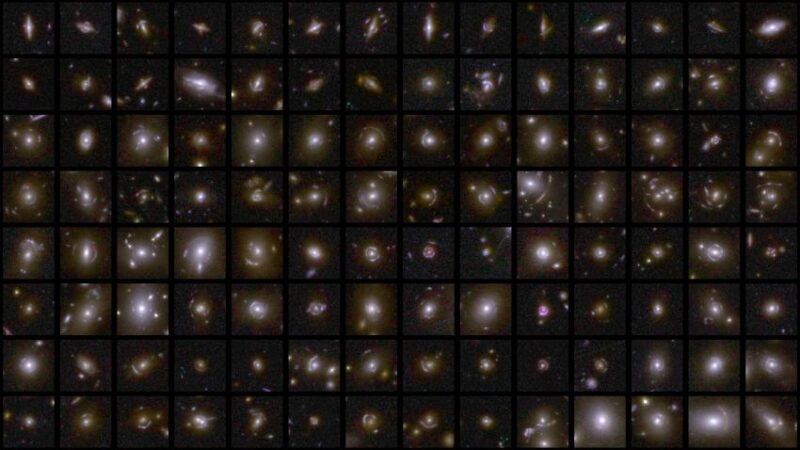
112 tiny galaxy photos with thin arcs of light around each.
These Euclid space telescope images show galaxies bending spacetime, causing light from more distant galaxies to distort around them. A new citizen science project, Space Warps, is enlisting members of the public to find more of these galaxies. Image via ESA/ Euclid/ Euclid Consortium/ NASA/ image processing by M. Walmsley/ M. Huertas-Company/ J.-C. Cuillandre.

ESA originally published this article on April 21, 2026. Edits by EarthSky.

Euclid Space Warps: Help spot galaxies bending spacetime!

With the launch of Space Warps, a new citizen science project, you can now join in the search to find galaxies that are bending the very fabric of the universe.

Hosted on the Zooniverse platform, this project sees members of the public search through never-before-seen images captured by the Euclid space telescope to find rare and elusive strong gravitational lenses. The project aims to shine a light on dark matter in galaxies and provide clues about mysterious dark energy.

Science news, night sky events and beautiful photos, all in one place. Click here to subscribe to EarthSky’s free daily newsletter.

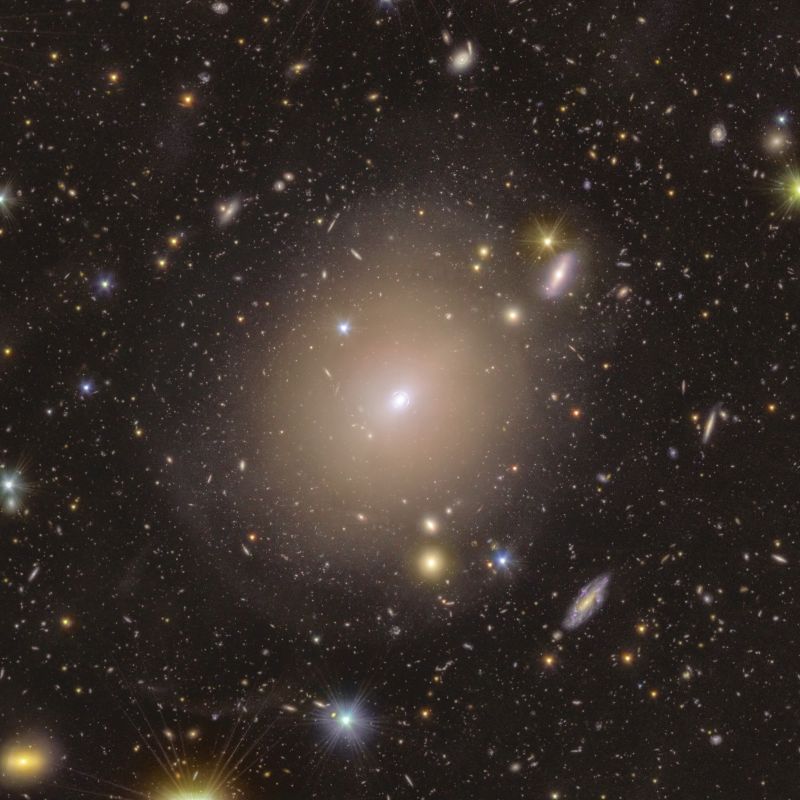
A solid glowing circle with a thin glowing ring around it that has four bright spots along it.
A case of strong gravitational lensing around galaxy NGC 6505. The ring of light plus those 4 glowing lumps are all from one distant galaxy, its light being bent by the galaxy in the foreground. Image via ESA/ Euclid/ Euclid Consortium/ NASA/ Image processing by J.-C. Cuillandre/ G. Anselmi/ T. Li.

Gravity warps spacetime

Warps in spacetime do not only show up in science fiction movies like Interstellar. In real life, we can see the warping effect that gravity has on spacetime in the form of gravitational lensing.

The enormous gravity of a massive object – such as a galaxy or cluster of galaxies – distorts the shape of spacetime and can bend the light rays coming from a distant galaxy behind. By warping spacetime, the foreground galaxy acts like a magnifying glass.

Light from the background object that would be obscured doesn’t travel in a straight line anymore. Instead, it curves around the intervening mass. That often produces multiple images, stretched arcs, or even a complete ring known as an “Einstein ring,” like the one recently discovered by Euclid.

ESA’s Euclid telescope launched in July 2023 and is revolutionizing the studies of strong gravitational lensing by providing very sensitive imaging over large swaths of the sky. This is exactly what is needed to identify rare gravitational lenses.

In March 2025, 500 galaxy-galaxy strong lenses were found nestled in just the first 0.04% of Euclid data, most of them previously unknown. This pioneering catalog was created thanks to the combined effort from citizen scientists, artificial intelligence and researchers.

Many small galaxies and one large, fuzzy almost circular one with a tiny, glowing ring around its bright center.
Look closely. Can you spot the ring of light around the center of this galaxy, NGC 6505? ESA’s Euclid telescope captured galaxy NGC 6505 acting as a gravitational lens, bending the light from a more distant galaxy and creating this Einstein ring. Image via ESA/ Euclid/ Euclid Consortium/ NASA. Image processing by J.-C. Cuillandre/ G. Anselmi/ T. Li.

Spot gravitational lenses with Space Warps

As Euclid continues its survey, sending around 100 gigabytes of data back to Earth every day, ESA and the Euclid Consortium once again need help from citizen scientists to identify strong gravitational lenses in a large data set.

For this, the Space Warps team has launched a citizen science project based on new Euclid images, which will be part of the future Euclid Data Release 1. This data is not public yet. So by participating in this new citizen science project, you can get an early glimpse of Euclid’s new images.

For this project, you will be inspecting new high quality imaging data from Euclid in which many previously unknown strong lenses are hiding. About 300,000 images pre-selected by AI algorithms will be shown, fine-tuned with the results from the initial citizen-science Euclid strong lens search.

These are the highest-ranked candidates from a whopping 72 million galaxies from Data Release 1 that were classified by the AI algorithms. Scientists expect that this exquisite high-quality data will reveal more than 10,000 new lenses.

Black background with countless tiny glowing oblong and irregular shapes.
View larger. | A zoomed-in view of Euclid’s Deep Field South. We see countless galaxies, along with a large galaxy cluster and some gravitational lenses. Image via ESA/ Euclid/ Euclid Consortium/ NASA. Image processing by J.-C. Cuillandre/ E. Bertin/ G. Anselmi.

What we can learn from strong lenses

The Euclid mission explores how the universe has expanded and how its structure has changed through cosmic history. It does so using mainly two methods: weak gravitational lensing and a phenomenon known as baryonic acoustic oscillations. From this, scientists can learn more about the role of gravity and the nature of dark matter and dark energy.

Strong gravitational lenses can also provide insights into these central questions. For example, strong lensing features can “weigh” individual galaxies and clusters of galaxies. This reveals the total matter (whether dark or light) and traces the distribution of dark matter.

By studying strong lenses across cosmic time, scientists can trace the expansion of the universe and its apparent acceleration. This will provide additional insight into the role of dark energy.

Aprajita Verma, Space Warps’ co-founder and project lead at the University of Oxford in the U.K., said:

We’ve already seen the success of combining AI with visual inspection by citizen volunteers and scientists on Space Warps, efficiently finding hundreds of high-probability lens candidates in an initial small Euclid search in 2024.

In this brand-new Data Release 1 data, 30 times larger than the initial search and together with our improved AI algorithms, we are expecting to find more than 10,000 high quality lens candidates. This is more than four times the number of lenses than we have been able to find since the first gravitational lens was discovered nearly 50 years ago.

We can’t wait to see what we will find within this unprecedented dataset. Join us on Space Warps to take part in this exciting search!

Bottom line: New citizen science project Space Warps lets you study new Euclid space telescope data to find galaxies bending the fabric of the universe.

Via ESA

Read more: New Euclid images reveal hidden gravitational lenses

The post Euclid Space Warps: Help spot galaxies bending spacetime! first appeared on EarthSky.


from EarthSky https://ift.tt/YA0TONK
112 tiny galaxy photos with thin arcs of light around each.
These Euclid space telescope images show galaxies bending spacetime, causing light from more distant galaxies to distort around them. A new citizen science project, Space Warps, is enlisting members of the public to find more of these galaxies. Image via ESA/ Euclid/ Euclid Consortium/ NASA/ image processing by M. Walmsley/ M. Huertas-Company/ J.-C. Cuillandre.

ESA originally published this article on April 21, 2026. Edits by EarthSky.

Euclid Space Warps: Help spot galaxies bending spacetime!

With the launch of Space Warps, a new citizen science project, you can now join in the search to find galaxies that are bending the very fabric of the universe.

Hosted on the Zooniverse platform, this project sees members of the public search through never-before-seen images captured by the Euclid space telescope to find rare and elusive strong gravitational lenses. The project aims to shine a light on dark matter in galaxies and provide clues about mysterious dark energy.

Science news, night sky events and beautiful photos, all in one place. Click here to subscribe to EarthSky’s free daily newsletter.

A solid glowing circle with a thin glowing ring around it that has four bright spots along it.
A case of strong gravitational lensing around galaxy NGC 6505. The ring of light plus those 4 glowing lumps are all from one distant galaxy, its light being bent by the galaxy in the foreground. Image via ESA/ Euclid/ Euclid Consortium/ NASA/ Image processing by J.-C. Cuillandre/ G. Anselmi/ T. Li.

Gravity warps spacetime

Warps in spacetime do not only show up in science fiction movies like Interstellar. In real life, we can see the warping effect that gravity has on spacetime in the form of gravitational lensing.

The enormous gravity of a massive object – such as a galaxy or cluster of galaxies – distorts the shape of spacetime and can bend the light rays coming from a distant galaxy behind. By warping spacetime, the foreground galaxy acts like a magnifying glass.

Light from the background object that would be obscured doesn’t travel in a straight line anymore. Instead, it curves around the intervening mass. That often produces multiple images, stretched arcs, or even a complete ring known as an “Einstein ring,” like the one recently discovered by Euclid.

ESA’s Euclid telescope launched in July 2023 and is revolutionizing the studies of strong gravitational lensing by providing very sensitive imaging over large swaths of the sky. This is exactly what is needed to identify rare gravitational lenses.

In March 2025, 500 galaxy-galaxy strong lenses were found nestled in just the first 0.04% of Euclid data, most of them previously unknown. This pioneering catalog was created thanks to the combined effort from citizen scientists, artificial intelligence and researchers.

Many small galaxies and one large, fuzzy almost circular one with a tiny, glowing ring around its bright center.
Look closely. Can you spot the ring of light around the center of this galaxy, NGC 6505? ESA’s Euclid telescope captured galaxy NGC 6505 acting as a gravitational lens, bending the light from a more distant galaxy and creating this Einstein ring. Image via ESA/ Euclid/ Euclid Consortium/ NASA. Image processing by J.-C. Cuillandre/ G. Anselmi/ T. Li.

Spot gravitational lenses with Space Warps

As Euclid continues its survey, sending around 100 gigabytes of data back to Earth every day, ESA and the Euclid Consortium once again need help from citizen scientists to identify strong gravitational lenses in a large data set.

For this, the Space Warps team has launched a citizen science project based on new Euclid images, which will be part of the future Euclid Data Release 1. This data is not public yet. So by participating in this new citizen science project, you can get an early glimpse of Euclid’s new images.

For this project, you will be inspecting new high quality imaging data from Euclid in which many previously unknown strong lenses are hiding. About 300,000 images pre-selected by AI algorithms will be shown, fine-tuned with the results from the initial citizen-science Euclid strong lens search.

These are the highest-ranked candidates from a whopping 72 million galaxies from Data Release 1 that were classified by the AI algorithms. Scientists expect that this exquisite high-quality data will reveal more than 10,000 new lenses.

Black background with countless tiny glowing oblong and irregular shapes.
View larger. | A zoomed-in view of Euclid’s Deep Field South. We see countless galaxies, along with a large galaxy cluster and some gravitational lenses. Image via ESA/ Euclid/ Euclid Consortium/ NASA. Image processing by J.-C. Cuillandre/ E. Bertin/ G. Anselmi.

What we can learn from strong lenses

The Euclid mission explores how the universe has expanded and how its structure has changed through cosmic history. It does so using mainly two methods: weak gravitational lensing and a phenomenon known as baryonic acoustic oscillations. From this, scientists can learn more about the role of gravity and the nature of dark matter and dark energy.

Strong gravitational lenses can also provide insights into these central questions. For example, strong lensing features can “weigh” individual galaxies and clusters of galaxies. This reveals the total matter (whether dark or light) and traces the distribution of dark matter.

By studying strong lenses across cosmic time, scientists can trace the expansion of the universe and its apparent acceleration. This will provide additional insight into the role of dark energy.

Aprajita Verma, Space Warps’ co-founder and project lead at the University of Oxford in the U.K., said:

We’ve already seen the success of combining AI with visual inspection by citizen volunteers and scientists on Space Warps, efficiently finding hundreds of high-probability lens candidates in an initial small Euclid search in 2024.

In this brand-new Data Release 1 data, 30 times larger than the initial search and together with our improved AI algorithms, we are expecting to find more than 10,000 high quality lens candidates. This is more than four times the number of lenses than we have been able to find since the first gravitational lens was discovered nearly 50 years ago.

We can’t wait to see what we will find within this unprecedented dataset. Join us on Space Warps to take part in this exciting search!

Bottom line: New citizen science project Space Warps lets you study new Euclid space telescope data to find galaxies bending the fabric of the universe.

Via ESA

Read more: New Euclid images reveal hidden gravitational lenses

The post Euclid Space Warps: Help spot galaxies bending spacetime! first appeared on EarthSky.


from EarthSky https://ift.tt/YA0TONK

adds 2