

Finding Hercules
Tonight, try locating the constellation Hercules the Strongman. This star pattern is ascending in the east-northeast on these Northern Hemisphere spring evenings. You can find it between two brilliantly bright stars, Arcturus and Vega.
The chart at the top of this post shows the evening sky in late April, when the constellation Hercules, and the two stars so essential for finding it, are well up in the northeastern to eastern sky.
The brighter of the two guide stars is Arcturus, in the constellation Boötes the Herdsman. The other, Vega, is in the constellation Lyra the Harp. At nightfall, Vega might still be below your horizon. If so, wait a while … it’ll rise soon.
Then if you draw a line between Arcturus and Vega, it’ll pass through what is known as the Keystone – a squarish asterism, or noticeable star pattern – in the center of Hercules.
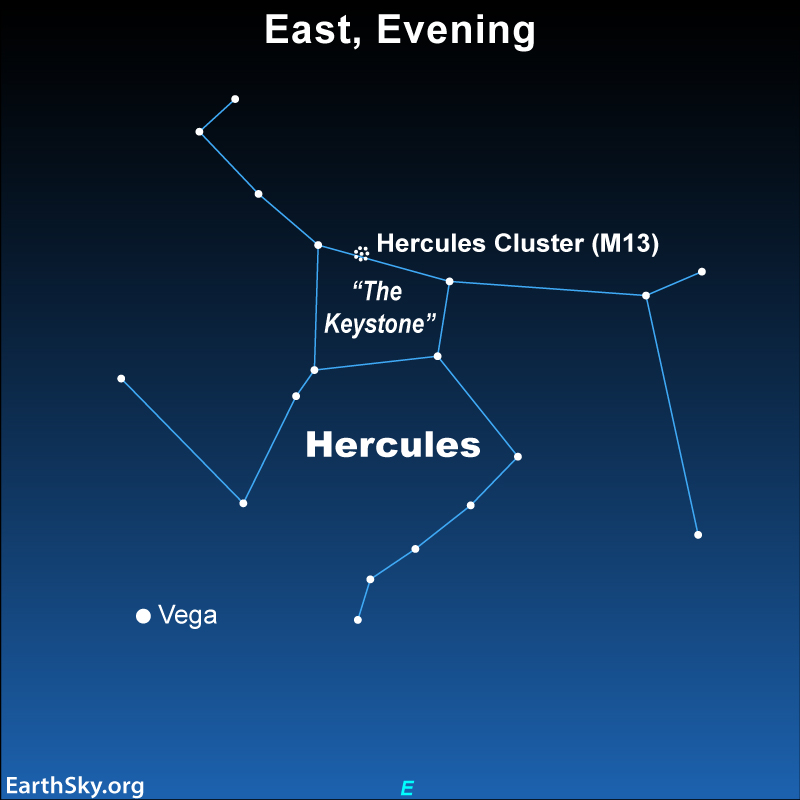
The Keystone guides you to M13
The Keystone is helpful for several reasons. First, it’s a noticeable star pattern, so it can lead your eye to Hercules.
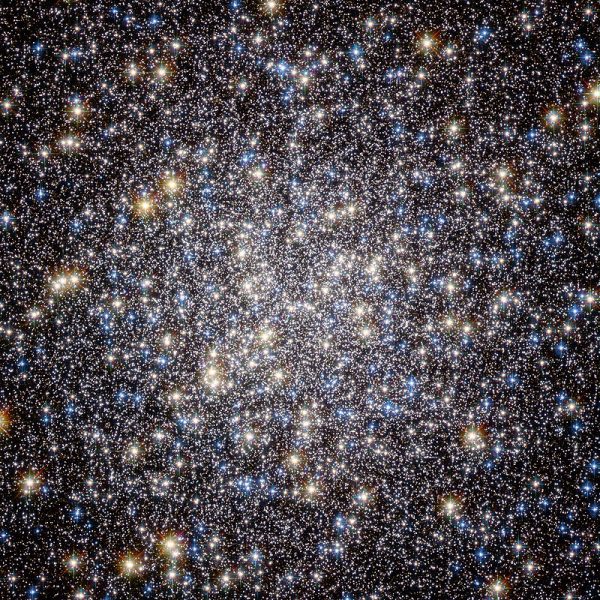
Second, the Keystone can help you find the most fascinating telescopic object within the boundaries of this constellation. This object is a globular star cluster known to stargazers as M13 or the Great Cluster. Although M13 is barely visible to the eye alone in dark skies, binoculars reveal a nebulous starlike patch of light. And telescopes show stars both on the periphery of the cluster and toward its center.
Undoubtedly, this beautiful object is one of the galaxy’s oldest inhabitants. It’s a tightly packed spherical collection of about one million stars.
Read more: M13 or the Great Cluster in Hercules
EarthSky astronomy kits are perfect for beginners. Order today from the EarthSky store
But wait, there’s more
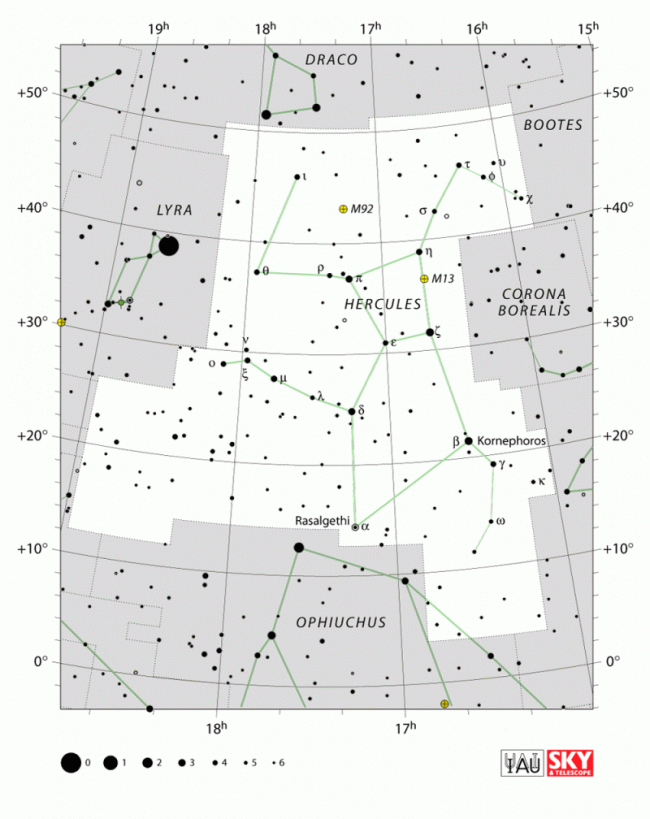
Although it’s not as spectacular as M13, Hercules has another great globular cluster, M92. It makes a triangle with the two northernmost stars in the Keystone. So imagine it is where Hercules’ head would be. Even though you can marginally see it without optical aid, it shows up easily in binoculars and a telescope.
Bottom line: Tonight, if you look between the brilliant stars Arcturus and Vega, you can find the constellation Hercules the Strongman. And look for its two fabulous globular clusters, easily found in binoculars.
The post Hercules is between 2 bright stars: Vega and Arcturus first appeared on EarthSky.
from EarthSky https://ift.tt/zSEDeHF
Finding Hercules
Tonight, try locating the constellation Hercules the Strongman. This star pattern is ascending in the east-northeast on these Northern Hemisphere spring evenings. You can find it between two brilliantly bright stars, Arcturus and Vega.
The chart at the top of this post shows the evening sky in late April, when the constellation Hercules, and the two stars so essential for finding it, are well up in the northeastern to eastern sky.
The brighter of the two guide stars is Arcturus, in the constellation Boötes the Herdsman. The other, Vega, is in the constellation Lyra the Harp. At nightfall, Vega might still be below your horizon. If so, wait a while … it’ll rise soon.
Then if you draw a line between Arcturus and Vega, it’ll pass through what is known as the Keystone – a squarish asterism, or noticeable star pattern – in the center of Hercules.
The Keystone guides you to M13
The Keystone is helpful for several reasons. First, it’s a noticeable star pattern, so it can lead your eye to Hercules.
Second, the Keystone can help you find the most fascinating telescopic object within the boundaries of this constellation. This object is a globular star cluster known to stargazers as M13 or the Great Cluster. Although M13 is barely visible to the eye alone in dark skies, binoculars reveal a nebulous starlike patch of light. And telescopes show stars both on the periphery of the cluster and toward its center.
Undoubtedly, this beautiful object is one of the galaxy’s oldest inhabitants. It’s a tightly packed spherical collection of about one million stars.
Read more: M13 or the Great Cluster in Hercules
EarthSky astronomy kits are perfect for beginners. Order today from the EarthSky store
But wait, there’s more
Although it’s not as spectacular as M13, Hercules has another great globular cluster, M92. It makes a triangle with the two northernmost stars in the Keystone. So imagine it is where Hercules’ head would be. Even though you can marginally see it without optical aid, it shows up easily in binoculars and a telescope.
Bottom line: Tonight, if you look between the brilliant stars Arcturus and Vega, you can find the constellation Hercules the Strongman. And look for its two fabulous globular clusters, easily found in binoculars.
The post Hercules is between 2 bright stars: Vega and Arcturus first appeared on EarthSky.
from EarthSky https://ift.tt/zSEDeHF

Aucun commentaire:
Enregistrer un commentaire