The December solstice fell on December 21, 2025. Our next perihelion – Earth’s closest point to the sun – will fall on January 3, 2026. Coincidence? EarthSky’s Deborah Byrd and John Goss have more. Watch in the player above or on YouTube.
Earth comes closest to the sun on January 3, 2026. This event is called Earth’s perihelion. Meanwhile, the December solstice is December 21, 2025. The December solstice and January perihelion come close together in time. Are they related? No. It’s just a coincidence that they fall within about a two-week period each year.
The December solstice marked the sun’s southernmost path across our sky. At this solstice, Earth’s Southern Hemisphere is tilted most toward the sun. And so it’s summer now in that hemisphere. Meanwhile, the northern half of the globe is tilted most away from the sun at the December solstice. We typically say that winter begins at this solstice on our half of the globe.
Perihelion isn’t about Earth’s tilt. It’s about how near or far we are from the sun in orbit. The date of Earth’s perihelion drifts as the centuries pass. These two astronomical events are about two weeks apart for us now. But they were closer a few centuries ago. In fact, in the year 1246 CE, they happened on the same day.
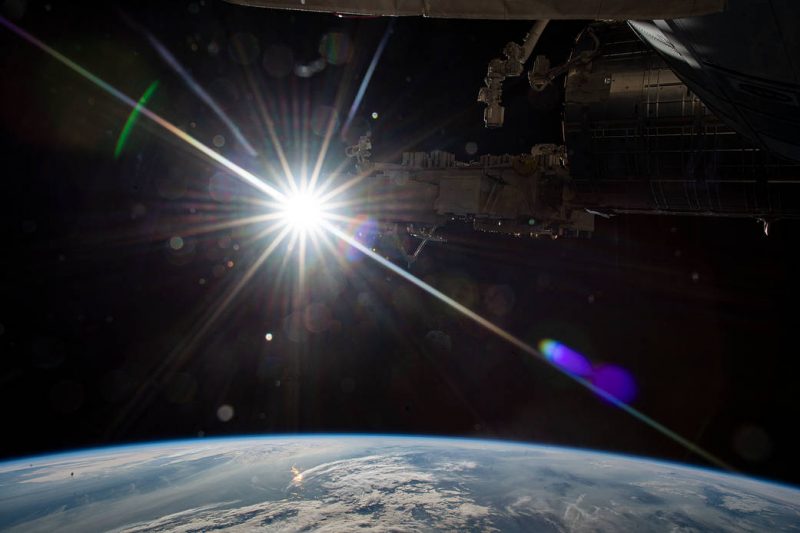
Are the December solstice and January perihelion related? After all, they’re both about our world’s relationship to the sun that binds it in orbit. Astronauts aboard the International Space Station took this image of Earth and the sun on May 9, 2021. Image via NASA.
Date of perihelion drifts
But, like all things in nature, the shape of Earth’s orbit isn’t static. Writing at timeanddate.com, Aparna Kher explained:
Due to variations in the eccentricity of the Earth’s orbit, the dates when the Earth reaches its perihelion or aphelion are not fixed. Since 1246 CE, the perihelion and aphelion dates have drifted by a day every 58 years. In the short term, the dates can vary up to two days from one year to another.
So as the centuries continue to pass, the December solstice and January perihelion will drift even farther apart. Kher continued:
On the average, one revolution of the Earth relative to perihelion is about 25 minutes longer than one revolution relative to the December solstice. Perihelion advances one full calendar date about every 58 years.
Mathematicians and astronomers estimate that in 6430, over 4000 years from now, the perihelion will coincide with the March equinox.
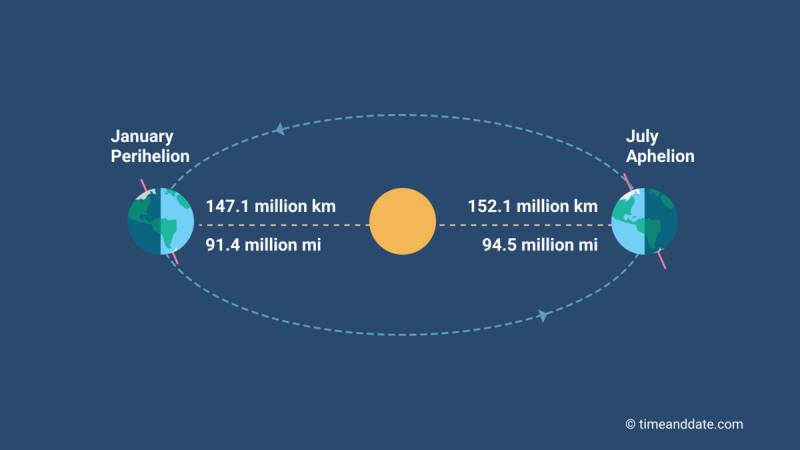
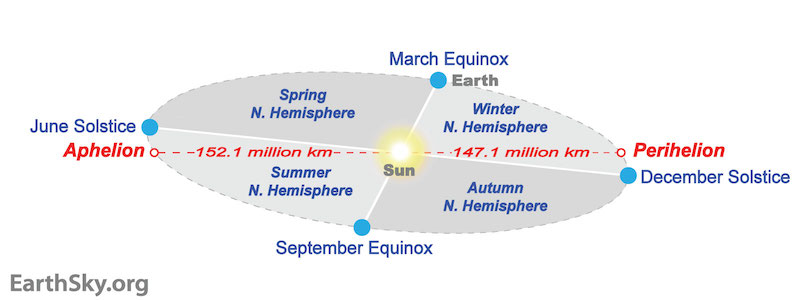
Earth-sun distance differences between the January perihelion (closest point) and July aphelion (farthest point). Earth is farthest from the sun when it is summer in the Northern Hemisphere. Illustration by timeanddate.com. Used with permission.
Bottom line: Earth’s December solstice and January perihelion are not related.
The December solstice fell on December 21, 2025. Our next perihelion – Earth’s closest point to the sun – will fall on January 3, 2026. Coincidence? EarthSky’s Deborah Byrd and John Goss have more. Watch in the player above or on YouTube.
Earth comes closest to the sun on January 3, 2026. This event is called Earth’s perihelion. Meanwhile, the December solstice is December 21, 2025. The December solstice and January perihelion come close together in time. Are they related? No. It’s just a coincidence that they fall within about a two-week period each year.
The December solstice marked the sun’s southernmost path across our sky. At this solstice, Earth’s Southern Hemisphere is tilted most toward the sun. And so it’s summer now in that hemisphere. Meanwhile, the northern half of the globe is tilted most away from the sun at the December solstice. We typically say that winter begins at this solstice on our half of the globe.
Perihelion isn’t about Earth’s tilt. It’s about how near or far we are from the sun in orbit. The date of Earth’s perihelion drifts as the centuries pass. These two astronomical events are about two weeks apart for us now. But they were closer a few centuries ago. In fact, in the year 1246 CE, they happened on the same day.
Are the December solstice and January perihelion related? After all, they’re both about our world’s relationship to the sun that binds it in orbit. Astronauts aboard the International Space Station took this image of Earth and the sun on May 9, 2021. Image via NASA.
Date of perihelion drifts
But, like all things in nature, the shape of Earth’s orbit isn’t static. Writing at timeanddate.com, Aparna Kher explained:
Due to variations in the eccentricity of the Earth’s orbit, the dates when the Earth reaches its perihelion or aphelion are not fixed. Since 1246 CE, the perihelion and aphelion dates have drifted by a day every 58 years. In the short term, the dates can vary up to two days from one year to another.
So as the centuries continue to pass, the December solstice and January perihelion will drift even farther apart. Kher continued:
On the average, one revolution of the Earth relative to perihelion is about 25 minutes longer than one revolution relative to the December solstice. Perihelion advances one full calendar date about every 58 years.
Mathematicians and astronomers estimate that in 6430, over 4000 years from now, the perihelion will coincide with the March equinox.
Earth-sun distance differences between the January perihelion (closest point) and July aphelion (farthest point). Earth is farthest from the sun when it is summer in the Northern Hemisphere. Illustration by timeanddate.com. Used with permission.
Bottom line: Earth’s December solstice and January perihelion are not related.
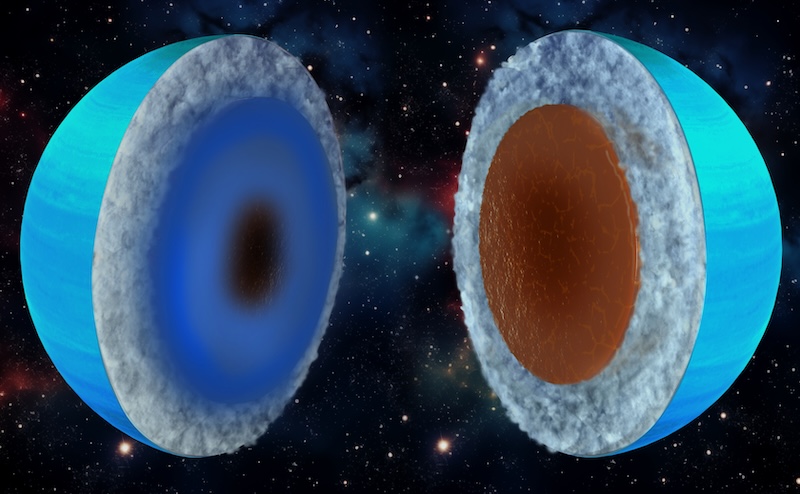
View larger. | Artist’s depiction of the interior of Uranus as either an ice giant (left) or rock giant (right). A new study suggests both Uranus and Neptune could be rock giants instead of the long-assumed ice giants. Image via Keck Institute for Space Studies/ Chuck Carter/ University of Zurich.
Uranus and Neptune are known as the “ice giants” in the solar system. Scientists have long thought their interiors are composed mostly of ice. But is that accurate?
Both planets might instead be rock giants, new research suggests. Their interiors would be much more rocky than previously thought.
The study doesn’t make any definitive conclusions. But it does expand the possibilities for what Uranus and Neptune are like on the inside.
Astronomers sort the planets in our solar system into three categories: rocky planets, gas giants and ice giants. Mercury, Venus, Earth and Mars are the rocky planets. Jupiter and Saturn are the gas giants. And Uranus and Neptune are considered ice giants, with volatile materials heavier than hydrogen and helium – such as water, ammonia or methane – in their interiors. But researchers from the University of Zurich and NCCR PlanetS in Switzerland said on December 10, 2025, that Uranus and Neptune might be more rocky than icy on the inside. Could they be rock giants instead of ice giants?
Notably, the new study doesn’t say Uranus and Neptune must be either ice giants or rock giants. Rather, it makes the case that the long-held view of them being ice giants isn’t the only possibility.
Zurich Univ. press release: Uranus and Neptune might be rock giants http://www.news.uzh.ch/en/articles/…Article by Morf & Helled: https://ift.tt/aBrJfTG…
The long-held view of Uranus and Neptune is that they are ice giants. This assumes ice makes up the bulk of their interior composition, beneath their deep atmospheres. But is that the only possibility? Perhaps not.
The new study expands the possible interior structures of Uranus and Neptune. It doesn’t claim that any one particular model is correct. But it does increase the range of possibilities. Lead author Luca Morf at the University of Zurich and NCCR PlanetS said calling them ice giants might be too simplified:
The ice giant classification is oversimplified, as Uranus and Neptune are still poorly understood. Models based on physics were too assumption-heavy, while empirical models are too simplistic. We combined both approaches to get interior models that are both ‘agnostic’ or unbiased and yet are physically consistent.
Luca Morf at the University of Zurich and NCCR PlanetS in Switzerland is the lead author of the new study about the compositions of Uranus and Neptune. Image via NCCR PlanetS.
Ice-rich or rock-rich?
The researchers took a new approach to assessing what the interiors of Uranus and Neptune are like. First, they used a random density profile for the planetary interior. Then they calculated the planetary gravitational field that is consistent with observational data. By doing so, they could infer a possible interior composition. Lastly, they repeated the process to obtain the best possible match between the models and the observational data.
The results were intriguing. They suggested that an icy interior is just one possibility. Both Uranus and Neptune could be either ice-rich or rock-rich on the inside. They also support what the researchers first proposed 15 years ago. Co-author Ravit Helled at the University of Zurich said:
It is something that we first suggested nearly 15 years ago, and now we have the numerical framework to demonstrate it.
Questions remain
The rock giant scenario isn’t conclusive yet. Questions remain, as Morf noted:
One of the main issues is that physicists still barely understand how materials behave under the exotic conditions of pressure and temperature found at the heart of a planet, this could impact our results.
Uranus and Neptune could still be either ice giants or rock giants. Helled added:
Both Uranus and Neptune could be rock giants or ice giants depending on the model assumptions. Current data are currently insufficient to distinguish the two, and we therefore need dedicated missions to Uranus and Neptune that can reveal their true nature.
View larger. | NASA’s Voyager 2 spacecraft captured these views of Uranus and Neptune during its flybys of the planets in the late 1980s. A new study suggests both planets might be rock giants instead of ice giants. Image via NASA/ JPL-Caltech/ B. Jónsson/ NOIRLab.
New clues about Uranus’ and Neptune’s magnetic fields
The findings also shed new light on Uranus’ and Neptune’s unusual magnetic fields. They are more complex than Earth’s, since they have more than two poles. Earth, on the other hand, simply has a magnetic North Pole and magnetic South Pole. As Helled explained:
Our models have so-called ‘ionic water’ layers which generate magnetic dynamos in locations that explain the observed non-dipolar magnetic fields. We also found that Uranus’ magnetic field originates deeper than Neptune’s.
There are currently no new missions being developed yet to return to Uranus or Neptune. The last visit was by Voyager 2 in the late 1980s. So, in the meantime scientists will continue to study the data from the old Voyager missions and from current telescopes to try to better understand these mysterious worlds.
Bottom line: Are Uranus and Neptune really ice giants as scientists have long thought? A new study suggests they might be much more rocky instead of icy on the inside.
View larger. | Artist’s depiction of the interior of Uranus as either an ice giant (left) or rock giant (right). A new study suggests both Uranus and Neptune could be rock giants instead of the long-assumed ice giants. Image via Keck Institute for Space Studies/ Chuck Carter/ University of Zurich.
Uranus and Neptune are known as the “ice giants” in the solar system. Scientists have long thought their interiors are composed mostly of ice. But is that accurate?
Both planets might instead be rock giants, new research suggests. Their interiors would be much more rocky than previously thought.
The study doesn’t make any definitive conclusions. But it does expand the possibilities for what Uranus and Neptune are like on the inside.
Astronomers sort the planets in our solar system into three categories: rocky planets, gas giants and ice giants. Mercury, Venus, Earth and Mars are the rocky planets. Jupiter and Saturn are the gas giants. And Uranus and Neptune are considered ice giants, with volatile materials heavier than hydrogen and helium – such as water, ammonia or methane – in their interiors. But researchers from the University of Zurich and NCCR PlanetS in Switzerland said on December 10, 2025, that Uranus and Neptune might be more rocky than icy on the inside. Could they be rock giants instead of ice giants?
Notably, the new study doesn’t say Uranus and Neptune must be either ice giants or rock giants. Rather, it makes the case that the long-held view of them being ice giants isn’t the only possibility.
Zurich Univ. press release: Uranus and Neptune might be rock giants http://www.news.uzh.ch/en/articles/…Article by Morf & Helled: https://ift.tt/aBrJfTG…
The long-held view of Uranus and Neptune is that they are ice giants. This assumes ice makes up the bulk of their interior composition, beneath their deep atmospheres. But is that the only possibility? Perhaps not.
The new study expands the possible interior structures of Uranus and Neptune. It doesn’t claim that any one particular model is correct. But it does increase the range of possibilities. Lead author Luca Morf at the University of Zurich and NCCR PlanetS said calling them ice giants might be too simplified:
The ice giant classification is oversimplified, as Uranus and Neptune are still poorly understood. Models based on physics were too assumption-heavy, while empirical models are too simplistic. We combined both approaches to get interior models that are both ‘agnostic’ or unbiased and yet are physically consistent.
Luca Morf at the University of Zurich and NCCR PlanetS in Switzerland is the lead author of the new study about the compositions of Uranus and Neptune. Image via NCCR PlanetS.
Ice-rich or rock-rich?
The researchers took a new approach to assessing what the interiors of Uranus and Neptune are like. First, they used a random density profile for the planetary interior. Then they calculated the planetary gravitational field that is consistent with observational data. By doing so, they could infer a possible interior composition. Lastly, they repeated the process to obtain the best possible match between the models and the observational data.
The results were intriguing. They suggested that an icy interior is just one possibility. Both Uranus and Neptune could be either ice-rich or rock-rich on the inside. They also support what the researchers first proposed 15 years ago. Co-author Ravit Helled at the University of Zurich said:
It is something that we first suggested nearly 15 years ago, and now we have the numerical framework to demonstrate it.
Questions remain
The rock giant scenario isn’t conclusive yet. Questions remain, as Morf noted:
One of the main issues is that physicists still barely understand how materials behave under the exotic conditions of pressure and temperature found at the heart of a planet, this could impact our results.
Uranus and Neptune could still be either ice giants or rock giants. Helled added:
Both Uranus and Neptune could be rock giants or ice giants depending on the model assumptions. Current data are currently insufficient to distinguish the two, and we therefore need dedicated missions to Uranus and Neptune that can reveal their true nature.
View larger. | NASA’s Voyager 2 spacecraft captured these views of Uranus and Neptune during its flybys of the planets in the late 1980s. A new study suggests both planets might be rock giants instead of ice giants. Image via NASA/ JPL-Caltech/ B. Jónsson/ NOIRLab.
New clues about Uranus’ and Neptune’s magnetic fields
The findings also shed new light on Uranus’ and Neptune’s unusual magnetic fields. They are more complex than Earth’s, since they have more than two poles. Earth, on the other hand, simply has a magnetic North Pole and magnetic South Pole. As Helled explained:
Our models have so-called ‘ionic water’ layers which generate magnetic dynamos in locations that explain the observed non-dipolar magnetic fields. We also found that Uranus’ magnetic field originates deeper than Neptune’s.
There are currently no new missions being developed yet to return to Uranus or Neptune. The last visit was by Voyager 2 in the late 1980s. So, in the meantime scientists will continue to study the data from the old Voyager missions and from current telescopes to try to better understand these mysterious worlds.
Bottom line: Are Uranus and Neptune really ice giants as scientists have long thought? A new study suggests they might be much more rocky instead of icy on the inside.
We’ve all seen a full moon looming large shortly after it rises, when it’s still hugging the horizon. And it’s true that the moon is sometimes closer to Earth than at other times, making it minutely larger in our sky. Yet the difference is barely discernible. When the moon viewed near the horizon looks larger than usual, your brain is playing a trick on you. It’s called the moon illusion.
You can check it out tomorrow night, on the full Wolf Moon. It’ll be the first supermoon of 2026. And this larger than normal moon will look huge – and bright – near the horizon.
We still don’t know the precise cause of the moon illusion. But the video above, from AsapSCIENCE, offers some explanations.
A common theory is when the moon is near the horizon, you’re seeing it in the company of many familiar visual reference points: trees, buildings, mountains and so on. Your brain automatically compares the moon to these reference points. But when the moon is higher up, there’s nothing to compare it to. As AsapSCIENCE says:
The moon seems smaller against the vastness of the night sky.
The moon looks bigger on the horizon. There is an optical illusion which makes the moon appear to be larger the lower it is in the sky. pic.twitter.com/zMAiAJ58g7
Maybe you’d like to test this theory yourself. According to NASA, here are some ways to prove it to yourself:
Hold up your outstretched index finger next to the moon. You’ll find that your fingernail and the moon are about the same size. Or try looking at the moon through a paper tube, or bend over and look backward between your legs. When you view it like this, the moon will be nowhere near as big as it had seemed.
Or NASA suggests:
Another ironclad way to size-check the moon is to take a photo when it’s near the horizon, and another when it’s high in the sky. If you keep your camera zoom settings the same, you’ll find that the moon is the same width, side to side, in both photos.
What about a red or orange moon?
By the way, there’s a second phenomenon that the moon displays when we see it near the horizon. That is, a low moon often appears red or orange in color. That reddish color is not an illusion. It’s a true physical effect, caused by the fact that – when the moon is low in the sky – you’re seeing it through a greater thickness of Earth’s atmosphere than when it’s overhead. The atmosphere filters out the bluer wavelengths of moonlight (which is really reflected sunlight). Meanwhile, it allows the red component of moonlight to travel straight through to your eyes. So a low moon is likely to look red or orange to you.
So how do people get those photos of extra big moons seen near a horizon? Photographers use zoom lenses and have familiar objects in the foreground making the more distant moon look huge. So they’re the result of photographic tricks and techniques, which you can read about here or here.
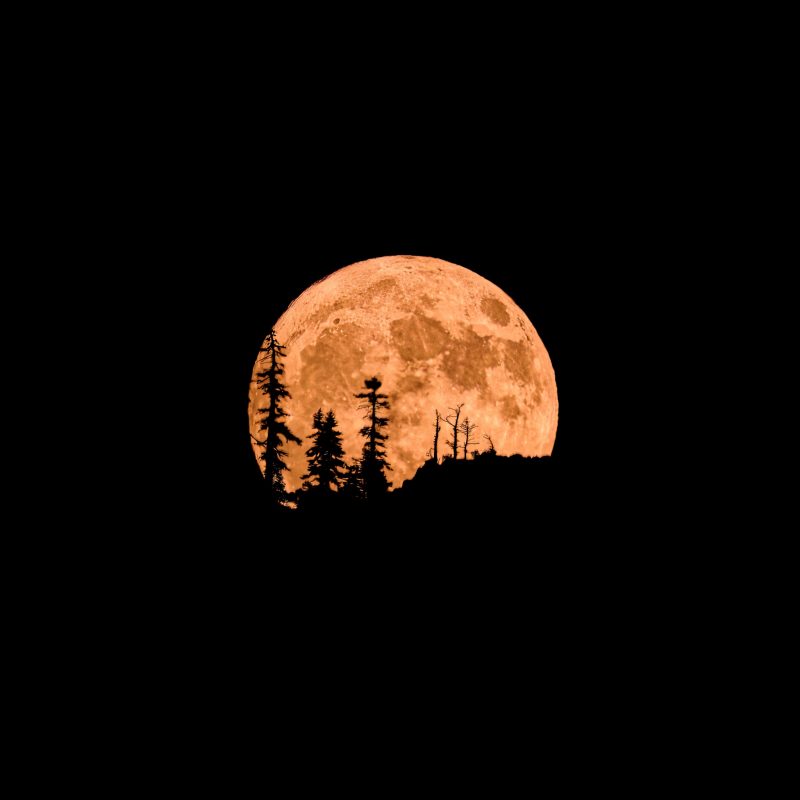
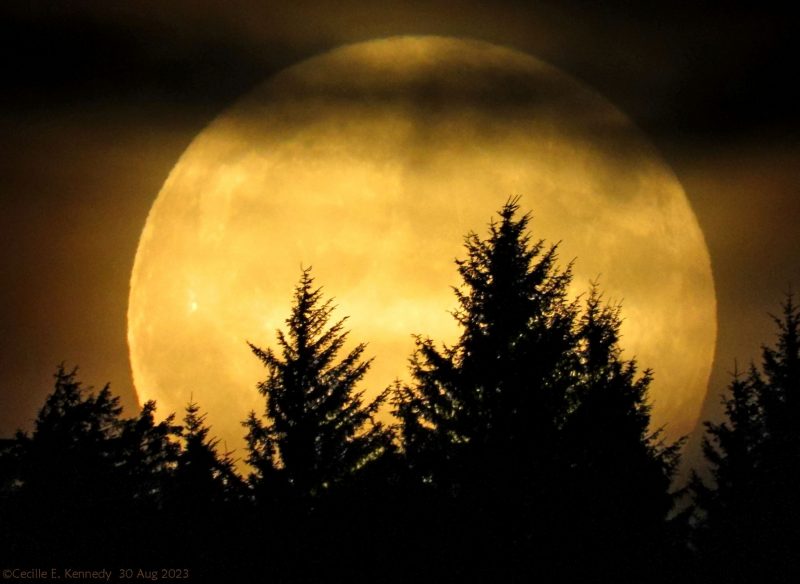
View at EarthSky Community Photos. | A great example of the moon illusion from Stephanie Becker in Soda Springs, California. She captured this image of the July full supermoon on July 2, 2023. Thank you, Stephanie!View at EarthSky Community Photos. | Cecille Kennedy in Depoe Bay, Oregon, captured this image on August 30, 2023. Cecille wrote: “The blue supermoon shines behind the clouds as it rises over the hills and the trees. A few minutes before the moon rose, the clouds were lavender rose pink. Then the lovely moon appeared.” Thank you, Cecille!
If you get a great photo of the full Wolf Moon supermoon, you can submit it here. We would love to see it!
Bottom line: It’s the full Wolf Moon tomorrow night. And it’s a supermoon. You might see a large-looking moon low in the sky. It’s the moon illusion that makes the moon look so big.
We’ve all seen a full moon looming large shortly after it rises, when it’s still hugging the horizon. And it’s true that the moon is sometimes closer to Earth than at other times, making it minutely larger in our sky. Yet the difference is barely discernible. When the moon viewed near the horizon looks larger than usual, your brain is playing a trick on you. It’s called the moon illusion.
You can check it out tomorrow night, on the full Wolf Moon. It’ll be the first supermoon of 2026. And this larger than normal moon will look huge – and bright – near the horizon.
We still don’t know the precise cause of the moon illusion. But the video above, from AsapSCIENCE, offers some explanations.
A common theory is when the moon is near the horizon, you’re seeing it in the company of many familiar visual reference points: trees, buildings, mountains and so on. Your brain automatically compares the moon to these reference points. But when the moon is higher up, there’s nothing to compare it to. As AsapSCIENCE says:
The moon seems smaller against the vastness of the night sky.
The moon looks bigger on the horizon. There is an optical illusion which makes the moon appear to be larger the lower it is in the sky. pic.twitter.com/zMAiAJ58g7
Maybe you’d like to test this theory yourself. According to NASA, here are some ways to prove it to yourself:
Hold up your outstretched index finger next to the moon. You’ll find that your fingernail and the moon are about the same size. Or try looking at the moon through a paper tube, or bend over and look backward between your legs. When you view it like this, the moon will be nowhere near as big as it had seemed.
Or NASA suggests:
Another ironclad way to size-check the moon is to take a photo when it’s near the horizon, and another when it’s high in the sky. If you keep your camera zoom settings the same, you’ll find that the moon is the same width, side to side, in both photos.
What about a red or orange moon?
By the way, there’s a second phenomenon that the moon displays when we see it near the horizon. That is, a low moon often appears red or orange in color. That reddish color is not an illusion. It’s a true physical effect, caused by the fact that – when the moon is low in the sky – you’re seeing it through a greater thickness of Earth’s atmosphere than when it’s overhead. The atmosphere filters out the bluer wavelengths of moonlight (which is really reflected sunlight). Meanwhile, it allows the red component of moonlight to travel straight through to your eyes. So a low moon is likely to look red or orange to you.
So how do people get those photos of extra big moons seen near a horizon? Photographers use zoom lenses and have familiar objects in the foreground making the more distant moon look huge. So they’re the result of photographic tricks and techniques, which you can read about here or here.
View at EarthSky Community Photos. | A great example of the moon illusion from Stephanie Becker in Soda Springs, California. She captured this image of the July full supermoon on July 2, 2023. Thank you, Stephanie!View at EarthSky Community Photos. | Cecille Kennedy in Depoe Bay, Oregon, captured this image on August 30, 2023. Cecille wrote: “The blue supermoon shines behind the clouds as it rises over the hills and the trees. A few minutes before the moon rose, the clouds were lavender rose pink. Then the lovely moon appeared.” Thank you, Cecille!
If you get a great photo of the full Wolf Moon supermoon, you can submit it here. We would love to see it!
Bottom line: It’s the full Wolf Moon tomorrow night. And it’s a supermoon. You might see a large-looking moon low in the sky. It’s the moon illusion that makes the moon look so big.
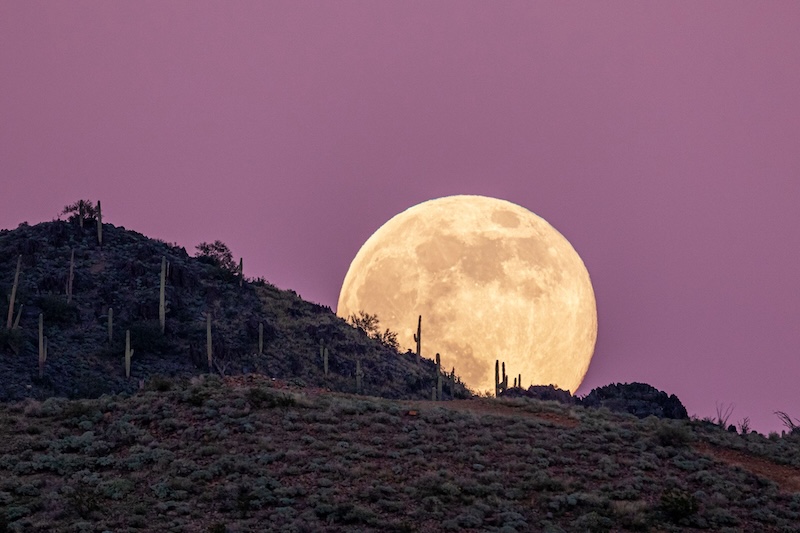
View at EarthSky Community Photos. | Kevin O’Donnell captured this image on December 4, 2025, and wrote: “Part of a time lapse captured during the Cold Moon Supermoon rising over the North Phoenix mountains.” Thank you, Kevin!
A cool cosmic coincidence kicks off 2026! The first full moon of the year — a supermoon — will coincide with Earth’s closest approach to the sun, known as perihelion, on and around January 2–3. That means the Earth, moon, and sun will all be unusually close and aligned as the new year begins. This rare event hasn’t happened since January 1912 and won’t occur again in our lifetimes. Join us on EarthSky’s livestream at 12 p.m. CST (18 UTC) on Wednesday, December 31, to explore this unique celestial alignment, learn why the seasons don’t follow Earth’s distance from the sun, and see how these subtle cosmic forces shape our sky.
What’s a supermoon?
2026 has eight supermoons! In fact, we have three full supermoons this year, and there’s five new supermoons this year. The year starts out with a full supermoon on January 2, 2026. So … what’s a supermoon?
New moon happens when the moon (in its monthly orbit of Earth) goes more or less between the sun and Earth. Full moon happens when the moon (in its monthly orbit) is on the opposite side of Earth from the sun. And perigee – from the root words peri meaning near and geo meaning Earth – is the moon’s closest point to Earth in a month.
So the new or full moon closely coincides with perigee several times each year. When that happens, in the language of popular culture, we have a supermoon.
The full supermoons of 2026 are:
Fred Espenak’s new supermoon table gives us these values – (in UTC dates) and moon distances – for full supermoons in 2026. Contrast these moon distances to the average moon distance of 238,900 miles (384,472 km).
Jan 3: 225,130 miles (362,312 kilometers)
Nov 24: 224,170 miles (360,768 kilometers)
Dec 24: 221,667 miles (356,740 kilometers)
Plus a full supermoon starts 2027
Jan 22: 222,229 miles (357,644 kilometers)
The full supermoon of December 24, 2026, will be the closest full supermoon of the year.
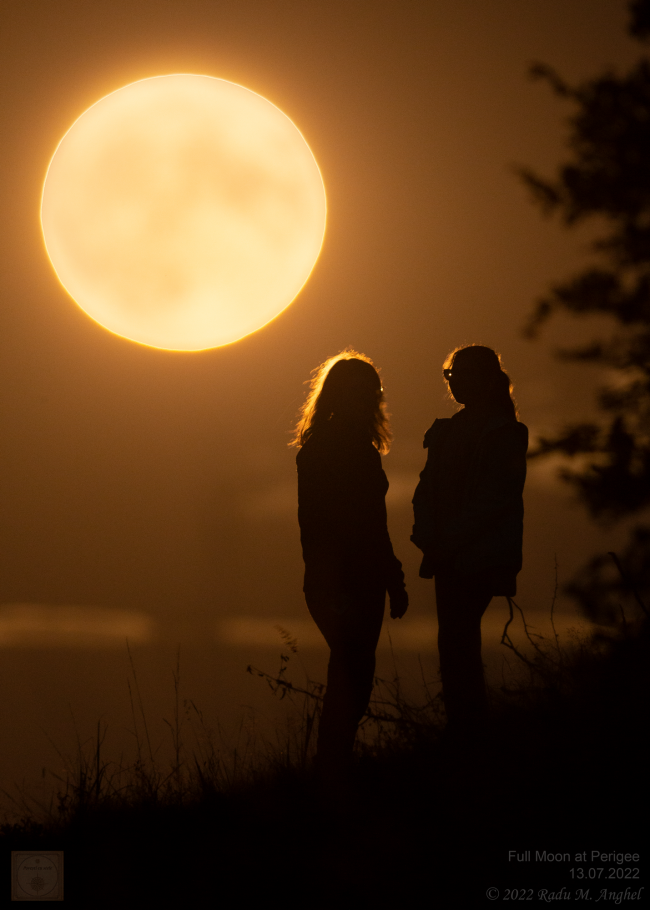
View at EarthSky Community Photos. | Radu Anghel in Parjol, România, caught what he called “a family photo with the supermoon of July 13, 2022.” Thank you, Radu! While supermoons don’t appear bigger to the eye than other full moons, they do appear brighter!
New supermoons of 2026 are:
Fred Espenak’s new supermoon table gives us these values – UTC dates and moon distances – for new supermoons in 2026. Contrast these moon distances to the average moon distance of 238,900 miles (384,472 km).
Apr 17: 226,299 miles (364,194 kilometers)
May 16: 222,819 miles (358,594 kilometers)
Jun 15: 221,966 miles (357,221 kilometers)
Jul 14: 223,789 miles (360,154 kilometers)
Aug 12: 228,017 miles (366,958 kilometers)
The new supermoon of June 15, 2026, will be the closest new supermoon for 2026.
And the new supermoon of August 12, 2026, will block out the sun causing a total solar eclipse.
What’s our source?
Note that different people define supermoons slightly differently. We use Fred Espenak’s full supermoon table to give us dates and moon distances for full supermoons in 2026. And we use his new supermoon table to give us dates and moon distances for new supermoons in 2026.
Also note that Fred’s dates and times are in UTC. So some supermoons may fall on the previous date your local time.
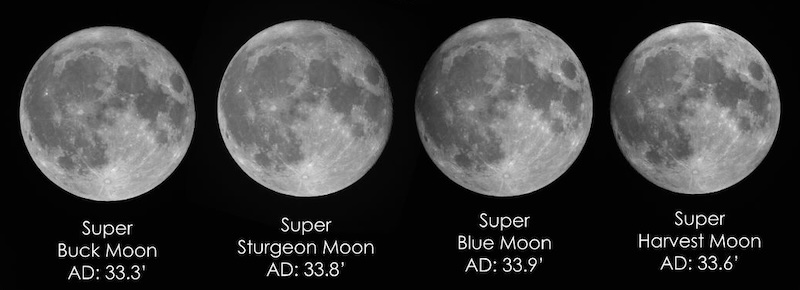
View at EarthSky Community Photos. | Soumyadeep Mukherjee captured all the full moons in 2023. Shown here – cropped out of the full image – are the 4 full supermoons of 2023 along with their apparent angular diameter (AD). Soumyadeep said: “All the images were captured with the same set of equipment at the same focal length (600mm).” Thank you, Soumyadeep!
Supermoons came from popular culture
Where did the term supermoon originate? As it’s used today, the word supermoon was coined by astrologer Richard Nolle in 1979. And according to Nolle’s definition, a full moon or new moon is a supermoon when it’s also within 90% of its closest point to Earth. However, different websites calculate supermoons differently.
As mentioned above, EarthSky uses supermoon dates as determined by astronomer Fred Espenak. He’s best known for his time at the Goddard Space Flight Center, where he became a world expert on eclipse predictions. Additionally, his method of calculating supermoons takes into account changes in the moon’s orbit during each lunar cycle.
Supermoon hype?
Some astronomers complain about the name supermoon. They like to call supermoons hype. But supermoons aren’t hype. They’re special. Many people now know and use the word supermoon. In fact, we even notice some diehards are starting to use it now. Such is the power of folklore.
The hype aspect of supermoons probably stemmed from an erroneous impression people had when the word supermoon came into popular usage a few decades ago. Some people mistakenly believed a full supermoon would look much, much bigger to the eye. But it doesn’t. Nowadays, most people seem to realize that supermoons don’t look bigger to the eye than ordinary full moons.
It’s true experienced observers do say they can detect a difference. But you’d have to be a very keen observer to notice it.
Most of us can’t tell any difference in the size of a supermoon and an ordinary full moon.
Is a supermoon brighter?
But … supermoons do look brighter than ordinary full moons! By a noticeable amount. That’s because a supermoon exceeds the disk size of an average-sized moon by up to 8% and the brightness of an average-sized full moon by some 16%. And then, it exceeds the disk size of a micromoon (a year’s most distant and therefore smallest full moon) up to 14% and the brightness of a micromoon by some 30%. So go outside on the night of a full supermoon. Even if you’re a casual observer of the moon, there’s the potential you’ll notice the supermoon is exceptionally bright!
For a visual reference, the size difference between a supermoon and micromoon is proportionally similar to that of a U.S. quarter versus a U.S. nickel. Again, that difference isn’t noticeable to the eye at the moon’s distance. But the brightness difference is noticeable.
By the way, before we called them supermoons, we in astronomy called these moons perigean full moons, or perigean new moons. No doubt about it, supermoon is catchier.
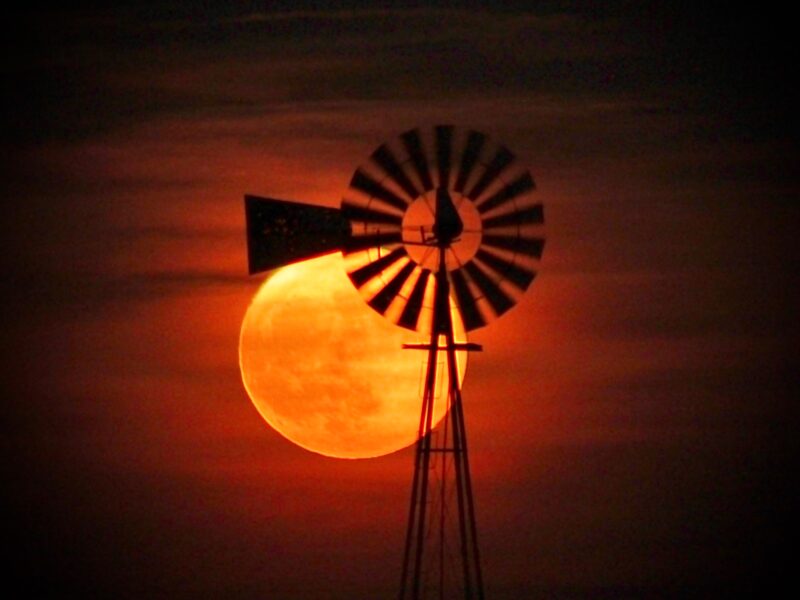
View at EarthSky Community Photos. | Bob Rich from Bryan, Texas, shared this image and wrote: “The August 2024 supermoon – and seasonal blue moon – rises behind a windmill.” Thank you!
High tides from new and full supermoons
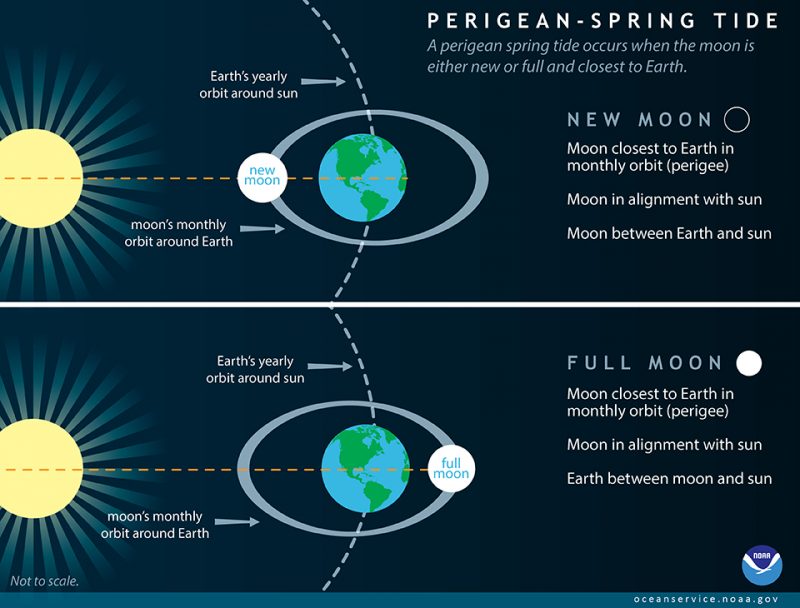
What’s more, all supermoons have the potential to cause higher-than-usual tides. High tides during the full or new moon are called spring tides. High tides during a full or new moon at perigee are called perigean spring tides, or, sometimes, king tides. And nowadays you sometimes hear them called supermoon tides.
These perigean or king or supermoon spring tides tend to follow the date of new or full moon by a day or so. These especially high tides are highly dependent on the shapes of local coastlines and on local weather conditions.
Do extra-high supermoon tides cause flooding? Maybe yes and maybe no. Flooding typically occurs when a strong weather system accompanies an especially high spring tide. According to Fred Espenak, the gravity from the closest supermoon is only 4% greater than the gravity from the moon at its average distance.
About 3 or 4 times a year, or more often, a new or full moon coincides with the moon’s closest point to Earth, or perigee. There’s usually only a small difference – typically a couple of inches (or centimeters) – between these “perigean spring tides” and normal tidal ranges. But, at these times, if a storm strikes along a coastline, flooding can occur. Image via NOAA/ National Ocean Service.
How often do we have a supermoon?
Often! But it also depends on your definition of supermoon.
Here’s a list of each year’s closest full supermoon perigees from 2017 to 2027 (from Espenak’s full supermoon table):
December 3, 2017 (357,987 kilometers or 222,443 miles)
January 2, 2018 (356,603 kilometers or 221,583 miles)
February 19, 2019 (356,846 kilometers or 221,734 miles)
April 8, 2020 (357,035 kilometers or 221,851 miles)
May 26, 2021 (357,463 kilometers or 222,117 miles)
July 13, 2022 (357,418 kilometers or 222,089 miles)
August 31, 2023 (357,344 kilometers or 222,043 miles)
October 17, 2024 (357,364 kilometers or 222,056 miles)
November 5, 2025 (356,980 kilometers or 221,817 miles)
December 24, 2026 (356,740 kilometers or 221,668 miles)
January 22, 2027 (357,644 kilometers or 222,229 miles)
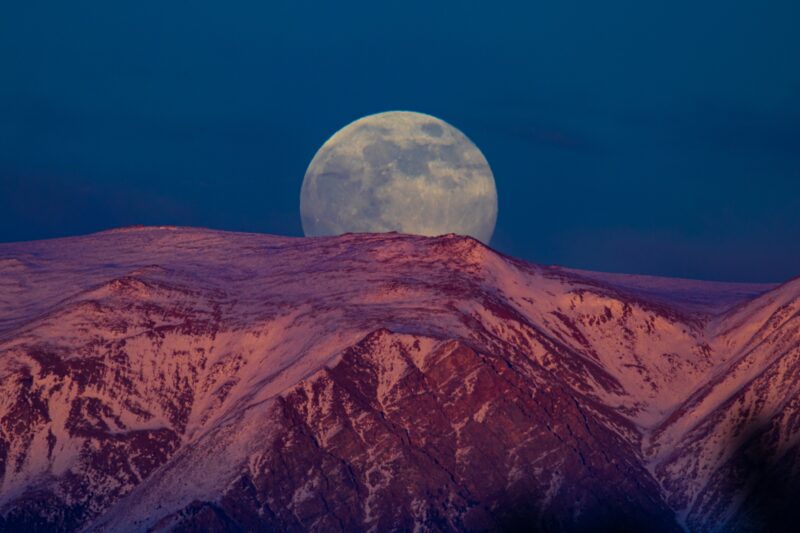
View at EarthSky Community Photos. | Jeremy Evans captured this amazing shot of the Cold Moon. Jeremy wrote: “Supermoon rise over the White Mountains, December 4, 2025. Taken from my front deck in the Eastern Sierra.” Thank you, Jeremy!
The recurring cycle of supermoons
The closest full moon supermoon in 2026 (December 24) will recur after 14 lunar months (14 returns to full moon) after the closest full supermoon of 2025 (November 5). That’s because 14 returns to full moon almost exactly equal 15 returns to perigee, a period of about one year, one month, and 18 days.
The mean lunar month (full moon to full moon, or new moon to new moon) = 29.53059 days, whereas the mean anomalistic month (perigee to perigee, or apogee to apogee) = 27.55455 days. Hence:
14 lunar months (14 returns to full moon) x 29.53059 days = 413.428 days
15 anomalistic months (15 returns to lunar perigee) x 27.55455 days = 413.318 days
So given that closest supermoon recurs in cycles of 413 days (about one year, one month and 18 days), we can expect the closest full moon supermoon to come about one month and 18 days later next year. Thus, the closest full supermoon of 2026 – December 24 – will be followed by the closest full supermoon 14 months later – January 22 – in 2027.
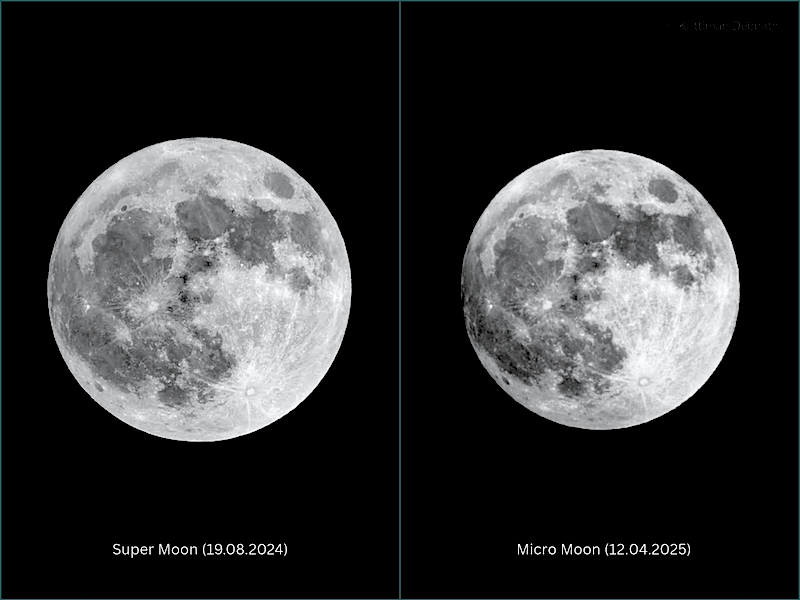
View at EarthSky Community Photos. | Krittiman Debnath of India submitted this composite image and wrote: “Here’s a side-by-side comparison of the supermoon on August 19, 2024, and the micromoon on April 12, 2025. They were both captured using my Celestron PowerSeeker 60AZ. Both images were taken with the same setup.” Thank you, Krittiman. You can easily see the size difference of a supermoon and a micromoon. However, most people won’t notice a size difference to the eye, but supermoons do look brighter.
What about micromoons?
The opposite of a supermoon is a micromoon. That’s when the new or full moon reaches apogee or its greatest distance from Earth. A full micromoon appears about 12-14% smaller than a full supermoon and about 7% smaller than an average full moon.
The average moon distance of 238,900 miles (384,472 km). So in 2026 there were three full micromoons, they are on May 1, May 31 and June 29. The full micromoon on May 31 will be the most distant full moon of the year and will be 252,360 miles (406,135 kilometers) away.
There is also one new micromoon in 2026. It’s on December 9. That new micromoon is the most distant new moon this year. It’ll lie 251,460 miles (404,687 kilometers) away.
Bottom line: What’s a supermoon? This year, 2026, has a full supermoon in January and two full supermoons in a row to end the year. Plus, January 2027 will be the last of three full supermoons in a row.
View at EarthSky Community Photos. | Kevin O’Donnell captured this image on December 4, 2025, and wrote: “Part of a time lapse captured during the Cold Moon Supermoon rising over the North Phoenix mountains.” Thank you, Kevin!
A cool cosmic coincidence kicks off 2026! The first full moon of the year — a supermoon — will coincide with Earth’s closest approach to the sun, known as perihelion, on and around January 2–3. That means the Earth, moon, and sun will all be unusually close and aligned as the new year begins. This rare event hasn’t happened since January 1912 and won’t occur again in our lifetimes. Join us on EarthSky’s livestream at 12 p.m. CST (18 UTC) on Wednesday, December 31, to explore this unique celestial alignment, learn why the seasons don’t follow Earth’s distance from the sun, and see how these subtle cosmic forces shape our sky.
What’s a supermoon?
2026 has eight supermoons! In fact, we have three full supermoons this year, and there’s five new supermoons this year. The year starts out with a full supermoon on January 2, 2026. So … what’s a supermoon?
New moon happens when the moon (in its monthly orbit of Earth) goes more or less between the sun and Earth. Full moon happens when the moon (in its monthly orbit) is on the opposite side of Earth from the sun. And perigee – from the root words peri meaning near and geo meaning Earth – is the moon’s closest point to Earth in a month.
So the new or full moon closely coincides with perigee several times each year. When that happens, in the language of popular culture, we have a supermoon.
The full supermoons of 2026 are:
Fred Espenak’s new supermoon table gives us these values – (in UTC dates) and moon distances – for full supermoons in 2026. Contrast these moon distances to the average moon distance of 238,900 miles (384,472 km).
Jan 3: 225,130 miles (362,312 kilometers)
Nov 24: 224,170 miles (360,768 kilometers)
Dec 24: 221,667 miles (356,740 kilometers)
Plus a full supermoon starts 2027
Jan 22: 222,229 miles (357,644 kilometers)
The full supermoon of December 24, 2026, will be the closest full supermoon of the year.
View at EarthSky Community Photos. | Radu Anghel in Parjol, România, caught what he called “a family photo with the supermoon of July 13, 2022.” Thank you, Radu! While supermoons don’t appear bigger to the eye than other full moons, they do appear brighter!
New supermoons of 2026 are:
Fred Espenak’s new supermoon table gives us these values – UTC dates and moon distances – for new supermoons in 2026. Contrast these moon distances to the average moon distance of 238,900 miles (384,472 km).
Apr 17: 226,299 miles (364,194 kilometers)
May 16: 222,819 miles (358,594 kilometers)
Jun 15: 221,966 miles (357,221 kilometers)
Jul 14: 223,789 miles (360,154 kilometers)
Aug 12: 228,017 miles (366,958 kilometers)
The new supermoon of June 15, 2026, will be the closest new supermoon for 2026.
And the new supermoon of August 12, 2026, will block out the sun causing a total solar eclipse.
What’s our source?
Note that different people define supermoons slightly differently. We use Fred Espenak’s full supermoon table to give us dates and moon distances for full supermoons in 2026. And we use his new supermoon table to give us dates and moon distances for new supermoons in 2026.
Also note that Fred’s dates and times are in UTC. So some supermoons may fall on the previous date your local time.
View at EarthSky Community Photos. | Soumyadeep Mukherjee captured all the full moons in 2023. Shown here – cropped out of the full image – are the 4 full supermoons of 2023 along with their apparent angular diameter (AD). Soumyadeep said: “All the images were captured with the same set of equipment at the same focal length (600mm).” Thank you, Soumyadeep!
Supermoons came from popular culture
Where did the term supermoon originate? As it’s used today, the word supermoon was coined by astrologer Richard Nolle in 1979. And according to Nolle’s definition, a full moon or new moon is a supermoon when it’s also within 90% of its closest point to Earth. However, different websites calculate supermoons differently.
As mentioned above, EarthSky uses supermoon dates as determined by astronomer Fred Espenak. He’s best known for his time at the Goddard Space Flight Center, where he became a world expert on eclipse predictions. Additionally, his method of calculating supermoons takes into account changes in the moon’s orbit during each lunar cycle.
Supermoon hype?
Some astronomers complain about the name supermoon. They like to call supermoons hype. But supermoons aren’t hype. They’re special. Many people now know and use the word supermoon. In fact, we even notice some diehards are starting to use it now. Such is the power of folklore.
The hype aspect of supermoons probably stemmed from an erroneous impression people had when the word supermoon came into popular usage a few decades ago. Some people mistakenly believed a full supermoon would look much, much bigger to the eye. But it doesn’t. Nowadays, most people seem to realize that supermoons don’t look bigger to the eye than ordinary full moons.
It’s true experienced observers do say they can detect a difference. But you’d have to be a very keen observer to notice it.
Most of us can’t tell any difference in the size of a supermoon and an ordinary full moon.
Is a supermoon brighter?
But … supermoons do look brighter than ordinary full moons! By a noticeable amount. That’s because a supermoon exceeds the disk size of an average-sized moon by up to 8% and the brightness of an average-sized full moon by some 16%. And then, it exceeds the disk size of a micromoon (a year’s most distant and therefore smallest full moon) up to 14% and the brightness of a micromoon by some 30%. So go outside on the night of a full supermoon. Even if you’re a casual observer of the moon, there’s the potential you’ll notice the supermoon is exceptionally bright!
For a visual reference, the size difference between a supermoon and micromoon is proportionally similar to that of a U.S. quarter versus a U.S. nickel. Again, that difference isn’t noticeable to the eye at the moon’s distance. But the brightness difference is noticeable.
By the way, before we called them supermoons, we in astronomy called these moons perigean full moons, or perigean new moons. No doubt about it, supermoon is catchier.
View at EarthSky Community Photos. | Bob Rich from Bryan, Texas, shared this image and wrote: “The August 2024 supermoon – and seasonal blue moon – rises behind a windmill.” Thank you!
High tides from new and full supermoons
What’s more, all supermoons have the potential to cause higher-than-usual tides. High tides during the full or new moon are called spring tides. High tides during a full or new moon at perigee are called perigean spring tides, or, sometimes, king tides. And nowadays you sometimes hear them called supermoon tides.
These perigean or king or supermoon spring tides tend to follow the date of new or full moon by a day or so. These especially high tides are highly dependent on the shapes of local coastlines and on local weather conditions.
Do extra-high supermoon tides cause flooding? Maybe yes and maybe no. Flooding typically occurs when a strong weather system accompanies an especially high spring tide. According to Fred Espenak, the gravity from the closest supermoon is only 4% greater than the gravity from the moon at its average distance.
About 3 or 4 times a year, or more often, a new or full moon coincides with the moon’s closest point to Earth, or perigee. There’s usually only a small difference – typically a couple of inches (or centimeters) – between these “perigean spring tides” and normal tidal ranges. But, at these times, if a storm strikes along a coastline, flooding can occur. Image via NOAA/ National Ocean Service.
How often do we have a supermoon?
Often! But it also depends on your definition of supermoon.
Here’s a list of each year’s closest full supermoon perigees from 2017 to 2027 (from Espenak’s full supermoon table):
December 3, 2017 (357,987 kilometers or 222,443 miles)
January 2, 2018 (356,603 kilometers or 221,583 miles)
February 19, 2019 (356,846 kilometers or 221,734 miles)
April 8, 2020 (357,035 kilometers or 221,851 miles)
May 26, 2021 (357,463 kilometers or 222,117 miles)
July 13, 2022 (357,418 kilometers or 222,089 miles)
August 31, 2023 (357,344 kilometers or 222,043 miles)
October 17, 2024 (357,364 kilometers or 222,056 miles)
November 5, 2025 (356,980 kilometers or 221,817 miles)
December 24, 2026 (356,740 kilometers or 221,668 miles)
January 22, 2027 (357,644 kilometers or 222,229 miles)
View at EarthSky Community Photos. | Jeremy Evans captured this amazing shot of the Cold Moon. Jeremy wrote: “Supermoon rise over the White Mountains, December 4, 2025. Taken from my front deck in the Eastern Sierra.” Thank you, Jeremy!
The recurring cycle of supermoons
The closest full moon supermoon in 2026 (December 24) will recur after 14 lunar months (14 returns to full moon) after the closest full supermoon of 2025 (November 5). That’s because 14 returns to full moon almost exactly equal 15 returns to perigee, a period of about one year, one month, and 18 days.
The mean lunar month (full moon to full moon, or new moon to new moon) = 29.53059 days, whereas the mean anomalistic month (perigee to perigee, or apogee to apogee) = 27.55455 days. Hence:
14 lunar months (14 returns to full moon) x 29.53059 days = 413.428 days
15 anomalistic months (15 returns to lunar perigee) x 27.55455 days = 413.318 days
So given that closest supermoon recurs in cycles of 413 days (about one year, one month and 18 days), we can expect the closest full moon supermoon to come about one month and 18 days later next year. Thus, the closest full supermoon of 2026 – December 24 – will be followed by the closest full supermoon 14 months later – January 22 – in 2027.
View at EarthSky Community Photos. | Krittiman Debnath of India submitted this composite image and wrote: “Here’s a side-by-side comparison of the supermoon on August 19, 2024, and the micromoon on April 12, 2025. They were both captured using my Celestron PowerSeeker 60AZ. Both images were taken with the same setup.” Thank you, Krittiman. You can easily see the size difference of a supermoon and a micromoon. However, most people won’t notice a size difference to the eye, but supermoons do look brighter.
What about micromoons?
The opposite of a supermoon is a micromoon. That’s when the new or full moon reaches apogee or its greatest distance from Earth. A full micromoon appears about 12-14% smaller than a full supermoon and about 7% smaller than an average full moon.
The average moon distance of 238,900 miles (384,472 km). So in 2026 there were three full micromoons, they are on May 1, May 31 and June 29. The full micromoon on May 31 will be the most distant full moon of the year and will be 252,360 miles (406,135 kilometers) away.
There is also one new micromoon in 2026. It’s on December 9. That new micromoon is the most distant new moon this year. It’ll lie 251,460 miles (404,687 kilometers) away.
Bottom line: What’s a supermoon? This year, 2026, has a full supermoon in January and two full supermoons in a row to end the year. Plus, January 2027 will be the last of three full supermoons in a row.
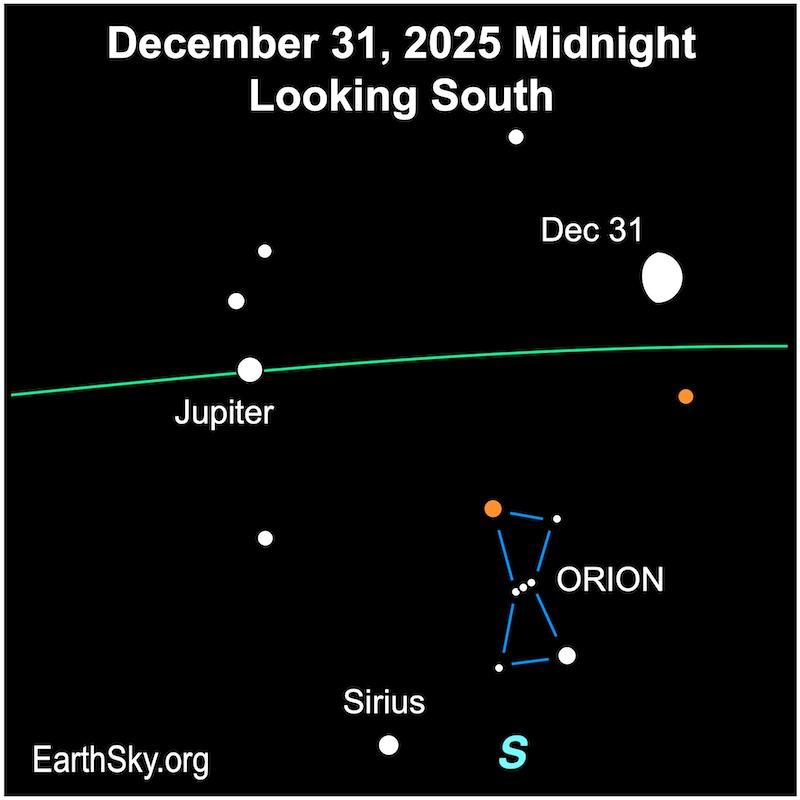
Every year, you can ring in the new year by going out at midnight and finding the dazzling star Sirius, sometimes called the New Year’s Star. In 2026, Sirius will be joined by the soon-to-be full supermoon and the bright planet Jupiter. And of course, the big, easy-to-recognize constellation Orion the Hunter makes them easy to find. You can’t miss them! Chart via EarthSky.
New Year’s Star Sirius, the moon and Jupiter to ring in 2026
Want to entertain your friends on New Year’s Eve? Show them the New Year’s Star, Sirius, the brightest star in Earth’s night sky. This star always reaches its highest point in the sky around the stroke of midnight on New Year’s Eve. And, in 2026, Sirius will have company. It’ll be joined by an almost full supermoon and the bright planet Jupiter. Both are nearly at their closest to Earth. Wow, what an eye-catching sight!
Sirius also has the nickname the Dog Star, because it’s part of the constellation Canis Major the Greater Dog. It’s a noticeable sight in our sky every evening during Northern Hemisphere winter (Southern Hemisphere summer). But its midnight culmination – its highest point in the sky at midnight your local time – always comes around New Year’s Eve.
And this year a soon-to-be supermoon and Jupiter will provide a double whammy in brightness! You can look for them any time now. Keep reading, to learn more about how to identify them.
Sirius, the moon and Jupiter are all bright
So how can you find these objects? There are a lot of bright stars in the evening sky now. But – just remember – Sirius is the brightest star in Earth’s night sky. In fact, the name Sirius means sparkling or scorching in both Latin and Greek.
Plus, the fat waning gibbous moon will light up the sky and will soon be the full Wolf Moon – and a supermoon – on January 3, 2026. In fact, it’s the last of four supermoons in a row.
And Jupiter is brighter than glittering Sirius! As 2025 ends and 2026 begins, Earth will be closest to Jupiter on January 9 and pass between Jupiter and the sun (on January 10), bringing that planet closest to us for this year. Jupiter is always bright, but it’s especially bright right now. Jupiter shines more brightly than Sirius.
These three bright objects near each other in the sky will surely catch your eye.
Also, remember, our solar system is a flat plane. So, the planets and the moon follow more or less the path of the sun across our sky. No matter where you are on Earth, look along the sun’s path, or ecliptic, for the moon and Jupiter. Sirius will be nearby.
Locating Sirius
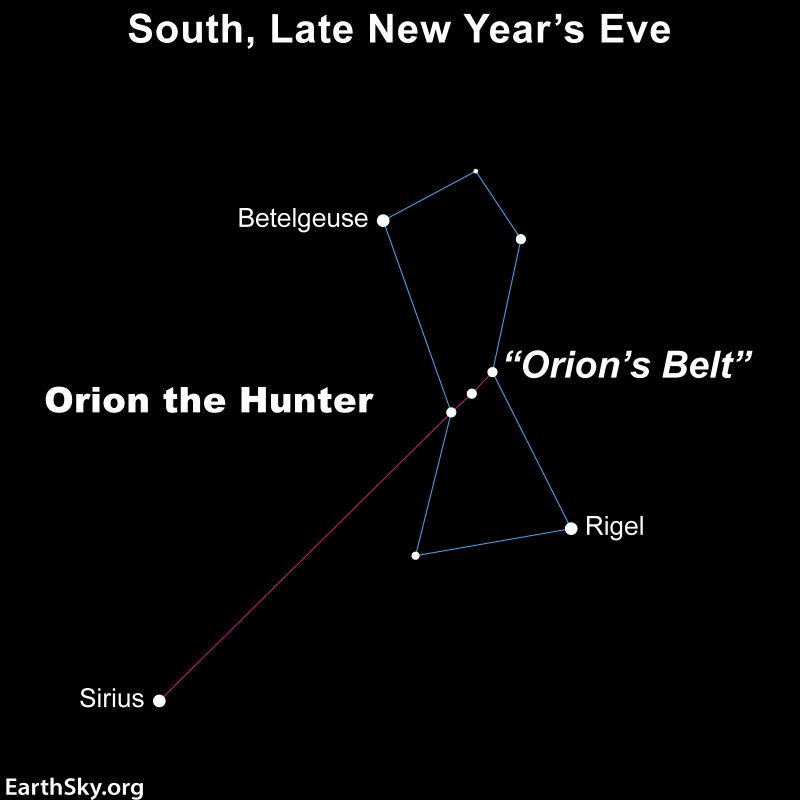
Need more help identifying Sirius? Here’s a sure-fire way to know. Look for three prominent stars in a row. They have the same size and brightness. These stars form the Belt of the constellation Orion the Hunter. Orion’s Belt always points to Sirius.
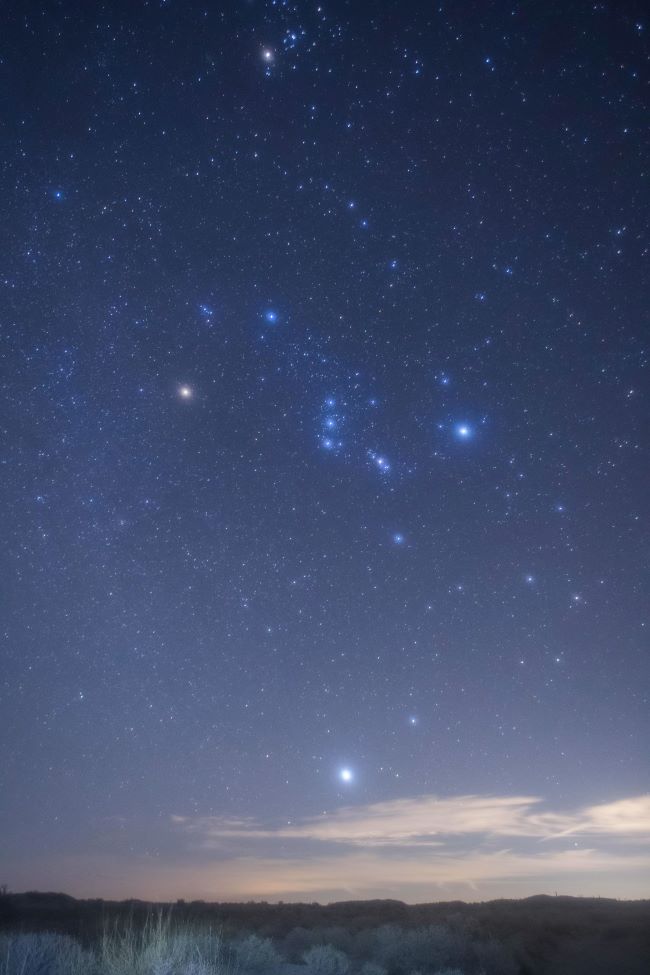
You can always recognize the star Sirius because it’s the brightest star in the sky. Also, the 3 prominent stars that form the Belt of the easy-to-see constellation Orion the Hunter point to it. Chart via EarthSky.View at EarthSky Community Photos. | Sergei Timofeevski shared this image from November 13, 2023. Sergei wrote: “The constellation Orion the Hunter and the star Sirius rising just above the eastern horizon in the Anza-Borrego Desert State Park, California.” Thank you, Sergei! Note bright Sirius at the bottom, and Orion’s Belt pointing to it.
Sirius is always up late for the party
In late 2025 and early 2026, two bright planets – Saturn and Jupiter – are in the in the evening sky. The planets are “wanderers.” They don’t stay fixed with respect to the star background. Jupiter rises shortly after sunset and will be visible all night, but Saturn will set before midnight. Meanwhile, bright Sirius is highest in the sky at midnight during every turn of the year.
To clarify, by midnight, we mean the middle of the night, that is, midway between sunset and sunrise. Like the sun, the stars rise in the east and travel westward across the sky. When the sun or any star is in the eastern half of the sky, it’s climbing upward or ascending. When the sun or any star is in the western sky, it’s descending downward. Therefore, midway between rising and setting, the sun or any star reaches its highest point in the sky.
Because the stars rise and set two hours earlier with each passing month, Sirius will be highest up for the night around 10 p.m. local time on February 1. By then, Earth will have passed Jupiter in our orbits around the sun. We’ll be fleeing ahead of it. But they’ll still be near Sirius in the sky … and they will still be bright!
Jupiter from our Community Photos
View at EarthSky Community Photos. | Brian Martin captured Jupiter on November 30, 2025, from California and wrote: ” Jupiter was very nice just after midnight with the seeing being average to slight above with no moons in the field I was hoping to capture some neat details and surely there was plenty. We have some ovals, lots of storm systems, clouds and a very active face despite the Great Red Spot (GRS) moving off about two hours before shooting. Jupiter was a decent altitude here. There’s a total of 15 minutes of data on this image.” Thank you, Brian.
Bottom line: Entertain your friends on New Year’s Eve by showing them the New Year’s Star, with the soon-to-be supermoon and Jupiter.
Every year, you can ring in the new year by going out at midnight and finding the dazzling star Sirius, sometimes called the New Year’s Star. In 2026, Sirius will be joined by the soon-to-be full supermoon and the bright planet Jupiter. And of course, the big, easy-to-recognize constellation Orion the Hunter makes them easy to find. You can’t miss them! Chart via EarthSky.
New Year’s Star Sirius, the moon and Jupiter to ring in 2026
Want to entertain your friends on New Year’s Eve? Show them the New Year’s Star, Sirius, the brightest star in Earth’s night sky. This star always reaches its highest point in the sky around the stroke of midnight on New Year’s Eve. And, in 2026, Sirius will have company. It’ll be joined by an almost full supermoon and the bright planet Jupiter. Both are nearly at their closest to Earth. Wow, what an eye-catching sight!
Sirius also has the nickname the Dog Star, because it’s part of the constellation Canis Major the Greater Dog. It’s a noticeable sight in our sky every evening during Northern Hemisphere winter (Southern Hemisphere summer). But its midnight culmination – its highest point in the sky at midnight your local time – always comes around New Year’s Eve.
And this year a soon-to-be supermoon and Jupiter will provide a double whammy in brightness! You can look for them any time now. Keep reading, to learn more about how to identify them.
Sirius, the moon and Jupiter are all bright
So how can you find these objects? There are a lot of bright stars in the evening sky now. But – just remember – Sirius is the brightest star in Earth’s night sky. In fact, the name Sirius means sparkling or scorching in both Latin and Greek.
Plus, the fat waning gibbous moon will light up the sky and will soon be the full Wolf Moon – and a supermoon – on January 3, 2026. In fact, it’s the last of four supermoons in a row.
And Jupiter is brighter than glittering Sirius! As 2025 ends and 2026 begins, Earth will be closest to Jupiter on January 9 and pass between Jupiter and the sun (on January 10), bringing that planet closest to us for this year. Jupiter is always bright, but it’s especially bright right now. Jupiter shines more brightly than Sirius.
These three bright objects near each other in the sky will surely catch your eye.
Also, remember, our solar system is a flat plane. So, the planets and the moon follow more or less the path of the sun across our sky. No matter where you are on Earth, look along the sun’s path, or ecliptic, for the moon and Jupiter. Sirius will be nearby.
Locating Sirius
Need more help identifying Sirius? Here’s a sure-fire way to know. Look for three prominent stars in a row. They have the same size and brightness. These stars form the Belt of the constellation Orion the Hunter. Orion’s Belt always points to Sirius.
You can always recognize the star Sirius because it’s the brightest star in the sky. Also, the 3 prominent stars that form the Belt of the easy-to-see constellation Orion the Hunter point to it. Chart via EarthSky.View at EarthSky Community Photos. | Sergei Timofeevski shared this image from November 13, 2023. Sergei wrote: “The constellation Orion the Hunter and the star Sirius rising just above the eastern horizon in the Anza-Borrego Desert State Park, California.” Thank you, Sergei! Note bright Sirius at the bottom, and Orion’s Belt pointing to it.
Sirius is always up late for the party
In late 2025 and early 2026, two bright planets – Saturn and Jupiter – are in the in the evening sky. The planets are “wanderers.” They don’t stay fixed with respect to the star background. Jupiter rises shortly after sunset and will be visible all night, but Saturn will set before midnight. Meanwhile, bright Sirius is highest in the sky at midnight during every turn of the year.
To clarify, by midnight, we mean the middle of the night, that is, midway between sunset and sunrise. Like the sun, the stars rise in the east and travel westward across the sky. When the sun or any star is in the eastern half of the sky, it’s climbing upward or ascending. When the sun or any star is in the western sky, it’s descending downward. Therefore, midway between rising and setting, the sun or any star reaches its highest point in the sky.
Because the stars rise and set two hours earlier with each passing month, Sirius will be highest up for the night around 10 p.m. local time on February 1. By then, Earth will have passed Jupiter in our orbits around the sun. We’ll be fleeing ahead of it. But they’ll still be near Sirius in the sky … and they will still be bright!
Jupiter from our Community Photos
View at EarthSky Community Photos. | Brian Martin captured Jupiter on November 30, 2025, from California and wrote: ” Jupiter was very nice just after midnight with the seeing being average to slight above with no moons in the field I was hoping to capture some neat details and surely there was plenty. We have some ovals, lots of storm systems, clouds and a very active face despite the Great Red Spot (GRS) moving off about two hours before shooting. Jupiter was a decent altitude here. There’s a total of 15 minutes of data on this image.” Thank you, Brian.
Bottom line: Entertain your friends on New Year’s Eve by showing them the New Year’s Star, with the soon-to-be supermoon and Jupiter.
Our celebration of New Year’s Day on January 1 is a human-made creation. It’s not precisely fixed by any natural or seasonal marker. It’s a civil event, not one defined by nature. Yet, for those of us in the Northern Hemisphere – where daylight recently ebbed to its lowest point and the days are starting to get longer again – there’s a feeling of rebirth in the air. New Year’s resolutions, anyone?
So where does the New Year’s Day concept come from?
It stems from an ancient Roman custom, the feast of the Roman god Janus. He was the god of beginnings, gates, transitions, time, duality, doorways, passages, frames, and endings. This is also where the name for the month of January comes from, since Janus was depicted as having two opposite faces. One face looked back into the past, and the other peered forward to the future.
Likewise, on January 1, we look back at the year that just ended and forward to the new year ahead.
To celebrate the new year, the Romans also made promises to Janus. The tradition of New Year’s resolutions stems from this ancient custom. On January 1, as the year began, it was customary to exchange cheerful words of good wishes. Shortly afterwards, on January 9, the rex sacrorum – a priesthood associated with the Roman Senate – offered the sacrifice of a ram to Janus.
For example, Jews use a lunar calendar and celebrate the New Year in the fall on Rosh Hashanah, the first day of the month of Tishri, which is the seventh month of the Jewish year. This date usually occurs in September, as it does in 2026. Similar to other cultures’ New Year’s Day, the two-day holiday is both a time of rejoicing and of serious introspection, a time to celebrate the completion of another year while also taking stock of one’s life and looking ahead.
Challah, a traditional Jewish bread, eaten for Rosh Hashanah. Image via Aviv Hod/ Wikimedia Commons (CC BY 3.0).
Lunar New Year
There is also the famous Chinese New Year, also known as the Lunar New Year, celebrated for weeks in January or early February. The Lunar New Year is the most important of Chinese holidays. Countries in Southeast Asia celebrate it including China, Thailand, Indonesia, Malaysia, and the Philippines. It’s also celebrated in Chinatowns and Asian homes around the world, where it’s considered a time to honor deities and ancestors and to be with family. The event always sparks a rush of travel that the New York Times has called the world’s largest annual human migration.
2025’s Lunar New Year celebrations fell on Saturday, January 29, 2025. It was the year of the Snake. In 2026, the Lunar New Year will begin on Tuesday, February 17, 2026. It’ll be the year of the Horse.
Our friend Matthew Chin in Hong Kong created this graphic and wrote: “The two Chinese characters are the same. It means ‘blessing,’ a hope that other people will get good luck. It is commonly used during Lunar New Year. The red background is also a kind of ‘good’ as Chinese people use red to represent ‘good luck.’” Thank you, Matthew!
Perihelion around January 1
By the way, in addition to the longer days here in the Northern Hemisphere, there’s another astronomical occurrence around January 1 each year that’s also related to Earth’s year, as defined by our orbit around the sun. That is, Earth’s perihelion – or closest point to the sun – happens every year in early January. In 2026, perihelion comes on January 3.
For 2026, the Northern Hemisphere winter stretches from December 21, 2025, to March 20, 2026. Perihelion occurs within this period, on January 3, 2026. Since Earth moves faster the closer it is to the sun, the Northern Hemisphere winter period is shorter by almost 5 days compared to the Northern Hemisphere summer, when the Earth is moving more slowly in its orbit. Chart via EarthSky.
History of New Year’s Day
January 1 hasn’t always been New Year’s Day.
In the past, some New Year’s celebrations took place at an equinox, a day when the sun is above Earth’s equator and night and day are equal in length. In many cultures, the March or vernal equinox marks a time of transition and new beginnings, and so cultural celebrations of a new year were natural for that equinox.
The September or autumnal equinox also had its proponents for the beginning of a new year. For example, the French Republican calendar – implemented during the French Revolution and used for about 12 years from late 1793 to 1805 – started its year at the September equinox.
The Greeks celebrated the new year on the winter solstice, the shortest day of the year.
Happy 2026, everyone!
Bottom line: We celebrate New Year’s Day on January 1 by tradition. Our modern New Year’s Day celebration stems from the ancient two-faced Roman god Janus, after whom the month of January is named.
Our celebration of New Year’s Day on January 1 is a human-made creation. It’s not precisely fixed by any natural or seasonal marker. It’s a civil event, not one defined by nature. Yet, for those of us in the Northern Hemisphere – where daylight recently ebbed to its lowest point and the days are starting to get longer again – there’s a feeling of rebirth in the air. New Year’s resolutions, anyone?
So where does the New Year’s Day concept come from?
It stems from an ancient Roman custom, the feast of the Roman god Janus. He was the god of beginnings, gates, transitions, time, duality, doorways, passages, frames, and endings. This is also where the name for the month of January comes from, since Janus was depicted as having two opposite faces. One face looked back into the past, and the other peered forward to the future.
Likewise, on January 1, we look back at the year that just ended and forward to the new year ahead.
To celebrate the new year, the Romans also made promises to Janus. The tradition of New Year’s resolutions stems from this ancient custom. On January 1, as the year began, it was customary to exchange cheerful words of good wishes. Shortly afterwards, on January 9, the rex sacrorum – a priesthood associated with the Roman Senate – offered the sacrifice of a ram to Janus.
For example, Jews use a lunar calendar and celebrate the New Year in the fall on Rosh Hashanah, the first day of the month of Tishri, which is the seventh month of the Jewish year. This date usually occurs in September, as it does in 2026. Similar to other cultures’ New Year’s Day, the two-day holiday is both a time of rejoicing and of serious introspection, a time to celebrate the completion of another year while also taking stock of one’s life and looking ahead.
Challah, a traditional Jewish bread, eaten for Rosh Hashanah. Image via Aviv Hod/ Wikimedia Commons (CC BY 3.0).
Lunar New Year
There is also the famous Chinese New Year, also known as the Lunar New Year, celebrated for weeks in January or early February. The Lunar New Year is the most important of Chinese holidays. Countries in Southeast Asia celebrate it including China, Thailand, Indonesia, Malaysia, and the Philippines. It’s also celebrated in Chinatowns and Asian homes around the world, where it’s considered a time to honor deities and ancestors and to be with family. The event always sparks a rush of travel that the New York Times has called the world’s largest annual human migration.
2025’s Lunar New Year celebrations fell on Saturday, January 29, 2025. It was the year of the Snake. In 2026, the Lunar New Year will begin on Tuesday, February 17, 2026. It’ll be the year of the Horse.
Our friend Matthew Chin in Hong Kong created this graphic and wrote: “The two Chinese characters are the same. It means ‘blessing,’ a hope that other people will get good luck. It is commonly used during Lunar New Year. The red background is also a kind of ‘good’ as Chinese people use red to represent ‘good luck.’” Thank you, Matthew!
Perihelion around January 1
By the way, in addition to the longer days here in the Northern Hemisphere, there’s another astronomical occurrence around January 1 each year that’s also related to Earth’s year, as defined by our orbit around the sun. That is, Earth’s perihelion – or closest point to the sun – happens every year in early January. In 2026, perihelion comes on January 3.
For 2026, the Northern Hemisphere winter stretches from December 21, 2025, to March 20, 2026. Perihelion occurs within this period, on January 3, 2026. Since Earth moves faster the closer it is to the sun, the Northern Hemisphere winter period is shorter by almost 5 days compared to the Northern Hemisphere summer, when the Earth is moving more slowly in its orbit. Chart via EarthSky.
History of New Year’s Day
January 1 hasn’t always been New Year’s Day.
In the past, some New Year’s celebrations took place at an equinox, a day when the sun is above Earth’s equator and night and day are equal in length. In many cultures, the March or vernal equinox marks a time of transition and new beginnings, and so cultural celebrations of a new year were natural for that equinox.
The September or autumnal equinox also had its proponents for the beginning of a new year. For example, the French Republican calendar – implemented during the French Revolution and used for about 12 years from late 1793 to 1805 – started its year at the September equinox.
The Greeks celebrated the new year on the winter solstice, the shortest day of the year.
Happy 2026, everyone!
Bottom line: We celebrate New Year’s Day on January 1 by tradition. Our modern New Year’s Day celebration stems from the ancient two-faced Roman god Janus, after whom the month of January is named.
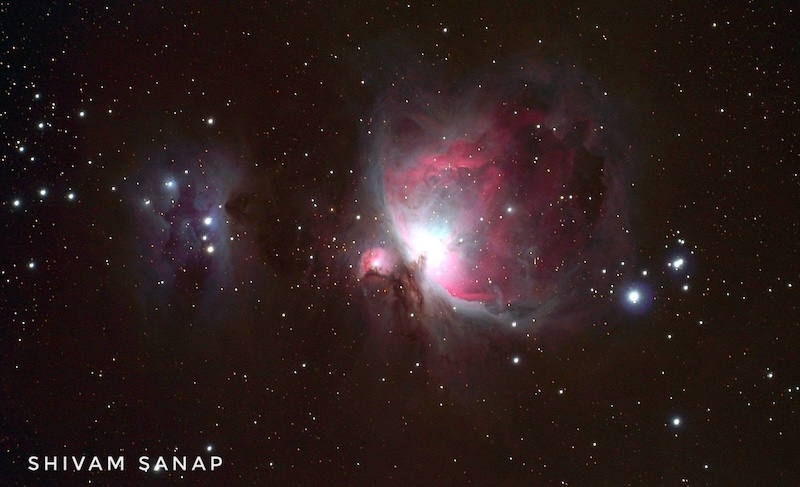
View at EarthSky Community Photos. | Shivam Sanap imaged the Orion nebula on August 2, 2025, from India, and wrote: “I captured the Orion nebula after a lot of hard work, and the results are truly amazing!”. Thank you, Shivam!
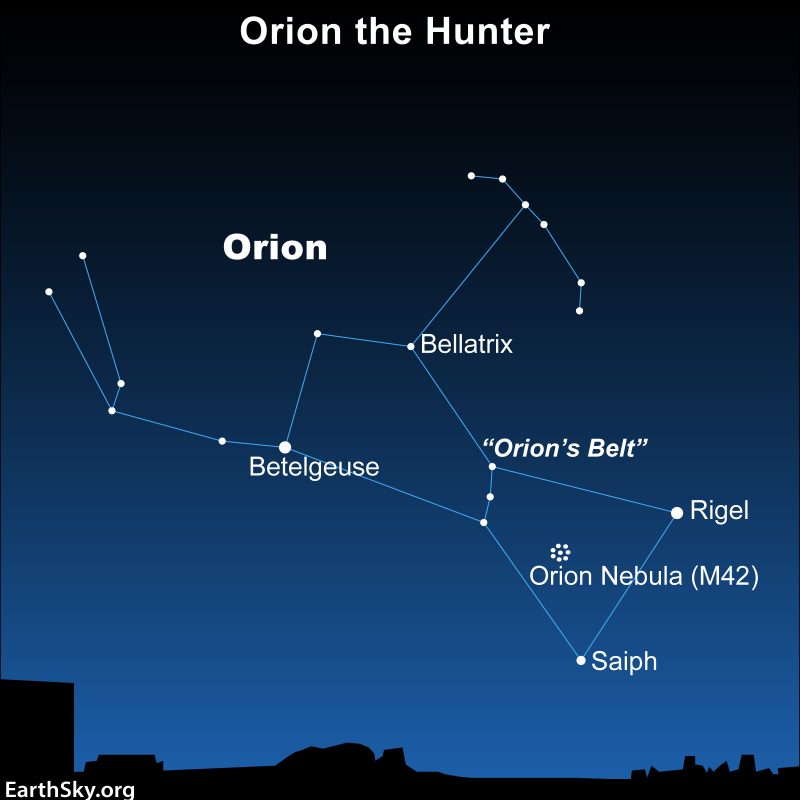
Orion the Hunter is the most noticeable of all constellations. The three stars of Orion’s Belt jump out at you as a short, straight row of medium-bright stars, midway between Orion’s two brightest stars, Betelgeuse and Rigel. Once you find the Belt stars, you can also locate the Orion nebula, otherwise known as M42. When you look at it, you’re gazing toward a stellar nursery, a place where new stars are born.
How to locate the Orion nebula
If you want to find this famous nebula, first you have to locate the constellation Orion. Fortunately, that’s easy, if you’re looking at the right time of year. The Northern Hemisphere winter months (Southern Hemisphere summer months) are the perfect time to come to know Orion.
First, look for the three medium-bright stars in a short, straight row. These stars represent Orion’s Belt.
Next, if you look closely, you’ll notice a curved line of stars “hanging” from the three Belt stars. These stars represent Orion’s Sword. Look for the Orion nebula about midway down in the Sword of Orion.
As a general rule, the higher the constellation Orion is in the sky, the easier it is to see the Orion nebula. From Northern Hemisphere locations, Orion is due south and highest in the sky around midnight in the middle of December. Then the stars return to the same place in the sky some four minutes earlier each night, or two hours earlier each month. So look for Orion to be highest up around 10 p.m. in mid-January and 8 p.m. in mid-February.
Another time people notice Orion is around the months of August and September, when this constellation appears in the east before dawn.
Generally, most nebulae – clouds of interstellar gas and dust – are difficult if not impossible to see with the unaided eye or even binoculars. But the Orion nebula is in a class nearly all by itself. That’s because it’s visible to the unaided eye on a dark, moonless night. To me, it looks like a star encased in a globe of luminescent fog. The star-gazing aficionado Stephen James O’Meara described it as:
… angel’s breath against a frosted sky.
In a dark-sky location, observe the Orion nebula for yourself to see what it looks like. A backyard telescope, or even binoculars, will do wonders to showcase one of the greatest celestial treasures in the winter sky.
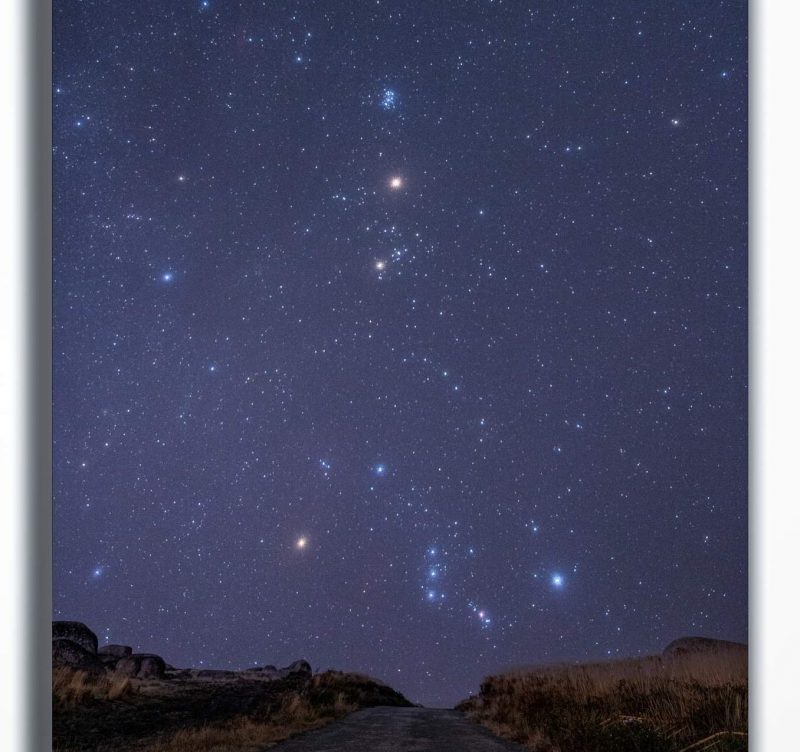
View at EarthSky Community Photos. | Miguel Ventura in Fafe, Portugal, captured this image on August 28, 2022, and wrote: “Every now and then the night sky offers us moments like this. We can see the Pleiades and the constellation Taurus with the planet Mars between these 2 … below near the horizon the imposing constellation Orion appears.” Thank you, Miguel! Can you see the expanded glow around one of the Sword stars? That’s M42, the Orion nebula.
Science and the Orion nebula
According to modern astronomers, the Orion nebula is an enormous cloud of gas and dust, one of many in our Milky Way galaxy. It lies roughly 1,300 light-years from Earth.
At some 30 light-years in diameter, this great nebulous cocoon is giving birth to perhaps a thousand stars. A young open star cluster, whose stars were born together in the gas cloud and are still loosely bound by gravity, appears within the nebula. Some people refer to it as the Orion Nebula Star Cluster. In 2012, an international team of astronomers suggested this cluster in the Orion nebula might have a black hole at its heart.
Through small telescopes you can see the four brightest stars in the Orion nebula, known as the Trapezium. The light of the young, hot Trapezium stars illuminate the Orion nebula. These stars are only a million or so years old, babies on the scale of star lifetimes.
But most of the stars in this emerging cluster are veiled behind the Orion nebula itself, the great stellar nursery in Orion’s Sword.
The Orion nebula’s position is Right Ascension: 5h 35m; Declination: 5 degrees 23′ south.
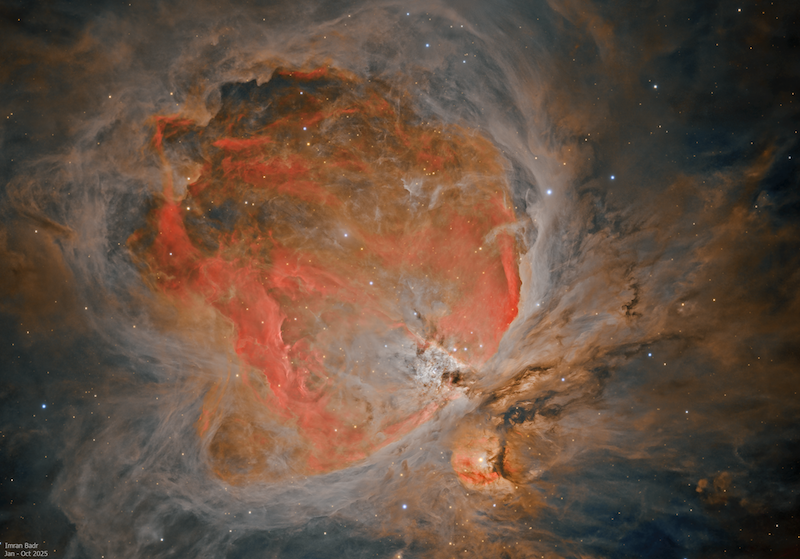
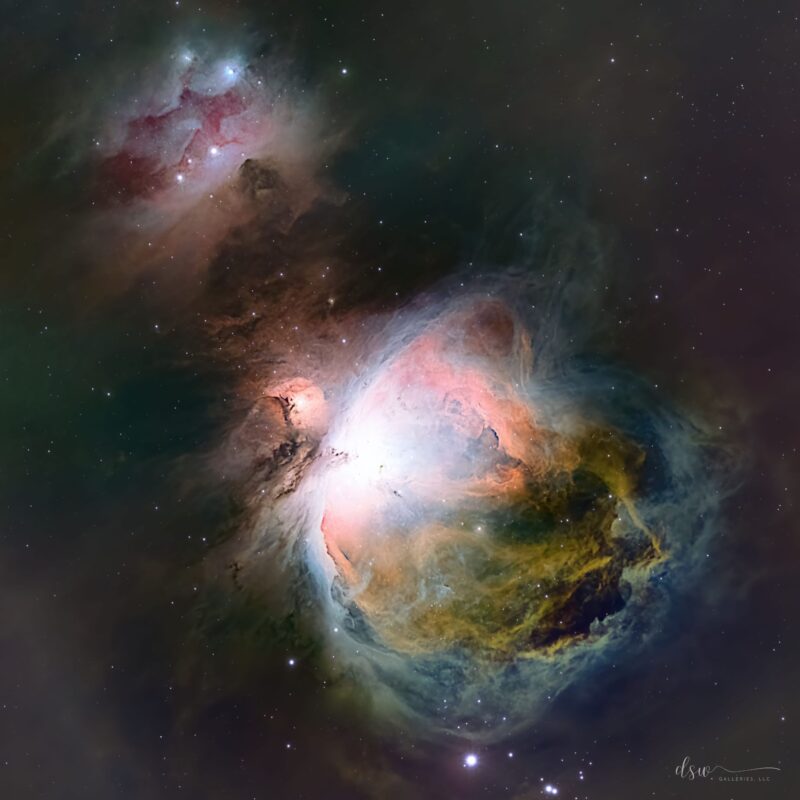
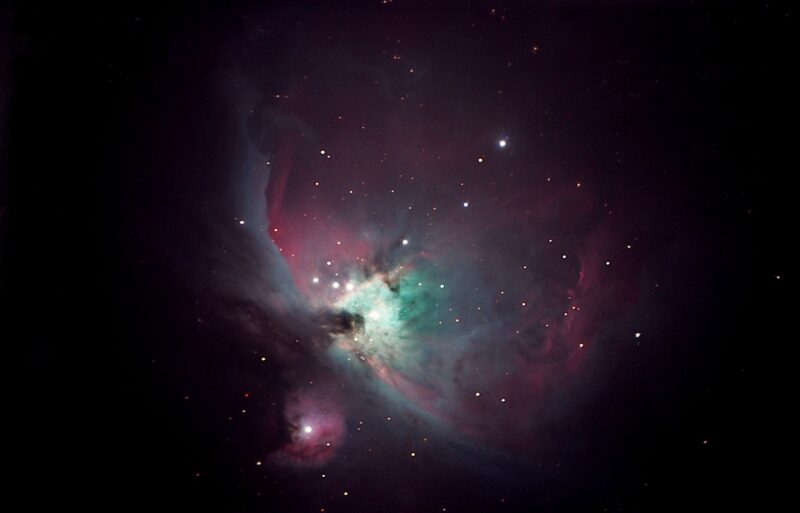
View at EarthSky Community Photos. | Imran Badr in San Jose, California, captured the Orion nebula on October 19, 2025. Imran wrote: “I wanted to show the delicate swirls of gases in this amazing deep space target. Due to very high brightness, such details are often hidden. I attempted this target using three telescopes, mounts and cameras.” Thank you, Imran!View at EarthSky Community Photos. | Jeremy Likness in Newport, Oregon, shared this image he captured on September 25, 2025, and wrote: “I shot maybe my most detailed version of Orion’s sword over the past 2 nights. This is the great Orion nebula (M42), de Mairan’s nebula (M43) and the Running Man nebula (NGC19677).” Thank you, Jeremy!View at EarthSky Community Photos. | Randy Strauss in Papillion, Nebraska, captured this telescopic view of the Orion nebula on March 4, 2024. Thank you, Randy! The Orion nebula is one of the most familiar celestial objects, easily visible to the unaided eye below the 3 stars of Orion’s Belt. But it’s a vast stellar nursery, a place where new stars are forming.
Bottom line: The Orion nebula appears to the eye as a tiny, hazy spot. But it’s a vast stellar nursery, a place where new stars are forming.
View at EarthSky Community Photos. | Shivam Sanap imaged the Orion nebula on August 2, 2025, from India, and wrote: “I captured the Orion nebula after a lot of hard work, and the results are truly amazing!”. Thank you, Shivam!
Orion the Hunter is the most noticeable of all constellations. The three stars of Orion’s Belt jump out at you as a short, straight row of medium-bright stars, midway between Orion’s two brightest stars, Betelgeuse and Rigel. Once you find the Belt stars, you can also locate the Orion nebula, otherwise known as M42. When you look at it, you’re gazing toward a stellar nursery, a place where new stars are born.
How to locate the Orion nebula
If you want to find this famous nebula, first you have to locate the constellation Orion. Fortunately, that’s easy, if you’re looking at the right time of year. The Northern Hemisphere winter months (Southern Hemisphere summer months) are the perfect time to come to know Orion.
First, look for the three medium-bright stars in a short, straight row. These stars represent Orion’s Belt.
Next, if you look closely, you’ll notice a curved line of stars “hanging” from the three Belt stars. These stars represent Orion’s Sword. Look for the Orion nebula about midway down in the Sword of Orion.
As a general rule, the higher the constellation Orion is in the sky, the easier it is to see the Orion nebula. From Northern Hemisphere locations, Orion is due south and highest in the sky around midnight in the middle of December. Then the stars return to the same place in the sky some four minutes earlier each night, or two hours earlier each month. So look for Orion to be highest up around 10 p.m. in mid-January and 8 p.m. in mid-February.
Another time people notice Orion is around the months of August and September, when this constellation appears in the east before dawn.
Generally, most nebulae – clouds of interstellar gas and dust – are difficult if not impossible to see with the unaided eye or even binoculars. But the Orion nebula is in a class nearly all by itself. That’s because it’s visible to the unaided eye on a dark, moonless night. To me, it looks like a star encased in a globe of luminescent fog. The star-gazing aficionado Stephen James O’Meara described it as:
… angel’s breath against a frosted sky.
In a dark-sky location, observe the Orion nebula for yourself to see what it looks like. A backyard telescope, or even binoculars, will do wonders to showcase one of the greatest celestial treasures in the winter sky.
View at EarthSky Community Photos. | Miguel Ventura in Fafe, Portugal, captured this image on August 28, 2022, and wrote: “Every now and then the night sky offers us moments like this. We can see the Pleiades and the constellation Taurus with the planet Mars between these 2 … below near the horizon the imposing constellation Orion appears.” Thank you, Miguel! Can you see the expanded glow around one of the Sword stars? That’s M42, the Orion nebula.
Science and the Orion nebula
According to modern astronomers, the Orion nebula is an enormous cloud of gas and dust, one of many in our Milky Way galaxy. It lies roughly 1,300 light-years from Earth.
At some 30 light-years in diameter, this great nebulous cocoon is giving birth to perhaps a thousand stars. A young open star cluster, whose stars were born together in the gas cloud and are still loosely bound by gravity, appears within the nebula. Some people refer to it as the Orion Nebula Star Cluster. In 2012, an international team of astronomers suggested this cluster in the Orion nebula might have a black hole at its heart.
Through small telescopes you can see the four brightest stars in the Orion nebula, known as the Trapezium. The light of the young, hot Trapezium stars illuminate the Orion nebula. These stars are only a million or so years old, babies on the scale of star lifetimes.
But most of the stars in this emerging cluster are veiled behind the Orion nebula itself, the great stellar nursery in Orion’s Sword.
The Orion nebula’s position is Right Ascension: 5h 35m; Declination: 5 degrees 23′ south.
View at EarthSky Community Photos. | Imran Badr in San Jose, California, captured the Orion nebula on October 19, 2025. Imran wrote: “I wanted to show the delicate swirls of gases in this amazing deep space target. Due to very high brightness, such details are often hidden. I attempted this target using three telescopes, mounts and cameras.” Thank you, Imran!View at EarthSky Community Photos. | Jeremy Likness in Newport, Oregon, shared this image he captured on September 25, 2025, and wrote: “I shot maybe my most detailed version of Orion’s sword over the past 2 nights. This is the great Orion nebula (M42), de Mairan’s nebula (M43) and the Running Man nebula (NGC19677).” Thank you, Jeremy!View at EarthSky Community Photos. | Randy Strauss in Papillion, Nebraska, captured this telescopic view of the Orion nebula on March 4, 2024. Thank you, Randy! The Orion nebula is one of the most familiar celestial objects, easily visible to the unaided eye below the 3 stars of Orion’s Belt. But it’s a vast stellar nursery, a place where new stars are forming.
Bottom line: The Orion nebula appears to the eye as a tiny, hazy spot. But it’s a vast stellar nursery, a place where new stars are forming.