
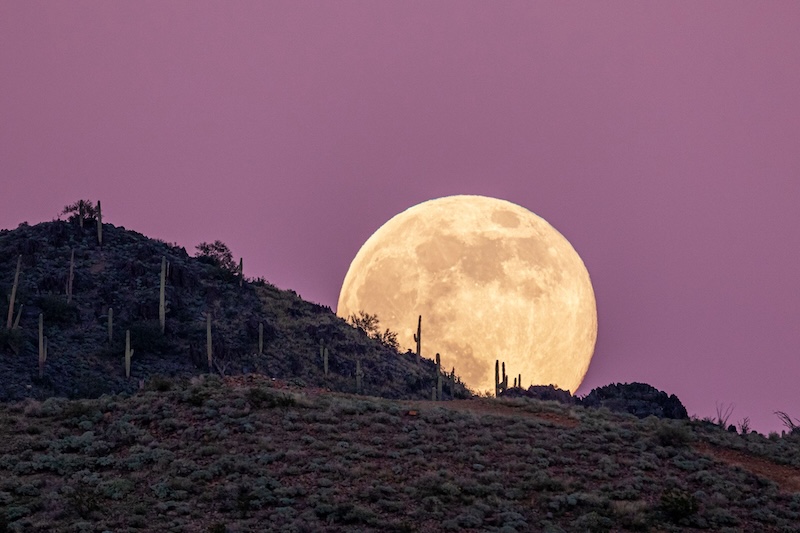
A cool cosmic coincidence kicks off 2026! The first full moon of the year — a supermoon — will coincide with Earth’s closest approach to the sun, known as perihelion, on and around January 2–3. That means the Earth, moon, and sun will all be unusually close and aligned as the new year begins. This rare event hasn’t happened since January 1912 and won’t occur again in our lifetimes. Join us on EarthSky’s livestream at 12 p.m. CST (18 UTC) on Wednesday, December 31, to explore this unique celestial alignment, learn why the seasons don’t follow Earth’s distance from the sun, and see how these subtle cosmic forces shape our sky.
What’s a supermoon?
2026 has eight supermoons! In fact, we have three full supermoons this year, and there’s five new supermoons this year. The year starts out with a full supermoon on January 2, 2026. So … what’s a supermoon?
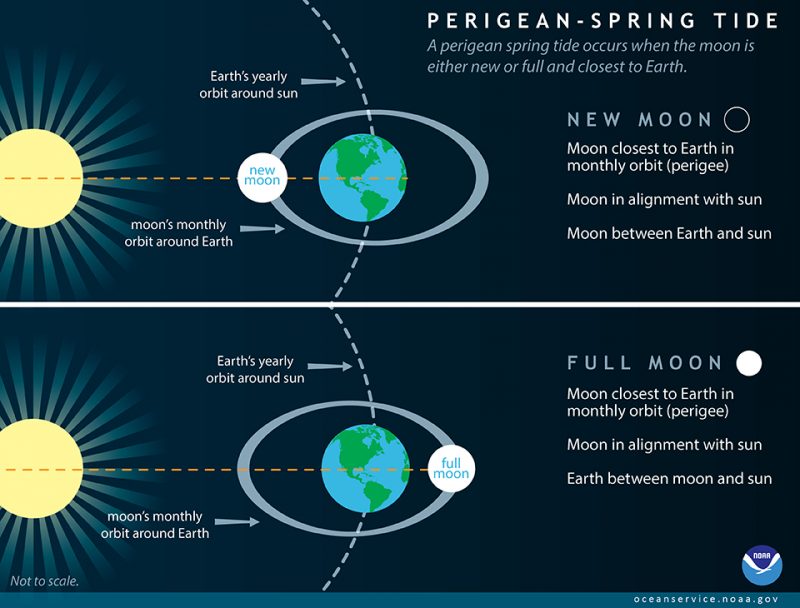
New moon happens when the moon (in its monthly orbit of Earth) goes more or less between the sun and Earth. Full moon happens when the moon (in its monthly orbit) is on the opposite side of Earth from the sun. And perigee – from the root words peri meaning near and geo meaning Earth – is the moon’s closest point to Earth in a month.
So the new or full moon closely coincides with perigee several times each year. When that happens, in the language of popular culture, we have a supermoon.
The full supermoons of 2026 are:
Fred Espenak’s new supermoon table gives us these values – (in UTC dates) and moon distances – for full supermoons in 2026. Contrast these moon distances to the average moon distance of 238,900 miles (384,472 km).
Jan 3: 225,130 miles (362,312 kilometers)
Nov 24: 224,170 miles (360,768 kilometers)
Dec 24: 221,667 miles (356,740 kilometers)
Plus a full supermoon starts 2027
Jan 22: 222,229 miles (357,644 kilometers)
The full supermoon of December 24, 2026, will be the closest full supermoon of the year.
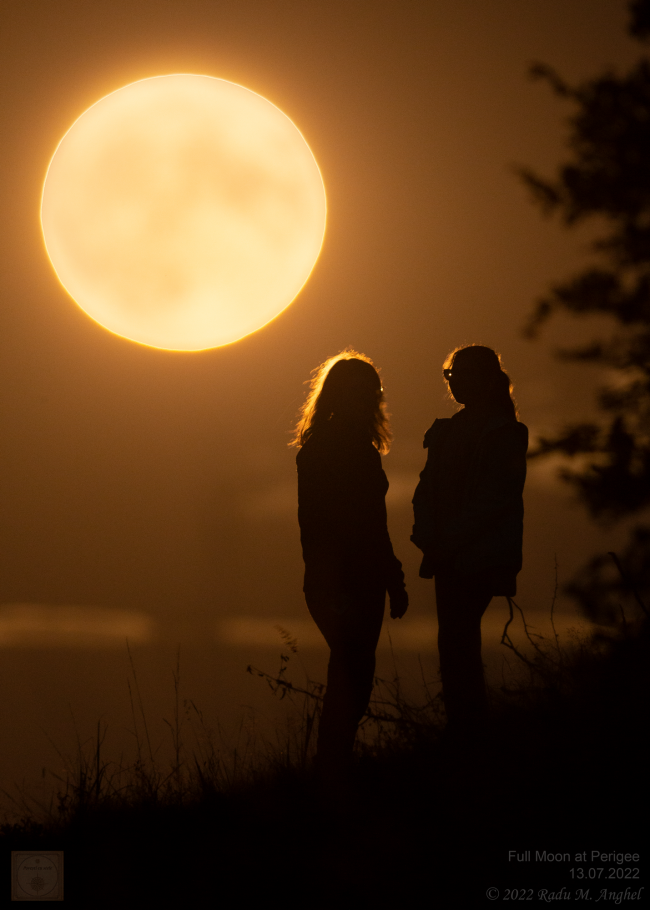
New supermoons of 2026 are:
Fred Espenak’s new supermoon table gives us these values – UTC dates and moon distances – for new supermoons in 2026. Contrast these moon distances to the average moon distance of 238,900 miles (384,472 km).
Apr 17: 226,299 miles (364,194 kilometers)
May 16: 222,819 miles (358,594 kilometers)
Jun 15: 221,966 miles (357,221 kilometers)
Jul 14: 223,789 miles (360,154 kilometers)
Aug 12: 228,017 miles (366,958 kilometers)
The new supermoon of June 15, 2026, will be the closest new supermoon for 2026.
And the new supermoon of August 12, 2026, will block out the sun causing a total solar eclipse.
What’s our source?
Note that different people define supermoons slightly differently. We use Fred Espenak’s full supermoon table to give us dates and moon distances for full supermoons in 2026. And we use his new supermoon table to give us dates and moon distances for new supermoons in 2026.
Also note that Fred’s dates and times are in UTC. So some supermoons may fall on the previous date your local time.
Supermoons came from popular culture
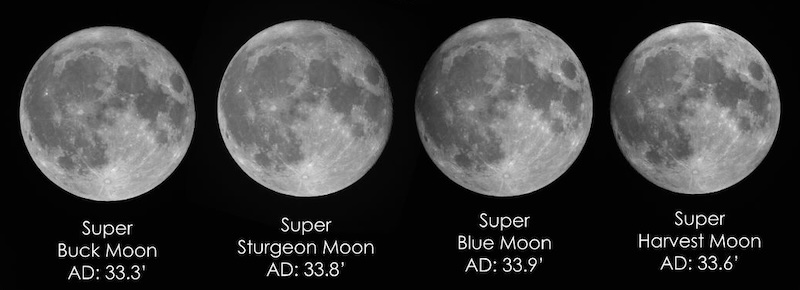
Where did the term supermoon originate? As it’s used today, the word supermoon was coined by astrologer Richard Nolle in 1979. And according to Nolle’s definition, a full moon or new moon is a supermoon when it’s also within 90% of its closest point to Earth. However, different websites calculate supermoons differently.
As mentioned above, EarthSky uses supermoon dates as determined by astronomer Fred Espenak. He’s best known for his time at the Goddard Space Flight Center, where he became a world expert on eclipse predictions. Additionally, his method of calculating supermoons takes into account changes in the moon’s orbit during each lunar cycle.
Supermoon hype?
Some astronomers complain about the name supermoon. They like to call supermoons hype. But supermoons aren’t hype. They’re special. Many people now know and use the word supermoon. In fact, we even notice some diehards are starting to use it now. Such is the power of folklore.
The hype aspect of supermoons probably stemmed from an erroneous impression people had when the word supermoon came into popular usage a few decades ago. Some people mistakenly believed a full supermoon would look much, much bigger to the eye. But it doesn’t. Nowadays, most people seem to realize that supermoons don’t look bigger to the eye than ordinary full moons.
It’s true experienced observers do say they can detect a difference. But you’d have to be a very keen observer to notice it.
Most of us can’t tell any difference in the size of a supermoon and an ordinary full moon.
Is a supermoon brighter?
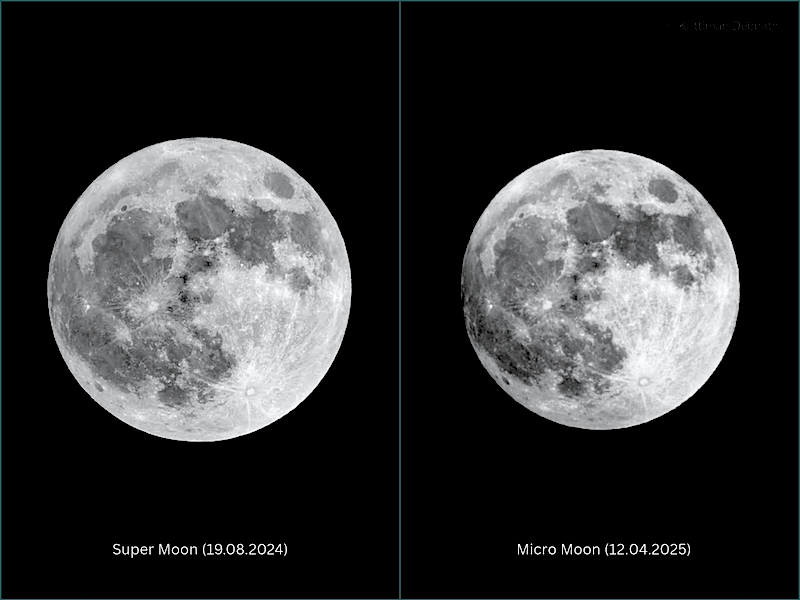
But … supermoons do look brighter than ordinary full moons! By a noticeable amount. That’s because a supermoon exceeds the disk size of an average-sized moon by up to 8% and the brightness of an average-sized full moon by some 16%. And then, it exceeds the disk size of a micromoon (a year’s most distant and therefore smallest full moon) up to 14% and the brightness of a micromoon by some 30%. So go outside on the night of a full supermoon. Even if you’re a casual observer of the moon, there’s the potential you’ll notice the supermoon is exceptionally bright!
For a visual reference, the size difference between a supermoon and micromoon is proportionally similar to that of a U.S. quarter versus a U.S. nickel. Again, that difference isn’t noticeable to the eye at the moon’s distance. But the brightness difference is noticeable.
By the way, before we called them supermoons, we in astronomy called these moons perigean full moons, or perigean new moons. No doubt about it, supermoon is catchier.
High tides from new and full supermoons
What’s more, all supermoons have the potential to cause higher-than-usual tides. High tides during the full or new moon are called spring tides. High tides during a full or new moon at perigee are called perigean spring tides, or, sometimes, king tides. And nowadays you sometimes hear them called supermoon tides.
These perigean or king or supermoon spring tides tend to follow the date of new or full moon by a day or so. These especially high tides are highly dependent on the shapes of local coastlines and on local weather conditions.
Do extra-high supermoon tides cause flooding? Maybe yes and maybe no. Flooding typically occurs when a strong weather system accompanies an especially high spring tide. According to Fred Espenak, the gravity from the closest supermoon is only 4% greater than the gravity from the moon at its average distance.
How often do we have a supermoon?
Often! But it also depends on your definition of supermoon.
Here’s a list of each year’s closest full supermoon perigees from 2017 to 2027 (from Espenak’s full supermoon table):
December 3, 2017 (357,987 kilometers or 222,443 miles)
January 2, 2018 (356,603 kilometers or 221,583 miles)
February 19, 2019 (356,846 kilometers or 221,734 miles)
April 8, 2020 (357,035 kilometers or 221,851 miles)
May 26, 2021 (357,463 kilometers or 222,117 miles)
July 13, 2022 (357,418 kilometers or 222,089 miles)
August 31, 2023 (357,344 kilometers or 222,043 miles)
October 17, 2024 (357,364 kilometers or 222,056 miles)
November 5, 2025 (356,980 kilometers or 221,817 miles)
December 24, 2026 (356,740 kilometers or 221,668 miles)
January 22, 2027 (357,644 kilometers or 222,229 miles)
The recurring cycle of supermoons
The closest full moon supermoon in 2026 (December 24) will recur after 14 lunar months (14 returns to full moon) after the closest full supermoon of 2025 (November 5). That’s because 14 returns to full moon almost exactly equal 15 returns to perigee, a period of about one year, one month, and 18 days.
The mean lunar month (full moon to full moon, or new moon to new moon) = 29.53059 days, whereas the mean anomalistic month (perigee to perigee, or apogee to apogee) = 27.55455 days. Hence:
14 lunar months (14 returns to full moon) x 29.53059 days = 413.428 days
15 anomalistic months (15 returns to lunar perigee) x 27.55455 days = 413.318 days
So given that closest supermoon recurs in cycles of 413 days (about one year, one month and 18 days), we can expect the closest full moon supermoon to come about one month and 18 days later next year. Thus, the closest full supermoon of 2026 – December 24 – will be followed by the closest full supermoon 14 months later – January 22 – in 2027.
What about micromoons?
The opposite of a supermoon is a micromoon. That’s when the new or full moon reaches apogee or its greatest distance from Earth. A full micromoon appears about 12-14% smaller than a full supermoon and about 7% smaller than an average full moon.
The average moon distance of 238,900 miles (384,472 km). So in 2026 there were three full micromoons, they are on May 1, May 31 and June 29. The full micromoon on May 31 will be the most distant full moon of the year and will be 252,360 miles (406,135 kilometers) away.
There is also one new micromoon in 2026. It’s on December 9. That new micromoon is the most distant new moon this year. It’ll lie 251,460 miles (404,687 kilometers) away.
Bottom line: What’s a supermoon? This year, 2026, has a full supermoon in January and two full supermoons in a row to end the year. Plus, January 2027 will be the last of three full supermoons in a row.
Read more: Does a supermoon have a super effect on us?
The post What’s a supermoon? Here are the supermoons in 2026 first appeared on EarthSky.
from EarthSky https://ift.tt/ovAhyX8
A cool cosmic coincidence kicks off 2026! The first full moon of the year — a supermoon — will coincide with Earth’s closest approach to the sun, known as perihelion, on and around January 2–3. That means the Earth, moon, and sun will all be unusually close and aligned as the new year begins. This rare event hasn’t happened since January 1912 and won’t occur again in our lifetimes. Join us on EarthSky’s livestream at 12 p.m. CST (18 UTC) on Wednesday, December 31, to explore this unique celestial alignment, learn why the seasons don’t follow Earth’s distance from the sun, and see how these subtle cosmic forces shape our sky.
What’s a supermoon?
2026 has eight supermoons! In fact, we have three full supermoons this year, and there’s five new supermoons this year. The year starts out with a full supermoon on January 2, 2026. So … what’s a supermoon?
New moon happens when the moon (in its monthly orbit of Earth) goes more or less between the sun and Earth. Full moon happens when the moon (in its monthly orbit) is on the opposite side of Earth from the sun. And perigee – from the root words peri meaning near and geo meaning Earth – is the moon’s closest point to Earth in a month.
So the new or full moon closely coincides with perigee several times each year. When that happens, in the language of popular culture, we have a supermoon.
The full supermoons of 2026 are:
Fred Espenak’s new supermoon table gives us these values – (in UTC dates) and moon distances – for full supermoons in 2026. Contrast these moon distances to the average moon distance of 238,900 miles (384,472 km).
Jan 3: 225,130 miles (362,312 kilometers)
Nov 24: 224,170 miles (360,768 kilometers)
Dec 24: 221,667 miles (356,740 kilometers)
Plus a full supermoon starts 2027
Jan 22: 222,229 miles (357,644 kilometers)
The full supermoon of December 24, 2026, will be the closest full supermoon of the year.
New supermoons of 2026 are:
Fred Espenak’s new supermoon table gives us these values – UTC dates and moon distances – for new supermoons in 2026. Contrast these moon distances to the average moon distance of 238,900 miles (384,472 km).
Apr 17: 226,299 miles (364,194 kilometers)
May 16: 222,819 miles (358,594 kilometers)
Jun 15: 221,966 miles (357,221 kilometers)
Jul 14: 223,789 miles (360,154 kilometers)
Aug 12: 228,017 miles (366,958 kilometers)
The new supermoon of June 15, 2026, will be the closest new supermoon for 2026.
And the new supermoon of August 12, 2026, will block out the sun causing a total solar eclipse.
What’s our source?
Note that different people define supermoons slightly differently. We use Fred Espenak’s full supermoon table to give us dates and moon distances for full supermoons in 2026. And we use his new supermoon table to give us dates and moon distances for new supermoons in 2026.
Also note that Fred’s dates and times are in UTC. So some supermoons may fall on the previous date your local time.
Supermoons came from popular culture
Where did the term supermoon originate? As it’s used today, the word supermoon was coined by astrologer Richard Nolle in 1979. And according to Nolle’s definition, a full moon or new moon is a supermoon when it’s also within 90% of its closest point to Earth. However, different websites calculate supermoons differently.
As mentioned above, EarthSky uses supermoon dates as determined by astronomer Fred Espenak. He’s best known for his time at the Goddard Space Flight Center, where he became a world expert on eclipse predictions. Additionally, his method of calculating supermoons takes into account changes in the moon’s orbit during each lunar cycle.
Supermoon hype?
Some astronomers complain about the name supermoon. They like to call supermoons hype. But supermoons aren’t hype. They’re special. Many people now know and use the word supermoon. In fact, we even notice some diehards are starting to use it now. Such is the power of folklore.
The hype aspect of supermoons probably stemmed from an erroneous impression people had when the word supermoon came into popular usage a few decades ago. Some people mistakenly believed a full supermoon would look much, much bigger to the eye. But it doesn’t. Nowadays, most people seem to realize that supermoons don’t look bigger to the eye than ordinary full moons.
It’s true experienced observers do say they can detect a difference. But you’d have to be a very keen observer to notice it.
Most of us can’t tell any difference in the size of a supermoon and an ordinary full moon.
Is a supermoon brighter?
But … supermoons do look brighter than ordinary full moons! By a noticeable amount. That’s because a supermoon exceeds the disk size of an average-sized moon by up to 8% and the brightness of an average-sized full moon by some 16%. And then, it exceeds the disk size of a micromoon (a year’s most distant and therefore smallest full moon) up to 14% and the brightness of a micromoon by some 30%. So go outside on the night of a full supermoon. Even if you’re a casual observer of the moon, there’s the potential you’ll notice the supermoon is exceptionally bright!
For a visual reference, the size difference between a supermoon and micromoon is proportionally similar to that of a U.S. quarter versus a U.S. nickel. Again, that difference isn’t noticeable to the eye at the moon’s distance. But the brightness difference is noticeable.
By the way, before we called them supermoons, we in astronomy called these moons perigean full moons, or perigean new moons. No doubt about it, supermoon is catchier.
High tides from new and full supermoons
What’s more, all supermoons have the potential to cause higher-than-usual tides. High tides during the full or new moon are called spring tides. High tides during a full or new moon at perigee are called perigean spring tides, or, sometimes, king tides. And nowadays you sometimes hear them called supermoon tides.
These perigean or king or supermoon spring tides tend to follow the date of new or full moon by a day or so. These especially high tides are highly dependent on the shapes of local coastlines and on local weather conditions.
Do extra-high supermoon tides cause flooding? Maybe yes and maybe no. Flooding typically occurs when a strong weather system accompanies an especially high spring tide. According to Fred Espenak, the gravity from the closest supermoon is only 4% greater than the gravity from the moon at its average distance.
How often do we have a supermoon?
Often! But it also depends on your definition of supermoon.
Here’s a list of each year’s closest full supermoon perigees from 2017 to 2027 (from Espenak’s full supermoon table):
December 3, 2017 (357,987 kilometers or 222,443 miles)
January 2, 2018 (356,603 kilometers or 221,583 miles)
February 19, 2019 (356,846 kilometers or 221,734 miles)
April 8, 2020 (357,035 kilometers or 221,851 miles)
May 26, 2021 (357,463 kilometers or 222,117 miles)
July 13, 2022 (357,418 kilometers or 222,089 miles)
August 31, 2023 (357,344 kilometers or 222,043 miles)
October 17, 2024 (357,364 kilometers or 222,056 miles)
November 5, 2025 (356,980 kilometers or 221,817 miles)
December 24, 2026 (356,740 kilometers or 221,668 miles)
January 22, 2027 (357,644 kilometers or 222,229 miles)
The recurring cycle of supermoons
The closest full moon supermoon in 2026 (December 24) will recur after 14 lunar months (14 returns to full moon) after the closest full supermoon of 2025 (November 5). That’s because 14 returns to full moon almost exactly equal 15 returns to perigee, a period of about one year, one month, and 18 days.
The mean lunar month (full moon to full moon, or new moon to new moon) = 29.53059 days, whereas the mean anomalistic month (perigee to perigee, or apogee to apogee) = 27.55455 days. Hence:
14 lunar months (14 returns to full moon) x 29.53059 days = 413.428 days
15 anomalistic months (15 returns to lunar perigee) x 27.55455 days = 413.318 days
So given that closest supermoon recurs in cycles of 413 days (about one year, one month and 18 days), we can expect the closest full moon supermoon to come about one month and 18 days later next year. Thus, the closest full supermoon of 2026 – December 24 – will be followed by the closest full supermoon 14 months later – January 22 – in 2027.
What about micromoons?
The opposite of a supermoon is a micromoon. That’s when the new or full moon reaches apogee or its greatest distance from Earth. A full micromoon appears about 12-14% smaller than a full supermoon and about 7% smaller than an average full moon.
The average moon distance of 238,900 miles (384,472 km). So in 2026 there were three full micromoons, they are on May 1, May 31 and June 29. The full micromoon on May 31 will be the most distant full moon of the year and will be 252,360 miles (406,135 kilometers) away.
There is also one new micromoon in 2026. It’s on December 9. That new micromoon is the most distant new moon this year. It’ll lie 251,460 miles (404,687 kilometers) away.
Bottom line: What’s a supermoon? This year, 2026, has a full supermoon in January and two full supermoons in a row to end the year. Plus, January 2027 will be the last of three full supermoons in a row.
Read more: Does a supermoon have a super effect on us?
The post What’s a supermoon? Here are the supermoons in 2026 first appeared on EarthSky.
from EarthSky https://ift.tt/ovAhyX8

Aucun commentaire:
Enregistrer un commentaire