
The 2026 EarthSky lunar calendar makes a great gift for the new year. Get yours today!
New Year’s Star Sirius, the moon and Jupiter to ring in 2026
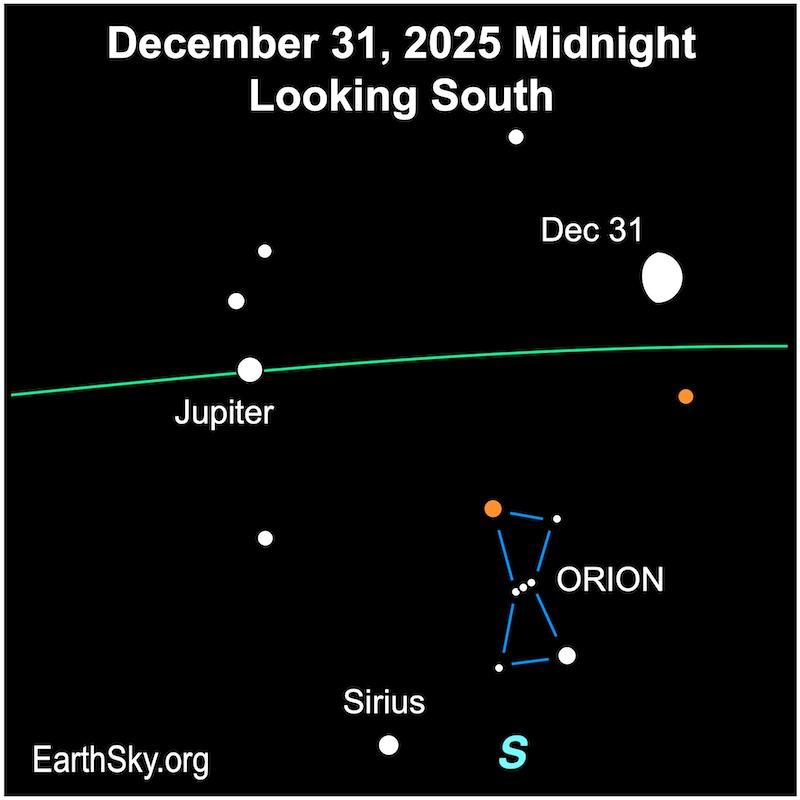
Want to entertain your friends on New Year’s Eve? Show them the New Year’s Star, Sirius, the brightest star in Earth’s night sky. This star always reaches its highest point in the sky around the stroke of midnight on New Year’s Eve. And, in 2026, Sirius will have company. It’ll be joined by an almost full supermoon and the bright planet Jupiter. Both are nearly at their closest to Earth. Wow, what an eye-catching sight!
Sirius also has the nickname the Dog Star, because it’s part of the constellation Canis Major the Greater Dog. It’s a noticeable sight in our sky every evening during Northern Hemisphere winter (Southern Hemisphere summer). But its midnight culmination – its highest point in the sky at midnight your local time – always comes around New Year’s Eve.
And this year a soon-to-be supermoon and Jupiter will provide a double whammy in brightness! You can look for them any time now. Keep reading, to learn more about how to identify them.
Sirius, the moon and Jupiter are all bright
So how can you find these objects? There are a lot of bright stars in the evening sky now. But – just remember – Sirius is the brightest star in Earth’s night sky. In fact, the name Sirius means sparkling or scorching in both Latin and Greek.
Plus, the fat waning gibbous moon will light up the sky and will soon be the full Wolf Moon – and a supermoon – on January 3, 2026. In fact, it’s the last of four supermoons in a row.
And Jupiter is brighter than glittering Sirius! As 2025 ends and 2026 begins, Earth will be closest to Jupiter on January 9 and pass between Jupiter and the sun (on January 10), bringing that planet closest to us for this year. Jupiter is always bright, but it’s especially bright right now. Jupiter shines more brightly than Sirius.
These three bright objects near each other in the sky will surely catch your eye.
Also, remember, our solar system is a flat plane. So, the planets and the moon follow more or less the path of the sun across our sky. No matter where you are on Earth, look along the sun’s path, or ecliptic, for the moon and Jupiter. Sirius will be nearby.
Locating Sirius
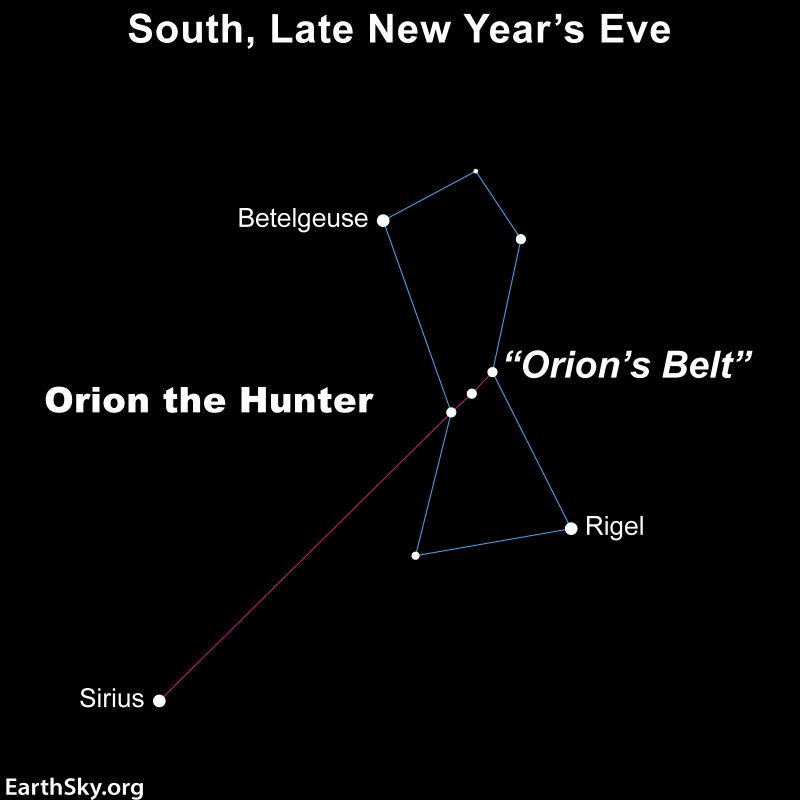
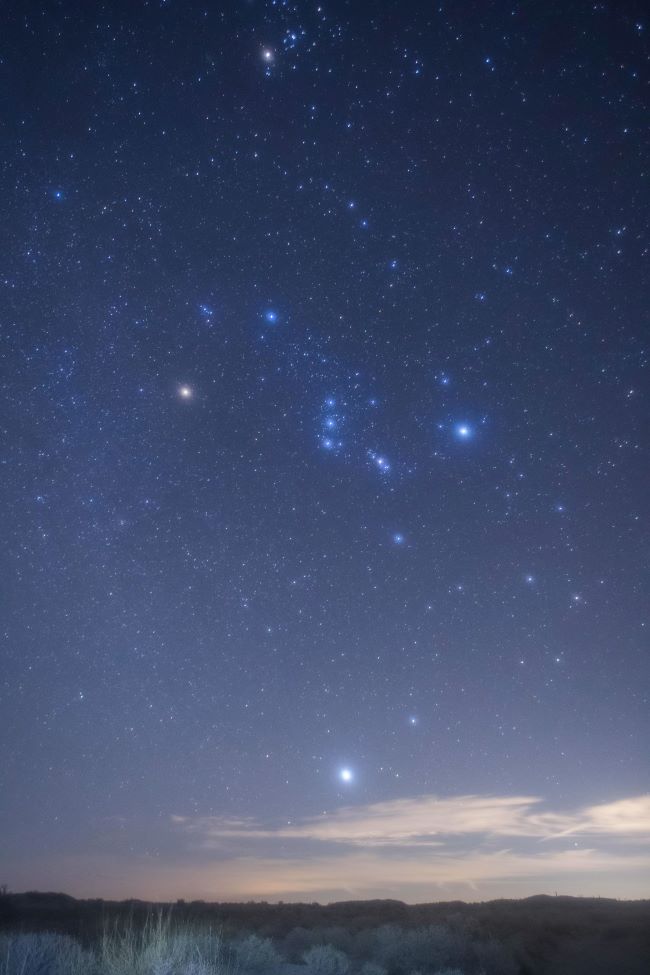
Need more help identifying Sirius? Here’s a sure-fire way to know. Look for three prominent stars in a row. They have the same size and brightness. These stars form the Belt of the constellation Orion the Hunter. Orion’s Belt always points to Sirius.
Sirius is always up late for the party
In late 2025 and early 2026, two bright planets – Saturn and Jupiter – are in the in the evening sky. The planets are “wanderers.” They don’t stay fixed with respect to the star background. Jupiter rises shortly after sunset and will be visible all night, but Saturn will set before midnight. Meanwhile, bright Sirius is highest in the sky at midnight during every turn of the year.
To clarify, by midnight, we mean the middle of the night, that is, midway between sunset and sunrise. Like the sun, the stars rise in the east and travel westward across the sky. When the sun or any star is in the eastern half of the sky, it’s climbing upward or ascending. When the sun or any star is in the western sky, it’s descending downward. Therefore, midway between rising and setting, the sun or any star reaches its highest point in the sky.
Because the stars rise and set two hours earlier with each passing month, Sirius will be highest up for the night around 10 p.m. local time on February 1. By then, Earth will have passed Jupiter in our orbits around the sun. We’ll be fleeing ahead of it. But they’ll still be near Sirius in the sky … and they will still be bright!
Jupiter from our Community Photos

Bottom line: Entertain your friends on New Year’s Eve by showing them the New Year’s Star, with the soon-to-be supermoon and Jupiter.
The post New Year’s Star Sirius, the moon and Jupiter ring in 2026 first appeared on EarthSky.
from EarthSky https://ift.tt/gOkd5Hf
The 2026 EarthSky lunar calendar makes a great gift for the new year. Get yours today!
New Year’s Star Sirius, the moon and Jupiter to ring in 2026
Want to entertain your friends on New Year’s Eve? Show them the New Year’s Star, Sirius, the brightest star in Earth’s night sky. This star always reaches its highest point in the sky around the stroke of midnight on New Year’s Eve. And, in 2026, Sirius will have company. It’ll be joined by an almost full supermoon and the bright planet Jupiter. Both are nearly at their closest to Earth. Wow, what an eye-catching sight!
Sirius also has the nickname the Dog Star, because it’s part of the constellation Canis Major the Greater Dog. It’s a noticeable sight in our sky every evening during Northern Hemisphere winter (Southern Hemisphere summer). But its midnight culmination – its highest point in the sky at midnight your local time – always comes around New Year’s Eve.
And this year a soon-to-be supermoon and Jupiter will provide a double whammy in brightness! You can look for them any time now. Keep reading, to learn more about how to identify them.
Sirius, the moon and Jupiter are all bright
So how can you find these objects? There are a lot of bright stars in the evening sky now. But – just remember – Sirius is the brightest star in Earth’s night sky. In fact, the name Sirius means sparkling or scorching in both Latin and Greek.
Plus, the fat waning gibbous moon will light up the sky and will soon be the full Wolf Moon – and a supermoon – on January 3, 2026. In fact, it’s the last of four supermoons in a row.
And Jupiter is brighter than glittering Sirius! As 2025 ends and 2026 begins, Earth will be closest to Jupiter on January 9 and pass between Jupiter and the sun (on January 10), bringing that planet closest to us for this year. Jupiter is always bright, but it’s especially bright right now. Jupiter shines more brightly than Sirius.
These three bright objects near each other in the sky will surely catch your eye.
Also, remember, our solar system is a flat plane. So, the planets and the moon follow more or less the path of the sun across our sky. No matter where you are on Earth, look along the sun’s path, or ecliptic, for the moon and Jupiter. Sirius will be nearby.
Locating Sirius
Need more help identifying Sirius? Here’s a sure-fire way to know. Look for three prominent stars in a row. They have the same size and brightness. These stars form the Belt of the constellation Orion the Hunter. Orion’s Belt always points to Sirius.
Sirius is always up late for the party
In late 2025 and early 2026, two bright planets – Saturn and Jupiter – are in the in the evening sky. The planets are “wanderers.” They don’t stay fixed with respect to the star background. Jupiter rises shortly after sunset and will be visible all night, but Saturn will set before midnight. Meanwhile, bright Sirius is highest in the sky at midnight during every turn of the year.
To clarify, by midnight, we mean the middle of the night, that is, midway between sunset and sunrise. Like the sun, the stars rise in the east and travel westward across the sky. When the sun or any star is in the eastern half of the sky, it’s climbing upward or ascending. When the sun or any star is in the western sky, it’s descending downward. Therefore, midway between rising and setting, the sun or any star reaches its highest point in the sky.
Because the stars rise and set two hours earlier with each passing month, Sirius will be highest up for the night around 10 p.m. local time on February 1. By then, Earth will have passed Jupiter in our orbits around the sun. We’ll be fleeing ahead of it. But they’ll still be near Sirius in the sky … and they will still be bright!
Jupiter from our Community Photos
Bottom line: Entertain your friends on New Year’s Eve by showing them the New Year’s Star, with the soon-to-be supermoon and Jupiter.
The post New Year’s Star Sirius, the moon and Jupiter ring in 2026 first appeared on EarthSky.
from EarthSky https://ift.tt/gOkd5Hf

Aucun commentaire:
Enregistrer un commentaire