
EarthSky’s 2026 lunar calendar is available now. Get yours today! Makes a great New Year’s gift.
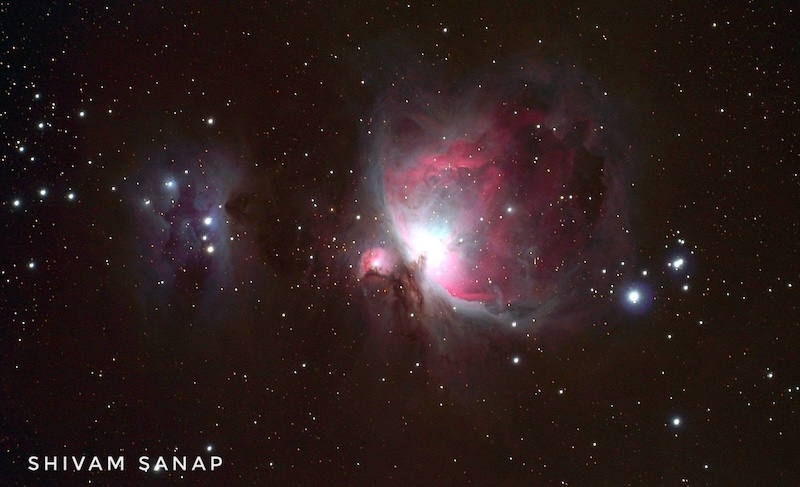
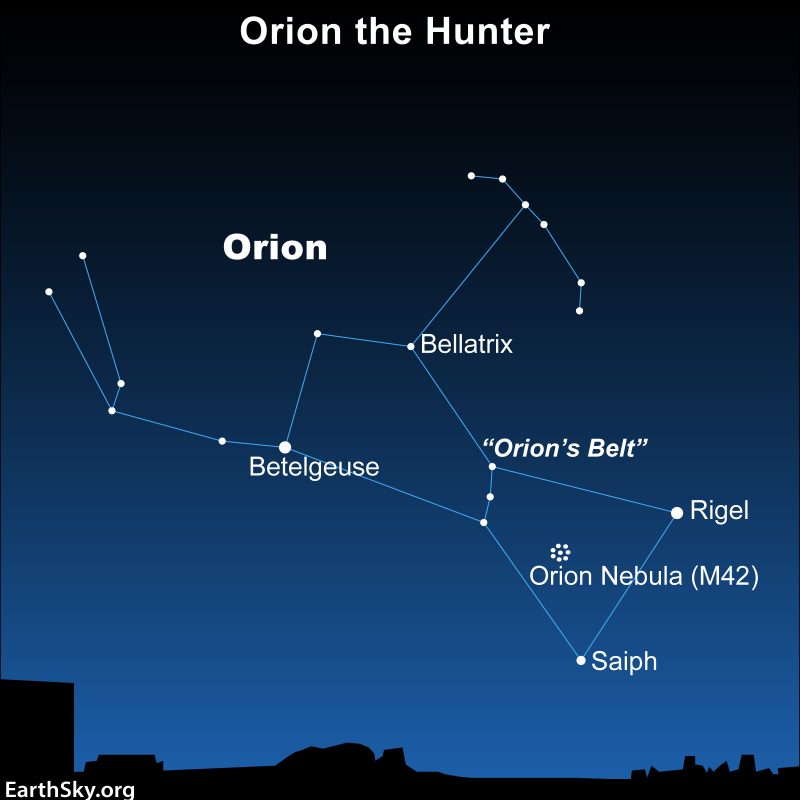
Orion the Hunter is the most noticeable of all constellations. The three stars of Orion’s Belt jump out at you as a short, straight row of medium-bright stars, midway between Orion’s two brightest stars, Betelgeuse and Rigel. Once you find the Belt stars, you can also locate the Orion nebula, otherwise known as M42. When you look at it, you’re gazing toward a stellar nursery, a place where new stars are born.
How to locate the Orion nebula
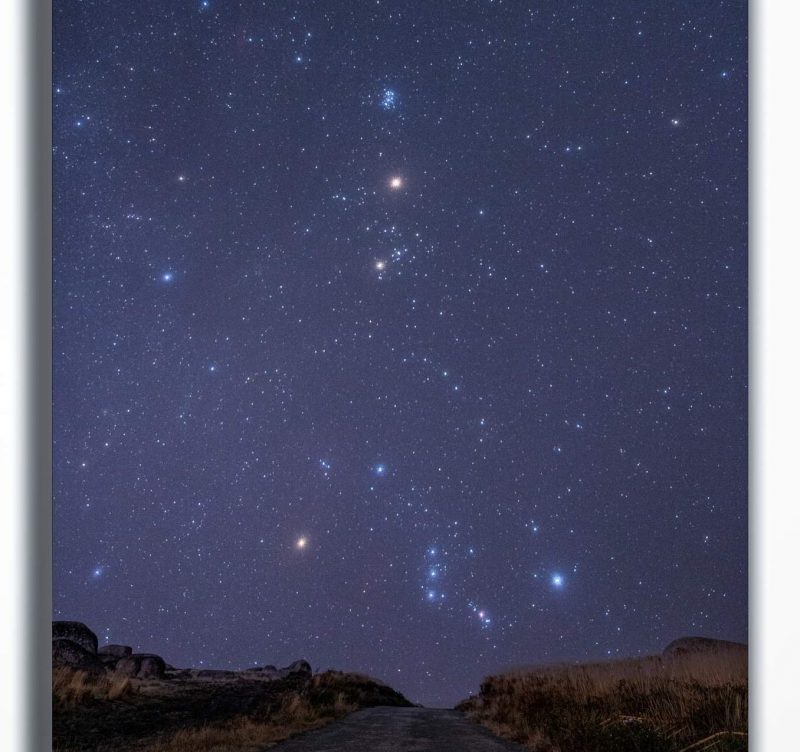
If you want to find this famous nebula, first you have to locate the constellation Orion. Fortunately, that’s easy, if you’re looking at the right time of year. The Northern Hemisphere winter months (Southern Hemisphere summer months) are the perfect time to come to know Orion.
First, look for the three medium-bright stars in a short, straight row. These stars represent Orion’s Belt.
Next, if you look closely, you’ll notice a curved line of stars “hanging” from the three Belt stars. These stars represent Orion’s Sword. Look for the Orion nebula about midway down in the Sword of Orion.
As a general rule, the higher the constellation Orion is in the sky, the easier it is to see the Orion nebula. From Northern Hemisphere locations, Orion is due south and highest in the sky around midnight in the middle of December. Then the stars return to the same place in the sky some four minutes earlier each night, or two hours earlier each month. So look for Orion to be highest up around 10 p.m. in mid-January and 8 p.m. in mid-February.
Another time people notice Orion is around the months of August and September, when this constellation appears in the east before dawn.
A globe of luminescent fog
Generally, most nebulae – clouds of interstellar gas and dust – are difficult if not impossible to see with the unaided eye or even binoculars. But the Orion nebula is in a class nearly all by itself. That’s because it’s visible to the unaided eye on a dark, moonless night. To me, it looks like a star encased in a globe of luminescent fog. The star-gazing aficionado Stephen James O’Meara described it as:
… angel’s breath against a frosted sky.
In a dark-sky location, observe the Orion nebula for yourself to see what it looks like. A backyard telescope, or even binoculars, will do wonders to showcase one of the greatest celestial treasures in the winter sky.
Science and the Orion nebula
According to modern astronomers, the Orion nebula is an enormous cloud of gas and dust, one of many in our Milky Way galaxy. It lies roughly 1,300 light-years from Earth.
At some 30 light-years in diameter, this great nebulous cocoon is giving birth to perhaps a thousand stars. A young open star cluster, whose stars were born together in the gas cloud and are still loosely bound by gravity, appears within the nebula. Some people refer to it as the Orion Nebula Star Cluster. In 2012, an international team of astronomers suggested this cluster in the Orion nebula might have a black hole at its heart.
Through small telescopes you can see the four brightest stars in the Orion nebula, known as the Trapezium. The light of the young, hot Trapezium stars illuminate the Orion nebula. These stars are only a million or so years old, babies on the scale of star lifetimes.
But most of the stars in this emerging cluster are veiled behind the Orion nebula itself, the great stellar nursery in Orion’s Sword.
The Orion nebula’s position is Right Ascension: 5h 35m; Declination: 5 degrees 23′ south.
Read more: Life’s building blocks found in Orion Nebula
Some images from our EarthSky Community Photos
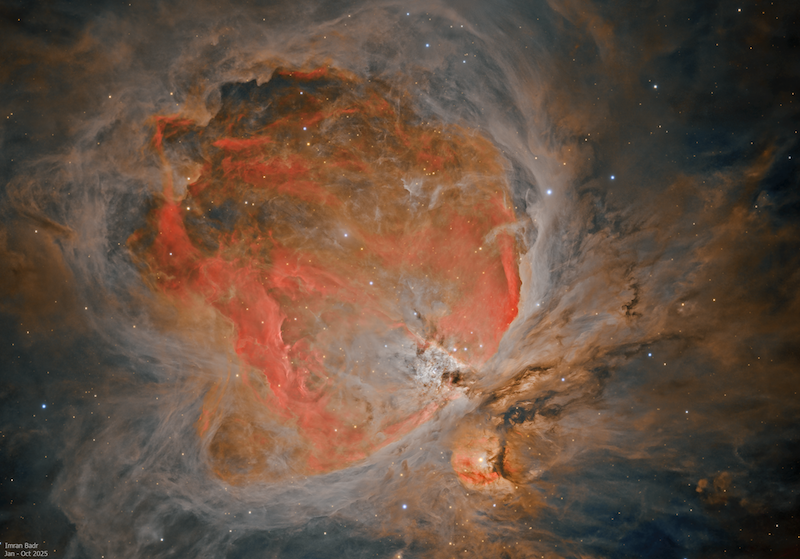
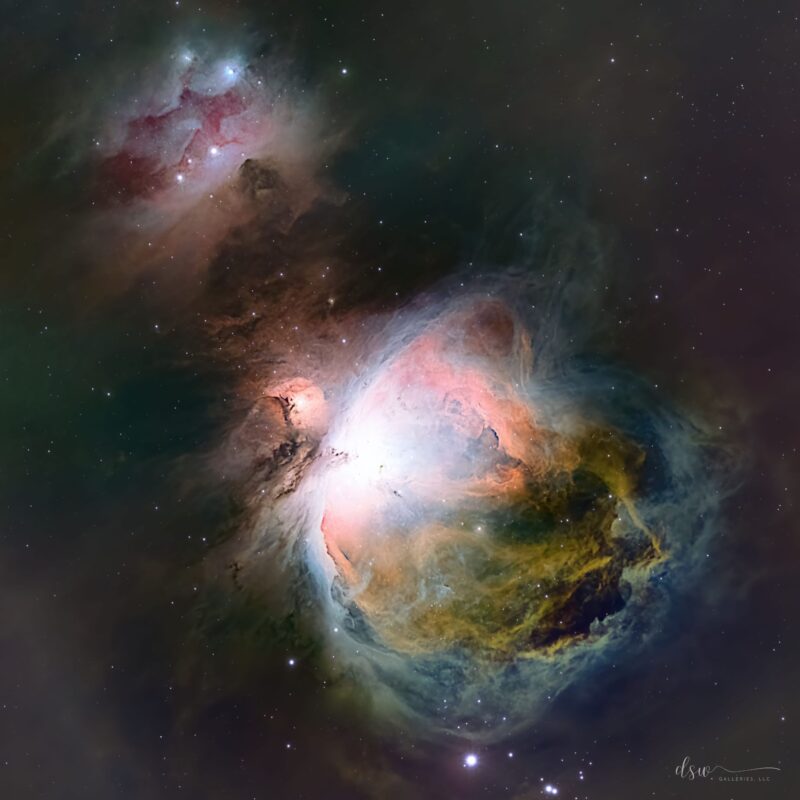
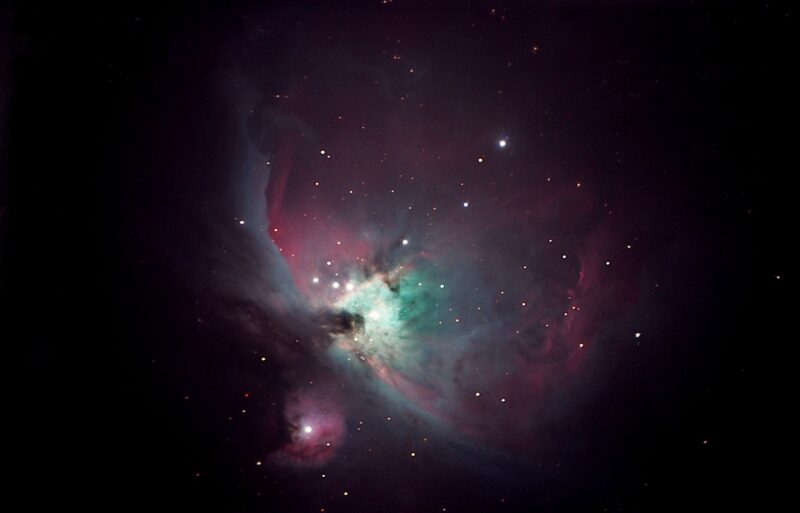
Bottom line: The Orion nebula appears to the eye as a tiny, hazy spot. But it’s a vast stellar nursery, a place where new stars are forming.
Enjoying EarthSky? Sign up for our free daily newsletter today!
The post The Orion nebula (M42) is a starry nursery first appeared on EarthSky.
from EarthSky https://ift.tt/vTUmaw6
EarthSky’s 2026 lunar calendar is available now. Get yours today! Makes a great New Year’s gift.
Orion the Hunter is the most noticeable of all constellations. The three stars of Orion’s Belt jump out at you as a short, straight row of medium-bright stars, midway between Orion’s two brightest stars, Betelgeuse and Rigel. Once you find the Belt stars, you can also locate the Orion nebula, otherwise known as M42. When you look at it, you’re gazing toward a stellar nursery, a place where new stars are born.
How to locate the Orion nebula
If you want to find this famous nebula, first you have to locate the constellation Orion. Fortunately, that’s easy, if you’re looking at the right time of year. The Northern Hemisphere winter months (Southern Hemisphere summer months) are the perfect time to come to know Orion.
First, look for the three medium-bright stars in a short, straight row. These stars represent Orion’s Belt.
Next, if you look closely, you’ll notice a curved line of stars “hanging” from the three Belt stars. These stars represent Orion’s Sword. Look for the Orion nebula about midway down in the Sword of Orion.
As a general rule, the higher the constellation Orion is in the sky, the easier it is to see the Orion nebula. From Northern Hemisphere locations, Orion is due south and highest in the sky around midnight in the middle of December. Then the stars return to the same place in the sky some four minutes earlier each night, or two hours earlier each month. So look for Orion to be highest up around 10 p.m. in mid-January and 8 p.m. in mid-February.
Another time people notice Orion is around the months of August and September, when this constellation appears in the east before dawn.
A globe of luminescent fog
Generally, most nebulae – clouds of interstellar gas and dust – are difficult if not impossible to see with the unaided eye or even binoculars. But the Orion nebula is in a class nearly all by itself. That’s because it’s visible to the unaided eye on a dark, moonless night. To me, it looks like a star encased in a globe of luminescent fog. The star-gazing aficionado Stephen James O’Meara described it as:
… angel’s breath against a frosted sky.
In a dark-sky location, observe the Orion nebula for yourself to see what it looks like. A backyard telescope, or even binoculars, will do wonders to showcase one of the greatest celestial treasures in the winter sky.
Science and the Orion nebula
According to modern astronomers, the Orion nebula is an enormous cloud of gas and dust, one of many in our Milky Way galaxy. It lies roughly 1,300 light-years from Earth.
At some 30 light-years in diameter, this great nebulous cocoon is giving birth to perhaps a thousand stars. A young open star cluster, whose stars were born together in the gas cloud and are still loosely bound by gravity, appears within the nebula. Some people refer to it as the Orion Nebula Star Cluster. In 2012, an international team of astronomers suggested this cluster in the Orion nebula might have a black hole at its heart.
Through small telescopes you can see the four brightest stars in the Orion nebula, known as the Trapezium. The light of the young, hot Trapezium stars illuminate the Orion nebula. These stars are only a million or so years old, babies on the scale of star lifetimes.
But most of the stars in this emerging cluster are veiled behind the Orion nebula itself, the great stellar nursery in Orion’s Sword.
The Orion nebula’s position is Right Ascension: 5h 35m; Declination: 5 degrees 23′ south.
Read more: Life’s building blocks found in Orion Nebula
Some images from our EarthSky Community Photos
Bottom line: The Orion nebula appears to the eye as a tiny, hazy spot. But it’s a vast stellar nursery, a place where new stars are forming.
Enjoying EarthSky? Sign up for our free daily newsletter today!
The post The Orion nebula (M42) is a starry nursery first appeared on EarthSky.
from EarthSky https://ift.tt/vTUmaw6

Aucun commentaire:
Enregistrer un commentaire