aads

Leonid meteor shower: All you need to know in 2026

Join EarthSky’s Deborah Byrd for a look at the November Leonid meteor shower! We’ll revisit the spectacular Leonid meteor storms of 1833 and 1966, when meteors seemed to rain from the sky, and explore what this year’s shower has in store. Could 2026 bring another storm?

Mid-November meteors … the Leonids

Predicted peak: The peak is predicted** for 0 UTC on November 18, 2026.
When to watch: The midnight to dawn hours — on the mornings of November 17 and November 18 — are likely best. And this year, near the radiant point of the Leonids meteor shower, you’ll spot Jupiter and Mars, separated by only about two full-moon widths.
Radiant: Rises around midnight, highest in the sky at dawn. You’ll see more meteors after the radiant has come over the eastern horizon. Do you need to look at the radiant to see the meteors? No. The meteors will fly from that single point in the sky, but they’ll appear all over the sky.
Nearest moon phase: In 2026, the 1st quarter moon falls at 11:48 UTC on November 17. A 1st quarter moon sets around midnight. So the moon won’t interfere with the Leonids in 2026.
Expected meteors at peak, under ideal conditions: Under a dark sky with no moon, you might see 10 to 15 Leonid meteors per hour.
The 2027 lunar calendar from EarthSky is now available! See the moon’s phase for every day of the year. Get yours now!

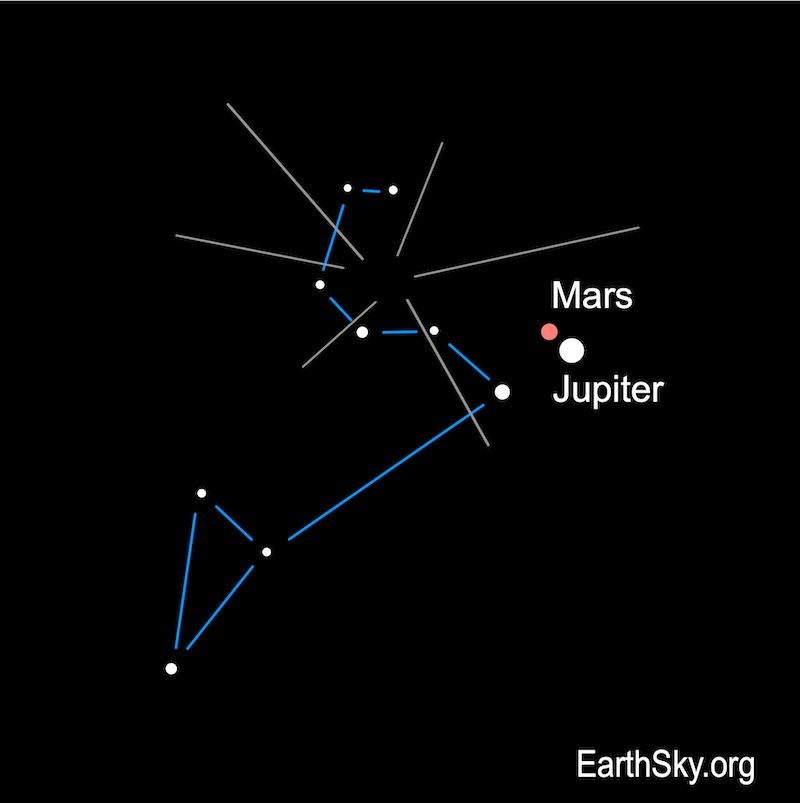
A large dot, Jupiter, is by a smaller dot, Mars. The outline with stars making up the constellation Leo the Lion is shown with fainter and longer lines depicting the radiant of Leonid meteors streaking away from the head of Leo.
The Leonids stream from a single point in the sky — the radiant point — in the constellation Leo the Lion. And people are always asking how to find the radiant. In 2026, the planets Jupiter and Mars can help! They are close together on the sky’s dome — in the east around midnight — and at their highest in the sky just before dawn breaks. They’re right next to the Leonids’ radiant point in the sky. So look for Jupiter and Mars! Have a dark sky? Look for the backwards question mark pattern in Leo. It’s known as the Sickle. Chart via EarthSky.

A meteor storm in 2026?

Earth is passing through the Leonid meteor stream in space from October 28 through December 7. You might see a Leonid meteor at any time during that period, especially if you’re out under a dark sky.

The Leonid meteor shower is famous! But why, when the hourly rate is so low, just 10-15 meteors per hour? The Leonids’ fame stems from its periodic meteor storms. The Leonids produced the first major meteor storm of modern times on November 12-13, 1833. It’s often called The Night the Stars Fell. We can’t know the meteor rate exactly. But a widely accepted estimate suggests a rate of up to 2,500 meteors per minute (approximately 150,000 meteors per hour), with some observers reporting seeing up to 20 to 70 meteors per second at the storm’s absolute climax.

Leonids also produced one of the greatest storms in living memory — with rates as high as in the 1833 storm for a period of about 15-20 minutes — on the morning of November 17, 1966. Some who witnessed it reported having a strong impression of Earth moving through space, as our world forded the meteor stream. “I almost felt as if I needed to grip the ground,” one observer told EarthSky.

Leonid meteor storms sometimes recur in cycles of 33 to 34 years. But the Leonids around the turn of the century — while wonderful for many observers — did not match the shower of 1966.

Alas! In most years, the Lion whimpers rather than roars. And scientists don’t expect a Leonid meteor storm this year.

Still, the shower should be fun to watch! Find a dark place to watch at EarthSky’s Best Places to Stargaze page.

Report a fireball (very bright meteor) to the American Meteor Society: it’s fun and easy

Read more: Veteran meteor photographer Eliot Herman’s website: Meteor Photography
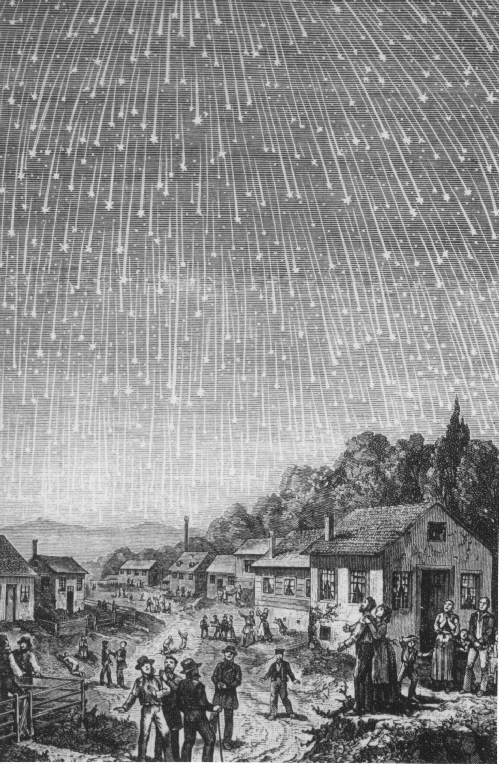
Sky filled with very, very many stars with long streaks for each; 1830s people out looking up.
The Night the Stars Fell. Engraving by Adolf Vollmy (1889). Vollmy produced this engraving of the 1833 Leonid meteor shower for the Adventist book Bible Readings for the Home Circle. It’s based on a painting by Swiss artist Karl Jauslin, which, in turn, was based on a first-person account of the 1833 storm by a minister, Joseph Harvey Waggoner. Image via Wikimedia Commons.

The parent comet of the Leonid meteor shower

From the late, great Don Machholz (1952-2022), who discovered 12 comets …

Periodic Comet Tempel-Tuttle, officially known as 55P/Tempel-Tuttle, is responsible for the Leonid meteor shower. Wilhelm Tempel of Marseille Observatory in France discovered this comet on the evening of December 19, 1865. He found the comet in the northern sky, located in a part of the sky under the North Star near the star Beta Ursae Minoris.

Word of the comet discovery became known throughout Europe. But the news had not yet spread to the United States. Horace Tuttle of Harvard College Observatory picked up the comet 17 days later, on the evening of January 5, 1866. Because this was an independent discovery, Tuttle’s name was added to the comet. Based upon the measurements during this visit of the comet, scientists calculated an orbit of 33.17 years. Astronomers quickly realized that the meteor storm of 1833 — and the annual meteor showers that occurred in mid-November of each year — were the result of this comet.

One would think there’d have been interest in recovering this comet as it came back to Earth’s vicinity in 1899. But there wasn’t much interest in seeing the comet that year. Everyone wanted to see a meteor storm. So, observers missed the comet in 1899. Also missing was a great meteor storm that year.

Scientists expected the next return in 1932. The observatories, using photographic plates with narrow field-of-view telescopes, missed it then too. And again, a major meteor shower did not materialize.

The comet was finally recovered in 1965. The brightest the comet got that year was 16th magnitude, visible only in very large telescopes. But the spectacular meteor storm of 1966 followed!

On the next return, in early 1998, the comet was bright enough that you could see it in binoculars. This pass produced additional impressive meteor showers, which stretched across several years in 1999-2001. 

55P/Tempel-Tuttle is due back in early 2031.

Leonid meteor storms in recent history

Most astronomers say you need more than 1,000 meteors an hour to consider a shower a storm. That’s far from the 10 to 15 meteors per hour the Leonids deliver in average years.

The Leonid’s parent comet, Tempel-Tuttle, completes a single orbit around the sun about once every 33 years. It releases fresh material every time it approaches the sun. Since the 19th century, skywatchers have looked for Leonid meteor storms about every 33 years, beginning with the meteor storm of 1833, which witnesses said produced up to 150,000 meteors per hour.

The next great Leonid storms were about 33 years later, in 1866 and 1867. In 1899, a meteor storm did not materialize. In fact, the anticipation of a great meteor storm was so high — and the results so disappointing — that many astronomers felt it was the worst blow ever suffered by astronomy in the eyes of the public.

Not until 1966 did the next spectacular Leonid storm happen, this time over the Americas. In 1966, observers in the southwest United States reported seeing up to 70 meteors per second during a span of 15-20 minutes on the morning of November 17, 1966.

Then came the 1999-2001 showers.

  • 1999: Observed rates peaked on November 18 at approximately 3,700 to 4,000 meteors per hour. The peak lasted for a short window and was best seen from Europe, North Africa and the Middle East.
  • 2000: Rates dropped considerably in contrast to 1999, but Earth still encountered multiple dust trails. Rates peaked at approximately 130 to 480 meteors per hour, hampered somewhat by bright moonlight.
  • 2001: The Leonids returned with a major double peak on November 18–19.
    • First Peak: Produced 1,500 to 2,000 meteors per hour, best seen from North America and Hawaii.
    • Second Peak: Reached 3,000 to 3,700 meteors per hour, matching or slightly exceeding the peak intensity of the 1999 storm. Best seen from East Asia and Australia.
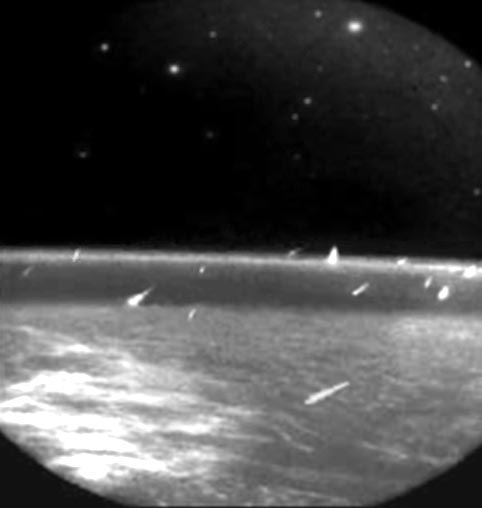
12 small bright objects streaking toward Earth as seen from orbit in black and white.
Leonid meteors viewed from space in 1997. Image via NASA.

The radiant of the Leonid meteor shower
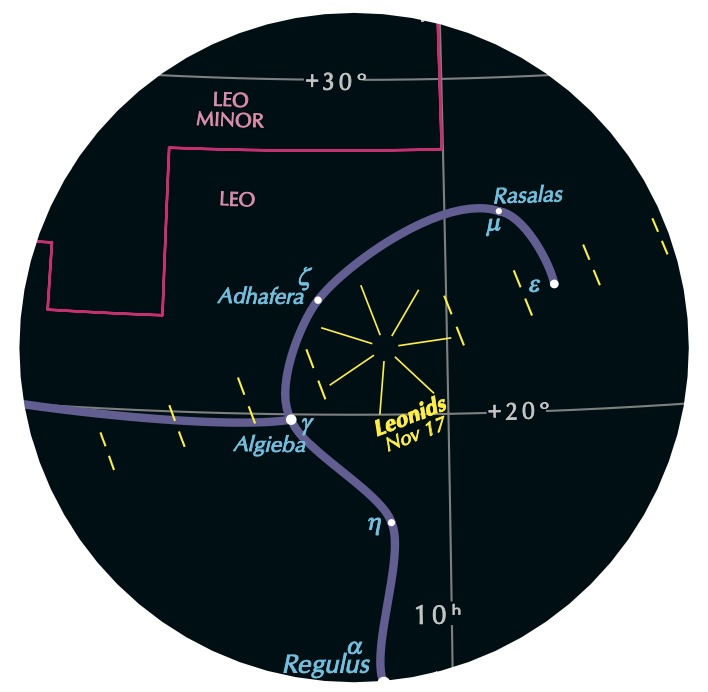
Sky chart with radial lines, grid lines, and several labeled stars in a sickle shape.
The 2026 Leonid meteor shower, seen in sky mode (from the Earth’s surface, looking up). On the late evening of November 17, 2026, the radiant appears to originate inside the Sickle of Leo the Lion. Chart via Guy Ottewell’s Astronomical Calendar.
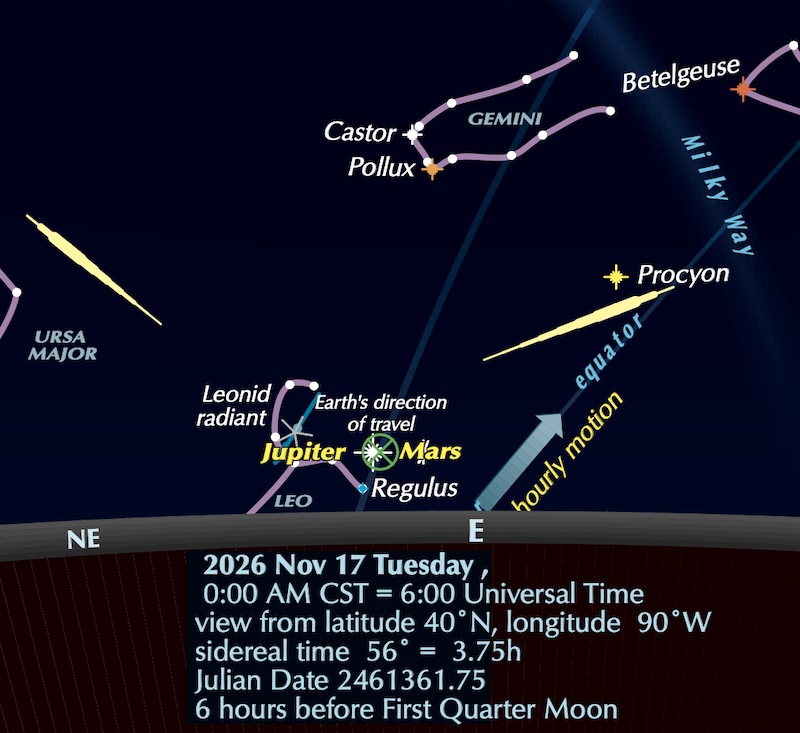
Diagram: Gemini and part of Leo - with Jupiter and Mars - above the horizon with meteors streaking away from Leo, with explanatory text.
The view looking toward the east-northeast horizon during the Leonid meteor shower. In 2026, watch after midnight until dawn on the mornings of November 17 and 18. Also, bright Jupiter and the red planet Mars are among the stars of Leo. Image via Guy Ottewell’s Astronomical Calendar 2026.
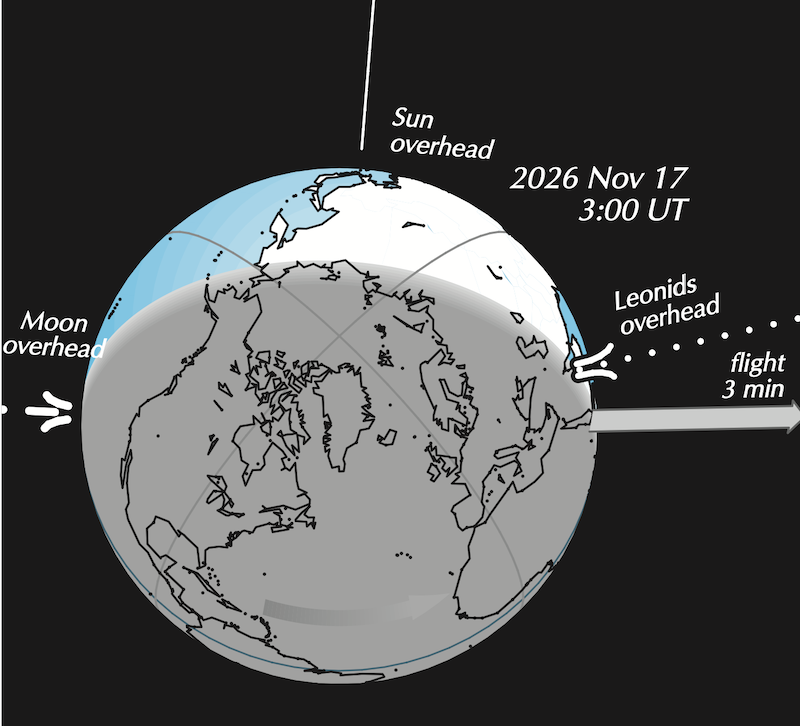
Diagram of Earth globe with lines toward location of moon, sun, and direction the meteors are coming in.
Diagram of the 2026 Leonid meteor shower as seen from above the Earth’s surface, looking down. Chart via Guy Ottewell’s 2026 Astronomical Calendar.

Leonid meteors from the EarthSky Community

A thin white streak slightly bulging in the middle in a dark blue sky, above rooftops.
View at EarthSky Community Photos. | Kathie O’Donnell in Rapid City, South Dakota, captured this Leonid on November 18, 2024, after 2 nights of searching in the northern sky. She wrote: “This one looks to be very bright considering the moon was hanging out.” Thank you, Kathie!
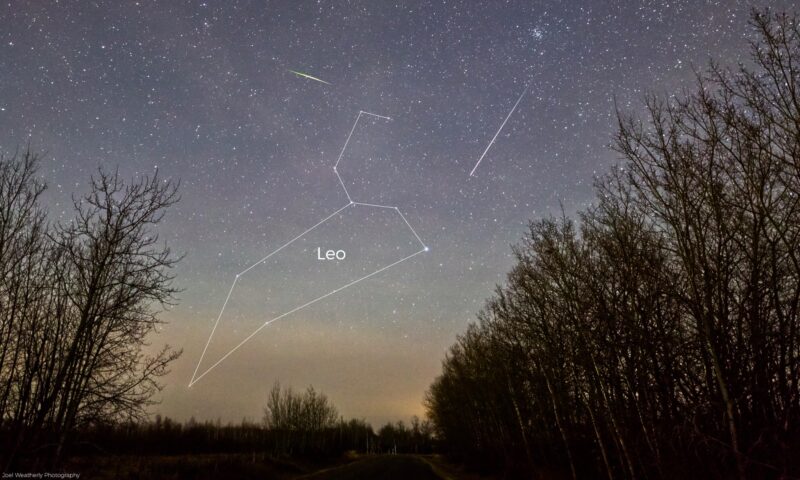
Starry sky with constellation Leo outlined, plus 2 thin streaks, one short and green and other long and white.
View at EarthSky Community Photos. | Joel Weatherly in Edmonton, Alberta, Canada, shared this composite image on November 18, 2023, and wrote: “Last night, the Leonids peaked with several meteors, including a few bright, long-lasting ones, racing across Leo. The brilliant meteor to the right of Leo produced a persistent train that remained visible for roughly 5 minutes.” Thank you, Joel!
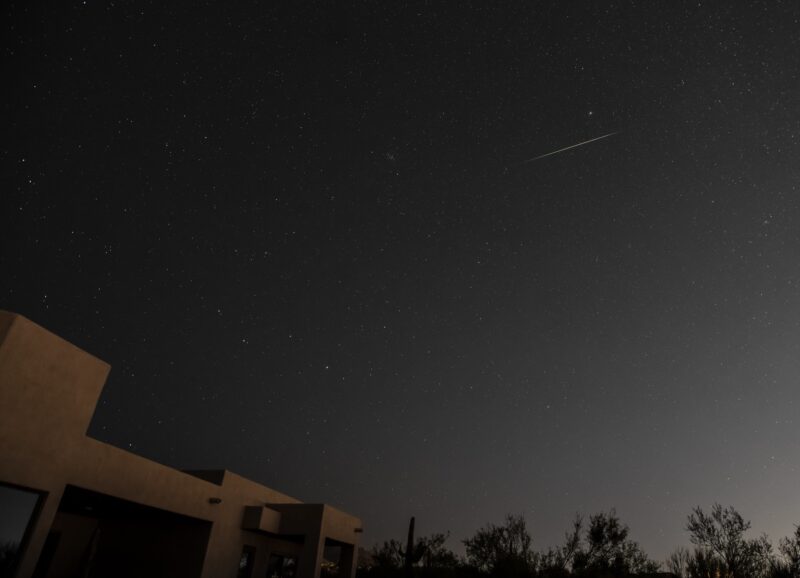
Starry, dark sky with a long streak crossing it. There is a house and some trees below.
View at EarthSky Community Photos. | Eliot Herman in Tucson, Arizona, photographed this early Leonid meteor on November 12, 2023, about 6 days before the peak. Thank you, Eliot.

More Leonid meteor shower photos from the EarthSky Community

Starry sky with stars of Orion and a short, bright streak next to them.
View at EarthSky Community Photos. | Jojie Shazri in Lawas, Sarawak, Malaysia, captured this image on November 21, 2020, and wrote: “The Leonid meteor fireball streaked near the Bellatrix star.” Thank you, Jojie! Bellatrix represents Orion‘s left shoulder. Can you see it?
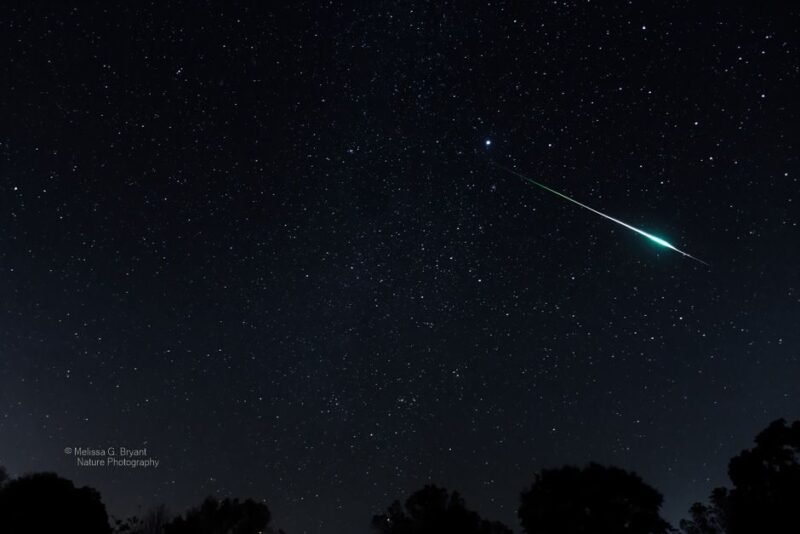
Dark, starry sky with a long thin streak crossing it, bulging glowing green at one end.
View at EarthSky Community Photos. | Melissa Bryant in Bowman, Georgia, went out to see the meteor shower on November 17, 2020, and wrote: “I was out at the right time and right position. After the third shot I got this awesome meteor streaking across. It was awesome to see and get a photo of it.” Thank you, Melissa!
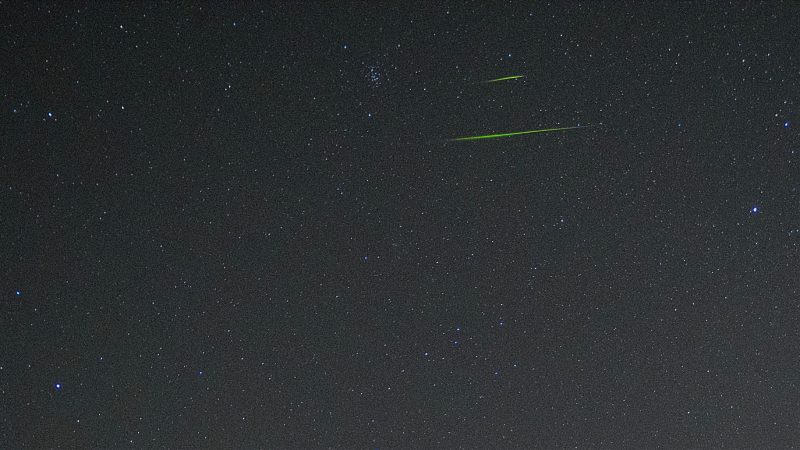
Two thin green horizontal streaks in dark starry sky.
View larger to see the colors better. | Eliot Herman in Tucson, Arizona, shared this double Leonid meteor photo, captured 2 days before the peak of the shower in 2018. Eliot commented: “The Leonids are the greenest meteors I see.” And he has seen a lot of meteors!

Bottom line: Watch the Leonid meteor shower tonight! Best viewing is after midnight until dawn. The 1st quarter moon sets at midnight and won’t interfere with the Leonids in 2026.

**Predicted peak times and dates for meteor showers are from the American Meteor Society. Note that meteor shower peak times can vary.

EarthSky’s meteor shower guide for 2026

EarthSky’s night sky guide: Visible planets and more

Meteor showers: Tips for watching the show

Learn how to shoot photos of meteors

The post Leonid meteor shower: All you need to know in 2026 first appeared on EarthSky.


from EarthSky https://ift.tt/2Qu71DN
Join EarthSky’s Deborah Byrd for a look at the November Leonid meteor shower! We’ll revisit the spectacular Leonid meteor storms of 1833 and 1966, when meteors seemed to rain from the sky, and explore what this year’s shower has in store. Could 2026 bring another storm?

Mid-November meteors … the Leonids

Predicted peak: The peak is predicted** for 0 UTC on November 18, 2026.
When to watch: The midnight to dawn hours — on the mornings of November 17 and November 18 — are likely best. And this year, near the radiant point of the Leonids meteor shower, you’ll spot Jupiter and Mars, separated by only about two full-moon widths.
Radiant: Rises around midnight, highest in the sky at dawn. You’ll see more meteors after the radiant has come over the eastern horizon. Do you need to look at the radiant to see the meteors? No. The meteors will fly from that single point in the sky, but they’ll appear all over the sky.
Nearest moon phase: In 2026, the 1st quarter moon falls at 11:48 UTC on November 17. A 1st quarter moon sets around midnight. So the moon won’t interfere with the Leonids in 2026.
Expected meteors at peak, under ideal conditions: Under a dark sky with no moon, you might see 10 to 15 Leonid meteors per hour.

The 2027 lunar calendar from EarthSky is now available! See the moon’s phase for every day of the year. Get yours now!

A large dot, Jupiter, is by a smaller dot, Mars. The outline with stars making up the constellation Leo the Lion is shown with fainter and longer lines depicting the radiant of Leonid meteors streaking away from the head of Leo.
The Leonids stream from a single point in the sky — the radiant point — in the constellation Leo the Lion. And people are always asking how to find the radiant. In 2026, the planets Jupiter and Mars can help! They are close together on the sky’s dome — in the east around midnight — and at their highest in the sky just before dawn breaks. They’re right next to the Leonids’ radiant point in the sky. So look for Jupiter and Mars! Have a dark sky? Look for the backwards question mark pattern in Leo. It’s known as the Sickle. Chart via EarthSky.

A meteor storm in 2026?

Earth is passing through the Leonid meteor stream in space from October 28 through December 7. You might see a Leonid meteor at any time during that period, especially if you’re out under a dark sky.

The Leonid meteor shower is famous! But why, when the hourly rate is so low, just 10-15 meteors per hour? The Leonids’ fame stems from its periodic meteor storms. The Leonids produced the first major meteor storm of modern times on November 12-13, 1833. It’s often called The Night the Stars Fell. We can’t know the meteor rate exactly. But a widely accepted estimate suggests a rate of up to 2,500 meteors per minute (approximately 150,000 meteors per hour), with some observers reporting seeing up to 20 to 70 meteors per second at the storm’s absolute climax.

Leonids also produced one of the greatest storms in living memory — with rates as high as in the 1833 storm for a period of about 15-20 minutes — on the morning of November 17, 1966. Some who witnessed it reported having a strong impression of Earth moving through space, as our world forded the meteor stream. “I almost felt as if I needed to grip the ground,” one observer told EarthSky.

Leonid meteor storms sometimes recur in cycles of 33 to 34 years. But the Leonids around the turn of the century — while wonderful for many observers — did not match the shower of 1966.

Alas! In most years, the Lion whimpers rather than roars. And scientists don’t expect a Leonid meteor storm this year.

Still, the shower should be fun to watch! Find a dark place to watch at EarthSky’s Best Places to Stargaze page.

Report a fireball (very bright meteor) to the American Meteor Society: it’s fun and easy

Read more: Veteran meteor photographer Eliot Herman’s website: Meteor Photography

Sky filled with very, very many stars with long streaks for each; 1830s people out looking up.
The Night the Stars Fell. Engraving by Adolf Vollmy (1889). Vollmy produced this engraving of the 1833 Leonid meteor shower for the Adventist book Bible Readings for the Home Circle. It’s based on a painting by Swiss artist Karl Jauslin, which, in turn, was based on a first-person account of the 1833 storm by a minister, Joseph Harvey Waggoner. Image via Wikimedia Commons.

The parent comet of the Leonid meteor shower

From the late, great Don Machholz (1952-2022), who discovered 12 comets …

Periodic Comet Tempel-Tuttle, officially known as 55P/Tempel-Tuttle, is responsible for the Leonid meteor shower. Wilhelm Tempel of Marseille Observatory in France discovered this comet on the evening of December 19, 1865. He found the comet in the northern sky, located in a part of the sky under the North Star near the star Beta Ursae Minoris.

Word of the comet discovery became known throughout Europe. But the news had not yet spread to the United States. Horace Tuttle of Harvard College Observatory picked up the comet 17 days later, on the evening of January 5, 1866. Because this was an independent discovery, Tuttle’s name was added to the comet. Based upon the measurements during this visit of the comet, scientists calculated an orbit of 33.17 years. Astronomers quickly realized that the meteor storm of 1833 — and the annual meteor showers that occurred in mid-November of each year — were the result of this comet.

One would think there’d have been interest in recovering this comet as it came back to Earth’s vicinity in 1899. But there wasn’t much interest in seeing the comet that year. Everyone wanted to see a meteor storm. So, observers missed the comet in 1899. Also missing was a great meteor storm that year.

Scientists expected the next return in 1932. The observatories, using photographic plates with narrow field-of-view telescopes, missed it then too. And again, a major meteor shower did not materialize.

The comet was finally recovered in 1965. The brightest the comet got that year was 16th magnitude, visible only in very large telescopes. But the spectacular meteor storm of 1966 followed!

On the next return, in early 1998, the comet was bright enough that you could see it in binoculars. This pass produced additional impressive meteor showers, which stretched across several years in 1999-2001. 

55P/Tempel-Tuttle is due back in early 2031.

Leonid meteor storms in recent history

Most astronomers say you need more than 1,000 meteors an hour to consider a shower a storm. That’s far from the 10 to 15 meteors per hour the Leonids deliver in average years.

The Leonid’s parent comet, Tempel-Tuttle, completes a single orbit around the sun about once every 33 years. It releases fresh material every time it approaches the sun. Since the 19th century, skywatchers have looked for Leonid meteor storms about every 33 years, beginning with the meteor storm of 1833, which witnesses said produced up to 150,000 meteors per hour.

The next great Leonid storms were about 33 years later, in 1866 and 1867. In 1899, a meteor storm did not materialize. In fact, the anticipation of a great meteor storm was so high — and the results so disappointing — that many astronomers felt it was the worst blow ever suffered by astronomy in the eyes of the public.

Not until 1966 did the next spectacular Leonid storm happen, this time over the Americas. In 1966, observers in the southwest United States reported seeing up to 70 meteors per second during a span of 15-20 minutes on the morning of November 17, 1966.

Then came the 1999-2001 showers.

  • 1999: Observed rates peaked on November 18 at approximately 3,700 to 4,000 meteors per hour. The peak lasted for a short window and was best seen from Europe, North Africa and the Middle East.
  • 2000: Rates dropped considerably in contrast to 1999, but Earth still encountered multiple dust trails. Rates peaked at approximately 130 to 480 meteors per hour, hampered somewhat by bright moonlight.
  • 2001: The Leonids returned with a major double peak on November 18–19.
    • First Peak: Produced 1,500 to 2,000 meteors per hour, best seen from North America and Hawaii.
    • Second Peak: Reached 3,000 to 3,700 meteors per hour, matching or slightly exceeding the peak intensity of the 1999 storm. Best seen from East Asia and Australia.
12 small bright objects streaking toward Earth as seen from orbit in black and white.
Leonid meteors viewed from space in 1997. Image via NASA.

The radiant of the Leonid meteor shower
Sky chart with radial lines, grid lines, and several labeled stars in a sickle shape.
The 2026 Leonid meteor shower, seen in sky mode (from the Earth’s surface, looking up). On the late evening of November 17, 2026, the radiant appears to originate inside the Sickle of Leo the Lion. Chart via Guy Ottewell’s Astronomical Calendar.
Diagram: Gemini and part of Leo - with Jupiter and Mars - above the horizon with meteors streaking away from Leo, with explanatory text.
The view looking toward the east-northeast horizon during the Leonid meteor shower. In 2026, watch after midnight until dawn on the mornings of November 17 and 18. Also, bright Jupiter and the red planet Mars are among the stars of Leo. Image via Guy Ottewell’s Astronomical Calendar 2026.
Diagram of Earth globe with lines toward location of moon, sun, and direction the meteors are coming in.
Diagram of the 2026 Leonid meteor shower as seen from above the Earth’s surface, looking down. Chart via Guy Ottewell’s 2026 Astronomical Calendar.

Leonid meteors from the EarthSky Community
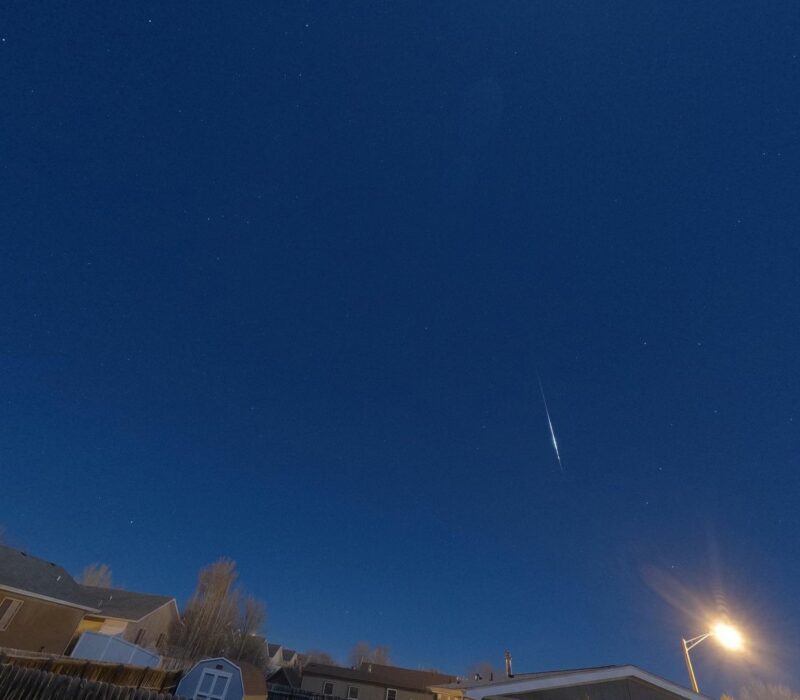
A thin white streak slightly bulging in the middle in a dark blue sky, above rooftops.
View at EarthSky Community Photos. | Kathie O’Donnell in Rapid City, South Dakota, captured this Leonid on November 18, 2024, after 2 nights of searching in the northern sky. She wrote: “This one looks to be very bright considering the moon was hanging out.” Thank you, Kathie!
Starry sky with constellation Leo outlined, plus 2 thin streaks, one short and green and other long and white.
View at EarthSky Community Photos. | Joel Weatherly in Edmonton, Alberta, Canada, shared this composite image on November 18, 2023, and wrote: “Last night, the Leonids peaked with several meteors, including a few bright, long-lasting ones, racing across Leo. The brilliant meteor to the right of Leo produced a persistent train that remained visible for roughly 5 minutes.” Thank you, Joel!
Starry, dark sky with a long streak crossing it. There is a house and some trees below.
View at EarthSky Community Photos. | Eliot Herman in Tucson, Arizona, photographed this early Leonid meteor on November 12, 2023, about 6 days before the peak. Thank you, Eliot.

More Leonid meteor shower photos from the EarthSky Community
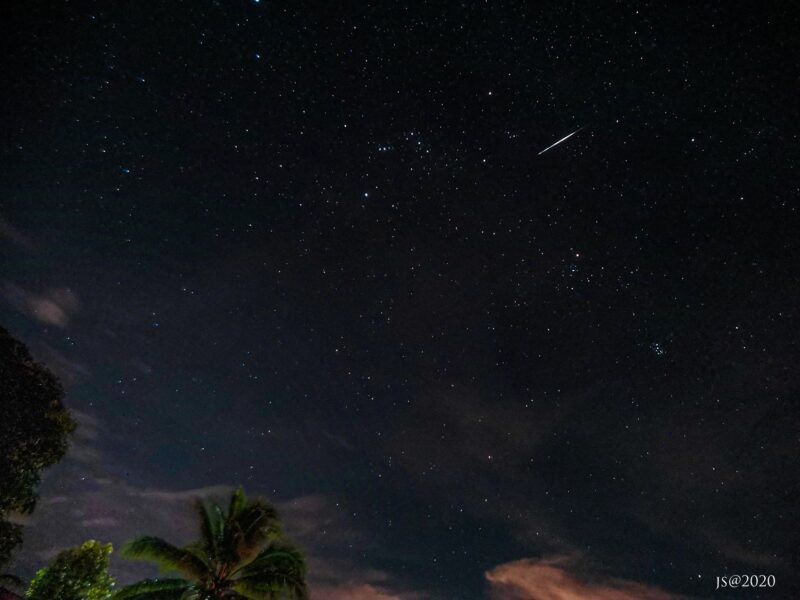
Starry sky with stars of Orion and a short, bright streak next to them.
View at EarthSky Community Photos. | Jojie Shazri in Lawas, Sarawak, Malaysia, captured this image on November 21, 2020, and wrote: “The Leonid meteor fireball streaked near the Bellatrix star.” Thank you, Jojie! Bellatrix represents Orion‘s left shoulder. Can you see it?
Dark, starry sky with a long thin streak crossing it, bulging glowing green at one end.
View at EarthSky Community Photos. | Melissa Bryant in Bowman, Georgia, went out to see the meteor shower on November 17, 2020, and wrote: “I was out at the right time and right position. After the third shot I got this awesome meteor streaking across. It was awesome to see and get a photo of it.” Thank you, Melissa!
Two thin green horizontal streaks in dark starry sky.
View larger to see the colors better. | Eliot Herman in Tucson, Arizona, shared this double Leonid meteor photo, captured 2 days before the peak of the shower in 2018. Eliot commented: “The Leonids are the greenest meteors I see.” And he has seen a lot of meteors!

Bottom line: Watch the Leonid meteor shower tonight! Best viewing is after midnight until dawn. The 1st quarter moon sets at midnight and won’t interfere with the Leonids in 2026.

**Predicted peak times and dates for meteor showers are from the American Meteor Society. Note that meteor shower peak times can vary.

EarthSky’s meteor shower guide for 2026

EarthSky’s night sky guide: Visible planets and more

Meteor showers: Tips for watching the show

Learn how to shoot photos of meteors

The post Leonid meteor shower: All you need to know in 2026 first appeared on EarthSky.


from EarthSky https://ift.tt/2Qu71DN

Mars Sample Return: NASA’s new effort to bring samples home

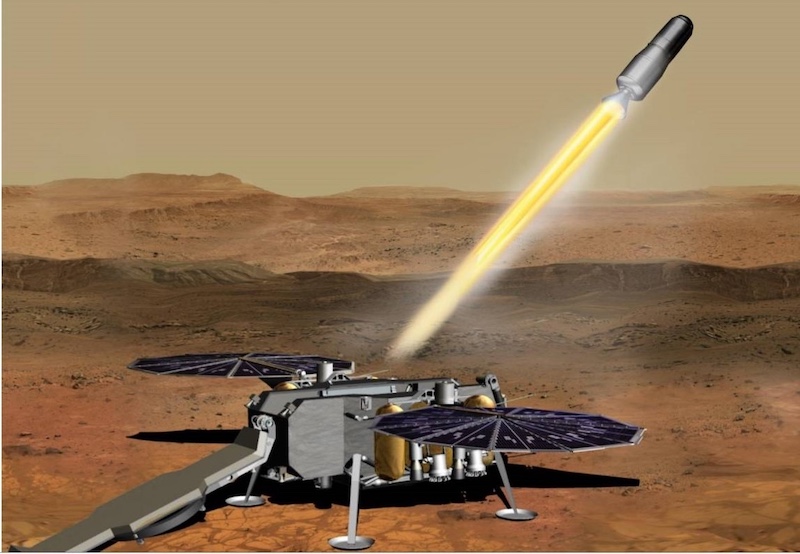
Mars Sample Return: Small rocket taking off from a lander on reddish surface with mountains in the distance.
View larger. | Artist’s concept of the Mars Ascent Vehicle lifting off from the Martian surface, as envisioned in an earlier version of the Mars Sample Return mission. Scientists are eager to have the samples that the Perseverance rover has collected brought back to Earth. Image via NASA/ JPL-Caltech.
  • Mars Sample Return was NASA’s original plan to bring samples of Martian rocks and sand back to Earth. Scientists would then study them in laboratories, looking for clues about the planet’s wet past and possible signs of microbial life.
  • NASA has now proposed a new strategy to bring those samples home. Will it work?
  • Previous proposals were deemed to be too expensive, and the timeframe to bring the samples back to Earth was too long.

Are you a moon-watcher? Then you’ll love EarthSky’s 2027 lunar calendar! Order yours today.

Mars Sample Return still alive?

The Mars Sample Return concept was scrapped — and declared dead — due to ballooning costs and a too-long timeframe. But the Mars Perseverance rover has already collected samples. It’s possible they contain evidence of ancient microbial life on Mars. So scientists are itching to have the samples returned to Earth. And now NASA has announced a new plan.

Tiffany Morgan, director of the Mars Exploration Program, detailed NASA’s new Perseverance Sample Retrieval Architecture on November 9, 2026, during a virtual meeting of the Mars Exploration Program Analysis Group. The new retrieval architecture provides a framework that NASA could build the actual mission upon. The idea now is to develop “impartial recommendations” for the mission. For example, the architecture will cover proposed mission requirements, review previous lessons learned and evaluate current capabilities and acquisition options.

There will also be a Perseverance Sample Retrieval Architecture strategy team kickoff in January 2027. A final report will be due in winter 2027-2028.

Leonard David wrote about the new concept for Space.com and Leonard David’s INSIDE OUTER SPACE on November 10, 2026.

NASA’s New Mars Sample Return Effort Detailedwww.leonarddavid.com/nasas-new-ma…

— Leonard David (@ldavid1129.bsky.social) 2026-11-10T19:09:08.202Z

NASA is kickstarting a new initiative for its troubled Mars Sample Return (MSR) program. The plan is to establish a fresh NASA strategy for gathering Mars samples collected by the Perseverance rover and launching them back to Earth. ? ? #PlanetSci

— Dr Space Junk (Alice Gorman) (@drspacejunk.bsky.social) 2026-11-13T07:14:22.855Z

A new strategy for Mars Sample Return

The framework of the new strategy is as follows:

  • Develop impartial recommendations for retrieving the Martian samples collected by NASA’s Perseverance Mars rover and deliver them to Earth
  • Assess proposed mission requirements
  • Review prior lessons learned
  • Evaluate current capabilities and acquisition options

A previous proposal would have cost an estimated $11 billion by 2024. And the samples wouldn’t have been returned to Earth until 2040. NASA determined that was too long and too expensive.

Another effort would cost $8 billion, with a return to Earth by 2035.

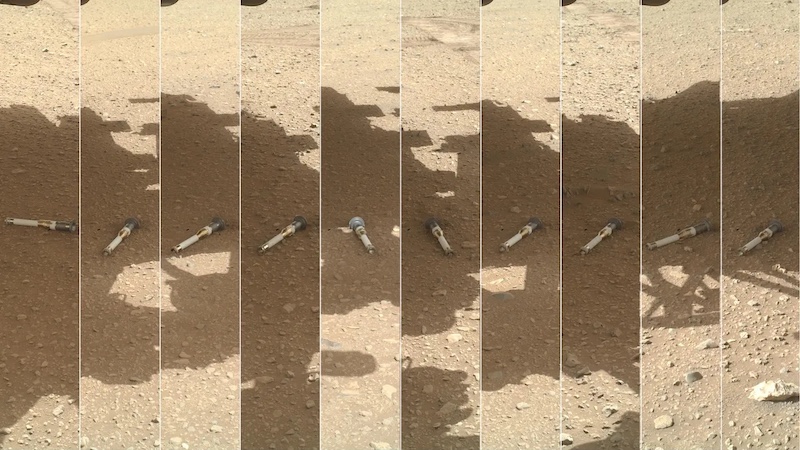
Mars Sample Return: 10 long rectangles in a row. Each rectangle has a photo of reddish rocky ground, with a small tube laying in the center.
View larger. | Some of the samples, in small tubes, that Perseverance has collected over the years. Image via NASA.

Perseverance rover’s priceless samples

The Perseverance rover has obtained numerous samples from Martian rocks. They are stored in small tubes. Some tubes are kept within the rover for analysis and others are left on the ground, waiting — hopefully — to be picked up later in a sample return mission. The rover had collected 33 samples by 2025.

Meanwhile, Perseverance is still exploring a region just outside the rim of Jezero crater. It still has a few sample tubes left, but not too many.

Signs of ancient life?

One of the most important — and exciting — samples comes from a rock called Cheyava Falls. It lies in an ancient riverbed that dried up billions of years ago.

Perseverance found odd rings and dots on the rock that looked like leopard spots and poppy seeds. They highly resembled formations on rocks on Earth created by microbes. Could they be signs of ancient life?

The rover itself can’t determine for sure their origins, however. The samples need to be studied in more advanced labs on Earth. This is the primary reason these samples are so important. They could hold evidence of ancient microbial life. And we can’t bring them home yet.

Mars Sample Return: Closeup of brown rock with small, irregular roundish marks with dark edges and light centers, and also tiny black spots.
View larger/full image. | Perseverance captured this view of the “leopard spots” (rings) and “poppy seeds” (smaller dots) on a Martian mudstone rock. Continued analysis of the rover data supports the possibility that the formations involved living microorganisms. It’s a compelling — though still inconclusive — case for ancient life on Mars. Image via NASA/ JPL-Caltech/ MSSS.

Risks for future human missions

There is another element to the sample return quest as well. It involves the risks to future human astronauts landing on Mars. There could be compounds in the samples or other rocks or sand that are toxic and dangerous to humans.

Bruce Jakosky of the University of Colorado Boulder and the University of Washington told Space.com:

The purpose is to understand the risk to astronauts and to hardware. The risk includes that from compounds that are present in the soil that are hazardous to astronauts if breathed in. This includes perchlorates and chloromethanes that have been identified already, and detection of other species that might be present. It also includes dust that can be breathed in by astronauts and that can affect hardware wear and tear.

Astronaut in bulky white suit standing near a big red boulder in reddish terrain with dusty yellow sky above.
View larger. | An astronaut examines rocks on Mars in this artist’s concept. Toxic compounds in the rocks or sand could pose a risk to future astronauts. The new sample return strategy calls for the samples from the Perseverance rover to be returned to Earth for study before any human missions begin. Image via NASA/ Wikimedia Commons.

Mars Sample Return 1st, then astronauts

Jakosky explained why it’s important to bring the samples back to Earth before human missions to Mars. This includes astronaut safety as a top priority:

  • Identify and characterize known hazardous chemicals to ensure astronaut safety (e.g., perchlorates and chloromethanes), and look for possible additional hazardous chemicals
  • Characterize very fine dust particles that could cause respiratory issues in astronauts
  • Characterize dust and regolith properties for spacesuit design and wear patterns
  • Search in advance of the arrival of humans for evidence of extant life that could interact with terrestrial life
  • Enhance astronaut effectiveness on the surface and science return from human missions by providing initial context and analysis
  • Demonstrate successful round-trip to Mars
  • Demonstrate successful round-trip travel, including entry, descent, landing and ascent from the surface of Mars.
  • Demonstrate implementation of planetary protection protocols. While human missions would not use the same approaches, what we learn from doing these would make the approach for humans much easier to plan and implement.

China’s sample return mission

Meanwhile, China is pushing ahead with its own sample return mission. The complex Tianwen-3 mission will have a lander, an ascender, a service capsule, an orbiter and an Earth reentry module.

China is looking to launch the mission by 2028 and bring the samples back to Earth by 2031.

Bottom line: NASA has begun a new effort for a Mars Sample Return mission to bring the highly-sought samples from the Perseverance rover back to Earth.

Via Space.com

Via Leonard David’s INSIDE OUTER SPACE

Read more: Life on Mars? Odd rings and spots tantalize scientists

Read more: Ancient life on Mars? Rover finds intriguing ‘leopard spots’

The post Mars Sample Return: NASA’s new effort to bring samples home first appeared on EarthSky.


from EarthSky https://ift.tt/uQmvWN4

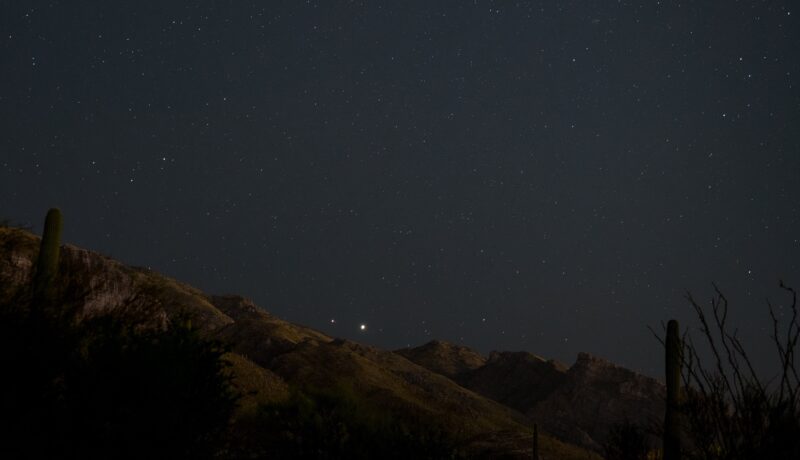
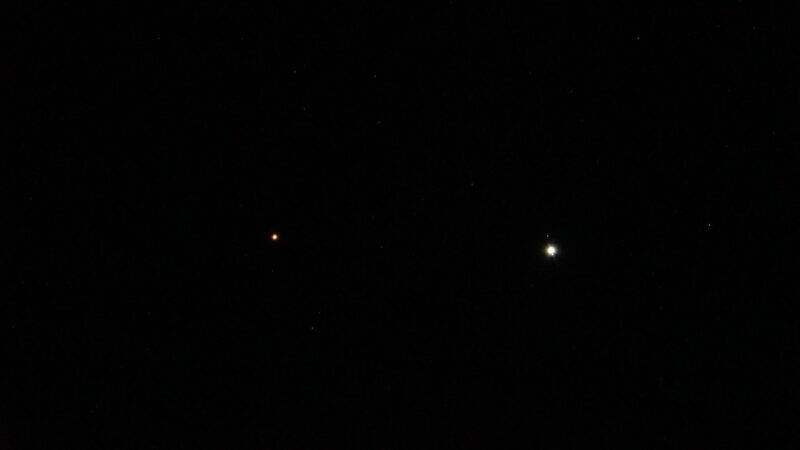
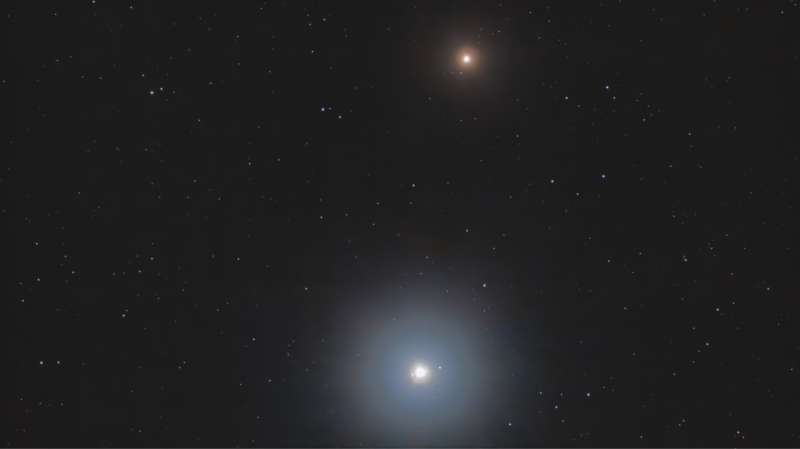
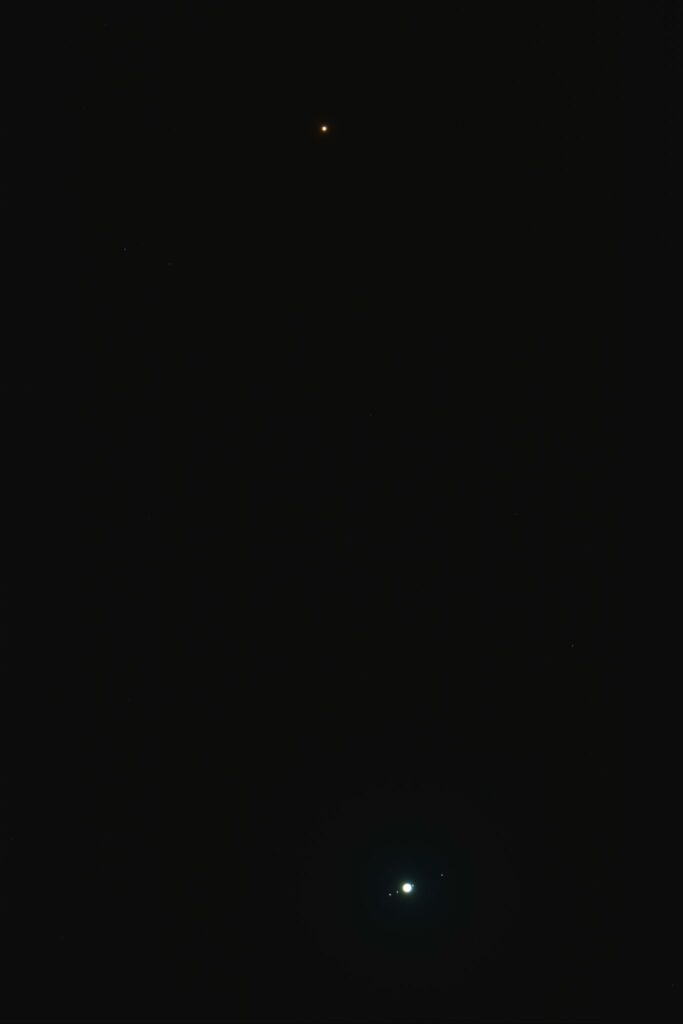
Jupiter-Mars conjunction 2026: Best images here!

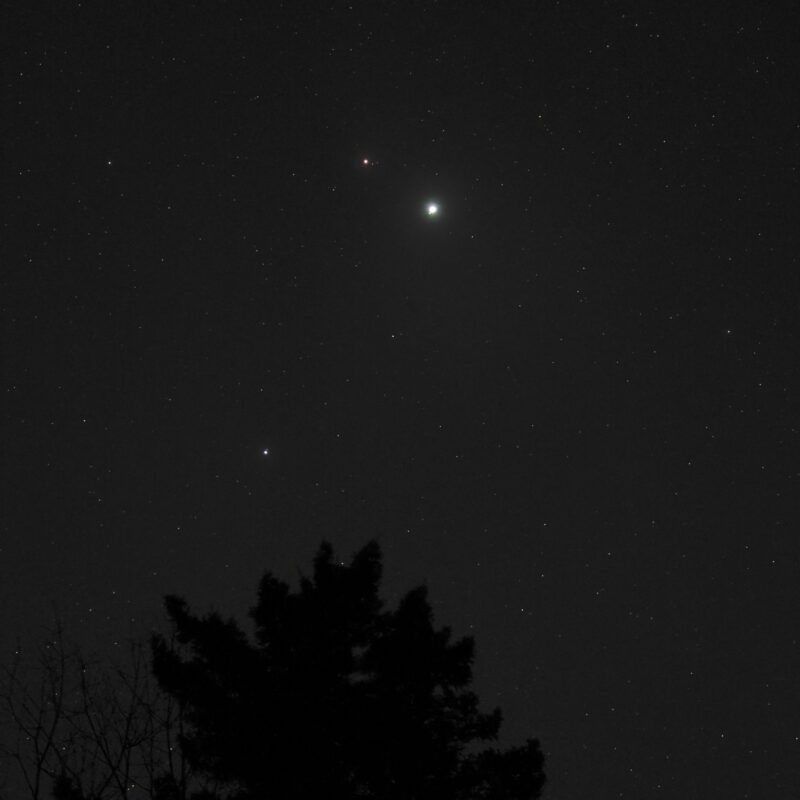
A bright, white dot (Jupiter) and a smaller, red dot (Mars) in a dark sky.
View at EarthSky Community Photos. | Steven Bellavia in Parksville, New York, captured this photo of the Jupiter-Mars conjunction on November 16, 2026. Thank you, Steven! Jupiter is the brighter of the pair. See more great shots below.

Bright planet Jupiter and reddish Mars have been edging closer in our morning sky all November. And on November 15-17, they reached a beautifully close conjunction. Enjoy some of the great images our global community of photographers captured of this event below.

And keep watching! Jupiter and Mars are now moving apart, but they’ll remain close through the rest of November. They’re currently rising around midnight and climbing high into the southeastern sky in the hours before dawn. Keep track of these worlds in our night sky guide, and share your pictures with us!

Jupiter-Mars conjunction pictures

Two bright dots low in the sky, near the top of a mountain.
View at EarthSky Community Photos. | Eliot Herman in Arizona captured the planets on November 16, 2026, and wrote: “Photo I have been planning for some weeks, to get the close conjunction of Mars and Jupiter rising over the foothills of the Catalina Mountains in Tucson, in a dark sky. This was my chance with all the recent weather.” Thank you, Eliot! Jupiter is the brighter of the two, while Mars is the reddish dot on the left.
A red dot to the left and a bigger, white dot to the right. The dot on the right shows a line of tiny dots.
View at EarthSky Community Photos. | Roberto Burkle in Quintana Roo, Mexico, captured this wonderful view on November 15, 2026, and wrote: “The alignment of the red planet (left) with the largest of all the planets in the solar system.” Thank you, Roberto. If you look closely, you can even see some of Jupiter’s large moons!
Red dot at top. Bigger, brighter dot at bottom. The bigger dot has a line of 3 dots.
View at EarthSky Community Photos. | Vineeth Kaimal in Karnataka, India, captured this view of Mars, Jupiter and its large moons. Vineeth wrote: “In the image, Io is visible to the left of Jupiter, and Europa and Callisto to the right. Ganymede is too close to Jupiter and not identifiable separately. Mars is at the top of the image.” Thank you!
Dark sky with a red dot at top and a bigger, white dot at bottom. Four dots form a line and cross the bigger dot.
View at EarthSky Community Photos. | Catherine Hyde in Cambria, California, captured this view on November 15, 2026. She wrote: “If you zoom in, you’ll see 4 of Jupiter’s moons. They are, from lower left to upper right, Ganymede, Europa, Io and Callisto.” Wow! Thank you, Catherine!

Bottom line: Jupiter and Mars had a beautiful cosmic encounter in November 2026. Enjoy this gallery of November’s Jupiter-Mars conjunction.

The post Jupiter-Mars conjunction 2026: Best images here! first appeared on EarthSky.


from EarthSky https://ift.tt/14hEoqZ

Look for Mercury this week, farthest from morning sun

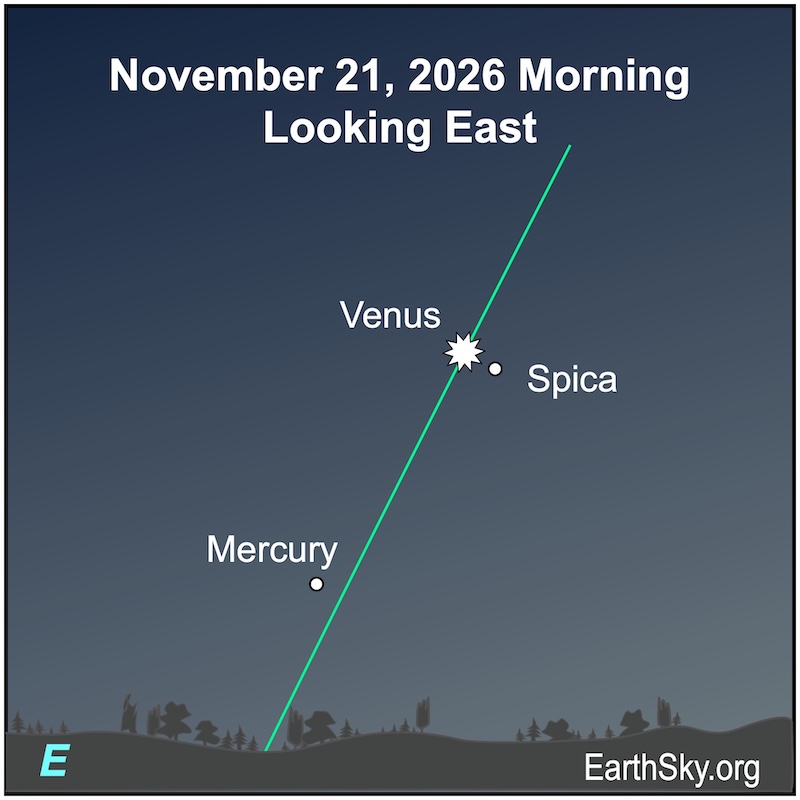
Chart showing a dot, Mercury, above a wavy line, the horizon. Far above it is a starred dot, Venus, next to a small dot, the star Spica.
Mercury will reach its greatest apparent distance from the sun — in the east before sunrise — on November 21, 2026. Astronomers call it a greatest western elongation of Mercury. Any of the mornings around November 21 are a great time to look. For all of us on Earth, it will lie in the brightening twilight, closer to the sunrise point than brilliant Venus (with the bright star Spica next to it). Mercury will be easiest to see from the Northern Hemisphere. But Southern Hemisphere observers might glimpse it, too! Chart via EarthSky.

Mercury farthest from the sunrise on November 21

The innermost planet Mercury orbits the sun every 88 days. And Earth is moving, too. So Mercury ends up passing between us and the sun about every 116 days. It last did this on November 4, 2026, reaching the point astronomers call inferior conjunction. And since then, Mercury has been speeding ahead of Earth in orbit.

And now Mercury is back in our eastern predawn sky. Look for it in the sunrise direction shortly just as dawn is breaking. Mercury is bright! But it’s nowhere near as bright as Venus, which rises earlier and appears farther from the sunrise point than Mercury.

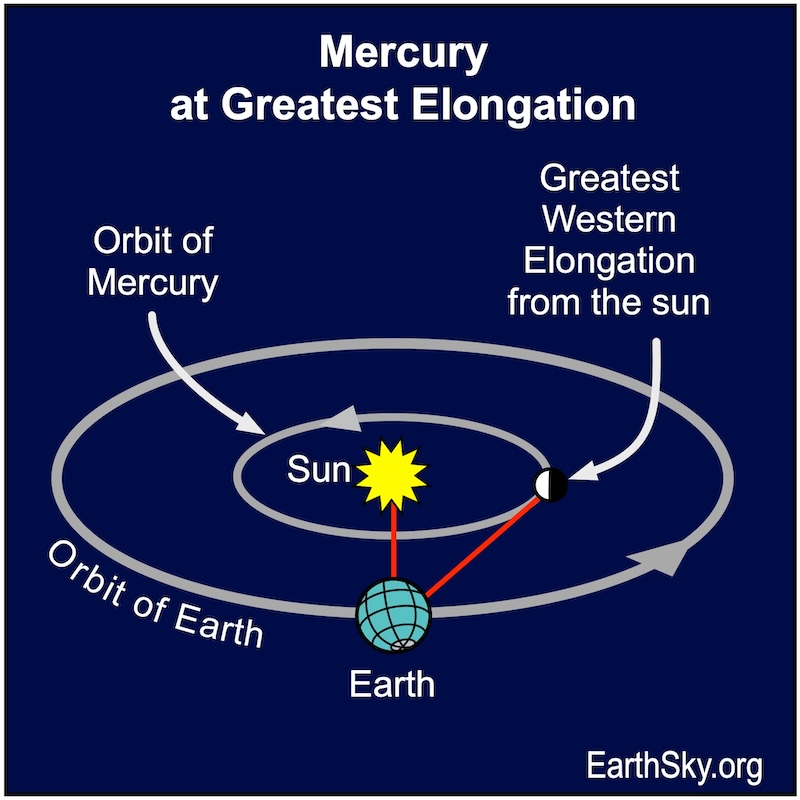
Mercury will reach its greatest western elongation – its greatest apparent distance from the rising sun, in the east at dawn – on November 21, 2026. This morning apparition – a brief one – favors the Northern Hemisphere. But Southern Hemisphere observers might glimpse Mercury, too, especially while using binoculars to scan for it along the eastern horizon.

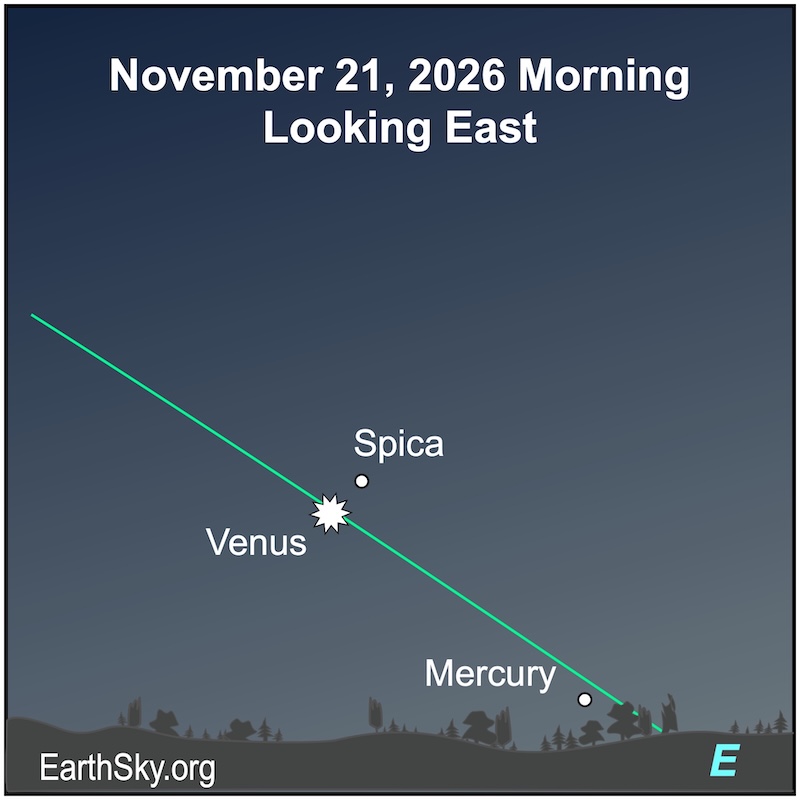
A dot, Mercury, is above a wavy line, the horizon. To its upper left is a starred dot, Venus, and a dot, Spica.
From the Southern Hemisphere, Mercury will lie low on the horizon that day when it reaches greatest elongation. Above Mercury, Venus and Spica will be much easier to spot. Chart via EarthSky.

Mercury greatest elongation, November 2026

When to watch: Officially, Mercury emerged the second week of November in the morning sky. Look for it shortly before sunrise. At greatest elongation, Mercury is farthest from the sunrise. In the mornings after that, as it’s edging back toward the sunrise, it’ll brighten a little bit more. That will make Mercury easier to spot in the morning twilight.
Where to look: Look in the sunrise direction as the sky is brightening.
Greatest elongation – marking Mercury’s farthest point from the sunrise glare – is at at 0 UTC on November 21 (6 p.m. CT on November 20). Mercury will shine at magnitude -0.6 on that morning. And it’ll be 20 degrees from the sun on our sky’s dome.
Through a telescope on and around November 21, Mercury appears 62% illuminated and 6.64 arcseconds across.
Note: This will be a long morning apparition for Mercury, for the Northern Hemisphere. After November 21, Mercury brightens a bit to magnitude -0.9 (bright, but competing with the morning twilight) until it slips away later – around mid-month – in the December morning twilight.
Venus is nearby: Also in the morning twilight – but higher is the sky – is bright Venus.

Mercury finder charts

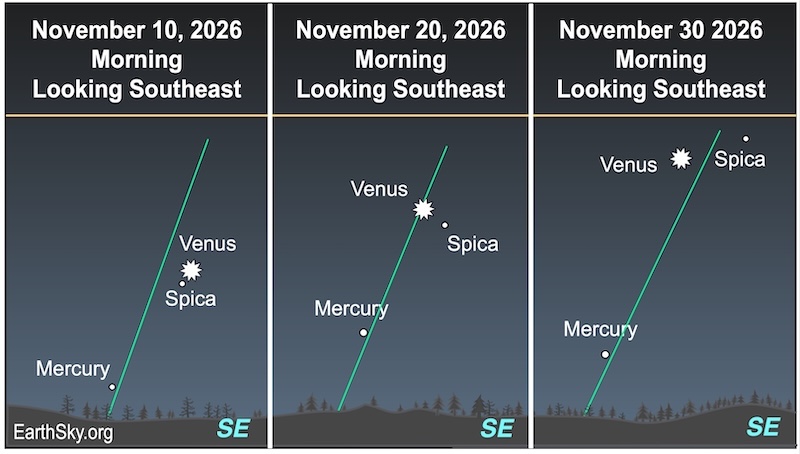
Three charts showing the appearance of Mercury in November. In the first, a small dot, Mercury is just above a wavy line, the horizon. Above them are a starred dot, Venus, and a small dot, the star Spica. In the second, the small dot, Mercury, has moved higher above the wavy line, the horizon. In the third, the small dot, Mercury, has dropped closer to a wavy line.
In early November, Mercury will lie low in the east shortly before sunrise. Brilliant Venus, and the star Spica are next to each other and far above Mercury. After the middle of the month, Mercury will have brightened and climbed toward Venus and Spica. By month’s end, Mercury will have begun to descend, and slip away by mid-December . Chart via EarthSky.

For precise sun and Mercury rising times at your location:

Old Farmer’s Almanac (U.S. and Canada)
timeanddate.com (worldwide)
Stellarium (online planetarium)

Mercury events in 2026

Jan 21, 2026: Superior conjunction (passes behind sun from Earth)
Feb 19, 2026: Greatest elongation (evening)
Mar 7, 2026: Inferior conjunction (races between Earth and sun)
Apr 3, 2026: Greatest elongation (morning)
May 14, 2026: Superior conjunction (passes behind sun from Earth)
Jun 15, 2026: Greatest elongation (evening)
Jul 13, 2026: Inferior conjunction (races between Earth and sun)
Aug 2, 2026: Greatest elongation (morning)
Aug 27, 2026: Superior conjunction (passes behind sun from Earth)
Oct 12, 2026: Greatest elongation (evening)
Nov 4, 2026: Inferior conjunction (races between Earth and sun)
Nov 21, 2026: Greatest elongation (morning)

Mercury charts from Guy Ottewell

Sky chart with arc-shaped dotted planet paths, and sky objects labeled.
Mercury’s greatest morning elongations in 2026 from the Northern Hemisphere as viewed through a powerful telescope. The planet images are at the 1st, 11th, and 21st of each month. Dots show the actual positions of the planet for every day. Chart via Guy Ottewell’s 2026 Astronomical Calendar. Used with permission.
Sky chart with arc-shaped dotted planet paths, and sky objects labeled.
Mercury’s greatest morning elongations in 2026 from the Southern Hemisphere as viewed through a powerful telescope. The planet images are at the 1st, 11th, and 21st of each month. Dots show the actual positions of the planet for every day. Chart via Guy Ottewell’s 2026 Astronomical Calendar. Used with permission.

A comparison of elongations

Mercury’s greatest elongations are not equal. Indeed, some are “greater” than others. For example, the distance of Mercury from the sun on our sky’s dome varies from about 28 degrees (maximum) to 18 degrees (minimum).

Also, Mercury’s elongations are better or worse depending on the time of the year they occur and your location on Earth. So, for both hemispheres, spring evenings and autumn mornings are best.

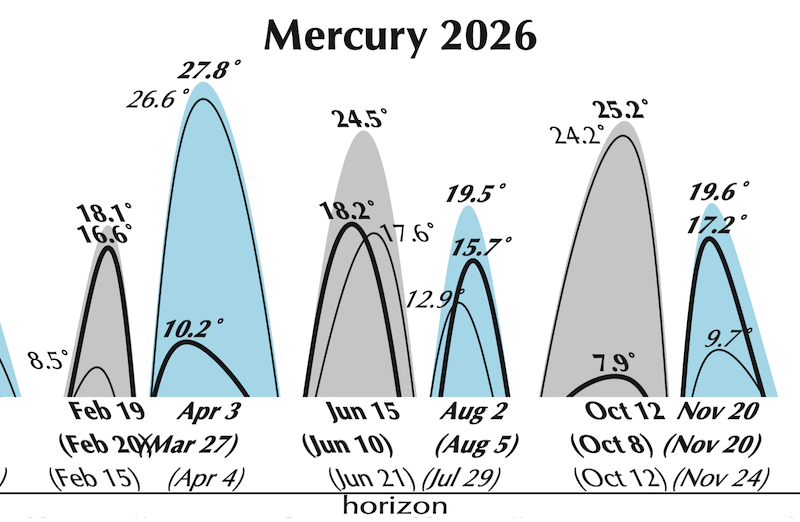
As an illustration, the chart below – from a Northern Hemisphere perspective – might help you visualize these differences.

Chart with row of steep, alternating light blue and gray arcs, each with a date and height in degrees.
Mercury elongations compared. Here, gray areas represent evening apparitions (eastward elongation). Blue areas represent morning apparitions (westward elongation). The top figures are the maximum elongations, reached at the top dates shown beneath. Curves show the altitude of the planet above the horizon at sunrise or sunset, for latitude 40 degrees north (thick line) and 35 degrees south (thin line). Likewise, maxima are reached at the dates in parentheses below (40 degrees north in bold). Chart via Guy Ottewell’s 2026 Astronomical Calendar. Used with permission.

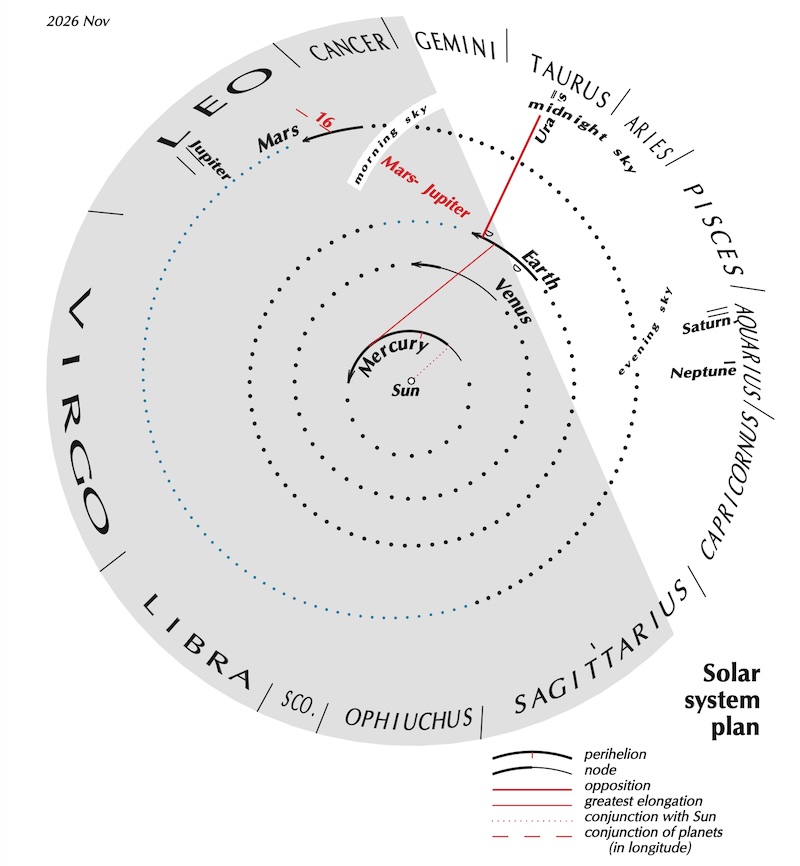
Heliocentric solar system, November 2026

Circle with sun at center, planets around, and zodiac names on outer edge.
Heliocentric view of solar system, November 2026. Chart via Guy Ottewell’s 2026 Astronomical Calendar. Used with permission. Plus Guy Ottewell explains heliocentric charts here.

Seasons make a difference

So, in the autumn for either hemisphere, the ecliptic – or path of the sun, moon and planets – makes a narrow angle to the horizon in the evening. Conversely, it makes a steep slant, nearly perpendicular, in the morning. So – in autumn from either hemisphere – morning elongations of Mercury are best. Then, Mercury appears higher above the horizon and farther from the glow of the sun. Conversely, evening elongations in autumn are harder to see.

On the other hand, in the spring for either hemisphere, the situation reverses. Then, the ecliptic and the horizon meet at a sharper angle on spring evenings and at a narrower angle on spring mornings. So, in springtime for either hemisphere, evening elongations of Mercury are best. Meanwhile, morning elongations in springtime are harder to see.

Diagram of orbits of Earth and Mercury, and lines of sight from Earth to the sun and to Mercury.
Mercury reaches its largest apparent distance from the sun on November 21, 2026. This is called its greatest western elongation. Chart via EarthSky.

Bottom line: Mercury will reach its greatest elongation – greatest distance from the sunrise – on November 21, 2026. Look east at dawn. It’ll disappear from the morning sky in mid-December. Bright Venus will be nearby.

Do you love twilight? The 3 stages explained

Visible planets and night sky guide

The post Look for Mercury this week, farthest from morning sun first appeared on EarthSky.


from EarthSky https://ift.tt/2okPaQY

Heightmaxxing And Erdafitinib: Will The Cancer Drug Make You Taller?

Heightmaxxing And Erdafitinib: Will The Cancer Drug Make You Taller?

A cancer drug linked to rapid growth spurts in children has caught the attention of teenagers looking to gain an extra few inches in height.

Erdafitinib, a medicine designed to treat advanced cancer, has been linked to extraordinary growth spurts in children receiving treatment for brain tumors. Reports of these effects have fueled interest among people seeking to maximize their height – so-called “heightmaxxing”, though it’s unclear how many are actually taking the drug. However, the trend is visible enough online that TikTok has banned some accounts from promoting it.

However, the same treatment that appears to stimulate height can also interfere with normal skeletal development, potentially causing permanent damage.

Erdafitinib is a targeted cancer drug approved for treating certain patients with advanced bladder cancer. It is also used experimentally for certain types of brain tumor in children. It blocks a family of proteins called fibroblast growth factor receptors, or FGFRs.

These receptors act like molecular switches, controlling how cells grow, divide and survive. In some cancers, genetic changes leave these switches permanently on, causing cells to multiply uncontrollably. Erdafitinib interferes with these signals, slowing cancer cell growth.

Unlike conventional chemotherapy, which affects many rapidly dividing cells, targeted therapies are designed to interfere with specific molecular pathways. But these pathways are rarely exclusive to cancer.

FGFRs also work in healthy tissues, including the eyes, skin and, crucially, developing bones. Blocking them can therefore affect much more than the tumor.

The link to height lies in how bones grow. During childhood and adolescence, long bones contain regions of cartilage near their ends called growth plates. Cartilage cells in these plates multiply and enlarge before gradually being replaced by bone. This process lengthens the arms, legs and spine.

One receptor, FGFR3, helps control this process. Surprisingly, it acts as a brake rather than an accelerator on bone growth.

Erdafitinib has been touted on Chinese video site TikTok as enabling - heightmaxxing

Buying cancer drugs online is never a safe option. New Africa/Shutterstock.com

When FGFR3 is overactive, cartilage growth is restricted, as in achondroplasia, the most common cause of disproportionate short stature.

Scientists have therefore investigated whether reducing FGFR3 activity might encourage bone growth. Treatments targeting this pathway are already being studied or used for certain skeletal disorders. Erdafitinib blocks several FGFR proteins, including FGFR3, raising the possibility that it could release the biological brakes on height.

But stimulating bone growth and producing a healthy, proportionate skeleton are not necessarily the same thing.

The excitement stems largely from a couple of cases. Researchers in Vienna described two children with brain tumors who experienced unexpectedly rapid growth while taking the drug. Their growth did not appear to be explained by growth hormone or puberty, which suggests the drug was directly affecting skeletal development.

An even more dramatic case involved a 15-year-old boy treated with erdafitinib for a brain tumor. Over about nine months, he grew 14.3 centimeters – far more than would be expected in that time.

However, the rapid growth came with serious skeletal abnormalities, including spinal deformities that needed corrective surgery.

These reports are scientifically important, but they involve very small numbers of seriously ill children, often receiving other treatments. They cannot tell us whether erdafitinib would safely increase the final height of healthy adolescents, or whether the extra growth would be sustained, proportionate and accompanied by normal bone strength.

Taking erdafitinib to grow taller is dangerous for several reasons. Bones, muscles, ligaments and joints must develop together to maintain strength and alignment. Accelerating one part without the others could result in deformities, abnormal spinal curvature or poor bone mineralization.

The drug also has significant side-effects unrelated to height, including a rise in phosphate levels in the blood. Phosphate is essential for healthy bones, but excessive levels can contribute to abnormal mineral deposits in tissues. Erdafitinib can also cause serious eye problems, which may threaten vision.

In cancer medicine, such risks may be justified when a drug offers the chance of controlling a life-threatening disease. For an otherwise healthy teenager hoping to be slightly taller, the balance between benefit and harm is entirely different.

Social media discussions also tend to overlook a basic biological limit. Once puberty is complete, the growth plates normally fuse, and the long bones can no longer lengthen. There is no credible evidence that erdafitinib can make a fully grown adult taller, whatever the dose.

The high price of heightmaxxing

The popularity of heightmaxxing and other forms of maxxing reflects a broader cultural obsession with appearance, particularly among young men.

Social media increasingly presents height, muscularity and facial features as things that can, and perhaps should, be optimised. In online communities where a few extra centimetres are portrayed as the difference between romantic success and failure, the temptation to experiment with unproven treatments can be powerful.

The effects of erdafitinib on bone growth may eventually contribute to medical advances. Understanding how FGFR signaling controls skeletal development could help researchers develop treatments for children with specific growth disorders. But turning an unexpected side-effect into a safe treatment requires rigorous clinical trials, careful dosing and long-term monitoring.

For now, the lesson from erdafitinib is clear: a medicine that can make bones grow faster does not necessarily make them grow better. For anyone risking their eyesight, skeletal health and potentially permanent disability in pursuit of an extra inch or two, heightmaxxing could come at an extraordinarily high price.

Featured image credit Leona Octavii/Shutterstock. Article by Justin Stebbing, Professor of Biomedical Sciences, Anglia Ruskin University. This article is republished from The Conversation under a Creative Commons license. Read the original article.

The Conversation

sb admin
Categories


from ScienceBlogs - Where the world discusses science https://ift.tt/8BmS2vh

Earth’s spin is constant. Why don’t we feel it?

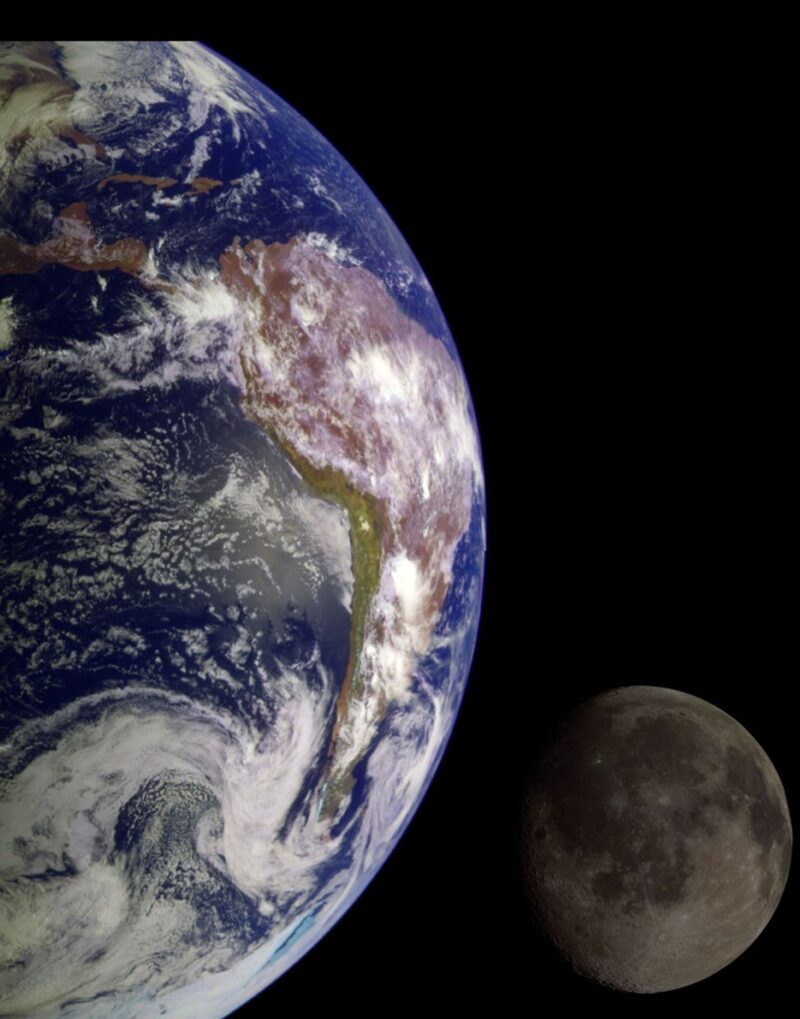
Earth and its moon, as seen in 1992 by the the Galileo spacecraft. Galileo was on its way to Jupiter. Separate images of the Earth and moon were combined to generate this view. Want to see the original? It’s here. Image via NASA.

Love watching the night sky? You’ll love EarthSky’s lunar calendar. Order yours now!

Earth’s spin is constant. Why don’t we feel it?

Earth spins on its axis once in every 24-hour day. At Earth’s equator, the speed of Earth’s spin is about 1,000 miles per hour (1,600 km per hour). This day-night spin has carried you around under the sun and stars every day of your life.

And yet you don’t feel Earth spinning. Why not? It’s because you and everything else — including Earth’s oceans and atmosphere — are spinning along with the Earth at the same constant speed.

If Earth’s spin were suddenly to speed up or slow down, you would definitely feel it. It would be like riding along in a fast car, and having someone suddenly accelerate or slam on the brakes!

Think about riding in a car or flying in a plane. If the ride is going smoothly, you can almost convince yourself you’re not moving. A jumbo jet flies at about 500 miles per hour (about 800 kph), or about half as fast as the Earth spins at its equator. But, while you’re riding on that jet, if you close your eyes, you don’t feel like you’re moving at all.

And when the flight attendant comes by and pours coffee into your cup, the coffee doesn’t fly to the back of the plane. That’s because the coffee, the cup and you are all moving at the same rate as the plane.

Now think about what would happen if the car or plane wasn’t moving at a constant rate. But instead, it is speeding up and slowing down. Then, when the flight attendant poured your coffee … look out!

Discovering Earth’s spin on its axis

The constant spin of the Earth confused our ancestors about the true nature of the cosmos. They noticed that the stars, sun and moon all appeared to move above the Earth. But they couldn’t feel the Earth move. They believed Earth was stationary and “the heavens” moved above us.

With the notable exception of the early Greek scientist Aristarchus of Samos, the world’s great thinkers upheld the geocentric (Earth-centered) idea of the cosmos for many centuries. Meanwhile, Aristarchus first proposed a heliocentric (sun-centered) model of the universe hundreds of years BCE.

It wasn’t until the 16th century that the sun-centered model of Copernicus began to be discussed and understood. While not without errors, Copernicus’ model eventually convinced the world that Earth spun on its axis beneath the stars and moved in orbit around the sun.

You can take a photo of Earth’s spin. A long-exposure photo of the northern sky — made by leaving a camera’s shutter open for an extended period — reveals the apparent motion of all the stars around Polaris, the North Star. And this apparent motion is due to Earth’s spin. An example of “star trails” made in this way is below.

Arcs of light circling around one spot.
View at EarthSky Community Photos. | Jeff Grubbs in Elgin, Arizona, captured these star trails on May 22, 2025. Thanks, Jeff! You can see hundreds of stars circling around the star Polaris. Learn how to create photos of star trails with long exposures.

Bottom line: We don’t feel Earth spin on its axis because Earth’s spin is steady — and moves at a constant rate in orbit around the sun — carrying us as passengers right along with it.

Creepy sound of Earth’s magnetic field flip: Listen here!

Read more: Our solar system is moving 3 times faster than expected

The post Earth’s spin is constant. Why don’t we feel it? first appeared on EarthSky.


from EarthSky https://ift.tt/aG6teMk

Glorious Starship capture! SpaceX makes spaceflight history (again)

Starship captures thrills space fans

Say what you will about Elon Musk. His company, SpaceX, continues to blow the minds of new and old spaceflight fans with this weekend’s starship capture in midair.

SpaceX successfully caught the returning upper stage of its Starship rocket on Saturday, November 14, 2026. It used the giant mechanical tower arms — almost universally called “chopsticks” by SpaceX and spaceflight fans. The “chopsticks” — nicknamed “Mechazilla — grabbed Starship out of the air at its Starbase facility in South Texas.

The maneuver capped off Integrated Flight Test 15 (IFT-15). It marked the first time an orbital upper-stage spacecraft has returned from space to be plucked out of the air at its launch site.

The feat occurred at roughly 3:20 p.m. CST on Saturday. The vehicle—designated Ship 42—descended through overcast skies over Boca Chica. It fired its engines to hover before settling between Mechazilla’s giant, waiting arms at Launch Pad 2.

A massive leap forward

About 22 hours prior to Saturday’s amazing Starship capture, Ship 42 lifted off from Starbase on Friday evening, November 13. The spacecraft completed 14 orbits at an altitude of roughly 265 kilometers (165 miles). Then it re-entered, putting its upgraded thermal protection tiles to the test against extreme reentry heat.

The mission fell just short of a complete success. SpaceX had hoped to catch both rocket stages during Flight 15. It has already mastered catching the Super Heavy first-stage booster on earlier test flights. But an unspecified anomaly shortly after Friday’s launch forced flight controllers to abort the booster’s return,. They diverted the booster it over the Gulf of Mexico, where it exploded prior to splashdown.

Despite the lost booster, recovering the upper stage represents a massive leap forward. Because an orbital ship travels significantly higher and faster than a booster, surviving reentry and hitting a pinpoint landing target is vastly more complex.

‘Almost magic’

Ditching heavy landing legs in favor of tower catches is central to SpaceX’s goal of rapid reusability—a capability essential for driving down launch costs and supporting NASA’s Artemis lunar program. NASA Administrator Jared Isaacman hailed the catch as:

… Almost magic.

Spaceflight fans agree.

Bottom line: SpaceX achieved another major milestone on November 14, 2026, with its Starship capture. The catching mechanism — nicknamed “Mechazilla — grabbed Starship out of the air at SpaceX’s Starbase facility in South Texas.

The post Glorious Starship capture! SpaceX makes spaceflight history (again) first appeared on EarthSky.


from EarthSky https://ift.tt/Pt0aF9f

adds 2