aads

The constellation Andromeda the Chained Lady

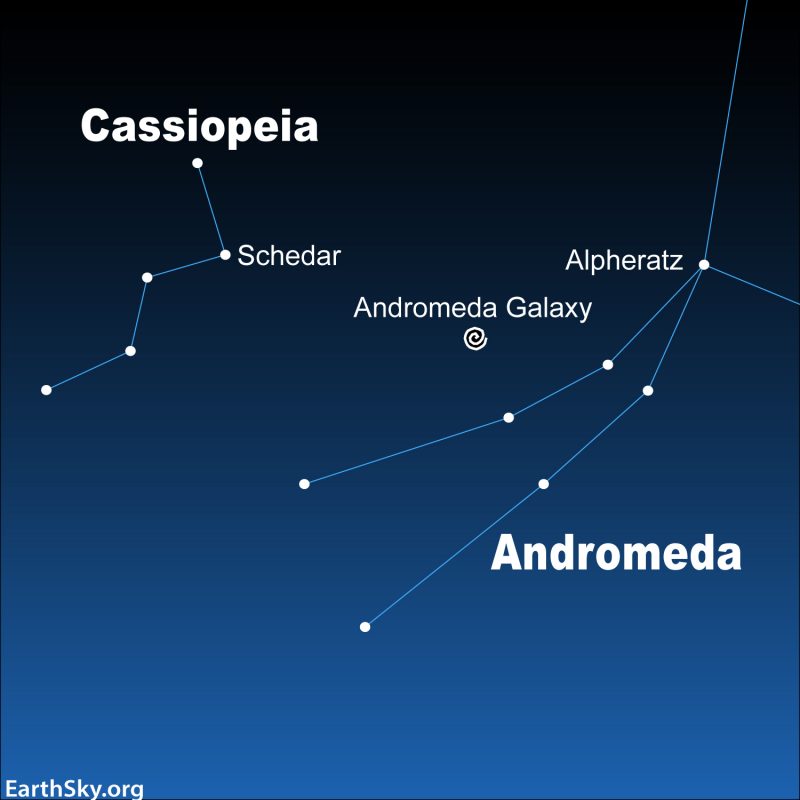
Star chart: constellations Andromeda at bottom right and Cassiopeia upper left with labels and galaxy between them.
The W-shaped constellation Cassiopeia points to the stars of the constellation Andromeda and the Andromeda Galaxy (M31). Chart via EarthSky.

The constellation Andromeda is named for the daughter of Queen Cassiopeia and King Cepheus of Greek mythology. Andromeda has the nickname of the Chained Lady because her parents chained her up and offered her as a sacrifice to appease the sea monster Cetus. In the story, she is saved by Perseus and eventually becomes his queen. All these mythological characters are now visible as constellations in the night sky.
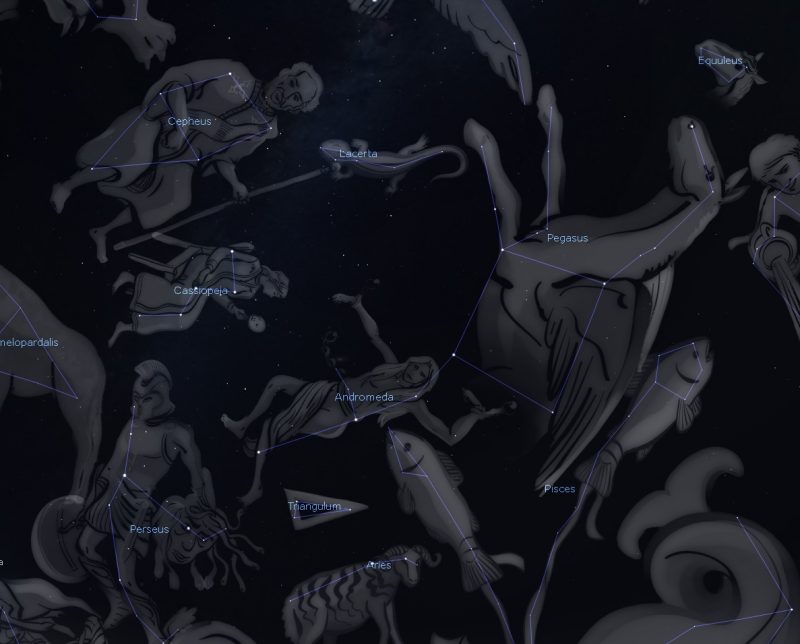
Star map with labeled drawings of people and animals, including Andromeda, with scattered stars.
View larger. | Andromeda the Chained Lady lies near her parents, Queen Cassiopeia and King Cepheus. She also contributes one star to the Great Square of Pegasus. Image via Stellarium. Used with permission.

How to find the constellation Andromeda

Andromeda is easy to find because of the company it keeps. The W-shaped constellation Cassiopeia points toward Andromeda. Andromeda is also next to the Great Square of Pegasus. In fact, one of the stars of the Great Square actually belongs to Andromeda.

November and December are excellent months to try to spot Andromeda the Chained Lady. Look east after it gets dark to find the constellation already high above the horizon. Plus, Andromeda favors viewers in the Northern Hemisphere; it is not visible to those south of 40 degrees south latitude. The constellation is the 19th largest, in size, of the 88 constellations. The finder chart above can guide you to it.

Stars of the constellation Andromeda

The brightest star in the Great Square of Pegasus actually belongs to Andromeda: the magnitude 2.06 star Alpheratz. Alpheratz lies 97 light-years away. In addition, another magnitude 2.06 star, Mirach, lies to the upper left of Alpheratz. Mirach lies 197 light-years away and is the closest bright star to the Andromeda Galaxy. The third brightest star in Andromeda is magnitude 2.26 Almach, to the upper left of Mirach. Almach lies 355 light-years away.
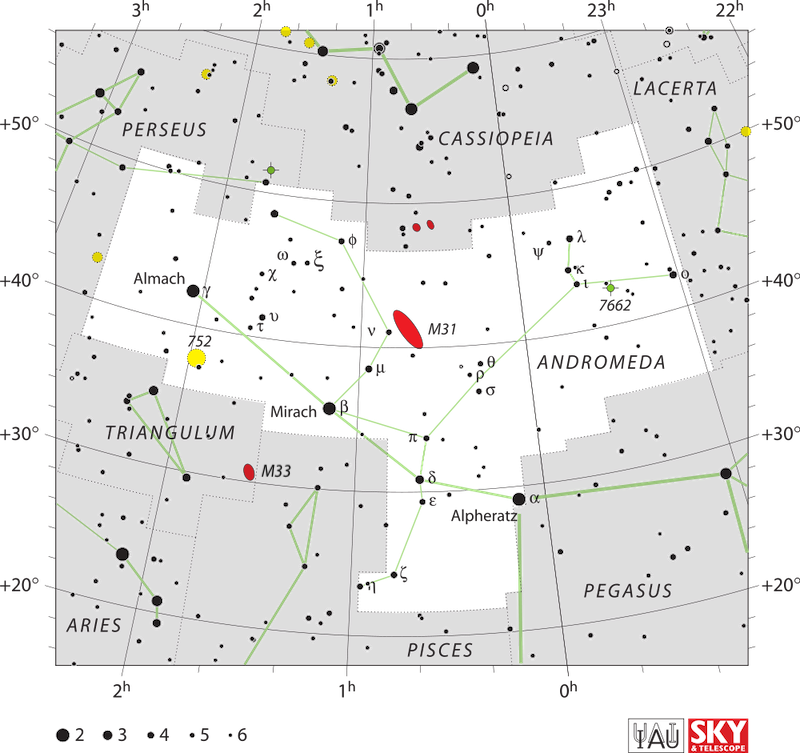
Star chart of Andomeda with stars in black on white and red ovals for galaxies.
A star map of the constellation Andromeda showing the locations of the Andromeda Galaxy (M31) and the Triangulum galaxy (M33). Image via IAU/ Sky & Telescope/ Wikimedia Commons.
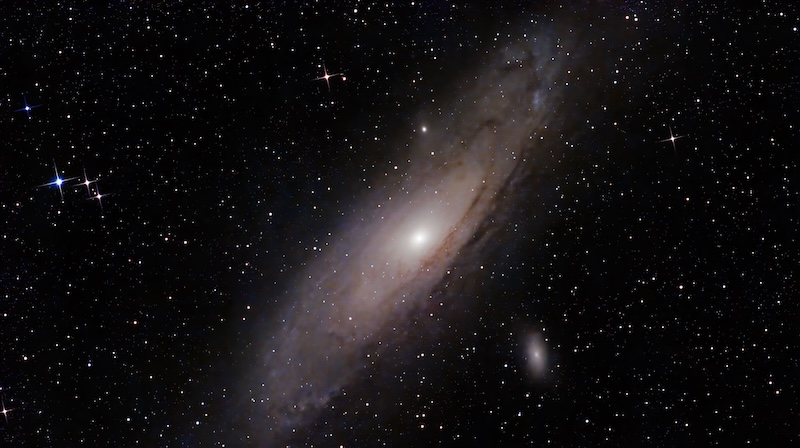
Glowing swirl with very bright center in a starry sky.
View at EarthSky Community Photos. | Vikash Singh captured this image on July 15, 2026, from India. Vikash wrote: “This is the Andromeda Galaxy (M31), captured using the Dwarf 3 smart telescope. The completely clear night sky and low light pollution of Ladakh made it possible to capture incredible details of our neighboring galaxy.” Thank you, Vikash!

Finding the Andromeda Galaxy with Cassiopeia

Although M31, the Andromeda Galaxy, is centrally located in the constellation Andromeda, it’s also easy to find by using the stars of Cassiopeia. The magnitude 3.5 galaxy can be seen as a hazy patch in a dark sky, but most people will need binoculars or a telescope to find the wide misty patch.

Andromeda stretches about 3 degrees across and 1 degree wide. That’s twice as wide as the full moon. It lies at a distance of approximately 2.5 million light-years from Earth, which means that as we view the light from Andromeda, we are seeing it as it was 2.5 million years ago.

To find the Andromeda Galaxy, look for the W shape of Cassiopeia. With the two V shapes that make up the W, use the V shape on the right. Imagine the V as an arrow, pointing into the constellation Andromeda. From the tip of the arrow star to the spiral galaxy, the angular distance is a little over 15 degrees. (Hold your hand at arm’s length and use your index finger and pinky spread apart to measure 15 degrees on the sky’s dome.) The arrow of Cassiopeia does not point precisely to Andromeda, however. You will have to look a bit to the right to find the galaxy M31.

Star chart with blinking yellow arrow from Cassiopeia to Andromeda galaxy.
Some people use the M- or W-shaped constellation Cassiopeia to find the Andromeda Galaxy. See how the V shape points to the galaxy? Chart via Stellarium. Used with permission.

Finding Andromeda Galaxy from the Great Square of Pegasus

One of the stars that makes up the Great Square of Pegasus — Alpheratz — belongs to the constellation Andromeda. You can use Alpheratz to find the Andromeda Galaxy. Then look left and find three stars leading away from it: a 3rd magnitude star (Delta Andromedae), Mirach and Almach. Focus on Mirach, and then look above Mirach. There are two stars in a line above it, the top one dimmer than the bottom. If you can see the highest star without optical aid, look just to its right for a slightly lighter patch of sky. Put your binoculars or a telescope on it to confirm that you’ve found the Andromeda Galaxy.

Star chart with 2 blinking yellow arrows from Great Square to constellation Andromeda to Andromeda galaxy.
Many observers find the Andromeda Galaxy by star-hopping from the Great Square of Pegasus to the constellation Andromeda and then to the galaxy. Chart via Stellarium. Used with permission.

Observing M31, the Andromeda Galaxy

M31, at magnitude 3.5, should be easy to see once you have it located in your binoculars or telescope. Indeed, the grayish patch should show an oval shape, characteristic of spiral galaxies. In addition, two other Messier objects are within your field of view when you are looking at Andromeda. M32 and M110 are elliptical galaxies that are companions to the large Andromeda Galaxy. They also lie 2.5 million light-years away. M32 is magnitude 8.1 and is closest to the galaxy, appearing to lie on the larger spiral’s edge. M110 is magnitude 8.5 and is a bit farther away from the large spiral.
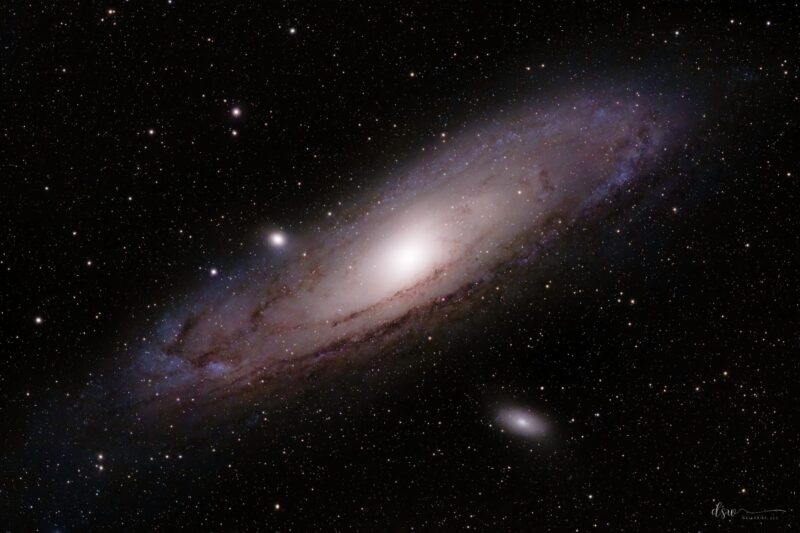
Large, pinkish, oblique glowing spiral object with thousands of foreground stars.
View at EarthSky Community Photos. | Jeremy Likness in Newport, Oregon, captured this telescopic view of the Andromeda Galaxy on September 10, 2026. Jeremy wrote: “The numbers are mind-numbing. 2.5 million light years? One trillion stars? My target: M31, the Andromeda Galaxy. Our nearest galactic neighbor is also enthusiastically approaching us at a rate of 250,000 miles per hour, on track to collide after the estimated billions of years it will take to cross the estimated 250 million light years between our galaxies. And this is the busy neighborhood!” Thank you, Jeremy!

Read more: Are the Andromeda and Milky Way galaxies already merging?

Bottom line: The constellation Andromeda the Chained Lady is most famous for containing the closest large spiral galaxy to the Milky Way.

The post The constellation Andromeda the Chained Lady first appeared on EarthSky.


from EarthSky https://ift.tt/sqgLv2H
Star chart: constellations Andromeda at bottom right and Cassiopeia upper left with labels and galaxy between them.
The W-shaped constellation Cassiopeia points to the stars of the constellation Andromeda and the Andromeda Galaxy (M31). Chart via EarthSky.

The constellation Andromeda is named for the daughter of Queen Cassiopeia and King Cepheus of Greek mythology. Andromeda has the nickname of the Chained Lady because her parents chained her up and offered her as a sacrifice to appease the sea monster Cetus. In the story, she is saved by Perseus and eventually becomes his queen. All these mythological characters are now visible as constellations in the night sky.

Star map with labeled drawings of people and animals, including Andromeda, with scattered stars.
View larger. | Andromeda the Chained Lady lies near her parents, Queen Cassiopeia and King Cepheus. She also contributes one star to the Great Square of Pegasus. Image via Stellarium. Used with permission.

How to find the constellation Andromeda

Andromeda is easy to find because of the company it keeps. The W-shaped constellation Cassiopeia points toward Andromeda. Andromeda is also next to the Great Square of Pegasus. In fact, one of the stars of the Great Square actually belongs to Andromeda.

November and December are excellent months to try to spot Andromeda the Chained Lady. Look east after it gets dark to find the constellation already high above the horizon. Plus, Andromeda favors viewers in the Northern Hemisphere; it is not visible to those south of 40 degrees south latitude. The constellation is the 19th largest, in size, of the 88 constellations. The finder chart above can guide you to it.

Stars of the constellation Andromeda

The brightest star in the Great Square of Pegasus actually belongs to Andromeda: the magnitude 2.06 star Alpheratz. Alpheratz lies 97 light-years away. In addition, another magnitude 2.06 star, Mirach, lies to the upper left of Alpheratz. Mirach lies 197 light-years away and is the closest bright star to the Andromeda Galaxy. The third brightest star in Andromeda is magnitude 2.26 Almach, to the upper left of Mirach. Almach lies 355 light-years away.

Star chart of Andomeda with stars in black on white and red ovals for galaxies.
A star map of the constellation Andromeda showing the locations of the Andromeda Galaxy (M31) and the Triangulum galaxy (M33). Image via IAU/ Sky & Telescope/ Wikimedia Commons.
Glowing swirl with very bright center in a starry sky.
View at EarthSky Community Photos. | Vikash Singh captured this image on July 15, 2026, from India. Vikash wrote: “This is the Andromeda Galaxy (M31), captured using the Dwarf 3 smart telescope. The completely clear night sky and low light pollution of Ladakh made it possible to capture incredible details of our neighboring galaxy.” Thank you, Vikash!

Finding the Andromeda Galaxy with Cassiopeia

Although M31, the Andromeda Galaxy, is centrally located in the constellation Andromeda, it’s also easy to find by using the stars of Cassiopeia. The magnitude 3.5 galaxy can be seen as a hazy patch in a dark sky, but most people will need binoculars or a telescope to find the wide misty patch.

Andromeda stretches about 3 degrees across and 1 degree wide. That’s twice as wide as the full moon. It lies at a distance of approximately 2.5 million light-years from Earth, which means that as we view the light from Andromeda, we are seeing it as it was 2.5 million years ago.

To find the Andromeda Galaxy, look for the W shape of Cassiopeia. With the two V shapes that make up the W, use the V shape on the right. Imagine the V as an arrow, pointing into the constellation Andromeda. From the tip of the arrow star to the spiral galaxy, the angular distance is a little over 15 degrees. (Hold your hand at arm’s length and use your index finger and pinky spread apart to measure 15 degrees on the sky’s dome.) The arrow of Cassiopeia does not point precisely to Andromeda, however. You will have to look a bit to the right to find the galaxy M31.

Star chart with blinking yellow arrow from Cassiopeia to Andromeda galaxy.
Some people use the M- or W-shaped constellation Cassiopeia to find the Andromeda Galaxy. See how the V shape points to the galaxy? Chart via Stellarium. Used with permission.

Finding Andromeda Galaxy from the Great Square of Pegasus

One of the stars that makes up the Great Square of Pegasus — Alpheratz — belongs to the constellation Andromeda. You can use Alpheratz to find the Andromeda Galaxy. Then look left and find three stars leading away from it: a 3rd magnitude star (Delta Andromedae), Mirach and Almach. Focus on Mirach, and then look above Mirach. There are two stars in a line above it, the top one dimmer than the bottom. If you can see the highest star without optical aid, look just to its right for a slightly lighter patch of sky. Put your binoculars or a telescope on it to confirm that you’ve found the Andromeda Galaxy.

Star chart with 2 blinking yellow arrows from Great Square to constellation Andromeda to Andromeda galaxy.
Many observers find the Andromeda Galaxy by star-hopping from the Great Square of Pegasus to the constellation Andromeda and then to the galaxy. Chart via Stellarium. Used with permission.

Observing M31, the Andromeda Galaxy

M31, at magnitude 3.5, should be easy to see once you have it located in your binoculars or telescope. Indeed, the grayish patch should show an oval shape, characteristic of spiral galaxies. In addition, two other Messier objects are within your field of view when you are looking at Andromeda. M32 and M110 are elliptical galaxies that are companions to the large Andromeda Galaxy. They also lie 2.5 million light-years away. M32 is magnitude 8.1 and is closest to the galaxy, appearing to lie on the larger spiral’s edge. M110 is magnitude 8.5 and is a bit farther away from the large spiral.

Large, pinkish, oblique glowing spiral object with thousands of foreground stars.
View at EarthSky Community Photos. | Jeremy Likness in Newport, Oregon, captured this telescopic view of the Andromeda Galaxy on September 10, 2026. Jeremy wrote: “The numbers are mind-numbing. 2.5 million light years? One trillion stars? My target: M31, the Andromeda Galaxy. Our nearest galactic neighbor is also enthusiastically approaching us at a rate of 250,000 miles per hour, on track to collide after the estimated billions of years it will take to cross the estimated 250 million light years between our galaxies. And this is the busy neighborhood!” Thank you, Jeremy!

Read more: Are the Andromeda and Milky Way galaxies already merging?

Bottom line: The constellation Andromeda the Chained Lady is most famous for containing the closest large spiral galaxy to the Milky Way.

The post The constellation Andromeda the Chained Lady first appeared on EarthSky.


from EarthSky https://ift.tt/sqgLv2H
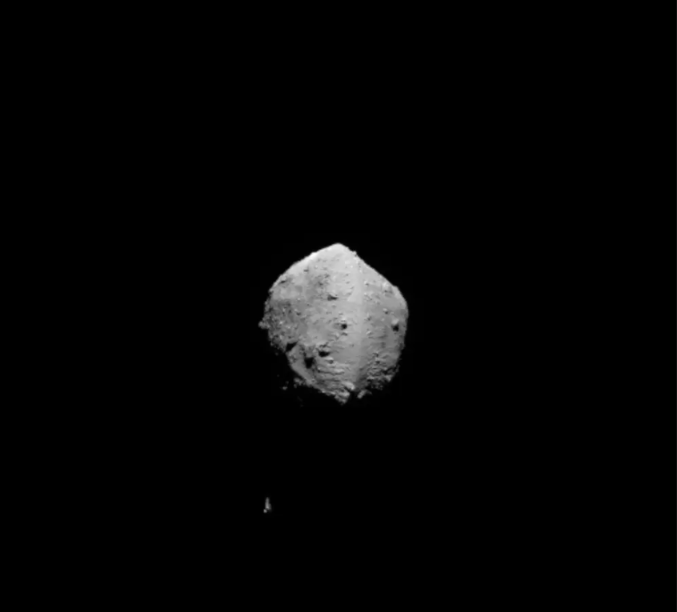
Hera mission gets its 1st closeup view of Didymos and Dimorphos

A roughly spherical rocky body with some lumps and a glimpse of a smaller object below and mostly in shadow.
This is Hera’s 1st closeup view of Didymos. The ESA space mission is on its way to investigate what happened when the DART mission impacted Didymos’s little moonlet, Dimorphos. A glimpse of Dimorphos is visible here, hiding in Didymos’s shadow. Image via ESA.

Hera’s 1st closeup view of Didymos and Dimorphos

On November 5, 2026, ESA said that its Hera mission has caught its first glimpse of its target, the binary asteroid system of Didymos and Dimorphos. Dimorphos, a little moonlet of asteroid Didymos, was struck by NASA’s DART mission back in 2022, in the name of planetary defense. Hera was about 37 miles (60 km) away from Didymos when it took this image. Little Dimorphos also shows a glimpse of itself, hiding in the larger asteroid’s shadow.

Hera principal investigator Patrick Michel said:

The first thing we said was wow! This is the other side of Didymos from the one that DART’s camera showed us shortly before impact, so this feels like looking at a whole new world. This side of Didymos has the same central ridge along its equator that we saw before, but otherwise appears very different, with multiple boulders and craters and what look like patterns of grooves or ridges.

ESA’s Hera mission scientist Michael Kueppers added:

Since we expect a lot of impact-ejected material to have made it across the approximately 1 km of space from Dimorphos to Didymos, it may be that some of these characteristics originate from this transport of material, and we have an exciting work ahead of us to sort it out. We look forward to seeing much more of both bodies and systemically mapping all the changes we identify.

ESA said that detailed images of both asteroids will be unveiled on November 25.

The Hera mission hits the brakes

The European Space Agency’s Hera mission has hit the brakes! The spacecraft is headed for the site of a human-made impact on the asteroid Dimorphos, created in 2022 by NASA’s DART spacecraft as a test of our ability to move an asteroid in its orbit. But — before Hera can properly reach Dimorphos — first it had to slow down.

That’s why the spacecraft will fire its thrusters on October 15, 2026. And, ESA said, the maneuver was a tricky one:

Hera will rotate around so that its ring of Orbit Control Thrusters face toward the Didymos system. Three of these hydrazine-based thrusters will be ignited at once, burning continuously for a total of 93 minutes, to reduce Hera’s velocity relative to the asteroids by a few hundred meters per second.

We’re happy to report that all went well. Now, Hera is closing in on Dimorphos to begin its investigations!

A spacecraft with 2 large panels and a circular light moves toward the viewer.
The Hera mission to asteroid Dimorphos — the asteroid struck by another earthly spacecraft (DART) in 2022, in the name of planetary defense — performed a braking maneuver on October 15. Why is Hera going to Dimorphos?  Read more below. Image via ESA Science Office.

Hera is ready for its asteroid rendezvous

In 2022, the groundbreaking DART mission struck and moved an asteroid. It was a test of Earth’s ability to defend itself from an incoming asteroid threat. Two years ago, on October 7, 2024, a follow-up mission — ESA’s Hera — launched toward the asteroid impact site on Dimorphos, a little moon of the asteroid Didymos. Now, Hera is ready for its November 2026 meeting with the asteroid pair. After it arrives, it will spend six months investigating the aftereffects from the impact.

So far in 2026, the Hera mission has undergone a deep-space maneuver to correct its course toward its target. And in July 2026, it finished receiving an upgrade to its software. The braking maneuver on October 15 worked to get the spacecraft to its target.

When Hera reaches the asteroids, it will release two cubesats, Milani and Junventas. Milani is in charge of spectral surface observations (splitting light bounced off the asteroid into a rainbow array of colors, then analyzing that light). And Juventas will take the first radar soundings in the heart of an asteroid.

Hera mission: Yellow boxy spacecraft passing in front of deep, shadowed crater on irregular gray space rock.
In this artist’s concept, the Hera mission scans the impact crater that DART left behind. Image via ESA.

When DART hit Didymos

Back in 2022, when DART hit Didymos’ little moon Dimorphos, it made a big splash. We know for sure it pushed the asteroid slightly out of its previous orbit. And the debris kicked up in the collision might even have created a new meteor shower for Earth!

Hera is going to learn more about just what happened when DART struck the little asteroid, creating a crater on its surface and moving it slightly in orbit. It’s going to learn more about Dimorphos itself, to help refine our knowledge of what DART did … to keep us safe from future asteroid collisions.

This will be the first investigation of a binary asteroid. Hera’s focus will be on Dimorphos, the moonlet that DART impacted. According to ESA — the mission planner — Hera will conduct a “crime scene investigation” at the little asteroid moon. But Hera will also check out both Didymos and the dusty environs unleashed by the impact.

Here are 3 mysteries that Hera will help solve

ESA shared three mysteries that Hera will help solve:

  1. Hera will measure the density and composition of Dimorphos in detail and help scientists determine whether it is a “rubble pile” loosely held together by gravity, or a solid core covered in boulders and gravel.
  2. Hera will map the crater created by DART’s impact down to 4-inch (10-cm) resolution to help scientists better understand how the surface material responded to the collision. It’s possible that there is no crater at all, but rather the impact reshaped the entire asteroid!
  3. About 15% of known asteroids are actually binary systems, but their origins remain mysterious. Hera will determine whether Dimorphos and Didymos are made from the same material, which would hint that the rapidly spinning Didymos once threw off debris into space that later formed Dimorphos.

Hera project scientist Michael Küppers

Watch EarthSky’s Deborah Byrd speak with Hera project scientist Michael Küppers below. Get the latest here about keeping Earth safe from asteroids.

The Hera mission and a missing planet

Watch a video about the Hera mission to the asteroids Didymos and Dimorphos.

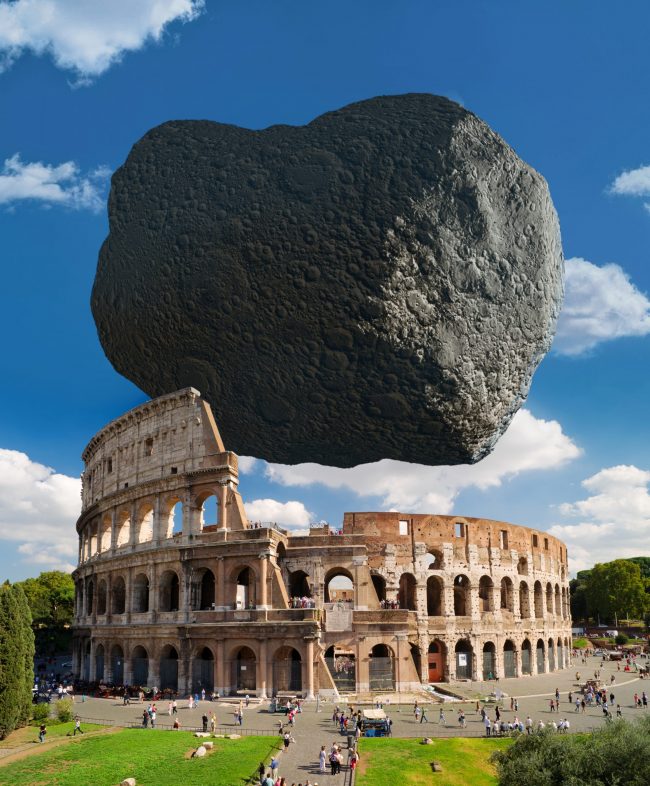
The Hera mission vs the Colosseum

The asteroid Didymos is about a half mile (800 meters) wide. So, that’s about the size of the Golden Gate Bridge. Its little companion, Dimorphos, is about 560 feet (170 meters) in diameter. And that’s about the size of the Great Pyramid. Or compare it to Italy’s Colosseum below.

Huge, irregular rock hovering over Roman Colosseum, a large, ruined stone stadium.
This graphic compares the size of the asteroid moonlet Dimorphos to the Colosseum in Rome, Italy. Image via ESA.

Bottom line: The Hera mission just got its 1st closeup view of the asteroid Didymos and its little moonlet Dimorphos. Soon it will begin investigating the aftermath of the DART impact.

Via ESA

Read more: Boulders from asteroid Dimorphos, after spacecraft impact

Read more: Remember when DART struck an asteroid? New surprises!

The post Hera mission gets its 1st closeup view of Didymos and Dimorphos first appeared on EarthSky.


from EarthSky https://ift.tt/2VT3REo

The moon and Jupiter play hide-and-seek. More pics here!

3 views of striped Jupiter disappearing behind the gray-white limb of the moon.
View at EarthSky Community Photos. | Michael Teoh in Ipoh, Perak, Malaysia, captured this view of Jupiter disappearing behind the moon on the morning of November 3, 2026. Thank you, Michael! Read more about these images of the moon and Jupiter below.

The moon and Jupiter play hide-and-seek

On the morning of November 3, 2026, observers in parts of Asia, Australia and New Zealand saw the moon and Jupiter appear so close in the sky that the moon briefly blocked Jupiter from view. Astronomers call this a lunar occultation. And it’ll happen again at the end of the month!

In November, Jupiter is rising very late at night and staying visible until sunrise. The king of the planets is currently close to the red planet, Mars, and the brightest star in Leo the Lion, Regulus. Throughout November, Jupiter and Mars will appear closer and closer on the sky’s dome until they reach their closest on November 15. On that date, they’ll be a little more than two moon-widths apart.

Plus, these planets will be right in front of the radiant point of the Leonid meteor shower! That’s the point which all Leonid meteors appear to shoot from. This shower will reach its peak on November 17-18, not long after Jupiter and Mars reach their closest.

After the Jupiter-Mars conjunction, don’t stop watching! Because even as these worlds slowly pull apart again, Mars will first cross the distance between Jupiter and Regulus to form a tight triplet in the sky, and then the moon will return to the scene.

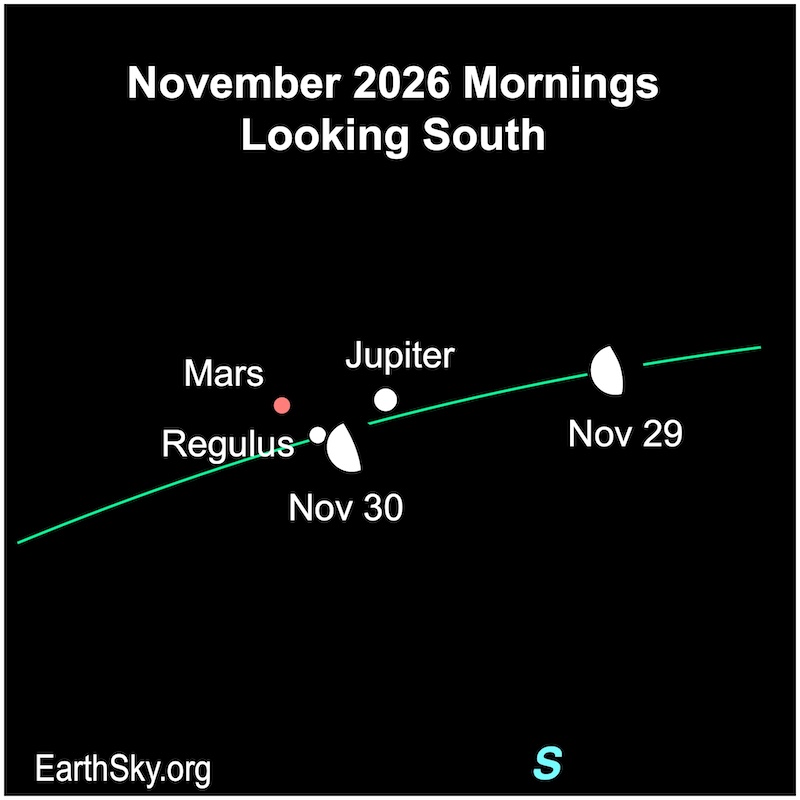
On November 29 and 30, look for the moon close to Jupiter, with Mars and Regulus below. Lucky observers in southern parts of the globe, including southern Argentina and Chile, will see the moon pass in front of Jupiter on November 30.

Chart showing a fat hemisphere, the moon, on two successive morning. On the first, it is right of a large dot, Jupiter, which is right of two dots, Mars, and the star Regulus. On the second morning, the hemisphere is below a large dot, Jupiter, and next to two dots, Mars, and the star Regulus.
The moon will be high in the east before dawn on the last 2 mornings of November. Jupiter, Mars and the bright star Regulus will be nearby. On November 30, some observers will see the moon pass in front of Jupiter. Chart via EarthSky.

Jupiter disappearing and reappearing

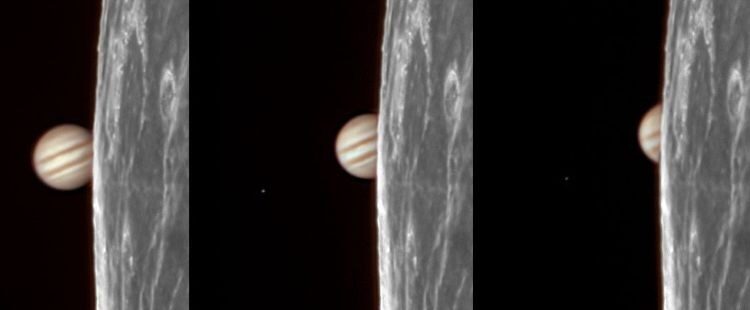
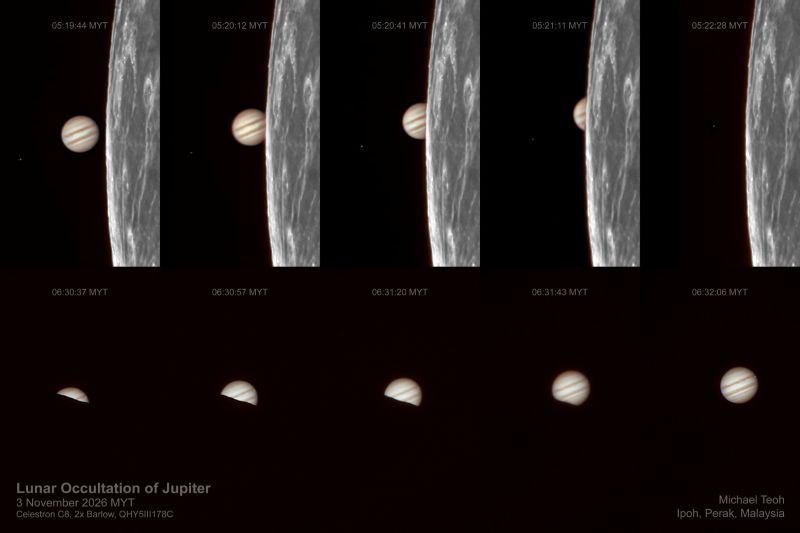
Michael Teoh in Malaysia captured the first lunar occultation of Jupiter in early November. He also managed to captured two of Jupiter’s moons!

Top panels show striped planet disappearing behind moon's limb; bottom shows it reemerging from dark side.
View larger at EarthSky Community Photos. | Michael Teoh in Ipoh, Perak, Malaysia, captured this view of Jupiter disappearing and then reappearing from behind the moon on the morning of November 3, 2026. Michael wrote: “During this lunar occultation of Jupiter, 2 Galilean moons were visible. At the ingress phase (top row), Io trails to the west of Jupiter, while Europa transits across the surface of Jupiter. But at this point, Europa wasn’t visible due to the limitation of the resolution, poor seeing conditions and low contrast against the Jovian disk. At the egress phase (bottom row), the trailing Io was still blocked by the moon, while Europa appears exiting the eastern limb of Jupiter, thanks to the much improved seeing condition and better contrast against the darker Jovian limb.” Click here to see a larger version. Thank you, Michael!

More EarthSky Community Photos

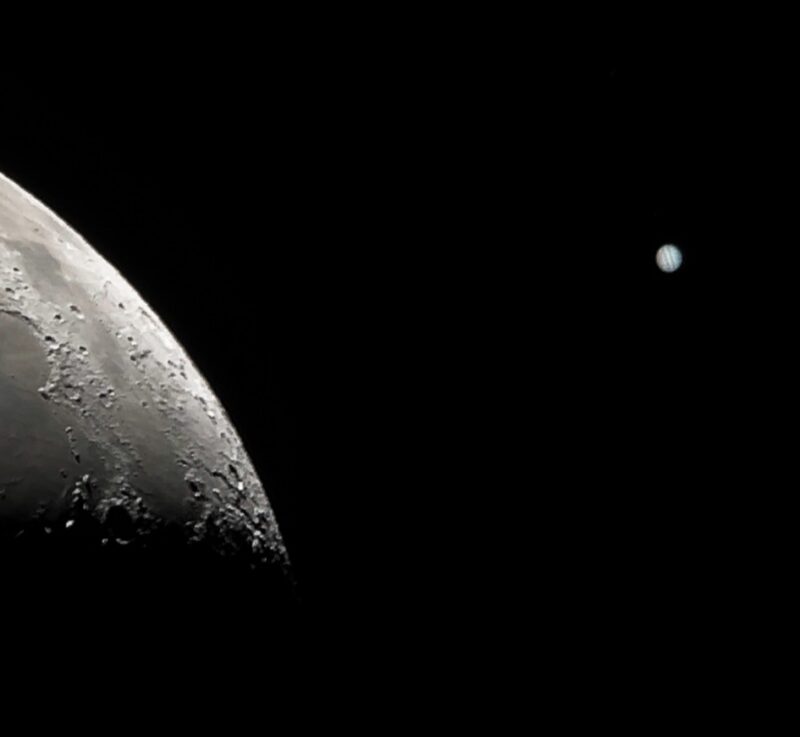
On the left is the cratered moon; on the right is distant Jupiter with faint horizontal stripes.
View at EarthSky Community Photos. | Atharva Maurya captured this stunning close-up from Bhadohi, India. Thank you, Atharva!
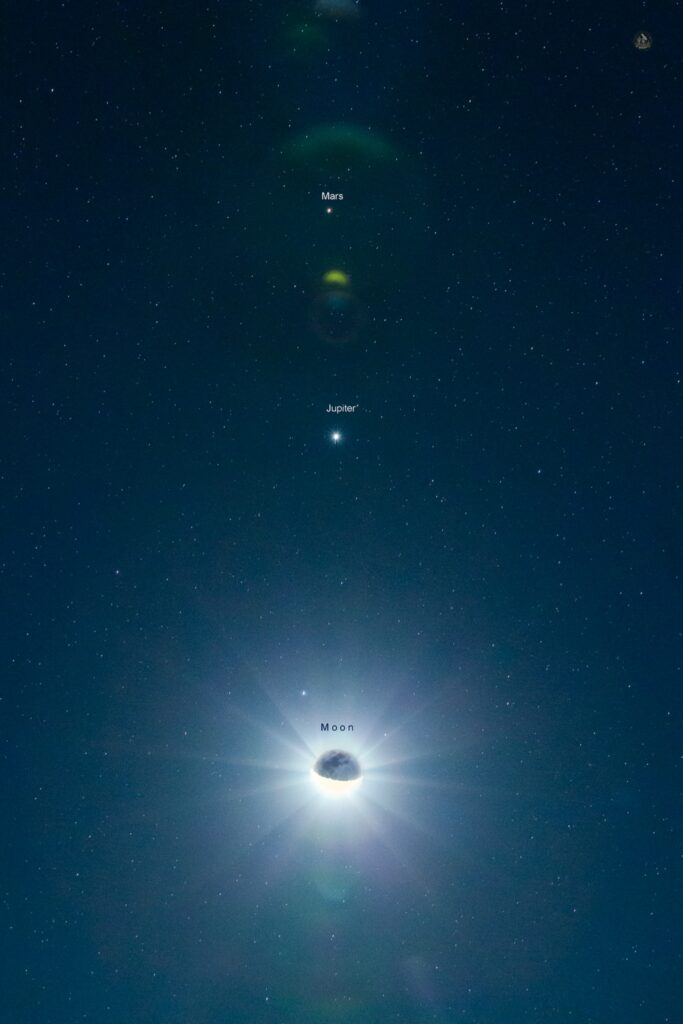
A bright, vertically aligned stack shows the glowing moon, Jupiter and Mars in a starry sky.
View at EarthSky Community Photos. | Jelieta Walinski in the Desert Bloom Observatory, Arizona, captured the moon, Jupiter and Mars. She wrote: “Sometimes, astrophotography teaches us that capturing the universe is not always about magnification. Sometimes, we must widen our perspective to appreciate the bigger picture.” Thank you, Jelieta!
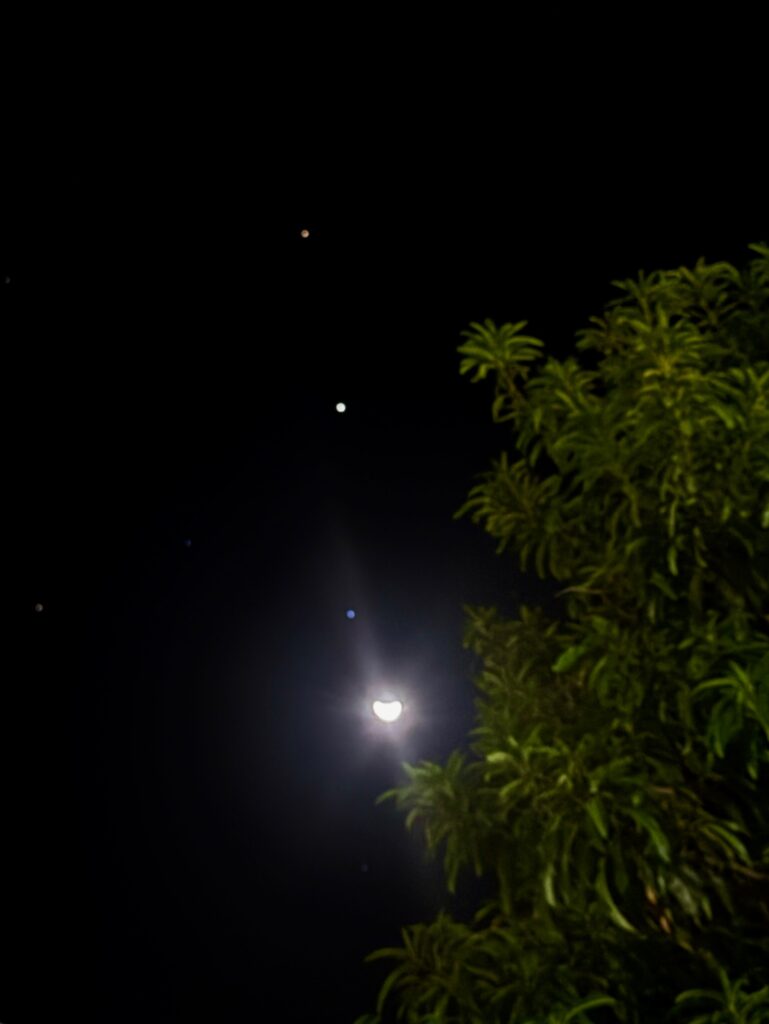
Green tree branches frame the glowing white moon, blue Regulus, bright Jupiter and reddish Mars.
View at EarthSky Community Photos. | Look at those colors! Gail Gunstone in Loreto, Mexico, wrote: “Mars, Jupiter, Regulus and the moon by my mango tree.” What a delicious photo. Thank you, Gail!

Bottom line: The moon and Jupiter played hide-and-seek on November 3, 2026. And they’ll pair up again at the end of the month! Plus, don’t miss the Jupiter-Mars conjunction mid-month.

 For more sky events, visit EarthSky’s night sky guide.

You deserve a daily dose of good news. For the latest in science and the night sky, subscribe to EarthSky’s free daily newsletter.

The post The moon and Jupiter play hide-and-seek. More pics here! first appeared on EarthSky.


from EarthSky https://ift.tt/dXLFYtj

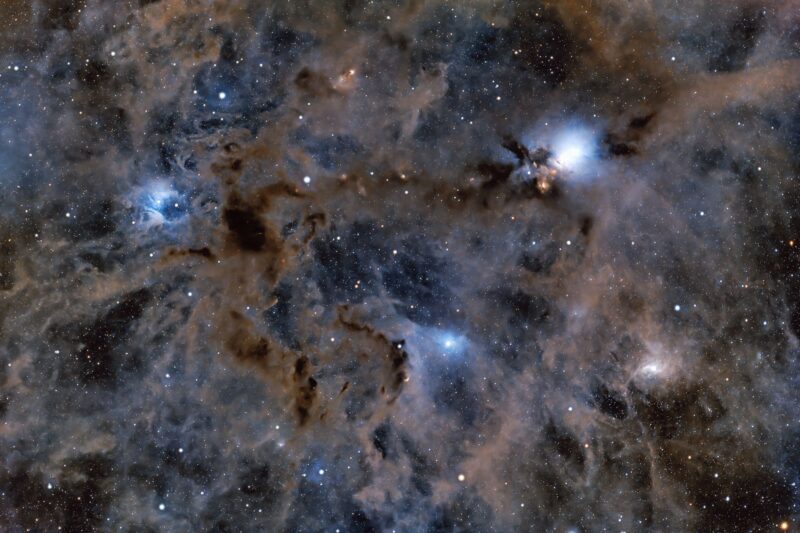
Dark nebulae are star-obscuring clouds of gas and dust

A complex structure of blue and brown gas overlaid with dark nebulae, with numerous background stars.
View at EarthSky Community Photos. | Steven Bellavia in Smithfield, Virginia, captured this telescopic view of dark nebulae at the intersection of the constellations Perseus the Hero, Taurus the Bull and Aries the Ram on December 16, 2025. Thank you, Steven!

What are dark nebulae?

Plunge into the darker side of the night sky and get to know dark nebulae. Dark nebulae — or absorption nebulae — are clouds of gas and dust in space dense enough to block light from background stars.

These vast clouds are mostly composed of molecular hydrogen. And often, they are locations where material is coalescing to form new stars.

American astronomer Edward Emerson Barnard was the first to create a large catalog of 182 dark nebulae in the year 1919. And since then, hundreds more have been found and charted in our Milky Way galaxy.

Below are some of the best-known dark nebulae, favorites of observers and astrophotographers.

Science news, night sky events and beautiful photos, all in one place. Click here to subscribe to our free daily newsletter.

Dark nebulae make up the Great Rift

The Great Rift, or Dark Rift, is a structure stargazers can see with the eye alone from a dark-sky site. In northern summer, you can see the starry band of the Milky Way — the edgewise view into our own galaxy — stretched across the night sky. And if you look closely, that starry band appears to be split into two lengthwise by darkened lanes of obscuring dust. This is the Great Rift.

The Milky Way with starry clouds and bright patches along with dark lanes.
View at EarthSky Community Photos. | Jafar Al-Saeegh in Karbala, Iraq, captured the Milky Way’s light and dark regions on May 15, 2024. Thank you, Jafar!

The Coalsack

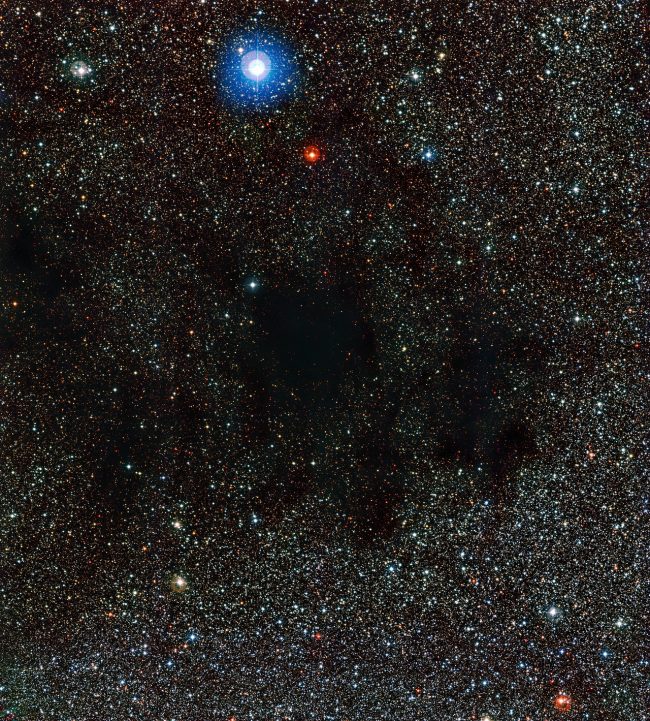
The Coalsack is generally considered the easiest dark nebula to see. However, you have to be in the Southern Hemisphere to see it. To those on the southern half of Earth’s globe, the Coalsack is visible to the unaided eye as a dark, cloudy patch in the Milky Way. It’s located in the famous constellation Crux the Southern Cross.

Dense starfield with large, blobby dark areas near bright blue and bright red stars.
This is the Coalsack, a huge cloud of gas and dust in space. April and May are some of the best months to see the Coalsack in the constellation Crux the Southern Cross in the Southern Hemisphere. Image via ESO.
Watch this video and note the many dark clouds in the Milky Way as you zoom in to see the Coalsack.

The Horsehead Nebula

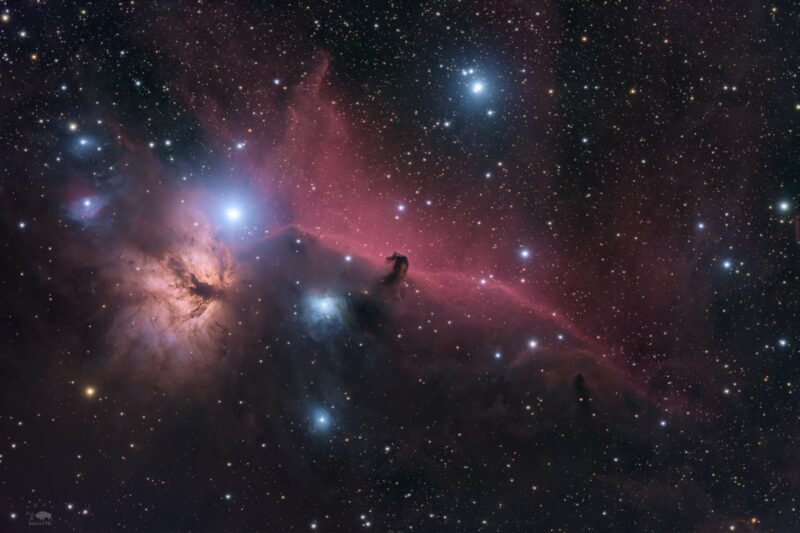
The Horsehead Nebula, or Barnard 33, is striking for its horsehead shape. It lies in the direction of the constellation Orion the Hunter.

Find the Horsehead Nebula by looking for Orion’s Belt, the constellation’s prominent line of three stars. The easternmost belt star (the star farthest left on the belt when looking at Orion in the Northern Hemisphere) is the star Alnitak. And just south of Alnitak is the Horsehead Nebula.

However, while famous, the Horsehead isn’t easy for amateurs to spot. You’ll need excellent seeing conditions, a large telescope and the help of a filter. It’s a great target in winter skies.

A purple nebula with a horse-shaped dark indentation, with some bright and many faint stars.
View at EarthSky Community Photos. | Ernest Jacobs in North Java, New York, captured the Horsehead Nebula on February 8, 2026. Ernest wrote: “The first clear night in months was Super Bowl Sunday. Temperatures were well below zero. A few of us braved the cold and headed out to our club’s observatory. We captured the Horsehead and Flame Nebulae. The bright star Alnitak (leftmost star of Orion’s Belt) is the bright star above the Flame Nebula.” Thank you, Ernest!

The Snake Nebula

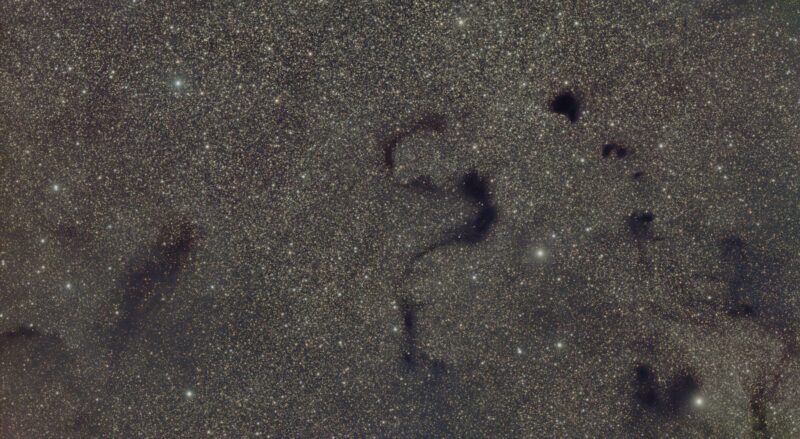
The Snake Nebula, or Barnard 72, is an S-shaped dark nebula in the constellation Ophiuchus the Serpent Bearer. The dark blobs below the Snake Nebula are a type of dark nebulae with the name of Bok globules.

Very dense star field with dark shape like an S blocking starlight behind.
View at EarthSky Community Photos. | Thomas Sorensen took this image from Tremonton, Utah, on March 25, 2025. Thanks, Thomas! This image shows some Milky Way stars’ light being blocked by a thick collection of gas and dust shaped like a snake or letter S. They are called dark nebulae.

Bok globules

Smaller, isolated dark nebulae get their own designation: Bok globules. Bok globules are cool clouds of gas and dust that look like drops of black paint. Usually, multiple star systems are forming inside.

Dutch-American astronomer Bart Bok gets credit for the discovery of Bok globules. But he had long been collaborating with astronomer Priscilla Fairfield, who he married in 1929. The Royal Astronomical society said:

It is difficult and pointless to separate his achievements from hers.

An example of a Bok globule is Barnard 68. This dark absorption nebula of molecular gas is within the Milky Way galaxy. It lies in the direction of the constellation Ophiuchus at a distance of 500 light-years.

Stark black blob fanning up and to the right in a dense, colorful starfield.
Barnard 68 is a Bok globule close to the Snake nebula in the constellation Ophiuchus. It’s also at its best in June and July. Can you spot Barnard 68 in the image of the Snake nebula above? Image via ESO/ Wikimedia Commons (CC BY 4.0).

Dark nebulae in other galaxies

You can see dark nebulae in distant galaxies where a dark, dust lane obscures part of a spiral arm or the bulge, such as in the Black Eye Galaxy. The Black Eye galaxy, or M64, also has the nickname of the Evil Eye galaxy. This spiral with huge swaths of absorbing dust lies in the direction of the constellation Coma Berenices. This galaxy lies 17 million light-years away.

Oblique view of giant spiral galaxy showing dark brown obscuring dust along the front half.
The Black Eye Galaxy displays great swaths of dark, obscuring clouds in its spiral form. The Black Eye galaxy lies toward the constellation Coma Berenices, a good target in May skies. Image via the Hubble Space Telescope/ Wikimedia Commons.

Bottom line: A dark nebula is a cloud of interstellar gas and dust that blocks light from background stars and other luminous objects. The Horsehead Nebula is a famous dark nebula.

Read more: Thinking of buying a telescope? Read these tips 1st

Read more: What are the best targets for binoculars?

The post Dark nebulae are star-obscuring clouds of gas and dust first appeared on EarthSky.


from EarthSky https://ift.tt/UGMCRt4

ESCAPADE mission to fly past Earth twice in 2 days

ESCAPADE mission: Earth spins as a blue line arcs in and turns orange as it passes closest, followed by a second line.
On November 7 and 9, 2026, the ESCAPADE mission will perform 2 flybys of Earth, 1 for each of the 2 spacecraft, Blue and Gold. The mission is headed toward Mars. Image via NASA/ Advanced Space/ Matt Bolliger.

ESCAPADE mission will fly past Earth on November 7 and 9

The ESCAPADE mission, which launched last November, is heading to Mars. But to get there, its twin spacecraft — dubbed Blue and Gold — need to first head back to Earth. This week they’ll fly past our world, using its gravity to slingshot them on to the red planet.

The first probe, Blue, will swing past Earth on November 7, 2026, followed by the Gold probe two days later. The spacecraft will fire their engines at closest approach for an extra boost that scientists are calling a trans-Mars injection burn. This will help them increase their speeds by more than 1,000 miles an hour.

With this boost, the probes should reach Mars on September 7 and 9, 2027. There, they’ll study how charged particles from the sun interact with Mars’ magnetic environment. 

Will you be able to see the flyby?

Maybe! But you’ll probably need a telescope. The two refrigerator-size space probes will fly higher than most Earth-orbiting satellites.

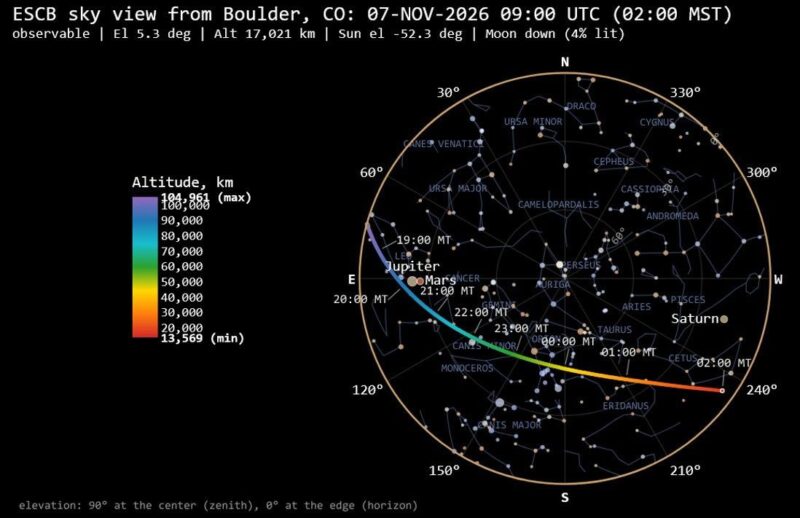
The western U.S. could spot the twin spacecraft before their engine burns. NASA said that the first one, Blue:

… will likely be brightest for the western U.S. between midnight and 1 a.m. PST in the early morning of November 7, and the second one [Gold] will be brightest between 1 and 2 a.m. PST on November 9.

The next viewing chance will be for those in southern Australia during the engine burns. Blue’s will be at 8:51 p.m. Australia Eastern Daylight Time on November 7. And Gold’s will begin at 9:51 p.m. Australia Eastern Daylight Time on November 9.

The spacecraft will be moving slowly compared to closer satellites. It should take a few hours for them to cross the sky from east to west.

Star chart showing curved path of probe in rainbow hues representing altitudes, passing near Jupiter and Mars heading west.
Star chart for the view from Boulder, Colorado, as the Blue probe passes Earth on November 7, 2026. See more maps at NASA’s Scientific Visualization Studio. Image via NASA/ Advanced Space.

ESCAPADE mission launched to Mars in November 2025

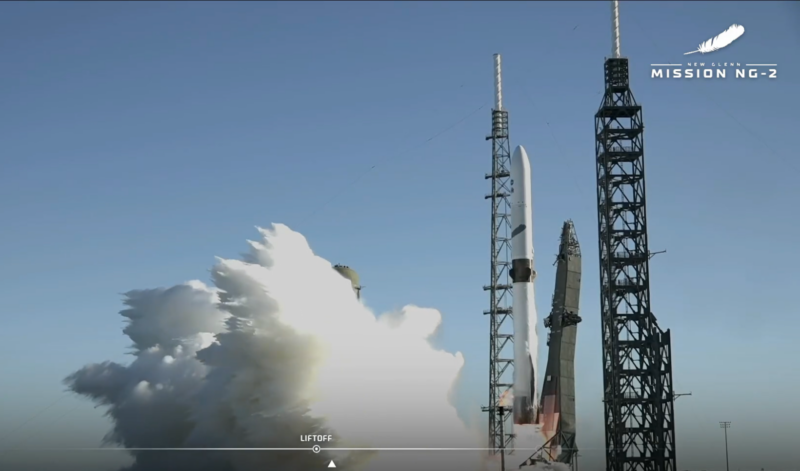
Blue Origin’s New Glenn rocket successfully launched the ESCAPADE mission toward Mars on November 13, 2025. The mission left from Launch Complex 36 at Cape Canaveral Space Force Station in Florida. ESCAPADE stands for Escape and Plasma Acceleration and Dynamics Explorers. The mission will use twin spacecraft, nicknamed Blue and Gold, to study Mars’ magnetic environment.

This was just the 2nd launch for the New Glenn heavy-lift launch vehicle after its initial launch in January 2025. The roar from the team was deafening on the Blue Origin feed as the reusable New Glenn booster returned and safely landed on a platform back on Earth.

ESCAPADE mission: A rocket starts to lift upward over a plume of white steam as the arm falls away.
Blue Origin’s New Glenn rocket lifted up from Cape Canaveral, Florida, on November 13, 2025. It was carrying the ESCAPADE mission into space. Image via Blue Origin.
ESCAPADE mission: 4 panels showing people cheering and making triumphant gestures after liftoff.
The Blue Origin team cheered loudly when the New Glenn reusable booster made its safe return to Earth. Image via Blue Origin.
ESCAPADE mission: Cylindrical rocket on black background with 7 glowing engines in the end with smoke coming out of them.
The New Glenn rocket launched the ESCAPADE mission toward Mars on November 13, 2025. Image via Blue Origin.

Mars’ electrically charged environment

The ESCAPADE mission aims to track the internal workings of Mars’ magnetic environment. Mars doesn’t have a global magnetic field in the same sense Earth does. It doesn’t have a single, planet-wide magnetic field generated by a molten, convecting iron core (a dynamo). Earth’s global magnetic field surrounds the whole planet and creates a strong magnetosphere that protects us from the solar wind. Mars doesn’t have this in quite the same way.

But Mars does have many localized magnetic fields frozen into patches of its crust. They are remnant magnetizations, or leftovers from an ancient global magnetic field that Mars apparently had billions of years ago. Mars orbits one step farther from the sun than Earth. And it’s a smaller and colder planet than Earth. When Mars’ core cooled and its dynamo shut down, the global field collapsed. But iron-bearing rocks that had solidified while the field still existed kept their magnetization. Those patches still create small, regional magnetic fields — some surprisingly strong — especially in Mars’ southern highlands.

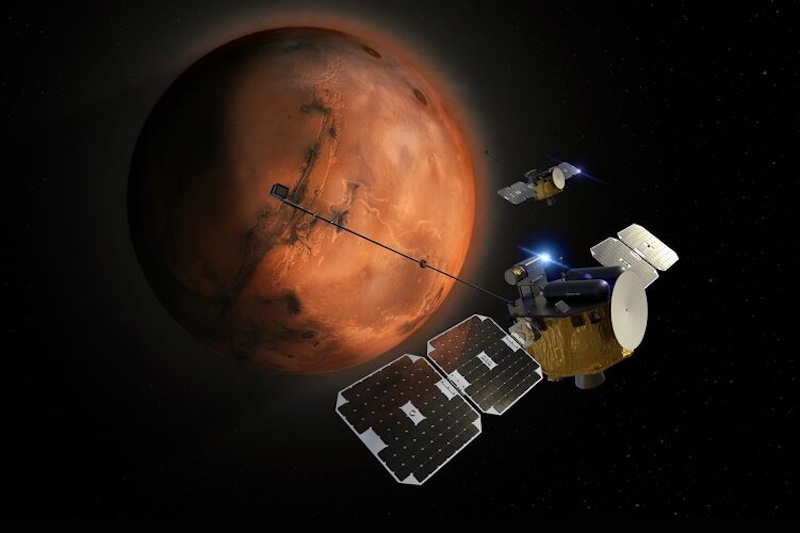
ESCAPADE mission: 2 spacecraft with wide solar panels positioned in orbit of red planet Mars.
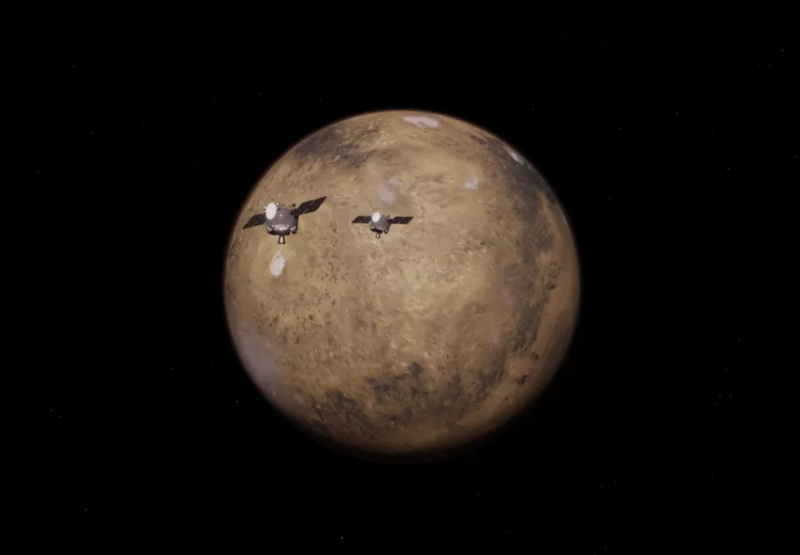
Artist’s concept of the twin Blue and Gold orbiters on the ESCAPADE mission to Mars. Image via Rocket Lab/ UC Berkeley.
Rotating ball, representing Mars, with red and blue patches on its surface.
Here’s a magnetic map of Mars. Mars has many localized magnetic fields that are frozen into patches of its crust. Data from many earlier spacecraft missions made this map possible. Red represents positive magnetic fields and blue, negative magnetic fields. Image via NOAA.

ESCAPADE’s goal

ESCAPADE’s goal is to study how those crustal magnetic fields interact with the solar wind. ESCAPADE’s twin spacecraft will orbit Mars to measure how solar particles and the Martian atmosphere behave around those regions of remnant magnetism. Scientists expect ESCAPADE will help them understand more of the details of how Mars lost most of its atmosphere over time, and how Mars lost its magnetosphere.

So Mars’ magnetic field is unlike those on other planets. It’s more of a hybrid. On the one hand, it’s a solar-induced magnetosphere, like that on Venus, created in part by the interaction of the solar wind with the Martian atmosphere. On the other hand, it also has localized areas of intrinsic magnetic fields from the planet’s crust. And there are larger-scale global influences as well.

Scientists want to know how energy and matter from the solar wind make their way in and out of Mars’ magnetic environment. NASA described the mission goals:

ESCAPADE will analyze how Mars’ magnetic field guides particle flows around the planet, how energy and momentum are transported from the solar wind through the magnetic environment and what processes control the flow of energy and matter into and out of the Martian atmosphere.

Artwork of a brownish planet and 2 space probes headed there.
Artist’s concept of the Blue and Gold probes on their way to Mars. Image via NASA/ James Rattray/ Rocket Lab USA.

Details of the mission

The ESCAPADE mission is a relatively inexpensive mission with a design led by UC Berkeley. The twin spacecraft have a total cost of under $80 million. That’s only about 10% the cost of sending a typical spacecraft to Mars.

The Blue and Gold spacecraft are nicknamed for Berkeley’s school colors. The probes will orbit the red planet, taking simultaneous observations from different locations. Scientists hope to see the real-time response of Mars’ magnetic environment as it’s buffeted by the solar wind.

As with most questions astronomers aim to solve, this one also boils down to the big picture of life in our universe. Was Mars once habitable for some form of life? And could it be habitable in the future for a human population?

Planet set in a flat plane with magnetic lines around it and 2 satellites.
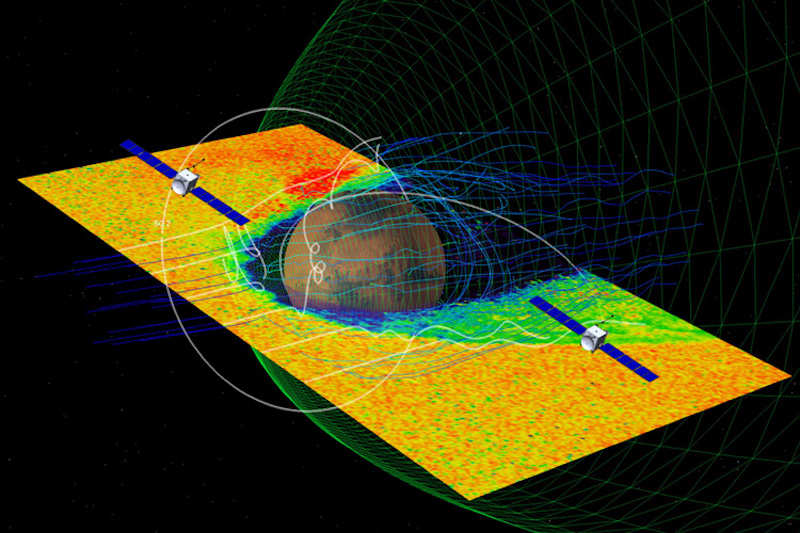
The twin orbiters will circle Mars in complementary orbits. They will sample the hot ionized plasma (yellow and green) and magnetic fields (blue lines) to understand how Mars’ atmosphere escapes into space. Image via UC Berkeley/ Robert Lillis.

Bottom line: On November 7 and 9, 2026, the ESCAPADE mission’s twin probes — first Blue and then Gold — will perform flybys of Earth on the way to Mars.

Via NASA and NASA

Read more: Yeast on Mars could survive, unique new research shows

Read more: What etched these strange gullies on Mars into the sand?

Science news, night sky events and beautiful photos, all in one place. Click here to subscribe to our free daily newsletter.

The post ESCAPADE mission to fly past Earth twice in 2 days first appeared on EarthSky.


from EarthSky https://ift.tt/4cRgfNO

A new mini-moon for Earth! Meet 2026 QQ8

A roundish, very rough rock in space.
Earth has a new mini-moon! This artist’s concept shows what the little space rock could look like. Image via CharlVera/ Pixabay.

Meet mini-moon 2026 QQ8

Earth’s gravity has temporarily captured a mini-moon, named 2026 QQ8. On October 29, 2026, the Minor Planet Center reported that Krisztián Sárneczky had originally discovered the little space rock near Earth back on August 20, 2026. It seems this object entered orbit around our planet back in April.

There’s no need to worry about a collision: The closest that 2026 QQ8 will get to Earth is 0.0038 astronomical units (AU). That’s about 1 and a half times farther than our actual moon is from us.

The mini-moon is only about 3 feet (1 meter) in size, which wouldn’t do much more than put on a fiery show if it impacted with Earth’s atmosphere anyway.

At first, there was debate over whether the object was of natural origin or a piece of junk, possibly from a rocket or old satellite. So astronomers took follow-up observations with the University of Hawaii 2.2-meter telescope and the Lowell Discovery Telescope. With these additional observations, the Minor Planet Center was able to confirm it’s not space junk. The mini-moon is of natural origin, likely a small asteroid.

You deserve a daily dose of good news. For the latest in science and the night sky, subscribe to EarthSky’s free daily newsletter.

The path of the mini-moon

The mini-moon became temporarily bound to us back in late April. And it should stick with us through December. Then, in 2027, it will continue on its own journey in our solar system.

Looking at the orbital data, astronomers are able to trace its path better. And they discovered that 2026 QQ8 comes close to Earth approximately every 10 years. Back in 1965, it came fairly close, but not quite close enough for a temporary capture. In 2058 it will come close again, but also not quite close enough to regain its mini-moon status.

In these other instances, the little rock does not cross into what astronomers call the Hill sphere or Hill radius. Outside of the Hill sphere, the sun dominates the motions of objects. But in April, 2026 QQ8 passed the Hill sphere of Earth, which is why it is temporarily bound to us.

Red path of an space rock turns to yellow as it makes an odd loop around Earth and the moon.
This animation by Tony Dunn shows the mini-moon’s orbit as it becomes captured by Earth’s gravity and does a strange-looking loop around Earth before escaping again. The more circular white path is the moon orbiting Earth.

Its path around Earth is not a nice, neat circle. Below is a gif showing the mini-moon’s unusual orbit around Earth, plus our own moon’s orbit.

Other recent mini-moons

It’s not unusual for Earth to temporarily capture a little space rock. Some of the previous mini-moons we’ve had include:

What’s a quasi-moon? A quasi-moon is not truly orbiting Earth. It just looks like it from our perspective. More accurately, a quasi-moon is basically sharing an orbit with us. But that orbit is not exactly the same as ours. It does not always stay ahead or behind us in orbit, so sometimes we see it in front of us and sometimes we see it behind us.

Bottom line: Earth has another new mini-moon! The little space rock 2026 QQ8 entered orbit around Earth back in April and will stay until the end of the year.

Via MPC

Read more: Did comets seed life on Earth? A new study says probably not

Read more: 10,000 Starlink satellites orbiting Earth … and counting

The post A new mini-moon for Earth! Meet 2026 QQ8 first appeared on EarthSky.


from EarthSky https://ift.tt/T97srt3

Pegasus the Flying Horse, and the best sky story ever

Pegasus the Flying Horse is the 7th-largest of the 88 constellations. It’s prominent in the east on autumn evenings in the Northern Hemisphere (spring evenings in the Southern Hemisphere). Find out more in the video above, or on YouTube.

Pegasus the Flying Horse

Pegasus the Flying Horse rises in the east on autumn evenings in the Northern Hemisphere, or spring evenings in the Southern Hemisphere. It’s the 7th-largest of the 88 official constellations, and it dominates the sky with its giant square asterism, fittingly called the Great Square.

The Great Square is huge, covering 20 degrees from top to bottom. That’s the span of two fist-widths held at arm’s length. And that makes Pegasus easy to find. This constellation rises above the eastern horizon at nightfall in early Northern Hemisphere fall, and is nearly overhead at nightfall by the season’s end.

In mythology, Pegasus figured into one of the greatest — and surely the most elaborate — of all sky myths. This one is from ancient Greece, some 3,000 years ago. According to the myth, Pegasus was the flying horse ridden by Perseus the Hero, as he swooped in to save Princess Andromeda from a sea monster. There’s more to the story, which you’ll find in the video at the top of this page.

Sky chart with numerous labeled stars and lines between them making a large square with legs.
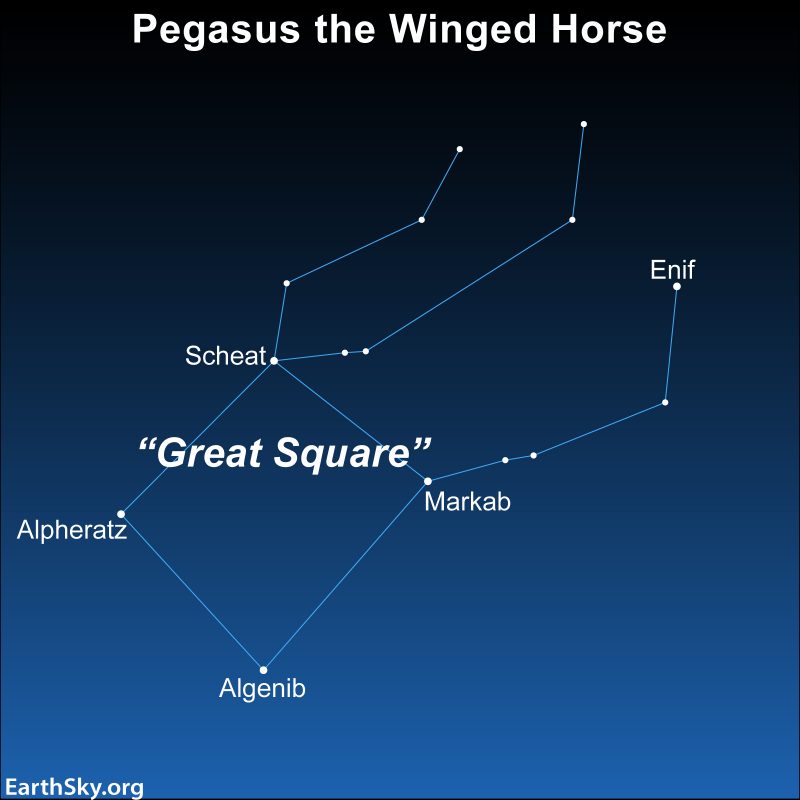
On autumn evenings in the Northern Hemisphere — spring evenings in the Southern Hemisphere — Pegasus the Flying Horse is ascending in the east in the evening hours. You’ll most easily notice the giant, square-shaped asterism within Pegasus, called the Great Square. Chart via EarthSky.

Stars of Pegasus

As it rises in the evening, the star in the Great Square closest to the horizon is Algenib, with a magnitude of 2.8. It lies 390 light-years away. The star on the opposite corner of the square from Algenib is Scheat, a magnitude 2.4 star lying 199 light-years away. The star to the south in the square is Markab, a magnitude 2.5 star at a distance of 140 light-years. And the final star in the square is Alpheratz. Technically, Alpheratz lies just across the border of Pegasus and is actually a member of the constellation Andromeda. Alpheratz is the brightest of the four stars at magnitude 2.1 and lies 97 light-years away.

The Great Square marks the body of the flying horse. Trails leading off the west side of the square mark the front legs and head of Pegasus. Extending out from Markab, two stars at magnitude 3.4 and 3.5, Homam and Biham, lead the way to the head star, magnitude 2.4 star Enif. This star is helpful in finding the globular cluster Messier 15 (M15).

Find the forelegs of Pegasus off of Scheat. Five degrees west of Scheat is 3rd-magnitude star Matar. As the brightest leg star in Pegasus, it’s helpful in finding a couple of notable galaxies.

Star chart with pictures of Pegasus the Flying Horse and neighboring constellations.
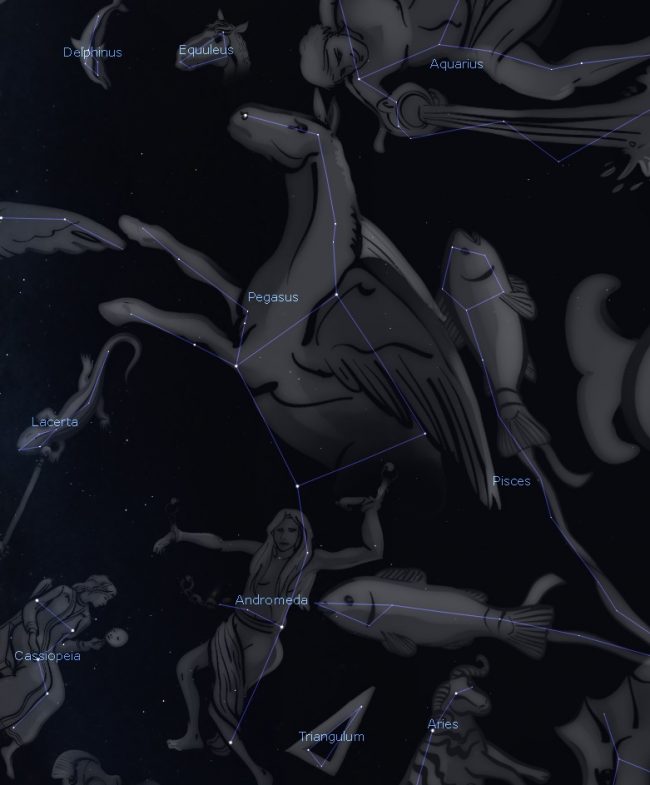
Pegasus the Flying Horse is a giant constellation that rises in the east on October evenings. Image via Stellarium.

The asterism of the Great Square

The Great Square of Pegasus can look like a huge diamond. Think of it as a giant baseball diamond rising during playoffs month in the east after dark.

The Great Square is an asterism, or a group of stars that isn’t itself a constellation but is easy to recognize.

Night sky photo with lines between stars and a man pointing up at the constellation.
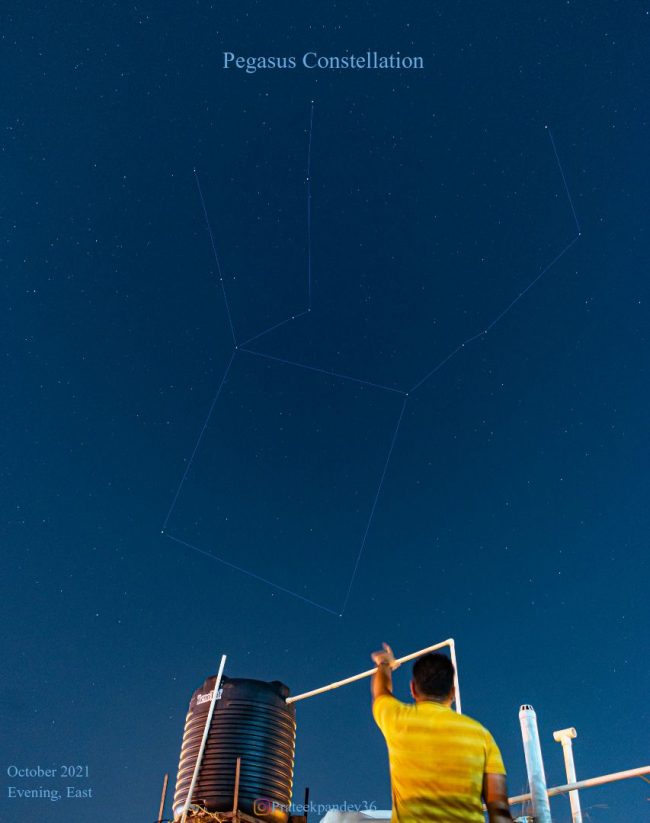
View at EarthSky Community Photos. | Prateek Pandey in Bhopal, India, captured this photo of Pegasus. He wrote: “Pegasus is named after the winged horse in Greek mythology. Curiously, the constellation Pegasus only represents the top half of the horse. In some depictions, the horse is shown rising out of the water. Viewed best in autumn, turn your eyes to the east as the night falls, and see the winged horse rising high up in the sky.” Thank you, Prateek!

Using Pegasus to find the Andromeda Galaxy

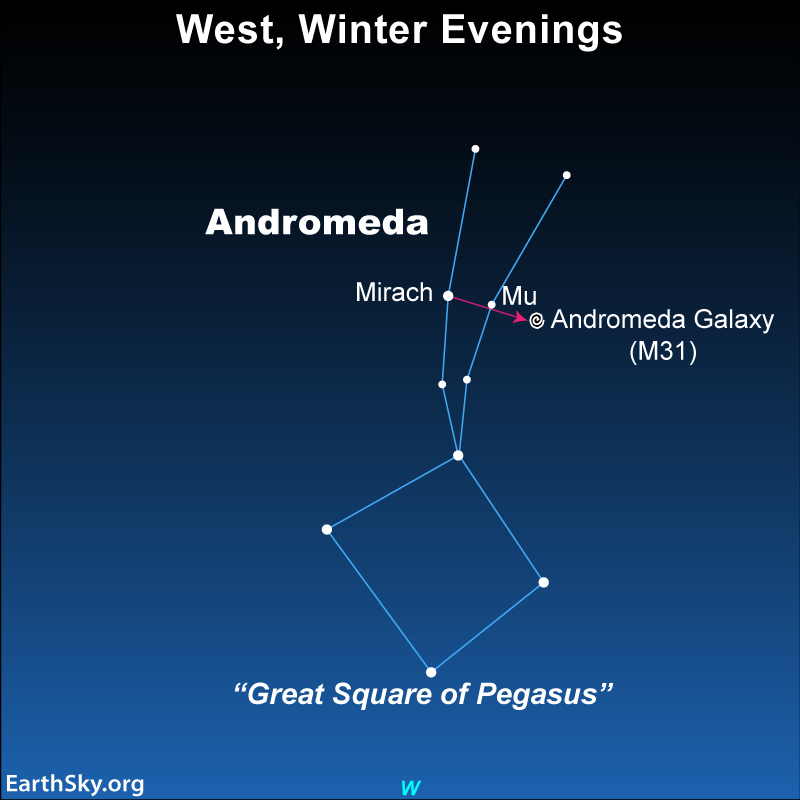
Pegasus is close to the constellation Andromeda, so it’s useful for star-hopping to the Andromeda galaxy. You’ll need a dark-sky site to track down Andromeda without optical aid. It’s much easier to spot with binoculars or a telescope. Follow this link for more information on how to use Pegasus to find Andromeda.

Star chart: Lines showing constellations with large square and arrow pointing to galaxy symbol.
Find the Andromeda Galaxy (M31) by star-hopping from the Great Square of Pegasus. Chart via EarthSky.
Glowing swirl with very bright center in a starry sky.
View at EarthSky Community Photos. | Vikash Singh captured this image on July 15, 2026, from India. Vikash wrote: “This is the Andromeda Galaxy (M31), captured using the Dwarf 3 smart telescope. The completely clear night sky and low light pollution of Ladakh made it possible to capture incredible details of our neighboring galaxy.” Thank you, Vikash!

Stephan’s Quintet

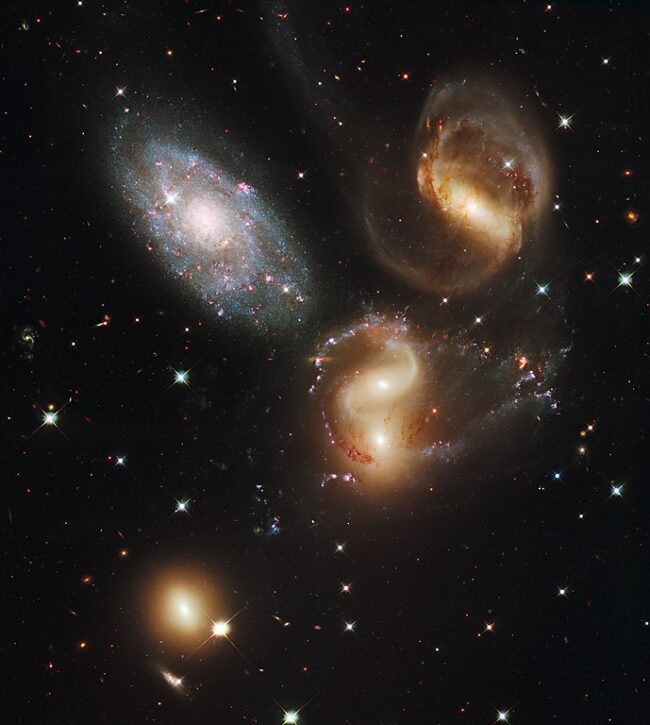
Pegasus is home to many galaxy clusters. The most famous is probably Stephan’s Quintet, a favorite target among astrophotographers. This tight gathering of five galaxies has a faint magnitude of 13.6. The largest and brightest, NGC 7320, has a small redshift compared to the other four, revealing that it is probably not a physical member of the group and just a line-of-sight coincidence.

Fun fact: In the 1946 movie It’s a Wonderful Life, angels in heaven discussing George Bailey are depicted as the galaxies in Stephan’s Quintet.

A large spiral with multiple small, nebulous objects, over a rich background of stars.
View at EarthSky Community Photos. | Andy Dungan near Cotopaxi, Colorado, captured two galaxy groups, namely Stephan’s Quintet and the Deer Lick Group, both in the constellation Pegasus, on October 27, 2024. Andy wrote: “Over the years I have run into pictures and discussions of these two objects. Both are rather small and close together. Their data and histories are fun too. What fun it is exploring the universe.” Thank you, Andy!
A cluster of galaxies including large colorful spirals and two galaxies merging.
This image of Stephan’s Quintet is from 2009, courtesy of the Hubble Space Telescope. Image via Wikimedia Commons/ NASA/ ESA/ Hubble SM4 ERO Team.

Other galaxies in Pegasus the Flying Horse

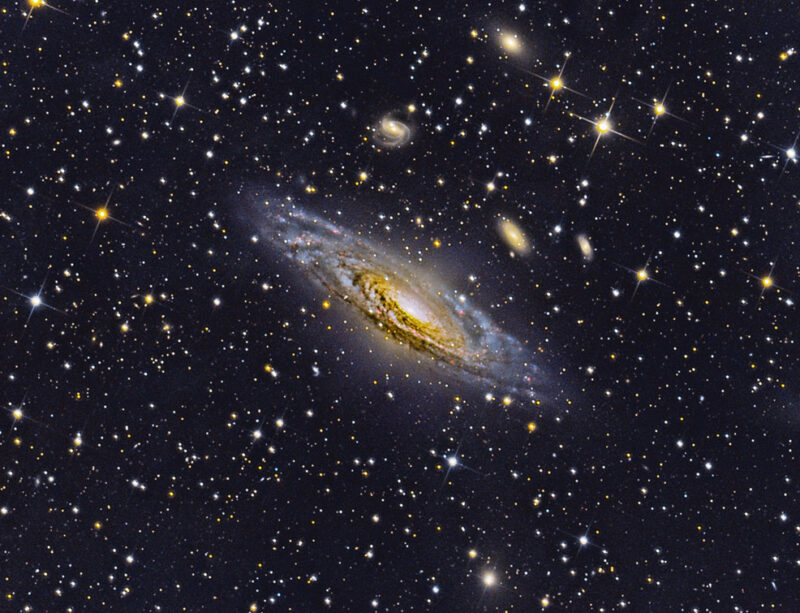
Three other notable galaxy clusters lie in Pegasus. The brightest is magnitude 9.5 and is just half a degree from Stephan’s Quintet. The cluster has the curious name Deer Lick Group. Follow Scheat to Matar and then about 4.5 degrees farther and slightly north of the direction you were heading. This will bring you to the Deer Lick Group, NGC 7331. Here you’ll find one large spiral galaxy and a spattering of smaller ones.

Large, oblique spiral galaxy and some smaller spiral and elliptical galaxies nearby in star field.
The Deer Lick Group contains one large spiral galaxy and other smaller galaxies. It lies in the constellation Pegasus. Image via W4sm astro/ Wikimedia Commons.

The Pegasus I Cluster lies on the southern edge of the constellation not far from the circlet of Pisces. At a distance of 8 degrees from Markab on the sky’s dome, the Pegasus I Cluster is a grouping with a magnitude of 11.1. The galaxy cluster requires a large telescope to see or a long-exposure photograph, but it reveals a beautiful and striking number of galaxies.

The Pegasus II Cluster lies back within the square of Pegasus. Halfway between Alpheratz and Scheat, it lies just inside the border of a line that would be drawn connecting these two stars. A bit dimmer at magnitude 12.6, the Pegasus II Cluster (NGC 7720) is a powerful radio source, the target of much scientific study.

Globular Cluster M15 in Pegasus the Flying Horse

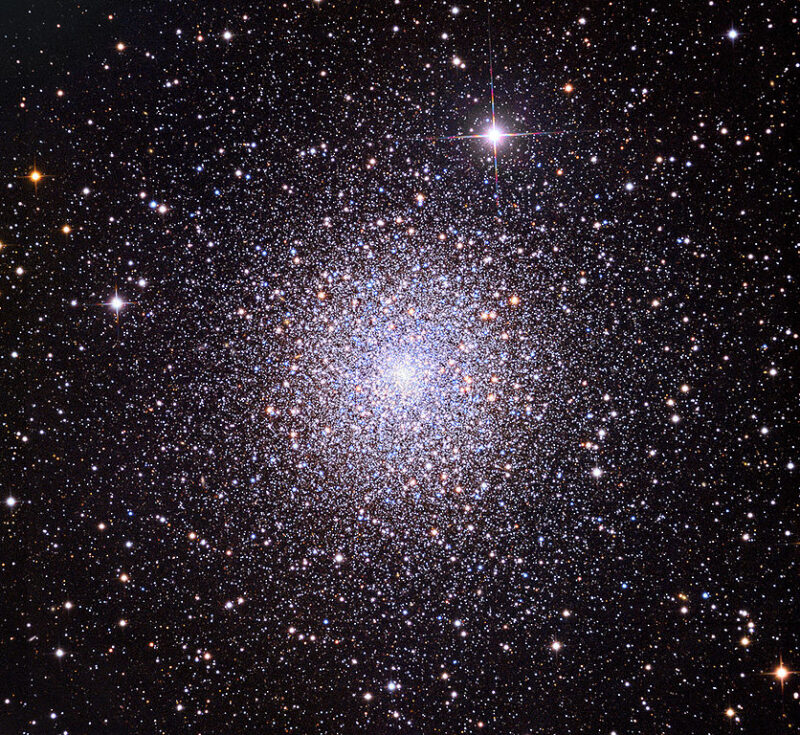
One other deep-sky object of note in Pegasus is the globular cluster Messier 15 (M15). You can find M15 easily using the head and neck stars of Pegasus. Start with the star Markab and go to the two dimmer stars that mark the neck. From the last star of the neck (Biham) to the brighter head star Enif, continue a line straight out for a little more than 4 degrees. Here you will find the magnitude 6.4 globular cluster M15. It lies about 33,600 light-years away and will show up nicely in a pair of binoculars.

Countless colorful points of light clustered together with a bright center and spilling outward into a starfield.
You can find the globular cluster Messier 15 (M15) in the constellation Pegasus. It shines at magnitude 6.4. Image via Mount Lemmon SkyCenter Schulman Telescope/ Adam Block/ Wikimedia Commons.

First exoplanet around a sun-like star

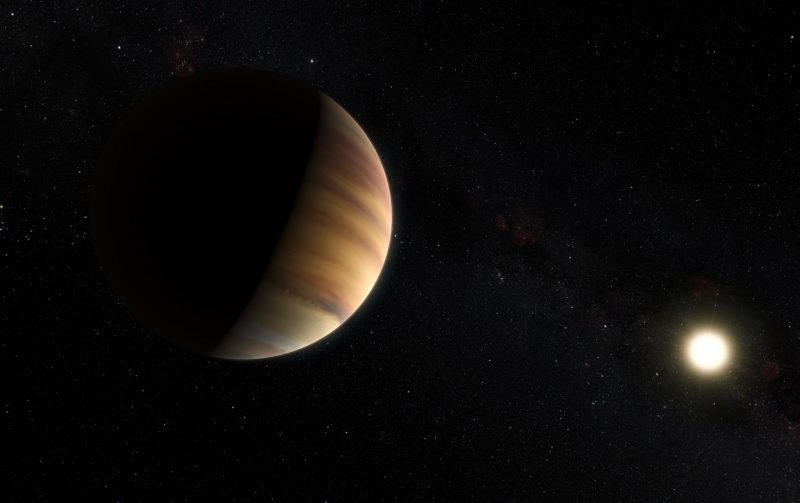
Astronomers discovered the first exoplanet orbiting a sun-like star in the constellation Pegasus. They named the planet 51 Pegasi b after the star it orbits. Didier Queloz and Michel Mayor discovered the planet in 1995 and received the Nobel Prize in Physics for their discovery in 2019.

Yellow, brown, and tan striped planet with distant yellowish-white star.
Artist’s concept of the hot Jupiter exoplanet 51 Pegasi b. The first exoplanet discovered around a sun-like star, 51 Pegasi b lies about 50 light-years from Earth in the constellation Pegasus the Flying Horse. Image via ESO/ M. Kornmesser/ Nick Risinger/ Wikimedia Commons.

Bottom line: Pegasus the Flying Horse is a giant constellation that dominates the skies in Northern Hemisphere fall. The constellation contains a famous asterism called the Great Square.

The post Pegasus the Flying Horse, and the best sky story ever first appeared on EarthSky.


from EarthSky https://ift.tt/5b4mS7q

adds 2