
Pegasus the Flying Horse
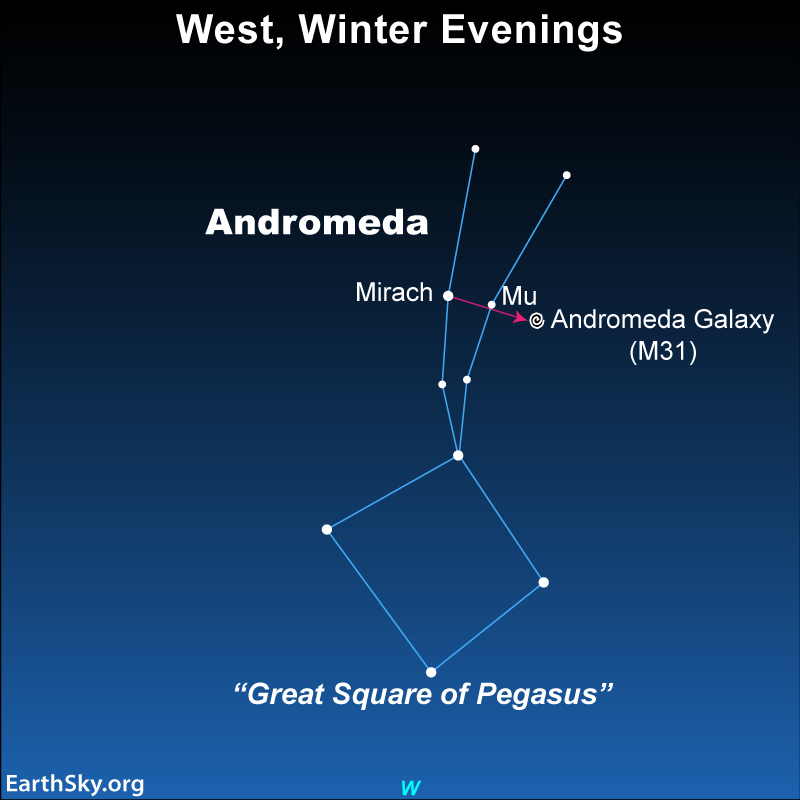
Pegasus the Flying Horse rises in the east on autumn evenings in the Northern Hemisphere, or spring evenings in the Southern Hemisphere. It’s the 7th-largest of the 88 official constellations, and it dominates the sky with its giant square asterism, fittingly called the Great Square.
The Great Square is huge, covering 20 degrees from top to bottom. That’s the span of two fist-widths held at arm’s length. And that makes Pegasus easy to find. This constellation rises above the eastern horizon at nightfall in early Northern Hemisphere fall, and is nearly overhead at nightfall by the season’s end.
In mythology, Pegasus figured into one of the greatest — and surely the most elaborate — of all sky myths. This one is from ancient Greece, some 3,000 years ago. According to the myth, Pegasus was the flying horse ridden by Perseus the Hero, as he swooped in to save Princess Andromeda from a sea monster. There’s more to the story, which you’ll find in the video at the top of this page.
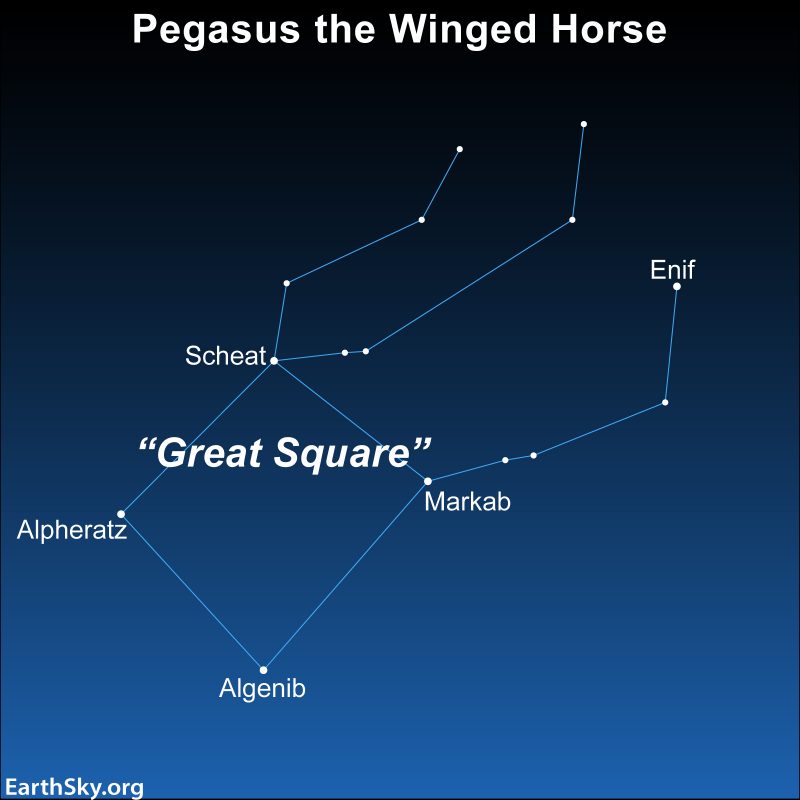
Stars of Pegasus
As it rises in the evening, the star in the Great Square closest to the horizon is Algenib, with a magnitude of 2.8. It lies 390 light-years away. The star on the opposite corner of the square from Algenib is Scheat, a magnitude 2.4 star lying 199 light-years away. The star to the south in the square is Markab, a magnitude 2.5 star at a distance of 140 light-years. And the final star in the square is Alpheratz. Technically, Alpheratz lies just across the border of Pegasus and is actually a member of the constellation Andromeda. Alpheratz is the brightest of the four stars at magnitude 2.1 and lies 97 light-years away.
The Great Square marks the body of the flying horse. Trails leading off the west side of the square mark the front legs and head of Pegasus. Extending out from Markab, two stars at magnitude 3.4 and 3.5, Homam and Biham, lead the way to the head star, magnitude 2.4 star Enif. This star is helpful in finding the globular cluster Messier 15 (M15).
Find the forelegs of Pegasus off of Scheat. Five degrees west of Scheat is 3rd-magnitude star Matar. As the brightest leg star in Pegasus, it’s helpful in finding a couple of notable galaxies.
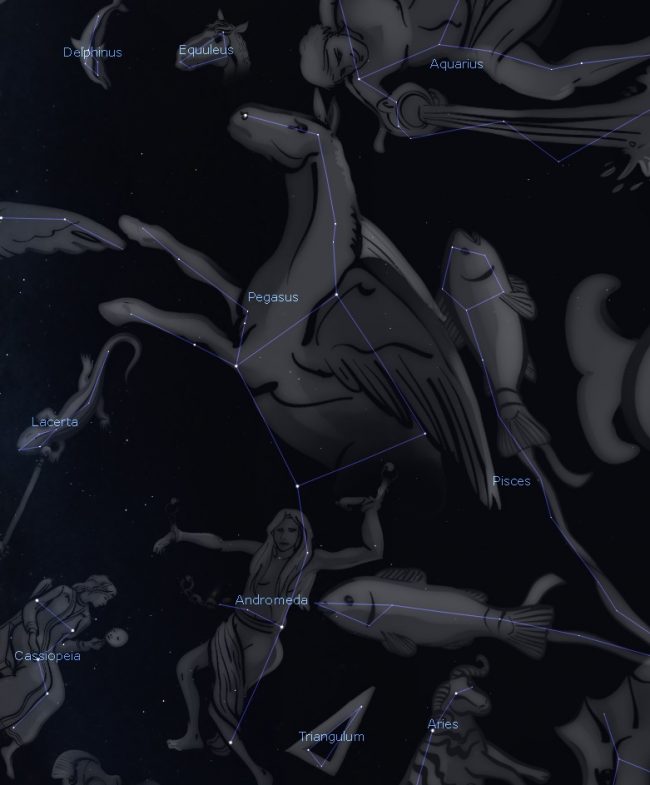
The asterism of the Great Square
The Great Square of Pegasus can look like a huge diamond. Think of it as a giant baseball diamond rising during playoffs month in the east after dark.
The Great Square is an asterism, or a group of stars that isn’t itself a constellation but is easy to recognize.
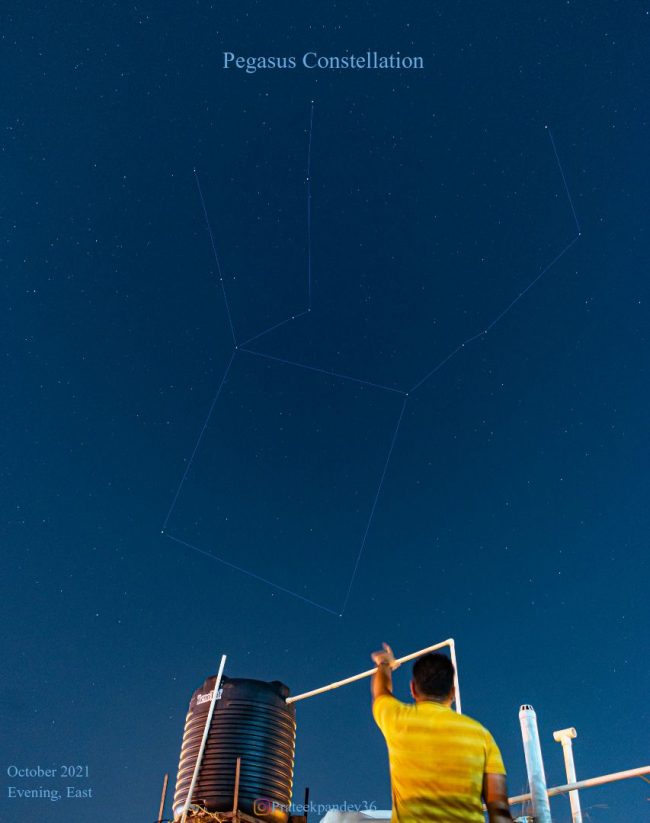
Using Pegasus to find the Andromeda Galaxy
Pegasus is close to the constellation Andromeda, so it’s useful for star-hopping to the Andromeda galaxy. You’ll need a dark-sky site to track down Andromeda without optical aid. It’s much easier to spot with binoculars or a telescope. Follow this link for more information on how to use Pegasus to find Andromeda.
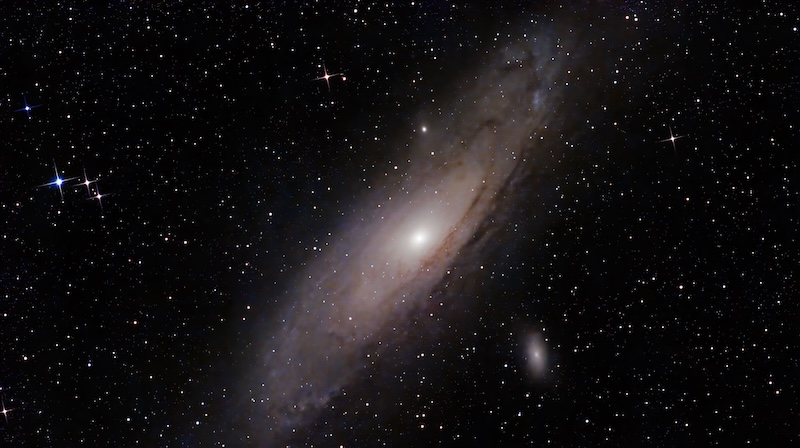
Stephan’s Quintet
Pegasus is home to many galaxy clusters. The most famous is probably Stephan’s Quintet, a favorite target among astrophotographers. This tight gathering of five galaxies has a faint magnitude of 13.6. The largest and brightest, NGC 7320, has a small redshift compared to the other four, revealing that it is probably not a physical member of the group and just a line-of-sight coincidence.
Fun fact: In the 1946 movie It’s a Wonderful Life, angels in heaven discussing George Bailey are depicted as the galaxies in Stephan’s Quintet.

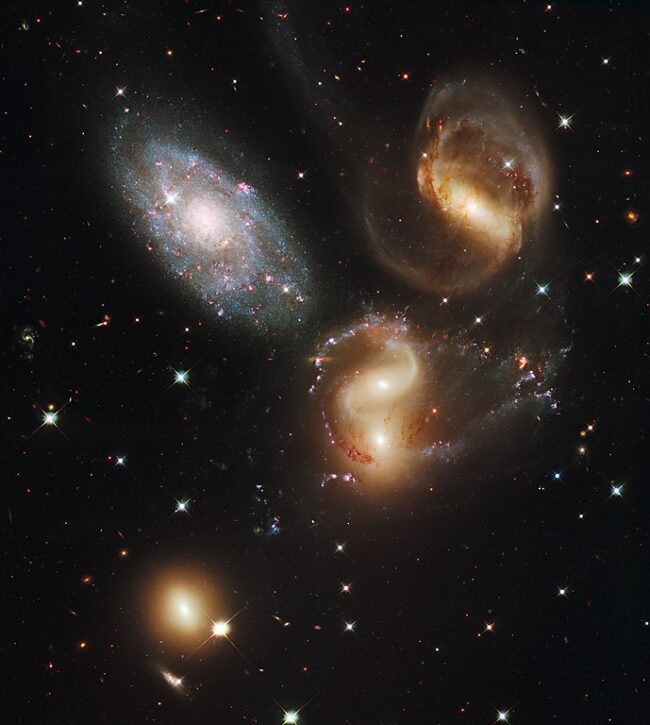
Other galaxies in Pegasus the Flying Horse
Three other notable galaxy clusters lie in Pegasus. The brightest is magnitude 9.5 and is just half a degree from Stephan’s Quintet. The cluster has the curious name Deer Lick Group. Follow Scheat to Matar and then about 4.5 degrees farther and slightly north of the direction you were heading. This will bring you to the Deer Lick Group, NGC 7331. Here you’ll find one large spiral galaxy and a spattering of smaller ones.
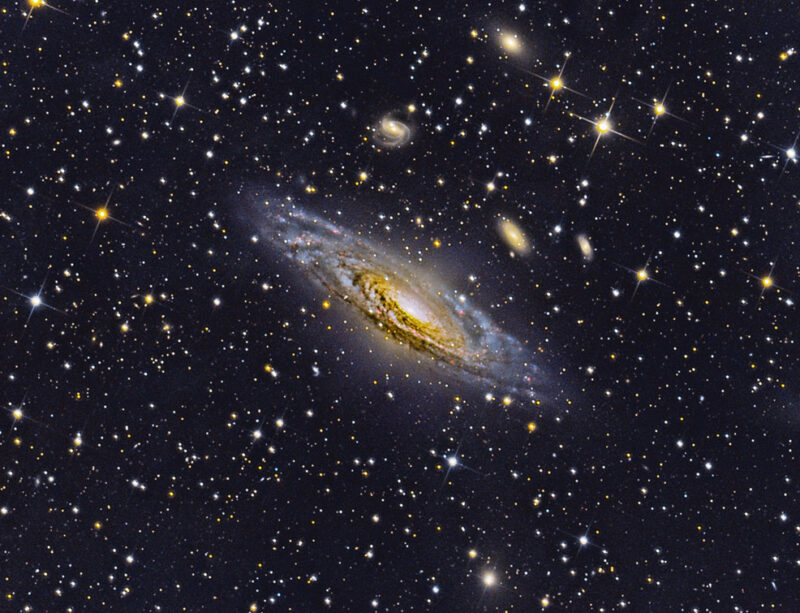
The Pegasus I Cluster lies on the southern edge of the constellation not far from the circlet of Pisces. At a distance of 8 degrees from Markab on the sky’s dome, the Pegasus I Cluster is a grouping with a magnitude of 11.1. The galaxy cluster requires a large telescope to see or a long-exposure photograph, but it reveals a beautiful and striking number of galaxies.
The Pegasus II Cluster lies back within the square of Pegasus. Halfway between Alpheratz and Scheat, it lies just inside the border of a line that would be drawn connecting these two stars. A bit dimmer at magnitude 12.6, the Pegasus II Cluster (NGC 7720) is a powerful radio source, the target of much scientific study.
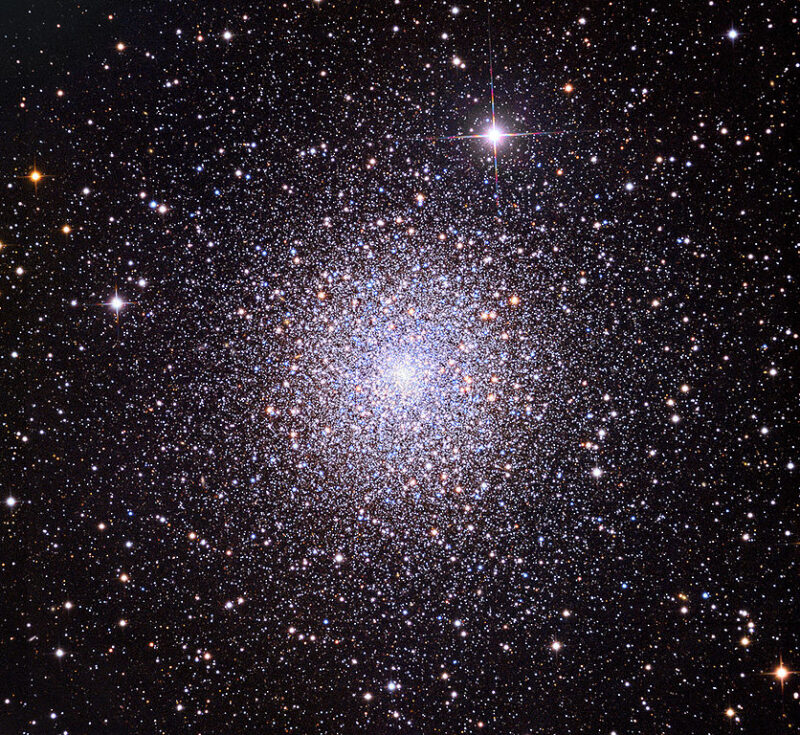
Globular Cluster M15 in Pegasus the Flying Horse
One other deep-sky object of note in Pegasus is the globular cluster Messier 15 (M15). You can find M15 easily using the head and neck stars of Pegasus. Start with the star Markab and go to the two dimmer stars that mark the neck. From the last star of the neck (Biham) to the brighter head star Enif, continue a line straight out for a little more than 4 degrees. Here you will find the magnitude 6.4 globular cluster M15. It lies about 33,600 light-years away and will show up nicely in a pair of binoculars.
First exoplanet around a sun-like star
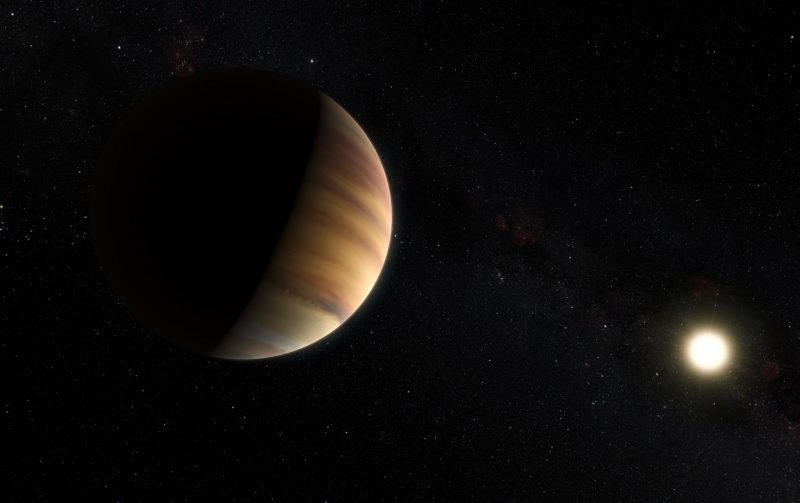
Astronomers discovered the first exoplanet orbiting a sun-like star in the constellation Pegasus. They named the planet 51 Pegasi b after the star it orbits. Didier Queloz and Michel Mayor discovered the planet in 1995 and received the Nobel Prize in Physics for their discovery in 2019.
Bottom line: Pegasus the Flying Horse is a giant constellation that dominates the skies in Northern Hemisphere fall. The constellation contains a famous asterism called the Great Square.
The post Pegasus the Flying Horse, and the best sky story ever first appeared on EarthSky.
from EarthSky https://ift.tt/5b4mS7q
Pegasus the Flying Horse
Pegasus the Flying Horse rises in the east on autumn evenings in the Northern Hemisphere, or spring evenings in the Southern Hemisphere. It’s the 7th-largest of the 88 official constellations, and it dominates the sky with its giant square asterism, fittingly called the Great Square.
The Great Square is huge, covering 20 degrees from top to bottom. That’s the span of two fist-widths held at arm’s length. And that makes Pegasus easy to find. This constellation rises above the eastern horizon at nightfall in early Northern Hemisphere fall, and is nearly overhead at nightfall by the season’s end.
In mythology, Pegasus figured into one of the greatest — and surely the most elaborate — of all sky myths. This one is from ancient Greece, some 3,000 years ago. According to the myth, Pegasus was the flying horse ridden by Perseus the Hero, as he swooped in to save Princess Andromeda from a sea monster. There’s more to the story, which you’ll find in the video at the top of this page.
Stars of Pegasus
As it rises in the evening, the star in the Great Square closest to the horizon is Algenib, with a magnitude of 2.8. It lies 390 light-years away. The star on the opposite corner of the square from Algenib is Scheat, a magnitude 2.4 star lying 199 light-years away. The star to the south in the square is Markab, a magnitude 2.5 star at a distance of 140 light-years. And the final star in the square is Alpheratz. Technically, Alpheratz lies just across the border of Pegasus and is actually a member of the constellation Andromeda. Alpheratz is the brightest of the four stars at magnitude 2.1 and lies 97 light-years away.
The Great Square marks the body of the flying horse. Trails leading off the west side of the square mark the front legs and head of Pegasus. Extending out from Markab, two stars at magnitude 3.4 and 3.5, Homam and Biham, lead the way to the head star, magnitude 2.4 star Enif. This star is helpful in finding the globular cluster Messier 15 (M15).
Find the forelegs of Pegasus off of Scheat. Five degrees west of Scheat is 3rd-magnitude star Matar. As the brightest leg star in Pegasus, it’s helpful in finding a couple of notable galaxies.
The asterism of the Great Square
The Great Square of Pegasus can look like a huge diamond. Think of it as a giant baseball diamond rising during playoffs month in the east after dark.
The Great Square is an asterism, or a group of stars that isn’t itself a constellation but is easy to recognize.
Using Pegasus to find the Andromeda Galaxy
Pegasus is close to the constellation Andromeda, so it’s useful for star-hopping to the Andromeda galaxy. You’ll need a dark-sky site to track down Andromeda without optical aid. It’s much easier to spot with binoculars or a telescope. Follow this link for more information on how to use Pegasus to find Andromeda.
Stephan’s Quintet
Pegasus is home to many galaxy clusters. The most famous is probably Stephan’s Quintet, a favorite target among astrophotographers. This tight gathering of five galaxies has a faint magnitude of 13.6. The largest and brightest, NGC 7320, has a small redshift compared to the other four, revealing that it is probably not a physical member of the group and just a line-of-sight coincidence.
Fun fact: In the 1946 movie It’s a Wonderful Life, angels in heaven discussing George Bailey are depicted as the galaxies in Stephan’s Quintet.
Other galaxies in Pegasus the Flying Horse
Three other notable galaxy clusters lie in Pegasus. The brightest is magnitude 9.5 and is just half a degree from Stephan’s Quintet. The cluster has the curious name Deer Lick Group. Follow Scheat to Matar and then about 4.5 degrees farther and slightly north of the direction you were heading. This will bring you to the Deer Lick Group, NGC 7331. Here you’ll find one large spiral galaxy and a spattering of smaller ones.
The Pegasus I Cluster lies on the southern edge of the constellation not far from the circlet of Pisces. At a distance of 8 degrees from Markab on the sky’s dome, the Pegasus I Cluster is a grouping with a magnitude of 11.1. The galaxy cluster requires a large telescope to see or a long-exposure photograph, but it reveals a beautiful and striking number of galaxies.
The Pegasus II Cluster lies back within the square of Pegasus. Halfway between Alpheratz and Scheat, it lies just inside the border of a line that would be drawn connecting these two stars. A bit dimmer at magnitude 12.6, the Pegasus II Cluster (NGC 7720) is a powerful radio source, the target of much scientific study.
Globular Cluster M15 in Pegasus the Flying Horse
One other deep-sky object of note in Pegasus is the globular cluster Messier 15 (M15). You can find M15 easily using the head and neck stars of Pegasus. Start with the star Markab and go to the two dimmer stars that mark the neck. From the last star of the neck (Biham) to the brighter head star Enif, continue a line straight out for a little more than 4 degrees. Here you will find the magnitude 6.4 globular cluster M15. It lies about 33,600 light-years away and will show up nicely in a pair of binoculars.
First exoplanet around a sun-like star
Astronomers discovered the first exoplanet orbiting a sun-like star in the constellation Pegasus. They named the planet 51 Pegasi b after the star it orbits. Didier Queloz and Michel Mayor discovered the planet in 1995 and received the Nobel Prize in Physics for their discovery in 2019.
Bottom line: Pegasus the Flying Horse is a giant constellation that dominates the skies in Northern Hemisphere fall. The constellation contains a famous asterism called the Great Square.
The post Pegasus the Flying Horse, and the best sky story ever first appeared on EarthSky.
from EarthSky https://ift.tt/5b4mS7q

Aucun commentaire:
Enregistrer un commentaire