aads

Did the Viking 2 lander detect marsquakes in 1976?

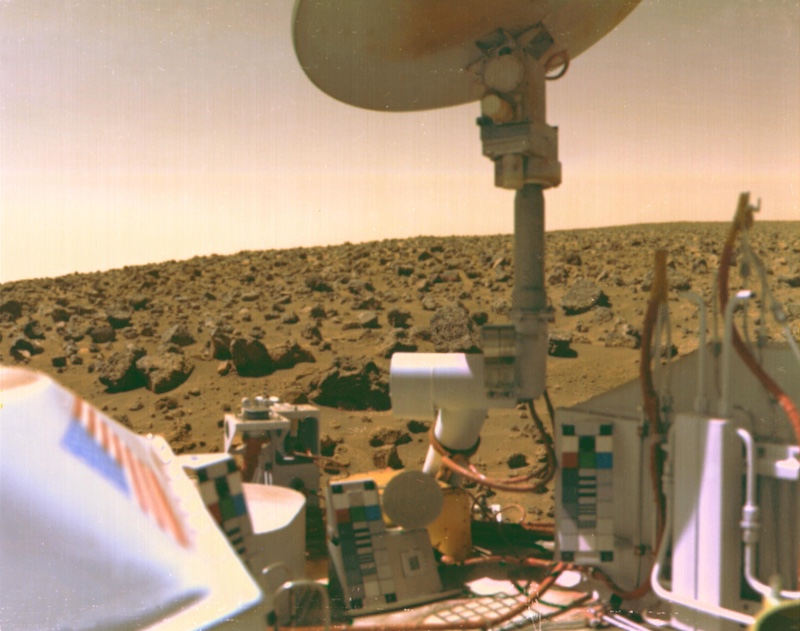
Marsquakes: Partial view of a robotic machine on reddish, rocky terrain, with dusty sky.
NASA’s Viking 2 landed on Mars in 1976. It detected 2 possible marsquakes, on sols 53 and 80. Decades later, NASA’s InSight lander detected nearly 1,000 marsquakes, some of them in the same region as the Viking 2 events. Image via NASA/ JPL-Caltech.
  • Mars has marsquakes, the equivalent of Earth’s earthquakes. They show this neighboring planet is still seismically active.
  • NASA’s Viking 2 lander detected two possible marsquakes back in 1976. But they weren’t confirmed at the time.
  • From 2018 to 2022, NASA’s InSight lander detected nearly 1,000 marsquakes. A new analysis shows that some of them were from the same region as the 1976 Viking 2 detections.

Science news, night sky events and beautiful photos, all in one place. Click here to subscribe to our free daily newsletter.

Marsquakes in the same place decades apart

The Viking 2 lander — 4th spacecraft from Earth ever to land on Mars — touched down on September 3, 1976. It landed in a region we earthlings call Utopia Planitia. Viking 2’s job was to search for signs of Martian life (it didn’t conclusively find any). It did carry a seismometer, with the hope it might detect marsquakes. But the instrument — mounted on the top deck of the lander — was susceptible to the Martian wind. And it was hard for scientists to separate true seismology from the wind’s vibrational “noise.”

Still, Viking 2 did detect what scientists believed were two small marsquakes on the plains of Utopia Planitia. It felt them on sol 53 and sol 80 of the mission. A sol is a Martian day, slightly longer than an Earth day.

Fast forward some four decades. Now, another Mars spacecraft — NASA’s InSight lander, which set down in Elysium Planitia in 2018 — has detected nearly 1,000 marsquakes in the same approximate region where Viking 2 landed in 1976. Has InSight confirmed Viking 2’s marsquakes? Not exactly. But by comparing the data from the two missions, scientists have gained new clues to the seismic history of Mars.

The researchers published their peer-reviewed findings in AGU Advances on September 30, 2026.

And Matthew R. Francis wrote about the new findings for Eos on October 21, 2026.
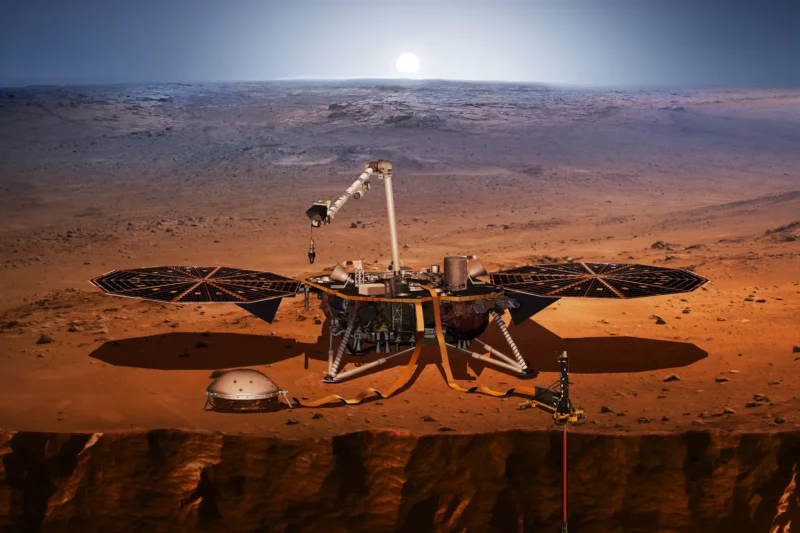
Artist's illustration of a robot spacecraft on a red desert plain.
Artist’s concept of NASA’s Mars InSight lander. It touched down on Mars on November 26, 2018. Image via NASA/ JPL/ Caltech.

Comparing the data

Viking 2’s landing site in Utopia Planitia — and InSight’s landing site in Elysium Planitia — are both in Mars’ northern lowlands. They are geographically adjacent regions, so similar that scientists and science journalists often refer to the Elysium-Utopia basin.

In the decades in between Viking 2 and InSight, scientists have pondered whether Mars was still geologically active. Now we know the planet does still experience marsquakes, the Martian equivalent of earthquakes.

Wanbo Xiao at Peking University in China is the lead author of the new InSight study. Xiao and his team compared the data from the old Viking 2 mission to the more recent data from InSight.

While one of the two detections by Viking 2 was dubious (probably because of the wind), the second one appeared more likely to be an actual marsquake.

Of course, though, Viking 2 had just one tiny seismometer, on its deck. And InSight was designed specifically to look for marsquakes or other seismic activity below the Martian surface. Its seismometer was more advanced and placed directly on the ground. The paper states:

For nearly 50 years, scientists debated whether the candidate seismic signals recorded by Viking 2 reflected true Martian tectonics, considering limitations of the Viking instrument. Decades later, the substantial marsquakes detected by the InSight mission revealed a clearer seismic context of the planet. Here we reconstruct the original Viking seismic workflow and reexamine its candidate events, recorded on sol 53 and sol 80, using modern knowledge from InSight.
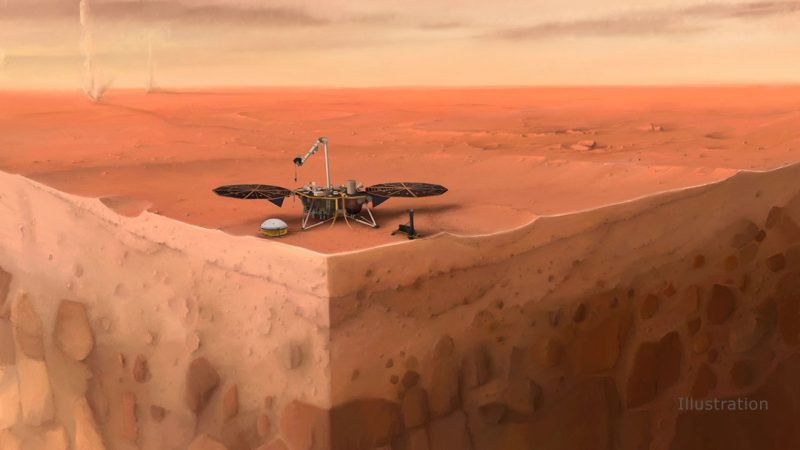
Robotic lander on a planetary surface, with view of layers of rock beneath it in orange colors.
View larger. | Illustration depicting NASA’s InSight lander, with a cutaway view of the subsurface of Mars. Image via PGP/ Nicolas Sarter/ Jet Propulsion Laboratory/ NASA.

Marsquake or meteorite impact?

Viking 2’s sol 80 event was in the same region in Mars’ northern plains as the InSight detections. But — even after all these decades — it’s still not clear if it was an actual marsquake. It’s possible that a meteorite impact caused the seismic waves. As the paper notes:

The sol 80 event possibly located in the same northern-plains source region inferred for InSight seasonal marsquakes, although a distant tectonic marsquake or a meteorite impact remain as alternative explanations. The faster decay of the sol 80 event than typical InSight marsquakes could imply lateral variations of structural energy absorption in the Martian subsurface.

More broadly, this study shows how a historical planetary data set can gain new scientific implications when revisited using later mission data.

So what is the explanation for the differences between the Viking 2 data and the InSight data? The researchers conclude that there are probably several reasons. As they mentioned in the paper:

Fifty years after Viking 2 returned the first seismic observations from Mars, we reconstruct its unique seismic workflow and reassess the most credible candidate event, the sol 80 signal, using knowledge gained from the InSight mission. Our analysis reveals that the apparent contrast between Viking and InSight seismic observations primarily reflects differences in instrument response, sampling strategy, and the distinct spectral characteristics of Martian seismic events, rather than a change in Martian activity alone.

Marsquakes offer clues to seismic history on Mars

The sol 80 event in particular provides more clues to the history of seismic activity on Mars. As the paper explains:

The Viking 2 sol 80 event provides new constraints on Mars’ seismic history. Its independently inferred location overlaps the broad northern-plains region associated with InSight seasonal marsquakes, suggesting a possible long-lived active region outside Cerberus Fossae. However, alternative origins, including a distant tectonic marsquake analogous to InSight BB [broadband] events or a meteorite impact analogous to VF [very high frequency] events, cannot be excluded.

Small white metallic dome with long tether attached sitting on reddish dusty ground with small rocks and dusty sky.
View larger. | NASA’s InSight lander took this image of its seismometer on sol 96 (March 5, 2019). InSight detected many marsquakes in the subsurface but not aquifers. If they exist, they are probably too deep for detection with a regular radar. Image via NASA/ JPL-Caltech.

Mars’ ‘Grand Canyon’ and others also still active

Valles Marineris. Scientists with Columbia University and Imperial College London just reported this month that the so-called Mars’ Grand Canyon — Valles Marineris — also is still experiencing marsquakes. That data came from the InSight lander, too. Valles Marineris is located south and southwest of both Utopia Planitia and Elysium Planitia. It straddles the Martian equator and stretches more than 2,500 miles (4,000 km), nine times longer than the Grand Canyon on Earth.

Cerberus Fossae. This is Mars’ primary seismic “hotspot.” It’s located east of InSight’s landing site and is a system of massive, young parallel fissures and faults running through the crust. InSight traced hundreds of marsquakes directly to magma movement, localized faulting, and active stress release in this region.

Tharsis Volcanic Region. Other distant, low-frequency quakes were traced back toward the Tharsis rise — the vast volcanic plateau home to Olympus Mons and the three massive Tharsis Montes volcanoes — indicating deep mantle activity or residual cooling under the volcanoes.

In addition, InSight recorded several seismic signals that appeared to be non-tectonic “impact quakes” caused by meteoroid strikes. Mars orbiters confirmed these by spotting fresh, newly formed impact craters in regions like Amazonis Planitia and Cerberus Fossae.
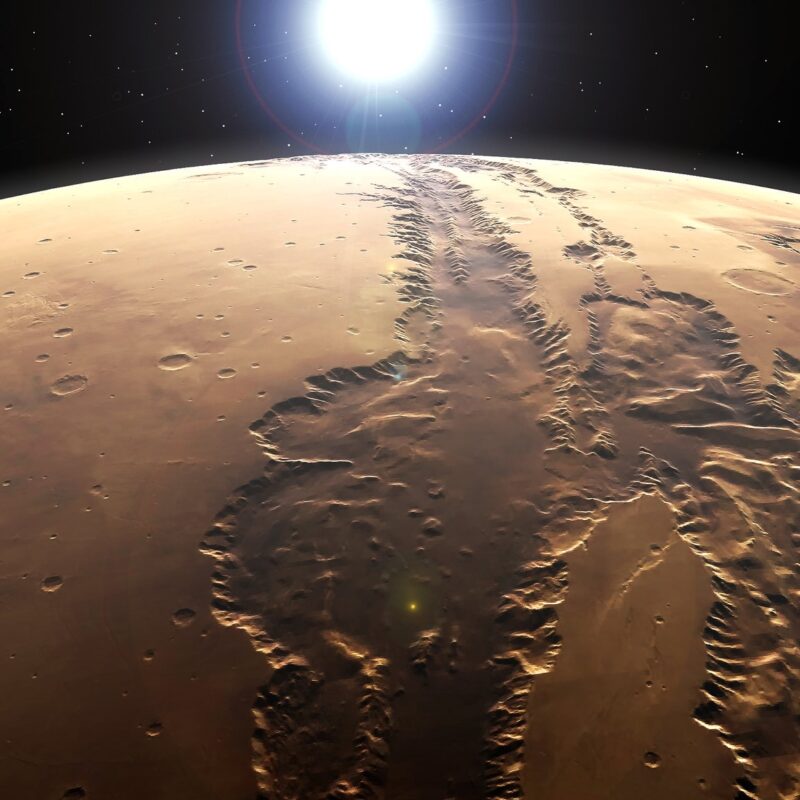
Huge canyon system on a brownish-red planet viewed from space, with a bright sun in the distance.
View larger. | Artist’s concept of the view over Valles Marineris, aka the Grand Canyon of Mars. Researchers have found new evidence for an ancient Mars ocean within the canyon. Still-visible deltas show that rivers once emptied into this alien ocean along an ancient shoreline, including in Coprates Chasma in the southeastern part of the canyon system. Image via Kevin Gill/ Flickr.

Bottom line: New analysis shows that two possible marsquakes detected by Viking 2 were in the same region as nearly 1,000 others detected by the InSight lander decades later.

Source: Fifty Years Later: Revisiting Viking 2 Seismic Signals Through InSight

Via Eos

Read more:

Marsquakes might explain Mars’ north-south hemisphere differences

Marsquakes reveal red planet’s deep secrets

InSight Lander reveals 1st marsquakes on Mars

The post Did the Viking 2 lander detect marsquakes in 1976? first appeared on EarthSky.


from EarthSky https://ift.tt/mEeO9vx
Marsquakes: Partial view of a robotic machine on reddish, rocky terrain, with dusty sky.
NASA’s Viking 2 landed on Mars in 1976. It detected 2 possible marsquakes, on sols 53 and 80. Decades later, NASA’s InSight lander detected nearly 1,000 marsquakes, some of them in the same region as the Viking 2 events. Image via NASA/ JPL-Caltech.
  • Mars has marsquakes, the equivalent of Earth’s earthquakes. They show this neighboring planet is still seismically active.
  • NASA’s Viking 2 lander detected two possible marsquakes back in 1976. But they weren’t confirmed at the time.
  • From 2018 to 2022, NASA’s InSight lander detected nearly 1,000 marsquakes. A new analysis shows that some of them were from the same region as the 1976 Viking 2 detections.

Science news, night sky events and beautiful photos, all in one place. Click here to subscribe to our free daily newsletter.

Marsquakes in the same place decades apart

The Viking 2 lander — 4th spacecraft from Earth ever to land on Mars — touched down on September 3, 1976. It landed in a region we earthlings call Utopia Planitia. Viking 2’s job was to search for signs of Martian life (it didn’t conclusively find any). It did carry a seismometer, with the hope it might detect marsquakes. But the instrument — mounted on the top deck of the lander — was susceptible to the Martian wind. And it was hard for scientists to separate true seismology from the wind’s vibrational “noise.”

Still, Viking 2 did detect what scientists believed were two small marsquakes on the plains of Utopia Planitia. It felt them on sol 53 and sol 80 of the mission. A sol is a Martian day, slightly longer than an Earth day.

Fast forward some four decades. Now, another Mars spacecraft — NASA’s InSight lander, which set down in Elysium Planitia in 2018 — has detected nearly 1,000 marsquakes in the same approximate region where Viking 2 landed in 1976. Has InSight confirmed Viking 2’s marsquakes? Not exactly. But by comparing the data from the two missions, scientists have gained new clues to the seismic history of Mars.

The researchers published their peer-reviewed findings in AGU Advances on September 30, 2026.

And Matthew R. Francis wrote about the new findings for Eos on October 21, 2026.

Artist's illustration of a robot spacecraft on a red desert plain.
Artist’s concept of NASA’s Mars InSight lander. It touched down on Mars on November 26, 2018. Image via NASA/ JPL/ Caltech.

Comparing the data

Viking 2’s landing site in Utopia Planitia — and InSight’s landing site in Elysium Planitia — are both in Mars’ northern lowlands. They are geographically adjacent regions, so similar that scientists and science journalists often refer to the Elysium-Utopia basin.

In the decades in between Viking 2 and InSight, scientists have pondered whether Mars was still geologically active. Now we know the planet does still experience marsquakes, the Martian equivalent of earthquakes.

Wanbo Xiao at Peking University in China is the lead author of the new InSight study. Xiao and his team compared the data from the old Viking 2 mission to the more recent data from InSight.

While one of the two detections by Viking 2 was dubious (probably because of the wind), the second one appeared more likely to be an actual marsquake.

Of course, though, Viking 2 had just one tiny seismometer, on its deck. And InSight was designed specifically to look for marsquakes or other seismic activity below the Martian surface. Its seismometer was more advanced and placed directly on the ground. The paper states:

For nearly 50 years, scientists debated whether the candidate seismic signals recorded by Viking 2 reflected true Martian tectonics, considering limitations of the Viking instrument. Decades later, the substantial marsquakes detected by the InSight mission revealed a clearer seismic context of the planet. Here we reconstruct the original Viking seismic workflow and reexamine its candidate events, recorded on sol 53 and sol 80, using modern knowledge from InSight.

Robotic lander on a planetary surface, with view of layers of rock beneath it in orange colors.
View larger. | Illustration depicting NASA’s InSight lander, with a cutaway view of the subsurface of Mars. Image via PGP/ Nicolas Sarter/ Jet Propulsion Laboratory/ NASA.

Marsquake or meteorite impact?

Viking 2’s sol 80 event was in the same region in Mars’ northern plains as the InSight detections. But — even after all these decades — it’s still not clear if it was an actual marsquake. It’s possible that a meteorite impact caused the seismic waves. As the paper notes:

The sol 80 event possibly located in the same northern-plains source region inferred for InSight seasonal marsquakes, although a distant tectonic marsquake or a meteorite impact remain as alternative explanations. The faster decay of the sol 80 event than typical InSight marsquakes could imply lateral variations of structural energy absorption in the Martian subsurface.

More broadly, this study shows how a historical planetary data set can gain new scientific implications when revisited using later mission data.

So what is the explanation for the differences between the Viking 2 data and the InSight data? The researchers conclude that there are probably several reasons. As they mentioned in the paper:

Fifty years after Viking 2 returned the first seismic observations from Mars, we reconstruct its unique seismic workflow and reassess the most credible candidate event, the sol 80 signal, using knowledge gained from the InSight mission. Our analysis reveals that the apparent contrast between Viking and InSight seismic observations primarily reflects differences in instrument response, sampling strategy, and the distinct spectral characteristics of Martian seismic events, rather than a change in Martian activity alone.

Marsquakes offer clues to seismic history on Mars

The sol 80 event in particular provides more clues to the history of seismic activity on Mars. As the paper explains:

The Viking 2 sol 80 event provides new constraints on Mars’ seismic history. Its independently inferred location overlaps the broad northern-plains region associated with InSight seasonal marsquakes, suggesting a possible long-lived active region outside Cerberus Fossae. However, alternative origins, including a distant tectonic marsquake analogous to InSight BB [broadband] events or a meteorite impact analogous to VF [very high frequency] events, cannot be excluded.

Small white metallic dome with long tether attached sitting on reddish dusty ground with small rocks and dusty sky.
View larger. | NASA’s InSight lander took this image of its seismometer on sol 96 (March 5, 2019). InSight detected many marsquakes in the subsurface but not aquifers. If they exist, they are probably too deep for detection with a regular radar. Image via NASA/ JPL-Caltech.

Mars’ ‘Grand Canyon’ and others also still active

Valles Marineris. Scientists with Columbia University and Imperial College London just reported this month that the so-called Mars’ Grand Canyon — Valles Marineris — also is still experiencing marsquakes. That data came from the InSight lander, too. Valles Marineris is located south and southwest of both Utopia Planitia and Elysium Planitia. It straddles the Martian equator and stretches more than 2,500 miles (4,000 km), nine times longer than the Grand Canyon on Earth.

Cerberus Fossae. This is Mars’ primary seismic “hotspot.” It’s located east of InSight’s landing site and is a system of massive, young parallel fissures and faults running through the crust. InSight traced hundreds of marsquakes directly to magma movement, localized faulting, and active stress release in this region.

Tharsis Volcanic Region. Other distant, low-frequency quakes were traced back toward the Tharsis rise — the vast volcanic plateau home to Olympus Mons and the three massive Tharsis Montes volcanoes — indicating deep mantle activity or residual cooling under the volcanoes.

In addition, InSight recorded several seismic signals that appeared to be non-tectonic “impact quakes” caused by meteoroid strikes. Mars orbiters confirmed these by spotting fresh, newly formed impact craters in regions like Amazonis Planitia and Cerberus Fossae.

Huge canyon system on a brownish-red planet viewed from space, with a bright sun in the distance.
View larger. | Artist’s concept of the view over Valles Marineris, aka the Grand Canyon of Mars. Researchers have found new evidence for an ancient Mars ocean within the canyon. Still-visible deltas show that rivers once emptied into this alien ocean along an ancient shoreline, including in Coprates Chasma in the southeastern part of the canyon system. Image via Kevin Gill/ Flickr.

Bottom line: New analysis shows that two possible marsquakes detected by Viking 2 were in the same region as nearly 1,000 others detected by the InSight lander decades later.

Source: Fifty Years Later: Revisiting Viking 2 Seismic Signals Through InSight

Via Eos

Read more:

Marsquakes might explain Mars’ north-south hemisphere differences

Marsquakes reveal red planet’s deep secrets

InSight Lander reveals 1st marsquakes on Mars

The post Did the Viking 2 lander detect marsquakes in 1976? first appeared on EarthSky.


from EarthSky https://ift.tt/mEeO9vx
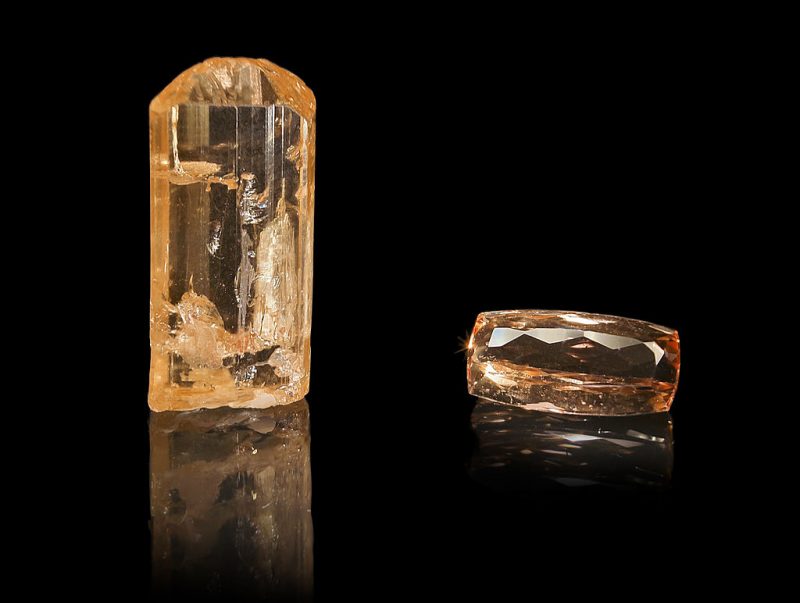
November birthstone: Choose from either topaz or citrine

November birthstone: Two golden colored, transparent colored gemstones, one a natural crystal and one faceted.
A natural topaz crystal and a faceted topaz. Topaz is 1 of the 2 options for the November birthstone. The other choice is citrine. Image via Didier Descouens/ Wikipedia.

Topaz, a November birthstone

Topaz, one of two November birthstones, an exquisite gem of many colors, is a much sought-after gemstone for jewelry. In ancient times, people believed that topaz possessed magical and healing qualities. Its name may originate from the Sanskrit word for fire.

You deserve a daily dose of good news. For the latest in science and the night sky, subscribe to EarthSky’s free daily newsletter.

Colors of topaz

Topaz occurs in a range of magnificent colors: pale blue, pink, red, brown, varying shades of yellow, and even black. However, pure topaz itself is a colorless stone. Some red and some pink topazes get their colors from chromium atoms in the crystal. Most other colors occur due to minor element substitutions and defects in the crystal. However, some colors are unstable and can fade away. Heat can cause color changes. But high-energy irradiation of colorless topaz can transform it to blue gemstones.

Chemically, topaz is an aluminum silicate mineral containing fluorine and hydroxide (a hydrogen-oxygen molecule). Strong chemical bonds within topaz make it the hardest of silicate minerals, rating 8 on the Mohs scale. According to Geoscience Australia, high concentrations of fluorine — a condition needed for topaz formation — are geologically rare. They explained that topaz forms in cavities in certain igneous rocks:

The crystals grow in the late stages of a magma cooling, when there is enough fluorine to enable the formation of topaz. Some topaz crystals grow after hot fluids (hydrothermal solutions), rich in fluorine, flow through cracks in rocks that have already cooled.

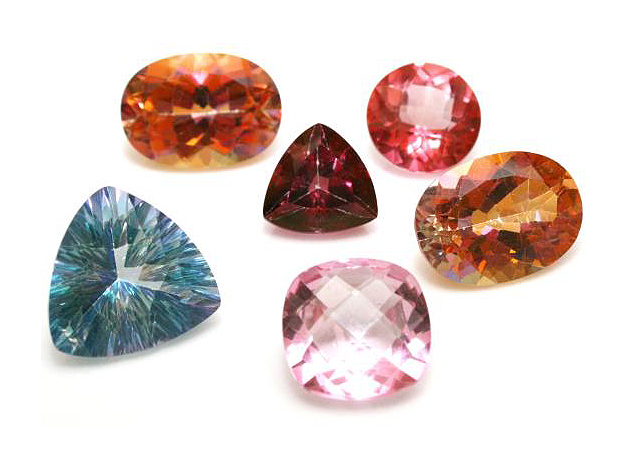
Glittering faceted gemstones in several colors: round, oval, square, and triangular.
Different colors of topaz. Image via Michelle Jo/ Wikipedia.

Topaz on display

Topaz gemstones occur in many sizes, from tiny crystals to large rocks. For example, one of the biggest uncut topaz stones, a specimen from Brazil, weighs almost 600 pounds (270 kg). It’s on display at the American Museum of Natural History in New York.

And one of the largest cut topazes in the world – the American Golden Topaz – resides at the Smithsonian Museum of Natural History in Washington, D.C. It weighs 10.1 pounds (4.6 kg) and is about 7 inches (18 cm) in length.

Uses for topaz

The lively fire, clarity, colors and hardness of topaz make it ideal for jewelry such as necklaces, brooches and bracelets. People sometimes mistake colorless pure topaz for a diamond. Because of its rarity, topaz is an expensive gem. The most valued and rarest color is red. Imperial topaz — sherry-colored varieties of brownish-yellow, orange-yellow and reddish brown — are the most popular topaz stones. They command high prices, as do pink stones. Light blue and pale yellow topazes are of less value, but are nevertheless stunning gemstones.

Besides its use in jewelry, topaz has industrial applications. For example, it’s used as a refractory material in kilns and furnaces because it maintains its strength under extreme heat. That property also makes it useful as a mold for molten glass and metals.

Brazil is the largest producer of topaz, the most notable source being the Minas Geranis region. Also, Topaz is mined in several countries including Pakistan, Sri Lanka, Russia and Australia. And in the United States, people have found it in Utah, Texas and California.

Topaz lore

The gemstone’s name, topaz, may have originated from the Sanskrit word meaning fire. However, there’s also a more convoluted alternate story. The gemstone’s name might be from an ancient Greek island in the Red Sea called Topazos. The island, supposedly difficult to locate, was where people mined a yellow stone. Most now think that stone is actually chrysolite.

In ancient lore, topaz had the power to cool boiling water. Supposedly, these gemstones made their owners cheerful, giving them pleasant dreams. People also believed that those who wore topaz would have a long life with beauty and intelligence.

During the Middle Ages, people believed that gemstones with special engravings held great powers. The 13th century “Book of Wings” by Ragiel said about the topaz:

The figure of a falcon, if on a topaz, helps to acquire the goodwill of kings, princes, and magnates.

As medication, people tried to cure fevers with topaz. They added powdered topaz to wine to prevent asthma and insomnia. They believed that a topaz held in the hand of a woman during childbirth lessened her pain.

Saint Hildegard, a 12th century German Benedictine abbess, recommended topaz as a cure for weak vision. People immersed the stone in wine for three days and nights, then rubbed the liquid on the eyes. A 15th century Roman physician claimed to have cured plague sores by touching them with a topaz that once belonged to two Catholic popes.

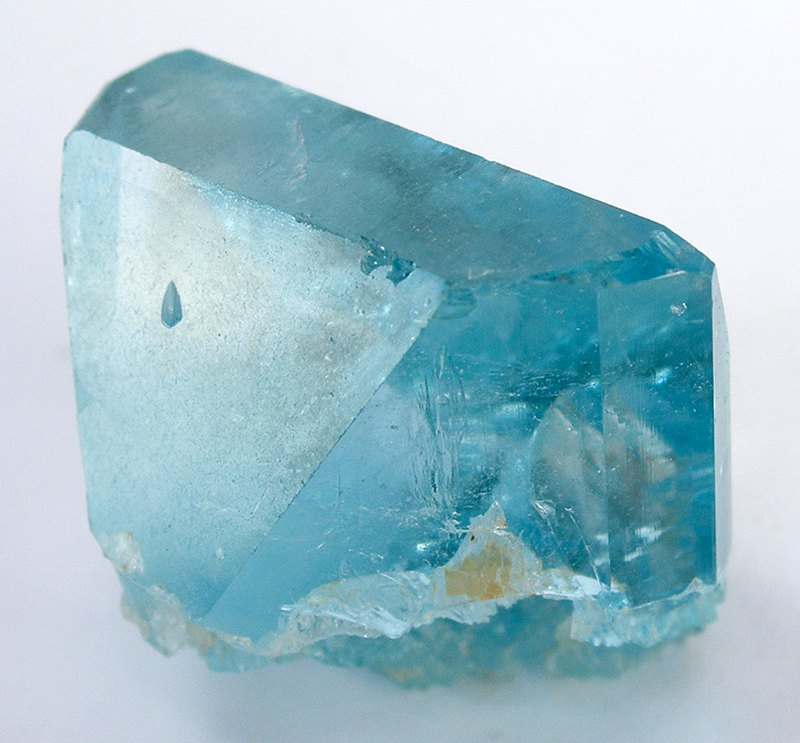
A chunk of clear light blue topaz, a natural crystal with flat sides.
Blue topaz from Zimbabwe. The rock measures about 1.4 x 1.1 x 1 inches (3.5 x 2.8 x 2.5 cm). Image via Robert M. Lavinsky/ Wikimedia Commons.

Citrine is another choice

Yellow citrine is one of the many colors found in the quartz family. Citrine colors range from a pale yellow to reddish-orange to brown. Occasionally, citrine is a yellow-green color. Its coloring agent is iron. Also, natural citrine is rare, so most citrines you find in jewelry are heat-treated smoky quartz or amethyst.

Even though yellow topaz and citrine look alike visually, they have a different rating on the Mohs hardness scale. Topaz is slightly a harder gemstone than citrine rated at 8 on the Mohs scale, and citrine is a 7. Other yellow gemstones include golden beryl and tourmaline.

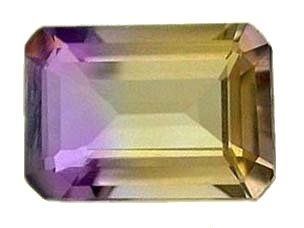
A unique gemstone – ametrine – is sometimes unearthed. It’s a mixture of citrine and amethyst occurring in the same crystal. It is especially attractive when both the yellow and purple are vibrant and the split is down the middle of the gemstone.

A faceted rectangular gemstone purple at one end fading into yellow at the other end.
A combination of 2 forms of quartz – citrine and amethyst – called ametrine. Image via Wikimedia Commons.

Brazil produces the most citrine. Citrine is also found in Madagascar, the United States, Argentina, Myanmar, Namibia, Russia, Scotland and Spain.

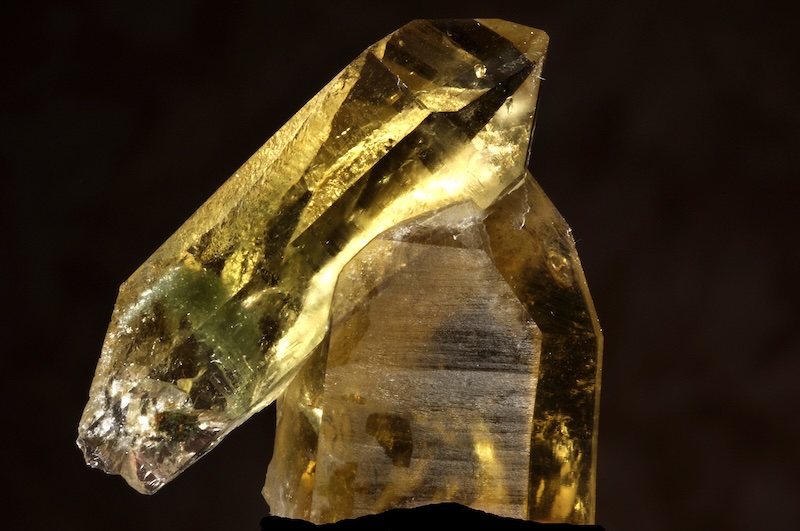
Two pointed, hexagonal natural crystals of a transparent yellow gemstone.
Citrine crystals. Image via Parent Géry/ Wikimedia Commons.

History of citrine

Citrine comes from the Latin word citrina which means “yellow”.

Using citrine as a gemstone began in Greece starting about 300 BCE, during the Hellenistic Age. Since citrine was associated with prosperity, it is also called the “merchant’s stone” or the “money stone.”

See the birthstones for the rest of the year

January birthstone
February birthstone
March birthstone
April birthstone
May birthstone
June birthstone
July birthstone
August birthstone
September birthstone
October birthstone
November birthstone
December birthstone

Bottom line: Topaz and citrine are the November birthstones. Topaz is a hard mineral popular in jewelry, with an enduring mythology of magical and healing powers. Citrine is a member of the quartz family. So November babies have some colorful choices for their birthstone.

The post November birthstone: Choose from either topaz or citrine first appeared on EarthSky.


from EarthSky https://ift.tt/G631XUH

Could the Taurid meteors bring a risk of airbursts in 2026?

A streak of colored light coming from the upper right and expanding near the bottom.
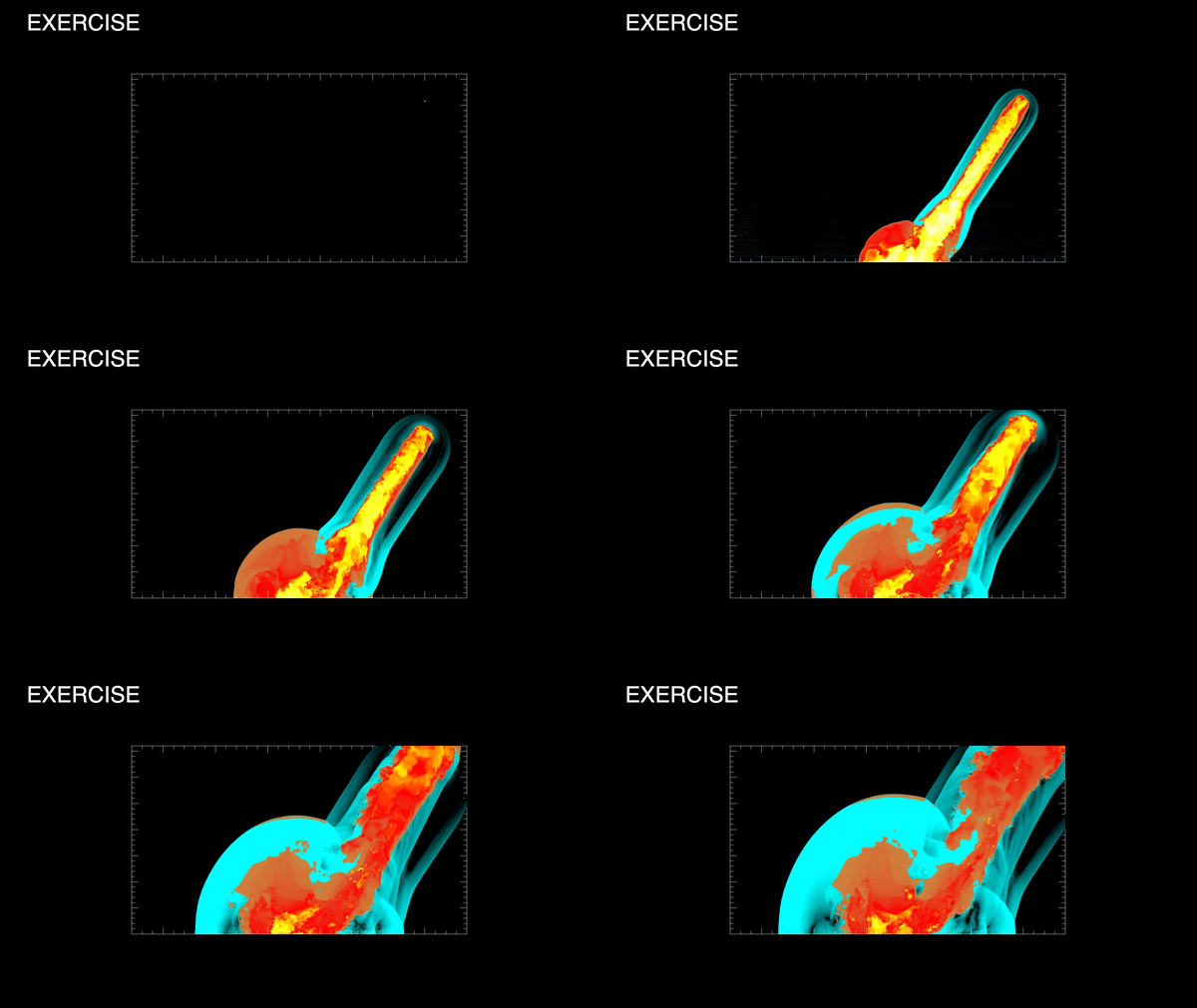
This animation doesn’t illustrate a real impact from space. It’s a simulation, showing a hypothetical impact of an asteroid impact over Denver, Colorado, on a hypothetical future date: April 28, 2027. Physicist Mark Boslough — an expert in planetary defense — said: “The blue pinprick is the first step of my simulation of an asteroid descending over Denver … ” This image was from a 2019 NASA conference on planetary defense.

Science news, night sky events and beautiful photos, all in one place. Click here to subscribe to EarthSky’s free daily newsletter.

Could Taurid meteors bring an airburst in 2026?

Last year, we told you about a new study suggesting the yearly Taurid meteor shower — and its associated Halloween fireballs — might bring an increased risk of an airburst in 2032 and 2036. The lead author of that study, physicist and planetary defense expert Mark Boslough of the University of New Mexico, contacted EarthSky this week.

His new calculations now suggest a risk of airburst from the Taurids in 2026. But he says the possibility rests on two big, unproven assumptions. Let’s dive in.

In the 2025 study, researchers described a hypothetical swarm of larger objects within the Taurid meteor stream. The study suggested Earth could pass near this swarm in 2032 and 2036, potentially increasing the risk of an airburst in our atmosphere. What’s an airburst? It’s an explosion in Earth’s atmosphere caused by an incoming space rock. The most famous airburst happened in the Tunguska region of Siberia in 1908. And the Chelyabinsk meteor in 2013 — which broke windows in six Russian cities — was also an airburst.

Boslough has now outlined a more speculative possibility: Could more Taurid objects — related to the famous 1908 Tunguska explosion — still be out there in space? And if so, could they return to Earth’s vicinity in 2026?

Tunguska and the Taurids

The Tunguska event flattened forestland in Siberia. Scientists say it happened when a space rock created an airburst in the atmosphere. And some researchers have linked the Tunguska event to the Beta Taurids, a daytime meteor shower associated with the same stream of debris that produces the better-known North and South Taurids in October and November.

Boslough’s 2025 study related to hypothetical objects — associated with the Taurid meteor stream — that might be in an resonance orbit with Earth. An orbital resonance is two orbiting bodies whose orbital periods are related by some ratio.

In other words, was the object that created the Tunguska event a solitary object in space? Or was it part of a cluster of objects, which in turn are associated with the well-known Taurid meteor shower? And if so are there still objects out there in space in a resonance orbit with Earth — an orbit that will bring them back to our vicinity?

We don’t know the answers to these questions. But Boslough estimates that — if they exist — such objects would orbit the sun 18 times for every 61 Earth orbits (an 18:61 resonance orbit with Earth).

So if the Tunguska object did belong to a cluster of debris in that particular resonance orbit, then the cluster — perhaps containing objects big enough to create another airburst — might return to Earth’s vicinity every 61 years. 1908 + 61 = 1969. And 1969 + 61 = 2030. So what does that mean for 2026?

Mark Boslough told EarthSky that, yes, an object in a 61-year resonance orbit would return in June 1930. But, he said:

So imagine if the Tunguska object had missed the Earth in 1908. Then it could return in 2030.  The Halloween 2026 date is significant because the same resonance that creates a close June encounter in 2030 creates a close encounter around Halloween, four years earlier (2026). 

…The good thing about the Taurid resonant swarm hypothesis is that it’s testable. And we will know for sure in 2032 if it really exists.

Of course, these are all events based on hypotheticals. As Boslough told EarthSky, this might only happen:

…IF the Tunguska object was part of a cluster, and IF it had the same orbital elements as the hypothetical swarm (both are big ifs). I will be the first to caution that this is highly speculative because of those two big IFs. We do not know if either are true.

Read on for more insight from the 2025 study.

Halloween fireballs

The term Halloween fireballs refers to the unusually bright meteors (fireballs) produced in some years (but not all years) by the Taurid meteor shower. This shower peaks every year in late October and early November. So if you’re a meteor watcher, there’s a good chance you’ve seen a Halloween fireball already.

Most meteor showers come from comets. When a comet comes in toward the sun, it warms up and releases a trail of debris – dust particles and rocks – along its path. Earth frequently crosses comet paths in its own orbit around the sun. The bits of comet dust and rock enter our atmosphere and burn up due to friction with the air … and voila! We have a meteor shower.

The Taurid shower is a bit different. Astronomers believe it might be the result of a large object that broke up, creating Comet Encke and several asteroids. And scientists think that one of those asteroids – 2004 TG10 – is the parent to the Taurid meteor shower. This asteroid, which the Spacewatch program discovered on October 8, 2004, has an orbit that matches Comet Encke.

And there are multiple Taurid meteor showers. The South and North Taurids are November meteor showers, and the Beta Taurids in June are a daylight shower. They are all associated with Comet Encke and its debris.

Do the Taurid fireballs suggest larger-sized objects moving within the Taurid meteor stream? Some astronomers have even suggested there could be large asteroids hiding in the Taurid stream. But we don’t know if that’s the case.

A matter of planetary defense

Still, it’s a possibility we have to take seriously. Astronomer Mark Boslough said that investigating the possibility of the Taurid meteors producing airbursts is a matter of planetary defense. That’s because, in the past, airbursts have wreaked havoc on the ground.

Boslough said:

Planetary defense is the multidisciplinary and internationally coordinated effort to protect the Earth and its inhabitants from impacts by near-Earth objects. It requires surveys to discover and track near-Earth objects, campaigns to characterize those that are hazardous, modeling efforts to understand and predict impact effects and associated consequences, and mitigation through impact avoidance and/or civil defense.

Researching the Halloween fireballs

The researchers looked at observational data on the Taurid meteors. They found:

… the risk from airburst-sized near-Earth objects, which are small enough to explode in the atmosphere instead of striking the ground, might be larger than currently estimated.

The debris that lights up the Taurid meteors or Halloween fireballs is in harmony with Jupiter’s orbit. For every seven orbits of the sun the debris stream makes, Jupiter makes two orbits. This puts it in resonance with Jupiter. So part of its stream approaches Jupiter at regular intervals. And Jupiter’s large gravity might help organize that stream into dense clusters. The researchers said if Jupiter is indeed having this affect on the swarm, Earth could pass near these denser clusters in 2032 and 2036.

Thus we have the increased risk of airbursts in Earth’s atmosphere.

Halloween fireballs: A man in a long-sleeve orange shirt and khaki pants standing in the desert holding a camera.
Mark Boslough of the University of New Mexico is the lead author of the new paper. Image via UNM.

Bottom line: A researcher from the University of New Mexico said the Taurid meteor shower could bring an increased risk of an airburst in 2026. But it’s based on some pretty big IFs.

Source of the 2025 study: 2032 and 2036 risk enhancement from NEOs in the Taurid stream: Is there a significant coherent component to impact risk?

Via University of New Mexico

The post Could the Taurid meteors bring a risk of airbursts in 2026? first appeared on EarthSky.


from EarthSky https://ift.tt/6r0VLsN

Daylight Time ends Sunday: 7 tips to help you adjust

Daylight time ends: Closeup of the face of a soundly sleeping baby.
Daylight Time ends Sunday, November 1, 2026. You can sleep like a baby one hour longer! Image via Joni Stewart. Used with permission.

Daylight Time ends

Are you a fan of daylight saving time? Like it or not, the U.S. and parts of Canada continue to use daylight saving time. So at 2 a.m. on Sunday, November 1, 2026, clocks in most U.S. states and select Canadian provinces are due to be turned back one hour (European countries already changed last weekend). So, fall back, clock-watchers!

And, once again, Daylight Time ends for many of us. It’ll begin again on Sunday, March 14, 2027.

That’s unless the U.S. Senate passes the sunshine protection act before then.

The memory tool for your clocks is spring forward, fall back. Easy to do with clocks. Less easy – for many – with our own bodies. According to WebMD, in general, “gaining” an hour in the fall is easier than “losing” an hour in the spring. But many report feeling groggy or off-kilter in the week following both the spring and fall time changes.

Didn’t the U.S. Congress vote on to change that before?

As you may remember, a bill to make daylight saving time permanent was passed by the U.S. Senate in 2022. However, it was never voted on by the U.S. House of Representatives.

Then the bill was introduced again in 2023. But according to Reuters:

The legislation, introduced by a bipartisan group of senators, was passed by the Senate in 2022 but stalled in the U.S. House of Representatives because lawmakers could not agree on whether to keep standard time or permanent daylight saving time.

And now in 2026, another bill is waiting to be voted on by the U.S. Senate. No one can agree on what to do about daylight saving time.

So in the meantime …

Here’s 7 tips to help you adjust

Here are some tips that might help you adjust, mostly adapted from a November 4, 2022, post by the American Academy of Sleep Medicine:

  1. Get at least seven hours of sleep (for adults) or eight hours of sleep (for teens) per night before and after the time change. You can use the American Academy of Sleep Medicine’s bedtime calculator to identify an appropriate nightly bedtime.
  2. Gradually adjust your sleep and wake times. Shift your bedtime 15 to 20 minutes earlier each night for a few nights before the spring time change, or 15 to 20 minutes later each night for a few nights before the fall time change. (If you are experiencing chronic insufficient sleep, you should avoid shifting your bedtime later before the fall time change; you will benefit from getting an “extra” hour of sleep on the night when you “fall back” to standard time.)
  3. Adjust other daily routines – such as mealtimes – to match your new schedule prior to the time change.
  4. Set your clocks to the new time on Saturday evening, and go to bed at your normal bedtime.
  5. Use light and darkness to help your body adjust. In the spring, head outside for some sunlight on Sunday morning and dim the lights in the evening. In the fall, minimize light exposure until your target morning wake time.
  6. Adjusting your exposure to light and darkness will help set your body clock, which regulates the timing of sleep and alertness.
  7. Get plenty of sleep on Sunday night to ensure you’re rested and ready for the week ahead.

Good luck!

Bottom line: Daylight Time ends on November 1, 2026, in North America. Here are seven tips from the American Academy of Sleep Medicine to help you adjust.

The post Daylight Time ends Sunday: 7 tips to help you adjust first appeared on EarthSky.


from EarthSky https://ift.tt/reTLgGh

Halloween is an astronomy holiday. It’s a cross-quarter day

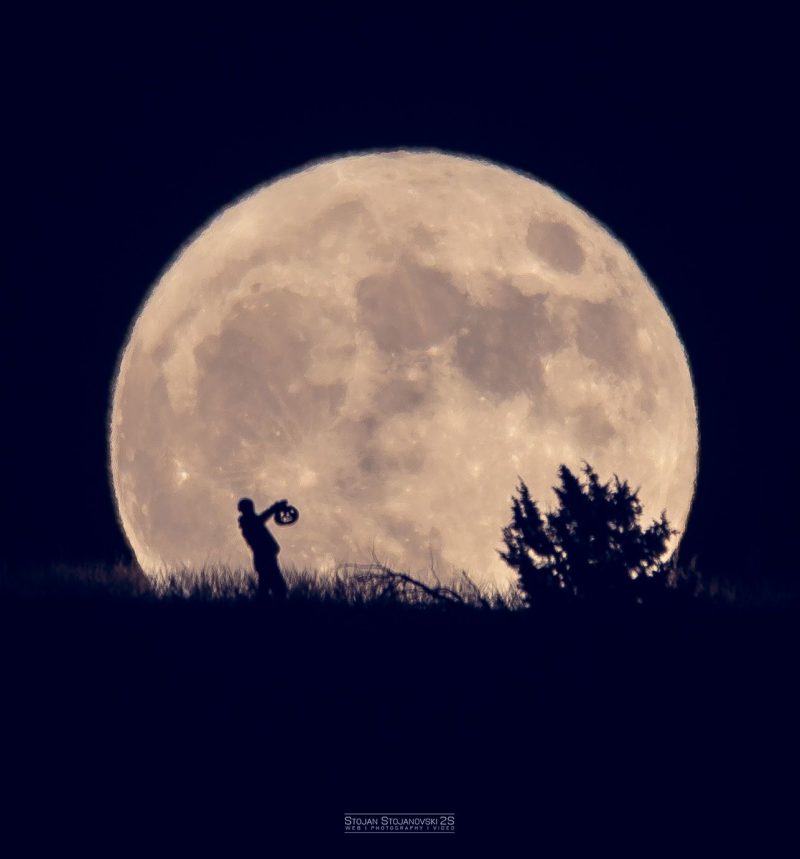
Halloween: A giant full moon on horizon with small, silhouetted man holding a jack-o-lantern.
View at EarthSky Community Photos. | Stojan Stojanovski in Debrca, Macedonia, caught this wonderful image on Halloween night in 2020, when there was a full moon. Thank you, Stojan! By the way, the next full moon on Halloween will be in 2039.

Halloween is a cross-quarter day

Sure, Halloween is the modern-day descendant of Samhain, a sacred festival of the ancient Celts and Druids in the British Isles. And, yes, Halloween is short for All Hallows’ Eve. But, at its heart, Halloween is an astronomy holiday, rooted in Earth’s orbit around the sun.

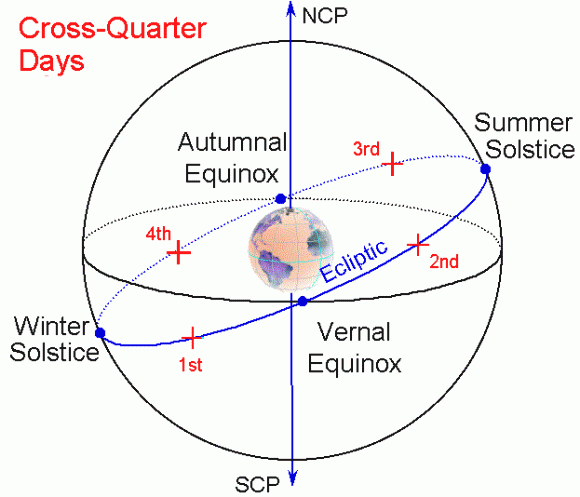
That’s because Halloween is a cross-quarter day, and a testament to our ancestors’ deep understanding of the sky. Cross-quarter days fall more or less midway between the equinoxes (when the sun sets due west) and solstices (when the sun sets at its most northern or southern point on the horizon). Halloween — October 31 — is approximately midway between our September equinox and December solstice.

In other words, in traditional astronomy, there are eight major seasonal subdivisions of every year. They include the March and September equinoxes, the June and December solstices and the intervening four cross-quarter days.

In modern times, the four cross-quarter days are often called Groundhog Day (February 2), May Day (May 1), Lammas (August 1) and Halloween (October 31).

Halloween falls at a dark time of year

For those of us in the Northern Hemisphere, Halloween is the darkest of the cross-quarter days. And it comes at a time of year when the days are growing shorter. Early people once said that the spirits of the dead wander from sunset until midnight around this cross-quarter day. After midnight – on November 1, now called All Saints’ Day – the ghosts supposedly go back to rest.

The October 31 date for Halloween is fixed by tradition. The true cross-quarter day falls on November 7, representing a discrepancy of about a week. According to the ancient Celts, a cross-quarter day marks the beginning – not the middle – of a season.

Diagram of Earth's orbit with equinoxes, solstices, and cross-quarter days marked.
Equinoxes, solstices and cross-quarter days are all hallmarks of Earth’s orbit around the sun. Halloween is the 4th cross-quarter day of the year. Illustration via NASA.

The Pleiades connection

Some believe that an early forebear of Halloween – Samhain – happened on the night that the Pleiades star cluster culminated at midnight.

In other words, the Pleiades climbed to its highest point in the sky at midnight on or near the same date as this cross-quarter day. Now, the midnight culmination of the Pleiades cluster occurs on November 21, but Halloween is fixed on October 31.

Presuming the supposed connection between Samhain and the midnight culmination of the Pleiades, the two events took place on or near the same date in the 11th century CE (1001-1100) and 12th century (1101-1200). This was several centuries before the introduction of the Gregorian calendar.

At that time, when the Julian calendar was in use, the cross-quarter day and the midnight culmination of the Pleiades fell – amazingly enough – on or near October 31. But, then, the Julian calendar was about one week out of step with the seasons. Had the Gregorian calendar been in use back then, the date of the cross-quarter day celebration would have been November 7.

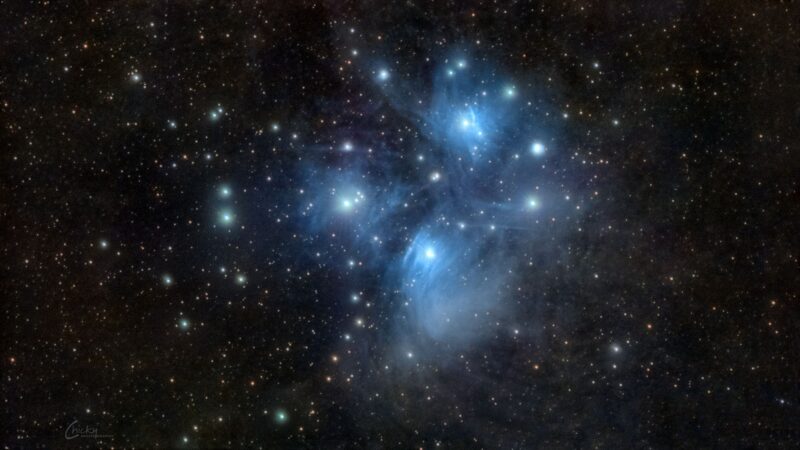
A large area of electric blue nebulosity with bright white stars immersed within.
View at EarthSky Community Photos. | Chicky Leclair in Helotes, Texas, completed this long exposure of the Pleiades star cluster on December 25, 2025. Thank you, Chicky!

Bottom line: October 31, the date for Halloween, marks the approximate midway point between the September equinox and the December solstice. So Halloween is an astronomy holiday, and one of the year’s four cross-quarter days.

Read about another cross-quarter day, Groundhog Day

May Day is a cross-quarter day

Enjoying EarthSky? Sign up for our free daily newsletter today!

The post Halloween is an astronomy holiday. It’s a cross-quarter day first appeared on EarthSky.


from EarthSky https://ift.tt/65lDTa2

The Witch Head Nebula rises near Orion on Halloween

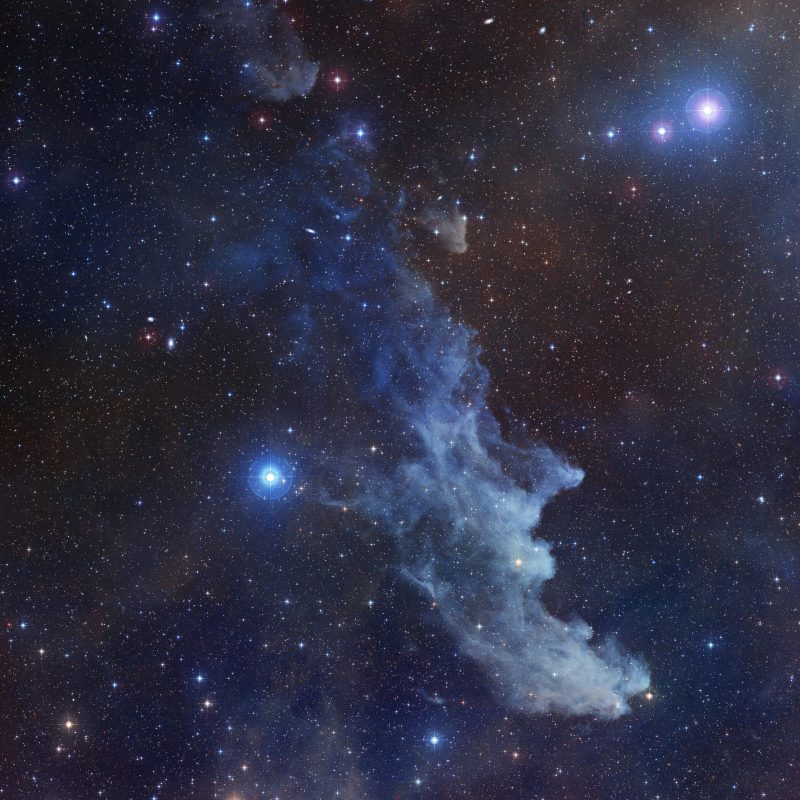
Witch Head nebula: Bluish-purple gas cloud in the profile of a witch with pointy nose and chin, in starry space.
The Witch Head Nebula – IC 2118 – lies near the bright star Rigel in Orion the Hunter. This reflection nebula is the perfect complement to the spooky season. Image via NASA/ STScI Digitized Sky Survey/ Noel Carboni.

Witch Head Nebula

It’s that time of year again, when creepy-crawlies and spine-chilling images tickle our imaginations. One of the spookiest views in the night sky is of the Witch Head Nebula, with the catalog designation IC 2118. The Witch Head Nebula is located near Orion‘s brightest star, Rigel. But Rigel is just outside the image above, so the witch gets all the attention. And, if the field of view was large enough to include the blue supergiant star, you could see that the witch appears to be gazing at Rigel.

The constellation Orion, accompanied by the Witch Head Nebula, rises from the eastern horizon before midnight every Halloween. This lengthy nebula spans 70 light-years across and lies 900 light-years from Earth. The nebula is extraordinarily faint, at magnitude 13, so you can only spot it with large telescopes.

Scientists think it might be an ancient supernova remnant. The Witch Head Nebula is categorized as a reflection nebula, or one that shines with the aid of a nearby star. In this case, Rigel shines its bright light on the gas and dust to create the reflection that we see. Basically, the dust reflects more blue light than red, which gives it its eerie purplish-blue hue.

Want to learn how to “capture the witch?” Try this post from the Galactic Hunter.

Want more ghoulish fun? Watch: Halloween Is an astronomy holiday

Some photos from our EarthSky Community

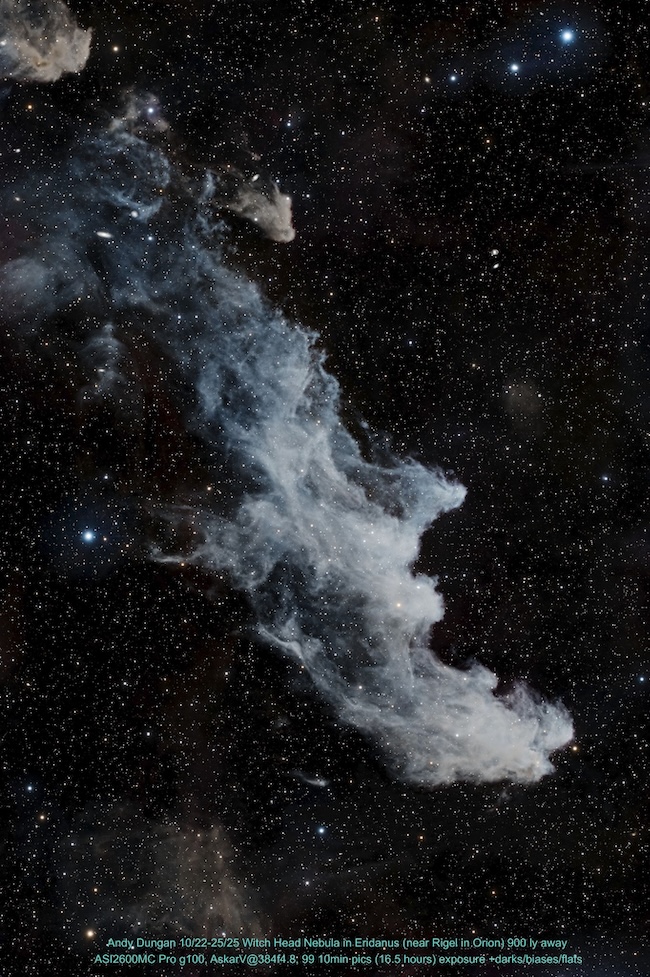
A whitish nebula against a dark, starry sky. The nebula looks like a witch head from the side with a pointy nose.
View at EarthSky Community Photos. | Andy Dungan captured this on October 26, 2025, from Colorado. Andy wrote: “It’s hard to believe 900 light years away is relatively close. This one fascinates me because it really looks like the profile of a witch with a pointy nose. And because it is illuminated by Rigel in Orion. It is thought to be part of a supernova remnant. This picture simply has to be taken prior to Halloween!” Thank you, Andy!
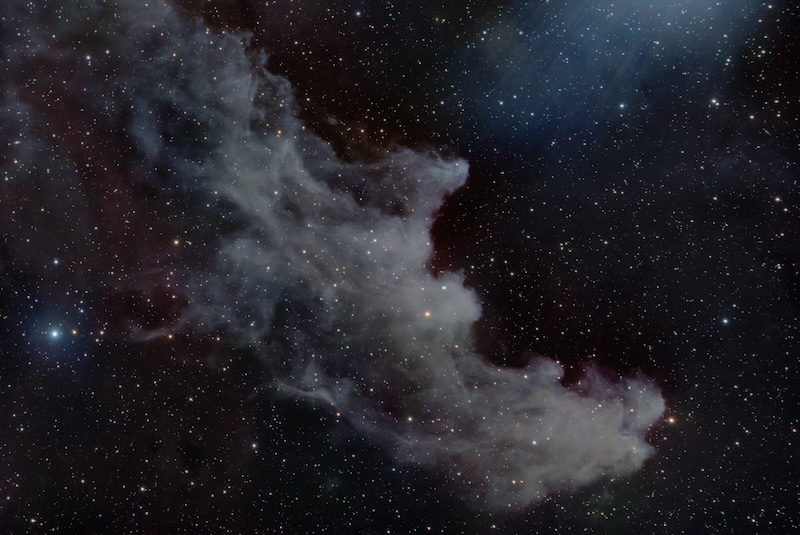
A ghostly nebula resembling witch's head from the side with a starry background and a glowing streak of blue at the top.
EarthSky’s Marcy Curran’s husband captured the Witch Head Nebula on December 2, 2024, from Wyoming. Martin said: “I like the blue glow because it looks like they’re astonished by whatever is out of the frame”. That’s the glow from the bright star Rigel. Thank you, Martin!

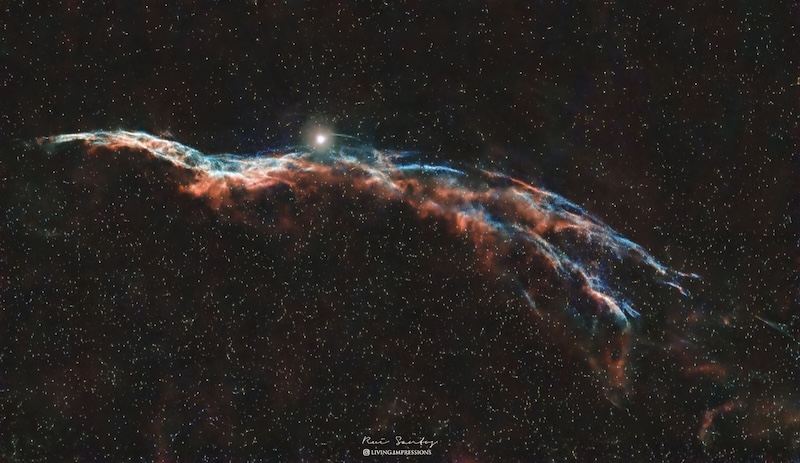
And, if you wonder how a witch can get around in the sky … there’s a Witch’s Broom Nebula located in Cygnus.

Streamers of blue and orange nebula resembling an old fashioned broom on a starry sky with a bright star above it.
View at EarthSky Community Photos. | Rui Santos captured this image on July 9, 2025, from Portugal. Rui wrote: “The Western Veil Nebula, in the constellation Cygnus, is part of a supernova remnant. So it’s the remains of a massive star that exploded around 8,000 years ago. It’s about 2,400 light-years from Earth and had nearly 20 times the mass of our sun! The explosion was so powerful that it hurled the star’s outer layers into space at incredibly high speeds. Those formed filament-like structures that glow as they collide with interstellar gas. It’s amazing to think that such a catastrophic event could leave behind something so incredibly beautiful.” It’s also known as the Witch’s Broom. Thank you, Rui!

Bottom line: The Witch Head Nebula rises near the star Rigel in Orion on Halloween night, but you need a telescope to see it.

Read more: Halloween is an astronomy holiday. It’s a cross-quarter day

Read more: Here’s where popular witch icons originated

The post The Witch Head Nebula rises near Orion on Halloween first appeared on EarthSky.


from EarthSky https://ift.tt/bQS1xKi

The enormous oarfish could inspire new ways to explore the ocean

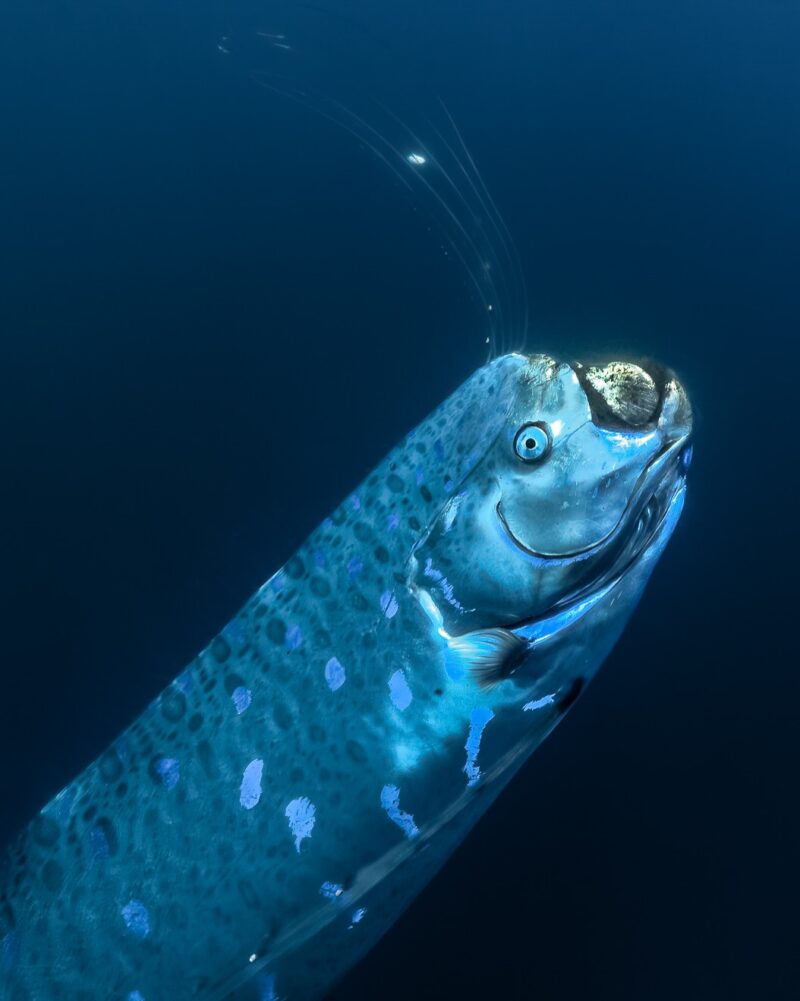
A long, spotted deep-sea fish with glowing white spots and long filaments on its head.
Scientists have uncovered some of the mysteries of the oarfish, one of the ocean’s largest yet most elusive inhabitants. Image via Isabelleandthesea.

The giant oarfish

If you’re fascinated by extraordinary creatures like the Loch Ness Monster, get ready to meet a real-life giant. But forget about the Scottish lochs. The oarfish inhabits the ocean’s depths, a dark world where sunlight barely reaches.

Few people have been lucky enough to see this magnificent animal in its vast natural habitat. And even fewer have had the chance to study it in depth. But late last month, a team of scientists discovered something fascinating. They unlocked the intricate mechanics behind this creature’s movement.

Could the oarfish’s remarkably efficient and stealthy swimming, powered by its long dorsal fin, hold the key to new advances in underwater robotics? Scientists hope these nature-inspired innovations could one day let us explore the ocean’s hidden wonders while leaving its inhabitants undisturbed.

The researchers published their study in the peer-reviewed journal BioOne on September 30, 2026.

The oarfish’s fin inspires underwater robotics

The giant oarfish can reach around 26 feet (8 meters) in length, making it a true ocean colossus. Its body is long and slender, with a ribbon-like shape that gradually tapers toward the rear. Just to give you an idea of how enormous it is, it took no fewer than 15 people to hold a specimen measuring 23 feet (7 meters)!

And its appearance is just as striking. This creature has no scales; instead, its sides shimmer with a brilliant silvery sheen thanks to a covering that contains guanine.

This smooth, metallic surface contrasts with its vivid red and orange dorsal fin. The fin runs along almost the entire length of its back. The first few fin rays are especially long, forming a striking crest above its head, as if the fish were wearing a crown of fire.

But its long dorsal fin is far more than decoration. It plays a major role in the fish’s movement. It generates waves along the fin without requiring large side-to-side movements of the body.

This raises a fascinating question: how does the fish coordinate such a long structure, made up of numerous fin rays, to produce such fluid motion? To understand this, researchers must look beyond its striking silhouette. They must examine how the muscles, joints and skeletal elements of its fin are arranged.

This is where a research project begins to connect the biology of the fish with a very different field: underwater robotics.

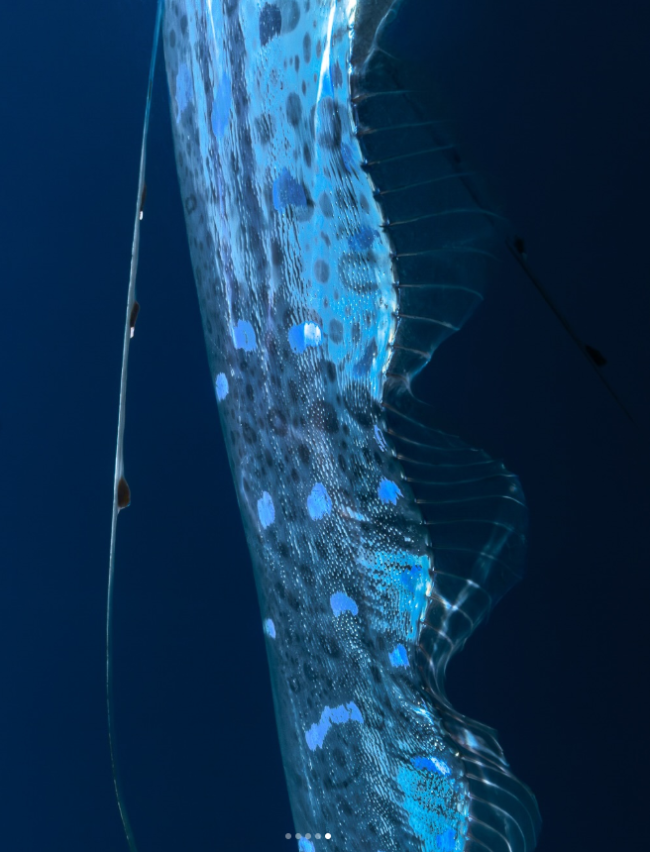
A long oarfish with a wavy dorsal fin along its back and ribbon-like pelvic fins.
The oarfish’s dorsal fin plays a key role in its remarkably efficient and stealthy swimming. Image via Isabelleandthesea.

The oarfish: Inspired by nature, designed to explore

Unlike many fish, the oarfish propels itself by sending waves along its dorsal fin while keeping its body relatively steady. Scientists already knew it swam this way. But they still needed to understand how it controls such a long, complex structure with such precise coordination.

To investigate, a research team led by Gabriel Vinícius Felix Afonso, a Ph.D. student at the Virginia Institute of Marine Science, studied the anatomy of the dorsal fin in detail. They examined specimens, using imaging techniques and analyzing videos of oarfish in the wild. They studied how the muscles, joints and fin rays are arranged and how they work together to produce movement.

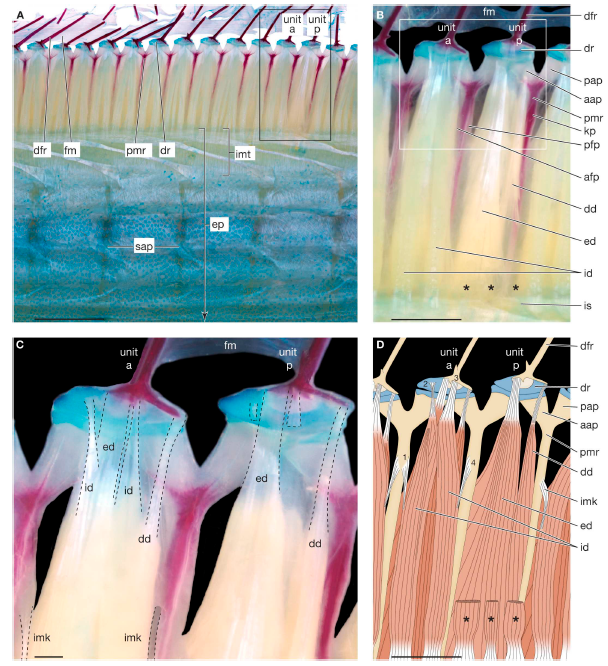
The findings revealed a surprising mechanism: a group of six muscles controls each fin ray, which attach to it at 12 points. The joint also works much like a ball-and-socket joint, similar to the one in the human shoulder, allowing it to rotate in every direction through a full 360 degrees. Together, these muscles and joints help explain how the fish coordinates its fin movements to generate waves along its length.

Where does the name oarfish come from?

Interestingly, the oarfish’s name does not come from its striking dorsal fin, but from its unusually long pelvic fins. Located beneath the front part of its body, each of these fins consists of a single ray that resembles a little oar. But despite inspiring the fish’s name, these pelvic fins are not primarily responsible for its distinctive swimming motion. That role belongs to the dorsal fin, whose precisely coordinated movements allow waves to travel along the fish’s body.

We asked Felix Afonso about why the oarfish inspired him to think about aquatic robotics. He said:

If you look at large species of fish that live in the open ocean, you will see fish with spindle-like shapes, such as tunas and billfish, as well as round shapes, such as sunfish and opahs. Unlike those species, the oarfish has an unusual body shape for an open-ocean fish. Interestingly, the oarfish does not swim by undulating its body like an eel. Instead, the oarfish keeps its body rigid while only its long dorsal fin undulates. This combination of an unusual body shape and an unexpected swimming mode attracted our attention, prompting us to study the oarfish’s functional morphology for future biomimetic robotic applications.

4 images showing fish bones, muscles and tendons that control fin movement.
Imaging reveals the intricate anatomy of the oarfish’s dorsal fin, including the muscles and joints that allow its fin rays to move with remarkable precision. Image via Afonso et al. 2026.

An inhabitant of the deep

Despite its unforgettable size, shimmering appearance, super-long pelvic fins and hypnotic dorsal fin motion, the oarfish remains one of the lesser-known inhabitants of the deep ocean.

The oarfish is found throughout the world’s oceans, particularly in tropical and temperate waters. But it lives mainly in open water, far from shore and at depths where sunlight grows increasingly faint.

It is typically found hundreds of feet below the surface, with records reaching depths of around 3,280 feet (1,000 meters). There, in an environment that is difficult to observe directly, much of its life unfolds beyond our view, leaving researchers with many unanswered questions.

In addition, sightings near the surface are unusual and sometimes involve animals that are weakened or in distress. This makes their behavior difficult to study. Finding a stranded specimen or one close to shore allows scientists to examine its anatomy, but it is not the same as observing how it lives and behaves in its natural environment.

Watch how the oarfish propels itself using nothing but waves traveling along its nearly transparent dorsal fin, while the rest of its body stays almost perfectly still. Video via Isabelleandthesea.

A giant that feeds on tiny prey

You might expect an animal this size to feed like a formidable predator, but the reality is quite different. The oarfish feeds mainly on small organisms, including krill and other planktonic crustaceans. Small fish and squid have also been reported among its possible prey.

Its head is relatively small compared with the length of its body and ends in a short, protrusible mouth that can extend forward to capture food. But it doesn’t need powerful jaws or an impressive set of teeth: its gill structures help trap tiny organisms as water passes through its mouth. Rather than chasing large prey, it makes use of much smaller food sources suspended in the water.

It’s remarkable that a fish capable of growing many feet long gets much of its nourishment from such tiny creatures. It’s also a reminder of just how diverse feeding strategies can be among marine animals.

The oarfish has also been observed swimming vertically, with its head pointing upward. Scientists believe this posture may help it spot prey silhouetted against the light filtering down from the surface. It may also make the fish less visible to predators looking down from above.

Shimmering like liquid silver, the oarfish reveals its striking appearance from every angle, whether seen up close or gliding in the distance. Video via Isabelleandthesea.

Nature’s lessons for safe ocean exploration

Over millions of years, animals have evolved remarkable ways to move, feed and adapt to their surroundings. Studying these abilities allows us to better understand the natural world, revealing just how much there is still to learn from the creatures with which we share our planet.

What we learn from them can also inspire new technologies. In the case of the oarfish, understanding how it swims could help researchers develop quieter underwater robots, opening up new ways to explore the ocean and observe marine life while causing as little disturbance as possible.

The more we learn about animals and the environments they depend on, the better we can protect them. By combining scientific discovery with more respectful ways of exploring, we can uncover some of the ocean’s secrets while helping preserve the remarkable life it sustains.

Take a closer look at oarfish larvae and watch as one extends its protrusible mouth in this fascinating close-up. Video via Bobtec.

Love wildlife and the natural world? Get the latest animal stories — as well as space and night sky updates delivered to your inbox.

Bottom line: The giant oarfish has a remarkable fin that could inspire quieter underwater robots and open new possibilities for ocean exploration and conservation.

Source: Dorsal-Fin Musculoskeletal System of Oarfishes (Regalecidae): Fin Rays as Rotating Elements in an Undulatory System

Via Cornell University

Read more:

Ocean sunfish are odd, gentle giants: Lifeform of the week

Anglerfish are our mysterious, deep-sea lifeform of the week

Seahorses are tiny, ravenous creatures: Lifeform of the week

The post The enormous oarfish could inspire new ways to explore the ocean first appeared on EarthSky.


from EarthSky https://ift.tt/G1Ur4ZK

adds 2