aads

Is Ophiuchus the 13th constellation of the zodiac?

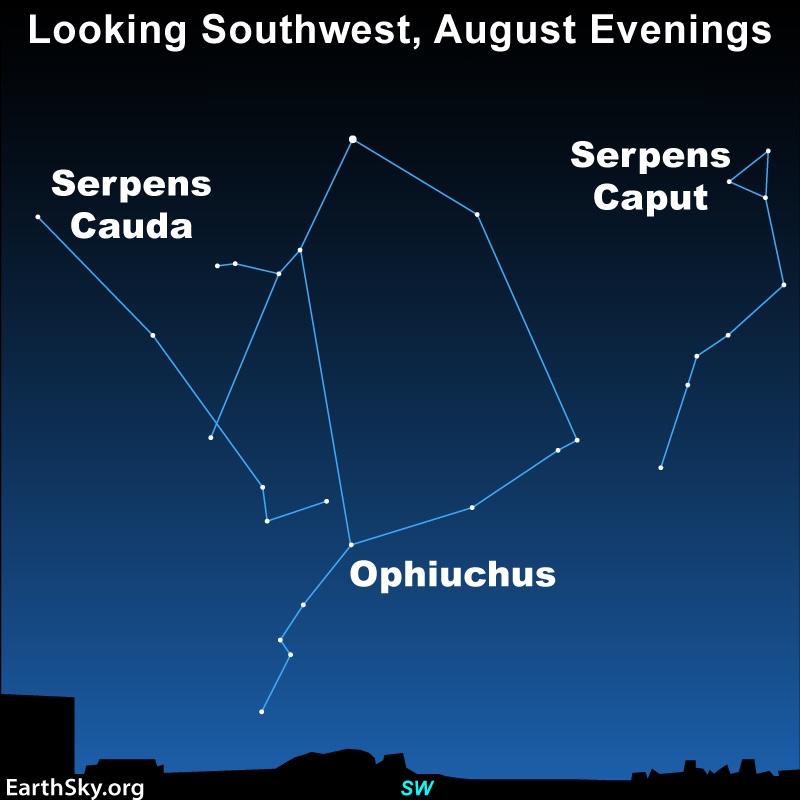
Star chart showing the stars that make up Serpens Cauda, Serpens Caput and Ophiuchus.
If you’re in the Northern Hemisphere, look southward on your summer evenings for mighty Ophiuchus the Serpent Bearer. It’s surrounded by the constellations Serpens Cauda and Serpens Caput. Chart via EarthSky.

Ophiuchus, the unofficial 13th constellation of the zodiac

If you were born somewhere between November 30 and December 18, chances are the sun was in the constellation Ophiuchus the Serpent Bearer. Therefore, your “sign” should be Ophiuchus. But, of course, Ophiuchus is not an official constellation of the zodiac, nor will you find it in horoscopes. Ophiuchus the Serpent Bearer is a large constellation that you can spot near the southern horizon from the Northern Hemisphere during July, August and September evenings. The Serpent Bearer is standing on the Scorpion and its red star Antares.

From the Southern Hemisphere, Ophiuchus is closer to overhead. Ophiuchus’ brightest star is Rasalhague.

The official boundary lines for all 88 constellations were drawn up by the International Astronomical Union (IAU) in the 1930s.

Signs versus constellations

Poor Ophiuchus. Nobody ever claims him as a birth sign, despite the fact that the ecliptic runs across him, too. After all, the band of the zodiac extends some 8 degrees north and south of the ecliptic, spanning a total of 16 degrees in width. And the constellations are not evenly spaced along this band in our sky. The signs of the zodiac are familiar to all who read online astrology advice. There are 12 familiar signs of the zodiac, but no Ophiuchus.

Yet the moon and planets do regularly move within the boundaries of Ophiuchus. And so does the sun. The sun is in front of Ophiuchus from about November 30 to December 18 each year.

The sun is said to enter the sign Sagittarius around November 21, or whenever the sun is precisely 30 degrees west of the December solstice point. And then the sun then enters the sign Capricorn on the December 21 solstice. So the sun passes through the “sign” Sagittarius for the period before and up to the December solstice, irrespective of the fact that the sun is actually shining in front of the constellation Ophiuchus from November 30 to December 18.

By the way, the December solstice point moves one degree westward in front of the zodiacal constellations – or backdrop stars – in about 72 years. This means that the December solstice point will finally move into the constellation Ophiuchus by the year 2269.
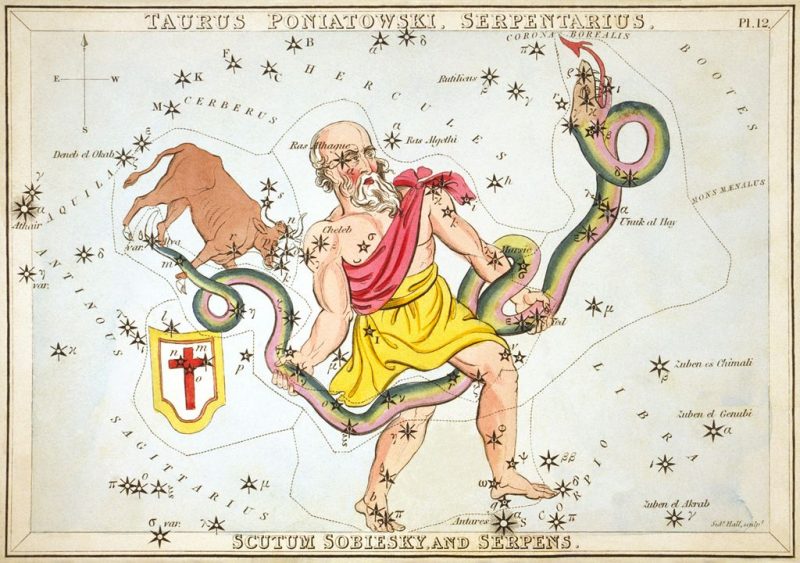
Antique color etching of old bald bearded man in ancient Greek garb holding a long writhing snake.
Ophiuchus holding the serpent, Serpens, as depicted in Urania’s Mirror, a set of constellation cards published in London circa 1825. Image via Adam Cuerden/ Wikipedia.

When and where to locate Ophiuchus

The best time to observe Ophiuchus is during a Northern Hemisphere summer (Southern Hemisphere winter). From the Northern Hemisphere, late July and early August present this constellation high in the southern sky at nightfall and early evening. It’s in the southwest sky on autumn evenings in the Northern Hemisphere.

This rather large constellation fills the area of sky to the north of the constellation Scorpius the Scorpion and to the south of the constellation Hercules the Strongman. If you’re familiar with Scorpius’ brightest star Antares, try star-hopping to Ophiuchus from this ruddy gem of a star. The head of Ophiuchus is marked by the star Rasalhague (Alpha Ophiuchi).
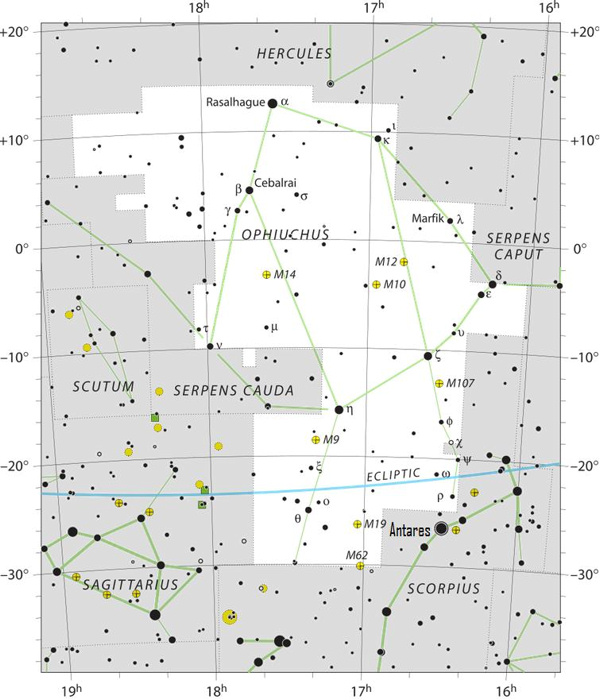
Star chart with labeled stars in black on white and green lines for the constellations.
View larger. | Ophiuchus the Serpent Bearer. Image via Wikipedia (CC BY 3.0).

Ophiuchus is joined in legend and in the sky to the constellation of the Serpent. If you have a dark sky, you might find this is one constellation that looks like what it’s supposed to be: a big guy holding a snake. The name Ophiuchus comes from two Greek words meaning serpent and holding.

Deep-sky objects in Ophiuchus

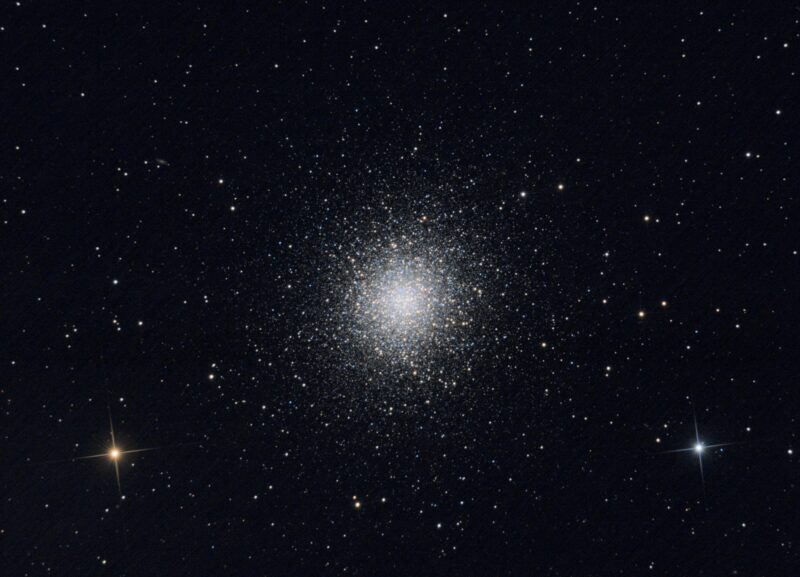
On a night when the moon is absent, take your binoculars and use them to scan Ophiuchus, which lies near the band of the Milky Way and so has many deep-sky wonders. Ophiuchus boasts of numerous globular clusters, for example. The two easiest globular clusters to see with ordinary binoculars are M10 and M12, as shown on the above chart. Through binoculars, they look like faint puffs of light, but with the telescope, you begin to see these globular clusters for what they really are. They are immense stellar cities spanning a hundred to a few hundred light-years in diameter, teeming with hundreds of thousands of stars.

Another big deep-sky favorite is the Pipe Nebula, a vast interstellar cloud of gas and dust sweeping across about 7 degrees of sky. At arm’s length, that’s about the width of three to four fingers. This dark nebula resides at a distance of 600 to 700 light-years in southern Ophiuchus. You can see it with the unaided eye in a dark, transparent sky. The Pipe Nebula is due east of the star Antares and due north of the stars Shaula and Lesath. These two stars (but not the Pipe Nebula) are shown on the above chart.

Ophiuchus in myth and star lore

In Greek sky lore, Ophiuchus represents Asclepius, Greek god of medicine and doctors. He is always holding a great serpent or snake. And, depending on how it’s used, a snake’s venom can either kill or cure. It’s said that Asclepius concocted a healing potion from the venom of Serpens the Serpent, mixing it with a Gorgon’s blood and an unknown herb. This potion gave humans access to immortality, until the god of the underworld, Pluto, appealed to the king of the gods. Pluto asked Zeus to reconsider the ramifications of the death of death.

We hardly know how Pluto made his appeal. Perhaps he said only that which never lives never dies, and that no mortal can have one without the other. Sophocles may have expressed the myth’s inherent message when saying:

Better to die, and sleep the never-waking sleep, than linger on and dare to live when the soul’s life is gone.

Possibly, the poet T.S. Eliot echoed the theme of the ever-living story in his Four Quartets:

We die with the dying:
See, they depart, and we go with them.
We are born with the dead:
See, they return, and bring us with them.

In any event, according to the myth, Zeus confiscated the potion, removed Asclepius from Earth and placed the gifted physician into the starry heavens. Today, the Staff of Asclepius – symbol of the World Health Organization and other medical organizations – pays tribute to this story and echoes the mighty celestial shape of the constellation Ophiuchus the Serpent Bearer.

Ophiuchus in history and science

It’s been more than 400 years since anyone has seen a supernova explosion of a star within our own Milky Way galaxy. But in the year 1604, a supernova known as Kepler’s Supernova exploded onto the scene, attaining unaided-eye visibility for 18 months. It shone in southern Ophiuchus, not all that far from the Pipe Nebula.

Kepler’s Supernova in 1604 came upon the heels of Tycho’s Supernova that lit up Cassiopeia in 1572. These supernovae sent shock waves into the intelligentsia of Europe, which firmly believed in the Aristotelian notion of an immutable universe outside the orbit of the moon. Tycho Brahe took a parallax measurement of the 1572 supernova, proving that it could not be an atmospheric phenomenon. In fact, the supernova shone well beyond the moon’s orbit. Shortly thereafter, Kepler’s Supernova in 1604 seemed to drive home the point all over again.

Moreover, Tycho Brahe measured the distance of a comet in 1577, also finding it to be farther away than the moon. Aristotelians wanted to believe comets were gases burning in the atmosphere, but once again, Tycho threw cold water on the idea of Aristotle’s immutable universe.

Bottom line: The sun lies within the boundaries of the constellation Ophiuchus the Serpent Bearer for about two weeks of every year. Thus, Ophiuchus is an unofficial member of the zodiac. Learn the difference between constellations and signs, and how to locate Ophiuchus.

The constellations of the zodiac

Say hello to Aries the Ram
Meet Taurus the Bull in the evening sky
Meet Gemini the Twins, home to 2 bright stars
Cancer the Crab and its Beehive Cluster
Leo the Lion and its backward question mark
Virgo the Maiden in northern spring skies
Meet Libra the Scales, a zodiacal constellation
Scorpius the Scorpion is a summertime delight
Sagittarius the Archer and its famous Teapot
Capricornus the Sea-goat has an arrowhead shape
Meet Aquarius the Water Bearer and its stars
Meet Pisces the Fish, 1st constellation of the zodiac

Enjoying EarthSky? Sign up for our free daily newsletter today!

The post Is Ophiuchus the 13th constellation of the zodiac? first appeared on EarthSky.


from EarthSky https://ift.tt/cZLkPJI
Star chart showing the stars that make up Serpens Cauda, Serpens Caput and Ophiuchus.
If you’re in the Northern Hemisphere, look southward on your summer evenings for mighty Ophiuchus the Serpent Bearer. It’s surrounded by the constellations Serpens Cauda and Serpens Caput. Chart via EarthSky.

Ophiuchus, the unofficial 13th constellation of the zodiac

If you were born somewhere between November 30 and December 18, chances are the sun was in the constellation Ophiuchus the Serpent Bearer. Therefore, your “sign” should be Ophiuchus. But, of course, Ophiuchus is not an official constellation of the zodiac, nor will you find it in horoscopes. Ophiuchus the Serpent Bearer is a large constellation that you can spot near the southern horizon from the Northern Hemisphere during July, August and September evenings. The Serpent Bearer is standing on the Scorpion and its red star Antares.

From the Southern Hemisphere, Ophiuchus is closer to overhead. Ophiuchus’ brightest star is Rasalhague.

The official boundary lines for all 88 constellations were drawn up by the International Astronomical Union (IAU) in the 1930s.

Signs versus constellations

Poor Ophiuchus. Nobody ever claims him as a birth sign, despite the fact that the ecliptic runs across him, too. After all, the band of the zodiac extends some 8 degrees north and south of the ecliptic, spanning a total of 16 degrees in width. And the constellations are not evenly spaced along this band in our sky. The signs of the zodiac are familiar to all who read online astrology advice. There are 12 familiar signs of the zodiac, but no Ophiuchus.

Yet the moon and planets do regularly move within the boundaries of Ophiuchus. And so does the sun. The sun is in front of Ophiuchus from about November 30 to December 18 each year.

The sun is said to enter the sign Sagittarius around November 21, or whenever the sun is precisely 30 degrees west of the December solstice point. And then the sun then enters the sign Capricorn on the December 21 solstice. So the sun passes through the “sign” Sagittarius for the period before and up to the December solstice, irrespective of the fact that the sun is actually shining in front of the constellation Ophiuchus from November 30 to December 18.

By the way, the December solstice point moves one degree westward in front of the zodiacal constellations – or backdrop stars – in about 72 years. This means that the December solstice point will finally move into the constellation Ophiuchus by the year 2269.

Antique color etching of old bald bearded man in ancient Greek garb holding a long writhing snake.
Ophiuchus holding the serpent, Serpens, as depicted in Urania’s Mirror, a set of constellation cards published in London circa 1825. Image via Adam Cuerden/ Wikipedia.

When and where to locate Ophiuchus

The best time to observe Ophiuchus is during a Northern Hemisphere summer (Southern Hemisphere winter). From the Northern Hemisphere, late July and early August present this constellation high in the southern sky at nightfall and early evening. It’s in the southwest sky on autumn evenings in the Northern Hemisphere.

This rather large constellation fills the area of sky to the north of the constellation Scorpius the Scorpion and to the south of the constellation Hercules the Strongman. If you’re familiar with Scorpius’ brightest star Antares, try star-hopping to Ophiuchus from this ruddy gem of a star. The head of Ophiuchus is marked by the star Rasalhague (Alpha Ophiuchi).

Star chart with labeled stars in black on white and green lines for the constellations.
View larger. | Ophiuchus the Serpent Bearer. Image via Wikipedia (CC BY 3.0).

Ophiuchus is joined in legend and in the sky to the constellation of the Serpent. If you have a dark sky, you might find this is one constellation that looks like what it’s supposed to be: a big guy holding a snake. The name Ophiuchus comes from two Greek words meaning serpent and holding.

Deep-sky objects in Ophiuchus

On a night when the moon is absent, take your binoculars and use them to scan Ophiuchus, which lies near the band of the Milky Way and so has many deep-sky wonders. Ophiuchus boasts of numerous globular clusters, for example. The two easiest globular clusters to see with ordinary binoculars are M10 and M12, as shown on the above chart. Through binoculars, they look like faint puffs of light, but with the telescope, you begin to see these globular clusters for what they really are. They are immense stellar cities spanning a hundred to a few hundred light-years in diameter, teeming with hundreds of thousands of stars.

Another big deep-sky favorite is the Pipe Nebula, a vast interstellar cloud of gas and dust sweeping across about 7 degrees of sky. At arm’s length, that’s about the width of three to four fingers. This dark nebula resides at a distance of 600 to 700 light-years in southern Ophiuchus. You can see it with the unaided eye in a dark, transparent sky. The Pipe Nebula is due east of the star Antares and due north of the stars Shaula and Lesath. These two stars (but not the Pipe Nebula) are shown on the above chart.

Ophiuchus in myth and star lore

In Greek sky lore, Ophiuchus represents Asclepius, Greek god of medicine and doctors. He is always holding a great serpent or snake. And, depending on how it’s used, a snake’s venom can either kill or cure. It’s said that Asclepius concocted a healing potion from the venom of Serpens the Serpent, mixing it with a Gorgon’s blood and an unknown herb. This potion gave humans access to immortality, until the god of the underworld, Pluto, appealed to the king of the gods. Pluto asked Zeus to reconsider the ramifications of the death of death.

We hardly know how Pluto made his appeal. Perhaps he said only that which never lives never dies, and that no mortal can have one without the other. Sophocles may have expressed the myth’s inherent message when saying:

Better to die, and sleep the never-waking sleep, than linger on and dare to live when the soul’s life is gone.

Possibly, the poet T.S. Eliot echoed the theme of the ever-living story in his Four Quartets:

We die with the dying:
See, they depart, and we go with them.
We are born with the dead:
See, they return, and bring us with them.

In any event, according to the myth, Zeus confiscated the potion, removed Asclepius from Earth and placed the gifted physician into the starry heavens. Today, the Staff of Asclepius – symbol of the World Health Organization and other medical organizations – pays tribute to this story and echoes the mighty celestial shape of the constellation Ophiuchus the Serpent Bearer.

Ophiuchus in history and science

It’s been more than 400 years since anyone has seen a supernova explosion of a star within our own Milky Way galaxy. But in the year 1604, a supernova known as Kepler’s Supernova exploded onto the scene, attaining unaided-eye visibility for 18 months. It shone in southern Ophiuchus, not all that far from the Pipe Nebula.

Kepler’s Supernova in 1604 came upon the heels of Tycho’s Supernova that lit up Cassiopeia in 1572. These supernovae sent shock waves into the intelligentsia of Europe, which firmly believed in the Aristotelian notion of an immutable universe outside the orbit of the moon. Tycho Brahe took a parallax measurement of the 1572 supernova, proving that it could not be an atmospheric phenomenon. In fact, the supernova shone well beyond the moon’s orbit. Shortly thereafter, Kepler’s Supernova in 1604 seemed to drive home the point all over again.

Moreover, Tycho Brahe measured the distance of a comet in 1577, also finding it to be farther away than the moon. Aristotelians wanted to believe comets were gases burning in the atmosphere, but once again, Tycho threw cold water on the idea of Aristotle’s immutable universe.

Bottom line: The sun lies within the boundaries of the constellation Ophiuchus the Serpent Bearer for about two weeks of every year. Thus, Ophiuchus is an unofficial member of the zodiac. Learn the difference between constellations and signs, and how to locate Ophiuchus.

The constellations of the zodiac

Say hello to Aries the Ram
Meet Taurus the Bull in the evening sky
Meet Gemini the Twins, home to 2 bright stars
Cancer the Crab and its Beehive Cluster
Leo the Lion and its backward question mark
Virgo the Maiden in northern spring skies
Meet Libra the Scales, a zodiacal constellation
Scorpius the Scorpion is a summertime delight
Sagittarius the Archer and its famous Teapot
Capricornus the Sea-goat has an arrowhead shape
Meet Aquarius the Water Bearer and its stars
Meet Pisces the Fish, 1st constellation of the zodiac

Enjoying EarthSky? Sign up for our free daily newsletter today!

The post Is Ophiuchus the 13th constellation of the zodiac? first appeared on EarthSky.


from EarthSky https://ift.tt/cZLkPJI
A moon for Mars! Asaph Hall finds Phobos 149 years ago

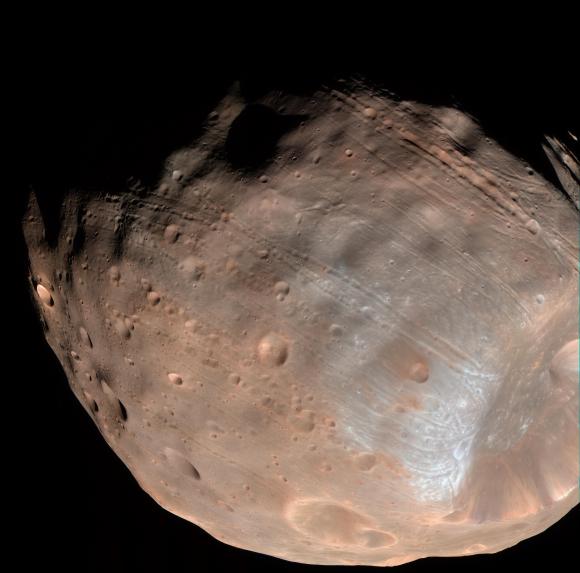
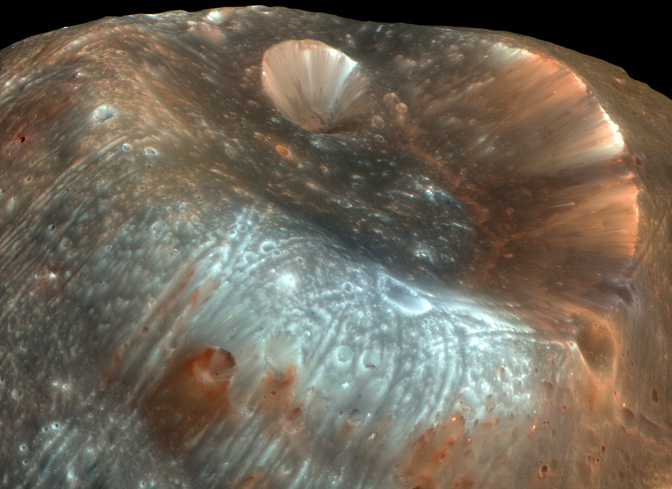
Moon for Mars: Very large crater on blue and tan landscape with one distinct and many small craters in it.
Asaph Hall discovered Phobos, a moon for Mars, on August 17, 1877. This image of the large crater Stickney on the Martian moon Phobos is color-enhanced. The crater is 5.6 miles (9 km) in diameter, so it covers a substantial proportion of Phobos’ surface. The impact almost destroyed the small moon! Notice the smaller crater within Stickney, about 1.2 miles (2 km) in diameter, resulting from a later impact. Image via HiRISE/ MRO/ LPL (U. Arizona)/ NASA.

August 17, 1877: Asaph Hall discovers a moon for Mars

On August 17 149 years ago, American astronomer Asaph Hall discovered the first known moon for our neighboring planet, Mars. Later that year, he found a second Martian moon. Today, we call the first and larger moon Phobos. And we call the second and smaller one Deimos.

To date, Phobos and Deimos remain the only known moons of Mars.

Both Phobos and Deimos are potato-shaped. They look more like asteroids than like Earth’s much-larger companion moon. In fact, it’s likely that Mars captured these little worlds that now orbit the red planet. Studies have indicated that – millions of years from now – Phobos will shatter and form a ring around Mars. Some astronomers think Phobos alternates between being a planetary ring, then clumping up again to form a moon. More about ring theories of Phobos below.

Catch the wonder of the night sky. Subscribe to EarthSky’s free daily newsletter for science, stars, planets and more.

Phobos and Deimos, fear and terror

The names Phobos and Deimos mean fear and terror, respectively. Their names refer to the sons of the war god Ares in Greek mythology. Ares was the Greek counterpart to the Roman war god Mars.

Although it’s the larger of Mars’ two moons, Phobos is tiny. It has a mean diameter of only about 14 miles (22.5 km). But it’s seven times more massive than Deimos, which has a mean diameter of about 7.7 miles (12.4 km). For these moons, we’re speaking in terms of a mean diameter because both moons are oblong in shape and not spherical. In contrast, Earth’s moon is nearly round, since it’s large enough for its gravity to have pulled it into a spherical shape.

Earth’s moon is also much larger (2,159 miles or 3,475 km in diameter). Since both Phobos and Deimos are so tiny, they have very weak gravity. And that means they don’t have enough gravity to make them round.

Mariner 9 was 1st to see them close

During Mariner 9’s mission to Mars in 1971 and 1972, scientists got their first closeup look at Phobos. Just like asteroids, its oblong surface shows many small craters. But one large crater stood out as much bigger than the rest. Astronomers named it Stickney Crater, for Angeline Stickney: an American academic, suffragist and mathematician, and Asaph Hall’s wife.

Stickney looks like a giant hole on one end of Phobos. Whatever rocky body created it was almost big enough to have shattered the moon. It’s thought that, whenever the impact occurred, Phobos barely survived.

Oval rocky object in black space, half in shadow, with giant dent in one end.
Viking I image of Phobos and its large crater Stickney. The spacecraft captured this image in June 1977, 100 years after the discovery of Phobos. Image via NASA/ ESA.
Oblong rocky moon covered with craters and many shallow, straight grooves, in black space.
A closer view of the grooves on Phobos. Image via NASA/ JPL-Caltech/ University of Arizona.
Moon for Mars: Rectangular rolled-out map of gray terrain covered by craters and grooves.
The Viking orbiter obtained this global map of Phobos. Image via NASA/ Astrogeology Science Center/ Planetary Data System/ Phil Stooke.

Was Phobos once a ring? Will it be again?

Phobos has long, shallow grooves running across its surface, radiating away from Stickney. Many planetary scientists believe these grooves are early signs of eventual structural failure in the moon. They say it’s possible that – some 50 million years from now – Phobos will break apart, forming a ring around Mars.

A study in 2018 suggested that rolling boulders created the grooves, spraying across the surface during impact. As Ken Ramsley, a planetary science researcher at Brown University who led the work, explained:

These grooves are a distinctive feature of Phobos, and planetary scientists have been debating how they formed for 40 years. We think this study is another step toward zeroing in on an explanation.

More ring theories

In 2017, a new theory by Purdue University scientists suggested Phobos might not only break apart and form a ring around the planet but also suggests this ring formation happened before.

David Minton, a professor, and Andrew Hesselbrock, a doctoral student, both at Purdue, developed a computer model showing debris ejected into space from an asteroid or other body slamming into Mars. This event – some 4.3 billion years ago – would cause the material to subsequently alternate between becoming a planetary ring and clumping up again to form the moon Phobos.

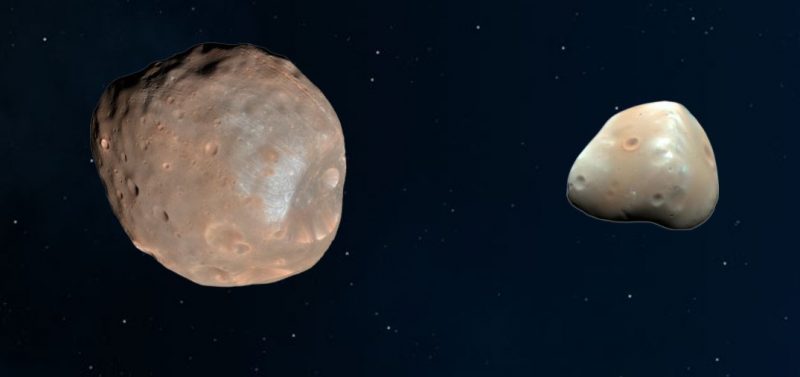
2 irregular, cratered, tan rocky objects, 1 twice the size of the other, on black background.
Size and visual comparison of Phobos (left) and Deimos (right). Image via NASA.

Deimos played a role

Another study, from scientists at Purdue and the SETI Institute in June 2020, also concluded that Mars used to have a ring or series of rings. The scientists based that study on an analysis of the orbit of the other Martian moon, Deimos.

Deimos is smaller than Phobos. And it has an orbit that’s tilted with respect to Mars’ equator by about 2 degrees. Meanwhile, Phobos’ orbit isn’t inclined as much. The larger moon is inclined to Mars’ equator by only about 1 degree. The scientists said in a statement:

These orbital resonances are picky but predictable … We can tell that only an outward-moving moon could have strongly affected Deimos, which means that Mars must have had a ring pushing the inner moon outward … This moon may have been 20 times as massive as Phobos, and may have been its ‘grandparent’ existing just over 3 billion years ago … [It] was followed by two more ring-moon cycles, with the latest moon being Phobos.

So, basically, there may have been a moon about 20 times more massive than Phobos, and Mars’ rings pushed it outward. And at least two times since then, that moon broke apart and then formed a new ring, before the material coalesced together again to form a new moon. Phobos is now that current moon. The scientists say it will eventually break apart to form a new ring, thus continuing the cycle.

Scientists also now know Phobos is much younger than Deimos – perhaps only 200 million years old – which would fit the moon/ring scenario. The Phobos we see today is simply a newer and smaller version of its original self.

Eclipsing moons

Asaph Hall probably never imagined the idea of Phobos breaking apart and forming a ring around Mars. And he couldn’t possibly have imagined the video below, which was acquired by NASA’s Mars rover Curiosity on August 1, 2013. This video shows both moons, Phobos and Deimos, as you might see them while standing on the surface of Mars. You can clearly see some of the large craters on Phobos in these images.

This was the first time that images taken from Mars’ surface caught one moon eclipsing the other … but probably not the last.

Bottom line: On this date in 1877, American astronomer Asaph Hall discovered a moon for Mars: Phobos, the larger of Mars’ two moons. He discovered the other moon, Deimos, later that year.

Read more: Watch as Mars’ moons trade places in the sky

Read more: New Mars and Deimos pics from revealing Hera flyby

The post A moon for Mars! Asaph Hall finds Phobos 149 years ago first appeared on EarthSky.


from EarthSky https://ift.tt/2LQhYHj
Moon for Mars: Very large crater on blue and tan landscape with one distinct and many small craters in it.
Asaph Hall discovered Phobos, a moon for Mars, on August 17, 1877. This image of the large crater Stickney on the Martian moon Phobos is color-enhanced. The crater is 5.6 miles (9 km) in diameter, so it covers a substantial proportion of Phobos’ surface. The impact almost destroyed the small moon! Notice the smaller crater within Stickney, about 1.2 miles (2 km) in diameter, resulting from a later impact. Image via HiRISE/ MRO/ LPL (U. Arizona)/ NASA.

August 17, 1877: Asaph Hall discovers a moon for Mars

On August 17 149 years ago, American astronomer Asaph Hall discovered the first known moon for our neighboring planet, Mars. Later that year, he found a second Martian moon. Today, we call the first and larger moon Phobos. And we call the second and smaller one Deimos.

To date, Phobos and Deimos remain the only known moons of Mars.

Both Phobos and Deimos are potato-shaped. They look more like asteroids than like Earth’s much-larger companion moon. In fact, it’s likely that Mars captured these little worlds that now orbit the red planet. Studies have indicated that – millions of years from now – Phobos will shatter and form a ring around Mars. Some astronomers think Phobos alternates between being a planetary ring, then clumping up again to form a moon. More about ring theories of Phobos below.

Catch the wonder of the night sky. Subscribe to EarthSky’s free daily newsletter for science, stars, planets and more.

Phobos and Deimos, fear and terror

The names Phobos and Deimos mean fear and terror, respectively. Their names refer to the sons of the war god Ares in Greek mythology. Ares was the Greek counterpart to the Roman war god Mars.

Although it’s the larger of Mars’ two moons, Phobos is tiny. It has a mean diameter of only about 14 miles (22.5 km). But it’s seven times more massive than Deimos, which has a mean diameter of about 7.7 miles (12.4 km). For these moons, we’re speaking in terms of a mean diameter because both moons are oblong in shape and not spherical. In contrast, Earth’s moon is nearly round, since it’s large enough for its gravity to have pulled it into a spherical shape.

Earth’s moon is also much larger (2,159 miles or 3,475 km in diameter). Since both Phobos and Deimos are so tiny, they have very weak gravity. And that means they don’t have enough gravity to make them round.

Mariner 9 was 1st to see them close

During Mariner 9’s mission to Mars in 1971 and 1972, scientists got their first closeup look at Phobos. Just like asteroids, its oblong surface shows many small craters. But one large crater stood out as much bigger than the rest. Astronomers named it Stickney Crater, for Angeline Stickney: an American academic, suffragist and mathematician, and Asaph Hall’s wife.

Stickney looks like a giant hole on one end of Phobos. Whatever rocky body created it was almost big enough to have shattered the moon. It’s thought that, whenever the impact occurred, Phobos barely survived.

Oval rocky object in black space, half in shadow, with giant dent in one end.
Viking I image of Phobos and its large crater Stickney. The spacecraft captured this image in June 1977, 100 years after the discovery of Phobos. Image via NASA/ ESA.
Oblong rocky moon covered with craters and many shallow, straight grooves, in black space.
A closer view of the grooves on Phobos. Image via NASA/ JPL-Caltech/ University of Arizona.
Moon for Mars: Rectangular rolled-out map of gray terrain covered by craters and grooves.
The Viking orbiter obtained this global map of Phobos. Image via NASA/ Astrogeology Science Center/ Planetary Data System/ Phil Stooke.

Was Phobos once a ring? Will it be again?

Phobos has long, shallow grooves running across its surface, radiating away from Stickney. Many planetary scientists believe these grooves are early signs of eventual structural failure in the moon. They say it’s possible that – some 50 million years from now – Phobos will break apart, forming a ring around Mars.

A study in 2018 suggested that rolling boulders created the grooves, spraying across the surface during impact. As Ken Ramsley, a planetary science researcher at Brown University who led the work, explained:

These grooves are a distinctive feature of Phobos, and planetary scientists have been debating how they formed for 40 years. We think this study is another step toward zeroing in on an explanation.

More ring theories

In 2017, a new theory by Purdue University scientists suggested Phobos might not only break apart and form a ring around the planet but also suggests this ring formation happened before.

David Minton, a professor, and Andrew Hesselbrock, a doctoral student, both at Purdue, developed a computer model showing debris ejected into space from an asteroid or other body slamming into Mars. This event – some 4.3 billion years ago – would cause the material to subsequently alternate between becoming a planetary ring and clumping up again to form the moon Phobos.

2 irregular, cratered, tan rocky objects, 1 twice the size of the other, on black background.
Size and visual comparison of Phobos (left) and Deimos (right). Image via NASA.

Deimos played a role

Another study, from scientists at Purdue and the SETI Institute in June 2020, also concluded that Mars used to have a ring or series of rings. The scientists based that study on an analysis of the orbit of the other Martian moon, Deimos.

Deimos is smaller than Phobos. And it has an orbit that’s tilted with respect to Mars’ equator by about 2 degrees. Meanwhile, Phobos’ orbit isn’t inclined as much. The larger moon is inclined to Mars’ equator by only about 1 degree. The scientists said in a statement:

These orbital resonances are picky but predictable … We can tell that only an outward-moving moon could have strongly affected Deimos, which means that Mars must have had a ring pushing the inner moon outward … This moon may have been 20 times as massive as Phobos, and may have been its ‘grandparent’ existing just over 3 billion years ago … [It] was followed by two more ring-moon cycles, with the latest moon being Phobos.

So, basically, there may have been a moon about 20 times more massive than Phobos, and Mars’ rings pushed it outward. And at least two times since then, that moon broke apart and then formed a new ring, before the material coalesced together again to form a new moon. Phobos is now that current moon. The scientists say it will eventually break apart to form a new ring, thus continuing the cycle.

Scientists also now know Phobos is much younger than Deimos – perhaps only 200 million years old – which would fit the moon/ring scenario. The Phobos we see today is simply a newer and smaller version of its original self.

Eclipsing moons

Asaph Hall probably never imagined the idea of Phobos breaking apart and forming a ring around Mars. And he couldn’t possibly have imagined the video below, which was acquired by NASA’s Mars rover Curiosity on August 1, 2013. This video shows both moons, Phobos and Deimos, as you might see them while standing on the surface of Mars. You can clearly see some of the large craters on Phobos in these images.

This was the first time that images taken from Mars’ surface caught one moon eclipsing the other … but probably not the last.

Bottom line: On this date in 1877, American astronomer Asaph Hall discovered a moon for Mars: Phobos, the larger of Mars’ two moons. He discovered the other moon, Deimos, later that year.

Read more: Watch as Mars’ moons trade places in the sky

Read more: New Mars and Deimos pics from revealing Hera flyby

The post A moon for Mars! Asaph Hall finds Phobos 149 years ago first appeared on EarthSky.


from EarthSky https://ift.tt/2LQhYHj

Swift spacecraft, and a mission to save it, caught on video


The Sociedad de Astronomía del Caribe in Añasco, Puerto Rico, captured this video at about 8:02–8:03 p.m. AST on August 10, 2026. It shows an experimental commercial robotic repair vehicle called LINK, slightly ahead of NASA’s Swift spacecraft in low Earth orbit (by about a minute). Both LINK and Swift now appear to have the same (or a similar) trajectory, which is good news. LINK is meant to boost Swift to a higher orbit, saving it from falling back into Earth’s atmosphere by the end of 2026.

The nail-biting Swift spacecraft rescue effort

The Neil Gehrels Swift Observatory, better known as Swift, has been orbiting Earth since 2004. It has been studying the most powerful explosions in the universe: gamma-ray bursts. Now, Swift’s orbit is rapidly decaying. That means Swift is slowly falling back to Earth.

And if nothing stops it, it will burn up in Earth’s atmosphere later this year. If that happens, Swift is expected to put on a spectacular, fiery show.

But something might save it. In an effort to extend the life of this important science mission, NASA has employed a 2nd spacecraft – a commercial robotic repair vehicle called LINK, built by Katalyst Space – on July 3, 2026.

So LINK was supposed to chase down Swift, grab it, and raise its orbit. But about three weeks into the mission, two of LINK’s three reaction wheels failed, sending LINK into an uncontrolled spin and causing communication to be intermittent. What will happen now? Is there any good news? As it turns out … there is.

The current status of the rescue

NASA said on August 11 in its Swift blog that a flight software update has now been uploaded to LINK. NASA said:

The software update’s new attitude control algorithms are designed to maintain LINK’s stability using the spacecraft’s remaining actuators.

And, in recent days, LINK does appear more stable. Amateur astronomers in Puerto Rico – with the Sociedad de Astronomía del Caribe – captured video of both LINK and Swift in the same (or a similar) orbit around Earth. The video comes from Añasco, Puerto Rico, at about 8:02–8:03 p.m. AST on August 10, 2026. Watch the video at the top of this post. And keep reading to learn more.

In the meantime, be aware that there’s a real clock ticking here. Swift is gradually losing altitude because of atmospheric drag. If it drops below roughly 300 km (186 miles), recovery becomes essentially impossible; NASA expects that point to arrive around October.

Swift spacecraft: Small spacecraft with wide solar panels and mechanical arms grabbing a bigger spacecraft.
Meet the space-based Swift Observatory. Its orbit is decaying; it is falling back to Earth. NASA plans to save it, and boost it to a higher orbit, with a rescue mission called LINK. If there’s no intervention, Swift will plunge back to Earth by the fall of 2026. Image via NASA.

Seeing Swift and LINK in orbit

Amateur astronomers frequently try to spy faint spacecraft in orbit around Earth, and LINK and Swift are no exceptions. The website Heavens-Above.com is designed specifically to enable observers to become aware of satellite passes from their location.

The Sociedad de Astronomia del Caribe in Añasco, Puerto Rico, caught both Swift and LINK on video on August 2, 2026. That earlier video showed that Link was about 8 minutes behind the Swift spacecraft.

But, between August 9 and 10, the club’s cameras showed LINK as slightly ahead of Swift in orbit. That’s what you’ll see if you watch the video above.

In the Sociedad de Astronomia del Caribe video at the top of this post, the Link rescue spacecraft passes very close to a bright star. The star is Antares, brightest light in the constellation Scorpius the Scorpion. A minute later, the Swift Observatory is seen also passing by this bright star.

The video capture was possible by analyzing the trajectory of both spacecraft using various sources including Heavens-Above.com.

It’s encouraging that LINK and Swift are so close together! And that they seem to be following the same (or a similar) path.

Don’t miss the next unmissable sky event! Subscribe to EarthSky’s free daily newsletter for sky and science news.

Can you see LINK and Swift?

Observers can try to glimpse the decaying Swift Observatory with the eye. It sometimes reaches a visual magnitude around +2.0 to +1.5, making it as bright as a moderately bright star.

It would be especially easy to spot if you were observing far from city lights, once you know where to look.

The Link rescue spacecraft is fainter and more difficult to see. But some experienced observers have reported seeing it with the unaided eye.

To spot the Swift Observatory or the LINK rescue vehicle in orbit using the website Heavens-Above.com, you need custom visibility predictions for your exact location.  

Here’s how to set your observing location:

  • Navigate to the Heavens-Above main site or open the Heavens-Above mobile app.
  • Click on Configuration (or the location selector in the upper-right corner).
  • Input your specific city or exact GPS coordinates so that pass times and trajectory angles calculate accurately for your horizon.

Here’s how to find the 2 spacecraft:

  • Return to the main database menu and locate the Satellites section.
  • Select Search database for satellite (or use the Satellite database / Search link).
  • Query for Swift (the Neil Gehrels Swift Observatory, NORAD ID 28485) or LINK (or Katalyst Space / Pegasus XL payload related to the mission).

Here’s how to generate the pass predictions:

  • Open the satellite’s details page and click 10-day predictions for visible passes (or change filters to show “All passes” if you want daytime/radio passes).  
  • Review the pass table for key metrics. These are: start / highest / end times; altitude aka elevation (look for passes exceeding 30 to 40 degrees elevation for clear viewing above trees or buildings); and brightness aka magnitude (lower or negative numbers indicate brighter objects, and Swift typically reaches a visual magnitude of around +1.5 to +2.0, making it visible to the unaided eye under dark sky conditions.)

Here’s how to use the interactive sky charts

  • Click on any specific date/pass row to generate a star chart.
  • The chart overlays the satellite’s precise trajectory against recognizable constellations and stars (such as Scorpius or Antares), showing you exactly where to aim your eyes, binoculars, or camera equipment.

This video walk-through shows how to set up your ground coordinates and fetch pass predictions on Heavens-Above: How to Track the ISS with Heavens-Above.com.

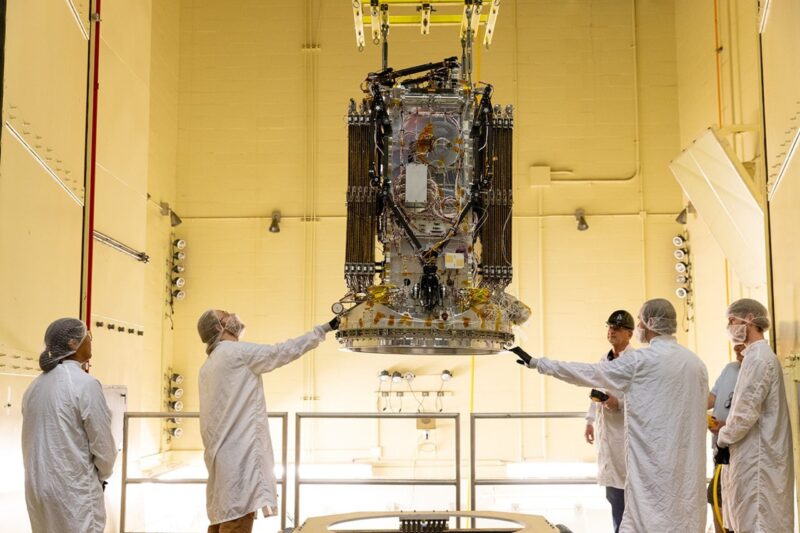
Five people in white suits in a clean room looking at a spacecraft hanging above the floor.
Engineers from Katalyst Space test the LINK spacecraft that will launch to save Swift. Image via Scott Wiessinger/ NASA.

Boost timeline

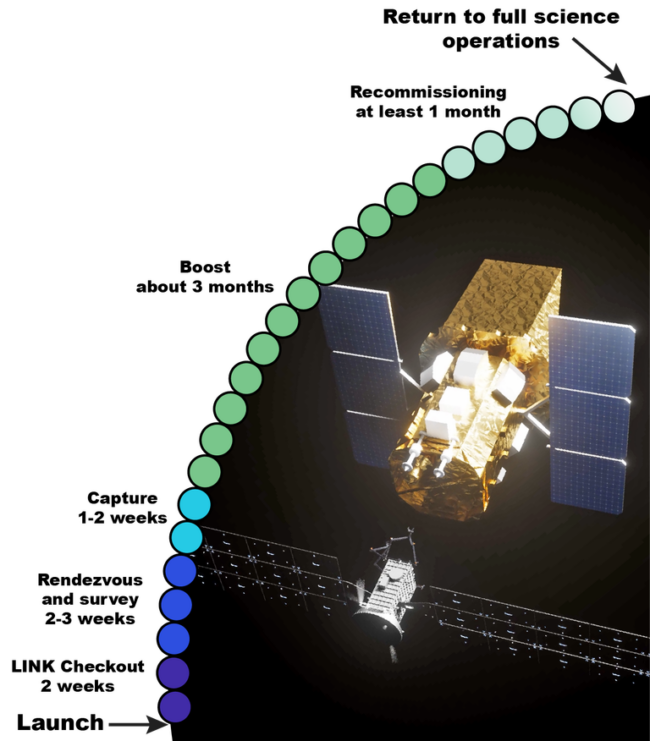
Below is a timeline from launch through the boost steps until Swift returns to science operations. NASA has temporarily suspended science operations on Swift until the boosting mission is complete.


Graphic with 2 spacecraft in space and a line with mission milestones listed with times.
According to NASA’s timeline, it will take several months to complete the boost of the Swift spacecraft. This artist’s concept shows Swift at top and LINK below. Image via Katalyst Space/ NASA/ Goddard Space Flight Center.

More about the Swift spacecraft

The Swift spacecraft has three telescopes that watch the night sky. They are the Burst Alert Telescope, X-Ray Telescope and Ultraviolet/Optical Telescope.

The Burst Alert Telescope (BAT) is Swift’s wide-field gamma-ray detector. This telescope continuously monitors a large portion of the sky, watching for sudden flashes of high-energy gamma rays from gamma-ray bursts. When it detects a burst, it quickly calculates the object’s position and sends the coordinates to astronomers worldwide. It also directs the Swift spacecraft to rapidly turn toward the event for closer study.

Once Swift has slewed toward a newly detected gamma-ray burst, the X-Ray Telescope (XRT) takes over. It observes the burst’s fading X-ray afterglow. And it measures how its brightness changes over time and analyzes the energies of the emitted X-rays. Also, the XRT can pinpoint a burst’s location better than BAT and can continue tracking the event for days or even weeks. So the XRT helps scientists understand the physics of these powerful explosions and their environments.

Finally, the Ultraviolet/Optical Telescope studies gamma-ray bursts and other cosmic objects in ultraviolet and visible light. It provides Swift’s most precise positions for newly discovered bursts. It also captures details about their brightness, color and evolution. Overall, these observations help astronomers determine distances, identify host galaxies and better understand the nature of the explosions and other transient events Swift observes across the universe.

Bottom line: The Swift space telescope is falling back to Earth. The LINK spacecraft is trying to save it. See both in orbit in a new video.

Via NASA

Read more: What is the Earth’s most distant spacecraft?

Read more: Remember when DART struck an asteroid? New surprises!

The post Swift spacecraft, and a mission to save it, caught on video first appeared on EarthSky.


from EarthSky https://ift.tt/ltTPyOa


The Sociedad de Astronomía del Caribe in Añasco, Puerto Rico, captured this video at about 8:02–8:03 p.m. AST on August 10, 2026. It shows an experimental commercial robotic repair vehicle called LINK, slightly ahead of NASA’s Swift spacecraft in low Earth orbit (by about a minute). Both LINK and Swift now appear to have the same (or a similar) trajectory, which is good news. LINK is meant to boost Swift to a higher orbit, saving it from falling back into Earth’s atmosphere by the end of 2026.

The nail-biting Swift spacecraft rescue effort

The Neil Gehrels Swift Observatory, better known as Swift, has been orbiting Earth since 2004. It has been studying the most powerful explosions in the universe: gamma-ray bursts. Now, Swift’s orbit is rapidly decaying. That means Swift is slowly falling back to Earth.

And if nothing stops it, it will burn up in Earth’s atmosphere later this year. If that happens, Swift is expected to put on a spectacular, fiery show.

But something might save it. In an effort to extend the life of this important science mission, NASA has employed a 2nd spacecraft – a commercial robotic repair vehicle called LINK, built by Katalyst Space – on July 3, 2026.

So LINK was supposed to chase down Swift, grab it, and raise its orbit. But about three weeks into the mission, two of LINK’s three reaction wheels failed, sending LINK into an uncontrolled spin and causing communication to be intermittent. What will happen now? Is there any good news? As it turns out … there is.

The current status of the rescue

NASA said on August 11 in its Swift blog that a flight software update has now been uploaded to LINK. NASA said:

The software update’s new attitude control algorithms are designed to maintain LINK’s stability using the spacecraft’s remaining actuators.

And, in recent days, LINK does appear more stable. Amateur astronomers in Puerto Rico – with the Sociedad de Astronomía del Caribe – captured video of both LINK and Swift in the same (or a similar) orbit around Earth. The video comes from Añasco, Puerto Rico, at about 8:02–8:03 p.m. AST on August 10, 2026. Watch the video at the top of this post. And keep reading to learn more.

In the meantime, be aware that there’s a real clock ticking here. Swift is gradually losing altitude because of atmospheric drag. If it drops below roughly 300 km (186 miles), recovery becomes essentially impossible; NASA expects that point to arrive around October.

Swift spacecraft: Small spacecraft with wide solar panels and mechanical arms grabbing a bigger spacecraft.
Meet the space-based Swift Observatory. Its orbit is decaying; it is falling back to Earth. NASA plans to save it, and boost it to a higher orbit, with a rescue mission called LINK. If there’s no intervention, Swift will plunge back to Earth by the fall of 2026. Image via NASA.

Seeing Swift and LINK in orbit

Amateur astronomers frequently try to spy faint spacecraft in orbit around Earth, and LINK and Swift are no exceptions. The website Heavens-Above.com is designed specifically to enable observers to become aware of satellite passes from their location.

The Sociedad de Astronomia del Caribe in Añasco, Puerto Rico, caught both Swift and LINK on video on August 2, 2026. That earlier video showed that Link was about 8 minutes behind the Swift spacecraft.

But, between August 9 and 10, the club’s cameras showed LINK as slightly ahead of Swift in orbit. That’s what you’ll see if you watch the video above.

In the Sociedad de Astronomia del Caribe video at the top of this post, the Link rescue spacecraft passes very close to a bright star. The star is Antares, brightest light in the constellation Scorpius the Scorpion. A minute later, the Swift Observatory is seen also passing by this bright star.

The video capture was possible by analyzing the trajectory of both spacecraft using various sources including Heavens-Above.com.

It’s encouraging that LINK and Swift are so close together! And that they seem to be following the same (or a similar) path.

Don’t miss the next unmissable sky event! Subscribe to EarthSky’s free daily newsletter for sky and science news.

Can you see LINK and Swift?

Observers can try to glimpse the decaying Swift Observatory with the eye. It sometimes reaches a visual magnitude around +2.0 to +1.5, making it as bright as a moderately bright star.

It would be especially easy to spot if you were observing far from city lights, once you know where to look.

The Link rescue spacecraft is fainter and more difficult to see. But some experienced observers have reported seeing it with the unaided eye.

To spot the Swift Observatory or the LINK rescue vehicle in orbit using the website Heavens-Above.com, you need custom visibility predictions for your exact location.  

Here’s how to set your observing location:

  • Navigate to the Heavens-Above main site or open the Heavens-Above mobile app.
  • Click on Configuration (or the location selector in the upper-right corner).
  • Input your specific city or exact GPS coordinates so that pass times and trajectory angles calculate accurately for your horizon.

Here’s how to find the 2 spacecraft:

  • Return to the main database menu and locate the Satellites section.
  • Select Search database for satellite (or use the Satellite database / Search link).
  • Query for Swift (the Neil Gehrels Swift Observatory, NORAD ID 28485) or LINK (or Katalyst Space / Pegasus XL payload related to the mission).

Here’s how to generate the pass predictions:

  • Open the satellite’s details page and click 10-day predictions for visible passes (or change filters to show “All passes” if you want daytime/radio passes).  
  • Review the pass table for key metrics. These are: start / highest / end times; altitude aka elevation (look for passes exceeding 30 to 40 degrees elevation for clear viewing above trees or buildings); and brightness aka magnitude (lower or negative numbers indicate brighter objects, and Swift typically reaches a visual magnitude of around +1.5 to +2.0, making it visible to the unaided eye under dark sky conditions.)

Here’s how to use the interactive sky charts

  • Click on any specific date/pass row to generate a star chart.
  • The chart overlays the satellite’s precise trajectory against recognizable constellations and stars (such as Scorpius or Antares), showing you exactly where to aim your eyes, binoculars, or camera equipment.

This video walk-through shows how to set up your ground coordinates and fetch pass predictions on Heavens-Above: How to Track the ISS with Heavens-Above.com.

Five people in white suits in a clean room looking at a spacecraft hanging above the floor.
Engineers from Katalyst Space test the LINK spacecraft that will launch to save Swift. Image via Scott Wiessinger/ NASA.

Boost timeline

Below is a timeline from launch through the boost steps until Swift returns to science operations. NASA has temporarily suspended science operations on Swift until the boosting mission is complete.

Graphic with 2 spacecraft in space and a line with mission milestones listed with times.
According to NASA’s timeline, it will take several months to complete the boost of the Swift spacecraft. This artist’s concept shows Swift at top and LINK below. Image via Katalyst Space/ NASA/ Goddard Space Flight Center.

More about the Swift spacecraft

The Swift spacecraft has three telescopes that watch the night sky. They are the Burst Alert Telescope, X-Ray Telescope and Ultraviolet/Optical Telescope.

The Burst Alert Telescope (BAT) is Swift’s wide-field gamma-ray detector. This telescope continuously monitors a large portion of the sky, watching for sudden flashes of high-energy gamma rays from gamma-ray bursts. When it detects a burst, it quickly calculates the object’s position and sends the coordinates to astronomers worldwide. It also directs the Swift spacecraft to rapidly turn toward the event for closer study.

Once Swift has slewed toward a newly detected gamma-ray burst, the X-Ray Telescope (XRT) takes over. It observes the burst’s fading X-ray afterglow. And it measures how its brightness changes over time and analyzes the energies of the emitted X-rays. Also, the XRT can pinpoint a burst’s location better than BAT and can continue tracking the event for days or even weeks. So the XRT helps scientists understand the physics of these powerful explosions and their environments.

Finally, the Ultraviolet/Optical Telescope studies gamma-ray bursts and other cosmic objects in ultraviolet and visible light. It provides Swift’s most precise positions for newly discovered bursts. It also captures details about their brightness, color and evolution. Overall, these observations help astronomers determine distances, identify host galaxies and better understand the nature of the explosions and other transient events Swift observes across the universe.

Bottom line: The Swift space telescope is falling back to Earth. The LINK spacecraft is trying to save it. See both in orbit in a new video.

Via NASA

Read more: What is the Earth’s most distant spacecraft?

Read more: Remember when DART struck an asteroid? New surprises!

The post Swift spacecraft, and a mission to save it, caught on video first appeared on EarthSky.


from EarthSky https://ift.tt/ltTPyOa

Deep partial lunar eclipse of the August 27-28 Sturgeon Moon

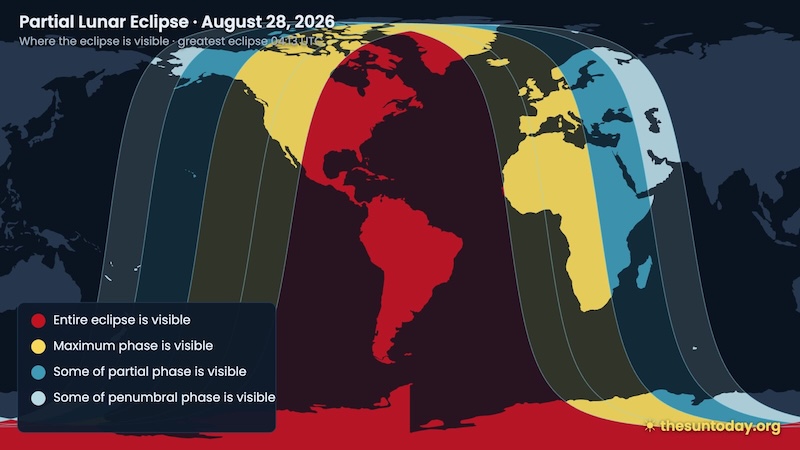
Global map showing where the partial lunar eclipse on August 28, 2026, is visible.
Here’s a global map showing where the August 27-28, 2026, partial lunar eclipse is visible. Image via thesuntoday.org.

The crest of the August full Sturgeon Moon falls at 4:18 UTC on August 28 (11:18 p.m. CDT on August 27).

And people in Africa, Europe, Scandinavia, Iceland, parts of Greenland, Antarctica, most of the Americas and eastern Pacific Ocean will see a deep partial lunar eclipse overnight on August 27-28, 2026.

The whole half of Earth facing the full moon – that is, the whole half of Earth that’s in nighttime – will see the lunar eclipse. It’s well placed for the Western Hemisphere. Of course, lunar eclipses are safe to view with the unaided eye. Binoculars and telescopes aren’t required to view a lunar eclipse, but they do enhance the view.

At maximum eclipse, about 96% of the moon will enter Earth’s dark umbral shadow. For the most part, the August 27-28, 2026, lunar eclipse will appear nearly as a total lunar eclipse of the moon. In other words, as the eclipse progresses and is near maximum eclipse, you should notice the red glow of totality and a bright white patch along the moon’s northeastern limb.

Check timeanddate.com for precise timing from your location.

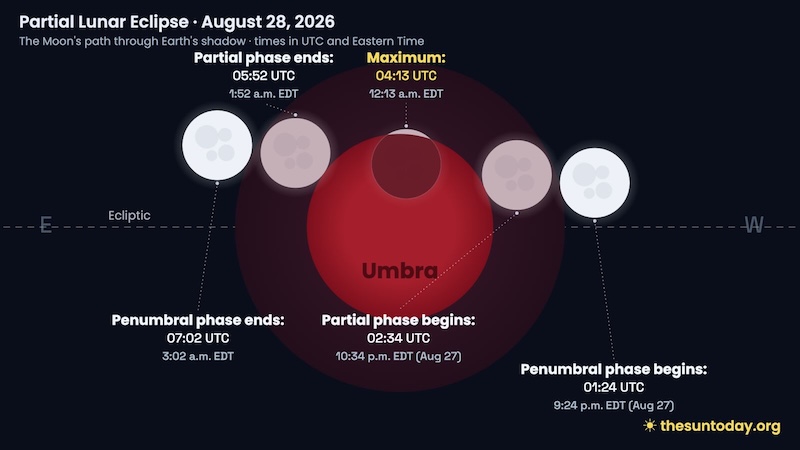
Chart showing stages of the partial lunar eclipse on August 28, 2026.
Chart showing the stages of the August 28, 2026, partial lunar eclipse. The maximum eclipse is at 04:13 UTC on August 28. Image via thesuntoday.org.

When the lunar eclipse occurs worldwide

Penumbral eclipse begins at 1:23 UTC on August 28, 2026. That’s 8:23 p.m. CDT on August 27. Earth’s lighter penumbral shadow will begin crossing the moon’s face. You probably won’t notice it at first. But, as the eclipse progresses, you should see a subtle shading on the moon.
Partial eclipse begins at 2:33 UTC on August 28, 2026. That’s 9:33 p.m. CDT on August 27. As the partial eclipse begins, it’ll appear as if a tiny, but dark, bite is taken from one edge of the moon.
Greatest eclipse at 4:12 UTC on August 28, 2026. That’s 11:12 p.m. CDT on August 27. At maximum eclipse, about 96% of the moon’s disk will lie inside Earth’s dark umbral shadow.
Partial eclipse ends at 5:52 UTC on August 28, 2026. That’s 12:52 a.m. CDT.
Penumbral eclipse ends at 7:02 UTC on August 28, 2026. That’s 2:02 a.m. CDT.

Source: Eclipsewise.com

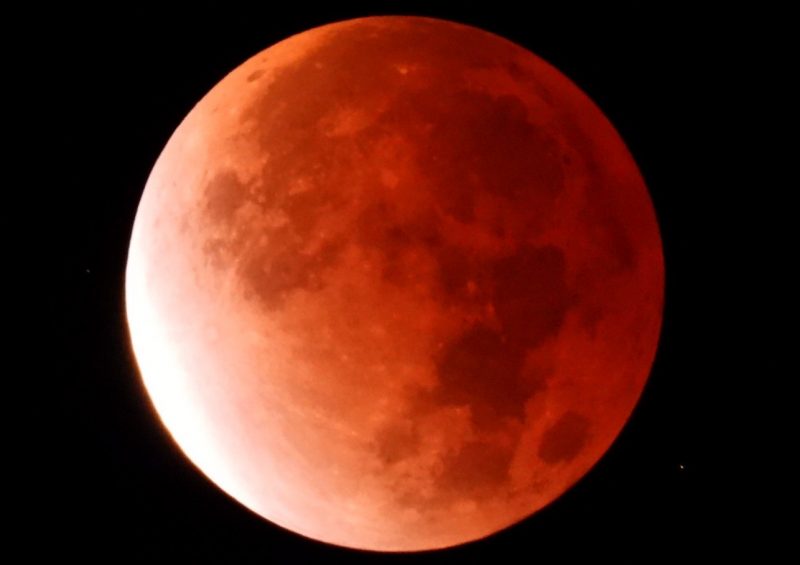
Reddish moon with a white glow on the lower left side.
View at EarthSky Community Photos. | Robert Hall in South Mississippi took this image of the lunar eclipse on November 19, 2021. He wrote: “The moon turned red once it was 90% eclipsed.” Thank you, Robert! See more lunar eclipse photos below.

Visit timeanddate.com to get an exact timing of the eclipse from your location.

Animated map of the lunar eclipse.

How long will it last?

From start to finish, the eclipse will last 339 minutes. And the moon will be in Earth’s dark shadow – for the partial eclipse – for 199 minutes.

Read more: Why no eclipse at every full and new moon?

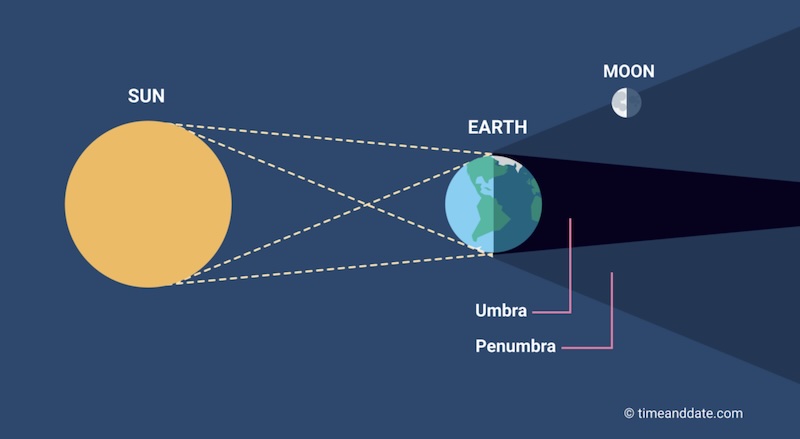
Diagram of the sun on left, Earth in the middle casting shadow, moon in shadow on right. There's a dark umbra shadow and a lighter penumbral shadow.
During a lunar eclipse, Earth’s shadow falls on the moon. So if the moon passes through the dark central shadow of Earth – the umbra – a partial or total lunar eclipse takes place. But if the moon only passes through the outer part of the shadow (the penumbra), a subtle penumbral eclipse occurs. Diagram via timeanddate.com. Used with permission.

Moon and Soros

The moment of greatest eclipse takes place 5.8 days after the moon reaches apogee, its farthest point from Earth for the month.

The Saros catalog describes the periodicity of eclipses. This August 27-28 total lunar eclipse belongs to Saros 138. It is number 29 of 82 lunar eclipses in the series. All eclipses in this series occur at the moon’s ascending node. The moon moves southward with respect to the node with each succeeding eclipse in the series.

The instant of greatest eclipse – when the axis of the moon’s shadow cone passes closest to Earth’s center – takes place at 4:12 UTC on August 28. The moon will lie at zenith – directly overhead – at a point in the Brazilian Amazon.

Who can see lunar eclipses?

A full moon is up only at night. And a total lunar eclipse is visible from all parts of Earth that are experiencing night while the eclipse is taking place. But some will see the eclipse more clearly, or more thoroughly, than others, depending on location. For example, some will see it at moonrise or moonset, when the moon is low in the sky.

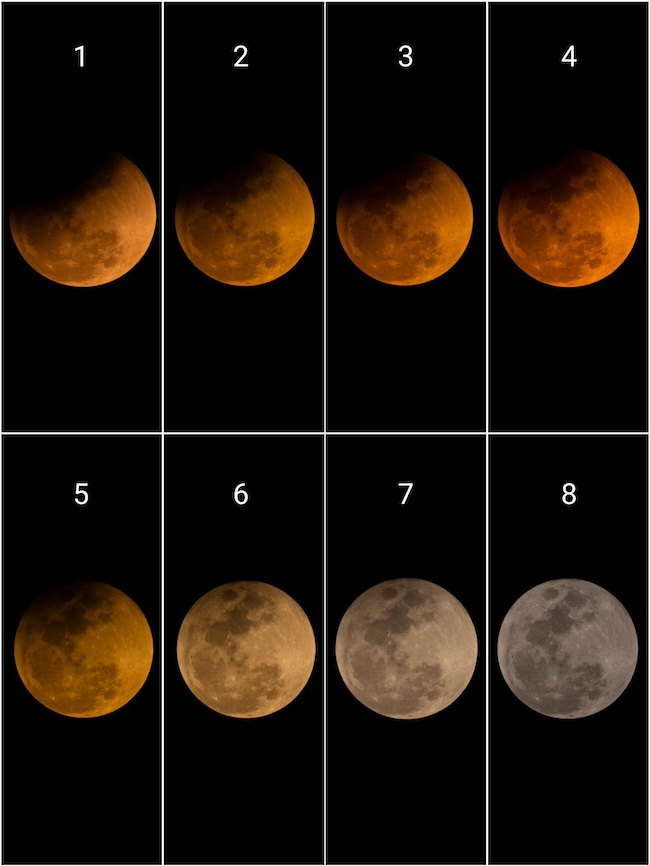
Sequence of eight images of the full moon during a total eclipse.
View at EarthSky Community Photos. | Atharva Maurya captured this image on March 3, 2026, from India and wrote: “This image showcases the different phases of lunar eclipse of March 3, 2026.” Thank you, Atharva!

The constellation behind the partial lunar eclipse

The August 28, 2026, partial lunar eclipse occurs when the moon is in the constellation of Aquarius the Water Bearer.

Find the moon’s path with respect to Earth’s umbral and penumbral shadows below.

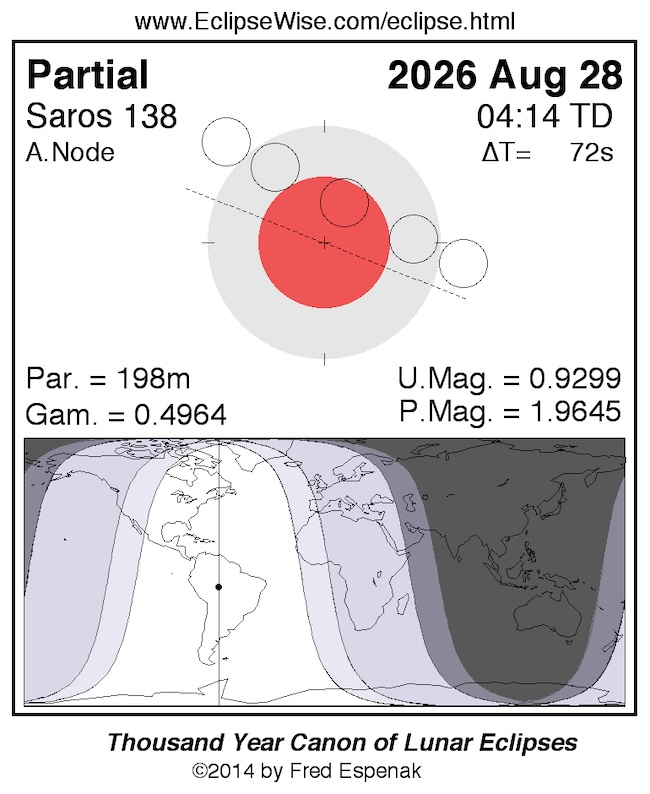
Chart showing the moon in eclipse and map of Earth with coverage.
A map for the partial lunar eclipse on August 27-28, 2026. It sweeps across Africa, Europe, Scandinavia, Iceland, parts of Greenland, Antarctica, most of the Americas and eastern Pacific Ocean. Areas in white on the map will see all of the partial eclipse. The line down the middle notes where the greatest eclipse occurs. Shaded areas will see part of the eclipse and dark areas are where the eclipse is not visible. Note the difference between UTC and TD (terrestrial dynamical time, often abbreviated TT as well). Key to lunar eclipse maps here. Image via Fred Espenak/ EclipseWise. Used with permission.

Maps and data for the total lunar eclipse

More resources

See Spectacular total lunar eclipse images from March 2-3, 2026

How to photograph a lunar eclipse

Submit your lunar eclipse photo to EarthSky here.

EarthSky’s monthly night sky guide: Visible planets and more

Bottom line: A deep partial lunar eclipse takes place on August 27-28, 2026, visible in Africa, Europe, Scandinavia, Iceland, parts of Greenland, Antarctica, most of the Americas and eastern Pacific Ocean. Maps and details here.

The post Deep partial lunar eclipse of the August 27-28 Sturgeon Moon first appeared on EarthSky.


from EarthSky https://ift.tt/JQaG5Hm
Global map showing where the partial lunar eclipse on August 28, 2026, is visible.
Here’s a global map showing where the August 27-28, 2026, partial lunar eclipse is visible. Image via thesuntoday.org.

The crest of the August full Sturgeon Moon falls at 4:18 UTC on August 28 (11:18 p.m. CDT on August 27).

And people in Africa, Europe, Scandinavia, Iceland, parts of Greenland, Antarctica, most of the Americas and eastern Pacific Ocean will see a deep partial lunar eclipse overnight on August 27-28, 2026.

The whole half of Earth facing the full moon – that is, the whole half of Earth that’s in nighttime – will see the lunar eclipse. It’s well placed for the Western Hemisphere. Of course, lunar eclipses are safe to view with the unaided eye. Binoculars and telescopes aren’t required to view a lunar eclipse, but they do enhance the view.

At maximum eclipse, about 96% of the moon will enter Earth’s dark umbral shadow. For the most part, the August 27-28, 2026, lunar eclipse will appear nearly as a total lunar eclipse of the moon. In other words, as the eclipse progresses and is near maximum eclipse, you should notice the red glow of totality and a bright white patch along the moon’s northeastern limb.

Check timeanddate.com for precise timing from your location.

Chart showing stages of the partial lunar eclipse on August 28, 2026.
Chart showing the stages of the August 28, 2026, partial lunar eclipse. The maximum eclipse is at 04:13 UTC on August 28. Image via thesuntoday.org.

When the lunar eclipse occurs worldwide

Penumbral eclipse begins at 1:23 UTC on August 28, 2026. That’s 8:23 p.m. CDT on August 27. Earth’s lighter penumbral shadow will begin crossing the moon’s face. You probably won’t notice it at first. But, as the eclipse progresses, you should see a subtle shading on the moon.
Partial eclipse begins at 2:33 UTC on August 28, 2026. That’s 9:33 p.m. CDT on August 27. As the partial eclipse begins, it’ll appear as if a tiny, but dark, bite is taken from one edge of the moon.
Greatest eclipse at 4:12 UTC on August 28, 2026. That’s 11:12 p.m. CDT on August 27. At maximum eclipse, about 96% of the moon’s disk will lie inside Earth’s dark umbral shadow.
Partial eclipse ends at 5:52 UTC on August 28, 2026. That’s 12:52 a.m. CDT.
Penumbral eclipse ends at 7:02 UTC on August 28, 2026. That’s 2:02 a.m. CDT.

Source: Eclipsewise.com

Reddish moon with a white glow on the lower left side.
View at EarthSky Community Photos. | Robert Hall in South Mississippi took this image of the lunar eclipse on November 19, 2021. He wrote: “The moon turned red once it was 90% eclipsed.” Thank you, Robert! See more lunar eclipse photos below.

Visit timeanddate.com to get an exact timing of the eclipse from your location.

Animated map of the lunar eclipse.

How long will it last?

From start to finish, the eclipse will last 339 minutes. And the moon will be in Earth’s dark shadow – for the partial eclipse – for 199 minutes.

Read more: Why no eclipse at every full and new moon?

Diagram of the sun on left, Earth in the middle casting shadow, moon in shadow on right. There's a dark umbra shadow and a lighter penumbral shadow.
During a lunar eclipse, Earth’s shadow falls on the moon. So if the moon passes through the dark central shadow of Earth – the umbra – a partial or total lunar eclipse takes place. But if the moon only passes through the outer part of the shadow (the penumbra), a subtle penumbral eclipse occurs. Diagram via timeanddate.com. Used with permission.

Moon and Soros

The moment of greatest eclipse takes place 5.8 days after the moon reaches apogee, its farthest point from Earth for the month.

The Saros catalog describes the periodicity of eclipses. This August 27-28 total lunar eclipse belongs to Saros 138. It is number 29 of 82 lunar eclipses in the series. All eclipses in this series occur at the moon’s ascending node. The moon moves southward with respect to the node with each succeeding eclipse in the series.

The instant of greatest eclipse – when the axis of the moon’s shadow cone passes closest to Earth’s center – takes place at 4:12 UTC on August 28. The moon will lie at zenith – directly overhead – at a point in the Brazilian Amazon.

Who can see lunar eclipses?

A full moon is up only at night. And a total lunar eclipse is visible from all parts of Earth that are experiencing night while the eclipse is taking place. But some will see the eclipse more clearly, or more thoroughly, than others, depending on location. For example, some will see it at moonrise or moonset, when the moon is low in the sky.

Sequence of eight images of the full moon during a total eclipse.
View at EarthSky Community Photos. | Atharva Maurya captured this image on March 3, 2026, from India and wrote: “This image showcases the different phases of lunar eclipse of March 3, 2026.” Thank you, Atharva!

The constellation behind the partial lunar eclipse

The August 28, 2026, partial lunar eclipse occurs when the moon is in the constellation of Aquarius the Water Bearer.

Find the moon’s path with respect to Earth’s umbral and penumbral shadows below.

Chart showing the moon in eclipse and map of Earth with coverage.
A map for the partial lunar eclipse on August 27-28, 2026. It sweeps across Africa, Europe, Scandinavia, Iceland, parts of Greenland, Antarctica, most of the Americas and eastern Pacific Ocean. Areas in white on the map will see all of the partial eclipse. The line down the middle notes where the greatest eclipse occurs. Shaded areas will see part of the eclipse and dark areas are where the eclipse is not visible. Note the difference between UTC and TD (terrestrial dynamical time, often abbreviated TT as well). Key to lunar eclipse maps here. Image via Fred Espenak/ EclipseWise. Used with permission.

Maps and data for the total lunar eclipse

More resources

See Spectacular total lunar eclipse images from March 2-3, 2026

How to photograph a lunar eclipse

Submit your lunar eclipse photo to EarthSky here.

EarthSky’s monthly night sky guide: Visible planets and more

Bottom line: A deep partial lunar eclipse takes place on August 27-28, 2026, visible in Africa, Europe, Scandinavia, Iceland, parts of Greenland, Antarctica, most of the Americas and eastern Pacific Ocean. Maps and details here.

The post Deep partial lunar eclipse of the August 27-28 Sturgeon Moon first appeared on EarthSky.


from EarthSky https://ift.tt/JQaG5Hm

Were these polygonal cracks on Venus once on a seafloor?

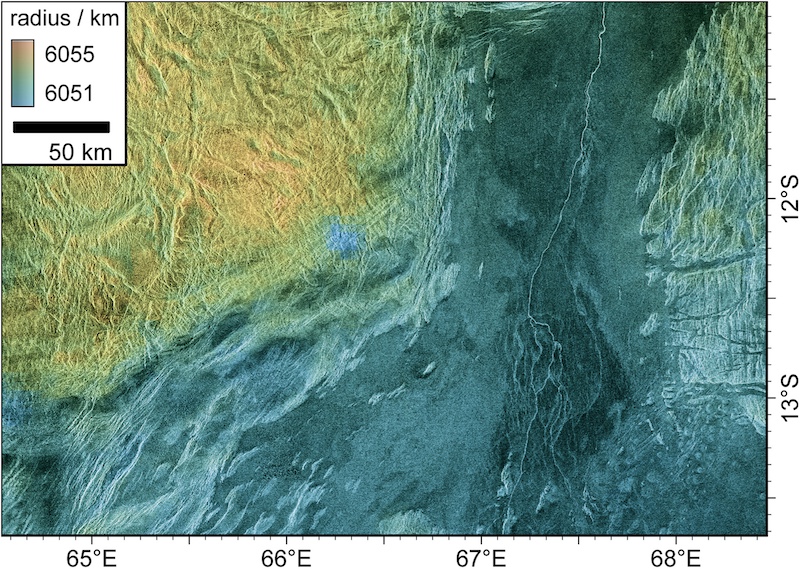
Cracks on Venus: View of terrain from above, with yellowish and purplish regions and long, winding cracks.
View larger. | Here’s a region of cracks on Venus, 2nd world outward from our sun. They might have formed on an ancient seafloor, scientists say. Image via Earth and Planetary Science Letters (2026) (CC BY 4.0).
  • Venus is extremely hot and dry on its surface. But scientists think it once had much more water, perhaps even oceans.
  • Large networks of polygonal cracks cover Venus’ surface in low-lying areas. A new study says they might have formed in seafloor mud as the water evaporated.
  • It’s still a hypothesis right now, but it would support other studies postulating ancient oceans on Venus.

You deserve a daily dose of good news. For the latest in science and the night sky, click here to subscribe to our free daily newsletter.

Polygonal cracks on Venus: How did they form?

Much of Venus’ surface is covered in long cracks. And scientists are still debating how they formed. One possible explanation has been volcanic rock that cooled and contracted to form the cracks. But there’s another – and more exciting – possibility. Some of the cracks might have formed in seafloor mud. That’s what a team of researchers from University of London and Imperial College in the U.K. say in a new paper titled The Lost Oceans of Venus.

These vast, polygonal cracks are found in low-lying regions of Venus. And they do look very similar to ones in seafloor mud on Earth. Thick layers of waterlogged clay get buried, compacted and squeezed dry over time. Did the same thing happen on Venus?

The intriguing peer-reviewed findings were published in Earth and Planetary Science Letters on July 29, 2026.

6 rectangles showing images of various types of cracks on a planet's surface.
View larger. | Here are the 6 types of cracks identified by the researchers. These cracks are found in low-lying areas on Venus. Image via Earth and Planetary Science Letters (2026) (CC BY 4.0).
3 squares in a chart showing oceans in the 1st one, salts in the 2nd one and cracks in the 3rd one.
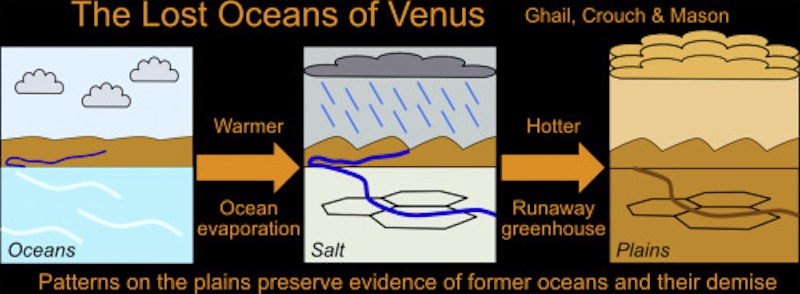
View larger. | This diagram depicts the process of how the Venus cracks might have formed. Oceans evaporated, leaving salts behind. Mud on the former seabed dried up, creating the polygonal cracks. Image via Ghail et al./ Earth and Planetary Science Letters.
Bright, orange and yellow mottled planet with varied surface texture, on black background.
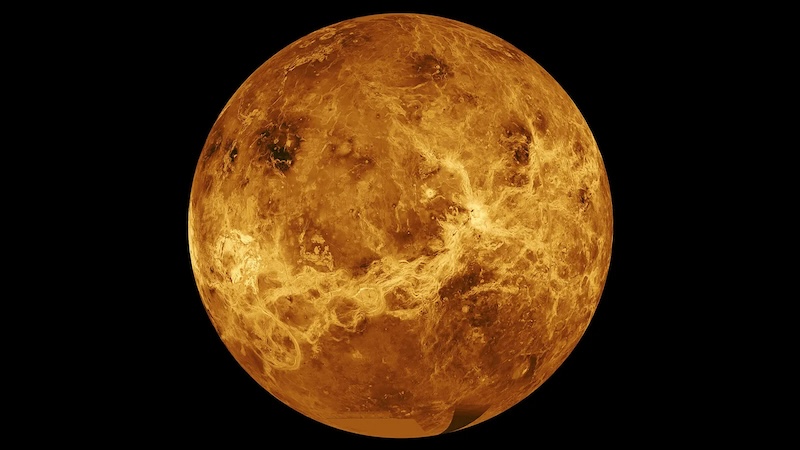
View larger. | This radar image of Venus’ surface, showing this cloud-covered world without its cloud cover, is a composite of data from NASA’s Magellan and Pioneer Venus Orbiter spacecraft. So we see Venus’ formerly hidden surface is tortured, with many cracks, valleys and volcanoes. Image via NASA/ JPL-Caltech.

6 types of cracks

Venus orbits the sun one step inward from Earth. Its cloud-covered surface has created a runaway greenhouse effect on the planet, giving it surface temperatures averaging roughly 464°C (867°F). So it’s hot enough on the surface of Venus to melt lead! And as a result we tend to think about Venus as a blazing hot world on its surface, which is also known to have features resembling volcanoes. But oceans on Venus? Could have happened?

The cracks might be evidence that it’s possible.

There are various types of cracks found on the surface of this neighboring world. One of them is composed of polygon shapes, in low-lying plains. Each polygon is about 1 to 2 kilometers (0.6 to 1.2 miles) across. The researchers then further divided these polygons into six distinct types. And, they say, the patterns overall are much more similar to cracks in dried-out seabeds than to cracks formed by volcanoes.

Similar cracks on Earth can be found in the Mediterranean Sea. A long time ago, almost 6 million years, it almost completely dried up. As the water gradually evaporated, it left behind thick salt deposits and cracks, like what we see on Venus.

Plus, there are also long, winding channels on Venus called canali by scientists. For some years, scientists have thought that flowing lava formed them. But they’re also similar to channels carved on seafloors.

In addition, wrinkled ridges in the lowlands might be above salt deposits, similar to on Earth.

Two black-and-white images of Venus set side by side. One reveals rings in the atmosphere.
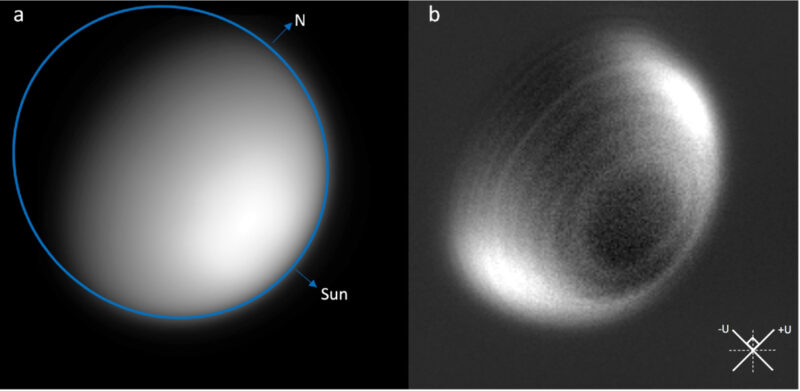
Another recent study found concentric rings in Venus’ atmosphere! On the left, an unpolarized view of the cloud tops of Venus shows a smooth, regular brightness. On the right, a view in polarized light reveals a set of concentric rings – really, atmospheric ripples – in the dense, high atmosphere. Image via Gourav Mahapatra/ The Planetary Science Journal.

The debate continues

These researchers have presented an interesting, even compelling, scenario. But it’s not proof yet of an ancient ocean on Venus. That will require more study to confirm, or not.

And some other studies have been doubtful about long-lost Venusian oceans.

So the debate will continue, until definitive evidence is found of ancient oceans on Venus. That might require future missions that will study the surface and atmosphere in unprecedented detail.

In another recent study, researchers discovered concentric rings in Venus’ atmosphere, above its thick layers of clouds. The rings are actually waves or ripples, but very ring-like!

Bottom line: Sprawling, huge cracks on Venus have long puzzled scientists. A new study suggests the polygon shapes formed from drying mud on an ancient seafloor.

Source: The lost oceans of Venus

Via Phys.org

Read more: Venus rings found high above the planet’s thick clouds

Read more: New study says water in Venus’ clouds surprisingly abundant

The post Were these polygonal cracks on Venus once on a seafloor? first appeared on EarthSky.


from EarthSky https://ift.tt/5Bm8oUf
Cracks on Venus: View of terrain from above, with yellowish and purplish regions and long, winding cracks.
View larger. | Here’s a region of cracks on Venus, 2nd world outward from our sun. They might have formed on an ancient seafloor, scientists say. Image via Earth and Planetary Science Letters (2026) (CC BY 4.0).
  • Venus is extremely hot and dry on its surface. But scientists think it once had much more water, perhaps even oceans.
  • Large networks of polygonal cracks cover Venus’ surface in low-lying areas. A new study says they might have formed in seafloor mud as the water evaporated.
  • It’s still a hypothesis right now, but it would support other studies postulating ancient oceans on Venus.

You deserve a daily dose of good news. For the latest in science and the night sky, click here to subscribe to our free daily newsletter.

Polygonal cracks on Venus: How did they form?

Much of Venus’ surface is covered in long cracks. And scientists are still debating how they formed. One possible explanation has been volcanic rock that cooled and contracted to form the cracks. But there’s another – and more exciting – possibility. Some of the cracks might have formed in seafloor mud. That’s what a team of researchers from University of London and Imperial College in the U.K. say in a new paper titled The Lost Oceans of Venus.

These vast, polygonal cracks are found in low-lying regions of Venus. And they do look very similar to ones in seafloor mud on Earth. Thick layers of waterlogged clay get buried, compacted and squeezed dry over time. Did the same thing happen on Venus?

The intriguing peer-reviewed findings were published in Earth and Planetary Science Letters on July 29, 2026.

6 rectangles showing images of various types of cracks on a planet's surface.
View larger. | Here are the 6 types of cracks identified by the researchers. These cracks are found in low-lying areas on Venus. Image via Earth and Planetary Science Letters (2026) (CC BY 4.0).
3 squares in a chart showing oceans in the 1st one, salts in the 2nd one and cracks in the 3rd one.
View larger. | This diagram depicts the process of how the Venus cracks might have formed. Oceans evaporated, leaving salts behind. Mud on the former seabed dried up, creating the polygonal cracks. Image via Ghail et al./ Earth and Planetary Science Letters.
Bright, orange and yellow mottled planet with varied surface texture, on black background.
View larger. | This radar image of Venus’ surface, showing this cloud-covered world without its cloud cover, is a composite of data from NASA’s Magellan and Pioneer Venus Orbiter spacecraft. So we see Venus’ formerly hidden surface is tortured, with many cracks, valleys and volcanoes. Image via NASA/ JPL-Caltech.

6 types of cracks

Venus orbits the sun one step inward from Earth. Its cloud-covered surface has created a runaway greenhouse effect on the planet, giving it surface temperatures averaging roughly 464°C (867°F). So it’s hot enough on the surface of Venus to melt lead! And as a result we tend to think about Venus as a blazing hot world on its surface, which is also known to have features resembling volcanoes. But oceans on Venus? Could have happened?

The cracks might be evidence that it’s possible.

There are various types of cracks found on the surface of this neighboring world. One of them is composed of polygon shapes, in low-lying plains. Each polygon is about 1 to 2 kilometers (0.6 to 1.2 miles) across. The researchers then further divided these polygons into six distinct types. And, they say, the patterns overall are much more similar to cracks in dried-out seabeds than to cracks formed by volcanoes.

Similar cracks on Earth can be found in the Mediterranean Sea. A long time ago, almost 6 million years, it almost completely dried up. As the water gradually evaporated, it left behind thick salt deposits and cracks, like what we see on Venus.

Plus, there are also long, winding channels on Venus called canali by scientists. For some years, scientists have thought that flowing lava formed them. But they’re also similar to channels carved on seafloors.

In addition, wrinkled ridges in the lowlands might be above salt deposits, similar to on Earth.

Two black-and-white images of Venus set side by side. One reveals rings in the atmosphere.
Another recent study found concentric rings in Venus’ atmosphere! On the left, an unpolarized view of the cloud tops of Venus shows a smooth, regular brightness. On the right, a view in polarized light reveals a set of concentric rings – really, atmospheric ripples – in the dense, high atmosphere. Image via Gourav Mahapatra/ The Planetary Science Journal.

The debate continues

These researchers have presented an interesting, even compelling, scenario. But it’s not proof yet of an ancient ocean on Venus. That will require more study to confirm, or not.

And some other studies have been doubtful about long-lost Venusian oceans.

So the debate will continue, until definitive evidence is found of ancient oceans on Venus. That might require future missions that will study the surface and atmosphere in unprecedented detail.

In another recent study, researchers discovered concentric rings in Venus’ atmosphere, above its thick layers of clouds. The rings are actually waves or ripples, but very ring-like!

Bottom line: Sprawling, huge cracks on Venus have long puzzled scientists. A new study suggests the polygon shapes formed from drying mud on an ancient seafloor.

Source: The lost oceans of Venus

Via Phys.org

Read more: Venus rings found high above the planet’s thick clouds

Read more: New study says water in Venus’ clouds surprisingly abundant

The post Were these polygonal cracks on Venus once on a seafloor? first appeared on EarthSky.


from EarthSky https://ift.tt/5Bm8oUf

Ancient Amazon civilization might have been home to millions

Ancient Amazon civilization: 6 boxes showing a bird's eye view of landscape with geometric shapes.
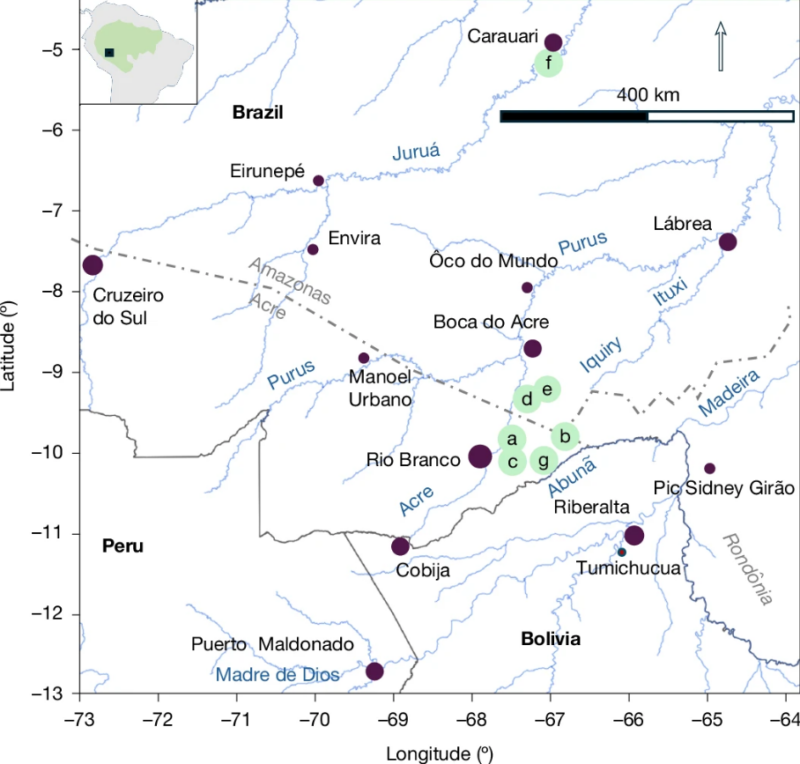
This is a glimpse of just a few of the 400-plus earthworks a new study discovered through laser scanning. The discoveries suggest that an ancient Amazon civilization might have been home to millions of people some 2,000 years ago. Image via University of Helsinki/ Nature.

Was an ancient Amazon civilization home to millions?

Researchers have used laser scanning in the Amazon to discover hundreds of ancient earthworks hidden in the jungle. Much of the Amazon is thickly covered in vegetation. But researchers from the University of Helsinki said on July 29, 2026, that using Light Detection and Ranging Imaging (Lidar) helped them peer through forests to reveal earthworks created by people who lived here from 600 BCE to 850 CE. During this approximately 1,500 year time span, researchers said up to 3 million people might have lived in southwestern Amazonia.

The researchers published their peer-reviewed study on July 29, 2026, in the journal Nature.

Earthworks by the Aquiry people

The area the researchers studied was the southwestern region of the Amazon. This area includes portions of present-day Brazil, Bolivia and Peru. The ancient peoples who lived here did not leave behind a record of what they called themselves. Researchers refer to them as the Aquiry civilization, taken from the name indigenous people used for the Acre River.

Also, this was not one large civilization but many communities of people. Co-author Pirjo Kristiina Virtanen of the University of Helsinki said:

This was not a single realm but a network of many different communities.

Because there isn’t stone in this region, the artifacts the population left behind are in the form of earthworks. Earthworks are artificial changes in the land by digging ditches and mounds, for example.

What happened to cause the civilization’s rapid collapse around 850 CE? This is still a mystery. And it might be related to the abrupt collapse of the Maya civilization in Central America around the same time.

Map with inset of part of South America and close up on rivers and communities.
The inset at top left shows part of South America with Amazonia in green. The black square is the area where the new research took place. The larger map shows green circles where researchers discovered some of the earthworks. Image via University of Helsinki/ Nature.

Scanning the Amazon from above

Lidar technology allows scientists to “see” through the vegetation in order to map features on the ground. The team surveyed about 4,500 square kilometers (1,700 square miles) of rainforest. Co-author Juha Hyyppä of the Finnish Geospatial Research Institute said:

We flew long, roughly 450-kilometer straight transects, mapping a strip about one kilometer wide every 10 kilometers. This allowed us to cover as large a continuous area as possible.

What they found was more than 400 earthworks. These earthworks were monumental geometric structures of a ceremonial nature, along with some later settlement sites. Researchers then undertook an analysis, extrapolating these discoveries to a larger territory. Their conservative finding was that some 20,000 earthworks may exist. And these could have been formed by and home to some 3 million people.

Lead author Martti Pärssinen of the University of Helsinki said:

Our findings overturn our understanding of the Amazon region’s past. The research shows that the human impact on the Amazon’s environment has been far greater than previously believed.

Modifying the land

It appears the Aquiry people not only dug earthworks but also cleared the land for certain crops and managed tree species they considered valuable.

The civilization, which reached its peak between 100 and 300 CE, burned bamboo trees to make way ceremonial centers. But they also burned them to make room for maize, squash, sweet potatoes, chili peppers, beans, peanuts and other crops. In addition, they bulldozed wide roads leading from one center to another.

It appears the Aquiry also favored protein-rich tree species. These species include the Brazil nut tree, the peach palm with its edible heart, and other fruit trees. Pärssinen said:

This has direct implications for our understanding of the region’s biocultural history. The civilization also affected ancient Amazonia’s carbon production and carbon balance, which should be better accounted for in future climate models.

So far, reseachers have only surveyed a small fraction of the southwestern Amazon. Thus, many more archaeological sites might still lie hidden beneath the forest canopy.

A view down at a cleared landscape between trees that shows geometric depressions.
Much of the Amazon is covered by dense forests. But this view of the landscape between the trees shows the Tequinho archeological site in the state of Acre, Brazil. Image via University of Helsinki.

Bottom line: Researchers used laser surveys to reveal hundreds of earthworks across southwestern Amazonia. They estimate that the ancient Amazon civilization could have supported as many as 3 million people at its peak.

Source: Over 20,000 precolonial earthworks in the Southwest Amazonia

Via University of Helsinki

The post Ancient Amazon civilization might have been home to millions first appeared on EarthSky.


from EarthSky https://ift.tt/pIu4es6
Ancient Amazon civilization: 6 boxes showing a bird's eye view of landscape with geometric shapes.
This is a glimpse of just a few of the 400-plus earthworks a new study discovered through laser scanning. The discoveries suggest that an ancient Amazon civilization might have been home to millions of people some 2,000 years ago. Image via University of Helsinki/ Nature.

Was an ancient Amazon civilization home to millions?

Researchers have used laser scanning in the Amazon to discover hundreds of ancient earthworks hidden in the jungle. Much of the Amazon is thickly covered in vegetation. But researchers from the University of Helsinki said on July 29, 2026, that using Light Detection and Ranging Imaging (Lidar) helped them peer through forests to reveal earthworks created by people who lived here from 600 BCE to 850 CE. During this approximately 1,500 year time span, researchers said up to 3 million people might have lived in southwestern Amazonia.

The researchers published their peer-reviewed study on July 29, 2026, in the journal Nature.

Earthworks by the Aquiry people

The area the researchers studied was the southwestern region of the Amazon. This area includes portions of present-day Brazil, Bolivia and Peru. The ancient peoples who lived here did not leave behind a record of what they called themselves. Researchers refer to them as the Aquiry civilization, taken from the name indigenous people used for the Acre River.

Also, this was not one large civilization but many communities of people. Co-author Pirjo Kristiina Virtanen of the University of Helsinki said:

This was not a single realm but a network of many different communities.

Because there isn’t stone in this region, the artifacts the population left behind are in the form of earthworks. Earthworks are artificial changes in the land by digging ditches and mounds, for example.

What happened to cause the civilization’s rapid collapse around 850 CE? This is still a mystery. And it might be related to the abrupt collapse of the Maya civilization in Central America around the same time.

Map with inset of part of South America and close up on rivers and communities.
The inset at top left shows part of South America with Amazonia in green. The black square is the area where the new research took place. The larger map shows green circles where researchers discovered some of the earthworks. Image via University of Helsinki/ Nature.

Scanning the Amazon from above

Lidar technology allows scientists to “see” through the vegetation in order to map features on the ground. The team surveyed about 4,500 square kilometers (1,700 square miles) of rainforest. Co-author Juha Hyyppä of the Finnish Geospatial Research Institute said:

We flew long, roughly 450-kilometer straight transects, mapping a strip about one kilometer wide every 10 kilometers. This allowed us to cover as large a continuous area as possible.

What they found was more than 400 earthworks. These earthworks were monumental geometric structures of a ceremonial nature, along with some later settlement sites. Researchers then undertook an analysis, extrapolating these discoveries to a larger territory. Their conservative finding was that some 20,000 earthworks may exist. And these could have been formed by and home to some 3 million people.

Lead author Martti Pärssinen of the University of Helsinki said:

Our findings overturn our understanding of the Amazon region’s past. The research shows that the human impact on the Amazon’s environment has been far greater than previously believed.

Modifying the land

It appears the Aquiry people not only dug earthworks but also cleared the land for certain crops and managed tree species they considered valuable.

The civilization, which reached its peak between 100 and 300 CE, burned bamboo trees to make way ceremonial centers. But they also burned them to make room for maize, squash, sweet potatoes, chili peppers, beans, peanuts and other crops. In addition, they bulldozed wide roads leading from one center to another.

It appears the Aquiry also favored protein-rich tree species. These species include the Brazil nut tree, the peach palm with its edible heart, and other fruit trees. Pärssinen said:

This has direct implications for our understanding of the region’s biocultural history. The civilization also affected ancient Amazonia’s carbon production and carbon balance, which should be better accounted for in future climate models.

So far, reseachers have only surveyed a small fraction of the southwestern Amazon. Thus, many more archaeological sites might still lie hidden beneath the forest canopy.

A view down at a cleared landscape between trees that shows geometric depressions.
Much of the Amazon is covered by dense forests. But this view of the landscape between the trees shows the Tequinho archeological site in the state of Acre, Brazil. Image via University of Helsinki.

Bottom line: Researchers used laser surveys to reveal hundreds of earthworks across southwestern Amazonia. They estimate that the ancient Amazon civilization could have supported as many as 3 million people at its peak.

Source: Over 20,000 precolonial earthworks in the Southwest Amazonia

Via University of Helsinki

The post Ancient Amazon civilization might have been home to millions first appeared on EarthSky.


from EarthSky https://ift.tt/pIu4es6

What’s a globular cluster? The Milky Way has about 150

Globular cluster: Sphere of myriad of multicolored bright stars, dense in the middle and falling off in density at the edges.
The Hubble Space Telescope captured this off-center closeup image of the globular cluster M5 in 2015. Image via HST/ NASA/ ESA/ APOD.
  • Globular clusters contain the most ancient stars in our Milky Way. They are huge, symmetrical groups of stars packed closely together in space.
  • They look like round fuzzy balls when seen through telescopes.
  • Stars in globular clusters probably formed first, as our galaxy was forming.

A globular cluster contains old stars

Globular clusters are tightly packed, symmetrical collections of stars. They orbit mostly in the extended stellar halos surrounding most spiral galaxies. Plus, globular clusters contain some of the oldest stars in a galaxy, forming early in its history. Could it be that – when it was first forming – a spiral galaxy was once a shapeless cloud of gas and dust? And could its first stars have collected into globular clusters? Could these clusters have stayed put in the halo around a galaxy’s center, while the rest of the spinning galaxy flattened out and formed spiral arms?

It’s possible, and the scenario above would explain why globular clusters orbit in a galaxy’s halo and contain its oldest stars.

But, no one knows precisely how globular clusters formed. Or what role, if any, they played in the development of galaxies. We know globular clusters are the oldest, largest and most massive type of star cluster. And globular clusters contain the oldest stars. Their age is determined by their almost complete lack of what astronomers call metals, the heavier elements forged in star interiors. That’s important because the early universe, before the first stars and galaxies were born, contained only hydrogen and helium.

Science news, night sky events and beautiful photos, all in one place. Click here to subscribe to our free daily newsletter.

A large, round, symmetrical ball of innumerable stars, so dense in the middle it appears solid white.
Omega Centauri, containing as many as 10 million stars, is by far the largest globular cluster associated with our Milky Way galaxy. It’s best viewed from the Southern Hemisphere. The image shows only the central part of the cluster, an area about the size of the full moon on the sky’s dome. Image via La Silla Observatory/ ESO.

The difference between a globular cluster and an open cluster

Globular clusters are big, symmetrical and old. They can reach 300 light-years in diameter and contain 10 million stars. On the other hand, open star clusters – such as the Pleiades – contain sibling stars and are scattered throughout the disk of our galaxy and presumably other galaxies.

Globular star clusters are symmetrical in shape, and are densest toward their centers. Open star clusters are irregular in shape and loosely grouped together.

Globular clusters orbit in the halo of our galaxy. Their positions center around the galaxy’s core and expand above and below the galactic disk. Open star clusters tend to orbit within the disk.

Globular star clusters contain hundreds of thousands of stars. Some globular clusters, like Omega Centauri, contain millions of stars. Open star clusters contain only hundreds of stars.

Glowing disk with bright core, and many smaller bright dots and large fuzzy halo around it.
Artist’s concept of globular star clusters orbiting our Milky Way galaxy (the white dots surrounding the disk-shaped galaxy). As it happens, the Milky Way contains over 150 globular clusters. Image via NASA/ Space Telescope Science Institute (STScI).

The Milky Way has over 150 globular clusters

Our own Milky Way has over 150 globular clusters with perhaps more hidden by galactic dust. The Andromeda galaxy (M31), our neighboring spiral galaxy, appears to have around 300 globular clusters.

Some elliptical galaxies, such as M87, have globular clusters. M87 is a giant elliptical galaxy with over 15,000 globular clusters. Over 1,000 globular clusters have been observed telescopically so far. M87 is also home to the supermassive black hole famously imaged by the Event Horizon Telescope in 2019.

The orbits of globular clusters are highly eccentric and inclined to the galactic plane. And they take about a few hundred million years to complete a single orbit since they are in the “outskirts” of a galaxy.

A globular cluster looks like a fuzzy ball in a telescope. Also, there are individual stars at the periphery merging into a solid ball of light towards the center. However, this is simply because the stars are so close together that they can’t be resolved individually telescopically.

At the center of a globular cluster, stars may reach a density of between 100 and 1,000 stars per cubic parsec. That’s in contrast to the density of stars near our sun, estimated at about 0.14 star per cubic parsec. Your night sky would be full of stars if you lived on a planet orbiting a star in a globular cluster!

Globulars are ancient stars

The stars in globular clusters are the galaxy’s most ancient inhabitants. They comprise a population of what astronomers call Population II stars. Their estimated ages are between 11 and 13 billion years old, making them almost as old as the galaxy itself. Not surprisingly, many of these ancient stars have evolved into huge, bloated red giant stars. So will our sun in a few billion years.

The stars in globular clusters are extremely metal-poor. Which is to say, they have tiny amounts of elements heavier than helium compared to the surrounding interstellar medium. Astronomers refer to all elements heavier than helium as “metals.” And the heavier elements made inside stars end up in the interstellar medium via supernova explosions. So, these old stars are expected to lack metals. In other words, Population II stars consist almost exclusively of hydrogen and helium, the materials present in the early universe.

However, globular clusters can have heavier metals, like those in stars that formed more recently. In particular, excesses of sodium, carbon, oxygen and aluminum, with heavier metals such as strontium, yttrium, barium and europium are present in some clusters. These anomalies remain a mystery but astronomers do have a few theories to explain this, such as the early presence of supermassive stars going supernova in the early universe.

Extremely crowded globe of multicolored brilliant stars, denser toward the middle.
The core of the great Hercules globular cluster Messier 13 from the Hubble Space Telescope. Image via ESA/ Wikimedia Commons.

Messier 13 is the best globular cluster in the Northern Hemisphere

The most famous globular cluster in the Northern Hemisphere is M13 in the constellation of Hercules, discovered by Edmond Halley in 1714. Another name for M13 is the Great Globular Cluster. Charles Messier later added it into his famous Messier catalog in 1764. In amateur telescopes, it is a small fuzzy patch of light, some 22,000 light-years from Earth. At the center of this cluster, stars orbit so closely that occasionally they collide. Furthermore, their deaths lead to the creation of new stars known as blue stragglers. This stellar population is the only type of newer stars in globular clusters.

Some other great globular clusters

Other globular clusters of note are M22 in Sagittarius – one of the brightest in the sky – M5 in Serpens and M12 in Ophiuchus. Many of the night sky’s biggest and brightest globular clusters are best viewed on spring nights and often feature in so-called Messier Marathons.

Furthermore, there are two fabulous globular clusters in the Southern Hemisphere. Omega Centauri, also known as NGC 5139, is visible with the unaided eye to observers at low northern latitudes and in the Southern Hemisphere. Omega Centauri contains approximately 10 million stars and is about 16,000 light-years away. The other is 47 Tucanae, noted for having a small, very bright and dense core. In fact, it is one of the most massive globular clusters in the galaxy, containing millions of stars.

Read more: Evidence for intermediate-mass black hole in Omega Centauri

Even the smallest telescopes reveal globular clusters as a wonderful sight. However, a large telescope resolves individual stars toward their centers.

A large, spherical cluster containing thousands of bright stars, so dense in the middle it looks solid white.
View at EarthSky Community Photos. | Gwen Forrester in DeKalb County, Tennessee, captured this telescopic view of Messier 13, the Great Hercules Cluster, on May 23, 2025. Thank you, Gwen!

Bottom line: Globular clusters are spherical collections of stars, orbiting mostly in the halo of spiral galaxies. Our Milky Way galaxy has over 150 globular clusters containing some of our galaxy’s oldest stars.

Another kind of cluster: What’s an open cluster?

Read more: Messier objects are fuzzy patches in the night sky

The post What’s a globular cluster? The Milky Way has about 150 first appeared on EarthSky.


from EarthSky https://ift.tt/xaoirJw
Globular cluster: Sphere of myriad of multicolored bright stars, dense in the middle and falling off in density at the edges.
The Hubble Space Telescope captured this off-center closeup image of the globular cluster M5 in 2015. Image via HST/ NASA/ ESA/ APOD.
  • Globular clusters contain the most ancient stars in our Milky Way. They are huge, symmetrical groups of stars packed closely together in space.
  • They look like round fuzzy balls when seen through telescopes.
  • Stars in globular clusters probably formed first, as our galaxy was forming.

A globular cluster contains old stars

Globular clusters are tightly packed, symmetrical collections of stars. They orbit mostly in the extended stellar halos surrounding most spiral galaxies. Plus, globular clusters contain some of the oldest stars in a galaxy, forming early in its history. Could it be that – when it was first forming – a spiral galaxy was once a shapeless cloud of gas and dust? And could its first stars have collected into globular clusters? Could these clusters have stayed put in the halo around a galaxy’s center, while the rest of the spinning galaxy flattened out and formed spiral arms?

It’s possible, and the scenario above would explain why globular clusters orbit in a galaxy’s halo and contain its oldest stars.

But, no one knows precisely how globular clusters formed. Or what role, if any, they played in the development of galaxies. We know globular clusters are the oldest, largest and most massive type of star cluster. And globular clusters contain the oldest stars. Their age is determined by their almost complete lack of what astronomers call metals, the heavier elements forged in star interiors. That’s important because the early universe, before the first stars and galaxies were born, contained only hydrogen and helium.

Science news, night sky events and beautiful photos, all in one place. Click here to subscribe to our free daily newsletter.

A large, round, symmetrical ball of innumerable stars, so dense in the middle it appears solid white.
Omega Centauri, containing as many as 10 million stars, is by far the largest globular cluster associated with our Milky Way galaxy. It’s best viewed from the Southern Hemisphere. The image shows only the central part of the cluster, an area about the size of the full moon on the sky’s dome. Image via La Silla Observatory/ ESO.

The difference between a globular cluster and an open cluster

Globular clusters are big, symmetrical and old. They can reach 300 light-years in diameter and contain 10 million stars. On the other hand, open star clusters – such as the Pleiades – contain sibling stars and are scattered throughout the disk of our galaxy and presumably other galaxies.

Globular star clusters are symmetrical in shape, and are densest toward their centers. Open star clusters are irregular in shape and loosely grouped together.

Globular clusters orbit in the halo of our galaxy. Their positions center around the galaxy’s core and expand above and below the galactic disk. Open star clusters tend to orbit within the disk.

Globular star clusters contain hundreds of thousands of stars. Some globular clusters, like Omega Centauri, contain millions of stars. Open star clusters contain only hundreds of stars.

Glowing disk with bright core, and many smaller bright dots and large fuzzy halo around it.
Artist’s concept of globular star clusters orbiting our Milky Way galaxy (the white dots surrounding the disk-shaped galaxy). As it happens, the Milky Way contains over 150 globular clusters. Image via NASA/ Space Telescope Science Institute (STScI).

The Milky Way has over 150 globular clusters

Our own Milky Way has over 150 globular clusters with perhaps more hidden by galactic dust. The Andromeda galaxy (M31), our neighboring spiral galaxy, appears to have around 300 globular clusters.

Some elliptical galaxies, such as M87, have globular clusters. M87 is a giant elliptical galaxy with over 15,000 globular clusters. Over 1,000 globular clusters have been observed telescopically so far. M87 is also home to the supermassive black hole famously imaged by the Event Horizon Telescope in 2019.

The orbits of globular clusters are highly eccentric and inclined to the galactic plane. And they take about a few hundred million years to complete a single orbit since they are in the “outskirts” of a galaxy.

A globular cluster looks like a fuzzy ball in a telescope. Also, there are individual stars at the periphery merging into a solid ball of light towards the center. However, this is simply because the stars are so close together that they can’t be resolved individually telescopically.

At the center of a globular cluster, stars may reach a density of between 100 and 1,000 stars per cubic parsec. That’s in contrast to the density of stars near our sun, estimated at about 0.14 star per cubic parsec. Your night sky would be full of stars if you lived on a planet orbiting a star in a globular cluster!

Globulars are ancient stars

The stars in globular clusters are the galaxy’s most ancient inhabitants. They comprise a population of what astronomers call Population II stars. Their estimated ages are between 11 and 13 billion years old, making them almost as old as the galaxy itself. Not surprisingly, many of these ancient stars have evolved into huge, bloated red giant stars. So will our sun in a few billion years.

The stars in globular clusters are extremely metal-poor. Which is to say, they have tiny amounts of elements heavier than helium compared to the surrounding interstellar medium. Astronomers refer to all elements heavier than helium as “metals.” And the heavier elements made inside stars end up in the interstellar medium via supernova explosions. So, these old stars are expected to lack metals. In other words, Population II stars consist almost exclusively of hydrogen and helium, the materials present in the early universe.

However, globular clusters can have heavier metals, like those in stars that formed more recently. In particular, excesses of sodium, carbon, oxygen and aluminum, with heavier metals such as strontium, yttrium, barium and europium are present in some clusters. These anomalies remain a mystery but astronomers do have a few theories to explain this, such as the early presence of supermassive stars going supernova in the early universe.

Extremely crowded globe of multicolored brilliant stars, denser toward the middle.
The core of the great Hercules globular cluster Messier 13 from the Hubble Space Telescope. Image via ESA/ Wikimedia Commons.

Messier 13 is the best globular cluster in the Northern Hemisphere

The most famous globular cluster in the Northern Hemisphere is M13 in the constellation of Hercules, discovered by Edmond Halley in 1714. Another name for M13 is the Great Globular Cluster. Charles Messier later added it into his famous Messier catalog in 1764. In amateur telescopes, it is a small fuzzy patch of light, some 22,000 light-years from Earth. At the center of this cluster, stars orbit so closely that occasionally they collide. Furthermore, their deaths lead to the creation of new stars known as blue stragglers. This stellar population is the only type of newer stars in globular clusters.

Some other great globular clusters

Other globular clusters of note are M22 in Sagittarius – one of the brightest in the sky – M5 in Serpens and M12 in Ophiuchus. Many of the night sky’s biggest and brightest globular clusters are best viewed on spring nights and often feature in so-called Messier Marathons.

Furthermore, there are two fabulous globular clusters in the Southern Hemisphere. Omega Centauri, also known as NGC 5139, is visible with the unaided eye to observers at low northern latitudes and in the Southern Hemisphere. Omega Centauri contains approximately 10 million stars and is about 16,000 light-years away. The other is 47 Tucanae, noted for having a small, very bright and dense core. In fact, it is one of the most massive globular clusters in the galaxy, containing millions of stars.

Read more: Evidence for intermediate-mass black hole in Omega Centauri

Even the smallest telescopes reveal globular clusters as a wonderful sight. However, a large telescope resolves individual stars toward their centers.

A large, spherical cluster containing thousands of bright stars, so dense in the middle it looks solid white.
View at EarthSky Community Photos. | Gwen Forrester in DeKalb County, Tennessee, captured this telescopic view of Messier 13, the Great Hercules Cluster, on May 23, 2025. Thank you, Gwen!

Bottom line: Globular clusters are spherical collections of stars, orbiting mostly in the halo of spiral galaxies. Our Milky Way galaxy has over 150 globular clusters containing some of our galaxy’s oldest stars.

Another kind of cluster: What’s an open cluster?

Read more: Messier objects are fuzzy patches in the night sky

The post What’s a globular cluster? The Milky Way has about 150 first appeared on EarthSky.


from EarthSky https://ift.tt/xaoirJw

adds 2