In this artist’s concept, the Hera mission scans the impact crater that DART left behind. Image via ESA.
Hera is ready for its asteroid rendezvous
In 2022, the groundbreaking DART mission struck and moved an asteroid. It was a test of Earth’s ability to defend itself from an incoming asteroid threat. On October 7, 2024, a follow-up mission – ESA’s Hera – launched toward the asteroid impact site on Dimorphos, a little moon of the asteroid Didymos. Now, Hera is now just a few months away from its November 2026 meeting with the asteroid pair. It will spend six months investigating the aftereffects from the impact.
So far in 2026, the Hera mission has undergone a deep-space maneuver to correct its course toward its target. And as of July 2026, it has just finished receiving an upgrade to its software. Hera is now about 8 light-minutes from Earth on its journey to the near-Earth asteroid.
When Hera reaches the asteroids, it will release two cubesats, Milani and Junventas. Milani is in charge of spectral surface observations (splitting light bounced off the asteroid into a rainbow array of colors, then analyzing that light). And Juventas will take the first radar soundings in the heart of an asteroid.
When DART hit Didymos
Back in 2022, when DART hit Didymos’s little moon Dimorphos, it made a big splash. We know for sure it pushed the asteroid slightly out of its previous orbit. And the debris kicked up in the collision might even have created a new meteor shower for Earth!
Hera is going to learn more about just what happened when DART struck the little asteroid, creating a crater on its surface and moving it slightly in orbit. It’s going to learn more about Dimorphos itself, to help refine our knowledge of what DART did … to keep us safe from future asteroid collisions.
This will be the first investigation of a binary asteroid. Hera’s focus will be on Dimorphos, the moonlet that DART impacted. According to ESA – the mission planner – Hera will conduct a “crime scene investigation” at the little asteroid moon. But Hera will also check out both Didymos and the dusty environs unleashed by the impact.
Hera will measure the density and composition of Dimorphos in detail and help scientists determine whether it is a ‘rubble pile’ loosely held together by gravity, or a solid core covered in boulders and gravel.
Hera will map the crater created by DART’s impact down to 10-cm resolution to help scientists better understand how the surface material responded to the collision. It’s possible that there is no crater at all, rather the impact reshaped the entire asteroid!
About 15% of known asteroids are actually binary systems, but their origins remain mysterious. Hera will determine whether Dimorphos and Didymos are made from the same material, which would hint that the rapidly spinning Didymos once threw off debris into space that later formed Dimorphos.
Hera project scientist Michael Küppers
Watch EarthSky’s Deborah Byrd speak with Hera project scientist Michael Küppers below. Get the latest here about keeping Earth safe from asteroids.
The Hera mission and a missing planet
Watch a video about the Hera mission to the asteroids Didymos and Dimorphos.
The Hera mission vs the Colosseum
The asteroid Didymos is about a half mile (780 meters) wide. So, that’s about the size of the Golden Gate Bridge. Its little companion, Dimorphos, is about 560 feet (170 meters) in diameter. And that’s about the size of the Great Pyramid. Or compare it to Italy’s Colosseum below.
This graphic compares the size of the asteroid moonlet Dimorphos to the Colosseum in Rome, Italy. Image via ESA.
Bottom line: The Hera mission is on its way to the asteroids Didymos and Dimorphos. The DART mission struck Dimorphos as a planetary defense test in 2022. Hera should reach the asteroids in November 2026.
In this artist’s concept, the Hera mission scans the impact crater that DART left behind. Image via ESA.
Hera is ready for its asteroid rendezvous
In 2022, the groundbreaking DART mission struck and moved an asteroid. It was a test of Earth’s ability to defend itself from an incoming asteroid threat. On October 7, 2024, a follow-up mission – ESA’s Hera – launched toward the asteroid impact site on Dimorphos, a little moon of the asteroid Didymos. Now, Hera is now just a few months away from its November 2026 meeting with the asteroid pair. It will spend six months investigating the aftereffects from the impact.
So far in 2026, the Hera mission has undergone a deep-space maneuver to correct its course toward its target. And as of July 2026, it has just finished receiving an upgrade to its software. Hera is now about 8 light-minutes from Earth on its journey to the near-Earth asteroid.
When Hera reaches the asteroids, it will release two cubesats, Milani and Junventas. Milani is in charge of spectral surface observations (splitting light bounced off the asteroid into a rainbow array of colors, then analyzing that light). And Juventas will take the first radar soundings in the heart of an asteroid.
When DART hit Didymos
Back in 2022, when DART hit Didymos’s little moon Dimorphos, it made a big splash. We know for sure it pushed the asteroid slightly out of its previous orbit. And the debris kicked up in the collision might even have created a new meteor shower for Earth!
Hera is going to learn more about just what happened when DART struck the little asteroid, creating a crater on its surface and moving it slightly in orbit. It’s going to learn more about Dimorphos itself, to help refine our knowledge of what DART did … to keep us safe from future asteroid collisions.
This will be the first investigation of a binary asteroid. Hera’s focus will be on Dimorphos, the moonlet that DART impacted. According to ESA – the mission planner – Hera will conduct a “crime scene investigation” at the little asteroid moon. But Hera will also check out both Didymos and the dusty environs unleashed by the impact.
Hera will measure the density and composition of Dimorphos in detail and help scientists determine whether it is a ‘rubble pile’ loosely held together by gravity, or a solid core covered in boulders and gravel.
Hera will map the crater created by DART’s impact down to 10-cm resolution to help scientists better understand how the surface material responded to the collision. It’s possible that there is no crater at all, rather the impact reshaped the entire asteroid!
About 15% of known asteroids are actually binary systems, but their origins remain mysterious. Hera will determine whether Dimorphos and Didymos are made from the same material, which would hint that the rapidly spinning Didymos once threw off debris into space that later formed Dimorphos.
Hera project scientist Michael Küppers
Watch EarthSky’s Deborah Byrd speak with Hera project scientist Michael Küppers below. Get the latest here about keeping Earth safe from asteroids.
The Hera mission and a missing planet
Watch a video about the Hera mission to the asteroids Didymos and Dimorphos.
The Hera mission vs the Colosseum
The asteroid Didymos is about a half mile (780 meters) wide. So, that’s about the size of the Golden Gate Bridge. Its little companion, Dimorphos, is about 560 feet (170 meters) in diameter. And that’s about the size of the Great Pyramid. Or compare it to Italy’s Colosseum below.
This graphic compares the size of the asteroid moonlet Dimorphos to the Colosseum in Rome, Italy. Image via ESA.
Bottom line: The Hera mission is on its way to the asteroids Didymos and Dimorphos. The DART mission struck Dimorphos as a planetary defense test in 2022. Hera should reach the asteroids in November 2026.
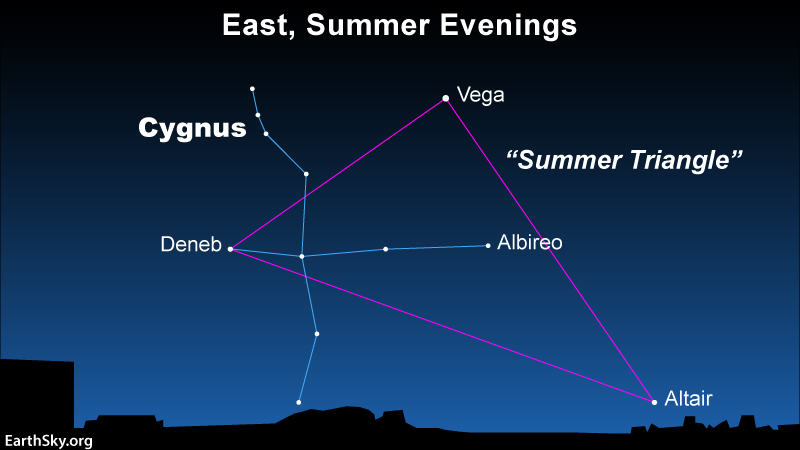
The bright star Deneb is part of the famous Summer Triangle asterism. Its constellation, Cygnus the Swan, flies across the sky on a northern summer evening sky. Chart via EarthSky.
Deneb or Alpha Cygni is the northernmost star in the famous Summer Triangle. For us in the Northern Hemisphere, this asterism is a prominent star pattern in the east on July and August evenings. Three bright stars make up the Summer Triangle. They are the brightest stars in three separate constellations. Deneb’s constellation is Cygnus the Swan. In a dark sky, you can imagine the Swan, flying along the starlit trail of the summer Milky Way. The constellation Cygnus also makes an obvious cross shape, and that’s another asterism. That is, it’s another prominent star pattern. It’s called the Northern Cross.
Okay, we’ve given you a lot of names here: Summer Triangle, Cygnus and Northern Cross.
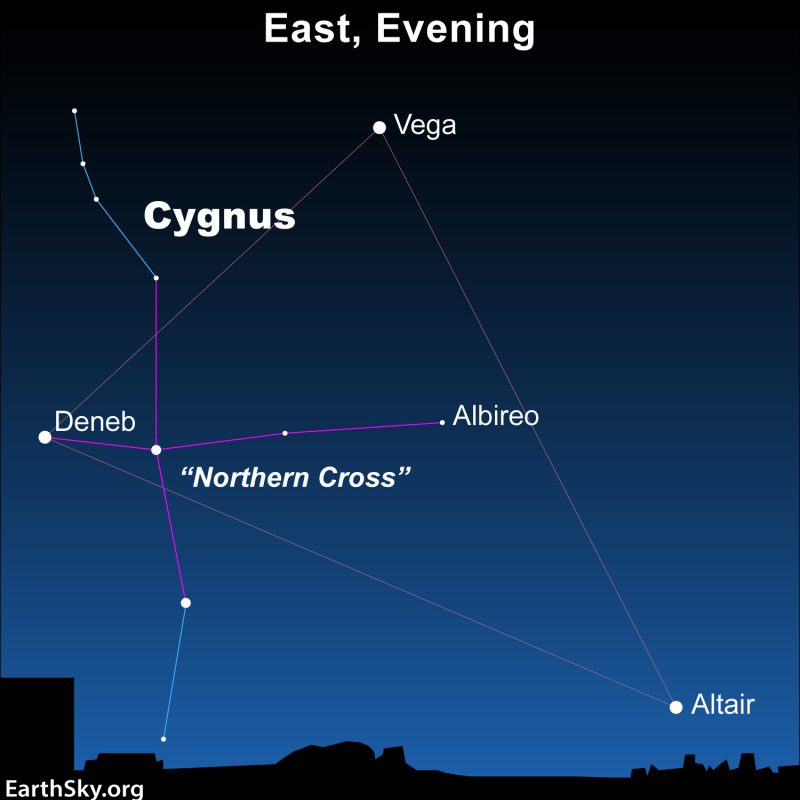
Just remember, the constellation Cygnus the Swan contains the asterism of the Northern Cross. The Cross is just another way to see the Swan. Deneb is at the top of the Cross, but at the tail of the Swan (the star name “deneb” always means “tail”). The little star Albireo is at the head of the Swan, but at the base of the Cross. Whew!
The constellation Cygnus represents a graceful swan. But many also see it as a cross, and so these stars have become known as the Northern Cross. It especially resembles a cross when it is standing upright on the horizon on December evenings. So Deneb marks the Tail of Cygnus the Swan and the head of the cross-like pattern known as the Northern Cross. Chart via EarthSky.
How to see Deneb from the Northern Hemisphere
Northern Hemisphere skywatchers can gaze at this faraway star in the evening starting around May, which is late spring in the Northern Hemisphere.
Like all stars, Deneb is found about one degree farther west at the same time each day, and climbs to its highest point about four minutes earlier per day, 1/2 hour earlier per week, or two hours earlier per month.
Deneb is circumpolar as seen from locations of about 45 degrees north latitude, roughly the northern tier of U.S. states. In other words, from the northern U.S. and similar latitudes, Deneb never sets but instead circles round and round the pole star.
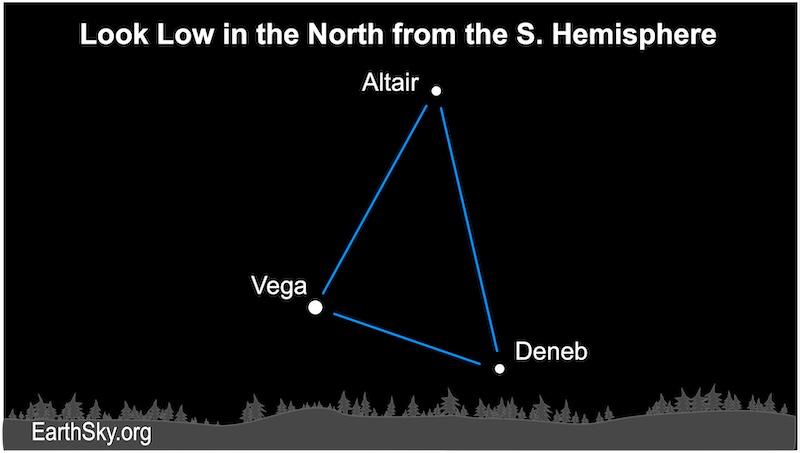
From the Southern Hemisphere, the Summer Triangle appears flipped upside down and rises low into the northern sky. And, for many at populated latitudes across the Southern Hemisphere, Deneb is close to or below the northern horizon rendering the triangle incomplete for many observers. If you are closer to the South Pole than about 45 degrees south latitude, you won’t see Deneb. So that includes Antarctica, far southern Argentina and Chile, and perhaps the far southern tip of New Zealand’s South Island.
So we in the Southern Hemisphere don’t tend to recognize the Summer Triangle as it is seen in the north, and even if we do, it’s only visible, briefly, during our winter season. So the name Summer Triangle is somewhat lost on us. But the sight of Vega and Altair rising to the northeast are a clear sign of winter in the southern hemisphere.
Will you see Deneb at all from the Southern Hemisphere? It’s not easy. For example:
Sydney, Australia (approx. 34° S): Deneb reaches a maximum altitude of about 11° above the northern horizon.
Auckland, New Zealand (approx. 37° S): Deneb reaches a maximum altitude of about 8° above the northern horizon.
Christchurch, New Zealand (approx. 43.5° S): Deneb reaches a maximum altitude of about 1° above the northern horizon. You probably won’t see it from Christchurch!
So mighty Deneb isn’t easy to catch from the far-southern Southern Hemisphere. But, when you do see it, think of the power of this mighty star shining over such a great distance in space!
Looking north from the Southern Hemisphere. Assuming you’re at about 40 degrees south latitude – to the equator – you can see all of the so-called Summer Triangle during your southern winter months by looking north. If you’re closer to the South Pole than about 40 degrees south latitude, you likely won’t see Deneb! Technically you can see it from slightly farther south. But, in reality, the murk on your northern horizon will likely block it from your view. Chart via EarthSky.
Very far away, and very luminous
The star Deneb in the constellation Cygnus the Swan is one of the most distant stars you’ll ever see with your eye alone. That’s because it’s one of our Milky Way galaxy’s most luminous stars.
Deneb is somewhere around 1,500 light-years away. That’s in contrast to most visible stars in our sky, located tens to hundreds of light-years away.
But astronomers still aren’t certain of the exact distance for this very luminous star. There are varying estimates for its distance. Why?
For some decades, ESA’s Earth-orbiting Hipparcos satellite, which operated from 1989 to 1993, provided the most important distance measurement for Deneb. Hipparcos was the predecessor to the Gaia space observatory. Gaia recently ended its mission of collecting data, with a primary goal of creating a 3D map of our Milky Way galaxy.
Both Hipparcos and Gaia gathered what’s called astrometric data on the stars. That is, they measured stars’ positions, motions and brightnesses not just once, but again and again. Those measurements let earthly astronomers calculate a distance, see how the star is moving, and much more.
Early analyses of Hipparcos data indicated a distance around 2,600 light-years for Deneb. Then, in 2009, a newer study – which used more powerful analysis techniques on Hipparcos data – gave a distance for Deneb that’s about half the widely accepted value, closer to 1,500 light-years.
Today, that value – around 1,500 light-years – is the most widely accepted value for Deneb’s distance.
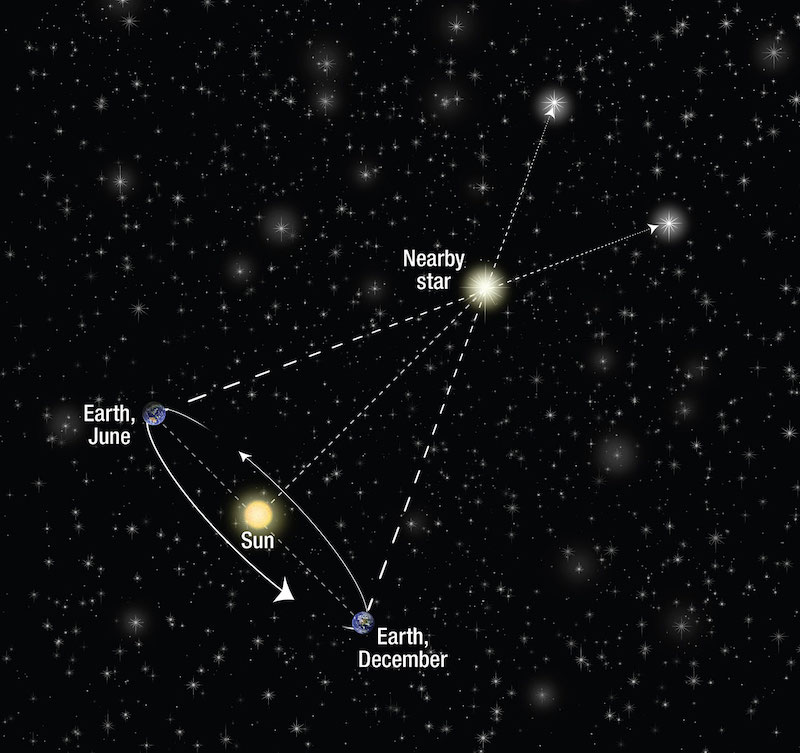
Astronomers use the parallax method to find distances to nearby stars. But Deneb is too far away for accurate parallax measurements from Earth’s surface. Image via NASA/ ESA/ A. Feild (STScI).
When will we know the distance to Deneb?
Gaia has released three sets of data. Why haven’t Gaia’s newer measurements let astronomers measure Deneb’s distance more precisely? It’s mainly because Gaia isn’t geared toward observing such a bright star as Deneb. Astronomer Anthony G.A. Brown of Leiden Observatory in the Netherlands – a member of the Gaia team – told EarthSky in July 2021 that Gaia data still haven’t been used to determine a new distance for Deneb. He said:
The Hipparcos distance estimate still stands.
Deneb is so bright that we can only observe it with Gaia through specially programmed observation sequences (the observing instruments on the spacecraft do not automatically pick up the star). We have observations of
Deneb in hand but these will require a dedicated processing which we have not yet started.
So, for now, the updated Hipparcos number of approximately 1,500 light-years is still the best estimate of Deneb’s distance.
And that’s impressive. So, for us to see a star shine so brightly in our sky from this great distance away, the star must be very powerful. Deneb is one of the most luminous stars – one of the brightest stars, intrinsically – that we can see with the eye.
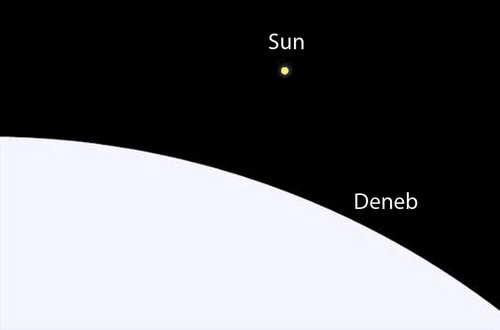
Deneb (bottom half of frame) is somewhere around 200 times wider in diameter than our sun. Image via Wikimedia Commons.
Science of Deneb
Deneb is a blue-white supergiant star with a spectral class of A2Ia. It is the 19th brightest star in the sky shining at +1.25 magnitude. It’s about 196,000 times more luminous than our sun. Deneb contains about 20 solar masses, and as mentioned above, its distance is uncertain. Deneb has a diameter about 203 times that of the sun. And that makes Deneb one of the largest type A spectral class stars known.
Deneb is the prototype for the Alpha Cygni variable stars. Its brightness varies due to non-radial fluctuations on the surface of the star. The fluctuations originate from areas on the surface of the star either expanding and contracting at the same time. They can last for days to weeks and their origin is unknown. The change in brightness is minimal, but detectable. For example, Deneb varies in brightness from magnitude 1.21 to 1.29. Another Alpha Cygni variable star is Rigel, in the constellation of Orion the Hunter.
Deneb was once a spectral class O-type main sequence star with a mass about 23 times that of the sun. Now that it’s a supergiant, it’s no longer fusing hydrogen in its core. It will evolve into a very luminous red supergiant or possibly a highly luminous blue variable star or maybe a Wolf-Rayet star. Regardless of which type of star it becomes, it’s expected to explode as a supernova sometime in the next few million years.
The name Deneb derives from the Arabic Al Dhanab al Dajajah meaning Tail of the Hen. It obviously dates from an earlier incarnation of Cygnus not as a swan but as a chicken. Like many bright stars, Deneb has been called by a number of other names, but the oddest, according to Richard Hinckley Allen, who cites the Arabic name above, was Uropygium, meaning the posterior part of a bird’s body from which feathers grow, and oddly sometimes called the “Pope’s nose.”
In Chinese mythology Deneb is associated with the story of the Celestial Princess or the Weaver Girl. In this story a girl (the star Vega) is separated from her beloved (a cowherd represented by the star Altair) by the Milky Way. Once a year, the girl and the cowherd are allowed to meet briefly when a large flock of magpies forms a bridge across the starry river. Deneb represents the bridge.
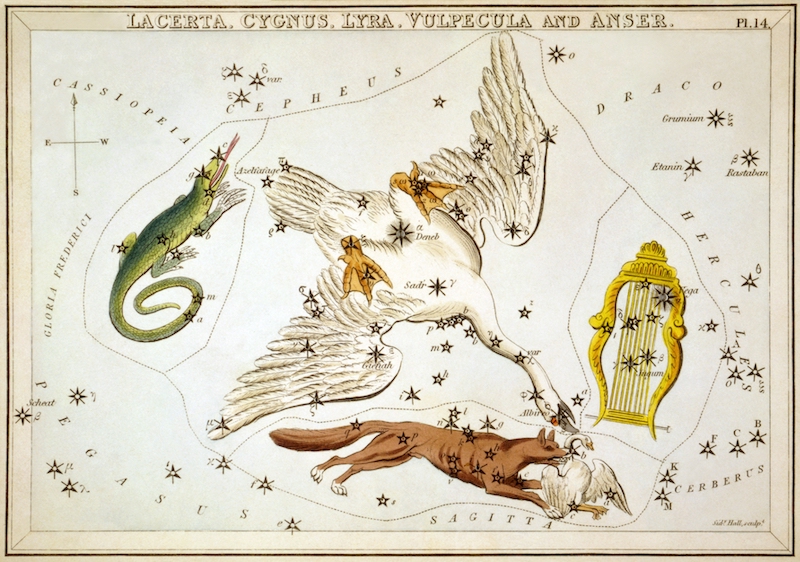
The constellation Lacerta the Lizard lies just behind the tail feathers of Cygnus the Swan. The chart also shows Lyra the Harp and Vulpecula the Fox. This star chart is from Urania’s Mirror, a set of celestial cards by Sidney Hall published in 1825. Image via Wikipedia.
Deneb’s position is RA: 20h 41m 26s, dec: +45° 16′ 49″.
Bottom line: Read here about the luminous Summer Triangle star Deneb, and learn how to see it in your sky.
The bright star Deneb is part of the famous Summer Triangle asterism. Its constellation, Cygnus the Swan, flies across the sky on a northern summer evening sky. Chart via EarthSky.
Deneb or Alpha Cygni is the northernmost star in the famous Summer Triangle. For us in the Northern Hemisphere, this asterism is a prominent star pattern in the east on July and August evenings. Three bright stars make up the Summer Triangle. They are the brightest stars in three separate constellations. Deneb’s constellation is Cygnus the Swan. In a dark sky, you can imagine the Swan, flying along the starlit trail of the summer Milky Way. The constellation Cygnus also makes an obvious cross shape, and that’s another asterism. That is, it’s another prominent star pattern. It’s called the Northern Cross.
Okay, we’ve given you a lot of names here: Summer Triangle, Cygnus and Northern Cross.
Just remember, the constellation Cygnus the Swan contains the asterism of the Northern Cross. The Cross is just another way to see the Swan. Deneb is at the top of the Cross, but at the tail of the Swan (the star name “deneb” always means “tail”). The little star Albireo is at the head of the Swan, but at the base of the Cross. Whew!
The constellation Cygnus represents a graceful swan. But many also see it as a cross, and so these stars have become known as the Northern Cross. It especially resembles a cross when it is standing upright on the horizon on December evenings. So Deneb marks the Tail of Cygnus the Swan and the head of the cross-like pattern known as the Northern Cross. Chart via EarthSky.
How to see Deneb from the Northern Hemisphere
Northern Hemisphere skywatchers can gaze at this faraway star in the evening starting around May, which is late spring in the Northern Hemisphere.
Like all stars, Deneb is found about one degree farther west at the same time each day, and climbs to its highest point about four minutes earlier per day, 1/2 hour earlier per week, or two hours earlier per month.
Deneb is circumpolar as seen from locations of about 45 degrees north latitude, roughly the northern tier of U.S. states. In other words, from the northern U.S. and similar latitudes, Deneb never sets but instead circles round and round the pole star.
From the Southern Hemisphere, the Summer Triangle appears flipped upside down and rises low into the northern sky. And, for many at populated latitudes across the Southern Hemisphere, Deneb is close to or below the northern horizon rendering the triangle incomplete for many observers. If you are closer to the South Pole than about 45 degrees south latitude, you won’t see Deneb. So that includes Antarctica, far southern Argentina and Chile, and perhaps the far southern tip of New Zealand’s South Island.
So we in the Southern Hemisphere don’t tend to recognize the Summer Triangle as it is seen in the north, and even if we do, it’s only visible, briefly, during our winter season. So the name Summer Triangle is somewhat lost on us. But the sight of Vega and Altair rising to the northeast are a clear sign of winter in the southern hemisphere.
Will you see Deneb at all from the Southern Hemisphere? It’s not easy. For example:
Sydney, Australia (approx. 34° S): Deneb reaches a maximum altitude of about 11° above the northern horizon.
Auckland, New Zealand (approx. 37° S): Deneb reaches a maximum altitude of about 8° above the northern horizon.
Christchurch, New Zealand (approx. 43.5° S): Deneb reaches a maximum altitude of about 1° above the northern horizon. You probably won’t see it from Christchurch!
So mighty Deneb isn’t easy to catch from the far-southern Southern Hemisphere. But, when you do see it, think of the power of this mighty star shining over such a great distance in space!
Looking north from the Southern Hemisphere. Assuming you’re at about 40 degrees south latitude – to the equator – you can see all of the so-called Summer Triangle during your southern winter months by looking north. If you’re closer to the South Pole than about 40 degrees south latitude, you likely won’t see Deneb! Technically you can see it from slightly farther south. But, in reality, the murk on your northern horizon will likely block it from your view. Chart via EarthSky.
Very far away, and very luminous
The star Deneb in the constellation Cygnus the Swan is one of the most distant stars you’ll ever see with your eye alone. That’s because it’s one of our Milky Way galaxy’s most luminous stars.
Deneb is somewhere around 1,500 light-years away. That’s in contrast to most visible stars in our sky, located tens to hundreds of light-years away.
But astronomers still aren’t certain of the exact distance for this very luminous star. There are varying estimates for its distance. Why?
For some decades, ESA’s Earth-orbiting Hipparcos satellite, which operated from 1989 to 1993, provided the most important distance measurement for Deneb. Hipparcos was the predecessor to the Gaia space observatory. Gaia recently ended its mission of collecting data, with a primary goal of creating a 3D map of our Milky Way galaxy.
Both Hipparcos and Gaia gathered what’s called astrometric data on the stars. That is, they measured stars’ positions, motions and brightnesses not just once, but again and again. Those measurements let earthly astronomers calculate a distance, see how the star is moving, and much more.
Early analyses of Hipparcos data indicated a distance around 2,600 light-years for Deneb. Then, in 2009, a newer study – which used more powerful analysis techniques on Hipparcos data – gave a distance for Deneb that’s about half the widely accepted value, closer to 1,500 light-years.
Today, that value – around 1,500 light-years – is the most widely accepted value for Deneb’s distance.
Astronomers use the parallax method to find distances to nearby stars. But Deneb is too far away for accurate parallax measurements from Earth’s surface. Image via NASA/ ESA/ A. Feild (STScI).
When will we know the distance to Deneb?
Gaia has released three sets of data. Why haven’t Gaia’s newer measurements let astronomers measure Deneb’s distance more precisely? It’s mainly because Gaia isn’t geared toward observing such a bright star as Deneb. Astronomer Anthony G.A. Brown of Leiden Observatory in the Netherlands – a member of the Gaia team – told EarthSky in July 2021 that Gaia data still haven’t been used to determine a new distance for Deneb. He said:
The Hipparcos distance estimate still stands.
Deneb is so bright that we can only observe it with Gaia through specially programmed observation sequences (the observing instruments on the spacecraft do not automatically pick up the star). We have observations of
Deneb in hand but these will require a dedicated processing which we have not yet started.
So, for now, the updated Hipparcos number of approximately 1,500 light-years is still the best estimate of Deneb’s distance.
And that’s impressive. So, for us to see a star shine so brightly in our sky from this great distance away, the star must be very powerful. Deneb is one of the most luminous stars – one of the brightest stars, intrinsically – that we can see with the eye.
Deneb (bottom half of frame) is somewhere around 200 times wider in diameter than our sun. Image via Wikimedia Commons.
Science of Deneb
Deneb is a blue-white supergiant star with a spectral class of A2Ia. It is the 19th brightest star in the sky shining at +1.25 magnitude. It’s about 196,000 times more luminous than our sun. Deneb contains about 20 solar masses, and as mentioned above, its distance is uncertain. Deneb has a diameter about 203 times that of the sun. And that makes Deneb one of the largest type A spectral class stars known.
Deneb is the prototype for the Alpha Cygni variable stars. Its brightness varies due to non-radial fluctuations on the surface of the star. The fluctuations originate from areas on the surface of the star either expanding and contracting at the same time. They can last for days to weeks and their origin is unknown. The change in brightness is minimal, but detectable. For example, Deneb varies in brightness from magnitude 1.21 to 1.29. Another Alpha Cygni variable star is Rigel, in the constellation of Orion the Hunter.
Deneb was once a spectral class O-type main sequence star with a mass about 23 times that of the sun. Now that it’s a supergiant, it’s no longer fusing hydrogen in its core. It will evolve into a very luminous red supergiant or possibly a highly luminous blue variable star or maybe a Wolf-Rayet star. Regardless of which type of star it becomes, it’s expected to explode as a supernova sometime in the next few million years.
The name Deneb derives from the Arabic Al Dhanab al Dajajah meaning Tail of the Hen. It obviously dates from an earlier incarnation of Cygnus not as a swan but as a chicken. Like many bright stars, Deneb has been called by a number of other names, but the oddest, according to Richard Hinckley Allen, who cites the Arabic name above, was Uropygium, meaning the posterior part of a bird’s body from which feathers grow, and oddly sometimes called the “Pope’s nose.”
In Chinese mythology Deneb is associated with the story of the Celestial Princess or the Weaver Girl. In this story a girl (the star Vega) is separated from her beloved (a cowherd represented by the star Altair) by the Milky Way. Once a year, the girl and the cowherd are allowed to meet briefly when a large flock of magpies forms a bridge across the starry river. Deneb represents the bridge.
The constellation Lacerta the Lizard lies just behind the tail feathers of Cygnus the Swan. The chart also shows Lyra the Harp and Vulpecula the Fox. This star chart is from Urania’s Mirror, a set of celestial cards by Sidney Hall published in 1825. Image via Wikipedia.
Deneb’s position is RA: 20h 41m 26s, dec: +45° 16′ 49″.
Bottom line: Read here about the luminous Summer Triangle star Deneb, and learn how to see it in your sky.
The giraffe weevil is one of nature’s strangest insects. With its oversized neck, unusual battles and ingenious nests, this tiny Madagascan beetle is full of surprises. Image via Magnusforsberg/ iNaturalist.
If someone asks you to name an animal with a long neck, chances are you’ll say “giraffe.” But if you want to impress your friends at trivia night, there’s another answer worth remembering: the giraffe weevil.
It doesn’t live on the African savanna, nor does it stand several feet tall. In fact, the giraffe weevil is small enough to comfortably fit on the tip of your finger. Yet this insect possesses an extraordinarily long neck, disproportionate enough to rival the giraffe itself.
Males use their elongated necks to fight rivals and compete for mates. Females, whose necks are much shorter, make up for it with a natural talent for building curious cradles out of rolled leaves.
These tiny insects live in Madagascar. Few places on Earth harbor as many biological oddities as the Great Red Island!
Red, black and elegant
This insect stands out thanks to its vivid colors and long neck. Image via Azph/ iNaturalist.
Unlike many beetles with stout, heavy bodies, the giraffe weevil has a surprisingly slender silhouette. Its long legs allow it to move easily among branches and leaves, and they are equipped with small protrusions that help it cling to vegetation.
Although the neck is the first thing that catches the eye, it is far from the only feature that makes the giraffe weevil difficult to forget. Its body combines a glossy black coloration with striking red elytra, or their hardened wing covers.
Up close, its appearance becomes even more unusual. At the end of its elongated neck sits a small head equipped with prominent dark eyes and a pair of antennae that constantly probe the surrounding environment. Unlike the bent antennae typical of many weevils, these are relatively straight and end in a small sensory structure specialized in detecting odors and other chemical signals in the environment — an essential ability for navigation and finding mates.
Unlike the bent antennae common to most weevils, these are relatively straight, with specialized tips that help it perceive scents and other chemical signals. Image via Loarie/ iNaturalist.
Much more than a long neck
Few body structures are as exaggerated as the neck of the giraffe weevil. In males, it can be several times longer than in females. And this difference is no accident. As in many species, the two sexes have followed different evolutionary paths to meet their respective challenges.
The neck plays a crucial role during the breeding season. When several males compete for a female, they may engage in combat using this structure as a kind of weapon. Rivals wrestle on branches, attempting to unbalance one another until one eventually gains the upper hand.
This phenomenon is known as sexual selection. Much like the antlers of deer, the giraffe weevil’s neck evolved because it provides reproductive advantages to those that possess a more developed version of it.
The giraffe weevil poses no threat to humans. It has no stinger, does not bite and is completely harmless. Its elongated neck may look intimidating, but it plays no role in defending against people or other large animals.
The giraffe weevil also has wings and small protrusions on its legs, which allow it to fly and cling to branches and leaves. Image via Greg Lasley/ iNaturalist.
The art of turning a leaf into a cradle
If the neck is the giraffe weevil’s most famous feature, its reproductive behavior is probably its most fascinating.
After mating, the female carefully selects a suitable leaf. Just any leaf won’t do. It must have the right size, shape and strength for the task she is about to undertake. Then begins a process that seems more fitting for a skilled craftsperson than for an insect.
Using her legs and the aid of her specialized anatomy, the leaf is gradually folded and rolled into a compact tubular structure. Inside it, the female lays a single egg and continues working until she completes a perfectly protected plant capsule. Once construction is finished, the leaf often detaches and falls to the forest floor.
What makes this so ingenious is that the tiny cradle serves several functions at once. It protects the egg from numerous predators, maintains relatively stable conditions for development and also contains the future larva’s first source of food.
Few insect species display such elaborate behavior when caring for the next generation.
This is a female giraffe weevil. Females have a shorter neck but a huge talent for building cradles to lay their eggs inside! Image via Aimee_11/ iNaturalist.
Born inside a pantry
The giraffe weevil’s story does not end once the egg is safely enclosed within the rolled leaf. After some time, a small larva emerges and finds itself surrounded by food from the very first moment of its life. The leaf that forms its shelter also serves as its first meal.
As it grows, the larva slowly consumes the plant tissue around it. In doing so, it obtains the energy needed to complete the various stages of its development.
Eventually, the time for metamorphosis arrives. Like other beetles, it passes through a pupal stage during which its body undergoes a profound transformation.
At last, the adult emerges, equipped with all the characteristics that have made this species one of the most distinctive insects in the world.
The cradles the females create not only provide shelter, but also serve as food for the larvae after the eggs hatch. Eventually, the larvae develop into the red and black insects we know. Image via Marcopogon/ iNaturalist.
An exclusive resident of the Great Red Island
The giraffe weevil lives only in Madagascar, a vast island off the eastern coast of Africa.
This geographic isolation has turned Madagascar into one of the planet’s greatest hotspots of unique evolution. For millions of years, many species evolved there independently, giving rise to animals found nowhere else on Earth.
Lemurs, impossibly shaped chameleons, bizarre insects and unique plants all form part of this extraordinary biological heritage.
The giraffe weevil is one of these endemic species. Its distribution is limited to certain forested regions of the island, where it depends on specific plants for both food and reproduction.
Much of its life unfolds among branches and leaves. There it finds shelter, food and the materials needed to build the structures in which its offspring will develop.
The giraffe weevil is found only in Madagascar. Isolated from the mainland for millions of years, the island became a cradle of unique evolution, giving rise to extraordinary species found nowhere else on Earth. Image via Treklightly/ iNaturalist.
What does the future hold for the giraffe weevil?
The giraffe weevil remains a relatively understudied insect. Scientists do not have as much information about its populations as they do for many mammals or birds. But that does not mean it is free from threats.
Like many of Madagascar’s endemic species, its greatest challenge is habitat loss. Deforestation, agricultural expansion and other human activities are steadily reducing the natural areas on which it depends.
When a species lives exclusively in a single region of the world, any change to that environment can have significant consequences.
And yet, despite measuring only a few inches in length, the giraffe weevil has become one of the most remarkable and instantly recognizable creatures in the natural world.
Although its elongated neck and unusual shape may seem intimidating, the giraffe weevil is tiny and completely harmless to humans and other animals. Small in size but extraordinary in design, it is one of Madagascar’s most remarkable evolutionary creations. Image via Heinonlein/ Wikimedia Commons.
Bottom line: The giraffe weevil is a tiny Madagascan beetle with a super-long neck, leaf-rolling skills and a fantastic evolutionary story.
The giraffe weevil is one of nature’s strangest insects. With its oversized neck, unusual battles and ingenious nests, this tiny Madagascan beetle is full of surprises. Image via Magnusforsberg/ iNaturalist.
If someone asks you to name an animal with a long neck, chances are you’ll say “giraffe.” But if you want to impress your friends at trivia night, there’s another answer worth remembering: the giraffe weevil.
It doesn’t live on the African savanna, nor does it stand several feet tall. In fact, the giraffe weevil is small enough to comfortably fit on the tip of your finger. Yet this insect possesses an extraordinarily long neck, disproportionate enough to rival the giraffe itself.
Males use their elongated necks to fight rivals and compete for mates. Females, whose necks are much shorter, make up for it with a natural talent for building curious cradles out of rolled leaves.
These tiny insects live in Madagascar. Few places on Earth harbor as many biological oddities as the Great Red Island!
Red, black and elegant
This insect stands out thanks to its vivid colors and long neck. Image via Azph/ iNaturalist.
Unlike many beetles with stout, heavy bodies, the giraffe weevil has a surprisingly slender silhouette. Its long legs allow it to move easily among branches and leaves, and they are equipped with small protrusions that help it cling to vegetation.
Although the neck is the first thing that catches the eye, it is far from the only feature that makes the giraffe weevil difficult to forget. Its body combines a glossy black coloration with striking red elytra, or their hardened wing covers.
Up close, its appearance becomes even more unusual. At the end of its elongated neck sits a small head equipped with prominent dark eyes and a pair of antennae that constantly probe the surrounding environment. Unlike the bent antennae typical of many weevils, these are relatively straight and end in a small sensory structure specialized in detecting odors and other chemical signals in the environment — an essential ability for navigation and finding mates.
Unlike the bent antennae common to most weevils, these are relatively straight, with specialized tips that help it perceive scents and other chemical signals. Image via Loarie/ iNaturalist.
Much more than a long neck
Few body structures are as exaggerated as the neck of the giraffe weevil. In males, it can be several times longer than in females. And this difference is no accident. As in many species, the two sexes have followed different evolutionary paths to meet their respective challenges.
The neck plays a crucial role during the breeding season. When several males compete for a female, they may engage in combat using this structure as a kind of weapon. Rivals wrestle on branches, attempting to unbalance one another until one eventually gains the upper hand.
This phenomenon is known as sexual selection. Much like the antlers of deer, the giraffe weevil’s neck evolved because it provides reproductive advantages to those that possess a more developed version of it.
The giraffe weevil poses no threat to humans. It has no stinger, does not bite and is completely harmless. Its elongated neck may look intimidating, but it plays no role in defending against people or other large animals.
The giraffe weevil also has wings and small protrusions on its legs, which allow it to fly and cling to branches and leaves. Image via Greg Lasley/ iNaturalist.
The art of turning a leaf into a cradle
If the neck is the giraffe weevil’s most famous feature, its reproductive behavior is probably its most fascinating.
After mating, the female carefully selects a suitable leaf. Just any leaf won’t do. It must have the right size, shape and strength for the task she is about to undertake. Then begins a process that seems more fitting for a skilled craftsperson than for an insect.
Using her legs and the aid of her specialized anatomy, the leaf is gradually folded and rolled into a compact tubular structure. Inside it, the female lays a single egg and continues working until she completes a perfectly protected plant capsule. Once construction is finished, the leaf often detaches and falls to the forest floor.
What makes this so ingenious is that the tiny cradle serves several functions at once. It protects the egg from numerous predators, maintains relatively stable conditions for development and also contains the future larva’s first source of food.
Few insect species display such elaborate behavior when caring for the next generation.
This is a female giraffe weevil. Females have a shorter neck but a huge talent for building cradles to lay their eggs inside! Image via Aimee_11/ iNaturalist.
Born inside a pantry
The giraffe weevil’s story does not end once the egg is safely enclosed within the rolled leaf. After some time, a small larva emerges and finds itself surrounded by food from the very first moment of its life. The leaf that forms its shelter also serves as its first meal.
As it grows, the larva slowly consumes the plant tissue around it. In doing so, it obtains the energy needed to complete the various stages of its development.
Eventually, the time for metamorphosis arrives. Like other beetles, it passes through a pupal stage during which its body undergoes a profound transformation.
At last, the adult emerges, equipped with all the characteristics that have made this species one of the most distinctive insects in the world.
The cradles the females create not only provide shelter, but also serve as food for the larvae after the eggs hatch. Eventually, the larvae develop into the red and black insects we know. Image via Marcopogon/ iNaturalist.
An exclusive resident of the Great Red Island
The giraffe weevil lives only in Madagascar, a vast island off the eastern coast of Africa.
This geographic isolation has turned Madagascar into one of the planet’s greatest hotspots of unique evolution. For millions of years, many species evolved there independently, giving rise to animals found nowhere else on Earth.
Lemurs, impossibly shaped chameleons, bizarre insects and unique plants all form part of this extraordinary biological heritage.
The giraffe weevil is one of these endemic species. Its distribution is limited to certain forested regions of the island, where it depends on specific plants for both food and reproduction.
Much of its life unfolds among branches and leaves. There it finds shelter, food and the materials needed to build the structures in which its offspring will develop.
The giraffe weevil is found only in Madagascar. Isolated from the mainland for millions of years, the island became a cradle of unique evolution, giving rise to extraordinary species found nowhere else on Earth. Image via Treklightly/ iNaturalist.
What does the future hold for the giraffe weevil?
The giraffe weevil remains a relatively understudied insect. Scientists do not have as much information about its populations as they do for many mammals or birds. But that does not mean it is free from threats.
Like many of Madagascar’s endemic species, its greatest challenge is habitat loss. Deforestation, agricultural expansion and other human activities are steadily reducing the natural areas on which it depends.
When a species lives exclusively in a single region of the world, any change to that environment can have significant consequences.
And yet, despite measuring only a few inches in length, the giraffe weevil has become one of the most remarkable and instantly recognizable creatures in the natural world.
Although its elongated neck and unusual shape may seem intimidating, the giraffe weevil is tiny and completely harmless to humans and other animals. Small in size but extraordinary in design, it is one of Madagascar’s most remarkable evolutionary creations. Image via Heinonlein/ Wikimedia Commons.
Bottom line: The giraffe weevil is a tiny Madagascan beetle with a super-long neck, leaf-rolling skills and a fantastic evolutionary story.
Clipped version of the jellyfish or “floating brain” video from over the Atlantic on January 1, 2020. It’s part of the 4th batch of Pentagon UAP files, released on July 10, 2026. Observers said the object didn’t maneuver or change direction and traveled with the wind. So it might be an unusually shaped balloon or clump of deflated balloons squashed together. Or it might be something else. An AI-enhanced version of this video went viral on the internet this weekend. Read more about the latest Pentagon UAP files below. Video via DoD/ Forbes.
The Pentagon released the 4th batch of its UAP files on July 10, 2026.
It contains a mix of video, image, document and audio files. There are 40 new files in all, and 19 are videos, including the now-viral “floating brain” video.
The release is part of a continuing rollout of files every couple or few weeks.
The Pentagon released a 4th batch of UAP/UFO files on July 10, 2026. The release includes 19 videos, 14 documents, three images and four audio files. One video – dubbed the “floating brain” – was immediately altered with AI and re-released to the internet, where it went viral this weekend. Forbes reported:
An X user applied AI to enhance the Pentagon’s previously released UFO footage designated DOW-UAP-PR030, also called the ‘floating brain’ UAP. The enhanced image depicts an image that shape-shifts and performs a sharp high-speed maneuver before it accelerates away …
The AI-enhanced image took the internet by storm, sparking a fresh wave of speculation, with viewers drawing very different conclusions about what they’re seeing.
One user wrote, ‘It’s just a bunch of Mylar balloons tied together. Probably escaped a fair. They can ascend for thousands of feet without popping like latex balloons.’
Another one also presented its own theory, stating, ‘Yeah, that thing flew here from Alpha Centauri, or from the Andromeda Galaxy. Makes perfect sense. Look at its mystifyingly perfect symmetry. It can’t possibly be a distorted balloon or a random piece of garbage. Our lives are changed forever.’
Meanwhile, the non-AI-enhanced videos – like the ones found on this page – are also being widely distributed online. The recent batch of UAP files includes the data coming from various agencies, including FBI, NASA, CIA, Energy Department and Pentagon.
The Pentagon had released its 1st batch of declassified UAP/UFO materials on May 8, 2026. It released a 2nd batch on May 22, and a 3rd batch on June 12.
And as usual, Sean Parnell, Assistant to the Secretary of War for Public Affairs and Chief Pentagon Spokesman, said in a statement:
Today, the Department of War is publishing the fourth release of declassified and historical Unidentified Anomalous Phenomena (UAP) files as part of the Presidential Unsealing and Reporting System for UAP Encounters (PURSUE). The collection continues to be housed on WAR.GOV/UFO, and the Department will release additional files on a rolling basis.
And again, many of these files have been known about already, both historically and more recently, by researchers and others who follow the subject. But these centralized releases will help more of the general public to see them as well.
The full video of the jellyfish or “floating brain” video from over the Atlantic on January 1, 2020. Video via DoD. UAP video from the Middle East on January 1, 2023. A dark squarish object comes into view at the bottom of the video. Just as it reaches the top of the frame, a long, dark, skinny object suddenly enters the frame at the same spot, and crosses very fast toward the lower left corner. Video via DoD.
‘Floating brain’ and other odd videos
One of the most unusual-looking videos is from January 1, 2020, over the Atlantic Ocean. It was taken by a “U.S. military platform.”
The witnesses described the object as a “darker, maroonish color, approximately 12-15 feet [3.6-4.5 m] in height.” It had an odd, kind of layered look, with smaller pieces extending sideways and from the bottom. Indeed, some people have likened it to a jellyfish or “floating brain.”
Unfortunately, as is often the case, the release provides no other details. The accompanying Range Fouler Debrief stated that the object didn’t maneuver or change direction and traveled with the wind. So a good possibility is that this was an unusually shaped balloon or clump of deflated balloons squashed together.
A Range Fouler Debrief is a standardized reporting form the U.S. Navy uses to record the circumstances surrounding an unauthorized intrusion into controlled airspace during active military operations or training.
Also, another interesting military video from somewhere in the Middle East on January 1, 2023, shows a dark squarish object coming into view at the bottom of the video. Just as it reaches the top of the frame, a long, dark, skinny object suddenly enters the frame at the same spot, and crosses very fast toward the lower left corner.
It looks like the square object suddenly changed shape and direction extremely quickly. But is it two different objects as the description suggests?
More historical and other documents
The documents in this release include more historical documents, as well as some more recent ones.
One of these is a document from 1948, from Project Sign. It includes 100 reports from between 1947 and 1948. This was also the time when World War II pilots reported sightings of foo fighters, glowing orbs that followed their aircraft. And the infamous Roswell incident occurred in July 1947.
In addition, a review file from Project Blue Book is also included. It documents the 1966 and 1967 Scientific Advisory Board review. The board recommended that the Air Force contract a university-affiliated scientific team to investigate selected UAP sightings.
Plus, a more recent document records details of a UAP reported near the Pantex nuclear plant in Texas on September 1, 2015. The object was diamond-shaped and rounded on the top, about 4 feet tall and 2 feet wide (1.2-.6 m). It was silent and moved slowly, about 10-15 mph (16-24 kph), sometimes increasing speed.
Parts of this document had originally been released in the 2nd batch of files released on May 22, 2026.
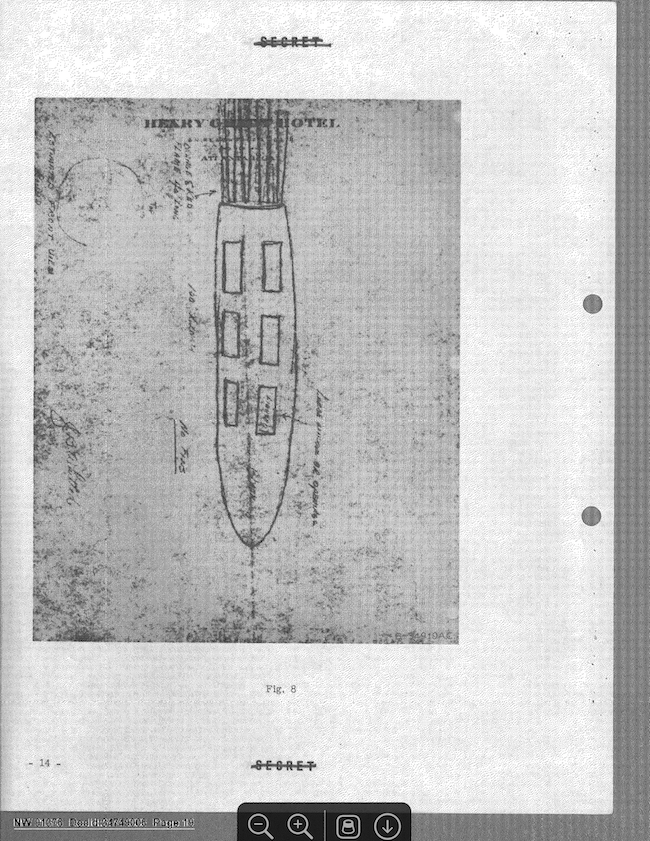
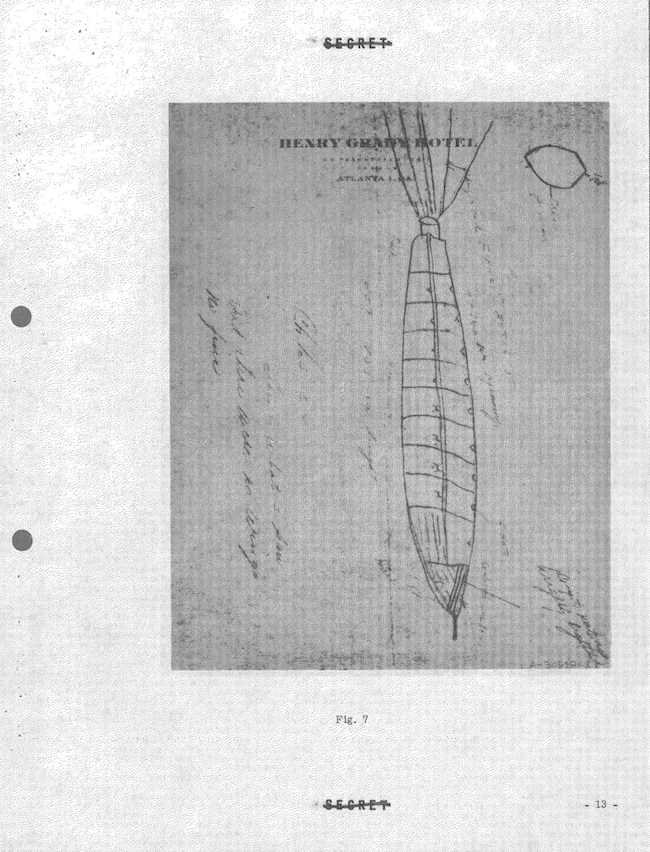
There is also an Air Force assessment from 1949 called “Analysis of Flying Object Incidents in the United States.” It includes details and sketches from the famous Chiles-Whitted pilot UAP case from July 24, 1948.
And while it is not known what the object was, there has been a long history of UAP near or right over nuclear installations in the U.S.
Other documents from the DoD, CIA and FGI are also here.
There is also a complete transcript of the February 1949 Los Alamos conference. Edward Teller, the Hungarian-American theoretical physicist known as the father of the hydrogen bomb, organized the conference. It discussed “green fireballs” seen near Los Alamos and other nuclear sites.
‘Characteristics they had never seen in 28 years of service’
And in another Range Fouler Debrief report from 2019, five military pilots reported an unauthorized intrusion into their airspace during active military operations or training. They described a small rectangular object that was caught on the camera of a surveillance plane. The witnesses described it as having flight characteristics they had never seen in 28 years of service for the Navy and Air Force. In addition, they reported that it moved fast enough to outrun the aircraft’s tracking system.
Fourth Release of UAP Encounter Documentswww.leonarddavid.com/fourth-relea…
Another document, the “1966-1967 deliberations and recommendations of the U.S. Air Force (USAF) Scientific Advisory Board’s Ad Hoc Committee to Review Project Blue Book,” includes the CIA’s official position at the time to deliberately “debunk” the UAP issue in the minds of the public. It says:
… the Panel recommends … That the national security agencies take immediate steps to strip the Unidentified Flying Objects of the special status they have been given and the aura of mystery they have unfortunately acquired.
The CIA did this to “reassure the public” that there was no threat or “inimical forces behind the phenomena.” Plus there was also new training for military personnel to focus on “true indications of hostile measures” from adversaries.
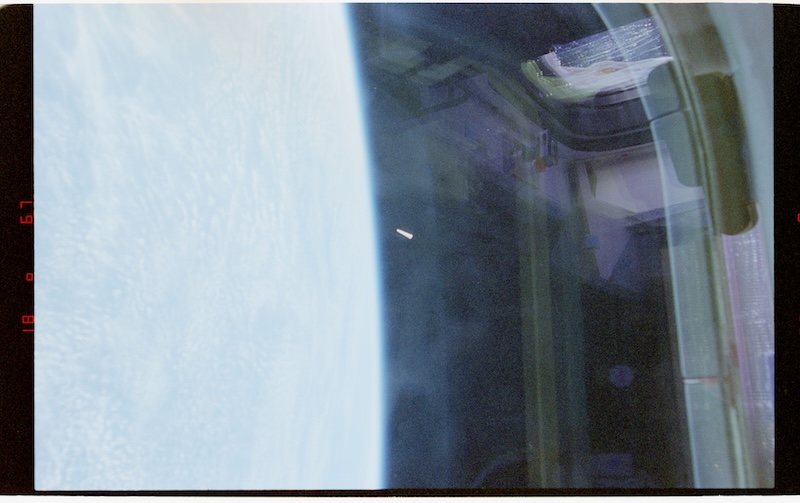
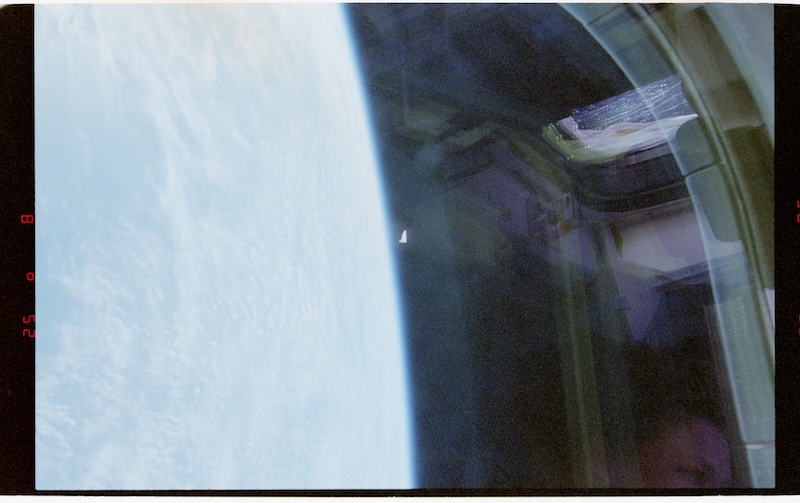
View larger. | 1st of 3 images from the Space Shuttle Columbia mission STS-80 in 1996. A triangular object can be seen in the distance. Image via NASA/ DoD.View larger. | 2nd of 3 images from the Space Shuttle Columbia mission STS-80 in 1996. A triangular object can be seen in the distance. Image via NASA/ DoD.View larger. | 3rd of 3 images from the Space Shuttle Columbia mission STS-80 in 1996. A triangular object can be seen in the distance, but now it’s in front of Earth and more difficult to see (near center of image). Image via NASA/ DoD.
More NASA images and audio
As with the previous releases, there are also some new NASA files. This includes three images and four audio files.
The images are from the Space Shuttle Columbia STS-80 mission in 1996. They show a long, narrow triangular object in the distance. The object has changed orientation between the first two images, and in the third Earth is behind it.
These images had been known about before, and in 2016, one of the astronauts on STS-80, Tom Jones, said that he thought the object was an ice particle or other debris.
The audio files are debriefings from the Apollo 14 and Apollo 17 missions. They discuss the “flashes of light” seen outside the astronauts’ capsules. This might have been a biological effect caused by high energy cosmic-rays passing through the astronauts’ eyes and striking the retina.
New Science Advisory Council and Governance Board
In related news, Avi Loeb at Harvard University said last month that the White House tasked him to lead a new UAP Science Advisory Council.
The council is part of a larger new UAP Governance Board. The Office of the Director of National Intelligence (ODNI) stated:
To support the President’s directive on UAP transparency, ODNI – alongside FBI and DOW [Department of War] – established a UAP Governance Board to provide guidance, recommendations and coordination at the interagency level, bringing together military, law enforcement, the intelligence community and other civilian agencies.
The 4th installment of the Pentagon’s UAP files has provided more videos, documents, images and audio to be examined and debated, but still no “smoking gun” hard evidence for any particular theory. What will the 5th release reveal? We’ll just have to wait to find out.
Bottom line: The 4th batch of the Pentagon UAP files has just been released. The files range from a “floating brain” video to more historical documents, including from NASA.
Clipped version of the jellyfish or “floating brain” video from over the Atlantic on January 1, 2020. It’s part of the 4th batch of Pentagon UAP files, released on July 10, 2026. Observers said the object didn’t maneuver or change direction and traveled with the wind. So it might be an unusually shaped balloon or clump of deflated balloons squashed together. Or it might be something else. An AI-enhanced version of this video went viral on the internet this weekend. Read more about the latest Pentagon UAP files below. Video via DoD/ Forbes.
The Pentagon released the 4th batch of its UAP files on July 10, 2026.
It contains a mix of video, image, document and audio files. There are 40 new files in all, and 19 are videos, including the now-viral “floating brain” video.
The release is part of a continuing rollout of files every couple or few weeks.
The Pentagon released a 4th batch of UAP/UFO files on July 10, 2026. The release includes 19 videos, 14 documents, three images and four audio files. One video – dubbed the “floating brain” – was immediately altered with AI and re-released to the internet, where it went viral this weekend. Forbes reported:
An X user applied AI to enhance the Pentagon’s previously released UFO footage designated DOW-UAP-PR030, also called the ‘floating brain’ UAP. The enhanced image depicts an image that shape-shifts and performs a sharp high-speed maneuver before it accelerates away …
The AI-enhanced image took the internet by storm, sparking a fresh wave of speculation, with viewers drawing very different conclusions about what they’re seeing.
One user wrote, ‘It’s just a bunch of Mylar balloons tied together. Probably escaped a fair. They can ascend for thousands of feet without popping like latex balloons.’
Another one also presented its own theory, stating, ‘Yeah, that thing flew here from Alpha Centauri, or from the Andromeda Galaxy. Makes perfect sense. Look at its mystifyingly perfect symmetry. It can’t possibly be a distorted balloon or a random piece of garbage. Our lives are changed forever.’
Meanwhile, the non-AI-enhanced videos – like the ones found on this page – are also being widely distributed online. The recent batch of UAP files includes the data coming from various agencies, including FBI, NASA, CIA, Energy Department and Pentagon.
The Pentagon had released its 1st batch of declassified UAP/UFO materials on May 8, 2026. It released a 2nd batch on May 22, and a 3rd batch on June 12.
And as usual, Sean Parnell, Assistant to the Secretary of War for Public Affairs and Chief Pentagon Spokesman, said in a statement:
Today, the Department of War is publishing the fourth release of declassified and historical Unidentified Anomalous Phenomena (UAP) files as part of the Presidential Unsealing and Reporting System for UAP Encounters (PURSUE). The collection continues to be housed on WAR.GOV/UFO, and the Department will release additional files on a rolling basis.
And again, many of these files have been known about already, both historically and more recently, by researchers and others who follow the subject. But these centralized releases will help more of the general public to see them as well.
The full video of the jellyfish or “floating brain” video from over the Atlantic on January 1, 2020. Video via DoD. UAP video from the Middle East on January 1, 2023. A dark squarish object comes into view at the bottom of the video. Just as it reaches the top of the frame, a long, dark, skinny object suddenly enters the frame at the same spot, and crosses very fast toward the lower left corner. Video via DoD.
‘Floating brain’ and other odd videos
One of the most unusual-looking videos is from January 1, 2020, over the Atlantic Ocean. It was taken by a “U.S. military platform.”
The witnesses described the object as a “darker, maroonish color, approximately 12-15 feet [3.6-4.5 m] in height.” It had an odd, kind of layered look, with smaller pieces extending sideways and from the bottom. Indeed, some people have likened it to a jellyfish or “floating brain.”
Unfortunately, as is often the case, the release provides no other details. The accompanying Range Fouler Debrief stated that the object didn’t maneuver or change direction and traveled with the wind. So a good possibility is that this was an unusually shaped balloon or clump of deflated balloons squashed together.
A Range Fouler Debrief is a standardized reporting form the U.S. Navy uses to record the circumstances surrounding an unauthorized intrusion into controlled airspace during active military operations or training.
Also, another interesting military video from somewhere in the Middle East on January 1, 2023, shows a dark squarish object coming into view at the bottom of the video. Just as it reaches the top of the frame, a long, dark, skinny object suddenly enters the frame at the same spot, and crosses very fast toward the lower left corner.
It looks like the square object suddenly changed shape and direction extremely quickly. But is it two different objects as the description suggests?
More historical and other documents
The documents in this release include more historical documents, as well as some more recent ones.
One of these is a document from 1948, from Project Sign. It includes 100 reports from between 1947 and 1948. This was also the time when World War II pilots reported sightings of foo fighters, glowing orbs that followed their aircraft. And the infamous Roswell incident occurred in July 1947.
In addition, a review file from Project Blue Book is also included. It documents the 1966 and 1967 Scientific Advisory Board review. The board recommended that the Air Force contract a university-affiliated scientific team to investigate selected UAP sightings.
Plus, a more recent document records details of a UAP reported near the Pantex nuclear plant in Texas on September 1, 2015. The object was diamond-shaped and rounded on the top, about 4 feet tall and 2 feet wide (1.2-.6 m). It was silent and moved slowly, about 10-15 mph (16-24 kph), sometimes increasing speed.
Parts of this document had originally been released in the 2nd batch of files released on May 22, 2026.
There is also an Air Force assessment from 1949 called “Analysis of Flying Object Incidents in the United States.” It includes details and sketches from the famous Chiles-Whitted pilot UAP case from July 24, 1948.
And while it is not known what the object was, there has been a long history of UAP near or right over nuclear installations in the U.S.
Other documents from the DoD, CIA and FGI are also here.
There is also a complete transcript of the February 1949 Los Alamos conference. Edward Teller, the Hungarian-American theoretical physicist known as the father of the hydrogen bomb, organized the conference. It discussed “green fireballs” seen near Los Alamos and other nuclear sites.
‘Characteristics they had never seen in 28 years of service’
And in another Range Fouler Debrief report from 2019, five military pilots reported an unauthorized intrusion into their airspace during active military operations or training. They described a small rectangular object that was caught on the camera of a surveillance plane. The witnesses described it as having flight characteristics they had never seen in 28 years of service for the Navy and Air Force. In addition, they reported that it moved fast enough to outrun the aircraft’s tracking system.
Fourth Release of UAP Encounter Documentswww.leonarddavid.com/fourth-relea…
Another document, the “1966-1967 deliberations and recommendations of the U.S. Air Force (USAF) Scientific Advisory Board’s Ad Hoc Committee to Review Project Blue Book,” includes the CIA’s official position at the time to deliberately “debunk” the UAP issue in the minds of the public. It says:
… the Panel recommends … That the national security agencies take immediate steps to strip the Unidentified Flying Objects of the special status they have been given and the aura of mystery they have unfortunately acquired.
The CIA did this to “reassure the public” that there was no threat or “inimical forces behind the phenomena.” Plus there was also new training for military personnel to focus on “true indications of hostile measures” from adversaries.
View larger. | 1st of 3 images from the Space Shuttle Columbia mission STS-80 in 1996. A triangular object can be seen in the distance. Image via NASA/ DoD.View larger. | 2nd of 3 images from the Space Shuttle Columbia mission STS-80 in 1996. A triangular object can be seen in the distance. Image via NASA/ DoD.View larger. | 3rd of 3 images from the Space Shuttle Columbia mission STS-80 in 1996. A triangular object can be seen in the distance, but now it’s in front of Earth and more difficult to see (near center of image). Image via NASA/ DoD.
More NASA images and audio
As with the previous releases, there are also some new NASA files. This includes three images and four audio files.
The images are from the Space Shuttle Columbia STS-80 mission in 1996. They show a long, narrow triangular object in the distance. The object has changed orientation between the first two images, and in the third Earth is behind it.
These images had been known about before, and in 2016, one of the astronauts on STS-80, Tom Jones, said that he thought the object was an ice particle or other debris.
The audio files are debriefings from the Apollo 14 and Apollo 17 missions. They discuss the “flashes of light” seen outside the astronauts’ capsules. This might have been a biological effect caused by high energy cosmic-rays passing through the astronauts’ eyes and striking the retina.
New Science Advisory Council and Governance Board
In related news, Avi Loeb at Harvard University said last month that the White House tasked him to lead a new UAP Science Advisory Council.
The council is part of a larger new UAP Governance Board. The Office of the Director of National Intelligence (ODNI) stated:
To support the President’s directive on UAP transparency, ODNI – alongside FBI and DOW [Department of War] – established a UAP Governance Board to provide guidance, recommendations and coordination at the interagency level, bringing together military, law enforcement, the intelligence community and other civilian agencies.
The 4th installment of the Pentagon’s UAP files has provided more videos, documents, images and audio to be examined and debated, but still no “smoking gun” hard evidence for any particular theory. What will the 5th release reveal? We’ll just have to wait to find out.
Bottom line: The 4th batch of the Pentagon UAP files has just been released. The files range from a “floating brain” video to more historical documents, including from NASA.
In the east on June, July and August evenings, you’ll find the large pattern of the Summer Triangle, made of 3 bright stars. In a dark sky, you’ll find 3 of the sky’s smallest constellations nestled among these stars.
3 small constellations
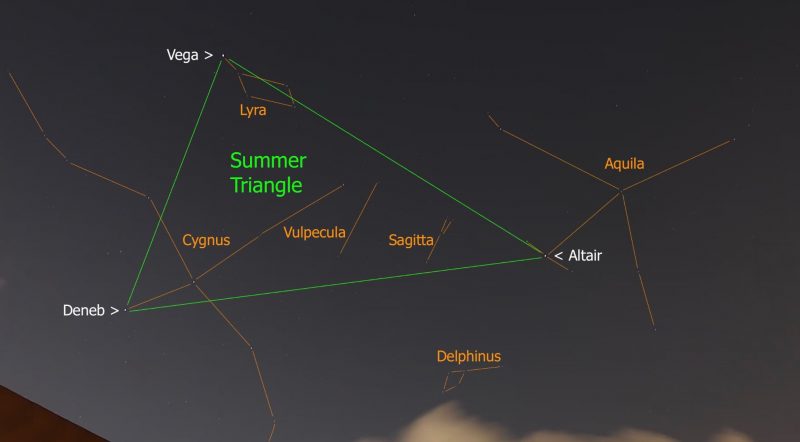
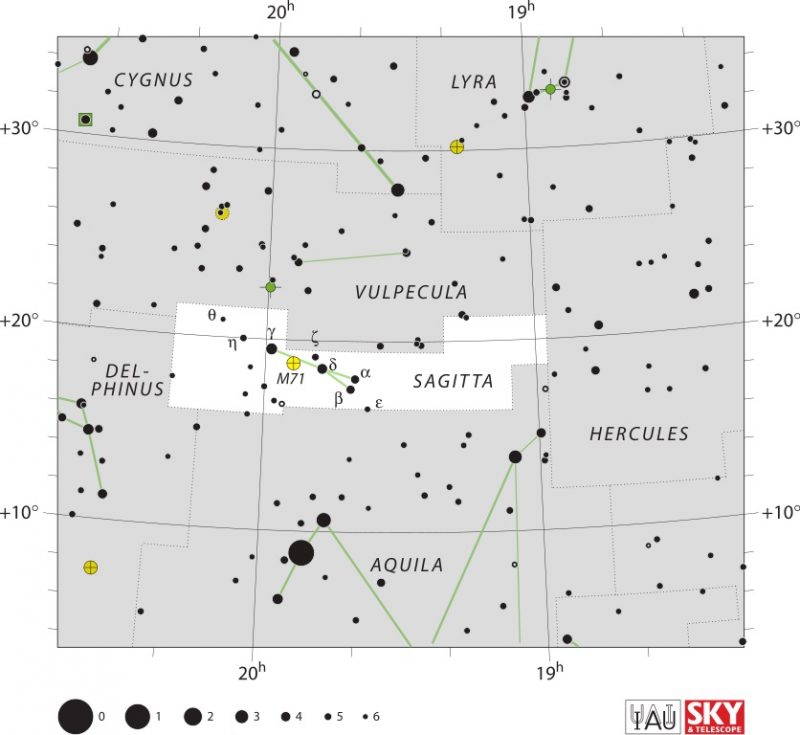
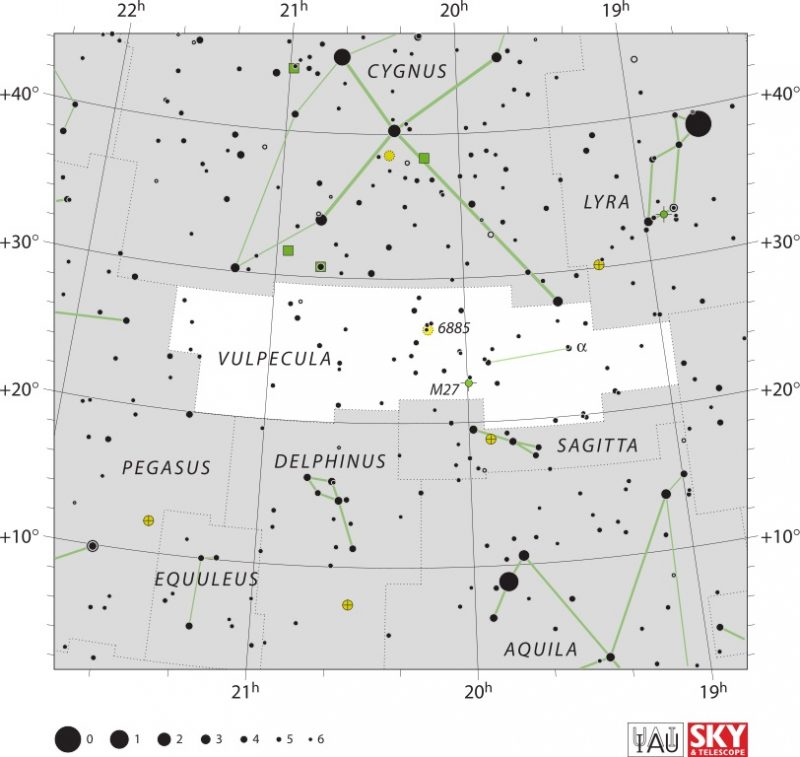
Look for the Summer Triangle, a large asterism visible in the east on July evenings. It consists of three bright stars in three separate constellations. These stars are Vega, Deneb and Altair. If you can find the Summer Triangle, you can use it to locate three of the sky’s smallest constellations. They are Vulpecula the Fox, Delphinus the Dolphin and Sagitta the Arrow. All three are impossible to see from the city. But they’re lots of fun to pick out in a dark sky.
How can you find them? Look at the detailed chart above, and try picking out Vega, Deneb and Altair. Notice these three bright stars make a large triangle on the sky’s dome. Now – still using the chart – look within and around the Summer Triangle for Delphinus, Sagitta and Vulpecula.
View at EarthSly Community Photos. | Raúl Cortés, of EarthSky, shared this image of the Summer Triangle with 6 constellations. It is a busy part of the sky, and very fun to see. Thank you, Raúl!
Delphinus the Dolphin
Delphinus is a truly delightful little constellation that really resembles a dolphin leaping among the waves. Also, Delphinus is one of the earliest constellations, first cataloged by the Greek astronomer Ptolemy in the second century CE. Sometimes, Delphinus is said to be the dolphin that carried a Greek poet – Arion – safely away from his enemies. Another star lore believed this sky Dolphin represented the dolphin sent by the sea god Poseidon to find Amphitrite, the Nereid he wanted to marry.
Delphinus the Dolphin. Utah’s Adventure Family wrote, “… looking at this beautiful constellation makes my heart soar every time.” Image via Stellarium.
Sagitta the Arrow
Sagitta is the third-smallest constellation in our sky, following Crux aka the Southern Cross and Equuleus. And Sagitta is near Vulpecula on the sky’s dome. Its name means “the arrow” in Latin. If you look for Sagitta, you’ll see why. This little star pattern does have a shape reminiscent of an arrow. Sagitta is also one of the earliest constellations, named by Ptolemy in the second century. Sagitta is sometimes said to be an arrow shot from the bow of Hercules, the great mythological hero and god.
The stars of Sagitta the Arrow. Image via IAU. Used with permission.
Vulpecula the Fox
Vulpecula means “the little fox” in Latin. It’s the hardest to find of these three small constellations because it lacks a distinctive shape. Vulpecula is a relatively new constellation, introduced by the Polish astronomer Johannes Hevelius in the late 17th century. Hevelius depicted Vulpecula as not just a fox, but as a fox carrying a goose in its mouth. He also named the goose Anser. Nowadays you can still see the fox and goose on old star charts. And Fox and Goose is a traditional British pub name, according to Ian Ridpath. If you have a dark sky, and you’re up for a binocular challenge, also try finding the Coathanger asterism in Vulpecula.
Bottom line: Although you need a dark country sky to see these three small constellations, they are worth hunting them down. They are: Vulpecula the Fox, Delphinus the Dolphin and Sagitta the Arrow. And they are all near the Summer Triangle.
In the east on June, July and August evenings, you’ll find the large pattern of the Summer Triangle, made of 3 bright stars. In a dark sky, you’ll find 3 of the sky’s smallest constellations nestled among these stars.
3 small constellations
Look for the Summer Triangle, a large asterism visible in the east on July evenings. It consists of three bright stars in three separate constellations. These stars are Vega, Deneb and Altair. If you can find the Summer Triangle, you can use it to locate three of the sky’s smallest constellations. They are Vulpecula the Fox, Delphinus the Dolphin and Sagitta the Arrow. All three are impossible to see from the city. But they’re lots of fun to pick out in a dark sky.
How can you find them? Look at the detailed chart above, and try picking out Vega, Deneb and Altair. Notice these three bright stars make a large triangle on the sky’s dome. Now – still using the chart – look within and around the Summer Triangle for Delphinus, Sagitta and Vulpecula.
View at EarthSly Community Photos. | Raúl Cortés, of EarthSky, shared this image of the Summer Triangle with 6 constellations. It is a busy part of the sky, and very fun to see. Thank you, Raúl!
Delphinus the Dolphin
Delphinus is a truly delightful little constellation that really resembles a dolphin leaping among the waves. Also, Delphinus is one of the earliest constellations, first cataloged by the Greek astronomer Ptolemy in the second century CE. Sometimes, Delphinus is said to be the dolphin that carried a Greek poet – Arion – safely away from his enemies. Another star lore believed this sky Dolphin represented the dolphin sent by the sea god Poseidon to find Amphitrite, the Nereid he wanted to marry.
Delphinus the Dolphin. Utah’s Adventure Family wrote, “… looking at this beautiful constellation makes my heart soar every time.” Image via Stellarium.
Sagitta the Arrow
Sagitta is the third-smallest constellation in our sky, following Crux aka the Southern Cross and Equuleus. And Sagitta is near Vulpecula on the sky’s dome. Its name means “the arrow” in Latin. If you look for Sagitta, you’ll see why. This little star pattern does have a shape reminiscent of an arrow. Sagitta is also one of the earliest constellations, named by Ptolemy in the second century. Sagitta is sometimes said to be an arrow shot from the bow of Hercules, the great mythological hero and god.
The stars of Sagitta the Arrow. Image via IAU. Used with permission.
Vulpecula the Fox
Vulpecula means “the little fox” in Latin. It’s the hardest to find of these three small constellations because it lacks a distinctive shape. Vulpecula is a relatively new constellation, introduced by the Polish astronomer Johannes Hevelius in the late 17th century. Hevelius depicted Vulpecula as not just a fox, but as a fox carrying a goose in its mouth. He also named the goose Anser. Nowadays you can still see the fox and goose on old star charts. And Fox and Goose is a traditional British pub name, according to Ian Ridpath. If you have a dark sky, and you’re up for a binocular challenge, also try finding the Coathanger asterism in Vulpecula.
Bottom line: Although you need a dark country sky to see these three small constellations, they are worth hunting them down. They are: Vulpecula the Fox, Delphinus the Dolphin and Sagitta the Arrow. And they are all near the Summer Triangle.
Michael Zeiler describes himself as an “eclipse cartographer.” You won’t believe the maps on his beautiful new website EclipseAtlas.com. Join EarthSky’s Deborah Byrd and Michael Zeiler for this view preview of the upcoming eclipse on August 12, 2026. Watch in the player above or on YouTube.
August 12, 2026, total solar eclipse
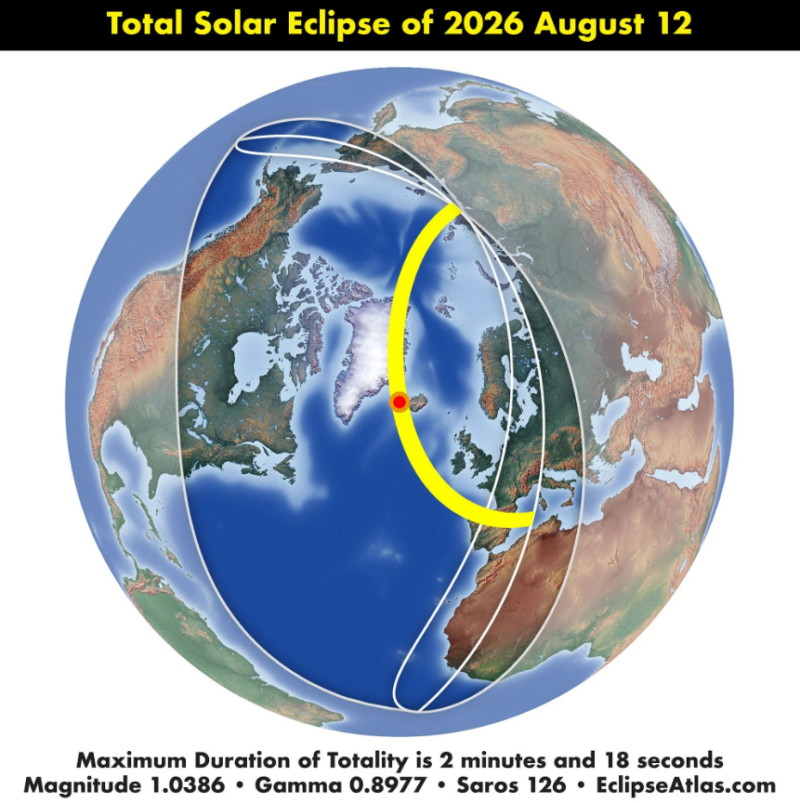
The second solar eclipse of 2026 will be a total solar eclipse on Wednesday, August 12, 2026. On this date, the new moon will cover the sun entirely. Its dark shadow will fall on Earth, blotting the sun entirely from view for observers in the Arctic, Greenland, Iceland, and Spain.
At its longest, near the centerline over the North Atlantic between Greenland and Iceland, the total part of the eclipse will last 2 minutes and 18 seconds. This is a relatively short eclipse! Compare the time of totality to that of the Great North American Eclipse on April 8, 2024 (4 minutes and 28 seconds). Or compare it to the total solar eclipse of August 2, 2027 in North Africa; this eclipse will be one of the longest of the 21st century (6 minutes and 23 seconds).
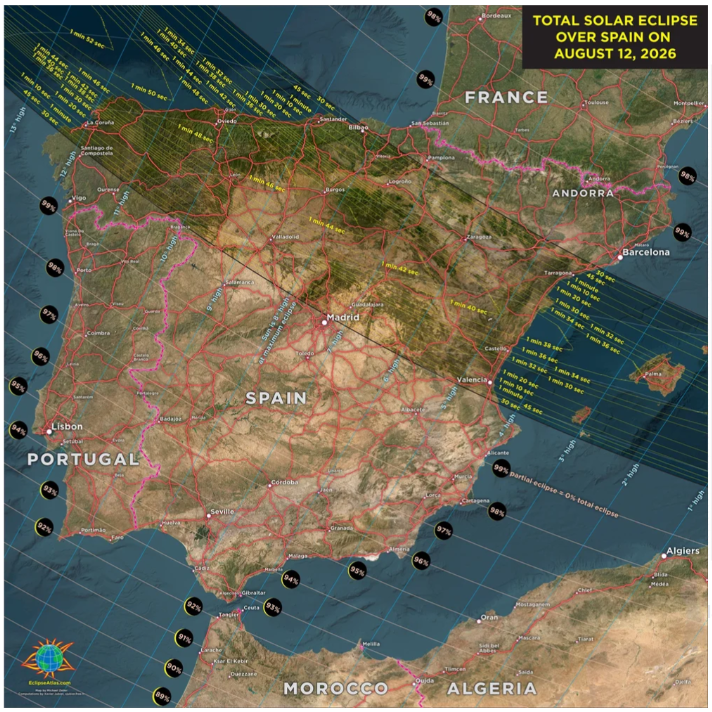
A popular eclipse destination in August, 2026, will be Spain, where the eclipse will happen close to sunset. Most observers in Spain will see between about 1 minute 20 seconds and 1 minute 50 seconds of totality, depending on exactly where they are within the path of the eclipse. But the sun will be only a few degrees above the western horizon during totality, creating the possibility of a spectacular darkened landscape below the eclipsed sun.
If you’re anywhere along the path of totality, there’s a chance you’ll see a Perseid meteor shoot by during totality! That’s because the Perseid meteor shower is peaking on eclipse day. For all of us, because the moon is new that day, it’s going to be a great year for the Perseids.
The continental United States will not see any part of the August 12, 2026, total solar eclipse.
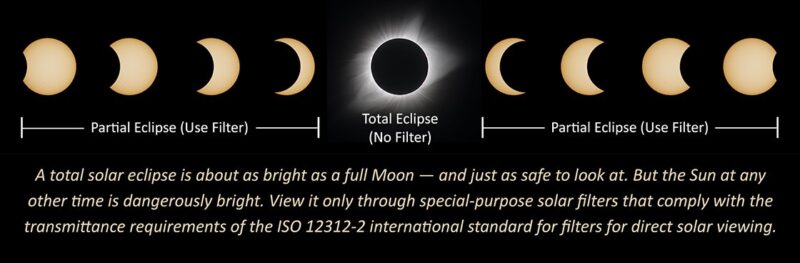
Only the total stage of the eclipse is safe to view without a filter. Image via AAS.
Eclipse maps from EclipseAtlas.com
Michael Zeiler at EclipseAtlas.com is an amazing resource for total solar eclipses. The maps here are just a selection of his extensive and informative collection.
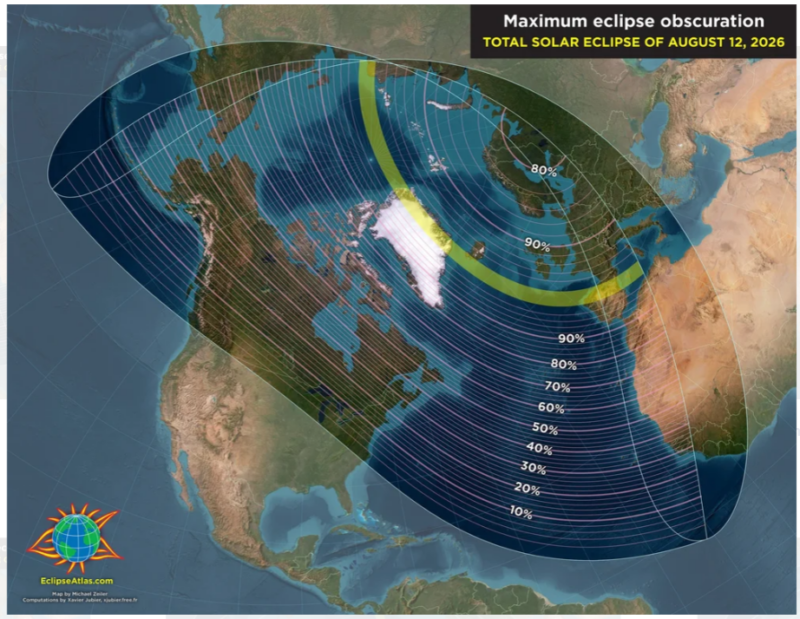
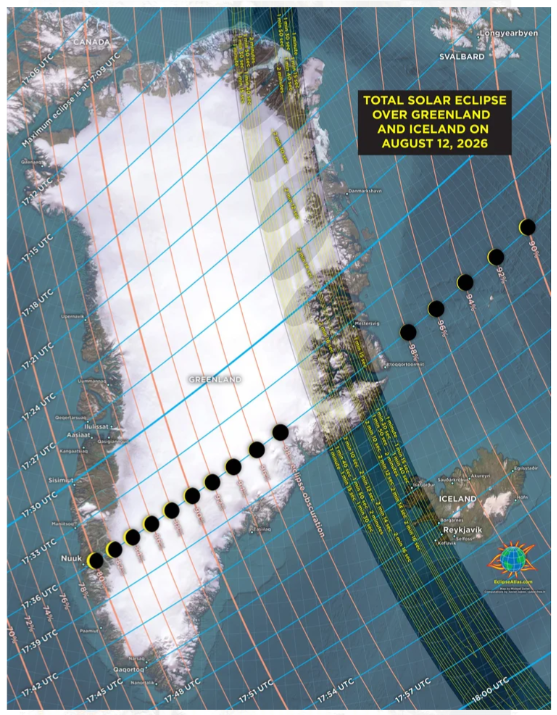
On August 12, 2026, a total solar eclipse will cross northern sections of the globe, including parts of Greenland and Iceland and then down into Spain. Image via EclipseAtlas.com. Used with permission.If you are outside the path of totality, you still might see a partial eclipse. This map shows areas of Europe, North America and Africa that can see the partial phase. Image via EclipseAtlas.com. Used with permission.A closeup on the total solar eclipse path of August 12, 2026, for Greenland and Iceland. Image via EclipseAtlas.com. Used with permission.This is a closeup of the path of the total solar eclipse across Spain on August 12, 2026. Image via EclipseAtlas.com. Used with permission.
Who will see the partial eclipse?
Western Europe will see a partial solar eclipse. And how about North America? Will it see any of the August 12, 2026 eclipse? Yes. The August 12, 2026 total solar eclipse will be visible as a partial eclipse from parts of Greenland and northeastern Canada. Approximate maximum obscuration (fraction of the sun’s diameter covered):
London: ~30–40%
Paris: ~45–55%
Brussels/Amsterdam: ~40–50%
Dublin: ~20–30%
Lisbon: ~70–80%
Madrid: 90%+ (outside but close to the path of totality)
Rome: ~20–30%
The farther south and west you are in Europe, the deeper the partial eclipse generally becomes. In Spain, areas just outside the path of totality will see the Sun reduced to a very thin crescent.
The eclipse barely reaches North America.
Greenland: 80–100% (totality in parts)
Northern Labrador: roughly 40–70%, depending on location
Newfoundland: generally under 30%, with northeastern parts seeing the deepest partial eclipse
Most of Canada: no eclipse
Continental U.S. (lower 48): no eclipse at all
Most of Alaska: no eclipse (only the extreme northeastern Arctic may glimpse a tiny partial eclipse)
Times of the August 12, 2026 total solar eclipse
Partial eclipse begins: at 15:34:11 UTC on August 12. Total eclipse begins: at 16:58:05 UTC on August 12. Greatest eclipse: at 17:45:53 UTC on August 12. Total eclipse ends: at 18:34:05 UTC on August 12. Partial eclipse ends: at 19:57:56 UTC on August 12. Note: The instant of greatest eclipse – when the axis of the moon’s shadow cone passes closest to Earth’s center – takes place at 17:45:53 UTC. It’s a relatively short total eclipse with a maximum duration of totality lasting over two minutes (depending on your location).
The path of totality begins at 17:00 UTC along the Arctic coastline. It races north and passes near the North Pole at 17:06 UTC where it has 1 minute and 54 seconds of totality.
Next it races to Greenland hitting the coastline at 17:15 UTC with 2 minutes 6 seconds of totality. Greatest eclipse – 2 minutes 18 seconds – occurs at 17:45:57 UTC near the Denmark Strait. It continues on to Ireland, Portugal and Spain. Areas in northern Spain are just inside the path of totality and will see 20 seconds of totality. It continues on over Spain to the Mediterranean coast where it finally reaches its last landfall the Balearic Islands and the eclipse ends at 18:34:05 UTC.
The eclipse path lasted over 92 minutes and covered 5,157 miles (8,300 kilometers) – or just 0.47% – of the Earth.
Remember to convert UTC to your time. Note the different between UTC and UT1. You can visit timeanddate.com to get an exact timing of the eclipse from your location. The number one rule for solar eclipse observing is to make sure you protect your eyes by using an appropriate filter.
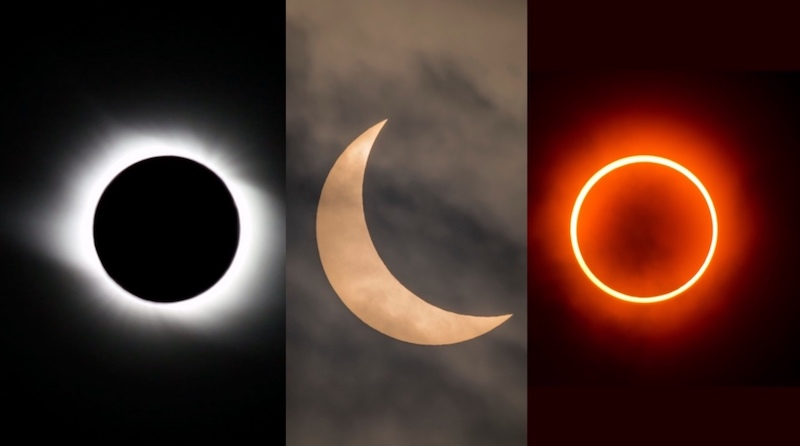
The appearance of a total solar eclipse (left), partial solar eclipse (middle) and annular solar eclipse (right). The one on the right – the annular eclipse – is what those along the eclipse path will see on Wednesday, October 2. Image via K. Bikos/ timeanddate.com. Used with permission.
Moon, constellation, Saros
Greatest eclipse takes place a little over one day after the moon reaches perigee, its closest point to Earth for the month. During the August 12, 2026, eclipse, the sun is located in the direction of the constellation Leo.
The Saros catalog describes the periodicity of eclipses. The eclipse belongs to Saros 126. It is number 48 of 72 eclipses in the series. All eclipses in this series occur at the moon’s descending node. The moon moves northward with respect to the node with each succeeding eclipse in the series.
These eclipses all take place during a single eclipse season.
An eclipse season is an approximate 35-day period during which it’s inevitable for at least two (and possibly three) eclipses to take place. The first eclipse season of 2026 had two eclipses: An annular solar eclipse on February 17 and a total lunar eclipse on March 2-3.
Composite image of the total phase of March 20, 2015, solar eclipse as seen from the Svalbard archipelago in the Arctic. Image via AAS/ Reinhard Wittich.
Bottom line: On August 12, 2026, a total solar eclipse will be visible including parts of Arctic, Greenland, Iceland, and Spain. And it’ll be visible as a partial eclipse from much of western Europe and North America.
Michael Zeiler describes himself as an “eclipse cartographer.” You won’t believe the maps on his beautiful new website EclipseAtlas.com. Join EarthSky’s Deborah Byrd and Michael Zeiler for this view preview of the upcoming eclipse on August 12, 2026. Watch in the player above or on YouTube.
August 12, 2026, total solar eclipse
The second solar eclipse of 2026 will be a total solar eclipse on Wednesday, August 12, 2026. On this date, the new moon will cover the sun entirely. Its dark shadow will fall on Earth, blotting the sun entirely from view for observers in the Arctic, Greenland, Iceland, and Spain.
At its longest, near the centerline over the North Atlantic between Greenland and Iceland, the total part of the eclipse will last 2 minutes and 18 seconds. This is a relatively short eclipse! Compare the time of totality to that of the Great North American Eclipse on April 8, 2024 (4 minutes and 28 seconds). Or compare it to the total solar eclipse of August 2, 2027 in North Africa; this eclipse will be one of the longest of the 21st century (6 minutes and 23 seconds).
A popular eclipse destination in August, 2026, will be Spain, where the eclipse will happen close to sunset. Most observers in Spain will see between about 1 minute 20 seconds and 1 minute 50 seconds of totality, depending on exactly where they are within the path of the eclipse. But the sun will be only a few degrees above the western horizon during totality, creating the possibility of a spectacular darkened landscape below the eclipsed sun.
If you’re anywhere along the path of totality, there’s a chance you’ll see a Perseid meteor shoot by during totality! That’s because the Perseid meteor shower is peaking on eclipse day. For all of us, because the moon is new that day, it’s going to be a great year for the Perseids.
The continental United States will not see any part of the August 12, 2026, total solar eclipse.
Only the total stage of the eclipse is safe to view without a filter. Image via AAS.
Eclipse maps from EclipseAtlas.com
Michael Zeiler at EclipseAtlas.com is an amazing resource for total solar eclipses. The maps here are just a selection of his extensive and informative collection.
On August 12, 2026, a total solar eclipse will cross northern sections of the globe, including parts of Greenland and Iceland and then down into Spain. Image via EclipseAtlas.com. Used with permission.If you are outside the path of totality, you still might see a partial eclipse. This map shows areas of Europe, North America and Africa that can see the partial phase. Image via EclipseAtlas.com. Used with permission.A closeup on the total solar eclipse path of August 12, 2026, for Greenland and Iceland. Image via EclipseAtlas.com. Used with permission.This is a closeup of the path of the total solar eclipse across Spain on August 12, 2026. Image via EclipseAtlas.com. Used with permission.
Who will see the partial eclipse?
Western Europe will see a partial solar eclipse. And how about North America? Will it see any of the August 12, 2026 eclipse? Yes. The August 12, 2026 total solar eclipse will be visible as a partial eclipse from parts of Greenland and northeastern Canada. Approximate maximum obscuration (fraction of the sun’s diameter covered):
London: ~30–40%
Paris: ~45–55%
Brussels/Amsterdam: ~40–50%
Dublin: ~20–30%
Lisbon: ~70–80%
Madrid: 90%+ (outside but close to the path of totality)
Rome: ~20–30%
The farther south and west you are in Europe, the deeper the partial eclipse generally becomes. In Spain, areas just outside the path of totality will see the Sun reduced to a very thin crescent.
The eclipse barely reaches North America.
Greenland: 80–100% (totality in parts)
Northern Labrador: roughly 40–70%, depending on location
Newfoundland: generally under 30%, with northeastern parts seeing the deepest partial eclipse
Most of Canada: no eclipse
Continental U.S. (lower 48): no eclipse at all
Most of Alaska: no eclipse (only the extreme northeastern Arctic may glimpse a tiny partial eclipse)
Times of the August 12, 2026 total solar eclipse
Partial eclipse begins: at 15:34:11 UTC on August 12. Total eclipse begins: at 16:58:05 UTC on August 12. Greatest eclipse: at 17:45:53 UTC on August 12. Total eclipse ends: at 18:34:05 UTC on August 12. Partial eclipse ends: at 19:57:56 UTC on August 12. Note: The instant of greatest eclipse – when the axis of the moon’s shadow cone passes closest to Earth’s center – takes place at 17:45:53 UTC. It’s a relatively short total eclipse with a maximum duration of totality lasting over two minutes (depending on your location).
The path of totality begins at 17:00 UTC along the Arctic coastline. It races north and passes near the North Pole at 17:06 UTC where it has 1 minute and 54 seconds of totality.
Next it races to Greenland hitting the coastline at 17:15 UTC with 2 minutes 6 seconds of totality. Greatest eclipse – 2 minutes 18 seconds – occurs at 17:45:57 UTC near the Denmark Strait. It continues on to Ireland, Portugal and Spain. Areas in northern Spain are just inside the path of totality and will see 20 seconds of totality. It continues on over Spain to the Mediterranean coast where it finally reaches its last landfall the Balearic Islands and the eclipse ends at 18:34:05 UTC.
The eclipse path lasted over 92 minutes and covered 5,157 miles (8,300 kilometers) – or just 0.47% – of the Earth.
Remember to convert UTC to your time. Note the different between UTC and UT1. You can visit timeanddate.com to get an exact timing of the eclipse from your location. The number one rule for solar eclipse observing is to make sure you protect your eyes by using an appropriate filter.
The appearance of a total solar eclipse (left), partial solar eclipse (middle) and annular solar eclipse (right). The one on the right – the annular eclipse – is what those along the eclipse path will see on Wednesday, October 2. Image via K. Bikos/ timeanddate.com. Used with permission.
Moon, constellation, Saros
Greatest eclipse takes place a little over one day after the moon reaches perigee, its closest point to Earth for the month. During the August 12, 2026, eclipse, the sun is located in the direction of the constellation Leo.
The Saros catalog describes the periodicity of eclipses. The eclipse belongs to Saros 126. It is number 48 of 72 eclipses in the series. All eclipses in this series occur at the moon’s descending node. The moon moves northward with respect to the node with each succeeding eclipse in the series.
These eclipses all take place during a single eclipse season.
An eclipse season is an approximate 35-day period during which it’s inevitable for at least two (and possibly three) eclipses to take place. The first eclipse season of 2026 had two eclipses: An annular solar eclipse on February 17 and a total lunar eclipse on March 2-3.
Composite image of the total phase of March 20, 2015, solar eclipse as seen from the Svalbard archipelago in the Arctic. Image via AAS/ Reinhard Wittich.
Bottom line: On August 12, 2026, a total solar eclipse will be visible including parts of Arctic, Greenland, Iceland, and Spain. And it’ll be visible as a partial eclipse from much of western Europe and North America.