
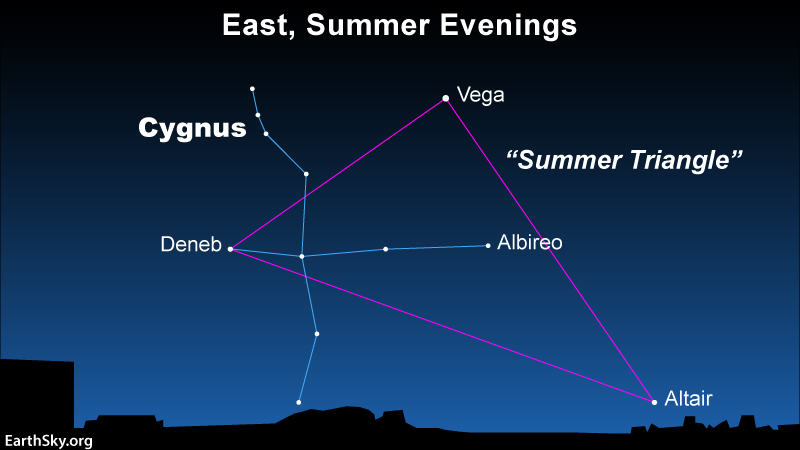
Deneb or Alpha Cygni is the northernmost star in the famous Summer Triangle. For us in the Northern Hemisphere, this asterism is a prominent star pattern in the east on July and August evenings. Three bright stars make up the Summer Triangle. They are the brightest stars in three separate constellations. Deneb’s constellation is Cygnus the Swan. In a dark sky, you can imagine the Swan, flying along the starlit trail of the summer Milky Way. The constellation Cygnus also makes an obvious cross shape, and that’s another asterism. That is, it’s another prominent star pattern. It’s called the Northern Cross.
Okay, we’ve given you a lot of names here: Summer Triangle, Cygnus and Northern Cross.
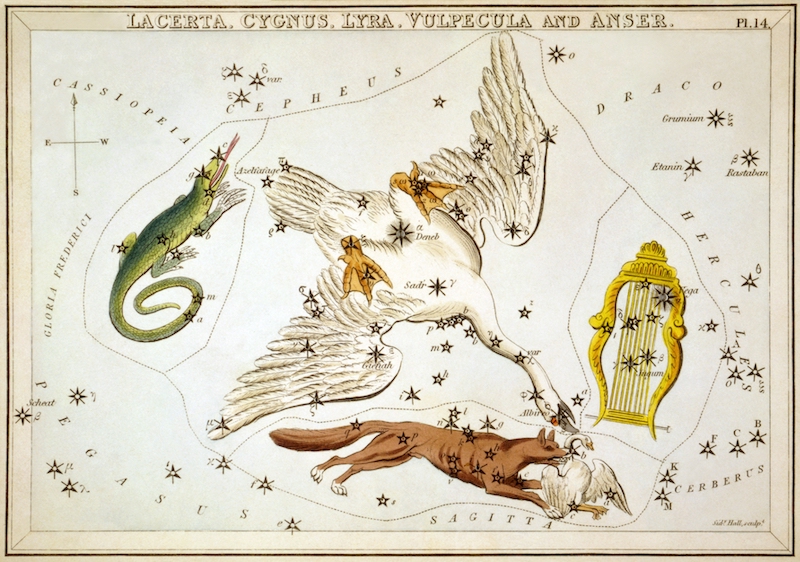
Just remember, the constellation Cygnus the Swan contains the asterism of the Northern Cross. The Cross is just another way to see the Swan. Deneb is at the top of the Cross, but at the tail of the Swan (the star name “deneb” always means “tail”). The little star Albireo is at the head of the Swan, but at the base of the Cross. Whew!
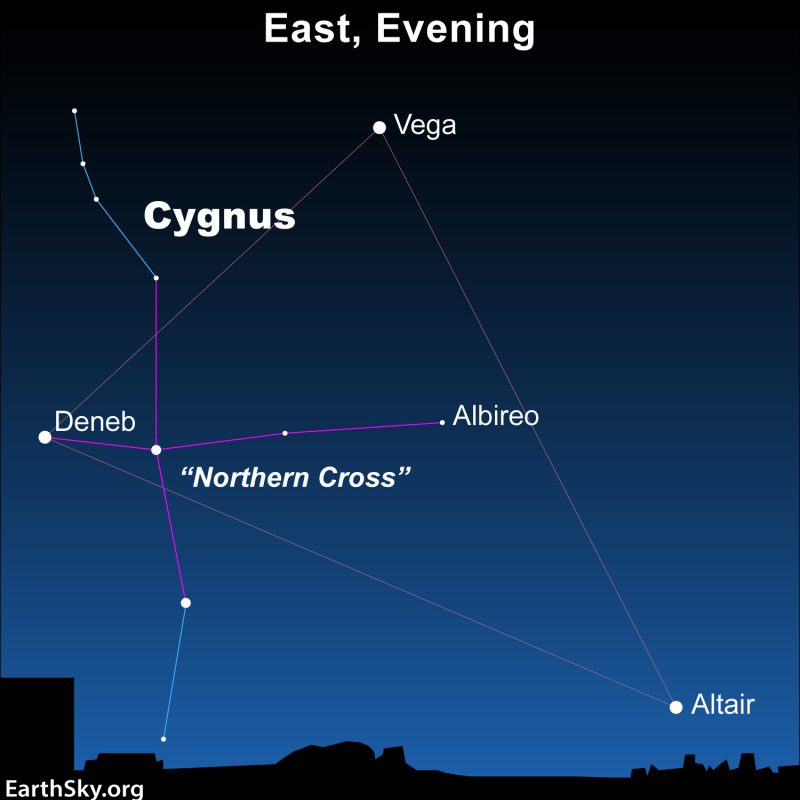
How to see Deneb from the Northern Hemisphere
Northern Hemisphere skywatchers can gaze at this faraway star in the evening starting around May, which is late spring in the Northern Hemisphere.
Like all stars, Deneb is found about one degree farther west at the same time each day, and climbs to its highest point about four minutes earlier per day, 1/2 hour earlier per week, or two hours earlier per month.
Deneb is circumpolar as seen from locations of about 45 degrees north latitude, roughly the northern tier of U.S. states. In other words, from the northern U.S. and similar latitudes, Deneb never sets but instead circles round and round the pole star.
How to see Deneb from the Southern Hemisphere
Via Daniel Gaussen, Founder & Guide – Stargaze Mackenzie – New Zealand
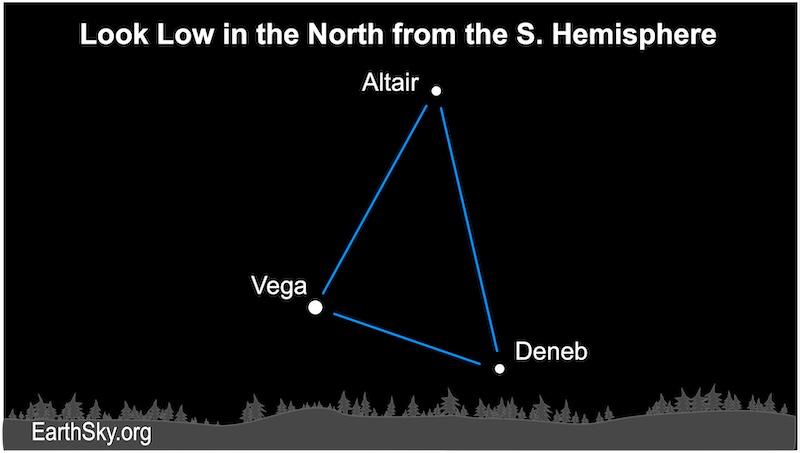
From the Southern Hemisphere, the Summer Triangle appears flipped upside down and rises low into the northern sky. And, for many at populated latitudes across the Southern Hemisphere, Deneb is close to or below the northern horizon rendering the triangle incomplete for many observers. If you are closer to the South Pole than about 45 degrees south latitude, you won’t see Deneb. So that includes Antarctica, far southern Argentina and Chile, and perhaps the far southern tip of New Zealand’s South Island.
So we in the Southern Hemisphere don’t tend to recognize the Summer Triangle as it is seen in the north, and even if we do, it’s only visible, briefly, during our winter season. So the name Summer Triangle is somewhat lost on us. But the sight of Vega and Altair rising to the northeast are a clear sign of winter in the southern hemisphere.
Will you see Deneb at all from the Southern Hemisphere? It’s not easy. For example:
- Sydney, Australia (approx. 34° S): Deneb reaches a maximum altitude of about 11° above the northern horizon.
- Auckland, New Zealand (approx. 37° S): Deneb reaches a maximum altitude of about 8° above the northern horizon.
- Christchurch, New Zealand (approx. 43.5° S): Deneb reaches a maximum altitude of about 1° above the northern horizon. You probably won’t see it from Christchurch!
So mighty Deneb isn’t easy to catch from the far-southern Southern Hemisphere. But, when you do see it, think of the power of this mighty star shining over such a great distance in space!
Very far away, and very luminous
The star Deneb in the constellation Cygnus the Swan is one of the most distant stars you’ll ever see with your eye alone. That’s because it’s one of our Milky Way galaxy’s most luminous stars.
Deneb is somewhere around 1,500 light-years away. That’s in contrast to most visible stars in our sky, located tens to hundreds of light-years away.
But astronomers still aren’t certain of the exact distance for this very luminous star. There are varying estimates for its distance. Why?
For some decades, ESA’s Earth-orbiting Hipparcos satellite, which operated from 1989 to 1993, provided the most important distance measurement for Deneb. Hipparcos was the predecessor to the Gaia space observatory. Gaia recently ended its mission of collecting data, with a primary goal of creating a 3D map of our Milky Way galaxy.
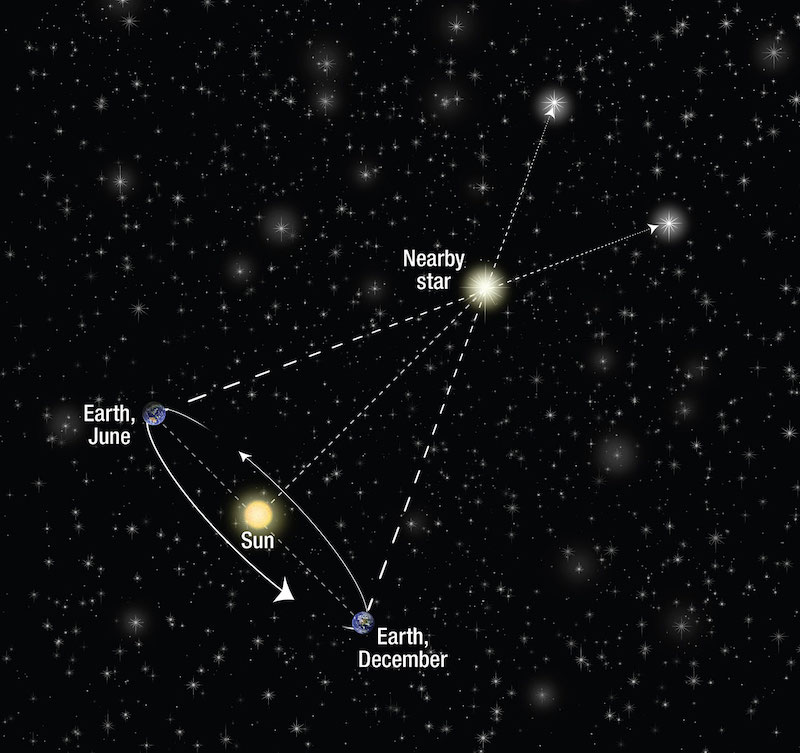
Both Hipparcos and Gaia gathered what’s called astrometric data on the stars. That is, they measured stars’ positions, motions and brightnesses not just once, but again and again. Those measurements let earthly astronomers calculate a distance, see how the star is moving, and much more.
Early analyses of Hipparcos data indicated a distance around 2,600 light-years for Deneb. Then, in 2009, a newer study – which used more powerful analysis techniques on Hipparcos data – gave a distance for Deneb that’s about half the widely accepted value, closer to 1,500 light-years.
Today, that value – around 1,500 light-years – is the most widely accepted value for Deneb’s distance.
When will we know the distance to Deneb?
Gaia has released three sets of data. Why haven’t Gaia’s newer measurements let astronomers measure Deneb’s distance more precisely? It’s mainly because Gaia isn’t geared toward observing such a bright star as Deneb. Astronomer Anthony G.A. Brown of Leiden Observatory in the Netherlands – a member of the Gaia team – told EarthSky in July 2021 that Gaia data still haven’t been used to determine a new distance for Deneb. He said:
The Hipparcos distance estimate still stands.
Deneb is so bright that we can only observe it with Gaia through specially programmed observation sequences (the observing instruments on the spacecraft do not automatically pick up the star). We have observations of
Deneb in hand but these will require a dedicated processing which we have not yet started.
So, for now, the updated Hipparcos number of approximately 1,500 light-years is still the best estimate of Deneb’s distance.
And that’s impressive. So, for us to see a star shine so brightly in our sky from this great distance away, the star must be very powerful. Deneb is one of the most luminous stars – one of the brightest stars, intrinsically – that we can see with the eye.
Science of Deneb
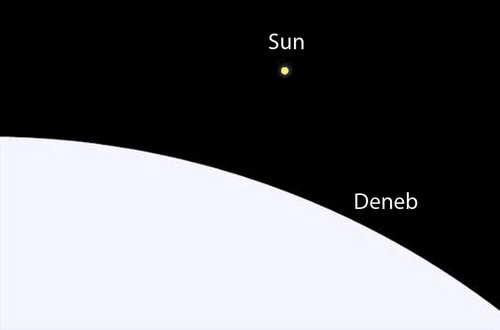
Deneb is a blue-white supergiant star with a spectral class of A2Ia. It is the 19th brightest star in the sky shining at +1.25 magnitude. It’s about 196,000 times more luminous than our sun. Deneb contains about 20 solar masses, and as mentioned above, its distance is uncertain. Deneb has a diameter about 203 times that of the sun. And that makes Deneb one of the largest type A spectral class stars known.
Deneb is the prototype for the Alpha Cygni variable stars. Its brightness varies due to non-radial fluctuations on the surface of the star. The fluctuations originate from areas on the surface of the star either expanding and contracting at the same time. They can last for days to weeks and their origin is unknown. The change in brightness is minimal, but detectable. For example, Deneb varies in brightness from magnitude 1.21 to 1.29. Another Alpha Cygni variable star is Rigel, in the constellation of Orion the Hunter.
Deneb was once a spectral class O-type main sequence star with a mass about 23 times that of the sun. Now that it’s a supergiant, it’s no longer fusing hydrogen in its core. It will evolve into a very luminous red supergiant or possibly a highly luminous blue variable star or maybe a Wolf-Rayet star. Regardless of which type of star it becomes, it’s expected to explode as a supernova sometime in the next few million years.
Deneb will be the North Pole Star around 9800 AD, but will be seven degrees from the pole. By the way, Deneb is the North Pole Star for Mars.
Deneb in history and mythology
The name Deneb derives from the Arabic Al Dhanab al Dajajah meaning Tail of the Hen. It obviously dates from an earlier incarnation of Cygnus not as a swan but as a chicken. Like many bright stars, Deneb has been called by a number of other names, but the oddest, according to Richard Hinckley Allen, who cites the Arabic name above, was Uropygium, meaning the posterior part of a bird’s body from which feathers grow, and oddly sometimes called the “Pope’s nose.”
In Chinese mythology Deneb is associated with the story of the Celestial Princess or the Weaver Girl. In this story a girl (the star Vega) is separated from her beloved (a cowherd represented by the star Altair) by the Milky Way. Once a year, the girl and the cowherd are allowed to meet briefly when a large flock of magpies forms a bridge across the starry river. Deneb represents the bridge.
Deneb’s position is RA: 20h 41m 26s, dec: +45° 16′ 49″.
Bottom line: Read here about the luminous Summer Triangle star Deneb, and learn how to see it in your sky.
Our Summer Triangle series includes:
Deneb is distant and very luminous
The post Summer Triangle star Deneb is distant and luminous first appeared on EarthSky.
from EarthSky https://ift.tt/TXn5fQz
Deneb or Alpha Cygni is the northernmost star in the famous Summer Triangle. For us in the Northern Hemisphere, this asterism is a prominent star pattern in the east on July and August evenings. Three bright stars make up the Summer Triangle. They are the brightest stars in three separate constellations. Deneb’s constellation is Cygnus the Swan. In a dark sky, you can imagine the Swan, flying along the starlit trail of the summer Milky Way. The constellation Cygnus also makes an obvious cross shape, and that’s another asterism. That is, it’s another prominent star pattern. It’s called the Northern Cross.
Okay, we’ve given you a lot of names here: Summer Triangle, Cygnus and Northern Cross.
Just remember, the constellation Cygnus the Swan contains the asterism of the Northern Cross. The Cross is just another way to see the Swan. Deneb is at the top of the Cross, but at the tail of the Swan (the star name “deneb” always means “tail”). The little star Albireo is at the head of the Swan, but at the base of the Cross. Whew!
How to see Deneb from the Northern Hemisphere
Northern Hemisphere skywatchers can gaze at this faraway star in the evening starting around May, which is late spring in the Northern Hemisphere.
Like all stars, Deneb is found about one degree farther west at the same time each day, and climbs to its highest point about four minutes earlier per day, 1/2 hour earlier per week, or two hours earlier per month.
Deneb is circumpolar as seen from locations of about 45 degrees north latitude, roughly the northern tier of U.S. states. In other words, from the northern U.S. and similar latitudes, Deneb never sets but instead circles round and round the pole star.
How to see Deneb from the Southern Hemisphere
Via Daniel Gaussen, Founder & Guide – Stargaze Mackenzie – New Zealand
From the Southern Hemisphere, the Summer Triangle appears flipped upside down and rises low into the northern sky. And, for many at populated latitudes across the Southern Hemisphere, Deneb is close to or below the northern horizon rendering the triangle incomplete for many observers. If you are closer to the South Pole than about 45 degrees south latitude, you won’t see Deneb. So that includes Antarctica, far southern Argentina and Chile, and perhaps the far southern tip of New Zealand’s South Island.
So we in the Southern Hemisphere don’t tend to recognize the Summer Triangle as it is seen in the north, and even if we do, it’s only visible, briefly, during our winter season. So the name Summer Triangle is somewhat lost on us. But the sight of Vega and Altair rising to the northeast are a clear sign of winter in the southern hemisphere.
Will you see Deneb at all from the Southern Hemisphere? It’s not easy. For example:
- Sydney, Australia (approx. 34° S): Deneb reaches a maximum altitude of about 11° above the northern horizon.
- Auckland, New Zealand (approx. 37° S): Deneb reaches a maximum altitude of about 8° above the northern horizon.
- Christchurch, New Zealand (approx. 43.5° S): Deneb reaches a maximum altitude of about 1° above the northern horizon. You probably won’t see it from Christchurch!
So mighty Deneb isn’t easy to catch from the far-southern Southern Hemisphere. But, when you do see it, think of the power of this mighty star shining over such a great distance in space!
Very far away, and very luminous
The star Deneb in the constellation Cygnus the Swan is one of the most distant stars you’ll ever see with your eye alone. That’s because it’s one of our Milky Way galaxy’s most luminous stars.
Deneb is somewhere around 1,500 light-years away. That’s in contrast to most visible stars in our sky, located tens to hundreds of light-years away.
But astronomers still aren’t certain of the exact distance for this very luminous star. There are varying estimates for its distance. Why?
For some decades, ESA’s Earth-orbiting Hipparcos satellite, which operated from 1989 to 1993, provided the most important distance measurement for Deneb. Hipparcos was the predecessor to the Gaia space observatory. Gaia recently ended its mission of collecting data, with a primary goal of creating a 3D map of our Milky Way galaxy.
Both Hipparcos and Gaia gathered what’s called astrometric data on the stars. That is, they measured stars’ positions, motions and brightnesses not just once, but again and again. Those measurements let earthly astronomers calculate a distance, see how the star is moving, and much more.
Early analyses of Hipparcos data indicated a distance around 2,600 light-years for Deneb. Then, in 2009, a newer study – which used more powerful analysis techniques on Hipparcos data – gave a distance for Deneb that’s about half the widely accepted value, closer to 1,500 light-years.
Today, that value – around 1,500 light-years – is the most widely accepted value for Deneb’s distance.
When will we know the distance to Deneb?
Gaia has released three sets of data. Why haven’t Gaia’s newer measurements let astronomers measure Deneb’s distance more precisely? It’s mainly because Gaia isn’t geared toward observing such a bright star as Deneb. Astronomer Anthony G.A. Brown of Leiden Observatory in the Netherlands – a member of the Gaia team – told EarthSky in July 2021 that Gaia data still haven’t been used to determine a new distance for Deneb. He said:
The Hipparcos distance estimate still stands.
Deneb is so bright that we can only observe it with Gaia through specially programmed observation sequences (the observing instruments on the spacecraft do not automatically pick up the star). We have observations of
Deneb in hand but these will require a dedicated processing which we have not yet started.
So, for now, the updated Hipparcos number of approximately 1,500 light-years is still the best estimate of Deneb’s distance.
And that’s impressive. So, for us to see a star shine so brightly in our sky from this great distance away, the star must be very powerful. Deneb is one of the most luminous stars – one of the brightest stars, intrinsically – that we can see with the eye.
Science of Deneb
Deneb is a blue-white supergiant star with a spectral class of A2Ia. It is the 19th brightest star in the sky shining at +1.25 magnitude. It’s about 196,000 times more luminous than our sun. Deneb contains about 20 solar masses, and as mentioned above, its distance is uncertain. Deneb has a diameter about 203 times that of the sun. And that makes Deneb one of the largest type A spectral class stars known.
Deneb is the prototype for the Alpha Cygni variable stars. Its brightness varies due to non-radial fluctuations on the surface of the star. The fluctuations originate from areas on the surface of the star either expanding and contracting at the same time. They can last for days to weeks and their origin is unknown. The change in brightness is minimal, but detectable. For example, Deneb varies in brightness from magnitude 1.21 to 1.29. Another Alpha Cygni variable star is Rigel, in the constellation of Orion the Hunter.
Deneb was once a spectral class O-type main sequence star with a mass about 23 times that of the sun. Now that it’s a supergiant, it’s no longer fusing hydrogen in its core. It will evolve into a very luminous red supergiant or possibly a highly luminous blue variable star or maybe a Wolf-Rayet star. Regardless of which type of star it becomes, it’s expected to explode as a supernova sometime in the next few million years.
Deneb will be the North Pole Star around 9800 AD, but will be seven degrees from the pole. By the way, Deneb is the North Pole Star for Mars.
Deneb in history and mythology
The name Deneb derives from the Arabic Al Dhanab al Dajajah meaning Tail of the Hen. It obviously dates from an earlier incarnation of Cygnus not as a swan but as a chicken. Like many bright stars, Deneb has been called by a number of other names, but the oddest, according to Richard Hinckley Allen, who cites the Arabic name above, was Uropygium, meaning the posterior part of a bird’s body from which feathers grow, and oddly sometimes called the “Pope’s nose.”
In Chinese mythology Deneb is associated with the story of the Celestial Princess or the Weaver Girl. In this story a girl (the star Vega) is separated from her beloved (a cowherd represented by the star Altair) by the Milky Way. Once a year, the girl and the cowherd are allowed to meet briefly when a large flock of magpies forms a bridge across the starry river. Deneb represents the bridge.
Deneb’s position is RA: 20h 41m 26s, dec: +45° 16′ 49″.
Bottom line: Read here about the luminous Summer Triangle star Deneb, and learn how to see it in your sky.
Our Summer Triangle series includes:
Deneb is distant and very luminous
The post Summer Triangle star Deneb is distant and luminous first appeared on EarthSky.
from EarthSky https://ift.tt/TXn5fQz

Aucun commentaire:
Enregistrer un commentaire