View at EarthSky Community Photos. | Christy Mandeville in Indian Shores, Florida, captured this dramatic sunset on a June evening in 2022. Christy wrote: “The little boy in the photo kept running around me as I was trying to capture the perfect sunset photo. After I went through the hundreds of photos I captured, I had no idea that he was in any of them! This one stood out.” Thank you, Christy! The latest sunsets follow the summer solstice. Read more below.
The latest sunsets after the summer solstice
For the Northern Hemisphere: Your latest sunsets – and latest evening twilights – are happening around now. They always come in late June and early July. Meanwhile, the Northern Hemisphere’s longest day falls on the June solstice.
For 40 degrees north (Philadelphia, Pennsylvania; Beijing; Turkey; Japan and Spain), the latest sunsets are centered around June 27. The year’s latest sunsets always come after the summer solstice. But the exact date of the latest sunset depends on your latitude. Farther north, the latest sunsets happen on dates centered around June 25.
Farther south, the latest sunsets are centered on dates in early July.
For the Southern Hemisphere: Your latest sunrises of the year happen in late June and early July.
For the Northern or Southern Hemispheres: Latest sunsets go hand-in-hand with your latest twilights. The latest twilights of the year for 40 degrees north also happen in late June and early July. See more about twilight below.
View at EarthSky Community Photos. | Cecille Kennedy in Netarts Bay, Oregon, captured this image of the sunset during the June solstice of 2016. She wrote: “This was my first sunset photo. I didn’t know it then but photography would prove to be an important hobby to me through the years. My friend said it’s my love hobby. So the June solstice to me have always meant the opening of a new door and a new possibility. The June solstice always fills me with hope.” Thank you, Cecille!
Why the latest sunsets come after the summer solstice
The latest sunsets come after the summer solstice because the day is more than 24 hours long at this time of the year.
For several weeks, around the June solstice, the day (as measured by successive returns of the midday sun) is nearly 1/4 minute longer than 24 hours. Hence, the midday sun (solar noon) comes later by the clock in late June than it does on the June solstice. Therefore, the sunrise and sunset times also come later by the clock, as the table below helps to explain.
If the Earth’s axis stood upright as our world circled the sun, and if the Earth also stayed the same distance from the sun all year long, then clock time and sun time would always agree.
However, the Earth’s axis is tilted 23.44 degrees away from vertical, and our distance from the sun varies by about 3 million miles (5 million km) throughout the year. At and around the equinoxes, solar days are shorter than 24 hours, yet at the solstices, solar days are longer than 24 hours.
That’s why the latest sunsets always come around June 27 at mid-northern latitudes every year.
At mid-northern latitudes, the later clock time for solar noon one week after the summer solstice is more substantial than the change in daylight hours. Given that the daylight hours on June 27 are almost the same as they are on the June 20-21 solstice, the later clock time for the June 27 solar noon gives us slightly later sunrise and sunset times, as well.
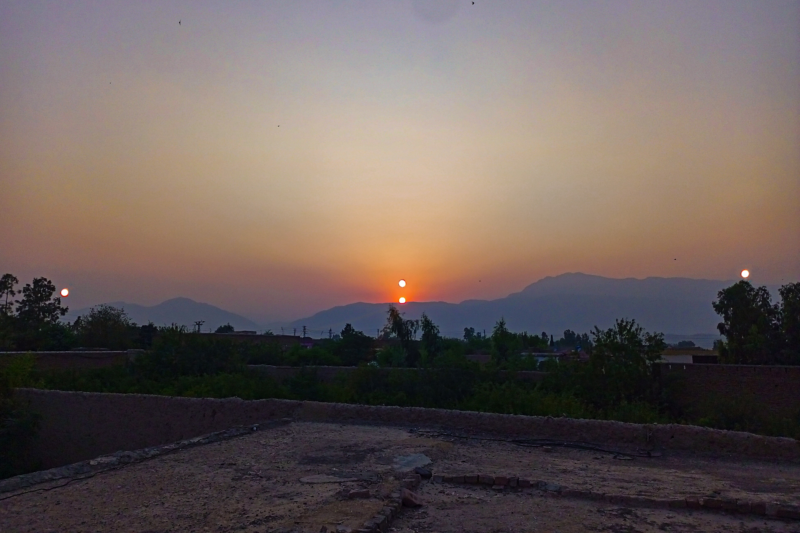
View at EarthSky Community Photos. | Hamza Khan in Pakistan, shared this image on January 8, 2025, and wrote: “This image shows the position of the sun in our area at sunset on the spring equinox, summer solstice, autumnal equinox and winter solstice.” Thank you, Hamza!
A word about twilight
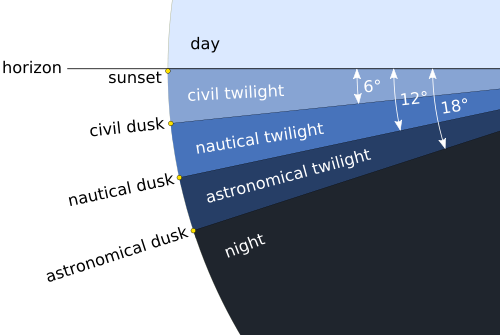
There are three kinds of twilight:
Civil twilight starts at sundown and ends when the sun is 6 degrees below the horizon.
Nautical twilight occurs when the sun is 6 to 12 degrees below the horizon.
Astronomical twilight happens when the sun is 12 to 18 degrees below the horizon.
North of 50 degrees north latitude, there’s no true night in the month of June. In June, that far north, the sun never gets far enough below the horizon for true night to occur. So from 50 degrees north latitude – to the Arctic Circle (66.5 degrees north latitude) – you’ll find midnight twilight at this time of the year.
And, above the Arctic Circle to the North Pole (90 degrees north latitude), this time of the year is the time of the midnight sun.
Skywatchers learn to recognize the subtle gradations of twilight. True night doesn’t begin until the sun sinks 18 degrees beneath the horizon. North of 50 degrees north latitude, there is no true night in June because the sun never gets far enough below the horizon. Visit Sunrise Sunset Calendars for the times of civil, nautical and astronomical twilight in your sky. Image via Wikimedia Commons (CC BY-SA 3.0).
Bottom line: Why don’t the latest sunsets come on the longest day (the solstice)? In a nutshell, it’s a discrepancy between the sun and the clock. Thus, for mid-northern latitudes, the latest sunsets always come in late June.
View at EarthSky Community Photos. | Christy Mandeville in Indian Shores, Florida, captured this dramatic sunset on a June evening in 2022. Christy wrote: “The little boy in the photo kept running around me as I was trying to capture the perfect sunset photo. After I went through the hundreds of photos I captured, I had no idea that he was in any of them! This one stood out.” Thank you, Christy! The latest sunsets follow the summer solstice. Read more below.
The latest sunsets after the summer solstice
For the Northern Hemisphere: Your latest sunsets – and latest evening twilights – are happening around now. They always come in late June and early July. Meanwhile, the Northern Hemisphere’s longest day falls on the June solstice.
For 40 degrees north (Philadelphia, Pennsylvania; Beijing; Turkey; Japan and Spain), the latest sunsets are centered around June 27. The year’s latest sunsets always come after the summer solstice. But the exact date of the latest sunset depends on your latitude. Farther north, the latest sunsets happen on dates centered around June 25.
Farther south, the latest sunsets are centered on dates in early July.
For the Southern Hemisphere: Your latest sunrises of the year happen in late June and early July.
For the Northern or Southern Hemispheres: Latest sunsets go hand-in-hand with your latest twilights. The latest twilights of the year for 40 degrees north also happen in late June and early July. See more about twilight below.
View at EarthSky Community Photos. | Cecille Kennedy in Netarts Bay, Oregon, captured this image of the sunset during the June solstice of 2016. She wrote: “This was my first sunset photo. I didn’t know it then but photography would prove to be an important hobby to me through the years. My friend said it’s my love hobby. So the June solstice to me have always meant the opening of a new door and a new possibility. The June solstice always fills me with hope.” Thank you, Cecille!
Why the latest sunsets come after the summer solstice
The latest sunsets come after the summer solstice because the day is more than 24 hours long at this time of the year.
For several weeks, around the June solstice, the day (as measured by successive returns of the midday sun) is nearly 1/4 minute longer than 24 hours. Hence, the midday sun (solar noon) comes later by the clock in late June than it does on the June solstice. Therefore, the sunrise and sunset times also come later by the clock, as the table below helps to explain.
If the Earth’s axis stood upright as our world circled the sun, and if the Earth also stayed the same distance from the sun all year long, then clock time and sun time would always agree.
However, the Earth’s axis is tilted 23.44 degrees away from vertical, and our distance from the sun varies by about 3 million miles (5 million km) throughout the year. At and around the equinoxes, solar days are shorter than 24 hours, yet at the solstices, solar days are longer than 24 hours.
That’s why the latest sunsets always come around June 27 at mid-northern latitudes every year.
At mid-northern latitudes, the later clock time for solar noon one week after the summer solstice is more substantial than the change in daylight hours. Given that the daylight hours on June 27 are almost the same as they are on the June 20-21 solstice, the later clock time for the June 27 solar noon gives us slightly later sunrise and sunset times, as well.
View at EarthSky Community Photos. | Hamza Khan in Pakistan, shared this image on January 8, 2025, and wrote: “This image shows the position of the sun in our area at sunset on the spring equinox, summer solstice, autumnal equinox and winter solstice.” Thank you, Hamza!
A word about twilight
There are three kinds of twilight:
Civil twilight starts at sundown and ends when the sun is 6 degrees below the horizon.
Nautical twilight occurs when the sun is 6 to 12 degrees below the horizon.
Astronomical twilight happens when the sun is 12 to 18 degrees below the horizon.
North of 50 degrees north latitude, there’s no true night in the month of June. In June, that far north, the sun never gets far enough below the horizon for true night to occur. So from 50 degrees north latitude – to the Arctic Circle (66.5 degrees north latitude) – you’ll find midnight twilight at this time of the year.
And, above the Arctic Circle to the North Pole (90 degrees north latitude), this time of the year is the time of the midnight sun.
Skywatchers learn to recognize the subtle gradations of twilight. True night doesn’t begin until the sun sinks 18 degrees beneath the horizon. North of 50 degrees north latitude, there is no true night in June because the sun never gets far enough below the horizon. Visit Sunrise Sunset Calendars for the times of civil, nautical and astronomical twilight in your sky. Image via Wikimedia Commons (CC BY-SA 3.0).
Bottom line: Why don’t the latest sunsets come on the longest day (the solstice)? In a nutshell, it’s a discrepancy between the sun and the clock. Thus, for mid-northern latitudes, the latest sunsets always come in late June.
The Caspian Sea is shrinking. But the reasons for water loss in Earth’s largest inland sea have been poorly understood. A new study has assessed the pressures the sea is facing. Image via NASA Earth Observatory.
The Caspian Sea – Earth’s largest inland sea – is shrinking
The Caspian Sea is the world’s largest inland sea when measured by surface area. It spans 143,200 square miles (371,000 square km), or about the size of Japan. And it sits on the boundary of Asia and Europe, with five countries sharing its borders: Russia and Azerbaijan on the European side and Iran, Turkmenistan and Kazakhstan on the Asian side.
But the Caspian Sea is shrinking. The sea has been receding since the 1990s in fact, especially in its northern regions, but the reasons for this have poorly understood. Now, a new study by an international team of researchers has taken a closer look at the stresses this important body of water is under. They found that the Caspian Sea’s decline is largely being driven by reduced river inflow, especially from Russia’s Volga river. And both climate change and human activity appear to blame.
The American Geophysical Union said on June 18, 2026, that:
saving it will require international action.
The researchers published their peer-reviewed study in the journal Earth’s Future on June 5, 2026.
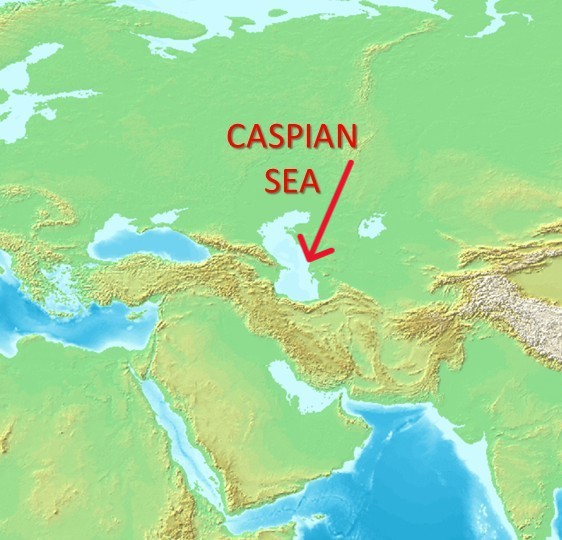
The Caspian Sea is on the boundary of where Europe meets Asia. Image via DEMIS Mapserver.
A better understanding of an unfolding disaster
Even though the Caspian Sea has been shrinking since the 1990s, the reasons behind the water drying up have not been well understood. So an international team of researchers, led by Jesse Duku of UC Irvine, looked at satellite observations, river flow records and climate data for a better understanding.
They found that precipitation across the region has remained largely unchanged since the early 1990s. However, evaporation from the sea’s surface has increased. But this only accounts for about 37% to 40% of the observed water loss. Instead, the biggest change has been a decline in river inflow. In particular, Russia’s Volga River – which supplies most of the Caspian Sea’s freshwater – has experienced a substantial decrease in inflow.
And, according to the study, the total inflow from the sea’s five major rivers fell significantly between 1991 and 2020. The researchers said the findings point to not just climate influences but to human activities. In fact, they found that water consumption and river regulation seem to be playing a larger role than scientists previously recognized.
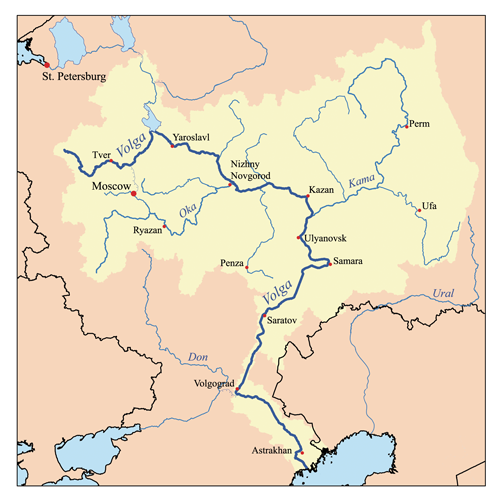
This map shows the locations of the 5 countries that have coastlines on the Caspian Sea. Image via ESA/ Copernicus.The Volga River drainage basin. Image via Wikipedia.
How much water is the Caspian Sea losing? Why is that important?
Since the mid-1990s, the Caspian Sea has lost about 5.5% of its surface area. That equals roughly 630 cubic kilometers (over 150 cubic miles) of water. And scientists project the sea could fall an additional 26 to 46 feet (8 to 14 meters) by 2100. The northern part of the Caspian Sea is already naturally shallow. And this is the region that has been especially vulnerable to falling water levels.
The researchers detected rising concentrations of chlorophyll-a in the northern Caspian. Scientists use this form of chlorophyll to measure the amount of algae and cyanobacteria, and the measurements suggest the waters are feeling an increase in ecological stress.
The Caspian Sea supports more than 850 endemic species, or species that are only found there. The species include the critically endangered Caspian seal and several species of sturgeon. Those sturgeon are the source of 90% of the world’s black caviar. Declining water levels also threaten wetlands, fish spawning grounds and coastal ecosystems.
But the impacts extend beyond wildlife. The Caspian Sea is vital for fisheries, trade and industry across the region. Lower water levels can disrupt ports and shipping routes. The study also said:
In addition, the Caspian Sea is a major hotspot for the oil and gas industry, where approximately 1 million tons of oil are estimated to leak into the sea annually. These combined pressures raise concerns about how hydrological shifts and human activities may influence water quality and ecosystem functioning.
The study’s authors warned that without coordinated management among the five nations bordering the sea, the region could face growing environmental and economic challenges.
The left side shows a view of the northern region of the Caspian Sea in 2006. The right side is how the same area looked in 2022. Image via NASA Earth Observatory.
How does this compare to the Aral Sea?
In the study, the authors compare the shrinking of the Caspian Sea to the Aral Sea. The Aral Sea is another large inland body of water in Central Asia. The Aral Sea once covered about 26,000 square miles (68,000 square km), making it the world’s 4th-largest lake. But beginning in the 1960s, Soviet irrigation projects diverted much of the water from the rivers that fed it. As a result, the Aral Sea lost about 90% of its volume over the following decades and split into several smaller lakes.
The Caspian Sea’s situation is not as severe. It remains far larger than the Aral Sea ever was, and scientists do not expect it to disappear. But both water bodies share a common challenge: reduced river inflow. In the Caspian Sea, declining flows from the Volga River and other tributaries, combined with rising evaporation linked to a warming climate, are contributing to falling water levels. Researchers said the comparison serves as a warning that human management of water resources can have long-lasting consequences for inland seas and the communities that depend on them.
They concluded that preventing further decline will require greater cooperation among Azerbaijan, Iran, Kazakhstan, Russia and Turkmenistan. Improved water management, better data sharing and policies that protect river inflows could help preserve the sea’s ecosystems and economies for future generations.
Bottom line: A new study finds that the Caspian Sea’s decline is being driven by both climate change and human activity. Reduced river inflow, especially from the Volga River, appears to be a major factor behind the shrinking of Earth’s largest inland sea.
The Caspian Sea is shrinking. But the reasons for water loss in Earth’s largest inland sea have been poorly understood. A new study has assessed the pressures the sea is facing. Image via NASA Earth Observatory.
The Caspian Sea – Earth’s largest inland sea – is shrinking
The Caspian Sea is the world’s largest inland sea when measured by surface area. It spans 143,200 square miles (371,000 square km), or about the size of Japan. And it sits on the boundary of Asia and Europe, with five countries sharing its borders: Russia and Azerbaijan on the European side and Iran, Turkmenistan and Kazakhstan on the Asian side.
But the Caspian Sea is shrinking. The sea has been receding since the 1990s in fact, especially in its northern regions, but the reasons for this have poorly understood. Now, a new study by an international team of researchers has taken a closer look at the stresses this important body of water is under. They found that the Caspian Sea’s decline is largely being driven by reduced river inflow, especially from Russia’s Volga river. And both climate change and human activity appear to blame.
The American Geophysical Union said on June 18, 2026, that:
saving it will require international action.
The researchers published their peer-reviewed study in the journal Earth’s Future on June 5, 2026.
The Caspian Sea is on the boundary of where Europe meets Asia. Image via DEMIS Mapserver.
A better understanding of an unfolding disaster
Even though the Caspian Sea has been shrinking since the 1990s, the reasons behind the water drying up have not been well understood. So an international team of researchers, led by Jesse Duku of UC Irvine, looked at satellite observations, river flow records and climate data for a better understanding.
They found that precipitation across the region has remained largely unchanged since the early 1990s. However, evaporation from the sea’s surface has increased. But this only accounts for about 37% to 40% of the observed water loss. Instead, the biggest change has been a decline in river inflow. In particular, Russia’s Volga River – which supplies most of the Caspian Sea’s freshwater – has experienced a substantial decrease in inflow.
And, according to the study, the total inflow from the sea’s five major rivers fell significantly between 1991 and 2020. The researchers said the findings point to not just climate influences but to human activities. In fact, they found that water consumption and river regulation seem to be playing a larger role than scientists previously recognized.
This map shows the locations of the 5 countries that have coastlines on the Caspian Sea. Image via ESA/ Copernicus.The Volga River drainage basin. Image via Wikipedia.
How much water is the Caspian Sea losing? Why is that important?
Since the mid-1990s, the Caspian Sea has lost about 5.5% of its surface area. That equals roughly 630 cubic kilometers (over 150 cubic miles) of water. And scientists project the sea could fall an additional 26 to 46 feet (8 to 14 meters) by 2100. The northern part of the Caspian Sea is already naturally shallow. And this is the region that has been especially vulnerable to falling water levels.
The researchers detected rising concentrations of chlorophyll-a in the northern Caspian. Scientists use this form of chlorophyll to measure the amount of algae and cyanobacteria, and the measurements suggest the waters are feeling an increase in ecological stress.
The Caspian Sea supports more than 850 endemic species, or species that are only found there. The species include the critically endangered Caspian seal and several species of sturgeon. Those sturgeon are the source of 90% of the world’s black caviar. Declining water levels also threaten wetlands, fish spawning grounds and coastal ecosystems.
But the impacts extend beyond wildlife. The Caspian Sea is vital for fisheries, trade and industry across the region. Lower water levels can disrupt ports and shipping routes. The study also said:
In addition, the Caspian Sea is a major hotspot for the oil and gas industry, where approximately 1 million tons of oil are estimated to leak into the sea annually. These combined pressures raise concerns about how hydrological shifts and human activities may influence water quality and ecosystem functioning.
The study’s authors warned that without coordinated management among the five nations bordering the sea, the region could face growing environmental and economic challenges.
The left side shows a view of the northern region of the Caspian Sea in 2006. The right side is how the same area looked in 2022. Image via NASA Earth Observatory.
How does this compare to the Aral Sea?
In the study, the authors compare the shrinking of the Caspian Sea to the Aral Sea. The Aral Sea is another large inland body of water in Central Asia. The Aral Sea once covered about 26,000 square miles (68,000 square km), making it the world’s 4th-largest lake. But beginning in the 1960s, Soviet irrigation projects diverted much of the water from the rivers that fed it. As a result, the Aral Sea lost about 90% of its volume over the following decades and split into several smaller lakes.
The Caspian Sea’s situation is not as severe. It remains far larger than the Aral Sea ever was, and scientists do not expect it to disappear. But both water bodies share a common challenge: reduced river inflow. In the Caspian Sea, declining flows from the Volga River and other tributaries, combined with rising evaporation linked to a warming climate, are contributing to falling water levels. Researchers said the comparison serves as a warning that human management of water resources can have long-lasting consequences for inland seas and the communities that depend on them.
They concluded that preventing further decline will require greater cooperation among Azerbaijan, Iran, Kazakhstan, Russia and Turkmenistan. Improved water management, better data sharing and policies that protect river inflows could help preserve the sea’s ecosystems and economies for future generations.
Bottom line: A new study finds that the Caspian Sea’s decline is being driven by both climate change and human activity. Reduced river inflow, especially from the Volga River, appears to be a major factor behind the shrinking of Earth’s largest inland sea.
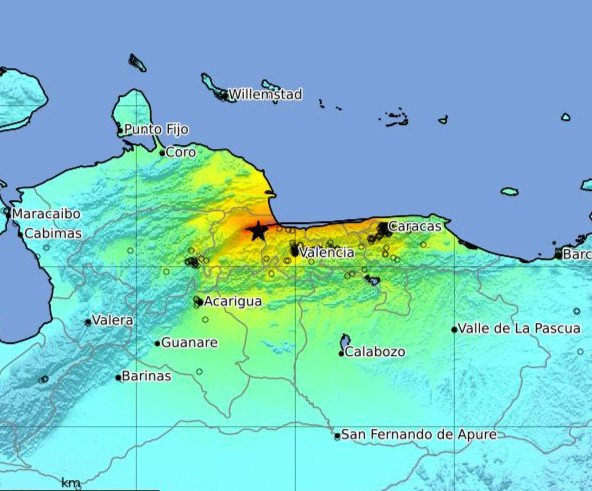
Two devastating earthquakes struck Venezuela in the space of a minute last night, June 24, 2026. This is an intensity map of the second, which had a magnitude of 7.5. That’s the strongest quake to hit Venezuela since 1990. Read about the Venezuela earthquakes below. Image via USGS.
Back-to-back Venezuela earthquakes last night kill at least 164
Two powerful earthquakes struck Venezuela in the space of a minute last night, leaving at least 164 dead and over 700 injured as of 10:30 UTC, June 25.
The quakes struck at 6:04 p.m. local time (22:04 UTC). Centered on the state of Carabobo – some 12 miles (20 km) from the country’s capital, Caracas – they had magnitudes of 7.2 and 7.5. The second was the strongest to strike Venezuela since a magnitude 7.7 quake in 1900.
Many buildings in Caracas have been reduced to rubble. And, as reported by the BBC, Venezuela’s acting president Delcy Rodríguez has stated that the most affected state is La Guaira, just north of Caracas, where “dozens” of buildings have collapsed.
The number of lives lost will almost certainly rise as more information comes in. Shortly after the earthquake struck, the US Geological Survey (USGS) predicted a 33% chance of 1,000 to 10,000 fatalities, and a 42% chance of 10,000 to 100,000 fatalities.
BREAKING: USGS upgrades Venezuela earthquake to 7.5. Major damage to buildings.
June 24 is a national holiday in Venezuela, commemorating the victory of Venezuelan independence leader Simón Bolívar against Spain in the 1821 Battle of Carabobo. So the devastating quakes came with many people at home, celebrating with their families.
This morning, rescue attempts continue amid fears of possible aftershocks.
Leaders across the world have offered condolences and pledged support, with governments including that of the U.S., Germany and China volunteering to aid relief efforts.
Bottom line: Two back-to-back Venezuela earthquakes caused devastation last night. The current death toll is at least 164, with over 700 injured.
Two devastating earthquakes struck Venezuela in the space of a minute last night, June 24, 2026. This is an intensity map of the second, which had a magnitude of 7.5. That’s the strongest quake to hit Venezuela since 1990. Read about the Venezuela earthquakes below. Image via USGS.
Back-to-back Venezuela earthquakes last night kill at least 164
Two powerful earthquakes struck Venezuela in the space of a minute last night, leaving at least 164 dead and over 700 injured as of 10:30 UTC, June 25.
The quakes struck at 6:04 p.m. local time (22:04 UTC). Centered on the state of Carabobo – some 12 miles (20 km) from the country’s capital, Caracas – they had magnitudes of 7.2 and 7.5. The second was the strongest to strike Venezuela since a magnitude 7.7 quake in 1900.
Many buildings in Caracas have been reduced to rubble. And, as reported by the BBC, Venezuela’s acting president Delcy Rodríguez has stated that the most affected state is La Guaira, just north of Caracas, where “dozens” of buildings have collapsed.
The number of lives lost will almost certainly rise as more information comes in. Shortly after the earthquake struck, the US Geological Survey (USGS) predicted a 33% chance of 1,000 to 10,000 fatalities, and a 42% chance of 10,000 to 100,000 fatalities.
BREAKING: USGS upgrades Venezuela earthquake to 7.5. Major damage to buildings.
June 24 is a national holiday in Venezuela, commemorating the victory of Venezuelan independence leader Simón Bolívar against Spain in the 1821 Battle of Carabobo. So the devastating quakes came with many people at home, celebrating with their families.
This morning, rescue attempts continue amid fears of possible aftershocks.
Leaders across the world have offered condolences and pledged support, with governments including that of the U.S., Germany and China volunteering to aid relief efforts.
Bottom line: Two back-to-back Venezuela earthquakes caused devastation last night. The current death toll is at least 164, with over 700 injured.
Mammatus clouds are pouch-like protrusions hanging from the undersides of clouds. You’ll usually find them under thunderstorm anvil clouds, but you might see them under other clouds as well. They’re composed primarily of ice. And groups of them can extend hundreds of miles in any direction. But they’re fleeting, remaining visible in your local sky for perhaps 10 or 15 minutes at a time.
Most clouds are formed by rising air. But mammatus clouds are formed by sinking air. They appear ominous.
People associate these cloud pouches with severe weather. And it’s true; they typically appear before or after a storm. But, in a way that’s so common in nature, their dangerous aspect goes hand-in-hand with a magnificent beauty. Enjoy the pictures below.
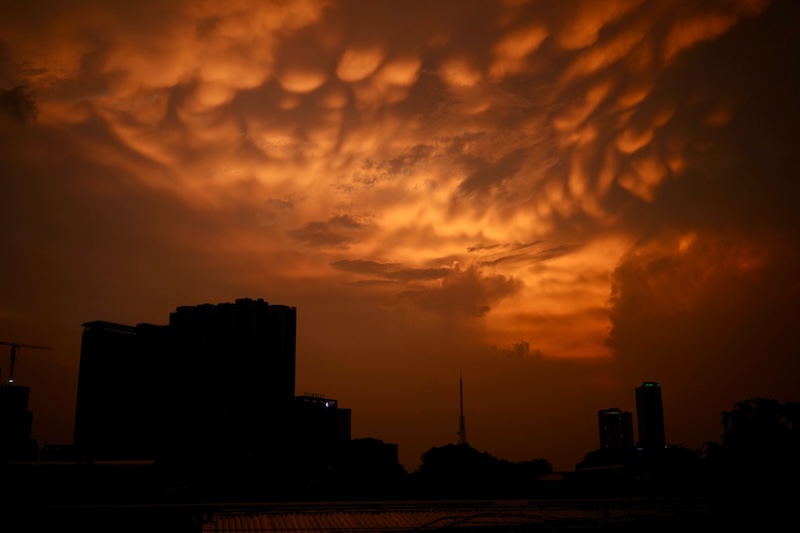
View at EarthSky Community Photos. | Deb King in Moundridge, Kansas, took this spectacular photo of mammatus clouds on June 10, 2026. Thank you, Deb!View at EarthSky Community Photos. | Vermont Jr. Coronel captured this photo from the Philippines on May 28, 2026, and wrote: “Mammatus clouds after the sudden thunderstorm on a very hot late afternoon. Thunderstorms are prevalent now in the Philippines during afternoon. A sign that the rainy season is about to begin.” Thank you, Vermont!View at EarthSky Community Photos. | Aaron Watson captured this image on July 17, 2025, from Colorado and wrote: “Interesting mammatus clouds this morning. It looked like long, deep grooves across the sky.” Thank you, Aaron!
More from our Community photos
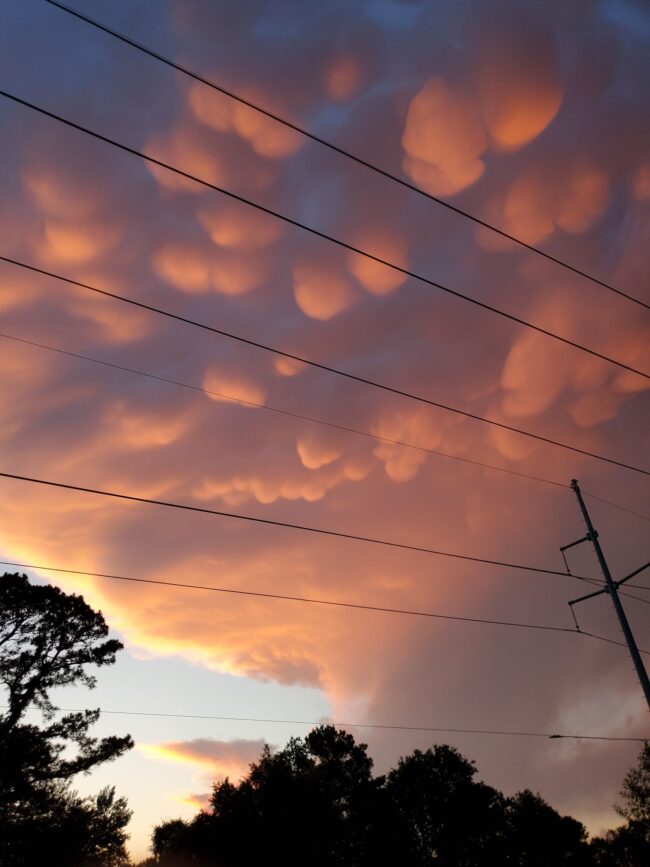
View at EarthSky Community Photos. | Michael O’Connor captured this image on July 12, 2025, from Michigan and wrote: “Mammatus clouds. First time ever seeing them.” Thank you, Michael!View at EarthSky Community Photos. | Lina Tomlin in Texarkana, Texas, photographed these mammatus clouds on April 29, 2024. Lina wrote: “Stepped outside and my jaw dropped. I loved watching this massive storm cell roll by. I saw more ‘bubble’ clouds appear, and as the sun went down they lit up. I’ve never been this close to clouds like that. Thrilling!” Thank you, Lina!
Bottom line: Mammatus clouds look like bubbling, low-hanging clouds. They’re often associated with thunderstorms. Learn more about them and see photos here.
Mammatus clouds are pouch-like protrusions hanging from the undersides of clouds. You’ll usually find them under thunderstorm anvil clouds, but you might see them under other clouds as well. They’re composed primarily of ice. And groups of them can extend hundreds of miles in any direction. But they’re fleeting, remaining visible in your local sky for perhaps 10 or 15 minutes at a time.
Most clouds are formed by rising air. But mammatus clouds are formed by sinking air. They appear ominous.
People associate these cloud pouches with severe weather. And it’s true; they typically appear before or after a storm. But, in a way that’s so common in nature, their dangerous aspect goes hand-in-hand with a magnificent beauty. Enjoy the pictures below.
View at EarthSky Community Photos. | Deb King in Moundridge, Kansas, took this spectacular photo of mammatus clouds on June 10, 2026. Thank you, Deb!View at EarthSky Community Photos. | Vermont Jr. Coronel captured this photo from the Philippines on May 28, 2026, and wrote: “Mammatus clouds after the sudden thunderstorm on a very hot late afternoon. Thunderstorms are prevalent now in the Philippines during afternoon. A sign that the rainy season is about to begin.” Thank you, Vermont!View at EarthSky Community Photos. | Aaron Watson captured this image on July 17, 2025, from Colorado and wrote: “Interesting mammatus clouds this morning. It looked like long, deep grooves across the sky.” Thank you, Aaron!
More from our Community photos
View at EarthSky Community Photos. | Michael O’Connor captured this image on July 12, 2025, from Michigan and wrote: “Mammatus clouds. First time ever seeing them.” Thank you, Michael!View at EarthSky Community Photos. | Lina Tomlin in Texarkana, Texas, photographed these mammatus clouds on April 29, 2024. Lina wrote: “Stepped outside and my jaw dropped. I loved watching this massive storm cell roll by. I saw more ‘bubble’ clouds appear, and as the sun went down they lit up. I’ve never been this close to clouds like that. Thrilling!” Thank you, Lina!
Bottom line: Mammatus clouds look like bubbling, low-hanging clouds. They’re often associated with thunderstorms. Learn more about them and see photos here.
The hottest days occur after the summer solstice. Image via Quang Nguyen Vinh/ Pexels.
It might seem logical for the hottest days in the Northern Hemisphere to fall around the June solstice, when the sun reaches its northernmost point for the year. But the hottest days in the north actually come a month or two after the solstice. And in the Southern Hemisphere, the coldest weather doesn’t arrive until a month or two after the June solstice. Why? It’s down to a phenomenon known as the lag of the seasons.
Why the north’s hottest days follow the solstice
You can understand this phenomenon if you’ve ever visited a beach in June. On Northern Hemisphere beaches around now, you’ll notice how cold the ocean feels. Or think about mountaintops in June, which can often still be blanketed by ice and snow. The summer sun still hasn’t had time to melt the ice and warm the oceans.
So that’s why the hot weather lags behind the year’s longest day and highest sun.
By August, ocean water on that same beach will be much warmer. And the snow line will have crept up the mountaintops. That’s why the hottest weather comes some months after the year’s longest day. The land and oceans simply need those extra months to warm up – to store heat – after the cold of winter.
And in the Southern Hemisphere
In the Southern Hemisphere now, the same phenomenon is occurring but in reverse. There, the lag of the seasons is delaying the year’s coldest weather. The June solstice, for the Southern Hemisphere, is the winter solstice. The coldest weather comes in July and August because the land and oceans in that part of the world take some extra weeks to give up their stored heat.
View at EarthSky Community Photos. | Cecille Kennedy captured this spectacular wave in Oregon on December 14, 2024. It takes a few months for the ocean to warm up in summer and cool down in winter, contributing to the so-called lag of the seasons. Thank you, Cecille!
Bottom line: The June solstice marks the height of the sun in the Northern Hemisphere, but the hottest weather comes a month or two later. The phenomenon is called the lag of the seasons, and the same process occurs in reverse in the Southern Hemisphere.
The hottest days occur after the summer solstice. Image via Quang Nguyen Vinh/ Pexels.
It might seem logical for the hottest days in the Northern Hemisphere to fall around the June solstice, when the sun reaches its northernmost point for the year. But the hottest days in the north actually come a month or two after the solstice. And in the Southern Hemisphere, the coldest weather doesn’t arrive until a month or two after the June solstice. Why? It’s down to a phenomenon known as the lag of the seasons.
Why the north’s hottest days follow the solstice
You can understand this phenomenon if you’ve ever visited a beach in June. On Northern Hemisphere beaches around now, you’ll notice how cold the ocean feels. Or think about mountaintops in June, which can often still be blanketed by ice and snow. The summer sun still hasn’t had time to melt the ice and warm the oceans.
So that’s why the hot weather lags behind the year’s longest day and highest sun.
By August, ocean water on that same beach will be much warmer. And the snow line will have crept up the mountaintops. That’s why the hottest weather comes some months after the year’s longest day. The land and oceans simply need those extra months to warm up – to store heat – after the cold of winter.
And in the Southern Hemisphere
In the Southern Hemisphere now, the same phenomenon is occurring but in reverse. There, the lag of the seasons is delaying the year’s coldest weather. The June solstice, for the Southern Hemisphere, is the winter solstice. The coldest weather comes in July and August because the land and oceans in that part of the world take some extra weeks to give up their stored heat.
View at EarthSky Community Photos. | Cecille Kennedy captured this spectacular wave in Oregon on December 14, 2024. It takes a few months for the ocean to warm up in summer and cool down in winter, contributing to the so-called lag of the seasons. Thank you, Cecille!
Bottom line: The June solstice marks the height of the sun in the Northern Hemisphere, but the hottest weather comes a month or two later. The phenomenon is called the lag of the seasons, and the same process occurs in reverse in the Southern Hemisphere.
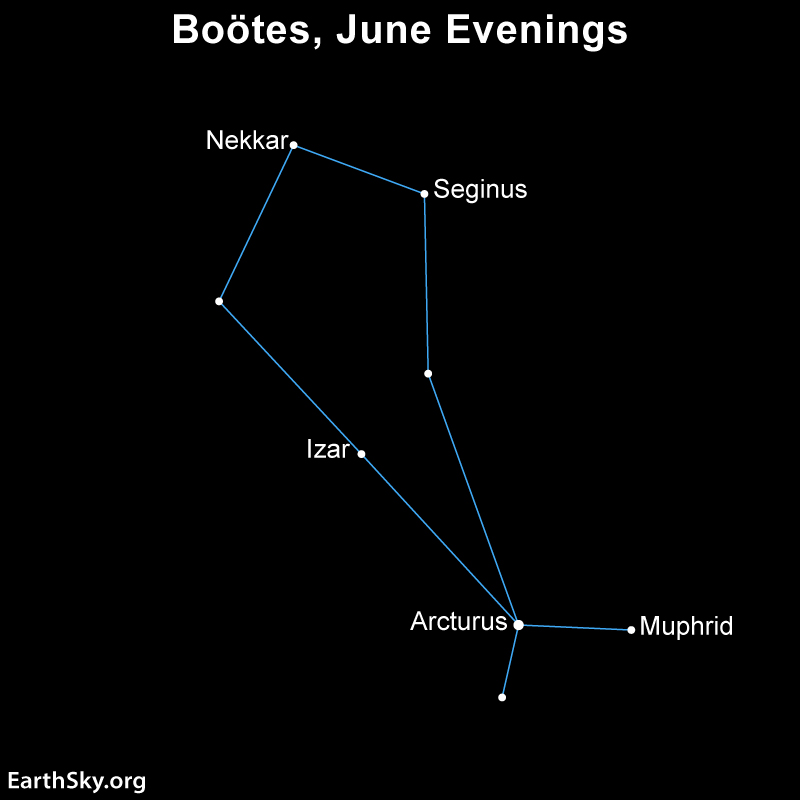
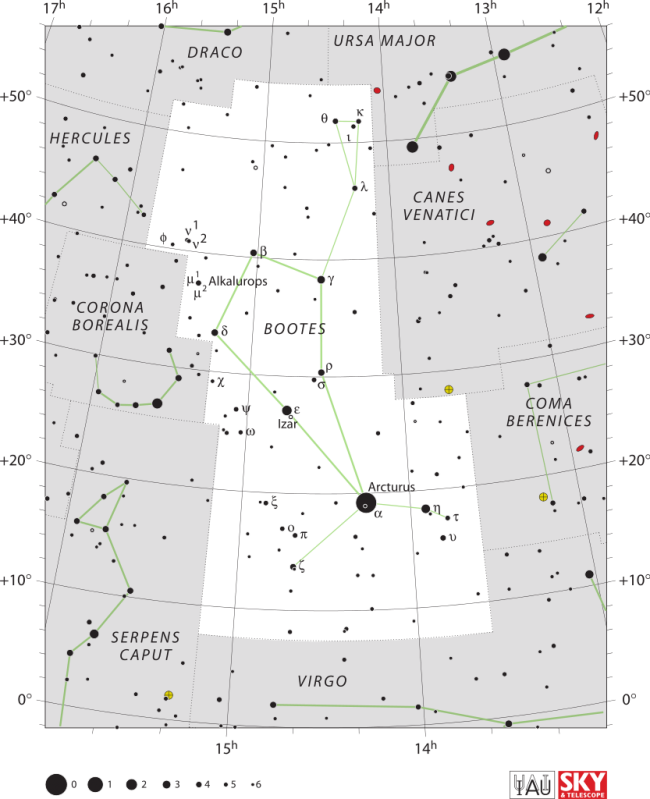
The constellation Boötes the Herdsman is an excellent target for June nights. Arcturus is the brightest star in the constellation. Chart via EarthSky.
Boötes the Herdsman is a Northern Hemisphere constellation best seen in the late spring or early summer. It’s one of the largest constellations in the sky, ranking 13th out of 88. Boötes is most famous for its bright star Arcturus, which is the 4th-brightest star in the night sky.
Locating the constellation Boötes
You can find Boötes south of Ursa Major the Great Bear, off the handle of the Big Dipper. Boötes’ brightest star, Arcturus, is part of a mnemonic device used to orient people to the night sky. The saying goes, Arc to Arcturus, speed on to Spica. This means that as you follow the curve in the dipper’s handle away from Ursa Major, you will run into a bright star: Arcturus in Boötes. Continue the curve along and you’ll find Spica, which is a part of Virgo.
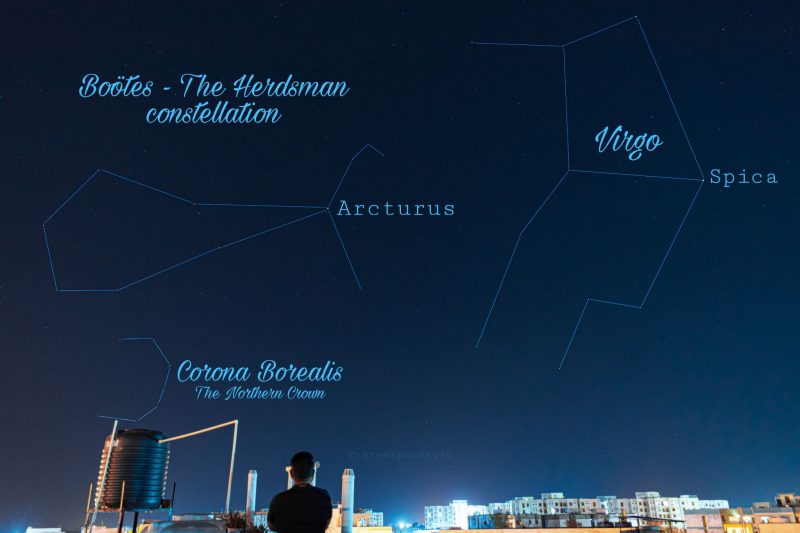
View at EarthSky Community Photos. | Prateek Pandey in Bhopal, Madhya Pradesh, India, captured this photo of Boötes, Virgo and Corona Borealis on March 5, 2021. He wrote: “Spring constellations twinkling in the eastern horizon.” Thank you, Prateek!
Tracing out the shape of Boötes
Boötes is supposed to be the figure of a man, which is somewhat recognizable with its tall diamond shape and two stick legs jutting out at the bottom.
The point at which the tall diamond shape and stick legs intersect is the star Arcturus. In addition, the Herdsman also appears to have his left arm raised over his head. Some say it’s easy to pick out as a kite-shaped group of stars.
The stars in the Herdsman
Arcturus, the brightest star in Boötes, shines at magnitude -0.04, making it the 4th-brightest star in the night sky.
The name Arcturus means bear watcher or bear guard, referring to its closeness to the Great Bear, Ursa Major. Lying 37 light-years away from Earth, Arcturus glows with a faint orange hue.
The second brightest star in Boötes lies on the left side of the diamond shape. It’s called Izar, or Epsilon Boötis, and is 10 degrees up from Arcturus. It’s a magnitude 2.37 star lying 203 light-years away.
The third brightest star in Boötes is his left knee, which is found to the lower right of Arcturus. This star is Muphrid, or Eta Boötis, at magnitude 2.68. Muphrid lies 37 light-years away.
The other stars in the body of the Herdsman are all of comparable brightness. Starting above Izar and working up, around and back toward Arcturus are the stars Delta Boötis, Beta Boötis aka Nekkar (consider this Boötes’ neck), Gamma Boötis (or Seginus) and Rho Boötis.
Delta Boötis shines at magnitude 3.46 at a distance of 121 light-years. Nekkar shines at magnitude 3.49 and lies 219 light-years distant. Seginus has the brightest magnitude of these four stars, at 3.04. It is also the closest of the four at 84 light-years. Finally, Rho Boötis, which lies almost even with Izar, shines at magnitude 3.57 and lies 149 light-years away.
Arcturus shows large proper motion
The bright orange star Arcturus is especially noteworthy for its large proper motion, or sideways motion as seen on the dome of Earth’s sky.
Arcturus is actually moving at a tremendous speed (122 km/s or 76 miles/s) relative to our solar system. And from the vantage point of Earth, Arcturus is rapidly moving in a southerly direction at a rate of 3.9 arcminutes per century.
Its closest point to Earth will be about 4,000 years from now. Then as it moves away, it will vanish from visibility to the unaided eye in about 500,000 years.
Why does it move so much faster than the other stars in Boötes? It’s because Arcturus is much closer to us than the constellation’s other stars. That’s also why it’s so much brighter than its companions.
The constellation Boötes the Herdsman is an excellent target for June nights. Arcturus is the brightest star in the constellation. Chart via EarthSky.
Boötes the Herdsman is a Northern Hemisphere constellation best seen in the late spring or early summer. It’s one of the largest constellations in the sky, ranking 13th out of 88. Boötes is most famous for its bright star Arcturus, which is the 4th-brightest star in the night sky.
Locating the constellation Boötes
You can find Boötes south of Ursa Major the Great Bear, off the handle of the Big Dipper. Boötes’ brightest star, Arcturus, is part of a mnemonic device used to orient people to the night sky. The saying goes, Arc to Arcturus, speed on to Spica. This means that as you follow the curve in the dipper’s handle away from Ursa Major, you will run into a bright star: Arcturus in Boötes. Continue the curve along and you’ll find Spica, which is a part of Virgo.
View at EarthSky Community Photos. | Prateek Pandey in Bhopal, Madhya Pradesh, India, captured this photo of Boötes, Virgo and Corona Borealis on March 5, 2021. He wrote: “Spring constellations twinkling in the eastern horizon.” Thank you, Prateek!
Tracing out the shape of Boötes
Boötes is supposed to be the figure of a man, which is somewhat recognizable with its tall diamond shape and two stick legs jutting out at the bottom.
The point at which the tall diamond shape and stick legs intersect is the star Arcturus. In addition, the Herdsman also appears to have his left arm raised over his head. Some say it’s easy to pick out as a kite-shaped group of stars.
The stars in the Herdsman
Arcturus, the brightest star in Boötes, shines at magnitude -0.04, making it the 4th-brightest star in the night sky.
The name Arcturus means bear watcher or bear guard, referring to its closeness to the Great Bear, Ursa Major. Lying 37 light-years away from Earth, Arcturus glows with a faint orange hue.
The second brightest star in Boötes lies on the left side of the diamond shape. It’s called Izar, or Epsilon Boötis, and is 10 degrees up from Arcturus. It’s a magnitude 2.37 star lying 203 light-years away.
The third brightest star in Boötes is his left knee, which is found to the lower right of Arcturus. This star is Muphrid, or Eta Boötis, at magnitude 2.68. Muphrid lies 37 light-years away.
The other stars in the body of the Herdsman are all of comparable brightness. Starting above Izar and working up, around and back toward Arcturus are the stars Delta Boötis, Beta Boötis aka Nekkar (consider this Boötes’ neck), Gamma Boötis (or Seginus) and Rho Boötis.
Delta Boötis shines at magnitude 3.46 at a distance of 121 light-years. Nekkar shines at magnitude 3.49 and lies 219 light-years distant. Seginus has the brightest magnitude of these four stars, at 3.04. It is also the closest of the four at 84 light-years. Finally, Rho Boötis, which lies almost even with Izar, shines at magnitude 3.57 and lies 149 light-years away.
Arcturus shows large proper motion
The bright orange star Arcturus is especially noteworthy for its large proper motion, or sideways motion as seen on the dome of Earth’s sky.
Arcturus is actually moving at a tremendous speed (122 km/s or 76 miles/s) relative to our solar system. And from the vantage point of Earth, Arcturus is rapidly moving in a southerly direction at a rate of 3.9 arcminutes per century.
Its closest point to Earth will be about 4,000 years from now. Then as it moves away, it will vanish from visibility to the unaided eye in about 500,000 years.
Why does it move so much faster than the other stars in Boötes? It’s because Arcturus is much closer to us than the constellation’s other stars. That’s also why it’s so much brighter than its companions.
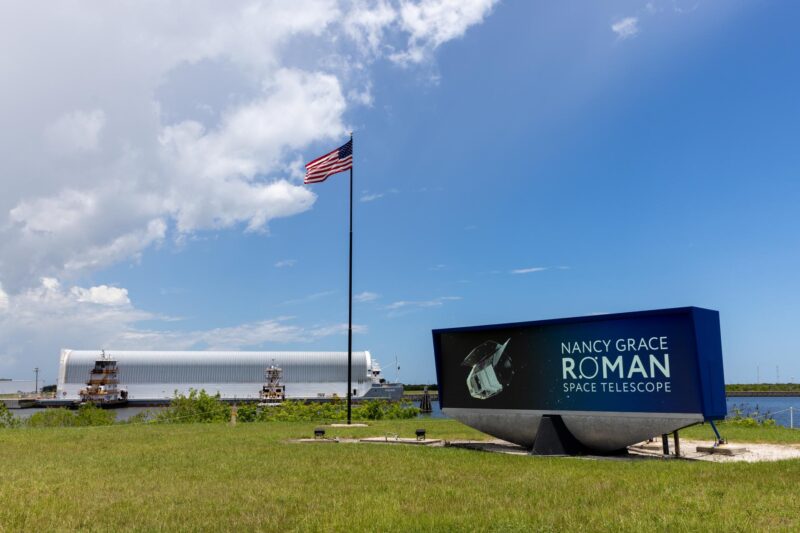
On June 21, 2026, the Nancy Grace Roman Space Telescope arrived at Kennedy Space Center (KSC) in Florida in preparation for its August launch. Image via NASA/Amber Jean Notvest.
The Nancy Grace Roman Space Telescope arrives at KSC
On June 21, 2026, the Nancy Grace Roman Space Telescope arrived at Kennedy Space Center (KSC) in Florida ahead of its launch this summer. The new telescope completed testing at NASA’s Goddard Space Flight Center in Greenbelt, Maryland, before being loaded on NASA’s Pegasus barge for its shipment to Florida. Amazingly, the space telescope is eight months ahead of schedule! Currently, NASA said the schedule for launch is no earlier than Sunday, August 30. That launch will be on a SpaceX Falcon Heavy rocket from Launch Complex 39A at KSC.
What’s next for the Nancy Grace Roman Space Telescope? Roman still has more testing ahead. Those tests will include work on its solar panels, insulation and thermal blankets. Eventually, workers will load about 290 gallons of hydrazine fuel into the spacecraft’s tanks.
After launch, the next stop for Roman will be L2, or the second sun-Earth Lagrange point. You may already be familiar with this location because the James Webb Space Telescope is also here, sending back infrared images of the universe. The Roman telescope also has infrared eyes. NASA said:
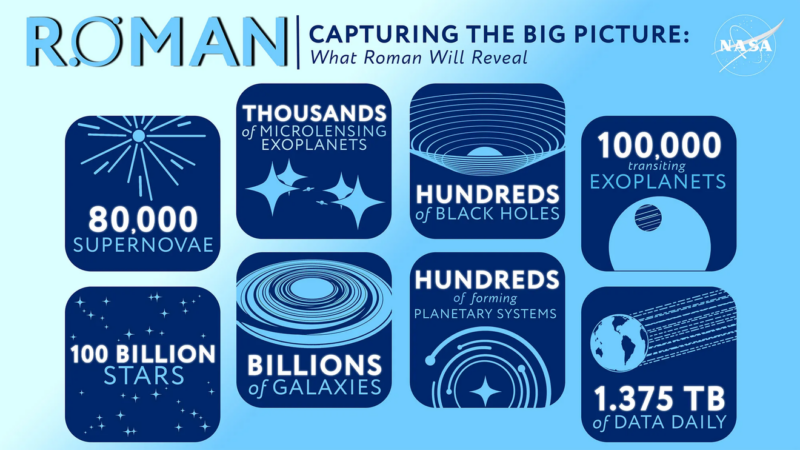
Roman’s wide field of view and rapid survey capabilities will reveal billions of galaxies, hundreds of thousands of new exoplanets, hundreds of blackholes, and will provide vast volumes of daily data for astronomers to study.
With Roman’s construction complete, we are poised at the brink of unfathomable scientific discovery. In the mission’s first five years, it’s expected to unveil more than 100,000 distant worlds, hundreds of millions of stars, and billions of galaxies. We stand to learn a tremendous amount of new information about the universe very rapidly after Roman launches.
Remember what astronomical images were like before we had the Hubble space telescope? Hubble was the first large optical telescope to be launched into space, above Earth’s obscuring atmosphere. And it fundamentally changed our view of the cosmos. Astronomers say the Nancy Grace Roman space telescope will do that, too, giving us a view of the universe we’ve never had before. The telescope will have a primary mirror of 7.9 feet in diameter (2.4 meters). That’s the same size as Hubble. But a single image from the Nancy Grace Roman space telescope will equal the sky coverage of 100 Hubble images.
Scientists expect the telescope to answer fundamental questions about distant planets orbiting stars in our Milky Way galaxy, about the dark energy we haven’t yet detected directly but believe makes up a substantial portion of our cosmos … and about what astronomers call the cosmic dawn.
The telescope’s Wide Field Instrument, its primary instrument, will have a field of view 100 times greater than Hubble’s infrared instrument. Roman’s large field of view means it can capture more sky in less time. The Wide Field Instrument will scan the Milky Way for exoplanets, or planets orbiting distant stars. Over the past 30 years, since the early 1990s until now, we’ve discovered more than 5,000 exoplanets. The Nancy Grace Roman space telescope is expected to increase that number to some 100,000 exoplanets in the next five years.
Roman’s other instrument is the Coronagraph Instrument. The Coronagraph Instrument will perform high contrast imaging and spectroscopy to gather more knowledge of individual exoplanets. More on the coronagraph below.
Interview with Néstor Espinoza
Watch this 52-second clip of astronomer Néstor Espinoza of the Space Telescope Science Institute talking with EarthSky’s Deborah Byrd. Néstor told us this telescope should increase the number of known exoplanets – or planets orbiting distant suns – from 5,000 now to 100,000 in just 5 years!
The Roman telescope’s 100,000 new exoplanets
The Roman space telescope will survey our galaxy, taking observations every 15 minutes for more than a year. What a mass of data it’ll collect in just that first year! The data will enable astronomers to track the brightness changes in stars, which could lead to discoveries of exoplanets, rogue planets, isolated black holes and more.
So how will the Roman space telescope find its 100,000 exoplanets? With the aid of the Roman Coronagraph, the first high-contrast active wavefront-control coronagraph to fly in space. NASA said:
The Roman Coronagraph will advance scientists’ ability to directly image planets and disks around other stars. Coronagraphs work by blocking light from a bright object, like a star, so that the observer can more easily see a faint object, like a planet [next to the bright object].
The Roman Coronagraph is designed to detect planets 100 million times fainter than their stars, or 100 to 1,000 times better than existing space-based coronagraphs.
The Roman Coronagraph will be capable of directly imaging reflected starlight from a planet akin to Jupiter in size, temperature and distance from its parent star.
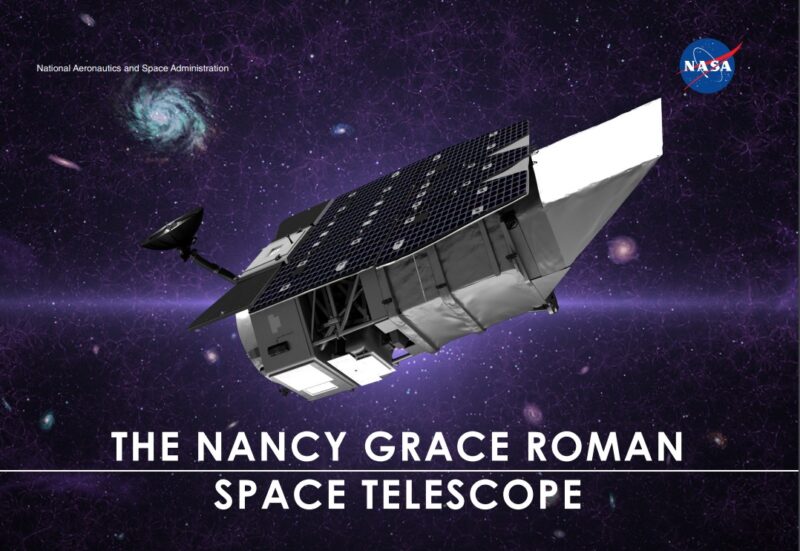
An artist’s concept of the Nancy Grace Roman Space Telescope. Image via NASA.
The Roman telescope and the cosmic dawn
After the Big Bang that set our universe into motion, the cosmos was dark for some 380,000 to 200 million years. Yes, dark. Even though stars had already begun to shine, neutral atoms would absorb their light, leaving the cosmos in a kind of obscuring fog. Then neutral atoms began to break apart, and the fog began to lift. The light of stars broke through and began traveling throughout space. Astronomers call this transition from dark to light the cosmic dawn. Takahiro Morishita of Caltech said:
Roman will excel at finding the building blocks of cosmic structures like galaxy clusters that later form. It will quickly identify the densest regions, where more ‘fog’ is being cleared, making Roman a key mission to probe early galaxy evolution and the cosmic dawn.
Roman’s wide field of view will help determine how common quasars are and whether certain types of galaxies played a larger role in clearing the fog. It will also look for “cosmic daybreakers” that illuminated our universe.
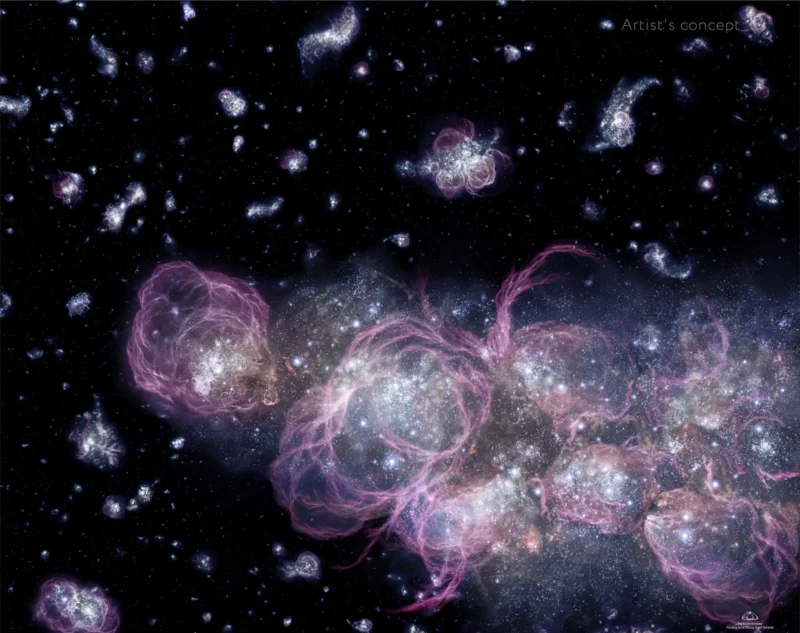
Artist’s concept of the cosmic dawn. This is how the universe may have looked at less than a billion years old. Image via NASA/ ESA/ and A. Schaller (for STScI).
The Roman space telescope and dark energy
Dark energy is a mysterious force that makes up about 68% of the total energy content of our universe. Dark energy is responsible for the acceleration of our expanding universe. Roman will help astronomers understand just what dark energy is by taking a closer look at how the universe has evolved. Roman’s wide field will allow us a bigger picture of the universe. Mapping the distribution of matter and measuring distant supernovae will help show how dark energy might have changed over time.
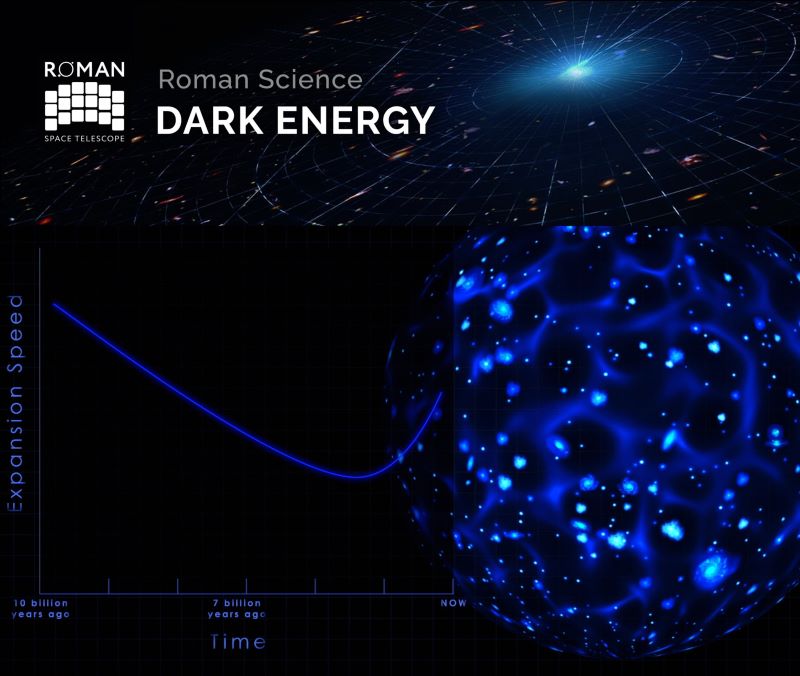
In the universe’s past, expansion occurred at a slower rate than what we see in our universe today. Dark energy is behind the accelerated expansion. Image via NASA Scientific Visualization Studio.
Who was Nancy Grace Roman?
Nancy Grace Roman has the honorary title of Mother of the Hubble Space Telescope. Born in 1925, Roman became one of the few female astronomers in a male-dominated science. Among other accomplishments, she became the first female executive at NASA and NASA’s first Chief of Astronomy. She earned her nickname by helping get the Hubble Space Telescope approved by Congress. Roman was most excited for Hubble’s discoveries on dark energy. The telescope that will now bear Roman’s name will increase our understanding of dark energy, the universe and our place in it.
Nancy Grace Roman, “mother of the Hubble space telescope,” during her career at NASA. Image via NASA.
Bottom line: The Nancy Grace Roman Space Telescope has now arrived at Kennedy Space Center. It will be prepped for launch this summer, eight months ahead of schedule.
On June 21, 2026, the Nancy Grace Roman Space Telescope arrived at Kennedy Space Center (KSC) in Florida in preparation for its August launch. Image via NASA/Amber Jean Notvest.
The Nancy Grace Roman Space Telescope arrives at KSC
On June 21, 2026, the Nancy Grace Roman Space Telescope arrived at Kennedy Space Center (KSC) in Florida ahead of its launch this summer. The new telescope completed testing at NASA’s Goddard Space Flight Center in Greenbelt, Maryland, before being loaded on NASA’s Pegasus barge for its shipment to Florida. Amazingly, the space telescope is eight months ahead of schedule! Currently, NASA said the schedule for launch is no earlier than Sunday, August 30. That launch will be on a SpaceX Falcon Heavy rocket from Launch Complex 39A at KSC.
What’s next for the Nancy Grace Roman Space Telescope? Roman still has more testing ahead. Those tests will include work on its solar panels, insulation and thermal blankets. Eventually, workers will load about 290 gallons of hydrazine fuel into the spacecraft’s tanks.
After launch, the next stop for Roman will be L2, or the second sun-Earth Lagrange point. You may already be familiar with this location because the James Webb Space Telescope is also here, sending back infrared images of the universe. The Roman telescope also has infrared eyes. NASA said:
Roman’s wide field of view and rapid survey capabilities will reveal billions of galaxies, hundreds of thousands of new exoplanets, hundreds of blackholes, and will provide vast volumes of daily data for astronomers to study.
With Roman’s construction complete, we are poised at the brink of unfathomable scientific discovery. In the mission’s first five years, it’s expected to unveil more than 100,000 distant worlds, hundreds of millions of stars, and billions of galaxies. We stand to learn a tremendous amount of new information about the universe very rapidly after Roman launches.
Remember what astronomical images were like before we had the Hubble space telescope? Hubble was the first large optical telescope to be launched into space, above Earth’s obscuring atmosphere. And it fundamentally changed our view of the cosmos. Astronomers say the Nancy Grace Roman space telescope will do that, too, giving us a view of the universe we’ve never had before. The telescope will have a primary mirror of 7.9 feet in diameter (2.4 meters). That’s the same size as Hubble. But a single image from the Nancy Grace Roman space telescope will equal the sky coverage of 100 Hubble images.
Scientists expect the telescope to answer fundamental questions about distant planets orbiting stars in our Milky Way galaxy, about the dark energy we haven’t yet detected directly but believe makes up a substantial portion of our cosmos … and about what astronomers call the cosmic dawn.
The telescope’s Wide Field Instrument, its primary instrument, will have a field of view 100 times greater than Hubble’s infrared instrument. Roman’s large field of view means it can capture more sky in less time. The Wide Field Instrument will scan the Milky Way for exoplanets, or planets orbiting distant stars. Over the past 30 years, since the early 1990s until now, we’ve discovered more than 5,000 exoplanets. The Nancy Grace Roman space telescope is expected to increase that number to some 100,000 exoplanets in the next five years.
Roman’s other instrument is the Coronagraph Instrument. The Coronagraph Instrument will perform high contrast imaging and spectroscopy to gather more knowledge of individual exoplanets. More on the coronagraph below.
Interview with Néstor Espinoza
Watch this 52-second clip of astronomer Néstor Espinoza of the Space Telescope Science Institute talking with EarthSky’s Deborah Byrd. Néstor told us this telescope should increase the number of known exoplanets – or planets orbiting distant suns – from 5,000 now to 100,000 in just 5 years!
The Roman telescope’s 100,000 new exoplanets
The Roman space telescope will survey our galaxy, taking observations every 15 minutes for more than a year. What a mass of data it’ll collect in just that first year! The data will enable astronomers to track the brightness changes in stars, which could lead to discoveries of exoplanets, rogue planets, isolated black holes and more.
So how will the Roman space telescope find its 100,000 exoplanets? With the aid of the Roman Coronagraph, the first high-contrast active wavefront-control coronagraph to fly in space. NASA said:
The Roman Coronagraph will advance scientists’ ability to directly image planets and disks around other stars. Coronagraphs work by blocking light from a bright object, like a star, so that the observer can more easily see a faint object, like a planet [next to the bright object].
The Roman Coronagraph is designed to detect planets 100 million times fainter than their stars, or 100 to 1,000 times better than existing space-based coronagraphs.
The Roman Coronagraph will be capable of directly imaging reflected starlight from a planet akin to Jupiter in size, temperature and distance from its parent star.
An artist’s concept of the Nancy Grace Roman Space Telescope. Image via NASA.
The Roman telescope and the cosmic dawn
After the Big Bang that set our universe into motion, the cosmos was dark for some 380,000 to 200 million years. Yes, dark. Even though stars had already begun to shine, neutral atoms would absorb their light, leaving the cosmos in a kind of obscuring fog. Then neutral atoms began to break apart, and the fog began to lift. The light of stars broke through and began traveling throughout space. Astronomers call this transition from dark to light the cosmic dawn. Takahiro Morishita of Caltech said:
Roman will excel at finding the building blocks of cosmic structures like galaxy clusters that later form. It will quickly identify the densest regions, where more ‘fog’ is being cleared, making Roman a key mission to probe early galaxy evolution and the cosmic dawn.
Roman’s wide field of view will help determine how common quasars are and whether certain types of galaxies played a larger role in clearing the fog. It will also look for “cosmic daybreakers” that illuminated our universe.
Artist’s concept of the cosmic dawn. This is how the universe may have looked at less than a billion years old. Image via NASA/ ESA/ and A. Schaller (for STScI).
The Roman space telescope and dark energy
Dark energy is a mysterious force that makes up about 68% of the total energy content of our universe. Dark energy is responsible for the acceleration of our expanding universe. Roman will help astronomers understand just what dark energy is by taking a closer look at how the universe has evolved. Roman’s wide field will allow us a bigger picture of the universe. Mapping the distribution of matter and measuring distant supernovae will help show how dark energy might have changed over time.
In the universe’s past, expansion occurred at a slower rate than what we see in our universe today. Dark energy is behind the accelerated expansion. Image via NASA Scientific Visualization Studio.
Who was Nancy Grace Roman?
Nancy Grace Roman has the honorary title of Mother of the Hubble Space Telescope. Born in 1925, Roman became one of the few female astronomers in a male-dominated science. Among other accomplishments, she became the first female executive at NASA and NASA’s first Chief of Astronomy. She earned her nickname by helping get the Hubble Space Telescope approved by Congress. Roman was most excited for Hubble’s discoveries on dark energy. The telescope that will now bear Roman’s name will increase our understanding of dark energy, the universe and our place in it.
Nancy Grace Roman, “mother of the Hubble space telescope,” during her career at NASA. Image via NASA.
Bottom line: The Nancy Grace Roman Space Telescope has now arrived at Kennedy Space Center. It will be prepped for launch this summer, eight months ahead of schedule.