aads

Draco the Dragon and Thuban, a former pole star

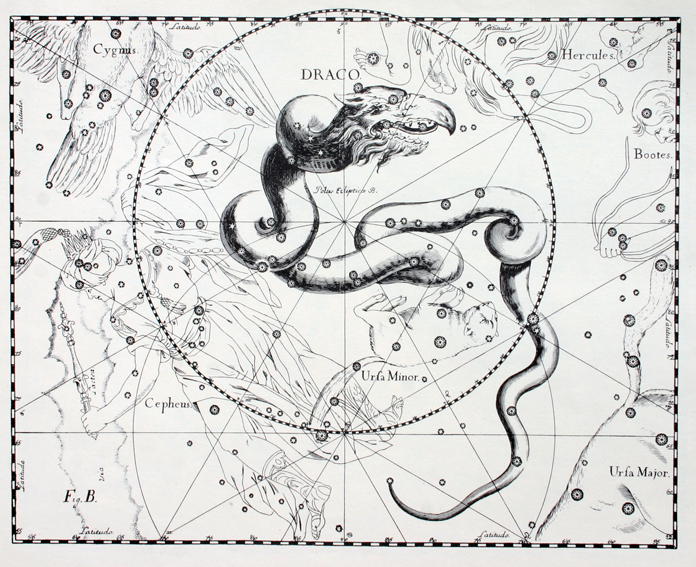
Draco: Antique etching of curling, writhing snake-like dragon with scattered stars in black on white.
Johannes Hevelius drew the constellation Draco the Dragon in Uranographia, his celestial catalog, in 1690. He plotted the sky in reverse, as if seen from above, facing down toward Earth. Note the circle around the Dragon and the star where the Dragon’s Tail intersects the circle. That star is Thuban, a former pole star. Image via Wikimedia Commons.

Don’t miss the next unmissable night sky event. Sign up to EarthSky’s free newsletter for daily night sky updates.

Pole stars aren’t permanent

Under a dark sky tonight, you’ll be able to pick out the constellation Draco the Dragon winding around the star Polaris. Polaris is Earth’s northern pole star today … but it hasn’t always been.

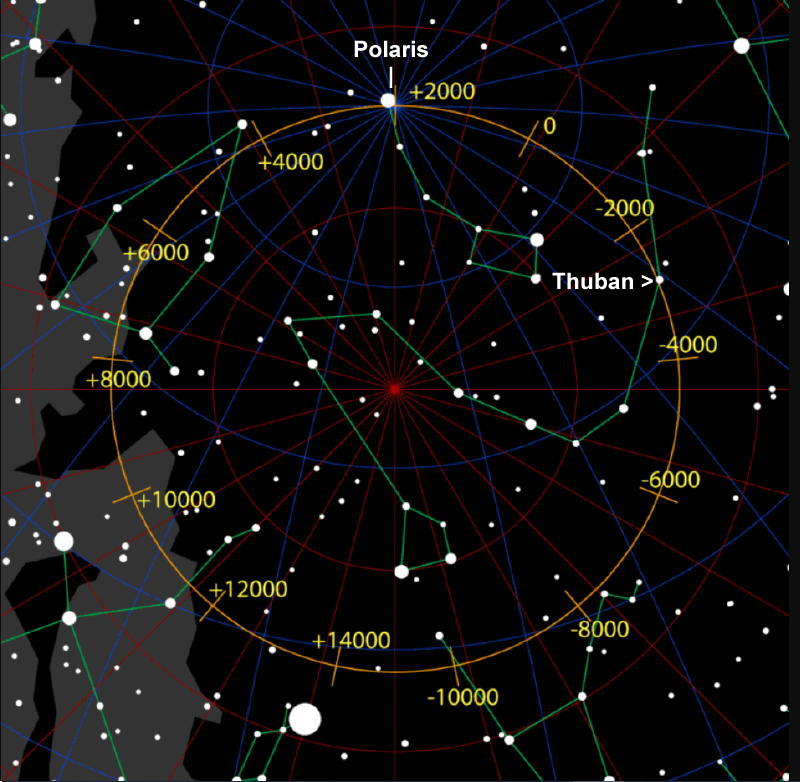
The image at the top of this post shows Draco as depicted in an old star atlas by Johannes Hevelius in 1690. See the circle? It indicates the changing position of the north celestial pole over a cycle of 26,000 years.

The 26,000-year cycle is known as precession. Basically, it’s a slow, smooth wobble that causes a change in the orientation of Earth’s axis over time. Precession causes Earth’s axis to trace out a circle among the stars. Thus, over time, Earth’s north pole points to various stars, and the identity of our North Star changes.

So to our ancient ancestors, the star we now call Polaris was an unremarkable star called Phoenice. And a star in Draco, called Thuban, was the pole star when the Egyptians built the pyramids some 4,500 years ago.

Star chart with large circle centered on north celestial pole, with years marked around it.
The 26,000-year precession cycle causes the north celestial pole to move counterclockwise relative to the background stars. So, whichever star is closest to the north celestial pole is called the North Star. Image via Wikimedia Commons (CC BY-SA 2.5).

Draco winds between the Big and Little Dippers

The famous Big Dipper can help guide you to Draco and its star Thuban. Just remember … the entire Dragon requires a dark sky to see. You’ll find the Big Dipper high in the north on June evenings. The two outer stars in the Dipper’s bowl point to our modern-day Polaris, the North Star, which marks the end of the Little Dipper’s handle.

The Little Dipper is relatively faint. If you can find both Dippers, then your sky is probably pretty dark. And you’ll need that dark sky to see Draco. You’ll have to let your eyes and imagination drift a bit to see the entire winding shape of the Dragon in the northern heavens.

See how the tail of Draco winds between the Big and Little Dippers on the chart below?
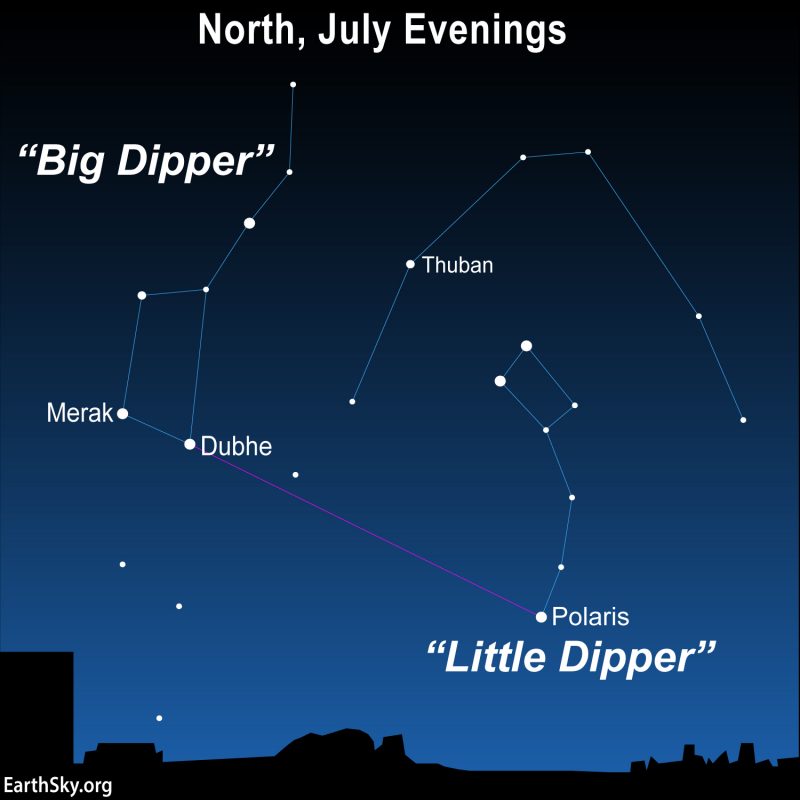
Star chart with Big and Little Dippers and several stars labeled.
During the northern summer, if you can find the Big and Little Dippers, you can find the constellation Draco the Dragon. The star Thuban lies between the Dippers. Chart via EarthSky.

And here’s Draco the Dragon and the Little Dipper. The four stars that make up Draco’s head usually are the easiest pattern to pick out.
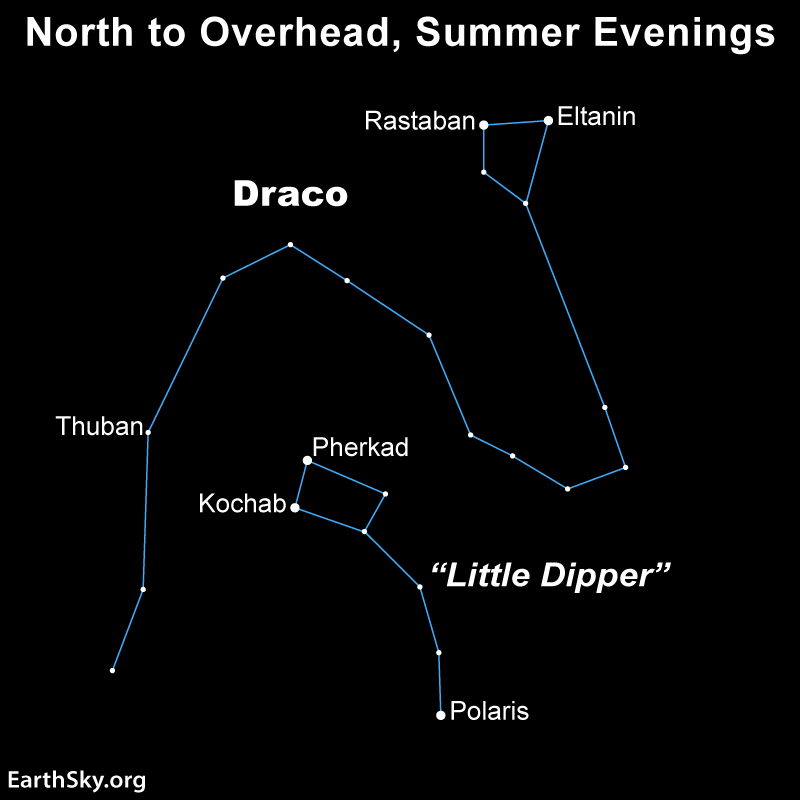
Star chart: Blue lines connecting labeled stars on black for 2 constellations, Draco and Little Dipper.
Eltanin and Rastaban mark the head of Draco the Dragon. You’ll find these stars in the northern sky. Chart via EarthSky.

Our charts are mostly set for mid-latitudes in the Northern Hemisphere. To see a precise view – and time – from your location, try Stellarium Online.

Ex-pole star Thuban is easy to find

If you can find both Dippers, and if your sky is relatively dark, you can easily pick out Thuban. The star is four times fainter than Polaris, but it’s easy to find by looking between the Dippers.

Thuban is famous for having served as a pole star around 3000 BCE. This date coincides with the beginning of the building of the pyramids in Egypt. In fact, it’s said that the descending passage of the Great Pyramid of Khufu at Gizeh was built to point directly at Thuban. So, our ancestors knew and celebrated this star. Now, the descending path points toward Polaris, the current North Star.

Overall, Thuban reigned as the pole star for more than a thousand years. It was closest to the pole in the year 2830 BCE, at a distance of only 10 arcminutes, or 1/6 of a degree. This easily beats Polaris, which will get no closer than 27 arcminutes to true north next century.

Thuban was within 1 degree of true north for 200 years. It’s reign as North Star is long over, but it will get its turn again in the year 20,346 CE. Don’t wait up for it!

Through a telescope, Thuban is a blue-white star, magnitude 3.67. It is located 303 light-years away, is about five times larger than our sun and shines 240 times brighter. It also has a companion, but it is too close to the primary star to observe.

The reign of Polaris

And Polaris? Its reign as North Star began in 1547 when Gemma Frisius first referred to it as “that star which is called polar.” In July 2016, the International Astronomical Union‘s (IAU) Working Group on Star Names made the name Polaris official.

In a few thousand years, Polaris will no longer be the North Star. Perhaps then the IAU will assemble the Working Group of Star Names and change the name back to Phoenice. (P.S. Dear Pluto, there is hope!)

Brilliant Sirius, a future southern Pole Star

Via Daniel Gaussen, Founder & Guide – Stargaze Mackenzie – New Zealand

The slow wobble of Earth’s axis affects the Southern Hemisphere, too. Today, southern skywatchers have no bright equivalent to Polaris. The faint star Sigma Octantis lies closest to the south celestial pole, but it is so dim (around magnitude 5.5) that many observers struggle to find it. As a result, the southern sky currently lacks an obvious pole star.

But that won’t always be the case. As we’ve seen with Polaris and Thuban, Earth’s 26,000-year cycle of precession means that different stars take turns marking the celestial poles. Around the year 9,250 CE, the star Delta Velorum in the constellation Vela will pass within just 0.2 degrees of the south celestial pole, making it an even more accurate pole star than Polaris is today.

Looking much farther into the future, the brightest star in the night sky will briefly claim the title. Around the year 66,270 CE, Sirius, the dazzling Dog Star in the constellation Canis Major, will pass within 1.6 degrees of the south celestial pole. Although not as precise a marker as Delta Velorum, Sirius will be far more conspicuous. For the first time in tens of thousands of years, southern observers will have an exceptionally bright star close to the celestial pole, serving as a prominent guide to the south.

Sirius is relatively close to Earth, at just 8.6 light-years away. This closeness means it has a noticeable motion across our sky. And because of this motion, Sirius does not return to the same position relative to the celestial poles every precessional cycle. It was not a southern pole star in the distant past, and after its future reign near the south celestial pole, it will continue drifting onward through the Milky Way, making its role as a southern pole star a unique and temporary chapter in the long story of Earth’s changing skies.

Bottom line: Tonight, look for the winding shape of Draco the Dragon in the northern sky. This constellation contains Thuban, a former pole star.

Read more about Sirius as a future southern pole star

Read more about Thuban, a former pole star

Read more: How to find the Big Dipper

The post Draco the Dragon and Thuban, a former pole star first appeared on EarthSky.


from EarthSky https://ift.tt/lJChXEx
Draco: Antique etching of curling, writhing snake-like dragon with scattered stars in black on white.
Johannes Hevelius drew the constellation Draco the Dragon in Uranographia, his celestial catalog, in 1690. He plotted the sky in reverse, as if seen from above, facing down toward Earth. Note the circle around the Dragon and the star where the Dragon’s Tail intersects the circle. That star is Thuban, a former pole star. Image via Wikimedia Commons.

Don’t miss the next unmissable night sky event. Sign up to EarthSky’s free newsletter for daily night sky updates.

Pole stars aren’t permanent

Under a dark sky tonight, you’ll be able to pick out the constellation Draco the Dragon winding around the star Polaris. Polaris is Earth’s northern pole star today … but it hasn’t always been.

The image at the top of this post shows Draco as depicted in an old star atlas by Johannes Hevelius in 1690. See the circle? It indicates the changing position of the north celestial pole over a cycle of 26,000 years.

The 26,000-year cycle is known as precession. Basically, it’s a slow, smooth wobble that causes a change in the orientation of Earth’s axis over time. Precession causes Earth’s axis to trace out a circle among the stars. Thus, over time, Earth’s north pole points to various stars, and the identity of our North Star changes.

So to our ancient ancestors, the star we now call Polaris was an unremarkable star called Phoenice. And a star in Draco, called Thuban, was the pole star when the Egyptians built the pyramids some 4,500 years ago.

Star chart with large circle centered on north celestial pole, with years marked around it.
The 26,000-year precession cycle causes the north celestial pole to move counterclockwise relative to the background stars. So, whichever star is closest to the north celestial pole is called the North Star. Image via Wikimedia Commons (CC BY-SA 2.5).

Draco winds between the Big and Little Dippers

The famous Big Dipper can help guide you to Draco and its star Thuban. Just remember … the entire Dragon requires a dark sky to see. You’ll find the Big Dipper high in the north on June evenings. The two outer stars in the Dipper’s bowl point to our modern-day Polaris, the North Star, which marks the end of the Little Dipper’s handle.

The Little Dipper is relatively faint. If you can find both Dippers, then your sky is probably pretty dark. And you’ll need that dark sky to see Draco. You’ll have to let your eyes and imagination drift a bit to see the entire winding shape of the Dragon in the northern heavens.

See how the tail of Draco winds between the Big and Little Dippers on the chart below?

Star chart with Big and Little Dippers and several stars labeled.
During the northern summer, if you can find the Big and Little Dippers, you can find the constellation Draco the Dragon. The star Thuban lies between the Dippers. Chart via EarthSky.

And here’s Draco the Dragon and the Little Dipper. The four stars that make up Draco’s head usually are the easiest pattern to pick out.

Star chart: Blue lines connecting labeled stars on black for 2 constellations, Draco and Little Dipper.
Eltanin and Rastaban mark the head of Draco the Dragon. You’ll find these stars in the northern sky. Chart via EarthSky.

Our charts are mostly set for mid-latitudes in the Northern Hemisphere. To see a precise view – and time – from your location, try Stellarium Online.

Ex-pole star Thuban is easy to find

If you can find both Dippers, and if your sky is relatively dark, you can easily pick out Thuban. The star is four times fainter than Polaris, but it’s easy to find by looking between the Dippers.

Thuban is famous for having served as a pole star around 3000 BCE. This date coincides with the beginning of the building of the pyramids in Egypt. In fact, it’s said that the descending passage of the Great Pyramid of Khufu at Gizeh was built to point directly at Thuban. So, our ancestors knew and celebrated this star. Now, the descending path points toward Polaris, the current North Star.

Overall, Thuban reigned as the pole star for more than a thousand years. It was closest to the pole in the year 2830 BCE, at a distance of only 10 arcminutes, or 1/6 of a degree. This easily beats Polaris, which will get no closer than 27 arcminutes to true north next century.

Thuban was within 1 degree of true north for 200 years. It’s reign as North Star is long over, but it will get its turn again in the year 20,346 CE. Don’t wait up for it!

Through a telescope, Thuban is a blue-white star, magnitude 3.67. It is located 303 light-years away, is about five times larger than our sun and shines 240 times brighter. It also has a companion, but it is too close to the primary star to observe.

The reign of Polaris

And Polaris? Its reign as North Star began in 1547 when Gemma Frisius first referred to it as “that star which is called polar.” In July 2016, the International Astronomical Union‘s (IAU) Working Group on Star Names made the name Polaris official.

In a few thousand years, Polaris will no longer be the North Star. Perhaps then the IAU will assemble the Working Group of Star Names and change the name back to Phoenice. (P.S. Dear Pluto, there is hope!)

Brilliant Sirius, a future southern Pole Star

Via Daniel Gaussen, Founder & Guide – Stargaze Mackenzie – New Zealand

The slow wobble of Earth’s axis affects the Southern Hemisphere, too. Today, southern skywatchers have no bright equivalent to Polaris. The faint star Sigma Octantis lies closest to the south celestial pole, but it is so dim (around magnitude 5.5) that many observers struggle to find it. As a result, the southern sky currently lacks an obvious pole star.

But that won’t always be the case. As we’ve seen with Polaris and Thuban, Earth’s 26,000-year cycle of precession means that different stars take turns marking the celestial poles. Around the year 9,250 CE, the star Delta Velorum in the constellation Vela will pass within just 0.2 degrees of the south celestial pole, making it an even more accurate pole star than Polaris is today.

Looking much farther into the future, the brightest star in the night sky will briefly claim the title. Around the year 66,270 CE, Sirius, the dazzling Dog Star in the constellation Canis Major, will pass within 1.6 degrees of the south celestial pole. Although not as precise a marker as Delta Velorum, Sirius will be far more conspicuous. For the first time in tens of thousands of years, southern observers will have an exceptionally bright star close to the celestial pole, serving as a prominent guide to the south.

Sirius is relatively close to Earth, at just 8.6 light-years away. This closeness means it has a noticeable motion across our sky. And because of this motion, Sirius does not return to the same position relative to the celestial poles every precessional cycle. It was not a southern pole star in the distant past, and after its future reign near the south celestial pole, it will continue drifting onward through the Milky Way, making its role as a southern pole star a unique and temporary chapter in the long story of Earth’s changing skies.

Bottom line: Tonight, look for the winding shape of Draco the Dragon in the northern sky. This constellation contains Thuban, a former pole star.

Read more about Sirius as a future southern pole star

Read more about Thuban, a former pole star

Read more: How to find the Big Dipper

The post Draco the Dragon and Thuban, a former pole star first appeared on EarthSky.


from EarthSky https://ift.tt/lJChXEx

Pinocchio frogs seem straight out of a fairy tale

Brown frog on a green leaf. It looks wet and has long, thin fingers and toes. It has a pointy nose.
Pinocchio frogs are named after the famous fictional character. Why? Because they have miraculously extending nose-like snouts! Watch this video to discover interesting facts about these fascinating amphibians. Image via Noppe Herlinde/ Shutterstock.

Pinocchio frogs seem straight out of a fairy tale

If you like the story of a wooden puppet whose nose grows whenever he tells a lie, you’re going to love Pinocchio frogs. But in their case, their noses don’t grow because they’re lying … they grow to help them flirt!

These tiny male amphibians call out to attract a mate, and when a female comes closer, she gets a look at that cute, quirky nose. Some birds show off their feathers, other animals perform elaborate dances … And Pinocchio frogs proudly show off their noses.

Brownish, small animal sitting on a leaf, with its head and snout high.
How cute is that little nose? Image via Ramdanimam/ iNaturalist.

Masterpieces of rainforest camouflage

Pinocchio frogs (Litoria pinocchio) are tiny creatures, usually around 2–3 inches (5–7 cm) in length. And they are arboreal. This means they live high in the canopy and only go to the ground occasionally. Their skin patterns combine browns, greens and mottled textures that match moss, bark and wet leaves, allowing them to camouflage in their habitat, the rainforests of New Guinea.

But sometimes they can appear more yellowish depending on light and humidity. In dense rainforests, sunlight filters through the branches and leaves. That yellowish color can also help them blend into their surroundings. This reflects how easily perception can change in rainforest conditions.

Pinocchio forgs: Yellow frog sits with its long hind legs folded beneath its body. It has a short, round nose.
Despite their small size, Pinocchio frogs are highly adapted to life in the rainforest, using their cryptic coloration to remain hidden among moss, bark and leaves. Environmental conditions such as light and humidity can subtly influence how their colors are perceived. Image via Varhan Rifka/ iNaturalist.

The mystery of the shifting snout

Male frogs develop a flexible rostral extension made of soft tissue. The frog can partially erect this structure, which changes shape with activity: it becomes more visible and pronounced during calling and shrinks back when the frog rests. Females do not develop this structure, which strongly suggests a role linked to reproduction.

Scientists think that the nasal projection plays a role in visual signaling during mating interactions, working alongside vocal calls. While calls carry over distance, the nasal structure may function as a close-range display, helping individuals stand out once they are near each other. In that sense, it could act as a visual courtship signal, similar to how a peacock’s tail signals quality during courtship.

Yellow frog on a thin branch showing a soft nose and an inflated throat sac.
Male Pinocchio frogs develop a distinctive soft-tissue nasal projection that becomes more prominent when they call. Together with their inflated vocal sac, this feature may help attract mates through a combination of visual and acoustic signals. Image via Tangsign studio/ Shutterstock.

Survival in a vertical world

Remote mountain forests in New Guinea have revealed many previously unknown species over time. These discoveries come from multiple expeditions rather than a single moment, reflecting how little-accessible these ecosystems remain.

Within this environment, the frogs spend most of their time on vegetation above the forest floor. Sticky toe pads allow them to move across wet leaves and narrow branches, while their compact bodies help them navigate the tangled structure of the rainforest. Like many tree frogs, they feed on small insects and other invertebrates, which they capture during their nocturnal activity.

Greenish frog with open wide eyes sitting almost vertically on a leaf. It has a long snout.
Remote mountain forests in New Guinea have yielded many previously unknown species, highlighting how little explored these ecosystems remain. These frogs live high on vegetation, using sticky toe pads to move and hunt at night. Image via Cahyo Lewar/ iNaturalist.

Life cycles in the clouds

Reproduction depends strongly on moisture. Females lay eggs in damp, protected locations close to water, where humidity prevents drying. The tadpoles begin life in water before gradually transforming into adult frogs.

Because rainfall in these forests fluctuates, breeding is closely tied to wetter periods. This dependence on microclimate conditions makes successful reproduction sensitive to environmental changes, even in relatively undisturbed habitats.

A small frog perched high on a branch surrounded by lush green leaves.
Breeding is closely linked to wetter periods, making this animal sensitive to changes in local climate conditions. Image via Tangsign studio/ Shutterstock.

Pinocchio frogs’ conservation status

There is not enough information to assign a precise conservation category to this frog. Its habitat in New Guinea is still partly remote and relatively intact, but other areas are increasingly affected by logging and land conversion.

The real uncertainty lies in what is still unknown: how many populations exist, how connected they are and how they respond to gradual environmental change. For now, much of its future remains hidden in the same forests where it does.

The so-called Pinocchio frog still appears and disappears between leaves and shadows, like something from a fairy tale that has quietly turned real in the forest.

A small frog with big eyes and a long snout lies flat on a high branch.
The Pinocchio frog is often seen only in brief glimpses among the foliage, moving quietly through the forest canopy and blending into light and shadow. In a place still full of undiscovered life, it is a reminder of how much of the natural world remains hidden just out of sight. Image via Ramdanimam/ iNaturalist.

Bottom line: Pinocchio frogs use a shifting nose for courtship displays, blending fairy-tale looks with real rainforest survival strategies.

Read more: A rare and elusive frog found again after 130 years

Read more: Mexican burrowing toad looks like a deflated balloon

The post Pinocchio frogs seem straight out of a fairy tale first appeared on EarthSky.


from EarthSky https://ift.tt/lSvw3z8
Brown frog on a green leaf. It looks wet and has long, thin fingers and toes. It has a pointy nose.
Pinocchio frogs are named after the famous fictional character. Why? Because they have miraculously extending nose-like snouts! Watch this video to discover interesting facts about these fascinating amphibians. Image via Noppe Herlinde/ Shutterstock.

Pinocchio frogs seem straight out of a fairy tale

If you like the story of a wooden puppet whose nose grows whenever he tells a lie, you’re going to love Pinocchio frogs. But in their case, their noses don’t grow because they’re lying … they grow to help them flirt!

These tiny male amphibians call out to attract a mate, and when a female comes closer, she gets a look at that cute, quirky nose. Some birds show off their feathers, other animals perform elaborate dances … And Pinocchio frogs proudly show off their noses.

Brownish, small animal sitting on a leaf, with its head and snout high.
How cute is that little nose? Image via Ramdanimam/ iNaturalist.

Masterpieces of rainforest camouflage

Pinocchio frogs (Litoria pinocchio) are tiny creatures, usually around 2–3 inches (5–7 cm) in length. And they are arboreal. This means they live high in the canopy and only go to the ground occasionally. Their skin patterns combine browns, greens and mottled textures that match moss, bark and wet leaves, allowing them to camouflage in their habitat, the rainforests of New Guinea.

But sometimes they can appear more yellowish depending on light and humidity. In dense rainforests, sunlight filters through the branches and leaves. That yellowish color can also help them blend into their surroundings. This reflects how easily perception can change in rainforest conditions.

Pinocchio forgs: Yellow frog sits with its long hind legs folded beneath its body. It has a short, round nose.
Despite their small size, Pinocchio frogs are highly adapted to life in the rainforest, using their cryptic coloration to remain hidden among moss, bark and leaves. Environmental conditions such as light and humidity can subtly influence how their colors are perceived. Image via Varhan Rifka/ iNaturalist.

The mystery of the shifting snout

Male frogs develop a flexible rostral extension made of soft tissue. The frog can partially erect this structure, which changes shape with activity: it becomes more visible and pronounced during calling and shrinks back when the frog rests. Females do not develop this structure, which strongly suggests a role linked to reproduction.

Scientists think that the nasal projection plays a role in visual signaling during mating interactions, working alongside vocal calls. While calls carry over distance, the nasal structure may function as a close-range display, helping individuals stand out once they are near each other. In that sense, it could act as a visual courtship signal, similar to how a peacock’s tail signals quality during courtship.

Yellow frog on a thin branch showing a soft nose and an inflated throat sac.
Male Pinocchio frogs develop a distinctive soft-tissue nasal projection that becomes more prominent when they call. Together with their inflated vocal sac, this feature may help attract mates through a combination of visual and acoustic signals. Image via Tangsign studio/ Shutterstock.

Survival in a vertical world

Remote mountain forests in New Guinea have revealed many previously unknown species over time. These discoveries come from multiple expeditions rather than a single moment, reflecting how little-accessible these ecosystems remain.

Within this environment, the frogs spend most of their time on vegetation above the forest floor. Sticky toe pads allow them to move across wet leaves and narrow branches, while their compact bodies help them navigate the tangled structure of the rainforest. Like many tree frogs, they feed on small insects and other invertebrates, which they capture during their nocturnal activity.

Greenish frog with open wide eyes sitting almost vertically on a leaf. It has a long snout.
Remote mountain forests in New Guinea have yielded many previously unknown species, highlighting how little explored these ecosystems remain. These frogs live high on vegetation, using sticky toe pads to move and hunt at night. Image via Cahyo Lewar/ iNaturalist.

Life cycles in the clouds

Reproduction depends strongly on moisture. Females lay eggs in damp, protected locations close to water, where humidity prevents drying. The tadpoles begin life in water before gradually transforming into adult frogs.

Because rainfall in these forests fluctuates, breeding is closely tied to wetter periods. This dependence on microclimate conditions makes successful reproduction sensitive to environmental changes, even in relatively undisturbed habitats.

A small frog perched high on a branch surrounded by lush green leaves.
Breeding is closely linked to wetter periods, making this animal sensitive to changes in local climate conditions. Image via Tangsign studio/ Shutterstock.

Pinocchio frogs’ conservation status

There is not enough information to assign a precise conservation category to this frog. Its habitat in New Guinea is still partly remote and relatively intact, but other areas are increasingly affected by logging and land conversion.

The real uncertainty lies in what is still unknown: how many populations exist, how connected they are and how they respond to gradual environmental change. For now, much of its future remains hidden in the same forests where it does.

The so-called Pinocchio frog still appears and disappears between leaves and shadows, like something from a fairy tale that has quietly turned real in the forest.

A small frog with big eyes and a long snout lies flat on a high branch.
The Pinocchio frog is often seen only in brief glimpses among the foliage, moving quietly through the forest canopy and blending into light and shadow. In a place still full of undiscovered life, it is a reminder of how much of the natural world remains hidden just out of sight. Image via Ramdanimam/ iNaturalist.

Bottom line: Pinocchio frogs use a shifting nose for courtship displays, blending fairy-tale looks with real rainforest survival strategies.

Read more: A rare and elusive frog found again after 130 years

Read more: Mexican burrowing toad looks like a deflated balloon

The post Pinocchio frogs seem straight out of a fairy tale first appeared on EarthSky.


from EarthSky https://ift.tt/lSvw3z8

Asteroid or comet? Meteor or meteorite?

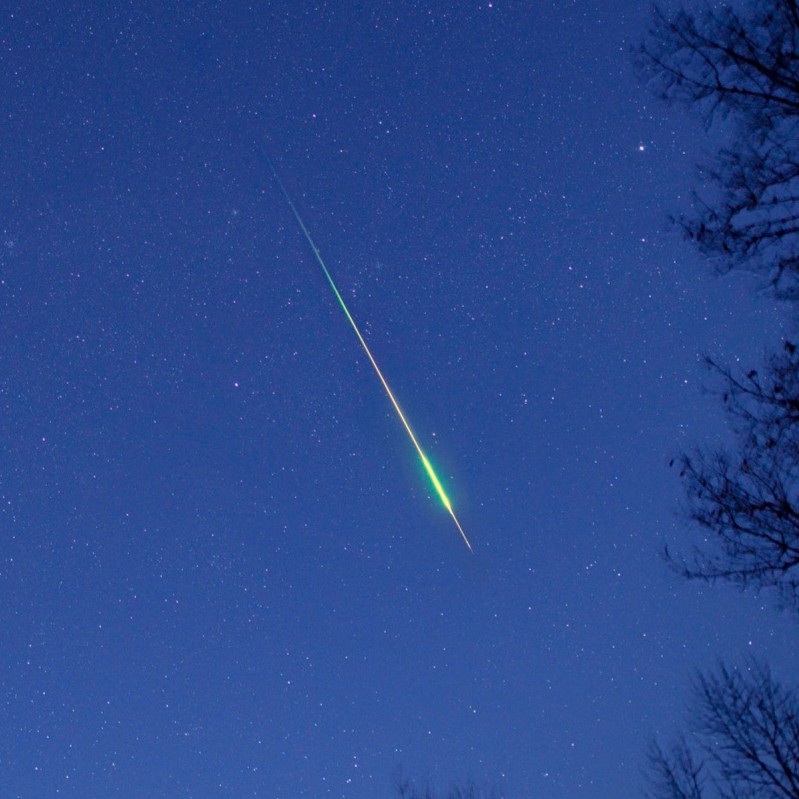
Asteroid or comet: A view of the sky with a bright greenish streak that is fatter near the bottom.
View at EarthSky Community Photos. | James Reynolds in Leicester, North Carolina, caught this Leonid meteor on November 17, 2020. Thanks, James! Okay, so a stream in your night sky is a meteor. But did it originate in an asteroid or comet?
  • “Asteroids” are rocky or metallic bodies, mostly orbiting in the asteroid belt between Mars and Jupiter.
  • “Comets” are icy, dusty objects that originated in the freezing outer solar system. When they come near the sun, they might develop a long tail.
  • A “meteor” is a fiery streak of space debris in Earth’s sky. Meteors might originate as icy debris left behind by comets. Or they might be small rocky or metallic asteroids.

Adam Lark, Hamilton College

Asteroid or comet or meteor?

Have you ever been out at night and seen a streak of light blast across the sky and disappear? Ever wonder where that shooting star came from, or how it got to be in your sky?

As the director of the Peters Observatory at Hamilton College in New York, I have seen many similar streaks across the sky, as I spend late nights at the observatory. And I am here to tell you that what you saw isn’t a star at all. You observed the end of a comet or asteroid’s 4.6-billion-year journey right before your eyes.

Remnants from the inner solar system

Roughly 4.6 billion years ago, the solar system was in its infancy. A vast ball of gas and dust that would become our solar system was accumulating matter in its center, forming what would eventually become our sun. It was also condensing dust in smaller patches farther from the center that would merge into the first chunks of materials, called planetesimals.

Asteroids formed from planetesimals in the inner portions of the solar system, near the sun. This location in the center of the solar system was warm, so the planetesimals were made mostly of the rocks and metals that could withstand the heat. The biggest of these chunks would congeal with others and form the terrestrial planets: Mercury, Venus, Earth and Mars. The remaining planetesimals that did not form into the terrestrial planets are the asteroids of today, left to orbit the inner portion of the solar system.

An illustration of a large, mostly round asteroid with some small craters on its surface
Asteroids such as Psyche are planetary remnants typically made of metal and rock. Image via NASA.

Remnants from the outer solar system

Comets formed in the outer parts of the solar system, where it was cold enough that any water, or similar hydrogen-based compounds, took the form of ice. The planetesimals forming in this region were composed of not just rock and metal but these ices as well.

Some of the planetesimals became big enough, fast enough, that they had enough gravitational pull to hold onto large atmospheres composed of the very abundant early solar system gases, such as hydrogen and helium. These planetesimals became the Jovian planets of today: Jupiter, Saturn, Uranus and Neptune. However, the planetesimals that did not form into the Jovian planets were left to travel through the solar system as comets.

A photo of an oval-shaped comet, with light illuminating it from the back side, which has a sparse trail of dust particles.
This image of Comet Hartley is from NASA’s EPOXI mission. The comet has a thin trail of dust particles coming off its back side. Image via NASA/JPL-Caltech/UMD.

Origin of meteors

Asteroids are still abundant in the inner solar system, so inevitably some will collide with Earth. When a chunk of rock enters Earth’s atmosphere, it’s traveling at dozens of miles per second. As it enters, it may create a thunderlike sonic boom in its wake. When it travels through the air faster than the speed of sound, the asteroid produces a shock wave, which can generate that boom.

During its journey through the atmosphere over tens of miles, the asteroid collides with air molecules. And the incredible temperatures and pressure usually vaporize it. That trail of vaporizing particles breaking off the asteroid causes a bright streak of light across the sky called a meteor, or colloquially a shooting star.

Comets, though typically found in the outer solar system, can also cause meteors, and even meteor showers. A few comets take long, elliptical paths through the inner solar system every year.

These objects, which astronomers sometimes call “dirty snowballs” because they are made of dust and ices, tend to slowly melt as they get too close to the sun. This causes the comet to develop a tail of gas and debris left in its wake.

If the path of the comet intersects with Earth’s orbit, the Earth will collide with these debris fields in its yearly orbit around the sun. As that debris enters the atmosphere, it vaporizes, causing numerous trails of light called meteor showers. Since this happens in the same part of our orbit every year, meteor showers are yearly events. If you find a dark sky, you can see dozens of meteors every hour during these annual meteor showers.

A poster showing the different types of meteors and terms used for them.
Astronomers use lots of different terms to classify meteors and other rocks in the solar system. Image via Canadian Space Agency.

Finding meteorites

The meteors that are large enough to make it through Earth’s atmosphere and crash into the surface are meteorites. Meteorites tend to come from asteroids that were originally larger than a football field.

It can be difficult to identify meteorites, because they look just like Earth rocks. Typically, people recover meteorites in geologically unchanging regions, such as deserts or ice fields, where the meteorites stand out against the landscape.

Read more: Meteorite hunting? Here’s tips on how to find one

They are often made of stone, nickel and iron and are likely magnetic. Many have irregular or pock-marked shapes, while others have a smooth crust from their time burning up in our atmosphere.

Meteorites are quite rare and important to the study of the early solar system. If you believe you’ve found one, you should verify your rock’s features fit those of a meteorite and then contact local geologists.

Next time you see a meteor in the night sky, remember that you are witnessing the end of its journey, spanning billions of years, as it burns up in the Earth’s atmosphere.The Conversation

Adam Lark, Associate Professor of Instruction for Physics, Hamilton College

This article is republished from The Conversation under a Creative Commons license. Read the original article.

Bottom line: Look up! A bright light zips through the night sky. But what is it? Asteroid or comet?

The post Asteroid or comet? Meteor or meteorite? first appeared on EarthSky.


from EarthSky https://ift.tt/KTjFt8X
Asteroid or comet: A view of the sky with a bright greenish streak that is fatter near the bottom.
View at EarthSky Community Photos. | James Reynolds in Leicester, North Carolina, caught this Leonid meteor on November 17, 2020. Thanks, James! Okay, so a stream in your night sky is a meteor. But did it originate in an asteroid or comet?
  • “Asteroids” are rocky or metallic bodies, mostly orbiting in the asteroid belt between Mars and Jupiter.
  • “Comets” are icy, dusty objects that originated in the freezing outer solar system. When they come near the sun, they might develop a long tail.
  • A “meteor” is a fiery streak of space debris in Earth’s sky. Meteors might originate as icy debris left behind by comets. Or they might be small rocky or metallic asteroids.

Adam Lark, Hamilton College

Asteroid or comet or meteor?

Have you ever been out at night and seen a streak of light blast across the sky and disappear? Ever wonder where that shooting star came from, or how it got to be in your sky?

As the director of the Peters Observatory at Hamilton College in New York, I have seen many similar streaks across the sky, as I spend late nights at the observatory. And I am here to tell you that what you saw isn’t a star at all. You observed the end of a comet or asteroid’s 4.6-billion-year journey right before your eyes.

Remnants from the inner solar system

Roughly 4.6 billion years ago, the solar system was in its infancy. A vast ball of gas and dust that would become our solar system was accumulating matter in its center, forming what would eventually become our sun. It was also condensing dust in smaller patches farther from the center that would merge into the first chunks of materials, called planetesimals.

Asteroids formed from planetesimals in the inner portions of the solar system, near the sun. This location in the center of the solar system was warm, so the planetesimals were made mostly of the rocks and metals that could withstand the heat. The biggest of these chunks would congeal with others and form the terrestrial planets: Mercury, Venus, Earth and Mars. The remaining planetesimals that did not form into the terrestrial planets are the asteroids of today, left to orbit the inner portion of the solar system.

An illustration of a large, mostly round asteroid with some small craters on its surface
Asteroids such as Psyche are planetary remnants typically made of metal and rock. Image via NASA.

Remnants from the outer solar system

Comets formed in the outer parts of the solar system, where it was cold enough that any water, or similar hydrogen-based compounds, took the form of ice. The planetesimals forming in this region were composed of not just rock and metal but these ices as well.

Some of the planetesimals became big enough, fast enough, that they had enough gravitational pull to hold onto large atmospheres composed of the very abundant early solar system gases, such as hydrogen and helium. These planetesimals became the Jovian planets of today: Jupiter, Saturn, Uranus and Neptune. However, the planetesimals that did not form into the Jovian planets were left to travel through the solar system as comets.

A photo of an oval-shaped comet, with light illuminating it from the back side, which has a sparse trail of dust particles.
This image of Comet Hartley is from NASA’s EPOXI mission. The comet has a thin trail of dust particles coming off its back side. Image via NASA/JPL-Caltech/UMD.

Origin of meteors

Asteroids are still abundant in the inner solar system, so inevitably some will collide with Earth. When a chunk of rock enters Earth’s atmosphere, it’s traveling at dozens of miles per second. As it enters, it may create a thunderlike sonic boom in its wake. When it travels through the air faster than the speed of sound, the asteroid produces a shock wave, which can generate that boom.

During its journey through the atmosphere over tens of miles, the asteroid collides with air molecules. And the incredible temperatures and pressure usually vaporize it. That trail of vaporizing particles breaking off the asteroid causes a bright streak of light across the sky called a meteor, or colloquially a shooting star.

Comets, though typically found in the outer solar system, can also cause meteors, and even meteor showers. A few comets take long, elliptical paths through the inner solar system every year.

These objects, which astronomers sometimes call “dirty snowballs” because they are made of dust and ices, tend to slowly melt as they get too close to the sun. This causes the comet to develop a tail of gas and debris left in its wake.

If the path of the comet intersects with Earth’s orbit, the Earth will collide with these debris fields in its yearly orbit around the sun. As that debris enters the atmosphere, it vaporizes, causing numerous trails of light called meteor showers. Since this happens in the same part of our orbit every year, meteor showers are yearly events. If you find a dark sky, you can see dozens of meteors every hour during these annual meteor showers.

A poster showing the different types of meteors and terms used for them.
Astronomers use lots of different terms to classify meteors and other rocks in the solar system. Image via Canadian Space Agency.

Finding meteorites

The meteors that are large enough to make it through Earth’s atmosphere and crash into the surface are meteorites. Meteorites tend to come from asteroids that were originally larger than a football field.

It can be difficult to identify meteorites, because they look just like Earth rocks. Typically, people recover meteorites in geologically unchanging regions, such as deserts or ice fields, where the meteorites stand out against the landscape.

Read more: Meteorite hunting? Here’s tips on how to find one

They are often made of stone, nickel and iron and are likely magnetic. Many have irregular or pock-marked shapes, while others have a smooth crust from their time burning up in our atmosphere.

Meteorites are quite rare and important to the study of the early solar system. If you believe you’ve found one, you should verify your rock’s features fit those of a meteorite and then contact local geologists.

Next time you see a meteor in the night sky, remember that you are witnessing the end of its journey, spanning billions of years, as it burns up in the Earth’s atmosphere.The Conversation

Adam Lark, Associate Professor of Instruction for Physics, Hamilton College

This article is republished from The Conversation under a Creative Commons license. Read the original article.

Bottom line: Look up! A bright light zips through the night sky. But what is it? Asteroid or comet?

The post Asteroid or comet? Meteor or meteorite? first appeared on EarthSky.


from EarthSky https://ift.tt/KTjFt8X

Artemis missions target South Pole–Aitken basin on the moon

South Pole–Aitken basin: Globe of a planet with a large lop-sided blue area in the middle, surrounded by a wide field of large rubble.
View larger. | This globe map shows the South Pole-Aitken basin (blue) and surrounding regions. Here we see rocks from the moon’s mantle, the thick, rocky layer directly beneath its thin outer crust. The rocks were blasted onto the surface by the giant impact that created this huge moon basin. Image via NASA/ JPL-Caltech/ Goddard/ Gabe Gowman-U. Arizona/ SwRI. Data from NASA’s GRAIL mission and NASA’s Lunar Reconnaissance Orbiter Laser Altimeter.
  • The South Pole-Aitken basin is the largest impact basin on the moon. It’s on the moon’s far side. How did it form?
  • Two new studies show that the asteroid that struck the moon, forming the basin, came from the north at a low angle. Rocks from both the lunar crust and mantle were ejected onto the surface.
  • Future Artemis astronauts will land in and around the South Pole-Aitken region. The new studies help show what the astronauts can expect to find.

You deserve a daily dose of good news. For the latest in science and the night sky, click here to subscribe to our free daily newsletter.

The South Pole–Aitken basin region is a future landing site

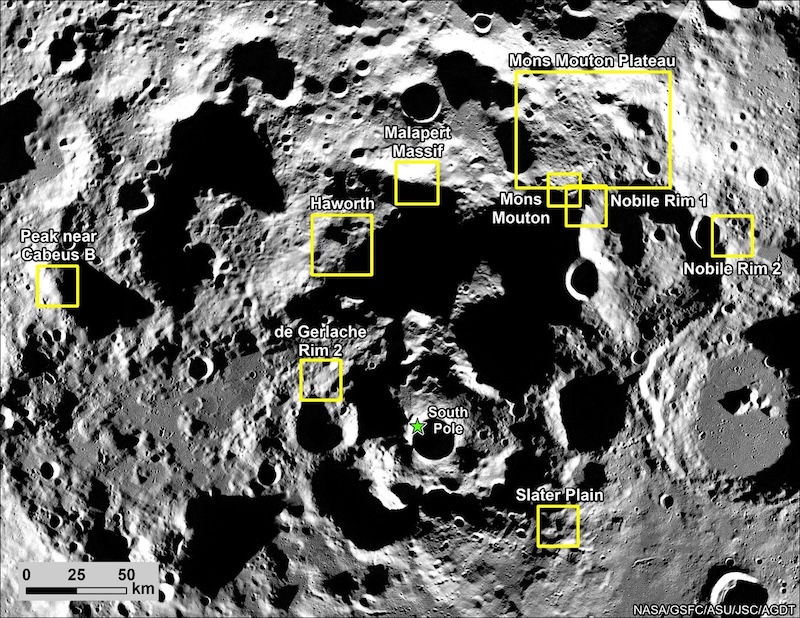
When Artemis astronauts return to the moon in the near future, they’ll land near the lunar south pole. Of the nine possible landing sites, some are within the South Pole-Aitken basin. Others are on or near the rim of the basin, while still others are just outside of it.

For example, the sites Nobile Rim 1, Nobile Rim 2 and Haworth are within the basin (see map below). Malapert Massif is near the basin’s rim. And de Gerlache Rim 2 is outside of the basin. Note that the basin’s boundary is rather obscure and not sharply delineated. So it’s not always clear which proposed landing sites are, technically, within the basin.

Now researchers have published two new peer-reviewed papers about the South Pole-Aitken basin. One is in Science Advances (May 6, 2026). And the other is in JGR Planets (April 23, 2026).

Black and white image of cratered terrain seen from above, with 9 labeled yellow squares scattered around.
View larger. | The 9 possible landing sites for future Artemis missions, in and around the South Pole-Aitken basin. Note that it will no longer be the Artemis 3 mission, in late 2027, that lands first. That mission will remain in Earth orbit. It will now be Artemis 4 and beyond for the landings. Image via NASA.

Water ice and sunlight

Here are two reasons this region was chosen for the astronauts: water ice and sunlight. The landing sites closest to the moon’s south pole offer access to water ice, which the astronauts will need as a primary resource. The sites also experience long periods of sunlight.

This giant moon basin is the moon’s oldest and largest impact crater, on the far side of the moon. But how much do we really know about this region? On June 15, 2026, researchers at the Southwest Research Institute (SwRI) in California, said that they have found new details about the South Pole-Aitken basin.

Since it is one of the oldest structures on the moon, the basin provides clues about the early solar system.

William Bottke is the director of the Center for Lunar Origin and Evolution (CLOE) and executive director of SwRI’s Science Directorate in Boulder, Colorado. He is also a co-author of both of the new studies. He said:

The basin offers scientists a rare opportunity to study the moon’s earliest history. The collision struck the lunar surface with such force that it may have excavated material from deep inside the moon, including portions of the lunar mantle [the region just below the moon’s thin crust].

Recreating the impact

To find out more about the future landing location for the Artemis astronauts, the researchers used advanced computer simulations and computer models. They recreated the impact that formed the basin. They found that the impacting asteroid came from the north and hit the moon’s surface at a low angle. That’s why the basin is more elongated in shape than round. (However, scientists said in 2024 that it’s actually slightly rounder than first thought). Shigeru Wakita at Purdue University, lead author of the South-Pole Aitken basin impact study, said:

Our simulation produces the right shape and nature of the impact basin. It also tells us about the projectile that created it and the direction of the impact.

Notably, the analysis suggests that the object that impacted was not just a simple asteroid. The impacting object must have been more complex, with an inner core surrounded by rock. The object’s interior appears to have been differentiated, separated into distinct compositional layers, more like a small protoplanet than a plain rock. Protoplanets are like “baby planets,” smaller objects forming from the accumulation of material in the early solar system. Many would eventually grow to become actual planets, like our own Earth.

When the impactor hit the moon, it created a deep, uneven cavity. The rock in the middle of the basin melted, and material from both the moon’s mantle and crust were thrown out into space.

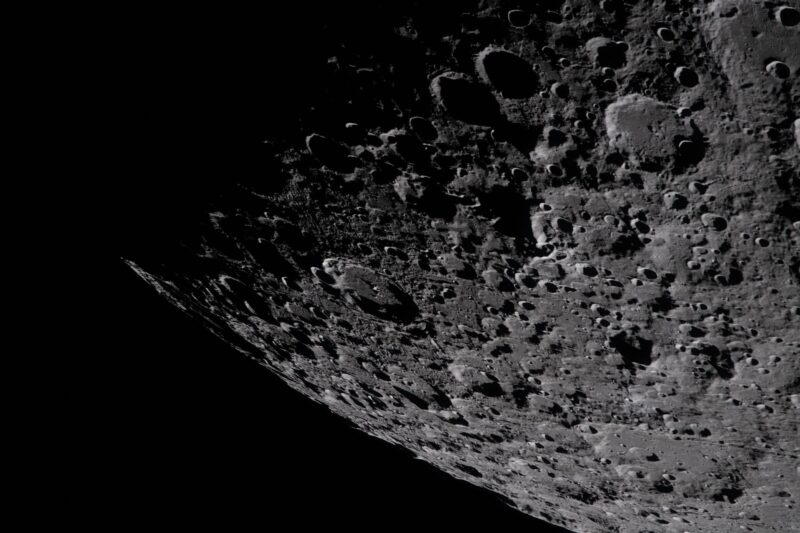
A piece of the lunar surface, seen from orbit, showing heavily cratered terrain.
Captured by the Artemis 2 crew, the heavily cratered eastern edge of the South Pole-Aitken basin – the moon’s oldest and largest impact basin – offers a glimpse into billions of years of lunar geologic history. Image via NASA.
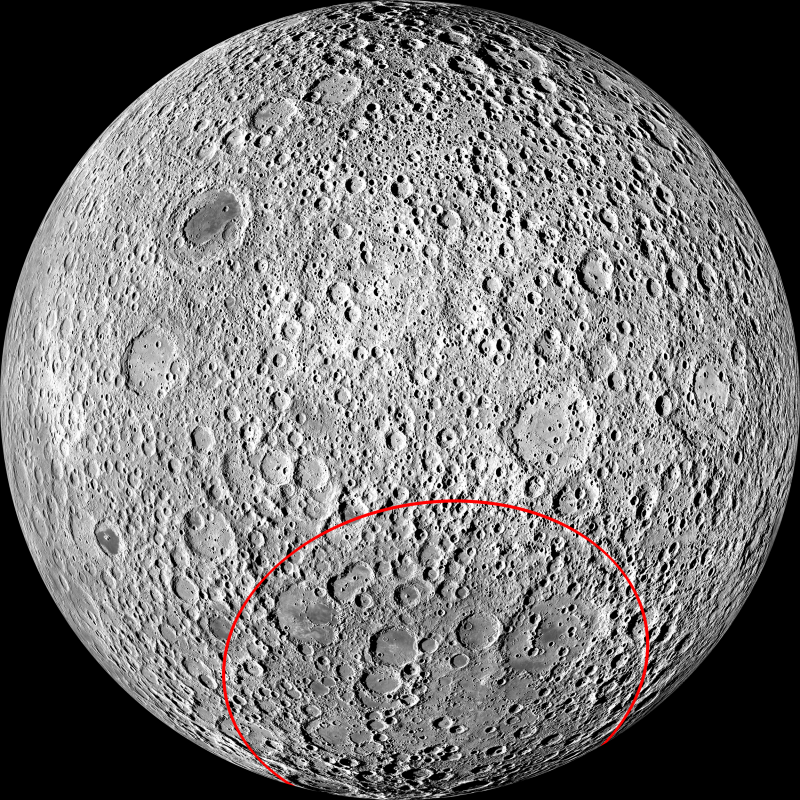
Far side of the moon. Light gray and cratered, but without large dark blotches. Red circle around a large area.
The South Pole-Aitken basin (outlined) on the far side of the moon. Image via NASA/ Sneeuwschaap/ Wikimedia Commons.

Ejecta in the basin

The researchers also wanted to know how the ejecta from the impact was distributed in and around the basin. To do this, they compared high-resolution gravity data with models that include both crustal and mantle material. The result was that the basin likely contains a substantial amount of rock from the moon’s mantle. Those rocks are also mixed into the ejecta blanket – the rocky debris – surrounding the basin.

Also, there were smaller secondary impacts that brought some of those rocks to the surface. That is treasure for the future Artemis astronauts who will land there. Gabriel Gowman at the University of Arizona, lead author of the gravity-based study, said:

The precise distribution of mantle material has been a big unknown. Our models indicate that the [South-Pole Aitken basin] impact ejected enough deep material to form a significant deposit that should still be accessible today. Most importantly, some of that material at a trace level may exist in regions being considered for the Artemis landings.

Smiling young man with short black hair wearing a sweater.
Shigeru Wakita at Purdue University is the lead author of the South-Pole Aitken basin impact paper. Image via Google Scholar.
Smiling young man with longish, tousled light brown hair wearing eyeglasses.
Gabriel Gowman at the University of Arizona is the lead author of the gravity mapping paper. Image via the University of Arizona.

Lots of mantle ejecta for astronauts to explore

Scientists had thought that the deepest part of the ejecta might be far away from the proposed landing sites in the area. But the new studies show this might not be the case. Some of the deposits could extend closer to the south polar region, including the landing sites. That’s good news for the astronauts being able to sample some of those deposits.

In 2019, scientists said they found evidence for an unusually dense mass beneath the South Pole-Aitken basin. The metallic rock is five times larger than the Big Island of Hawaii.

On June 25, 2024, the Chinese Chang’e 6 lunar probe landed in the Apollo basin, a region within the South Pole-Aitken basin. It returned samples to Earth 53 days later.

Bottom line: Two new studies examine the South Pole-Aitken basin on the moon. This region is a future landing site for Artemis astronauts.

Source: A southward differentiated impactor forms the tapered shape of the South Pole–Aitken impact basin on the Moon

Source: Gravity Mapping of Lunar Mantle Material in South Pole-Aitken Basin Ejecta

Via SwRI

Read more: Moon’s largest crater is rounder than 1st thought

Read more: What is the mystery mass on the moon?

The post Artemis missions target South Pole–Aitken basin on the moon first appeared on EarthSky.


from EarthSky https://ift.tt/AnGspkK
South Pole–Aitken basin: Globe of a planet with a large lop-sided blue area in the middle, surrounded by a wide field of large rubble.
View larger. | This globe map shows the South Pole-Aitken basin (blue) and surrounding regions. Here we see rocks from the moon’s mantle, the thick, rocky layer directly beneath its thin outer crust. The rocks were blasted onto the surface by the giant impact that created this huge moon basin. Image via NASA/ JPL-Caltech/ Goddard/ Gabe Gowman-U. Arizona/ SwRI. Data from NASA’s GRAIL mission and NASA’s Lunar Reconnaissance Orbiter Laser Altimeter.
  • The South Pole-Aitken basin is the largest impact basin on the moon. It’s on the moon’s far side. How did it form?
  • Two new studies show that the asteroid that struck the moon, forming the basin, came from the north at a low angle. Rocks from both the lunar crust and mantle were ejected onto the surface.
  • Future Artemis astronauts will land in and around the South Pole-Aitken region. The new studies help show what the astronauts can expect to find.

You deserve a daily dose of good news. For the latest in science and the night sky, click here to subscribe to our free daily newsletter.

The South Pole–Aitken basin region is a future landing site

When Artemis astronauts return to the moon in the near future, they’ll land near the lunar south pole. Of the nine possible landing sites, some are within the South Pole-Aitken basin. Others are on or near the rim of the basin, while still others are just outside of it.

For example, the sites Nobile Rim 1, Nobile Rim 2 and Haworth are within the basin (see map below). Malapert Massif is near the basin’s rim. And de Gerlache Rim 2 is outside of the basin. Note that the basin’s boundary is rather obscure and not sharply delineated. So it’s not always clear which proposed landing sites are, technically, within the basin.

Now researchers have published two new peer-reviewed papers about the South Pole-Aitken basin. One is in Science Advances (May 6, 2026). And the other is in JGR Planets (April 23, 2026).

Black and white image of cratered terrain seen from above, with 9 labeled yellow squares scattered around.
View larger. | The 9 possible landing sites for future Artemis missions, in and around the South Pole-Aitken basin. Note that it will no longer be the Artemis 3 mission, in late 2027, that lands first. That mission will remain in Earth orbit. It will now be Artemis 4 and beyond for the landings. Image via NASA.

Water ice and sunlight

Here are two reasons this region was chosen for the astronauts: water ice and sunlight. The landing sites closest to the moon’s south pole offer access to water ice, which the astronauts will need as a primary resource. The sites also experience long periods of sunlight.

This giant moon basin is the moon’s oldest and largest impact crater, on the far side of the moon. But how much do we really know about this region? On June 15, 2026, researchers at the Southwest Research Institute (SwRI) in California, said that they have found new details about the South Pole-Aitken basin.

Since it is one of the oldest structures on the moon, the basin provides clues about the early solar system.

William Bottke is the director of the Center for Lunar Origin and Evolution (CLOE) and executive director of SwRI’s Science Directorate in Boulder, Colorado. He is also a co-author of both of the new studies. He said:

The basin offers scientists a rare opportunity to study the moon’s earliest history. The collision struck the lunar surface with such force that it may have excavated material from deep inside the moon, including portions of the lunar mantle [the region just below the moon’s thin crust].

Recreating the impact

To find out more about the future landing location for the Artemis astronauts, the researchers used advanced computer simulations and computer models. They recreated the impact that formed the basin. They found that the impacting asteroid came from the north and hit the moon’s surface at a low angle. That’s why the basin is more elongated in shape than round. (However, scientists said in 2024 that it’s actually slightly rounder than first thought). Shigeru Wakita at Purdue University, lead author of the South-Pole Aitken basin impact study, said:

Our simulation produces the right shape and nature of the impact basin. It also tells us about the projectile that created it and the direction of the impact.

Notably, the analysis suggests that the object that impacted was not just a simple asteroid. The impacting object must have been more complex, with an inner core surrounded by rock. The object’s interior appears to have been differentiated, separated into distinct compositional layers, more like a small protoplanet than a plain rock. Protoplanets are like “baby planets,” smaller objects forming from the accumulation of material in the early solar system. Many would eventually grow to become actual planets, like our own Earth.

When the impactor hit the moon, it created a deep, uneven cavity. The rock in the middle of the basin melted, and material from both the moon’s mantle and crust were thrown out into space.

A piece of the lunar surface, seen from orbit, showing heavily cratered terrain.
Captured by the Artemis 2 crew, the heavily cratered eastern edge of the South Pole-Aitken basin – the moon’s oldest and largest impact basin – offers a glimpse into billions of years of lunar geologic history. Image via NASA.
Far side of the moon. Light gray and cratered, but without large dark blotches. Red circle around a large area.
The South Pole-Aitken basin (outlined) on the far side of the moon. Image via NASA/ Sneeuwschaap/ Wikimedia Commons.

Ejecta in the basin

The researchers also wanted to know how the ejecta from the impact was distributed in and around the basin. To do this, they compared high-resolution gravity data with models that include both crustal and mantle material. The result was that the basin likely contains a substantial amount of rock from the moon’s mantle. Those rocks are also mixed into the ejecta blanket – the rocky debris – surrounding the basin.

Also, there were smaller secondary impacts that brought some of those rocks to the surface. That is treasure for the future Artemis astronauts who will land there. Gabriel Gowman at the University of Arizona, lead author of the gravity-based study, said:

The precise distribution of mantle material has been a big unknown. Our models indicate that the [South-Pole Aitken basin] impact ejected enough deep material to form a significant deposit that should still be accessible today. Most importantly, some of that material at a trace level may exist in regions being considered for the Artemis landings.

Smiling young man with short black hair wearing a sweater.
Shigeru Wakita at Purdue University is the lead author of the South-Pole Aitken basin impact paper. Image via Google Scholar.
Smiling young man with longish, tousled light brown hair wearing eyeglasses.
Gabriel Gowman at the University of Arizona is the lead author of the gravity mapping paper. Image via the University of Arizona.

Lots of mantle ejecta for astronauts to explore

Scientists had thought that the deepest part of the ejecta might be far away from the proposed landing sites in the area. But the new studies show this might not be the case. Some of the deposits could extend closer to the south polar region, including the landing sites. That’s good news for the astronauts being able to sample some of those deposits.

In 2019, scientists said they found evidence for an unusually dense mass beneath the South Pole-Aitken basin. The metallic rock is five times larger than the Big Island of Hawaii.

On June 25, 2024, the Chinese Chang’e 6 lunar probe landed in the Apollo basin, a region within the South Pole-Aitken basin. It returned samples to Earth 53 days later.

Bottom line: Two new studies examine the South Pole-Aitken basin on the moon. This region is a future landing site for Artemis astronauts.

Source: A southward differentiated impactor forms the tapered shape of the South Pole–Aitken impact basin on the Moon

Source: Gravity Mapping of Lunar Mantle Material in South Pole-Aitken Basin Ejecta

Via SwRI

Read more: Moon’s largest crater is rounder than 1st thought

Read more: What is the mystery mass on the moon?

The post Artemis missions target South Pole–Aitken basin on the moon first appeared on EarthSky.


from EarthSky https://ift.tt/AnGspkK

The northernmost sunset is on the June solstice, today!

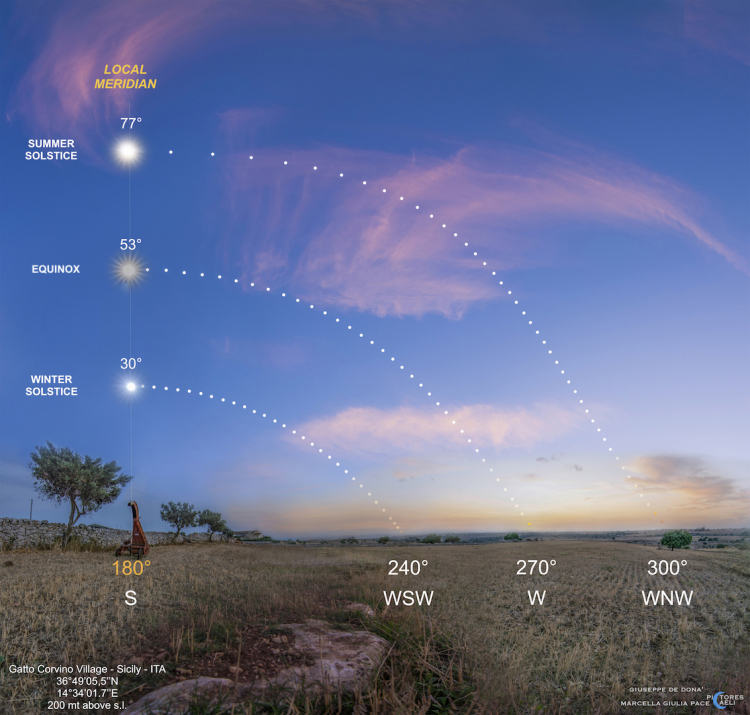
Three curved, dotted sun tracks across the sky from various heights above the horizon down to the horizon. Northernmost sunset is on June solstice.
The path of the sun across our sky – from about noon to sunset – on 3 different days of the year, an equinox and the summer and winter solstices. The June solstice is the Northern Hemisphere’s summer solstice. Notice the northernmost sunset on this day. Marcella Giulia Pace made these observations from Gatto Corvino village, Sicily, Italy. Used with permission.

The 2026 June solstice falls at 8:25 UTC on June 21. That’s 3:25 a.m. CDT.

Northern Hemisphere summer

The June solstice marks the year’s northernmost sunset and sunrise. It brings the year’s longest period of daylight to the Northern Hemisphere (and shortest period of daylight in the Southern Hemisphere). North of the Arctic Circle, the sun neither rises nor sets but stays above the horizon continuously around the clock.

In the Northern Hemisphere, noontime shadows are shortest at this solstice. It’s the year’s highest sun, as seen from the Tropic of Cancer and all places north.

For us in the Northern Hemisphere, the June solstice signals the beginning of summer. For the Southern Hemisphere, winter starts at this solstice.

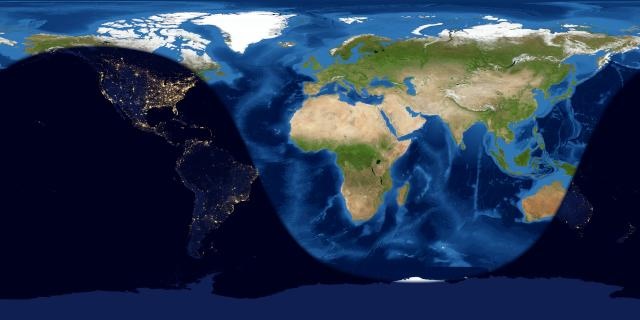
The solstice is a whole-Earth event. It happens at the same instant for all of us – the instant the sun reaches its northernmost point in our sky. But our clocks say different times.

Rolled-out map of Earth with night and day sides visible.
Day and night sides of Earth at the instant of the June 2026 solstice (June 21 at 8:25 UTC). Map via Fourmilab. Used with permission.

Southern Hemisphere winter

Earth’s orbit around the sun – and tilt on its axis – have brought us to a place in space where our world’s Northern Hemisphere has its time of greatest daylight: its longest day and shortest night. Meanwhile, the June solstice and northernmost sun brings the shortest day and longest night south of the equator.

This solstice marks the beginning of Southern Hemisphere winter.

It marks the lowest sun and longest noontime shadow for those on the southern part of Earth’s globe.

South of the Antarctic Circle, the sun neither rises nor sets but stays beneath the horizon for 24 hours.

Composite of 11 photos with sun just above a low mountain showing positions of the sun at dawn on 11 dates.
View at EarthSky Community Photos. | Sunrises between a June and December solstice. If you are standing facing east, the sun – from day to day, and week to week – moves progressively to the right (south) between these 2 solstices. Rupesh Sangoi captured separate images of the sunrise showing the sun’s movement along the horizon between a June and December solstice. Rupesh wrote: “Did this for over a year, at sunrise.” Glorious composite, Rupesh! Thank you.

Northernmost sunset, but not latest sunset

The sun sets farthest north on the day of the solstice, bringing the longest day for the Northern Hemisphere. But this summer solstice doesn’t bring the latest sunset. And it doesn’t bring the earliest sunrise. The exact dates vary with latitude, but the sequence is always the same: earliest sunrise before the summer solstice, longest day on the summer solstice, latest sunset after the summer solstice.

For the Southern Hemisphere, where it’s winter now, the latest sunrise – and earliest sunrise – don’t come on the day of the solstice either. Again, the exact dates vary with latitude. But the sequence is always the same: earliest sunset before the winter solstice, shortest day on the winter solstice, latest sunrise after the winter solstice.

12 panoramic images of the same landscape with the sun in different points of the sky. It creates the shape of an S.
View at EarthSky Community Photos. | Wael Omar shared this stunning composite image illustrating the change in the sunset’s position during 12 months in Cairo, Egypt. Thank you, Omar!

Each solstice marks a turning of the year

Even as this northern summer begins with the solstice, throughout the world the solstice also represents a “turning” of the year.

In fact, to many cultures, the solstice can mean a limit or a culmination of something. From around the world, the sun is now setting and rising as far north as it ever does. The solstice marks when the sun reaches its northernmost point for the year.

Then after the June solstice, the sun will begin its subtle shift southward on the sky’s dome again. Thus even in summer’s beginning, we find the seeds of summer’s end.

Read more: All you need to know about the June 2026 solstice

Rocky shoreline, a yellow-white glowing sun above large pointy rock against orange sky.
View larger. | Nikolaos Pantazis wrote: “Every year, on the days around summer solstice, the setting sun aligns with that rock near the village of Platanos, Peloponnese, Greece.” Thank you, Nikolaos!

Bottom line: The northernmost sunset (and sunrise) happen at the June solstice. Here’s some quick info that’ll help you connect with nature on this special day.

Help support EarthSky! Check out the EarthSky store for fun astronomy gifts and tools for all ages!

The post The northernmost sunset is on the June solstice, today! first appeared on EarthSky.


from EarthSky https://ift.tt/wVFoIC0
Three curved, dotted sun tracks across the sky from various heights above the horizon down to the horizon. Northernmost sunset is on June solstice.
The path of the sun across our sky – from about noon to sunset – on 3 different days of the year, an equinox and the summer and winter solstices. The June solstice is the Northern Hemisphere’s summer solstice. Notice the northernmost sunset on this day. Marcella Giulia Pace made these observations from Gatto Corvino village, Sicily, Italy. Used with permission.

The 2026 June solstice falls at 8:25 UTC on June 21. That’s 3:25 a.m. CDT.

Northern Hemisphere summer

The June solstice marks the year’s northernmost sunset and sunrise. It brings the year’s longest period of daylight to the Northern Hemisphere (and shortest period of daylight in the Southern Hemisphere). North of the Arctic Circle, the sun neither rises nor sets but stays above the horizon continuously around the clock.

In the Northern Hemisphere, noontime shadows are shortest at this solstice. It’s the year’s highest sun, as seen from the Tropic of Cancer and all places north.

For us in the Northern Hemisphere, the June solstice signals the beginning of summer. For the Southern Hemisphere, winter starts at this solstice.

The solstice is a whole-Earth event. It happens at the same instant for all of us – the instant the sun reaches its northernmost point in our sky. But our clocks say different times.

Rolled-out map of Earth with night and day sides visible.
Day and night sides of Earth at the instant of the June 2026 solstice (June 21 at 8:25 UTC). Map via Fourmilab. Used with permission.

Southern Hemisphere winter

Earth’s orbit around the sun – and tilt on its axis – have brought us to a place in space where our world’s Northern Hemisphere has its time of greatest daylight: its longest day and shortest night. Meanwhile, the June solstice and northernmost sun brings the shortest day and longest night south of the equator.

This solstice marks the beginning of Southern Hemisphere winter.

It marks the lowest sun and longest noontime shadow for those on the southern part of Earth’s globe.

South of the Antarctic Circle, the sun neither rises nor sets but stays beneath the horizon for 24 hours.

Composite of 11 photos with sun just above a low mountain showing positions of the sun at dawn on 11 dates.
View at EarthSky Community Photos. | Sunrises between a June and December solstice. If you are standing facing east, the sun – from day to day, and week to week – moves progressively to the right (south) between these 2 solstices. Rupesh Sangoi captured separate images of the sunrise showing the sun’s movement along the horizon between a June and December solstice. Rupesh wrote: “Did this for over a year, at sunrise.” Glorious composite, Rupesh! Thank you.

Northernmost sunset, but not latest sunset

The sun sets farthest north on the day of the solstice, bringing the longest day for the Northern Hemisphere. But this summer solstice doesn’t bring the latest sunset. And it doesn’t bring the earliest sunrise. The exact dates vary with latitude, but the sequence is always the same: earliest sunrise before the summer solstice, longest day on the summer solstice, latest sunset after the summer solstice.

For the Southern Hemisphere, where it’s winter now, the latest sunrise – and earliest sunrise – don’t come on the day of the solstice either. Again, the exact dates vary with latitude. But the sequence is always the same: earliest sunset before the winter solstice, shortest day on the winter solstice, latest sunrise after the winter solstice.

12 panoramic images of the same landscape with the sun in different points of the sky. It creates the shape of an S.
View at EarthSky Community Photos. | Wael Omar shared this stunning composite image illustrating the change in the sunset’s position during 12 months in Cairo, Egypt. Thank you, Omar!

Each solstice marks a turning of the year

Even as this northern summer begins with the solstice, throughout the world the solstice also represents a “turning” of the year.

In fact, to many cultures, the solstice can mean a limit or a culmination of something. From around the world, the sun is now setting and rising as far north as it ever does. The solstice marks when the sun reaches its northernmost point for the year.

Then after the June solstice, the sun will begin its subtle shift southward on the sky’s dome again. Thus even in summer’s beginning, we find the seeds of summer’s end.

Read more: All you need to know about the June 2026 solstice

Rocky shoreline, a yellow-white glowing sun above large pointy rock against orange sky.
View larger. | Nikolaos Pantazis wrote: “Every year, on the days around summer solstice, the setting sun aligns with that rock near the village of Platanos, Peloponnese, Greece.” Thank you, Nikolaos!

Bottom line: The northernmost sunset (and sunrise) happen at the June solstice. Here’s some quick info that’ll help you connect with nature on this special day.

Help support EarthSky! Check out the EarthSky store for fun astronomy gifts and tools for all ages!

The post The northernmost sunset is on the June solstice, today! first appeared on EarthSky.


from EarthSky https://ift.tt/wVFoIC0

34 dust devils on Mars in 1 shot! Can you spot them all?

Orange terrain with some small round spots on it.
View larger/ full image. | This cropped view shows a few of the 34 dust devils captured in a single image of the Martian surface. The Mars Express orbiter captured the full view on December 7, 2024, and ESA shared it on June 17, 2026. To see all 34 dust devils, click through to this zoomable image from ESA. How many can you spot? Image via ESA/DLR/FU Berlin.

Science news, night sky events and beautiful photos, all in one place. Click here to subscribe to EarthSky’s free daily newsletter.

34 dust devils on Mars in 1 shot!

Mars is famous for its tornado-like whirlwinds, made of the dusty debris coating its surface. These are dust devils. They form the same way on Mars as they do on Earth: as the sun warms the ground, the ground then heats the thin layer of air above. Then that air rises quickly through the cooler, dense air above, spiraling around a small area of low pressure.

On June 17, 2026, ESA shared an image from its Mars Express orbiter of 34 dust devils it captured on the red planet’s surface back on December 7, 2024. Can you spot all the dust devils in the image above?

Look closely. This region of Mars is in a valley system known as Mamers Valles. It holds ridges and plateau-like areas along with many small craters. Although the dust devils may look tiny – as a small light-colored dot with a shadow – in reality, dust devils on Mars can grow even larger than those on Earth. Martian dust devils can tower up to 5 miles (8 km) high and span hundreds of yards wide.

The location of the dust devils is in the image at the bottom of this post.

Then check out the original here. The largest version shows a whopping 34 dust devils!

Looking down at an orangish-brown landscape with ridges, small craters and tiny white nubs.
View larger. | There are 34 dust devils on Mars in this 1 image. How many can you spot? A key is below. The Mars Express orbiter captured this view of Mars on December 7, 2024, and ESA shared it on June 17, 2026. Image via ESA/DLR/FU Berlin.

More on Mamers Valles

Mamers Valles lies in Mars’ northern hemisphere. It consists of of valleys and canyons, some of which stretch for more than 600 miles (1,000 km). The higher areas are mesas, cliffs and some debris-covered glaciers. The glaciers lie at the base of the steep slopes. The terrain shows evidence that it was carved by flowing materials, such as water, ice and lava, sometime in its past.

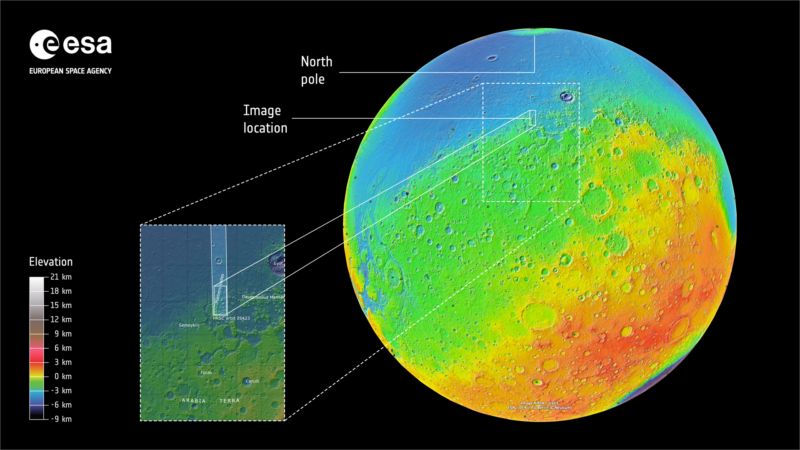
A rainbow-hued planet with lots of craters on the bottom and smoother near the top with an inset there.
Mamers Valles is a large valley in Mars’ northern hemisphere. This false-color view shows the location of the dust-devil-filled image above, which ESA released on June 17, 2026. Image via NASA/USGS; ESA/DLR/FU Berlin.

Answer key for the dust devils

Reddish terrain viewed from above with 34 white circles, some overlapping.
The white circles mark the locations of the 34 dust devils on Mars that the Mars Express orbiter spotted. Image via ESA/DLR/FU Berlin.

Bottom line: The Mars Express orbiter caught this view of the red planet, which is peppered with whirlwinds. Can you spot 34 dust devils in this one shot of Mars?

Via ESA

The post 34 dust devils on Mars in 1 shot! Can you spot them all? first appeared on EarthSky.


from EarthSky https://ift.tt/dfI8XEl

Orange terrain with some small round spots on it.
View larger/ full image. | This cropped view shows a few of the 34 dust devils captured in a single image of the Martian surface. The Mars Express orbiter captured the full view on December 7, 2024, and ESA shared it on June 17, 2026. To see all 34 dust devils, click through to this zoomable image from ESA. How many can you spot? Image via ESA/DLR/FU Berlin.

Science news, night sky events and beautiful photos, all in one place. Click here to subscribe to EarthSky’s free daily newsletter.

34 dust devils on Mars in 1 shot!

Mars is famous for its tornado-like whirlwinds, made of the dusty debris coating its surface. These are dust devils. They form the same way on Mars as they do on Earth: as the sun warms the ground, the ground then heats the thin layer of air above. Then that air rises quickly through the cooler, dense air above, spiraling around a small area of low pressure.

On June 17, 2026, ESA shared an image from its Mars Express orbiter of 34 dust devils it captured on the red planet’s surface back on December 7, 2024. Can you spot all the dust devils in the image above?

Look closely. This region of Mars is in a valley system known as Mamers Valles. It holds ridges and plateau-like areas along with many small craters. Although the dust devils may look tiny – as a small light-colored dot with a shadow – in reality, dust devils on Mars can grow even larger than those on Earth. Martian dust devils can tower up to 5 miles (8 km) high and span hundreds of yards wide.

The location of the dust devils is in the image at the bottom of this post.

Then check out the original here. The largest version shows a whopping 34 dust devils!

Looking down at an orangish-brown landscape with ridges, small craters and tiny white nubs.
View larger. | There are 34 dust devils on Mars in this 1 image. How many can you spot? A key is below. The Mars Express orbiter captured this view of Mars on December 7, 2024, and ESA shared it on June 17, 2026. Image via ESA/DLR/FU Berlin.

More on Mamers Valles

Mamers Valles lies in Mars’ northern hemisphere. It consists of of valleys and canyons, some of which stretch for more than 600 miles (1,000 km). The higher areas are mesas, cliffs and some debris-covered glaciers. The glaciers lie at the base of the steep slopes. The terrain shows evidence that it was carved by flowing materials, such as water, ice and lava, sometime in its past.

A rainbow-hued planet with lots of craters on the bottom and smoother near the top with an inset there.
Mamers Valles is a large valley in Mars’ northern hemisphere. This false-color view shows the location of the dust-devil-filled image above, which ESA released on June 17, 2026. Image via NASA/USGS; ESA/DLR/FU Berlin.

Answer key for the dust devils

Reddish terrain viewed from above with 34 white circles, some overlapping.
The white circles mark the locations of the 34 dust devils on Mars that the Mars Express orbiter spotted. Image via ESA/DLR/FU Berlin.

Bottom line: The Mars Express orbiter caught this view of the red planet, which is peppered with whirlwinds. Can you spot 34 dust devils in this one shot of Mars?

Via ESA

The post 34 dust devils on Mars in 1 shot! Can you spot them all? first appeared on EarthSky.


from EarthSky https://ift.tt/dfI8XEl

For all of Earth, longest sunsets around the solstice

Longest sunsets: Sunset at the beach with dramatic colors and a toddler silhouette to the side.
View at EarthSky Community Photos. | Christy Mandeville in Indian Shores, Florida, captured this dramatic sunset on a June evening in 2022. Christy wrote: “The little boy in the photo kept running around me as I was trying to capture the perfect sunset photo. After I went through the hundreds of photos I captured, I had no idea that he was in any of them! This one stood out.” Thank you, Christy! Read below why the longest sunsets happen around the solstices.

In 2026, the Northern Hemisphere’s summer solstice – and Southern Hemisphere’s winter solstice – falls on June 21, 2026, at 8:25 UTC (that is 3:25 a.m. in central North America; translate UTC to your time). Read more about the June solstice.

Science news, night sky events and beautiful photos, all in one place. Click here to subscribe to EarthSky’s free daily newsletter.

Longest sunsets in June and December

Here’s a natural phenomenon you might not have imagined: the longest sunsets happen around the time of the solstices. That is, it takes more seconds for the body of the sun to sink below your western horizon around the solstices, and fewer seconds around the equinoxes. It’s true whether you live in Earth’s Northern or Southern Hemisphere.

As viewed from both the Northern and Southern Hemispheres, the sun rises and sets farthest north at the June solstice and farthest south at the December solstice.

Now consider that the farther the sun sets from due west along the horizon, the shallower the angle of the setting sun. That means a longer duration for sunset at the solstices.

Meanwhile, at an equinox, the sun rises due east and sets due west. That means on the day of an equinox, the setting sun hits the horizon at its steepest possible angle.

Longest sunsets are how long?

The sunset duration varies by latitude. But let’s just consider one latitude: 40 degrees north, which is the latitude of Denver or Philadelphia in the United States, Sardinia in the Mediterranean, or Beijing in China.

At that latitude, on the day of a solstice, the sun sets in about 3 minutes and 15 seconds.

That’s half a minute longer than the sunset at the same latitude on the day of an equinox. The equinox sun at 40 degrees north latitude sets in roughly 2 minutes and 45 seconds.

At more northerly temperate latitudes, the sunset duration is greater; and at latitudes closer to the equator, the sunset duration is less. Near the Arctic Circle (65 degrees north latitude), the duration of a solstice sunset lasts about 15 minutes. At the equator (0 degrees latitude), the solstice sun takes a little over 2 minutes and 15 seconds to set.

Regardless of latitude, however, the duration of sunset is always longest at or near the solstices.

The sunsets are longer in December than June

As it turns out, the sunset and sunrise are a tad longer on the December solstice than they are on the June solstice.

That’s because the sun is closer to Earth in December than it is in June. Therefore, the sun’s disk looms a bit larger in our sky in December, and so it takes slightly longer to set.

Additionally, the closer December sun moves eastward upon the ecliptic at a faster clip, helping to slow down the December solstice sunset (and sunrise) even more. For instance, at 50 degrees north latitude, the winter solstice sunset (sunrise) lasts about 4 minutes and 18 seconds, or about 8 seconds longer than the sunset (sunrise) on the summer solstice.

And now you know!

Four photos of half-lit Earth, left two at a slant and right two straight up and down.
Equinoxes and solstices, via Geosync. The Earth’s axis points straight up and down, with north at the top. The solstices are on the left (December solstice at top, June solstice at bottom) and the equinoxes are to the right (March equinox at top, September equinox at bottom). Image via NASA.

Some sunsets from EarthSky Community Photos

Sunsets over the ocean with a bird in the crimson sky.
View at EarthSky Community Photos. | Cecille Kennedy captured this sunset on May 11, 2026, from Oregon and wrote: “The sun is sinking into the ocean horizon and if you look close there’s a thin line of neon green on its top rim (precursor to the green flash though the flash didn’t happen). A brown pelican on the right is flying south. Typically they are seen flying north this time of year but sometimes they are seen flying south for a brief stop at their favorite designated spots then proceed to fly north.” Thank you, Cecille!
A large, yellow, setting sun with a green flash on its upper edge.
View at EarthSky Community Photos. | Jelieta Walinski at Kitt Peak National Observatory near Tucson, Arizona, captured this solstice sunset on June 20, 2025. Jelieta wrote: “On the summer solstice, my husband and I ventured to Kitt Peak National Observatory, 6,000 feet above sea level, to witness the sun’s majesty. After scouting the perfect location, I was thrilled to capture the sun’s splendor with a unique twist — the elusive green flash!” Thank you, Jelieta!

Bottom line: Here’s a natural phenomenon you might never have imagined: the longest sunsets happen around the time of a solstice.

Help support EarthSky! Visit the EarthSky store for to see the great selection of educational tools and team gear we have to offer.

The post For all of Earth, longest sunsets around the solstice first appeared on EarthSky.


from EarthSky https://ift.tt/aBPsNrM
Longest sunsets: Sunset at the beach with dramatic colors and a toddler silhouette to the side.
View at EarthSky Community Photos. | Christy Mandeville in Indian Shores, Florida, captured this dramatic sunset on a June evening in 2022. Christy wrote: “The little boy in the photo kept running around me as I was trying to capture the perfect sunset photo. After I went through the hundreds of photos I captured, I had no idea that he was in any of them! This one stood out.” Thank you, Christy! Read below why the longest sunsets happen around the solstices.

In 2026, the Northern Hemisphere’s summer solstice – and Southern Hemisphere’s winter solstice – falls on June 21, 2026, at 8:25 UTC (that is 3:25 a.m. in central North America; translate UTC to your time). Read more about the June solstice.

Science news, night sky events and beautiful photos, all in one place. Click here to subscribe to EarthSky’s free daily newsletter.

Longest sunsets in June and December

Here’s a natural phenomenon you might not have imagined: the longest sunsets happen around the time of the solstices. That is, it takes more seconds for the body of the sun to sink below your western horizon around the solstices, and fewer seconds around the equinoxes. It’s true whether you live in Earth’s Northern or Southern Hemisphere.

As viewed from both the Northern and Southern Hemispheres, the sun rises and sets farthest north at the June solstice and farthest south at the December solstice.

Now consider that the farther the sun sets from due west along the horizon, the shallower the angle of the setting sun. That means a longer duration for sunset at the solstices.

Meanwhile, at an equinox, the sun rises due east and sets due west. That means on the day of an equinox, the setting sun hits the horizon at its steepest possible angle.

Longest sunsets are how long?

The sunset duration varies by latitude. But let’s just consider one latitude: 40 degrees north, which is the latitude of Denver or Philadelphia in the United States, Sardinia in the Mediterranean, or Beijing in China.

At that latitude, on the day of a solstice, the sun sets in about 3 minutes and 15 seconds.

That’s half a minute longer than the sunset at the same latitude on the day of an equinox. The equinox sun at 40 degrees north latitude sets in roughly 2 minutes and 45 seconds.

At more northerly temperate latitudes, the sunset duration is greater; and at latitudes closer to the equator, the sunset duration is less. Near the Arctic Circle (65 degrees north latitude), the duration of a solstice sunset lasts about 15 minutes. At the equator (0 degrees latitude), the solstice sun takes a little over 2 minutes and 15 seconds to set.

Regardless of latitude, however, the duration of sunset is always longest at or near the solstices.

The sunsets are longer in December than June

As it turns out, the sunset and sunrise are a tad longer on the December solstice than they are on the June solstice.

That’s because the sun is closer to Earth in December than it is in June. Therefore, the sun’s disk looms a bit larger in our sky in December, and so it takes slightly longer to set.

Additionally, the closer December sun moves eastward upon the ecliptic at a faster clip, helping to slow down the December solstice sunset (and sunrise) even more. For instance, at 50 degrees north latitude, the winter solstice sunset (sunrise) lasts about 4 minutes and 18 seconds, or about 8 seconds longer than the sunset (sunrise) on the summer solstice.

And now you know!

Four photos of half-lit Earth, left two at a slant and right two straight up and down.
Equinoxes and solstices, via Geosync. The Earth’s axis points straight up and down, with north at the top. The solstices are on the left (December solstice at top, June solstice at bottom) and the equinoxes are to the right (March equinox at top, September equinox at bottom). Image via NASA.

Some sunsets from EarthSky Community Photos

Sunsets over the ocean with a bird in the crimson sky.
View at EarthSky Community Photos. | Cecille Kennedy captured this sunset on May 11, 2026, from Oregon and wrote: “The sun is sinking into the ocean horizon and if you look close there’s a thin line of neon green on its top rim (precursor to the green flash though the flash didn’t happen). A brown pelican on the right is flying south. Typically they are seen flying north this time of year but sometimes they are seen flying south for a brief stop at their favorite designated spots then proceed to fly north.” Thank you, Cecille!
A large, yellow, setting sun with a green flash on its upper edge.
View at EarthSky Community Photos. | Jelieta Walinski at Kitt Peak National Observatory near Tucson, Arizona, captured this solstice sunset on June 20, 2025. Jelieta wrote: “On the summer solstice, my husband and I ventured to Kitt Peak National Observatory, 6,000 feet above sea level, to witness the sun’s majesty. After scouting the perfect location, I was thrilled to capture the sun’s splendor with a unique twist — the elusive green flash!” Thank you, Jelieta!

Bottom line: Here’s a natural phenomenon you might never have imagined: the longest sunsets happen around the time of a solstice.

Help support EarthSky! Visit the EarthSky store for to see the great selection of educational tools and team gear we have to offer.

The post For all of Earth, longest sunsets around the solstice first appeared on EarthSky.


from EarthSky https://ift.tt/aBPsNrM

adds 2