
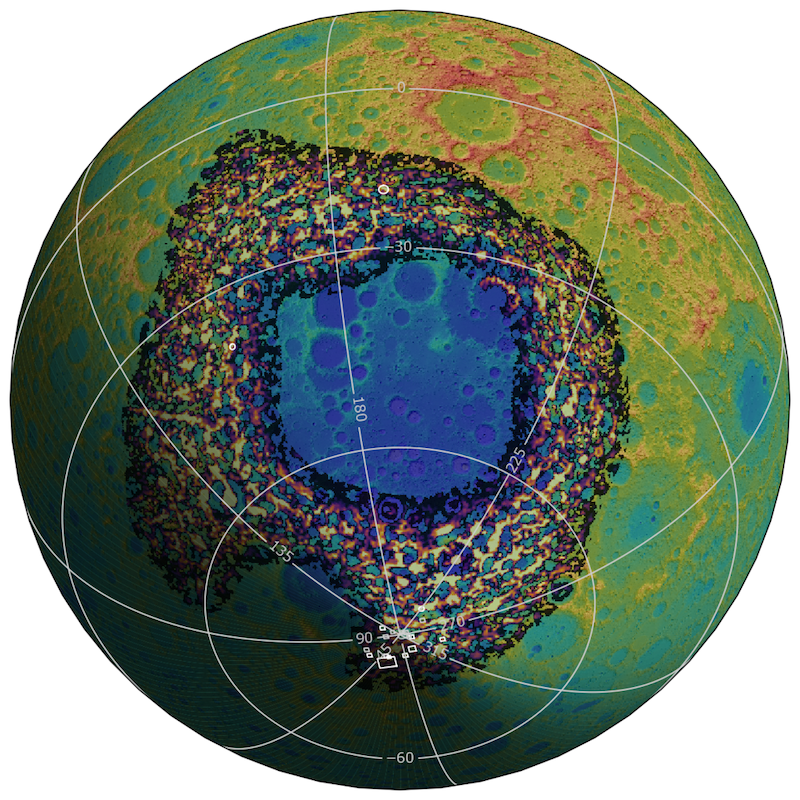
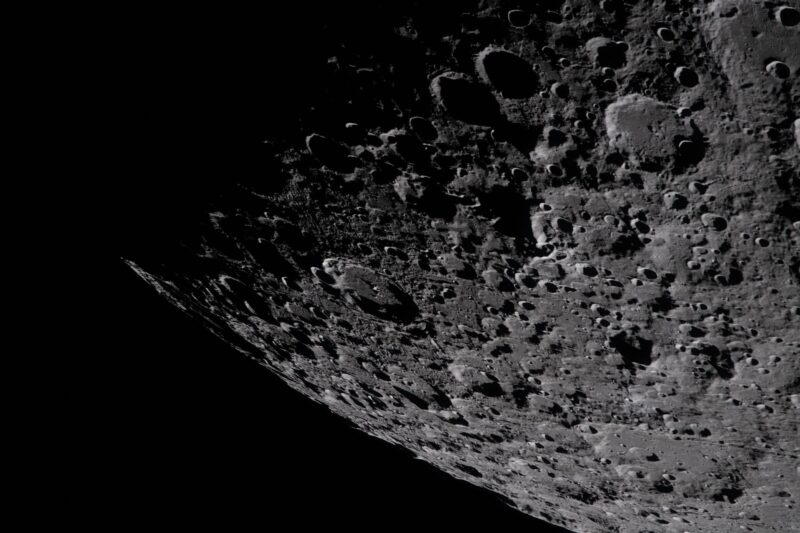
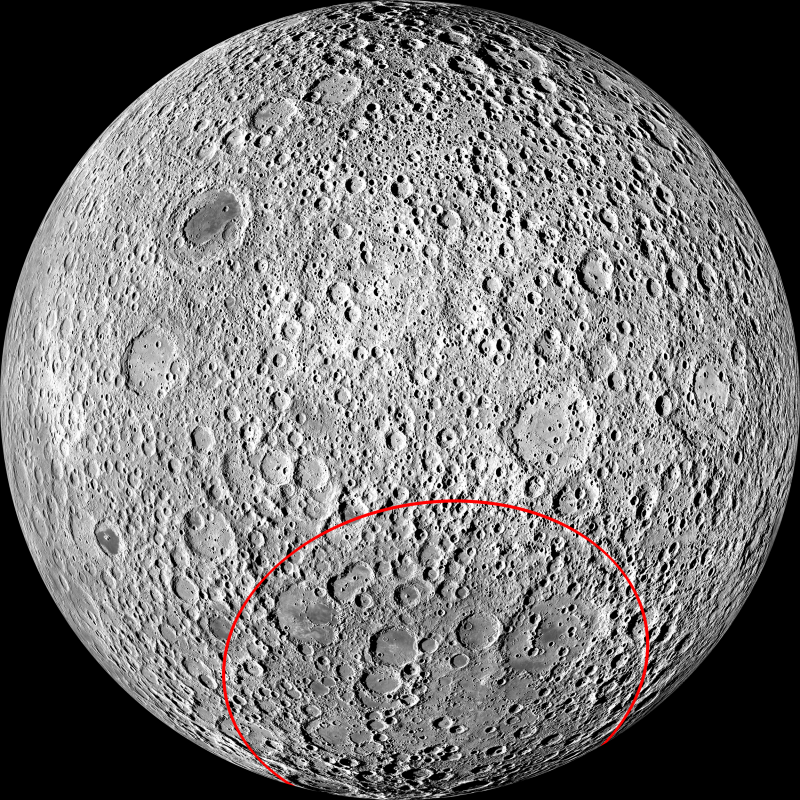
- The South Pole-Aitken basin is the largest impact basin on the moon. It’s on the moon’s far side. How did it form?
- Two new studies show that the asteroid that struck the moon, forming the basin, came from the north at a low angle. Rocks from both the lunar crust and mantle were ejected onto the surface.
- Future Artemis astronauts will land in and around the South Pole-Aitken region. The new studies help show what the astronauts can expect to find.
The South Pole–Aitken basin region is a future landing site
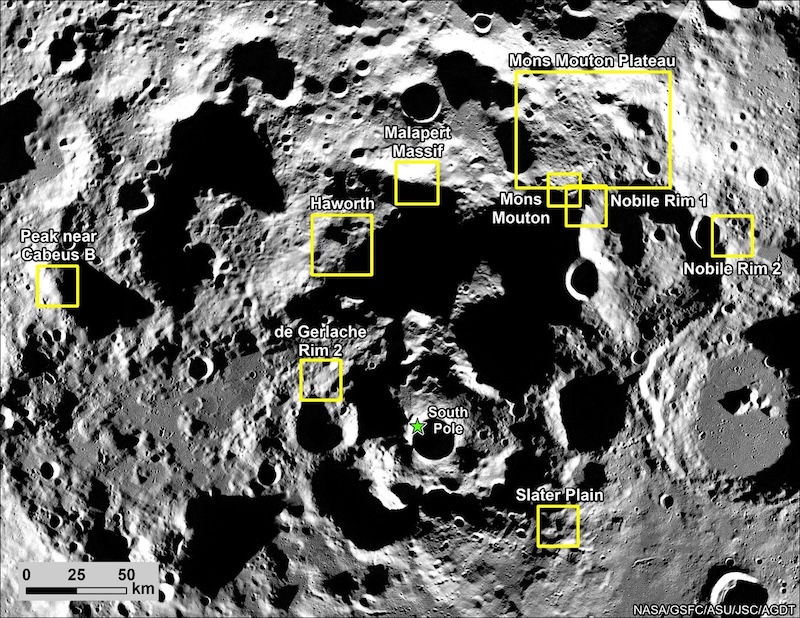
When Artemis astronauts return to the moon in the near future, they’ll land near the lunar south pole. Of the nine possible landing sites, some are within the South Pole-Aitken basin. Others are on or near the rim of the basin, while still others are just outside of it.
For example, the sites Nobile Rim 1, Nobile Rim 2 and Haworth are within the basin (see map below). Malapert Massif is near the basin’s rim. And de Gerlache Rim 2 is outside of the basin. Note that the basin’s boundary is rather obscure and not sharply delineated. So it’s not always clear which proposed landing sites are, technically, within the basin.
Now researchers have published two new peer-reviewed papers about the South Pole-Aitken basin. One is in Science Advances (May 6, 2026). And the other is in JGR Planets (April 23, 2026).
Water ice and sunlight
Here are two reasons this region was chosen for the astronauts: water ice and sunlight. The landing sites closest to the moon’s south pole offer access to water ice, which the astronauts will need as a primary resource. The sites also experience long periods of sunlight.
This giant moon basin is the moon’s oldest and largest impact crater, on the far side of the moon. But how much do we really know about this region? On June 15, 2026, researchers at the Southwest Research Institute (SwRI) in California, said that they have found new details about the South Pole-Aitken basin.
Since it is one of the oldest structures on the moon, the basin provides clues about the early solar system.
William Bottke is the director of the Center for Lunar Origin and Evolution (CLOE) and executive director of SwRI’s Science Directorate in Boulder, Colorado. He is also a co-author of both of the new studies. He said:
The basin offers scientists a rare opportunity to study the moon’s earliest history. The collision struck the lunar surface with such force that it may have excavated material from deep inside the moon, including portions of the lunar mantle [the region just below the moon’s thin crust].
Recreating the impact
To find out more about the future landing location for the Artemis astronauts, the researchers used advanced computer simulations and computer models. They recreated the impact that formed the basin. They found that the impacting asteroid came from the north and hit the moon’s surface at a low angle. That’s why the basin is more elongated in shape than round. (However, scientists said in 2024 that it’s actually slightly rounder than first thought). Shigeru Wakita at Purdue University, lead author of the South-Pole Aitken basin impact study, said:
Our simulation produces the right shape and nature of the impact basin. It also tells us about the projectile that created it and the direction of the impact.
Notably, the analysis suggests that the object that impacted was not just a simple asteroid. The impacting object must have been more complex, with an inner core surrounded by rock. The object’s interior appears to have been differentiated, separated into distinct compositional layers, more like a small protoplanet than a plain rock. Protoplanets are like “baby planets,” smaller objects forming from the accumulation of material in the early solar system. Many would eventually grow to become actual planets, like our own Earth.
When the impactor hit the moon, it created a deep, uneven cavity. The rock in the middle of the basin melted, and material from both the moon’s mantle and crust were thrown out into space.
Ejecta in the basin
The researchers also wanted to know how the ejecta from the impact was distributed in and around the basin. To do this, they compared high-resolution gravity data with models that include both crustal and mantle material. The result was that the basin likely contains a substantial amount of rock from the moon’s mantle. Those rocks are also mixed into the ejecta blanket – the rocky debris – surrounding the basin.
Also, there were smaller secondary impacts that brought some of those rocks to the surface. That is treasure for the future Artemis astronauts who will land there. Gabriel Gowman at the University of Arizona, lead author of the gravity-based study, said:
The precise distribution of mantle material has been a big unknown. Our models indicate that the [South-Pole Aitken basin] impact ejected enough deep material to form a significant deposit that should still be accessible today. Most importantly, some of that material at a trace level may exist in regions being considered for the Artemis landings.


Lots of mantle ejecta for astronauts to explore
Scientists had thought that the deepest part of the ejecta might be far away from the proposed landing sites in the area. But the new studies show this might not be the case. Some of the deposits could extend closer to the south polar region, including the landing sites. That’s good news for the astronauts being able to sample some of those deposits.
In 2019, scientists said they found evidence for an unusually dense mass beneath the South Pole-Aitken basin. The metallic rock is five times larger than the Big Island of Hawaii.
On June 25, 2024, the Chinese Chang’e 6 lunar probe landed in the Apollo basin, a region within the South Pole-Aitken basin. It returned samples to Earth 53 days later.
Bottom line: Two new studies examine the South Pole-Aitken basin on the moon. This region is a future landing site for Artemis astronauts.
Source: Gravity Mapping of Lunar Mantle Material in South Pole-Aitken Basin Ejecta
Read more: Moon’s largest crater is rounder than 1st thought
Read more: What is the mystery mass on the moon?
The post Artemis missions target South Pole–Aitken basin on the moon first appeared on EarthSky.
from EarthSky https://ift.tt/AnGspkK
- The South Pole-Aitken basin is the largest impact basin on the moon. It’s on the moon’s far side. How did it form?
- Two new studies show that the asteroid that struck the moon, forming the basin, came from the north at a low angle. Rocks from both the lunar crust and mantle were ejected onto the surface.
- Future Artemis astronauts will land in and around the South Pole-Aitken region. The new studies help show what the astronauts can expect to find.
The South Pole–Aitken basin region is a future landing site
When Artemis astronauts return to the moon in the near future, they’ll land near the lunar south pole. Of the nine possible landing sites, some are within the South Pole-Aitken basin. Others are on or near the rim of the basin, while still others are just outside of it.
For example, the sites Nobile Rim 1, Nobile Rim 2 and Haworth are within the basin (see map below). Malapert Massif is near the basin’s rim. And de Gerlache Rim 2 is outside of the basin. Note that the basin’s boundary is rather obscure and not sharply delineated. So it’s not always clear which proposed landing sites are, technically, within the basin.
Now researchers have published two new peer-reviewed papers about the South Pole-Aitken basin. One is in Science Advances (May 6, 2026). And the other is in JGR Planets (April 23, 2026).
Water ice and sunlight
Here are two reasons this region was chosen for the astronauts: water ice and sunlight. The landing sites closest to the moon’s south pole offer access to water ice, which the astronauts will need as a primary resource. The sites also experience long periods of sunlight.
This giant moon basin is the moon’s oldest and largest impact crater, on the far side of the moon. But how much do we really know about this region? On June 15, 2026, researchers at the Southwest Research Institute (SwRI) in California, said that they have found new details about the South Pole-Aitken basin.
Since it is one of the oldest structures on the moon, the basin provides clues about the early solar system.
William Bottke is the director of the Center for Lunar Origin and Evolution (CLOE) and executive director of SwRI’s Science Directorate in Boulder, Colorado. He is also a co-author of both of the new studies. He said:
The basin offers scientists a rare opportunity to study the moon’s earliest history. The collision struck the lunar surface with such force that it may have excavated material from deep inside the moon, including portions of the lunar mantle [the region just below the moon’s thin crust].
Recreating the impact
To find out more about the future landing location for the Artemis astronauts, the researchers used advanced computer simulations and computer models. They recreated the impact that formed the basin. They found that the impacting asteroid came from the north and hit the moon’s surface at a low angle. That’s why the basin is more elongated in shape than round. (However, scientists said in 2024 that it’s actually slightly rounder than first thought). Shigeru Wakita at Purdue University, lead author of the South-Pole Aitken basin impact study, said:
Our simulation produces the right shape and nature of the impact basin. It also tells us about the projectile that created it and the direction of the impact.
Notably, the analysis suggests that the object that impacted was not just a simple asteroid. The impacting object must have been more complex, with an inner core surrounded by rock. The object’s interior appears to have been differentiated, separated into distinct compositional layers, more like a small protoplanet than a plain rock. Protoplanets are like “baby planets,” smaller objects forming from the accumulation of material in the early solar system. Many would eventually grow to become actual planets, like our own Earth.
When the impactor hit the moon, it created a deep, uneven cavity. The rock in the middle of the basin melted, and material from both the moon’s mantle and crust were thrown out into space.
Ejecta in the basin
The researchers also wanted to know how the ejecta from the impact was distributed in and around the basin. To do this, they compared high-resolution gravity data with models that include both crustal and mantle material. The result was that the basin likely contains a substantial amount of rock from the moon’s mantle. Those rocks are also mixed into the ejecta blanket – the rocky debris – surrounding the basin.
Also, there were smaller secondary impacts that brought some of those rocks to the surface. That is treasure for the future Artemis astronauts who will land there. Gabriel Gowman at the University of Arizona, lead author of the gravity-based study, said:
The precise distribution of mantle material has been a big unknown. Our models indicate that the [South-Pole Aitken basin] impact ejected enough deep material to form a significant deposit that should still be accessible today. Most importantly, some of that material at a trace level may exist in regions being considered for the Artemis landings.
Lots of mantle ejecta for astronauts to explore
Scientists had thought that the deepest part of the ejecta might be far away from the proposed landing sites in the area. But the new studies show this might not be the case. Some of the deposits could extend closer to the south polar region, including the landing sites. That’s good news for the astronauts being able to sample some of those deposits.
In 2019, scientists said they found evidence for an unusually dense mass beneath the South Pole-Aitken basin. The metallic rock is five times larger than the Big Island of Hawaii.
On June 25, 2024, the Chinese Chang’e 6 lunar probe landed in the Apollo basin, a region within the South Pole-Aitken basin. It returned samples to Earth 53 days later.
Bottom line: Two new studies examine the South Pole-Aitken basin on the moon. This region is a future landing site for Artemis astronauts.
Source: Gravity Mapping of Lunar Mantle Material in South Pole-Aitken Basin Ejecta
Read more: Moon’s largest crater is rounder than 1st thought
Read more: What is the mystery mass on the moon?
The post Artemis missions target South Pole–Aitken basin on the moon first appeared on EarthSky.
from EarthSky https://ift.tt/AnGspkK

Aucun commentaire:
Enregistrer un commentaire