aads

Asteroid or comet? Meteor or meteorite?

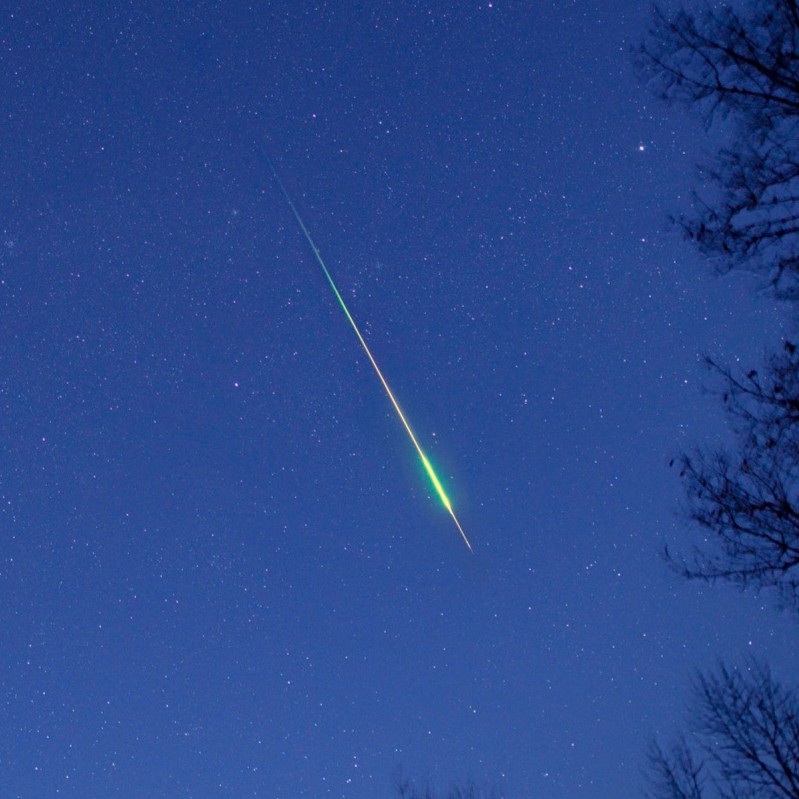
Asteroid or comet: A view of the sky with a bright greenish streak that is fatter near the bottom.
View at EarthSky Community Photos. | James Reynolds in Leicester, North Carolina, caught this Leonid meteor on November 17, 2020. Thanks, James! Okay, so a stream in your night sky is a meteor. But did it originate in an asteroid or comet?
  • “Asteroids” are rocky or metallic bodies, mostly orbiting in the asteroid belt between Mars and Jupiter.
  • “Comets” are icy, dusty objects that originated in the freezing outer solar system. When they come near the sun, they might develop a long tail.
  • A “meteor” is a fiery streak of space debris in Earth’s sky. Meteors might originate as icy debris left behind by comets. Or they might be small rocky or metallic asteroids.

Adam Lark, Hamilton College

Asteroid or comet or meteor?

Have you ever been out at night and seen a streak of light blast across the sky and disappear? Ever wonder where that shooting star came from, or how it got to be in your sky?

As the director of the Peters Observatory at Hamilton College in New York, I have seen many similar streaks across the sky, as I spend late nights at the observatory. And I am here to tell you that what you saw isn’t a star at all. You observed the end of a comet or asteroid’s 4.6-billion-year journey right before your eyes.

Remnants from the inner solar system

Roughly 4.6 billion years ago, the solar system was in its infancy. A vast ball of gas and dust that would become our solar system was accumulating matter in its center, forming what would eventually become our sun. It was also condensing dust in smaller patches farther from the center that would merge into the first chunks of materials, called planetesimals.

Asteroids formed from planetesimals in the inner portions of the solar system, near the sun. This location in the center of the solar system was warm, so the planetesimals were made mostly of the rocks and metals that could withstand the heat. The biggest of these chunks would congeal with others and form the terrestrial planets: Mercury, Venus, Earth and Mars. The remaining planetesimals that did not form into the terrestrial planets are the asteroids of today, left to orbit the inner portion of the solar system.

An illustration of a large, mostly round asteroid with some small craters on its surface
Asteroids such as Psyche are planetary remnants typically made of metal and rock. Image via NASA.

Remnants from the outer solar system

Comets formed in the outer parts of the solar system, where it was cold enough that any water, or similar hydrogen-based compounds, took the form of ice. The planetesimals forming in this region were composed of not just rock and metal but these ices as well.

Some of the planetesimals became big enough, fast enough, that they had enough gravitational pull to hold onto large atmospheres composed of the very abundant early solar system gases, such as hydrogen and helium. These planetesimals became the Jovian planets of today: Jupiter, Saturn, Uranus and Neptune. However, the planetesimals that did not form into the Jovian planets were left to travel through the solar system as comets.

A photo of an oval-shaped comet, with light illuminating it from the back side, which has a sparse trail of dust particles.
This image of Comet Hartley is from NASA’s EPOXI mission. The comet has a thin trail of dust particles coming off its back side. Image via NASA/JPL-Caltech/UMD.

Origin of meteors

Asteroids are still abundant in the inner solar system, so inevitably some will collide with Earth. When a chunk of rock enters Earth’s atmosphere, it’s traveling at dozens of miles per second. As it enters, it may create a thunderlike sonic boom in its wake. When it travels through the air faster than the speed of sound, the asteroid produces a shock wave, which can generate that boom.

During its journey through the atmosphere over tens of miles, the asteroid collides with air molecules. And the incredible temperatures and pressure usually vaporize it. That trail of vaporizing particles breaking off the asteroid causes a bright streak of light across the sky called a meteor, or colloquially a shooting star.

Comets, though typically found in the outer solar system, can also cause meteors, and even meteor showers. A few comets take long, elliptical paths through the inner solar system every year.

These objects, which astronomers sometimes call “dirty snowballs” because they are made of dust and ices, tend to slowly melt as they get too close to the sun. This causes the comet to develop a tail of gas and debris left in its wake.

If the path of the comet intersects with Earth’s orbit, the Earth will collide with these debris fields in its yearly orbit around the sun. As that debris enters the atmosphere, it vaporizes, causing numerous trails of light called meteor showers. Since this happens in the same part of our orbit every year, meteor showers are yearly events. If you find a dark sky, you can see dozens of meteors every hour during these annual meteor showers.

A poster showing the different types of meteors and terms used for them.
Astronomers use lots of different terms to classify meteors and other rocks in the solar system. Image via Canadian Space Agency.

Finding meteorites

The meteors that are large enough to make it through Earth’s atmosphere and crash into the surface are meteorites. Meteorites tend to come from asteroids that were originally larger than a football field.

It can be difficult to identify meteorites, because they look just like Earth rocks. Typically, people recover meteorites in geologically unchanging regions, such as deserts or ice fields, where the meteorites stand out against the landscape.

Read more: Meteorite hunting? Here’s tips on how to find one

They are often made of stone, nickel and iron and are likely magnetic. Many have irregular or pock-marked shapes, while others have a smooth crust from their time burning up in our atmosphere.

Meteorites are quite rare and important to the study of the early solar system. If you believe you’ve found one, you should verify your rock’s features fit those of a meteorite and then contact local geologists.

Next time you see a meteor in the night sky, remember that you are witnessing the end of its journey, spanning billions of years, as it burns up in the Earth’s atmosphere.The Conversation

Adam Lark, Associate Professor of Instruction for Physics, Hamilton College

This article is republished from The Conversation under a Creative Commons license. Read the original article.

Bottom line: Look up! A bright light zips through the night sky. But what is it? Asteroid or comet?

The post Asteroid or comet? Meteor or meteorite? first appeared on EarthSky.


from EarthSky https://ift.tt/KTjFt8X
Asteroid or comet: A view of the sky with a bright greenish streak that is fatter near the bottom.
View at EarthSky Community Photos. | James Reynolds in Leicester, North Carolina, caught this Leonid meteor on November 17, 2020. Thanks, James! Okay, so a stream in your night sky is a meteor. But did it originate in an asteroid or comet?
  • “Asteroids” are rocky or metallic bodies, mostly orbiting in the asteroid belt between Mars and Jupiter.
  • “Comets” are icy, dusty objects that originated in the freezing outer solar system. When they come near the sun, they might develop a long tail.
  • A “meteor” is a fiery streak of space debris in Earth’s sky. Meteors might originate as icy debris left behind by comets. Or they might be small rocky or metallic asteroids.

Adam Lark, Hamilton College

Asteroid or comet or meteor?

Have you ever been out at night and seen a streak of light blast across the sky and disappear? Ever wonder where that shooting star came from, or how it got to be in your sky?

As the director of the Peters Observatory at Hamilton College in New York, I have seen many similar streaks across the sky, as I spend late nights at the observatory. And I am here to tell you that what you saw isn’t a star at all. You observed the end of a comet or asteroid’s 4.6-billion-year journey right before your eyes.

Remnants from the inner solar system

Roughly 4.6 billion years ago, the solar system was in its infancy. A vast ball of gas and dust that would become our solar system was accumulating matter in its center, forming what would eventually become our sun. It was also condensing dust in smaller patches farther from the center that would merge into the first chunks of materials, called planetesimals.

Asteroids formed from planetesimals in the inner portions of the solar system, near the sun. This location in the center of the solar system was warm, so the planetesimals were made mostly of the rocks and metals that could withstand the heat. The biggest of these chunks would congeal with others and form the terrestrial planets: Mercury, Venus, Earth and Mars. The remaining planetesimals that did not form into the terrestrial planets are the asteroids of today, left to orbit the inner portion of the solar system.

An illustration of a large, mostly round asteroid with some small craters on its surface
Asteroids such as Psyche are planetary remnants typically made of metal and rock. Image via NASA.

Remnants from the outer solar system

Comets formed in the outer parts of the solar system, where it was cold enough that any water, or similar hydrogen-based compounds, took the form of ice. The planetesimals forming in this region were composed of not just rock and metal but these ices as well.

Some of the planetesimals became big enough, fast enough, that they had enough gravitational pull to hold onto large atmospheres composed of the very abundant early solar system gases, such as hydrogen and helium. These planetesimals became the Jovian planets of today: Jupiter, Saturn, Uranus and Neptune. However, the planetesimals that did not form into the Jovian planets were left to travel through the solar system as comets.

A photo of an oval-shaped comet, with light illuminating it from the back side, which has a sparse trail of dust particles.
This image of Comet Hartley is from NASA’s EPOXI mission. The comet has a thin trail of dust particles coming off its back side. Image via NASA/JPL-Caltech/UMD.

Origin of meteors

Asteroids are still abundant in the inner solar system, so inevitably some will collide with Earth. When a chunk of rock enters Earth’s atmosphere, it’s traveling at dozens of miles per second. As it enters, it may create a thunderlike sonic boom in its wake. When it travels through the air faster than the speed of sound, the asteroid produces a shock wave, which can generate that boom.

During its journey through the atmosphere over tens of miles, the asteroid collides with air molecules. And the incredible temperatures and pressure usually vaporize it. That trail of vaporizing particles breaking off the asteroid causes a bright streak of light across the sky called a meteor, or colloquially a shooting star.

Comets, though typically found in the outer solar system, can also cause meteors, and even meteor showers. A few comets take long, elliptical paths through the inner solar system every year.

These objects, which astronomers sometimes call “dirty snowballs” because they are made of dust and ices, tend to slowly melt as they get too close to the sun. This causes the comet to develop a tail of gas and debris left in its wake.

If the path of the comet intersects with Earth’s orbit, the Earth will collide with these debris fields in its yearly orbit around the sun. As that debris enters the atmosphere, it vaporizes, causing numerous trails of light called meteor showers. Since this happens in the same part of our orbit every year, meteor showers are yearly events. If you find a dark sky, you can see dozens of meteors every hour during these annual meteor showers.

A poster showing the different types of meteors and terms used for them.
Astronomers use lots of different terms to classify meteors and other rocks in the solar system. Image via Canadian Space Agency.

Finding meteorites

The meteors that are large enough to make it through Earth’s atmosphere and crash into the surface are meteorites. Meteorites tend to come from asteroids that were originally larger than a football field.

It can be difficult to identify meteorites, because they look just like Earth rocks. Typically, people recover meteorites in geologically unchanging regions, such as deserts or ice fields, where the meteorites stand out against the landscape.

Read more: Meteorite hunting? Here’s tips on how to find one

They are often made of stone, nickel and iron and are likely magnetic. Many have irregular or pock-marked shapes, while others have a smooth crust from their time burning up in our atmosphere.

Meteorites are quite rare and important to the study of the early solar system. If you believe you’ve found one, you should verify your rock’s features fit those of a meteorite and then contact local geologists.

Next time you see a meteor in the night sky, remember that you are witnessing the end of its journey, spanning billions of years, as it burns up in the Earth’s atmosphere.The Conversation

Adam Lark, Associate Professor of Instruction for Physics, Hamilton College

This article is republished from The Conversation under a Creative Commons license. Read the original article.

Bottom line: Look up! A bright light zips through the night sky. But what is it? Asteroid or comet?

The post Asteroid or comet? Meteor or meteorite? first appeared on EarthSky.


from EarthSky https://ift.tt/KTjFt8X
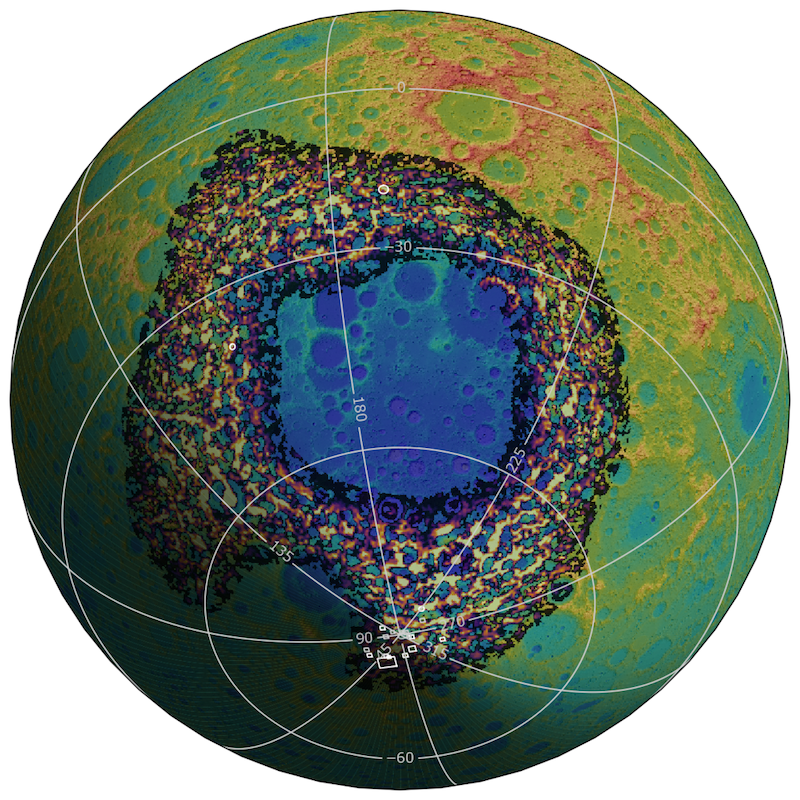
Artemis missions target South Pole–Aitken basin on the moon

South Pole–Aitken basin: Globe of a planet with a large lop-sided blue area in the middle, surrounded by a wide field of large rubble.
View larger. | This globe map shows the South Pole-Aitken basin (blue) and surrounding regions. Here we see rocks from the moon’s mantle, the thick, rocky layer directly beneath its thin outer crust. The rocks were blasted onto the surface by the giant impact that created this huge moon basin. Image via NASA/ JPL-Caltech/ Goddard/ Gabe Gowman-U. Arizona/ SwRI. Data from NASA’s GRAIL mission and NASA’s Lunar Reconnaissance Orbiter Laser Altimeter.
  • The South Pole-Aitken basin is the largest impact basin on the moon. It’s on the moon’s far side. How did it form?
  • Two new studies show that the asteroid that struck the moon, forming the basin, came from the north at a low angle. Rocks from both the lunar crust and mantle were ejected onto the surface.
  • Future Artemis astronauts will land in and around the South Pole-Aitken region. The new studies help show what the astronauts can expect to find.

You deserve a daily dose of good news. For the latest in science and the night sky, click here to subscribe to our free daily newsletter.

The South Pole–Aitken basin region is a future landing site

When Artemis astronauts return to the moon in the near future, they’ll land near the lunar south pole. Of the nine possible landing sites, some are within the South Pole-Aitken basin. Others are on or near the rim of the basin, while still others are just outside of it.

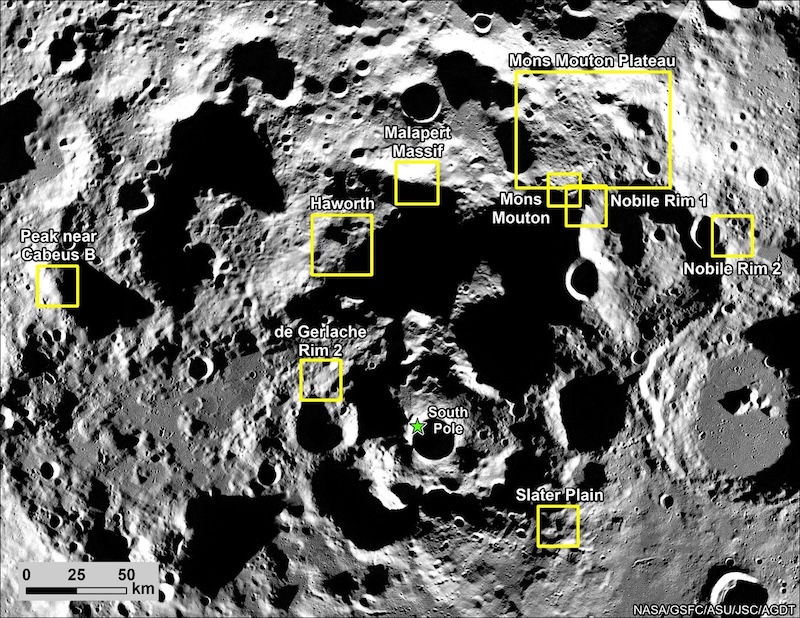
For example, the sites Nobile Rim 1, Nobile Rim 2 and Haworth are within the basin (see map below). Malapert Massif is near the basin’s rim. And de Gerlache Rim 2 is outside of the basin. Note that the basin’s boundary is rather obscure and not sharply delineated. So it’s not always clear which proposed landing sites are, technically, within the basin.

Now researchers have published two new peer-reviewed papers about the South Pole-Aitken basin. One is in Science Advances (May 6, 2026). And the other is in JGR Planets (April 23, 2026).

Black and white image of cratered terrain seen from above, with 9 labeled yellow squares scattered around.
View larger. | The 9 possible landing sites for future Artemis missions, in and around the South Pole-Aitken basin. Note that it will no longer be the Artemis 3 mission, in late 2027, that lands first. That mission will remain in Earth orbit. It will now be Artemis 4 and beyond for the landings. Image via NASA.

Water ice and sunlight

Here are two reasons this region was chosen for the astronauts: water ice and sunlight. The landing sites closest to the moon’s south pole offer access to water ice, which the astronauts will need as a primary resource. The sites also experience long periods of sunlight.

This giant moon basin is the moon’s oldest and largest impact crater, on the far side of the moon. But how much do we really know about this region? On June 15, 2026, researchers at the Southwest Research Institute (SwRI) in California, said that they have found new details about the South Pole-Aitken basin.

Since it is one of the oldest structures on the moon, the basin provides clues about the early solar system.

William Bottke is the director of the Center for Lunar Origin and Evolution (CLOE) and executive director of SwRI’s Science Directorate in Boulder, Colorado. He is also a co-author of both of the new studies. He said:

The basin offers scientists a rare opportunity to study the moon’s earliest history. The collision struck the lunar surface with such force that it may have excavated material from deep inside the moon, including portions of the lunar mantle [the region just below the moon’s thin crust].

Recreating the impact

To find out more about the future landing location for the Artemis astronauts, the researchers used advanced computer simulations and computer models. They recreated the impact that formed the basin. They found that the impacting asteroid came from the north and hit the moon’s surface at a low angle. That’s why the basin is more elongated in shape than round. (However, scientists said in 2024 that it’s actually slightly rounder than first thought). Shigeru Wakita at Purdue University, lead author of the South-Pole Aitken basin impact study, said:

Our simulation produces the right shape and nature of the impact basin. It also tells us about the projectile that created it and the direction of the impact.

Notably, the analysis suggests that the object that impacted was not just a simple asteroid. The impacting object must have been more complex, with an inner core surrounded by rock. The object’s interior appears to have been differentiated, separated into distinct compositional layers, more like a small protoplanet than a plain rock. Protoplanets are like “baby planets,” smaller objects forming from the accumulation of material in the early solar system. Many would eventually grow to become actual planets, like our own Earth.

When the impactor hit the moon, it created a deep, uneven cavity. The rock in the middle of the basin melted, and material from both the moon’s mantle and crust were thrown out into space.

A piece of the lunar surface, seen from orbit, showing heavily cratered terrain.
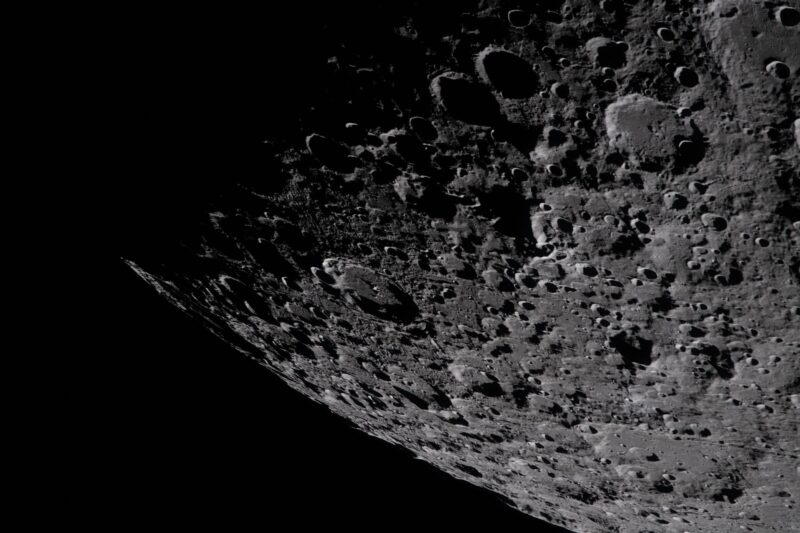
Captured by the Artemis 2 crew, the heavily cratered eastern edge of the South Pole-Aitken basin – the moon’s oldest and largest impact basin – offers a glimpse into billions of years of lunar geologic history. Image via NASA.
Far side of the moon. Light gray and cratered, but without large dark blotches. Red circle around a large area.
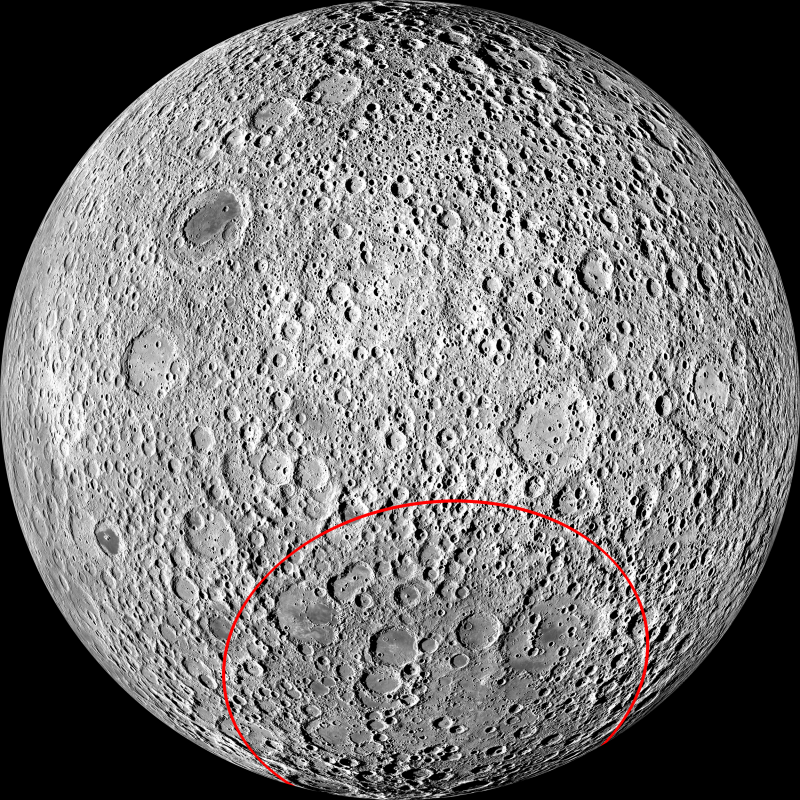
The South Pole-Aitken basin (outlined) on the far side of the moon. Image via NASA/ Sneeuwschaap/ Wikimedia Commons.

Ejecta in the basin

The researchers also wanted to know how the ejecta from the impact was distributed in and around the basin. To do this, they compared high-resolution gravity data with models that include both crustal and mantle material. The result was that the basin likely contains a substantial amount of rock from the moon’s mantle. Those rocks are also mixed into the ejecta blanket – the rocky debris – surrounding the basin.

Also, there were smaller secondary impacts that brought some of those rocks to the surface. That is treasure for the future Artemis astronauts who will land there. Gabriel Gowman at the University of Arizona, lead author of the gravity-based study, said:

The precise distribution of mantle material has been a big unknown. Our models indicate that the [South-Pole Aitken basin] impact ejected enough deep material to form a significant deposit that should still be accessible today. Most importantly, some of that material at a trace level may exist in regions being considered for the Artemis landings.

Smiling young man with short black hair wearing a sweater.
Shigeru Wakita at Purdue University is the lead author of the South-Pole Aitken basin impact paper. Image via Google Scholar.
Smiling young man with longish, tousled light brown hair wearing eyeglasses.
Gabriel Gowman at the University of Arizona is the lead author of the gravity mapping paper. Image via the University of Arizona.

Lots of mantle ejecta for astronauts to explore

Scientists had thought that the deepest part of the ejecta might be far away from the proposed landing sites in the area. But the new studies show this might not be the case. Some of the deposits could extend closer to the south polar region, including the landing sites. That’s good news for the astronauts being able to sample some of those deposits.

In 2019, scientists said they found evidence for an unusually dense mass beneath the South Pole-Aitken basin. The metallic rock is five times larger than the Big Island of Hawaii.

On June 25, 2024, the Chinese Chang’e 6 lunar probe landed in the Apollo basin, a region within the South Pole-Aitken basin. It returned samples to Earth 53 days later.

Bottom line: Two new studies examine the South Pole-Aitken basin on the moon. This region is a future landing site for Artemis astronauts.

Source: A southward differentiated impactor forms the tapered shape of the South Pole–Aitken impact basin on the Moon

Source: Gravity Mapping of Lunar Mantle Material in South Pole-Aitken Basin Ejecta

Via SwRI

Read more: Moon’s largest crater is rounder than 1st thought

Read more: What is the mystery mass on the moon?

The post Artemis missions target South Pole–Aitken basin on the moon first appeared on EarthSky.


from EarthSky https://ift.tt/AnGspkK
South Pole–Aitken basin: Globe of a planet with a large lop-sided blue area in the middle, surrounded by a wide field of large rubble.
View larger. | This globe map shows the South Pole-Aitken basin (blue) and surrounding regions. Here we see rocks from the moon’s mantle, the thick, rocky layer directly beneath its thin outer crust. The rocks were blasted onto the surface by the giant impact that created this huge moon basin. Image via NASA/ JPL-Caltech/ Goddard/ Gabe Gowman-U. Arizona/ SwRI. Data from NASA’s GRAIL mission and NASA’s Lunar Reconnaissance Orbiter Laser Altimeter.
  • The South Pole-Aitken basin is the largest impact basin on the moon. It’s on the moon’s far side. How did it form?
  • Two new studies show that the asteroid that struck the moon, forming the basin, came from the north at a low angle. Rocks from both the lunar crust and mantle were ejected onto the surface.
  • Future Artemis astronauts will land in and around the South Pole-Aitken region. The new studies help show what the astronauts can expect to find.

You deserve a daily dose of good news. For the latest in science and the night sky, click here to subscribe to our free daily newsletter.

The South Pole–Aitken basin region is a future landing site

When Artemis astronauts return to the moon in the near future, they’ll land near the lunar south pole. Of the nine possible landing sites, some are within the South Pole-Aitken basin. Others are on or near the rim of the basin, while still others are just outside of it.

For example, the sites Nobile Rim 1, Nobile Rim 2 and Haworth are within the basin (see map below). Malapert Massif is near the basin’s rim. And de Gerlache Rim 2 is outside of the basin. Note that the basin’s boundary is rather obscure and not sharply delineated. So it’s not always clear which proposed landing sites are, technically, within the basin.

Now researchers have published two new peer-reviewed papers about the South Pole-Aitken basin. One is in Science Advances (May 6, 2026). And the other is in JGR Planets (April 23, 2026).

Black and white image of cratered terrain seen from above, with 9 labeled yellow squares scattered around.
View larger. | The 9 possible landing sites for future Artemis missions, in and around the South Pole-Aitken basin. Note that it will no longer be the Artemis 3 mission, in late 2027, that lands first. That mission will remain in Earth orbit. It will now be Artemis 4 and beyond for the landings. Image via NASA.

Water ice and sunlight

Here are two reasons this region was chosen for the astronauts: water ice and sunlight. The landing sites closest to the moon’s south pole offer access to water ice, which the astronauts will need as a primary resource. The sites also experience long periods of sunlight.

This giant moon basin is the moon’s oldest and largest impact crater, on the far side of the moon. But how much do we really know about this region? On June 15, 2026, researchers at the Southwest Research Institute (SwRI) in California, said that they have found new details about the South Pole-Aitken basin.

Since it is one of the oldest structures on the moon, the basin provides clues about the early solar system.

William Bottke is the director of the Center for Lunar Origin and Evolution (CLOE) and executive director of SwRI’s Science Directorate in Boulder, Colorado. He is also a co-author of both of the new studies. He said:

The basin offers scientists a rare opportunity to study the moon’s earliest history. The collision struck the lunar surface with such force that it may have excavated material from deep inside the moon, including portions of the lunar mantle [the region just below the moon’s thin crust].

Recreating the impact

To find out more about the future landing location for the Artemis astronauts, the researchers used advanced computer simulations and computer models. They recreated the impact that formed the basin. They found that the impacting asteroid came from the north and hit the moon’s surface at a low angle. That’s why the basin is more elongated in shape than round. (However, scientists said in 2024 that it’s actually slightly rounder than first thought). Shigeru Wakita at Purdue University, lead author of the South-Pole Aitken basin impact study, said:

Our simulation produces the right shape and nature of the impact basin. It also tells us about the projectile that created it and the direction of the impact.

Notably, the analysis suggests that the object that impacted was not just a simple asteroid. The impacting object must have been more complex, with an inner core surrounded by rock. The object’s interior appears to have been differentiated, separated into distinct compositional layers, more like a small protoplanet than a plain rock. Protoplanets are like “baby planets,” smaller objects forming from the accumulation of material in the early solar system. Many would eventually grow to become actual planets, like our own Earth.

When the impactor hit the moon, it created a deep, uneven cavity. The rock in the middle of the basin melted, and material from both the moon’s mantle and crust were thrown out into space.

A piece of the lunar surface, seen from orbit, showing heavily cratered terrain.
Captured by the Artemis 2 crew, the heavily cratered eastern edge of the South Pole-Aitken basin – the moon’s oldest and largest impact basin – offers a glimpse into billions of years of lunar geologic history. Image via NASA.
Far side of the moon. Light gray and cratered, but without large dark blotches. Red circle around a large area.
The South Pole-Aitken basin (outlined) on the far side of the moon. Image via NASA/ Sneeuwschaap/ Wikimedia Commons.

Ejecta in the basin

The researchers also wanted to know how the ejecta from the impact was distributed in and around the basin. To do this, they compared high-resolution gravity data with models that include both crustal and mantle material. The result was that the basin likely contains a substantial amount of rock from the moon’s mantle. Those rocks are also mixed into the ejecta blanket – the rocky debris – surrounding the basin.

Also, there were smaller secondary impacts that brought some of those rocks to the surface. That is treasure for the future Artemis astronauts who will land there. Gabriel Gowman at the University of Arizona, lead author of the gravity-based study, said:

The precise distribution of mantle material has been a big unknown. Our models indicate that the [South-Pole Aitken basin] impact ejected enough deep material to form a significant deposit that should still be accessible today. Most importantly, some of that material at a trace level may exist in regions being considered for the Artemis landings.

Smiling young man with short black hair wearing a sweater.
Shigeru Wakita at Purdue University is the lead author of the South-Pole Aitken basin impact paper. Image via Google Scholar.
Smiling young man with longish, tousled light brown hair wearing eyeglasses.
Gabriel Gowman at the University of Arizona is the lead author of the gravity mapping paper. Image via the University of Arizona.

Lots of mantle ejecta for astronauts to explore

Scientists had thought that the deepest part of the ejecta might be far away from the proposed landing sites in the area. But the new studies show this might not be the case. Some of the deposits could extend closer to the south polar region, including the landing sites. That’s good news for the astronauts being able to sample some of those deposits.

In 2019, scientists said they found evidence for an unusually dense mass beneath the South Pole-Aitken basin. The metallic rock is five times larger than the Big Island of Hawaii.

On June 25, 2024, the Chinese Chang’e 6 lunar probe landed in the Apollo basin, a region within the South Pole-Aitken basin. It returned samples to Earth 53 days later.

Bottom line: Two new studies examine the South Pole-Aitken basin on the moon. This region is a future landing site for Artemis astronauts.

Source: A southward differentiated impactor forms the tapered shape of the South Pole–Aitken impact basin on the Moon

Source: Gravity Mapping of Lunar Mantle Material in South Pole-Aitken Basin Ejecta

Via SwRI

Read more: Moon’s largest crater is rounder than 1st thought

Read more: What is the mystery mass on the moon?

The post Artemis missions target South Pole–Aitken basin on the moon first appeared on EarthSky.


from EarthSky https://ift.tt/AnGspkK

The northernmost sunset is on the June solstice, today!

Three curved, dotted sun tracks across the sky from various heights above the horizon down to the horizon. Northernmost sunset is on June solstice.
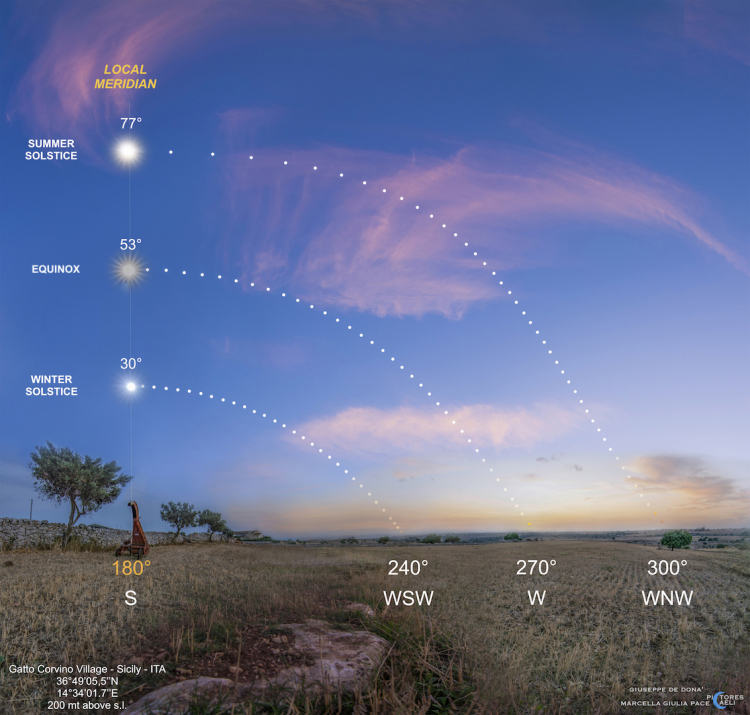
The path of the sun across our sky – from about noon to sunset – on 3 different days of the year, an equinox and the summer and winter solstices. The June solstice is the Northern Hemisphere’s summer solstice. Notice the northernmost sunset on this day. Marcella Giulia Pace made these observations from Gatto Corvino village, Sicily, Italy. Used with permission.

The 2026 June solstice falls at 8:25 UTC on June 21. That’s 3:25 a.m. CDT.

Northern Hemisphere summer

The June solstice marks the year’s northernmost sunset and sunrise. It brings the year’s longest period of daylight to the Northern Hemisphere (and shortest period of daylight in the Southern Hemisphere). North of the Arctic Circle, the sun neither rises nor sets but stays above the horizon continuously around the clock.

In the Northern Hemisphere, noontime shadows are shortest at this solstice. It’s the year’s highest sun, as seen from the Tropic of Cancer and all places north.

For us in the Northern Hemisphere, the June solstice signals the beginning of summer. For the Southern Hemisphere, winter starts at this solstice.

The solstice is a whole-Earth event. It happens at the same instant for all of us – the instant the sun reaches its northernmost point in our sky. But our clocks say different times.

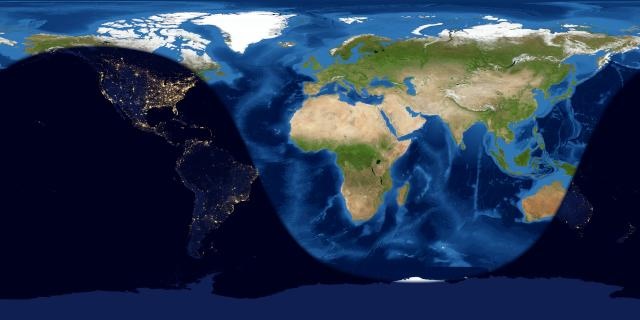
Rolled-out map of Earth with night and day sides visible.
Day and night sides of Earth at the instant of the June 2026 solstice (June 21 at 8:25 UTC). Map via Fourmilab. Used with permission.

Southern Hemisphere winter

Earth’s orbit around the sun – and tilt on its axis – have brought us to a place in space where our world’s Northern Hemisphere has its time of greatest daylight: its longest day and shortest night. Meanwhile, the June solstice and northernmost sun brings the shortest day and longest night south of the equator.

This solstice marks the beginning of Southern Hemisphere winter.

It marks the lowest sun and longest noontime shadow for those on the southern part of Earth’s globe.

South of the Antarctic Circle, the sun neither rises nor sets but stays beneath the horizon for 24 hours.

Composite of 11 photos with sun just above a low mountain showing positions of the sun at dawn on 11 dates.
View at EarthSky Community Photos. | Sunrises between a June and December solstice. If you are standing facing east, the sun – from day to day, and week to week – moves progressively to the right (south) between these 2 solstices. Rupesh Sangoi captured separate images of the sunrise showing the sun’s movement along the horizon between a June and December solstice. Rupesh wrote: “Did this for over a year, at sunrise.” Glorious composite, Rupesh! Thank you.

Northernmost sunset, but not latest sunset

The sun sets farthest north on the day of the solstice, bringing the longest day for the Northern Hemisphere. But this summer solstice doesn’t bring the latest sunset. And it doesn’t bring the earliest sunrise. The exact dates vary with latitude, but the sequence is always the same: earliest sunrise before the summer solstice, longest day on the summer solstice, latest sunset after the summer solstice.

For the Southern Hemisphere, where it’s winter now, the latest sunrise – and earliest sunrise – don’t come on the day of the solstice either. Again, the exact dates vary with latitude. But the sequence is always the same: earliest sunset before the winter solstice, shortest day on the winter solstice, latest sunrise after the winter solstice.

12 panoramic images of the same landscape with the sun in different points of the sky. It creates the shape of an S.
View at EarthSky Community Photos. | Wael Omar shared this stunning composite image illustrating the change in the sunset’s position during 12 months in Cairo, Egypt. Thank you, Omar!

Each solstice marks a turning of the year

Even as this northern summer begins with the solstice, throughout the world the solstice also represents a “turning” of the year.

In fact, to many cultures, the solstice can mean a limit or a culmination of something. From around the world, the sun is now setting and rising as far north as it ever does. The solstice marks when the sun reaches its northernmost point for the year.

Then after the June solstice, the sun will begin its subtle shift southward on the sky’s dome again. Thus even in summer’s beginning, we find the seeds of summer’s end.

Read more: All you need to know about the June 2026 solstice

Rocky shoreline, a yellow-white glowing sun above large pointy rock against orange sky.
View larger. | Nikolaos Pantazis wrote: “Every year, on the days around summer solstice, the setting sun aligns with that rock near the village of Platanos, Peloponnese, Greece.” Thank you, Nikolaos!

Bottom line: The northernmost sunset (and sunrise) happen at the June solstice. Here’s some quick info that’ll help you connect with nature on this special day.

Help support EarthSky! Check out the EarthSky store for fun astronomy gifts and tools for all ages!

The post The northernmost sunset is on the June solstice, today! first appeared on EarthSky.


from EarthSky https://ift.tt/wVFoIC0
Three curved, dotted sun tracks across the sky from various heights above the horizon down to the horizon. Northernmost sunset is on June solstice.
The path of the sun across our sky – from about noon to sunset – on 3 different days of the year, an equinox and the summer and winter solstices. The June solstice is the Northern Hemisphere’s summer solstice. Notice the northernmost sunset on this day. Marcella Giulia Pace made these observations from Gatto Corvino village, Sicily, Italy. Used with permission.

The 2026 June solstice falls at 8:25 UTC on June 21. That’s 3:25 a.m. CDT.

Northern Hemisphere summer

The June solstice marks the year’s northernmost sunset and sunrise. It brings the year’s longest period of daylight to the Northern Hemisphere (and shortest period of daylight in the Southern Hemisphere). North of the Arctic Circle, the sun neither rises nor sets but stays above the horizon continuously around the clock.

In the Northern Hemisphere, noontime shadows are shortest at this solstice. It’s the year’s highest sun, as seen from the Tropic of Cancer and all places north.

For us in the Northern Hemisphere, the June solstice signals the beginning of summer. For the Southern Hemisphere, winter starts at this solstice.

The solstice is a whole-Earth event. It happens at the same instant for all of us – the instant the sun reaches its northernmost point in our sky. But our clocks say different times.

Rolled-out map of Earth with night and day sides visible.
Day and night sides of Earth at the instant of the June 2026 solstice (June 21 at 8:25 UTC). Map via Fourmilab. Used with permission.

Southern Hemisphere winter

Earth’s orbit around the sun – and tilt on its axis – have brought us to a place in space where our world’s Northern Hemisphere has its time of greatest daylight: its longest day and shortest night. Meanwhile, the June solstice and northernmost sun brings the shortest day and longest night south of the equator.

This solstice marks the beginning of Southern Hemisphere winter.

It marks the lowest sun and longest noontime shadow for those on the southern part of Earth’s globe.

South of the Antarctic Circle, the sun neither rises nor sets but stays beneath the horizon for 24 hours.

Composite of 11 photos with sun just above a low mountain showing positions of the sun at dawn on 11 dates.
View at EarthSky Community Photos. | Sunrises between a June and December solstice. If you are standing facing east, the sun – from day to day, and week to week – moves progressively to the right (south) between these 2 solstices. Rupesh Sangoi captured separate images of the sunrise showing the sun’s movement along the horizon between a June and December solstice. Rupesh wrote: “Did this for over a year, at sunrise.” Glorious composite, Rupesh! Thank you.

Northernmost sunset, but not latest sunset

The sun sets farthest north on the day of the solstice, bringing the longest day for the Northern Hemisphere. But this summer solstice doesn’t bring the latest sunset. And it doesn’t bring the earliest sunrise. The exact dates vary with latitude, but the sequence is always the same: earliest sunrise before the summer solstice, longest day on the summer solstice, latest sunset after the summer solstice.

For the Southern Hemisphere, where it’s winter now, the latest sunrise – and earliest sunrise – don’t come on the day of the solstice either. Again, the exact dates vary with latitude. But the sequence is always the same: earliest sunset before the winter solstice, shortest day on the winter solstice, latest sunrise after the winter solstice.

12 panoramic images of the same landscape with the sun in different points of the sky. It creates the shape of an S.
View at EarthSky Community Photos. | Wael Omar shared this stunning composite image illustrating the change in the sunset’s position during 12 months in Cairo, Egypt. Thank you, Omar!

Each solstice marks a turning of the year

Even as this northern summer begins with the solstice, throughout the world the solstice also represents a “turning” of the year.

In fact, to many cultures, the solstice can mean a limit or a culmination of something. From around the world, the sun is now setting and rising as far north as it ever does. The solstice marks when the sun reaches its northernmost point for the year.

Then after the June solstice, the sun will begin its subtle shift southward on the sky’s dome again. Thus even in summer’s beginning, we find the seeds of summer’s end.

Read more: All you need to know about the June 2026 solstice

Rocky shoreline, a yellow-white glowing sun above large pointy rock against orange sky.
View larger. | Nikolaos Pantazis wrote: “Every year, on the days around summer solstice, the setting sun aligns with that rock near the village of Platanos, Peloponnese, Greece.” Thank you, Nikolaos!

Bottom line: The northernmost sunset (and sunrise) happen at the June solstice. Here’s some quick info that’ll help you connect with nature on this special day.

Help support EarthSky! Check out the EarthSky store for fun astronomy gifts and tools for all ages!

The post The northernmost sunset is on the June solstice, today! first appeared on EarthSky.


from EarthSky https://ift.tt/wVFoIC0

34 dust devils on Mars in 1 shot! Can you spot them all?

Orange terrain with some small round spots on it.
View larger/ full image. | This cropped view shows a few of the 34 dust devils captured in a single image of the Martian surface. The Mars Express orbiter captured the full view on December 7, 2024, and ESA shared it on June 17, 2026. To see all 34 dust devils, click through to this zoomable image from ESA. How many can you spot? Image via ESA/DLR/FU Berlin.

Science news, night sky events and beautiful photos, all in one place. Click here to subscribe to EarthSky’s free daily newsletter.

34 dust devils on Mars in 1 shot!

Mars is famous for its tornado-like whirlwinds, made of the dusty debris coating its surface. These are dust devils. They form the same way on Mars as they do on Earth: as the sun warms the ground, the ground then heats the thin layer of air above. Then that air rises quickly through the cooler, dense air above, spiraling around a small area of low pressure.

On June 17, 2026, ESA shared an image from its Mars Express orbiter of 34 dust devils it captured on the red planet’s surface back on December 7, 2024. Can you spot all the dust devils in the image above?

Look closely. This region of Mars is in a valley system known as Mamers Valles. It holds ridges and plateau-like areas along with many small craters. Although the dust devils may look tiny – as a small light-colored dot with a shadow – in reality, dust devils on Mars can grow even larger than those on Earth. Martian dust devils can tower up to 5 miles (8 km) high and span hundreds of yards wide.

The location of the dust devils is in the image at the bottom of this post.

Then check out the original here. The largest version shows a whopping 34 dust devils!

Looking down at an orangish-brown landscape with ridges, small craters and tiny white nubs.
View larger. | There are 34 dust devils on Mars in this 1 image. How many can you spot? A key is below. The Mars Express orbiter captured this view of Mars on December 7, 2024, and ESA shared it on June 17, 2026. Image via ESA/DLR/FU Berlin.

More on Mamers Valles

Mamers Valles lies in Mars’ northern hemisphere. It consists of of valleys and canyons, some of which stretch for more than 600 miles (1,000 km). The higher areas are mesas, cliffs and some debris-covered glaciers. The glaciers lie at the base of the steep slopes. The terrain shows evidence that it was carved by flowing materials, such as water, ice and lava, sometime in its past.

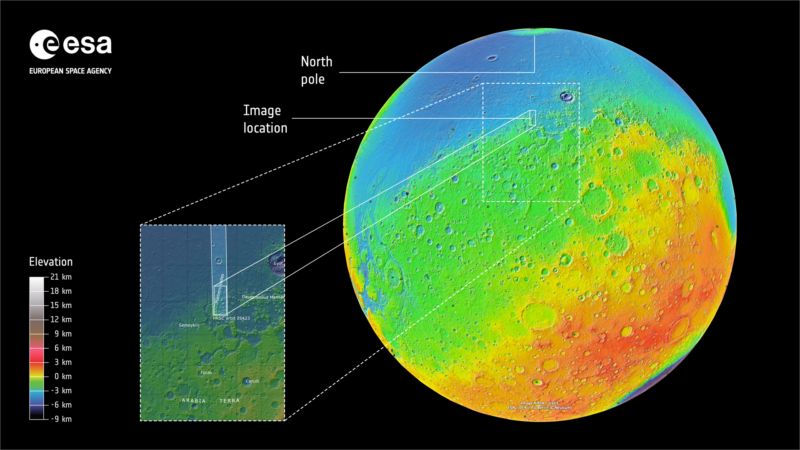
A rainbow-hued planet with lots of craters on the bottom and smoother near the top with an inset there.
Mamers Valles is a large valley in Mars’ northern hemisphere. This false-color view shows the location of the dust-devil-filled image above, which ESA released on June 17, 2026. Image via NASA/USGS; ESA/DLR/FU Berlin.

Answer key for the dust devils

Reddish terrain viewed from above with 34 white circles, some overlapping.
The white circles mark the locations of the 34 dust devils on Mars that the Mars Express orbiter spotted. Image via ESA/DLR/FU Berlin.

Bottom line: The Mars Express orbiter caught this view of the red planet, which is peppered with whirlwinds. Can you spot 34 dust devils in this one shot of Mars?

Via ESA

The post 34 dust devils on Mars in 1 shot! Can you spot them all? first appeared on EarthSky.


from EarthSky https://ift.tt/dfI8XEl

Orange terrain with some small round spots on it.
View larger/ full image. | This cropped view shows a few of the 34 dust devils captured in a single image of the Martian surface. The Mars Express orbiter captured the full view on December 7, 2024, and ESA shared it on June 17, 2026. To see all 34 dust devils, click through to this zoomable image from ESA. How many can you spot? Image via ESA/DLR/FU Berlin.

Science news, night sky events and beautiful photos, all in one place. Click here to subscribe to EarthSky’s free daily newsletter.

34 dust devils on Mars in 1 shot!

Mars is famous for its tornado-like whirlwinds, made of the dusty debris coating its surface. These are dust devils. They form the same way on Mars as they do on Earth: as the sun warms the ground, the ground then heats the thin layer of air above. Then that air rises quickly through the cooler, dense air above, spiraling around a small area of low pressure.

On June 17, 2026, ESA shared an image from its Mars Express orbiter of 34 dust devils it captured on the red planet’s surface back on December 7, 2024. Can you spot all the dust devils in the image above?

Look closely. This region of Mars is in a valley system known as Mamers Valles. It holds ridges and plateau-like areas along with many small craters. Although the dust devils may look tiny – as a small light-colored dot with a shadow – in reality, dust devils on Mars can grow even larger than those on Earth. Martian dust devils can tower up to 5 miles (8 km) high and span hundreds of yards wide.

The location of the dust devils is in the image at the bottom of this post.

Then check out the original here. The largest version shows a whopping 34 dust devils!

Looking down at an orangish-brown landscape with ridges, small craters and tiny white nubs.
View larger. | There are 34 dust devils on Mars in this 1 image. How many can you spot? A key is below. The Mars Express orbiter captured this view of Mars on December 7, 2024, and ESA shared it on June 17, 2026. Image via ESA/DLR/FU Berlin.

More on Mamers Valles

Mamers Valles lies in Mars’ northern hemisphere. It consists of of valleys and canyons, some of which stretch for more than 600 miles (1,000 km). The higher areas are mesas, cliffs and some debris-covered glaciers. The glaciers lie at the base of the steep slopes. The terrain shows evidence that it was carved by flowing materials, such as water, ice and lava, sometime in its past.

A rainbow-hued planet with lots of craters on the bottom and smoother near the top with an inset there.
Mamers Valles is a large valley in Mars’ northern hemisphere. This false-color view shows the location of the dust-devil-filled image above, which ESA released on June 17, 2026. Image via NASA/USGS; ESA/DLR/FU Berlin.

Answer key for the dust devils

Reddish terrain viewed from above with 34 white circles, some overlapping.
The white circles mark the locations of the 34 dust devils on Mars that the Mars Express orbiter spotted. Image via ESA/DLR/FU Berlin.

Bottom line: The Mars Express orbiter caught this view of the red planet, which is peppered with whirlwinds. Can you spot 34 dust devils in this one shot of Mars?

Via ESA

The post 34 dust devils on Mars in 1 shot! Can you spot them all? first appeared on EarthSky.


from EarthSky https://ift.tt/dfI8XEl

For all of Earth, longest sunsets around the solstice

Longest sunsets: Sunset at the beach with dramatic colors and a toddler silhouette to the side.
View at EarthSky Community Photos. | Christy Mandeville in Indian Shores, Florida, captured this dramatic sunset on a June evening in 2022. Christy wrote: “The little boy in the photo kept running around me as I was trying to capture the perfect sunset photo. After I went through the hundreds of photos I captured, I had no idea that he was in any of them! This one stood out.” Thank you, Christy! Read below why the longest sunsets happen around the solstices.

In 2026, the Northern Hemisphere’s summer solstice – and Southern Hemisphere’s winter solstice – falls on June 21, 2026, at 8:25 UTC (that is 3:25 a.m. in central North America; translate UTC to your time). Read more about the June solstice.

Science news, night sky events and beautiful photos, all in one place. Click here to subscribe to EarthSky’s free daily newsletter.

Longest sunsets in June and December

Here’s a natural phenomenon you might not have imagined: the longest sunsets happen around the time of the solstices. That is, it takes more seconds for the body of the sun to sink below your western horizon around the solstices, and fewer seconds around the equinoxes. It’s true whether you live in Earth’s Northern or Southern Hemisphere.

As viewed from both the Northern and Southern Hemispheres, the sun rises and sets farthest north at the June solstice and farthest south at the December solstice.

Now consider that the farther the sun sets from due west along the horizon, the shallower the angle of the setting sun. That means a longer duration for sunset at the solstices.

Meanwhile, at an equinox, the sun rises due east and sets due west. That means on the day of an equinox, the setting sun hits the horizon at its steepest possible angle.

Longest sunsets are how long?

The sunset duration varies by latitude. But let’s just consider one latitude: 40 degrees north, which is the latitude of Denver or Philadelphia in the United States, Sardinia in the Mediterranean, or Beijing in China.

At that latitude, on the day of a solstice, the sun sets in about 3 minutes and 15 seconds.

That’s half a minute longer than the sunset at the same latitude on the day of an equinox. The equinox sun at 40 degrees north latitude sets in roughly 2 minutes and 45 seconds.

At more northerly temperate latitudes, the sunset duration is greater; and at latitudes closer to the equator, the sunset duration is less. Near the Arctic Circle (65 degrees north latitude), the duration of a solstice sunset lasts about 15 minutes. At the equator (0 degrees latitude), the solstice sun takes a little over 2 minutes and 15 seconds to set.

Regardless of latitude, however, the duration of sunset is always longest at or near the solstices.

The sunsets are longer in December than June

As it turns out, the sunset and sunrise are a tad longer on the December solstice than they are on the June solstice.

That’s because the sun is closer to Earth in December than it is in June. Therefore, the sun’s disk looms a bit larger in our sky in December, and so it takes slightly longer to set.

Additionally, the closer December sun moves eastward upon the ecliptic at a faster clip, helping to slow down the December solstice sunset (and sunrise) even more. For instance, at 50 degrees north latitude, the winter solstice sunset (sunrise) lasts about 4 minutes and 18 seconds, or about 8 seconds longer than the sunset (sunrise) on the summer solstice.

And now you know!

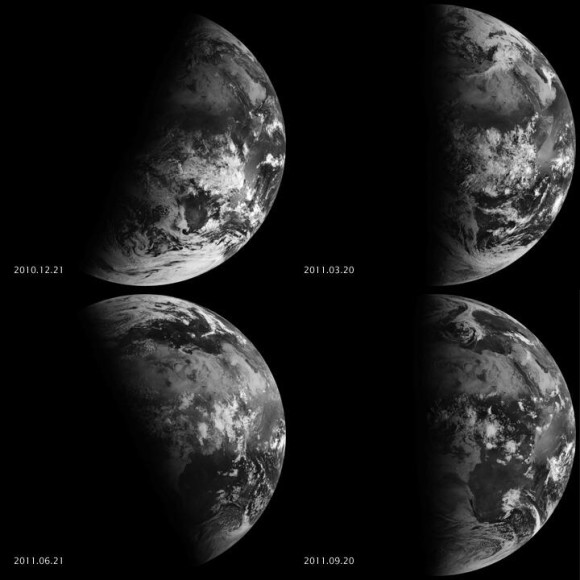
Four photos of half-lit Earth, left two at a slant and right two straight up and down.
Equinoxes and solstices, via Geosync. The Earth’s axis points straight up and down, with north at the top. The solstices are on the left (December solstice at top, June solstice at bottom) and the equinoxes are to the right (March equinox at top, September equinox at bottom). Image via NASA.

Some sunsets from EarthSky Community Photos

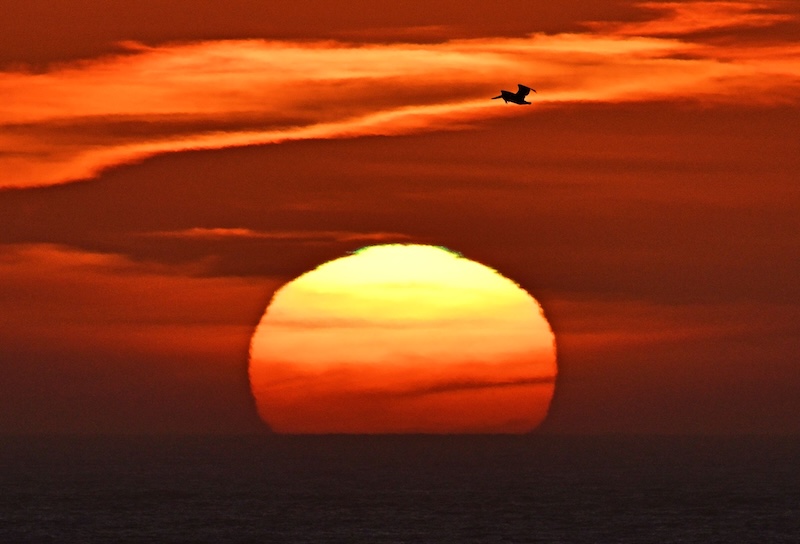
Sunsets over the ocean with a bird in the crimson sky.
View at EarthSky Community Photos. | Cecille Kennedy captured this sunset on May 11, 2026, from Oregon and wrote: “The sun is sinking into the ocean horizon and if you look close there’s a thin line of neon green on its top rim (precursor to the green flash though the flash didn’t happen). A brown pelican on the right is flying south. Typically they are seen flying north this time of year but sometimes they are seen flying south for a brief stop at their favorite designated spots then proceed to fly north.” Thank you, Cecille!
A large, yellow, setting sun with a green flash on its upper edge.
View at EarthSky Community Photos. | Jelieta Walinski at Kitt Peak National Observatory near Tucson, Arizona, captured this solstice sunset on June 20, 2025. Jelieta wrote: “On the summer solstice, my husband and I ventured to Kitt Peak National Observatory, 6,000 feet above sea level, to witness the sun’s majesty. After scouting the perfect location, I was thrilled to capture the sun’s splendor with a unique twist — the elusive green flash!” Thank you, Jelieta!

Bottom line: Here’s a natural phenomenon you might never have imagined: the longest sunsets happen around the time of a solstice.

Help support EarthSky! Visit the EarthSky store for to see the great selection of educational tools and team gear we have to offer.

The post For all of Earth, longest sunsets around the solstice first appeared on EarthSky.


from EarthSky https://ift.tt/aBPsNrM
Longest sunsets: Sunset at the beach with dramatic colors and a toddler silhouette to the side.
View at EarthSky Community Photos. | Christy Mandeville in Indian Shores, Florida, captured this dramatic sunset on a June evening in 2022. Christy wrote: “The little boy in the photo kept running around me as I was trying to capture the perfect sunset photo. After I went through the hundreds of photos I captured, I had no idea that he was in any of them! This one stood out.” Thank you, Christy! Read below why the longest sunsets happen around the solstices.

In 2026, the Northern Hemisphere’s summer solstice – and Southern Hemisphere’s winter solstice – falls on June 21, 2026, at 8:25 UTC (that is 3:25 a.m. in central North America; translate UTC to your time). Read more about the June solstice.

Science news, night sky events and beautiful photos, all in one place. Click here to subscribe to EarthSky’s free daily newsletter.

Longest sunsets in June and December

Here’s a natural phenomenon you might not have imagined: the longest sunsets happen around the time of the solstices. That is, it takes more seconds for the body of the sun to sink below your western horizon around the solstices, and fewer seconds around the equinoxes. It’s true whether you live in Earth’s Northern or Southern Hemisphere.

As viewed from both the Northern and Southern Hemispheres, the sun rises and sets farthest north at the June solstice and farthest south at the December solstice.

Now consider that the farther the sun sets from due west along the horizon, the shallower the angle of the setting sun. That means a longer duration for sunset at the solstices.

Meanwhile, at an equinox, the sun rises due east and sets due west. That means on the day of an equinox, the setting sun hits the horizon at its steepest possible angle.

Longest sunsets are how long?

The sunset duration varies by latitude. But let’s just consider one latitude: 40 degrees north, which is the latitude of Denver or Philadelphia in the United States, Sardinia in the Mediterranean, or Beijing in China.

At that latitude, on the day of a solstice, the sun sets in about 3 minutes and 15 seconds.

That’s half a minute longer than the sunset at the same latitude on the day of an equinox. The equinox sun at 40 degrees north latitude sets in roughly 2 minutes and 45 seconds.

At more northerly temperate latitudes, the sunset duration is greater; and at latitudes closer to the equator, the sunset duration is less. Near the Arctic Circle (65 degrees north latitude), the duration of a solstice sunset lasts about 15 minutes. At the equator (0 degrees latitude), the solstice sun takes a little over 2 minutes and 15 seconds to set.

Regardless of latitude, however, the duration of sunset is always longest at or near the solstices.

The sunsets are longer in December than June

As it turns out, the sunset and sunrise are a tad longer on the December solstice than they are on the June solstice.

That’s because the sun is closer to Earth in December than it is in June. Therefore, the sun’s disk looms a bit larger in our sky in December, and so it takes slightly longer to set.

Additionally, the closer December sun moves eastward upon the ecliptic at a faster clip, helping to slow down the December solstice sunset (and sunrise) even more. For instance, at 50 degrees north latitude, the winter solstice sunset (sunrise) lasts about 4 minutes and 18 seconds, or about 8 seconds longer than the sunset (sunrise) on the summer solstice.

And now you know!

Four photos of half-lit Earth, left two at a slant and right two straight up and down.
Equinoxes and solstices, via Geosync. The Earth’s axis points straight up and down, with north at the top. The solstices are on the left (December solstice at top, June solstice at bottom) and the equinoxes are to the right (March equinox at top, September equinox at bottom). Image via NASA.

Some sunsets from EarthSky Community Photos

Sunsets over the ocean with a bird in the crimson sky.
View at EarthSky Community Photos. | Cecille Kennedy captured this sunset on May 11, 2026, from Oregon and wrote: “The sun is sinking into the ocean horizon and if you look close there’s a thin line of neon green on its top rim (precursor to the green flash though the flash didn’t happen). A brown pelican on the right is flying south. Typically they are seen flying north this time of year but sometimes they are seen flying south for a brief stop at their favorite designated spots then proceed to fly north.” Thank you, Cecille!
A large, yellow, setting sun with a green flash on its upper edge.
View at EarthSky Community Photos. | Jelieta Walinski at Kitt Peak National Observatory near Tucson, Arizona, captured this solstice sunset on June 20, 2025. Jelieta wrote: “On the summer solstice, my husband and I ventured to Kitt Peak National Observatory, 6,000 feet above sea level, to witness the sun’s majesty. After scouting the perfect location, I was thrilled to capture the sun’s splendor with a unique twist — the elusive green flash!” Thank you, Jelieta!

Bottom line: Here’s a natural phenomenon you might never have imagined: the longest sunsets happen around the time of a solstice.

Help support EarthSky! Visit the EarthSky store for to see the great selection of educational tools and team gear we have to offer.

The post For all of Earth, longest sunsets around the solstice first appeared on EarthSky.


from EarthSky https://ift.tt/aBPsNrM

Does the North Star ever move in the sky?

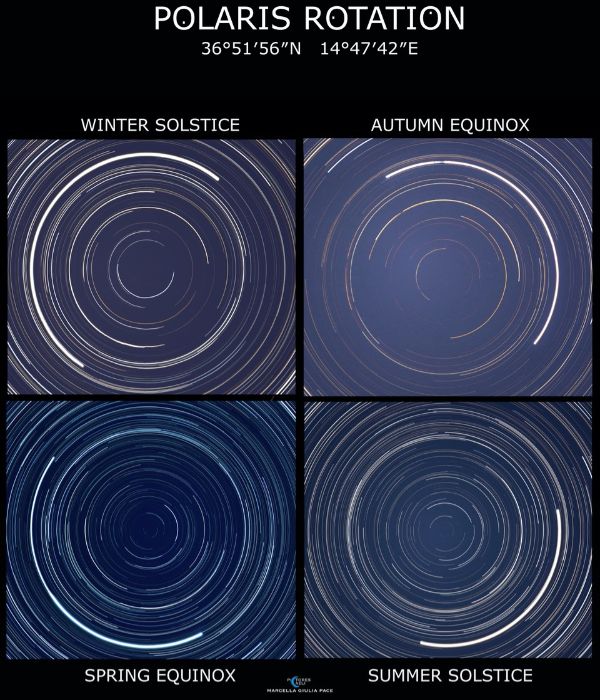
North Star: 4 panels, each with many concentric white arcs around a central point. One of the arcs is much brighter.
View at EarthSky Community Photos. | The bright star in the center of this montage of time-exposure photos is Polaris, the North Star. Perhaps you’ve heard it stays still in the northern sky, while the other stars circle around it? That’s true to the unaided eye, but not to a timelapse camera. Marcella Giulia Pace in Modica, Sicily, Italy, made this comparison of star trails in late 2022 and throughout 2023. As you can see, Polaris does move in a tiny circle around celestial north. Beautiful work, Marcella! Thank you.

The North Star, aka Polaris

The North Star, also known as Polaris, appears to stay fixed in our northern sky. It marks the location of the sky’s north pole – the north celestial pole – which is the point around which the whole starry northern sky turns as the Earth rotates. That’s why you can always use Polaris to find the direction north.

But even though the North Star doesn’t appear to move, a timelapse video reveals that it actually does. It makes its own little circle around the sky’s north pole every day. That’s because the North Star is offset a little – about 0.65 degrees – from celestial north. So Polaris makes a circle that’s 1.3 degrees in diameter each day.

Why do stars move, anyway?

Why does Polaris – and all the other stars in the sky – move at all? The answer is Earth’s spin. Because Earth rotates counter-clockwise when looking from above the North Pole, the sun in the daytime – and most stars at night – appear to rise in the east and set in the west.

Depending on your latitude, certain stars will be close enough to your nearest pole that they never rise or set. Never dipping below the horizon, they instead circle above you constantly. These are called circumpolar stars.

And the North Star is a special example of a circumpolar star. Because it lies almost exactly above Earth’s northern axis, it’s like the hub of a wheel. It doesn’t rise or set, and barely moves in a circle. Instead, it appears – to the eye – to stay put in the northern sky.

How high in your sky?

The North Star not only points toward the north, but its height in the northern sky also matches your latitude on earth. If you are sailing the Caribbean at 16° north latitude, the North Star will be about 16° high in your sky. If you are sailing around Nova Scotia, at 44° north latitude, then the North Star will be about 44° high in your northern sky. Each degree north or south equals 69 miles (111 km), so traveling 690 miles north or south will change your latitude, and the North Star’s elevation, by 10 degrees.


Read more: Polaris is the North Star

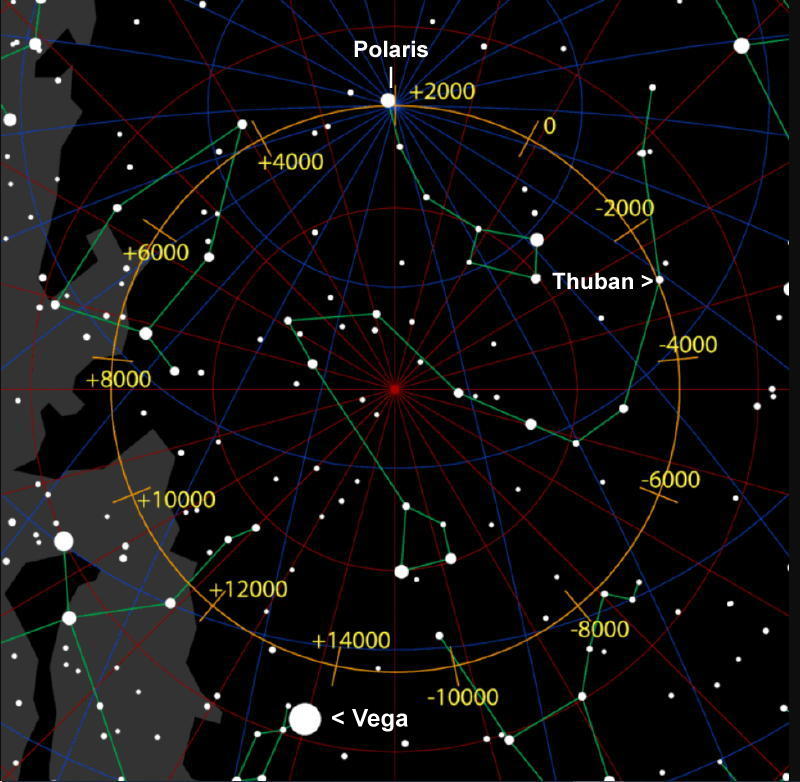
Star chart: a thin, wide circle around a central red dot, with years marked around the circle, and constellations.
The 26,000-year precession cycle causes the north celestial pole to move counter-clockwise relative to the background stars. Whichever star is closest to the north celestial pole is called the North Star. Image via Wikimedia Commons.

Taking turns as the North Star

A motion of Earth called precession causes our axis to trace out an imaginary circle on the celestial sphere every 26,000 years. And that means the star closest to the north celestial pole isn’t fixed.

Thousands of years ago, when the pyramids were rising from the sands of ancient Egypt, the North Star was an inconspicuous star called Thuban in the constellation Draco the Dragon.

Twelve thousand years from now, the blue-white star Vega in the constellation Lyra the Harp will be a much brighter North Star than our current Polaris.

Polaris could be a name for any North Star. Our current Polaris used to be called Phoenice. It is the 49th brightest star in the sky. It is not known for its brightness, but for its unique position in the sky.

Thousands of arcs of light circling around one spot.
View at EarthSky Community Photos. | Jeff Grubbs in Elgin, Arizona, captured these star trails on May 22, 2025. Thanks, Jeff! You can see all the stars circling around the star Polaris.

Proper motion

By the way, Polaris – like all stars – has more than one kind of motion. There’s the movement we see on our sky, caused by the Earth’s rotation. And then there’s each star’s actual motion through space.

The stars we see in our night sky are all members of our Milky Way galaxy. All of these stars are moving through space, but they’re so far away we can’t easily see them move. That’s why the stars appear fixed relative to each other. And it’s why, for the most part, we see the same constellations as our ancestors.

But over time, this movement – called proper motion – rearranges the patterns of stars we see in our sky. For Polaris, that movement is small, about 46 arcseconds in 1,000 years. That is about 1/40th of the diameter of the full moon as seen from Earth. So when you’re talking about stars moving or staying fixed, remember … they are all moving through the vastness of space. It’s just the relatively short time of a human lifespan that prevents us from seeing this grand motion.

Enjoying EarthSky? Sign up for our free daily newsletter today!

Bottom line: The North Star is a symbol for constancy. But a video or star trails image reveals that it makes its own little circle around the sky’s north pole every day.

Polaris is the present-day North Star of Earth

Use the Big Dipper to find Polaris, the North Star

The post Does the North Star ever move in the sky? first appeared on EarthSky.


from EarthSky https://ift.tt/S619fEZ
North Star: 4 panels, each with many concentric white arcs around a central point. One of the arcs is much brighter.
View at EarthSky Community Photos. | The bright star in the center of this montage of time-exposure photos is Polaris, the North Star. Perhaps you’ve heard it stays still in the northern sky, while the other stars circle around it? That’s true to the unaided eye, but not to a timelapse camera. Marcella Giulia Pace in Modica, Sicily, Italy, made this comparison of star trails in late 2022 and throughout 2023. As you can see, Polaris does move in a tiny circle around celestial north. Beautiful work, Marcella! Thank you.

The North Star, aka Polaris

The North Star, also known as Polaris, appears to stay fixed in our northern sky. It marks the location of the sky’s north pole – the north celestial pole – which is the point around which the whole starry northern sky turns as the Earth rotates. That’s why you can always use Polaris to find the direction north.

But even though the North Star doesn’t appear to move, a timelapse video reveals that it actually does. It makes its own little circle around the sky’s north pole every day. That’s because the North Star is offset a little – about 0.65 degrees – from celestial north. So Polaris makes a circle that’s 1.3 degrees in diameter each day.

Why do stars move, anyway?

Why does Polaris – and all the other stars in the sky – move at all? The answer is Earth’s spin. Because Earth rotates counter-clockwise when looking from above the North Pole, the sun in the daytime – and most stars at night – appear to rise in the east and set in the west.

Depending on your latitude, certain stars will be close enough to your nearest pole that they never rise or set. Never dipping below the horizon, they instead circle above you constantly. These are called circumpolar stars.

And the North Star is a special example of a circumpolar star. Because it lies almost exactly above Earth’s northern axis, it’s like the hub of a wheel. It doesn’t rise or set, and barely moves in a circle. Instead, it appears – to the eye – to stay put in the northern sky.

How high in your sky?

The North Star not only points toward the north, but its height in the northern sky also matches your latitude on earth. If you are sailing the Caribbean at 16° north latitude, the North Star will be about 16° high in your sky. If you are sailing around Nova Scotia, at 44° north latitude, then the North Star will be about 44° high in your northern sky. Each degree north or south equals 69 miles (111 km), so traveling 690 miles north or south will change your latitude, and the North Star’s elevation, by 10 degrees.


Read more: Polaris is the North Star

Star chart: a thin, wide circle around a central red dot, with years marked around the circle, and constellations.
The 26,000-year precession cycle causes the north celestial pole to move counter-clockwise relative to the background stars. Whichever star is closest to the north celestial pole is called the North Star. Image via Wikimedia Commons.

Taking turns as the North Star

A motion of Earth called precession causes our axis to trace out an imaginary circle on the celestial sphere every 26,000 years. And that means the star closest to the north celestial pole isn’t fixed.

Thousands of years ago, when the pyramids were rising from the sands of ancient Egypt, the North Star was an inconspicuous star called Thuban in the constellation Draco the Dragon.

Twelve thousand years from now, the blue-white star Vega in the constellation Lyra the Harp will be a much brighter North Star than our current Polaris.

Polaris could be a name for any North Star. Our current Polaris used to be called Phoenice. It is the 49th brightest star in the sky. It is not known for its brightness, but for its unique position in the sky.

Thousands of arcs of light circling around one spot.
View at EarthSky Community Photos. | Jeff Grubbs in Elgin, Arizona, captured these star trails on May 22, 2025. Thanks, Jeff! You can see all the stars circling around the star Polaris.

Proper motion

By the way, Polaris – like all stars – has more than one kind of motion. There’s the movement we see on our sky, caused by the Earth’s rotation. And then there’s each star’s actual motion through space.

The stars we see in our night sky are all members of our Milky Way galaxy. All of these stars are moving through space, but they’re so far away we can’t easily see them move. That’s why the stars appear fixed relative to each other. And it’s why, for the most part, we see the same constellations as our ancestors.

But over time, this movement – called proper motion – rearranges the patterns of stars we see in our sky. For Polaris, that movement is small, about 46 arcseconds in 1,000 years. That is about 1/40th of the diameter of the full moon as seen from Earth. So when you’re talking about stars moving or staying fixed, remember … they are all moving through the vastness of space. It’s just the relatively short time of a human lifespan that prevents us from seeing this grand motion.

Enjoying EarthSky? Sign up for our free daily newsletter today!

Bottom line: The North Star is a symbol for constancy. But a video or star trails image reveals that it makes its own little circle around the sky’s north pole every day.

Polaris is the present-day North Star of Earth

Use the Big Dipper to find Polaris, the North Star

The post Does the North Star ever move in the sky? first appeared on EarthSky.


from EarthSky https://ift.tt/S619fEZ

No crisis? Universe’s expansion is accelerating, study says

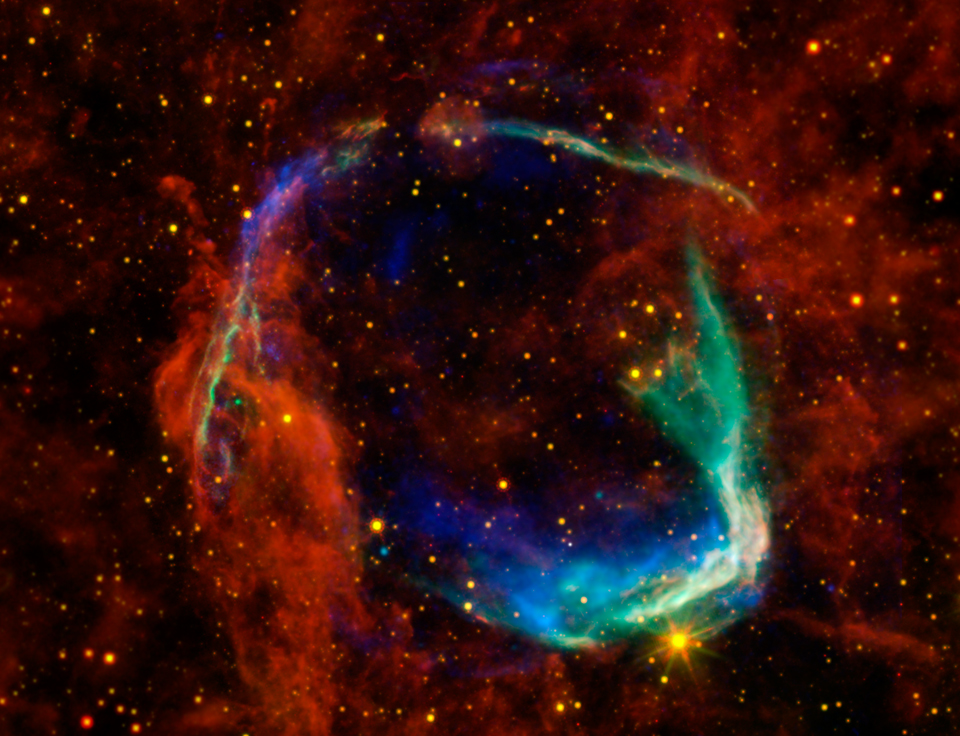
Universe's expansion: Ring-shaped multicolored wisps with foreground stars.
This is RCW 86, the remnant of a Type 1a supernova 8,000 light-years away. Studying Type 1a supernovae led to the discovery that the universe’s expansion is accelerating. An astonishing 2025 study called this discovery into question. But now, new research claims to have found flaws in the 2025 paper. Image via NASA/ CXC/ SAO/ ESA (X-ray)/ JPL-Caltech/ B. Williams (infrared).

The Royal Astronomical Society originally published this article on June 11, 2026. Edits by EarthSky.

No crisis? Universe’s expansion is accelerating after all, study says

Our universe’s expansion is still accelerating despite recent claims suggesting otherwise, an international team of astrophysicists say.

They have refuted a study published last year claiming the growth of the universe is slowing. Instead, the researchers insist there is no flaw in the widely-accepted theory that a mysterious force known as dark energy is driving the expanding cosmos.

The researchers include two Nobel laureates and represent institutions worldwide. They say the debate that followed last November’s revelations was the result of a scientific misunderstanding, rather than a cosmic grenade threatening to blow apart everything we know about the universe.

They published their rebuttal on June 10, 2026, in the peer-reviewed journal Monthly Notices of the Royal Astronomical Society.

Rebutting an extraordinary paper

The new research is a direct rebuttal of a study by a team of South Korean researchers published in November 2025. Their paper made the claim that the universe’s expansion might in fact be slowing down. This would be due to the influence of dark energy – which acts as a kind of anti-gravity – weakening over time.

Lead author Phil Wiseman, from the University of Southampton, said:

The previous and well accepted measurements were, in fact, fine and our current understanding of the fate of the universe remains robust.

Thankfully we have averted this crisis. But the mystery about why the rate of expansion of the universe is still accelerating remains.

By proving our measurements are correct, we can get back to trying to understand what this dark energy actually is, rather than wondering if it exists at all.

What were the flaws?

The international team of researchers involved in the new study included Adam Riess and Brian Schmidt, who collectively won the 2011 Nobel Prize in Physics alongside Saul Perlmutter.

The trio studied Type Ia supernovae, violent, luminous white dwarf star explosions and determined that more distant objects appeared to move faster. This lead to their conclusion that the universe’s expansion was accelerating.

This has been the globally-accepted theory ever since, although last year’s research by the South Korean team threatened to upset the applecart. It claimed that, as the universe aged, these supernovae had different maximum brightnesses. This tricked astronomers into thinking the cosmos was accelerating when it was in fact slowing.

But the University of Southampton-led researchers found an error in how the age of these stars was estimated. They say the previous findings incorrectly assumed the age of a galaxy was the same as the age of the star that exploded.

The experts also said the South Korean paper failed to account for the mass of host galaxies. That is a standard correction used in modern cosmology to prove accuracy.

Riess added:

Extraordinary claims require especially careful testing.

What we find is that when we calibrate these supernovae, accounting for different host environments and populations, the evidence for cosmic acceleration remains remarkably consistent.

Science is never settled

Mark Sullivan, also from the University of Southampton, said challenging accepted theories and observations was fundamental to science.

This is how progress is made. Although this idea did not turn out to be correct, it has opened up new ways of thinking about how supernovae explode and how we can measure dark energy more accurately.

Fellow co-author Brodie Popovic agreed:

We’ve recently been really focused on astrophysics of the explosions and how they impact cosmology.

This was a good opportunity to go back and go over all of our assumptions; it turns out, yes, we do understand this stuff and we’re accounting for it in our cosmology measurement.

Bottom line: Rebutting a surprising paper from 2025, a new study has found that the universe’s expansion is accelerating after all.

You deserve a daily dose of good news. For the latest in science and the night sky, click here to subscribe to our free daily newsletter.

The post No crisis? Universe’s expansion is accelerating, study says first appeared on EarthSky.


from EarthSky https://ift.tt/fVpNUk0
Universe's expansion: Ring-shaped multicolored wisps with foreground stars.
This is RCW 86, the remnant of a Type 1a supernova 8,000 light-years away. Studying Type 1a supernovae led to the discovery that the universe’s expansion is accelerating. An astonishing 2025 study called this discovery into question. But now, new research claims to have found flaws in the 2025 paper. Image via NASA/ CXC/ SAO/ ESA (X-ray)/ JPL-Caltech/ B. Williams (infrared).

The Royal Astronomical Society originally published this article on June 11, 2026. Edits by EarthSky.

No crisis? Universe’s expansion is accelerating after all, study says

Our universe’s expansion is still accelerating despite recent claims suggesting otherwise, an international team of astrophysicists say.

They have refuted a study published last year claiming the growth of the universe is slowing. Instead, the researchers insist there is no flaw in the widely-accepted theory that a mysterious force known as dark energy is driving the expanding cosmos.

The researchers include two Nobel laureates and represent institutions worldwide. They say the debate that followed last November’s revelations was the result of a scientific misunderstanding, rather than a cosmic grenade threatening to blow apart everything we know about the universe.

They published their rebuttal on June 10, 2026, in the peer-reviewed journal Monthly Notices of the Royal Astronomical Society.

Rebutting an extraordinary paper

The new research is a direct rebuttal of a study by a team of South Korean researchers published in November 2025. Their paper made the claim that the universe’s expansion might in fact be slowing down. This would be due to the influence of dark energy – which acts as a kind of anti-gravity – weakening over time.

Lead author Phil Wiseman, from the University of Southampton, said:

The previous and well accepted measurements were, in fact, fine and our current understanding of the fate of the universe remains robust.

Thankfully we have averted this crisis. But the mystery about why the rate of expansion of the universe is still accelerating remains.

By proving our measurements are correct, we can get back to trying to understand what this dark energy actually is, rather than wondering if it exists at all.

What were the flaws?

The international team of researchers involved in the new study included Adam Riess and Brian Schmidt, who collectively won the 2011 Nobel Prize in Physics alongside Saul Perlmutter.

The trio studied Type Ia supernovae, violent, luminous white dwarf star explosions and determined that more distant objects appeared to move faster. This lead to their conclusion that the universe’s expansion was accelerating.

This has been the globally-accepted theory ever since, although last year’s research by the South Korean team threatened to upset the applecart. It claimed that, as the universe aged, these supernovae had different maximum brightnesses. This tricked astronomers into thinking the cosmos was accelerating when it was in fact slowing.

But the University of Southampton-led researchers found an error in how the age of these stars was estimated. They say the previous findings incorrectly assumed the age of a galaxy was the same as the age of the star that exploded.

The experts also said the South Korean paper failed to account for the mass of host galaxies. That is a standard correction used in modern cosmology to prove accuracy.

Riess added:

Extraordinary claims require especially careful testing.

What we find is that when we calibrate these supernovae, accounting for different host environments and populations, the evidence for cosmic acceleration remains remarkably consistent.

Science is never settled

Mark Sullivan, also from the University of Southampton, said challenging accepted theories and observations was fundamental to science.

This is how progress is made. Although this idea did not turn out to be correct, it has opened up new ways of thinking about how supernovae explode and how we can measure dark energy more accurately.

Fellow co-author Brodie Popovic agreed:

We’ve recently been really focused on astrophysics of the explosions and how they impact cosmology.

This was a good opportunity to go back and go over all of our assumptions; it turns out, yes, we do understand this stuff and we’re accounting for it in our cosmology measurement.

Bottom line: Rebutting a surprising paper from 2025, a new study has found that the universe’s expansion is accelerating after all.

You deserve a daily dose of good news. For the latest in science and the night sky, click here to subscribe to our free daily newsletter.

The post No crisis? Universe’s expansion is accelerating, study says first appeared on EarthSky.


from EarthSky https://ift.tt/fVpNUk0

adds 2