View at EarthSky Community Photos. | Alexander Krivenyshev of WorldTimeZone.com captured this stormy shot on July 14, 2023. Alexander wrote: “Lightning bolt strikes the Hudson River between lower Manhattan and Jersey City.” Thank you, Alexander! A new study shows how cities can change the weather and provides particular insight into when urban flooding can happen.
It’s a hot, steamy day, and you see a pop-up thunderstorm darken the sky to your west as a low grumble of thunder shudders the ground. Whether you’re watching from the countryside or a cement-and-steel city can determine what will happen next. Researchers from Texas A&M University said on May 20, 2026, that certain types of storms can intensify over cities. They looked at more than 40,000 storms over 22 years in Texas to discover that certain storms, such as isolated thunderstorm cells, can grow stronger and drop more rain over urban areas.
The researchers pored over data of storms that hit Houston, Dallas-Fort Worth, Austin and San Antonio between 1995 and 2017. While other studies have looked at regional rainfall, this team of researchers zeroed in on the rainfall resulting from different types of storms that hit cities. Co-author John Nielsen-Gammon of Texas A&M University said:
Different storms are driven by different physical processes. Once you separate storms by type, the patterns became much clearer.
The researchers published their study in the peer-reviewed journal Nature on May 20, 2026.
Storms that boost rainfall
Urban flooding is a significant problem in cities. Cities largely consist of buildings and concrete without many places for rainwater to naturally soak into the ground. And storms that hit quickly with heavy rainfall can overwhelm a city’s stormwater system. As a result, streets can flood, endangering drivers and pedestrians. Plus, homes and businesses can incur expensive flood damage. So discovering which storms increase rainfall was particularly important to the researchers.
Two of the categories of storms the researchers looked at – single-cell thunderstorms and larger isolated storms – showed intensification and heavier rainfall when encountering a city. Looking at the radar data, the researchers found single-cell thunderstorms in particular grew taller and more intense over cities. The urban heat island effect – where cities trap heat and are warmer than the surrounding landscape – can cause updrafts that feed storms. In the four Texas cities studied, these small storms occurred 7 to 31% more often than over nearby rural land.
This was especially true at night, when rural areas cooled but the cities retained their heat. Nielsen-Gammon said:
Urban areas hold heat after sunset. That retained warmth can continue to fuel storms overnight, when similar storms over rural areas are more likely to weaken.
A person navigates a flooded city street at night. Image via Rafael Titoneli/ Pexels.
Storms that weaken over cities
But not all storms intensify when they reach a city. For example, storms along a cold front can weaken as they drift over urban heat islands. These types of storms form because of the temperature difference between the advancing cold air and the warm air already present. The study found that storms associated with cold fronts declined about 16 to 28% in their rainfall intensity compared with nearby rural areas. Although, as the storm first hits the city, it can sometimes briefly intensify as the temperature difference becomes sharper. But then it would diminish as the warmth of the city and buildings disrupt the air flow.
Nielsen-Gammon explained:
Cold front rainfall is driven by sharp temperature and wind differences. As they move into the warmer and more turbulent urban environment, those contrasts can weaken, reducing rainfall intensity.
Cities had less of an effect on the other two categories of storms the researchers studied: warm front storms and tropical storms. The main difference the researchers found was that for tropical storms, such as hurricanes, the heavy rain formed lower in the atmosphere over cities. So that could have an impact on flooding. But Nielsen-Gammon said:
These larger systems are driven mainly by ocean heat and larger-scale wind patterns. Urban effects don’t disappear, but they’re secondary compared to those factors.
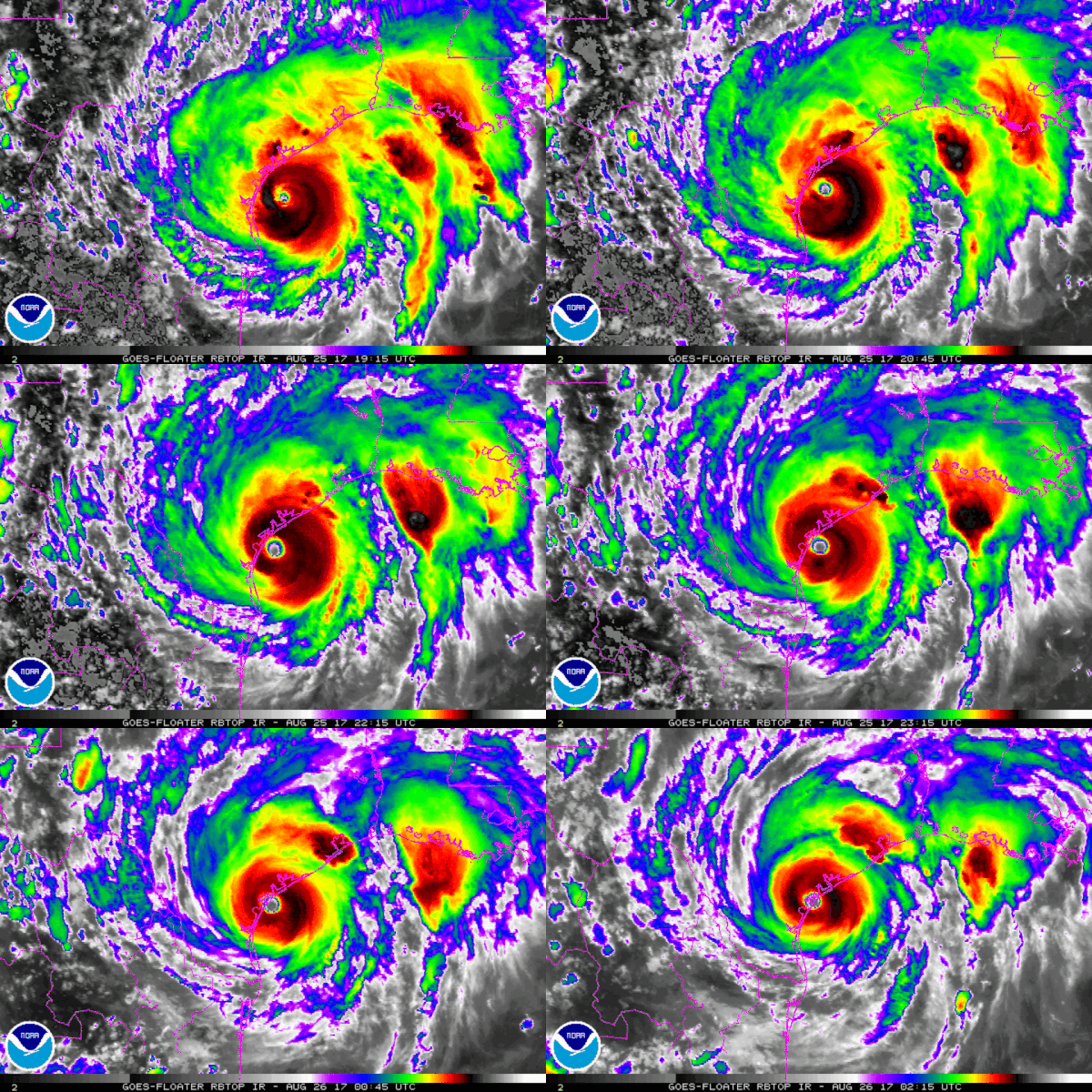
In 2017, Hurricane Harvey caused flooding in Texas and Louisiana and resulted in the deaths of more than 100 people. Image via NOAA/ Wikimedia Commons.
Knowing how cities can change the weather can help us prepare
The researchers said that urban planners need to factor in storms of short duration and high intensity. Previous plans for drainage systems and flood controls relied on averaged rainfall statistics. Nielsen-Gammon said:
If you design only for region-wide averages, you can underestimate the kinds of rainfall that actually cause the most damage. Understanding which storms cities amplify helps planners target the real risks. Asking whether cities get more or less rain is the wrong question. The right question is which storms are affected, because that’s what determines the risk people actually face on the ground.
Bottom line: Researchers have looked at 22 years of data to discover how cities can change the weather. Certain types of storms intensify over cities, leading to more urban flooding.
View at EarthSky Community Photos. | Alexander Krivenyshev of WorldTimeZone.com captured this stormy shot on July 14, 2023. Alexander wrote: “Lightning bolt strikes the Hudson River between lower Manhattan and Jersey City.” Thank you, Alexander! A new study shows how cities can change the weather and provides particular insight into when urban flooding can happen.
It’s a hot, steamy day, and you see a pop-up thunderstorm darken the sky to your west as a low grumble of thunder shudders the ground. Whether you’re watching from the countryside or a cement-and-steel city can determine what will happen next. Researchers from Texas A&M University said on May 20, 2026, that certain types of storms can intensify over cities. They looked at more than 40,000 storms over 22 years in Texas to discover that certain storms, such as isolated thunderstorm cells, can grow stronger and drop more rain over urban areas.
The researchers pored over data of storms that hit Houston, Dallas-Fort Worth, Austin and San Antonio between 1995 and 2017. While other studies have looked at regional rainfall, this team of researchers zeroed in on the rainfall resulting from different types of storms that hit cities. Co-author John Nielsen-Gammon of Texas A&M University said:
Different storms are driven by different physical processes. Once you separate storms by type, the patterns became much clearer.
The researchers published their study in the peer-reviewed journal Nature on May 20, 2026.
Storms that boost rainfall
Urban flooding is a significant problem in cities. Cities largely consist of buildings and concrete without many places for rainwater to naturally soak into the ground. And storms that hit quickly with heavy rainfall can overwhelm a city’s stormwater system. As a result, streets can flood, endangering drivers and pedestrians. Plus, homes and businesses can incur expensive flood damage. So discovering which storms increase rainfall was particularly important to the researchers.
Two of the categories of storms the researchers looked at – single-cell thunderstorms and larger isolated storms – showed intensification and heavier rainfall when encountering a city. Looking at the radar data, the researchers found single-cell thunderstorms in particular grew taller and more intense over cities. The urban heat island effect – where cities trap heat and are warmer than the surrounding landscape – can cause updrafts that feed storms. In the four Texas cities studied, these small storms occurred 7 to 31% more often than over nearby rural land.
This was especially true at night, when rural areas cooled but the cities retained their heat. Nielsen-Gammon said:
Urban areas hold heat after sunset. That retained warmth can continue to fuel storms overnight, when similar storms over rural areas are more likely to weaken.
A person navigates a flooded city street at night. Image via Rafael Titoneli/ Pexels.
Storms that weaken over cities
But not all storms intensify when they reach a city. For example, storms along a cold front can weaken as they drift over urban heat islands. These types of storms form because of the temperature difference between the advancing cold air and the warm air already present. The study found that storms associated with cold fronts declined about 16 to 28% in their rainfall intensity compared with nearby rural areas. Although, as the storm first hits the city, it can sometimes briefly intensify as the temperature difference becomes sharper. But then it would diminish as the warmth of the city and buildings disrupt the air flow.
Nielsen-Gammon explained:
Cold front rainfall is driven by sharp temperature and wind differences. As they move into the warmer and more turbulent urban environment, those contrasts can weaken, reducing rainfall intensity.
Cities had less of an effect on the other two categories of storms the researchers studied: warm front storms and tropical storms. The main difference the researchers found was that for tropical storms, such as hurricanes, the heavy rain formed lower in the atmosphere over cities. So that could have an impact on flooding. But Nielsen-Gammon said:
These larger systems are driven mainly by ocean heat and larger-scale wind patterns. Urban effects don’t disappear, but they’re secondary compared to those factors.
In 2017, Hurricane Harvey caused flooding in Texas and Louisiana and resulted in the deaths of more than 100 people. Image via NOAA/ Wikimedia Commons.
Knowing how cities can change the weather can help us prepare
The researchers said that urban planners need to factor in storms of short duration and high intensity. Previous plans for drainage systems and flood controls relied on averaged rainfall statistics. Nielsen-Gammon said:
If you design only for region-wide averages, you can underestimate the kinds of rainfall that actually cause the most damage. Understanding which storms cities amplify helps planners target the real risks. Asking whether cities get more or less rain is the wrong question. The right question is which storms are affected, because that’s what determines the risk people actually face on the ground.
Bottom line: Researchers have looked at 22 years of data to discover how cities can change the weather. Certain types of storms intensify over cities, leading to more urban flooding.
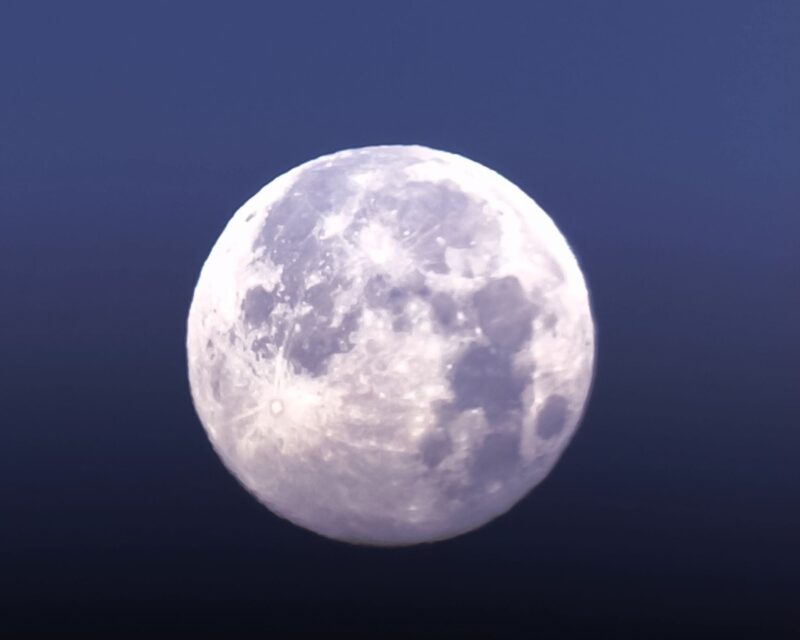
View at EarthSky Community Photos. | Stephane Picard in Quispamsis, New Brunswick, Canada, captured the full moon on the morning of December 5, 2025. Stephane wrote: “This morning’s December supermoon is appropriately called the Cold Moon, as our region will hit almost -30 Celsius (about -22 Fahrenheit). With nearly a foot (30 cm) of snow, it lit up the night over our bright snow base.” Thank you, Stephane! Is it possible to have only 2 full moons in a season? Read more below.
Longtime EarthSky writer – our own beloved Bruce McClure – loved cycles! Here’s one involving the moon …
2 full moons only in a season
A “season” to astronomers is the three-month period between a solstice and an equinox, or an equinox and a solstice. We have a full moon about once a month. So do we ever have a season with just two full moons?
The answer is, yes, it’s possible. But it’s extremely rare! It last happened between the December 1961 solstice and the March 1962 equinox. A full moon fell shortly before the December solstice in 1961 and after the March equinox in 1962, leaving only enough room for two full moons during that season.
Only two full moons occurred in the northern winter (southern summer) of 1961-1962:
Full moon: Dec. 22, 1961 (00:42 UTC)
Solstice: Dec. 22, 1961 (02:19 UT)
Full moon: Jan. 20, 1962
Full moon: Feb. 19, 1962
Equinox: Mar. 21, 1962 (02:30 UTC)
Full moon: Mar. 21, 1962 (07:55 UT)
When will it happen again? Not in the 21st century (2001-2100), 22nd century (2101-2200) or 23rd century (2201-2300). To find out when the next season of two full moons will happen, keep reading.
When’s the next time?
When is the next season with only two full moons? It took some legwork to find out this answer. I finally directed a query to obliquity.com. And, much to my delight, I received an immediate response from David Harper. He wrote in an email to EarthSky:
It’s a very rare phenomenon indeed. Between 1962 and 3000, it happens only four more times, in the winters of 2314/5, 2333/4, 2686/7 and 2705/6. In each case – as in 1961/2 – there is a full moon less than five hours before the December solstice, and there are four full moons in both the preceding autumn and following spring.
I find it interesting that two lunar cycles seem to be at work when it comes to realigning two full moons with the winter season: the long-period lunar cycle of 372 years and the 19-year Metonic cycle.
As you might have noticed, a two-full-moon season is only possible around the December solstice, which corresponds to the northern winter and southern summer. This is the shortest season of the year, lasting about 89 days. Northern spring (southern autumn) lasts for nearly 93 days, northern summer (southern winter) lasts for nearly 94 days, and northern autumn (southern spring) 90 days.
For a winter season to have only two full moons, the December full moon has to occur just before the December solstice.
Also, the full moons from December until March must closely coincide with lunar apogee – the moon’s farthest point from Earth in its monthly orbit. When full moons happen appreciably close to apogee, the time period between successive full moons is longer than average. The shorter season plus longer lunations (lunar months) conspire to give an extremely rare two-full-moon season.
An alternative to “Blue Moon”?
Since the saying once in a Blue Moon is supposed to indicate something exceedingly rare, or something that almost never happens, I propose that we consider calling the second of a season’s two full moons a Blue Moon!
Although fewer than 10% of the seasons harbor four full moons, the occurrence isn’t all that uncommon. A four-full-moon season happens seven times in 19 years. Or another way of looking at it, a total of 37 four-full-moon seasons take place in the 21st century (2001-2100).
Northern Hemisphere winter (Southern Hemisphere summer) is the shortest season. That’s when Earth travels fastest in its orbit because it is always closest to the sun during that season. We’re about 3 million miles (5 million km) closer to the sun in early January than in early July. Image via Wikimedia Commons.
Bottom line: A season with only two full moons is truly rare. It last happened during the Northern Hemisphere winter of 1961/1962 and won’t happen again until 2314/2315.
View at EarthSky Community Photos. | Stephane Picard in Quispamsis, New Brunswick, Canada, captured the full moon on the morning of December 5, 2025. Stephane wrote: “This morning’s December supermoon is appropriately called the Cold Moon, as our region will hit almost -30 Celsius (about -22 Fahrenheit). With nearly a foot (30 cm) of snow, it lit up the night over our bright snow base.” Thank you, Stephane! Is it possible to have only 2 full moons in a season? Read more below.
Longtime EarthSky writer – our own beloved Bruce McClure – loved cycles! Here’s one involving the moon …
2 full moons only in a season
A “season” to astronomers is the three-month period between a solstice and an equinox, or an equinox and a solstice. We have a full moon about once a month. So do we ever have a season with just two full moons?
The answer is, yes, it’s possible. But it’s extremely rare! It last happened between the December 1961 solstice and the March 1962 equinox. A full moon fell shortly before the December solstice in 1961 and after the March equinox in 1962, leaving only enough room for two full moons during that season.
Only two full moons occurred in the northern winter (southern summer) of 1961-1962:
Full moon: Dec. 22, 1961 (00:42 UTC)
Solstice: Dec. 22, 1961 (02:19 UT)
Full moon: Jan. 20, 1962
Full moon: Feb. 19, 1962
Equinox: Mar. 21, 1962 (02:30 UTC)
Full moon: Mar. 21, 1962 (07:55 UT)
When will it happen again? Not in the 21st century (2001-2100), 22nd century (2101-2200) or 23rd century (2201-2300). To find out when the next season of two full moons will happen, keep reading.
When’s the next time?
When is the next season with only two full moons? It took some legwork to find out this answer. I finally directed a query to obliquity.com. And, much to my delight, I received an immediate response from David Harper. He wrote in an email to EarthSky:
It’s a very rare phenomenon indeed. Between 1962 and 3000, it happens only four more times, in the winters of 2314/5, 2333/4, 2686/7 and 2705/6. In each case – as in 1961/2 – there is a full moon less than five hours before the December solstice, and there are four full moons in both the preceding autumn and following spring.
I find it interesting that two lunar cycles seem to be at work when it comes to realigning two full moons with the winter season: the long-period lunar cycle of 372 years and the 19-year Metonic cycle.
As you might have noticed, a two-full-moon season is only possible around the December solstice, which corresponds to the northern winter and southern summer. This is the shortest season of the year, lasting about 89 days. Northern spring (southern autumn) lasts for nearly 93 days, northern summer (southern winter) lasts for nearly 94 days, and northern autumn (southern spring) 90 days.
For a winter season to have only two full moons, the December full moon has to occur just before the December solstice.
Also, the full moons from December until March must closely coincide with lunar apogee – the moon’s farthest point from Earth in its monthly orbit. When full moons happen appreciably close to apogee, the time period between successive full moons is longer than average. The shorter season plus longer lunations (lunar months) conspire to give an extremely rare two-full-moon season.
An alternative to “Blue Moon”?
Since the saying once in a Blue Moon is supposed to indicate something exceedingly rare, or something that almost never happens, I propose that we consider calling the second of a season’s two full moons a Blue Moon!
Although fewer than 10% of the seasons harbor four full moons, the occurrence isn’t all that uncommon. A four-full-moon season happens seven times in 19 years. Or another way of looking at it, a total of 37 four-full-moon seasons take place in the 21st century (2001-2100).
Northern Hemisphere winter (Southern Hemisphere summer) is the shortest season. That’s when Earth travels fastest in its orbit because it is always closest to the sun during that season. We’re about 3 million miles (5 million km) closer to the sun in early January than in early July. Image via Wikimedia Commons.
Bottom line: A season with only two full moons is truly rare. It last happened during the Northern Hemisphere winter of 1961/1962 and won’t happen again until 2314/2315.
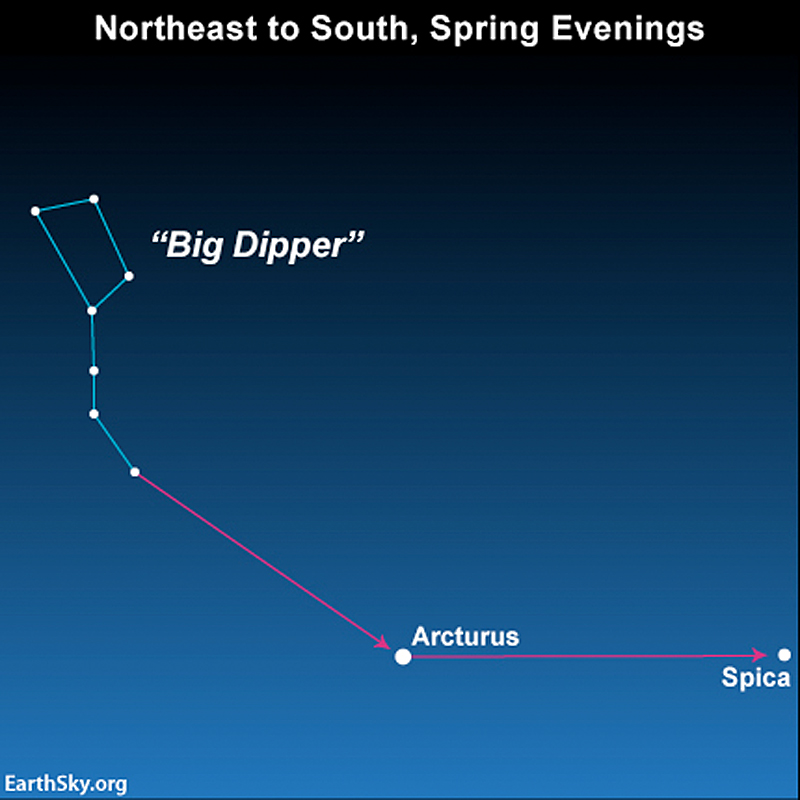
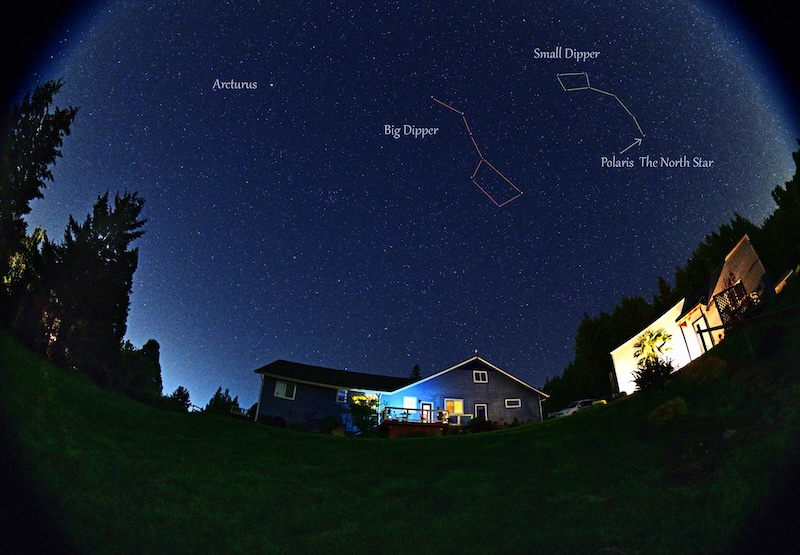
The bright star Arcturus is easy to identify for those in the Northern Hemisphere. Just follow the arc in the handle of the Big Dipper. In other words, follow the arc to Arcturus. Image via EarthSky.
Arcturus is a red giant star. It’s about 25 times the size of our sun, and some 170 times more luminous. And considering the fact that it’s only 36.7 light-years away, it should be little surprise that Arcturus is the 4th-brightest star in Earth’s sky.
And when it comes to stars in the northern half of the sky, Arcturus is the very brightest. It’s far enough north on the sky’s dome that – for Northern Hemisphere observers – it’s visible at some point in the night throughout most of the year.
In the Northern Hemisphere, Arcturus is best viewed on spring or early summer evenings. There’s an easy mnemonic for finding it. Just remember the phrase follow the arc to Arcturus. You need to continue the arc of the Big Dipper’s handle on the sky until you reach a bright orange star. That will be Arcturus!
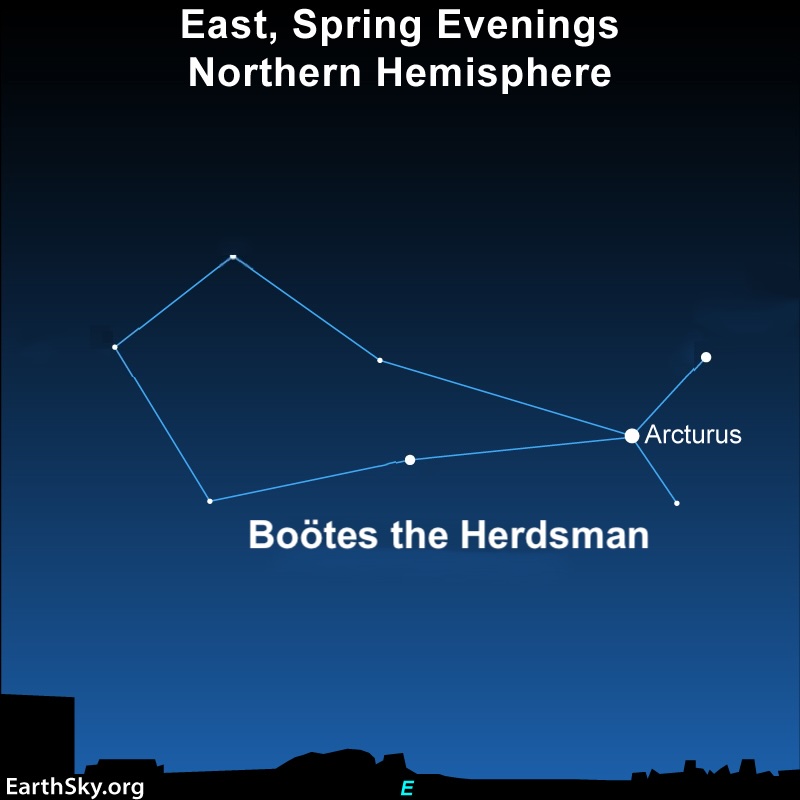
Arcturus is the brightest star of a cone-shaped constellation called Boötes the Herdsman. It takes a lot of imagination to see a herdsman in these stars … but you might easily see a kite! See the chart below.
Arcturus is in the constellation Boötes the Herdsman. Boötes has the shape of a kite, and Arcturus is at the point where you’d attach a tail. You can see it on spring evenings in the Northern Hemisphere.
It’s the brightest star in the northern half of the sky
When astronomers speak of the celestial sphere, they’re talking about the imaginary sphere of stars surrounding Earth.
Imagine Earth’s equator projected onto the sky. A line drawn all the way around the sky – above Earth’s equator – is called the celestial equator. It divides the sky into northern and southern hemispheres, much as the earthly equator does for Earth.
The three brightest stars of the sky – Sirius, Canopus and Alpha Centauri – are all south of this celestial equator.
But Arcturus is north of the celestial equator. That makes it the brightest star in the northern part of the sky. But it’s only marginally brighter than the north celestial sphere’s 2nd-brightest star, blue-white Vega.
By the way … did you know? Some people think Polaris, the North Star, is the brightest star. But it’s not. It’s about the 50th brightest star! It’s famous for being located near the celestial north pole. Read about Polaris here.
From southern latitudes, Arcturus still appears as a bright star. One Earth, one sky, after all. But the Northern Hemisphere’s follow the arc of the Big Dipper trick doesn’t apply. That’s because – from the Southern Hemisphere – the perspective on the sky is shifted. And so the Big Dipper sits low or is entirely out of view, below the northern horizon for much of the south.
Instead, to find Arcturus from the Southern Hemisphere, look northward on autumn evenings (April–June). Arcturus appears as a bright orange star, making a low arc across the northern sky, but standing out for its warm color.
One reliable way to identify Arcturus from the Southern Hemisphere is by using another bright star, Spica, as a guide. Spica is a more southerly star than Arcturus. So it makes a wider arc across our northern sky. It appears generally “above” Arcturus (often to one side of it) as you stand facing north. From our part of the globe, Arcturus and Spica appear as two bright stars, forming a loose line across the northern sky. Arcturus is the brighter of the two and noticeably more orange. Spica is blue-white in color.
It’s true Arcturus is the brightest star in the northern half of the sky. But Southern Hemisphere observers have a better view of the brightest stars overall. From the southern half of the globe, it’s possible to see all four of the brightest stars in the night sky – Sirius (brightest), Canopus (2nd-brightest), Alpha Centauri (3rd-brightest) and Arcturus — during the same season, spread across the sky.
So we in this hemisphere can see with our own eyes what’s true in an absolute sense for all of Earth; Arcturus ranks as the 4th-brightest star in the sky.
So be sure to look for Arcturus from the Southern Hemisphere. Though it never passes overhead from our latitudes, it is one of the most prominent stars of our northern sky.
History and mythology of Boötes and Arcturus
Arcturus’ constellation Boötes the Herdsman is sometimes pictured as guarding the Great Bear, or Ursa Major, which contains the Big Dipper asterism. We sometimes hear Arcturus called the Bear Guard.
In China, Arcturus’ constellation is also called the Dragon.
In some classical Greek stories, Boötes was Icarus, who flew too close to the sun.
Because it passes directly over the Hawaiian islands, Arcturus – brightest light in Boötes – was a particularly important navigational star to the islands’ indigenous inhabitants and other Polynesians.
The translation may be questioned, but Arcturus is among the few stars mentioned in the Bible. (“Which maketh Arcturus, Orion and Pleiades, and the chambers of the south” – Job 9:9, KJV, and “Canst thou bring forth Mazzaroth in his season? or canst thou guide Arcturus with his sons?” – Job 38:32, KJV.)
Arcturus is so bright, it can be seen in daytime
In 1635, less than three decades after the invention of the telescope, Jean-Baptiste Morin of France observed Arcturus in the daytime with a telescope.
It was the first time that any star, besides the sun and a rare supernova, had been seen telescopically during daylight hours.
You can also observe Arcturus with the unaided eye during the day. There’s an explanation on how to do it in this reprint of a science paper from 1911.
1933 Century of Progress Exposition in Chicago
One interesting story about Arcturus relates to the 1933 Century of Progress Exposition in Chicago. Its promoters wanted a flashy way to open the show. And somebody figured out that the light from Arcturus could start it.
At 9:15 pm on May 27, 1933, four telescopes located in different observatories captured the light from the star and focused it into photoelectric cells. The photocells in turn worked as the switch that turned on the main spotlights to open the exhibition. It’s a good thing it wasn’t cloudy!
How did this idea come about? There’d also been a World’s Fair in Chicago in 1893, 40 years earlier. And, at the time, astronomers thought that Arcturus was 40 light-years away. If so, that light left Arcturus at the end of the 1893 fair and traveled for 40 years through space, like an Olympic torch bearer, to open the 1933 show.
It was a good idea. But today’s astronomers place the distance to Arcturus at just less than 37 light-years. Oh well. Progress!
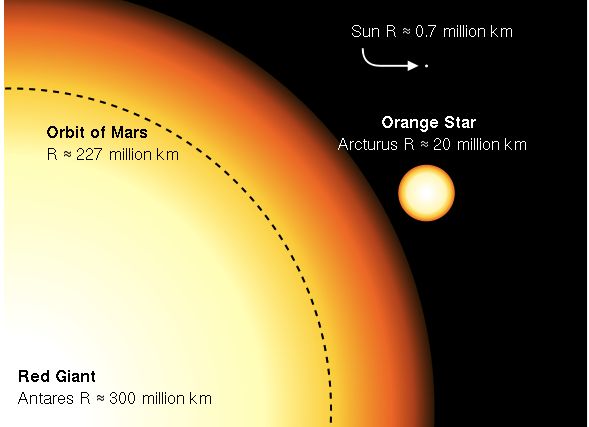
The red giant Arcturus is roughly 25 times the diameter of our sun. But it’s not the largest of the red giants, as this diagram shows. Image via Wikimedia Commons.
Arcturus compared to our sun
Arcturus is a more evolved star than our sun. Billions of years from now, our sun will be a red giant star, much as Arcturus is now.
Arcturus’ diameter is roughly 25 times greater than our sun’s. Because of its larger size, it radiates more than 100 times the light of our sun, in visible light. If you consider infrared and other frequencies in the electromagnetic spectrum, Arcturus is about 200 times more powerful than our sun. But its mass is only slightly greater than the sun’s.
The reddish or orange color of Arcturus signifies its temperature, which is about 7,300 degrees Fahrenheit (around 4,000 degrees Celsius). That makes it several thousand degrees cooler than the surface of our sun.
Arcturus is flying southward
Generally speaking, the stars are fixed. They are all moving through space, but we don’t see them move because they’re so far away. But Arcturus has a large proper motion, or sideways motion, on the dome of Earth’s sky. Among the 1st-magnitude (or bright) stars in our stellar neighborhood, only Alpha Centauri – our sun’s nearest neighbor among the stars – has a higher proper motion.
And of course, the large proper motion of Alpha Centauri stems from the fact that it’s so close to us.
But what does the proper motion of Arcturus tell us?
It tells us that Arcturus is moving at a tremendous speed (76 miles/s or 122 km/s) relative to our solar system. Arcturus is thought to be an old star. It appears to be moving with a group of at least 52 other such stars, known as the Arcturus stream or Arcturus moving group.
Scientists think these stars weren’t part of our Milky Way galaxy, originally. Instead, they might have come from a dwarf satellite galaxy that assimilated into the Milky Way.
From the vantage point of Earth, Arcturus is rapidly moving in a southerly direction at a rate of 3.9 arcminutes per century. It’s now at about its closest point to Earth. As it moves away, it’ll someday vanish from visibility to the unaided eye.
This will happen when it reaches the border of the southern constellations Carina and Vela … in about 150,000 years.
The position of Arcturus is RA: 14h 15 m 39.7s, dec: +19° 10′ 56″
View at EarthSky Community Photos. | Cecille Kennedy captured this image on May 1, 2025, from Oregon and wrote: “The Big Dipper, Arcturus and Polaris, the North Star, shine brightly with the other stars in the still of the blue midnight. The 2 front stars of the Big Dipper are called Pointers because they point to Polaris, the North Star. Polaris is the brightest star in the Little Dipper and the closest bright star to the north celestial pole. When you are looking at Polaris, you are facing north. Arcturus is a 1st-magnitude star and stands right behind the Big Dipper. Arcturus is the brightest star of the constellation Boötes the Herdsman.” Thank you, Cecille!
Bottom line: Arcturus is the brightest star in the northern half of the sky. It’s easy to find in spring in the Northern Hemisphere near the handle of the Big Dipper.
The bright star Arcturus is easy to identify for those in the Northern Hemisphere. Just follow the arc in the handle of the Big Dipper. In other words, follow the arc to Arcturus. Image via EarthSky.
Arcturus is a red giant star. It’s about 25 times the size of our sun, and some 170 times more luminous. And considering the fact that it’s only 36.7 light-years away, it should be little surprise that Arcturus is the 4th-brightest star in Earth’s sky.
And when it comes to stars in the northern half of the sky, Arcturus is the very brightest. It’s far enough north on the sky’s dome that – for Northern Hemisphere observers – it’s visible at some point in the night throughout most of the year.
In the Northern Hemisphere, Arcturus is best viewed on spring or early summer evenings. There’s an easy mnemonic for finding it. Just remember the phrase follow the arc to Arcturus. You need to continue the arc of the Big Dipper’s handle on the sky until you reach a bright orange star. That will be Arcturus!
Arcturus is the brightest star of a cone-shaped constellation called Boötes the Herdsman. It takes a lot of imagination to see a herdsman in these stars … but you might easily see a kite! See the chart below.
Arcturus is in the constellation Boötes the Herdsman. Boötes has the shape of a kite, and Arcturus is at the point where you’d attach a tail. You can see it on spring evenings in the Northern Hemisphere.
It’s the brightest star in the northern half of the sky
When astronomers speak of the celestial sphere, they’re talking about the imaginary sphere of stars surrounding Earth.
Imagine Earth’s equator projected onto the sky. A line drawn all the way around the sky – above Earth’s equator – is called the celestial equator. It divides the sky into northern and southern hemispheres, much as the earthly equator does for Earth.
The three brightest stars of the sky – Sirius, Canopus and Alpha Centauri – are all south of this celestial equator.
But Arcturus is north of the celestial equator. That makes it the brightest star in the northern part of the sky. But it’s only marginally brighter than the north celestial sphere’s 2nd-brightest star, blue-white Vega.
By the way … did you know? Some people think Polaris, the North Star, is the brightest star. But it’s not. It’s about the 50th brightest star! It’s famous for being located near the celestial north pole. Read about Polaris here.
From southern latitudes, Arcturus still appears as a bright star. One Earth, one sky, after all. But the Northern Hemisphere’s follow the arc of the Big Dipper trick doesn’t apply. That’s because – from the Southern Hemisphere – the perspective on the sky is shifted. And so the Big Dipper sits low or is entirely out of view, below the northern horizon for much of the south.
Instead, to find Arcturus from the Southern Hemisphere, look northward on autumn evenings (April–June). Arcturus appears as a bright orange star, making a low arc across the northern sky, but standing out for its warm color.
One reliable way to identify Arcturus from the Southern Hemisphere is by using another bright star, Spica, as a guide. Spica is a more southerly star than Arcturus. So it makes a wider arc across our northern sky. It appears generally “above” Arcturus (often to one side of it) as you stand facing north. From our part of the globe, Arcturus and Spica appear as two bright stars, forming a loose line across the northern sky. Arcturus is the brighter of the two and noticeably more orange. Spica is blue-white in color.
It’s true Arcturus is the brightest star in the northern half of the sky. But Southern Hemisphere observers have a better view of the brightest stars overall. From the southern half of the globe, it’s possible to see all four of the brightest stars in the night sky – Sirius (brightest), Canopus (2nd-brightest), Alpha Centauri (3rd-brightest) and Arcturus — during the same season, spread across the sky.
So we in this hemisphere can see with our own eyes what’s true in an absolute sense for all of Earth; Arcturus ranks as the 4th-brightest star in the sky.
So be sure to look for Arcturus from the Southern Hemisphere. Though it never passes overhead from our latitudes, it is one of the most prominent stars of our northern sky.
History and mythology of Boötes and Arcturus
Arcturus’ constellation Boötes the Herdsman is sometimes pictured as guarding the Great Bear, or Ursa Major, which contains the Big Dipper asterism. We sometimes hear Arcturus called the Bear Guard.
In China, Arcturus’ constellation is also called the Dragon.
In some classical Greek stories, Boötes was Icarus, who flew too close to the sun.
Because it passes directly over the Hawaiian islands, Arcturus – brightest light in Boötes – was a particularly important navigational star to the islands’ indigenous inhabitants and other Polynesians.
The translation may be questioned, but Arcturus is among the few stars mentioned in the Bible. (“Which maketh Arcturus, Orion and Pleiades, and the chambers of the south” – Job 9:9, KJV, and “Canst thou bring forth Mazzaroth in his season? or canst thou guide Arcturus with his sons?” – Job 38:32, KJV.)
Arcturus is so bright, it can be seen in daytime
In 1635, less than three decades after the invention of the telescope, Jean-Baptiste Morin of France observed Arcturus in the daytime with a telescope.
It was the first time that any star, besides the sun and a rare supernova, had been seen telescopically during daylight hours.
You can also observe Arcturus with the unaided eye during the day. There’s an explanation on how to do it in this reprint of a science paper from 1911.
1933 Century of Progress Exposition in Chicago
One interesting story about Arcturus relates to the 1933 Century of Progress Exposition in Chicago. Its promoters wanted a flashy way to open the show. And somebody figured out that the light from Arcturus could start it.
At 9:15 pm on May 27, 1933, four telescopes located in different observatories captured the light from the star and focused it into photoelectric cells. The photocells in turn worked as the switch that turned on the main spotlights to open the exhibition. It’s a good thing it wasn’t cloudy!
How did this idea come about? There’d also been a World’s Fair in Chicago in 1893, 40 years earlier. And, at the time, astronomers thought that Arcturus was 40 light-years away. If so, that light left Arcturus at the end of the 1893 fair and traveled for 40 years through space, like an Olympic torch bearer, to open the 1933 show.
It was a good idea. But today’s astronomers place the distance to Arcturus at just less than 37 light-years. Oh well. Progress!
The red giant Arcturus is roughly 25 times the diameter of our sun. But it’s not the largest of the red giants, as this diagram shows. Image via Wikimedia Commons.
Arcturus compared to our sun
Arcturus is a more evolved star than our sun. Billions of years from now, our sun will be a red giant star, much as Arcturus is now.
Arcturus’ diameter is roughly 25 times greater than our sun’s. Because of its larger size, it radiates more than 100 times the light of our sun, in visible light. If you consider infrared and other frequencies in the electromagnetic spectrum, Arcturus is about 200 times more powerful than our sun. But its mass is only slightly greater than the sun’s.
The reddish or orange color of Arcturus signifies its temperature, which is about 7,300 degrees Fahrenheit (around 4,000 degrees Celsius). That makes it several thousand degrees cooler than the surface of our sun.
Arcturus is flying southward
Generally speaking, the stars are fixed. They are all moving through space, but we don’t see them move because they’re so far away. But Arcturus has a large proper motion, or sideways motion, on the dome of Earth’s sky. Among the 1st-magnitude (or bright) stars in our stellar neighborhood, only Alpha Centauri – our sun’s nearest neighbor among the stars – has a higher proper motion.
And of course, the large proper motion of Alpha Centauri stems from the fact that it’s so close to us.
But what does the proper motion of Arcturus tell us?
It tells us that Arcturus is moving at a tremendous speed (76 miles/s or 122 km/s) relative to our solar system. Arcturus is thought to be an old star. It appears to be moving with a group of at least 52 other such stars, known as the Arcturus stream or Arcturus moving group.
Scientists think these stars weren’t part of our Milky Way galaxy, originally. Instead, they might have come from a dwarf satellite galaxy that assimilated into the Milky Way.
From the vantage point of Earth, Arcturus is rapidly moving in a southerly direction at a rate of 3.9 arcminutes per century. It’s now at about its closest point to Earth. As it moves away, it’ll someday vanish from visibility to the unaided eye.
This will happen when it reaches the border of the southern constellations Carina and Vela … in about 150,000 years.
The position of Arcturus is RA: 14h 15 m 39.7s, dec: +19° 10′ 56″
View at EarthSky Community Photos. | Cecille Kennedy captured this image on May 1, 2025, from Oregon and wrote: “The Big Dipper, Arcturus and Polaris, the North Star, shine brightly with the other stars in the still of the blue midnight. The 2 front stars of the Big Dipper are called Pointers because they point to Polaris, the North Star. Polaris is the brightest star in the Little Dipper and the closest bright star to the north celestial pole. When you are looking at Polaris, you are facing north. Arcturus is a 1st-magnitude star and stands right behind the Big Dipper. Arcturus is the brightest star of the constellation Boötes the Herdsman.” Thank you, Cecille!
Bottom line: Arcturus is the brightest star in the northern half of the sky. It’s easy to find in spring in the Northern Hemisphere near the handle of the Big Dipper.
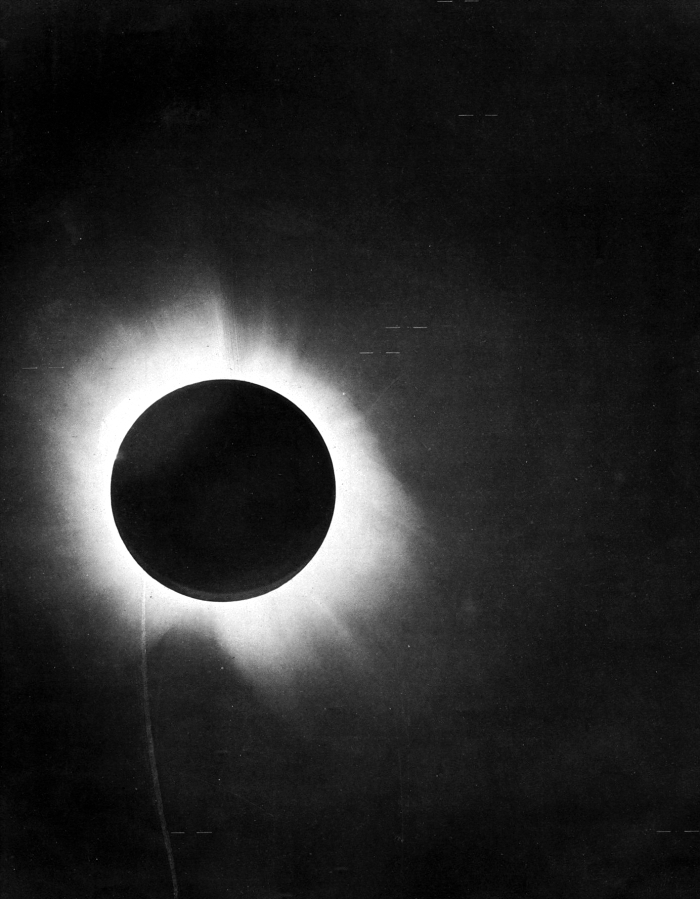
Einstein’s triumph. This early photograph shows a 1919 solar eclipse. See the tick marks around stars near the eclipsed sun? It was the precise measurement of the positions of these stars that proved the sun’s mass caused surrounding space to curve, bending starlight, in accordance with Einstein’s theory of general relativity. Image via Wikimedia Commons.
May 29, 1919, is the date of a solar eclipse that caused a revolution in human thought. The eclipse is famous for testing Albert Einstein’s theory of general relativity. Einstein was relatively unknown at the time. He had proposed general relativity in 1915, introducing a new way of thinking about gravity. Key to the theory was the transformative idea that mass causes space to curve.
Scientists were intrigued. But no one had experimentally proven Einstein’s theory to be true.
Then, on May 29, 1919, an expedition of English scientists – led by Sir Arthur Eddington – traveled to the island of Príncipe off the west coast of Africa to observe a total solar eclipse. If Einstein’s theory were correct, the light of stars should be bent while traveling the curved space near our sun. In other words, the sun’s gravity would cause the stars in the sun’s vicinity to appear displaced.
An eclipse, where the moon blocks the sunlight enough for stars to be seen near the sun, was the perfect opportunity to test this wild-sounding theory.
The scientists’ measurements during the eclipse showed that, astoundingly, Einstein’s predictions were correct. The locations of stars near the sun – made visible when the moon blocked the sun’s blazing light from view – appeared displaced.
Light did have to travel to our eyes on the curved space around the sun. Gravity worked as Einstein said it did.
From anonymity to stardom via a solar eclipse
Later that year – on November 6, 1919, in London – England’s Astronomer Royal, Frank Dyson, who had organized the expedition, presented the results at a joint meeting of the Royal Astronomical Society and the Royal Society. Dyson said “there can be no doubt” that measurements made during the May 29, 1919, solar eclipse “confirm Einstein’s prediction.”
As part of the celebration of the 100th anniversary of this legendary solar eclipse, Caltech physicist Sean Carroll explained to NBCNews in 2019:
General relativity was the poster child for being a crazy, new, hard-to-understand theory, with dramatic implications for the nature of reality. And yet you could see [the results]; you could photograph it. So people got caught up in that excitement.
And so Albert Einstein was catapulted to rock star fame, a status in popular culture he has retained ever since.
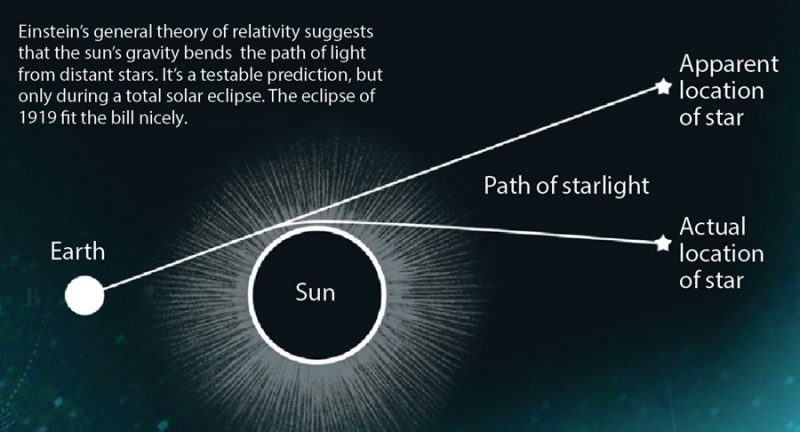
During a solar eclipse, stars normally not visible in the glaring sunlight appear on the side of the sun and are displaced from the location they’d normally be in. Why? Because – just as Einstein’s theory said it should – light bends in the presence of mass, in this case the mass of a star, our sun. Rather than traveling in a straight path, the light of distant stars is forced to travel a curved path along the curved space near the sun. Note that the bending of starlight is exaggerated in this image. In reality, the stars are displaced by up to 1.75 arcseconds (about 0.0005 degrees). Image via NASA/ Goddard Space Flight Center/ DiscoverMagazine.com.
A new perspective on gravity and the universe
Einstein’s general theory of relativity underlies our most basic modern cosmology, our way of looking at the universe as a whole. Before Einstein, scientists relied on Isaac Newton’s theory of gravity. Newton’s way of looking at gravity is still valid and is still taught to physics students. But while Newton’s formulation of gravity is more of a special case under specific conditions, Einstein’s theory is a refinement of scientists’ understanding of gravity that covers the big picture … and what a mind-blowing big picture! Einstein proposed that mass causes space to curve.
So, for example, although there appears to be a “force” (as described by Newton) that causes our Earth to be pulled towards the sun by gravity. That force can “simply” be described as Earth traveling in curved space around the sun, according to Einstein.
Einstein’s general theory of relativity not only explains the motion of Earth and the other planets in our solar system. In our modern cosmology, it also describes extreme examples of curved space, such as around black holes. And it helps to describe the history and expansion of the universe as a whole.
The solar eclipse was the first proof of many
In the century and a bit since the 1919 total solar eclipse, Einstein’s relativity theory has been proven again and again, in many different ways. You might have seen the recent first-ever photo of a black hole? It also proved, once again, that Einstein was right.
This image captured people’s imaginations when it was released in 2019: the first-ever actual image of a giant black hole, in the center of galaxy M87. It also proves Einstein’s theory, which predicted the observations from M87 with unerring accuracy. Image via Event Horizon Telescope Collaboration.
Now and then
The Royal Astronomical Society (RAS) described modern-day practical applications of Einstein’s theory:
The theory fundamentally changed our understanding of physics and astronomy, and underpins critical modern technologies such as the satellite-based Global Positioning System (GPS).
The theory of relativity is essential for the correct operation of GPS systems, which in turn are relied on in many common applications including vehicle satellite navigation (SatNav) systems, weather forecasting, and disaster relief and emergency services. However, the world had to wait decades before the applications of such a blue skies result could be realized.
Back in the day of the 1919 eclipse, Sir Arthur Eddington attended a dinner of the same organization – RAS – shortly after the successful expedition. He then showed his humorous side by reciting a verse he had written on the feat:
Oh leave the wise our measures to collate
One thing at least is certain, light has weight
One thing is certain and the rest debate
Light rays, when near the sun, do not go straight.
Bottom line: The solar eclipse of May 29, 1919, was the day astronomer Sir Arthur Eddington verified Einstein’s general theory of relativity, by observing how stars near the sun were displaced from their normal positions. This apparent change in position happens because, according to Einstein’s theory, the path of light is bent by gravity when it travels close to a massive object like our sun.
Einstein’s triumph. This early photograph shows a 1919 solar eclipse. See the tick marks around stars near the eclipsed sun? It was the precise measurement of the positions of these stars that proved the sun’s mass caused surrounding space to curve, bending starlight, in accordance with Einstein’s theory of general relativity. Image via Wikimedia Commons.
May 29, 1919, is the date of a solar eclipse that caused a revolution in human thought. The eclipse is famous for testing Albert Einstein’s theory of general relativity. Einstein was relatively unknown at the time. He had proposed general relativity in 1915, introducing a new way of thinking about gravity. Key to the theory was the transformative idea that mass causes space to curve.
Scientists were intrigued. But no one had experimentally proven Einstein’s theory to be true.
Then, on May 29, 1919, an expedition of English scientists – led by Sir Arthur Eddington – traveled to the island of Príncipe off the west coast of Africa to observe a total solar eclipse. If Einstein’s theory were correct, the light of stars should be bent while traveling the curved space near our sun. In other words, the sun’s gravity would cause the stars in the sun’s vicinity to appear displaced.
An eclipse, where the moon blocks the sunlight enough for stars to be seen near the sun, was the perfect opportunity to test this wild-sounding theory.
The scientists’ measurements during the eclipse showed that, astoundingly, Einstein’s predictions were correct. The locations of stars near the sun – made visible when the moon blocked the sun’s blazing light from view – appeared displaced.
Light did have to travel to our eyes on the curved space around the sun. Gravity worked as Einstein said it did.
From anonymity to stardom via a solar eclipse
Later that year – on November 6, 1919, in London – England’s Astronomer Royal, Frank Dyson, who had organized the expedition, presented the results at a joint meeting of the Royal Astronomical Society and the Royal Society. Dyson said “there can be no doubt” that measurements made during the May 29, 1919, solar eclipse “confirm Einstein’s prediction.”
As part of the celebration of the 100th anniversary of this legendary solar eclipse, Caltech physicist Sean Carroll explained to NBCNews in 2019:
General relativity was the poster child for being a crazy, new, hard-to-understand theory, with dramatic implications for the nature of reality. And yet you could see [the results]; you could photograph it. So people got caught up in that excitement.
And so Albert Einstein was catapulted to rock star fame, a status in popular culture he has retained ever since.
During a solar eclipse, stars normally not visible in the glaring sunlight appear on the side of the sun and are displaced from the location they’d normally be in. Why? Because – just as Einstein’s theory said it should – light bends in the presence of mass, in this case the mass of a star, our sun. Rather than traveling in a straight path, the light of distant stars is forced to travel a curved path along the curved space near the sun. Note that the bending of starlight is exaggerated in this image. In reality, the stars are displaced by up to 1.75 arcseconds (about 0.0005 degrees). Image via NASA/ Goddard Space Flight Center/ DiscoverMagazine.com.
A new perspective on gravity and the universe
Einstein’s general theory of relativity underlies our most basic modern cosmology, our way of looking at the universe as a whole. Before Einstein, scientists relied on Isaac Newton’s theory of gravity. Newton’s way of looking at gravity is still valid and is still taught to physics students. But while Newton’s formulation of gravity is more of a special case under specific conditions, Einstein’s theory is a refinement of scientists’ understanding of gravity that covers the big picture … and what a mind-blowing big picture! Einstein proposed that mass causes space to curve.
So, for example, although there appears to be a “force” (as described by Newton) that causes our Earth to be pulled towards the sun by gravity. That force can “simply” be described as Earth traveling in curved space around the sun, according to Einstein.
Einstein’s general theory of relativity not only explains the motion of Earth and the other planets in our solar system. In our modern cosmology, it also describes extreme examples of curved space, such as around black holes. And it helps to describe the history and expansion of the universe as a whole.
The solar eclipse was the first proof of many
In the century and a bit since the 1919 total solar eclipse, Einstein’s relativity theory has been proven again and again, in many different ways. You might have seen the recent first-ever photo of a black hole? It also proved, once again, that Einstein was right.
This image captured people’s imaginations when it was released in 2019: the first-ever actual image of a giant black hole, in the center of galaxy M87. It also proves Einstein’s theory, which predicted the observations from M87 with unerring accuracy. Image via Event Horizon Telescope Collaboration.
Now and then
The Royal Astronomical Society (RAS) described modern-day practical applications of Einstein’s theory:
The theory fundamentally changed our understanding of physics and astronomy, and underpins critical modern technologies such as the satellite-based Global Positioning System (GPS).
The theory of relativity is essential for the correct operation of GPS systems, which in turn are relied on in many common applications including vehicle satellite navigation (SatNav) systems, weather forecasting, and disaster relief and emergency services. However, the world had to wait decades before the applications of such a blue skies result could be realized.
Back in the day of the 1919 eclipse, Sir Arthur Eddington attended a dinner of the same organization – RAS – shortly after the successful expedition. He then showed his humorous side by reciting a verse he had written on the feat:
Oh leave the wise our measures to collate
One thing at least is certain, light has weight
One thing is certain and the rest debate
Light rays, when near the sun, do not go straight.
Bottom line: The solar eclipse of May 29, 1919, was the day astronomer Sir Arthur Eddington verified Einstein’s general theory of relativity, by observing how stars near the sun were displaced from their normal positions. This apparent change in position happens because, according to Einstein’s theory, the path of light is bent by gravity when it travels close to a massive object like our sun.
The Blue Origin mega-rocket explosion took place at 9 p.m. EDT on Friday, May 28, 2026. Image via SpaceFlight Now.
Jeff Bezos’ space company Blue Origin, experienced a major setback late Friday when its New Glenn mega-rocket exploded during testing at a launch site in Cape Canaveral, Florida. It was one of the largest rocket explosions in U.S. history. Blue Origin later confirmed the explosion, as did Jeff Bezos, who said in a statement:
All personnel are accounted for and safe. It’s too early to know the root cause, but we’re already working to find it. Very rough day, but we’ll rebuild whatever needs rebuilding and get back to flying.
The explosion happened at approximately 9 p.m. EDT on the night of May 28, 2026. At 8:31 p.m. EDT, Blue Origin released this official statement:
We experienced an anomaly during today’s hotfire test. All personnel have been accounted for. We will provide updates as we learn more.
https://ift.tt/ap2P5by
What sort of rocket was it?
The Blue Origin rocket is one of the largest operational or near-operational rockets on Earth. It belonged to the class of Heavy Lift Launch Vehicles (HLLVs). These rockets are about 98 meters (322 feet) tall, or roughly the height of a 32-story building.
NASA had just announced earlier this week that Blue Origin would play a major role in carrying payloads to the moon for its planned moon base. And this is the rocket design that will play a role in those moon missions.
This Blue Origin rocket is designed to carry up to 45 metric tons (nearly 100,000 pounds) of cargo to Low-Earth Orbit (LEO) in its fully reusable configuration. That’s roughly equivalent to launching three fully loaded commercial school buses into space at the exact same time.
The Blue Origin explosion came during testing
Blue Origin was performing a test ahead of an anticipated launch of the new rocket in the coming weeks. The coming launch was supposed to carry Amazon Leo internet satellites to space.
So the rocket was likely fully fueled, contributing to what is one of the largest rocket explosions in U.S. history and the worst failure in Blue Origin’s existence, according to media sources.
Prior to this, Blue Origin’s most notable inflight anomaly was an uncrewed New Shepard suborbital mission (NS-23) in 2022, which safely triggered its capsule escape system. And, before last night’s explosion, the company had never lost a massive, orbital-class vehicle like the New Glenn, let alone experienced a catastrophic pad explosion of this magnitude.
While the explosion caused significant damage to Launch Complex 36, Amazon luckily confirmed that the 48 Project Kuiper (Leo) internet satellites scheduled for the upcoming flight were not yet loaded onto the rocket during the test. So they are safe.
What sort of test was it?
A static fire test (also called a static hotfire test) is a common pre-launch procedure in aerospace engineering. During the test, a rocket’s engines are ignited at full thrust while the vehicle is securely clamped down to the launchpad.
The primary goal is to test the rocket’s propulsion system and overall readiness under flight-like conditions without actually letting it lift off.
Likely next steps for Blue Origin?
Now, Blue Origin is likely to shift from preparation to investigation and recovery. Because the New Glenn is central to both commercial contracts and NASA’s lunar timeline, the company faces intense pressure.
Their primary next steps probably include:
A “root cause” Investigation. Before any rocket can clear for flight, Blue Origin — coordinating with Space Launch Delta 45 and the Federal Aviation Administration (FAA) — must determine exactly what triggered the anomaly.
Rebuilding Launch Complex 36 at Cape Canaverl. The explosion of a 98-meter mega-rocket completely loaded with liquefied natural gas and liquid oxygen inflicts severe damage on pad infrastructure. Blue Origin will need to clear the debris and rebuild the heavily damaged launch mount, umbilical towers, fuel lines, and electrical systems. Jeff Bezos acknowledged the scale of this task in his statement, when he said, “We’ll rebuild whatever needs rebuilding and get back to flying.”
Rescheduling the flight profile. The destroyed rocket was supposed to launch 48 of Amazon’s Project Kuiper internet satellites. While those satellites are safe because they hadn’t been integrated onto the rocket yet, Blue Origin will have to manufacture a brand-new New Glenn first stage and reschedule the flight.
Mitigating delays for NASA’s moon missions. This failure heavily impacts NASA’s upcoming lunar schedule.
Bottom line: Blue Origin experienced a setback late Friday when its New Glenn mega-rocket exploded during testing at a launch site in Cape Canaveral, Florida.
The Blue Origin mega-rocket explosion took place at 9 p.m. EDT on Friday, May 28, 2026. Image via SpaceFlight Now.
Jeff Bezos’ space company Blue Origin, experienced a major setback late Friday when its New Glenn mega-rocket exploded during testing at a launch site in Cape Canaveral, Florida. It was one of the largest rocket explosions in U.S. history. Blue Origin later confirmed the explosion, as did Jeff Bezos, who said in a statement:
All personnel are accounted for and safe. It’s too early to know the root cause, but we’re already working to find it. Very rough day, but we’ll rebuild whatever needs rebuilding and get back to flying.
The explosion happened at approximately 9 p.m. EDT on the night of May 28, 2026. At 8:31 p.m. EDT, Blue Origin released this official statement:
We experienced an anomaly during today’s hotfire test. All personnel have been accounted for. We will provide updates as we learn more.
https://ift.tt/ap2P5by
What sort of rocket was it?
The Blue Origin rocket is one of the largest operational or near-operational rockets on Earth. It belonged to the class of Heavy Lift Launch Vehicles (HLLVs). These rockets are about 98 meters (322 feet) tall, or roughly the height of a 32-story building.
NASA had just announced earlier this week that Blue Origin would play a major role in carrying payloads to the moon for its planned moon base. And this is the rocket design that will play a role in those moon missions.
This Blue Origin rocket is designed to carry up to 45 metric tons (nearly 100,000 pounds) of cargo to Low-Earth Orbit (LEO) in its fully reusable configuration. That’s roughly equivalent to launching three fully loaded commercial school buses into space at the exact same time.
The Blue Origin explosion came during testing
Blue Origin was performing a test ahead of an anticipated launch of the new rocket in the coming weeks. The coming launch was supposed to carry Amazon Leo internet satellites to space.
So the rocket was likely fully fueled, contributing to what is one of the largest rocket explosions in U.S. history and the worst failure in Blue Origin’s existence, according to media sources.
Prior to this, Blue Origin’s most notable inflight anomaly was an uncrewed New Shepard suborbital mission (NS-23) in 2022, which safely triggered its capsule escape system. And, before last night’s explosion, the company had never lost a massive, orbital-class vehicle like the New Glenn, let alone experienced a catastrophic pad explosion of this magnitude.
While the explosion caused significant damage to Launch Complex 36, Amazon luckily confirmed that the 48 Project Kuiper (Leo) internet satellites scheduled for the upcoming flight were not yet loaded onto the rocket during the test. So they are safe.
What sort of test was it?
A static fire test (also called a static hotfire test) is a common pre-launch procedure in aerospace engineering. During the test, a rocket’s engines are ignited at full thrust while the vehicle is securely clamped down to the launchpad.
The primary goal is to test the rocket’s propulsion system and overall readiness under flight-like conditions without actually letting it lift off.
Likely next steps for Blue Origin?
Now, Blue Origin is likely to shift from preparation to investigation and recovery. Because the New Glenn is central to both commercial contracts and NASA’s lunar timeline, the company faces intense pressure.
Their primary next steps probably include:
A “root cause” Investigation. Before any rocket can clear for flight, Blue Origin — coordinating with Space Launch Delta 45 and the Federal Aviation Administration (FAA) — must determine exactly what triggered the anomaly.
Rebuilding Launch Complex 36 at Cape Canaverl. The explosion of a 98-meter mega-rocket completely loaded with liquefied natural gas and liquid oxygen inflicts severe damage on pad infrastructure. Blue Origin will need to clear the debris and rebuild the heavily damaged launch mount, umbilical towers, fuel lines, and electrical systems. Jeff Bezos acknowledged the scale of this task in his statement, when he said, “We’ll rebuild whatever needs rebuilding and get back to flying.”
Rescheduling the flight profile. The destroyed rocket was supposed to launch 48 of Amazon’s Project Kuiper internet satellites. While those satellites are safe because they hadn’t been integrated onto the rocket yet, Blue Origin will have to manufacture a brand-new New Glenn first stage and reschedule the flight.
Mitigating delays for NASA’s moon missions. This failure heavily impacts NASA’s upcoming lunar schedule.
Bottom line: Blue Origin experienced a setback late Friday when its New Glenn mega-rocket exploded during testing at a launch site in Cape Canaveral, Florida.
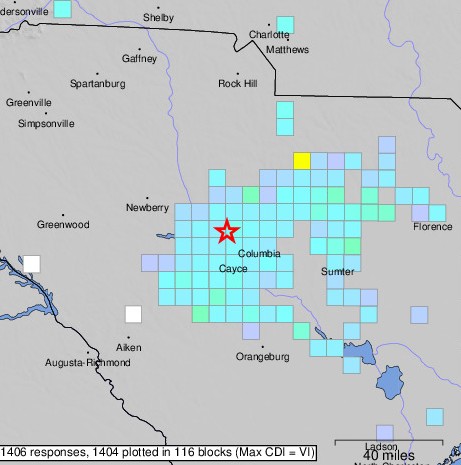
What sounded like a massive explosion rocked Midlands of South Carolina on May 28, 2026, around 5 p.m. local time. Even though people reported shaking, the USGS said there was no earthquake. Instead it said a sonic boom rattled the area. But what was the source? Image via USGS.
Strange sonic boom rattles South Carolina
Around 5:30 p.m. local time, residents of Midlands of South Carolina reported hearing an immense boom. At first, people took to social media wondering if they’d just experienced an earthquake. But the United States Geological Society (USGS) was quick to respond, reporting that it was a sonic boom that shook the air instead of an earthquake that shook the ground. It said the magnitude of the event was 0.0, so definitely not an earthquake.
People shared video from an airport and Ring doorbells on social media that captured the sound and rattling of buildings. Some even reported feeling the pressure wave. Meteorologist Chris Jackson was in South Carolina at the time and said:
It felt like someone shoved me right in my chest an instant before the boom began.
See the sonic boom rattle an airport hangar in this X post.
Could it have been an aircraft that created the sonic boom? Possibly, but at the moment there is no one taking claim as the source of the explosive sound.
A more likely possibility was that it was a meteor. But there haven’t really been reports of anyone seeing a meteor. Granted it was daylight at the time, but often with big meteors they still leave a trail in daylight. The American Meteor Society has not received an onslaught of sightings, anyway. You can see the pending reports here.
One possible eyewitness was Aaron Olson in Columbia, South Carolina. Aaron posted on X:
I noticed some odd contrails immediately following the boom too. Sort radiating from a common point. Lends itself to a meteor explosion.
And this doorbell camera appears to show a trail from a meteor. Look for it in the upper right. It resembles an airplane’s contrail.
Did you hear the sonic boom? Let us know in the comments below.
Bottom line: People in South Carolina heard a strange sonic boom on the evening of May 28, 2026, around 5:30 p.m. local time. The USGS said it wasn’t an earthquake. Could it have been a meteor?
What sounded like a massive explosion rocked Midlands of South Carolina on May 28, 2026, around 5 p.m. local time. Even though people reported shaking, the USGS said there was no earthquake. Instead it said a sonic boom rattled the area. But what was the source? Image via USGS.
Strange sonic boom rattles South Carolina
Around 5:30 p.m. local time, residents of Midlands of South Carolina reported hearing an immense boom. At first, people took to social media wondering if they’d just experienced an earthquake. But the United States Geological Society (USGS) was quick to respond, reporting that it was a sonic boom that shook the air instead of an earthquake that shook the ground. It said the magnitude of the event was 0.0, so definitely not an earthquake.
People shared video from an airport and Ring doorbells on social media that captured the sound and rattling of buildings. Some even reported feeling the pressure wave. Meteorologist Chris Jackson was in South Carolina at the time and said:
It felt like someone shoved me right in my chest an instant before the boom began.
See the sonic boom rattle an airport hangar in this X post.
Could it have been an aircraft that created the sonic boom? Possibly, but at the moment there is no one taking claim as the source of the explosive sound.
A more likely possibility was that it was a meteor. But there haven’t really been reports of anyone seeing a meteor. Granted it was daylight at the time, but often with big meteors they still leave a trail in daylight. The American Meteor Society has not received an onslaught of sightings, anyway. You can see the pending reports here.
One possible eyewitness was Aaron Olson in Columbia, South Carolina. Aaron posted on X:
I noticed some odd contrails immediately following the boom too. Sort radiating from a common point. Lends itself to a meteor explosion.
And this doorbell camera appears to show a trail from a meteor. Look for it in the upper right. It resembles an airplane’s contrail.
Did you hear the sonic boom? Let us know in the comments below.
Bottom line: People in South Carolina heard a strange sonic boom on the evening of May 28, 2026, around 5:30 p.m. local time. The USGS said it wasn’t an earthquake. Could it have been a meteor?
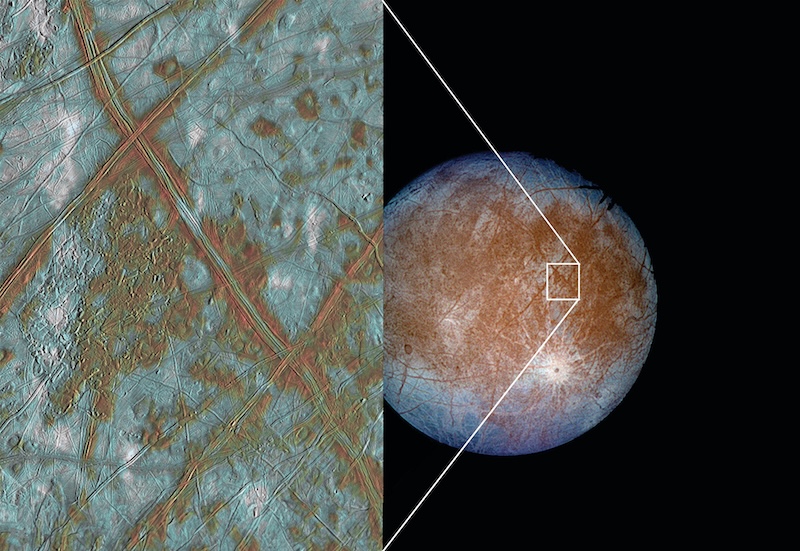
View larger. | Jupiter’s moon Europa, with an inset showing a closer view of cracks on the surface. A new study from SwRI lowers the probability of Europa’s water vapor plumes being real. Image via NASA/ SwRI.
Jupiter’s moon Europa has a global ocean beneath its icy crust. Does it have water vapor plumes too, like Saturn’s moon Enceladus?
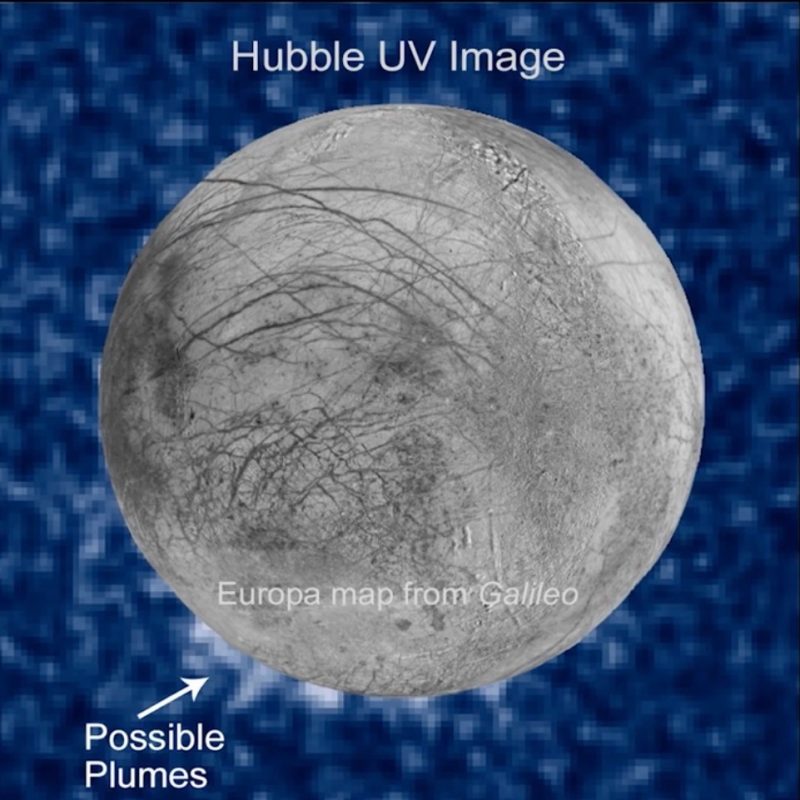
Previous observations by the Hubble Space Telescope hinted at plumes, although smaller than Enceladus’. But the plumes might not be there after all, a new study from SwRI says.
Plumes aren’t at all ruled out by the study, though. The data for their existence just isn’t as concrete as before.
Do plumes of water vapor blast from Jupiter’s moon Europa, like they do from Saturn’s moon Enceladus? Scientists have debated this for years.
Some previous observations by the Hubble Space Telescope hinted these plumes were there, but smaller and more sporadic than the ones on Enceladus. But now, a new study casts doubt the plumes being there at all.
Researchers from the Southwest Research Institute (SwRI) said on May 18, 2026, that the evidence for the plumes isn’t as strong as it once was.
The new study examines 14 years of Hubble observations using its Imaging Spectrograph (HST/STIS). Those observations focused on Europa’s Lyman-alpha emissions, a specific wavelength of ultraviolet light emitted and scattered by hydrogen atoms.
The researchers published their new peer-reviewed paper in Astronomy & Astrophysics on May 5, 2026.
SwRI in the news: New data casts doubt on the existence of vapor plumes on Europaow.ly/IW5750Z2c8Q
There was some difficulty in interpreting the data from the original Hubble observations going back to 2014. It had to do with exactly where Europa was in the images. Co-author Kurt Retherford at SwRI explained:
One of the difficulties in interpreting the data back then was determining where to place Europa within its context. The way Hubble works left some uncertainty in terms of placement relative to the center of the image. If Europa’s placement was off even just by a pixel or two, it could affect how the data gets interpreted.
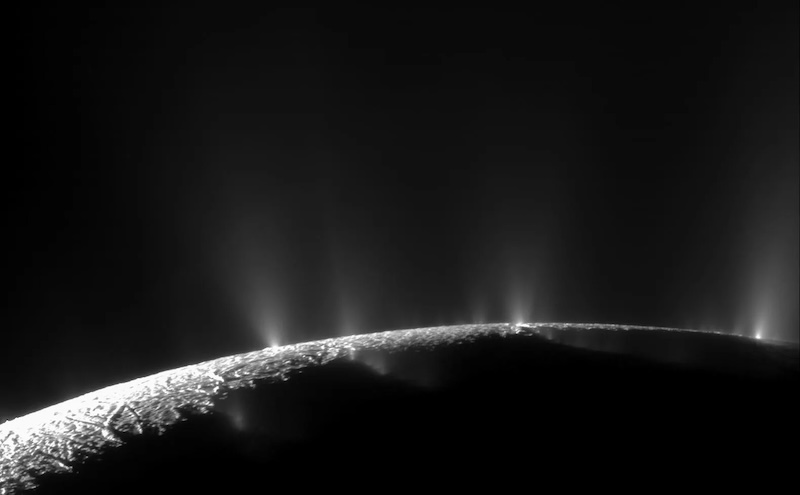
Previous image from Hubble, showing possible plume on Europa’s surface. Video still, via NASA.View larger. | Saturn’s moon Enceladus is well-known for its huge geyser-like plumes of water vapor. The plumes originate in the global subsurface ocean and erupt through cracks in the outer ice shell at the moon’s south pole. Image via NASA/ JPL/ Space Science Institute.
Plumes not ruled out
Lead author Lorenz Roth at the KTH Royal Institute of Technology in Sweden added:
Our reanalysis took our original 99.9% confidence in the plumes’ existence and reduced it to less than 90% confidence. That’s simply not enough evidence to support the certainty of claims we made at the time.
So the previous confidence level has dropped enough that the researchers can’t say for sure the plumes are there. But they are not ruled out, either. It’s just that the evidence isn’t concrete anymore. Retherford said:
The description of the phenomena just doesn’t hold up the same way anymore. The new data has made us reconsider the strength of the previous paper’s conclusion regarding water vapor plumes. The recent analysis also provides improved information about the neutral hydrogen atom component of Europa’s escaping atmosphere, originating from its water ice surface.
Lorenz Roth at the KTH Royal Institute of Technology in Sweden is the lead author of the new study about Europa’s plumes. Image via KTH.
Europa Clipper
We will likely have to wait for NASA’s Europa Clipper to arrive at Europa in April 2030 to know for sure whether Europa has plumes or not. Clipper will make multiple close flybys of Europa, studying its surface and interior in more detail than ever before. It will try to determine if Jupiter’s moon actually is habitable. And it will be able to detect any plumes … if they are there.
Bottom line: New observations from the Hubble Space Telescope suggest that Europa’s water vapor plumes are less likely than previously thought. But they don’t rule them out.
View larger. | Jupiter’s moon Europa, with an inset showing a closer view of cracks on the surface. A new study from SwRI lowers the probability of Europa’s water vapor plumes being real. Image via NASA/ SwRI.
Jupiter’s moon Europa has a global ocean beneath its icy crust. Does it have water vapor plumes too, like Saturn’s moon Enceladus?
Previous observations by the Hubble Space Telescope hinted at plumes, although smaller than Enceladus’. But the plumes might not be there after all, a new study from SwRI says.
Plumes aren’t at all ruled out by the study, though. The data for their existence just isn’t as concrete as before.
Do plumes of water vapor blast from Jupiter’s moon Europa, like they do from Saturn’s moon Enceladus? Scientists have debated this for years.
Some previous observations by the Hubble Space Telescope hinted these plumes were there, but smaller and more sporadic than the ones on Enceladus. But now, a new study casts doubt the plumes being there at all.
Researchers from the Southwest Research Institute (SwRI) said on May 18, 2026, that the evidence for the plumes isn’t as strong as it once was.
The new study examines 14 years of Hubble observations using its Imaging Spectrograph (HST/STIS). Those observations focused on Europa’s Lyman-alpha emissions, a specific wavelength of ultraviolet light emitted and scattered by hydrogen atoms.
The researchers published their new peer-reviewed paper in Astronomy & Astrophysics on May 5, 2026.
SwRI in the news: New data casts doubt on the existence of vapor plumes on Europaow.ly/IW5750Z2c8Q
There was some difficulty in interpreting the data from the original Hubble observations going back to 2014. It had to do with exactly where Europa was in the images. Co-author Kurt Retherford at SwRI explained:
One of the difficulties in interpreting the data back then was determining where to place Europa within its context. The way Hubble works left some uncertainty in terms of placement relative to the center of the image. If Europa’s placement was off even just by a pixel or two, it could affect how the data gets interpreted.
Previous image from Hubble, showing possible plume on Europa’s surface. Video still, via NASA.View larger. | Saturn’s moon Enceladus is well-known for its huge geyser-like plumes of water vapor. The plumes originate in the global subsurface ocean and erupt through cracks in the outer ice shell at the moon’s south pole. Image via NASA/ JPL/ Space Science Institute.
Plumes not ruled out
Lead author Lorenz Roth at the KTH Royal Institute of Technology in Sweden added:
Our reanalysis took our original 99.9% confidence in the plumes’ existence and reduced it to less than 90% confidence. That’s simply not enough evidence to support the certainty of claims we made at the time.
So the previous confidence level has dropped enough that the researchers can’t say for sure the plumes are there. But they are not ruled out, either. It’s just that the evidence isn’t concrete anymore. Retherford said:
The description of the phenomena just doesn’t hold up the same way anymore. The new data has made us reconsider the strength of the previous paper’s conclusion regarding water vapor plumes. The recent analysis also provides improved information about the neutral hydrogen atom component of Europa’s escaping atmosphere, originating from its water ice surface.
Lorenz Roth at the KTH Royal Institute of Technology in Sweden is the lead author of the new study about Europa’s plumes. Image via KTH.
Europa Clipper
We will likely have to wait for NASA’s Europa Clipper to arrive at Europa in April 2030 to know for sure whether Europa has plumes or not. Clipper will make multiple close flybys of Europa, studying its surface and interior in more detail than ever before. It will try to determine if Jupiter’s moon actually is habitable. And it will be able to detect any plumes … if they are there.
Bottom line: New observations from the Hubble Space Telescope suggest that Europa’s water vapor plumes are less likely than previously thought. But they don’t rule them out.