aads

Hidden soil fungi stole bacterial DNA to control the rain

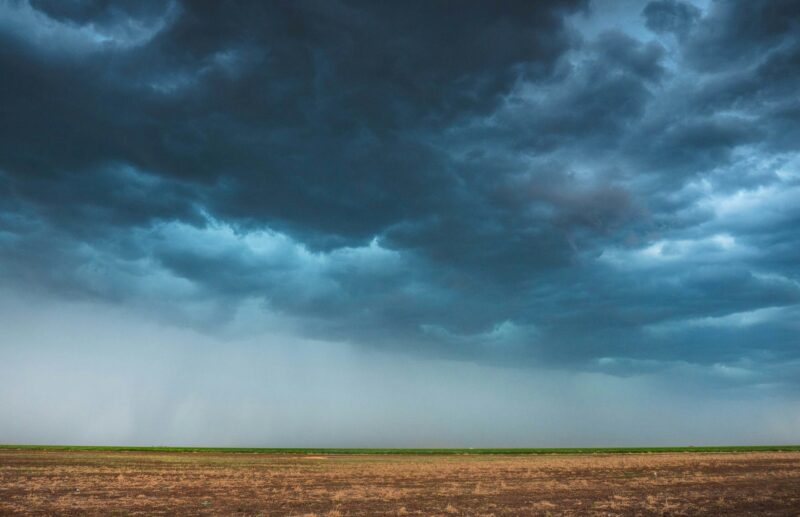
Dark blue clouds above the brown ground.
A new study has revealed that soil fungi can cause clouds like these to release their rain. Image via Raychel Sanner/ Unsplash.
  • Most rain starts as ice. Water in clouds needs to freeze into ice crystals before it can then fall as rain.
  • Certain forms of bacteria are able to trigger this process by traveling into the clouds and making water freeze at higher temperatures.
  • A new study says soil fungi do this too, having ‘stolen’ the genetic ability from bacteria.

By Diana R. Andrade-Linares, University of Limerick

Science news, night sky events and beautiful photos, all in one place.
Click here to subscribe to EarthSky’s free daily newsletter.

Hidden soil fungi stole bacterial DNA to control the rain

Tiny organisms on the ground – bacteria and fungi – have a superpower that allows them to reach up into the atmosphere and pull down the rain, according to a recent study.

To understand how a microbe can control a storm, we first have to look at how clouds become rain. High up in the atmosphere, water doesn’t always freeze at 0 degrees C (32 F). Temperatures are normally much lower at cloud level but pure water can stay liquid down to a bone-chilling -40 degrees C (-40 F).

Most rain starts as ice. In the atmosphere, clouds are full of supercooled water: liquid that is colder than freezing but hasn’t turned to ice yet because it has nothing to hold onto.

And for a cloud to turn into rain or snow, it needs a “seed”: a tiny particle for water molecules to grab onto so they can crystallise into ice, then fall from the clouds as rain. Dust, soot and salt – swept into the clouds by wind – can do this, but they aren’t very good at it. They usually require the temperature to drop significantly before they start working. This is where biology enters the frame.

Meet the ice-makers

For decades, scientists have known about ice-nucleating proteins (INpros) found in certain bacteria like Pseudomonas syringae. Bacteria travel from plant leaves into the clouds to trigger rain. They use special proteins to force water to freeze at temperatures as high as -2 degrees C (28 F). Remember, water freezes at a much lower temperature in the clouds).

But the recent discovery published in the journal Science Advances has revealed a new player in the climate game: fungal ice-nucleating proteins. While bacteria keep their ice-making proteins tucked away on their “skin”, fungi (mainly Fusarium and Mortierella) secrete these proteins into the soil around them. Their structure makes these fungal proteins water soluble and smaller than the bacterial ones, and with a high ice seeding activity which makes them more effective cloud seeds.
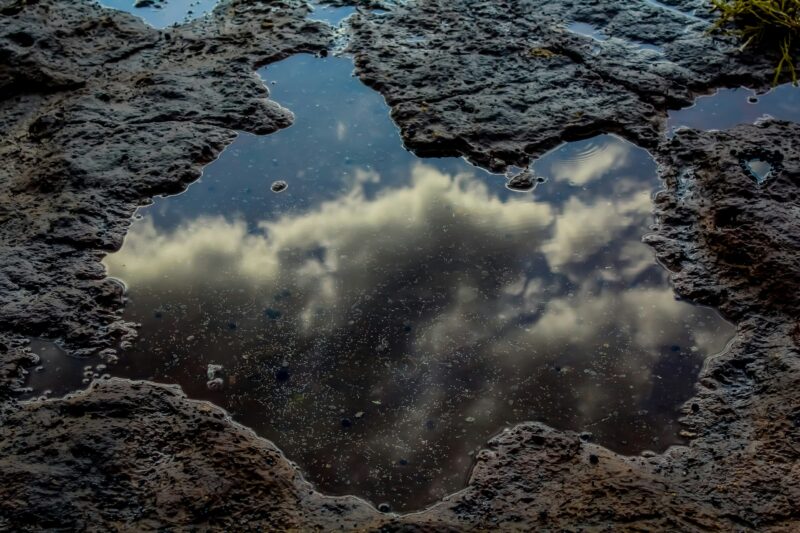
A puddle rests on brown earth, its surface reflecting the clouds above.
In soil like this, fungi can release proteins that help clouds turn to rain. Image via Andrew Tom/ Unsplash.

Making it rain

This leads us to the bio-precipitation cycle. Imagine a forest floor covered in these fungi. As the wind kicks up, their microscopic ice-making proteins are launched into the clouds. Once there, they act as powerful seeds.

And even in relatively warm clouds (above -5 degrees C or 23 F), these fungal proteins can force water to crystallize into ice. As these ice crystals grow, they become heavy and fall. Then as they drop through warmer air, they melt and turn into rain.

This consequently creates a loop:

  • Fungi grow in the damp soil of a forest.
  • Proteins from the fungi are swept into the sky.
  • Rain is triggered by these proteins, watering the forest below.
  • Growth of more fungi is triggered by the rain, starting the cycle over again.

Unlike the Pseudomonas bacteria, which use ice to “attack” and damage crops to access their nutrients, these Mortierella fungi are peaceful plant partners. They aren’t looking to destroy. Instead, they secrete their ice-making proteins into the surrounding soil, which seems to create a protective shield from harsh conditions and a nutrient-rich environment that helps both the fungus and the plant flourish.

The new discovery about fungi is exciting because it shows that even organisms buried in the soil can influence the atmosphere, adding a new dimension to this ancient partnership between life and the sky.

It’s a missing piece in the puzzle of how life and the global climate shape one another. This ice-making ability probably gives the fungi a survival edge. They use ice to pump moisture toward their mycelia (a vast, underground web of tiny fungal threads), shield themselves from jagged frost damage and hitchhike through the clouds to reach new homes.

The evolutionary heist

The new research also uncovered how fungi of the Mortierellaceae family gained the ability to create ice. When the researchers studied the fungi’s genetic code, they found that these fungi didn’t evolve this trait on their own. Millions of years ago, they “borrowed” the genetic code for it from bacteria, through a process called horizontal gene transfer.

Think of it as a biological copy and paste. While most animals only inherit DNA from their parents, microbes can swap snippets of genetic code with their neighbours, giving them an instant evolutionary upgrade.

But these fungi are much more efficient at making ice than the bacteria. That’s because the fungus secretes (sweats out) these proteins, meaning they can coat the environment around it and stay active in the soil after the fungus has moved on. These proteins are incredibly hardy. They can wash into streams, dry up into dust and get swept into the sky by the wind.

Why this matters?

This discovery could change how researchers view conservation. If we clear-cut a forest, stripping every tree away and leaving the land bare, we aren’t just losing trees. We might be breaking the biological engine that triggers regional rainfall.

As we face a changing climate with more frequent droughts, understanding these fungal ice-nucleating proteins could be vital. We might one day use these natural, biodegradable proteins for cloud seeding to create rain.

Many countries (like the UAE, China and parts of the US) already have cloud-seeding programs to protect crops from frost. But this kind of cloud seeding relies on silver iodide, a heavy metal that can linger in the environment.

The fungal proteins offer a natural, biodegradable alternative. They could also protect crops from frost. By forcing ice to form early and smoothly, they release a tiny burst of heat that acts like a thermal blanket for the plant.

We could use them to make snow on ski slopes with less energy, create better-tasting frozen foods by preventing large ice crystals from damaging food cells, or even develop eco-friendly cooling systems that don’t rely on harsh chemical refrigerants.

Diana R. Andrade-Linares, Postdoctoral Fellow in Microbial Ecology, University of Limerick

This article is republished from The Conversation under a Creative Commons license. Read the original article.

Bottom line: Some soil fungi have a superpower, inherited from bacteria. It means they can reach up into the atmosphere and pull down the rain.

Read more: Could future moon homes be made of fungi?

The post Hidden soil fungi stole bacterial DNA to control the rain first appeared on EarthSky.


from EarthSky https://ift.tt/C9gxJNa
Dark blue clouds above the brown ground.
A new study has revealed that soil fungi can cause clouds like these to release their rain. Image via Raychel Sanner/ Unsplash.
  • Most rain starts as ice. Water in clouds needs to freeze into ice crystals before it can then fall as rain.
  • Certain forms of bacteria are able to trigger this process by traveling into the clouds and making water freeze at higher temperatures.
  • A new study says soil fungi do this too, having ‘stolen’ the genetic ability from bacteria.

By Diana R. Andrade-Linares, University of Limerick

Science news, night sky events and beautiful photos, all in one place.
Click here to subscribe to EarthSky’s free daily newsletter.

Hidden soil fungi stole bacterial DNA to control the rain

Tiny organisms on the ground – bacteria and fungi – have a superpower that allows them to reach up into the atmosphere and pull down the rain, according to a recent study.

To understand how a microbe can control a storm, we first have to look at how clouds become rain. High up in the atmosphere, water doesn’t always freeze at 0 degrees C (32 F). Temperatures are normally much lower at cloud level but pure water can stay liquid down to a bone-chilling -40 degrees C (-40 F).

Most rain starts as ice. In the atmosphere, clouds are full of supercooled water: liquid that is colder than freezing but hasn’t turned to ice yet because it has nothing to hold onto.

And for a cloud to turn into rain or snow, it needs a “seed”: a tiny particle for water molecules to grab onto so they can crystallise into ice, then fall from the clouds as rain. Dust, soot and salt – swept into the clouds by wind – can do this, but they aren’t very good at it. They usually require the temperature to drop significantly before they start working. This is where biology enters the frame.

Meet the ice-makers

For decades, scientists have known about ice-nucleating proteins (INpros) found in certain bacteria like Pseudomonas syringae. Bacteria travel from plant leaves into the clouds to trigger rain. They use special proteins to force water to freeze at temperatures as high as -2 degrees C (28 F). Remember, water freezes at a much lower temperature in the clouds).

But the recent discovery published in the journal Science Advances has revealed a new player in the climate game: fungal ice-nucleating proteins. While bacteria keep their ice-making proteins tucked away on their “skin”, fungi (mainly Fusarium and Mortierella) secrete these proteins into the soil around them. Their structure makes these fungal proteins water soluble and smaller than the bacterial ones, and with a high ice seeding activity which makes them more effective cloud seeds.

A puddle rests on brown earth, its surface reflecting the clouds above.
In soil like this, fungi can release proteins that help clouds turn to rain. Image via Andrew Tom/ Unsplash.

Making it rain

This leads us to the bio-precipitation cycle. Imagine a forest floor covered in these fungi. As the wind kicks up, their microscopic ice-making proteins are launched into the clouds. Once there, they act as powerful seeds.

And even in relatively warm clouds (above -5 degrees C or 23 F), these fungal proteins can force water to crystallize into ice. As these ice crystals grow, they become heavy and fall. Then as they drop through warmer air, they melt and turn into rain.

This consequently creates a loop:

  • Fungi grow in the damp soil of a forest.
  • Proteins from the fungi are swept into the sky.
  • Rain is triggered by these proteins, watering the forest below.
  • Growth of more fungi is triggered by the rain, starting the cycle over again.

Unlike the Pseudomonas bacteria, which use ice to “attack” and damage crops to access their nutrients, these Mortierella fungi are peaceful plant partners. They aren’t looking to destroy. Instead, they secrete their ice-making proteins into the surrounding soil, which seems to create a protective shield from harsh conditions and a nutrient-rich environment that helps both the fungus and the plant flourish.

The new discovery about fungi is exciting because it shows that even organisms buried in the soil can influence the atmosphere, adding a new dimension to this ancient partnership between life and the sky.

It’s a missing piece in the puzzle of how life and the global climate shape one another. This ice-making ability probably gives the fungi a survival edge. They use ice to pump moisture toward their mycelia (a vast, underground web of tiny fungal threads), shield themselves from jagged frost damage and hitchhike through the clouds to reach new homes.

The evolutionary heist

The new research also uncovered how fungi of the Mortierellaceae family gained the ability to create ice. When the researchers studied the fungi’s genetic code, they found that these fungi didn’t evolve this trait on their own. Millions of years ago, they “borrowed” the genetic code for it from bacteria, through a process called horizontal gene transfer.

Think of it as a biological copy and paste. While most animals only inherit DNA from their parents, microbes can swap snippets of genetic code with their neighbours, giving them an instant evolutionary upgrade.

But these fungi are much more efficient at making ice than the bacteria. That’s because the fungus secretes (sweats out) these proteins, meaning they can coat the environment around it and stay active in the soil after the fungus has moved on. These proteins are incredibly hardy. They can wash into streams, dry up into dust and get swept into the sky by the wind.

Why this matters?

This discovery could change how researchers view conservation. If we clear-cut a forest, stripping every tree away and leaving the land bare, we aren’t just losing trees. We might be breaking the biological engine that triggers regional rainfall.

As we face a changing climate with more frequent droughts, understanding these fungal ice-nucleating proteins could be vital. We might one day use these natural, biodegradable proteins for cloud seeding to create rain.

Many countries (like the UAE, China and parts of the US) already have cloud-seeding programs to protect crops from frost. But this kind of cloud seeding relies on silver iodide, a heavy metal that can linger in the environment.

The fungal proteins offer a natural, biodegradable alternative. They could also protect crops from frost. By forcing ice to form early and smoothly, they release a tiny burst of heat that acts like a thermal blanket for the plant.

We could use them to make snow on ski slopes with less energy, create better-tasting frozen foods by preventing large ice crystals from damaging food cells, or even develop eco-friendly cooling systems that don’t rely on harsh chemical refrigerants.

Diana R. Andrade-Linares, Postdoctoral Fellow in Microbial Ecology, University of Limerick

This article is republished from The Conversation under a Creative Commons license. Read the original article.

Bottom line: Some soil fungi have a superpower, inherited from bacteria. It means they can reach up into the atmosphere and pull down the rain.

Read more: Could future moon homes be made of fungi?

The post Hidden soil fungi stole bacterial DNA to control the rain first appeared on EarthSky.


from EarthSky https://ift.tt/C9gxJNa

What are waterspouts, and how do they form?

Body of water with a few ships and a long, thin funnel from gray clouds above to surface of water.
View at EarthSky Community Photos. | Bob Kuo captured this waterspout over Sun Moon Lake in Taiwan, from a hotel balcony, on November 16, 2023. Thank you, Bob! Read more about waterspouts below.

A waterspout is just a tornado that forms over open water. A tornado over an ocean, lake – or even a river – is considered to be a waterspout. Waterspouts are typically weaker than most tornadoes. And they’re usually short-lived. But they can be destructive. Let’s look at some images and videos of waterspouts and learn more about how they form.

You deserve a daily dose of good news. For the latest in science and the night sky, click here to subscribe to our free daily newsletter.

When and where do waterspouts form?

Waterspouts typically occur in tropical regions, but they can form almost anywhere. For example, waterspouts have occurred in the Great Lakes, off the western coast of Europe, in the Mediterranean Sea and in the Baltic Sea.

In the U.S., the most common place to see waterspouts is along the Florida Keys and in the Gulf of Mexico. Waterspouts most often happen in the late spring and summer months, generally forming after 2 p.m. in the afternoon. Florida is the most tornado-prone area in the United States, and many of those move on or off shore as waterspouts. It’s not unusual to see 400 to 500 waterspouts a year in this area, with many that go unreported. In rare instances, more than one waterspout can form from a storm offshore.

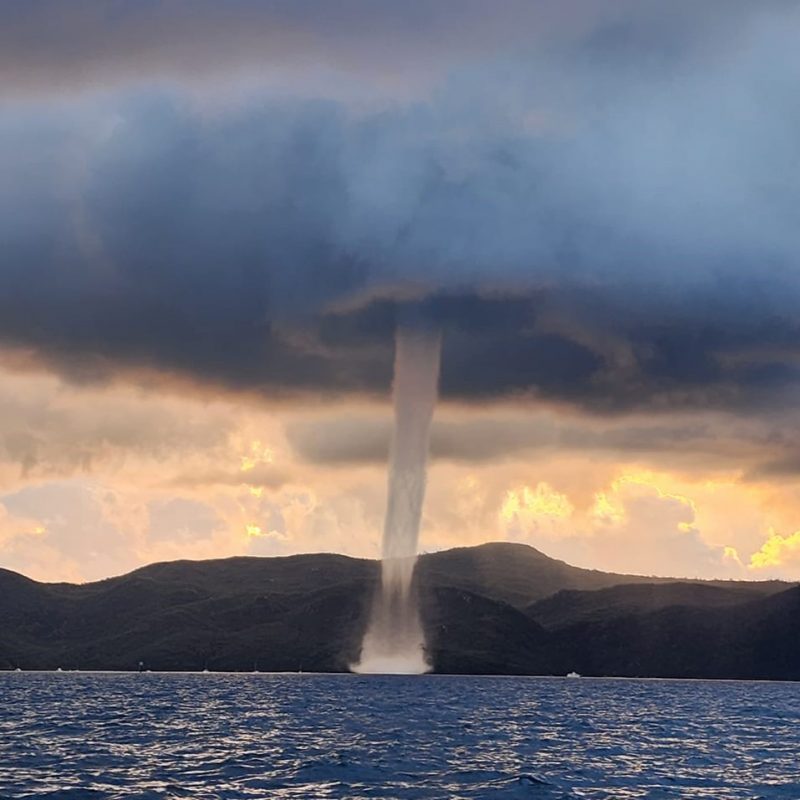
Smooth, translucent cylinder of cloud reaching down from dark clouds to body of water in front of dark mountains.
Catch My Drift Charters captured this image of a waterspout in the Whitsunday Islands of Australia on April 11, 2023. Used with permission.

Can a waterspout be destructive?

Waterspouts are typically weaker than tornadoes. But, as seen in the videos below, they can still cause a decent amount of damage. If you’re boating in the ocean, you’ll want to monitor the weather to avoid waterspouts. For instance, you might avoid being in the ocean around the Florida Keys in the afternoon or evening, when there’s a chance for thunderstorms at the coast. If you’re on a boat or ship and a waterspout develops, try to navigate around the area by going at right angles to its path. The National Oceanic and Atmospheric Administration (NOAA) recommends that those on boats or ships monitor special marine warnings issued by the National Weather Service.

And – of course – it’s highly recommended that you avoid navigating through a waterspout. They can cause damage and could hurt or kill you.

In fact, there are two types of waterspouts we commonly see: a fair-weather waterspout and a tornadic waterspout.

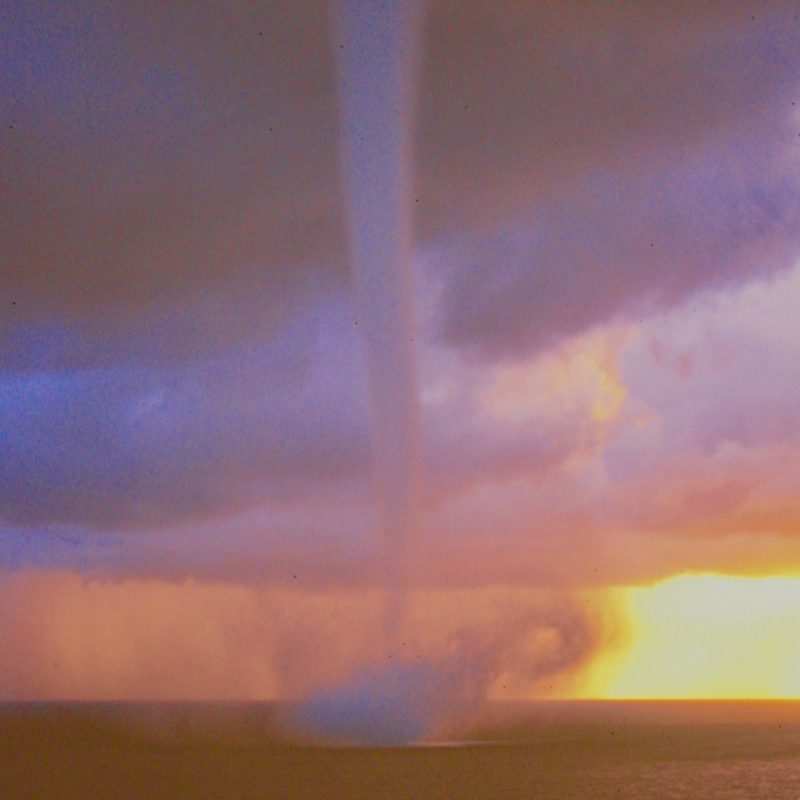
Waterspouts: Long sinuous funnel from orange dawn clouds to splashing ocean surface.
View at EarthSky Community Photos. | Mark Rutkowski said on July 3, 2020, that he caught this sunrise waterspout in the Atlantic Ocean near Miami. Thank you, Mark!

Fair-weather waterspouts

Fair-weather waterspouts form during relatively calm weather. They typically form along the dark, flat bases of a line of developing cumulus clouds. Air begins to circulate at the surface of the water and develops upward. Unlike tornadic waterspouts, which tend to happen in the afternoon, fair-weather waterspouts typically occur in the early to mid-morning hours, and sometimes in the early afternoon. Everyone associates tornadoes and waterspouts with thunderstorms, but when fair-weather waterspouts form, they typically occur during light wind conditions. Because of this, these waterspouts don’t move much.

There are five stages that occur for fair weather waterspouts. Here are the stages:

  1. The formation of a disk on the surface of the water, known as a dark spot
  2. A spiral pattern on the water surface
  3. A formation of a spray ring
  4. When the waterspout becomes a visible funnel: the waterspout!
  5. The last and final stage of the life cycle is when the waterspout decays. When the waterspout decays, it likely does so because a cool rain falls near the spout. This cool air typically disrupts the supply of warm, humid air that allows the waterspout to keep going.

Tornadic waterspouts

Tornadic waterspouts are simply tornadoes that form over water or move from land to water. They typically occur with afternoon and evening thunderstorms. You need two main ingredients for tornadic waterspouts: warm, moist air and an unstable atmosphere. Trade winds from boundaries can also influence the formation of this kind of waterspout.

Unlike fair-weather waterspouts, tornadic waterspouts typically develop downward in a thunderstorm and begin to appear initially as funnel clouds. The storms that develop these waterspouts are usually non-supercell thunderstorms. According to NOAA, a supercell thunderstorm is defined as:

… a large severe storm occurring in a significant vertically sheared environment; contains quasi-steady, strongly rotating updraft (mesocyclone); usually moves to the right (perhaps left) of the mean wind; can evolve from a non-supercell storm; and contain moderate-to-strong vertical speed and directional wind shear in the 0-6 km [0-3.7 miles] layer.

Supercell thunderstorms are what produce large, violent tornadoes. In non-supercell thunderstorms – like those that produce waterspouts – tornadoes that form are due to a boundary layer. Spin ups that do occur in the storm are generally short-lived. Obviously, every waterspout is different and some could last longer than others.

Waterspout videos

Check out the amazing video below of a waterspout pushing ashore on Grand Isle, Louisiana, on May 8, 2012. There’s spectacular footage of multiple waterspouts and a tornado hitting the coast around four minutes into the video. Scary stuff! FYI: Do not try this at home! If you know a tornado is about to strike near you, go inside and take shelter. It’s not the tornado itself that will hurt or kill you. Instead, it’s the flying debris in the air that’s dangerous.

Bottom line: Waterspouts can be harmless as long as you understand and avoid them. If you live along the coast, you should treat all waterspouts as you would tornadoes on land. Waterspouts form off non-supercell thunderstorms and are often short-lived. Some waterspouts can reach the coastline and become tornadoes, so it is important for everyone to monitor the weather as it evolves.

The post What are waterspouts, and how do they form? first appeared on EarthSky.


from EarthSky https://ift.tt/LZoB0rN
Body of water with a few ships and a long, thin funnel from gray clouds above to surface of water.
View at EarthSky Community Photos. | Bob Kuo captured this waterspout over Sun Moon Lake in Taiwan, from a hotel balcony, on November 16, 2023. Thank you, Bob! Read more about waterspouts below.

A waterspout is just a tornado that forms over open water. A tornado over an ocean, lake – or even a river – is considered to be a waterspout. Waterspouts are typically weaker than most tornadoes. And they’re usually short-lived. But they can be destructive. Let’s look at some images and videos of waterspouts and learn more about how they form.

You deserve a daily dose of good news. For the latest in science and the night sky, click here to subscribe to our free daily newsletter.

When and where do waterspouts form?

Waterspouts typically occur in tropical regions, but they can form almost anywhere. For example, waterspouts have occurred in the Great Lakes, off the western coast of Europe, in the Mediterranean Sea and in the Baltic Sea.

In the U.S., the most common place to see waterspouts is along the Florida Keys and in the Gulf of Mexico. Waterspouts most often happen in the late spring and summer months, generally forming after 2 p.m. in the afternoon. Florida is the most tornado-prone area in the United States, and many of those move on or off shore as waterspouts. It’s not unusual to see 400 to 500 waterspouts a year in this area, with many that go unreported. In rare instances, more than one waterspout can form from a storm offshore.

Smooth, translucent cylinder of cloud reaching down from dark clouds to body of water in front of dark mountains.
Catch My Drift Charters captured this image of a waterspout in the Whitsunday Islands of Australia on April 11, 2023. Used with permission.

Can a waterspout be destructive?

Waterspouts are typically weaker than tornadoes. But, as seen in the videos below, they can still cause a decent amount of damage. If you’re boating in the ocean, you’ll want to monitor the weather to avoid waterspouts. For instance, you might avoid being in the ocean around the Florida Keys in the afternoon or evening, when there’s a chance for thunderstorms at the coast. If you’re on a boat or ship and a waterspout develops, try to navigate around the area by going at right angles to its path. The National Oceanic and Atmospheric Administration (NOAA) recommends that those on boats or ships monitor special marine warnings issued by the National Weather Service.

And – of course – it’s highly recommended that you avoid navigating through a waterspout. They can cause damage and could hurt or kill you.

In fact, there are two types of waterspouts we commonly see: a fair-weather waterspout and a tornadic waterspout.

Waterspouts: Long sinuous funnel from orange dawn clouds to splashing ocean surface.
View at EarthSky Community Photos. | Mark Rutkowski said on July 3, 2020, that he caught this sunrise waterspout in the Atlantic Ocean near Miami. Thank you, Mark!

Fair-weather waterspouts

Fair-weather waterspouts form during relatively calm weather. They typically form along the dark, flat bases of a line of developing cumulus clouds. Air begins to circulate at the surface of the water and develops upward. Unlike tornadic waterspouts, which tend to happen in the afternoon, fair-weather waterspouts typically occur in the early to mid-morning hours, and sometimes in the early afternoon. Everyone associates tornadoes and waterspouts with thunderstorms, but when fair-weather waterspouts form, they typically occur during light wind conditions. Because of this, these waterspouts don’t move much.

There are five stages that occur for fair weather waterspouts. Here are the stages:

  1. The formation of a disk on the surface of the water, known as a dark spot
  2. A spiral pattern on the water surface
  3. A formation of a spray ring
  4. When the waterspout becomes a visible funnel: the waterspout!
  5. The last and final stage of the life cycle is when the waterspout decays. When the waterspout decays, it likely does so because a cool rain falls near the spout. This cool air typically disrupts the supply of warm, humid air that allows the waterspout to keep going.

Tornadic waterspouts

Tornadic waterspouts are simply tornadoes that form over water or move from land to water. They typically occur with afternoon and evening thunderstorms. You need two main ingredients for tornadic waterspouts: warm, moist air and an unstable atmosphere. Trade winds from boundaries can also influence the formation of this kind of waterspout.

Unlike fair-weather waterspouts, tornadic waterspouts typically develop downward in a thunderstorm and begin to appear initially as funnel clouds. The storms that develop these waterspouts are usually non-supercell thunderstorms. According to NOAA, a supercell thunderstorm is defined as:

… a large severe storm occurring in a significant vertically sheared environment; contains quasi-steady, strongly rotating updraft (mesocyclone); usually moves to the right (perhaps left) of the mean wind; can evolve from a non-supercell storm; and contain moderate-to-strong vertical speed and directional wind shear in the 0-6 km [0-3.7 miles] layer.

Supercell thunderstorms are what produce large, violent tornadoes. In non-supercell thunderstorms – like those that produce waterspouts – tornadoes that form are due to a boundary layer. Spin ups that do occur in the storm are generally short-lived. Obviously, every waterspout is different and some could last longer than others.

Waterspout videos

Check out the amazing video below of a waterspout pushing ashore on Grand Isle, Louisiana, on May 8, 2012. There’s spectacular footage of multiple waterspouts and a tornado hitting the coast around four minutes into the video. Scary stuff! FYI: Do not try this at home! If you know a tornado is about to strike near you, go inside and take shelter. It’s not the tornado itself that will hurt or kill you. Instead, it’s the flying debris in the air that’s dangerous.

Bottom line: Waterspouts can be harmless as long as you understand and avoid them. If you live along the coast, you should treat all waterspouts as you would tornadoes on land. Waterspouts form off non-supercell thunderstorms and are often short-lived. Some waterspouts can reach the coastline and become tornadoes, so it is important for everyone to monitor the weather as it evolves.

The post What are waterspouts, and how do they form? first appeared on EarthSky.


from EarthSky https://ift.tt/LZoB0rN

See Antlia the Air Pump on April evenings

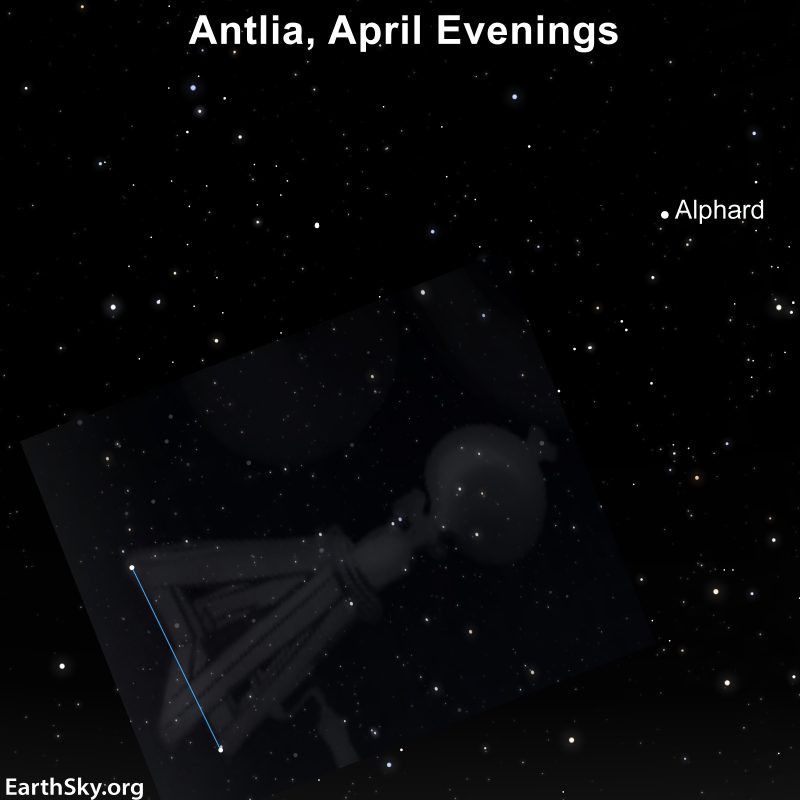
Antlia: Star chart with two stars connected by a line, faint outline of an old-fashioned air pump.
Antlia the Air Pump is a faint constellation that lies between Hydra the Water Snake with its bright star Alphard and the more southerly constellation of Vela the Sails.

Antlia the Air Pump is a constellation in the Southern Hemisphere that people in the Northern Hemisphere can see if they live at more southerly latitudes. And April is a good month to view Antlia, regardless of the hemisphere you’re in. In mid-evening in the Southern Hemisphere, Antlia will pass through the zenith, or the point that’s straight overhead. And for those at southerly locations in the Northern Hemisphere, look for Antlia to pass above your southern horizon in mid-evening.

The constellation of Antlia the Air Pump

To find Antlia from the Northern Hemisphere, look below the belly of Hydra, the long and rambling Water Snake. It’s below the star Alphard in Hydra and east of bright Sirius in Canis Major. Or from the Southern Hemisphere, you can look between Hydra and the flowing form of the Milky Way.

Antlia’s stars are so dim that the constellation didn’t exist until the 18th century. Nicolas Louis de Lacaille, a French astronomer who visited the Cape of Good Hope in the mid-1700s, created 14 constellations out of regions of dark sky. But before then, these were simply parts of older constellations. Lacaille named these new constellations after new or important scientific instruments of his time. Antlia, for example, he named after the air pump, which had been invented in the 1600s and improved in the 1700s.

The stars of the Air Pump

The brightest star in Antlia is Alpha Antliae, which shines at magnitude 4.2. It lies about 320 light-years away.

Astronomers have found a couple of stars in Antlia to have exoplanets, too, but these stars (and their planets) are too faint to be seen with the unaided eye.

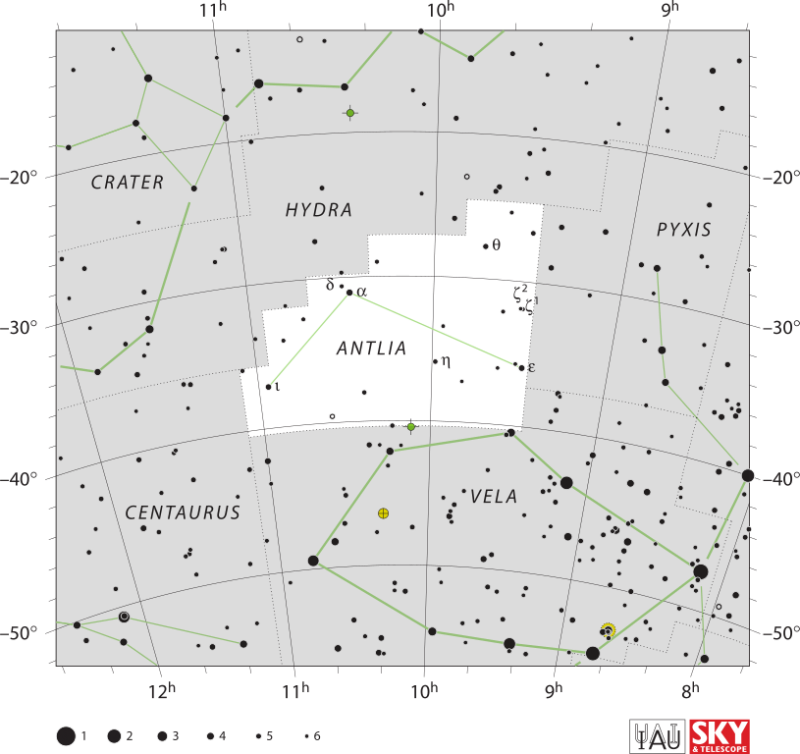
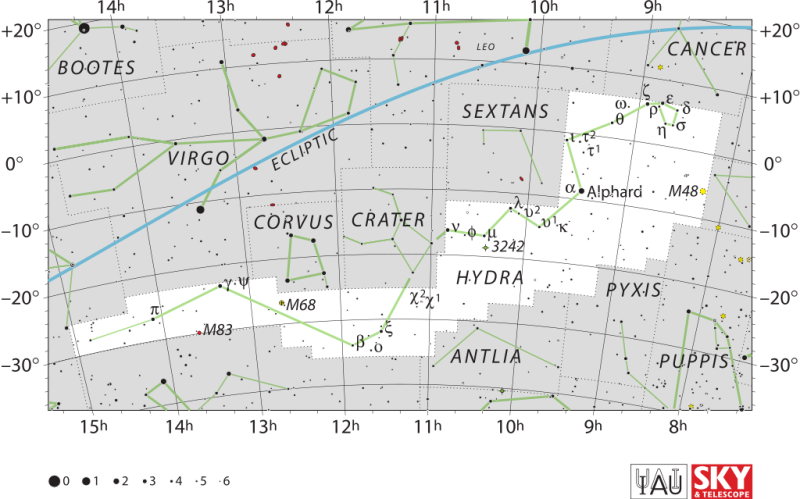
White star chart with black dots tracing out Antlia the Air Pump.
Antlia the Air Pump contains only dim stars. You can best see this constellation from a dark location in the Southern Hemisphere. Image via IAU/ Sky and Telescope.

Deep-sky objects in Antlia

While a large swath of galaxies crosses Antlia, these distant island universes are so far away and dim that the majority of amateur astronomers would have trouble locating them. If you’re a telescope owner with lots of experience, you might be able to spot the galaxy NGC 2997. This spiral galaxy is magnitude 10.1 and appears near the border with Pyxis the Compass. William Herschel discovered NGC 2997 in 1793. It lies approximately 40 million light-years away.

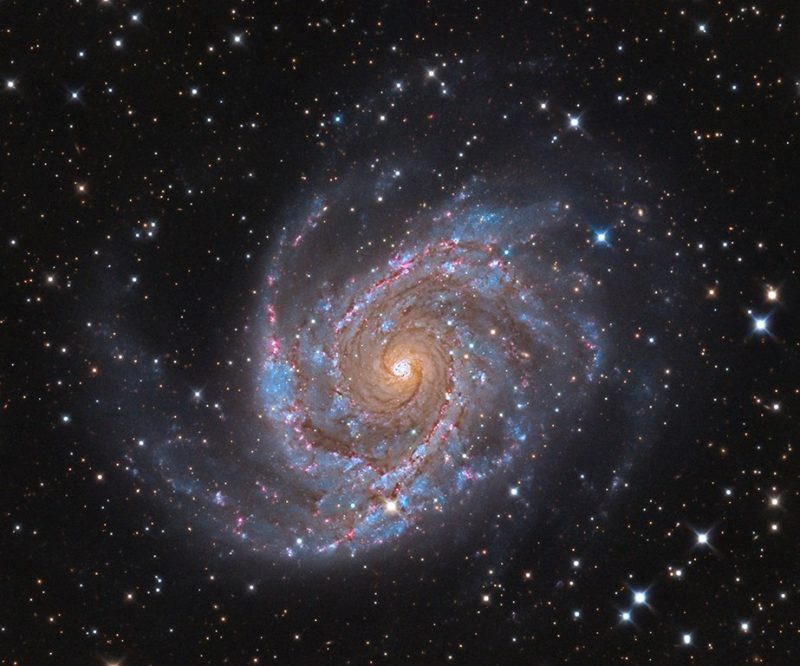
Blue and pink clusters in spiral arms with yellowish center.
The spiral galaxy NGC 2997 in Antlia. Image via Adam Block/ ChileScope/ Wikimedia Commons. CC BY-SA 3.0 US.

Bottom line: Antlia the Air Pump is a constellation that lies in southern skies. It contains dim stars and galaxies, including NGC 2997.

Don’t miss the next unmissable night sky event. Sign up to our free newsletter for daily night sky updates, as well as the latest science news.

The post See Antlia the Air Pump on April evenings first appeared on EarthSky.


from EarthSky https://ift.tt/6Bi37hz
Antlia: Star chart with two stars connected by a line, faint outline of an old-fashioned air pump.
Antlia the Air Pump is a faint constellation that lies between Hydra the Water Snake with its bright star Alphard and the more southerly constellation of Vela the Sails.

Antlia the Air Pump is a constellation in the Southern Hemisphere that people in the Northern Hemisphere can see if they live at more southerly latitudes. And April is a good month to view Antlia, regardless of the hemisphere you’re in. In mid-evening in the Southern Hemisphere, Antlia will pass through the zenith, or the point that’s straight overhead. And for those at southerly locations in the Northern Hemisphere, look for Antlia to pass above your southern horizon in mid-evening.

The constellation of Antlia the Air Pump

To find Antlia from the Northern Hemisphere, look below the belly of Hydra, the long and rambling Water Snake. It’s below the star Alphard in Hydra and east of bright Sirius in Canis Major. Or from the Southern Hemisphere, you can look between Hydra and the flowing form of the Milky Way.

Antlia’s stars are so dim that the constellation didn’t exist until the 18th century. Nicolas Louis de Lacaille, a French astronomer who visited the Cape of Good Hope in the mid-1700s, created 14 constellations out of regions of dark sky. But before then, these were simply parts of older constellations. Lacaille named these new constellations after new or important scientific instruments of his time. Antlia, for example, he named after the air pump, which had been invented in the 1600s and improved in the 1700s.

The stars of the Air Pump

The brightest star in Antlia is Alpha Antliae, which shines at magnitude 4.2. It lies about 320 light-years away.

Astronomers have found a couple of stars in Antlia to have exoplanets, too, but these stars (and their planets) are too faint to be seen with the unaided eye.

White star chart with black dots tracing out Antlia the Air Pump.
Antlia the Air Pump contains only dim stars. You can best see this constellation from a dark location in the Southern Hemisphere. Image via IAU/ Sky and Telescope.

Deep-sky objects in Antlia

While a large swath of galaxies crosses Antlia, these distant island universes are so far away and dim that the majority of amateur astronomers would have trouble locating them. If you’re a telescope owner with lots of experience, you might be able to spot the galaxy NGC 2997. This spiral galaxy is magnitude 10.1 and appears near the border with Pyxis the Compass. William Herschel discovered NGC 2997 in 1793. It lies approximately 40 million light-years away.

Blue and pink clusters in spiral arms with yellowish center.
The spiral galaxy NGC 2997 in Antlia. Image via Adam Block/ ChileScope/ Wikimedia Commons. CC BY-SA 3.0 US.

Bottom line: Antlia the Air Pump is a constellation that lies in southern skies. It contains dim stars and galaxies, including NGC 2997.

Don’t miss the next unmissable night sky event. Sign up to our free newsletter for daily night sky updates, as well as the latest science news.

The post See Antlia the Air Pump on April evenings first appeared on EarthSky.


from EarthSky https://ift.tt/6Bi37hz

New meteor shower from an asteroid being eroded by the sun

New meteor shower: Dozens of thin white streaks across the starry sky, seeming to come from a single point.
Here’s a time lapse showing an outburst of Geminid meteors lighting up the sky. Read about a recent study that associated a new meteor shower with an asteroid that was destroyed by the sun. Image via NASA/ JPL.

  • A new study finds a meteor shower linked to an asteroid being eroded by the sun.
  • Most meteors originate from debris of gas and dust left behind when a comet orbits the sun.
  • Some meteor showers, like the Geminids, are the result of debris left behind by an asteroid.

By Patrick M. Shober, NASA

You deserve a daily dose of good news. For the latest in science and the night sky, subscribe to EarthSky’s free daily newsletter.

New meteor shower

Across the Earth, every night, thousands of automated stargazers are waiting to take pictures of shooting stars. I am one of the scientists who study these meteors.

Most movies and news alerts focus on large asteroids that could destroy the Earth. And your phones notify you every few months that an object nine washing machines wide is going to just narrowly skim past. However, the small dust and rubble that enter our atmosphere daily tell an equally interesting story.

My planetary science colleagues and I use camera observations of the night sky to better understand dust, car-sized asteroids and debris from comets in our solar system.

In a study published in March 2026, I searched through millions of meteor observations collected by all-sky camera networks based in Canada, Japan, California and Europe and found a small, recently formed cluster. The 282 meteors associated with this cluster tell the story of an asteroid that got a little too close to the sun.

Meteor formation

When a sand-sized crumb of space rock hits our atmosphere, it heats up almost instantly, vaporizing its surface layer and turning it into an electrically charged gas. The whole fragment starts to glow. This is what we call a meteor. If the object is larger, like a boulder, and brighter, it’s called a bolide or a fireball. On average, these objects hit our atmosphere going over 15 miles per second (24 km/s). For small dust or sand-sized objects, the whole process lasts only a fraction of a second before they completely disappear.

Most of these sand-sized fragments in the solar system originate from comets – cold, icy objects from the outer reaches of the solar system. As comets pass by the sun, their icy components turn to gas, releasing tons of dust. This is why comets are often called “dirty snowballs” and appear fuzzy in telescopic images.

Asteroids, on the other hand, are leftovers from the early solar system that formed closer to the sun. They are dry and rocky, and do not have the same ices that give comets their characteristic tails.

What does it mean to be active?

Astronomers call an asteroid or comet “active” when it sheds dust, gas or larger fragments. This activity is caused by some external force on the object in space, like heat from the sun, a small impact, or when asteroids spin too fast and fly apart.

Understanding and identifying activity helps scientists better understand how these objects change over time.

For comets, sublimation of ices – when solid ice turns directly into gas, skipping the liquid phase – is the primary culprit. However, for asteroids, the reason for activity can vary greatly.

For example, NASA’s OSIRIS-REx mission, which launched into space to study an asteroid named Bennu, saw activity from its surface, with heat stress and small impacts among the leading explanations.

Other sources for asteroid activity include breakup when an asteroid spins too fast, tidal forces ripping apart asteroids during close encounters with a planet, or gas release.

Researchers most commonly search for activity using telescopes. Astronomers can look for a “tail” or fuzziness around the object. This tail is a clear sign that there is gas and dust around the body. But there is another way to search for activity – meteor showers.

Finding hidden asteroids via meteor showers

The most famous active asteroid is 3200 Phaethon. It is the parent body of the Geminid meteor shower that occurs every year in mid-December. During past close approaches with the sun, Phaethon released vast amounts of dust and larger fragments. These morsels of Phaethon have spread out along its entire orbit over time, leading to the present Geminid meteor stream.

Each meteor shower we observe occurs when the Earth passes through one of these debris streams. So if astronomers can detect meteor showers, they can also be used to find active objects in space.

At first, debris shed by an asteroid or comet travels closely together. Imagine squeezing a single drop of food dye into a moving stream of water: Initially, the dye stays in a tight, concentrated cloud. But as it flows, the water’s swirling currents pull at the dye, causing it to spread out and fade.

In space, the gravitational tugs from passing planets act like those currents. They pull on the individual meteor fragments in slightly different ways, causing the once-tight stream to gradually drift apart until it completely dilutes into the background dust of our solar system.

The discovery of a rock-comet

In a study published in March 2026 in The Astrophysical Journal, I used millions of observations of meteors to search for recent, unknown activity from asteroids near the Earth. I found one clear cluster of 282 meteors that stood out.

What makes this discovery so exciting is that we are essentially witnessing a hidden asteroid being baked to bits. This newly confirmed meteor stream follows an extreme orbit that plunges almost five times closer to the sun than Earth does.

Based on how these meteors break apart when they hit our atmosphere, we can tell they are moderately fragile, but tougher than stuff from comets. This finding tells us that intense solar heat is literally cracking the asteroid’s surface, baking out trapped gases and causing it to crumble. This is likely a major driver of Phaethon’s past activity and a key reason for the diversity of meteorites found on Earth.

The search for the source

Why does finding a hidden, crumbling asteroid matter? Meteor observations act as a uniquely sensitive probe that lets us study objects that are completely invisible to traditional telescopes.

Beyond solving astronomical mysteries, analyzing this debris helps us understand the physical evolution of asteroids and comets in our solar system. More importantly, it reveals hidden populations of near-Earth asteroids, which is vital information for planetary defense.

The new meteor shower’s parent asteroid remains elusive. However, NASA’s NEO Surveyor mission, launching in 2027, offers a promising solution. This space telescope, dedicated to planetary defense and the discovery of dark, hazardous, sun-approaching asteroids, will be the ideal tool for searching for the shower’s origin. The Conversation

Patrick M. Shober, Postdoctoral Fellow in Planetary Sciences, NASA

This article is republished from The Conversation under a Creative Commons license. Read the original article.

Bottom line: A new meteor shower has been linked to an asteroid broken up when it passed too close to the sun.

Read more: Spring fireball season is underway! Watch for them

Meteor shower guide 2026: Up next … the Lyrids

The post New meteor shower from an asteroid being eroded by the sun first appeared on EarthSky.


from EarthSky https://ift.tt/V6Jm29M
New meteor shower: Dozens of thin white streaks across the starry sky, seeming to come from a single point.
Here’s a time lapse showing an outburst of Geminid meteors lighting up the sky. Read about a recent study that associated a new meteor shower with an asteroid that was destroyed by the sun. Image via NASA/ JPL.

  • A new study finds a meteor shower linked to an asteroid being eroded by the sun.
  • Most meteors originate from debris of gas and dust left behind when a comet orbits the sun.
  • Some meteor showers, like the Geminids, are the result of debris left behind by an asteroid.

By Patrick M. Shober, NASA

You deserve a daily dose of good news. For the latest in science and the night sky, subscribe to EarthSky’s free daily newsletter.

New meteor shower

Across the Earth, every night, thousands of automated stargazers are waiting to take pictures of shooting stars. I am one of the scientists who study these meteors.

Most movies and news alerts focus on large asteroids that could destroy the Earth. And your phones notify you every few months that an object nine washing machines wide is going to just narrowly skim past. However, the small dust and rubble that enter our atmosphere daily tell an equally interesting story.

My planetary science colleagues and I use camera observations of the night sky to better understand dust, car-sized asteroids and debris from comets in our solar system.

In a study published in March 2026, I searched through millions of meteor observations collected by all-sky camera networks based in Canada, Japan, California and Europe and found a small, recently formed cluster. The 282 meteors associated with this cluster tell the story of an asteroid that got a little too close to the sun.

Meteor formation

When a sand-sized crumb of space rock hits our atmosphere, it heats up almost instantly, vaporizing its surface layer and turning it into an electrically charged gas. The whole fragment starts to glow. This is what we call a meteor. If the object is larger, like a boulder, and brighter, it’s called a bolide or a fireball. On average, these objects hit our atmosphere going over 15 miles per second (24 km/s). For small dust or sand-sized objects, the whole process lasts only a fraction of a second before they completely disappear.

Most of these sand-sized fragments in the solar system originate from comets – cold, icy objects from the outer reaches of the solar system. As comets pass by the sun, their icy components turn to gas, releasing tons of dust. This is why comets are often called “dirty snowballs” and appear fuzzy in telescopic images.

Asteroids, on the other hand, are leftovers from the early solar system that formed closer to the sun. They are dry and rocky, and do not have the same ices that give comets their characteristic tails.

What does it mean to be active?

Astronomers call an asteroid or comet “active” when it sheds dust, gas or larger fragments. This activity is caused by some external force on the object in space, like heat from the sun, a small impact, or when asteroids spin too fast and fly apart.

Understanding and identifying activity helps scientists better understand how these objects change over time.

For comets, sublimation of ices – when solid ice turns directly into gas, skipping the liquid phase – is the primary culprit. However, for asteroids, the reason for activity can vary greatly.

For example, NASA’s OSIRIS-REx mission, which launched into space to study an asteroid named Bennu, saw activity from its surface, with heat stress and small impacts among the leading explanations.

Other sources for asteroid activity include breakup when an asteroid spins too fast, tidal forces ripping apart asteroids during close encounters with a planet, or gas release.

Researchers most commonly search for activity using telescopes. Astronomers can look for a “tail” or fuzziness around the object. This tail is a clear sign that there is gas and dust around the body. But there is another way to search for activity – meteor showers.

Finding hidden asteroids via meteor showers

The most famous active asteroid is 3200 Phaethon. It is the parent body of the Geminid meteor shower that occurs every year in mid-December. During past close approaches with the sun, Phaethon released vast amounts of dust and larger fragments. These morsels of Phaethon have spread out along its entire orbit over time, leading to the present Geminid meteor stream.

Each meteor shower we observe occurs when the Earth passes through one of these debris streams. So if astronomers can detect meteor showers, they can also be used to find active objects in space.

At first, debris shed by an asteroid or comet travels closely together. Imagine squeezing a single drop of food dye into a moving stream of water: Initially, the dye stays in a tight, concentrated cloud. But as it flows, the water’s swirling currents pull at the dye, causing it to spread out and fade.

In space, the gravitational tugs from passing planets act like those currents. They pull on the individual meteor fragments in slightly different ways, causing the once-tight stream to gradually drift apart until it completely dilutes into the background dust of our solar system.

The discovery of a rock-comet

In a study published in March 2026 in The Astrophysical Journal, I used millions of observations of meteors to search for recent, unknown activity from asteroids near the Earth. I found one clear cluster of 282 meteors that stood out.

What makes this discovery so exciting is that we are essentially witnessing a hidden asteroid being baked to bits. This newly confirmed meteor stream follows an extreme orbit that plunges almost five times closer to the sun than Earth does.

Based on how these meteors break apart when they hit our atmosphere, we can tell they are moderately fragile, but tougher than stuff from comets. This finding tells us that intense solar heat is literally cracking the asteroid’s surface, baking out trapped gases and causing it to crumble. This is likely a major driver of Phaethon’s past activity and a key reason for the diversity of meteorites found on Earth.

The search for the source

Why does finding a hidden, crumbling asteroid matter? Meteor observations act as a uniquely sensitive probe that lets us study objects that are completely invisible to traditional telescopes.

Beyond solving astronomical mysteries, analyzing this debris helps us understand the physical evolution of asteroids and comets in our solar system. More importantly, it reveals hidden populations of near-Earth asteroids, which is vital information for planetary defense.

The new meteor shower’s parent asteroid remains elusive. However, NASA’s NEO Surveyor mission, launching in 2027, offers a promising solution. This space telescope, dedicated to planetary defense and the discovery of dark, hazardous, sun-approaching asteroids, will be the ideal tool for searching for the shower’s origin. The Conversation

Patrick M. Shober, Postdoctoral Fellow in Planetary Sciences, NASA

This article is republished from The Conversation under a Creative Commons license. Read the original article.

Bottom line: A new meteor shower has been linked to an asteroid broken up when it passed too close to the sun.

Read more: Spring fireball season is underway! Watch for them

Meteor shower guide 2026: Up next … the Lyrids

The post New meteor shower from an asteroid being eroded by the sun first appeared on EarthSky.


from EarthSky https://ift.tt/V6Jm29M

Hydra the Water Snake, the longest constellation

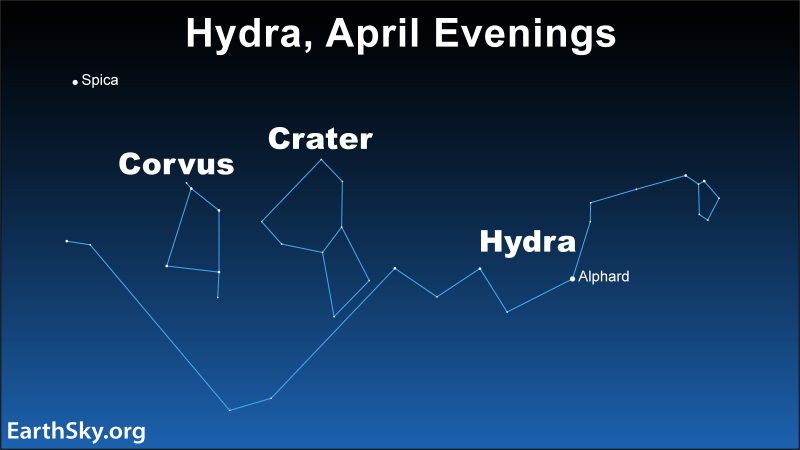
Hydra: Long line connected with dots and loop on right, chalice and irregular rectangle on top.
You can see the entire constellation Hydra the Water Snake on April evenings. Crater the Cup and Corvus the Crow are 2 constellations that sit upon the water snake. The bright star Spica in Virgo is nearby.

Hydra the Water Snake is the largest of all 88 constellations. It fills the space between zodiacal constellations along the ecliptic on one side and the Milky Way on the other. Hydra’s brightest star is Alphard, which is a sign of spring for the Northern Hemisphere. Moreover, the constellation is home to a variety pack of deep-sky observing targets.

Mythology of Hydra

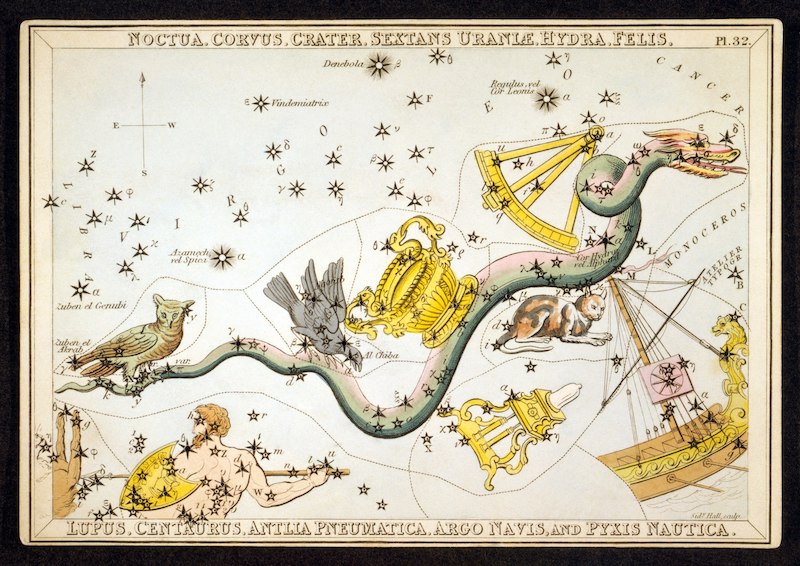
As you can see from the star chart, two constellations ride upon the back of Hydra the Water Snake: Corvus the Crow and Crater the Cup. One mythological story pairs up these three when the Crow serves the god Apollo a cup of water in which the Water Snake is hiding. Consequently, Apollo, angered by this ruse, throws them all up into the sky.

Antique map with long serpent and other animals and objects, scattered with stars.
Drawing from Urania’s Mirror, 1824. Hydra the Water Snake lies in the sky with the Crow and Cup on its back. Image via Sidney Hall/ Wikipedia. Public domain.

Finding the constellation Hydra

Hydra is located low in spring skies for observers in the Northern Hemisphere. Indeed, if you’re in the Southern Hemisphere, Hydra swims overhead. The circlet that forms the head of the Water Snake lies below the constellation Cancer the Crab with its famous Beehive Cluster. The body extends away from the head toward the southeast, all the way to Libra.

Assorted sizes of colored circles that are out-of-focus stars making up the constellation of Hydra.
View at EarthSky Community Photos. | Paolo Palma, in Italy, made this collage from 119 images – taken out of focus – and wrote: “Here, at a glance, are the colors of all the stars up to the sixth magnitude in the constellation Hydra, the longest constellation in the night sky. From an overview of its colors, it is clear that the constellation is largely made up of yellow and orange stars. And that the blue and pale yellow ones are concentrated mainly on the head. Then along the body there are numerous red ones, such as U and V Hya, two famous carbon stars, respectively one of the brightest and one of the reddest in the night sky.” Thank you, Paolo!

Stars trace out the Water Snake

Despite its long length, there are only a few stars of note in Hydra. The circlet marking the head of Hydra contains stars from magnitude 3.1 to 4.4. In particular, the brightest in the circlet is Zeta Hydrae at magnitude 3.11. It lies 152 light-years away. Then two degrees away is the next brightest star in this region of Hydra, Epsilon Hydrae at magnitude 3.39, lying 134 light-years away. The 4th magnitude star Rho Hydrae lies between these two, and three other dim stars (Delta at magnitude 4.1, Sigma at magnitude 4.4 and Eta at magnitude 4.2) complete the circlet.

The brightest star in Hydra – Alphard – lies about 16 degrees from the circlet. Additionally, it is 23 degrees south of the bright star Regulus in Leo. Alphard’s other name is Alpha Librae, and it shines at magnitude 1.99. Alphard lies 177 light-years away.

White chart with black dots for stars tracing long crooked line.
Hydra the Water Snake is the longest of the 88 constellations. It extends all the way from Cancer the Crab, below Leo the Lion, to the end of Virgo the Maiden. Image via Wikimedia Commons. CC BY 3.0.

Deep-sky objects in Hydra

There are three Messier objects in Hydra: an open cluster, a globular cluster and a galaxy. In addition, a nice nebula also resides here, giving Hydra one good example of each of the major types of deep-sky observing targets.

M48 is an open cluster on the far western edge of Hydra. It lies 14 degrees from the bright star Procyon in Canis Minor. Comparatively, M48 is magnitude 5.8 and lies about 1,500 light-years away. You can see this open cluster without optical aid under dark skies, but binoculars or a telescope will reveal about 50 of its 80 stars.

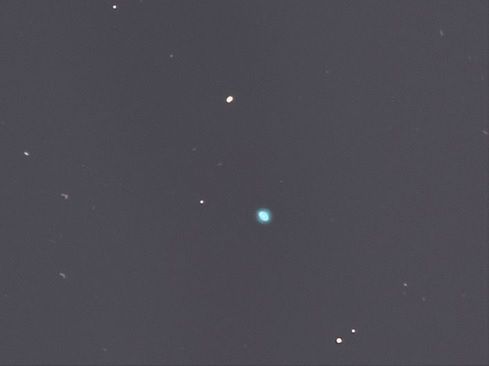
Hydra’s exemplary planetary nebula is the Ghost of Jupiter, or NGC 3242. This 9th-magnitude nebula consists of a star at center with a bright nebula and a ghostly cocoon. From our point of view, it takes up about the same amount of sky as Jupiter. The Ghost of Jupiter lies 31 degrees below the body of Leo the Lion.

Small, fuzzy green oblong in starfield.
View at EarthSky Community Photos. | Faiz Ahmad in Virginia, took this image on May 1, 2020. Faiz wrote: “NGC 3242, the Ghost of Jupiter, is a planetary nebula located in Hydra.” See the video here. Thank you, Faiz!

The globular cluster in Hydra, M68, lies just 3 1/2 degrees below the 2nd brightest star in Corvus. M68 is magnitude 8.19, lying 33,000 light-years away. It’s a good sight through a telescope.

The last Messier object lies 13 degrees east from M68. It’s M83, a magnitude 7.6 barred spiral galaxy. Part of the Centaurus group of galaxies, M83 – aka the Southern Pinwheel Galaxy – is one of the closer galaxies to Earth at 15 million light-years.

Bottom line: April is a good time to view Hydra the Water Snake, the largest of the 88 constellations.

The post Hydra the Water Snake, the longest constellation first appeared on EarthSky.


from EarthSky https://ift.tt/5i4uaOF
Hydra: Long line connected with dots and loop on right, chalice and irregular rectangle on top.
You can see the entire constellation Hydra the Water Snake on April evenings. Crater the Cup and Corvus the Crow are 2 constellations that sit upon the water snake. The bright star Spica in Virgo is nearby.

Hydra the Water Snake is the largest of all 88 constellations. It fills the space between zodiacal constellations along the ecliptic on one side and the Milky Way on the other. Hydra’s brightest star is Alphard, which is a sign of spring for the Northern Hemisphere. Moreover, the constellation is home to a variety pack of deep-sky observing targets.

Mythology of Hydra

As you can see from the star chart, two constellations ride upon the back of Hydra the Water Snake: Corvus the Crow and Crater the Cup. One mythological story pairs up these three when the Crow serves the god Apollo a cup of water in which the Water Snake is hiding. Consequently, Apollo, angered by this ruse, throws them all up into the sky.

Antique map with long serpent and other animals and objects, scattered with stars.
Drawing from Urania’s Mirror, 1824. Hydra the Water Snake lies in the sky with the Crow and Cup on its back. Image via Sidney Hall/ Wikipedia. Public domain.

Finding the constellation Hydra

Hydra is located low in spring skies for observers in the Northern Hemisphere. Indeed, if you’re in the Southern Hemisphere, Hydra swims overhead. The circlet that forms the head of the Water Snake lies below the constellation Cancer the Crab with its famous Beehive Cluster. The body extends away from the head toward the southeast, all the way to Libra.

Assorted sizes of colored circles that are out-of-focus stars making up the constellation of Hydra.
View at EarthSky Community Photos. | Paolo Palma, in Italy, made this collage from 119 images – taken out of focus – and wrote: “Here, at a glance, are the colors of all the stars up to the sixth magnitude in the constellation Hydra, the longest constellation in the night sky. From an overview of its colors, it is clear that the constellation is largely made up of yellow and orange stars. And that the blue and pale yellow ones are concentrated mainly on the head. Then along the body there are numerous red ones, such as U and V Hya, two famous carbon stars, respectively one of the brightest and one of the reddest in the night sky.” Thank you, Paolo!

Stars trace out the Water Snake

Despite its long length, there are only a few stars of note in Hydra. The circlet marking the head of Hydra contains stars from magnitude 3.1 to 4.4. In particular, the brightest in the circlet is Zeta Hydrae at magnitude 3.11. It lies 152 light-years away. Then two degrees away is the next brightest star in this region of Hydra, Epsilon Hydrae at magnitude 3.39, lying 134 light-years away. The 4th magnitude star Rho Hydrae lies between these two, and three other dim stars (Delta at magnitude 4.1, Sigma at magnitude 4.4 and Eta at magnitude 4.2) complete the circlet.

The brightest star in Hydra – Alphard – lies about 16 degrees from the circlet. Additionally, it is 23 degrees south of the bright star Regulus in Leo. Alphard’s other name is Alpha Librae, and it shines at magnitude 1.99. Alphard lies 177 light-years away.

White chart with black dots for stars tracing long crooked line.
Hydra the Water Snake is the longest of the 88 constellations. It extends all the way from Cancer the Crab, below Leo the Lion, to the end of Virgo the Maiden. Image via Wikimedia Commons. CC BY 3.0.

Deep-sky objects in Hydra

There are three Messier objects in Hydra: an open cluster, a globular cluster and a galaxy. In addition, a nice nebula also resides here, giving Hydra one good example of each of the major types of deep-sky observing targets.

M48 is an open cluster on the far western edge of Hydra. It lies 14 degrees from the bright star Procyon in Canis Minor. Comparatively, M48 is magnitude 5.8 and lies about 1,500 light-years away. You can see this open cluster without optical aid under dark skies, but binoculars or a telescope will reveal about 50 of its 80 stars.

Hydra’s exemplary planetary nebula is the Ghost of Jupiter, or NGC 3242. This 9th-magnitude nebula consists of a star at center with a bright nebula and a ghostly cocoon. From our point of view, it takes up about the same amount of sky as Jupiter. The Ghost of Jupiter lies 31 degrees below the body of Leo the Lion.

Small, fuzzy green oblong in starfield.
View at EarthSky Community Photos. | Faiz Ahmad in Virginia, took this image on May 1, 2020. Faiz wrote: “NGC 3242, the Ghost of Jupiter, is a planetary nebula located in Hydra.” See the video here. Thank you, Faiz!

The globular cluster in Hydra, M68, lies just 3 1/2 degrees below the 2nd brightest star in Corvus. M68 is magnitude 8.19, lying 33,000 light-years away. It’s a good sight through a telescope.

The last Messier object lies 13 degrees east from M68. It’s M83, a magnitude 7.6 barred spiral galaxy. Part of the Centaurus group of galaxies, M83 – aka the Southern Pinwheel Galaxy – is one of the closer galaxies to Earth at 15 million light-years.

Bottom line: April is a good time to view Hydra the Water Snake, the largest of the 88 constellations.

The post Hydra the Water Snake, the longest constellation first appeared on EarthSky.


from EarthSky https://ift.tt/5i4uaOF

The night sky in the time of the dinosaurs

Silhouette of two dinos at night with the stars and Milky Way behind them.
What did the night sky look like in the time of the dinosaurs? Image via Stephen Leonardi/ Pexels.

You deserve a daily dose of good news. For the latest in science and the night sky, subscribe to EarthSky’s free daily newsletter.

The night sky in the time of the dinosaurs

Step outside on a moonless night and gaze at the night sky. Your eyes will likely first seek out familiar patterns of stars, such as the constellations Orion the Hunter or Sagittarius the Archer. There are just certain sights that make a stargazer feel at home. But if you could travel back to the age of the dinosaurs, most of the familiar stars would be nowhere to be seen.

During the long reign of dinosaurs – from roughly 230 to 66 million years ago – the constellations we recognize today didn’t exist, at least not in their current forms. Stars are not only constantly being born and dying, they’re also always on the move. Just like our sun and its solar system, stars follow their own path through the Milky Way galaxy. And over millions of years, these differences can create a whole new starscape overhead.

The stars have changed in location over time

The stars the dinosaurs saw would not have been the same as the ones we see today. For starters, 100 million years ago, we would have been on the other side of the Milky Way galaxy. And all the other stars would have been following their own individual paths through our Milky Way. So while you might picture our galaxy as a spinning disk like a Frisbee, in reality, the stars aren’t anchored in the same exact locations. The stars drift closer and farther from each other. And the constellations morph into new configurations.

But some of the stars we currently know would at least have existed in the time of the dinosaurs. That includes stars such as Sirius and Vega. Sirius is about 200 to 300 million years old. And Vega is about 500 million years old. Where precisely they were that long ago in relation to us, however, is unclear.

Meanwhile, other stars such as Orion the Hunter’s Rigel and Betelgeuse are considerably younger. They didn’t come into existence until after the age of the dinosaurs. Rigel is a mere 8 million years old, and Betelgeuse is perhaps 10 million years old.


This video shows you how chaotic the motion of individual stars can be in the galaxy. This data is from the Gaia spacecraft and it shows the proper motions of 40,000 stars, all located within 326 light-years of the solar system. It follows stars from the present day out to 400,000 years into the future.

Focusing on Canis Major

When we talk about the skies the dinosaurs saw, that’s some 100 million years ago. And Sirius has existed for 200 to 300 million years. So let’s look at it and some other stars in Canis Major the Greater Dog as an example.

Sirius (Alpha Canis Majoris) is currently the brightest star in Earth’s nighttime sky. But, in fact, a couple other stars in Canis Major once shone much brighter than Sirius.

While stars appear bright to us partly because of their size, it’s also largely because of how close they are to us. Sirius is not a particularly massive star. It just happens to be nearby. And our distance to stars changes over time due to the motions of our solar system and the other stars.

Just 4.7 million years ago, a star that is now unremarkable in our sky – Epsilon Canis Majoris – was once as bright as Venus! At its brightest, Epsilon Canis Majoris was magnitude -3.99, when it was 34 light-years away from us. So, for a time, it was the brightest star in Earth’s night sky. Today, it shines at a decent magnitude 1.5 from a distance of 430 light-years.

Another star in Canis Major, Beta Canis Majoris, also got a turn at being the brightest star in our sky. Beta Canis Majoris was at its brightest 4.4 million years ago. At that time, it shone at magnitude -3.65 from a distance of 37 light-years.

Sirius, our current brightest star, shines at magnitude -1.46 from a distance of 8.6 light-years. It will continue to get a bit closer and brighter, maxxing out at magnitude -1.68 in 60,000 years, when it comes within 7.8 light-years of us.

Constellations and clusters in the time of the dinosaurs

So, it makes sense that if today’s stars were in different locations or not even in existence yet 100 million years ago, the constellations we see now would not have been the same constellations the dinosaurs saw. But what about other hallmarks of the sky, such as star clusters?

Well, for example, the Pleiades star cluster is a group of young, bright blue stars around 100 million years old. They would have still been forming during the age of the dinosaurs.

On the other hand, the Hyades star cluster – that V-shaped formation that makes up Taurus the Bull’s head – has been around for some 750 million years. But it would have been in a different configuration as the stars drifted into their current locations relative to each other. And, as for all stars and star clusters, they are not moving along with us through the galaxy. They chart their own course.

Something familiar! The Milky Way

The glowing band of the Milky Way would still have stretched across the sky. This hazy river of light formed by billions of distant stars has been around much longer than the dinosaurs. And its overall appearance to the unaided eye wouldn’t have changed dramatically over 100 million years. It’s just the brightest and nearest stars themselves that would have been different. But the background glow of our galaxy in the age of the dinosaurs would at least be a familiar sight to us.

See the best Milky Way photos of 2025 here

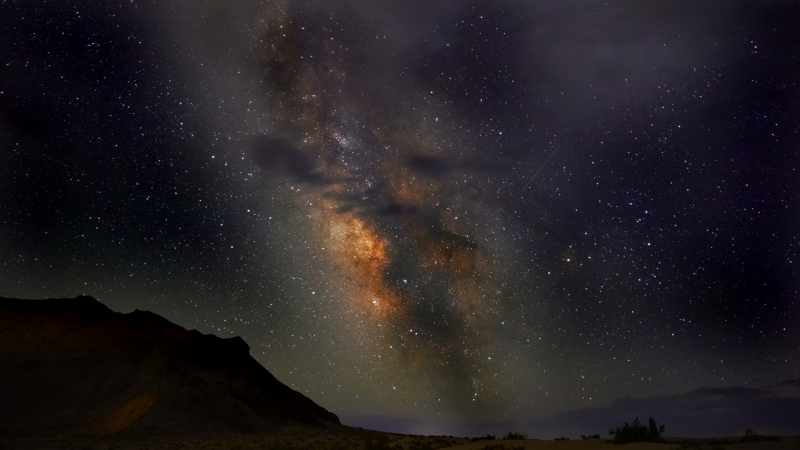
Colorful core of the Milky Way standing tall over the dark landscape.
View at EarthSky Community Photos. | Steve Price in The Knolls, Utah, captured this image on August 26, 2022. Thank you, Steve!

Our solar system in the age of the dinosaurs

The planets themselves, as little dots of light in the night sky, would have looked relatively the same. But if dinosaurs had been clever and “handy” enough to invent the telescope, a closeup look at Saturn would have been quite different. Astronomers think Saturn’s ring system is only about 10 to 100 million years old. So the dinosaurs most likely wouldn’t have seen rings around Saturn, had they been able to see the planet that closely.

The moon would have been slightly different in the age of the dinosaurs as well. It would have been just a bit closer to Earth 100 million years ago, so it would have appeared a bit larger in our sky. And, therefore, total solar eclipses would have lasted a little longer.

Another cool feature dinosaurs would have seen on the moon: erupting volcanoes! This information comes from China’s Chang’e 5 mission over the past couple years. Researchers discovered tiny glass beads in lunar samples brought back to Earth. And analysis of the beads indicates volcanoes were erupting on the moon as recently as 120 million years ago, while dinosaurs were still roaming Earth. What a sight that must have been.

No artificial light pollution and no satellites

Dinosaurs would have been looking at an exquisitely pure and dark night sky. There were no artificial lights or satellites or even airplanes marring the majestic night. The skies at night, especially during new moon, would have been dramatically dark. Meteor showers and auroras would have been some great options for nighttime entertainment after the skies grew dark.

The Milky Way could have cast shadows of the dinos as they lumbered across the landscape. Compare that to today, where, as recently as 2016, scientists in the journal Science Advances said that nearly 80% of U.S. citizens can’t even see the Milky Way due to light pollution.

If you’re ever offered a chance to ride in a time machine back to the age of the dinosaurs, don’t forget to stop and admire the stars.

A T-rex dino with the Milky Way behind him.
The night sky in the time of the dinosaurs would have looked somewhat different than we see today. Image via Jake Fagan/ Unsplash.

Bottom line: The night sky in the time of the dinosaurs would have looked much different than today’s. Some famous stars had not yet been born, while familiar features, such as the moon, would have been closer and still volcanically active.

Read more: Our sun might be a migrant from the inner Milky Way

Read more: Which Milky Way spiral arm contains our sun?

The post The night sky in the time of the dinosaurs first appeared on EarthSky.


from EarthSky https://ift.tt/nDzMHFs
Silhouette of two dinos at night with the stars and Milky Way behind them.
What did the night sky look like in the time of the dinosaurs? Image via Stephen Leonardi/ Pexels.

You deserve a daily dose of good news. For the latest in science and the night sky, subscribe to EarthSky’s free daily newsletter.

The night sky in the time of the dinosaurs

Step outside on a moonless night and gaze at the night sky. Your eyes will likely first seek out familiar patterns of stars, such as the constellations Orion the Hunter or Sagittarius the Archer. There are just certain sights that make a stargazer feel at home. But if you could travel back to the age of the dinosaurs, most of the familiar stars would be nowhere to be seen.

During the long reign of dinosaurs – from roughly 230 to 66 million years ago – the constellations we recognize today didn’t exist, at least not in their current forms. Stars are not only constantly being born and dying, they’re also always on the move. Just like our sun and its solar system, stars follow their own path through the Milky Way galaxy. And over millions of years, these differences can create a whole new starscape overhead.

The stars have changed in location over time

The stars the dinosaurs saw would not have been the same as the ones we see today. For starters, 100 million years ago, we would have been on the other side of the Milky Way galaxy. And all the other stars would have been following their own individual paths through our Milky Way. So while you might picture our galaxy as a spinning disk like a Frisbee, in reality, the stars aren’t anchored in the same exact locations. The stars drift closer and farther from each other. And the constellations morph into new configurations.

But some of the stars we currently know would at least have existed in the time of the dinosaurs. That includes stars such as Sirius and Vega. Sirius is about 200 to 300 million years old. And Vega is about 500 million years old. Where precisely they were that long ago in relation to us, however, is unclear.

Meanwhile, other stars such as Orion the Hunter’s Rigel and Betelgeuse are considerably younger. They didn’t come into existence until after the age of the dinosaurs. Rigel is a mere 8 million years old, and Betelgeuse is perhaps 10 million years old.


This video shows you how chaotic the motion of individual stars can be in the galaxy. This data is from the Gaia spacecraft and it shows the proper motions of 40,000 stars, all located within 326 light-years of the solar system. It follows stars from the present day out to 400,000 years into the future.

Focusing on Canis Major

When we talk about the skies the dinosaurs saw, that’s some 100 million years ago. And Sirius has existed for 200 to 300 million years. So let’s look at it and some other stars in Canis Major the Greater Dog as an example.

Sirius (Alpha Canis Majoris) is currently the brightest star in Earth’s nighttime sky. But, in fact, a couple other stars in Canis Major once shone much brighter than Sirius.

While stars appear bright to us partly because of their size, it’s also largely because of how close they are to us. Sirius is not a particularly massive star. It just happens to be nearby. And our distance to stars changes over time due to the motions of our solar system and the other stars.

Just 4.7 million years ago, a star that is now unremarkable in our sky – Epsilon Canis Majoris – was once as bright as Venus! At its brightest, Epsilon Canis Majoris was magnitude -3.99, when it was 34 light-years away from us. So, for a time, it was the brightest star in Earth’s night sky. Today, it shines at a decent magnitude 1.5 from a distance of 430 light-years.

Another star in Canis Major, Beta Canis Majoris, also got a turn at being the brightest star in our sky. Beta Canis Majoris was at its brightest 4.4 million years ago. At that time, it shone at magnitude -3.65 from a distance of 37 light-years.

Sirius, our current brightest star, shines at magnitude -1.46 from a distance of 8.6 light-years. It will continue to get a bit closer and brighter, maxxing out at magnitude -1.68 in 60,000 years, when it comes within 7.8 light-years of us.

Constellations and clusters in the time of the dinosaurs

So, it makes sense that if today’s stars were in different locations or not even in existence yet 100 million years ago, the constellations we see now would not have been the same constellations the dinosaurs saw. But what about other hallmarks of the sky, such as star clusters?

Well, for example, the Pleiades star cluster is a group of young, bright blue stars around 100 million years old. They would have still been forming during the age of the dinosaurs.

On the other hand, the Hyades star cluster – that V-shaped formation that makes up Taurus the Bull’s head – has been around for some 750 million years. But it would have been in a different configuration as the stars drifted into their current locations relative to each other. And, as for all stars and star clusters, they are not moving along with us through the galaxy. They chart their own course.

Something familiar! The Milky Way

The glowing band of the Milky Way would still have stretched across the sky. This hazy river of light formed by billions of distant stars has been around much longer than the dinosaurs. And its overall appearance to the unaided eye wouldn’t have changed dramatically over 100 million years. It’s just the brightest and nearest stars themselves that would have been different. But the background glow of our galaxy in the age of the dinosaurs would at least be a familiar sight to us.

See the best Milky Way photos of 2025 here

Colorful core of the Milky Way standing tall over the dark landscape.
View at EarthSky Community Photos. | Steve Price in The Knolls, Utah, captured this image on August 26, 2022. Thank you, Steve!

Our solar system in the age of the dinosaurs

The planets themselves, as little dots of light in the night sky, would have looked relatively the same. But if dinosaurs had been clever and “handy” enough to invent the telescope, a closeup look at Saturn would have been quite different. Astronomers think Saturn’s ring system is only about 10 to 100 million years old. So the dinosaurs most likely wouldn’t have seen rings around Saturn, had they been able to see the planet that closely.

The moon would have been slightly different in the age of the dinosaurs as well. It would have been just a bit closer to Earth 100 million years ago, so it would have appeared a bit larger in our sky. And, therefore, total solar eclipses would have lasted a little longer.

Another cool feature dinosaurs would have seen on the moon: erupting volcanoes! This information comes from China’s Chang’e 5 mission over the past couple years. Researchers discovered tiny glass beads in lunar samples brought back to Earth. And analysis of the beads indicates volcanoes were erupting on the moon as recently as 120 million years ago, while dinosaurs were still roaming Earth. What a sight that must have been.

No artificial light pollution and no satellites

Dinosaurs would have been looking at an exquisitely pure and dark night sky. There were no artificial lights or satellites or even airplanes marring the majestic night. The skies at night, especially during new moon, would have been dramatically dark. Meteor showers and auroras would have been some great options for nighttime entertainment after the skies grew dark.

The Milky Way could have cast shadows of the dinos as they lumbered across the landscape. Compare that to today, where, as recently as 2016, scientists in the journal Science Advances said that nearly 80% of U.S. citizens can’t even see the Milky Way due to light pollution.

If you’re ever offered a chance to ride in a time machine back to the age of the dinosaurs, don’t forget to stop and admire the stars.

A T-rex dino with the Milky Way behind him.
The night sky in the time of the dinosaurs would have looked somewhat different than we see today. Image via Jake Fagan/ Unsplash.

Bottom line: The night sky in the time of the dinosaurs would have looked much different than today’s. Some famous stars had not yet been born, while familiar features, such as the moon, would have been closer and still volcanically active.

Read more: Our sun might be a migrant from the inner Milky Way

Read more: Which Milky Way spiral arm contains our sun?

The post The night sky in the time of the dinosaurs first appeared on EarthSky.


from EarthSky https://ift.tt/nDzMHFs

Ancestors of mammals laid eggs, says new fossil evidence

A grey drawing of an embryo in a shell. This fossil is evidence that the ancestors of mammals laid eggs.
Artist’s concept of the embryonic Lystrosaurus in its shell. The reconstruction is based on a fossil found in South Africa. It’s evidence that the ancestors of mammals laid eggs. Image via Sophie Vrard and Julien Benoit/ University of the Witwatersrand.
  • A 250-million-year-old fossil of an embryonic Lystrosaurus — an extinct animal that’s an ancestor of mammals — shows these creatures laid eggs.
  • Lystrosaurus, a piglike herbivore with a turtlelike beak and tusks, survived Earth’s worst mass extinction at the end of the Permian Epoch.
  • Advanced CT scanning revealed the tiny skeleton inside a rock nodule. And it had characteristics that confirmed the animal died before hatching.

Science news, night sky events and beautiful photos, all in one place. Click here to subscribe to EarthSky’s free daily newsletter.

CT scans of a rock nodule reveal a tiny skeleton

When researchers found a 250-million-year-old rock nodule with bits of fossil bone on its surface, they were curious to know what was inside. So they used advanced x-ray CT scans to study the rock’s interior. What they discovered was a tiny curled-up skeleton, tightly packed as if inside an egg. It was an embryonic Lystrosaurus, an animal that’s an evolutionary ancestor of mammals. The team said on April 9, 2026, that this fossil is strong evidence that the precursors to mammals laid eggs, instead of giving birth to live offspring.

Co-author Jennifer Botha of the University of the Witwatersrand said:

This fossil was discovered during a field excursion I led in 2008, nearly 17 years ago. My preparator and exceptional fossil finder, John Nyaphuli, identified a small nodule that at first revealed only tiny flecks of bone. As he carefully prepared the specimen, it became clear that it was a perfectly curled-up Lystrosaurus hatchling. I suspected even then that it had died within the egg, but at the time, we simply didn’t have the technology to confirm it.

The scientists published their study in the peer-reviewed journal PLOS One on April 9, 2026.

Lystrosaurus was a precursor to mammals

Lystrosaurus was a strange-looking beast. It had a sprawling piglike body, with a horny turtlelike beak on its head, as well as two tusklike teeth. These herbivorous creatures lived during the Late Permian and Early Triassic, approximately 259 to 247 million years ago.

At least four species of Lystrosaurus once roamed Pangea, an ancient supercontinent. Scientists have found fossils of these creatures in Antarctica, India, China, Mongolia, Russia and South Africa.

At the end of the Permian Epoch, about 252 million years ago, Earth underwent its most severe mass extinction. Major volcanic eruptions were the main triggers of this extinction. As a result, many animal species vanished forever. But Lystrosaurus survived and went on to thrive despite the unstable environment with hot conditions and long dry spells.

Scientists interested in mammalian reproduction have wondered if mammal ancestors gave birth to live young or laid eggs. They also wondered how they cared for their young. Most mammals today give birth to live young. But there’s a type of mammal called monotremes that lay eggs. They also nurse their young with milk. Monotremes – the platypus and four species of echidnas – are only found in Australia and New Guinea.

A grey-brown animal with a beak and two tusks.
This is an artist’s depiction of Lystrosaurus georgi. It’s 1 of at least 4 known species of Lystrosaurus. Image via Dmitry Bogdanov/ Wikimedia Commons (GNU FDL).

Using the latest tech to see inside the rock

The scientists could not fully extract the fragile fossil from the rock without risking damage to it. So, they turned to advanced synchrotron x-ray computed tomography (CT). Here, x-ray pulses probed the interior of the rock nodule to reveal its internal structure, in this case, the fossilized bones of Lystrosaurus. The result was a three-dimensional image reconstruction of the bones.

The team carried out this work at The European Synchrotron in France. Vincent Fernandez, who works at this facility, commented:

Understanding reproduction in mammal ancestors has been a long-lasting enigma and this fossil provides a key piece to this puzzle. It was essential that we scanned the fossil just right to capture the level of detail needed to resolve such tiny, delicate bones.

A colorful diagram of the fossil parts inside the rock.
The Lystrosaurus embryo skeleton parts are color-coded in this three-dimensional image derived from the CT scan. The ribs are blue, backbones are shades of green, forelimbs are red, the femur is yellow, the skull is light red and the mandible is light orange. Image via Julien Benoit/ University of the Witwatersrand.

How scientists established this fossil was in an egg

How did the scientists know that this fossil was an embryonic Lystrosaurus? Lead author Julien Benoit of the University of the Witwatersrand said:

When I saw the incomplete mandibular symphysis [process of growing together], I was genuinely excited. The mandible, the lower jaw, is made up of two halves that must fuse before the animal can feed. The fact that this fusion had not yet occurred shows that the individual would have been incapable of feeding itself.

There were additional signs as well. For instance, other skeletal features – its shape, size, curled posture, weak limbs and the condition of its pelvis — indicated that this was an animal that was not capable of surviving on its own. In fact, it was still in its final stages of development. And the way it was curled up, in such a compact way, indicated it was in an egg.

So why haven’t scientists found Lystrosaurus eggs before? The researchers suggest that these eggs could have been soft-shelled, and therefore not preserved during the fossilization process.

A dark grey rock with bits of dark bone on the surface, held in a person's hand.
This is the rock nodule containing the embryonic Lystrosaurus fossil. The researchers used an advanced x-ray CT scanner to see the skeleton inside the rock. Image via Julien Benoit/ University of the Witwatersrand.

What the egg tells us about the ancestors of mammals

Lystrosaurus was a medium-sized animal, ranging in length from 2 to 8 feet (0.6 to 2.4 meters), depending on the species. On average, they were about 3 feet (0.9 meters) long.

Based on the size of the fossil, the researchers think the egg was about 3 inches long (7.6 cm) and 2 inches (5 cm) wide. It may have weighed about 4 ounces (113 grams). In addition, the animal’s skull was about 1.4 inches in length (35.5 mm).

This suggested that Lystrosaurus laid relatively large eggs for its body size. In modern-day animals, a large egg means there is more yolk in it, providing food for the embryo to develop into a fairly mature juvenile form. In other words, Lystrosaurus could move around shortly after birth and feed itself.

So the researchers think Lystrosaurus did not produce milk for its young, like mammals do today.

The team also said large eggs are better able to survive drought conditions because they are more resistant to drying out. This could be the reason why Lystrosaurus was able to survive the Permian extinction.

Bottom line: Scientists discovered a 250-million-year-old Lystrosaurus fossil that was still in its egg. Its shows these ancestors of mammals laid eggs.

Source: The first non-mammalian synapsid embryo from the Triassic of South Africa

Via The European Synchrotron

Read more: Some tropical mammals shy away from the full moon

Read more: What caused the Great Dying?

The post Ancestors of mammals laid eggs, says new fossil evidence first appeared on EarthSky.


from EarthSky https://ift.tt/8nze1py
A grey drawing of an embryo in a shell. This fossil is evidence that the ancestors of mammals laid eggs.
Artist’s concept of the embryonic Lystrosaurus in its shell. The reconstruction is based on a fossil found in South Africa. It’s evidence that the ancestors of mammals laid eggs. Image via Sophie Vrard and Julien Benoit/ University of the Witwatersrand.
  • A 250-million-year-old fossil of an embryonic Lystrosaurus — an extinct animal that’s an ancestor of mammals — shows these creatures laid eggs.
  • Lystrosaurus, a piglike herbivore with a turtlelike beak and tusks, survived Earth’s worst mass extinction at the end of the Permian Epoch.
  • Advanced CT scanning revealed the tiny skeleton inside a rock nodule. And it had characteristics that confirmed the animal died before hatching.

Science news, night sky events and beautiful photos, all in one place. Click here to subscribe to EarthSky’s free daily newsletter.

CT scans of a rock nodule reveal a tiny skeleton

When researchers found a 250-million-year-old rock nodule with bits of fossil bone on its surface, they were curious to know what was inside. So they used advanced x-ray CT scans to study the rock’s interior. What they discovered was a tiny curled-up skeleton, tightly packed as if inside an egg. It was an embryonic Lystrosaurus, an animal that’s an evolutionary ancestor of mammals. The team said on April 9, 2026, that this fossil is strong evidence that the precursors to mammals laid eggs, instead of giving birth to live offspring.

Co-author Jennifer Botha of the University of the Witwatersrand said:

This fossil was discovered during a field excursion I led in 2008, nearly 17 years ago. My preparator and exceptional fossil finder, John Nyaphuli, identified a small nodule that at first revealed only tiny flecks of bone. As he carefully prepared the specimen, it became clear that it was a perfectly curled-up Lystrosaurus hatchling. I suspected even then that it had died within the egg, but at the time, we simply didn’t have the technology to confirm it.

The scientists published their study in the peer-reviewed journal PLOS One on April 9, 2026.

Lystrosaurus was a precursor to mammals

Lystrosaurus was a strange-looking beast. It had a sprawling piglike body, with a horny turtlelike beak on its head, as well as two tusklike teeth. These herbivorous creatures lived during the Late Permian and Early Triassic, approximately 259 to 247 million years ago.

At least four species of Lystrosaurus once roamed Pangea, an ancient supercontinent. Scientists have found fossils of these creatures in Antarctica, India, China, Mongolia, Russia and South Africa.

At the end of the Permian Epoch, about 252 million years ago, Earth underwent its most severe mass extinction. Major volcanic eruptions were the main triggers of this extinction. As a result, many animal species vanished forever. But Lystrosaurus survived and went on to thrive despite the unstable environment with hot conditions and long dry spells.

Scientists interested in mammalian reproduction have wondered if mammal ancestors gave birth to live young or laid eggs. They also wondered how they cared for their young. Most mammals today give birth to live young. But there’s a type of mammal called monotremes that lay eggs. They also nurse their young with milk. Monotremes – the platypus and four species of echidnas – are only found in Australia and New Guinea.

A grey-brown animal with a beak and two tusks.
This is an artist’s depiction of Lystrosaurus georgi. It’s 1 of at least 4 known species of Lystrosaurus. Image via Dmitry Bogdanov/ Wikimedia Commons (GNU FDL).

Using the latest tech to see inside the rock

The scientists could not fully extract the fragile fossil from the rock without risking damage to it. So, they turned to advanced synchrotron x-ray computed tomography (CT). Here, x-ray pulses probed the interior of the rock nodule to reveal its internal structure, in this case, the fossilized bones of Lystrosaurus. The result was a three-dimensional image reconstruction of the bones.

The team carried out this work at The European Synchrotron in France. Vincent Fernandez, who works at this facility, commented:

Understanding reproduction in mammal ancestors has been a long-lasting enigma and this fossil provides a key piece to this puzzle. It was essential that we scanned the fossil just right to capture the level of detail needed to resolve such tiny, delicate bones.

A colorful diagram of the fossil parts inside the rock.
The Lystrosaurus embryo skeleton parts are color-coded in this three-dimensional image derived from the CT scan. The ribs are blue, backbones are shades of green, forelimbs are red, the femur is yellow, the skull is light red and the mandible is light orange. Image via Julien Benoit/ University of the Witwatersrand.

How scientists established this fossil was in an egg

How did the scientists know that this fossil was an embryonic Lystrosaurus? Lead author Julien Benoit of the University of the Witwatersrand said:

When I saw the incomplete mandibular symphysis [process of growing together], I was genuinely excited. The mandible, the lower jaw, is made up of two halves that must fuse before the animal can feed. The fact that this fusion had not yet occurred shows that the individual would have been incapable of feeding itself.

There were additional signs as well. For instance, other skeletal features – its shape, size, curled posture, weak limbs and the condition of its pelvis — indicated that this was an animal that was not capable of surviving on its own. In fact, it was still in its final stages of development. And the way it was curled up, in such a compact way, indicated it was in an egg.

So why haven’t scientists found Lystrosaurus eggs before? The researchers suggest that these eggs could have been soft-shelled, and therefore not preserved during the fossilization process.

A dark grey rock with bits of dark bone on the surface, held in a person's hand.
This is the rock nodule containing the embryonic Lystrosaurus fossil. The researchers used an advanced x-ray CT scanner to see the skeleton inside the rock. Image via Julien Benoit/ University of the Witwatersrand.

What the egg tells us about the ancestors of mammals

Lystrosaurus was a medium-sized animal, ranging in length from 2 to 8 feet (0.6 to 2.4 meters), depending on the species. On average, they were about 3 feet (0.9 meters) long.

Based on the size of the fossil, the researchers think the egg was about 3 inches long (7.6 cm) and 2 inches (5 cm) wide. It may have weighed about 4 ounces (113 grams). In addition, the animal’s skull was about 1.4 inches in length (35.5 mm).

This suggested that Lystrosaurus laid relatively large eggs for its body size. In modern-day animals, a large egg means there is more yolk in it, providing food for the embryo to develop into a fairly mature juvenile form. In other words, Lystrosaurus could move around shortly after birth and feed itself.

So the researchers think Lystrosaurus did not produce milk for its young, like mammals do today.

The team also said large eggs are better able to survive drought conditions because they are more resistant to drying out. This could be the reason why Lystrosaurus was able to survive the Permian extinction.

Bottom line: Scientists discovered a 250-million-year-old Lystrosaurus fossil that was still in its egg. Its shows these ancestors of mammals laid eggs.

Source: The first non-mammalian synapsid embryo from the Triassic of South Africa

Via The European Synchrotron

Read more: Some tropical mammals shy away from the full moon

Read more: What caused the Great Dying?

The post Ancestors of mammals laid eggs, says new fossil evidence first appeared on EarthSky.


from EarthSky https://ift.tt/8nze1py

adds 2