

The night sky in the time of the dinosaurs
Step outside on a moonless night and gaze at the night sky. Your eyes will likely first seek out familiar patterns of stars, such as the constellations Orion the Hunter or Sagittarius the Archer. There are just certain sights that make a stargazer feel at home. But if you could travel back to the age of the dinosaurs, most of the familiar stars would be nowhere to be seen.
During the long reign of dinosaurs – from roughly 230 to 66 million years ago – the constellations we recognize today didn’t exist, at least not in their current forms. Stars are not only constantly being born and dying, they’re also always on the move. Just like our sun and its solar system, stars follow their own path through the Milky Way galaxy. And over millions of years, these differences can create a whole new starscape overhead.
The stars have changed in location over time
The stars the dinosaurs saw would not have been the same as the ones we see today. For starters, 100 million years ago, we would have been on the other side of the Milky Way galaxy. And all the other stars would have been following their own individual paths through our Milky Way. So while you might picture our galaxy as a spinning disk like a Frisbee, in reality, the stars aren’t anchored in the same exact locations. The stars drift closer and farther from each other. And the constellations morph into new configurations.
But some of the stars we currently know would at least have existed in the time of the dinosaurs. That includes stars such as Sirius and Vega. Sirius is about 200 to 300 million years old. And Vega is about 500 million years old. Where precisely they were that long ago in relation to us, however, is unclear.
Meanwhile, other stars such as Orion the Hunter’s Rigel and Betelgeuse are considerably younger. They didn’t come into existence until after the age of the dinosaurs. Rigel is a mere 8 million years old, and Betelgeuse is perhaps 10 million years old.
This video shows you how chaotic the motion of individual stars can be in the galaxy. This data is from the Gaia spacecraft and it shows the proper motions of 40,000 stars, all located within 326 light-years of the solar system. It follows stars from the present day out to 400,000 years into the future.
Focusing on Canis Major
When we talk about the skies the dinosaurs saw, that’s some 100 million years ago. And Sirius has existed for 200 to 300 million years. So let’s look at it and some other stars in Canis Major the Greater Dog as an example.
Sirius (Alpha Canis Majoris) is currently the brightest star in Earth’s nighttime sky. But, in fact, a couple other stars in Canis Major once shone much brighter than Sirius.
While stars appear bright to us partly because of their size, it’s also largely because of how close they are to us. Sirius is not a particularly massive star. It just happens to be nearby. And our distance to stars changes over time due to the motions of our solar system and the other stars.
Just 4.7 million years ago, a star that is now unremarkable in our sky – Epsilon Canis Majoris – was once as bright as Venus! At its brightest, Epsilon Canis Majoris was magnitude -3.99, when it was 34 light-years away from us. So, for a time, it was the brightest star in Earth’s night sky. Today, it shines at a decent magnitude 1.5 from a distance of 430 light-years.
Another star in Canis Major, Beta Canis Majoris, also got a turn at being the brightest star in our sky. Beta Canis Majoris was at its brightest 4.4 million years ago. At that time, it shone at magnitude -3.65 from a distance of 37 light-years.
Sirius, our current brightest star, shines at magnitude -1.46 from a distance of 8.6 light-years. It will continue to get a bit closer and brighter, maxxing out at magnitude -1.68 in 60,000 years, when it comes within 7.8 light-years of us.
Constellations and clusters in the time of the dinosaurs
So, it makes sense that if today’s stars were in different locations or not even in existence yet 100 million years ago, the constellations we see now would not have been the same constellations the dinosaurs saw. But what about other hallmarks of the sky, such as star clusters?
Well, for example, the Pleiades star cluster is a group of young, bright blue stars around 100 million years old. They would have still been forming during the age of the dinosaurs.
On the other hand, the Hyades star cluster – that V-shaped formation that makes up Taurus the Bull’s head – has been around for some 750 million years. But it would have been in a different configuration as the stars drifted into their current locations relative to each other. And, as for all stars and star clusters, they are not moving along with us through the galaxy. They chart their own course.
Something familiar! The Milky Way
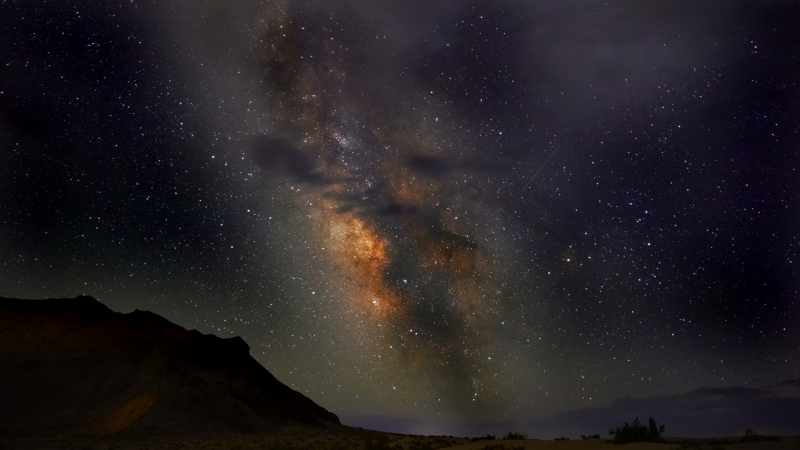
The glowing band of the Milky Way would still have stretched across the sky. This hazy river of light formed by billions of distant stars has been around much longer than the dinosaurs. And its overall appearance to the unaided eye wouldn’t have changed dramatically over 100 million years. It’s just the brightest and nearest stars themselves that would have been different. But the background glow of our galaxy in the age of the dinosaurs would at least be a familiar sight to us.
See the best Milky Way photos of 2025 here
Our solar system in the age of the dinosaurs
The planets themselves, as little dots of light in the night sky, would have looked relatively the same. But if dinosaurs had been clever and “handy” enough to invent the telescope, a closeup look at Saturn would have been quite different. Astronomers think Saturn’s ring system is only about 10 to 100 million years old. So the dinosaurs most likely wouldn’t have seen rings around Saturn, had they been able to see the planet that closely.
The moon would have been slightly different in the age of the dinosaurs as well. It would have been just a bit closer to Earth 100 million years ago, so it would have appeared a bit larger in our sky. And, therefore, total solar eclipses would have lasted a little longer.
Another cool feature dinosaurs would have seen on the moon: erupting volcanoes! This information comes from China’s Chang’e 5 mission over the past couple years. Researchers discovered tiny glass beads in lunar samples brought back to Earth. And analysis of the beads indicates volcanoes were erupting on the moon as recently as 120 million years ago, while dinosaurs were still roaming Earth. What a sight that must have been.
No artificial light pollution and no satellites
Dinosaurs would have been looking at an exquisitely pure and dark night sky. There were no artificial lights or satellites or even airplanes marring the majestic night. The skies at night, especially during new moon, would have been dramatically dark. Meteor showers and auroras would have been some great options for nighttime entertainment after the skies grew dark.
The Milky Way could have cast shadows of the dinos as they lumbered across the landscape. Compare that to today, where, as recently as 2016, scientists in the journal Science Advances said that nearly 80% of U.S. citizens can’t even see the Milky Way due to light pollution.
If you’re ever offered a chance to ride in a time machine back to the age of the dinosaurs, don’t forget to stop and admire the stars.

Bottom line: The night sky in the time of the dinosaurs would have looked much different than today’s. Some famous stars had not yet been born, while familiar features, such as the moon, would have been closer and still volcanically active.
Read more: Our sun might be a migrant from the inner Milky Way
Read more: Which Milky Way spiral arm contains our sun?
The post The night sky in the time of the dinosaurs first appeared on EarthSky.
from EarthSky https://ift.tt/nDzMHFs
The night sky in the time of the dinosaurs
Step outside on a moonless night and gaze at the night sky. Your eyes will likely first seek out familiar patterns of stars, such as the constellations Orion the Hunter or Sagittarius the Archer. There are just certain sights that make a stargazer feel at home. But if you could travel back to the age of the dinosaurs, most of the familiar stars would be nowhere to be seen.
During the long reign of dinosaurs – from roughly 230 to 66 million years ago – the constellations we recognize today didn’t exist, at least not in their current forms. Stars are not only constantly being born and dying, they’re also always on the move. Just like our sun and its solar system, stars follow their own path through the Milky Way galaxy. And over millions of years, these differences can create a whole new starscape overhead.
The stars have changed in location over time
The stars the dinosaurs saw would not have been the same as the ones we see today. For starters, 100 million years ago, we would have been on the other side of the Milky Way galaxy. And all the other stars would have been following their own individual paths through our Milky Way. So while you might picture our galaxy as a spinning disk like a Frisbee, in reality, the stars aren’t anchored in the same exact locations. The stars drift closer and farther from each other. And the constellations morph into new configurations.
But some of the stars we currently know would at least have existed in the time of the dinosaurs. That includes stars such as Sirius and Vega. Sirius is about 200 to 300 million years old. And Vega is about 500 million years old. Where precisely they were that long ago in relation to us, however, is unclear.
Meanwhile, other stars such as Orion the Hunter’s Rigel and Betelgeuse are considerably younger. They didn’t come into existence until after the age of the dinosaurs. Rigel is a mere 8 million years old, and Betelgeuse is perhaps 10 million years old.
This video shows you how chaotic the motion of individual stars can be in the galaxy. This data is from the Gaia spacecraft and it shows the proper motions of 40,000 stars, all located within 326 light-years of the solar system. It follows stars from the present day out to 400,000 years into the future.
Focusing on Canis Major
When we talk about the skies the dinosaurs saw, that’s some 100 million years ago. And Sirius has existed for 200 to 300 million years. So let’s look at it and some other stars in Canis Major the Greater Dog as an example.
Sirius (Alpha Canis Majoris) is currently the brightest star in Earth’s nighttime sky. But, in fact, a couple other stars in Canis Major once shone much brighter than Sirius.
While stars appear bright to us partly because of their size, it’s also largely because of how close they are to us. Sirius is not a particularly massive star. It just happens to be nearby. And our distance to stars changes over time due to the motions of our solar system and the other stars.
Just 4.7 million years ago, a star that is now unremarkable in our sky – Epsilon Canis Majoris – was once as bright as Venus! At its brightest, Epsilon Canis Majoris was magnitude -3.99, when it was 34 light-years away from us. So, for a time, it was the brightest star in Earth’s night sky. Today, it shines at a decent magnitude 1.5 from a distance of 430 light-years.
Another star in Canis Major, Beta Canis Majoris, also got a turn at being the brightest star in our sky. Beta Canis Majoris was at its brightest 4.4 million years ago. At that time, it shone at magnitude -3.65 from a distance of 37 light-years.
Sirius, our current brightest star, shines at magnitude -1.46 from a distance of 8.6 light-years. It will continue to get a bit closer and brighter, maxxing out at magnitude -1.68 in 60,000 years, when it comes within 7.8 light-years of us.
Constellations and clusters in the time of the dinosaurs
So, it makes sense that if today’s stars were in different locations or not even in existence yet 100 million years ago, the constellations we see now would not have been the same constellations the dinosaurs saw. But what about other hallmarks of the sky, such as star clusters?
Well, for example, the Pleiades star cluster is a group of young, bright blue stars around 100 million years old. They would have still been forming during the age of the dinosaurs.
On the other hand, the Hyades star cluster – that V-shaped formation that makes up Taurus the Bull’s head – has been around for some 750 million years. But it would have been in a different configuration as the stars drifted into their current locations relative to each other. And, as for all stars and star clusters, they are not moving along with us through the galaxy. They chart their own course.
Something familiar! The Milky Way
The glowing band of the Milky Way would still have stretched across the sky. This hazy river of light formed by billions of distant stars has been around much longer than the dinosaurs. And its overall appearance to the unaided eye wouldn’t have changed dramatically over 100 million years. It’s just the brightest and nearest stars themselves that would have been different. But the background glow of our galaxy in the age of the dinosaurs would at least be a familiar sight to us.
See the best Milky Way photos of 2025 here
Our solar system in the age of the dinosaurs
The planets themselves, as little dots of light in the night sky, would have looked relatively the same. But if dinosaurs had been clever and “handy” enough to invent the telescope, a closeup look at Saturn would have been quite different. Astronomers think Saturn’s ring system is only about 10 to 100 million years old. So the dinosaurs most likely wouldn’t have seen rings around Saturn, had they been able to see the planet that closely.
The moon would have been slightly different in the age of the dinosaurs as well. It would have been just a bit closer to Earth 100 million years ago, so it would have appeared a bit larger in our sky. And, therefore, total solar eclipses would have lasted a little longer.
Another cool feature dinosaurs would have seen on the moon: erupting volcanoes! This information comes from China’s Chang’e 5 mission over the past couple years. Researchers discovered tiny glass beads in lunar samples brought back to Earth. And analysis of the beads indicates volcanoes were erupting on the moon as recently as 120 million years ago, while dinosaurs were still roaming Earth. What a sight that must have been.
No artificial light pollution and no satellites
Dinosaurs would have been looking at an exquisitely pure and dark night sky. There were no artificial lights or satellites or even airplanes marring the majestic night. The skies at night, especially during new moon, would have been dramatically dark. Meteor showers and auroras would have been some great options for nighttime entertainment after the skies grew dark.
The Milky Way could have cast shadows of the dinos as they lumbered across the landscape. Compare that to today, where, as recently as 2016, scientists in the journal Science Advances said that nearly 80% of U.S. citizens can’t even see the Milky Way due to light pollution.
If you’re ever offered a chance to ride in a time machine back to the age of the dinosaurs, don’t forget to stop and admire the stars.
Bottom line: The night sky in the time of the dinosaurs would have looked much different than today’s. Some famous stars had not yet been born, while familiar features, such as the moon, would have been closer and still volcanically active.
Read more: Our sun might be a migrant from the inner Milky Way
Read more: Which Milky Way spiral arm contains our sun?
The post The night sky in the time of the dinosaurs first appeared on EarthSky.
from EarthSky https://ift.tt/nDzMHFs

Aucun commentaire:
Enregistrer un commentaire