aads

The 1919 solar eclipse that proved Einstein right

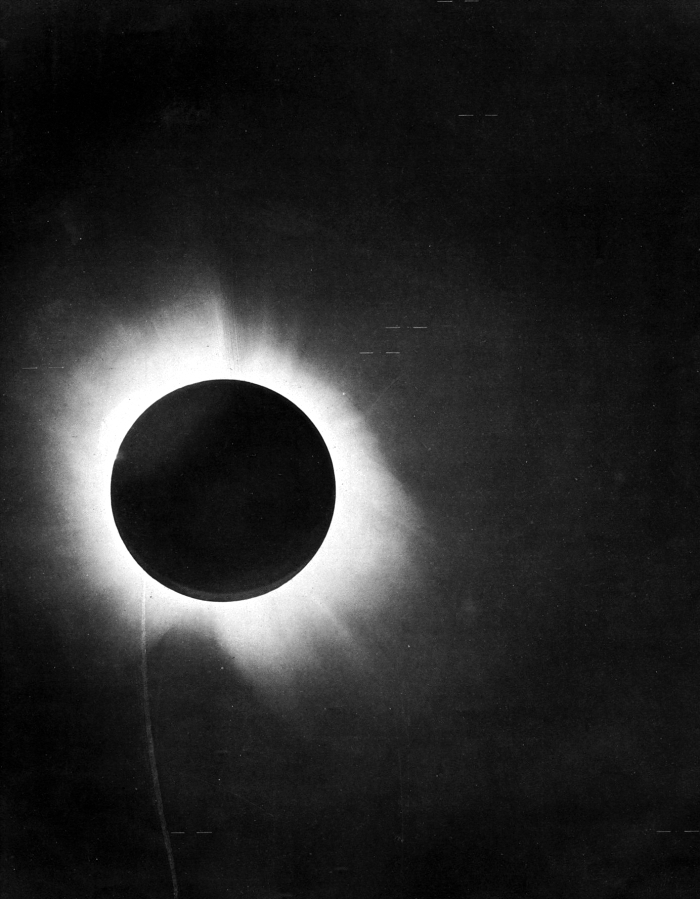
1919 solar eclipse: Black disk, with streamers of white light coming off it all around, and some tiny white dots with tick marks.
Einstein’s triumph. This early photograph shows a 1919 solar eclipse. See the tick marks around stars near the eclipsed sun? It was the precise measurement of the positions of these stars that proved the sun’s mass caused surrounding space to curve, bending starlight, in accordance with Einstein’s theory of general relativity. Image via Wikimedia Commons.

You deserve a daily dose of good news. For the latest in science and the night sky, subscribe to EarthSky’s free daily newsletter.

May 29, 1919, is the date of a solar eclipse that caused a revolution in human thought. The eclipse is famous for testing Albert Einstein’s theory of general relativity. Einstein was relatively unknown at the time. He had proposed general relativity in 1915, introducing a new way of thinking about gravity. Key to the theory was the transformative idea that mass causes space to curve.

Scientists were intrigued. But no one had experimentally proven Einstein’s theory to be true.

Then, on May 29, 1919, an expedition of English scientists – led by Sir Arthur Eddington – traveled to the island of Príncipe off the west coast of Africa to observe a total solar eclipse. If Einstein’s theory were correct, the light of stars should be bent while traveling the curved space near our sun. In other words, the sun’s gravity would cause the stars in the sun’s vicinity to appear displaced.

An eclipse, where the moon blocks the sunlight enough for stars to be seen near the sun, was the perfect opportunity to test this wild-sounding theory.

The scientists’ measurements during the eclipse showed that, astoundingly, Einstein’s predictions were correct. The locations of stars near the sun – made visible when the moon blocked the sun’s blazing light from view – appeared displaced.

Light did have to travel to our eyes on the curved space around the sun. Gravity worked as Einstein said it did.

From anonymity to stardom via a solar eclipse

Later that year – on November 6, 1919, in London – England’s Astronomer Royal, Frank Dyson, who had organized the expedition, presented the results at a joint meeting of the Royal Astronomical Society and the Royal Society. Dyson said “there can be no doubt” that measurements made during the May 29, 1919, solar eclipse “confirm Einstein’s prediction.”

As part of the celebration of the 100th anniversary of this legendary solar eclipse, Caltech physicist Sean Carroll explained to NBCNews in 2019:

General relativity was the poster child for being a crazy, new, hard-to-understand theory, with dramatic implications for the nature of reality. And yet you could see [the results]; you could photograph it. So people got caught up in that excitement.

And so Albert Einstein was catapulted to rock star fame, a status in popular culture he has retained ever since.
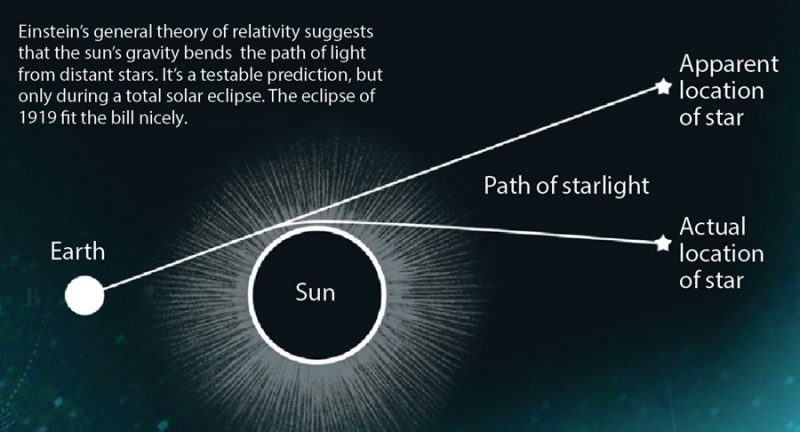
Diagram of sun, star, Earth. Straight line from us to a star's apparent location and a bent line to its real location.
During a solar eclipse, stars normally not visible in the glaring sunlight appear on the side of the sun and are displaced from the location they’d normally be in. Why? Because – just as Einstein’s theory said it should – light bends in the presence of mass, in this case the mass of a star, our sun. Rather than traveling in a straight path, the light of distant stars is forced to travel a curved path along the curved space near the sun. Note that the bending of starlight is exaggerated in this image. In reality, the stars are displaced by up to 1.75 arcseconds (about 0.0005 degrees). Image via NASA/ Goddard Space Flight Center/ DiscoverMagazine.com.

A new perspective on gravity and the universe

Einstein’s general theory of relativity underlies our most basic modern cosmology, our way of looking at the universe as a whole. Before Einstein, scientists relied on Isaac Newton’s theory of gravity. Newton’s way of looking at gravity is still valid and is still taught to physics students. But while Newton’s formulation of gravity is more of a special case under specific conditions, Einstein’s theory is a refinement of scientists’ understanding of gravity that covers the big picture … and what a mind-blowing big picture! Einstein proposed that mass causes space to curve.

So, for example, although there appears to be a “force” (as described by Newton) that causes our Earth to be pulled towards the sun by gravity. That force can “simply” be described as Earth traveling in curved space around the sun, according to Einstein.

Einstein’s general theory of relativity not only explains the motion of Earth and the other planets in our solar system. In our modern cosmology, it also describes extreme examples of curved space, such as around black holes. And it helps to describe the history and expansion of the universe as a whole.

The solar eclipse was the first proof of many

In the century and a bit since the 1919 total solar eclipse, Einstein’s relativity theory has been proven again and again, in many different ways. You might have seen the recent first-ever photo of a black hole? It also proved, once again, that Einstein was right.

Read more: Black hole image confirms Einstein’s relativity theory

Read more: Clocks, gravity and the limits of relativity
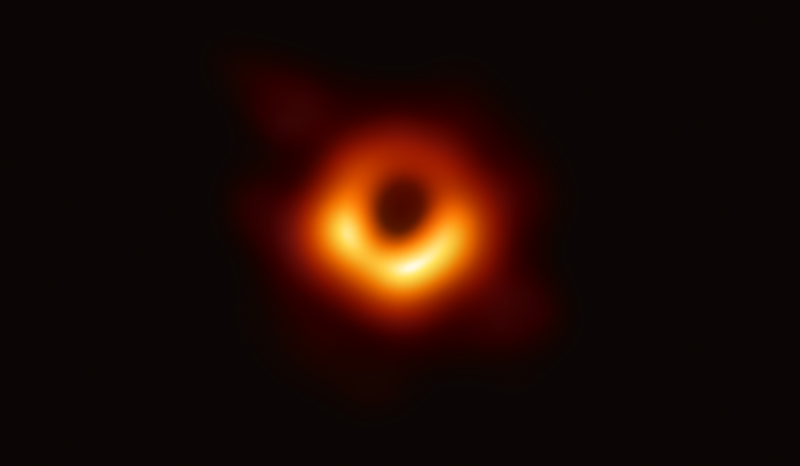
Glowing, fuzzy orange donut with black center.
This image captured people’s imaginations when it was released in 2019: the first-ever actual image of a giant black hole, in the center of galaxy M87. It also proves Einstein’s theory, which predicted the observations from M87 with unerring accuracy. Image via Event Horizon Telescope Collaboration.

Now and then

The Royal Astronomical Society (RAS) described modern-day practical applications of Einstein’s theory:

The theory fundamentally changed our understanding of physics and astronomy, and underpins critical modern technologies such as the satellite-based Global Positioning System (GPS).

The theory of relativity is essential for the correct operation of GPS systems, which in turn are relied on in many common applications including vehicle satellite navigation (SatNav) systems, weather forecasting, and disaster relief and emergency services. However, the world had to wait decades before the applications of such a blue skies result could be realized.

Back in the day of the 1919 eclipse, Sir Arthur Eddington attended a dinner of the same organization – RAS – shortly after the successful expedition. He then showed his humorous side by reciting a verse he had written on the feat:

Oh leave the wise our measures to collate
One thing at least is certain, light has weight
One thing is certain and the rest debate
Light rays, when near the sun, do not go straight.

Black and white photo of a man with pince-nez glasses.
Sir Arthur Eddington led the expedition that provided the first proof of Einstein’s theory of general relativity. Image via Wikimedia Commons.
A dark-haired young man with a mustache and a dignified expression, in a suit.
Albert Einstein in 1912. Image via Wikimedia Commons.

Bottom line: The solar eclipse of May 29, 1919, was the day astronomer Sir Arthur Eddington verified Einstein’s general theory of relativity, by observing how stars near the sun were displaced from their normal positions. This apparent change in position happens because, according to Einstein’s theory, the path of light is bent by gravity when it travels close to a massive object like our sun.

Via RAS

Via NBCNews

And via DiscoverMagazine.com

The post The 1919 solar eclipse that proved Einstein right first appeared on EarthSky.


from EarthSky https://ift.tt/62XNdPJ
1919 solar eclipse: Black disk, with streamers of white light coming off it all around, and some tiny white dots with tick marks.
Einstein’s triumph. This early photograph shows a 1919 solar eclipse. See the tick marks around stars near the eclipsed sun? It was the precise measurement of the positions of these stars that proved the sun’s mass caused surrounding space to curve, bending starlight, in accordance with Einstein’s theory of general relativity. Image via Wikimedia Commons.

You deserve a daily dose of good news. For the latest in science and the night sky, subscribe to EarthSky’s free daily newsletter.

May 29, 1919, is the date of a solar eclipse that caused a revolution in human thought. The eclipse is famous for testing Albert Einstein’s theory of general relativity. Einstein was relatively unknown at the time. He had proposed general relativity in 1915, introducing a new way of thinking about gravity. Key to the theory was the transformative idea that mass causes space to curve.

Scientists were intrigued. But no one had experimentally proven Einstein’s theory to be true.

Then, on May 29, 1919, an expedition of English scientists – led by Sir Arthur Eddington – traveled to the island of Príncipe off the west coast of Africa to observe a total solar eclipse. If Einstein’s theory were correct, the light of stars should be bent while traveling the curved space near our sun. In other words, the sun’s gravity would cause the stars in the sun’s vicinity to appear displaced.

An eclipse, where the moon blocks the sunlight enough for stars to be seen near the sun, was the perfect opportunity to test this wild-sounding theory.

The scientists’ measurements during the eclipse showed that, astoundingly, Einstein’s predictions were correct. The locations of stars near the sun – made visible when the moon blocked the sun’s blazing light from view – appeared displaced.

Light did have to travel to our eyes on the curved space around the sun. Gravity worked as Einstein said it did.

From anonymity to stardom via a solar eclipse

Later that year – on November 6, 1919, in London – England’s Astronomer Royal, Frank Dyson, who had organized the expedition, presented the results at a joint meeting of the Royal Astronomical Society and the Royal Society. Dyson said “there can be no doubt” that measurements made during the May 29, 1919, solar eclipse “confirm Einstein’s prediction.”

As part of the celebration of the 100th anniversary of this legendary solar eclipse, Caltech physicist Sean Carroll explained to NBCNews in 2019:

General relativity was the poster child for being a crazy, new, hard-to-understand theory, with dramatic implications for the nature of reality. And yet you could see [the results]; you could photograph it. So people got caught up in that excitement.

And so Albert Einstein was catapulted to rock star fame, a status in popular culture he has retained ever since.

Diagram of sun, star, Earth. Straight line from us to a star's apparent location and a bent line to its real location.
During a solar eclipse, stars normally not visible in the glaring sunlight appear on the side of the sun and are displaced from the location they’d normally be in. Why? Because – just as Einstein’s theory said it should – light bends in the presence of mass, in this case the mass of a star, our sun. Rather than traveling in a straight path, the light of distant stars is forced to travel a curved path along the curved space near the sun. Note that the bending of starlight is exaggerated in this image. In reality, the stars are displaced by up to 1.75 arcseconds (about 0.0005 degrees). Image via NASA/ Goddard Space Flight Center/ DiscoverMagazine.com.

A new perspective on gravity and the universe

Einstein’s general theory of relativity underlies our most basic modern cosmology, our way of looking at the universe as a whole. Before Einstein, scientists relied on Isaac Newton’s theory of gravity. Newton’s way of looking at gravity is still valid and is still taught to physics students. But while Newton’s formulation of gravity is more of a special case under specific conditions, Einstein’s theory is a refinement of scientists’ understanding of gravity that covers the big picture … and what a mind-blowing big picture! Einstein proposed that mass causes space to curve.

So, for example, although there appears to be a “force” (as described by Newton) that causes our Earth to be pulled towards the sun by gravity. That force can “simply” be described as Earth traveling in curved space around the sun, according to Einstein.

Einstein’s general theory of relativity not only explains the motion of Earth and the other planets in our solar system. In our modern cosmology, it also describes extreme examples of curved space, such as around black holes. And it helps to describe the history and expansion of the universe as a whole.

The solar eclipse was the first proof of many

In the century and a bit since the 1919 total solar eclipse, Einstein’s relativity theory has been proven again and again, in many different ways. You might have seen the recent first-ever photo of a black hole? It also proved, once again, that Einstein was right.

Read more: Black hole image confirms Einstein’s relativity theory

Read more: Clocks, gravity and the limits of relativity

Glowing, fuzzy orange donut with black center.
This image captured people’s imaginations when it was released in 2019: the first-ever actual image of a giant black hole, in the center of galaxy M87. It also proves Einstein’s theory, which predicted the observations from M87 with unerring accuracy. Image via Event Horizon Telescope Collaboration.

Now and then

The Royal Astronomical Society (RAS) described modern-day practical applications of Einstein’s theory:

The theory fundamentally changed our understanding of physics and astronomy, and underpins critical modern technologies such as the satellite-based Global Positioning System (GPS).

The theory of relativity is essential for the correct operation of GPS systems, which in turn are relied on in many common applications including vehicle satellite navigation (SatNav) systems, weather forecasting, and disaster relief and emergency services. However, the world had to wait decades before the applications of such a blue skies result could be realized.

Back in the day of the 1919 eclipse, Sir Arthur Eddington attended a dinner of the same organization – RAS – shortly after the successful expedition. He then showed his humorous side by reciting a verse he had written on the feat:

Oh leave the wise our measures to collate
One thing at least is certain, light has weight
One thing is certain and the rest debate
Light rays, when near the sun, do not go straight.

Black and white photo of a man with pince-nez glasses.
Sir Arthur Eddington led the expedition that provided the first proof of Einstein’s theory of general relativity. Image via Wikimedia Commons.
A dark-haired young man with a mustache and a dignified expression, in a suit.
Albert Einstein in 1912. Image via Wikimedia Commons.

Bottom line: The solar eclipse of May 29, 1919, was the day astronomer Sir Arthur Eddington verified Einstein’s general theory of relativity, by observing how stars near the sun were displaced from their normal positions. This apparent change in position happens because, according to Einstein’s theory, the path of light is bent by gravity when it travels close to a massive object like our sun.

Via RAS

Via NBCNews

And via DiscoverMagazine.com

The post The 1919 solar eclipse that proved Einstein right first appeared on EarthSky.


from EarthSky https://ift.tt/62XNdPJ

Blue Origin mega-rocket explodes on launch pad

Blue Origin explosion: A sepia-toned image of a wide explosion extending outward and upward from the ground.
The Blue Origin mega-rocket explosion took place at 9 p.m. EDT on Friday, May 28, 2026. Image via SpaceFlight Now.

Jeff Bezos’ space company Blue Origin, experienced a major setback late Friday when its New Glenn mega-rocket exploded during testing at a launch site in Cape Canaveral, Florida. It was one of the largest rocket explosions in U.S. history. Blue Origin later confirmed the explosion, as did Jeff Bezos, who said in a statement:

All personnel are accounted for and safe. It’s too early to know the root cause, but we’re already working to find it. Very rough day, but we’ll rebuild whatever needs rebuilding and get back to flying.

The explosion happened at approximately 9 p.m. EDT on the night of May 28, 2026. At 8:31 p.m. EDT, Blue Origin released this official statement:

We experienced an anomaly during today’s hotfire test. All personnel have been accounted for. We will provide updates as we learn more.

https://ift.tt/ap2P5by

What sort of rocket was it?

The Blue Origin rocket is one of the largest operational or near-operational rockets on Earth. It belonged to the class of Heavy Lift Launch Vehicles (HLLVs). These rockets are about 98 meters (322 feet) tall, or roughly the height of a 32-story building.

NASA had just announced earlier this week that Blue Origin would play a major role in carrying payloads to the moon for its planned moon base. And this is the rocket design that will play a role in those moon missions.

This Blue Origin rocket is designed to carry up to 45 metric tons (nearly 100,000 pounds) of cargo to Low-Earth Orbit (LEO) in its fully reusable configuration. That’s roughly equivalent to launching three fully loaded commercial school buses into space at the exact same time.

The Blue Origin explosion came during testing

Blue Origin was performing a test ahead of an anticipated launch of the new rocket in the coming weeks. The coming launch was supposed to carry Amazon Leo internet satellites to space.

So the rocket was likely fully fueled, contributing to what is one of the largest rocket explosions in U.S. history and the worst failure in Blue Origin’s existence, according to media sources.

Prior to this, Blue Origin’s most notable inflight anomaly was an uncrewed New Shepard suborbital mission (NS-23) in 2022, which safely triggered its capsule escape system. And, before last night’s explosion, the company had never lost a massive, orbital-class vehicle like the New Glenn, let alone experienced a catastrophic pad explosion of this magnitude.

While the explosion caused significant damage to Launch Complex 36, Amazon luckily confirmed that the 48 Project Kuiper (Leo) internet satellites scheduled for the upcoming flight were not yet loaded onto the rocket during the test. So they are safe.

What sort of test was it?

A static fire test (also called a static hotfire test) is a common pre-launch procedure in aerospace engineering. During the test, a rocket’s engines are ignited at full thrust while the vehicle is securely clamped down to the launchpad.

The primary goal is to test the rocket’s propulsion system and overall readiness under flight-like conditions without actually letting it lift off.

Likely next steps for Blue Origin?

Now, Blue Origin is likely to shift from preparation to investigation and recovery. Because the New Glenn is central to both commercial contracts and NASA’s lunar timeline, the company faces intense pressure.

Their primary next steps probably include:

  • A “root cause” Investigation. Before any rocket can clear for flight, Blue Origin — coordinating with Space Launch Delta 45 and the Federal Aviation Administration (FAA) — must determine exactly what triggered the anomaly.
  • Rebuilding Launch Complex 36 at Cape Canaverl. The explosion of a 98-meter mega-rocket completely loaded with liquefied natural gas and liquid oxygen inflicts severe damage on pad infrastructure. Blue Origin will need to clear the debris and rebuild the heavily damaged launch mount, umbilical towers, fuel lines, and electrical systems. Jeff Bezos acknowledged the scale of this task in his statement, when he said, “We’ll rebuild whatever needs rebuilding and get back to flying.”
  • Rescheduling the flight profile. The destroyed rocket was supposed to launch 48 of Amazon’s Project Kuiper internet satellites. While those satellites are safe because they hadn’t been integrated onto the rocket yet, Blue Origin will have to manufacture a brand-new New Glenn first stage and reschedule the flight.
  • Mitigating delays for NASA’s moon missions. This failure heavily impacts NASA’s upcoming lunar schedule.

Bottom line: Blue Origin experienced a setback late Friday when its New Glenn mega-rocket exploded during testing at a launch site in Cape Canaveral, Florida.

The post Blue Origin mega-rocket explodes on launch pad first appeared on EarthSky.


from EarthSky https://ift.tt/vKOcA32
Blue Origin explosion: A sepia-toned image of a wide explosion extending outward and upward from the ground.
The Blue Origin mega-rocket explosion took place at 9 p.m. EDT on Friday, May 28, 2026. Image via SpaceFlight Now.

Jeff Bezos’ space company Blue Origin, experienced a major setback late Friday when its New Glenn mega-rocket exploded during testing at a launch site in Cape Canaveral, Florida. It was one of the largest rocket explosions in U.S. history. Blue Origin later confirmed the explosion, as did Jeff Bezos, who said in a statement:

All personnel are accounted for and safe. It’s too early to know the root cause, but we’re already working to find it. Very rough day, but we’ll rebuild whatever needs rebuilding and get back to flying.

The explosion happened at approximately 9 p.m. EDT on the night of May 28, 2026. At 8:31 p.m. EDT, Blue Origin released this official statement:

We experienced an anomaly during today’s hotfire test. All personnel have been accounted for. We will provide updates as we learn more.

https://ift.tt/ap2P5by

What sort of rocket was it?

The Blue Origin rocket is one of the largest operational or near-operational rockets on Earth. It belonged to the class of Heavy Lift Launch Vehicles (HLLVs). These rockets are about 98 meters (322 feet) tall, or roughly the height of a 32-story building.

NASA had just announced earlier this week that Blue Origin would play a major role in carrying payloads to the moon for its planned moon base. And this is the rocket design that will play a role in those moon missions.

This Blue Origin rocket is designed to carry up to 45 metric tons (nearly 100,000 pounds) of cargo to Low-Earth Orbit (LEO) in its fully reusable configuration. That’s roughly equivalent to launching three fully loaded commercial school buses into space at the exact same time.

The Blue Origin explosion came during testing

Blue Origin was performing a test ahead of an anticipated launch of the new rocket in the coming weeks. The coming launch was supposed to carry Amazon Leo internet satellites to space.

So the rocket was likely fully fueled, contributing to what is one of the largest rocket explosions in U.S. history and the worst failure in Blue Origin’s existence, according to media sources.

Prior to this, Blue Origin’s most notable inflight anomaly was an uncrewed New Shepard suborbital mission (NS-23) in 2022, which safely triggered its capsule escape system. And, before last night’s explosion, the company had never lost a massive, orbital-class vehicle like the New Glenn, let alone experienced a catastrophic pad explosion of this magnitude.

While the explosion caused significant damage to Launch Complex 36, Amazon luckily confirmed that the 48 Project Kuiper (Leo) internet satellites scheduled for the upcoming flight were not yet loaded onto the rocket during the test. So they are safe.

What sort of test was it?

A static fire test (also called a static hotfire test) is a common pre-launch procedure in aerospace engineering. During the test, a rocket’s engines are ignited at full thrust while the vehicle is securely clamped down to the launchpad.

The primary goal is to test the rocket’s propulsion system and overall readiness under flight-like conditions without actually letting it lift off.

Likely next steps for Blue Origin?

Now, Blue Origin is likely to shift from preparation to investigation and recovery. Because the New Glenn is central to both commercial contracts and NASA’s lunar timeline, the company faces intense pressure.

Their primary next steps probably include:

  • A “root cause” Investigation. Before any rocket can clear for flight, Blue Origin — coordinating with Space Launch Delta 45 and the Federal Aviation Administration (FAA) — must determine exactly what triggered the anomaly.
  • Rebuilding Launch Complex 36 at Cape Canaverl. The explosion of a 98-meter mega-rocket completely loaded with liquefied natural gas and liquid oxygen inflicts severe damage on pad infrastructure. Blue Origin will need to clear the debris and rebuild the heavily damaged launch mount, umbilical towers, fuel lines, and electrical systems. Jeff Bezos acknowledged the scale of this task in his statement, when he said, “We’ll rebuild whatever needs rebuilding and get back to flying.”
  • Rescheduling the flight profile. The destroyed rocket was supposed to launch 48 of Amazon’s Project Kuiper internet satellites. While those satellites are safe because they hadn’t been integrated onto the rocket yet, Blue Origin will have to manufacture a brand-new New Glenn first stage and reschedule the flight.
  • Mitigating delays for NASA’s moon missions. This failure heavily impacts NASA’s upcoming lunar schedule.

Bottom line: Blue Origin experienced a setback late Friday when its New Glenn mega-rocket exploded during testing at a launch site in Cape Canaveral, Florida.

The post Blue Origin mega-rocket explodes on launch pad first appeared on EarthSky.


from EarthSky https://ift.tt/vKOcA32

Strange sonic boom rattles South Carolina

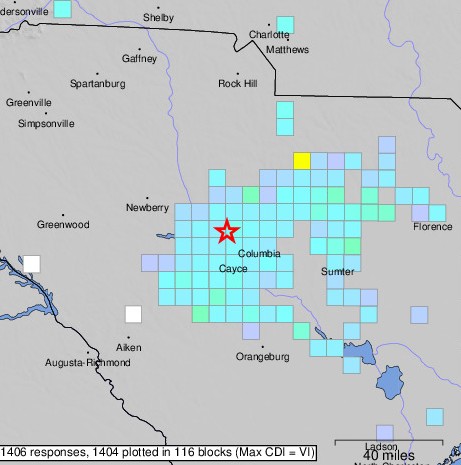
Sonic boom: Map of South Carolina with light blue squares around Columbia.
What sounded like a massive explosion rocked Midlands of South Carolina on May 28, 2026, around 5 p.m. local time. Even though people reported shaking, the USGS said there was no earthquake. Instead it said a sonic boom rattled the area. But what was the source? Image via USGS.

Strange sonic boom rattles South Carolina

Around 5:30 p.m. local time, residents of Midlands of South Carolina reported hearing an immense boom. At first, people took to social media wondering if they’d just experienced an earthquake. But the United States Geological Society (USGS) was quick to respond, reporting that it was a sonic boom that shook the air instead of an earthquake that shook the ground. It said the magnitude of the event was 0.0, so definitely not an earthquake.

People shared video from an airport and Ring doorbells on social media that captured the sound and rattling of buildings. Some even reported feeling the pressure wave. Meteorologist Chris Jackson was in South Carolina at the time and said:

It felt like someone shoved me right in my chest an instant before the boom began.

See the sonic boom rattle an airport hangar in this X post.

And here’s another video from outside an airport that recorded the sonic boom.

What was it?

Could it have been an aircraft that created the sonic boom? Possibly, but at the moment there is no one taking claim as the source of the explosive sound.

A more likely possibility was that it was a meteor. But there haven’t really been reports of anyone seeing a meteor. Granted it was daylight at the time, but often with big meteors they still leave a trail in daylight. The American Meteor Society has not received an onslaught of sightings, anyway. You can see the pending reports here.

One possible eyewitness was Aaron Olson in Columbia, South Carolina. Aaron posted on X:

I noticed some odd contrails immediately following the boom too. Sort radiating from a common point. Lends itself to a meteor explosion.

And this doorbell camera appears to show a trail from a meteor. Look for it in the upper right. It resembles an airplane’s contrail.

Did you hear the sonic boom? Let us know in the comments below.

Bottom line: People in South Carolina heard a strange sonic boom on the evening of May 28, 2026, around 5:30 p.m. local time. The USGS said it wasn’t an earthquake. Could it have been a meteor?

Read more: Meteor shower guide 2026: Up next … the Arietids

The post Strange sonic boom rattles South Carolina first appeared on EarthSky.


from EarthSky https://ift.tt/l4zNg02
Sonic boom: Map of South Carolina with light blue squares around Columbia.
What sounded like a massive explosion rocked Midlands of South Carolina on May 28, 2026, around 5 p.m. local time. Even though people reported shaking, the USGS said there was no earthquake. Instead it said a sonic boom rattled the area. But what was the source? Image via USGS.

Strange sonic boom rattles South Carolina

Around 5:30 p.m. local time, residents of Midlands of South Carolina reported hearing an immense boom. At first, people took to social media wondering if they’d just experienced an earthquake. But the United States Geological Society (USGS) was quick to respond, reporting that it was a sonic boom that shook the air instead of an earthquake that shook the ground. It said the magnitude of the event was 0.0, so definitely not an earthquake.

People shared video from an airport and Ring doorbells on social media that captured the sound and rattling of buildings. Some even reported feeling the pressure wave. Meteorologist Chris Jackson was in South Carolina at the time and said:

It felt like someone shoved me right in my chest an instant before the boom began.

See the sonic boom rattle an airport hangar in this X post.

And here’s another video from outside an airport that recorded the sonic boom.

What was it?

Could it have been an aircraft that created the sonic boom? Possibly, but at the moment there is no one taking claim as the source of the explosive sound.

A more likely possibility was that it was a meteor. But there haven’t really been reports of anyone seeing a meteor. Granted it was daylight at the time, but often with big meteors they still leave a trail in daylight. The American Meteor Society has not received an onslaught of sightings, anyway. You can see the pending reports here.

One possible eyewitness was Aaron Olson in Columbia, South Carolina. Aaron posted on X:

I noticed some odd contrails immediately following the boom too. Sort radiating from a common point. Lends itself to a meteor explosion.

And this doorbell camera appears to show a trail from a meteor. Look for it in the upper right. It resembles an airplane’s contrail.

Did you hear the sonic boom? Let us know in the comments below.

Bottom line: People in South Carolina heard a strange sonic boom on the evening of May 28, 2026, around 5:30 p.m. local time. The USGS said it wasn’t an earthquake. Could it have been a meteor?

Read more: Meteor shower guide 2026: Up next … the Arietids

The post Strange sonic boom rattles South Carolina first appeared on EarthSky.


from EarthSky https://ift.tt/l4zNg02

Do Europa’s water vapor plumes not exist after all?

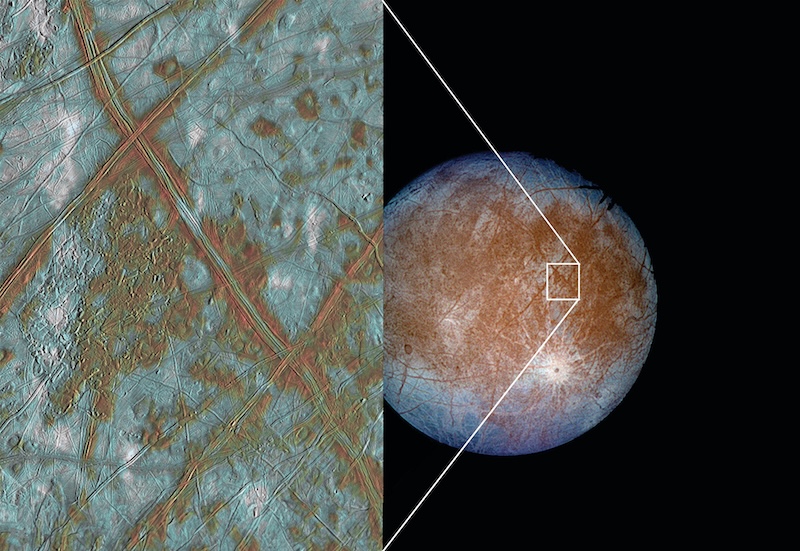
Europa's water vapor plumes: Icy moon or planet-like body with darker brownish areas. A small inset rectangle opens to show closeup of surface with long brownish cracks and other spots.
View larger. | Jupiter’s moon Europa, with an inset showing a closer view of cracks on the surface. A new study from SwRI lowers the probability of Europa’s water vapor plumes being real. Image via NASA/ SwRI.
  • Jupiter’s moon Europa has a global ocean beneath its icy crust. Does it have water vapor plumes too, like Saturn’s moon Enceladus?
  • Previous observations by the Hubble Space Telescope hinted at plumes, although smaller than Enceladus’. But the plumes might not be there after all, a new study from SwRI says.
  • Plumes aren’t at all ruled out by the study, though. The data for their existence just isn’t as concrete as before.

You deserve a daily dose of good news. For the latest in science and the night sky, click here to subscribe to our free daily newsletter.

Europa’s water vapor plumes: real or not?

Do plumes of water vapor blast from Jupiter’s moon Europa, like they do from Saturn’s moon Enceladus? Scientists have debated this for years.

Some previous observations by the Hubble Space Telescope hinted these plumes were there, but smaller and more sporadic than the ones on Enceladus. But now, a new study casts doubt the plumes being there at all.

Researchers from the Southwest Research Institute (SwRI) said on May 18, 2026, that the evidence for the plumes isn’t as strong as it once was.

The new study examines 14 years of Hubble observations using its Imaging Spectrograph (HST/STIS). Those observations focused on Europa’s Lyman-alpha emissions, a specific wavelength of ultraviolet light emitted and scattered by hydrogen atoms.

The researchers published their new peer-reviewed paper in Astronomy & Astrophysics on May 5, 2026.

SwRI in the news: New data casts doubt on the existence of vapor plumes on Europaow.ly/IW5750Z2c8Q

Southwest Research Institute (@swri.org) 2026-05-20T18:02:38.988Z

Difficulties in interpreting the data

There was some difficulty in interpreting the data from the original Hubble observations going back to 2014. It had to do with exactly where Europa was in the images. Co-author Kurt Retherford at SwRI explained:

One of the difficulties in interpreting the data back then was determining where to place Europa within its context. The way Hubble works left some uncertainty in terms of placement relative to the center of the image. If Europa’s placement was off even just by a pixel or two, it could affect how the data gets interpreted.

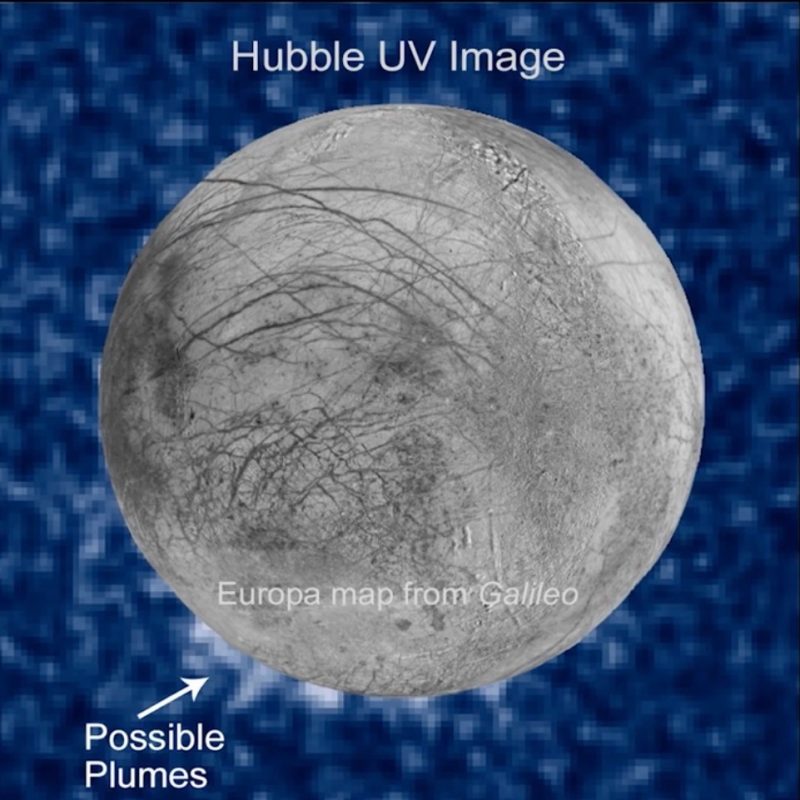
Previous image from Hubble, showing possible plume on Europa’s surface. Video still, via NASA.
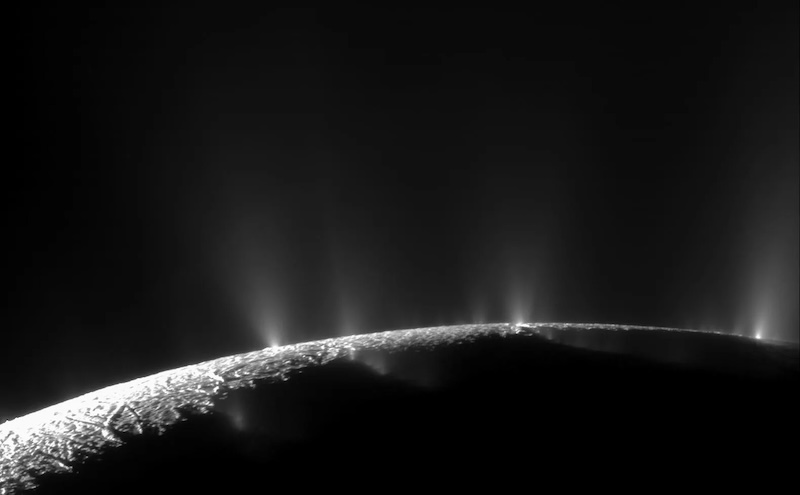
Sunlit edge of planet-like body with geyser-like jets erupting into space.
View larger. | Saturn’s moon Enceladus is well-known for its huge geyser-like plumes of water vapor. The plumes originate in the global subsurface ocean and erupt through cracks in the outer ice shell at the moon’s south pole. Image via NASA/ JPL/ Space Science Institute.

Plumes not ruled out

Lead author Lorenz Roth at the KTH Royal Institute of Technology in Sweden added:

Our reanalysis took our original 99.9% confidence in the plumes’ existence and reduced it to less than 90% confidence. That’s simply not enough evidence to support the certainty of claims we made at the time.

So the previous confidence level has dropped enough that the researchers can’t say for sure the plumes are there. But they are not ruled out, either. It’s just that the evidence isn’t concrete anymore. Retherford said:

The description of the phenomena just doesn’t hold up the same way anymore. The new data has made us reconsider the strength of the previous paper’s conclusion regarding water vapor plumes. The recent analysis also provides improved information about the neutral hydrogen atom component of Europa’s escaping atmosphere, originating from its water ice surface.

Smiling man with dark brown hair, moustache and beard, wearing a yellow shirt.
Lorenz Roth at the KTH Royal Institute of Technology in Sweden is the lead author of the new study about Europa’s plumes. Image via KTH.

Europa Clipper

We will likely have to wait for NASA’s Europa Clipper to arrive at Europa in April 2030 to know for sure whether Europa has plumes or not. Clipper will make multiple close flybys of Europa, studying its surface and interior in more detail than ever before. It will try to determine if Jupiter’s moon actually is habitable. And it will be able to detect any plumes … if they are there.

Bottom line: New observations from the Hubble Space Telescope suggest that Europa’s water vapor plumes are less likely than previously thought. But they don’t rule them out.

Source: Europa’s Lyman-a emissions from HST/STIS observations

Via SwRI

Read more: Seeking Europa’s water plumes with Clipper

Read more: Possible water plumes spotted on Europa

The post Do Europa’s water vapor plumes not exist after all? first appeared on EarthSky.


from EarthSky https://ift.tt/DLgO4GC
Europa's water vapor plumes: Icy moon or planet-like body with darker brownish areas. A small inset rectangle opens to show closeup of surface with long brownish cracks and other spots.
View larger. | Jupiter’s moon Europa, with an inset showing a closer view of cracks on the surface. A new study from SwRI lowers the probability of Europa’s water vapor plumes being real. Image via NASA/ SwRI.
  • Jupiter’s moon Europa has a global ocean beneath its icy crust. Does it have water vapor plumes too, like Saturn’s moon Enceladus?
  • Previous observations by the Hubble Space Telescope hinted at plumes, although smaller than Enceladus’. But the plumes might not be there after all, a new study from SwRI says.
  • Plumes aren’t at all ruled out by the study, though. The data for their existence just isn’t as concrete as before.

You deserve a daily dose of good news. For the latest in science and the night sky, click here to subscribe to our free daily newsletter.

Europa’s water vapor plumes: real or not?

Do plumes of water vapor blast from Jupiter’s moon Europa, like they do from Saturn’s moon Enceladus? Scientists have debated this for years.

Some previous observations by the Hubble Space Telescope hinted these plumes were there, but smaller and more sporadic than the ones on Enceladus. But now, a new study casts doubt the plumes being there at all.

Researchers from the Southwest Research Institute (SwRI) said on May 18, 2026, that the evidence for the plumes isn’t as strong as it once was.

The new study examines 14 years of Hubble observations using its Imaging Spectrograph (HST/STIS). Those observations focused on Europa’s Lyman-alpha emissions, a specific wavelength of ultraviolet light emitted and scattered by hydrogen atoms.

The researchers published their new peer-reviewed paper in Astronomy & Astrophysics on May 5, 2026.

SwRI in the news: New data casts doubt on the existence of vapor plumes on Europaow.ly/IW5750Z2c8Q

Southwest Research Institute (@swri.org) 2026-05-20T18:02:38.988Z

Difficulties in interpreting the data

There was some difficulty in interpreting the data from the original Hubble observations going back to 2014. It had to do with exactly where Europa was in the images. Co-author Kurt Retherford at SwRI explained:

One of the difficulties in interpreting the data back then was determining where to place Europa within its context. The way Hubble works left some uncertainty in terms of placement relative to the center of the image. If Europa’s placement was off even just by a pixel or two, it could affect how the data gets interpreted.

Previous image from Hubble, showing possible plume on Europa’s surface. Video still, via NASA.
Sunlit edge of planet-like body with geyser-like jets erupting into space.
View larger. | Saturn’s moon Enceladus is well-known for its huge geyser-like plumes of water vapor. The plumes originate in the global subsurface ocean and erupt through cracks in the outer ice shell at the moon’s south pole. Image via NASA/ JPL/ Space Science Institute.

Plumes not ruled out

Lead author Lorenz Roth at the KTH Royal Institute of Technology in Sweden added:

Our reanalysis took our original 99.9% confidence in the plumes’ existence and reduced it to less than 90% confidence. That’s simply not enough evidence to support the certainty of claims we made at the time.

So the previous confidence level has dropped enough that the researchers can’t say for sure the plumes are there. But they are not ruled out, either. It’s just that the evidence isn’t concrete anymore. Retherford said:

The description of the phenomena just doesn’t hold up the same way anymore. The new data has made us reconsider the strength of the previous paper’s conclusion regarding water vapor plumes. The recent analysis also provides improved information about the neutral hydrogen atom component of Europa’s escaping atmosphere, originating from its water ice surface.

Smiling man with dark brown hair, moustache and beard, wearing a yellow shirt.
Lorenz Roth at the KTH Royal Institute of Technology in Sweden is the lead author of the new study about Europa’s plumes. Image via KTH.

Europa Clipper

We will likely have to wait for NASA’s Europa Clipper to arrive at Europa in April 2030 to know for sure whether Europa has plumes or not. Clipper will make multiple close flybys of Europa, studying its surface and interior in more detail than ever before. It will try to determine if Jupiter’s moon actually is habitable. And it will be able to detect any plumes … if they are there.

Bottom line: New observations from the Hubble Space Telescope suggest that Europa’s water vapor plumes are less likely than previously thought. But they don’t rule them out.

Source: Europa’s Lyman-a emissions from HST/STIS observations

Via SwRI

Read more: Seeking Europa’s water plumes with Clipper

Read more: Possible water plumes spotted on Europa

The post Do Europa’s water vapor plumes not exist after all? first appeared on EarthSky.


from EarthSky https://ift.tt/DLgO4GC

Meet Mimosa, a star of the Southern Cross

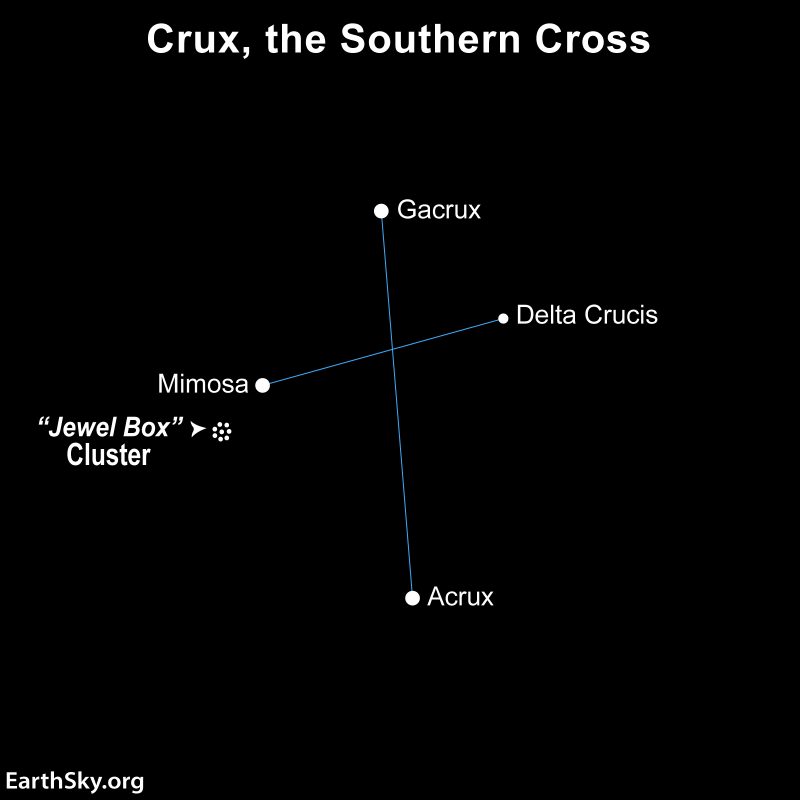
Mimosa: Star chart: 4 labeled stars at ends of cross arms and small dots for a labeled star cluster.
Crux is the constellation of the Southern Cross. And it lies deep in Southern Hemisphere skies, but can also be seen from southerly latitdes in the Northern Hemisphere. Mimosa is on the left, near the famous Jewel Box Cluster. Image via EarthSky.

You deserve a daily dose of good news. For the latest in science and the night sky, click here to subscribe to our free daily newsletter.

A star named Mimosa

The constellation of the Southern Cross is called Crux. Its brightest star is called Alpha Crucis or Acrux. And its 2nd-brightest star, Beta Crucis, is sometimes called Becrux … but more often called Mimosa.

Blue-white Mimosa is the 20th brightest star in all the heavens.

And the origin of its name is somewhat mysterious. Unlike many bright stars, Beta Crucis is so far south that it wasn’t well known to most ancient Mediterranean skywatchers. So it never received one of the old Arabic or Greek traditional names that many northern stars have. The name Mimosa seems to have become popular later, possibly in the modern era of southern-sky astronomy.

Also, it’s said, the name might have been inspired by flowering mimosa herbs and shrubs. But most of those flowers are pink, red or yellow. And Mimosa is a blue-white star.

Its blue-white glow helps create the jewel-like appearance of the Southern Cross.

A midnight culmination happens when a star is highest in your sky at your local midnight. It happens for everyone on Earth around the same dates, on or about April 2 each year. Stars rise four minutes earlier each day. So, by May, Mimosa is highest in your sky in mid-evening. And, by June, it’s highest in early evening.

So April, May and June are great months for seeing Mimosa, no matter where you are on Earth.

Mimosa from the Southern Hemisphere

Southern Hemisphere observers know and love Mimosa. It’s circumpolar – up all night – for latitudes of about 30 degrees south and higher.

Mimosa’s declination (the sky equivalent of latitude) is about -60 degrees. So – when highest in the sky as seen from a very high southern latitide, say, about 45° south – Mimosa reaches an altitude of about 75° above the southern horizon. That’s the view from New Zealand’s South Island.

Meanwhile, from a latitude of 30 degrees S., Mimosa would appear only about 60 degrees up in the south, at its highest. That’s the view from Porto Alegre, Brazil – La Serena, Chile – and Springbok, South Africa. From Brisbane, Australia (27.5° south), Mimosa reaches nearly 58° above the horizon, at its highest.

Because it’s so high up in the sky, Mimosa offers great deep-sky views of objects such as the Jewel-Box Cluster and the Coal Sack Nebula.

Want an exact location for Mimosa from your latitude and time of night? Try Stellarium.

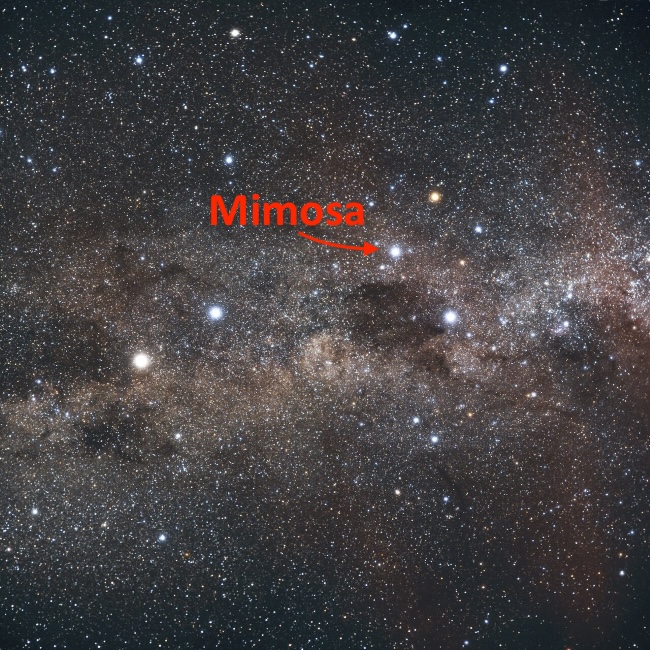
In starry sky, 4 bright stars forming a cross shape and 2 more out to the side, against a hazy glowing band.
The Southern Cross (the 4 bright stars on the right), with Mimosa indicated. It’s about 280 light-years away. The 2 bright stars on the left are Alpha Centauri (closest star system to our sun, at 4 light-years away) and Beta Centauri (around 390 light-years away). Image via European Southern Observatory/ S. Brunier.

Mimosa from the Northern Hemisphere

You won’t see Mimosa north of 30 degrees north latitude. Some cities near 30 degrees north latitude are Austin, Texas; Cairo, Egypt; and New Delhi, India.

From Northern Hemisphere locations such as Honolulu Hawaii (21 degrees N), Mimosa can be seen more easily.

But, for observers in the Northern Hemisphere, Mimosa is in view for only a short time each year (or each night, when it is visible). For example, observers around Miami, Florida (26 degrees N latitude), can just glimpse the Southern Cross and Mimosa on May evenings. From there, it rises about 5 degrees above the southern horizon and stays up more than four hours.

The nearer the observer is to the northern observation limit (30 degrees N), the lower the arc of Mimosa across the southern sky, and the shorter the time it will be visible. For example, from Austin, the star barely skirts the horizon for about a half hour at most. Often, it can’t be seen at all due to the dimming affects of Earth’s atmosphere.

So it’s a challenge!

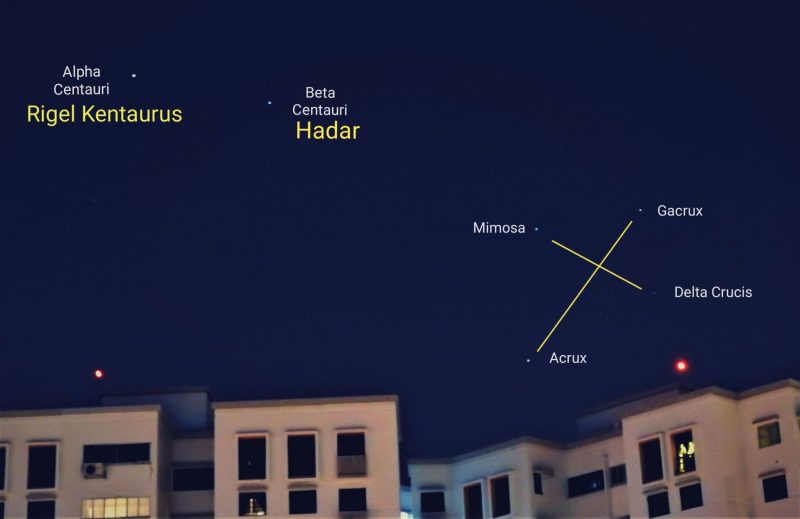
Dark sky over buildings with stars labeled and Southern Cross outlined.
View at EarthSky Community Photos. | Kannan A in Woodlands, Singapore, captured this photo of the Southern Cross – and the star Mimosa – on March 8, 2021. He wrote: “The Southern Cross constellation seen here in the morning in Singapore looking south. On the left of this cross are the 2 pointer stars, Alpha Centauri (Rigel Kentaurus) and Beta Centauri (Hadar). They point to the Southern Cross.” Thanks, Kannan!

History and mythology of Mimosa

Because of its southerly location, Crux and Mimosa were essentially unknown in classical western mythology. But these stars were well known to Australian Aboriginal peoples, as well as to the islanders of Polynesia and the people of southern Africa.

One Aboriginal story is that the stars of the Southern Cross are a reminder of the time and place where death first came to mankind. Two of the stars in Crux are said to represent the glowing eyes of the spirit of death. And the other two are said to be the eyes of the first man to die.

The main stars of Crux, including Mimosa, appear on the flags of both Australia and New Zealand. Mimosa appears as the left side of the crossbar, and Acrux as the bottom of the Cross.

See flags featuring the stars of the Southern Cross

New Zealand flag, showing the Southern Cross, via Wikipedia. [public domain]

The science of Beta Crucis

Mimosa lies about 280 light-years from Earth. It has a visual magnitude of 1.25.

Mimosa is a giant (or subgiant) blue star, more than 3,000 times brighter than our sun in visible light.

So Mimosa is blue and very hot. It has a radius about eight times that of the sun, with a mass 14 times greater. But all of these figures are uncertain. And the reason is a small stellar companion for Mimosa about which we know little. Mimosa also is a complex variable star.

Directly south of Mimosa is the Coalsack, a distinctive dark nebula in the Milky Way.

The famous Jewel Box Cluster lies to Mimosa’s east.

Position of Mimosa (Beta Crucis) is RA: 12h 47m 44s, dec: -59° 41′ 19″.

Bottom line: Mimosa is the 2nd-brightest star in Crux, the Southern Cross. It’s circumpolar – up all night – from much of the Southern Hemisphere.

Acrux is brightest star in Southern Cross

Southern Cross: Signpost of southern skies

How to see the Southern Cross from the Northern Hemisphere

The post Meet Mimosa, a star of the Southern Cross first appeared on EarthSky.


from EarthSky https://ift.tt/H0ZDaAF
Mimosa: Star chart: 4 labeled stars at ends of cross arms and small dots for a labeled star cluster.
Crux is the constellation of the Southern Cross. And it lies deep in Southern Hemisphere skies, but can also be seen from southerly latitdes in the Northern Hemisphere. Mimosa is on the left, near the famous Jewel Box Cluster. Image via EarthSky.

You deserve a daily dose of good news. For the latest in science and the night sky, click here to subscribe to our free daily newsletter.

A star named Mimosa

The constellation of the Southern Cross is called Crux. Its brightest star is called Alpha Crucis or Acrux. And its 2nd-brightest star, Beta Crucis, is sometimes called Becrux … but more often called Mimosa.

Blue-white Mimosa is the 20th brightest star in all the heavens.

And the origin of its name is somewhat mysterious. Unlike many bright stars, Beta Crucis is so far south that it wasn’t well known to most ancient Mediterranean skywatchers. So it never received one of the old Arabic or Greek traditional names that many northern stars have. The name Mimosa seems to have become popular later, possibly in the modern era of southern-sky astronomy.

Also, it’s said, the name might have been inspired by flowering mimosa herbs and shrubs. But most of those flowers are pink, red or yellow. And Mimosa is a blue-white star.

Its blue-white glow helps create the jewel-like appearance of the Southern Cross.

A midnight culmination happens when a star is highest in your sky at your local midnight. It happens for everyone on Earth around the same dates, on or about April 2 each year. Stars rise four minutes earlier each day. So, by May, Mimosa is highest in your sky in mid-evening. And, by June, it’s highest in early evening.

So April, May and June are great months for seeing Mimosa, no matter where you are on Earth.

Mimosa from the Southern Hemisphere

Southern Hemisphere observers know and love Mimosa. It’s circumpolar – up all night – for latitudes of about 30 degrees south and higher.

Mimosa’s declination (the sky equivalent of latitude) is about -60 degrees. So – when highest in the sky as seen from a very high southern latitide, say, about 45° south – Mimosa reaches an altitude of about 75° above the southern horizon. That’s the view from New Zealand’s South Island.

Meanwhile, from a latitude of 30 degrees S., Mimosa would appear only about 60 degrees up in the south, at its highest. That’s the view from Porto Alegre, Brazil – La Serena, Chile – and Springbok, South Africa. From Brisbane, Australia (27.5° south), Mimosa reaches nearly 58° above the horizon, at its highest.

Because it’s so high up in the sky, Mimosa offers great deep-sky views of objects such as the Jewel-Box Cluster and the Coal Sack Nebula.

Want an exact location for Mimosa from your latitude and time of night? Try Stellarium.

In starry sky, 4 bright stars forming a cross shape and 2 more out to the side, against a hazy glowing band.
The Southern Cross (the 4 bright stars on the right), with Mimosa indicated. It’s about 280 light-years away. The 2 bright stars on the left are Alpha Centauri (closest star system to our sun, at 4 light-years away) and Beta Centauri (around 390 light-years away). Image via European Southern Observatory/ S. Brunier.

Mimosa from the Northern Hemisphere

You won’t see Mimosa north of 30 degrees north latitude. Some cities near 30 degrees north latitude are Austin, Texas; Cairo, Egypt; and New Delhi, India.

From Northern Hemisphere locations such as Honolulu Hawaii (21 degrees N), Mimosa can be seen more easily.

But, for observers in the Northern Hemisphere, Mimosa is in view for only a short time each year (or each night, when it is visible). For example, observers around Miami, Florida (26 degrees N latitude), can just glimpse the Southern Cross and Mimosa on May evenings. From there, it rises about 5 degrees above the southern horizon and stays up more than four hours.

The nearer the observer is to the northern observation limit (30 degrees N), the lower the arc of Mimosa across the southern sky, and the shorter the time it will be visible. For example, from Austin, the star barely skirts the horizon for about a half hour at most. Often, it can’t be seen at all due to the dimming affects of Earth’s atmosphere.

So it’s a challenge!

Dark sky over buildings with stars labeled and Southern Cross outlined.
View at EarthSky Community Photos. | Kannan A in Woodlands, Singapore, captured this photo of the Southern Cross – and the star Mimosa – on March 8, 2021. He wrote: “The Southern Cross constellation seen here in the morning in Singapore looking south. On the left of this cross are the 2 pointer stars, Alpha Centauri (Rigel Kentaurus) and Beta Centauri (Hadar). They point to the Southern Cross.” Thanks, Kannan!

History and mythology of Mimosa

Because of its southerly location, Crux and Mimosa were essentially unknown in classical western mythology. But these stars were well known to Australian Aboriginal peoples, as well as to the islanders of Polynesia and the people of southern Africa.

One Aboriginal story is that the stars of the Southern Cross are a reminder of the time and place where death first came to mankind. Two of the stars in Crux are said to represent the glowing eyes of the spirit of death. And the other two are said to be the eyes of the first man to die.

The main stars of Crux, including Mimosa, appear on the flags of both Australia and New Zealand. Mimosa appears as the left side of the crossbar, and Acrux as the bottom of the Cross.

See flags featuring the stars of the Southern Cross

New Zealand flag, showing the Southern Cross, via Wikipedia. [public domain]

The science of Beta Crucis

Mimosa lies about 280 light-years from Earth. It has a visual magnitude of 1.25.

Mimosa is a giant (or subgiant) blue star, more than 3,000 times brighter than our sun in visible light.

So Mimosa is blue and very hot. It has a radius about eight times that of the sun, with a mass 14 times greater. But all of these figures are uncertain. And the reason is a small stellar companion for Mimosa about which we know little. Mimosa also is a complex variable star.

Directly south of Mimosa is the Coalsack, a distinctive dark nebula in the Milky Way.

The famous Jewel Box Cluster lies to Mimosa’s east.

Position of Mimosa (Beta Crucis) is RA: 12h 47m 44s, dec: -59° 41′ 19″.

Bottom line: Mimosa is the 2nd-brightest star in Crux, the Southern Cross. It’s circumpolar – up all night – from much of the Southern Hemisphere.

Acrux is brightest star in Southern Cross

Southern Cross: Signpost of southern skies

How to see the Southern Cross from the Northern Hemisphere

The post Meet Mimosa, a star of the Southern Cross first appeared on EarthSky.


from EarthSky https://ift.tt/H0ZDaAF

Deneb is an incredibly distant star. But how do we know?

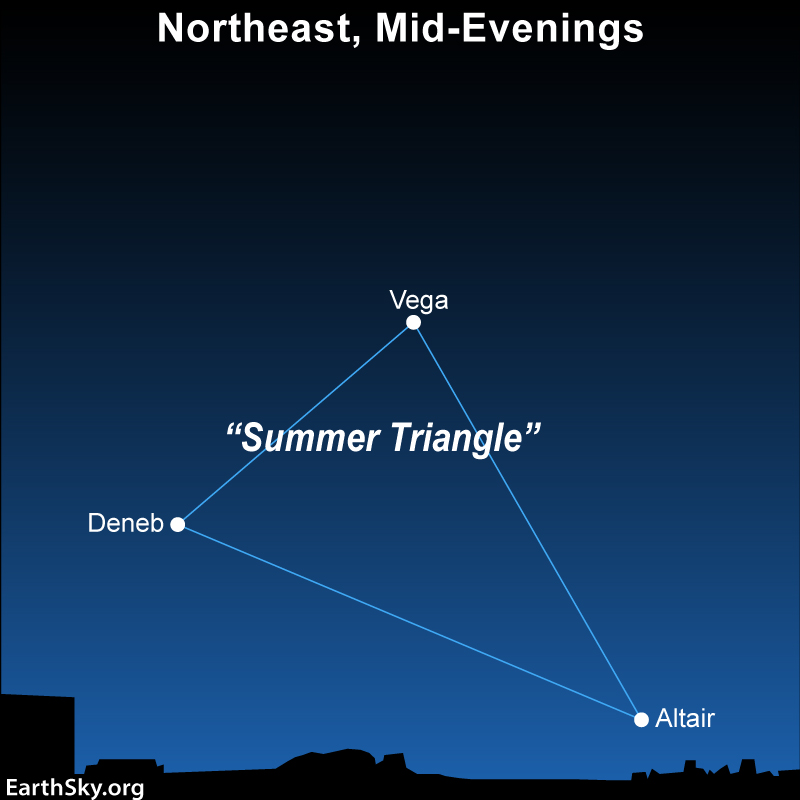
Deneb: 3 lines and 3 dots for Deneb, Vega and Altair create a triangle. Words
Deneb is in the furthest-left corner of the Summer Triangle. Chart via EarthSky.

How far away is Deneb?

The beautiful Summer Triangle is coming back into view for convenient evening viewing. This asterism consists of three bright stars in three different constellations. Now notice the star Deneb in one corner of the Triangle. When you gaze at Deneb, you’re gazing across a great expanse of space. We don’t know the exact distance to Deneb. We see a range of distances for this star from about 1,600 light-years to about 2,600 light-years. Either way, Deneb is one of the most distant stars we can see with the eye alone.

So distance estimates vary for this star. And they vary a lot! Why?

The answer is a glimpse into the process of science, and the way that astronomers use advancing technologies to try to improve on previous discoveries.

Discovering Deneb’s distance

Scientists have obtained estimates for Deneb’s distance through a variety of methods. Some of these methods involve theoretical models related to the way stars evolve. Some assume Deneb’s membership in Cygnus OB7, a star-forming complex within our Milky Way galaxy.

ESA’s Earth-orbiting Hipparcos Space Astrometry Mission provided the most significant modern measurement of Deneb’s distance in the 1990s. Hipparcos gathered astrometric data on Deneb. Early analyses of the data indicated a distance of somewhere around 2,600 light-years. That’s the figure you still see most often today.

But, since then, various groups of astronomers have re-analyzed Hipparcos data. This is because computer power, which gets stronger with each passing year, helps to improve techniques for analysis. For example, the peer-reviewed journal Astronomy and Astrophysics published a study in 2009, using a newer method of analysis (skip to the last page for Deneb).

This new analysis showed a distance to Deneb that’s barely half the widely accepted value. The study suggests 1,548 light-years as the distance, with a range between 1,336 and 1,841 light-years. That’s a big ballpark figure.

So is Deneb 1,600 light-years away or 2,600 light-years away? The fact is, we don’t know. Either way, it’s still one of the most distant stars we see with the unaided eye.

Diagram with lines drawn between Earth and a nearby star from 2 opposite sides of the sun.
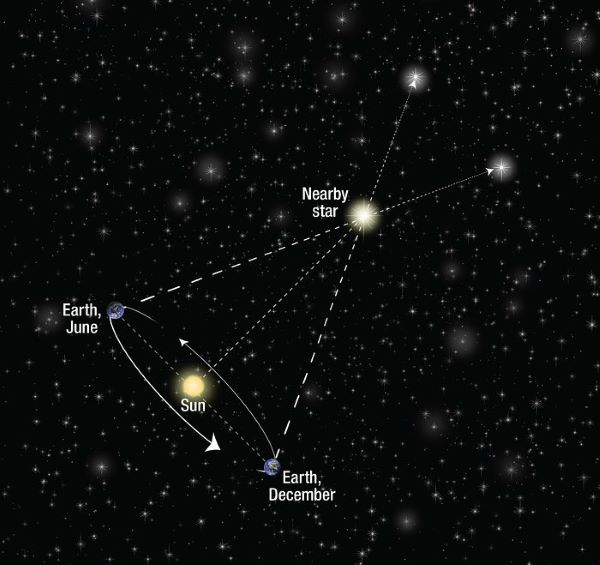
Astronomers use the parallax method to measure distances to nearby stars. But Deneb is too far away for accurate parallax measurements from Earth’s surface. Image via ESA/ NASA/ A. Feild.

Why does Deneb’s distance matter?

Distance matters because it can give us other measurements, too. If astronomers don’t know exactly how far away Deneb is, they can’t get accurate numbers of its size, mass and energy output.

ESA had a second astrometric satellite – the magnificent Gaia space observatory – that was in a distant orbit similar to that of the James Webb Space Telescope. Gaia launched on December 19, 2013. Its five-year nominal mission ended in July 2019. However, the mission was extended to December 31, 2025. And Gaia was officially powered down in March 2025. Gaia’s goal was to measure the positions and distances of stars with more precision than ever before, and it exceeded expectations. We really can’t say enough about the incredible things we’ve learned about our Milky Way galaxy via Gaia. Click here for a few of Gaia’s discoveries.

However, a new estimate for Deneb’s distance wasn’t included in Gaia’s 1st data release, in 2016. And it wasn’t included in Gaia’s 2nd data release in 2018. How about the 3rd data release? Nope, not there either. The 4th data release is expected to come out in 2026.

Chart showing groups of stars of varying colors and sizes.
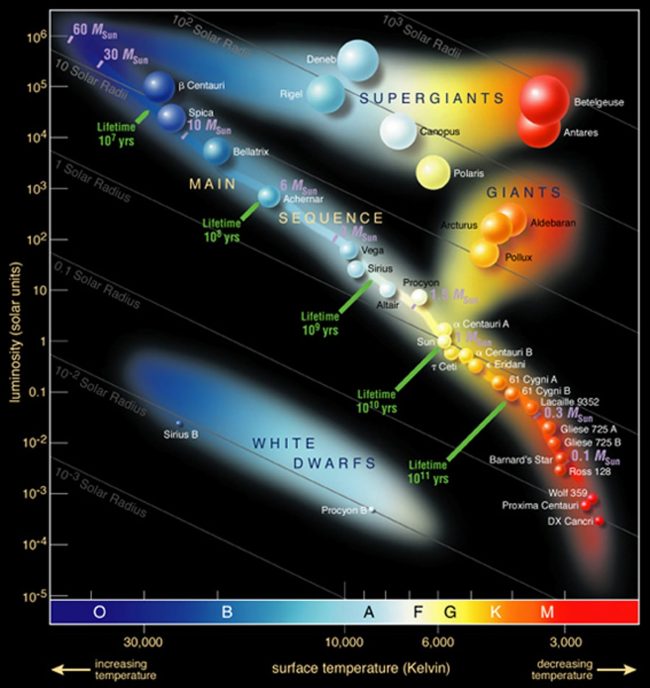
View larger. | This is the famous Hertzsprung-Russell diagram, which shows the luminosities of stars. See Deneb at the top of the diagram? It is one of the most luminous stars known. Image via ESO.

Deneb was too bright for Gaia

Gaia produced data on some 2 billion sources in our Milky Way galaxy. But it couldn’t image Deneb, the 19th brightest star in our sky. That’s because Gaia was not able to measure the distance to bright stars. They would have saturated Gaia’s sensor making measurements impossible. Gaia’s brightest possible star was magnitude 1.71. Deneb is brighter, at magnitude 1.25.

And it’s not that Gaia didn’t try. In 2018, the Gaia team posted an employment opportunity specifically asking for someone to find a way to image bright stars with Gaia. But that position was never filled.

When Gaia was launched, its team was working on the problem of imaging bright stars. Paper after paper after poster addressed the problem of Gaia not being able to image bright stars. But it never happened.

So, how far away is Deneb? If it is part of the Cygnus OB7 group, then it’s as far away as that group: about 2,050 light-years. But the center of that group is 5.2 degrees to the northeast of Deneb, so Deneb might not be a part of it.

Interestingly, in 1838, the first star for which the distance was calculated was 61 Cygni, which lies less than 8 degrees southeast of Deneb.

Bottom line: The star Deneb – part of the famous Summer Triangle – is one of the most distant stars you can see with your eye alone. But we don’t yet know its precise distance.

Read more: Delta Cephei helps measure cosmic distances

The post Deneb is an incredibly distant star. But how do we know? first appeared on EarthSky.


from EarthSky https://ift.tt/LtoivFl
Deneb: 3 lines and 3 dots for Deneb, Vega and Altair create a triangle. Words
Deneb is in the furthest-left corner of the Summer Triangle. Chart via EarthSky.

How far away is Deneb?

The beautiful Summer Triangle is coming back into view for convenient evening viewing. This asterism consists of three bright stars in three different constellations. Now notice the star Deneb in one corner of the Triangle. When you gaze at Deneb, you’re gazing across a great expanse of space. We don’t know the exact distance to Deneb. We see a range of distances for this star from about 1,600 light-years to about 2,600 light-years. Either way, Deneb is one of the most distant stars we can see with the eye alone.

So distance estimates vary for this star. And they vary a lot! Why?

The answer is a glimpse into the process of science, and the way that astronomers use advancing technologies to try to improve on previous discoveries.

Discovering Deneb’s distance

Scientists have obtained estimates for Deneb’s distance through a variety of methods. Some of these methods involve theoretical models related to the way stars evolve. Some assume Deneb’s membership in Cygnus OB7, a star-forming complex within our Milky Way galaxy.

ESA’s Earth-orbiting Hipparcos Space Astrometry Mission provided the most significant modern measurement of Deneb’s distance in the 1990s. Hipparcos gathered astrometric data on Deneb. Early analyses of the data indicated a distance of somewhere around 2,600 light-years. That’s the figure you still see most often today.

But, since then, various groups of astronomers have re-analyzed Hipparcos data. This is because computer power, which gets stronger with each passing year, helps to improve techniques for analysis. For example, the peer-reviewed journal Astronomy and Astrophysics published a study in 2009, using a newer method of analysis (skip to the last page for Deneb).

This new analysis showed a distance to Deneb that’s barely half the widely accepted value. The study suggests 1,548 light-years as the distance, with a range between 1,336 and 1,841 light-years. That’s a big ballpark figure.

So is Deneb 1,600 light-years away or 2,600 light-years away? The fact is, we don’t know. Either way, it’s still one of the most distant stars we see with the unaided eye.

Diagram with lines drawn between Earth and a nearby star from 2 opposite sides of the sun.
Astronomers use the parallax method to measure distances to nearby stars. But Deneb is too far away for accurate parallax measurements from Earth’s surface. Image via ESA/ NASA/ A. Feild.

Why does Deneb’s distance matter?

Distance matters because it can give us other measurements, too. If astronomers don’t know exactly how far away Deneb is, they can’t get accurate numbers of its size, mass and energy output.

ESA had a second astrometric satellite – the magnificent Gaia space observatory – that was in a distant orbit similar to that of the James Webb Space Telescope. Gaia launched on December 19, 2013. Its five-year nominal mission ended in July 2019. However, the mission was extended to December 31, 2025. And Gaia was officially powered down in March 2025. Gaia’s goal was to measure the positions and distances of stars with more precision than ever before, and it exceeded expectations. We really can’t say enough about the incredible things we’ve learned about our Milky Way galaxy via Gaia. Click here for a few of Gaia’s discoveries.

However, a new estimate for Deneb’s distance wasn’t included in Gaia’s 1st data release, in 2016. And it wasn’t included in Gaia’s 2nd data release in 2018. How about the 3rd data release? Nope, not there either. The 4th data release is expected to come out in 2026.

Chart showing groups of stars of varying colors and sizes.
View larger. | This is the famous Hertzsprung-Russell diagram, which shows the luminosities of stars. See Deneb at the top of the diagram? It is one of the most luminous stars known. Image via ESO.

Deneb was too bright for Gaia

Gaia produced data on some 2 billion sources in our Milky Way galaxy. But it couldn’t image Deneb, the 19th brightest star in our sky. That’s because Gaia was not able to measure the distance to bright stars. They would have saturated Gaia’s sensor making measurements impossible. Gaia’s brightest possible star was magnitude 1.71. Deneb is brighter, at magnitude 1.25.

And it’s not that Gaia didn’t try. In 2018, the Gaia team posted an employment opportunity specifically asking for someone to find a way to image bright stars with Gaia. But that position was never filled.

When Gaia was launched, its team was working on the problem of imaging bright stars. Paper after paper after poster addressed the problem of Gaia not being able to image bright stars. But it never happened.

So, how far away is Deneb? If it is part of the Cygnus OB7 group, then it’s as far away as that group: about 2,050 light-years. But the center of that group is 5.2 degrees to the northeast of Deneb, so Deneb might not be a part of it.

Interestingly, in 1838, the first star for which the distance was calculated was 61 Cygni, which lies less than 8 degrees southeast of Deneb.

Bottom line: The star Deneb – part of the famous Summer Triangle – is one of the most distant stars you can see with your eye alone. But we don’t yet know its precise distance.

Read more: Delta Cephei helps measure cosmic distances

The post Deneb is an incredibly distant star. But how do we know? first appeared on EarthSky.


from EarthSky https://ift.tt/LtoivFl

It’s time for Manhattanhenge! Here’s how to see it

Manhattanhenge: Orange sun at horizon under golden sky between iconic tall buildings, with a street full of cars in foreground.
View at EarthSky Community Photos. | Steve Schaum captured this image of Manhattanhenge in New York City on May 30, 2023, and wrote: “This was an adventure of a day. I set up 7+ hours before this shot and watched the crowd grow from 25 to over a thousand. Dr. Neil deGrasse Tyson showed up and I had the pleasure of talking to him. It was a long day, but I usually make friends during days like this, and two years later I still talk to them.” Thank you, Steve!

The first set of Manhattanhenge views will happen on the evenings of May 28 and 29, 2026.

Don’t miss the next unmissable night sky event. Sign up for EarthSky’s free newsletter and get daily night sky updates!

Manhattanhenge, and how to see it

Twice a year – around May 28 and 29, and again around July 11 and 12 – people in New York City look for Manhattanhenge. It’s a phenomenon where the sunset aligns perfectly on east-west oriented streets and avenues of Manhattan. So cool!

In 2026, the first set of Manhattanhenge dates fall on May 28 (half sun at about 8:14 p.m. EDT) and May 29 (full sun at about 8:13 p.m. EDT).

And the second set of dates occur on July 11 (full sun at around 8:20 p.m. EDT) and 12 (half sun at around 8:21 p.m. EDT).

According to the American Museum of Natural History:

Four nights of the year, the streets of Manhattan’s grid become the site for a stunning sunset phenomenon known as Manhattanhenge. During Manhattanhenge, the sun sets in perfect alignment with Manhattan’s east-west numbered streets, creating cinema-worthy photo opportunities …

Where to watch it

Some of the best places to spot it are along 14th, 23rd, 34th (includes the Empire State Building), 42nd, 57th and 79th Streets.

Another good place is from the Tudor City Bridge in Manhattan (though it can be crowded) or Hunter’s Point South Park in Long Island City, Queens.

Regardless of where you watch the sunset, make sure you are as far east as possible while keeping New Jersey in the background across the Hudson River to accentuate the effect.

People standing on a pier with their phones raised. Sun at horizon between distant skyscrapers.
View at EarthSky Community Photos. | Walter Karling at Gantry Plaza State Park, Long Island City, took this image on July 12, 2022. Walter wrote: “Photographing Manhattanhenge from Queens.” Thank you, Walter!

Neil deGrasse Tyson on Manhattanhenge


Astrophysicist Neil deGrasse Tyson coined the phrase Manhattanhenge. It’s a nod to the prehistoric monument Stonehenge in England, which was designed to frame the summer solstice sunrise and the winter solstice sunset. Manhattanhenge is accidental. It happens because Manhattan was built with a grid system of streets running north-south and east-west, Tyson explains in the video above.

Aligned sunsets

Each Manhattanhenge is two days. On one day the sun’s full disk aligns with the street grid, and then on the other day half the sun’s disk aligns with the street grid.

The two sets of aligned sunsets are centered around the dates of the summer solstice, leading to the effect’s other name, not as commonly used: the Manhattan Solstice.

Six months later, Reverse Manhattanhenge happens around the mornings around January 11, when the rising sun creates the same effect on the other side of the island at shortly after 7 a.m. EST.

A crowd holding phones up looking down a street lined with buildings and a setting sun at the end.
Manhattanhenge on July 12, 2016, at 42nd Street. Tourists blocked an entire section of 42nd Street, including its intersection with 6th Avenue, to take pictures of the sunset. Image via Fred Hsu/ Wikimedia Commons.

Solstice and equinox alignments around the world

The phenomenon of Manhattanhenge is fun. And it’s one of many similar alignments that occur around the world on various dates. Think Stonehenge at the equinoxes and solstices.

The point of sunset along the horizon varies throughout the year. At this time of the year – before the June solstice – the sunset point is shifting northward each day on the horizon as seen from around the globe. It’s the northward-shifting path of the sun that gives us summer in the Northern Hemisphere and winter in the Southern Hemisphere. And it’s the shifting path of the sun that gives people various alignments of the sunset with familiar landmarks.

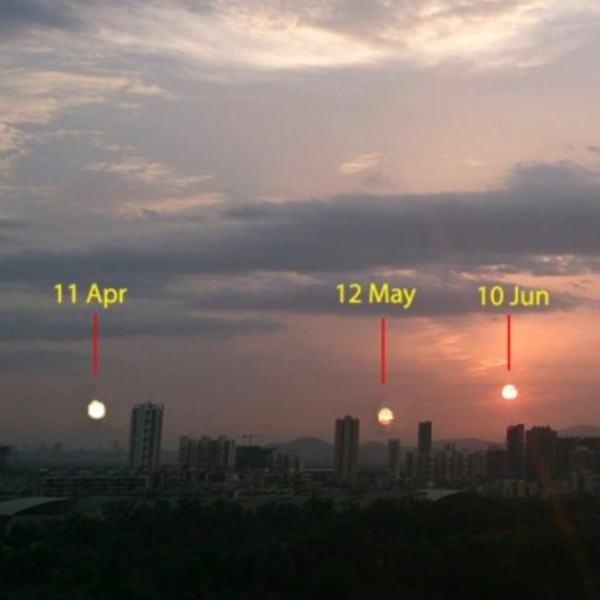
City skyline with three well-separated dated sun positions near the horizon.
Abhijit Juvekar in Dombivli, India, created this composite image of sunsets over a period of 3 months to show how the sun sets progressively farther north in the months leading up to the June solstice. Abhijit posted this image on EarthSky Facebook. Used with permission.

Watching Manhattanhenge

You can observe Manhattanhenge from lots of different places on the east-west streets of the Manhattan street grid. The best places to watch Manhattanhenge are wide streets with an unobstructed view toward New Jersey across the Hudson River.

Popular spots are 34th Street near the Empire State Building and 42nd Street near the Chrysler Building. Wide cross streets – such as 14th, 34th, 42nd and 57th Streets – that ensure the best views of the west-northwest horizon (toward New Jersey) are generally good spots.

Keep in mind that Manhattanhenge draws large crowds, especially around the city’s landmarks.

Here’s a video of Manhattanhenge on May 29, 2025.

Why does Manhattanhenge happen?

The June solstice on June 21 will bring the sun’s northernmost point in our sky and northernmost sunset. Afterward, the sun’s path in our sky, and the sunset point, will both start shifting southward again. As for the sun’s alignment with the city of New York, and the streets of Manhattan Island … well, thank the original planners of this city. Scientific American explained:

The phenomenon is based on a design for Manhattan outlined in The Commissioners’ Plan of 1811 for a rectilinear grid or gridiron of straight streets and avenues that intersect one another at right angles. This design runs from north of Houston Street in Lower Manhattan to just south of 155th Street in Upper Manhattan. Most cross streets in between were arranged in a regular right-angled grid that was tilted 29 degrees east of true north to roughly replicate the angle of the island of Manhattan.

And because of this 29-degree tilt in the grid, the magic moment of the setting sun aligning with Manhattan’s cross streets does not coincide with the June solstice but rather with specific dates in late May and early July.

It’s a great photo opportunity

Did you get a photo of Manhattanhenge? We’d love to see it! Submit it to us at EarthSky Community Photos.

Sun at horizon under golden sky between iconic tall buildings, with body of water in foreground.
Manhattanhenge in 2017. Gowrishankar Lakshminarayanan was in Gantry Plaza State Park, Queens, New York, looking straight through 42nd Street with the Chrysler building to the right. He said he created this 3-image composite to preserve the disk of the sun and show shadow details of the surroundings. Used with permission.

Bottom line: Each year around May 28 and July 11, New Yorkers watch for Manhattanhenge, an alignment of the sunset along city streets. Here’s how to see it.

Read more: Winter solstice at Stonehenge

Read more: Drought reveals a lost Spanish Stonehenge

The post It’s time for Manhattanhenge! Here’s how to see it first appeared on EarthSky.


from EarthSky https://ift.tt/G5BWQTe
Manhattanhenge: Orange sun at horizon under golden sky between iconic tall buildings, with a street full of cars in foreground.
View at EarthSky Community Photos. | Steve Schaum captured this image of Manhattanhenge in New York City on May 30, 2023, and wrote: “This was an adventure of a day. I set up 7+ hours before this shot and watched the crowd grow from 25 to over a thousand. Dr. Neil deGrasse Tyson showed up and I had the pleasure of talking to him. It was a long day, but I usually make friends during days like this, and two years later I still talk to them.” Thank you, Steve!

The first set of Manhattanhenge views will happen on the evenings of May 28 and 29, 2026.

Don’t miss the next unmissable night sky event. Sign up for EarthSky’s free newsletter and get daily night sky updates!

Manhattanhenge, and how to see it

Twice a year – around May 28 and 29, and again around July 11 and 12 – people in New York City look for Manhattanhenge. It’s a phenomenon where the sunset aligns perfectly on east-west oriented streets and avenues of Manhattan. So cool!

In 2026, the first set of Manhattanhenge dates fall on May 28 (half sun at about 8:14 p.m. EDT) and May 29 (full sun at about 8:13 p.m. EDT).

And the second set of dates occur on July 11 (full sun at around 8:20 p.m. EDT) and 12 (half sun at around 8:21 p.m. EDT).

According to the American Museum of Natural History:

Four nights of the year, the streets of Manhattan’s grid become the site for a stunning sunset phenomenon known as Manhattanhenge. During Manhattanhenge, the sun sets in perfect alignment with Manhattan’s east-west numbered streets, creating cinema-worthy photo opportunities …

Where to watch it

Some of the best places to spot it are along 14th, 23rd, 34th (includes the Empire State Building), 42nd, 57th and 79th Streets.

Another good place is from the Tudor City Bridge in Manhattan (though it can be crowded) or Hunter’s Point South Park in Long Island City, Queens.

Regardless of where you watch the sunset, make sure you are as far east as possible while keeping New Jersey in the background across the Hudson River to accentuate the effect.

People standing on a pier with their phones raised. Sun at horizon between distant skyscrapers.
View at EarthSky Community Photos. | Walter Karling at Gantry Plaza State Park, Long Island City, took this image on July 12, 2022. Walter wrote: “Photographing Manhattanhenge from Queens.” Thank you, Walter!

Neil deGrasse Tyson on Manhattanhenge


Astrophysicist Neil deGrasse Tyson coined the phrase Manhattanhenge. It’s a nod to the prehistoric monument Stonehenge in England, which was designed to frame the summer solstice sunrise and the winter solstice sunset. Manhattanhenge is accidental. It happens because Manhattan was built with a grid system of streets running north-south and east-west, Tyson explains in the video above.

Aligned sunsets

Each Manhattanhenge is two days. On one day the sun’s full disk aligns with the street grid, and then on the other day half the sun’s disk aligns with the street grid.

The two sets of aligned sunsets are centered around the dates of the summer solstice, leading to the effect’s other name, not as commonly used: the Manhattan Solstice.

Six months later, Reverse Manhattanhenge happens around the mornings around January 11, when the rising sun creates the same effect on the other side of the island at shortly after 7 a.m. EST.

A crowd holding phones up looking down a street lined with buildings and a setting sun at the end.
Manhattanhenge on July 12, 2016, at 42nd Street. Tourists blocked an entire section of 42nd Street, including its intersection with 6th Avenue, to take pictures of the sunset. Image via Fred Hsu/ Wikimedia Commons.

Solstice and equinox alignments around the world

The phenomenon of Manhattanhenge is fun. And it’s one of many similar alignments that occur around the world on various dates. Think Stonehenge at the equinoxes and solstices.

The point of sunset along the horizon varies throughout the year. At this time of the year – before the June solstice – the sunset point is shifting northward each day on the horizon as seen from around the globe. It’s the northward-shifting path of the sun that gives us summer in the Northern Hemisphere and winter in the Southern Hemisphere. And it’s the shifting path of the sun that gives people various alignments of the sunset with familiar landmarks.

City skyline with three well-separated dated sun positions near the horizon.
Abhijit Juvekar in Dombivli, India, created this composite image of sunsets over a period of 3 months to show how the sun sets progressively farther north in the months leading up to the June solstice. Abhijit posted this image on EarthSky Facebook. Used with permission.

Watching Manhattanhenge

You can observe Manhattanhenge from lots of different places on the east-west streets of the Manhattan street grid. The best places to watch Manhattanhenge are wide streets with an unobstructed view toward New Jersey across the Hudson River.

Popular spots are 34th Street near the Empire State Building and 42nd Street near the Chrysler Building. Wide cross streets – such as 14th, 34th, 42nd and 57th Streets – that ensure the best views of the west-northwest horizon (toward New Jersey) are generally good spots.

Keep in mind that Manhattanhenge draws large crowds, especially around the city’s landmarks.

Here’s a video of Manhattanhenge on May 29, 2025.

Why does Manhattanhenge happen?

The June solstice on June 21 will bring the sun’s northernmost point in our sky and northernmost sunset. Afterward, the sun’s path in our sky, and the sunset point, will both start shifting southward again. As for the sun’s alignment with the city of New York, and the streets of Manhattan Island … well, thank the original planners of this city. Scientific American explained:

The phenomenon is based on a design for Manhattan outlined in The Commissioners’ Plan of 1811 for a rectilinear grid or gridiron of straight streets and avenues that intersect one another at right angles. This design runs from north of Houston Street in Lower Manhattan to just south of 155th Street in Upper Manhattan. Most cross streets in between were arranged in a regular right-angled grid that was tilted 29 degrees east of true north to roughly replicate the angle of the island of Manhattan.

And because of this 29-degree tilt in the grid, the magic moment of the setting sun aligning with Manhattan’s cross streets does not coincide with the June solstice but rather with specific dates in late May and early July.

It’s a great photo opportunity

Did you get a photo of Manhattanhenge? We’d love to see it! Submit it to us at EarthSky Community Photos.

Sun at horizon under golden sky between iconic tall buildings, with body of water in foreground.
Manhattanhenge in 2017. Gowrishankar Lakshminarayanan was in Gantry Plaza State Park, Queens, New York, looking straight through 42nd Street with the Chrysler building to the right. He said he created this 3-image composite to preserve the disk of the sun and show shadow details of the surroundings. Used with permission.

Bottom line: Each year around May 28 and July 11, New Yorkers watch for Manhattanhenge, an alignment of the sunset along city streets. Here’s how to see it.

Read more: Winter solstice at Stonehenge

Read more: Drought reveals a lost Spanish Stonehenge

The post It’s time for Manhattanhenge! Here’s how to see it first appeared on EarthSky.


from EarthSky https://ift.tt/G5BWQTe

adds 2