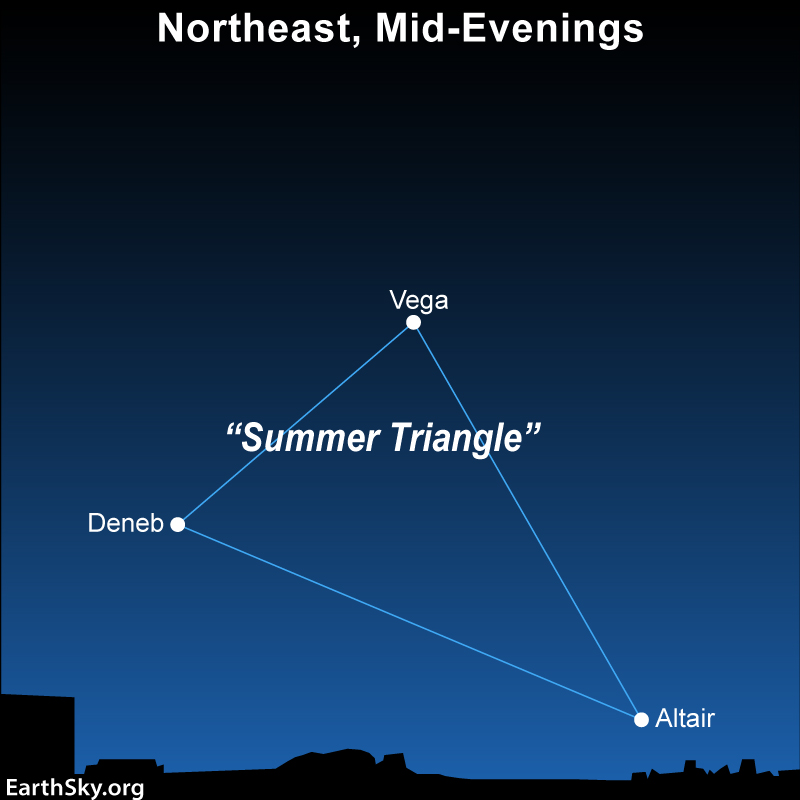
Deneb is in the furthest-left corner of the Summer Triangle. Chart via EarthSky.
How far away is Deneb?
The beautiful Summer Triangle is coming back into view for convenient evening viewing. This asterism consists of three bright stars in three different constellations. Now notice the star Deneb in one corner of the Triangle. When you gaze at Deneb, you’re gazing across a great expanse of space. We don’t know the exact distance to Deneb. We see a range of distances for this star from about 1,600 light-years to about 2,600 light-years. Either way, Deneb is one of the most distant stars we can see with the eye alone.
So distance estimates vary for this star. And they vary a lot! Why?
The answer is a glimpse into the process of science, and the way that astronomers use advancing technologies to try to improve on previous discoveries.
Discovering Deneb’s distance
Scientists have obtained estimates for Deneb’s distance through a variety of methods. Some of these methods involve theoretical models related to the way stars evolve. Some assume Deneb’s membership in Cygnus OB7, a star-forming complex within our Milky Way galaxy.
ESA’s Earth-orbiting Hipparcos Space Astrometry Mission provided the most significant modern measurement of Deneb’s distance in the 1990s. Hipparcos gathered astrometric data on Deneb. Early analyses of the data indicated a distance of somewhere around 2,600 light-years. That’s the figure you still see most often today.
But, since then, various groups of astronomers have re-analyzed Hipparcos data. This is because computer power, which gets stronger with each passing year, helps to improve techniques for analysis. For example, the peer-reviewed journal Astronomy and Astrophysicspublished a study in 2009, using a newer method of analysis (skip to the last page for Deneb).
This new analysis showed a distance to Deneb that’s barely half the widely accepted value. The study suggests 1,548 light-years as the distance, with a range between 1,336 and 1,841 light-years. That’s a big ballpark figure.
So is Deneb 1,600 light-years away or 2,600 light-years away? The fact is, we don’t know. Either way, it’s still one of the most distant stars we see with the unaided eye.
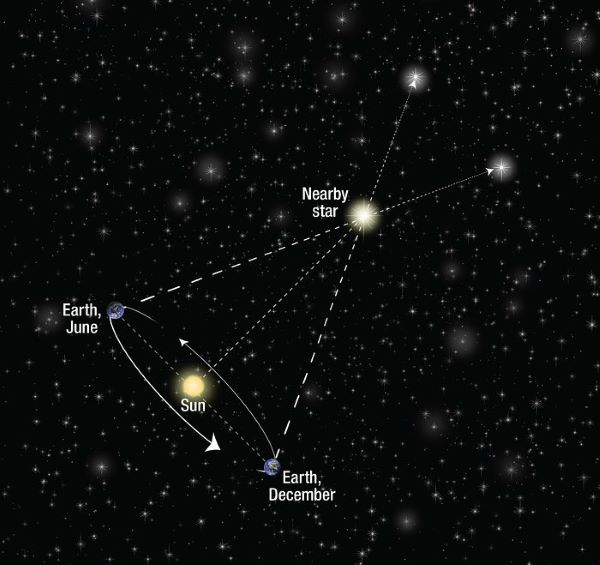
Astronomers use the parallax method to measure distances to nearby stars. But Deneb is too far away for accurate parallax measurements from Earth’s surface. Image via ESA/ NASA/ A. Feild.
Why does Deneb’s distance matter?
Distance matters because it can give us other measurements, too. If astronomers don’t know exactly how far away Deneb is, they can’t get accurate numbers of its size, mass and energy output.
ESA had a second astrometric satellite – the magnificent Gaia space observatory – that was in a distant orbit similar to that of the James Webb Space Telescope. Gaia launched on December 19, 2013. Its five-year nominal mission ended in July 2019. However, the mission was extended to December 31, 2025. And Gaia was officially powered down in March 2025. Gaia’s goal was to measure the positions and distances of stars with more precision than ever before, and it exceeded expectations. We really can’t say enough about the incredible things we’ve learned about our Milky Way galaxy via Gaia. Click here for a few of Gaia’s discoveries.
However, a new estimate for Deneb’s distance wasn’t included in Gaia’s 1st data release, in 2016. And it wasn’t included in Gaia’s 2nd data release in 2018. How about the 3rd data release? Nope, not there either. The 4th data release is expected to come out in 2026.
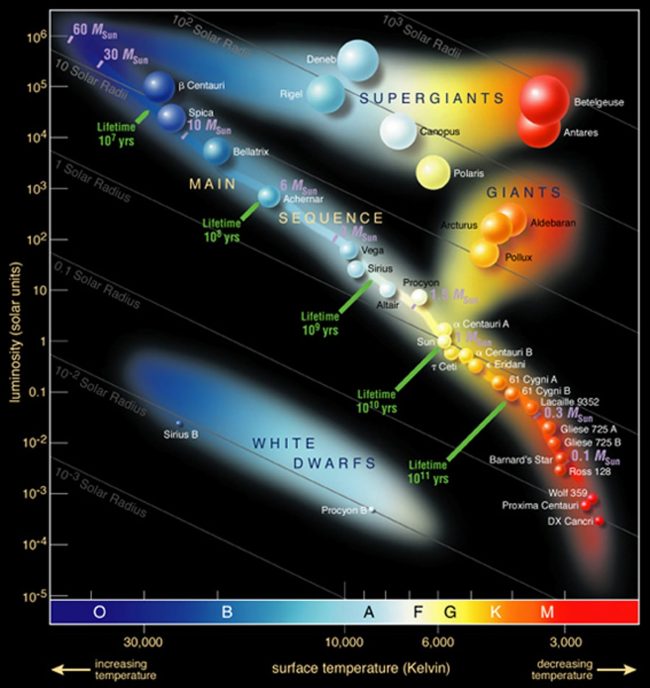
View larger. | This is the famous Hertzsprung-Russell diagram, which shows the luminosities of stars. See Deneb at the top of the diagram? It is one of the most luminous stars known. Image via ESO.
Deneb was too bright for Gaia
Gaia produced data on some 2 billion sources in our Milky Way galaxy. But it couldn’t image Deneb, the 19th brightest star in our sky. That’s because Gaia was not able to measure the distance to bright stars. They would have saturated Gaia’s sensor making measurements impossible. Gaia’s brightest possible star was magnitude 1.71. Deneb is brighter, at magnitude 1.25.
And it’s not that Gaia didn’t try. In 2018, the Gaia team posted an employment opportunity specifically asking for someone to find a way to image bright stars with Gaia. But that position was never filled.
When Gaia was launched, its team was working on the problem of imaging bright stars. Paper after paper after poster addressed the problem of Gaia not being able to image bright stars. But it never happened.
So, how far away is Deneb? If it is part of the Cygnus OB7 group, then it’s as far away as that group: about 2,050 light-years. But the center of that group is 5.2 degrees to the northeast of Deneb, so Deneb might not be a part of it.
Interestingly, in 1838, the first star for which the distance was calculated was 61 Cygni, which lies less than 8 degrees southeast of Deneb.
Bottom line: The star Deneb – part of the famous Summer Triangle – is one of the most distant stars you can see with your eye alone. But we don’t yet know its precise distance.
Deneb is in the furthest-left corner of the Summer Triangle. Chart via EarthSky.
How far away is Deneb?
The beautiful Summer Triangle is coming back into view for convenient evening viewing. This asterism consists of three bright stars in three different constellations. Now notice the star Deneb in one corner of the Triangle. When you gaze at Deneb, you’re gazing across a great expanse of space. We don’t know the exact distance to Deneb. We see a range of distances for this star from about 1,600 light-years to about 2,600 light-years. Either way, Deneb is one of the most distant stars we can see with the eye alone.
So distance estimates vary for this star. And they vary a lot! Why?
The answer is a glimpse into the process of science, and the way that astronomers use advancing technologies to try to improve on previous discoveries.
Discovering Deneb’s distance
Scientists have obtained estimates for Deneb’s distance through a variety of methods. Some of these methods involve theoretical models related to the way stars evolve. Some assume Deneb’s membership in Cygnus OB7, a star-forming complex within our Milky Way galaxy.
ESA’s Earth-orbiting Hipparcos Space Astrometry Mission provided the most significant modern measurement of Deneb’s distance in the 1990s. Hipparcos gathered astrometric data on Deneb. Early analyses of the data indicated a distance of somewhere around 2,600 light-years. That’s the figure you still see most often today.
But, since then, various groups of astronomers have re-analyzed Hipparcos data. This is because computer power, which gets stronger with each passing year, helps to improve techniques for analysis. For example, the peer-reviewed journal Astronomy and Astrophysicspublished a study in 2009, using a newer method of analysis (skip to the last page for Deneb).
This new analysis showed a distance to Deneb that’s barely half the widely accepted value. The study suggests 1,548 light-years as the distance, with a range between 1,336 and 1,841 light-years. That’s a big ballpark figure.
So is Deneb 1,600 light-years away or 2,600 light-years away? The fact is, we don’t know. Either way, it’s still one of the most distant stars we see with the unaided eye.
Astronomers use the parallax method to measure distances to nearby stars. But Deneb is too far away for accurate parallax measurements from Earth’s surface. Image via ESA/ NASA/ A. Feild.
Why does Deneb’s distance matter?
Distance matters because it can give us other measurements, too. If astronomers don’t know exactly how far away Deneb is, they can’t get accurate numbers of its size, mass and energy output.
ESA had a second astrometric satellite – the magnificent Gaia space observatory – that was in a distant orbit similar to that of the James Webb Space Telescope. Gaia launched on December 19, 2013. Its five-year nominal mission ended in July 2019. However, the mission was extended to December 31, 2025. And Gaia was officially powered down in March 2025. Gaia’s goal was to measure the positions and distances of stars with more precision than ever before, and it exceeded expectations. We really can’t say enough about the incredible things we’ve learned about our Milky Way galaxy via Gaia. Click here for a few of Gaia’s discoveries.
However, a new estimate for Deneb’s distance wasn’t included in Gaia’s 1st data release, in 2016. And it wasn’t included in Gaia’s 2nd data release in 2018. How about the 3rd data release? Nope, not there either. The 4th data release is expected to come out in 2026.
View larger. | This is the famous Hertzsprung-Russell diagram, which shows the luminosities of stars. See Deneb at the top of the diagram? It is one of the most luminous stars known. Image via ESO.
Deneb was too bright for Gaia
Gaia produced data on some 2 billion sources in our Milky Way galaxy. But it couldn’t image Deneb, the 19th brightest star in our sky. That’s because Gaia was not able to measure the distance to bright stars. They would have saturated Gaia’s sensor making measurements impossible. Gaia’s brightest possible star was magnitude 1.71. Deneb is brighter, at magnitude 1.25.
And it’s not that Gaia didn’t try. In 2018, the Gaia team posted an employment opportunity specifically asking for someone to find a way to image bright stars with Gaia. But that position was never filled.
When Gaia was launched, its team was working on the problem of imaging bright stars. Paper after paper after poster addressed the problem of Gaia not being able to image bright stars. But it never happened.
So, how far away is Deneb? If it is part of the Cygnus OB7 group, then it’s as far away as that group: about 2,050 light-years. But the center of that group is 5.2 degrees to the northeast of Deneb, so Deneb might not be a part of it.
Interestingly, in 1838, the first star for which the distance was calculated was 61 Cygni, which lies less than 8 degrees southeast of Deneb.
Bottom line: The star Deneb – part of the famous Summer Triangle – is one of the most distant stars you can see with your eye alone. But we don’t yet know its precise distance.
View at EarthSky Community Photos. | Steve Schaum captured this image of Manhattanhenge in New York City on May 30, 2023, and wrote: “This was an adventure of a day. I set up 7+ hours before this shot and watched the crowd grow from 25 to over a thousand. Dr. Neil deGrasse Tyson showed up and I had the pleasure of talking to him. It was a long day, but I usually make friends during days like this, and two years later I still talk to them.” Thank you, Steve!
The first set of Manhattanhenge views will happen on the evenings of May 28 and 29, 2026.
Twice a year – around May 28 and 29, and again around July 11 and 12 – people in New York City look for Manhattanhenge. It’s a phenomenon where the sunset aligns perfectly on east-west oriented streets and avenues of Manhattan. So cool!
In 2026, the first set of Manhattanhenge dates fall on May 28 (half sun at about 8:14 p.m. EDT) and May 29 (full sun at about 8:13 p.m. EDT).
And the second set of dates occur on July 11 (full sun at around 8:20 p.m. EDT) and 12 (half sun at around 8:21 p.m. EDT).
Four nights of the year, the streets of Manhattan’s grid become the site for a stunning sunset phenomenon known as Manhattanhenge. During Manhattanhenge, the sun sets in perfect alignment with Manhattan’s east-west numbered streets, creating cinema-worthy photo opportunities …
Where to watch it
Some of the best places to spot it are along 14th, 23rd, 34th (includes the Empire State Building), 42nd, 57th and 79th Streets.
Another good place is from the Tudor City Bridge in Manhattan (though it can be crowded) or Hunter’s Point South Park in Long Island City, Queens.
Regardless of where you watch the sunset, make sure you are as far east as possible while keeping New Jersey in the background across the Hudson River to accentuate the effect.
View at EarthSky Community Photos. | Walter Karling at Gantry Plaza State Park, Long Island City, took this image on July 12, 2022. Walter wrote: “Photographing Manhattanhenge from Queens.” Thank you, Walter!
Neil deGrasse Tyson on Manhattanhenge
Astrophysicist Neil deGrasse Tyson coined the phrase Manhattanhenge. It’s a nod to the prehistoric monument Stonehenge in England, which was designed to frame the summer solstice sunrise and the winter solstice sunset. Manhattanhenge is accidental. It happens because Manhattan was built with a grid system of streets running north-south and east-west, Tyson explains in the video above.
Aligned sunsets
Each Manhattanhenge is two days. On one day the sun’s full disk aligns with the street grid, and then on the other day half the sun’s disk aligns with the street grid.
The two sets of aligned sunsets are centered around the dates of the summer solstice, leading to the effect’s other name, not as commonly used: the Manhattan Solstice.
Six months later, Reverse Manhattanhenge happens around the mornings around January 11, when the rising sun creates the same effect on the other side of the island at shortly after 7 a.m. EST.
Manhattanhenge on July 12, 2016, at 42nd Street. Tourists blocked an entire section of 42nd Street, including its intersection with 6th Avenue, to take pictures of the sunset. Image via Fred Hsu/ Wikimedia Commons.
Solstice and equinox alignments around the world
The phenomenon of Manhattanhenge is fun. And it’s one of many similar alignments that occur around the world on various dates. Think Stonehenge at the equinoxes and solstices.
The point of sunset along the horizon varies throughout the year. At this time of the year – before the June solstice – the sunset point is shifting northward each day on the horizon as seen from around the globe. It’s the northward-shifting path of the sun that gives us summer in the Northern Hemisphere and winter in the Southern Hemisphere. And it’s the shifting path of the sun that gives people various alignments of the sunset with familiar landmarks.
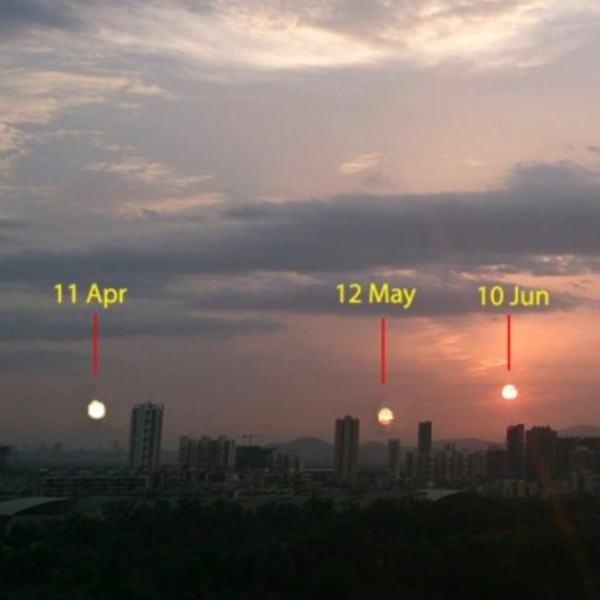
Abhijit Juvekar in Dombivli, India, created this composite image of sunsets over a period of 3 months to show how the sun sets progressively farther north in the months leading up to the June solstice. Abhijit posted this image on EarthSky Facebook. Used with permission.
Watching Manhattanhenge
You can observe Manhattanhenge from lots of different places on the east-west streets of the Manhattan street grid. The best places to watch Manhattanhenge are wide streets with an unobstructed view toward New Jersey across the Hudson River.
Popular spots are 34th Street near the Empire State Building and 42nd Street near the Chrysler Building. Wide cross streets – such as 14th, 34th, 42nd and 57th Streets – that ensure the best views of the west-northwest horizon (toward New Jersey) are generally good spots.
Keep in mind that Manhattanhenge draws large crowds, especially around the city’s landmarks.
The June solstice on June 21 will bring the sun’s northernmost point in our sky and northernmost sunset. Afterward, the sun’s path in our sky, and the sunset point, will both start shifting southward again. As for the sun’s alignment with the city of New York, and the streets of Manhattan Island … well, thank the original planners of this city. Scientific Americanexplained:
The phenomenon is based on a design for Manhattan outlined in The Commissioners’ Plan of 1811 for a rectilinear grid or gridiron of straight streets and avenues that intersect one another at right angles. This design runs from north of Houston Street in Lower Manhattan to just south of 155th Street in Upper Manhattan. Most cross streets in between were arranged in a regular right-angled grid that was tilted 29 degrees east of true north to roughly replicate the angle of the island of Manhattan.
And because of this 29-degree tilt in the grid, the magic moment of the setting sun aligning with Manhattan’s cross streets does not coincide with the June solstice but rather with specific dates in late May and early July.
It’s a great photo opportunity
Did you get a photo of Manhattanhenge? We’d love to see it! Submit it to us at EarthSky Community Photos.
Manhattanhenge in 2017. Gowrishankar Lakshminarayanan was in Gantry Plaza State Park, Queens, New York, looking straight through 42nd Street with the Chrysler building to the right. He said he created this 3-image composite to preserve the disk of the sun and show shadow details of the surroundings. Used with permission.
Bottom line: Each year around May 28 and July 11, New Yorkers watch for Manhattanhenge, an alignment of the sunset along city streets. Here’s how to see it.
View at EarthSky Community Photos. | Steve Schaum captured this image of Manhattanhenge in New York City on May 30, 2023, and wrote: “This was an adventure of a day. I set up 7+ hours before this shot and watched the crowd grow from 25 to over a thousand. Dr. Neil deGrasse Tyson showed up and I had the pleasure of talking to him. It was a long day, but I usually make friends during days like this, and two years later I still talk to them.” Thank you, Steve!
The first set of Manhattanhenge views will happen on the evenings of May 28 and 29, 2026.
Twice a year – around May 28 and 29, and again around July 11 and 12 – people in New York City look for Manhattanhenge. It’s a phenomenon where the sunset aligns perfectly on east-west oriented streets and avenues of Manhattan. So cool!
In 2026, the first set of Manhattanhenge dates fall on May 28 (half sun at about 8:14 p.m. EDT) and May 29 (full sun at about 8:13 p.m. EDT).
And the second set of dates occur on July 11 (full sun at around 8:20 p.m. EDT) and 12 (half sun at around 8:21 p.m. EDT).
Four nights of the year, the streets of Manhattan’s grid become the site for a stunning sunset phenomenon known as Manhattanhenge. During Manhattanhenge, the sun sets in perfect alignment with Manhattan’s east-west numbered streets, creating cinema-worthy photo opportunities …
Where to watch it
Some of the best places to spot it are along 14th, 23rd, 34th (includes the Empire State Building), 42nd, 57th and 79th Streets.
Another good place is from the Tudor City Bridge in Manhattan (though it can be crowded) or Hunter’s Point South Park in Long Island City, Queens.
Regardless of where you watch the sunset, make sure you are as far east as possible while keeping New Jersey in the background across the Hudson River to accentuate the effect.
View at EarthSky Community Photos. | Walter Karling at Gantry Plaza State Park, Long Island City, took this image on July 12, 2022. Walter wrote: “Photographing Manhattanhenge from Queens.” Thank you, Walter!
Neil deGrasse Tyson on Manhattanhenge
Astrophysicist Neil deGrasse Tyson coined the phrase Manhattanhenge. It’s a nod to the prehistoric monument Stonehenge in England, which was designed to frame the summer solstice sunrise and the winter solstice sunset. Manhattanhenge is accidental. It happens because Manhattan was built with a grid system of streets running north-south and east-west, Tyson explains in the video above.
Aligned sunsets
Each Manhattanhenge is two days. On one day the sun’s full disk aligns with the street grid, and then on the other day half the sun’s disk aligns with the street grid.
The two sets of aligned sunsets are centered around the dates of the summer solstice, leading to the effect’s other name, not as commonly used: the Manhattan Solstice.
Six months later, Reverse Manhattanhenge happens around the mornings around January 11, when the rising sun creates the same effect on the other side of the island at shortly after 7 a.m. EST.
Manhattanhenge on July 12, 2016, at 42nd Street. Tourists blocked an entire section of 42nd Street, including its intersection with 6th Avenue, to take pictures of the sunset. Image via Fred Hsu/ Wikimedia Commons.
Solstice and equinox alignments around the world
The phenomenon of Manhattanhenge is fun. And it’s one of many similar alignments that occur around the world on various dates. Think Stonehenge at the equinoxes and solstices.
The point of sunset along the horizon varies throughout the year. At this time of the year – before the June solstice – the sunset point is shifting northward each day on the horizon as seen from around the globe. It’s the northward-shifting path of the sun that gives us summer in the Northern Hemisphere and winter in the Southern Hemisphere. And it’s the shifting path of the sun that gives people various alignments of the sunset with familiar landmarks.
Abhijit Juvekar in Dombivli, India, created this composite image of sunsets over a period of 3 months to show how the sun sets progressively farther north in the months leading up to the June solstice. Abhijit posted this image on EarthSky Facebook. Used with permission.
Watching Manhattanhenge
You can observe Manhattanhenge from lots of different places on the east-west streets of the Manhattan street grid. The best places to watch Manhattanhenge are wide streets with an unobstructed view toward New Jersey across the Hudson River.
Popular spots are 34th Street near the Empire State Building and 42nd Street near the Chrysler Building. Wide cross streets – such as 14th, 34th, 42nd and 57th Streets – that ensure the best views of the west-northwest horizon (toward New Jersey) are generally good spots.
Keep in mind that Manhattanhenge draws large crowds, especially around the city’s landmarks.
The June solstice on June 21 will bring the sun’s northernmost point in our sky and northernmost sunset. Afterward, the sun’s path in our sky, and the sunset point, will both start shifting southward again. As for the sun’s alignment with the city of New York, and the streets of Manhattan Island … well, thank the original planners of this city. Scientific Americanexplained:
The phenomenon is based on a design for Manhattan outlined in The Commissioners’ Plan of 1811 for a rectilinear grid or gridiron of straight streets and avenues that intersect one another at right angles. This design runs from north of Houston Street in Lower Manhattan to just south of 155th Street in Upper Manhattan. Most cross streets in between were arranged in a regular right-angled grid that was tilted 29 degrees east of true north to roughly replicate the angle of the island of Manhattan.
And because of this 29-degree tilt in the grid, the magic moment of the setting sun aligning with Manhattan’s cross streets does not coincide with the June solstice but rather with specific dates in late May and early July.
It’s a great photo opportunity
Did you get a photo of Manhattanhenge? We’d love to see it! Submit it to us at EarthSky Community Photos.
Manhattanhenge in 2017. Gowrishankar Lakshminarayanan was in Gantry Plaza State Park, Queens, New York, looking straight through 42nd Street with the Chrysler building to the right. He said he created this 3-image composite to preserve the disk of the sun and show shadow details of the surroundings. Used with permission.
Bottom line: Each year around May 28 and July 11, New Yorkers watch for Manhattanhenge, an alignment of the sunset along city streets. Here’s how to see it.
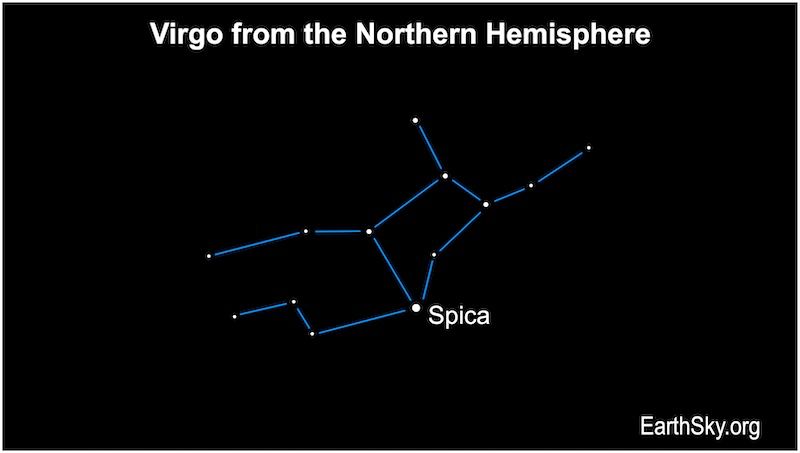
From the Northern Hemisphere, the constellation Virgo the Maiden is easy to find by using the handle of the Big Dipper as a guide to Virgo’s brightest star Spica. Look below for a chart and instructions! Image via EarthSky.
Virgo the Maiden is the largest constellation of the zodiac. And the 12 constellations of the zodiac are important because they define the sun’s path across our sky. So both Northern and Southern Hemisphere stargazers can see Virgo equally well. May and June are excellent times to look for it!
Virgo appears high above the southern horizon on May and June evenings for us in the Northern Hemisphere. Remember … it follows the path of the sun. The same is true from the Southern Hemisphere, but, from there, one faces northward to see the sun’s daily path across our sky. So Southern Hemisphere dwellers look northward to see Virgo on May and June evenings.
And Virgo is big. It’s the biggest zodiacal constellation and 2nd-largest constellation overall (after Hydra the Water Snake). It’s large and dim, with only one bright star. This star is called Spica.
Virgo represents a harvest goddess
Virgo the Maiden is typically seen as goddess of the harvest. And the bright star Spica marks a bundle of wheat held in the Maiden’s left hand.
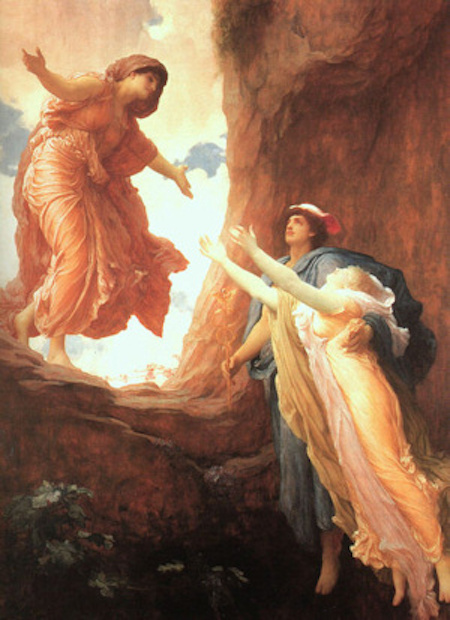
In fact, the constellation Virgo is linked to one of the best known of all Greek myths, that of Demeter and Persephone. According to the myth, it once was always springtime on Earth. That was due to Demeter, an Earth goddess, who deeply loved her daughter Persephone. But then the god of the underworld, Hades, spied Persephone, fell in love with her and kidnapped her.
Demeter was overcome with grief. She abandoned her role as an Earth goddess. And so the world’s fruitfulness and fertility suffered. As often happened in Greek myths, Zeus – king of the gods – intervened. He insisted that Hades return Persephone to Demeter. But Zeus set a condition. He said Persephone must not eat until she returned to her home. That’s when Hades gave Persephone a pomegranate. It’s said that Persephone ate just six seeds.
So Persephone returned to her mother. But – because of the pomegranate – she has to return to the underworld for six months every year.
Now, it’s said, spring returns to the Northern Hemisphere each year when Persephone reunites with Demeter. Then northern winter season reigns again when Persephone dwells in the underworld.
From the perspective of the Northern Hemisphere, Virgo is absent from early evening sky in late autumn, winter and early spring. Virgo’s return to the sky at nightfall – in the months of April, May and June – coincides with the northern spring.
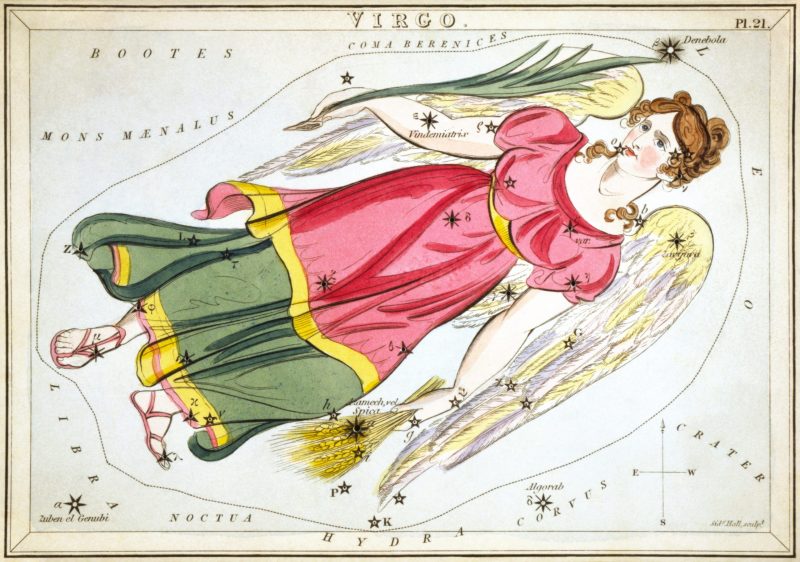
“The Return of Persephone” by Frederic Leighton. Image via Wikipedia.Here’s a classical illustration of the constellation Virgo the Maiden, via Urania’s Mirror/ Wikipedia.
See Virgo from the Northern Hemisphere
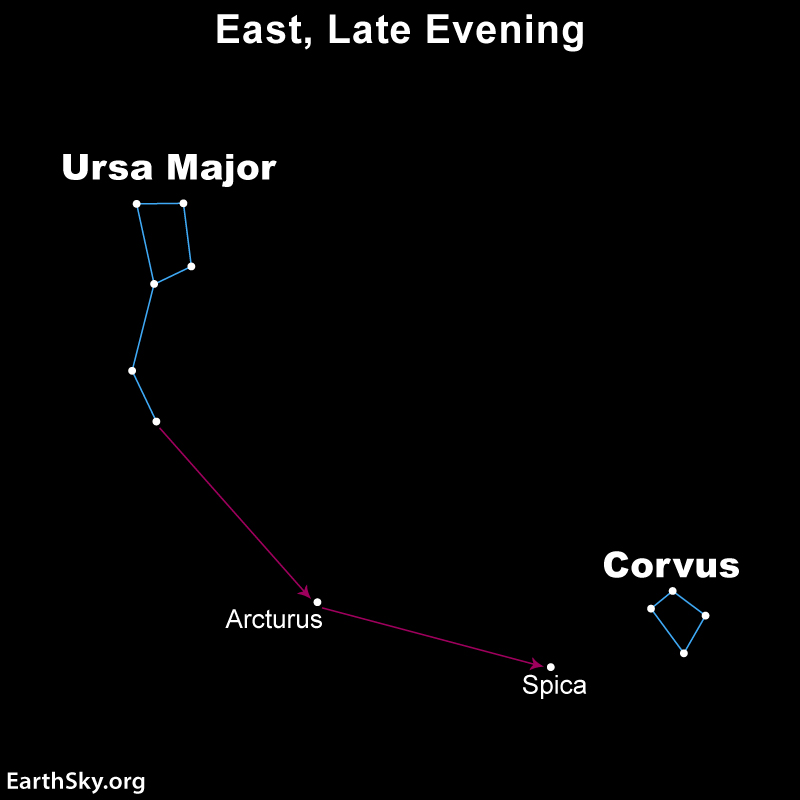
From the Northern Hemisphere, there’s an easy trick to finding this constellation and its brightest star. Just remember this mnemonic: Follow the arc to Arcturus and speed on (or “drive a spike”) to Spica. If you can see the Big Dipper in the northern sky, you can follow the curve of its handle outward to a bright orange star. That’s Arcturus in the constellation Boötes.
Then “speed on” (or “drive a spike”) to Spica in Virgo.
The Big Dipper, Arcturus and Spica are all so bright you can see them from inside cities. Just know you need a dark sky to trace the large figure of Virgo on the sky’s dome. Visit EarthSky’s Best Places to Stargaze.
To find the constellation Virgo, look for the star Spica. Just “follow the arc to Arcturus, and speed on to Spica.” You’ll be following the curve in the Big Dipper’s handle to bright orange Arcturus. Then you’ll extend that line to Spica. To be sure you’ve found Spica, look for a lopsided square pattern nearby; that’s Corvus the Crow. Image via EarthSky.
For Southern Hemisphere observers, Virgo is one of the most prominent constellations of the autumn evening sky during May and June. Instead of looking south as Northern Hemisphere observers do, Southern Hemisphere stargazers should look toward the northern sky, where Virgo crosses the meridian high above the horizon.
The constellation appears upside down compared with Northern Hemisphere star charts, a reminder that our view of the celestial sphere is reversed. Despite this different orientation, the bright blue-white star Spica remains easy to identify as Virgo’s brightest star.
One of the easiest ways to find Spica is by using the Spring Triangle, named in the north (but seen during autumn in the south), formed by Spica, Arcturus, and Regulus. During May and June evenings, these three bright stars dominate the northern sky, with Spica the highest of the three stars.
Look for the distinctive shape of Virgo extending below Spica. The constellation forms a large, somewhat rectangular pattern of stars, although these stars are much fainter than Virgo’s brightest star.
Virgo’s position along the ecliptic means the moon and planets frequently pass through the constellation. Southern Hemisphere observers are also well placed to explore the rich galaxy fields of the Virgo Cluster.
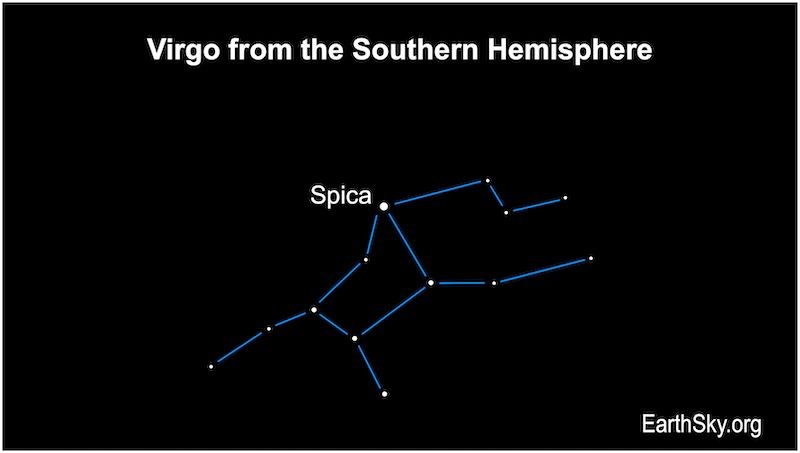
From the Southern Hemisphere, look northward to see the constellation Virgo arcing across the northern sky. Because it’s a constellation of the zodiac, it follows the path of the sun. Contrast this chart to the image at the top of this page, and you’ll see that – from the Southern Hemisphere – Virgo appears upside-down.
The stars of the Maiden
Spica is a blue-white 1st-magnitude star near the center of Virgo. It’s the 15th-brightest star in the night sky. Spica shines at magnitude 1.04 and lies 250 light-years from Earth.
The 2nd-brightest star in Virgo is much fainter. It lies northwest of Spica on the sky’s dome. It’s Gamma Virginis, or Porrima, a moderately bright star at magnitude 2.74. It’s known as a binary star system, some 38 light-years away.
Virgo’s 3rd-brightest star is at the northern reaches of the constellation. Vindemiatrix shines at magnitude 2.82. It’s located 109 light-years away.
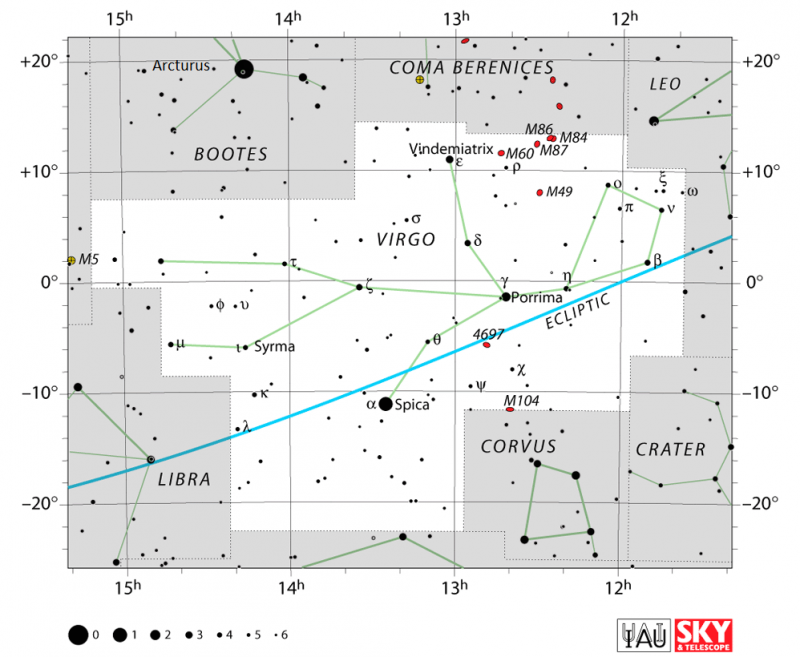
Virgo the Maiden and its stars. Image via IAU/ Wikipedia.
The Virgo Cluster
Virgo is famous for its thousands of galaxies. One grouping – the Virgo Cluster – is near the border with Coma Berenices, west of Vindemiatrix. The Virgo Cluster is the nearest large group of galaxies to the Milky Way. And it lies at the center of our Local Supercluster of galaxies. The Local Group of galaxies, which includes the Milky Way, is also part of the Local Supercluster.
Additionally, the gravitational pull from the Virgo Cluster in the Local Supercluster is slowing the escape velocity of the Milky Way and our Local Group. So the Virgo cluster is one of the few places in the universe we are speeding toward. Therefore, the galaxies in the Virgo Cluster are some of the few we see with a blueshift instead of a redshift. One day, these many galaxies will merge into one huge conglomeration.
In fact, the galaxy with one of the highest blueshifts lies right on the border of Virgo and Coma Berenices. This galaxy, M90, is moving rapidly among the other objects in the Virgo Cluster. That’s because it’s also being stripped of gas and dust due to its close quarters with the other galaxies. At magnitude 9.5, you can see this galaxy in a telescope across the 60 million light-year span.
In addition, other galaxies between 8th and 9th magnitude in this location are M49, M58, M59, M60, M84, M86, M87, and M89. Even more galaxies come into view if you scan along the line between Virgo and Coma Berenices.
M87 is a special galaxy located in the direction of Virgo. It’s part of the Virgo Cluster. It shines at magnitude 8.6 and is therefore easy to detect in any telescope and even in some binoculars. M87 lies about 60 million light-years away. Its potato-shaped clump of stars extends well over half a million light-years across, about five times our Milky Way’s diameter. Meanwhile, the galaxy’s halo is about a million light-years, and maybe larger.
M87 is home to the largest known number of globular star clusters. For comparison, the Milky Way has about 200 globulars, while M87 has thousands.
Another amazing feature of M87 is the jet that extends outward from its core for thousands of light-years. A monster black hole at the galaxy’s core is the source of the jet. In fact, M87’s black hole was the 1st ever imaged, in 2019. That image was enhanced and released with more detail in April 2023.
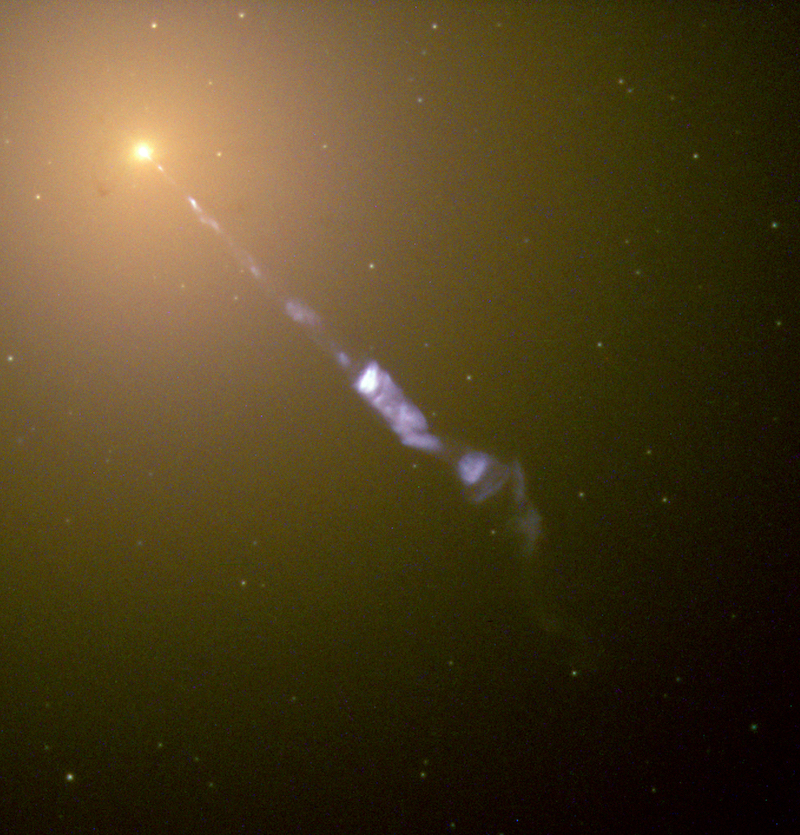
View larger. | An optical light image of the jet erupting from the black hole at the core of galaxy Messier 87 (M87 or NGC 4486). The Hubble Space Telescope took this image on July 6, 2000. Image via NASA/ The Hubble Heritage Team (STScI/AURA)/ Wikimedia Commons.
The Sombrero Galaxy
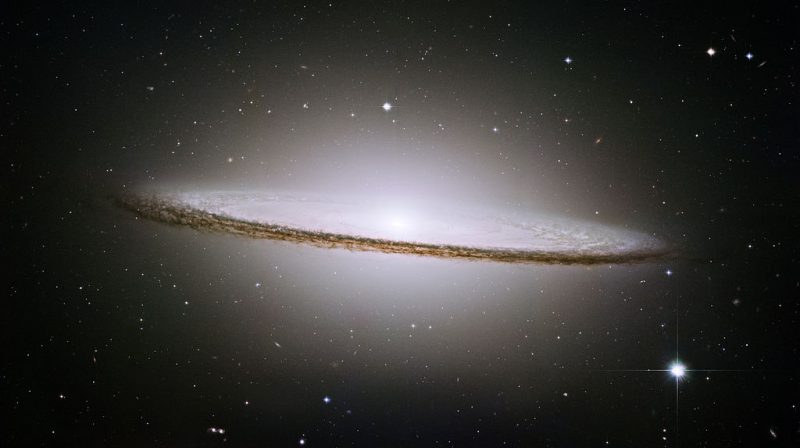
Not to be overlooked is another bright and notable galaxy that’s apart from the large Virgo Cluster: M104, or the Sombrero Galaxy. It’s located on the southeastern border of the constellation next to Corvus the Crow. Without a doubt, M104 is a stunning galaxy in photographs. Even better, at magnitude 8.3, you can see it in small telescopes. It’s an edge-on, dusty spiral galaxy with a bright core. M104 lies approximately 55 million light-years away.
M104, or the Sombrero Galaxy, lies in the constellation Virgo the Maiden. Image via ESA/ Wikimedia Commons.
From the Northern Hemisphere, the constellation Virgo the Maiden is easy to find by using the handle of the Big Dipper as a guide to Virgo’s brightest star Spica. Look below for a chart and instructions! Image via EarthSky.
Virgo the Maiden is the largest constellation of the zodiac. And the 12 constellations of the zodiac are important because they define the sun’s path across our sky. So both Northern and Southern Hemisphere stargazers can see Virgo equally well. May and June are excellent times to look for it!
Virgo appears high above the southern horizon on May and June evenings for us in the Northern Hemisphere. Remember … it follows the path of the sun. The same is true from the Southern Hemisphere, but, from there, one faces northward to see the sun’s daily path across our sky. So Southern Hemisphere dwellers look northward to see Virgo on May and June evenings.
And Virgo is big. It’s the biggest zodiacal constellation and 2nd-largest constellation overall (after Hydra the Water Snake). It’s large and dim, with only one bright star. This star is called Spica.
Virgo represents a harvest goddess
Virgo the Maiden is typically seen as goddess of the harvest. And the bright star Spica marks a bundle of wheat held in the Maiden’s left hand.
In fact, the constellation Virgo is linked to one of the best known of all Greek myths, that of Demeter and Persephone. According to the myth, it once was always springtime on Earth. That was due to Demeter, an Earth goddess, who deeply loved her daughter Persephone. But then the god of the underworld, Hades, spied Persephone, fell in love with her and kidnapped her.
Demeter was overcome with grief. She abandoned her role as an Earth goddess. And so the world’s fruitfulness and fertility suffered. As often happened in Greek myths, Zeus – king of the gods – intervened. He insisted that Hades return Persephone to Demeter. But Zeus set a condition. He said Persephone must not eat until she returned to her home. That’s when Hades gave Persephone a pomegranate. It’s said that Persephone ate just six seeds.
So Persephone returned to her mother. But – because of the pomegranate – she has to return to the underworld for six months every year.
Now, it’s said, spring returns to the Northern Hemisphere each year when Persephone reunites with Demeter. Then northern winter season reigns again when Persephone dwells in the underworld.
From the perspective of the Northern Hemisphere, Virgo is absent from early evening sky in late autumn, winter and early spring. Virgo’s return to the sky at nightfall – in the months of April, May and June – coincides with the northern spring.
“The Return of Persephone” by Frederic Leighton. Image via Wikipedia.Here’s a classical illustration of the constellation Virgo the Maiden, via Urania’s Mirror/ Wikipedia.
See Virgo from the Northern Hemisphere
From the Northern Hemisphere, there’s an easy trick to finding this constellation and its brightest star. Just remember this mnemonic: Follow the arc to Arcturus and speed on (or “drive a spike”) to Spica. If you can see the Big Dipper in the northern sky, you can follow the curve of its handle outward to a bright orange star. That’s Arcturus in the constellation Boötes.
Then “speed on” (or “drive a spike”) to Spica in Virgo.
The Big Dipper, Arcturus and Spica are all so bright you can see them from inside cities. Just know you need a dark sky to trace the large figure of Virgo on the sky’s dome. Visit EarthSky’s Best Places to Stargaze.
To find the constellation Virgo, look for the star Spica. Just “follow the arc to Arcturus, and speed on to Spica.” You’ll be following the curve in the Big Dipper’s handle to bright orange Arcturus. Then you’ll extend that line to Spica. To be sure you’ve found Spica, look for a lopsided square pattern nearby; that’s Corvus the Crow. Image via EarthSky.
For Southern Hemisphere observers, Virgo is one of the most prominent constellations of the autumn evening sky during May and June. Instead of looking south as Northern Hemisphere observers do, Southern Hemisphere stargazers should look toward the northern sky, where Virgo crosses the meridian high above the horizon.
The constellation appears upside down compared with Northern Hemisphere star charts, a reminder that our view of the celestial sphere is reversed. Despite this different orientation, the bright blue-white star Spica remains easy to identify as Virgo’s brightest star.
One of the easiest ways to find Spica is by using the Spring Triangle, named in the north (but seen during autumn in the south), formed by Spica, Arcturus, and Regulus. During May and June evenings, these three bright stars dominate the northern sky, with Spica the highest of the three stars.
Look for the distinctive shape of Virgo extending below Spica. The constellation forms a large, somewhat rectangular pattern of stars, although these stars are much fainter than Virgo’s brightest star.
Virgo’s position along the ecliptic means the moon and planets frequently pass through the constellation. Southern Hemisphere observers are also well placed to explore the rich galaxy fields of the Virgo Cluster.
From the Southern Hemisphere, look northward to see the constellation Virgo arcing across the northern sky. Because it’s a constellation of the zodiac, it follows the path of the sun. Contrast this chart to the image at the top of this page, and you’ll see that – from the Southern Hemisphere – Virgo appears upside-down.
The stars of the Maiden
Spica is a blue-white 1st-magnitude star near the center of Virgo. It’s the 15th-brightest star in the night sky. Spica shines at magnitude 1.04 and lies 250 light-years from Earth.
The 2nd-brightest star in Virgo is much fainter. It lies northwest of Spica on the sky’s dome. It’s Gamma Virginis, or Porrima, a moderately bright star at magnitude 2.74. It’s known as a binary star system, some 38 light-years away.
Virgo’s 3rd-brightest star is at the northern reaches of the constellation. Vindemiatrix shines at magnitude 2.82. It’s located 109 light-years away.
Virgo the Maiden and its stars. Image via IAU/ Wikipedia.
The Virgo Cluster
Virgo is famous for its thousands of galaxies. One grouping – the Virgo Cluster – is near the border with Coma Berenices, west of Vindemiatrix. The Virgo Cluster is the nearest large group of galaxies to the Milky Way. And it lies at the center of our Local Supercluster of galaxies. The Local Group of galaxies, which includes the Milky Way, is also part of the Local Supercluster.
Additionally, the gravitational pull from the Virgo Cluster in the Local Supercluster is slowing the escape velocity of the Milky Way and our Local Group. So the Virgo cluster is one of the few places in the universe we are speeding toward. Therefore, the galaxies in the Virgo Cluster are some of the few we see with a blueshift instead of a redshift. One day, these many galaxies will merge into one huge conglomeration.
In fact, the galaxy with one of the highest blueshifts lies right on the border of Virgo and Coma Berenices. This galaxy, M90, is moving rapidly among the other objects in the Virgo Cluster. That’s because it’s also being stripped of gas and dust due to its close quarters with the other galaxies. At magnitude 9.5, you can see this galaxy in a telescope across the 60 million light-year span.
In addition, other galaxies between 8th and 9th magnitude in this location are M49, M58, M59, M60, M84, M86, M87, and M89. Even more galaxies come into view if you scan along the line between Virgo and Coma Berenices.
M87 is a special galaxy located in the direction of Virgo. It’s part of the Virgo Cluster. It shines at magnitude 8.6 and is therefore easy to detect in any telescope and even in some binoculars. M87 lies about 60 million light-years away. Its potato-shaped clump of stars extends well over half a million light-years across, about five times our Milky Way’s diameter. Meanwhile, the galaxy’s halo is about a million light-years, and maybe larger.
M87 is home to the largest known number of globular star clusters. For comparison, the Milky Way has about 200 globulars, while M87 has thousands.
Another amazing feature of M87 is the jet that extends outward from its core for thousands of light-years. A monster black hole at the galaxy’s core is the source of the jet. In fact, M87’s black hole was the 1st ever imaged, in 2019. That image was enhanced and released with more detail in April 2023.
View larger. | An optical light image of the jet erupting from the black hole at the core of galaxy Messier 87 (M87 or NGC 4486). The Hubble Space Telescope took this image on July 6, 2000. Image via NASA/ The Hubble Heritage Team (STScI/AURA)/ Wikimedia Commons.
The Sombrero Galaxy
Not to be overlooked is another bright and notable galaxy that’s apart from the large Virgo Cluster: M104, or the Sombrero Galaxy. It’s located on the southeastern border of the constellation next to Corvus the Crow. Without a doubt, M104 is a stunning galaxy in photographs. Even better, at magnitude 8.3, you can see it in small telescopes. It’s an edge-on, dusty spiral galaxy with a bright core. M104 lies approximately 55 million light-years away.
M104, or the Sombrero Galaxy, lies in the constellation Virgo the Maiden. Image via ESA/ Wikimedia Commons.
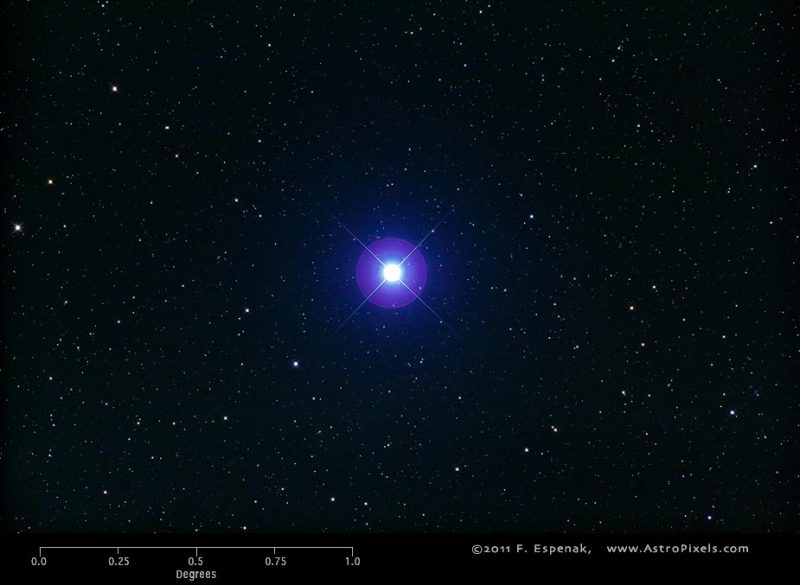
Even though our eyes see the star Spica as 1 star, it’s really at least 2. Photo by Fred Espenak at AstroPixels. Used with permission.
Spica is a close double star
The star Spica – aka Alpha Virginis – is the brightest star in the constellation Virgo the Maiden. From our distance of about 250 light-years away, Spica appears as a lone blue-white star. But the single point of light we see as Spica is really at least two stars.
Both the stars that we know make up Spica are larger and hotter than our sun. And they’re separated by only 11 million miles (less than 18 million km). That’s not much more than 10% of the distance between Earth and our sun (93 million miles or 150 million km). They orbit their common center of gravity in only four days.
Because they’re so close, the two stars in the Spica system are individually indistinguishable from a single point of light, even with a telescope. Only the analysis of its light with a spectroscope – an instrument that splits light into its component colors – revealed the dual nature of this star.
Hot, hot, hot
Spica’s two stars are so close, and they orbit so quickly around each other, that their mutual gravity distorts each star into an egg shape. It’s thought that the pointed ends of these egg-shaped stars face each other as they whirl around.
The pair of stars are both dwarf stars, brightening as they near the end of their lifetimes.
Spica is one of the hottest 1st-magnitude star systems. The hottest of the pair is about 40,000 degrees F or 22,000 C. That’s blistering in contrast to the sun’s 10,000 F or 5,500 C. This star might someday explode as a supernova.
The light from Spica’s two stars, taken together, is on average more than 12,100 times brighter than our sun’s light. Their estimated diameters are 7.8 and 4 times our sun’s diameter.
Spica is one of several bright stars that the moon occasionally passes in front of. And that gives astronomers a great opportunity to study the star system closely. By observing precisely how Spica’s light is extinguished when the moon passes in front of it, some astronomers think that it may not just be a binary star. Instead, they think that there may be as many as three other stars in the system. So Spica might not be a double star, but a quintuple star!
The best evening views of Spica come from northern spring to late northern summer, when this star arcs across the southern sky in the evening. So in the month of May, as seen from the Northern Hemisphere, you’ll find Spica in the southeast in early evening. From the Southern Hemisphere, Spica will be closer to due east. From all of Earth in May, as night passes, Spica appears to move westward. Spica rises earlier each evening so that – by the end of August – it can be viewed only briefly in the west to west-southwest sky as darkness falls.
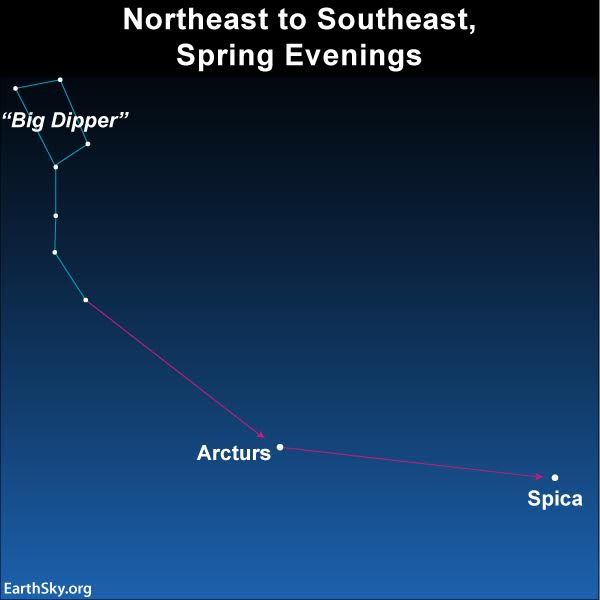
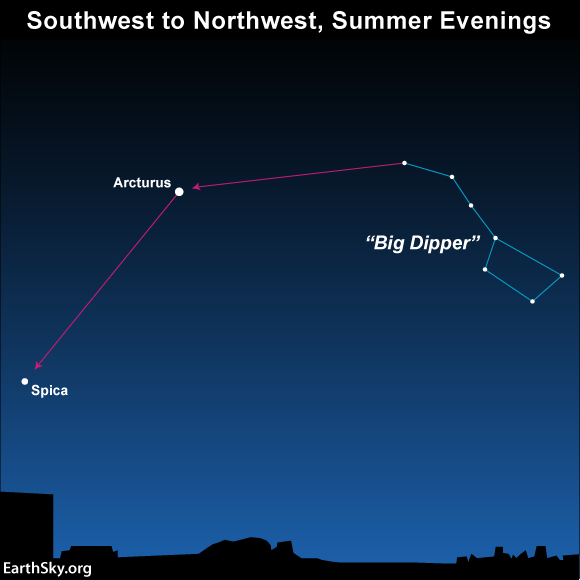
There’s a foolproof way to find Spica, using the Big Dipper as a guide. Scouts and stargazers remember this trick with the saying: Follow the arc to Arcturus, and speed on (or drive a spike) to Spica.
Look for the Big Dipper
First, look for the Big Dipper in the northern sky. It’s highest in the evening sky in the northern spring and summer. Notice that the Big Dipper has a bowl and a long, curved handle. Follow the arc of the Dipper’s handle outward, away from the Dipper’s bowl. The first bright star you come to is orange Arcturus. Then speed on (or drive a spike) along this curving path. And the next bright star you come to is Spica.
Spica shines at magnitude 1.04, making it the brightest light in Virgo. In fact, it’s the 15th-brightest star visible from anywhere on Earth. It’s virtually the same brightness as Antares in the constellation Scorpius, so sometimes Antares is listed as the 15th and Spica as the 16th brightest.
In northern spring, look northeast to southeast in the evening. You’ll find the Big Dipper in the northeast evening sky. Then, follow the arc to Arcturus, and speed on to Spica.In northern summer, look northwest to southwest. You’ll find the Big Dipper in the northwest evening sky. But you can still follow the arc to Arcturus, and drive a speed on to Spica.
History and mythology of Spica
The name Spica is from the Latin word for “ear” (of grain). The general connotation is that Spica refers to an “ear of wheat.” Indeed, the star and the constellation Virgo itself were sometimes associated with the Greek goddess of the harvest, Demeter.
There are many names and stories for Spica’s constellation – Virgo – in mythology, and by association with Spica as well. Fewer stories refer to Spica independently. Many classical references refer to Virgo’s stars as a goddess or with some association with wheat or the harvest, since the sun passes through Virgo in the fall. In Greece and Rome she typically was Astraea, the very personification of Justice; or Persephone, daughter of Demeter. In Egypt, Virgo was identified with Isis, and Spica was considered her lute bearer. In ancient China, Spica was a special star of spring known as the Horn.
One Arabic name was Azimech, derived from words meaning Defenseless One or Solitary One. This title may be in reference to Spica’s solitary status with no other bright stars nearby. But Spica is not the most solitary star. That honor goes to Fomalhaut, sometimes called the Autumn Star.
Here’s a classical illustration of the constellation Virgo the Maiden, with Spica embedded in the wheat in her left hand. Image via Urania’s Mirror/ Wikipedia (public domain).
For Southern Hemisphere observers, Spica’s constellation Virgo is one of the most prominent constellations of the autumn evening sky during May and June. Instead of looking south as Northern Hemisphere observers do, Southern Hemisphere stargazers should look toward the northern sky, where Virgo crosses the meridian high above the horizon.
The constellation appears upside down compared with Northern Hemisphere star charts, a reminder that our view of the celestial sphere is reversed. Despite this different orientation, the bright blue-white star Spica remains easy to identify as Virgo’s brightest star.
One of the easiest ways to find Spica is by using the so-called Spring Triangle, formed by Spica, Arcturus, and Regulus. This was named for Northern Hemisphere spring, so it’s actually seen during autumn in the south. During May and June evenings, these three bright stars dominate the northern sky, with Spica reaching highest of the three.
For observers in New Zealand’s South Island (around 45 latitude south), Spica reaches an altitude of about 61° when crossing the meridian, while from Auckland (37 latitude south) it culminates around 53° above the northern horizon.
Look for the distinctive shape of Virgo extending below Spica. The constellation forms a large, somewhat rectangular pattern of stars, although these stars are much fainter than Virgo’s brightest star.
Bottom line: Spica is the brightest star in Virgo. Spica is at least two stars orbiting extremely close together, distorting each other into egg shapes.
Even though our eyes see the star Spica as 1 star, it’s really at least 2. Photo by Fred Espenak at AstroPixels. Used with permission.
Spica is a close double star
The star Spica – aka Alpha Virginis – is the brightest star in the constellation Virgo the Maiden. From our distance of about 250 light-years away, Spica appears as a lone blue-white star. But the single point of light we see as Spica is really at least two stars.
Both the stars that we know make up Spica are larger and hotter than our sun. And they’re separated by only 11 million miles (less than 18 million km). That’s not much more than 10% of the distance between Earth and our sun (93 million miles or 150 million km). They orbit their common center of gravity in only four days.
Because they’re so close, the two stars in the Spica system are individually indistinguishable from a single point of light, even with a telescope. Only the analysis of its light with a spectroscope – an instrument that splits light into its component colors – revealed the dual nature of this star.
Hot, hot, hot
Spica’s two stars are so close, and they orbit so quickly around each other, that their mutual gravity distorts each star into an egg shape. It’s thought that the pointed ends of these egg-shaped stars face each other as they whirl around.
The pair of stars are both dwarf stars, brightening as they near the end of their lifetimes.
Spica is one of the hottest 1st-magnitude star systems. The hottest of the pair is about 40,000 degrees F or 22,000 C. That’s blistering in contrast to the sun’s 10,000 F or 5,500 C. This star might someday explode as a supernova.
The light from Spica’s two stars, taken together, is on average more than 12,100 times brighter than our sun’s light. Their estimated diameters are 7.8 and 4 times our sun’s diameter.
Spica is one of several bright stars that the moon occasionally passes in front of. And that gives astronomers a great opportunity to study the star system closely. By observing precisely how Spica’s light is extinguished when the moon passes in front of it, some astronomers think that it may not just be a binary star. Instead, they think that there may be as many as three other stars in the system. So Spica might not be a double star, but a quintuple star!
The best evening views of Spica come from northern spring to late northern summer, when this star arcs across the southern sky in the evening. So in the month of May, as seen from the Northern Hemisphere, you’ll find Spica in the southeast in early evening. From the Southern Hemisphere, Spica will be closer to due east. From all of Earth in May, as night passes, Spica appears to move westward. Spica rises earlier each evening so that – by the end of August – it can be viewed only briefly in the west to west-southwest sky as darkness falls.
There’s a foolproof way to find Spica, using the Big Dipper as a guide. Scouts and stargazers remember this trick with the saying: Follow the arc to Arcturus, and speed on (or drive a spike) to Spica.
Look for the Big Dipper
First, look for the Big Dipper in the northern sky. It’s highest in the evening sky in the northern spring and summer. Notice that the Big Dipper has a bowl and a long, curved handle. Follow the arc of the Dipper’s handle outward, away from the Dipper’s bowl. The first bright star you come to is orange Arcturus. Then speed on (or drive a spike) along this curving path. And the next bright star you come to is Spica.
Spica shines at magnitude 1.04, making it the brightest light in Virgo. In fact, it’s the 15th-brightest star visible from anywhere on Earth. It’s virtually the same brightness as Antares in the constellation Scorpius, so sometimes Antares is listed as the 15th and Spica as the 16th brightest.
In northern spring, look northeast to southeast in the evening. You’ll find the Big Dipper in the northeast evening sky. Then, follow the arc to Arcturus, and speed on to Spica.In northern summer, look northwest to southwest. You’ll find the Big Dipper in the northwest evening sky. But you can still follow the arc to Arcturus, and drive a speed on to Spica.
History and mythology of Spica
The name Spica is from the Latin word for “ear” (of grain). The general connotation is that Spica refers to an “ear of wheat.” Indeed, the star and the constellation Virgo itself were sometimes associated with the Greek goddess of the harvest, Demeter.
There are many names and stories for Spica’s constellation – Virgo – in mythology, and by association with Spica as well. Fewer stories refer to Spica independently. Many classical references refer to Virgo’s stars as a goddess or with some association with wheat or the harvest, since the sun passes through Virgo in the fall. In Greece and Rome she typically was Astraea, the very personification of Justice; or Persephone, daughter of Demeter. In Egypt, Virgo was identified with Isis, and Spica was considered her lute bearer. In ancient China, Spica was a special star of spring known as the Horn.
One Arabic name was Azimech, derived from words meaning Defenseless One or Solitary One. This title may be in reference to Spica’s solitary status with no other bright stars nearby. But Spica is not the most solitary star. That honor goes to Fomalhaut, sometimes called the Autumn Star.
Here’s a classical illustration of the constellation Virgo the Maiden, with Spica embedded in the wheat in her left hand. Image via Urania’s Mirror/ Wikipedia (public domain).
For Southern Hemisphere observers, Spica’s constellation Virgo is one of the most prominent constellations of the autumn evening sky during May and June. Instead of looking south as Northern Hemisphere observers do, Southern Hemisphere stargazers should look toward the northern sky, where Virgo crosses the meridian high above the horizon.
The constellation appears upside down compared with Northern Hemisphere star charts, a reminder that our view of the celestial sphere is reversed. Despite this different orientation, the bright blue-white star Spica remains easy to identify as Virgo’s brightest star.
One of the easiest ways to find Spica is by using the so-called Spring Triangle, formed by Spica, Arcturus, and Regulus. This was named for Northern Hemisphere spring, so it’s actually seen during autumn in the south. During May and June evenings, these three bright stars dominate the northern sky, with Spica reaching highest of the three.
For observers in New Zealand’s South Island (around 45 latitude south), Spica reaches an altitude of about 61° when crossing the meridian, while from Auckland (37 latitude south) it culminates around 53° above the northern horizon.
Look for the distinctive shape of Virgo extending below Spica. The constellation forms a large, somewhat rectangular pattern of stars, although these stars are much fainter than Virgo’s brightest star.
Bottom line: Spica is the brightest star in Virgo. Spica is at least two stars orbiting extremely close together, distorting each other into egg shapes.
EarthSky’s Deborah Byrd talks about the May 30-31 Blue Moon and micromoon on this week’s livestream. Join the live dicusssion at noon CDT (17 UTC) on Wednesday, May 27. You can watch in the player above or on Youtube.
May 2026 has 2 full moons. The 1st was the full Flower Moon on May 1. The 2nd will be on overnight May 30-31. It’s a Blue Moon and a micromoon – or distant full moon – the most distant full moon of 2026.
The full Blue Moon overnight on May 30-31, 2026
The coming Blue Moon – at 8:45 UTC on May 31, 2026 – is a Blue Moon and the most distant full micromoon of this year. Blue Moons aren’t blue. But micromoons – near their monthly apogees, or most distant points from Earth for the month – are small moons on our sky’s dome (although not noticeably small to the human eye).
And this May 30-31 moon is 2026’s smallest moon. It’s about 252,360 miles (406,134 km) away, in contrast to an average moon distance of about 238,900 miles (384,472 km).
And so the May 30-31 full moon will be about 7% dimmer than an average full moon, and about 25–30% dimmer than a supermoon, or particularly close full moon.
The crest of this 2nd full moon of May falls at 8:45 UTC on May 31. That’s 3:45 a.m. CDT. So, if you live in the Americas, Europe or Africa, the moon is fullest for you during the night of May 30. But those west of the International Date Line (Australia, New Zealand and Asia) will find their fullest moon on the night of May 31.
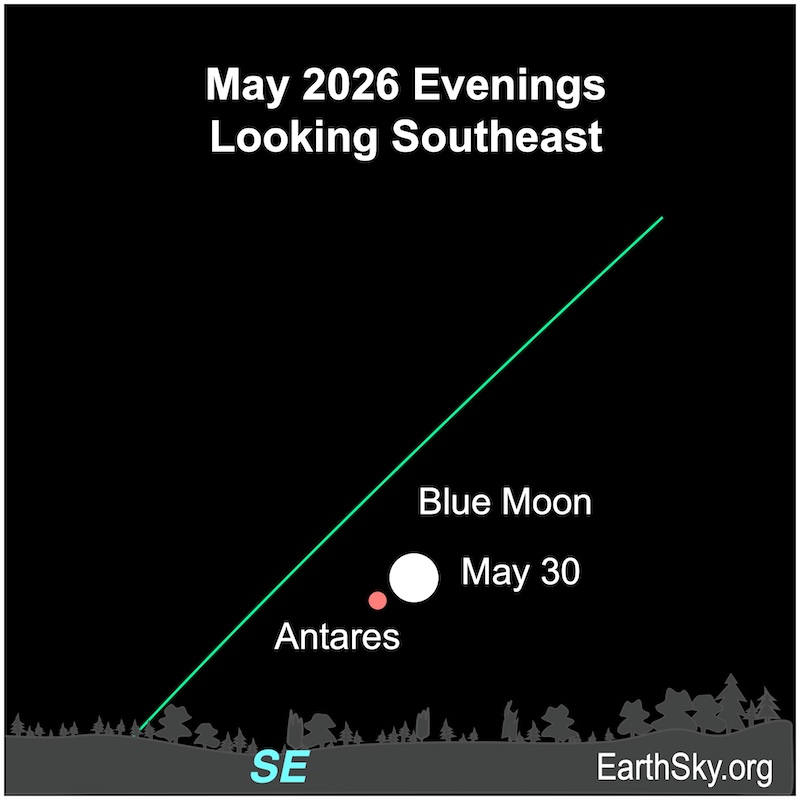
The May 30-31 Blue Moon and micromoon will be near a bright star. It’s Antares, Heart of the Scorpion in the constellation Scorpius.
On May 30, the full Blue Moon will appear close to the bright red star Antares, Heart of Scorpius the Scorpion. The crest of the full moon falls at 8:45 UTC on May 31. That’s 3:45 a.m. CDT. So, it’s almost as full when it rises in the east after sunset on May 30 and May 31. And it’s the 2nd and most distant of 3 full micromoons – or most distant full moons – in a row in 2026. So it’ll be the smallest full moon of 2026. Chart via EarthSky.
What’s a Blue Moon?
So, why is the May 30-31 full moon a Blue Moon? It won’t be blue in color.
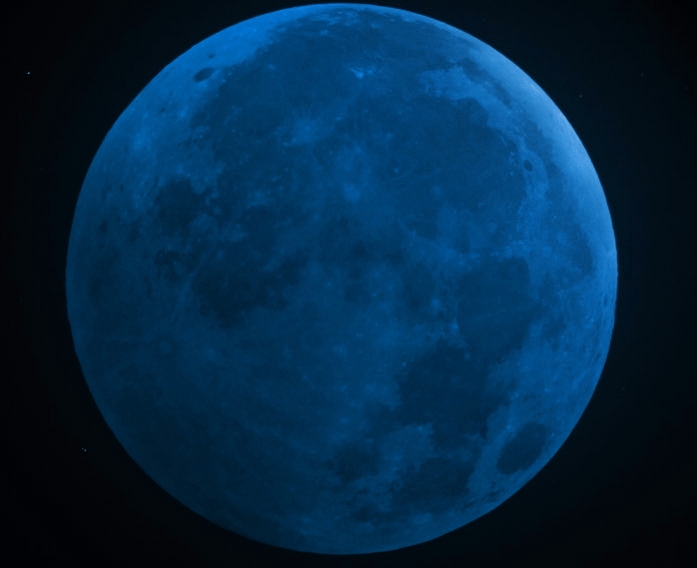
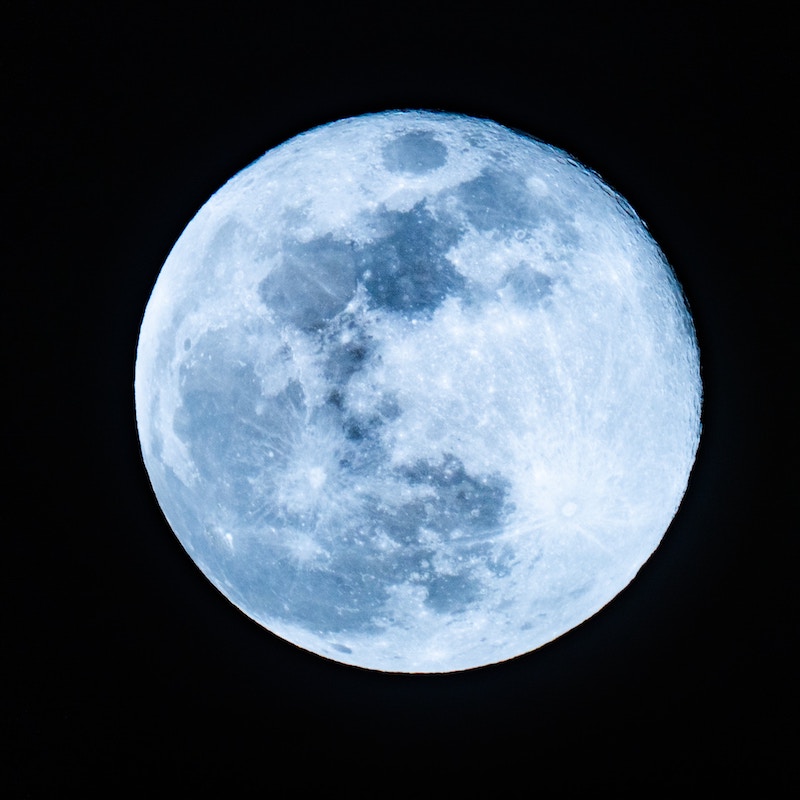
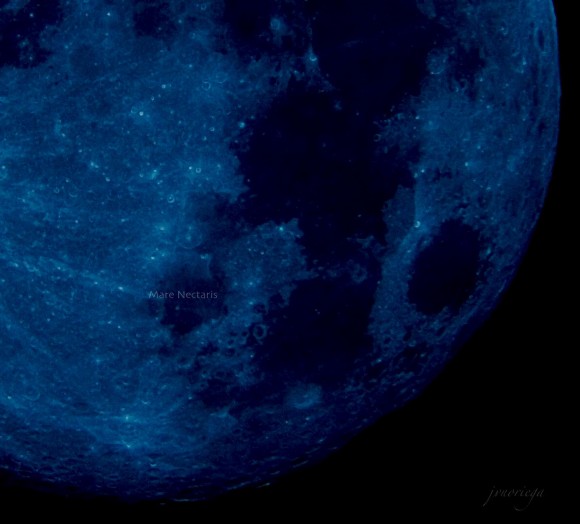
Blue-colored moons in images – such as the images on this page – are often made using special blue camera filters or in a post-processing program such as PhotoShop. Usually, but not always.
True blue-colored moons are rare, and they aren’t necessarily full. They happen when Earth’s atmosphere contains dust or smoke particles of a certain size. The particles must be slightly wider than 900 nanometers.
So you might find particles of this size in the air above you when, for example, a wildfire is raging nearby. That’s because particles of this size are very efficient at scattering red light. When these particles are present in our air, and moonlight shines through them, the moon might appear blue in color.
People reported genuinely blue-looking moons after:
A hypothetical representation of a blue-colored moon. Blue-colored moons are extremely rare. They happen in a region that has experienced a major wildfire or a volcanic eruption. For example, people saw blue-colored moons after Krakatoa’s 1883 eruption and Mount St. Helens’ 1980 eruption. Will the May 30-31, 2026, full Blue Moon look this color? No. It’ll be a Blue Moon in name only. Image via BlueHypercane761/ Wikimedia Commons.
What’s a monthly Blue Moon?
In modern times, most of us know that Blue Moons emerged from folklore. We call a full moon a Blue Moon when it’s the 2nd full moon of a single calendar month. This sort of Blue Moon happens seven times in every 19 years, or about every two to three years.
Let’s take a look at the eight calendar-month Blue-Moons (dates in UTC) in the present 19-year Metonic cycle:
March 31, 2018
October 31, 2020
August 31, 2023
May 31, 2026
December 31, 2028
September 30, 2031
July 31, 2034
January 31, 2037
Also, in a year where February has no full moon at all, as in the year 2018, you can have two full moons in January and two full moons in March. Thus, during those years there are two Blue Moons in single year. The next time we have two Blue Moons in one year is 2037.
How often do monthly Blue Moons happen? Often!
Most Blue Moons are not blue in color. This photo of a moon among fast-moving clouds was created using special blue filters. Image via EarthSky friend Jv Noriega.
What’s a seasonal Blue Moon?
By season, we’re referring to the period of time between a solstice and an equinox, or vice versa. We’re talking about winter, spring, summer, fall. Each season typically lasts three months and typically has three full moons.
The next seasonal Blue Moon will fall on May 20, 2027. It happens because June 2027’s full moon falls about two days before the June solstice, early in the season of northern summer (southern winter). And thus, there’s enough time to squeeze four full moons into the 2027 March equinox season, which will end at the June solstice on June 21, 2027.
Weirdly, it’s not the 4th of these four full moons that’ll be called a Blue Moon. It’s the 3rd. Go figure.
Full moons (based on UTC date and time) between March 2027 equinox and June 2027 solstice:
March equinox: March 20, 2027
March full moon: March 22, 2027
April full moon: April 20, 2027
May full moon: May 20, 2027
June full moon: June 18, 2027
June solstice: June 21, 2027
A full “blue” moon. This image was likely made using a blue filter. Photo via Eileen Rollin/ Unsplash.
How often do seasonal Blue Moons occur?
The phases of the moon recur on or near the same calendar dates every 19 years. That’s because 235 lunar months (235 returns to full moon) almost exactly equal 19 calendar years. Sure enough, 19 years from 2024 – in the year 2043 – the full moons will fall on June 22, July 21, August 20, and September 18.
Seasonal Blue Moons occur because there are 235 full moons but only 76 seasons (4 x 19 = 76) in this 19-year lunar cycle. If you have only three full moons in each season, then that’s a total of 228 full moons (76 x 3 = 228). Yet, there are 235 full moons in this 19-year cycle. So, these seven additional full moons (235 – 228 = 7) have to showcase seven four-full-moon seasons in this 19-year period. We list upcoming seasonal Blue Moon UTC dates – following the August 19, 2024, seasonal Blue Moon – below:
May 20, 2027
August 24, 2029
August 21, 2032
May 22, 2035
May 18, 2038
August 22, 2040
August 20, 2043
How often do seasonal Blue Moons happen? Like monthly Blue Moons, they happen a lot.
A seasonal and a monthly Blue Moon in a single year?
Very rarely, a seasonal Blue Moon (3rd of four full moons in one season) and a monthly Blue Moon (2nd of two full moons in one calendar month) can occur in the same calendar year. For this to happen, you need 13 full moons between successive December solstices for a seasonal Blue Moon and, generally, 13 full moons in one calendar year for a monthly Blue Moon.
This will next happen in the year 2048, when a monthly Blue Moon falls on January 31, and a seasonal Blue Moon on August 23.
Then 19 years later, in the year 2067, there will be a monthly Blue Moon on March 30, and a seasonal Blue Moon on November 20. In this instance, there are 13 full moons between successive December solstices, but only 12 full moons in one calendar year and no February 2067 full moon.
Why call them Blue Moons?
The idea of a Blue Moon as the 2nd full moon in a month is more recent – more modern – than the idea of a Blue Moon as the 3rd of four full moons in a season. It stemmed from the March 1946 issue of Sky and Telescope magazine. The magazine published an article called “Once in a Blue Moon” by James Hugh Pruett. Pruett was referring to the 1937 Maine Farmer’s Almanac, which defined Blue Moons as the 3rd of four full moons in a season. But he inadvertently simplified the definition. He wrote:
Seven times in 19 years there were – and still are – 13 full moons in a year. This gives 11 months with one full moon each and one with two. This second in a month, so I interpret it, was called Blue Moon.
Had James Hugh Pruett looked at the actual date of the 1937 Blue Moon, he would have found that it had occurred August 21, 1937. Also, there were only 12 full moons in 1937. You generally need 13 full moons in one calendar year to have two full moons in one calendar month.
However, that fortuitous oversight gave birth to a new and perfectly understandable definition for Blue Moon.
It’s very rare that you would see a moon that’s actually blue in color. This photo was created using special filters. Most Blue Moons you hear about are Blue in name only. Image via our friend Jv Noriega.
Blue Moons as modern folklore
The notion of a Blue Moon as the 2nd full moon of a calendar month was buried for decades. Then, in the late 1970s, EarthSky’s Deborah Byrd happened upon a copy of the old 1946 issue of Sky and Telescope in the stacks of the Peridier Library at the University of Texas Astronomy Department. Afterward, she began using the term Blue Moon to describe the second full moon in a calendar month on the radio series StarDate, which she wrote and produced.
Later, this definition of Blue Moon was also popularized by a book for children by Margot McLoone-Basta, called The Kids’ World Almanac of Records and Facts, published in New York by World Almanac Publications in 1985. The second-full-moon-in-a-month definition was also used in the board game Trivial Pursuit.
Today, it has become part of modern folklore. As the folklorist Philip Hiscock wrote in his comprehensive article Once in a Blue Moon:
‘Old folklore’ it is not, but real folklore it is.
Bottom line: The full moon overnight on May 30-31, 2026, is a Blue Moon. What is a Blue Moon? The 2nd of two full moons in a calendar month? Or the 3rd of four full moons in a single season? The answer is … both!
EarthSky’s Deborah Byrd talks about the May 30-31 Blue Moon and micromoon on this week’s livestream. Join the live dicusssion at noon CDT (17 UTC) on Wednesday, May 27. You can watch in the player above or on Youtube.
May 2026 has 2 full moons. The 1st was the full Flower Moon on May 1. The 2nd will be on overnight May 30-31. It’s a Blue Moon and a micromoon – or distant full moon – the most distant full moon of 2026.
The full Blue Moon overnight on May 30-31, 2026
The coming Blue Moon – at 8:45 UTC on May 31, 2026 – is a Blue Moon and the most distant full micromoon of this year. Blue Moons aren’t blue. But micromoons – near their monthly apogees, or most distant points from Earth for the month – are small moons on our sky’s dome (although not noticeably small to the human eye).
And this May 30-31 moon is 2026’s smallest moon. It’s about 252,360 miles (406,134 km) away, in contrast to an average moon distance of about 238,900 miles (384,472 km).
And so the May 30-31 full moon will be about 7% dimmer than an average full moon, and about 25–30% dimmer than a supermoon, or particularly close full moon.
The crest of this 2nd full moon of May falls at 8:45 UTC on May 31. That’s 3:45 a.m. CDT. So, if you live in the Americas, Europe or Africa, the moon is fullest for you during the night of May 30. But those west of the International Date Line (Australia, New Zealand and Asia) will find their fullest moon on the night of May 31.
The May 30-31 Blue Moon and micromoon will be near a bright star. It’s Antares, Heart of the Scorpion in the constellation Scorpius.
On May 30, the full Blue Moon will appear close to the bright red star Antares, Heart of Scorpius the Scorpion. The crest of the full moon falls at 8:45 UTC on May 31. That’s 3:45 a.m. CDT. So, it’s almost as full when it rises in the east after sunset on May 30 and May 31. And it’s the 2nd and most distant of 3 full micromoons – or most distant full moons – in a row in 2026. So it’ll be the smallest full moon of 2026. Chart via EarthSky.
What’s a Blue Moon?
So, why is the May 30-31 full moon a Blue Moon? It won’t be blue in color.
Blue-colored moons in images – such as the images on this page – are often made using special blue camera filters or in a post-processing program such as PhotoShop. Usually, but not always.
True blue-colored moons are rare, and they aren’t necessarily full. They happen when Earth’s atmosphere contains dust or smoke particles of a certain size. The particles must be slightly wider than 900 nanometers.
So you might find particles of this size in the air above you when, for example, a wildfire is raging nearby. That’s because particles of this size are very efficient at scattering red light. When these particles are present in our air, and moonlight shines through them, the moon might appear blue in color.
People reported genuinely blue-looking moons after:
A hypothetical representation of a blue-colored moon. Blue-colored moons are extremely rare. They happen in a region that has experienced a major wildfire or a volcanic eruption. For example, people saw blue-colored moons after Krakatoa’s 1883 eruption and Mount St. Helens’ 1980 eruption. Will the May 30-31, 2026, full Blue Moon look this color? No. It’ll be a Blue Moon in name only. Image via BlueHypercane761/ Wikimedia Commons.
What’s a monthly Blue Moon?
In modern times, most of us know that Blue Moons emerged from folklore. We call a full moon a Blue Moon when it’s the 2nd full moon of a single calendar month. This sort of Blue Moon happens seven times in every 19 years, or about every two to three years.
Let’s take a look at the eight calendar-month Blue-Moons (dates in UTC) in the present 19-year Metonic cycle:
March 31, 2018
October 31, 2020
August 31, 2023
May 31, 2026
December 31, 2028
September 30, 2031
July 31, 2034
January 31, 2037
Also, in a year where February has no full moon at all, as in the year 2018, you can have two full moons in January and two full moons in March. Thus, during those years there are two Blue Moons in single year. The next time we have two Blue Moons in one year is 2037.
How often do monthly Blue Moons happen? Often!
Most Blue Moons are not blue in color. This photo of a moon among fast-moving clouds was created using special blue filters. Image via EarthSky friend Jv Noriega.
What’s a seasonal Blue Moon?
By season, we’re referring to the period of time between a solstice and an equinox, or vice versa. We’re talking about winter, spring, summer, fall. Each season typically lasts three months and typically has three full moons.
The next seasonal Blue Moon will fall on May 20, 2027. It happens because June 2027’s full moon falls about two days before the June solstice, early in the season of northern summer (southern winter). And thus, there’s enough time to squeeze four full moons into the 2027 March equinox season, which will end at the June solstice on June 21, 2027.
Weirdly, it’s not the 4th of these four full moons that’ll be called a Blue Moon. It’s the 3rd. Go figure.
Full moons (based on UTC date and time) between March 2027 equinox and June 2027 solstice:
March equinox: March 20, 2027
March full moon: March 22, 2027
April full moon: April 20, 2027
May full moon: May 20, 2027
June full moon: June 18, 2027
June solstice: June 21, 2027
A full “blue” moon. This image was likely made using a blue filter. Photo via Eileen Rollin/ Unsplash.
How often do seasonal Blue Moons occur?
The phases of the moon recur on or near the same calendar dates every 19 years. That’s because 235 lunar months (235 returns to full moon) almost exactly equal 19 calendar years. Sure enough, 19 years from 2024 – in the year 2043 – the full moons will fall on June 22, July 21, August 20, and September 18.
Seasonal Blue Moons occur because there are 235 full moons but only 76 seasons (4 x 19 = 76) in this 19-year lunar cycle. If you have only three full moons in each season, then that’s a total of 228 full moons (76 x 3 = 228). Yet, there are 235 full moons in this 19-year cycle. So, these seven additional full moons (235 – 228 = 7) have to showcase seven four-full-moon seasons in this 19-year period. We list upcoming seasonal Blue Moon UTC dates – following the August 19, 2024, seasonal Blue Moon – below:
May 20, 2027
August 24, 2029
August 21, 2032
May 22, 2035
May 18, 2038
August 22, 2040
August 20, 2043
How often do seasonal Blue Moons happen? Like monthly Blue Moons, they happen a lot.
A seasonal and a monthly Blue Moon in a single year?
Very rarely, a seasonal Blue Moon (3rd of four full moons in one season) and a monthly Blue Moon (2nd of two full moons in one calendar month) can occur in the same calendar year. For this to happen, you need 13 full moons between successive December solstices for a seasonal Blue Moon and, generally, 13 full moons in one calendar year for a monthly Blue Moon.
This will next happen in the year 2048, when a monthly Blue Moon falls on January 31, and a seasonal Blue Moon on August 23.
Then 19 years later, in the year 2067, there will be a monthly Blue Moon on March 30, and a seasonal Blue Moon on November 20. In this instance, there are 13 full moons between successive December solstices, but only 12 full moons in one calendar year and no February 2067 full moon.
Why call them Blue Moons?
The idea of a Blue Moon as the 2nd full moon in a month is more recent – more modern – than the idea of a Blue Moon as the 3rd of four full moons in a season. It stemmed from the March 1946 issue of Sky and Telescope magazine. The magazine published an article called “Once in a Blue Moon” by James Hugh Pruett. Pruett was referring to the 1937 Maine Farmer’s Almanac, which defined Blue Moons as the 3rd of four full moons in a season. But he inadvertently simplified the definition. He wrote:
Seven times in 19 years there were – and still are – 13 full moons in a year. This gives 11 months with one full moon each and one with two. This second in a month, so I interpret it, was called Blue Moon.
Had James Hugh Pruett looked at the actual date of the 1937 Blue Moon, he would have found that it had occurred August 21, 1937. Also, there were only 12 full moons in 1937. You generally need 13 full moons in one calendar year to have two full moons in one calendar month.
However, that fortuitous oversight gave birth to a new and perfectly understandable definition for Blue Moon.
It’s very rare that you would see a moon that’s actually blue in color. This photo was created using special filters. Most Blue Moons you hear about are Blue in name only. Image via our friend Jv Noriega.
Blue Moons as modern folklore
The notion of a Blue Moon as the 2nd full moon of a calendar month was buried for decades. Then, in the late 1970s, EarthSky’s Deborah Byrd happened upon a copy of the old 1946 issue of Sky and Telescope in the stacks of the Peridier Library at the University of Texas Astronomy Department. Afterward, she began using the term Blue Moon to describe the second full moon in a calendar month on the radio series StarDate, which she wrote and produced.
Later, this definition of Blue Moon was also popularized by a book for children by Margot McLoone-Basta, called The Kids’ World Almanac of Records and Facts, published in New York by World Almanac Publications in 1985. The second-full-moon-in-a-month definition was also used in the board game Trivial Pursuit.
Today, it has become part of modern folklore. As the folklorist Philip Hiscock wrote in his comprehensive article Once in a Blue Moon:
‘Old folklore’ it is not, but real folklore it is.
Bottom line: The full moon overnight on May 30-31, 2026, is a Blue Moon. What is a Blue Moon? The 2nd of two full moons in a calendar month? Or the 3rd of four full moons in a single season? The answer is … both!
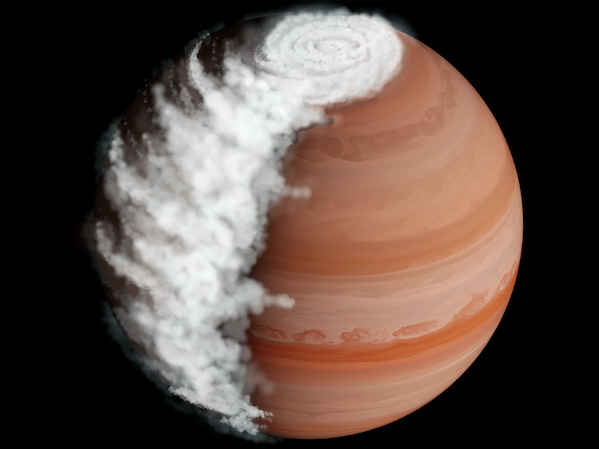
WASP-94A b is a hot Jupiter exoplanet about 700 light-years from Earth. Astronomers recently performed more observations of it with the James Webb Space Telescope.
The planet has cloudy morning and clear evenings, Webb found. Clouds of sandy particles form in the mornings and the dissipate by the evening.
The cloud-free evenings also allowed Webb to analyze the atmosphere itself more clearly, without clouds contaminating the data.
On a hot Jupiter-type exoplanet about 700 light-years away, sand clouds build up every morning, but then dissipate by nightfall. That’s the amazingly precise finding of a team of researchers at Johns Hopkins University, announced on May 21, 2026.
The planet – WASP-94A b – is tidally locked to its star. So it always keeps a single side facing its star, which is a little hotter, larger, and more luminous than our sun. No one has directly measured the rotation period of WASP-94A b. But its orbital period is about four Earth days. So it probably rotates once in that amount of time (much as our moon takes about a month to orbit Earth, while rotating once on its axis).
The clouds appear to form on the cooler nightside of WASP-94A b. They circulate toward this world’s dayside and ultimately evaporate in the intense heat. Why so intense? Because WASP-94A b is orbiting super-closely to its star, only about 5 million miles (8 million km) away. That’s in contrast to Earth at 93 million miles (150 million km), or the sun’s innermost planet, Mercury, which gets no closer than 29 million miles (47 million km) to our star.
And, by isolating the clouds in their analysis, the researchers said they could better determine the composition of the planet’s atmosphere.
This is one of just a handful of times that astronomers have detected cloud cycles on a hot Jupiter. The researchers made the observations with the James Webb Space Telescope.
They published the new peer-reviewed findings in the journal Science on May 21, 2026. There is also an earlier preprint version of the paper from last year available.
Observing the transit of WASP-94A b
The Webb telescope observed the planet as it transited – passed in front of – its star. The researchers took measurements as the planet started to transit, and as it finished the transit. At the leading edge, the atmosphere flows from the nightside to the dayside. This makes it the morning. But at the trailing edge, the atmosphere flows from the dayside to the nightside, making it evening.
The observations revealed that the morning atmosphere is filled with clouds made of magnesium silicate – aka talc – a common mineral found in rocks on Earth. The evening atmosphere, though, is clear and cloud-free.
Cloudy Mornings And Clear Evenings On Giant Extrasolar World WASP-94A bastrobiology.com/2025/05/clou… #astrobiology #exoplanet #atmosphere
Now on @sciam.bsky.social: NASA's JWST just delivered a fascinating weather report for the distant exoplanet WASP-94A b, finding the gas-giant world has partly cloudy skies. By @krcallaway.bsky.social.https://ift.tt/Dc9PvoV…
So, what is the reason for this interesting atmospheric phenomenon? Right now, the researchers have two main hypotheses:
First, powerful winds could be lifting clouds higher up on the cooler nightside of the planet. Then, the clouds plunge back down on the hotter dayside. This buries the clouds much deeper in the atmosphere where they remain hidden.
Or, another possibility is that this process is similar to when fog burns off on Earth. The clouds form on the cooler nightside of the planet. Then, they drift into the hotter dayside. Because it is so hot, the chemicals in the clouds boil away and the clouds vaporize.
As co-author and program principal investigator David Sing at Johns Hopkins University said:
It was a huge surprise. People have expected some differences, like it’s cooler in the morning than the evening; that’s something natural that we experience here on Earth. But what we saw was a real dichotomy between the weather on both sides of the planet, and huge differences in cloud coverage, and that changes our whole picture of the planet.
Sagnick Mukherjee at Arizona State University is the lead author of the new study about clouds on WASP-94A b. Image via GitHub.
Cloud-free evenings
The evenings being free of clouds gave the researchers an opportunity. They could study the atmosphere itself more clearly with Webb. The Hubble Space Telescope isn’t able to do this. Lead author Sagnick Mukherjee at Arizona State University explained:
With the Hubble telescope, when we used to do this type of observation, we got an average view of the whole planet with data from the clouds and the atmosphere squished together and indistinguishable. This approach with the JWST lets us localize our observations, which helped us see the cloud cycle.
And what did the observations show? That WASP-94A b is actually more like Jupiter than first thought. Earlier observations suggested that WASP-94A b had hundreds of times more oxygen and carbon than Jupiter. But now the newer, cleaner analysis shows that really only has five times more. That fits much better into current planetary formation models.
View larger. | Jupiter as captured by the Juno spacecraft in February 2019. The new study also shows that WASP-94A b is more like Jupiter than previously thought, with only 5 times more oxygen and carbon. Image via NASA/ JPL-Caltech/ SwRI/ MSSS/ Kevin M. Gill.
A clearer view of the atmosphere
The new observations are a big step in being able to study both clouds and the atmosphere on exoplanets. Sing said:
I’ve been looking at exoplanets for 20 years, and general cloudiness has been a thorn in our side. We’ve known for quite a while that clouds are pervasive on hot Jupiter planets, which is annoying because it’s like trying to look at the planet through a foggy window. Not only have we been able to clear the view, but we can finally pin down what the clouds are made out of and how they’re condensing and evaporating as they move around the planet.
Bottom line: New observations with the Webb space telescope of the hot Jupiter exoplanet WASP-94A b show that sandy clouds fill the morning skies, but dissipate by evening.
WASP-94A b is a hot Jupiter exoplanet about 700 light-years from Earth. Astronomers recently performed more observations of it with the James Webb Space Telescope.
The planet has cloudy morning and clear evenings, Webb found. Clouds of sandy particles form in the mornings and the dissipate by the evening.
The cloud-free evenings also allowed Webb to analyze the atmosphere itself more clearly, without clouds contaminating the data.
On a hot Jupiter-type exoplanet about 700 light-years away, sand clouds build up every morning, but then dissipate by nightfall. That’s the amazingly precise finding of a team of researchers at Johns Hopkins University, announced on May 21, 2026.
The planet – WASP-94A b – is tidally locked to its star. So it always keeps a single side facing its star, which is a little hotter, larger, and more luminous than our sun. No one has directly measured the rotation period of WASP-94A b. But its orbital period is about four Earth days. So it probably rotates once in that amount of time (much as our moon takes about a month to orbit Earth, while rotating once on its axis).
The clouds appear to form on the cooler nightside of WASP-94A b. They circulate toward this world’s dayside and ultimately evaporate in the intense heat. Why so intense? Because WASP-94A b is orbiting super-closely to its star, only about 5 million miles (8 million km) away. That’s in contrast to Earth at 93 million miles (150 million km), or the sun’s innermost planet, Mercury, which gets no closer than 29 million miles (47 million km) to our star.
And, by isolating the clouds in their analysis, the researchers said they could better determine the composition of the planet’s atmosphere.
This is one of just a handful of times that astronomers have detected cloud cycles on a hot Jupiter. The researchers made the observations with the James Webb Space Telescope.
They published the new peer-reviewed findings in the journal Science on May 21, 2026. There is also an earlier preprint version of the paper from last year available.
Observing the transit of WASP-94A b
The Webb telescope observed the planet as it transited – passed in front of – its star. The researchers took measurements as the planet started to transit, and as it finished the transit. At the leading edge, the atmosphere flows from the nightside to the dayside. This makes it the morning. But at the trailing edge, the atmosphere flows from the dayside to the nightside, making it evening.
The observations revealed that the morning atmosphere is filled with clouds made of magnesium silicate – aka talc – a common mineral found in rocks on Earth. The evening atmosphere, though, is clear and cloud-free.
Cloudy Mornings And Clear Evenings On Giant Extrasolar World WASP-94A bastrobiology.com/2025/05/clou… #astrobiology #exoplanet #atmosphere
Now on @sciam.bsky.social: NASA's JWST just delivered a fascinating weather report for the distant exoplanet WASP-94A b, finding the gas-giant world has partly cloudy skies. By @krcallaway.bsky.social.https://ift.tt/Dc9PvoV…
So, what is the reason for this interesting atmospheric phenomenon? Right now, the researchers have two main hypotheses:
First, powerful winds could be lifting clouds higher up on the cooler nightside of the planet. Then, the clouds plunge back down on the hotter dayside. This buries the clouds much deeper in the atmosphere where they remain hidden.
Or, another possibility is that this process is similar to when fog burns off on Earth. The clouds form on the cooler nightside of the planet. Then, they drift into the hotter dayside. Because it is so hot, the chemicals in the clouds boil away and the clouds vaporize.
As co-author and program principal investigator David Sing at Johns Hopkins University said:
It was a huge surprise. People have expected some differences, like it’s cooler in the morning than the evening; that’s something natural that we experience here on Earth. But what we saw was a real dichotomy between the weather on both sides of the planet, and huge differences in cloud coverage, and that changes our whole picture of the planet.
Sagnick Mukherjee at Arizona State University is the lead author of the new study about clouds on WASP-94A b. Image via GitHub.
Cloud-free evenings
The evenings being free of clouds gave the researchers an opportunity. They could study the atmosphere itself more clearly with Webb. The Hubble Space Telescope isn’t able to do this. Lead author Sagnick Mukherjee at Arizona State University explained:
With the Hubble telescope, when we used to do this type of observation, we got an average view of the whole planet with data from the clouds and the atmosphere squished together and indistinguishable. This approach with the JWST lets us localize our observations, which helped us see the cloud cycle.
And what did the observations show? That WASP-94A b is actually more like Jupiter than first thought. Earlier observations suggested that WASP-94A b had hundreds of times more oxygen and carbon than Jupiter. But now the newer, cleaner analysis shows that really only has five times more. That fits much better into current planetary formation models.
View larger. | Jupiter as captured by the Juno spacecraft in February 2019. The new study also shows that WASP-94A b is more like Jupiter than previously thought, with only 5 times more oxygen and carbon. Image via NASA/ JPL-Caltech/ SwRI/ MSSS/ Kevin M. Gill.
A clearer view of the atmosphere
The new observations are a big step in being able to study both clouds and the atmosphere on exoplanets. Sing said:
I’ve been looking at exoplanets for 20 years, and general cloudiness has been a thorn in our side. We’ve known for quite a while that clouds are pervasive on hot Jupiter planets, which is annoying because it’s like trying to look at the planet through a foggy window. Not only have we been able to clear the view, but we can finally pin down what the clouds are made out of and how they’re condensing and evaporating as they move around the planet.
Bottom line: New observations with the Webb space telescope of the hot Jupiter exoplanet WASP-94A b show that sandy clouds fill the morning skies, but dissipate by evening.