aads

Venus-Jupiter conjunction in June: Start watching now!

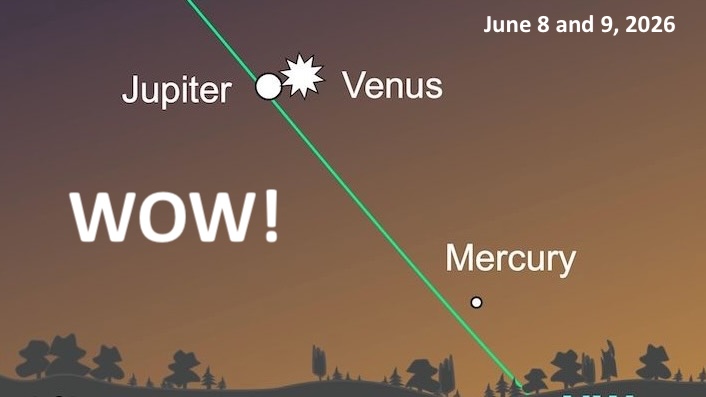
Venus-Jupiter conjunction: Sky chart with Venus right next to Jupiter and Mercury below, with WOW written next to them.
On June 8 and 9, 2026, Venus and Jupiter will have a spectacular conjunction. They’ll be approximately 3 moon-widths apart (roughly 1.5 degrees). But you can start watching them get closer now! See more charts for the nights leading up to the Venus-Jupiter conjunction below. Image via EarthSky.

Don’t miss the next unmissable night sky event. Sign up for EarthSky’s free newsletter and get daily night sky updates!

See the Venus-Jupiter conjunction

As seen from all of Earth, an amazing event is coming to our evening sky. And you can start watching now! It’s a spectacular conjunction of the sky’s two brightest planets, Venus and Jupiter. Their closest pairing is around June 8 and 9.

Look west after sunset. As darkness falls, Venus is the first planet you’ll see. Jupiter – only slightly fainter than Venus – will appear next. It’s a bit higher than Venus in the western twilight. Watch every night as evening twilight fades, and as the planets creep closer together.

See the charts below for the moon’s passage this week past these two blazing worlds. We also show charts for the end of May, when Venus and Jupiter will be getting close!

Then wow! By June 6 or 7, the planets will be really close! And when June 8 and 9 arrives – their evenings of closest approach – these two blazing worlds in our evening sky will be only about 1.5 degrees apart. Your pinky held at arm’s length should just fit between the two planets. Don’t miss this!

In early June, as seen from Earth’s Northern or Southern Hemisphere, the planetary pair will set more than two hours after sunset.

Optical aid will enhance the view

You definitely won’t need binoculars or a telescope to see Venus and Jupiter. They’ll outshine all the stars!

But ordinary binoculars will give you an enhanced view. When closest, Venus and Jupiter will easily fit into your binoculars’ field of view. Look for a subtle color difference, with Venus piercing white and Jupiter slightly creamier or yellowish.

With a tripod or steady hand (or by leaning against a wall or fence), your binoculars might show you one or two of Jupiter’s four largest moons. These are the famous Galilean satellites (Io, Europa, Ganymede, and Callisto). They’ll look like tiny pinpricks of light, in a line bisecting the planet.

Meanwhile, a telescope will reveal more. Venus is currently in a gibbous phase, between half and fully lit. Didn’t know Venus shows phases? It does!

Brightest vs. biggest

Jupiter and Venus look roughly the same size in our sky. But, if you could see them side by side in space, you’d find Jupiter about 12 times wider than Venus. Also, you could fit over 1,000 Venuses inside Jupiter. So why does Venus look brighter to us?

For one, Venus is much closer to us than Jupiter. Right now the two planets might look close together in our sky. But in reality they’re quite far apart. Venus is currently about 111 million miles (180 million km) from Earth. And Jupiter is much farther away at 560 million miles (900 million km) from Earth.

And here’s reason #2 why Venus looks brighter. It’s covered with thick clouds that are good at reflecting sunlight. Venus reflects about 70% of the sunlight that strikes it. Jupiter reflects about 52% of the sunlight that strikes it.

Read more: Why is Venus so bright in our Earth’s sky?

May 17-20 (Northern Hemisphere): Moon, Venus, Jupiter!
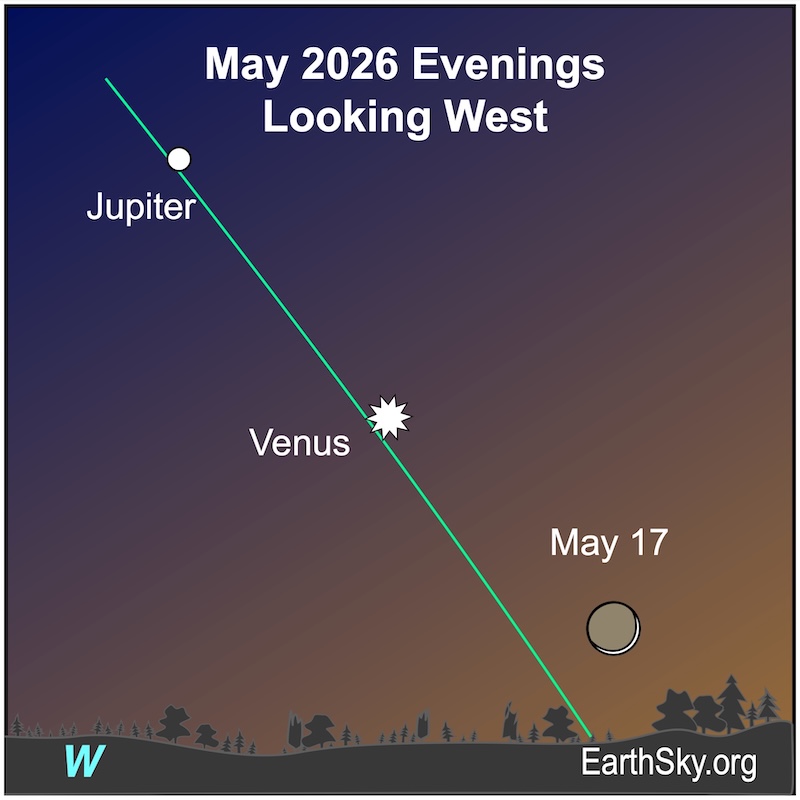
Sky chart: Very thin crescent moon by to the horizon, and dots for Jupiter and Venus, all along the slanted ecliptic line.
The day after new moon – as seen from the Northern Hemisphere – a razor-thin young moon will appear low in the west after sunset. This is a great time of year to see young moons low in the western sky. Blazing Venus will be above the moon on May 17. And bright Jupiter will be above Venus. Don’t miss these next few evenings! And keep an eye on these planets, the two brightest planets visible from Earth. They will be only 3 moon-widths apart around June 8 and 9. Spectacular! Chart via EarthSky.
Sky chart: Thin crescent moon right next to Venus, with Jupiter above, all along slanted green ecliptic line.
Wow! Here’s the Northern Hemisphere view of the slender young moon and blazing Venus – the brightest planet – on May 18, 2026. Look west shortly after sunset. Jupiter, the 2nd-brightest planet, will be above them. So beautiful! Chart via EarthSky.
Sky chart: Crescent moon halfway between Jupiter and Venus, all along the slanted green ecliptic line.
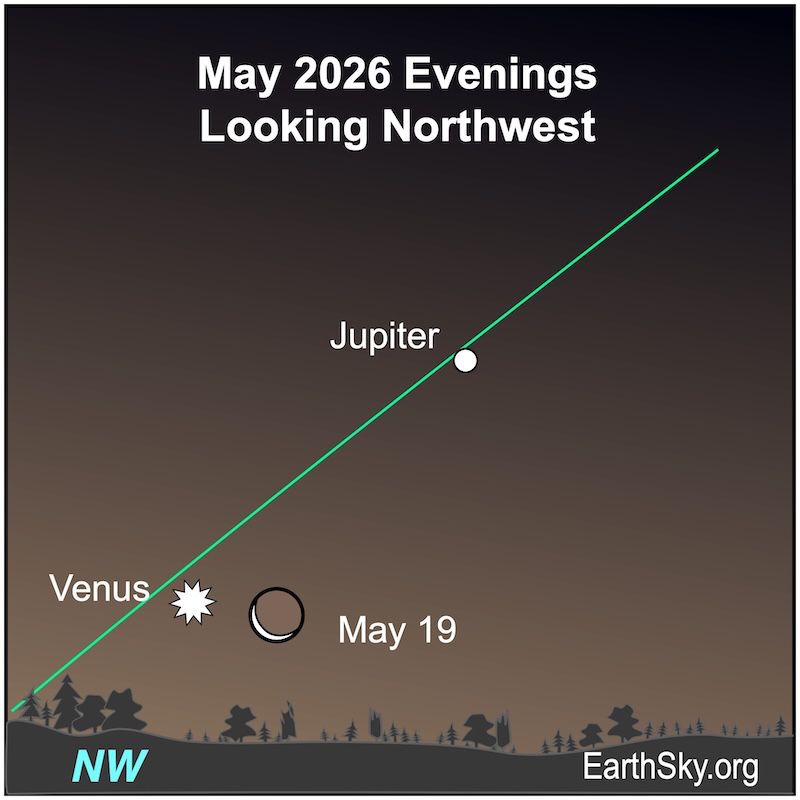
This is a great time of year to see planets in the west after sunset from the Northern Hemisphere. On May 19, 2026, the waxing crescent moon will lie between Venus and Jupiter. Watch for them in the west shortly after sunset. They’ll all set around midnight. Chart via EarthSky.
Sky chart: Crescent moon close to Jupiter, with Venus below, all along the slanted green ecliptic line.
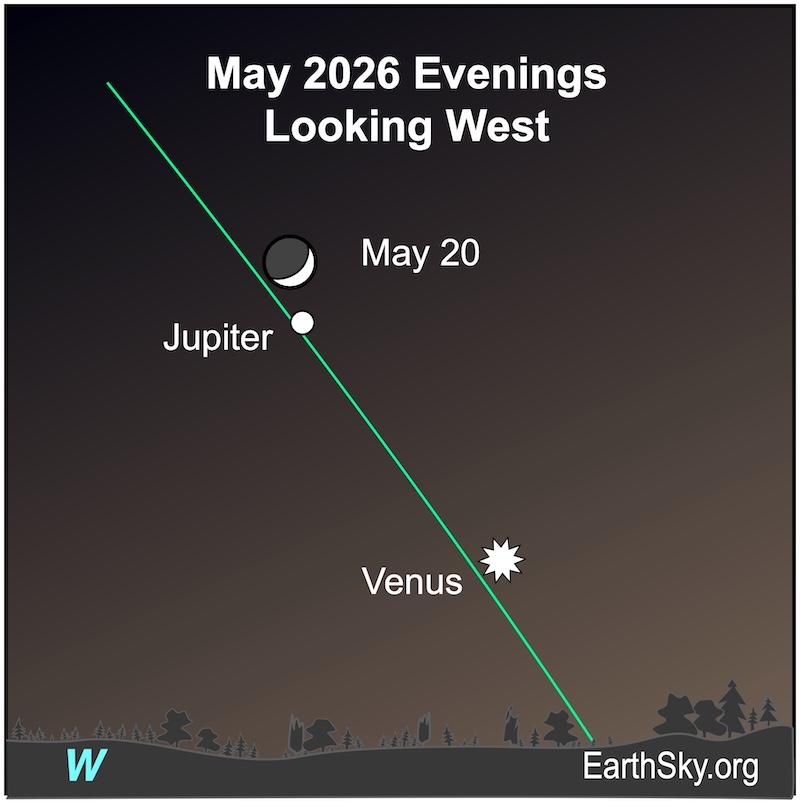
On May 20, 2026, the waxing crescent moon will float close to Jupiter (2nd-brightest planet) and above brilliant Venus (brightest planet). It’ll be a beautiful evening scene. Look west shortly after the sun goes down. By the way, Venus and Jupiter are inching closer together on the sky’s dome. Their conjunction will fall around June 8 and 9. Chart via EarthSky.

These charts are mostly set for mid-latitudes in the Northern Hemisphere. To see a precise view – and time – from your location, try Stellarium Online.

May 19-21 (Southern Hemisphere): Moon, Venus, Jupiter!

Sky chart: the thin crescent moon next to Venus close to the horizon and Jupiter above, along ecliptic line.
We set these Southern Hemisphere charts for longitudes around New Zealand and Australia. And so the dates are shifted (because these charts are across the International Date Line), in contrast to the Northern Hemisphere charts above. Here is the the young moon near brilliant Venus – the brightest planet – on May 19, as seen from New Zealand and Australia. Watch for them in the west shortly after sunset. Jupiter, the 2nd-brightest planet, will be above them. They’ll be an eye-catching sight! Chart via EarthSky.
Sky chart: Crescent moon between Jupiter and low Venus, all along the slanted ecliptic line.
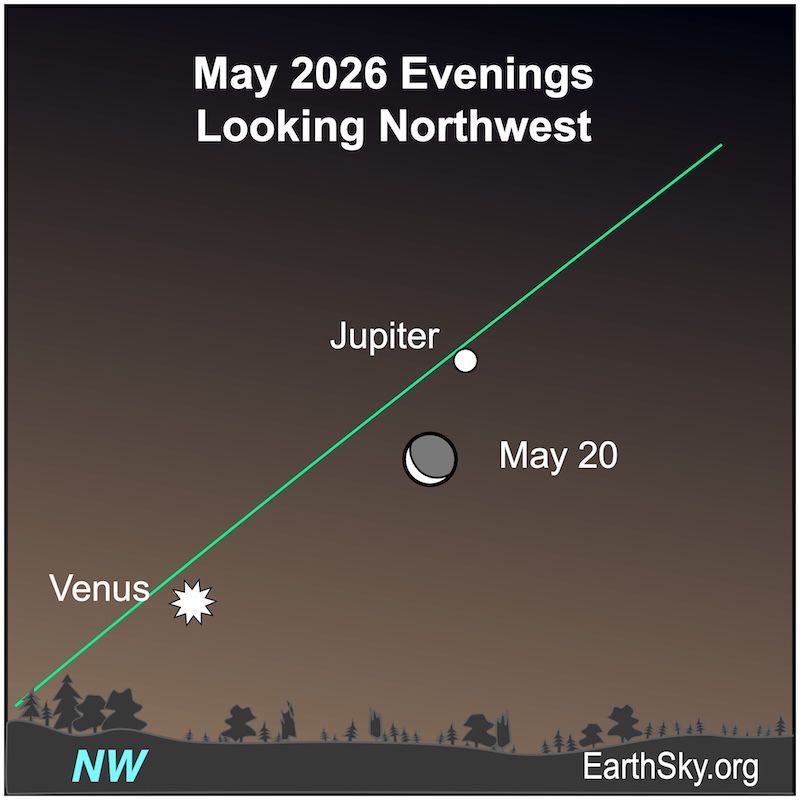
From Australia and New Zealand on May 20, the waxing crescent moon will lie between Venus and Jupiter. Watch for them in the west shortly after sunset. They’ll all set around midnight. Chart via EarthSky.
Sky chart: Jupiter and Venus along the slanted ecliptic line,, with crescent moon higher than Jupiter.
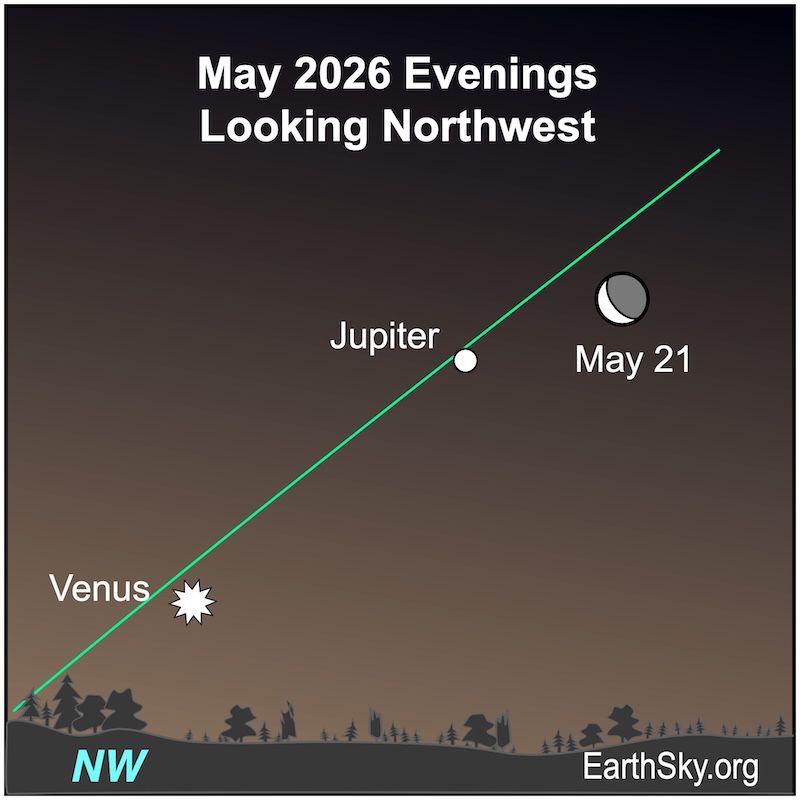
From Australia and New Zealand on May 21, 2026, the waxing crescent moon will float close to Jupiter (2nd-brightest planet) and above brilliant Venus (brightest planet). It’ll be a beautiful evening scene. Look west shortly after the sun goes down. By the way, Venus and Jupiter are inching closer together on the sky’s dome. Their conjunction will fall around June 8 and 9. Keep an eye on them for the next few weeks! Chart via EarthSky.

These charts are mostly set for mid-latitudes in the Southern Hemisphere. To see a precise view – and time – from your location, try Stellarium Online.

Northern and Southern Hemispheres in late May

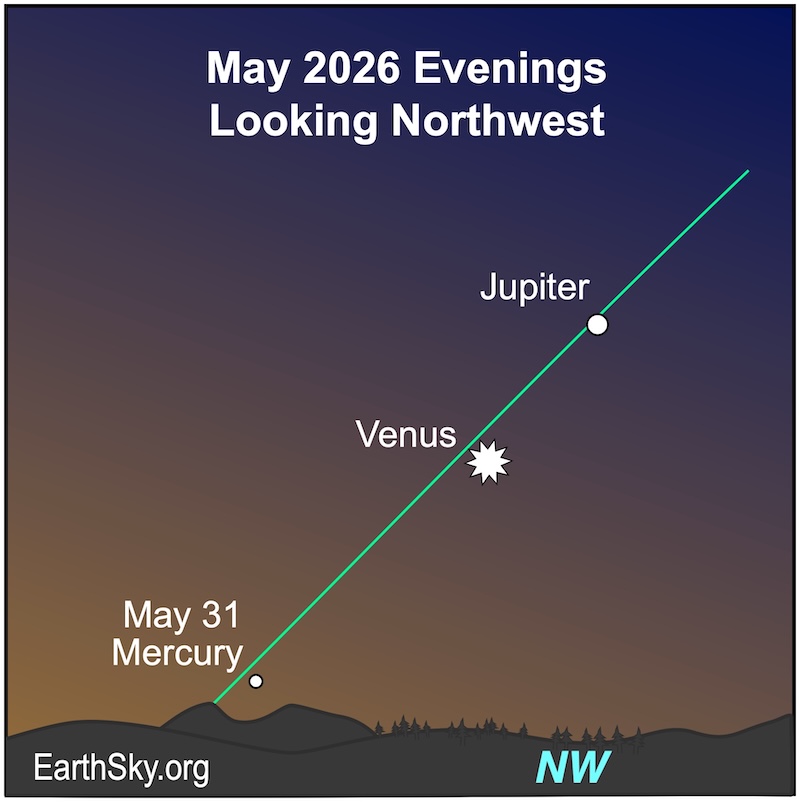
Sky chart: Mercury near horizon, Venus and Jupiter higher up, all along the slanted ecliptic line.
For viewers in the Northern Hemisphere, on the last few days of May, little Mercury will appear in the bright evening twilight low above the western horizon. Brilliant Venus and bright Jupiter will shine nearby. Chart via EarthSky.
Sky chat: Mercury at horizong, Venus and Jupiter higher up, all along slanted ecliptic line.
For viewers in the Southern Hemisphere, on the last few days of May, little Mercury will appear in the bright evening twilight low above the western horizon. Brilliant Venus and bright Jupiter will shine nearby. Chart via EarthSky.

Venus-Jupiter conjunction: What else to watch for

While watching for Venus and Jupiter, you might also notice some other bright points of light nearby.

Gemini’s twin stars, Castor and Pollux, are a bit to the north (right) of the planets. They’re not nearly as bright as Venus and Jupiter. But they’ll mimic the “doubleness” of the two planets. So they’ll be noticeable if your sky is dark enough.

And lower down, closer to the horizon, you might spot another planet, elusive Mercury. It should be fairly bright, but not nearly as bright as Venus and Jupiter.

What to watch for after June 9

After the close June 9 conjunction, Venus will appear each evening a little farther from the sunset point than Jupiter. Its greatest elongation, or greatest apparent distance from the sun in the twilight sky, will fall on August 14-15, 2026. Afterwards, Venus will drop sunward. It’ll pass between us and the sun in October 2026, and afterwards emerge in the east before dawn.

Meanwhile, Jupiter will continue dropping steadily down toward the sunset point. It’ll pass into the sun’s glare in July 2026, moving behind the sun from Earth. It’ll emerge in the east before dawn after about mid-August.

On June 16, a thin crescent moon will make a triangle with Jupiter and Mercury. And on June 17, the moon will be just a bit higher than Venus. Use binoculars to look between the moon and Venus in order to spot a pretty star cluster known as the Beehive. This cluster buzzing with stars lies in the constellation Cancer the Crab.

More charts to come! Stay tuned.

Bottom line: Get ready for a spectacular Venus-Jupiter conjunction! You can already start watching the planets now as they get closer in the evening sky after sunset. The big event happens on June 8 and 9, 2026.

The post Venus-Jupiter conjunction in June: Start watching now! first appeared on EarthSky.


from EarthSky https://ift.tt/EMOZaTw
Venus-Jupiter conjunction: Sky chart with Venus right next to Jupiter and Mercury below, with WOW written next to them.
On June 8 and 9, 2026, Venus and Jupiter will have a spectacular conjunction. They’ll be approximately 3 moon-widths apart (roughly 1.5 degrees). But you can start watching them get closer now! See more charts for the nights leading up to the Venus-Jupiter conjunction below. Image via EarthSky.

Don’t miss the next unmissable night sky event. Sign up for EarthSky’s free newsletter and get daily night sky updates!

See the Venus-Jupiter conjunction

As seen from all of Earth, an amazing event is coming to our evening sky. And you can start watching now! It’s a spectacular conjunction of the sky’s two brightest planets, Venus and Jupiter. Their closest pairing is around June 8 and 9.

Look west after sunset. As darkness falls, Venus is the first planet you’ll see. Jupiter – only slightly fainter than Venus – will appear next. It’s a bit higher than Venus in the western twilight. Watch every night as evening twilight fades, and as the planets creep closer together.

See the charts below for the moon’s passage this week past these two blazing worlds. We also show charts for the end of May, when Venus and Jupiter will be getting close!

Then wow! By June 6 or 7, the planets will be really close! And when June 8 and 9 arrives – their evenings of closest approach – these two blazing worlds in our evening sky will be only about 1.5 degrees apart. Your pinky held at arm’s length should just fit between the two planets. Don’t miss this!

In early June, as seen from Earth’s Northern or Southern Hemisphere, the planetary pair will set more than two hours after sunset.

Optical aid will enhance the view

You definitely won’t need binoculars or a telescope to see Venus and Jupiter. They’ll outshine all the stars!

But ordinary binoculars will give you an enhanced view. When closest, Venus and Jupiter will easily fit into your binoculars’ field of view. Look for a subtle color difference, with Venus piercing white and Jupiter slightly creamier or yellowish.

With a tripod or steady hand (or by leaning against a wall or fence), your binoculars might show you one or two of Jupiter’s four largest moons. These are the famous Galilean satellites (Io, Europa, Ganymede, and Callisto). They’ll look like tiny pinpricks of light, in a line bisecting the planet.

Meanwhile, a telescope will reveal more. Venus is currently in a gibbous phase, between half and fully lit. Didn’t know Venus shows phases? It does!

Brightest vs. biggest

Jupiter and Venus look roughly the same size in our sky. But, if you could see them side by side in space, you’d find Jupiter about 12 times wider than Venus. Also, you could fit over 1,000 Venuses inside Jupiter. So why does Venus look brighter to us?

For one, Venus is much closer to us than Jupiter. Right now the two planets might look close together in our sky. But in reality they’re quite far apart. Venus is currently about 111 million miles (180 million km) from Earth. And Jupiter is much farther away at 560 million miles (900 million km) from Earth.

And here’s reason #2 why Venus looks brighter. It’s covered with thick clouds that are good at reflecting sunlight. Venus reflects about 70% of the sunlight that strikes it. Jupiter reflects about 52% of the sunlight that strikes it.

Read more: Why is Venus so bright in our Earth’s sky?

May 17-20 (Northern Hemisphere): Moon, Venus, Jupiter!
Sky chart: Very thin crescent moon by to the horizon, and dots for Jupiter and Venus, all along the slanted ecliptic line.
The day after new moon – as seen from the Northern Hemisphere – a razor-thin young moon will appear low in the west after sunset. This is a great time of year to see young moons low in the western sky. Blazing Venus will be above the moon on May 17. And bright Jupiter will be above Venus. Don’t miss these next few evenings! And keep an eye on these planets, the two brightest planets visible from Earth. They will be only 3 moon-widths apart around June 8 and 9. Spectacular! Chart via EarthSky.
Sky chart: Thin crescent moon right next to Venus, with Jupiter above, all along slanted green ecliptic line.
Wow! Here’s the Northern Hemisphere view of the slender young moon and blazing Venus – the brightest planet – on May 18, 2026. Look west shortly after sunset. Jupiter, the 2nd-brightest planet, will be above them. So beautiful! Chart via EarthSky.
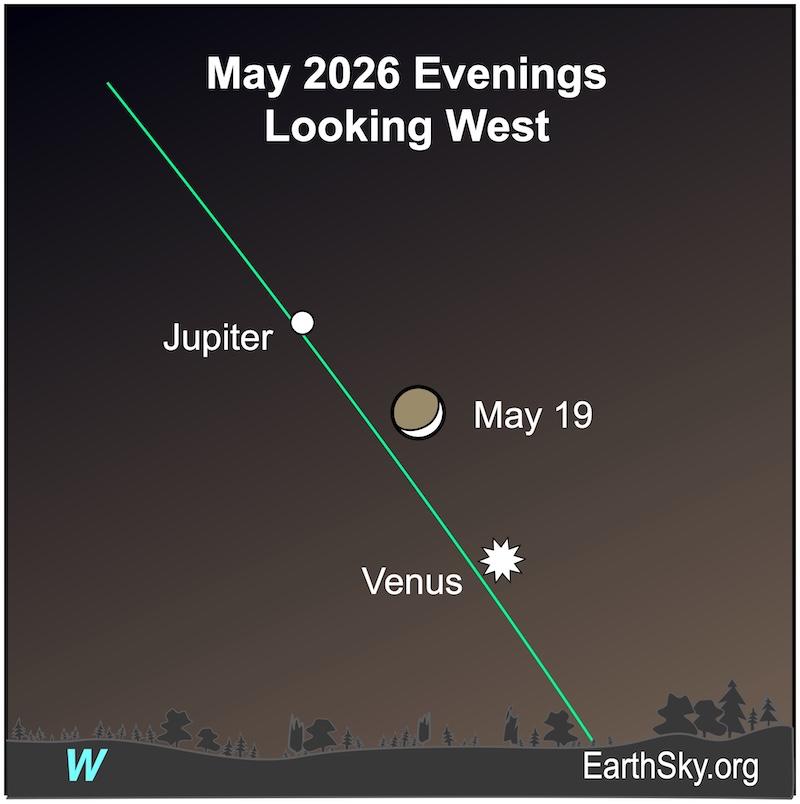
Sky chart: Crescent moon halfway between Jupiter and Venus, all along the slanted green ecliptic line.
This is a great time of year to see planets in the west after sunset from the Northern Hemisphere. On May 19, 2026, the waxing crescent moon will lie between Venus and Jupiter. Watch for them in the west shortly after sunset. They’ll all set around midnight. Chart via EarthSky.
Sky chart: Crescent moon close to Jupiter, with Venus below, all along the slanted green ecliptic line.
On May 20, 2026, the waxing crescent moon will float close to Jupiter (2nd-brightest planet) and above brilliant Venus (brightest planet). It’ll be a beautiful evening scene. Look west shortly after the sun goes down. By the way, Venus and Jupiter are inching closer together on the sky’s dome. Their conjunction will fall around June 8 and 9. Chart via EarthSky.

These charts are mostly set for mid-latitudes in the Northern Hemisphere. To see a precise view – and time – from your location, try Stellarium Online.

May 19-21 (Southern Hemisphere): Moon, Venus, Jupiter!
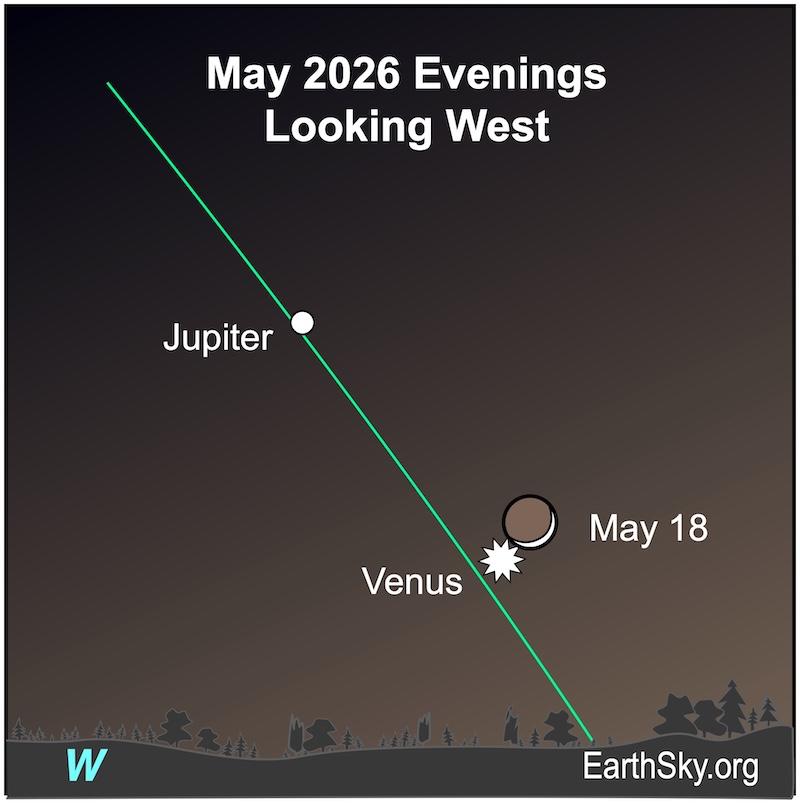
Sky chart: the thin crescent moon next to Venus close to the horizon and Jupiter above, along ecliptic line.
We set these Southern Hemisphere charts for longitudes around New Zealand and Australia. And so the dates are shifted (because these charts are across the International Date Line), in contrast to the Northern Hemisphere charts above. Here is the the young moon near brilliant Venus – the brightest planet – on May 19, as seen from New Zealand and Australia. Watch for them in the west shortly after sunset. Jupiter, the 2nd-brightest planet, will be above them. They’ll be an eye-catching sight! Chart via EarthSky.
Sky chart: Crescent moon between Jupiter and low Venus, all along the slanted ecliptic line.
From Australia and New Zealand on May 20, the waxing crescent moon will lie between Venus and Jupiter. Watch for them in the west shortly after sunset. They’ll all set around midnight. Chart via EarthSky.
Sky chart: Jupiter and Venus along the slanted ecliptic line,, with crescent moon higher than Jupiter.
From Australia and New Zealand on May 21, 2026, the waxing crescent moon will float close to Jupiter (2nd-brightest planet) and above brilliant Venus (brightest planet). It’ll be a beautiful evening scene. Look west shortly after the sun goes down. By the way, Venus and Jupiter are inching closer together on the sky’s dome. Their conjunction will fall around June 8 and 9. Keep an eye on them for the next few weeks! Chart via EarthSky.

These charts are mostly set for mid-latitudes in the Southern Hemisphere. To see a precise view – and time – from your location, try Stellarium Online.

Northern and Southern Hemispheres in late May
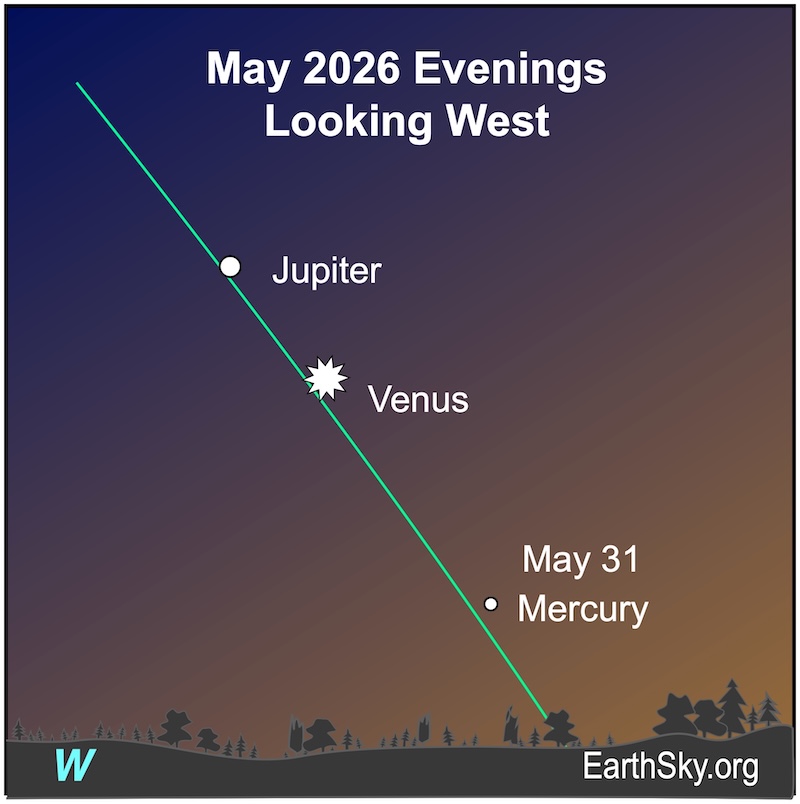
Sky chart: Mercury near horizon, Venus and Jupiter higher up, all along the slanted ecliptic line.
For viewers in the Northern Hemisphere, on the last few days of May, little Mercury will appear in the bright evening twilight low above the western horizon. Brilliant Venus and bright Jupiter will shine nearby. Chart via EarthSky.
Sky chat: Mercury at horizong, Venus and Jupiter higher up, all along slanted ecliptic line.
For viewers in the Southern Hemisphere, on the last few days of May, little Mercury will appear in the bright evening twilight low above the western horizon. Brilliant Venus and bright Jupiter will shine nearby. Chart via EarthSky.

Venus-Jupiter conjunction: What else to watch for

While watching for Venus and Jupiter, you might also notice some other bright points of light nearby.

Gemini’s twin stars, Castor and Pollux, are a bit to the north (right) of the planets. They’re not nearly as bright as Venus and Jupiter. But they’ll mimic the “doubleness” of the two planets. So they’ll be noticeable if your sky is dark enough.

And lower down, closer to the horizon, you might spot another planet, elusive Mercury. It should be fairly bright, but not nearly as bright as Venus and Jupiter.

What to watch for after June 9

After the close June 9 conjunction, Venus will appear each evening a little farther from the sunset point than Jupiter. Its greatest elongation, or greatest apparent distance from the sun in the twilight sky, will fall on August 14-15, 2026. Afterwards, Venus will drop sunward. It’ll pass between us and the sun in October 2026, and afterwards emerge in the east before dawn.

Meanwhile, Jupiter will continue dropping steadily down toward the sunset point. It’ll pass into the sun’s glare in July 2026, moving behind the sun from Earth. It’ll emerge in the east before dawn after about mid-August.

On June 16, a thin crescent moon will make a triangle with Jupiter and Mercury. And on June 17, the moon will be just a bit higher than Venus. Use binoculars to look between the moon and Venus in order to spot a pretty star cluster known as the Beehive. This cluster buzzing with stars lies in the constellation Cancer the Crab.

More charts to come! Stay tuned.

Bottom line: Get ready for a spectacular Venus-Jupiter conjunction! You can already start watching the planets now as they get closer in the evening sky after sunset. The big event happens on June 8 and 9, 2026.

The post Venus-Jupiter conjunction in June: Start watching now! first appeared on EarthSky.


from EarthSky https://ift.tt/EMOZaTw

Which moon phase is best for stargazing? That depends.

Various dark foreground trees with a starry cloud arching over the background.
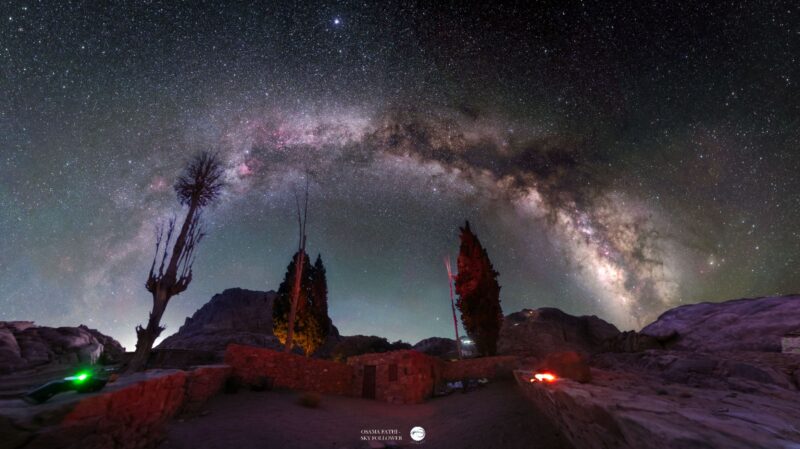
View at EarthSky Community Photos. | Ossama Fathy in St. Catherine, Egypt, captured this shot of the Milky Way on April 4, 2025. Ossama wrote: “From Farsh El Nabi Elias, a sacred and elevated plateau (2,000 meters or 6500 feet above sea level) near the summit of Mount Moses (Mount Sinai) in Egypt. Mount Moses is a site revered across multiple faiths.” Thank you, Ossama! Read more about which moon phase is best for stargazing below.

Which moon phase is best for stargazing? That depends on what you want to do.

Stargazing for dim objects is best without moonlight

Most astronomers prefer to observe the sky when the moon is not visible. That’s because they want to look at planets, stars, galaxies, clusters, the Milky Way and nebulae. To see these deep-sky objects well, the sky must be dark, free of light pollution and moonlight.

The darkest skies will be around the new moon, when the moon rises and sets with the sun. So the moon is not in the nighttime sky. Therefore, both the morning and evening sky are moon-free and great for stargazing. It’s best to go out in the country to a dark site.

Oblique view of a galaxy with pink wisps toward the middle and sparse foreground stars.
View at EarthSky Community Photos. | Steven Bellavia in Smithfield, Virginia, captured this telescopic view of Messier 82, the Starburst Galaxy in Ursa Major, on March 10, 2026. Steven wrote: “M82 had a gravitational interaction with its larger neighbor, galaxy M81. This, in turn, funneled large amounts of gas toward the core of M82, which then triggered intense star formation at a rate 10 times faster than in our Milky Way.” Thank you, Steven!

Here is a great website to determine the moonrise and moonset times from your location: Sunrise Sunset Calendars. Be sure to check “Moonrise and moonset.”

Don’t miss the next unmissable night sky event. Sign up for EarthSky’s free newsletter and get daily night sky updates!

Circumventing the moon phase for dim objects

As the moon moves from a new phase to a crescent in the evening sky, dark sky observing can continue. Astronomers either wait until after the moon sets or observe in a part of the sky far from the moon. During this lunar phase, the moonlight is not very bright. That changes as the moon grows in illumination. But not in the way you might think.

When the moon is 1st quarter or last (3rd) quarter – and half-lit in the sky – its brightness is only about 1/6th of a full moon. Then three nights before a full moon it is half as bright as a full moon. Only during the full moon phase does the moon reach its brightest. This sharp peak in brightness on the nights near full moon is due to what is known as the opposition surge, caused by both shadow-hiding and backscattering of sunlight off of the moon.

You can also adjust your observing time to avoid a moonlit sky. The 1st quarter moon sets at around midnight so you have a dark sky in the early morning hours. Around a 3rd quarter moon you can observe in the evening hours since the moon rises at about midnight.

Stargazing during a full moon

Sometimes, events like the appearance of a comet, a meteor shower or auroras occur during a bright moon. There is simply nothing the astronomer can do about that. As for comets, eventually, the moon moves out of the sky or the comet moves to the morning or evening sky. For meteor showers, which occur on nearly the same day each year, you can observe before moonrise or after moonset. And if you must deal with the moon, hide it behind something so that its light does not shine directly upon your surroundings.

Bright, glowing swirls of curtain-like green light in the night sky above a parking lot.
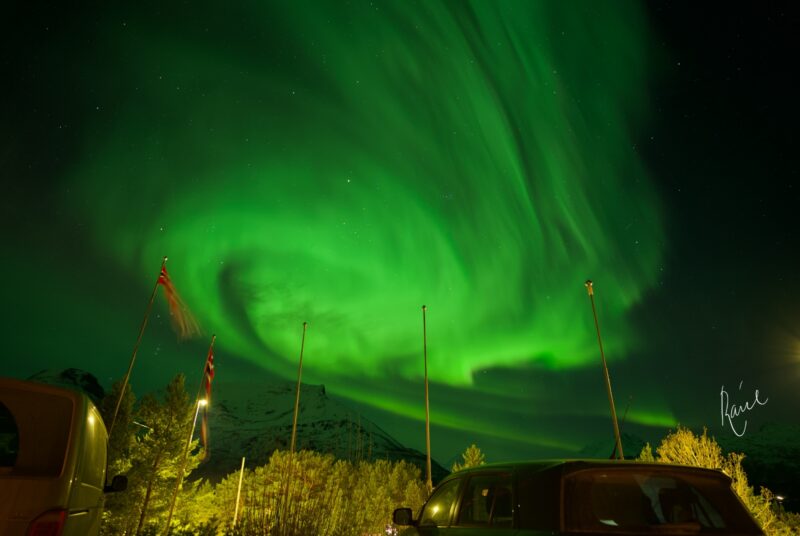
View at EarthSky Community Photos. | An amazing aurora photo captured by EarthSky’s Raúl Cortés. He and his family were driving around northern Norway up into Lapland. He caught this aurora from outside a restaurant in northern Norway on February 28, 2025. Bright and beautiful, despite light pollution! Raúl wrote: “The best we saw was in Skibotn just in front of Lyngen Fjord.” Thank you, Raúl!

And what to do when an aurora appears in your moonlit sky? Photograph it, and let the moonlight illuminate the earth’s surface, providing a stunning foreground landscape. Make something good out of a bad situation. Or as the old saying goes, “When life gives you bears, make barricades.” Or something like that.

Just ignore that bright moon up there

A growing number of amateur astronomers and most professional astronomers do not look through their telescopes but instead, use them to image the sky. To their surprise, they have learned that a significant amount of moonlight does not interfere with their images. Using special filters to remove moonlight and taking multiple images to stack – to increase contrast – they can image up to nearly the full moon and still get good images.

And if the moon is out while you are stargazing, look at everything else first and then enjoy the view of the moon through binoculars or telescopes. That’s because the moon is so bright, you won’t see anything dim afterwards.

Stargazing to enjoy the moon

Schematic illustration of moon phases along a full moon cycle, placed in a circle with annotations.
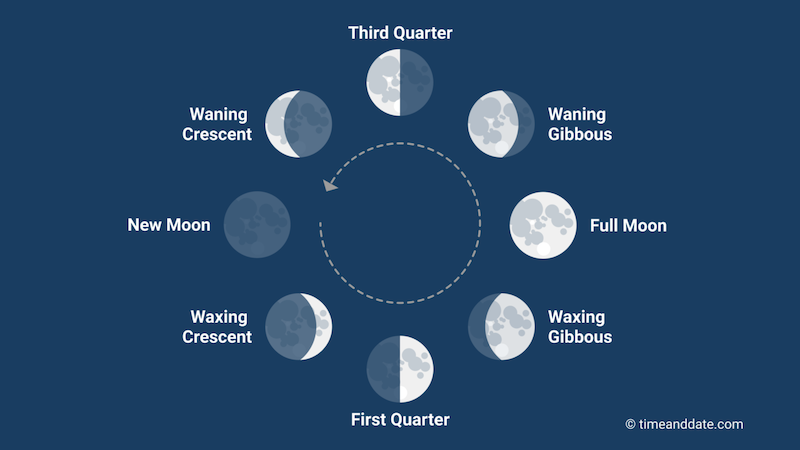
This schematic explains the different moon phases and how they are illuminated. Image via timeanddate.com. Used with permission.

The moon is above the horizon half of the day. It’s even visible in the daytime. And, as it travels around the sky each month, it puts on a show that changes each night. It is interesting and fun to follow the phases of the moon. The moon rises roughly 50 minutes later each day so maybe follow the moon through an entire lunar cycle. Learn more about understanding the phases of the moon.

Want to know the current or upcoming moon phase? Check our visible planet and night sky guide.

So, which moon phase is best for stargazing?

And the answer is … it depends on what you want to see. Some people enjoy watching the moon itself, as it waxes and wanes in our sky. Others avoid it because it overwhelms the dim objects they really want to see.

Bottom line: The best phase of the moon for stargazing depends on what you want to do. Some enjoy watching the moon itself. On the other hand, people using telescopes avoid the moon because its glare interferes with deep-sky objects.

A planisphere is virtually indispensable for beginning stargazers. Order your EarthSky planisphere today.

The post Which moon phase is best for stargazing? That depends. first appeared on EarthSky.


from EarthSky https://ift.tt/3MWmyvz
Various dark foreground trees with a starry cloud arching over the background.
View at EarthSky Community Photos. | Ossama Fathy in St. Catherine, Egypt, captured this shot of the Milky Way on April 4, 2025. Ossama wrote: “From Farsh El Nabi Elias, a sacred and elevated plateau (2,000 meters or 6500 feet above sea level) near the summit of Mount Moses (Mount Sinai) in Egypt. Mount Moses is a site revered across multiple faiths.” Thank you, Ossama! Read more about which moon phase is best for stargazing below.

Which moon phase is best for stargazing? That depends on what you want to do.

Stargazing for dim objects is best without moonlight

Most astronomers prefer to observe the sky when the moon is not visible. That’s because they want to look at planets, stars, galaxies, clusters, the Milky Way and nebulae. To see these deep-sky objects well, the sky must be dark, free of light pollution and moonlight.

The darkest skies will be around the new moon, when the moon rises and sets with the sun. So the moon is not in the nighttime sky. Therefore, both the morning and evening sky are moon-free and great for stargazing. It’s best to go out in the country to a dark site.

Oblique view of a galaxy with pink wisps toward the middle and sparse foreground stars.
View at EarthSky Community Photos. | Steven Bellavia in Smithfield, Virginia, captured this telescopic view of Messier 82, the Starburst Galaxy in Ursa Major, on March 10, 2026. Steven wrote: “M82 had a gravitational interaction with its larger neighbor, galaxy M81. This, in turn, funneled large amounts of gas toward the core of M82, which then triggered intense star formation at a rate 10 times faster than in our Milky Way.” Thank you, Steven!

Here is a great website to determine the moonrise and moonset times from your location: Sunrise Sunset Calendars. Be sure to check “Moonrise and moonset.”

Don’t miss the next unmissable night sky event. Sign up for EarthSky’s free newsletter and get daily night sky updates!

Circumventing the moon phase for dim objects

As the moon moves from a new phase to a crescent in the evening sky, dark sky observing can continue. Astronomers either wait until after the moon sets or observe in a part of the sky far from the moon. During this lunar phase, the moonlight is not very bright. That changes as the moon grows in illumination. But not in the way you might think.

When the moon is 1st quarter or last (3rd) quarter – and half-lit in the sky – its brightness is only about 1/6th of a full moon. Then three nights before a full moon it is half as bright as a full moon. Only during the full moon phase does the moon reach its brightest. This sharp peak in brightness on the nights near full moon is due to what is known as the opposition surge, caused by both shadow-hiding and backscattering of sunlight off of the moon.

You can also adjust your observing time to avoid a moonlit sky. The 1st quarter moon sets at around midnight so you have a dark sky in the early morning hours. Around a 3rd quarter moon you can observe in the evening hours since the moon rises at about midnight.

Stargazing during a full moon

Sometimes, events like the appearance of a comet, a meteor shower or auroras occur during a bright moon. There is simply nothing the astronomer can do about that. As for comets, eventually, the moon moves out of the sky or the comet moves to the morning or evening sky. For meteor showers, which occur on nearly the same day each year, you can observe before moonrise or after moonset. And if you must deal with the moon, hide it behind something so that its light does not shine directly upon your surroundings.

Bright, glowing swirls of curtain-like green light in the night sky above a parking lot.
View at EarthSky Community Photos. | An amazing aurora photo captured by EarthSky’s Raúl Cortés. He and his family were driving around northern Norway up into Lapland. He caught this aurora from outside a restaurant in northern Norway on February 28, 2025. Bright and beautiful, despite light pollution! Raúl wrote: “The best we saw was in Skibotn just in front of Lyngen Fjord.” Thank you, Raúl!

And what to do when an aurora appears in your moonlit sky? Photograph it, and let the moonlight illuminate the earth’s surface, providing a stunning foreground landscape. Make something good out of a bad situation. Or as the old saying goes, “When life gives you bears, make barricades.” Or something like that.

Just ignore that bright moon up there

A growing number of amateur astronomers and most professional astronomers do not look through their telescopes but instead, use them to image the sky. To their surprise, they have learned that a significant amount of moonlight does not interfere with their images. Using special filters to remove moonlight and taking multiple images to stack – to increase contrast – they can image up to nearly the full moon and still get good images.

And if the moon is out while you are stargazing, look at everything else first and then enjoy the view of the moon through binoculars or telescopes. That’s because the moon is so bright, you won’t see anything dim afterwards.

Stargazing to enjoy the moon

Schematic illustration of moon phases along a full moon cycle, placed in a circle with annotations.
This schematic explains the different moon phases and how they are illuminated. Image via timeanddate.com. Used with permission.

The moon is above the horizon half of the day. It’s even visible in the daytime. And, as it travels around the sky each month, it puts on a show that changes each night. It is interesting and fun to follow the phases of the moon. The moon rises roughly 50 minutes later each day so maybe follow the moon through an entire lunar cycle. Learn more about understanding the phases of the moon.

Want to know the current or upcoming moon phase? Check our visible planet and night sky guide.

So, which moon phase is best for stargazing?

And the answer is … it depends on what you want to see. Some people enjoy watching the moon itself, as it waxes and wanes in our sky. Others avoid it because it overwhelms the dim objects they really want to see.

Bottom line: The best phase of the moon for stargazing depends on what you want to do. Some enjoy watching the moon itself. On the other hand, people using telescopes avoid the moon because its glare interferes with deep-sky objects.

A planisphere is virtually indispensable for beginning stargazers. Order your EarthSky planisphere today.

The post Which moon phase is best for stargazing? That depends. first appeared on EarthSky.


from EarthSky https://ift.tt/3MWmyvz

Stardust in Antarctica shows Earth crossed a supernova cloud

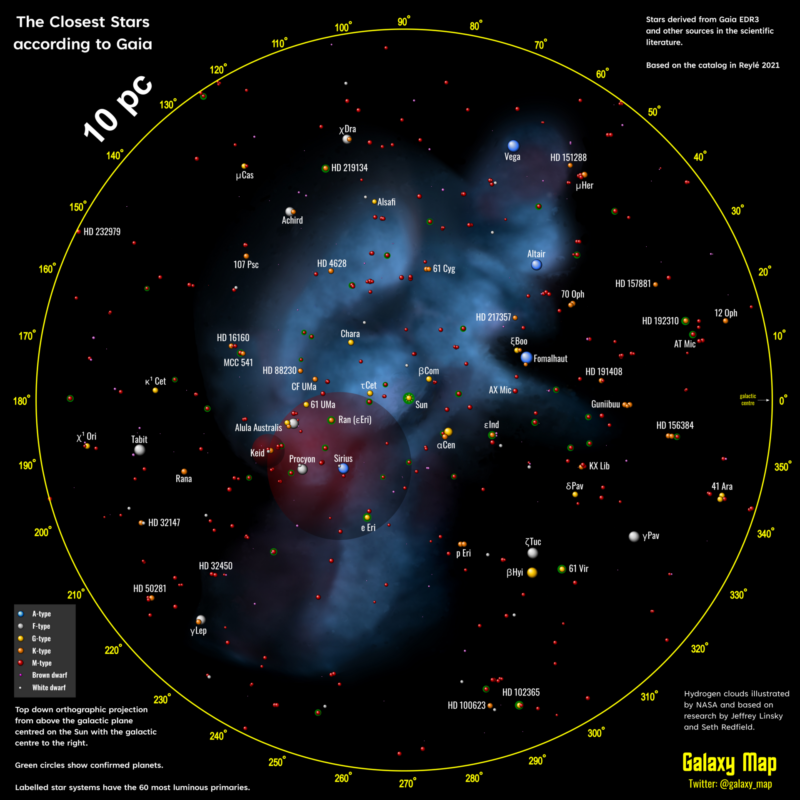
Stars within 10 parsecs (about 33 light-years). This map is based on data from the GAIA space observatory and uses other references in the scientific literature. Star systems whose primary star belongs to spectral class A-K are labelled. Also includes known hydrogen clouds within 10 parsecs including two white dwarf HII regions. Image via Galaxymap.org.

Science news, night sky events and beautiful photos, all in one place. Click here to subscribe to EarthSky’s free daily newsletter.

  • Stardust in Antarctic ice – originating in vast clouds in space, left when stars explode – reveals the presence of iron-60. This material doesn’t form naturally on Earth. But supernovae produce it.
  • A look back at ice cores tens of thousands of years old shows the amount of iron-60 varies slightly over this time period. It suggests our solar system has been traveling through a cloud of supernova debris for 40,000 to 124,000 years.
  • The amount of iron-60 was sparser in the past than it is now. So it appears we are still passing through one of these interstellar clouds. So the iron-60 helps trace our path through the universe.

By Dominik Koll, Australian National University

Stardust in Antarctica shows Earth crossed supernova cloud

When you think of outer space, you’re likely picturing stars, planets and moons. But much of space is filled with clouds of gas, plasma and stardust … or interstellar clouds.

In the local parts of our galaxy alone, there’s a complex of roughly 15 individual interstellar clouds. The solar system is currently traversing one of them, aptly named the Local Interstellar Cloud. Scientists believe the origin and history of these clouds are tightly connected to the birth and death of stars. But we can see their imprints right here on Earth, in a place you might not expect: Antarctic ice.

My colleagues and I have been studying stardust – the dust left behind in space from supernova explosions – trapped in old Antarctic snow and ice. This dust lets us trace the history of our solar neighborhood, including the solar system itself.

In a new study that the peer-reviewed journal Physical Review Letterspublished on May 13, 2026 – we found a subtle clue that reveals our solar system’s movement through the local interstellar environment over the past 80,000 years.

Stardust in Antarctica: A cylindrical piece of white ice on a black background.
This ice core from Antarctica contains stardust from supernovae, or exploding stars. An analysis revealed a material called iron-60, an isotope of iron. Iron-60 doesn’t occur naturally on Earth. Its presence in Antarctic ice shows that our solar system has traveled through a cloud of supernova debris. Image via Alfred-Wegener-Institute/Esther Horvath/ The Conversation.

Looking down to see the sky

Astronomy usually looks outward. Telescopes collect light from distant stars and galaxies, allowing us to observe events across vast stretches of space and time. From these observations, we infer how stars live and die, how elements are formed, and how the universe evolves.

Our approach turns that idea on its head.

Instead of observing the light coming to us, we study the debris of exploding stars right here on Earth. As cosmic furnaces, stars forge many elements in their cores, from carbon and oxygen to calcium and iron. This includes rare isotopes (variants of chemical elements) such as iron-60.

When massive stars explode into supernovae at the end of their life, these elements fly out into space and become interstellar dust.

Tiny grains of this dust then drift through the galaxy and occasionally find their way to Earth’s surface. Radioactive iron-60, a fingerprint of stellar explosions, lies embedded within these grains. By searching for these atoms in geological archives on Earth, we can probe astrophysical events like supernovae long after their light has faded.

This is why Antarctica is so valuable. Its snow accumulates slowly and remains largely undisturbed, forming a layered record that stretches back tens of thousands of years. Each layer captures a snapshot of the material that was present in our cosmic neighborhood at the time.

Finding stardust in Antarctica

When we studied 500 kg (1,100 lbs) of recent snow in Antarctica, we unexpectedly found this rare radioactive isotope. Where did it come from? There was no recent near-Earth supernova.

But our solar neighborhood is filled with 15 clouds, with the solar system currently traversing at least one of them. Is the stardust waiting in the clouds for Earth to sweep it up? If yes, then the amount of stardust Earth collects should be related to their structure: the denser the clouds, the more iron-60 they contain. This was our educated guess in 2019.

Soon, some scientists brought forth other explanations. Millions of years ago Earth received large showers of iron-60 from massive supernovae. Is the iron-60 in Antarctic snow the last remnant or an echo of this signal? A rain that became a drizzle?

To find out, we analyzed a 300-kg (660-lb) section of Antarctic ice, dating from 40,000 to 80,000 years ago. The process is painstaking. First we needed to melt the ice. Then we chemically treated it to isolate tiny amounts of iron, including the iron-60 from the stardust.

Next, using the sensitive atom-counting technique of accelerator mass spectrometry at the Heavy-Ion Accelerator Facility at Australian National University, we counted individual atoms of iron-60.

The expectation was straightforward: based on previous measurements from surface snow of Antarctica and several-thousand-year-old ocean sediments, we anticipated a certain steady level of iron-60 deposition.

The results

Instead, we found less. Not zero, but noticeably lower than we expected.

This result suggests that less interstellar dust was reaching Earth during that period. This is a remarkable change on a comparatively short astrophysical timescale and does not fit the long timescales of the iron-60 deposits that landed here millions of years ago. Instead, we needed to look for a smaller, more local source for the isotope.

Great green and yellow wispy cloud stretching irregularly in space from a bright center.
The Orion Molecular Cloud Complex is a type of interstellar cloud. Image via NASA/JPL-Caltech.

A fitting story

Naturally, astronomers are also quite interested in the clouds around the solar system. Last year, a study reconstructing the history of the clouds arrived at the conclusion that they most likely originated in a stellar explosion. Furthermore, they found the solar system has been traversing the Local Interstellar Cloud from sometime between 40,000 and 124,000 years ago.

If that’s correct, we would expect that the amount of iron-60 on Earth should have changed sometime in the same time period: between 40,000 and 124,000 years ago.

This is exactly what our results showed in Antarctica.

The story doesn’t fit perfectly, though. If these clouds did originate directly from an exploding star, we would expect way more iron-60 than we actually see in Antarctic ice.

Nevertheless, these clouds are imprinted in Earth’s geological record. If we look deeper and analyze even older ice, we might soon unravel the mystery of these local interstellar clouds, revealing their full history and uncertain origins.The Conversation

Dominik Koll, Honorary Lecturer, Nuclear Physics, Australian National University

This article is republished from The Conversation under a Creative Commons license. Read the original article.

Bottom line: Stardust in Antarctica reveals the presence of an element that is not naturally made on Earth. But it is created in supernovae. Looking at the time period this material appears in ice cores lets us know when Earth passed through this cloud of supernova debris.

The post Stardust in Antarctica shows Earth crossed a supernova cloud first appeared on EarthSky.


from EarthSky https://ift.tt/cO6LyQr
Stars within 10 parsecs (about 33 light-years). This map is based on data from the GAIA space observatory and uses other references in the scientific literature. Star systems whose primary star belongs to spectral class A-K are labelled. Also includes known hydrogen clouds within 10 parsecs including two white dwarf HII regions. Image via Galaxymap.org.

Science news, night sky events and beautiful photos, all in one place. Click here to subscribe to EarthSky’s free daily newsletter.

  • Stardust in Antarctic ice – originating in vast clouds in space, left when stars explode – reveals the presence of iron-60. This material doesn’t form naturally on Earth. But supernovae produce it.
  • A look back at ice cores tens of thousands of years old shows the amount of iron-60 varies slightly over this time period. It suggests our solar system has been traveling through a cloud of supernova debris for 40,000 to 124,000 years.
  • The amount of iron-60 was sparser in the past than it is now. So it appears we are still passing through one of these interstellar clouds. So the iron-60 helps trace our path through the universe.

By Dominik Koll, Australian National University

Stardust in Antarctica shows Earth crossed supernova cloud

When you think of outer space, you’re likely picturing stars, planets and moons. But much of space is filled with clouds of gas, plasma and stardust … or interstellar clouds.

In the local parts of our galaxy alone, there’s a complex of roughly 15 individual interstellar clouds. The solar system is currently traversing one of them, aptly named the Local Interstellar Cloud. Scientists believe the origin and history of these clouds are tightly connected to the birth and death of stars. But we can see their imprints right here on Earth, in a place you might not expect: Antarctic ice.

My colleagues and I have been studying stardust – the dust left behind in space from supernova explosions – trapped in old Antarctic snow and ice. This dust lets us trace the history of our solar neighborhood, including the solar system itself.

In a new study that the peer-reviewed journal Physical Review Letterspublished on May 13, 2026 – we found a subtle clue that reveals our solar system’s movement through the local interstellar environment over the past 80,000 years.

Stardust in Antarctica: A cylindrical piece of white ice on a black background.
This ice core from Antarctica contains stardust from supernovae, or exploding stars. An analysis revealed a material called iron-60, an isotope of iron. Iron-60 doesn’t occur naturally on Earth. Its presence in Antarctic ice shows that our solar system has traveled through a cloud of supernova debris. Image via Alfred-Wegener-Institute/Esther Horvath/ The Conversation.

Looking down to see the sky

Astronomy usually looks outward. Telescopes collect light from distant stars and galaxies, allowing us to observe events across vast stretches of space and time. From these observations, we infer how stars live and die, how elements are formed, and how the universe evolves.

Our approach turns that idea on its head.

Instead of observing the light coming to us, we study the debris of exploding stars right here on Earth. As cosmic furnaces, stars forge many elements in their cores, from carbon and oxygen to calcium and iron. This includes rare isotopes (variants of chemical elements) such as iron-60.

When massive stars explode into supernovae at the end of their life, these elements fly out into space and become interstellar dust.

Tiny grains of this dust then drift through the galaxy and occasionally find their way to Earth’s surface. Radioactive iron-60, a fingerprint of stellar explosions, lies embedded within these grains. By searching for these atoms in geological archives on Earth, we can probe astrophysical events like supernovae long after their light has faded.

This is why Antarctica is so valuable. Its snow accumulates slowly and remains largely undisturbed, forming a layered record that stretches back tens of thousands of years. Each layer captures a snapshot of the material that was present in our cosmic neighborhood at the time.

Finding stardust in Antarctica

When we studied 500 kg (1,100 lbs) of recent snow in Antarctica, we unexpectedly found this rare radioactive isotope. Where did it come from? There was no recent near-Earth supernova.

But our solar neighborhood is filled with 15 clouds, with the solar system currently traversing at least one of them. Is the stardust waiting in the clouds for Earth to sweep it up? If yes, then the amount of stardust Earth collects should be related to their structure: the denser the clouds, the more iron-60 they contain. This was our educated guess in 2019.

Soon, some scientists brought forth other explanations. Millions of years ago Earth received large showers of iron-60 from massive supernovae. Is the iron-60 in Antarctic snow the last remnant or an echo of this signal? A rain that became a drizzle?

To find out, we analyzed a 300-kg (660-lb) section of Antarctic ice, dating from 40,000 to 80,000 years ago. The process is painstaking. First we needed to melt the ice. Then we chemically treated it to isolate tiny amounts of iron, including the iron-60 from the stardust.

Next, using the sensitive atom-counting technique of accelerator mass spectrometry at the Heavy-Ion Accelerator Facility at Australian National University, we counted individual atoms of iron-60.

The expectation was straightforward: based on previous measurements from surface snow of Antarctica and several-thousand-year-old ocean sediments, we anticipated a certain steady level of iron-60 deposition.

The results

Instead, we found less. Not zero, but noticeably lower than we expected.

This result suggests that less interstellar dust was reaching Earth during that period. This is a remarkable change on a comparatively short astrophysical timescale and does not fit the long timescales of the iron-60 deposits that landed here millions of years ago. Instead, we needed to look for a smaller, more local source for the isotope.

Great green and yellow wispy cloud stretching irregularly in space from a bright center.
The Orion Molecular Cloud Complex is a type of interstellar cloud. Image via NASA/JPL-Caltech.

A fitting story

Naturally, astronomers are also quite interested in the clouds around the solar system. Last year, a study reconstructing the history of the clouds arrived at the conclusion that they most likely originated in a stellar explosion. Furthermore, they found the solar system has been traversing the Local Interstellar Cloud from sometime between 40,000 and 124,000 years ago.

If that’s correct, we would expect that the amount of iron-60 on Earth should have changed sometime in the same time period: between 40,000 and 124,000 years ago.

This is exactly what our results showed in Antarctica.

The story doesn’t fit perfectly, though. If these clouds did originate directly from an exploding star, we would expect way more iron-60 than we actually see in Antarctic ice.

Nevertheless, these clouds are imprinted in Earth’s geological record. If we look deeper and analyze even older ice, we might soon unravel the mystery of these local interstellar clouds, revealing their full history and uncertain origins.The Conversation

Dominik Koll, Honorary Lecturer, Nuclear Physics, Australian National University

This article is republished from The Conversation under a Creative Commons license. Read the original article.

Bottom line: Stardust in Antarctica reveals the presence of an element that is not naturally made on Earth. But it is created in supernovae. Looking at the time period this material appears in ice cores lets us know when Earth passed through this cloud of supernova debris.

The post Stardust in Antarctica shows Earth crossed a supernova cloud first appeared on EarthSky.


from EarthSky https://ift.tt/cO6LyQr

Contemplate the apex of the sun in May, with Vega

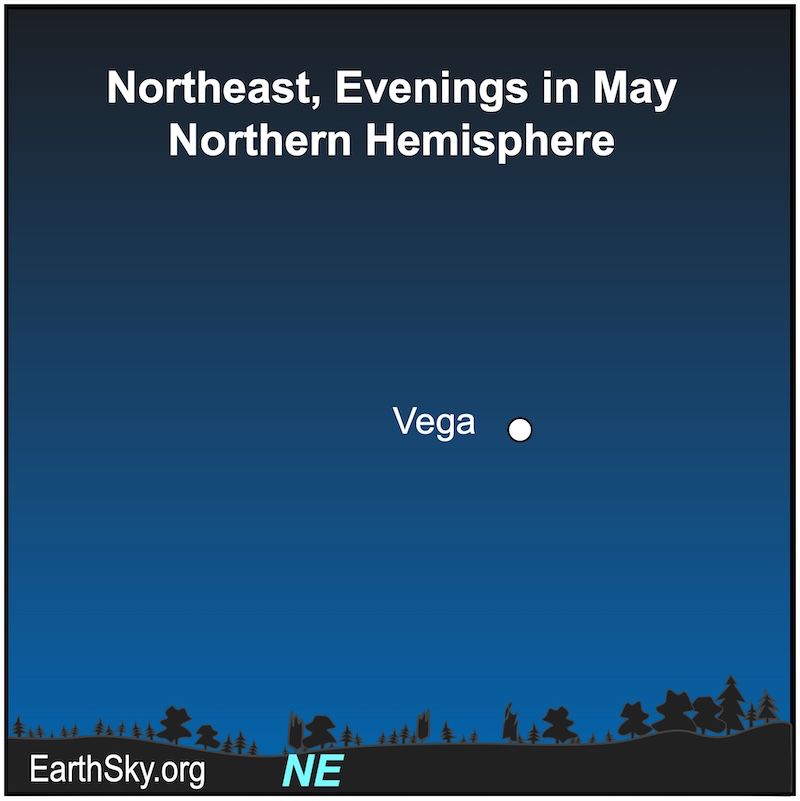
Apex of the sun: Nighttime sky chart showing a single bright star above the northeast horizon.
From the Northern Hemisphere, the bright star Vega is easy to spot on May evenings. Go outside on a May evening, and face northeast. You’ll easily notice Vega, a bright blue-white star. If your sky is dark, you might also see its constellation Lyra the Harp. In its journey around the galaxy, our sun moves toward bright Vega. The point toward which we move is called the apex of the sun, aka the solar apex. Image via EarthSky.

Don’t miss the next unmissable night sky event. Sign up for EarthSky’s free newsletter for daily night sky updates.

Apex of the sun = our sun’s direction of motion

Our star, the sun, and its planets are moving through space in the general direction of the bright star Vega. Astronomers call the sun’s direction of motion by a great old name: the solar apex or, more romantically, the apex of the sun’s way.

And the month of May is a great time to visualize our sun’s motion through space, if you live in the Northern Hemisphere. In May, our Milky Way galaxy lies as flat around the horizon as it can. And the star Vega – which is near the solar apex on the sky’s dome – is ascending in the northeast on May evenings for Northern Hemisphere viewers.

Vega is part of the constellation Lyra the Harp.

Can you see Vega from the Southern Hemisphere, too? Yes, but, from southerly latitudes, it isn’t up in early evening in May. That’s because, at that time of the night, the body of Earth itself blocks it from the view of southern observers. If you’re in the Southern Hemisphere, you can see Vega, but you’ll need to look later at night. Look here for details on the differences in seeing Vega from Northern and Southern Hemisphere locations, in May.

Where is the solar apex in our sky?

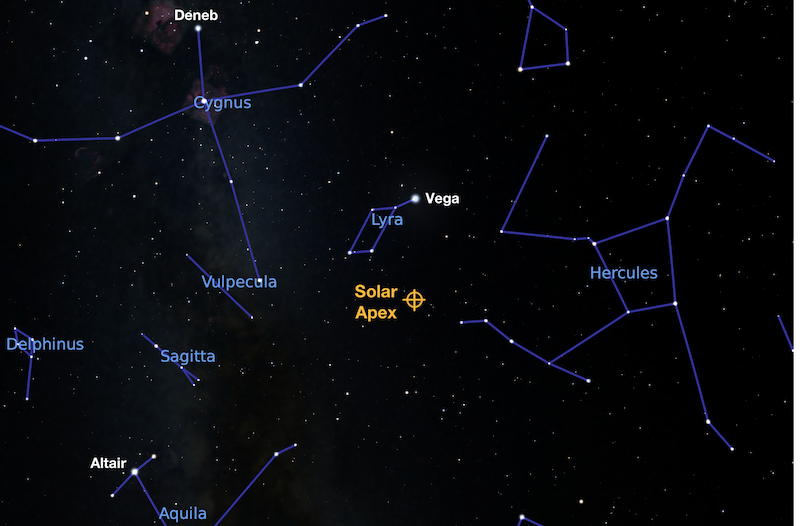
The solar apex isn’t exactly in Vega’s direction. It’s located in our sky in the direction of a constellation that’s harder to pick out … the constellation Hercules. This constellation is southwest of the star Vega and its constellation Lyra. It’s a location on the celestial sphere with these coordinates: 18h 28m 0s in right ascension, 30° N in declination.

How do we know our sun is moving in this direction? Astronomers find this point on our sky by measuring the motions of stars near the sun.

Star chart: a few constellations around a mark labeled solar apex near the bright star Vega.
A star chart showing the location of the solar apex in the sky. It’s not far from Vega. Image via Stellarium. Used with permission.

Sun’s motion in its galactic neighborhood

Think back to when you last walked on a busy sidewalk. In general, most people are walking at a similar pace. At a distance, they look close together. But if you pick up your pace when walking toward them, people appear to be moving apart.

As the sun travels along its galactic sidewalk with neighboring stars, it moves slightly faster than the mean velocity of its neighbors. If you could fast-forward over several hundred thousand years, you’d notice the following: nearby stars appear to move away from the solar apex. On the opposite side of the celestial sphere, called the antapex, you’d see the opposite: the distance between stars in the sky appears to get smaller.

You can see this effect in an animation from the European Space Agency, based on data from the Gaia space telescope. Scientists extrapolated the motion of 40,000 stars over 1.6 million years to see how they would appear to move in the sky. All these stars had known motions that Gaia measured and were within 326 light-years of the sun.

The trails show how far the stars move on the celestial sphere. It’s a busy animation. But if you look closely, you’ll notice, towards the end, many (not all) stars on the upper left appear to be moving away from a central point. That’s the solar apex. And on the right, they appear to be getting closer to each other. That’s the antapex, which is opposite on the sky from the solar apex. You can read more about this video the at ESA website.

Looking toward the apex of the sun

Vega is a bright star. So you can look for it and find it pretty easily, from Northern Hemisphere locations, in the northeast in early evening in May. By the predawn and dawn hours, the Southern Hemisphere can see Vega, too. Look north from the Southern Hemisphere before dawn.

To see a precise view – and time – for Vega from your location, try Stellarium Online.

Then look for the star Vega and contemplate the fact that our sun and family of planets travel more or less toward it.

With its blue-white color, Vega also happens to be one of the loveliest stars you’ll ever see.

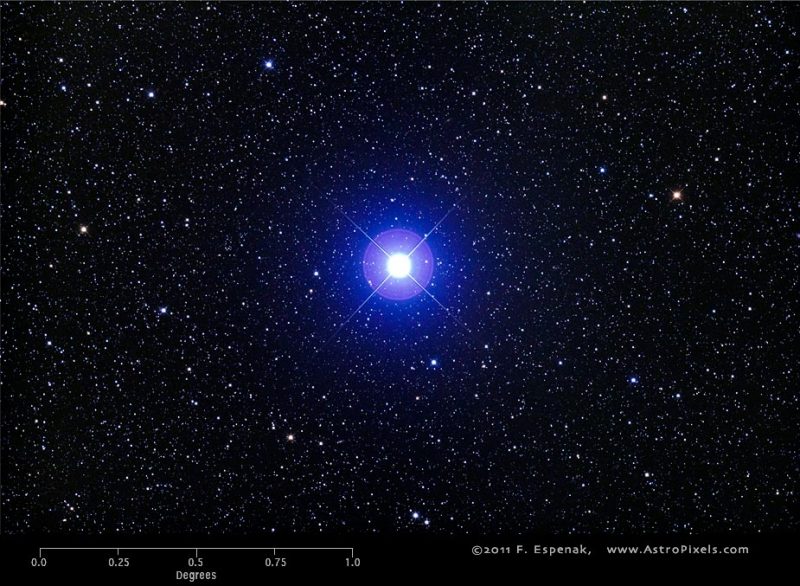
Starfield with large, brilliant blue star in the middle, with lens rays coming from it.
The blue-white star Vega is near the apex of the sun’s way, our sun’s direction of motion through space. Image via Fred Espenak at AstroPixels.com. Used with permission.

Sun’s motion in our galaxy

A friend from Australia wrote:

I seek to find out what speed our sun is traveling at and also how many years it takes to circumnavigate the galaxy.

Our sun takes a long time to circumnavigate the Milky Way, which is a collection of several hundred billion stars with an estimated diameter of about 100,000 light-years. There are various estimates for the speed the sun travels through the galaxy, but its speed is in the range of about 140 miles per second (225 km/sec).

Likewise, there are multiple estimates for the length of time it takes the sun to complete one circuit of the galaxy, but a typical estimate is about 230 million years.

That period of time – the length of the sun’s orbit around the Milky Way’s center – is sometimes called a cosmic year.

What is the solar antapex?

The solar antapex is located opposite the solar apex on the celestial sphere, near the bright star Sirius. Therefore, our sun and planets travel more or less away from Sirius (that’s in the constellation Canis Major). Sirius is the sky’s brightest star. Not surprisingly, Vega and Sirius lie in opposite directions in Earth’s sky.

You can look for Sirius at this time of year, too. Remember, Vega resides almost exactly opposite Sirius. If you have an unobstructed horizon, this evening you might see Sirius low in the southwest as Vega rises low in the northeast (at mid-northern latitudes).

At mid-northern latitudes, you’ll possibly see both stars around 8:30 to 9 p.m. local time (the time on your clock wherever you are) in May.

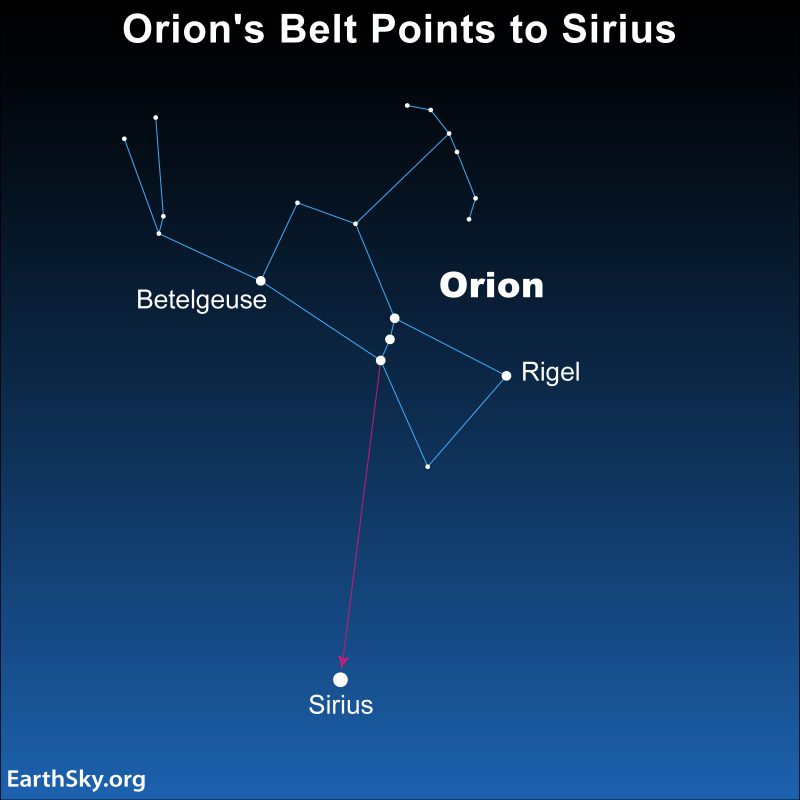
Star chart: Orion looks like an hourglass with arms. From its waist an arrow points to a bright star.
Use the 3 stars of Orion’s Belt to find Sirius, the brightest star of the nighttime sky. From mid-latitudes in the Northern Hemisphere, you might see Sirius low in the southwest, as Vega rises in the northeast.

Bottom line: Our sun – and solar system – are moving in space in the general direction of the solar apex, which is located near the star Vega.

Read our daily sun news

The post Contemplate the apex of the sun in May, with Vega first appeared on EarthSky.


from EarthSky https://ift.tt/pTxP0GL
Apex of the sun: Nighttime sky chart showing a single bright star above the northeast horizon.
From the Northern Hemisphere, the bright star Vega is easy to spot on May evenings. Go outside on a May evening, and face northeast. You’ll easily notice Vega, a bright blue-white star. If your sky is dark, you might also see its constellation Lyra the Harp. In its journey around the galaxy, our sun moves toward bright Vega. The point toward which we move is called the apex of the sun, aka the solar apex. Image via EarthSky.

Don’t miss the next unmissable night sky event. Sign up for EarthSky’s free newsletter for daily night sky updates.

Apex of the sun = our sun’s direction of motion

Our star, the sun, and its planets are moving through space in the general direction of the bright star Vega. Astronomers call the sun’s direction of motion by a great old name: the solar apex or, more romantically, the apex of the sun’s way.

And the month of May is a great time to visualize our sun’s motion through space, if you live in the Northern Hemisphere. In May, our Milky Way galaxy lies as flat around the horizon as it can. And the star Vega – which is near the solar apex on the sky’s dome – is ascending in the northeast on May evenings for Northern Hemisphere viewers.

Vega is part of the constellation Lyra the Harp.

Can you see Vega from the Southern Hemisphere, too? Yes, but, from southerly latitudes, it isn’t up in early evening in May. That’s because, at that time of the night, the body of Earth itself blocks it from the view of southern observers. If you’re in the Southern Hemisphere, you can see Vega, but you’ll need to look later at night. Look here for details on the differences in seeing Vega from Northern and Southern Hemisphere locations, in May.

Where is the solar apex in our sky?

The solar apex isn’t exactly in Vega’s direction. It’s located in our sky in the direction of a constellation that’s harder to pick out … the constellation Hercules. This constellation is southwest of the star Vega and its constellation Lyra. It’s a location on the celestial sphere with these coordinates: 18h 28m 0s in right ascension, 30° N in declination.

How do we know our sun is moving in this direction? Astronomers find this point on our sky by measuring the motions of stars near the sun.

Star chart: a few constellations around a mark labeled solar apex near the bright star Vega.
A star chart showing the location of the solar apex in the sky. It’s not far from Vega. Image via Stellarium. Used with permission.

Sun’s motion in its galactic neighborhood

Think back to when you last walked on a busy sidewalk. In general, most people are walking at a similar pace. At a distance, they look close together. But if you pick up your pace when walking toward them, people appear to be moving apart.

As the sun travels along its galactic sidewalk with neighboring stars, it moves slightly faster than the mean velocity of its neighbors. If you could fast-forward over several hundred thousand years, you’d notice the following: nearby stars appear to move away from the solar apex. On the opposite side of the celestial sphere, called the antapex, you’d see the opposite: the distance between stars in the sky appears to get smaller.

You can see this effect in an animation from the European Space Agency, based on data from the Gaia space telescope. Scientists extrapolated the motion of 40,000 stars over 1.6 million years to see how they would appear to move in the sky. All these stars had known motions that Gaia measured and were within 326 light-years of the sun.

The trails show how far the stars move on the celestial sphere. It’s a busy animation. But if you look closely, you’ll notice, towards the end, many (not all) stars on the upper left appear to be moving away from a central point. That’s the solar apex. And on the right, they appear to be getting closer to each other. That’s the antapex, which is opposite on the sky from the solar apex. You can read more about this video the at ESA website.

Looking toward the apex of the sun

Vega is a bright star. So you can look for it and find it pretty easily, from Northern Hemisphere locations, in the northeast in early evening in May. By the predawn and dawn hours, the Southern Hemisphere can see Vega, too. Look north from the Southern Hemisphere before dawn.

To see a precise view – and time – for Vega from your location, try Stellarium Online.

Then look for the star Vega and contemplate the fact that our sun and family of planets travel more or less toward it.

With its blue-white color, Vega also happens to be one of the loveliest stars you’ll ever see.

Starfield with large, brilliant blue star in the middle, with lens rays coming from it.
The blue-white star Vega is near the apex of the sun’s way, our sun’s direction of motion through space. Image via Fred Espenak at AstroPixels.com. Used with permission.

Sun’s motion in our galaxy

A friend from Australia wrote:

I seek to find out what speed our sun is traveling at and also how many years it takes to circumnavigate the galaxy.

Our sun takes a long time to circumnavigate the Milky Way, which is a collection of several hundred billion stars with an estimated diameter of about 100,000 light-years. There are various estimates for the speed the sun travels through the galaxy, but its speed is in the range of about 140 miles per second (225 km/sec).

Likewise, there are multiple estimates for the length of time it takes the sun to complete one circuit of the galaxy, but a typical estimate is about 230 million years.

That period of time – the length of the sun’s orbit around the Milky Way’s center – is sometimes called a cosmic year.

What is the solar antapex?

The solar antapex is located opposite the solar apex on the celestial sphere, near the bright star Sirius. Therefore, our sun and planets travel more or less away from Sirius (that’s in the constellation Canis Major). Sirius is the sky’s brightest star. Not surprisingly, Vega and Sirius lie in opposite directions in Earth’s sky.

You can look for Sirius at this time of year, too. Remember, Vega resides almost exactly opposite Sirius. If you have an unobstructed horizon, this evening you might see Sirius low in the southwest as Vega rises low in the northeast (at mid-northern latitudes).

At mid-northern latitudes, you’ll possibly see both stars around 8:30 to 9 p.m. local time (the time on your clock wherever you are) in May.

Star chart: Orion looks like an hourglass with arms. From its waist an arrow points to a bright star.
Use the 3 stars of Orion’s Belt to find Sirius, the brightest star of the nighttime sky. From mid-latitudes in the Northern Hemisphere, you might see Sirius low in the southwest, as Vega rises in the northeast.

Bottom line: Our sun – and solar system – are moving in space in the general direction of the solar apex, which is located near the star Vega.

Read our daily sun news

The post Contemplate the apex of the sun in May, with Vega first appeared on EarthSky.


from EarthSky https://ift.tt/pTxP0GL

Baily’s beads seen during a solar eclipse today in 1836

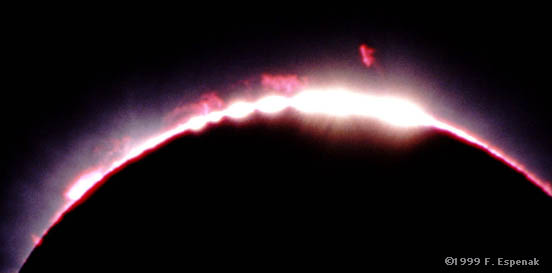
Baily's Beads: Dots of bright light appearing on round edge of dark orb.
Baily’s beads are beads of sunlight caused when sunlight shines between mountains and other features on the moon. These Baily’s beads are from the February 16, 1991, annular solar eclipse. Image via Fred Espenak, aka Mr Eclipse. Used with permission.

Science news, night sky events and beautiful photos, all in one place. Click here to subscribe to EarthSky’s free daily newsletter.

May 15, 1836: On this date in science, Francis Baily (1774-1844), an English astronomer, saw beads of sunlight shining along the edge of the moon’s silhouette during an eclipse of the sun.

It was an annular eclipse – nowadays often called a ring of fire eclipse – meaning that the moon was too far away in its monthly orbit around Earth to appear large enough in our sky to cover the sun completely. Baily saw beads of light shining around the darkened lunar limb (edge of the moon).

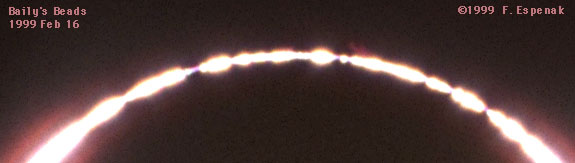
Dark half circle with dots of light along the edge.
Another shot of Bailey’s beads from the February 16, 1999, eclipse. Image via Fred Espenak. Used with permission.

Baily’s discovery

Baily’s goal was to time the length of the annular phase of the eclipse. He would do this by recording the time during which the moon was inside the sun’s disk. He would start timing as soon as a line of sunlight appeared along the trailing edge of the moon.

Baily expected to observe a nice, smooth line of sunlight along one edge of the moon. Imagine his surprise as he watched and waited for it to appear – while observing with a filtered 2.6-inch, f/16 refracting telescope – at 40x magnification. Instead of seeing a smooth line of sunlight, he saw a broken line of light and dark spots.

Don’t start that stopwatch yet, Mr. Baily!

Baily and others have commented that the line of light and dark spots resembled beads on a string. And, as the seconds ticked by, Baily saw the dark spots decrease in both number and size. And he saw the light spots increase in both number and size, until there was a fine line of sunlight around the edge of the moon.

Okay, now start the stopwatch!

But after the moon was completely inside the solar disk, the moon did look “smooth and circular” to him. At least four other local observers confirmed this observation during this eclipse.

Sunlight shining through lunar valleys

Later, others realized that these beads of light appeared due to mountains and valleys, crater walls, and other topographic features extending above the limb, or edge, of the moon as seen from Earth. This phenomenon earned the name Baily’s beads. And you can see it during total eclipses, too, just before the moon covers the sun completely. A video of Baily’s beads is here.

Baily published his discovery in the Monthly Notices of the Royal Astronomical Society in December of 1836. In a talk to the Royal Astronomical Society, he mentioned that he knew of only one other person who had seen these before, that being Jean Henri van Swinden (1746–1823), a Dutch scientist.

Today, Baily’s beads are one of the eclipse effects that amateur astronomers around the world – using proper eye protection – watch for during annular and total eclipses of the sun.

Distinguished, older balding man in early Victorian garb.
Francis Baily, for whom Baily’s beads are named. Image via Wikimedia Commons.

Baily’s beads during a total eclipse

Baily discovered the beads during an annular eclipse, but they’re best known for being visible during a total eclipse. Let’s look at the process during a total eclipse.

During a total eclipse, the moon moves across a sun that takes up the same amount of sky. As the leading edge of the moon moves toward covering the remainder of the sun, dark spots interrupt the last bit of sunlight. Those are lunar mountains. Totality has not yet begun, as sunlight is still peeking between these dark spots.

As the seconds tick by, the sunlight decreases, and the dark areas increase until there is only one spot of light on the limb of the moon: the diamond ring. When that final bright spot disappears, the total eclipse begins. Remove the solar filters for a fantastic view.

As the total phase draws to a close, the effects resume in reverse order. On the trailing side of the moon the sunlight appears. First, the diamond ring. Next, Baily’s beads. Watch a video of Baily’s beads during the August 21, 2017, total eclipse here.

The Baily’s beads phase is unappreciated during total eclipses. The main show is totality, and observers are typically preparing to remove their solar filters while Baily’s beads and the diamond ring are occurring. And those Baily’s beads at the end of totality? They are accompanied by sighs as the total phase comes to an abrupt end. But you can watch the phenomena at the end of the total eclipse with unfiltered and dark-adapted eyes, so they might appear brighter and more noteworthy than those leading into the total phase.

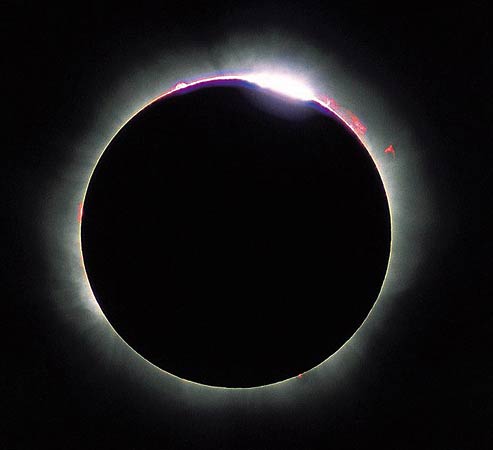
Black circle with dots of light around it.
Baily’s beads, visible during a total eclipse of the sun. Here, you’re almost seeing another effect, known as the diamond ring. Image via Luc Viatour/ Encyclopedia Britannica.

Baily’s beads during an annular eclipse

Here is the process during an annular eclipse, the type that Baily saw. To start, the moon appears smaller than the sun, so you must use filters the entire time. At the center of the annular eclipse, you see a ring of the sun around the moon. And the episode begins on the trailing, not the leading, edge of the moon. As the last bit of the moon moves onto the sun, the uneven dark limb (edge) of the moon produces bright spots. These bright spots increase in number and size until the whole edge of the moon is a bright arc of sunlight.

That is what Baily saw. Toward the end of the annular phase of the eclipse, now looking toward the leading edge of the moon, that bright arc of sunlight begins to be interrupted by dark spots, growing in size. A video of Baily’s beads during an annular eclipse is here.

Extending the beads

Is there a way to make those beads visible for a longer length of time? Yes, there are two ways. One is to hop onto a jet and zoom along the path of the eclipse. This will also extend the length of the total phase of the eclipse.

The other way is to set up near the edge of the central path of the eclipse. The typical eclipse shows the main event, whether annular or total, only along a path on the earth that is about 100 miles (160 km) wide. Sit in the center of that path and the eclipse phase will last longer than near the north or south limit of this path. But if you go near the north or south limit, the Baily’s beads phase will last longer, at the sacrifice of the central phase. A video of Baily’s beads lasting more than two minutes is here.

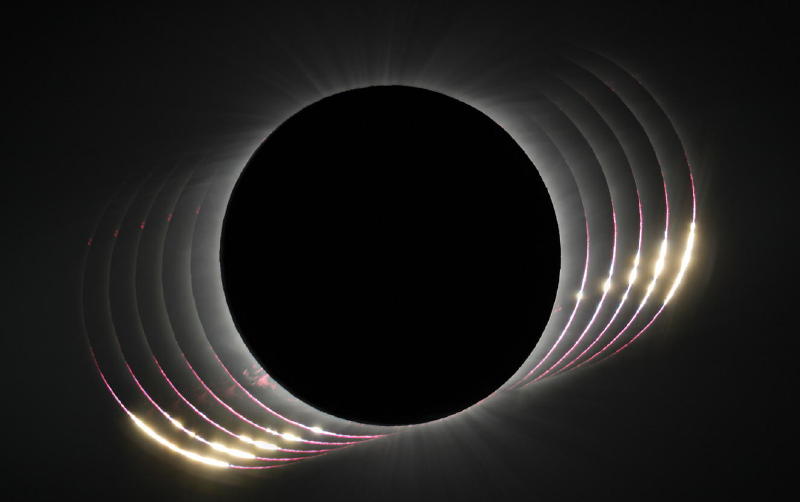
Black circle with parallel white arcs on both sides.
Petr Horalek took these images from the La Silla Observatory in Chile during the July 2, 2019, total eclipse. He was near the edge of the path of totality. Image via Petr Horalek. Used by permission.

Baily’s beads or Halley’s beads?

On April 22, 1715 (Julian calendar, or May 3, 1715, Gregorian calendar) Edmond Halley (1656-1742) observed a total solar eclipse from London. He predicted the eclipse, and so it is often referred to as Halley’s Eclipse. During this total eclipse, Halley observed Baily’s beads too, 59 years before Baily was even born. Here is Halley’s description:

About two Minutes before the Total Immersion, the remaining part of the Sun was reduced to a very fine Horn, whose Extremeties seemed to lose their Acuteness, and to become round like Stars … which Appearance could proceed from no other Cause but the Inequalities of the Moon’s Surface, there being some elevated parts thereof near the Moon’s Southern Pole, by whose Interposition part of that exceedingly fine Filament of Light was intercepted.

This is an excellent description of Baily’s beads, even though Halley hit the “shift” key a few too many times!

Edmond Halley was the first to observe and identify the event we now call Baily’s beads, yet they are not named after him. What is named after Edmond Halley?

Halley’s Comet, which he did not discover, but he did predict its return.
Halley’s Eclipse in 1715, which he also predicted.
Halley, the crater on the moon, named long after Halley passed away.
Halley, the crater on Mars, named in 1973.
Halley Research Station, in Antarctica, established in 1956. Edmond Halley never went to Antarctica, nor to the moon nor Mars, for that matter.
Halley’s Mount, a hill on the island of Saint Helena, from where Halley observed the southern sky.

But we don’t have “Halley’s beads,” even though he discovered and defined them. One suggestion is to refer to the beads seen during the annular eclipses as Baily’s beads and the ones seen during the total eclipses as Halley’s beads. Then Edmond Halley would finally be recognized for something he discovered.

When’s your next chance to spot Baily’s beads? Read more: Total solar eclipse dazzles observers on August 12, 2026.

Bottom line: May 15, 1836: Francis Baily, an English astronomer, saw light shining through lunar ridges during an eclipse of the sun. These are now known as Baily’s beads.

The post Baily’s beads seen during a solar eclipse today in 1836 first appeared on EarthSky.


from EarthSky https://ift.tt/c3XWOFV
Baily's Beads: Dots of bright light appearing on round edge of dark orb.
Baily’s beads are beads of sunlight caused when sunlight shines between mountains and other features on the moon. These Baily’s beads are from the February 16, 1991, annular solar eclipse. Image via Fred Espenak, aka Mr Eclipse. Used with permission.

Science news, night sky events and beautiful photos, all in one place. Click here to subscribe to EarthSky’s free daily newsletter.

May 15, 1836: On this date in science, Francis Baily (1774-1844), an English astronomer, saw beads of sunlight shining along the edge of the moon’s silhouette during an eclipse of the sun.

It was an annular eclipse – nowadays often called a ring of fire eclipse – meaning that the moon was too far away in its monthly orbit around Earth to appear large enough in our sky to cover the sun completely. Baily saw beads of light shining around the darkened lunar limb (edge of the moon).

Dark half circle with dots of light along the edge.
Another shot of Bailey’s beads from the February 16, 1999, eclipse. Image via Fred Espenak. Used with permission.

Baily’s discovery

Baily’s goal was to time the length of the annular phase of the eclipse. He would do this by recording the time during which the moon was inside the sun’s disk. He would start timing as soon as a line of sunlight appeared along the trailing edge of the moon.

Baily expected to observe a nice, smooth line of sunlight along one edge of the moon. Imagine his surprise as he watched and waited for it to appear – while observing with a filtered 2.6-inch, f/16 refracting telescope – at 40x magnification. Instead of seeing a smooth line of sunlight, he saw a broken line of light and dark spots.

Don’t start that stopwatch yet, Mr. Baily!

Baily and others have commented that the line of light and dark spots resembled beads on a string. And, as the seconds ticked by, Baily saw the dark spots decrease in both number and size. And he saw the light spots increase in both number and size, until there was a fine line of sunlight around the edge of the moon.

Okay, now start the stopwatch!

But after the moon was completely inside the solar disk, the moon did look “smooth and circular” to him. At least four other local observers confirmed this observation during this eclipse.

Sunlight shining through lunar valleys

Later, others realized that these beads of light appeared due to mountains and valleys, crater walls, and other topographic features extending above the limb, or edge, of the moon as seen from Earth. This phenomenon earned the name Baily’s beads. And you can see it during total eclipses, too, just before the moon covers the sun completely. A video of Baily’s beads is here.

Baily published his discovery in the Monthly Notices of the Royal Astronomical Society in December of 1836. In a talk to the Royal Astronomical Society, he mentioned that he knew of only one other person who had seen these before, that being Jean Henri van Swinden (1746–1823), a Dutch scientist.

Today, Baily’s beads are one of the eclipse effects that amateur astronomers around the world – using proper eye protection – watch for during annular and total eclipses of the sun.

Distinguished, older balding man in early Victorian garb.
Francis Baily, for whom Baily’s beads are named. Image via Wikimedia Commons.

Baily’s beads during a total eclipse

Baily discovered the beads during an annular eclipse, but they’re best known for being visible during a total eclipse. Let’s look at the process during a total eclipse.

During a total eclipse, the moon moves across a sun that takes up the same amount of sky. As the leading edge of the moon moves toward covering the remainder of the sun, dark spots interrupt the last bit of sunlight. Those are lunar mountains. Totality has not yet begun, as sunlight is still peeking between these dark spots.

As the seconds tick by, the sunlight decreases, and the dark areas increase until there is only one spot of light on the limb of the moon: the diamond ring. When that final bright spot disappears, the total eclipse begins. Remove the solar filters for a fantastic view.

As the total phase draws to a close, the effects resume in reverse order. On the trailing side of the moon the sunlight appears. First, the diamond ring. Next, Baily’s beads. Watch a video of Baily’s beads during the August 21, 2017, total eclipse here.

The Baily’s beads phase is unappreciated during total eclipses. The main show is totality, and observers are typically preparing to remove their solar filters while Baily’s beads and the diamond ring are occurring. And those Baily’s beads at the end of totality? They are accompanied by sighs as the total phase comes to an abrupt end. But you can watch the phenomena at the end of the total eclipse with unfiltered and dark-adapted eyes, so they might appear brighter and more noteworthy than those leading into the total phase.

Black circle with dots of light around it.
Baily’s beads, visible during a total eclipse of the sun. Here, you’re almost seeing another effect, known as the diamond ring. Image via Luc Viatour/ Encyclopedia Britannica.

Baily’s beads during an annular eclipse

Here is the process during an annular eclipse, the type that Baily saw. To start, the moon appears smaller than the sun, so you must use filters the entire time. At the center of the annular eclipse, you see a ring of the sun around the moon. And the episode begins on the trailing, not the leading, edge of the moon. As the last bit of the moon moves onto the sun, the uneven dark limb (edge) of the moon produces bright spots. These bright spots increase in number and size until the whole edge of the moon is a bright arc of sunlight.

That is what Baily saw. Toward the end of the annular phase of the eclipse, now looking toward the leading edge of the moon, that bright arc of sunlight begins to be interrupted by dark spots, growing in size. A video of Baily’s beads during an annular eclipse is here.

Extending the beads

Is there a way to make those beads visible for a longer length of time? Yes, there are two ways. One is to hop onto a jet and zoom along the path of the eclipse. This will also extend the length of the total phase of the eclipse.

The other way is to set up near the edge of the central path of the eclipse. The typical eclipse shows the main event, whether annular or total, only along a path on the earth that is about 100 miles (160 km) wide. Sit in the center of that path and the eclipse phase will last longer than near the north or south limit of this path. But if you go near the north or south limit, the Baily’s beads phase will last longer, at the sacrifice of the central phase. A video of Baily’s beads lasting more than two minutes is here.

Black circle with parallel white arcs on both sides.
Petr Horalek took these images from the La Silla Observatory in Chile during the July 2, 2019, total eclipse. He was near the edge of the path of totality. Image via Petr Horalek. Used by permission.

Baily’s beads or Halley’s beads?

On April 22, 1715 (Julian calendar, or May 3, 1715, Gregorian calendar) Edmond Halley (1656-1742) observed a total solar eclipse from London. He predicted the eclipse, and so it is often referred to as Halley’s Eclipse. During this total eclipse, Halley observed Baily’s beads too, 59 years before Baily was even born. Here is Halley’s description:

About two Minutes before the Total Immersion, the remaining part of the Sun was reduced to a very fine Horn, whose Extremeties seemed to lose their Acuteness, and to become round like Stars … which Appearance could proceed from no other Cause but the Inequalities of the Moon’s Surface, there being some elevated parts thereof near the Moon’s Southern Pole, by whose Interposition part of that exceedingly fine Filament of Light was intercepted.

This is an excellent description of Baily’s beads, even though Halley hit the “shift” key a few too many times!

Edmond Halley was the first to observe and identify the event we now call Baily’s beads, yet they are not named after him. What is named after Edmond Halley?

Halley’s Comet, which he did not discover, but he did predict its return.
Halley’s Eclipse in 1715, which he also predicted.
Halley, the crater on the moon, named long after Halley passed away.
Halley, the crater on Mars, named in 1973.
Halley Research Station, in Antarctica, established in 1956. Edmond Halley never went to Antarctica, nor to the moon nor Mars, for that matter.
Halley’s Mount, a hill on the island of Saint Helena, from where Halley observed the southern sky.

But we don’t have “Halley’s beads,” even though he discovered and defined them. One suggestion is to refer to the beads seen during the annular eclipses as Baily’s beads and the ones seen during the total eclipses as Halley’s beads. Then Edmond Halley would finally be recognized for something he discovered.

When’s your next chance to spot Baily’s beads? Read more: Total solar eclipse dazzles observers on August 12, 2026.

Bottom line: May 15, 1836: Francis Baily, an English astronomer, saw light shining through lunar ridges during an eclipse of the sun. These are now known as Baily’s beads.

The post Baily’s beads seen during a solar eclipse today in 1836 first appeared on EarthSky.


from EarthSky https://ift.tt/c3XWOFV

How to see the Southern Cross from the Northern Hemisphere

Dark sky over buildings with 6 stars labeled and Southern Cross pattern shown.
View at EarthSky Community Photos. | Kannan A in Woodlands, Singapore, captured this photo of the Southern Cross on March 8, 2021. He wrote: “The Southern Cross constellation seen here in the morning in Singapore looking south. On the left of this cross are the 2 pointer stars, Alpha Centauri (Rigel Kentaurus) and Beta Centauri (Hadar). They point to the Southern Cross.” Thanks, Kannan!

The Southern Cross – also known as Crux – is an iconic constellation for people south of the equator. It’s visible every clear night, and its stars shine brightly enough to be picked out pretty easily even from urban locations.

If you’re in the Northern Hemisphere, you might be able to see the famous Southern Cross too. You just need to be far enough south, and know where and when to look.

Science news, night sky events and beautiful photos, all in one place. Click here to subscribe to our free daily newsletter.

Where can you see the Southern Cross?

At 35 degrees south latitude and all latitudes farther south, you can see the Southern Cross all night, all year round. In that part of the Southern Hemisphere, the Southern Cross is circumpolar: it is always above the horizon, as it circles the sky close to the celestial pole.

However, for much of the Northern Hemisphere – including most of the United States – the Southern Cross can never be seen. It never rises above the horizon.

You can see all of Crux from the U.S. state of Hawaii. In the contiguous U.S., you must be in southern Florida or Texas (about 26 degrees north latitude or farther south). Even from the far-southern contiguous U.S., you have a limited viewing window for catching the Southern Cross. It must be the right season of the year. It must be the right time of night. And you have to look in the right direction: south!

Two very bright stars, Alpha and Beta Centauri, with 4 stars of Crux, close to horizon in densely starry sky.
View at EarthSky Community Photos. | Bright stars Alpha and Beta Centauri pointing to Crux, or the Southern Cross, from Stephen Green in Waikoloa, Hawaii, on April 26, 2019. Stephen is at about 20 degrees north latitude. Thank you, Stephen!

When to look?

For the Northern Hemisphere’s tropical and subtropical regions, May is a good time to find Crux in the evening sky. It is visible in other months, but not at such a convenient time. In March, you have to wait until about 1 a.m. to catch the Southern Cross at its highest elevation. In December and January, you have to catch it before dawn.

No matter the hour or date, Crux climbs to its highest point in the sky when it’s due south. It is easy to visualize the Cross, because it stands upright over the horizon.

A man seen from behind looking outward over a city toward the Southern Cross with stars labeled.
View at EarthSky Community Photos. | Prateek Pandey in Bhopal, India, caught the Southern Cross while at its highest point around midnight (its midnight culmination) on March 6, 2021. In April and May, the Southern Cross reaches its highest point in the sky earlier in the evening. Thank you, Prateek!

Use the Big Dipper as a guide

Although the Big Dipper is a fixture of Northern Hemisphere skies, it has a close kinship with the Southern Cross. The Big Dipper and the Southern Cross are highest in the sky at the same time of year.

Remember, spring up and fall down: the Big Dipper soars highest in the sky during the Northern Hemisphere’s spring. When you see the Big Dipper above Polaris, the North Star, the Southern Cross can be seen standing over the southern horizon in Texas and southern Florida.

In the Southern Hemisphere it works the same way, just in reverse. You can see the Big Dipper in the Southern Hemisphere from about 26 degrees south latitude and all latitudes farther north. But to spot it, it depends on the season and the time of night. When the Southern Cross sails highest in the Southern Hemisphere sky, the “upside-down” Big Dipper is seen just above the northern horizon at latitudes near the tropic of Capricorn (23.5 degrees south latitude).

Starry sky with 2 bright stars, lined up next to 4 stars making ends of a cross.
View at EarthSky Community Photos. | Dr Ski in Valencia, Philippines, captured the Southern Cross, along with its pointer stars, Alpha Centauri (far left) and Beta Centauri. He wrote: “When you see the Southern Cross for the first time, you understand now why you came this way. – CS&N.” Thanks, Dr Ski!

The Southern Cross in navigation

When European sailors journeyed south of the equator, they found that the North Star had disappeared below the horizon. As they sailed even farther south, the Big Dipper dropped out of sight as well. Unlike the Northern Hemisphere, the Southern Hemisphere has no bright pole star to highlight the celestial pole. Fortunately, the Southern Cross acts as a navigational aid.

There are various ways to find the direction due south using the Southern Cross as a guide. For example, a line drawn from the star Gacrux through the star Acrux points in the general direction of the south celestial pole (the point in the sky directly above Earth’s south pole). Discover more ways to locate south using the Southern Cross.

Bottom line: The Southern Cross can be seen from the Northern Hemisphere, as long as you’re below 26 degrees north and know when and where to look!

Read more: The Southern Cross is your guide to due south

The post How to see the Southern Cross from the Northern Hemisphere first appeared on EarthSky.


from EarthSky https://ift.tt/bZTlK9x
Dark sky over buildings with 6 stars labeled and Southern Cross pattern shown.
View at EarthSky Community Photos. | Kannan A in Woodlands, Singapore, captured this photo of the Southern Cross on March 8, 2021. He wrote: “The Southern Cross constellation seen here in the morning in Singapore looking south. On the left of this cross are the 2 pointer stars, Alpha Centauri (Rigel Kentaurus) and Beta Centauri (Hadar). They point to the Southern Cross.” Thanks, Kannan!

The Southern Cross – also known as Crux – is an iconic constellation for people south of the equator. It’s visible every clear night, and its stars shine brightly enough to be picked out pretty easily even from urban locations.

If you’re in the Northern Hemisphere, you might be able to see the famous Southern Cross too. You just need to be far enough south, and know where and when to look.

Science news, night sky events and beautiful photos, all in one place. Click here to subscribe to our free daily newsletter.

Where can you see the Southern Cross?

At 35 degrees south latitude and all latitudes farther south, you can see the Southern Cross all night, all year round. In that part of the Southern Hemisphere, the Southern Cross is circumpolar: it is always above the horizon, as it circles the sky close to the celestial pole.

However, for much of the Northern Hemisphere – including most of the United States – the Southern Cross can never be seen. It never rises above the horizon.

You can see all of Crux from the U.S. state of Hawaii. In the contiguous U.S., you must be in southern Florida or Texas (about 26 degrees north latitude or farther south). Even from the far-southern contiguous U.S., you have a limited viewing window for catching the Southern Cross. It must be the right season of the year. It must be the right time of night. And you have to look in the right direction: south!

Two very bright stars, Alpha and Beta Centauri, with 4 stars of Crux, close to horizon in densely starry sky.
View at EarthSky Community Photos. | Bright stars Alpha and Beta Centauri pointing to Crux, or the Southern Cross, from Stephen Green in Waikoloa, Hawaii, on April 26, 2019. Stephen is at about 20 degrees north latitude. Thank you, Stephen!

When to look?

For the Northern Hemisphere’s tropical and subtropical regions, May is a good time to find Crux in the evening sky. It is visible in other months, but not at such a convenient time. In March, you have to wait until about 1 a.m. to catch the Southern Cross at its highest elevation. In December and January, you have to catch it before dawn.

No matter the hour or date, Crux climbs to its highest point in the sky when it’s due south. It is easy to visualize the Cross, because it stands upright over the horizon.

A man seen from behind looking outward over a city toward the Southern Cross with stars labeled.
View at EarthSky Community Photos. | Prateek Pandey in Bhopal, India, caught the Southern Cross while at its highest point around midnight (its midnight culmination) on March 6, 2021. In April and May, the Southern Cross reaches its highest point in the sky earlier in the evening. Thank you, Prateek!

Use the Big Dipper as a guide

Although the Big Dipper is a fixture of Northern Hemisphere skies, it has a close kinship with the Southern Cross. The Big Dipper and the Southern Cross are highest in the sky at the same time of year.

Remember, spring up and fall down: the Big Dipper soars highest in the sky during the Northern Hemisphere’s spring. When you see the Big Dipper above Polaris, the North Star, the Southern Cross can be seen standing over the southern horizon in Texas and southern Florida.

In the Southern Hemisphere it works the same way, just in reverse. You can see the Big Dipper in the Southern Hemisphere from about 26 degrees south latitude and all latitudes farther north. But to spot it, it depends on the season and the time of night. When the Southern Cross sails highest in the Southern Hemisphere sky, the “upside-down” Big Dipper is seen just above the northern horizon at latitudes near the tropic of Capricorn (23.5 degrees south latitude).

Starry sky with 2 bright stars, lined up next to 4 stars making ends of a cross.
View at EarthSky Community Photos. | Dr Ski in Valencia, Philippines, captured the Southern Cross, along with its pointer stars, Alpha Centauri (far left) and Beta Centauri. He wrote: “When you see the Southern Cross for the first time, you understand now why you came this way. – CS&N.” Thanks, Dr Ski!

The Southern Cross in navigation

When European sailors journeyed south of the equator, they found that the North Star had disappeared below the horizon. As they sailed even farther south, the Big Dipper dropped out of sight as well. Unlike the Northern Hemisphere, the Southern Hemisphere has no bright pole star to highlight the celestial pole. Fortunately, the Southern Cross acts as a navigational aid.

There are various ways to find the direction due south using the Southern Cross as a guide. For example, a line drawn from the star Gacrux through the star Acrux points in the general direction of the south celestial pole (the point in the sky directly above Earth’s south pole). Discover more ways to locate south using the Southern Cross.

Bottom line: The Southern Cross can be seen from the Northern Hemisphere, as long as you’re below 26 degrees north and know when and where to look!

Read more: The Southern Cross is your guide to due south

The post How to see the Southern Cross from the Northern Hemisphere first appeared on EarthSky.


from EarthSky https://ift.tt/bZTlK9x

Skylab – America’s 1st space station – 53 years later

Skylab: pace station with 4 blades like a helicopter, above cloudtops, with curve of Earth visible.
Skylab, America’s first space station, launched on May 14, 1973. Its highly publicized crash back to Earth – during which it dropped huge chunks of hardware into the Indian Ocean and across Western Australia – took place on July 11, 1979. Image via NASA.

As we approach the 53rd anniversary of Skylab, America’s 1st space station, we look back on its launch and successes. NASA originally published this story on Skylab’s 40th anniversary, in 2019. Updates via NASA, and edits by EarthSky.

Skylab: America’s 1st space station

On May 14, 1973, 53 years ago today, a Saturn V rocket launched Skylab – America’s 1st space station – into Earth-orbit. Three crews ultimately lived and worked on Skylab for over 171 days. However, the space station is perhaps best known for its dramatic and highly publicized fall back to Earth. Read more about that below.

Skylab used technology from the Apollo moon missions, including using the Apollo spacecraft to deliver the Skylab crews and return them to Earth.

Overall, Skylab had two important goals. First, NASA had set out to prove humans could work and live in space for extended periods of time. Second, the astronauts aboard Skylab would study and expand our knowledge of the sun and solar astronomy.

The launch didn’t go smoothly

Upon liftoff, a meteoroid shield meant to shade the spacecraft deployed and tore itself off of the space station. So, the first crew had to remedy this situation while orbiting about 270 miles (435 km) above the surface of the Earth.

At the same time, the shade detachment caused one of the solar-array wings to partly deploy. Then, the 2nd stage retro-rockets blew it off into space. And because of this event, a strap from the shield covered another solar-array wing so that wing couldn’t open all the way to generate power.

Luckily, all the other equipment and spacecraft functions were fine. For example, the Apollo Telescope Mount – the solar observatory on Skylab – with its solar arrays, and most importantly, the pressurization of the space station, were all in good working order.

The Skylab team on Earth spent over a week working to stabilize Skylab and find workarounds for several issues. In addition, they addressed a serious overheating of the craft by varying its nose-up attitude to maintain an acceptable position.

Finally, the spacecraft was operational, but for some time functioned with less than 50% of its designed electrical system.

White rocket with a red structure on the right side. Both are reflected in a river. There are bushes in the foreground and blue sky above.
The Skylab 1-Saturn V space vehicle lifts off from Launch Pad 39A on May 14, 1973. Image via NASA.

Skylab was a success

Overall, there were three crews – with three members each – that lived on Skylab. They lived and worked on Skylab for a total of 171 days and 13 hours. The crews performed over 300 experiments, including testing human’s ability to live in zero gravity. They also observed the sun and Earth.

The crews set new space records that included man-hours in space and time in extravehicular activities. Their combined totals exceeded all the world’s previous spaceflights at that time.

It was our 1st true space station

Skylab showed humans could maintain a space station, perform experiments and remain in good physical health while living in the weightlessness of space. The 1st crew stayed onboard for 28 days. The 2nd crew were in space for 59 days. And the 3rd crew remained on the space station for 84 days. Also, Skylab was the first space station to receive resupply ships, now a common occurrence for the ISS.

The Skylab crew studied solar flares from space and tracked cyclones and hurricanes on Earth. Overall, they took more than 170,000 photos of the sun and over 46,000 photos of the Earth.

By the way, the 3rd crew made a few observations of comet Kohoutek, a comet that was hyped as a possible comet of the century but failed to live up to the hype.

Golden station in space with 4 blades shining. Earth is below.
As the crew leaves Skylab 2, they look back on a gold sun shield cover on the main portion of space station. The 4 windmill-like solar arrays are part of the Apollo Telescope Mount used for solar astronomy. Image via NASA.

The final days and fall of Skylab

After the last crew returned to Earth, the ground crew ran a few more tests of the systems onboard. Primarily they were checking for equipment failures and how much systems had degraded over the time spent in space.

Eventually, Skylab was moved in to position for reentry and all its systems were shut down. Its orbit was expected to decay over about 10 years.

But it only remained in a stable orbit for eight years and so came back to Earth earlier than expected.

And its fall to Earth was highly publicized! It was perhaps the first major fall of a satellite from orbit.

After much speculation about where Skylab would land – and whether it would damage people or things on the ground – Skylab finally crashed back to Earth on July 11, 1979. It caused big hunks of hardware to fall into the Indian Ocean and across Western Australia.

And, famously, it prompted the sparsely populated town of Esperance, in Western Australia, to fine NASA $400 for littering!

Bottom line: Skylab was America’s first space station. Three crews lived and worked in space for over 171 days. They studied the sun and Earth and demonstrated humans could live and work in space for long periods of time.

Via NASA: Happy 40th Anniversary to Skylab

Via NASA: Skylab: America’s First Space Station

Read more: How to see the International Space Station in your sky

You deserve a daily dose of good news. For the latest in science and the night sky, click here to subscribe to our free daily newsletter.

The post Skylab – America’s 1st space station – 53 years later first appeared on EarthSky.


from EarthSky https://ift.tt/tOA6yzW
Skylab: pace station with 4 blades like a helicopter, above cloudtops, with curve of Earth visible.
Skylab, America’s first space station, launched on May 14, 1973. Its highly publicized crash back to Earth – during which it dropped huge chunks of hardware into the Indian Ocean and across Western Australia – took place on July 11, 1979. Image via NASA.

As we approach the 53rd anniversary of Skylab, America’s 1st space station, we look back on its launch and successes. NASA originally published this story on Skylab’s 40th anniversary, in 2019. Updates via NASA, and edits by EarthSky.

Skylab: America’s 1st space station

On May 14, 1973, 53 years ago today, a Saturn V rocket launched Skylab – America’s 1st space station – into Earth-orbit. Three crews ultimately lived and worked on Skylab for over 171 days. However, the space station is perhaps best known for its dramatic and highly publicized fall back to Earth. Read more about that below.

Skylab used technology from the Apollo moon missions, including using the Apollo spacecraft to deliver the Skylab crews and return them to Earth.

Overall, Skylab had two important goals. First, NASA had set out to prove humans could work and live in space for extended periods of time. Second, the astronauts aboard Skylab would study and expand our knowledge of the sun and solar astronomy.

The launch didn’t go smoothly

Upon liftoff, a meteoroid shield meant to shade the spacecraft deployed and tore itself off of the space station. So, the first crew had to remedy this situation while orbiting about 270 miles (435 km) above the surface of the Earth.

At the same time, the shade detachment caused one of the solar-array wings to partly deploy. Then, the 2nd stage retro-rockets blew it off into space. And because of this event, a strap from the shield covered another solar-array wing so that wing couldn’t open all the way to generate power.

Luckily, all the other equipment and spacecraft functions were fine. For example, the Apollo Telescope Mount – the solar observatory on Skylab – with its solar arrays, and most importantly, the pressurization of the space station, were all in good working order.

The Skylab team on Earth spent over a week working to stabilize Skylab and find workarounds for several issues. In addition, they addressed a serious overheating of the craft by varying its nose-up attitude to maintain an acceptable position.

Finally, the spacecraft was operational, but for some time functioned with less than 50% of its designed electrical system.

White rocket with a red structure on the right side. Both are reflected in a river. There are bushes in the foreground and blue sky above.
The Skylab 1-Saturn V space vehicle lifts off from Launch Pad 39A on May 14, 1973. Image via NASA.

Skylab was a success

Overall, there were three crews – with three members each – that lived on Skylab. They lived and worked on Skylab for a total of 171 days and 13 hours. The crews performed over 300 experiments, including testing human’s ability to live in zero gravity. They also observed the sun and Earth.

The crews set new space records that included man-hours in space and time in extravehicular activities. Their combined totals exceeded all the world’s previous spaceflights at that time.

It was our 1st true space station

Skylab showed humans could maintain a space station, perform experiments and remain in good physical health while living in the weightlessness of space. The 1st crew stayed onboard for 28 days. The 2nd crew were in space for 59 days. And the 3rd crew remained on the space station for 84 days. Also, Skylab was the first space station to receive resupply ships, now a common occurrence for the ISS.

The Skylab crew studied solar flares from space and tracked cyclones and hurricanes on Earth. Overall, they took more than 170,000 photos of the sun and over 46,000 photos of the Earth.

By the way, the 3rd crew made a few observations of comet Kohoutek, a comet that was hyped as a possible comet of the century but failed to live up to the hype.

Golden station in space with 4 blades shining. Earth is below.
As the crew leaves Skylab 2, they look back on a gold sun shield cover on the main portion of space station. The 4 windmill-like solar arrays are part of the Apollo Telescope Mount used for solar astronomy. Image via NASA.

The final days and fall of Skylab

After the last crew returned to Earth, the ground crew ran a few more tests of the systems onboard. Primarily they were checking for equipment failures and how much systems had degraded over the time spent in space.

Eventually, Skylab was moved in to position for reentry and all its systems were shut down. Its orbit was expected to decay over about 10 years.

But it only remained in a stable orbit for eight years and so came back to Earth earlier than expected.

And its fall to Earth was highly publicized! It was perhaps the first major fall of a satellite from orbit.

After much speculation about where Skylab would land – and whether it would damage people or things on the ground – Skylab finally crashed back to Earth on July 11, 1979. It caused big hunks of hardware to fall into the Indian Ocean and across Western Australia.

And, famously, it prompted the sparsely populated town of Esperance, in Western Australia, to fine NASA $400 for littering!

Bottom line: Skylab was America’s first space station. Three crews lived and worked in space for over 171 days. They studied the sun and Earth and demonstrated humans could live and work in space for long periods of time.

Via NASA: Happy 40th Anniversary to Skylab

Via NASA: Skylab: America’s First Space Station

Read more: How to see the International Space Station in your sky

You deserve a daily dose of good news. For the latest in science and the night sky, click here to subscribe to our free daily newsletter.

The post Skylab – America’s 1st space station – 53 years later first appeared on EarthSky.


from EarthSky https://ift.tt/tOA6yzW

adds 2