
Apex of the sun = our sun’s direction of motion
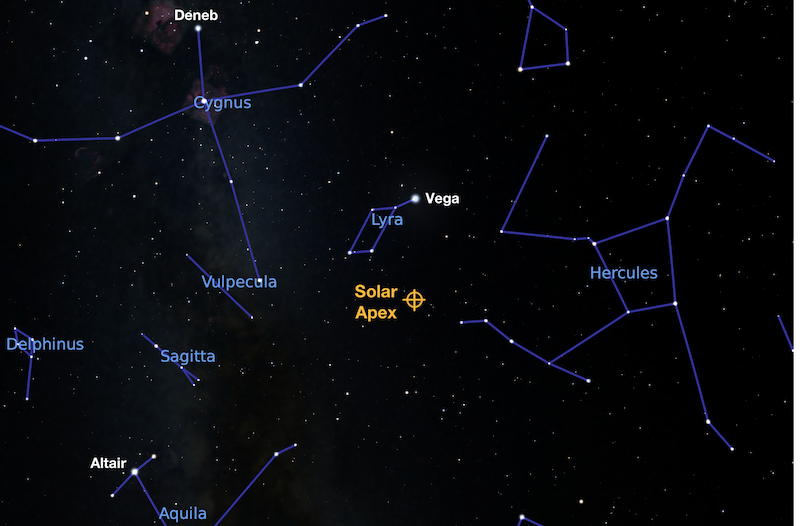
Our star, the sun, and its planets are moving through space in the general direction of the bright star Vega. Astronomers call the sun’s direction of motion by a great old name: the solar apex or, more romantically, the apex of the sun’s way.
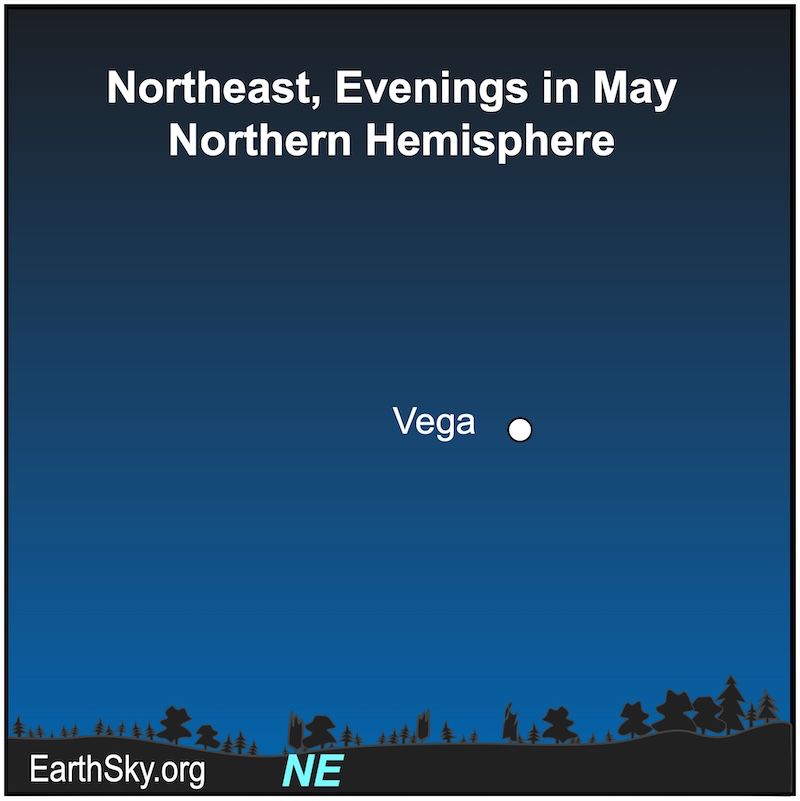
And the month of May is a great time to visualize our sun’s motion through space, if you live in the Northern Hemisphere. In May, our Milky Way galaxy lies as flat around the horizon as it can. And the star Vega – which is near the solar apex on the sky’s dome – is ascending in the northeast on May evenings for Northern Hemisphere viewers.
Vega is part of the constellation Lyra the Harp.
Can you see Vega from the Southern Hemisphere, too? Yes, but, from southerly latitudes, it isn’t up in early evening in May. That’s because, at that time of the night, the body of Earth itself blocks it from the view of southern observers. If you’re in the Southern Hemisphere, you can see Vega, but you’ll need to look later at night. Look here for details on the differences in seeing Vega from Northern and Southern Hemisphere locations, in May.
Where is the solar apex in our sky?
The solar apex isn’t exactly in Vega’s direction. It’s located in our sky in the direction of a constellation that’s harder to pick out … the constellation Hercules. This constellation is southwest of the star Vega and its constellation Lyra. It’s a location on the celestial sphere with these coordinates: 18h 28m 0s in right ascension, 30° N in declination.
How do we know our sun is moving in this direction? Astronomers find this point on our sky by measuring the motions of stars near the sun.
Sun’s motion in its galactic neighborhood
Think back to when you last walked on a busy sidewalk. In general, most people are walking at a similar pace. At a distance, they look close together. But if you pick up your pace when walking toward them, people appear to be moving apart.
As the sun travels along its galactic sidewalk with neighboring stars, it moves slightly faster than the mean velocity of its neighbors. If you could fast-forward over several hundred thousand years, you’d notice the following: nearby stars appear to move away from the solar apex. On the opposite side of the celestial sphere, called the antapex, you’d see the opposite: the distance between stars in the sky appears to get smaller.
You can see this effect in an animation from the European Space Agency, based on data from the Gaia space telescope. Scientists extrapolated the motion of 40,000 stars over 1.6 million years to see how they would appear to move in the sky. All these stars had known motions that Gaia measured and were within 326 light-years of the sun.
The trails show how far the stars move on the celestial sphere. It’s a busy animation. But if you look closely, you’ll notice, towards the end, many (not all) stars on the upper left appear to be moving away from a central point. That’s the solar apex. And on the right, they appear to be getting closer to each other. That’s the antapex, which is opposite on the sky from the solar apex. You can read more about this video the at ESA website.
Looking toward the apex of the sun
Vega is a bright star. So you can look for it and find it pretty easily, from Northern Hemisphere locations, in the northeast in early evening in May. By the predawn and dawn hours, the Southern Hemisphere can see Vega, too. Look north from the Southern Hemisphere before dawn.
To see a precise view – and time – for Vega from your location, try Stellarium Online.
Then look for the star Vega and contemplate the fact that our sun and family of planets travel more or less toward it.
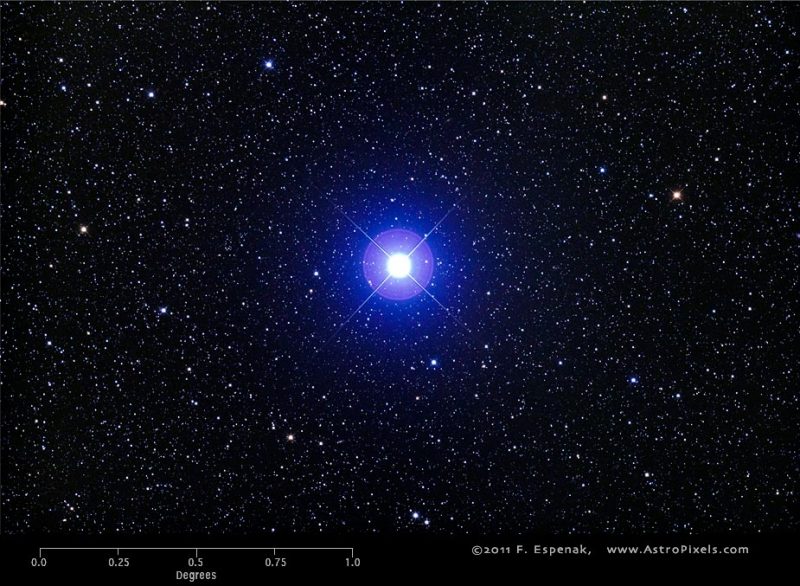
With its blue-white color, Vega also happens to be one of the loveliest stars you’ll ever see.
Sun’s motion in our galaxy
A friend from Australia wrote:
I seek to find out what speed our sun is traveling at and also how many years it takes to circumnavigate the galaxy.
Our sun takes a long time to circumnavigate the Milky Way, which is a collection of several hundred billion stars with an estimated diameter of about 100,000 light-years. There are various estimates for the speed the sun travels through the galaxy, but its speed is in the range of about 140 miles per second (225 km/sec).
Likewise, there are multiple estimates for the length of time it takes the sun to complete one circuit of the galaxy, but a typical estimate is about 230 million years.
That period of time – the length of the sun’s orbit around the Milky Way’s center – is sometimes called a cosmic year.
What is the solar antapex?
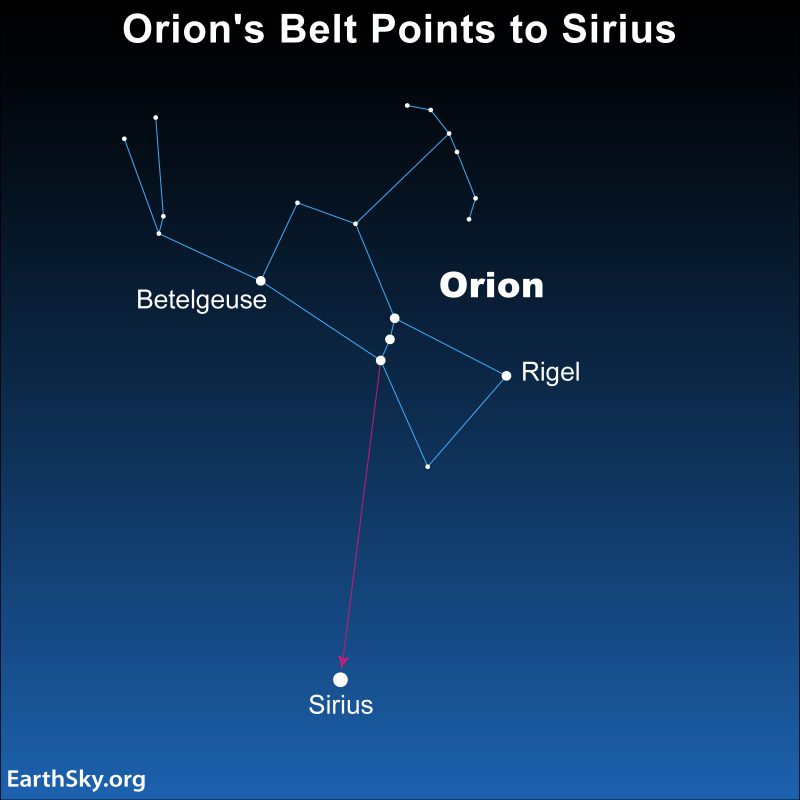
The solar antapex is located opposite the solar apex on the celestial sphere, near the bright star Sirius. Therefore, our sun and planets travel more or less away from Sirius (that’s in the constellation Canis Major). Sirius is the sky’s brightest star. Not surprisingly, Vega and Sirius lie in opposite directions in Earth’s sky.
You can look for Sirius at this time of year, too. Remember, Vega resides almost exactly opposite Sirius. If you have an unobstructed horizon, this evening you might see Sirius low in the southwest as Vega rises low in the northeast (at mid-northern latitudes).
At mid-northern latitudes, you’ll possibly see both stars around 8:30 to 9 p.m. local time (the time on your clock wherever you are) in May.
Bottom line: Our sun – and solar system – are moving in space in the general direction of the solar apex, which is located near the star Vega.
The post Contemplate the apex of the sun in May, with Vega first appeared on EarthSky.
from EarthSky https://ift.tt/pTxP0GL
Apex of the sun = our sun’s direction of motion
Our star, the sun, and its planets are moving through space in the general direction of the bright star Vega. Astronomers call the sun’s direction of motion by a great old name: the solar apex or, more romantically, the apex of the sun’s way.
And the month of May is a great time to visualize our sun’s motion through space, if you live in the Northern Hemisphere. In May, our Milky Way galaxy lies as flat around the horizon as it can. And the star Vega – which is near the solar apex on the sky’s dome – is ascending in the northeast on May evenings for Northern Hemisphere viewers.
Vega is part of the constellation Lyra the Harp.
Can you see Vega from the Southern Hemisphere, too? Yes, but, from southerly latitudes, it isn’t up in early evening in May. That’s because, at that time of the night, the body of Earth itself blocks it from the view of southern observers. If you’re in the Southern Hemisphere, you can see Vega, but you’ll need to look later at night. Look here for details on the differences in seeing Vega from Northern and Southern Hemisphere locations, in May.
Where is the solar apex in our sky?
The solar apex isn’t exactly in Vega’s direction. It’s located in our sky in the direction of a constellation that’s harder to pick out … the constellation Hercules. This constellation is southwest of the star Vega and its constellation Lyra. It’s a location on the celestial sphere with these coordinates: 18h 28m 0s in right ascension, 30° N in declination.
How do we know our sun is moving in this direction? Astronomers find this point on our sky by measuring the motions of stars near the sun.
Sun’s motion in its galactic neighborhood
Think back to when you last walked on a busy sidewalk. In general, most people are walking at a similar pace. At a distance, they look close together. But if you pick up your pace when walking toward them, people appear to be moving apart.
As the sun travels along its galactic sidewalk with neighboring stars, it moves slightly faster than the mean velocity of its neighbors. If you could fast-forward over several hundred thousand years, you’d notice the following: nearby stars appear to move away from the solar apex. On the opposite side of the celestial sphere, called the antapex, you’d see the opposite: the distance between stars in the sky appears to get smaller.
You can see this effect in an animation from the European Space Agency, based on data from the Gaia space telescope. Scientists extrapolated the motion of 40,000 stars over 1.6 million years to see how they would appear to move in the sky. All these stars had known motions that Gaia measured and were within 326 light-years of the sun.
The trails show how far the stars move on the celestial sphere. It’s a busy animation. But if you look closely, you’ll notice, towards the end, many (not all) stars on the upper left appear to be moving away from a central point. That’s the solar apex. And on the right, they appear to be getting closer to each other. That’s the antapex, which is opposite on the sky from the solar apex. You can read more about this video the at ESA website.
Looking toward the apex of the sun
Vega is a bright star. So you can look for it and find it pretty easily, from Northern Hemisphere locations, in the northeast in early evening in May. By the predawn and dawn hours, the Southern Hemisphere can see Vega, too. Look north from the Southern Hemisphere before dawn.
To see a precise view – and time – for Vega from your location, try Stellarium Online.
Then look for the star Vega and contemplate the fact that our sun and family of planets travel more or less toward it.
With its blue-white color, Vega also happens to be one of the loveliest stars you’ll ever see.
Sun’s motion in our galaxy
A friend from Australia wrote:
I seek to find out what speed our sun is traveling at and also how many years it takes to circumnavigate the galaxy.
Our sun takes a long time to circumnavigate the Milky Way, which is a collection of several hundred billion stars with an estimated diameter of about 100,000 light-years. There are various estimates for the speed the sun travels through the galaxy, but its speed is in the range of about 140 miles per second (225 km/sec).
Likewise, there are multiple estimates for the length of time it takes the sun to complete one circuit of the galaxy, but a typical estimate is about 230 million years.
That period of time – the length of the sun’s orbit around the Milky Way’s center – is sometimes called a cosmic year.
What is the solar antapex?
The solar antapex is located opposite the solar apex on the celestial sphere, near the bright star Sirius. Therefore, our sun and planets travel more or less away from Sirius (that’s in the constellation Canis Major). Sirius is the sky’s brightest star. Not surprisingly, Vega and Sirius lie in opposite directions in Earth’s sky.
You can look for Sirius at this time of year, too. Remember, Vega resides almost exactly opposite Sirius. If you have an unobstructed horizon, this evening you might see Sirius low in the southwest as Vega rises low in the northeast (at mid-northern latitudes).
At mid-northern latitudes, you’ll possibly see both stars around 8:30 to 9 p.m. local time (the time on your clock wherever you are) in May.
Bottom line: Our sun – and solar system – are moving in space in the general direction of the solar apex, which is located near the star Vega.
The post Contemplate the apex of the sun in May, with Vega first appeared on EarthSky.
from EarthSky https://ift.tt/pTxP0GL

Aucun commentaire:
Enregistrer un commentaire