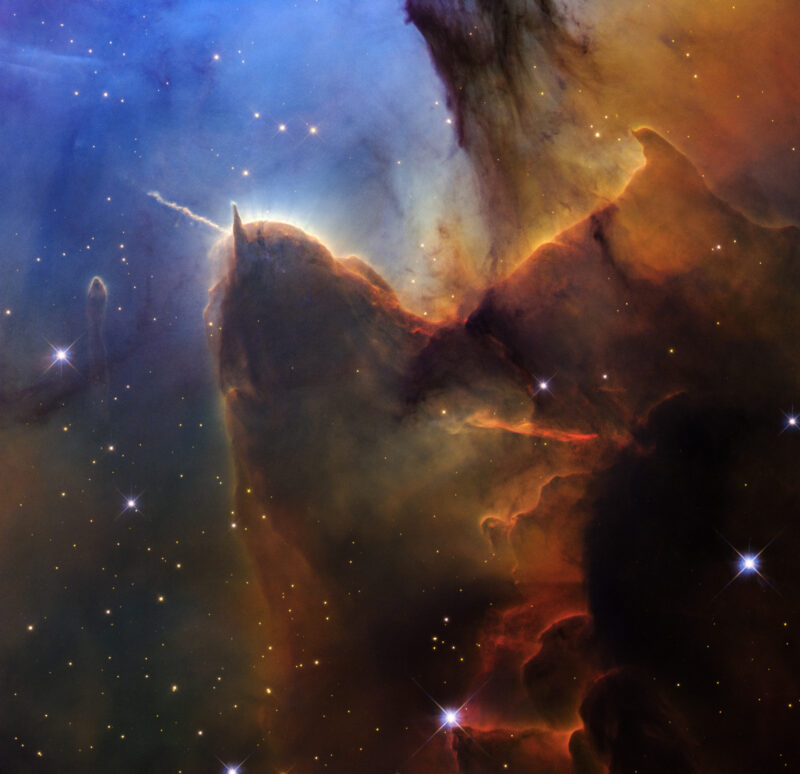
NASA celebrates Hubble’s 36th anniversary with a new image of the Trifid Nebula, a star-forming region it first captured in 1997. Watch a video below to see how the nebula has changed over in time. Image via NASA/ ESA/ STScI. Image Processing: Joseph DePasquale (STScI)
The Hubble Space Telescope is celebrating its 36th anniversary. The telescope launched to space on April 24, 1990.
To celebrate, NASA released a new image of the Trifid Nebula. The Trifid Nebula is a star-forming region in the Milky Way in the direction of Sagittarius.
The Trifid Nebula has changed since Hubble first imaged it. See the changes to the nebula in a video here.
The Trifid Nebula highlights Hubble’s 36 anniversary
Today, April 24, marks the 36th anniversary of the Hubble Space Telescope‘s launch! For the anniversary, Hubble captured this shimmering region of star-formation – a close-up of the Trifid Nebula about 5,000 light-years from Earth – in intricate detail. The colors in this visible light image are reminiscent of an underwater scene filled with fine-grained sediments fluttering through the ocean’s depths.
Several massive stars, which are outside this field of view, have shaped this region for at least 300,000 years. Their powerful winds continue to blow an enormous bubble. And a small portion of that bubble is showcased in the image here. The winds push and compress the cloud’s gas and dust, triggering new waves of star formation.
This isn’t the first time Hubble has gazed at this scene. The telescope observed the Trifid in 1997. And now, 29 years later, it has leveraged almost its full operational lifetime to show us changes in the nebula on human time scales. Why look at the same location again? In addition to seeing changes over time, Hubble is also equipped with an improved camera with a wider field of view and greater sensitivity that was installed during Servicing Mission 4 in 2009.
See the nebula change over time
Watch this video to see the Trifid Nebula change over time.
Bottom line: It’s the Hubble Space Telescope’s 36th anniversary! To celebrate, NASA has released an image of the iconic Trifid Nebula.
NASA celebrates Hubble’s 36th anniversary with a new image of the Trifid Nebula, a star-forming region it first captured in 1997. Watch a video below to see how the nebula has changed over in time. Image via NASA/ ESA/ STScI. Image Processing: Joseph DePasquale (STScI)
The Hubble Space Telescope is celebrating its 36th anniversary. The telescope launched to space on April 24, 1990.
To celebrate, NASA released a new image of the Trifid Nebula. The Trifid Nebula is a star-forming region in the Milky Way in the direction of Sagittarius.
The Trifid Nebula has changed since Hubble first imaged it. See the changes to the nebula in a video here.
The Trifid Nebula highlights Hubble’s 36 anniversary
Today, April 24, marks the 36th anniversary of the Hubble Space Telescope‘s launch! For the anniversary, Hubble captured this shimmering region of star-formation – a close-up of the Trifid Nebula about 5,000 light-years from Earth – in intricate detail. The colors in this visible light image are reminiscent of an underwater scene filled with fine-grained sediments fluttering through the ocean’s depths.
Several massive stars, which are outside this field of view, have shaped this region for at least 300,000 years. Their powerful winds continue to blow an enormous bubble. And a small portion of that bubble is showcased in the image here. The winds push and compress the cloud’s gas and dust, triggering new waves of star formation.
This isn’t the first time Hubble has gazed at this scene. The telescope observed the Trifid in 1997. And now, 29 years later, it has leveraged almost its full operational lifetime to show us changes in the nebula on human time scales. Why look at the same location again? In addition to seeing changes over time, Hubble is also equipped with an improved camera with a wider field of view and greater sensitivity that was installed during Servicing Mission 4 in 2009.
See the nebula change over time
Watch this video to see the Trifid Nebula change over time.
Bottom line: It’s the Hubble Space Telescope’s 36th anniversary! To celebrate, NASA has released an image of the iconic Trifid Nebula.
The LA County Natural History Museum’s 2026 City Nature Challenge runs now through Monday, April 27, 2026. The goal is to collect images of wildlife in local neighborhoods around the world. To join in, visit the 2026 City Nature Challenge page. Image via fauxels/ Pexels.
This is your global invitation to go exploring at home
The LA County Natural History Museum wants the entire world to go outside and have a good look around this weekend. They’d like us all to take a close gander at the biosphere in our neighborhoods. And they want us record what we find from now through Monday, April 27, 2026.
This annual event isn’t just a great opportunity to experience wildlife at home. Indeed, it’s also a chance to provide critical scientific data about our ever-changing biosphere. From the City Nature Challenge website:
The City Nature Challenge is an international effort to document nature in cities. The global event calls on current and aspiring community scientists, nature and science fans, and people of all ages and backgrounds to get outside and observe and submit pictures of wild plants, animals, and fungi during the Challenge dates in order to help scientists track real-time changes in our planet’s biodiversity and better understand wildlife conservation.
Wildlife only, please!
We’re sure your lawn and landscaping are no doubt lovely. But this event is about observing and recording the wild things that call the world immediately around you their home.
So here’s what the folks at the museum would like to know:
What can you find in your house?
What can you see through your windows?
And what are the wild plants growing in your backyard? (Weeds count!)
What insects or other creatures are using the cultivated plants in your backyard as a habitat or a food source?
What observations can you make along the sidewalk in front of your house or apartment complex? (Always be mindful of traffic and safety.)
Even though you don’t even have to go outside to participate, the museum suggests going for a walk. Or venture into the weeds and visit your local park. And remember to look up in the trees, underneath everything. That means getting low to see what’s creeping and crawling down there.
Pics or it didn’t happen!
Of course, recording your adventures in pictures and sharing them is the most important part of the challenge. Thankfully, iNaturalist.org makes that really simple.
Here’s how to join in from the challenge website:
Step 1: Find wildlife anywhere in LA County. (Or your local area).
Step 2: Take photos of WILD** plants and animals.
Step 3: Share your observations in the iNaturalist app. If it’s planted or taken care of by people it is not WILD. Mark it captive/cultivated!
Step 4: Learn more as your finds get identified.
**Wild means not captive or cultivated. Try not to take pictures of captive animals in zoos or aquaria and cultivated plants in your garden or at a nursery.
By the way, we’d love to see and share your images of nature too. Check out EarthSky Community Photos to find out more.
Bottom line: This weekend, April 24-27, 2026, join the global City Nature Challenge and record the biosphere in your neighborhood to help track real-time change.
The LA County Natural History Museum’s 2026 City Nature Challenge runs now through Monday, April 27, 2026. The goal is to collect images of wildlife in local neighborhoods around the world. To join in, visit the 2026 City Nature Challenge page. Image via fauxels/ Pexels.
This is your global invitation to go exploring at home
The LA County Natural History Museum wants the entire world to go outside and have a good look around this weekend. They’d like us all to take a close gander at the biosphere in our neighborhoods. And they want us record what we find from now through Monday, April 27, 2026.
This annual event isn’t just a great opportunity to experience wildlife at home. Indeed, it’s also a chance to provide critical scientific data about our ever-changing biosphere. From the City Nature Challenge website:
The City Nature Challenge is an international effort to document nature in cities. The global event calls on current and aspiring community scientists, nature and science fans, and people of all ages and backgrounds to get outside and observe and submit pictures of wild plants, animals, and fungi during the Challenge dates in order to help scientists track real-time changes in our planet’s biodiversity and better understand wildlife conservation.
Wildlife only, please!
We’re sure your lawn and landscaping are no doubt lovely. But this event is about observing and recording the wild things that call the world immediately around you their home.
So here’s what the folks at the museum would like to know:
What can you find in your house?
What can you see through your windows?
And what are the wild plants growing in your backyard? (Weeds count!)
What insects or other creatures are using the cultivated plants in your backyard as a habitat or a food source?
What observations can you make along the sidewalk in front of your house or apartment complex? (Always be mindful of traffic and safety.)
Even though you don’t even have to go outside to participate, the museum suggests going for a walk. Or venture into the weeds and visit your local park. And remember to look up in the trees, underneath everything. That means getting low to see what’s creeping and crawling down there.
Pics or it didn’t happen!
Of course, recording your adventures in pictures and sharing them is the most important part of the challenge. Thankfully, iNaturalist.org makes that really simple.
Here’s how to join in from the challenge website:
Step 1: Find wildlife anywhere in LA County. (Or your local area).
Step 2: Take photos of WILD** plants and animals.
Step 3: Share your observations in the iNaturalist app. If it’s planted or taken care of by people it is not WILD. Mark it captive/cultivated!
Step 4: Learn more as your finds get identified.
**Wild means not captive or cultivated. Try not to take pictures of captive animals in zoos or aquaria and cultivated plants in your garden or at a nursery.
By the way, we’d love to see and share your images of nature too. Check out EarthSky Community Photos to find out more.
Bottom line: This weekend, April 24-27, 2026, join the global City Nature Challenge and record the biosphere in your neighborhood to help track real-time change.
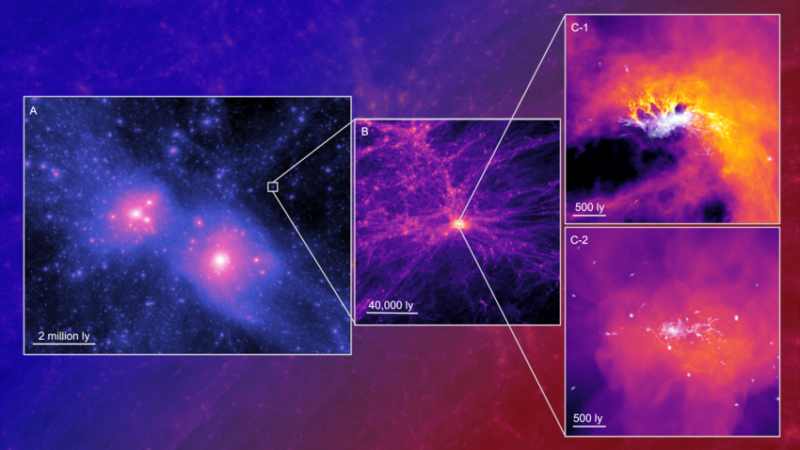
Figure A shows a dark matter map in our neighborhood of the universe. The 2 blobs are dark matter halos of the Milky Way and Andromeda galaxies. Figure B zooms in to show a small dark matter clump about 700 million years after the Big Bang. Then C-1 and C-2 are stars and gas in the simulated ultra-faint dwarf galaxy. These show different radiation levels shortly after the Big Bang. Ultra-faint dwarf galaxies change their properties depending on which radiation is used. The scale on each image is in units of light-years. Image via Royal Astronomical Society/ J Sureda/ A Fattahi/ S Brown/ S Avraham. Attribution (CC BY 4.0).
Ultra-faint dwarf galaxies – tiny satellites of the Milky Way – act as cosmic fossils. They preserve clues about radiation and star formation in the early universe.
New high-resolution simulations show these faint galaxies are extremely sensitive to early-universe conditions. Those conditions determined whether small dark matter halos formed stars or stayed dark.
Future observations from the Vera C. Rubin Observatory could use these galaxies to reconstruct the universe’s earliest climate.
Ultra-faint dwarf galaxies show state of the early universe
Ultra-faint dwarf galaxies – tiny satellite galaxies orbiting the Milky Way – have long been seen as cosmic fossils.
Now, a new study published April 24, 2026, in Monthly Notices of the Royal Astronomical Society uses an unprecedented set of simulations to show just how powerfully these faint systems can reflect the conditions of the early universe. And it tells us why some galaxies grew and others did not.
These little galaxies could also reveal what the universe’s earliest ‘climate’ was like. For example, it could show the level of radiation and how this impacted whether and where stars formed.
Astronomers often describe dwarf galaxies as small cousins of the Milky Way. They form in small dark matter halos predicted by the standard model of cosmology. The faintest examples of such systems are extreme in both size and fragility. And they lie on the boundary of our knowledge about galaxy formation and dark matter.
Simulating tiny galaxies
Associate professor Azadeh Fattahi, of the Oskar Klein Centre (OKC) in Stockholm, led the new study with the LYRA collaboration and in collaboration with Durham University and the University of Hawaii. Fattahi said:
In this work we presented a brand-new suite of cosmological simulations focused on the faintest galaxies in the universe, with an unprecedented resolution. These are by far the largest sample of such galaxies ever simulated at these resolutions. The smallest galaxies are called ultra-faint dwarf galaxies, which are a million times less massive than the Milky Way or even smaller. Due to their small size these galaxies have proven very difficult to model and simulate.
This new simulation suite represents a major step forward, enabling a systematic view of how these galaxies form and evolve.
A down-to-earth analogy
Shaun Brown led the study while working at OKC and Durham University. Brown said:
A useful analogy is to plants and crops and how they grow is sensitive to the weather conditions. In the same way that the yield of a crop in summer can indirectly tell you a lot about what the weather in spring must have been like, the properties of faint dwarf galaxies today can tell us a lot about the conditions, or weather, of the universe at a much earlier time.
What makes the results especially timely is that the simulations do more than reproduce faint dwarf galaxies. They suggest that these local objects can act as a probe of the universe’s earliest ‘climate’. The team explored how different assumptions about the early radiation environment influence which small dark matter haloes manage to form stars at all. Brown explained:
In the paper we studied two different assumptions about the properties of the early universe when it was less than 500 million years old, to understand the effect on the properties of these small galaxies today when the universe is 13 billion years old. We found that these small ultra-faint galaxies are very sensitive to these changes, while more massive galaxies, like our Milky Way, don’t really care.
For the smallest galaxies, early conditions can decide whether they become visible galaxies or remain starless dark matter halos.
Future research
That sensitivity opens a clear path to testing early-universe physics with upcoming observations. Fattahi said:
Excitingly, in the near future we will have data from the Vera C. Rubin Observatory which will be able to find many more of these ultra faint dwarfs around the Milky Way.
Many astronomers hope Rubin can deliver a near-complete census of Milky Way satellite galaxies. And these simulations hint that this census may carry information far beyond our local neighborhood. Fattahi added:
Our work suggests that these upcoming observations of the very local universe will be able to constrain what the universe at its infancy looked like, something we currently cannot directly access with other observations.
The result is particularly relevant in the light of recent discoveries, by the James Webb Space Telescope, of galaxies in the early universe. Some of those galaxies are unexpectedly massive and bright.
If the early universe is producing surprises at large distances, then local relics from the same epoch – ultra-faint dwarfs – may provide an additional route to understanding what happened, according to Dr Fattahi.
Looking ahead, Dr Fattahi’s team plans to tackle questions that are still open in modern galaxy and structure formation. For example, where did the very first generation of stars form in the universe? Or what do the properties of ultra-faint dwarf galaxies tell us about the nature of dark matter?
Bottom line: Ultra-faint dwarf galaxies preserve clues to early-universe conditions, acting as cosmic fossils. Simulations show early radiation shaped whether these tiny galaxies formed stars or stayed dark.
Figure A shows a dark matter map in our neighborhood of the universe. The 2 blobs are dark matter halos of the Milky Way and Andromeda galaxies. Figure B zooms in to show a small dark matter clump about 700 million years after the Big Bang. Then C-1 and C-2 are stars and gas in the simulated ultra-faint dwarf galaxy. These show different radiation levels shortly after the Big Bang. Ultra-faint dwarf galaxies change their properties depending on which radiation is used. The scale on each image is in units of light-years. Image via Royal Astronomical Society/ J Sureda/ A Fattahi/ S Brown/ S Avraham. Attribution (CC BY 4.0).
Ultra-faint dwarf galaxies – tiny satellites of the Milky Way – act as cosmic fossils. They preserve clues about radiation and star formation in the early universe.
New high-resolution simulations show these faint galaxies are extremely sensitive to early-universe conditions. Those conditions determined whether small dark matter halos formed stars or stayed dark.
Future observations from the Vera C. Rubin Observatory could use these galaxies to reconstruct the universe’s earliest climate.
Ultra-faint dwarf galaxies show state of the early universe
Ultra-faint dwarf galaxies – tiny satellite galaxies orbiting the Milky Way – have long been seen as cosmic fossils.
Now, a new study published April 24, 2026, in Monthly Notices of the Royal Astronomical Society uses an unprecedented set of simulations to show just how powerfully these faint systems can reflect the conditions of the early universe. And it tells us why some galaxies grew and others did not.
These little galaxies could also reveal what the universe’s earliest ‘climate’ was like. For example, it could show the level of radiation and how this impacted whether and where stars formed.
Astronomers often describe dwarf galaxies as small cousins of the Milky Way. They form in small dark matter halos predicted by the standard model of cosmology. The faintest examples of such systems are extreme in both size and fragility. And they lie on the boundary of our knowledge about galaxy formation and dark matter.
Simulating tiny galaxies
Associate professor Azadeh Fattahi, of the Oskar Klein Centre (OKC) in Stockholm, led the new study with the LYRA collaboration and in collaboration with Durham University and the University of Hawaii. Fattahi said:
In this work we presented a brand-new suite of cosmological simulations focused on the faintest galaxies in the universe, with an unprecedented resolution. These are by far the largest sample of such galaxies ever simulated at these resolutions. The smallest galaxies are called ultra-faint dwarf galaxies, which are a million times less massive than the Milky Way or even smaller. Due to their small size these galaxies have proven very difficult to model and simulate.
This new simulation suite represents a major step forward, enabling a systematic view of how these galaxies form and evolve.
A down-to-earth analogy
Shaun Brown led the study while working at OKC and Durham University. Brown said:
A useful analogy is to plants and crops and how they grow is sensitive to the weather conditions. In the same way that the yield of a crop in summer can indirectly tell you a lot about what the weather in spring must have been like, the properties of faint dwarf galaxies today can tell us a lot about the conditions, or weather, of the universe at a much earlier time.
What makes the results especially timely is that the simulations do more than reproduce faint dwarf galaxies. They suggest that these local objects can act as a probe of the universe’s earliest ‘climate’. The team explored how different assumptions about the early radiation environment influence which small dark matter haloes manage to form stars at all. Brown explained:
In the paper we studied two different assumptions about the properties of the early universe when it was less than 500 million years old, to understand the effect on the properties of these small galaxies today when the universe is 13 billion years old. We found that these small ultra-faint galaxies are very sensitive to these changes, while more massive galaxies, like our Milky Way, don’t really care.
For the smallest galaxies, early conditions can decide whether they become visible galaxies or remain starless dark matter halos.
Future research
That sensitivity opens a clear path to testing early-universe physics with upcoming observations. Fattahi said:
Excitingly, in the near future we will have data from the Vera C. Rubin Observatory which will be able to find many more of these ultra faint dwarfs around the Milky Way.
Many astronomers hope Rubin can deliver a near-complete census of Milky Way satellite galaxies. And these simulations hint that this census may carry information far beyond our local neighborhood. Fattahi added:
Our work suggests that these upcoming observations of the very local universe will be able to constrain what the universe at its infancy looked like, something we currently cannot directly access with other observations.
The result is particularly relevant in the light of recent discoveries, by the James Webb Space Telescope, of galaxies in the early universe. Some of those galaxies are unexpectedly massive and bright.
If the early universe is producing surprises at large distances, then local relics from the same epoch – ultra-faint dwarfs – may provide an additional route to understanding what happened, according to Dr Fattahi.
Looking ahead, Dr Fattahi’s team plans to tackle questions that are still open in modern galaxy and structure formation. For example, where did the very first generation of stars form in the universe? Or what do the properties of ultra-faint dwarf galaxies tell us about the nature of dark matter?
Bottom line: Ultra-faint dwarf galaxies preserve clues to early-universe conditions, acting as cosmic fossils. Simulations show early radiation shaped whether these tiny galaxies formed stars or stayed dark.
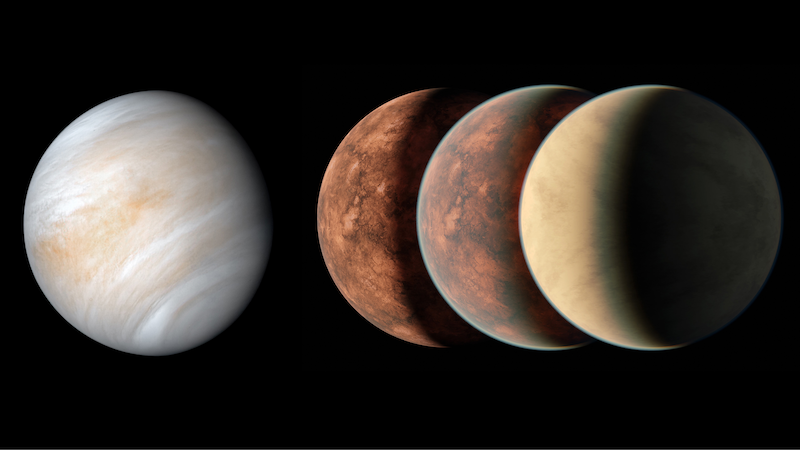
View larger. | This image compares Venus (left) with 3 possible atmospheres for Gliese 12 b, an exoplanet that’s 40 light-years away. Venus is now a hot and arid planet, despite the fact that it possibly started off with a similar amount of water as Earth. A new study questions how much water on exoplanets life would require. Image via NASA/ JPL-Caltech/ R. Hurt (Caltech-IPAC)/ University of Washington.
Life as we know it needs water to exist. But how much water does an exoplanet need to be habitable in the long term?
More water than previously thought is the answer suggested by a new study.
At least 20 to 50% of the water on Earth would be required. Otherwise, the planet might start losing water on its surface and become arid.
How much water does an exoplanet need to stay habitable?
Astronomers consider water to be essential for life as we know it to form on a given planet. But, unfortunately, not all watery worlds stay watery. Venus, according to some studies, once had as much water as Earth does … but is now scorching hot, arid, and lifeless.
A new study from researchers at the University of Washington in Seattle suggests that Venus starting out with slightly less water than Earth could have made all the difference. The researchers said on April 15, 2026, that this lack of water could have destabilized the cycle of carbon between the planet’s atmosphere and interior. This would have caused carbon dioxide to build up in the air, raising temperatures and causing more water to evaporate.
So how much water does a world need to stay habitable? The study suggests that a rocky Earth-sized planet would need at least 20 to 50% of the water in Earth’s oceans to avoid this fate. That should be enough to maintain the crucial carbon cycle, keeping water on the surface long enough to potentially give water-based life time to develop.
This applies to planets in the habitable zone of their stars in particular. That’s the region where temperatures could allow liquid water to exist to begin with.
Scientists have long focused on the habitable zone around stars in the search for life. That’s because this is where liquid water could exist on rocky planets. But that depends on other factors, too, such as the composition of the atmosphere (if there is one) and the planet itself. White-Gianella said:
When you are searching for life in the broad landscape of the universe with limited resources, you have to filter out some planets.
Carbon Cycle Imbalances on Arid Terrestrial Planets with Implications for Venus: iopscience.iop.org/article/10.3… -> Planets need more water to support life than scientists previously thought: https://ift.tt/ZBa4izS…
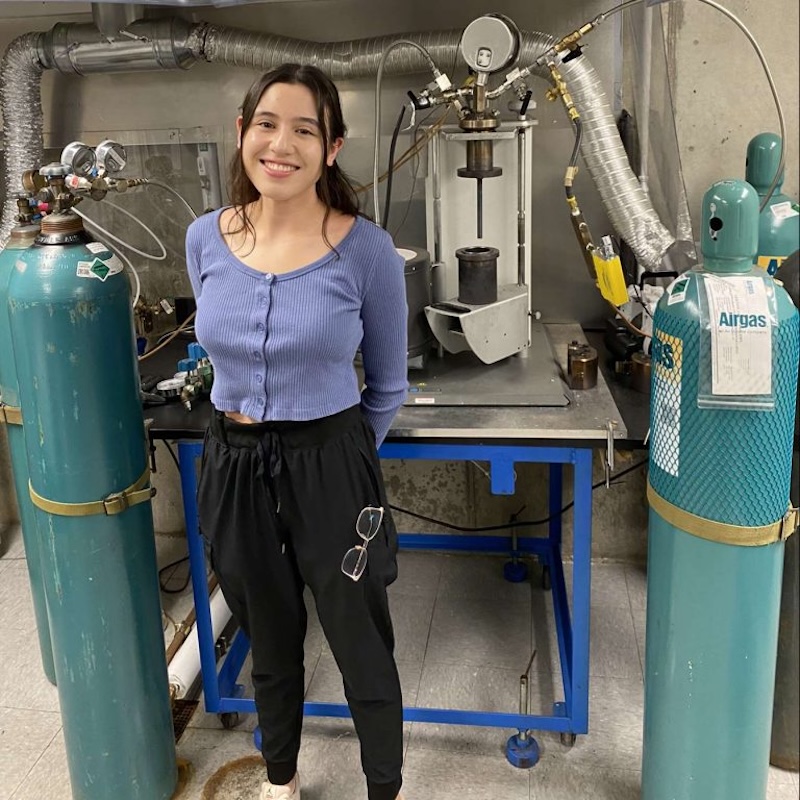
To try to determine how much water a planet needs to be habitable, the study focused on arid planets that likely only have a little water. White-Gianella explained:
We were interested in arid planets with very limited surface water inventory, far less than one Earth ocean. Many of these planets are in the habitable zone of their star, but we weren’t sure if they could actually be habitable.
The carbon cycle
Since some of those planets are in the habitable zone, could they be habitable even with less water?
The researchers found that it depends on something called the carbon cycle. This cycle, driven by water, exchanges carbon between the atmosphere and interior of the planet, over millions of years. This process helps stabilize temperatures on the surface of the planet.
How does it work? Volcanoes emit carbon dioxide. The carbon dioxide accumulates in the atmosphere. Eventually it falls back to Earth in rain. Subsequently, the rain erodes and chemically reacts with rocks. The runoff in rivers brings the carbon back to the ocean, where it sinks down to the seafloor. Carbon-rich oceanic plates then move below the continental plates. Finally, millions of years later, the carbon comes back up to the surface in the form of mountains.
Low water levels
But there’s a catch. What if water levels drop too low for rainfall to occur? The carbon removal segment of the cycle – erosion by rain – can no longer keep up with carbon emissions from volcanoes. As a result, carbon dioxide builds up in the atmosphere. And this could create a runaway greenhouse effect, with temperatures becoming too hot to sustain life. This is what scientists say happened with Venus. As White-Gianella noted:
So that, unfortunately, makes these arid planets within habitable zones unlikely to be good candidates for life.
Krissanen-Totton said:
This has implications for a lot of the potentially habitable real estate out there.
The new carbon model of the study, focusing on arid planets, is an update to previous models. Those models focused more on water and cooler planets. They included factors such as evaporation from sunlight. But they neglected other factors, such as wind. Krissanen-Totton explained:
These sophisticated, mechanistic models of the carbon cycle have emerged from people trying to understand how Earth’s thermostat has worked – or hasn’t – to regulate temperature through time.
The new results show that even if a planet starts out with lots of surface water, it can lose it later on if the carbon cycle is interrupted.
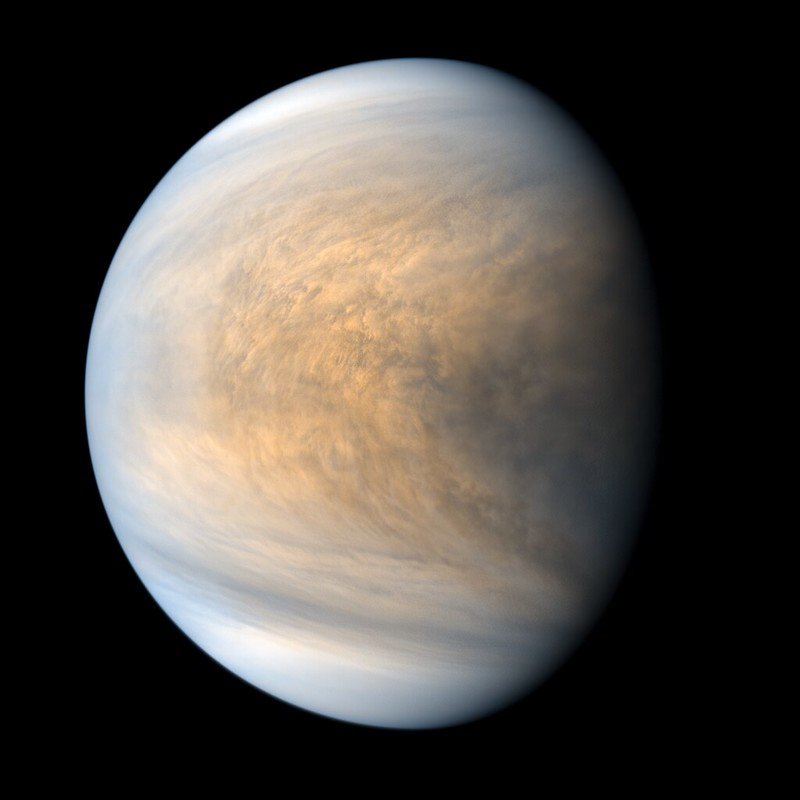
View larger. | Japan’s Akatsuki (Venus Climate Orbiter) spacecraft captured this view of Venus on October 24, 2018. Venus is a good analog for exoplanets that lose their water and become arid and inhospitable to life on their surfaces. Image via JAXA/ ISAS/ DARTS/ Kevin M. Gill (CC BY 2.0).
Venus as an exoplanet analog
We already know of one such planet, and it’s in our own solar system: Venus. Scientists think Venus once had much more water, maybe even oceans. But Venus has since lost that water. Why?
Today, Venus is scorching hot on its surface, too hot for life. The dense carbon dioxide atmosphere traps heat so it can’t escape.
The researchers in the new study suggest that Venus might have had slightly less water than Earth early on. This caused an imbalance in the carbon cycle. And as the carbon dioxide accumulated in the atmosphere, the temperature kept rising.
Venus is a good analog for the kinds of exoplanets the researchers studied. As White-Gianella noted:
It’s very unlikely that we will land something on the surface of an exoplanet in our lifetime, but Venus – our next-door neighbor – is arguably the best exoplanet analog.
Speaking of Venus, another study, from 2025, suggests that Venus actually has more water in its atmosphere than previously thought. It’s still fire and brimstone on the surface, but perhaps this water could help sustain microbes that scientists have postulated could survive higher up in the atmosphere.
Bottom line: How much water on exoplanets does life need? A new study suggests at least 20 to 50% of the water on Earth.
View larger. | This image compares Venus (left) with 3 possible atmospheres for Gliese 12 b, an exoplanet that’s 40 light-years away. Venus is now a hot and arid planet, despite the fact that it possibly started off with a similar amount of water as Earth. A new study questions how much water on exoplanets life would require. Image via NASA/ JPL-Caltech/ R. Hurt (Caltech-IPAC)/ University of Washington.
Life as we know it needs water to exist. But how much water does an exoplanet need to be habitable in the long term?
More water than previously thought is the answer suggested by a new study.
At least 20 to 50% of the water on Earth would be required. Otherwise, the planet might start losing water on its surface and become arid.
How much water does an exoplanet need to stay habitable?
Astronomers consider water to be essential for life as we know it to form on a given planet. But, unfortunately, not all watery worlds stay watery. Venus, according to some studies, once had as much water as Earth does … but is now scorching hot, arid, and lifeless.
A new study from researchers at the University of Washington in Seattle suggests that Venus starting out with slightly less water than Earth could have made all the difference. The researchers said on April 15, 2026, that this lack of water could have destabilized the cycle of carbon between the planet’s atmosphere and interior. This would have caused carbon dioxide to build up in the air, raising temperatures and causing more water to evaporate.
So how much water does a world need to stay habitable? The study suggests that a rocky Earth-sized planet would need at least 20 to 50% of the water in Earth’s oceans to avoid this fate. That should be enough to maintain the crucial carbon cycle, keeping water on the surface long enough to potentially give water-based life time to develop.
This applies to planets in the habitable zone of their stars in particular. That’s the region where temperatures could allow liquid water to exist to begin with.
Scientists have long focused on the habitable zone around stars in the search for life. That’s because this is where liquid water could exist on rocky planets. But that depends on other factors, too, such as the composition of the atmosphere (if there is one) and the planet itself. White-Gianella said:
When you are searching for life in the broad landscape of the universe with limited resources, you have to filter out some planets.
Carbon Cycle Imbalances on Arid Terrestrial Planets with Implications for Venus: iopscience.iop.org/article/10.3… -> Planets need more water to support life than scientists previously thought: https://ift.tt/ZBa4izS…
To try to determine how much water a planet needs to be habitable, the study focused on arid planets that likely only have a little water. White-Gianella explained:
We were interested in arid planets with very limited surface water inventory, far less than one Earth ocean. Many of these planets are in the habitable zone of their star, but we weren’t sure if they could actually be habitable.
The carbon cycle
Since some of those planets are in the habitable zone, could they be habitable even with less water?
The researchers found that it depends on something called the carbon cycle. This cycle, driven by water, exchanges carbon between the atmosphere and interior of the planet, over millions of years. This process helps stabilize temperatures on the surface of the planet.
How does it work? Volcanoes emit carbon dioxide. The carbon dioxide accumulates in the atmosphere. Eventually it falls back to Earth in rain. Subsequently, the rain erodes and chemically reacts with rocks. The runoff in rivers brings the carbon back to the ocean, where it sinks down to the seafloor. Carbon-rich oceanic plates then move below the continental plates. Finally, millions of years later, the carbon comes back up to the surface in the form of mountains.
Low water levels
But there’s a catch. What if water levels drop too low for rainfall to occur? The carbon removal segment of the cycle – erosion by rain – can no longer keep up with carbon emissions from volcanoes. As a result, carbon dioxide builds up in the atmosphere. And this could create a runaway greenhouse effect, with temperatures becoming too hot to sustain life. This is what scientists say happened with Venus. As White-Gianella noted:
So that, unfortunately, makes these arid planets within habitable zones unlikely to be good candidates for life.
Krissanen-Totton said:
This has implications for a lot of the potentially habitable real estate out there.
The new carbon model of the study, focusing on arid planets, is an update to previous models. Those models focused more on water and cooler planets. They included factors such as evaporation from sunlight. But they neglected other factors, such as wind. Krissanen-Totton explained:
These sophisticated, mechanistic models of the carbon cycle have emerged from people trying to understand how Earth’s thermostat has worked – or hasn’t – to regulate temperature through time.
The new results show that even if a planet starts out with lots of surface water, it can lose it later on if the carbon cycle is interrupted.
View larger. | Japan’s Akatsuki (Venus Climate Orbiter) spacecraft captured this view of Venus on October 24, 2018. Venus is a good analog for exoplanets that lose their water and become arid and inhospitable to life on their surfaces. Image via JAXA/ ISAS/ DARTS/ Kevin M. Gill (CC BY 2.0).
Venus as an exoplanet analog
We already know of one such planet, and it’s in our own solar system: Venus. Scientists think Venus once had much more water, maybe even oceans. But Venus has since lost that water. Why?
Today, Venus is scorching hot on its surface, too hot for life. The dense carbon dioxide atmosphere traps heat so it can’t escape.
The researchers in the new study suggest that Venus might have had slightly less water than Earth early on. This caused an imbalance in the carbon cycle. And as the carbon dioxide accumulated in the atmosphere, the temperature kept rising.
Venus is a good analog for the kinds of exoplanets the researchers studied. As White-Gianella noted:
It’s very unlikely that we will land something on the surface of an exoplanet in our lifetime, but Venus – our next-door neighbor – is arguably the best exoplanet analog.
Speaking of Venus, another study, from 2025, suggests that Venus actually has more water in its atmosphere than previously thought. It’s still fire and brimstone on the surface, but perhaps this water could help sustain microbes that scientists have postulated could survive higher up in the atmosphere.
Bottom line: How much water on exoplanets does life need? A new study suggests at least 20 to 50% of the water on Earth.
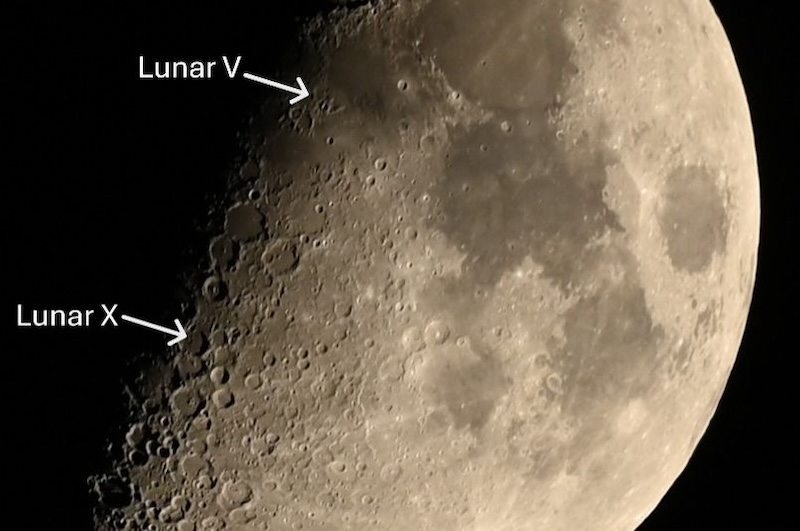
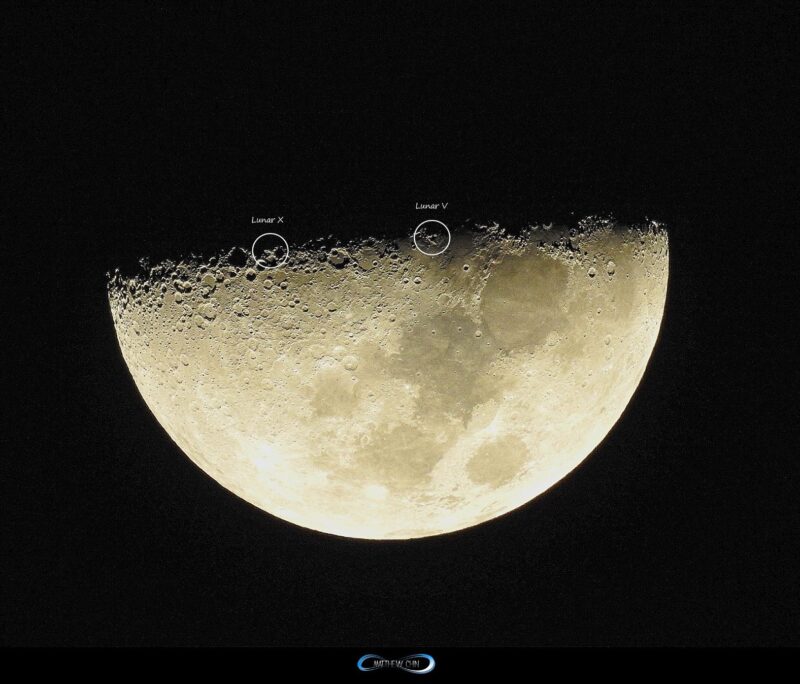
View at EarthSky Community Photos. | Frank Lu of Texas captured this image on February 5, 2025, and wrote: “Inspired by Deborah Byrd’s article in EarthSky’s Astronomy Essentials, I went out looking for the Lunar X and Lunar V on this 1st-quarter moon. I’m extremely pleased to find them.” Thank you, Frank!
Tonight’s 1st quarter moon is a perfect time to look for the Lunar X and V. It occurs overnight tonight at 2:32 UTC on April 24. So take a look!
Have you heard of Lunar X and Lunar V? They are famous optical features on the moon, visible through telescopes. So, when the moon’s terminator – or line between light and dark on the moon – is located in just the right place, you can see a letter X and a letter V on the moon’s surface. Are they a sign of an alien visitation? No. Rather, Lunar X is a great example of how lighting and topography can combine on a planet or moon to produce a pattern that seems familiar to the human eye.
In reality, the illusion of Lunar X is created by sunlight falling on the rims/ridges between the craters La Caille, Bianchini and Purbach. And the V is caused by light illuminating crater Ukert, along with several smaller craters.
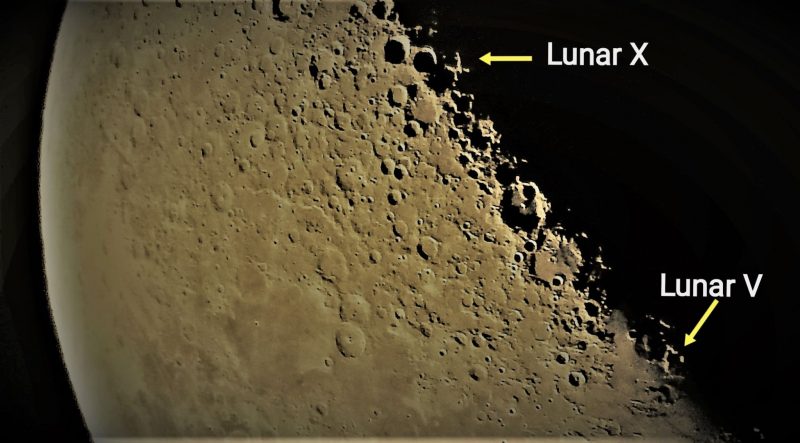
View at EarthSky Community Photos. | Kannan A in Singapore wrote on April 19, 2021: “Upon a close look at the moon tonight, I realized that the Lunar X and Lunar V were clearly visible. These are transient lunar features visible on the lunar surface for about 4 hours once a month. They are most striking when they are visible on the shadow side of the terminator. But they will remain visible against the lunar surface even after the terminator has moved because they are brighter than the surrounding area.” Thank you, Kannan!
When are they visible?
Basically, people see Lunar X and Lunar V at each cycle of the moon, but only for a short time. In fact, they’re observable for about four hours around the 1st quarter moon phase.
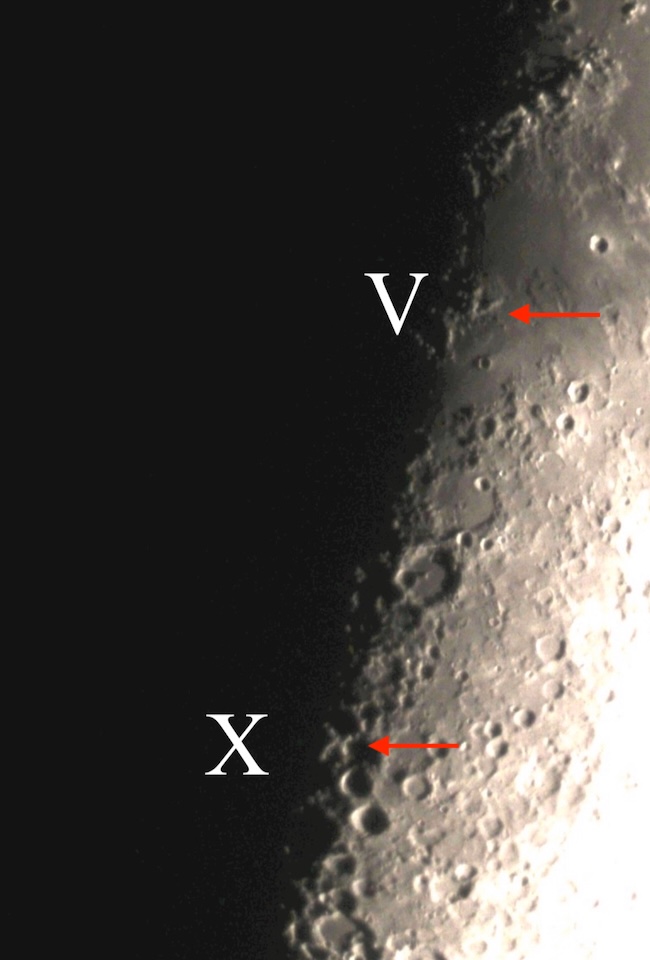
View at EarthSky Community Photo. | Greg Redfern captured this image from Virginia on July 2, 2025, and wrote: “The lunar X & V showed up last night in great splendor … what a treat to see and image.” Thank you, Greg!View at EarthSky Community Photos. | Matthew Chin from Hong Kong, China, shared this image of the moon, where Lunar X and Lunar V are visible, on January 18, 2024. Thank you, Matthew!
Bottom line: Lunar X and Lunar V are optical features on the moon. They are visible through a telescope for several hours around the time of the 1st quarter moon.
View at EarthSky Community Photos. | Frank Lu of Texas captured this image on February 5, 2025, and wrote: “Inspired by Deborah Byrd’s article in EarthSky’s Astronomy Essentials, I went out looking for the Lunar X and Lunar V on this 1st-quarter moon. I’m extremely pleased to find them.” Thank you, Frank!
Tonight’s 1st quarter moon is a perfect time to look for the Lunar X and V. It occurs overnight tonight at 2:32 UTC on April 24. So take a look!
Have you heard of Lunar X and Lunar V? They are famous optical features on the moon, visible through telescopes. So, when the moon’s terminator – or line between light and dark on the moon – is located in just the right place, you can see a letter X and a letter V on the moon’s surface. Are they a sign of an alien visitation? No. Rather, Lunar X is a great example of how lighting and topography can combine on a planet or moon to produce a pattern that seems familiar to the human eye.
In reality, the illusion of Lunar X is created by sunlight falling on the rims/ridges between the craters La Caille, Bianchini and Purbach. And the V is caused by light illuminating crater Ukert, along with several smaller craters.
View at EarthSky Community Photos. | Kannan A in Singapore wrote on April 19, 2021: “Upon a close look at the moon tonight, I realized that the Lunar X and Lunar V were clearly visible. These are transient lunar features visible on the lunar surface for about 4 hours once a month. They are most striking when they are visible on the shadow side of the terminator. But they will remain visible against the lunar surface even after the terminator has moved because they are brighter than the surrounding area.” Thank you, Kannan!
When are they visible?
Basically, people see Lunar X and Lunar V at each cycle of the moon, but only for a short time. In fact, they’re observable for about four hours around the 1st quarter moon phase.
View at EarthSky Community Photo. | Greg Redfern captured this image from Virginia on July 2, 2025, and wrote: “The lunar X & V showed up last night in great splendor … what a treat to see and image.” Thank you, Greg!View at EarthSky Community Photos. | Matthew Chin from Hong Kong, China, shared this image of the moon, where Lunar X and Lunar V are visible, on January 18, 2024. Thank you, Matthew!
Bottom line: Lunar X and Lunar V are optical features on the moon. They are visible through a telescope for several hours around the time of the 1st quarter moon.
On Earth, nothing could feel as familiar as the passing of our seasons. And our days are steady, too — 24 hours, over and over, all our lives. But not so on Mars. Different world, just one step outward from Earth. Same laws of nature … but alien all the same. In this livestream, EarthSky’s Deborah Byrd explores the seasons on the Red Planet — and how even small differences in time and orbit can reshape our perception of a world. Watch in the player above or on YouTube.
Summer solstice in Mars’ southern hemisphere
Earth’s next solstice will fall at 8:25 UTC on June 21, 2026. It’ll be a summer solstice for the Northern Hemisphere (and a winter solstice for the Southern Hemisphere). It’ll happen when Earth’s south pole is tilted most toward the sun.
Like Earth, Mars tilts on its axis with respect to its orbit around the sun. It tilts by about 25 degrees, in contrast to Earth’s 23.5 degrees. So Mars has equinoxes and solstices as well. And Mars’ summer solstice for its southern hemisphere arrives on April 25, 2026.
Like Earth, Mars has 4 seasons
Mars takes 687 Earth-days to orbit the sun once. That’s almost 2 Earth-years. So each season on Mars – winter, spring, summer, fall – lasts roughly twice as long as a season on Earth.
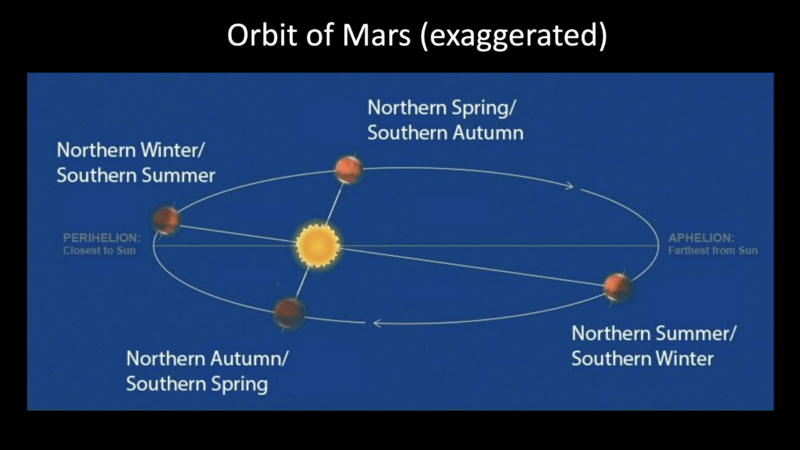
And, meanwhile, although the image below is exaggerated, the orbit of Mars is more squashed than that of Earth. Astronomers say it’s more elliptical. Mars is farther from the sun during southern winter … and closer during southern summer. So the Mars southern hemisphere has shorter, hotter, more extreme seasons.
So – now, in April 2026, as Mars’ northern hemisphere of is tipping into the deepest part of winter – its southern hemisphere is celebrating summer. Of course, nothing is blooming. To date, scientists haven’t confirmed life on Mars, today or in the past. But there’s still seasonal change, just as there is in the most Mars-like places on Earth … Antarctica, for example.
Mars has 4 seasons, just as Earth does. But the Mars seasons last twice as long, because Mars takes 2 years to orbit the sun once. Summer solstice for Mars southern hemisphere falls on April 25, 2026. And the southern hemisphere has “harsher” seasons than in the north. During southern winter, Mars is farthest away from the sun in its elliptical orbit. Winter in Mars’ southern hemisphere is colder, because then Mars is the farthest away from the sun, moving more slowly in its orbit. Going from a winter to warmer spring can be quite dramatic. Spring for the rovers on Mars is the start of the dust season. By summer, global dust storms can blanket the whole planet. Image via NASA.
The season of dust
And on Mars, the seasons aren’t equal. That’s because Mars’ seasons are more lopsided than on Earth. Mars’ orbit is more squashed (more elliptical) than Earth’s. So its closest points to the sun are relatively closer than Earth’s. And Mars’ closest point to the sun – its perihelion – always happens near the Mars southern summer. In 2026, perihelion for Mars happened in late March.
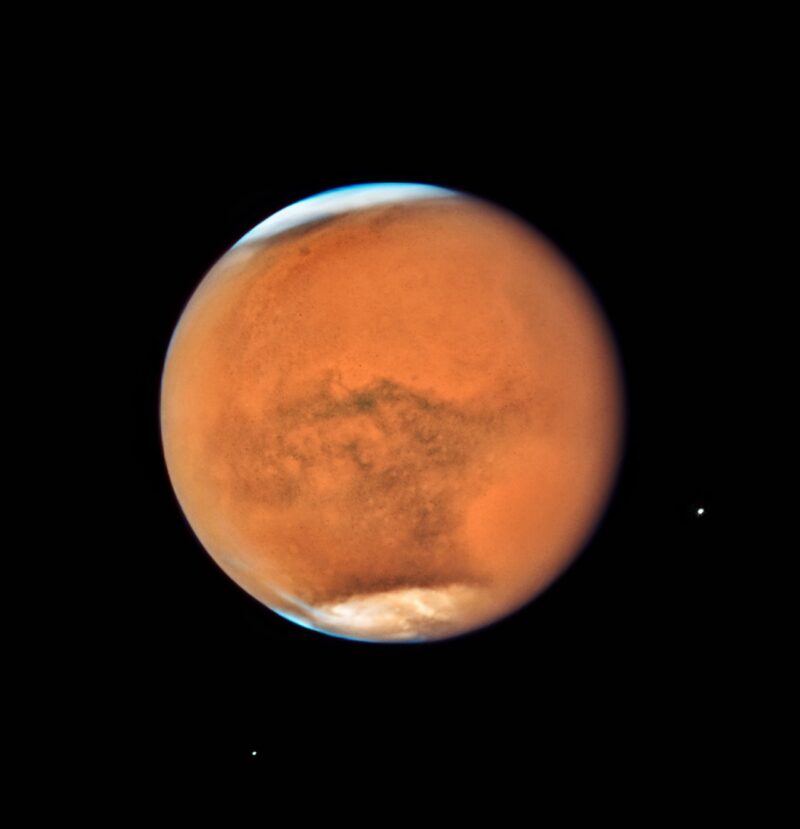
So Mars is relatively closest to the sun, moving fastest in orbit, around the time of late spring or early summer in its southern hemisphere. That’s why the Mars southern summers are shorter, hotter, and more volatile than in the north. That’s when dust storms can kick up, sometimes growing large enough to wrap around the entire planet. In the image below – from the Hubble Space Telescope in 2018 – you can see what that looks like. No surface features are visible because – for some months in 2018, centered on the Martian southern summer – Mars was shrouded in dust.
In mid-July 2018, the NASA/ESA Hubble Space Telescope observed Mars, only 13 days before the planet made its closest approach to Earth. While previous images showed detailed surface features of the planet, this image is dominated by a gigantic sandstorm enshrouding the entire planet. Each Martian year, moderately large dust storms cover continent-sized areas and last for weeks at a time. Global dust storms — lasting for weeks or months — tend to happen during the spring and summer in the southern hemisphere, when Mars is closest to the Sun and heating is at a maximum, leading to greater generation of winds. While spacecraft orbiting Mars can study the storm’s behaviour at lower altitudes, Hubble observations allow astronomers to study changes in the higher atmosphere. The combined observations will help planetary scientists to build a better understanding of how these global storms arise. Image via ESA/Hubble.
What’s happening on Mars now?
As of April 2026, atmospheric conditions on the Red Planet are relatively clear.
Current Martian weather stats – formed from recent data from the Perseverance and Curiosity rovers (the only two rovers active on Mars now) indicate “very dusty conditions” locally at certain craters. But these are localized events. And Mars is now entering a season where localized dust activity typically increases.
On average, global storms happen once every 3 to 4 Mars-years. That’s about every 5-and-a-half to 8 Earth-years. We haven’t had a a truly huge, global Mars dust storm since 2018.
So the “watch” is officially on for Mars dust in 2026.
And the current Martian season – summer in the southern hemisphere, officially starting on April 25, 2026 – is the primary reason for anticipation.
Bottom line: The summer solstice on Mars’ southern hemisphere happens on April 25, 2026. At that time, the south pole of Mars is pointed most directly toward the sun.
On Earth, nothing could feel as familiar as the passing of our seasons. And our days are steady, too — 24 hours, over and over, all our lives. But not so on Mars. Different world, just one step outward from Earth. Same laws of nature … but alien all the same. In this livestream, EarthSky’s Deborah Byrd explores the seasons on the Red Planet — and how even small differences in time and orbit can reshape our perception of a world. Watch in the player above or on YouTube.
Summer solstice in Mars’ southern hemisphere
Earth’s next solstice will fall at 8:25 UTC on June 21, 2026. It’ll be a summer solstice for the Northern Hemisphere (and a winter solstice for the Southern Hemisphere). It’ll happen when Earth’s south pole is tilted most toward the sun.
Like Earth, Mars tilts on its axis with respect to its orbit around the sun. It tilts by about 25 degrees, in contrast to Earth’s 23.5 degrees. So Mars has equinoxes and solstices as well. And Mars’ summer solstice for its southern hemisphere arrives on April 25, 2026.
Like Earth, Mars has 4 seasons
Mars takes 687 Earth-days to orbit the sun once. That’s almost 2 Earth-years. So each season on Mars – winter, spring, summer, fall – lasts roughly twice as long as a season on Earth.
And, meanwhile, although the image below is exaggerated, the orbit of Mars is more squashed than that of Earth. Astronomers say it’s more elliptical. Mars is farther from the sun during southern winter … and closer during southern summer. So the Mars southern hemisphere has shorter, hotter, more extreme seasons.
So – now, in April 2026, as Mars’ northern hemisphere of is tipping into the deepest part of winter – its southern hemisphere is celebrating summer. Of course, nothing is blooming. To date, scientists haven’t confirmed life on Mars, today or in the past. But there’s still seasonal change, just as there is in the most Mars-like places on Earth … Antarctica, for example.
Mars has 4 seasons, just as Earth does. But the Mars seasons last twice as long, because Mars takes 2 years to orbit the sun once. Summer solstice for Mars southern hemisphere falls on April 25, 2026. And the southern hemisphere has “harsher” seasons than in the north. During southern winter, Mars is farthest away from the sun in its elliptical orbit. Winter in Mars’ southern hemisphere is colder, because then Mars is the farthest away from the sun, moving more slowly in its orbit. Going from a winter to warmer spring can be quite dramatic. Spring for the rovers on Mars is the start of the dust season. By summer, global dust storms can blanket the whole planet. Image via NASA.
The season of dust
And on Mars, the seasons aren’t equal. That’s because Mars’ seasons are more lopsided than on Earth. Mars’ orbit is more squashed (more elliptical) than Earth’s. So its closest points to the sun are relatively closer than Earth’s. And Mars’ closest point to the sun – its perihelion – always happens near the Mars southern summer. In 2026, perihelion for Mars happened in late March.
So Mars is relatively closest to the sun, moving fastest in orbit, around the time of late spring or early summer in its southern hemisphere. That’s why the Mars southern summers are shorter, hotter, and more volatile than in the north. That’s when dust storms can kick up, sometimes growing large enough to wrap around the entire planet. In the image below – from the Hubble Space Telescope in 2018 – you can see what that looks like. No surface features are visible because – for some months in 2018, centered on the Martian southern summer – Mars was shrouded in dust.
In mid-July 2018, the NASA/ESA Hubble Space Telescope observed Mars, only 13 days before the planet made its closest approach to Earth. While previous images showed detailed surface features of the planet, this image is dominated by a gigantic sandstorm enshrouding the entire planet. Each Martian year, moderately large dust storms cover continent-sized areas and last for weeks at a time. Global dust storms — lasting for weeks or months — tend to happen during the spring and summer in the southern hemisphere, when Mars is closest to the Sun and heating is at a maximum, leading to greater generation of winds. While spacecraft orbiting Mars can study the storm’s behaviour at lower altitudes, Hubble observations allow astronomers to study changes in the higher atmosphere. The combined observations will help planetary scientists to build a better understanding of how these global storms arise. Image via ESA/Hubble.
What’s happening on Mars now?
As of April 2026, atmospheric conditions on the Red Planet are relatively clear.
Current Martian weather stats – formed from recent data from the Perseverance and Curiosity rovers (the only two rovers active on Mars now) indicate “very dusty conditions” locally at certain craters. But these are localized events. And Mars is now entering a season where localized dust activity typically increases.
On average, global storms happen once every 3 to 4 Mars-years. That’s about every 5-and-a-half to 8 Earth-years. We haven’t had a a truly huge, global Mars dust storm since 2018.
So the “watch” is officially on for Mars dust in 2026.
And the current Martian season – summer in the southern hemisphere, officially starting on April 25, 2026 – is the primary reason for anticipation.
Bottom line: The summer solstice on Mars’ southern hemisphere happens on April 25, 2026. At that time, the south pole of Mars is pointed most directly toward the sun.
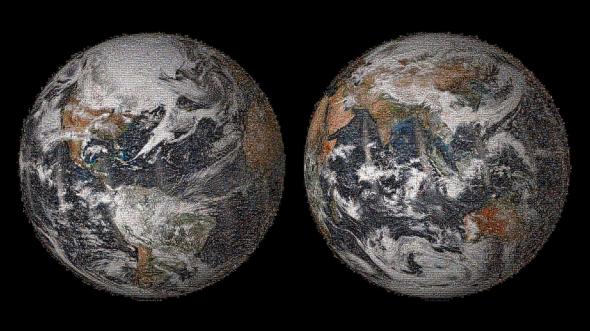
This is NASA’s massive 3.2 gigapixel mosaic of … us. And we look good. It contains more than 36,000 individual photographs from the more than 50,000 images posted around the world on Earth Day, April 22, 2014. Image via NASA.
The first Earth Day – April 22, 1970 – is sometimes said to have marked the beginning of the modern environmental movement.
It predates the U.S. Environmental Protection Agency, for example. It may be hard to imagine it now, but the first Earth Day was a revelation to many. It was a way not only of raising consciousness about environmental issues, but also of bringing together different groups that had been fighting separately against issues including oil spills, pollution from factories and power plants, raw sewage, toxic dumps, pesticides, the loss of wilderness, air pollution and more. At the first Earth Day in 1970, an estimated 20 million Americans participated. They took to the streets, parks and auditoriums to demonstrate for a healthy environment and to participate in teach-ins.
The April 22 date was selected in part because it fell between colleges’ spring break and final exams. And it was also when Arbor Day was observed, a day when people are encouraged to plant trees, which began in Nebraska in 1872.
Since 1970, many important environmental events have happened on Earth Day, including the signing of the Paris Agreement on April 22, 2016.
J. Sterling Morton was a Nebraska pioneer, a writer and editor for Nebraska’s first newspaper, and later secretary of the Nebraska Territory. He advocated planting trees in what was then a dusty and treeless prairie. At a State Board of Agriculture meeting in January 1872, Morton proposed that Nebraska citizens set aside April 10 as a day to plant trees. He suggested offering prizes as incentives for communities and organizations that planted the most trees. It’s said that Nebraskans planted about 1 million trees on that first Arbor Day in 1872. Planting trees remains a common practice in celebrating Earth Day today.
Ten years later, in 1882, Nebraska declared Arbor Day a legal holiday and the date was changed to Morton’s birthday, April 22. Arbor Day became a national observance, and it seemed natural to schedule April 22, 1970 – Arbor Day – as the first Earth Day.
Arbor Day celebration at N.Y. Public School #4, 173rd St. & Fulton Ave., New York. Date unknown. Image via Library of Congress.
Uniting for environmental change
Kathleen Rogers is a former environmental attorney who has led the Earth Day Network since 2001. She frequently comments on environmental issues in the media (CNN, Fox News, NPR, Time, Washington Post, Los Angeles Times). She wrote of Earth Day:
Earth Day is now a global event each year, and we believe that more than 1 billion people in 192 countries now take part in what is the largest civic-focused day of action in the world.
It is a day of political action and civic participation. People march, sign petitions, meet with their elected officials, plant trees, clean up their towns and roads. Corporations and governments use it to make pledges and announce sustainability measures. Faith leaders connect Earth Day with protecting God’s greatest creations, humans, biodiversity, and the planet that we all live on.
Bottom line: Why do we celebrate Earth Day on April 22? The date stems from an earlier observance, Arbor Day. This year’s focus is “Our Power, Our Planet.”
This is NASA’s massive 3.2 gigapixel mosaic of … us. And we look good. It contains more than 36,000 individual photographs from the more than 50,000 images posted around the world on Earth Day, April 22, 2014. Image via NASA.
The first Earth Day – April 22, 1970 – is sometimes said to have marked the beginning of the modern environmental movement.
It predates the U.S. Environmental Protection Agency, for example. It may be hard to imagine it now, but the first Earth Day was a revelation to many. It was a way not only of raising consciousness about environmental issues, but also of bringing together different groups that had been fighting separately against issues including oil spills, pollution from factories and power plants, raw sewage, toxic dumps, pesticides, the loss of wilderness, air pollution and more. At the first Earth Day in 1970, an estimated 20 million Americans participated. They took to the streets, parks and auditoriums to demonstrate for a healthy environment and to participate in teach-ins.
The April 22 date was selected in part because it fell between colleges’ spring break and final exams. And it was also when Arbor Day was observed, a day when people are encouraged to plant trees, which began in Nebraska in 1872.
Since 1970, many important environmental events have happened on Earth Day, including the signing of the Paris Agreement on April 22, 2016.
J. Sterling Morton was a Nebraska pioneer, a writer and editor for Nebraska’s first newspaper, and later secretary of the Nebraska Territory. He advocated planting trees in what was then a dusty and treeless prairie. At a State Board of Agriculture meeting in January 1872, Morton proposed that Nebraska citizens set aside April 10 as a day to plant trees. He suggested offering prizes as incentives for communities and organizations that planted the most trees. It’s said that Nebraskans planted about 1 million trees on that first Arbor Day in 1872. Planting trees remains a common practice in celebrating Earth Day today.
Ten years later, in 1882, Nebraska declared Arbor Day a legal holiday and the date was changed to Morton’s birthday, April 22. Arbor Day became a national observance, and it seemed natural to schedule April 22, 1970 – Arbor Day – as the first Earth Day.
Arbor Day celebration at N.Y. Public School #4, 173rd St. & Fulton Ave., New York. Date unknown. Image via Library of Congress.
Uniting for environmental change
Kathleen Rogers is a former environmental attorney who has led the Earth Day Network since 2001. She frequently comments on environmental issues in the media (CNN, Fox News, NPR, Time, Washington Post, Los Angeles Times). She wrote of Earth Day:
Earth Day is now a global event each year, and we believe that more than 1 billion people in 192 countries now take part in what is the largest civic-focused day of action in the world.
It is a day of political action and civic participation. People march, sign petitions, meet with their elected officials, plant trees, clean up their towns and roads. Corporations and governments use it to make pledges and announce sustainability measures. Faith leaders connect Earth Day with protecting God’s greatest creations, humans, biodiversity, and the planet that we all live on.
Bottom line: Why do we celebrate Earth Day on April 22? The date stems from an earlier observance, Arbor Day. This year’s focus is “Our Power, Our Planet.”