
- The Hubble Space Telescope is celebrating its 36th anniversary. The telescope launched to space on April 24, 1990.
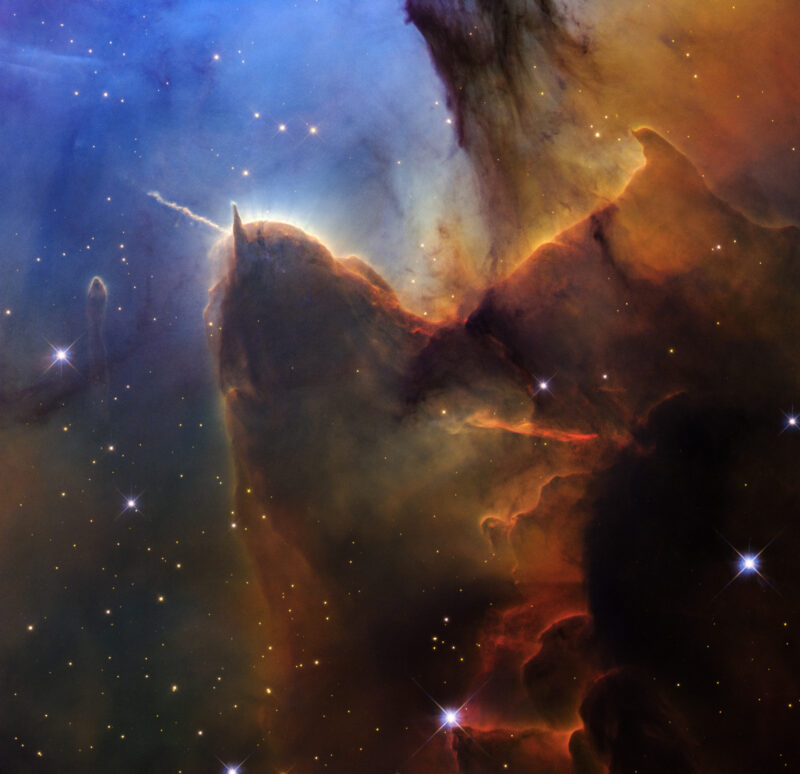
- To celebrate, NASA released a new image of the Trifid Nebula. The Trifid Nebula is a star-forming region in the Milky Way in the direction of Sagittarius.
- The Trifid Nebula has changed since Hubble first imaged it. See the changes to the nebula in a video here.
NASA published this original story on April 20, 2026. Edits by EarthSky.
The Trifid Nebula highlights Hubble’s 36 anniversary
Today, April 24, marks the 36th anniversary of the Hubble Space Telescope‘s launch! For the anniversary, Hubble captured this shimmering region of star-formation – a close-up of the Trifid Nebula about 5,000 light-years from Earth – in intricate detail. The colors in this visible light image are reminiscent of an underwater scene filled with fine-grained sediments fluttering through the ocean’s depths.
Several massive stars, which are outside this field of view, have shaped this region for at least 300,000 years. Their powerful winds continue to blow an enormous bubble. And a small portion of that bubble is showcased in the image here. The winds push and compress the cloud’s gas and dust, triggering new waves of star formation.
This isn’t the first time Hubble has gazed at this scene. The telescope observed the Trifid in 1997. And now, 29 years later, it has leveraged almost its full operational lifetime to show us changes in the nebula on human time scales. Why look at the same location again? In addition to seeing changes over time, Hubble is also equipped with an improved camera with a wider field of view and greater sensitivity that was installed during Servicing Mission 4 in 2009.
See the nebula change over time
Watch this video to see the Trifid Nebula change over time.
Bottom line: It’s the Hubble Space Telescope’s 36th anniversary! To celebrate, NASA has released an image of the iconic Trifid Nebula.
The post The Trifid Nebula highlights Hubble’s 36 anniversary first appeared on EarthSky.
from EarthSky https://ift.tt/0YlFHev
- The Hubble Space Telescope is celebrating its 36th anniversary. The telescope launched to space on April 24, 1990.
- To celebrate, NASA released a new image of the Trifid Nebula. The Trifid Nebula is a star-forming region in the Milky Way in the direction of Sagittarius.
- The Trifid Nebula has changed since Hubble first imaged it. See the changes to the nebula in a video here.
NASA published this original story on April 20, 2026. Edits by EarthSky.
The Trifid Nebula highlights Hubble’s 36 anniversary
Today, April 24, marks the 36th anniversary of the Hubble Space Telescope‘s launch! For the anniversary, Hubble captured this shimmering region of star-formation – a close-up of the Trifid Nebula about 5,000 light-years from Earth – in intricate detail. The colors in this visible light image are reminiscent of an underwater scene filled with fine-grained sediments fluttering through the ocean’s depths.
Several massive stars, which are outside this field of view, have shaped this region for at least 300,000 years. Their powerful winds continue to blow an enormous bubble. And a small portion of that bubble is showcased in the image here. The winds push and compress the cloud’s gas and dust, triggering new waves of star formation.
This isn’t the first time Hubble has gazed at this scene. The telescope observed the Trifid in 1997. And now, 29 years later, it has leveraged almost its full operational lifetime to show us changes in the nebula on human time scales. Why look at the same location again? In addition to seeing changes over time, Hubble is also equipped with an improved camera with a wider field of view and greater sensitivity that was installed during Servicing Mission 4 in 2009.
See the nebula change over time
Watch this video to see the Trifid Nebula change over time.
Bottom line: It’s the Hubble Space Telescope’s 36th anniversary! To celebrate, NASA has released an image of the iconic Trifid Nebula.
The post The Trifid Nebula highlights Hubble’s 36 anniversary first appeared on EarthSky.
from EarthSky https://ift.tt/0YlFHev

Aucun commentaire:
Enregistrer un commentaire