aads

5 insights on interstellar comet 3I/ATLAS from ESA’s Juice mission

Comet 3I/ATLAS moving slowly in front of background stars.
Observations of Comet 3I/ATLAS by the JANUS camera on ESA’s Juice mission. Juice caught the comet on November 5, 2025, when it was 64 million kilometers (40 million miles) away from the spacecraft. The length of the tail stretching away from the sun is about 6 million km (8 million miles) long here. Image via ESA/ Juice/ JANUS (CC BY-SA 3.0 IGO).

Science news, night sky events and beautiful photos, all in one place. Click here to subscribe to our free daily newsletter.

  • ESA’s JUpiter ICy Moons Explorer, aka Juice, is on a mission to the largest planet in our solar system. But in November 2025, it had a chance to observe interstellar comet 3I/ATLAS.
  • Juice observed Comet 3I/ATLAS releasing huge amounts of water vapor, mainly from its sun-facing side and surrounding dust coma.
  • The comet’s gas and dust extend over 5 million km (3 million miles), and images show typical comet behavior, much like ordinary solar system comets.

The European Space Agency published this original story on April 2, 2026. Edits by EarthSky.

The Juice mission observes interstellar comet 3I/ATLAS

In November 2025, Juice was in the right place at the right time with the right equipment to observe interstellar comet 3I/ATLAS just after its closest approach to the sun. Our mission operations teams switched on five of Juice’s science instruments to collect information about how the active comet was behaving at the time.

Following a three-month wait to receive the data on Earth, scientists working on each of these instruments have spent the last few weeks delving into the photos, spectra and numbers. Results are still preliminary, work is still ongoing, but here are five things we’ve already learned.

1. 70 Olympic swimming pools of water vapor every day

On November 2, 2025, just four days after 3I/ATLAS had made its closest approach to the sun, Juice’s Moons And Jupiter Imaging Spectrometer (MAJIS) detected that the comet was spewing out 2,000 kg of water vapor every second. That’s equivalent to 70 Olympic swimming pools per day.

Comets – true to their ‘dirty snowball’ nickname – are mostly made of ice. As they approach the sun, this ice turns to gas and escapes the comet. The amount of water vapor leaving 3I/ATLAS is not exceptional. But it is on the high side of what we would expect from a comet close to the sun, based on what we have seen before in comets like 67P (300 kg per second) and Halley (20,000 kg per second).

These numbers depend a lot on the size of a comet and its distance from the sun. MAJIS detected 3I/ATLAS again on November 12 and 19, as it was moving away from the sun. By November 12, the amount of water vapor being released by the comet did not seem to have reduced significantly. The instrument team is planning to analyze the data from November 19 in the coming weeks.

A bright image of a comet with a graph showing some spikes.
MAJIS infrared observations of 3I/ATLAS in infrared light, overlaid on an image from Juice’s navigation camera. The instrument detected water vapor and carbon dioxide being released by the comet. Image via ESA/ Juice/ MAJIS (CC BY-SA 3.0 IGO).

2. Water vapor released in the direction of the sun

Juice’s Submillimeter Wave Instrument (SWI) also detected water vapor from 3I/ATLAS. It revealed that most of it was coming from the sun-facing side of the comet. It also appears that a lot of this water vapor is not actually coming directly from the solid part of the comet (its nucleus). Instead, it’s coming from icy dust grains that have escaped into a surrounding halo of dust and gas (its coma).

The SWI team are continuing to look into the data to determine how much ‘light’ water (normal H2O) 3I/ATLAS is releasing. It is interesting to compare this to the amount of ‘semiheavy’ water (HDO) from the comet, which has been measured by the ALMA and Webb telescopes. This ratio is a really important number in our studies of the universe. It gives a kind of ‘fingerprint’ that describes how and where an object formed.

ALMA and Webb found this ratio to be unexpectedly and extremely high for 3I/ATLAS. This may possibly be because the comet was born in a very cold and very ancient environment, where it was exposed to a lot of ultraviolet radiation from young stars. The SWI team is investigating whether the Juice data back up these findings.

3. Gas and dust stretch for 5 million km

Juice’s Ultraviolet Imaging Spectrograph (UVS) captured light coming from oxygen, hydrogen and carbon atoms in the gas and dust surrounding and trailing behind the comet. Oxygen, hydrogen, carbon and dust emit photons of light at specific wavelengths, which UVS recorded as counts per second.

UVS saw these gas elements and dust stretching up to more than 5 million km (3.1 million miles) from 3I/ATLAS’s nucleus. Gas and dust are common around active comets, with tails sometimes reaching up to 10 million km (6.2 million miles) long.

Pixellated colors with a concentration of orange near the left and a key on the right.
Counts of oxygen, hydrogen, carbon and dust measured by Juice’s UVS instrument from Comet 3I/ATLAS. Image via ESA (CC BY-SA 3.0 IGO).

4. This interstellar comet looks just like a normal comet!

Juice’s high-resolution science camera, JANUS (short for ‘Jovis Amorum ac Natorum Undique Scrutator’ – or ‘Scrutiniser of Jupiter, and all his loves and descendants’) also saw 3I/ATLAS spewing gas and dust.

Despite being over 60 million km (37 million miles) from 3I/ATLAS, JANUS clearly reveals the coma in which the nucleus is hiding, as well as two tails. One tail stretches away from the sun. And the other follows the path taken by the comet through the solar system. We can also see fainter shapes within the coma and tails that indicate various processes and interactions with the radiation, particles and magnetic field from the sun. The JANUS team is currently investigating these shapes in more detail.

Overall, JANUS shows that, despite its interstellar origin, Comet 3I/ATLAS was behaving like a typical comet from the solar system during a close approach to the sun.

Image of a comet through blue and red filters.
Comet 3I/ATLAS through red and violet filters. In the red filter, the bright center of the coma is more compact and there are two tails: one straight down, and a fuzzier one going to the lower left. In the violet filter, the coma is bigger but fainter, and only one tail stands out clearly. The differences arise because different gas and dust particles release or reflect light at different wavelengths. Image via ESA (CC BY-SA 3.0 IGO).

5. 3I/ATLAS is supporting our planetary defense efforts

Juice’s Navigation Camera (NavCam) is specially designed to help Juice navigate around Jupiter’s icy moons following arrival in 2031. The encounter with 3I/ATLAS enabled us to do something totally unexpected with it.

We have already used telescopes on and around Earth to estimate the location and path of Comet 3I/ATLAS through the solar system. It seems to come from the direction of the Milky Way’s disk. Therefore, it was likely created more than 10 billion years ago.

NavCam had a much closer view of 3I/ATLAS, from a different angle as from Earth-based telescopes, during a period when the comet was not visible from Earth. This meant that ESA’s Planetary Defence team could line up NavCam images from throughout November to get a better idea of the comet’s changing position and trajectory.

In this way, the team – which usually tracks potentially hazardous asteroids – showed how powerful observations from deep-space missions can be to precisely calculate the orbits of comets or asteroids that cannot immediately be seen from Earth.

What’s more, because a comet’s trajectory is affected slightly by the release of dust and gas, the team is starting to use the trajectory measurements based on NavCam images to understand what materials – and how much of them – the comet is leaving in its wake.

A white comet changing in brightness and moving against the background stars.
Juice’s NavCam had a much closer view of 3I/ATLAS from a different angle as from Earth-based telescopes, during a period when the comet was not visible from Earth. This meant that NavCam images from throughout November 2025 could be lined up to get a better idea of the comet’s changing position and trajectory. Image via ESA/ Juice/ NavCam (CC BY-SA 3.0 IGO).

What’s next for Juice?

Instrument teams will continue to study the data, with many teams planning to publish papers on their results in the coming months. Olivier Witasse, ESA Juice Project Scientist, said:

3I/ATLAS is a rare and unexpected visitor. Its arrival came as a complete surprise. But when we realized that Juice would be close to the comet around its closest approach to the sun, we realized what a unique opportunity this was to collect a once-in-a-lifetime dataset.

Observing the comet was challenging, with no guarantee of success. But in the end, it turned into a great bonus for Juice during its journey to Jupiter.

The closest Juice came to 3I/ATLAS was about 60 million km (37 million miles), whereas it will see Jupiter’s moons from just a few hundred kilometers away. Even so, being designed and equipped to study icy moons, Juice’s instruments were a great match for the icy interstellar comet.

We still have five years to wait before Juice arrives at Jupiter in 2031. But all its instruments will be switched on once again in September 2026 when Juice returns to Earth for another gravity assist. Co-Project Scientist Claire Vallat said:

The data we are already seeing from Juice’s instruments is really promising. We are getting more excited about how well they work and how much we will reveal about Jupiter and its icy moons in the 2030s.

Bottom line: Juice reveals Comet 3I/ATLAS is highly active, with a vast gas and dust cloud. It behaves like solar system comets while offering clues to its interstellar origins.

Via ESA

The post 5 insights on interstellar comet 3I/ATLAS from ESA’s Juice mission first appeared on EarthSky.


from EarthSky https://ift.tt/AgVXbni
Comet 3I/ATLAS moving slowly in front of background stars.
Observations of Comet 3I/ATLAS by the JANUS camera on ESA’s Juice mission. Juice caught the comet on November 5, 2025, when it was 64 million kilometers (40 million miles) away from the spacecraft. The length of the tail stretching away from the sun is about 6 million km (8 million miles) long here. Image via ESA/ Juice/ JANUS (CC BY-SA 3.0 IGO).

Science news, night sky events and beautiful photos, all in one place. Click here to subscribe to our free daily newsletter.

  • ESA’s JUpiter ICy Moons Explorer, aka Juice, is on a mission to the largest planet in our solar system. But in November 2025, it had a chance to observe interstellar comet 3I/ATLAS.
  • Juice observed Comet 3I/ATLAS releasing huge amounts of water vapor, mainly from its sun-facing side and surrounding dust coma.
  • The comet’s gas and dust extend over 5 million km (3 million miles), and images show typical comet behavior, much like ordinary solar system comets.

The European Space Agency published this original story on April 2, 2026. Edits by EarthSky.

The Juice mission observes interstellar comet 3I/ATLAS

In November 2025, Juice was in the right place at the right time with the right equipment to observe interstellar comet 3I/ATLAS just after its closest approach to the sun. Our mission operations teams switched on five of Juice’s science instruments to collect information about how the active comet was behaving at the time.

Following a three-month wait to receive the data on Earth, scientists working on each of these instruments have spent the last few weeks delving into the photos, spectra and numbers. Results are still preliminary, work is still ongoing, but here are five things we’ve already learned.

1. 70 Olympic swimming pools of water vapor every day

On November 2, 2025, just four days after 3I/ATLAS had made its closest approach to the sun, Juice’s Moons And Jupiter Imaging Spectrometer (MAJIS) detected that the comet was spewing out 2,000 kg of water vapor every second. That’s equivalent to 70 Olympic swimming pools per day.

Comets – true to their ‘dirty snowball’ nickname – are mostly made of ice. As they approach the sun, this ice turns to gas and escapes the comet. The amount of water vapor leaving 3I/ATLAS is not exceptional. But it is on the high side of what we would expect from a comet close to the sun, based on what we have seen before in comets like 67P (300 kg per second) and Halley (20,000 kg per second).

These numbers depend a lot on the size of a comet and its distance from the sun. MAJIS detected 3I/ATLAS again on November 12 and 19, as it was moving away from the sun. By November 12, the amount of water vapor being released by the comet did not seem to have reduced significantly. The instrument team is planning to analyze the data from November 19 in the coming weeks.

A bright image of a comet with a graph showing some spikes.
MAJIS infrared observations of 3I/ATLAS in infrared light, overlaid on an image from Juice’s navigation camera. The instrument detected water vapor and carbon dioxide being released by the comet. Image via ESA/ Juice/ MAJIS (CC BY-SA 3.0 IGO).

2. Water vapor released in the direction of the sun

Juice’s Submillimeter Wave Instrument (SWI) also detected water vapor from 3I/ATLAS. It revealed that most of it was coming from the sun-facing side of the comet. It also appears that a lot of this water vapor is not actually coming directly from the solid part of the comet (its nucleus). Instead, it’s coming from icy dust grains that have escaped into a surrounding halo of dust and gas (its coma).

The SWI team are continuing to look into the data to determine how much ‘light’ water (normal H2O) 3I/ATLAS is releasing. It is interesting to compare this to the amount of ‘semiheavy’ water (HDO) from the comet, which has been measured by the ALMA and Webb telescopes. This ratio is a really important number in our studies of the universe. It gives a kind of ‘fingerprint’ that describes how and where an object formed.

ALMA and Webb found this ratio to be unexpectedly and extremely high for 3I/ATLAS. This may possibly be because the comet was born in a very cold and very ancient environment, where it was exposed to a lot of ultraviolet radiation from young stars. The SWI team is investigating whether the Juice data back up these findings.

3. Gas and dust stretch for 5 million km

Juice’s Ultraviolet Imaging Spectrograph (UVS) captured light coming from oxygen, hydrogen and carbon atoms in the gas and dust surrounding and trailing behind the comet. Oxygen, hydrogen, carbon and dust emit photons of light at specific wavelengths, which UVS recorded as counts per second.

UVS saw these gas elements and dust stretching up to more than 5 million km (3.1 million miles) from 3I/ATLAS’s nucleus. Gas and dust are common around active comets, with tails sometimes reaching up to 10 million km (6.2 million miles) long.

Pixellated colors with a concentration of orange near the left and a key on the right.
Counts of oxygen, hydrogen, carbon and dust measured by Juice’s UVS instrument from Comet 3I/ATLAS. Image via ESA (CC BY-SA 3.0 IGO).

4. This interstellar comet looks just like a normal comet!

Juice’s high-resolution science camera, JANUS (short for ‘Jovis Amorum ac Natorum Undique Scrutator’ – or ‘Scrutiniser of Jupiter, and all his loves and descendants’) also saw 3I/ATLAS spewing gas and dust.

Despite being over 60 million km (37 million miles) from 3I/ATLAS, JANUS clearly reveals the coma in which the nucleus is hiding, as well as two tails. One tail stretches away from the sun. And the other follows the path taken by the comet through the solar system. We can also see fainter shapes within the coma and tails that indicate various processes and interactions with the radiation, particles and magnetic field from the sun. The JANUS team is currently investigating these shapes in more detail.

Overall, JANUS shows that, despite its interstellar origin, Comet 3I/ATLAS was behaving like a typical comet from the solar system during a close approach to the sun.

Image of a comet through blue and red filters.
Comet 3I/ATLAS through red and violet filters. In the red filter, the bright center of the coma is more compact and there are two tails: one straight down, and a fuzzier one going to the lower left. In the violet filter, the coma is bigger but fainter, and only one tail stands out clearly. The differences arise because different gas and dust particles release or reflect light at different wavelengths. Image via ESA (CC BY-SA 3.0 IGO).

5. 3I/ATLAS is supporting our planetary defense efforts

Juice’s Navigation Camera (NavCam) is specially designed to help Juice navigate around Jupiter’s icy moons following arrival in 2031. The encounter with 3I/ATLAS enabled us to do something totally unexpected with it.

We have already used telescopes on and around Earth to estimate the location and path of Comet 3I/ATLAS through the solar system. It seems to come from the direction of the Milky Way’s disk. Therefore, it was likely created more than 10 billion years ago.

NavCam had a much closer view of 3I/ATLAS, from a different angle as from Earth-based telescopes, during a period when the comet was not visible from Earth. This meant that ESA’s Planetary Defence team could line up NavCam images from throughout November to get a better idea of the comet’s changing position and trajectory.

In this way, the team – which usually tracks potentially hazardous asteroids – showed how powerful observations from deep-space missions can be to precisely calculate the orbits of comets or asteroids that cannot immediately be seen from Earth.

What’s more, because a comet’s trajectory is affected slightly by the release of dust and gas, the team is starting to use the trajectory measurements based on NavCam images to understand what materials – and how much of them – the comet is leaving in its wake.

A white comet changing in brightness and moving against the background stars.
Juice’s NavCam had a much closer view of 3I/ATLAS from a different angle as from Earth-based telescopes, during a period when the comet was not visible from Earth. This meant that NavCam images from throughout November 2025 could be lined up to get a better idea of the comet’s changing position and trajectory. Image via ESA/ Juice/ NavCam (CC BY-SA 3.0 IGO).

What’s next for Juice?

Instrument teams will continue to study the data, with many teams planning to publish papers on their results in the coming months. Olivier Witasse, ESA Juice Project Scientist, said:

3I/ATLAS is a rare and unexpected visitor. Its arrival came as a complete surprise. But when we realized that Juice would be close to the comet around its closest approach to the sun, we realized what a unique opportunity this was to collect a once-in-a-lifetime dataset.

Observing the comet was challenging, with no guarantee of success. But in the end, it turned into a great bonus for Juice during its journey to Jupiter.

The closest Juice came to 3I/ATLAS was about 60 million km (37 million miles), whereas it will see Jupiter’s moons from just a few hundred kilometers away. Even so, being designed and equipped to study icy moons, Juice’s instruments were a great match for the icy interstellar comet.

We still have five years to wait before Juice arrives at Jupiter in 2031. But all its instruments will be switched on once again in September 2026 when Juice returns to Earth for another gravity assist. Co-Project Scientist Claire Vallat said:

The data we are already seeing from Juice’s instruments is really promising. We are getting more excited about how well they work and how much we will reveal about Jupiter and its icy moons in the 2030s.

Bottom line: Juice reveals Comet 3I/ATLAS is highly active, with a vast gas and dust cloud. It behaves like solar system comets while offering clues to its interstellar origins.

Via ESA

The post 5 insights on interstellar comet 3I/ATLAS from ESA’s Juice mission first appeared on EarthSky.


from EarthSky https://ift.tt/AgVXbni
Meet the Chamaeleon, a southern constellation

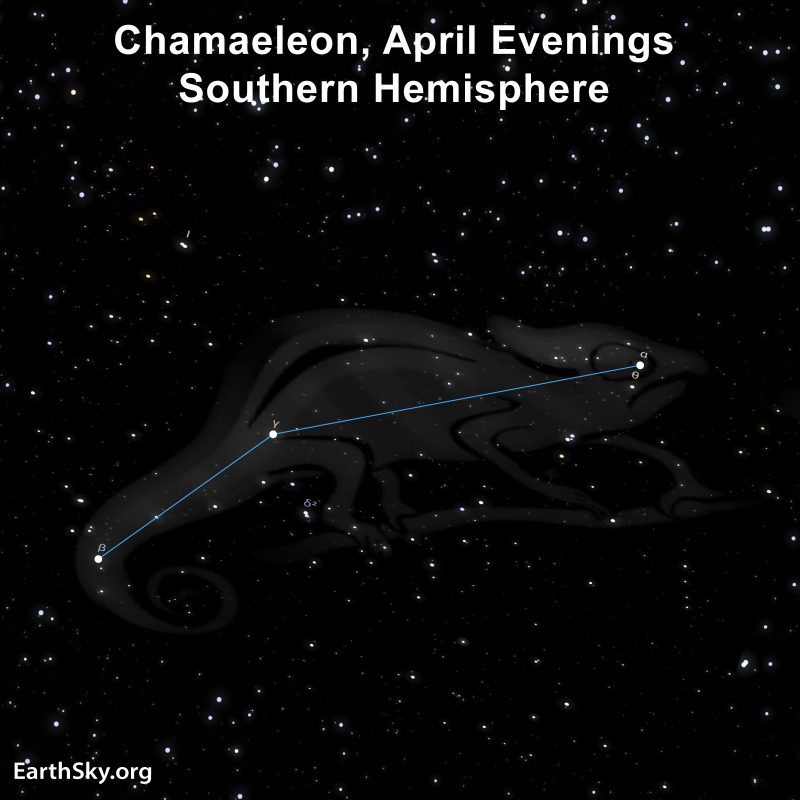
Chamaeleon constellation: Three white dots on black background connected by a line with a faint background image of a lizard.
The constellation Chamaeleon is a Southern Hemisphere target for April evenings. Chart via EarthSky.

The constellation of the Chamaeleon lies deep in the Southern Hemisphere sky. You have to be south of the equator to spot it. As a south circumpolar constellation, it circles closely around the south celestial pole. So, from most of the Southern Hemisphere, it never sets. And that’s why, if you’re in the Southern Hemisphere, you can see it on any night of the year.

The origin of the Chamaeleon

Pieter Dirkszoon Keyser and Frederick de Houtman created the Chamaeleon, along with 11 other Southern Hemisphere constellations, in the late 1500s. These Dutch navigators explored the Southern Hemisphere and took astronomical observations, naming the new constellations after creatures they met on their travels. The chameleon is a type of lizard, and the northern sky has its own lizard constellation: Lacerta.

Locating the constellation of the Chameleon

You can find the constellation Chamaeleon any time of year in the Southern Hemisphere between the south celestial pole and the flowing river of the Milky Way. Also, if you can find the Southern Hemisphere’s prominent constellation of the Southern Cross, or Crux, and draw a line to the south celestial pole, you’ll pass through Chamaeleon.

Star chart of Chamaeleon constellation with stars in black on white.
The dim stars of the Chamaeleon lie near the south celestial pole. Image via IAU/ Sky and Telescope/ Wikipedia. CC BY 3.0.

The stars of the Chamaeleon

The stars of the constellation are all 4th magnitude and dimmer. Alpha Chamaeleontis and Theta Chamaeleontis lie a mere 1/2 degree from each other, with Alpha at magnitude 4.06 and Theta at magnitude 4.35. They lie 63 and 155 light-years away, respectively.

Delta Chamaeleontis is a double star near the center of the constellation. Its two components, four arcminutes apart, are magnitude 4.45 and 5.46, averaging 350 light-years distant. Then two degrees away is Gamma Chamaeleontis, magnitude 4.12 and 413 light-years away. Lastly is Beta Chamaeleontis at magnitude 4.24 and 271 light-years distant, found at the opposite end of the constellation as Alpha.

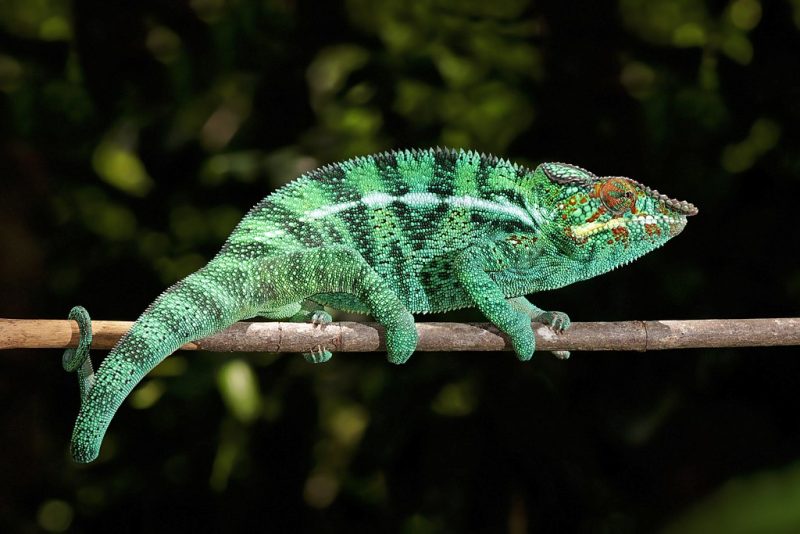
Stocky lizard with dark and light green stripes and tail curling around branch.
The constellation is supposed to represent the type of lizard known as the chameleon. Shown here is the panther chameleon from Madagascar. Image via Wikimedia Commons.

Bottom line: The constellation Chamaeleon is a dark patch of sky that lies deep in the Southern Hemisphere and is visible any night of the year.

The post Meet the Chamaeleon, a southern constellation first appeared on EarthSky.


from EarthSky https://ift.tt/y9uDGpS
Chamaeleon constellation: Three white dots on black background connected by a line with a faint background image of a lizard.
The constellation Chamaeleon is a Southern Hemisphere target for April evenings. Chart via EarthSky.

The constellation of the Chamaeleon lies deep in the Southern Hemisphere sky. You have to be south of the equator to spot it. As a south circumpolar constellation, it circles closely around the south celestial pole. So, from most of the Southern Hemisphere, it never sets. And that’s why, if you’re in the Southern Hemisphere, you can see it on any night of the year.

The origin of the Chamaeleon

Pieter Dirkszoon Keyser and Frederick de Houtman created the Chamaeleon, along with 11 other Southern Hemisphere constellations, in the late 1500s. These Dutch navigators explored the Southern Hemisphere and took astronomical observations, naming the new constellations after creatures they met on their travels. The chameleon is a type of lizard, and the northern sky has its own lizard constellation: Lacerta.

Locating the constellation of the Chameleon

You can find the constellation Chamaeleon any time of year in the Southern Hemisphere between the south celestial pole and the flowing river of the Milky Way. Also, if you can find the Southern Hemisphere’s prominent constellation of the Southern Cross, or Crux, and draw a line to the south celestial pole, you’ll pass through Chamaeleon.

Star chart of Chamaeleon constellation with stars in black on white.
The dim stars of the Chamaeleon lie near the south celestial pole. Image via IAU/ Sky and Telescope/ Wikipedia. CC BY 3.0.

The stars of the Chamaeleon

The stars of the constellation are all 4th magnitude and dimmer. Alpha Chamaeleontis and Theta Chamaeleontis lie a mere 1/2 degree from each other, with Alpha at magnitude 4.06 and Theta at magnitude 4.35. They lie 63 and 155 light-years away, respectively.

Delta Chamaeleontis is a double star near the center of the constellation. Its two components, four arcminutes apart, are magnitude 4.45 and 5.46, averaging 350 light-years distant. Then two degrees away is Gamma Chamaeleontis, magnitude 4.12 and 413 light-years away. Lastly is Beta Chamaeleontis at magnitude 4.24 and 271 light-years distant, found at the opposite end of the constellation as Alpha.

Stocky lizard with dark and light green stripes and tail curling around branch.
The constellation is supposed to represent the type of lizard known as the chameleon. Shown here is the panther chameleon from Madagascar. Image via Wikimedia Commons.

Bottom line: The constellation Chamaeleon is a dark patch of sky that lies deep in the Southern Hemisphere and is visible any night of the year.

The post Meet the Chamaeleon, a southern constellation first appeared on EarthSky.


from EarthSky https://ift.tt/y9uDGpS

See the best deep-sky photos of March 2026

Deep-sky photos: A spherical cluster with a myriad bright stars, densely white at the center and less dense at the edges.
View at EarthSky Community Photos. | Catherine Hyde in Cambria, California, captured this telescopic view of Messier 53 on March 24, 2026. Catherine wrote: “This is the globular cluster M53 in Coma Berenices.” Thank you, Catherine! See more deep-sky photos from March 2026 below.

Stunning deep-sky photos from our community

The EarthSky community has many talented astrophotographers who capture stunning images of the deep sky. We gathered some of our favorite deep-sky photos we received in March 2026 for you to enjoy. Do you have images of your own to share? You can submit them to us here. We would love to see them!

You deserve a daily dose of good news. For the latest in science and the night sky, click here to subscribe to our free daily newsletter.

Deep-sky photos of diffuse nebulae

A large cloud of wispy, electric green gas, among scattered stars.
View at EarthSky Community Photos. | Jelieta Walinski at Desert Bloom Observatory in St. David, Arizona, used more than 100 hours of exposures to image this emerald nebula. Jelieta wrote: “In a quiet region of the constellation Serpens, this emission nebula reveals itself as a cosmic bloom. This deep image transforms faint hydrogen gas into a luminous structure resembling a flower unfolding in green radiance.” Thank you, Jelieta!
Streaky red space clouds among stars, with a small dark indentation resembling the head of a horse.
View at EarthSky Community Photos. | Mohammed Ahmed in Suez, Egypt, used a telephoto lens to capture this view of the Horsehead Nebula in the constellation Orion on March 22, 2026. Mohammed wrote: “I wanted to say goodbye to winter with this shot. This is the famous Horsehead Nebula, a dark nebula located in Orion near the star Alnitak. It’s one of the hidden gems of the winter sky, and now we will have to wait for next winter for Orion to come back.” Thank you, Mohammed!
A long, wispy, glowing red and green space cloud and a smaller round one, among numerous stars.
View at EarthSky Community Photos. | Kueng Cornelia in Lake Zurich, Switzerland, captured this telescopic view of the Seagull Nebula, in the constellation Monoceros, on March 18, 2025. Kueng wrote: “I am on the way to collect nebulae with animal names for my lovely grandchildren. Just now in my backyard toward the south, IC 2177 – the Seagull Nebula – is in good position.” Thank you, Kueng!

More diffuse nebulae

A broken cocoon of pink nebulosity with stars immersed within and in the surroundings.
View at EarthSky Community Photos. | Catherine Hyde in Cambria, California, captured this telescopic view of the Medusa Nebula on March 24, 2026. Catherine wrote: “This is the Medusa Nebula, a very old planetary nebula in the constellation Gemini. This is a stacked image using about 16 hours of total exposure time over 4 nights.” Thank you, Catherine!
A large, pink cloud of gas in a wispy H shape, plus numerous faint stars.
View at EarthSky Community Photos. | Mohammed Ahmed in Suez, Egypt, used a telephoto lens to capture this view of Thor’s Helmet in the constellation Canis Major, on March 12, 2026. Mohammed wrote: “This is Thor’s Helmet Nebula (NGC 2359). What you’re seeing here is the interstellar wind and a pre-supernova of a Wolf-Rayet star. This is a dying star, and we are seeing it about 12,000 light-years away.” Thank you, Mohammed!

Deep-sky photos of distant galaxies

Oblique view of a galaxy with pink wisps toward the middle and sparse foreground stars.
View at EarthSky Community Photos. | Steven Bellavia in Smithfield, Virginia, captured this telescopic view of Messier 82, the Starburst Galaxy in Ursa Major, on March 10, 2026. Steven wrote: “M82 had a gravitational interaction with its larger neighbor, galaxy M81. This, in turn, funneled large amounts of gas toward the core of M82, which then triggered intense star formation at a rate 10 times faster than in our Milky Way.” Thank you, Steven!
3 side-on views of galaxies, and an image with all 3 of them together.
View at EarthSky Community Photos. | Steven Bellavia in Scottsburg, Virginia, captured these exposures of the Leo Triplet of Galaxies on March 19, 2026. Steven wrote: “I have always enjoyed images of the Leo Triplet of galaxies. But I have also always wanted to capture them close up, one at a time, as each one is beautiful and full of intricate colors and details, often missed in the wide-field images. So on my recent astro-camping trip to the Staunton River Star Party, I captured 2 of the 3, close up, with the 3rd from a year ago, also from the same star party.” Thank you, Steven!

Bottom line: Without a doubt, you’ll enjoy this gallery of deep-sky photos for March 2026 from our EarthSky community. If you have a great photo to share, send it in, too. We love to see them!

Share your recent Earth or sky photo at EarthSky Community Photos.

Read more: Messier objects are fuzzy patches in the night sky

The post See the best deep-sky photos of March 2026 first appeared on EarthSky.


from EarthSky https://ift.tt/VsKZ2Xt
Deep-sky photos: A spherical cluster with a myriad bright stars, densely white at the center and less dense at the edges.
View at EarthSky Community Photos. | Catherine Hyde in Cambria, California, captured this telescopic view of Messier 53 on March 24, 2026. Catherine wrote: “This is the globular cluster M53 in Coma Berenices.” Thank you, Catherine! See more deep-sky photos from March 2026 below.

Stunning deep-sky photos from our community

The EarthSky community has many talented astrophotographers who capture stunning images of the deep sky. We gathered some of our favorite deep-sky photos we received in March 2026 for you to enjoy. Do you have images of your own to share? You can submit them to us here. We would love to see them!

You deserve a daily dose of good news. For the latest in science and the night sky, click here to subscribe to our free daily newsletter.

Deep-sky photos of diffuse nebulae

A large cloud of wispy, electric green gas, among scattered stars.
View at EarthSky Community Photos. | Jelieta Walinski at Desert Bloom Observatory in St. David, Arizona, used more than 100 hours of exposures to image this emerald nebula. Jelieta wrote: “In a quiet region of the constellation Serpens, this emission nebula reveals itself as a cosmic bloom. This deep image transforms faint hydrogen gas into a luminous structure resembling a flower unfolding in green radiance.” Thank you, Jelieta!
Streaky red space clouds among stars, with a small dark indentation resembling the head of a horse.
View at EarthSky Community Photos. | Mohammed Ahmed in Suez, Egypt, used a telephoto lens to capture this view of the Horsehead Nebula in the constellation Orion on March 22, 2026. Mohammed wrote: “I wanted to say goodbye to winter with this shot. This is the famous Horsehead Nebula, a dark nebula located in Orion near the star Alnitak. It’s one of the hidden gems of the winter sky, and now we will have to wait for next winter for Orion to come back.” Thank you, Mohammed!
A long, wispy, glowing red and green space cloud and a smaller round one, among numerous stars.
View at EarthSky Community Photos. | Kueng Cornelia in Lake Zurich, Switzerland, captured this telescopic view of the Seagull Nebula, in the constellation Monoceros, on March 18, 2025. Kueng wrote: “I am on the way to collect nebulae with animal names for my lovely grandchildren. Just now in my backyard toward the south, IC 2177 – the Seagull Nebula – is in good position.” Thank you, Kueng!

More diffuse nebulae

A broken cocoon of pink nebulosity with stars immersed within and in the surroundings.
View at EarthSky Community Photos. | Catherine Hyde in Cambria, California, captured this telescopic view of the Medusa Nebula on March 24, 2026. Catherine wrote: “This is the Medusa Nebula, a very old planetary nebula in the constellation Gemini. This is a stacked image using about 16 hours of total exposure time over 4 nights.” Thank you, Catherine!
A large, pink cloud of gas in a wispy H shape, plus numerous faint stars.
View at EarthSky Community Photos. | Mohammed Ahmed in Suez, Egypt, used a telephoto lens to capture this view of Thor’s Helmet in the constellation Canis Major, on March 12, 2026. Mohammed wrote: “This is Thor’s Helmet Nebula (NGC 2359). What you’re seeing here is the interstellar wind and a pre-supernova of a Wolf-Rayet star. This is a dying star, and we are seeing it about 12,000 light-years away.” Thank you, Mohammed!

Deep-sky photos of distant galaxies

Oblique view of a galaxy with pink wisps toward the middle and sparse foreground stars.
View at EarthSky Community Photos. | Steven Bellavia in Smithfield, Virginia, captured this telescopic view of Messier 82, the Starburst Galaxy in Ursa Major, on March 10, 2026. Steven wrote: “M82 had a gravitational interaction with its larger neighbor, galaxy M81. This, in turn, funneled large amounts of gas toward the core of M82, which then triggered intense star formation at a rate 10 times faster than in our Milky Way.” Thank you, Steven!
3 side-on views of galaxies, and an image with all 3 of them together.
View at EarthSky Community Photos. | Steven Bellavia in Scottsburg, Virginia, captured these exposures of the Leo Triplet of Galaxies on March 19, 2026. Steven wrote: “I have always enjoyed images of the Leo Triplet of galaxies. But I have also always wanted to capture them close up, one at a time, as each one is beautiful and full of intricate colors and details, often missed in the wide-field images. So on my recent astro-camping trip to the Staunton River Star Party, I captured 2 of the 3, close up, with the 3rd from a year ago, also from the same star party.” Thank you, Steven!

Bottom line: Without a doubt, you’ll enjoy this gallery of deep-sky photos for March 2026 from our EarthSky community. If you have a great photo to share, send it in, too. We love to see them!

Share your recent Earth or sky photo at EarthSky Community Photos.

Read more: Messier objects are fuzzy patches in the night sky

The post See the best deep-sky photos of March 2026 first appeared on EarthSky.


from EarthSky https://ift.tt/VsKZ2Xt

Why do tinamou birds lay such colorful eggs?

A brown bird standing among tall grass. It has a delicate crest of feathers on its head.
This is the elegant crested tinamou (Eudromia elegans). Many bird species that are closely related will lay eggs that are similar in color. But tinamou birds, which live in habitats ranging from Mexico down through South America, lay eggs that come in a variety of colors. Image via Scott Hecker/ Flickr (CC BY 2.0).

Why do tinamou birds lay such colorful eggs?

The myriad egg colors that tinamou birds lay – which range from brilliant pinks and blues to rich purples and greens – have long fascinated scientists. Why do similar species under the same habitat pressures produce different egg colors? Scientists think the diverse colors might be a social mating signal. The latest research shows that various colors could help these ground-nesting birds differentiate their eggs from those of closely related species.

A team of researchers published their findings on Tinamou egg color in the peer-reviewed journal Evolution in May of 2023.

Deep chocolate-brown eggs above and turquoise blue eggs below.
The tinamou bird lays a variety of colors of eggs. Top: The chocolate-colored eggs are from the spotted nothura species of tinamou. Bottom: The turquoise eggs are from the white-throated tinamou. Images via Manuel Anastácio/ (Wikimedia Commons CC BY 3.0).

Science news, night sky events and beautiful photos, all in one place. Click here to subscribe to our free daily newsletter.

What determines egg colors?

Scientists have a decent grasp on the broad factors that influence what color eggs a bird will have. These factors include nesting location and habitat, competition and predation by other species, and mating and incubation cues. Ground-nesting birds, such as killdeers and piping plovers, typically lay pale, speckled eggs that provide camouflage from predators. Meanwhile, birds that are cavity nesters, such as red-bellied woodpeckers and barred owls, lay white eggs. That’s because color would have little benefit in the dark and not be worth the energy investment. Then there are birds that lay brightly colored eggs, such as American robins. The robin’s-egg-blue pigment – or biliverdin – is thought to protect the developing embryo from harmful ultraviolet light.

Tinamou birds, which are native to Mexico, Central America and South America, use an assortment of vibrant egg colors. These colors may seem perplexing at first glance. Because these birds are ground nesters, we might expect cryptic (camouflaging) egg coloration to fool predators. But tinamou birds have a well-camouflaged mottled plumage, and they sit on the nests, guarding and incubating the eggs. Thus, the eggs are not readily visible to predators. So other evolutionary driving forces must be at play.

Tinamou egg color as a mating cue

The hypothesis proposed by the team of scientists – Qin Li, Dahong Chen and Silu Wang – in the 2023 study is that egg color serves as a mating signal that contributes to tinamou speciation, which is the process by which new species are formed. They collected data on egg color of 32 tinamou species, using both community science databases and museum collections.

The findings showed that divergent egg colors were more common among species living in the same ecoregions.

Their conclusion was that egg colors evolved partly to help species recognize each other and avoid mating mistakes in areas where similar species live. In the wild, a female would see eggs already in a nest when she approaches a male to mate. The color of the eggs help her determine which species the nest belongs to. Thus, she can decide whether or not to lay eggs with that male and avoid breeding with the wrong species.

In tinamou birds, the females mate with multiple males, and it is the male (not the female) that sits on the nest to incubate the eggs. The nests may contain eggs from multiple females of the same species but not eggs from different species. Possibly, the egg colors could also serve as a cue to the male to incubate only those eggs from his species.

Four turquoise-blue eggs, one a brighter light blue, among leaf litter.
More turquoise eggs from a great tinamou. Image via Andres Cuervo/ Flickr (CC BY 2.0).

A theory that extends back to Darwin

Tinamou birds appear to be displaying a phenomenon that biologists call character displacement. In character displacement, species living in the same habitat evolve to have different traits to avoid competition. The classic example of character displacement is Darwin’s beloved Galapagos finches. They evolved to have divergent beak shapes, allowing each species to specialize in eating different types of seeds.

Additional reasons for varying egg colors

There might not be only one reason for why tinamou birds lay various colored eggs. Besides helping females find the nests of their own species, predation could still play a role.

Evolutionary biologist Patricia Brennan conducted an earlier study in which she proposed that tinamou egg color may be a signal to other female birds promoting synchronous laying. The idea is that if multiple females can find a nest easily because of the colorful eggs, they may be compelled to lay their eggs at the same time in the same nest as a form of communal nesting. Then, at least some of the eggs would likely survive attacks by predators, such as snakes, foxes and hawks, because there’s safety in numbers. In other words, the sheer number of eggs produced at once increases the odds that at least some will survive.

As egg color expert Dan Ardia, in an interview in the Cornell Laboratory of Ornithology’s Living Bird magazine, said:

There are many competing hypotheses to explain egg coloration and they’re not all mutually exclusive. Pigment function is almost surely a complicated combination of factors depending on the idiosyncrasies of each species.

If you plan to decorate eggs for Easter, you can sneak in some science lessons on how egg color can be used by ground-nesting birds for camouflage and for finding nests. Do you think kids will have a hard time finding camouflaged eggs? EarthSky would love to see science-themed Easter egg photos. Submit them to us!

Bottom line: Why do tinamou birds lay such colorful eggs? Scientists think the many egg colors evolved in part to help closely related species recognize each other and avoid competition from other species at their nest sites.

Source: Character displacement of egg colors during tinamou speciation

Read more: Wisdom, oldest bird, returns with mate to Midway Atoll!

The post Why do tinamou birds lay such colorful eggs? first appeared on EarthSky.


from EarthSky https://ift.tt/Q6hZNlO
A brown bird standing among tall grass. It has a delicate crest of feathers on its head.
This is the elegant crested tinamou (Eudromia elegans). Many bird species that are closely related will lay eggs that are similar in color. But tinamou birds, which live in habitats ranging from Mexico down through South America, lay eggs that come in a variety of colors. Image via Scott Hecker/ Flickr (CC BY 2.0).

Why do tinamou birds lay such colorful eggs?

The myriad egg colors that tinamou birds lay – which range from brilliant pinks and blues to rich purples and greens – have long fascinated scientists. Why do similar species under the same habitat pressures produce different egg colors? Scientists think the diverse colors might be a social mating signal. The latest research shows that various colors could help these ground-nesting birds differentiate their eggs from those of closely related species.

A team of researchers published their findings on Tinamou egg color in the peer-reviewed journal Evolution in May of 2023.

Deep chocolate-brown eggs above and turquoise blue eggs below.
The tinamou bird lays a variety of colors of eggs. Top: The chocolate-colored eggs are from the spotted nothura species of tinamou. Bottom: The turquoise eggs are from the white-throated tinamou. Images via Manuel Anastácio/ (Wikimedia Commons CC BY 3.0).

Science news, night sky events and beautiful photos, all in one place. Click here to subscribe to our free daily newsletter.

What determines egg colors?

Scientists have a decent grasp on the broad factors that influence what color eggs a bird will have. These factors include nesting location and habitat, competition and predation by other species, and mating and incubation cues. Ground-nesting birds, such as killdeers and piping plovers, typically lay pale, speckled eggs that provide camouflage from predators. Meanwhile, birds that are cavity nesters, such as red-bellied woodpeckers and barred owls, lay white eggs. That’s because color would have little benefit in the dark and not be worth the energy investment. Then there are birds that lay brightly colored eggs, such as American robins. The robin’s-egg-blue pigment – or biliverdin – is thought to protect the developing embryo from harmful ultraviolet light.

Tinamou birds, which are native to Mexico, Central America and South America, use an assortment of vibrant egg colors. These colors may seem perplexing at first glance. Because these birds are ground nesters, we might expect cryptic (camouflaging) egg coloration to fool predators. But tinamou birds have a well-camouflaged mottled plumage, and they sit on the nests, guarding and incubating the eggs. Thus, the eggs are not readily visible to predators. So other evolutionary driving forces must be at play.

Tinamou egg color as a mating cue

The hypothesis proposed by the team of scientists – Qin Li, Dahong Chen and Silu Wang – in the 2023 study is that egg color serves as a mating signal that contributes to tinamou speciation, which is the process by which new species are formed. They collected data on egg color of 32 tinamou species, using both community science databases and museum collections.

The findings showed that divergent egg colors were more common among species living in the same ecoregions.

Their conclusion was that egg colors evolved partly to help species recognize each other and avoid mating mistakes in areas where similar species live. In the wild, a female would see eggs already in a nest when she approaches a male to mate. The color of the eggs help her determine which species the nest belongs to. Thus, she can decide whether or not to lay eggs with that male and avoid breeding with the wrong species.

In tinamou birds, the females mate with multiple males, and it is the male (not the female) that sits on the nest to incubate the eggs. The nests may contain eggs from multiple females of the same species but not eggs from different species. Possibly, the egg colors could also serve as a cue to the male to incubate only those eggs from his species.

Four turquoise-blue eggs, one a brighter light blue, among leaf litter.
More turquoise eggs from a great tinamou. Image via Andres Cuervo/ Flickr (CC BY 2.0).

A theory that extends back to Darwin

Tinamou birds appear to be displaying a phenomenon that biologists call character displacement. In character displacement, species living in the same habitat evolve to have different traits to avoid competition. The classic example of character displacement is Darwin’s beloved Galapagos finches. They evolved to have divergent beak shapes, allowing each species to specialize in eating different types of seeds.

Additional reasons for varying egg colors

There might not be only one reason for why tinamou birds lay various colored eggs. Besides helping females find the nests of their own species, predation could still play a role.

Evolutionary biologist Patricia Brennan conducted an earlier study in which she proposed that tinamou egg color may be a signal to other female birds promoting synchronous laying. The idea is that if multiple females can find a nest easily because of the colorful eggs, they may be compelled to lay their eggs at the same time in the same nest as a form of communal nesting. Then, at least some of the eggs would likely survive attacks by predators, such as snakes, foxes and hawks, because there’s safety in numbers. In other words, the sheer number of eggs produced at once increases the odds that at least some will survive.

As egg color expert Dan Ardia, in an interview in the Cornell Laboratory of Ornithology’s Living Bird magazine, said:

There are many competing hypotheses to explain egg coloration and they’re not all mutually exclusive. Pigment function is almost surely a complicated combination of factors depending on the idiosyncrasies of each species.

If you plan to decorate eggs for Easter, you can sneak in some science lessons on how egg color can be used by ground-nesting birds for camouflage and for finding nests. Do you think kids will have a hard time finding camouflaged eggs? EarthSky would love to see science-themed Easter egg photos. Submit them to us!

Bottom line: Why do tinamou birds lay such colorful eggs? Scientists think the many egg colors evolved in part to help closely related species recognize each other and avoid competition from other species at their nest sites.

Source: Character displacement of egg colors during tinamou speciation

Read more: Wisdom, oldest bird, returns with mate to Midway Atoll!

The post Why do tinamou birds lay such colorful eggs? first appeared on EarthSky.


from EarthSky https://ift.tt/Q6hZNlO

Star-hop from Orion to Sirius: See them before they go!

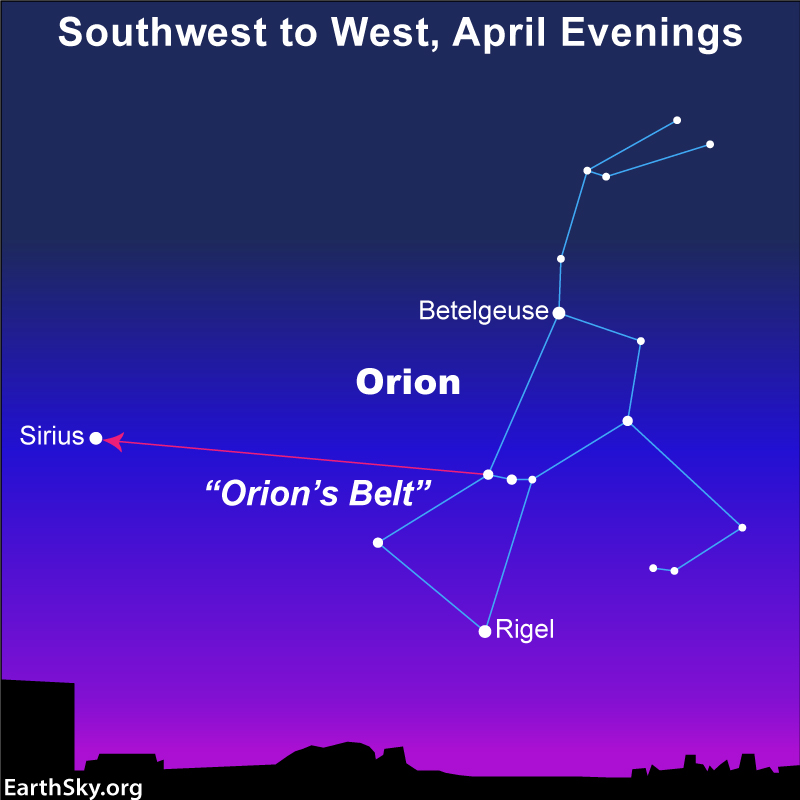
Star chart: constellation Orion, with a red line and arrow from Orion's belt to Sirius.
Star-hopping is the art of navigating around the sky using bright stars. On April evenings, you can look west after sunset to star-hop from the constellation Orion to Sirius. Chart via EarthSky.

You deserve a daily dose of good news. For the latest in science and the night sky, subscribe to EarthSky’s free daily newsletter.

Star-hop from Orion to Sirius

One very easy constellation to find at this time of the year is the magnificent Orion the Hunter, now descending in the west after sunset. It’s easy because Orion contains a very noticeable pattern of three medium-bright stars in a short straight row. These stars are known as Orion’s Belt. Find Orion, and continue the line of his belt to star-hop to Sirius. Found in the constellation Canis Major, this is the night sky’s brightest star!

As Earth revolves around the sun, both the constellation Orion and the star Sirius are about to disappear for a while. They always drop into the sun’s glare shortly after this time of the year, as Earth’s motion brings the sun between us and them. So be sure to look for them while you can, soon after the sun goes down. We’ll see them again in the east before dawn, beginning around late July or early August.

Try it for yourself

People learning to recognize the stars often use star-hopping – going from stars they know to objects that are fainter or less easily identifiable – to find and recognize new stars and constellations. The use of Orion’s Belt to find Sirius is one of the best-known star-hops in the sky, because the stars are so bright and the pattern is so definite.

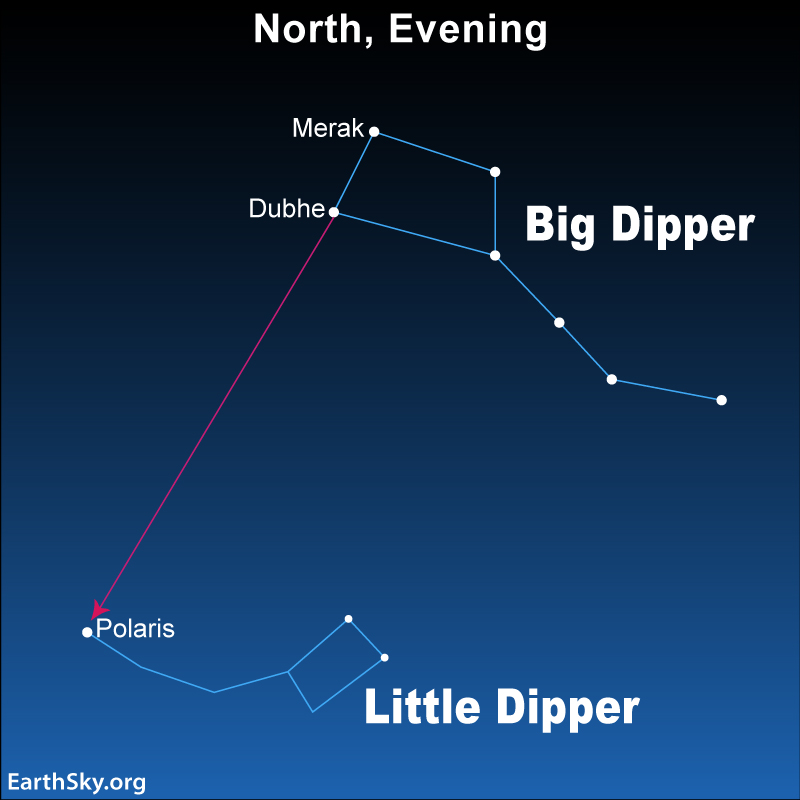
Another great star-hop to try is using the Big Dipper to find Polaris, the North Star. If you’re in the Northern Hemisphere, this star-hop will allow you to always find north!

The Big and Little Dipper with arrow showing how 2 stars from the Big Dipper point to Polaris.
Look for the Big and Little Dipper high in the northern sky on spring evenings. This view is for the Northern Hemisphere. The 2 outer stars in the bowl of the Dipper point to Polaris, the North Star. Polaris marks the end of the handle of the Little Dipper. Chart via EarthSky.
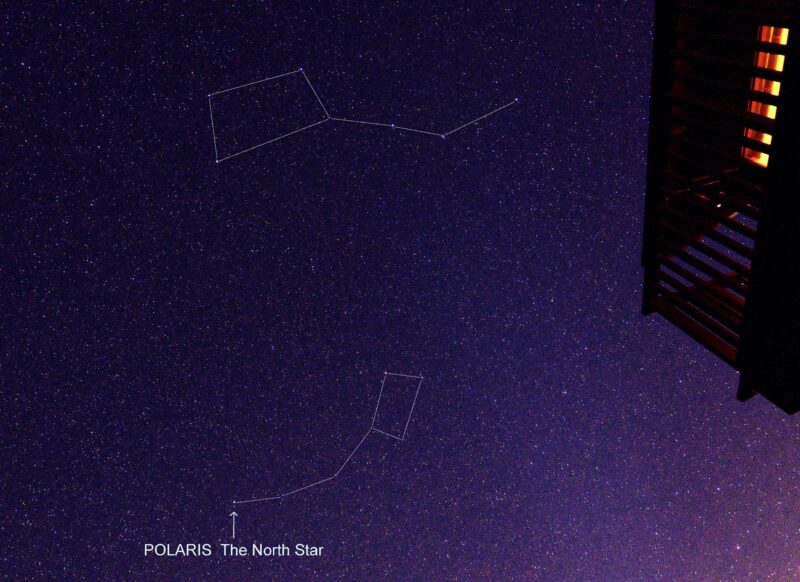
Sky photo: purple sky full of stars with 2 dipper-shaped figures and Polaris labeled.
View at EarthSky Community Photos. | Cecille Kennedy in Oregon shared this image with us on March 13, 2024. Cecille wrote: “Before midnight, pointing the camera straight up into the night sky, there is the Big Dipper and the Little Dipper. When you are looking at Polaris, you are facing north. While other constellations move around, Polaris stays still as it’s found at the north celestial pole. Thus Polaris is a very useful star for navigators and sailors. The 2 front stars in the asterism of the Big Dipper are called Pointers because they point to the North Star or Polaris.” Thank you, Cecille!

Bottom line: Star-hopping is going from stars you know to stars you don’t know. Star-hop from the constellation Orion the Hunter to Sirius, the night sky’s brightest star, before they’re gone!

EarthSky astronomy kits are perfect for beginners. Order today from the EarthSky store

Orion the Hunter, the most recognizable constellation

Is Sirius the most luminous star in the sky?

The post Star-hop from Orion to Sirius: See them before they go! first appeared on EarthSky.


from EarthSky https://ift.tt/BlNfpSH
Star chart: constellation Orion, with a red line and arrow from Orion's belt to Sirius.
Star-hopping is the art of navigating around the sky using bright stars. On April evenings, you can look west after sunset to star-hop from the constellation Orion to Sirius. Chart via EarthSky.

You deserve a daily dose of good news. For the latest in science and the night sky, subscribe to EarthSky’s free daily newsletter.

Star-hop from Orion to Sirius

One very easy constellation to find at this time of the year is the magnificent Orion the Hunter, now descending in the west after sunset. It’s easy because Orion contains a very noticeable pattern of three medium-bright stars in a short straight row. These stars are known as Orion’s Belt. Find Orion, and continue the line of his belt to star-hop to Sirius. Found in the constellation Canis Major, this is the night sky’s brightest star!

As Earth revolves around the sun, both the constellation Orion and the star Sirius are about to disappear for a while. They always drop into the sun’s glare shortly after this time of the year, as Earth’s motion brings the sun between us and them. So be sure to look for them while you can, soon after the sun goes down. We’ll see them again in the east before dawn, beginning around late July or early August.

Try it for yourself

People learning to recognize the stars often use star-hopping – going from stars they know to objects that are fainter or less easily identifiable – to find and recognize new stars and constellations. The use of Orion’s Belt to find Sirius is one of the best-known star-hops in the sky, because the stars are so bright and the pattern is so definite.

Another great star-hop to try is using the Big Dipper to find Polaris, the North Star. If you’re in the Northern Hemisphere, this star-hop will allow you to always find north!

The Big and Little Dipper with arrow showing how 2 stars from the Big Dipper point to Polaris.
Look for the Big and Little Dipper high in the northern sky on spring evenings. This view is for the Northern Hemisphere. The 2 outer stars in the bowl of the Dipper point to Polaris, the North Star. Polaris marks the end of the handle of the Little Dipper. Chart via EarthSky.
Sky photo: purple sky full of stars with 2 dipper-shaped figures and Polaris labeled.
View at EarthSky Community Photos. | Cecille Kennedy in Oregon shared this image with us on March 13, 2024. Cecille wrote: “Before midnight, pointing the camera straight up into the night sky, there is the Big Dipper and the Little Dipper. When you are looking at Polaris, you are facing north. While other constellations move around, Polaris stays still as it’s found at the north celestial pole. Thus Polaris is a very useful star for navigators and sailors. The 2 front stars in the asterism of the Big Dipper are called Pointers because they point to the North Star or Polaris.” Thank you, Cecille!

Bottom line: Star-hopping is going from stars you know to stars you don’t know. Star-hop from the constellation Orion the Hunter to Sirius, the night sky’s brightest star, before they’re gone!

EarthSky astronomy kits are perfect for beginners. Order today from the EarthSky store

Orion the Hunter, the most recognizable constellation

Is Sirius the most luminous star in the sky?

The post Star-hop from Orion to Sirius: See them before they go! first appeared on EarthSky.


from EarthSky https://ift.tt/BlNfpSH

Easter is April 5 and Orthodox Easter is April 12

Image shows a basket full of eggs painted with colorful designs.
View at EarthSky Community Photos. | Steve Price of Draper, Utah, posted this photo on March 30, 2024. Steve wrote: “These are some of the Ukrainian Pysanky Easter eggs I made. We display them each Easter season.” Thanks, Steve!

You deserve a daily dose of good news. For the latest in science and the night sky, subscribe to EarthSky’s free daily newsletter.

When is Easter in 2026?

Here’s the rule for Easter Sunday. It generally falls on the first Sunday after the first full moon on or after the vernal equinox.

And so Easter is a movable feast. Its date is different from year to year. The 2026 equinox was March 20. It marked an unofficial beginning of spring for the Northern Hemisphere and autumn for the Southern Hemisphere. The first full moon after the March equinox arrives overnight on April 1-2, 2026. Voilà! In 2026, Easter is April 5.

And then Eastern Orthodox Easter falls on April 12, 2026. Generally, that date is a little different because it follows the Julian calendar.

How is Easter determined?

The Council of Nicaea – first ecumenical council of the Christian church – established the date of Easter when it met in Turkey in the year 325 CE. By ecclesiastical rules set centuries ago, there are 35 dates on which Easter can take place.

The earliest possible date for Easter is March 22 and the latest possible date is April 25.

Easter can never come as early as March 21, though. That’s because, by ecclesiastical rules, the vernal equinox is fixed on March 21. That’s in spite of the fact that in the 21st century (2001 to 2100) every March equinox after the year 2007 will fall on March 19 or March 20.

The last time Easter fell on March 22 (earliest possible date) was in 1818, and the next time will be in 2285. The most recent time an Easter came in March was March 27, 2016.

Easter: Basket of eggs intricately painted in many bright colors.
Easter eggs from the Czech Republic. Image via svajcr/ Wikipedia.

More details and dates

The earliest Easter in the 21st century came in the year 2008 (March 23, 2008). Another March 23 Easter won’t come again until the year 2160.

The century’s latest Easter will occur in the year 2038 (April 25, 2038). After that, it will next fall on April 25 in the year 2190.

See dates of Easter from 1700 to 2299 at Thomas Larsen’s list.

One last detail. Most of us celebrate Easter Sunday via a combination of ecclesiastical rules set long ago and real events in our night sky. But these don’t always coincide. For example, an ecclesiastical full moon doesn’t usually happen on the same date as the full moon you see at night. Ecclesiastical full moons are formally fixed as the 14th day of the ecclesiastical lunar month.

So it’s possible for an ecclesiastical Easter and an astronomical Easter to occur on different dates, as well.

Table with columns for earliest dates of Easter in Gregorian and Julian calendars.
Visit timeanddate.com for more about the date of Easter. Chart via timeanddate.com. Used with permission.

Bottom line: How the date of Easter is determined, and some dates of earliest and latest Easters. Happy Easter to all who celebrate!

The post Easter is April 5 and Orthodox Easter is April 12 first appeared on EarthSky.


from EarthSky https://ift.tt/x4hZRCo
Image shows a basket full of eggs painted with colorful designs.
View at EarthSky Community Photos. | Steve Price of Draper, Utah, posted this photo on March 30, 2024. Steve wrote: “These are some of the Ukrainian Pysanky Easter eggs I made. We display them each Easter season.” Thanks, Steve!

You deserve a daily dose of good news. For the latest in science and the night sky, subscribe to EarthSky’s free daily newsletter.

When is Easter in 2026?

Here’s the rule for Easter Sunday. It generally falls on the first Sunday after the first full moon on or after the vernal equinox.

And so Easter is a movable feast. Its date is different from year to year. The 2026 equinox was March 20. It marked an unofficial beginning of spring for the Northern Hemisphere and autumn for the Southern Hemisphere. The first full moon after the March equinox arrives overnight on April 1-2, 2026. Voilà! In 2026, Easter is April 5.

And then Eastern Orthodox Easter falls on April 12, 2026. Generally, that date is a little different because it follows the Julian calendar.

How is Easter determined?

The Council of Nicaea – first ecumenical council of the Christian church – established the date of Easter when it met in Turkey in the year 325 CE. By ecclesiastical rules set centuries ago, there are 35 dates on which Easter can take place.

The earliest possible date for Easter is March 22 and the latest possible date is April 25.

Easter can never come as early as March 21, though. That’s because, by ecclesiastical rules, the vernal equinox is fixed on March 21. That’s in spite of the fact that in the 21st century (2001 to 2100) every March equinox after the year 2007 will fall on March 19 or March 20.

The last time Easter fell on March 22 (earliest possible date) was in 1818, and the next time will be in 2285. The most recent time an Easter came in March was March 27, 2016.

Easter: Basket of eggs intricately painted in many bright colors.
Easter eggs from the Czech Republic. Image via svajcr/ Wikipedia.

More details and dates

The earliest Easter in the 21st century came in the year 2008 (March 23, 2008). Another March 23 Easter won’t come again until the year 2160.

The century’s latest Easter will occur in the year 2038 (April 25, 2038). After that, it will next fall on April 25 in the year 2190.

See dates of Easter from 1700 to 2299 at Thomas Larsen’s list.

One last detail. Most of us celebrate Easter Sunday via a combination of ecclesiastical rules set long ago and real events in our night sky. But these don’t always coincide. For example, an ecclesiastical full moon doesn’t usually happen on the same date as the full moon you see at night. Ecclesiastical full moons are formally fixed as the 14th day of the ecclesiastical lunar month.

So it’s possible for an ecclesiastical Easter and an astronomical Easter to occur on different dates, as well.

Table with columns for earliest dates of Easter in Gregorian and Julian calendars.
Visit timeanddate.com for more about the date of Easter. Chart via timeanddate.com. Used with permission.

Bottom line: How the date of Easter is determined, and some dates of earliest and latest Easters. Happy Easter to all who celebrate!

The post Easter is April 5 and Orthodox Easter is April 12 first appeared on EarthSky.


from EarthSky https://ift.tt/x4hZRCo

A new platypus mystery … hollow hairs like bird feathers!


The strange platypus has unveiled another new quirk. Scientists in Belgium said that the structures inside its hair cells are hollow. Previously we only knew bird feathers to have this unique trait. Image via Charles J. Sharp/ Wikipedia (CC BY-SA 4.0).

You deserve a daily dose of good news. For the latest in science and the night sky, click here to subscribe to our free daily newsletter.

The platypus, one of the strangest animals on the planet, has surprised scientists once again. A team of researchers from Ghent University in Belgium has discovered that this egg-laying mammal from Australia has a microscopic feature in its hair never seen before in mammals. These structures inside platypus hairs are hollow, resembling those of bird feathers.

The findings, published on March 18, 2026, in the peer-reviewed journal Biology Letters, add yet another twist to the long list of traits that make the platypus so unique.

Platypus surprises never end

The platypus already looks like a mix of different animals. It has a bill like a duck, a tail like a beaver and a body like an otter. But its uniqueness goes far beyond its appearance. It’s a mammal, but it lays eggs instead of giving birth. Plus, it hunts by detecting electric signals produced by its prey’s muscles.

It also glows bluish-green under ultraviolet light, carries many more sex chromosomes than most mammals and shows unusual biological traits. Males are venomous, while females produce milk but do not have nipples.

Now, scientists have uncovered another surprising feature hidden deep inside its hair.


Read more about the strange platypus here and watch this video.

Platypus secret hidden in hair

Platypus hairs contains melanosomes. Melanosomes are tiny structures inside animal cells that store pigment. But the researchers found that platypus’ melanosomes are hollow. Until now, scientists had only seen hollow melanosomes in bird feathers, not in mammals. The researchers wrote in the paper:

Excitingly, over 200 years after its description as something in between birds and mammals, we find additional convergence between the platypus and birds.

To investigate further, the team analyzed hair from 10 platypuses using powerful microscopes. They also compared the results with other animals, including echidnas – the platypus’ closest living relatives – as well as marsupials like wombats and Tasmanian devils. None of these animals showed hollow melanosomes. This makes the platypus the only known mammal with this trait among the 126 species studied so far. Lead author Jessica Leigh Dobson told Science News:

I find it very, very unlikely that it wouldn’t have been found already.

Small, sleek brown animal with a large black duck bill emerging from a burrow.
Deep within the platypus’ hair lies a birdlike feature never before observed in any other mammal. Image via Rainbow606/ Wikimedia Commons (CC BY-SA 3.0).

A shape that breaks the rules

The discovery became even more puzzling when researchers looked at the shape of these structures. Platypus melanosomes are not only hollow, but also spherical. That’s a combination never seen before in vertebrates.

In birds, hollow melanosomes tend to be rod-like or flattened. Some mammals do have spherical melanosomes, but those are always solid. The platypus, once again, does things differently.

Close view of a platypus, with its big, black rubbery bill and small eyes.
Structures found in platypus hair possess a unique and unprecedented shape – different from their counterparts in other mammals and in birds – that challenge what scientists thought was possible in vertebrate biology. Image via Dr. Philip Bethge/ Wikimedia Commons (CC BY-SA 4.0).

A mystery scientists can’t explain

The team also studied the pigment inside the hair. They found mostly eumelanin, which produces brown and black tones. It also found possible traces of pheomelanin, responsible for red and yellow hues.

This result matches the animal’s dark coloration, but it creates a contradiction. Normally, spherical melanosomes link to pheomelanin, not eumelanin. Dobson told BBC Wildlife Magazine:

This doesn’t really conform with what we currently know about how melanosome shape correlates with color.

Platypuses vs birds: not the same shine

In birds, hollow melanosomes often create iridescence, a shimmering effect that produces shifting rainbow colors. However, platypus fur does not show this effect. Their coloration remains a simple brown.

Even more surprising, mammals that do show iridescence, such as golden moles and giant otter shrews, have solid melanosomes instead of hollow ones.

A platypus with flat legs, tail and beak underwater. It has long, sharp claws on its hind feet.
Although the hair contains birdlike hollow melanosomes, the platypus’ fur does not display the iridescent colors seen in birds, highlighting a striking difference between these animals. Image via Stefan Kraft/ Wikimedia Commons (CC BY-SA 3.0).

An unanswered question

For now, scientists still do not know why the platypus has hollow melanosomes. One idea suggests this feature could relate to its aquatic lifestyle. Possibly helping with insulation or another function unrelated to color. Tim Caro, an evolutionary ecologist at the University of Bristol in England, who was not involved with the research, told Science News:

My gut feeling is it’s nothing to do with color, it’s to do with some other lifestyle attribute.

But this raises another question. If this trait helps animals that live in water, why has it not appeared in other aquatic mammals? Dobson said at Agence France-Presse:

Further work is definitely needed to find out why they have them.

Brown animal gracefully swimming underwater, with a duck-like bill, flat beaver-like tail, sleek otter-like body.
The platypus continues to astonish scientists with its constantly emerging, unexpected traits that defy conventional understanding of mammals. Image via Rainbow606/ Wikimedia Commons (CC BY-SA 3.0).

The platypus and its unique place in nature

There is only one species of platypus, and it lives exclusively in Australia. Yet despite decades of research, this unusual animal continues to challenge what we thought we knew.

Each new discovery only deepens the mystery, confirming the platypus as one of nature’s most puzzling and fascinating creatures … a species scientists are still far from fully understanding.

Small duck-billed sleek-furred brown animal swimming on the surface of water, with a floating leaf nearby.
Exclusively found in Australia, the platypus remains a singular and fascinating creature whose unusual characteristics – including the mysterious hollow structures in its hair – continue to baffle scientists and raise more questions than answers about their function and role in the natural world. Image via Michael Jerrard/ Unsplash.

Bottom line: The platypus keeps amazing scientists: even its hair hides a strange secret that, until now, only birds were known to have.

Source: A unique hollow melanosome morphology in the hairs of the platypus Ornithorhynchus anatinus

Via Smithsonian Magazine

Read more:

Tasmanian devil population increases with breeding program

The gliding possum is a nocturnal acrobat of the forest

Australian lyrebirds have a hidden skill for farming

The post A new platypus mystery … hollow hairs like bird feathers! first appeared on EarthSky.


from EarthSky https://ift.tt/OqBDrRZ


The strange platypus has unveiled another new quirk. Scientists in Belgium said that the structures inside its hair cells are hollow. Previously we only knew bird feathers to have this unique trait. Image via Charles J. Sharp/ Wikipedia (CC BY-SA 4.0).

You deserve a daily dose of good news. For the latest in science and the night sky, click here to subscribe to our free daily newsletter.

The platypus, one of the strangest animals on the planet, has surprised scientists once again. A team of researchers from Ghent University in Belgium has discovered that this egg-laying mammal from Australia has a microscopic feature in its hair never seen before in mammals. These structures inside platypus hairs are hollow, resembling those of bird feathers.

The findings, published on March 18, 2026, in the peer-reviewed journal Biology Letters, add yet another twist to the long list of traits that make the platypus so unique.

Platypus surprises never end

The platypus already looks like a mix of different animals. It has a bill like a duck, a tail like a beaver and a body like an otter. But its uniqueness goes far beyond its appearance. It’s a mammal, but it lays eggs instead of giving birth. Plus, it hunts by detecting electric signals produced by its prey’s muscles.

It also glows bluish-green under ultraviolet light, carries many more sex chromosomes than most mammals and shows unusual biological traits. Males are venomous, while females produce milk but do not have nipples.

Now, scientists have uncovered another surprising feature hidden deep inside its hair.


Read more about the strange platypus here and watch this video.

Platypus secret hidden in hair

Platypus hairs contains melanosomes. Melanosomes are tiny structures inside animal cells that store pigment. But the researchers found that platypus’ melanosomes are hollow. Until now, scientists had only seen hollow melanosomes in bird feathers, not in mammals. The researchers wrote in the paper:

Excitingly, over 200 years after its description as something in between birds and mammals, we find additional convergence between the platypus and birds.

To investigate further, the team analyzed hair from 10 platypuses using powerful microscopes. They also compared the results with other animals, including echidnas – the platypus’ closest living relatives – as well as marsupials like wombats and Tasmanian devils. None of these animals showed hollow melanosomes. This makes the platypus the only known mammal with this trait among the 126 species studied so far. Lead author Jessica Leigh Dobson told Science News:

I find it very, very unlikely that it wouldn’t have been found already.

Small, sleek brown animal with a large black duck bill emerging from a burrow.
Deep within the platypus’ hair lies a birdlike feature never before observed in any other mammal. Image via Rainbow606/ Wikimedia Commons (CC BY-SA 3.0).

A shape that breaks the rules

The discovery became even more puzzling when researchers looked at the shape of these structures. Platypus melanosomes are not only hollow, but also spherical. That’s a combination never seen before in vertebrates.

In birds, hollow melanosomes tend to be rod-like or flattened. Some mammals do have spherical melanosomes, but those are always solid. The platypus, once again, does things differently.

Close view of a platypus, with its big, black rubbery bill and small eyes.
Structures found in platypus hair possess a unique and unprecedented shape – different from their counterparts in other mammals and in birds – that challenge what scientists thought was possible in vertebrate biology. Image via Dr. Philip Bethge/ Wikimedia Commons (CC BY-SA 4.0).

A mystery scientists can’t explain

The team also studied the pigment inside the hair. They found mostly eumelanin, which produces brown and black tones. It also found possible traces of pheomelanin, responsible for red and yellow hues.

This result matches the animal’s dark coloration, but it creates a contradiction. Normally, spherical melanosomes link to pheomelanin, not eumelanin. Dobson told BBC Wildlife Magazine:

This doesn’t really conform with what we currently know about how melanosome shape correlates with color.

Platypuses vs birds: not the same shine

In birds, hollow melanosomes often create iridescence, a shimmering effect that produces shifting rainbow colors. However, platypus fur does not show this effect. Their coloration remains a simple brown.

Even more surprising, mammals that do show iridescence, such as golden moles and giant otter shrews, have solid melanosomes instead of hollow ones.

A platypus with flat legs, tail and beak underwater. It has long, sharp claws on its hind feet.
Although the hair contains birdlike hollow melanosomes, the platypus’ fur does not display the iridescent colors seen in birds, highlighting a striking difference between these animals. Image via Stefan Kraft/ Wikimedia Commons (CC BY-SA 3.0).

An unanswered question

For now, scientists still do not know why the platypus has hollow melanosomes. One idea suggests this feature could relate to its aquatic lifestyle. Possibly helping with insulation or another function unrelated to color. Tim Caro, an evolutionary ecologist at the University of Bristol in England, who was not involved with the research, told Science News:

My gut feeling is it’s nothing to do with color, it’s to do with some other lifestyle attribute.

But this raises another question. If this trait helps animals that live in water, why has it not appeared in other aquatic mammals? Dobson said at Agence France-Presse:

Further work is definitely needed to find out why they have them.

Brown animal gracefully swimming underwater, with a duck-like bill, flat beaver-like tail, sleek otter-like body.
The platypus continues to astonish scientists with its constantly emerging, unexpected traits that defy conventional understanding of mammals. Image via Rainbow606/ Wikimedia Commons (CC BY-SA 3.0).

The platypus and its unique place in nature

There is only one species of platypus, and it lives exclusively in Australia. Yet despite decades of research, this unusual animal continues to challenge what we thought we knew.

Each new discovery only deepens the mystery, confirming the platypus as one of nature’s most puzzling and fascinating creatures … a species scientists are still far from fully understanding.

Small duck-billed sleek-furred brown animal swimming on the surface of water, with a floating leaf nearby.
Exclusively found in Australia, the platypus remains a singular and fascinating creature whose unusual characteristics – including the mysterious hollow structures in its hair – continue to baffle scientists and raise more questions than answers about their function and role in the natural world. Image via Michael Jerrard/ Unsplash.

Bottom line: The platypus keeps amazing scientists: even its hair hides a strange secret that, until now, only birds were known to have.

Source: A unique hollow melanosome morphology in the hairs of the platypus Ornithorhynchus anatinus

Via Smithsonian Magazine

Read more:

Tasmanian devil population increases with breeding program

The gliding possum is a nocturnal acrobat of the forest

Australian lyrebirds have a hidden skill for farming

The post A new platypus mystery … hollow hairs like bird feathers! first appeared on EarthSky.


from EarthSky https://ift.tt/OqBDrRZ

adds 2